Introduction
LeetCode 2657 – Find the Prefix Common Array of Two Arrays is an interesting prefix and hashing problem that tests your understanding of:
- Prefix processing
- Hashing
- Frequency counting
- Set operations
- Array traversal
At first glance, the problem may look confusing because of the term:
But once you understand the meaning of prefixes and common elements, the problem becomes straightforward.
This problem is useful for improving:
- Prefix-based thinking
- Hashing intuition
- Optimization skills
- Interview problem-solving ability
Problem Link
🔗 Find the prefix Common Array of Two Arrays
Problem Statement
You are given two permutations:
Both arrays contain numbers:
exactly once.
You need to create an array:
where:
represents:
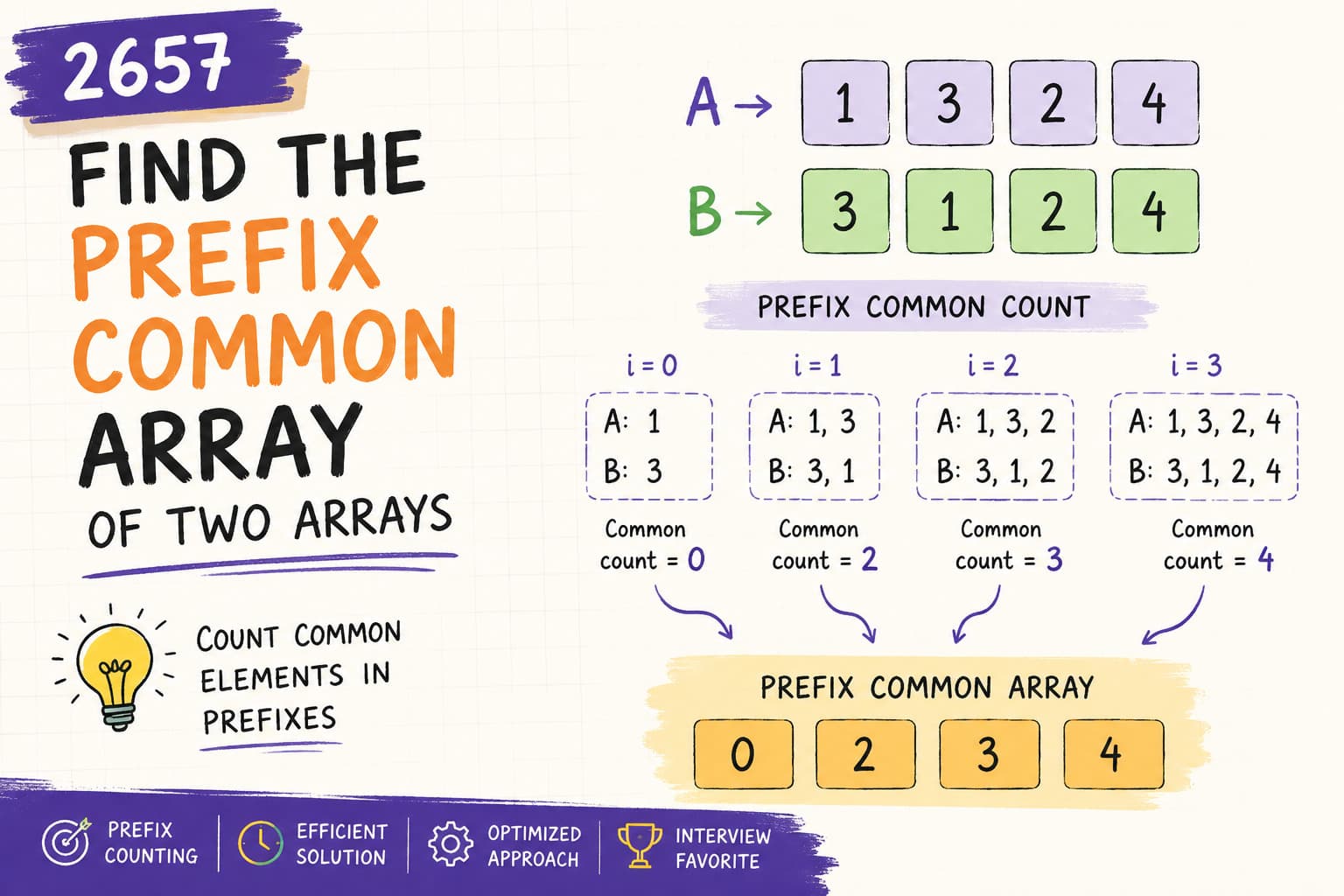
Count of numbers present in both arrays from index 0 to i.
Understanding Prefix Common Array
Suppose:
Prefix at Index 0
Common numbers:
So:
Prefix at Index 1
Common numbers:
So:
Final Output
Key Observation
Both arrays are permutations.
This means:
- Every number appears exactly once.
- Once a number appears in both prefixes, it remains common forever.
This simplifies the logic significantly.
Brute Force Approach
Intuition
For every index:
- Build prefixes
- Compare elements
- Count common numbers
Brute Force Algorithm
For each index:
- Traverse all previous elements
- Check whether numbers exist in both prefixes
- Count matches
Brute Force Complexity
Time Complexity
because for every index we may scan previous elements.
Space Complexity
Understanding Approach
This approach uses:
- HashMap
- Prefix tracking
- Counting common values
The idea is:
- Store prefix elements from B
- Traverse A prefix
- Count matching numbers
This works because prefixes gradually expand.
Java Solution
Better Optimized Approach
We can solve this more cleanly using:
or frequency counting.
Optimized Intuition
At every index:
- Add A[i]
- Add B[i]
- Track which numbers appeared
- If a number appears in both arrays, increase common count
Best Optimized Approach Using Frequency Array
Because values are from:
we can use a frequency array.
Optimized Java Solution
Why Does This Work?
Every number appears once in A and once in B.
So:
- First appearance → frequency becomes 1
- Second appearance → frequency becomes 2
When frequency becomes:
it means the number has appeared in both prefixes.
So we increase:
Dry Run
Input
Step 1
Index:
Add:
Frequencies:
No common elements.
Step 2
Add:
Frequencies:
Two common elements found.
Step 3
Add:
Frequency:
Common becomes:
Step 4
Add:
Frequency:
Common becomes:
Final Output
Time Complexity Analysis
Time Complexity
Nested traversal inside loop.
Space Complexity
Optimized Frequency Approach
Time Complexity
Single traversal.
Space Complexity
Frequency array.
HashMap vs Frequency Array
| Approach | Time Complexity | Space Complexity |
| HashMap | O(N²) | O(N) |
| Frequency Array | O(N) | O(N) |
Interview Explanation
In interviews, explain:
Since both arrays are permutations, every number appears exactly twice overall — once in A and once in B. Using frequency counting, whenever a number’s frequency becomes 2, it means it has appeared in both prefixes.
This demonstrates:
- Prefix understanding
- Optimization thinking
- Hashing skills
Common Mistakes
1. Recalculating Common Elements Every Time
This causes:
complexity.
2. Forgetting Arrays Are Permutations
This special condition allows frequency optimization.
3. Incorrect Prefix Logic
Remember:
FAQs
Q1. Why is this called Prefix Common Array?
Because:
stores common elements between prefixes ending at index:
Q2. Why does frequency 2 mean common?
Because every number appears once in each array.
Q3. Which approach is best?
Frequency array approach is the most optimized.
Q4. Is this problem important for interviews?
Yes.
It tests:
- Prefix logic
- Hashing
- Optimization
- Array traversal
Related Problems
After mastering this problem, practice:
- Intersection of Two Arrays
- Intersection of Two Arrays II
- Contains Duplicate
- Subarray Sum Equals K
- Prefix Sum
- Find the Difference of Two Arrays
Conclusion
LeetCode 2657 is an excellent prefix and hashing problem.
It teaches:
- Prefix processing
- Frequency counting
- Optimization techniques
- Hashing fundamentals
The key insight is:
A number becomes common exactly when its frequency becomes 2.
Once you understand this observation, the optimized solution becomes very simple and efficient.