LeetCode 3120: Count the Number of Special Characters I – Java HashSet Solution Explained
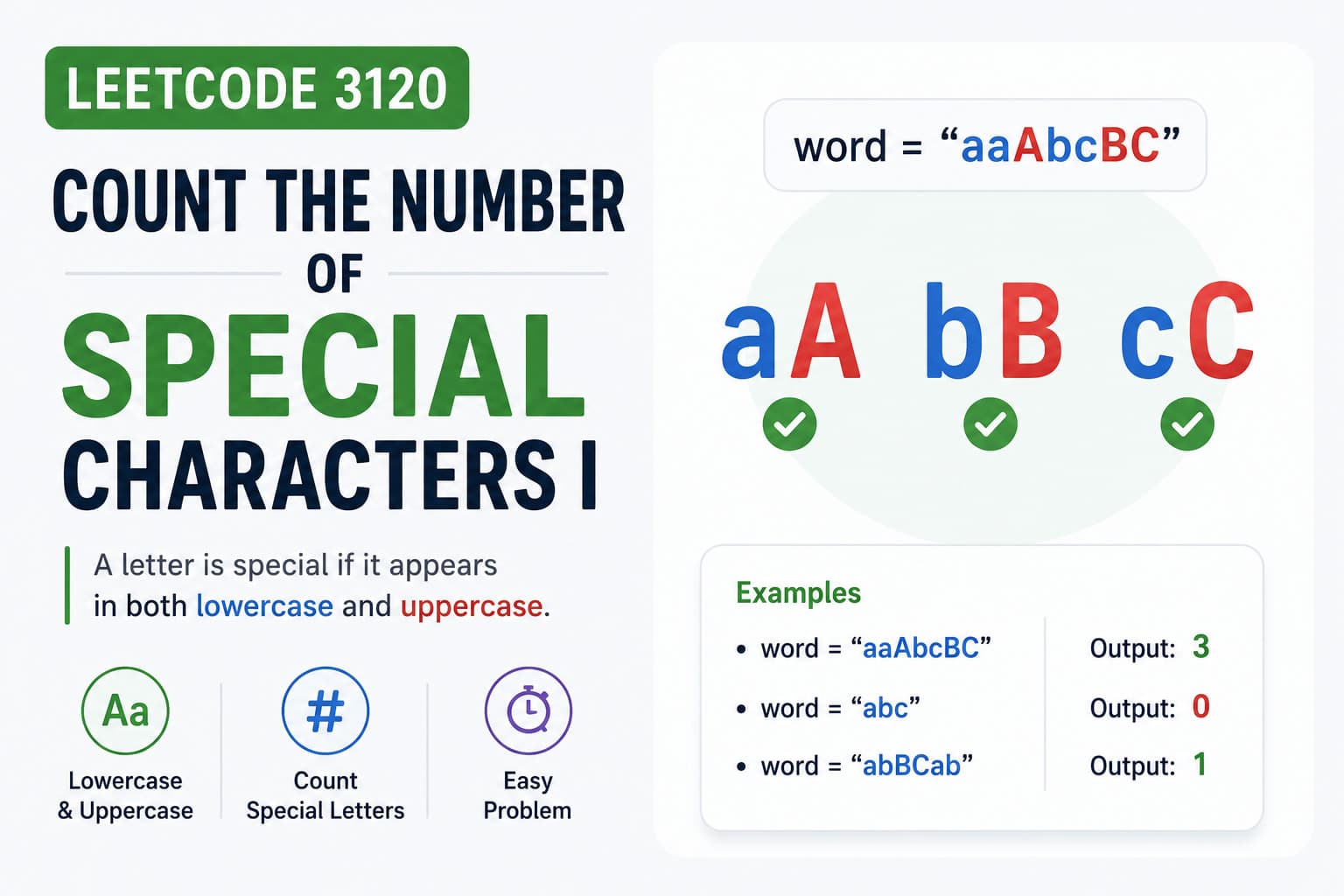
IntroductionLeetCode 3120 – Count the Number of Special Characters I is a beginner-friendly string and hashing problem.This problem focuses on:Character manipulationUppercase and lowercase conversionHashSet usageString traversalBasic optimization techniquesIt is a good interview problem for testing:Understanding of ASCII charactersJava Character methodsSet operationsProblem-solving logicProblem Link🔗 https://leetcode.com/problems/count-the-number-of-special-characters-i/Problem StatementYou are given a string:wordA character is called:specialif it appears in both:LowercaseUppercaseReturn:Total number of special charactersExample 1Inputword = "aaAbcBC"Output3ExplanationCharacters:'a' and 'A''b' and 'B''c' and 'C'All appear in both cases.So answer is:3Example 2Inputword = "abc"Output:0No uppercase letters exist.Example 3Inputword = "abBCab"Output:1Only:'b' and 'B'appear in both forms.IntuitionWe need to check:For every lowercase character:Does its uppercase version exist?Using HashSet makes lookup very fast.Brute Force ApproachIdeaFor every character:Traverse entire stringSearch for uppercase/lowercase pairCount valid matchesBrute Force ComplexityTime ComplexityO(N²)because nested traversal is required.Space ComplexityO(1)Optimized HashSet ApproachIdeaUse two sets:One for lowercase lettersOne for uppercase lettersThen check matching pairs.Java Solutionclass Solution {public int numberOfSpecialChars(String word) {HashSet<Character> lower = new HashSet<>();HashSet<Character> upper = new HashSet<>();for(int i = 0; i < word.length(); i++) {if(word.charAt(i) >= 'a' && word.charAt(i) <= 'z') {lower.add(word.charAt(i));}else {upper.add(word.charAt(i));}}int ans = 0;for(int i = 0; i < word.length(); i++) {char up = Character.toUpperCase(word.charAt(i));if(lower.contains(word.charAt(i)) && upper.contains(up)) {ans++;lower.remove(word.charAt(i));upper.remove(up);}}return ans;}}Cleaner Optimized Versionclass Solution {public int numberOfSpecialChars(String word) {HashSet<Character> lower = new HashSet<>();HashSet<Character> upper = new HashSet<>();for(char ch : word.toCharArray()) {if(Character.isLowerCase(ch)) {lower.add(ch);}else {upper.add(ch);}}int count = 0;for(char ch : lower) {if(upper.contains(Character.toUpperCase(ch))) {count++;}}return count;}}Why This WorksWe separate:Lowercase charactersUppercase charactersThen for every lowercase letter:We check whether uppercase version exists.HashSet lookup works in:O(1)average time.Dry RunInputword = "aaAbcBC"Step 1Lowercase set:[a, b, c]Uppercase set:[A, B, C]Step 2Check:'a' → 'A' exists'b' → 'B' exists'c' → 'C' existsCount becomes:3Final Answer3Time Complexity AnalysisOptimized HashSet SolutionTime ComplexityO(N)because string traversal happens only once.Space ComplexityO(1)Maximum alphabet size is fixed:26 lowercase + 26 uppercaseBrute Force vs OptimizedApproachTime ComplexitySpace ComplexityBrute ForceO(N²)O(1)HashSet ApproachO(N)O(1)Interview ExplanationIn interviews, explain:We use two HashSets to separately store lowercase and uppercase letters. Then we check whether a lowercase character has its uppercase counterpart.This demonstrates:Efficient lookup usageHashing knowledgeCharacter manipulation skillsCommon Mistakes1. Double Counting CharactersWithout removing counted characters:same letter may be counted multiple times2. Forgetting Case ConversionAlways convert:Character.toUpperCase(ch)before comparison.3. Using Nested Loops UnnecessarilyHashSet reduces lookup complexity significantly.FAQsQ1. Why use HashSet?Because lookup operations are very fast.Q2. Can this be solved without extra space?Yes.Using arrays of size 26 is also possible.Q3. Why remove characters after counting?To avoid duplicate counting.Q4. Is this problem important for interviews?Yes.It tests:String handlingCharacter conversionHashSet usageOptimization thinkingRelated ProblemsPractice these next:Valid AnagramFirst Unique Character in a StringRansom NoteConclusionLeetCode 3120 is a simple but effective problem for learning:HashSet operationsString traversalCase conversionEfficient lookup techniquesThe key idea is:Store lowercase and uppercase letters separately, then check matching pairs efficiently.Once this pattern becomes clear, many string hashing problems become much easier.