Search Blogs

Showing results for "Data Structure"

Found 36 results

Stack Data Structure in Java: The Complete In-Depth Guide

Stack Data Structure in Java: The Complete In-Depth Guide

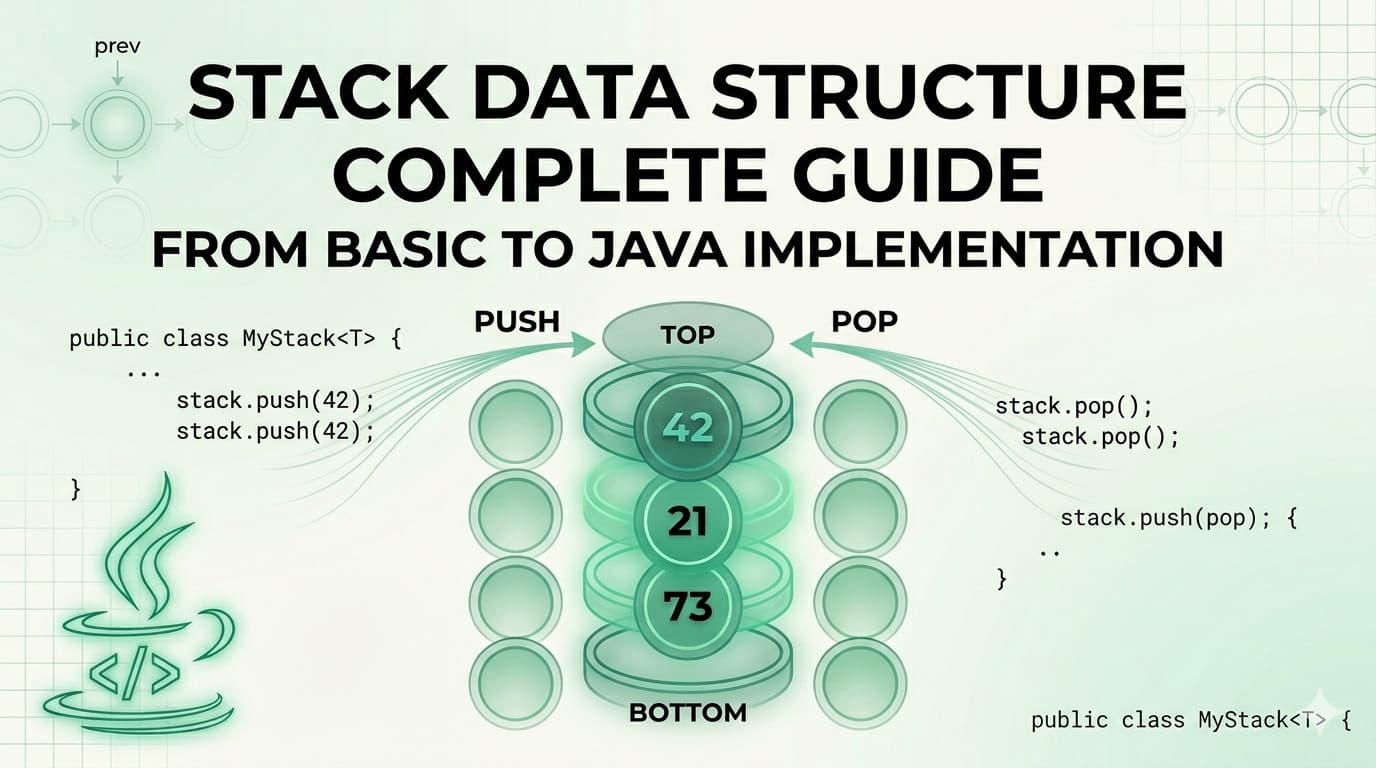
1. What Is a Stack?A Stack is a linear data structure that stores elements in a sequential order, but with one strict rule — you can only insert or remove elements from one end, called the top.It is one of the simplest yet most powerful data structures in computer science. Its strength comes from its constraint. Because everything happens at one end, the behavior of a stack is completely predictable.The formal definition: A Stack is a linear data structure that follows the Last In, First Out (LIFO) principle — the element inserted last is the first one to be removed.Here is what a stack looks like visually: ┌──────────┐ │ 50 │ ← TOP (last inserted, first removed) ├──────────┤ │ 40 │ ├──────────┤ │ 30 │ ├──────────┤ │ 20 │ ├──────────┤ │ 10 │ ← BOTTOM (first inserted, last removed) └──────────┘When you push 60 onto this stack, it goes on top. When you pop, 60 comes out first. That is LIFO.2. Real-World AnalogiesBefore writing a single line of code, it helps to see stacks in the real world. These analogies will make the concept permanently stick.A Pile of Plates In a cafeteria, clean plates are stacked on top of each other. You always pick the top plate. You always place a new plate on top. You never reach into the middle. This is a stack.Browser Back Button Every time you visit a new webpage, it gets pushed onto a history stack. When you press the Back button, the browser pops the most recent page off the stack and takes you there. The page you visited first is at the bottom — you only reach it after going back through everything else.Undo Feature in Text Editors When you type in a document and press Ctrl+Z, the most recent action is undone first. That is because every action you perform is pushed onto a stack. Undo simply pops from that stack.Call Stack in Programming When a function calls another function, the current function's state is pushed onto the call stack. When the inner function finishes, it is popped off and execution returns to the outer function. This is the literal stack your programs run on.A Stack of Books Put five books on a table, one on top of another. You can only take the top book without knocking the pile over. That is a stack.3. The LIFO Principle ExplainedLIFO stands for Last In, First Out.It means whatever you put in last is the first thing to come out. This is the exact opposite of a Queue (which is FIFO — First In, First Out).Let us trace through an example step by step:Start: Stack is empty → []Push 10 → [10] (10 is at the top)Push 20 → [10, 20] (20 is at the top)Push 30 → [10, 20, 30] (30 is at the top)Pop → returns 30 (30 was last in, first out) Stack: [10, 20]Pop → returns 20 Stack: [10]Peek → returns 10 (just looks, does not remove) Stack: [10]Pop → returns 10 Stack: [] (stack is now empty)Every single operation happens only at the top. The bottom of the stack is never directly accessible.4. Stack Operations & Time ComplexityA stack supports the following core operations:OperationDescriptionTime Complexitypush(x)Insert element x onto the top of the stackO(1)pop()Remove and return the top elementO(1)peek() / top()Return the top element without removing itO(1)isEmpty()Check if the stack has no elementsO(1)isFull()Check if the stack has reached its capacity (Array only)O(1)size()Return the number of elements in the stackO(1)search(x)Find position of element from top (Java built-in only)O(n)All primary stack operations — push, pop, peek, isEmpty — run in O(1) constant time. This is what makes the stack so efficient. It does not matter whether the stack has 10 elements or 10 million — these operations are always instant.Space complexity for a stack holding n elements is O(n).5. Implementation 1 — Using a Static ArrayThis is the most fundamental way to implement a stack. We use a fixed-size array and a variable called top to track where the top of the stack currently is.How it works:top starts at -1 (stack is empty)On push: increment top, then place the element at arr[top]On pop: return arr[top], then decrement topOn peek: return arr[top] without changing it// StackUsingArray.javapublic class StackUsingArray { private int[] arr; private int top; private int capacity; // Constructor — initialize with a fixed capacity public StackUsingArray(int capacity) { this.capacity = capacity; arr = new int[capacity]; top = -1; } // Push: add element to the top public void push(int value) { if (isFull()) { System.out.println("Stack Overflow! Cannot push " + value); return; } arr[++top] = value; System.out.println("Pushed: " + value); } // Pop: remove and return top element public int pop() { if (isEmpty()) { System.out.println("Stack Underflow! Stack is empty."); return -1; } return arr[top--]; } // Peek: view the top element without removing public int peek() { if (isEmpty()) { System.out.println("Stack is empty."); return -1; } return arr[top]; } // Check if stack is empty public boolean isEmpty() { return top == -1; } // Check if stack is full public boolean isFull() { return top == capacity - 1; } // Return current size public int size() { return top + 1; } // Display all elements public void display() { if (isEmpty()) { System.out.println("Stack is empty."); return; } System.out.print("Stack (top → bottom): "); for (int i = top; i >= 0; i--) { System.out.print(arr[i] + " "); } System.out.println(); } // Main method to test public static void main(String[] args) { StackUsingArray stack = new StackUsingArray(5); stack.push(10); stack.push(20); stack.push(30); stack.push(40); stack.push(50); stack.push(60); // This will trigger Stack Overflow stack.display(); System.out.println("Peek: " + stack.peek()); System.out.println("Pop: " + stack.pop()); System.out.println("Pop: " + stack.pop()); stack.display(); System.out.println("Size: " + stack.size()); }}```**Output:**```Pushed: 10Pushed: 20Pushed: 30Pushed: 40Pushed: 50Stack Overflow! Cannot push 60Stack (top → bottom): 50 40 30 20 10Peek: 50Pop: 50Pop: 40Stack (top → bottom): 30 20 10Size: 3Key Points about Array Implementation:Fixed size — you must declare capacity upfrontVery fast — direct array index accessStack Overflow is possible if capacity is exceededMemory is pre-allocated even if stack is not full6. Implementation 2 — Using an ArrayListAn ArrayList-based stack removes the fixed-size limitation. The ArrayList grows dynamically, so you never have to worry about stack overflow due to capacity.How it works:The end of the ArrayList acts as the topadd() is used for pushremove(size - 1) is used for popget(size - 1) is used for peek// StackUsingArrayList.javaimport java.util.ArrayList;public class StackUsingArrayList { private ArrayList<Integer> list; // Constructor public StackUsingArrayList() { list = new ArrayList<>(); } // Push: add to the end (which is our top) public void push(int value) { list.add(value); System.out.println("Pushed: " + value); } // Pop: remove and return the last element public int pop() { if (isEmpty()) { System.out.println("Stack Underflow! Stack is empty."); return -1; } int top = list.get(list.size() - 1); list.remove(list.size() - 1); return top; } // Peek: view the last element public int peek() { if (isEmpty()) { System.out.println("Stack is empty."); return -1; } return list.get(list.size() - 1); } // Check if stack is empty public boolean isEmpty() { return list.isEmpty(); } // Return size public int size() { return list.size(); } // Display elements from top to bottom public void display() { if (isEmpty()) { System.out.println("Stack is empty."); return; } System.out.print("Stack (top → bottom): "); for (int i = list.size() - 1; i >= 0; i--) { System.out.print(list.get(i) + " "); } System.out.println(); } // Main method to test public static void main(String[] args) { StackUsingArrayList stack = new StackUsingArrayList(); stack.push(5); stack.push(15); stack.push(25); stack.push(35); stack.display(); System.out.println("Peek: " + stack.peek()); System.out.println("Pop: " + stack.pop()); System.out.println("Pop: " + stack.pop()); stack.display(); System.out.println("Is Empty: " + stack.isEmpty()); System.out.println("Size: " + stack.size()); }}```**Output:**```Pushed: 5Pushed: 15Pushed: 25Pushed: 35Stack (top → bottom): 35 25 15 5Peek: 35Pop: 35Pop: 25Stack (top → bottom): 15 5Is Empty: falseSize: 2Key Points about ArrayList Implementation:Dynamic size — grows automatically as neededNo overflow riskSlight overhead compared to raw array due to ArrayList internalsExcellent for most practical use cases7. Implementation 3 — Using a LinkedListA LinkedList-based stack is the most memory-efficient approach when you do not know the stack size in advance. Each element (node) holds data and a pointer to the next node. The head of the LinkedList acts as the top of the stack.How it works:Each node stores a value and a reference to the node below itPush creates a new node and makes it the new headPop removes the head node and returns its valuePeek returns the head node's value without removing it// StackUsingLinkedList.javapublic class StackUsingLinkedList { // Inner Node class private static class Node { int data; Node next; Node(int data) { this.data = data; this.next = null; } } private Node top; // Head of the linked list = top of stack private int size; // Constructor public StackUsingLinkedList() { top = null; size = 0; } // Push: create new node and link it to top public void push(int value) { Node newNode = new Node(value); newNode.next = top; // new node points to current top top = newNode; // new node becomes the new top size++; System.out.println("Pushed: " + value); } // Pop: remove and return top node's data public int pop() { if (isEmpty()) { System.out.println("Stack Underflow! Stack is empty."); return -1; } int value = top.data; top = top.next; // move top pointer to next node size--; return value; } // Peek: return top node's data without removing public int peek() { if (isEmpty()) { System.out.println("Stack is empty."); return -1; } return top.data; } // Check if empty public boolean isEmpty() { return top == null; } // Return size public int size() { return size; } // Display elements from top to bottom public void display() { if (isEmpty()) { System.out.println("Stack is empty."); return; } System.out.print("Stack (top → bottom): "); Node current = top; while (current != null) { System.out.print(current.data + " "); current = current.next; } System.out.println(); } // Main method to test public static void main(String[] args) { StackUsingLinkedList stack = new StackUsingLinkedList(); stack.push(100); stack.push(200); stack.push(300); stack.push(400); stack.display(); System.out.println("Peek: " + stack.peek()); System.out.println("Pop: " + stack.pop()); System.out.println("Pop: " + stack.pop()); stack.display(); System.out.println("Size: " + stack.size()); }}```**Output:**```Pushed: 100Pushed: 200Pushed: 300Pushed: 400Stack (top → bottom): 400 300 200 100Peek: 400Pop: 400Pop: 300Stack (top → bottom): 200 100Size: 2Key Points about LinkedList Implementation:Truly dynamic — each node allocated only when neededNo wasted memory from pre-allocationSlightly more memory per element (each node carries a pointer)Ideal for stacks where size is completely unknown8. Java's Built-in Stack ClassJava provides a ready-made Stack class inside java.util. It extends Vector and is thread-safe by default.// JavaBuiltinStack.javaimport java.util.Stack;public class JavaBuiltinStack { public static void main(String[] args) { Stack<Integer> stack = new Stack<>(); // Push elements stack.push(10); stack.push(20); stack.push(30); stack.push(40); System.out.println("Stack: " + stack); // Peek — look at top without removing System.out.println("Peek: " + stack.peek()); // Pop — remove top System.out.println("Pop: " + stack.pop()); System.out.println("After pop: " + stack); // Search — returns 1-based position from top System.out.println("Search 20: position " + stack.search(20)); // isEmpty System.out.println("Is Empty: " + stack.isEmpty()); // Size System.out.println("Size: " + stack.size()); }}```**Output:**```Stack: [10, 20, 30, 40]Peek: 40Pop: 40After pop: [10, 20, 30]Search 20: position 2Is Empty: falseSize: 3Important Note: In modern Java development, it is often recommended to use Deque (specifically ArrayDeque) instead of Stack for better performance, since Stack is synchronized and carries the overhead of Vector.// Using ArrayDeque as a stack (modern preferred approach)import java.util.ArrayDeque;import java.util.Deque;public class ModernStack { public static void main(String[] args) { Deque<Integer> stack = new ArrayDeque<>(); stack.push(10); // pushes to front stack.push(20); stack.push(30); System.out.println("Top: " + stack.peek()); System.out.println("Pop: " + stack.pop()); System.out.println("Stack: " + stack); }}9. Comparison of All ImplementationsFeatureArrayArrayListLinkedListJava StackArrayDequeSizeFixedDynamicDynamicDynamicDynamicStack Overflow RiskYesNoNoNoNoMemory UsagePre-allocatedAuto-growsPer-node overheadAuto-growsAuto-growsPush TimeO(1)O(1) amortizedO(1)O(1)O(1)Pop TimeO(1)O(1)O(1)O(1)O(1)Peek TimeO(1)O(1)O(1)O(1)O(1)Thread SafeNoNoNoYesNoBest ForKnown size, max speedGeneral useUnknown/huge sizeLegacy codeModern Java10. Advantages & DisadvantagesAdvantagesAdvantageExplanationSimple to implementVery few rules and operations to worry aboutO(1) operationsPush, pop, and peek are all constant timeMemory efficientNo extra pointers needed (array-based)Supports recursionThe call stack is itself a stackEasy undo/redoNatural fit for reversible action trackingBacktrackingPerfectly suited for maze, puzzle, and game solvingExpression evaluationPowers compilers and calculatorsDisadvantagesDisadvantageExplanationLimited accessCannot access elements in the middle directlyFixed size (array)Array-based stacks overflow if size is exceededNo random accessYou cannot do stack[2] — only top is accessibleMemory waste (array)Pre-allocated array wastes space if underusedNot suitable for all problemsMany problems need queues, trees, or graphs insteadStack overflow in recursionVery deep recursion can overflow the JVM call stack11. Real-World Use Cases of StackUnderstanding when to use a stack is just as important as knowing how to implement one. Here is where stacks show up in real software:Function Call Management (Call Stack) Every time your Java program calls a method, the JVM pushes that method's frame onto the call stack. When the method returns, the frame is popped. This is why you see "StackOverflowError" when you write infinite recursion.Undo and Redo Operations Text editors, image editors (Photoshop), and IDEs use two stacks — one for undo history and one for redo history. Every action pushes onto the undo stack. Ctrl+Z pops from it and pushes to the redo stack.Browser Navigation Your browser maintains a back-stack and a forward-stack. Visiting a new page pushes to the back-stack. Pressing Back pops from it and pushes to the forward-stack.Expression Evaluation and Conversion Compilers use stacks to evaluate arithmetic expressions and convert between infix, prefix, and postfix notations. For example: 3 + 4 * 2 must be evaluated considering operator precedence — this is done with a stack.Balanced Parentheses Checking Linters, compilers, and IDEs use stacks to check if brackets are balanced: {[()]} is valid, {[(])} is not.Backtracking Algorithms Maze solving, N-Queens, Sudoku solvers, and depth-first search all use stacks (explicitly or via recursion) to backtrack to previous states when a path fails.Syntax Parsing Compilers parse source code using stacks to match opening and closing constructs like if/else, try/catch, { and }.12. Practice Problems with Full SolutionsHere is where things get really interesting. These problems will sharpen your stack intuition and prepare you for coding interviews.Problem 1 — Reverse a String Using a StackDifficulty: EasyProblem: Write a Java program to reverse a string using a Stack.Approach: Push every character of the string onto a stack, then pop them all. Since LIFO reverses the order, the characters come out reversed.// ReverseString.javaimport java.util.Stack;public class ReverseString { public static String reverse(String str) { Stack<Character> stack = new Stack<>(); // Push all characters for (char c : str.toCharArray()) { stack.push(c); } // Pop all characters to build reversed string StringBuilder reversed = new StringBuilder(); while (!stack.isEmpty()) { reversed.append(stack.pop()); } return reversed.toString(); } public static void main(String[] args) { System.out.println(reverse("hello")); // olleh System.out.println(reverse("java")); // avaj System.out.println(reverse("racecar")); // racecar (palindrome) System.out.println(reverse("datastructure")); // erutcurtasatad }}Problem 2 — Check Balanced ParenthesesDifficulty: Easy–MediumProblem: Given a string containing (, ), {, }, [, ], determine if the brackets are balanced.Approach: Push every opening bracket onto the stack. When you see a closing bracket, check if it matches the top of the stack. If it does, pop. If it does not, the string is unbalanced.// BalancedParentheses.javaimport java.util.Stack;public class BalancedParentheses { public static boolean isBalanced(String expr) { Stack<Character> stack = new Stack<>(); for (char c : expr.toCharArray()) { // Push all opening brackets if (c == '(' || c == '{' || c == '[') { stack.push(c); } // For closing brackets, check the top of stack else if (c == ')' || c == '}' || c == ']') { if (stack.isEmpty()) return false; char top = stack.pop(); if (c == ')' && top != '(') return false; if (c == '}' && top != '{') return false; if (c == ']' && top != '[') return false; } } // Stack must be empty at the end for a balanced expression return stack.isEmpty(); } public static void main(String[] args) { System.out.println(isBalanced("{[()]}")); // true System.out.println(isBalanced("{[(])}")); // false System.out.println(isBalanced("((()))")); // true System.out.println(isBalanced("{]")); // false System.out.println(isBalanced("")); // true (empty is balanced) }}Problem 3 — Reverse a Stack (Without Extra Data Structure)Difficulty: Medium–HardProblem: Reverse all elements of a stack using only recursion — no array or extra stack allowed.Approach: This is a classic recursion problem. You need two recursive functions:insertAtBottom(stack, item) — inserts an element at the very bottom of the stackreverseStack(stack) — pops all elements, reverses, and uses insertAtBottom to rebuild// ReverseStack.javaimport java.util.Stack;public class ReverseStack { // Insert an element at the bottom of the stack public static void insertAtBottom(Stack<Integer> stack, int item) { if (stack.isEmpty()) { stack.push(item); return; } int top = stack.pop(); insertAtBottom(stack, item); stack.push(top); } // Reverse the stack using insertAtBottom public static void reverseStack(Stack<Integer> stack) { if (stack.isEmpty()) return; int top = stack.pop(); reverseStack(stack); // reverse the remaining stack insertAtBottom(stack, top); // insert popped element at bottom } public static void main(String[] args) { Stack<Integer> stack = new Stack<>(); stack.push(1); stack.push(2); stack.push(3); stack.push(4); stack.push(5); System.out.println("Before: " + stack); // [1, 2, 3, 4, 5] reverseStack(stack); System.out.println("After: " + stack); // [5, 4, 3, 2, 1] }}Problem 4 — Evaluate a Postfix ExpressionDifficulty: MediumProblem: Evaluate a postfix (Reverse Polish Notation) expression. Example: "2 3 4 * +" should return 14 because it is 2 + (3 * 4).Approach: Scan left to right. If you see a number, push it. If you see an operator, pop two numbers, apply the operator, and push the result.// PostfixEvaluation.javaimport java.util.Stack;public class PostfixEvaluation { public static int evaluate(String expression) { Stack<Integer> stack = new Stack<>(); String[] tokens = expression.split(" "); for (String token : tokens) { // If it's a number, push it if (token.matches("-?\\d+")) { stack.push(Integer.parseInt(token)); } // If it's an operator, pop two and apply else { int b = stack.pop(); // second operand int a = stack.pop(); // first operand switch (token) { case "+": stack.push(a + b); break; case "-": stack.push(a - b); break; case "*": stack.push(a * b); break; case "/": stack.push(a / b); break; } } } return stack.pop(); } public static void main(String[] args) { System.out.println(evaluate("2 3 4 * +")); // 14 → 2 + (3*4) System.out.println(evaluate("5 1 2 + 4 * + 3 -")); // 14 → 5+((1+2)*4)-3 System.out.println(evaluate("3 4 +")); // 7 }}Problem 5 — Next Greater ElementDifficulty: MediumProblem: For each element in an array, find the next greater element to its right. If none exists, output -1.Example: Input: [4, 5, 2, 10, 8] → Output: [5, 10, 10, -1, -1]Approach: Iterate right to left. Maintain a stack of candidates. For each element, pop all stack elements that are smaller than or equal to it — they can never be the answer for any element to the left. The top of the stack (if not empty) is the next greater element.// NextGreaterElement.javaimport java.util.Stack;import java.util.Arrays;public class NextGreaterElement { public static int[] nextGreater(int[] arr) { int n = arr.length; int[] result = new int[n]; Stack<Integer> stack = new Stack<>(); // stores elements, not indices // Traverse from right to left for (int i = n - 1; i >= 0; i--) { // Pop elements smaller than or equal to current while (!stack.isEmpty() && stack.peek() <= arr[i]) { stack.pop(); } // Next greater element result[i] = stack.isEmpty() ? -1 : stack.peek(); // Push current element for future comparisons stack.push(arr[i]); } return result; } public static void main(String[] args) { int[] arr1 = {4, 5, 2, 10, 8}; System.out.println(Arrays.toString(nextGreater(arr1))); // [5, 10, 10, -1, -1] int[] arr2 = {1, 3, 2, 4}; System.out.println(Arrays.toString(nextGreater(arr2))); // [3, 4, 4, -1] int[] arr3 = {5, 4, 3, 2, 1}; System.out.println(Arrays.toString(nextGreater(arr3))); // [-1, -1, -1, -1, -1] }}Problem 6 — Sort a Stack Using RecursionDifficulty: HardProblem: Sort a stack in ascending order (smallest on top) using only recursion — no loops, no extra data structure.// SortStack.javaimport java.util.Stack;public class SortStack { // Insert element in correct sorted position public static void sortedInsert(Stack<Integer> stack, int item) { if (stack.isEmpty() || item > stack.peek()) { stack.push(item); return; } int top = stack.pop(); sortedInsert(stack, item); stack.push(top); } // Sort the stack public static void sortStack(Stack<Integer> stack) { if (stack.isEmpty()) return; int top = stack.pop(); sortStack(stack); // sort remaining sortedInsert(stack, top); // insert top in sorted position } public static void main(String[] args) { Stack<Integer> stack = new Stack<>(); stack.push(34); stack.push(3); stack.push(31); stack.push(98); stack.push(92); stack.push(23); System.out.println("Before sort: " + stack); sortStack(stack); System.out.println("After sort: " + stack); // smallest on top }}13. Summary & Key TakeawaysA stack is a simple, elegant, and powerful data structure. Here is everything in one place:What it is: A linear data structure that follows LIFO — Last In, First Out.Core operations: push (add to top), pop (remove from top), peek (view top), isEmpty — all in O(1) time.Three ways to implement it in Java:Array-based: fast, fixed size, risk of overflowArrayList-based: dynamic, easy, slightly more overheadLinkedList-based: truly dynamic, memory-efficient per-element, best for unknown sizesWhen to use it:Undo/redo systemsBrowser navigationBalancing brackets and parenthesesEvaluating mathematical expressionsBacktracking problemsManaging recursive function callsDepth-first searchWhen NOT to use it:When you need random access to elementsWhen insertion/deletion is needed from both ends (use Deque)When you need to search efficiently (use HashMap or BST)Modern Java recommendation: Prefer ArrayDeque over the legacy Stack class for non-thread-safe scenarios. Use Stack only when you need synchronized access.The stack is one of those data structures that once you truly understand, you start seeing it everywhere — in your browser, in your IDE, in recursive algorithms, and deep within the operating system itself.This article covered everything from the fundamentals of the Stack data structure to multiple Java implementations, time complexity analysis, real-world applications, and six practice problems of increasing difficulty. Bookmark it as a reference and revisit the practice problems regularly — they are the real test of your understanding.
DataStructuresJavaStackDataStructureLIFO
Queue Data Structure Complete Guide - Java Explained With All Operations

Queue Data Structure Complete Guide - Java Explained With All Operations

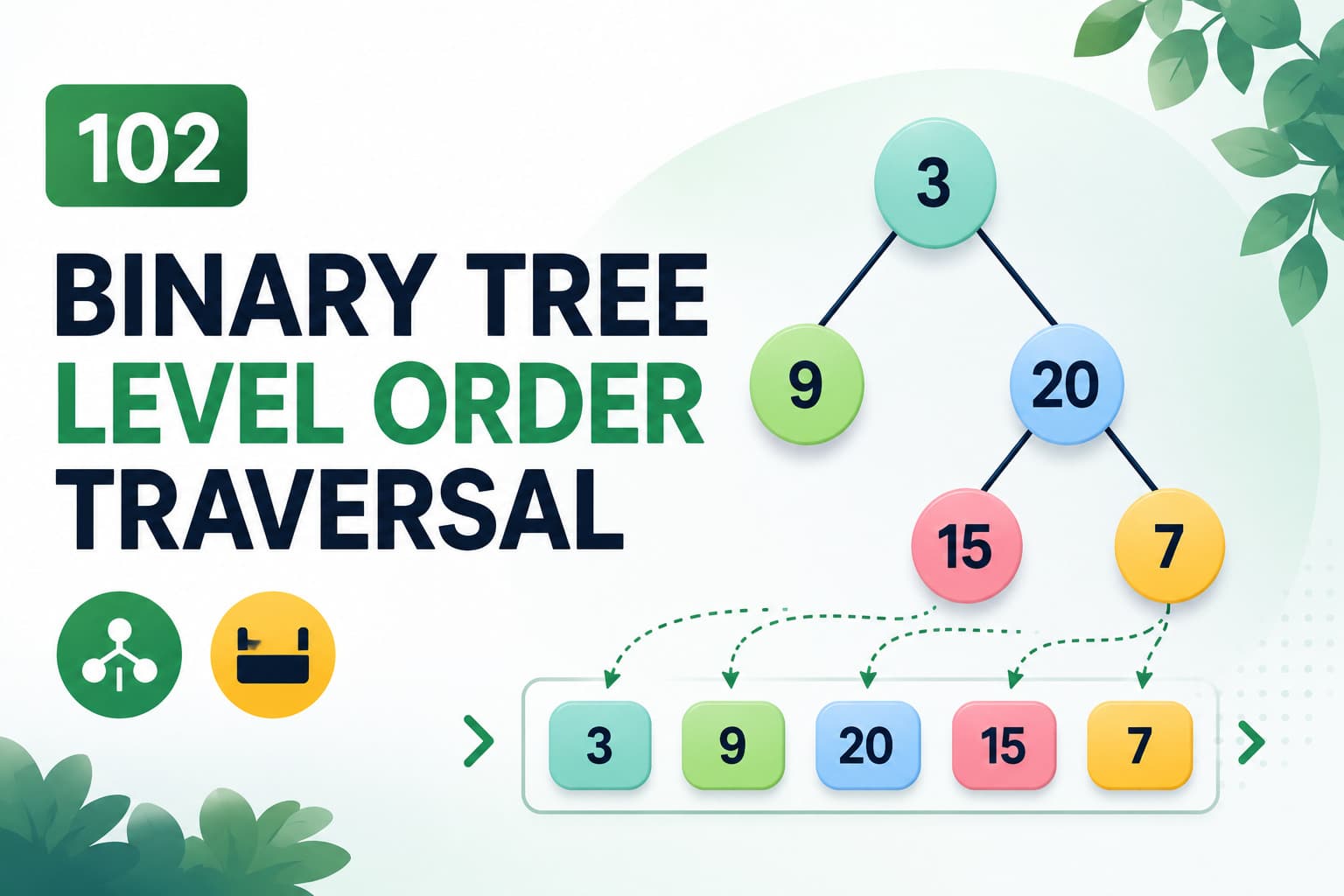
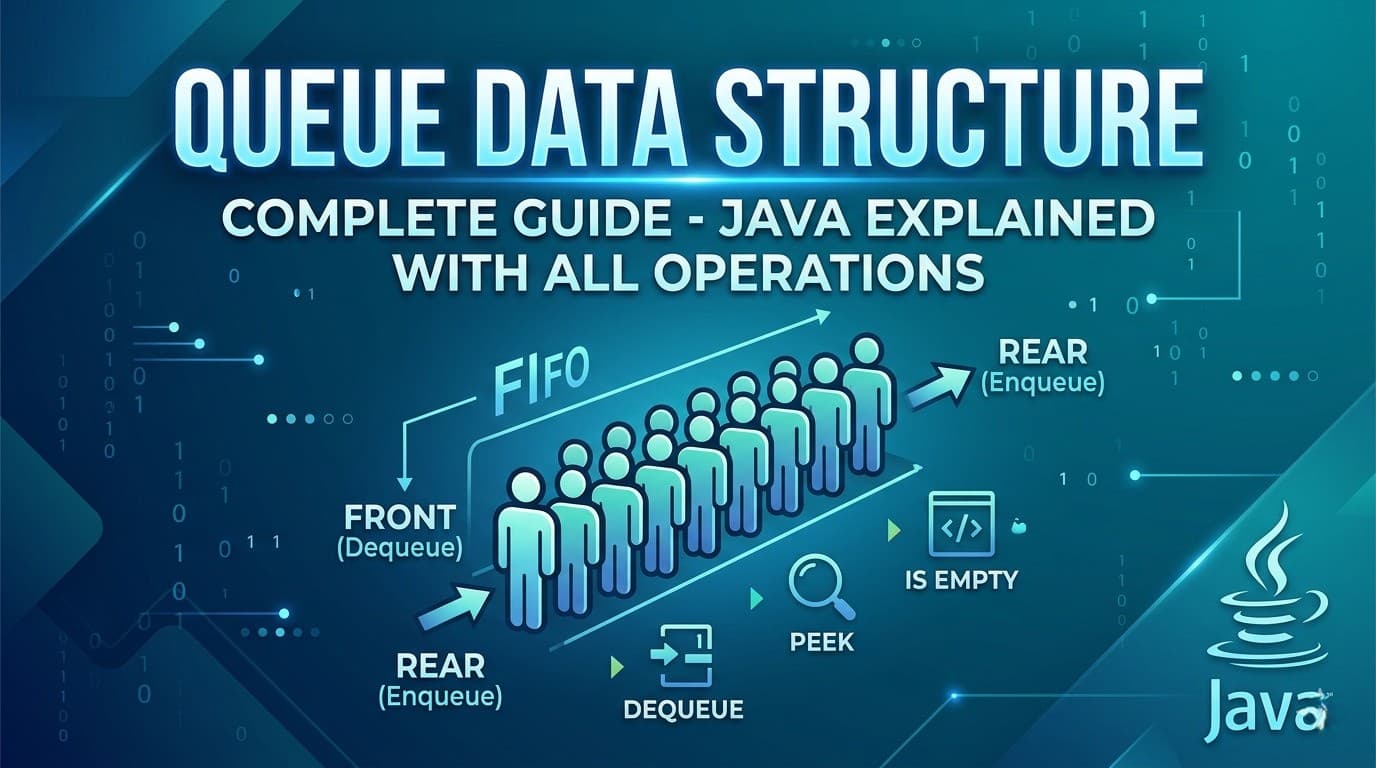
IntroductionIf you have been learning Data Structures and Algorithms, you have probably already spent time with arrays, linked lists, and stacks. Now it is time to meet one of the most important and widely used data structures in computer science — the Queue.Queue is not just a theoretical concept. It powers some of the most critical systems you use every day — from how your printer handles jobs, to how your CPU schedules tasks, to how Google Maps finds the shortest path between two locations. Understanding Queue deeply means understanding how real systems work.In this complete guide we will cover absolutely everything — what a Queue is, how it differs from a Stack, every type of Queue, all operations with code, Java implementations, time and space complexity, common interview questions, and the most important LeetCode problems that use Queue.What Is a Queue?A Queue is a linear data structure that follows the FIFO principle — First In First Out. This means the element that was added first is the one that gets removed first.Think of it exactly like a real-world queue (a line of people). The person who joined the line first gets served first. No cutting in line, no serving from the back — strict order from front to back.This is the fundamental difference between a Queue and a Stack:Stack → LIFO (Last In First Out) — like a stack of plates, you take from the topQueue → FIFO (First In First Out) — like a line of people, you serve from the frontReal Life Examples of QueueBefore writing a single line of code, let us understand where queues appear in real life. This will make every technical concept feel natural.Printer Queue — when you send multiple documents to print, they print in the order they were sent. The first document sent prints first.CPU Task Scheduling — your operating system manages running processes in a queue. Tasks get CPU time in the order they arrive (in basic scheduling).Customer Service Call Center — when you call a helpline and are put on hold, you are placed in a queue. The first caller on hold gets connected first.WhatsApp Messages — messages are delivered in the order they are sent. The first message sent is the first one received.BFS (Breadth First Search) — every time you use Google Maps or any navigation app to find the shortest path, it uses BFS internally which is entirely powered by a Queue.Ticket Booking Systems — online booking portals process requests in the order they arrive. First come first served.Queue Terminology — Key Terms You Must KnowBefore diving into code, let us get the vocabulary right:Front — the end from which elements are removed (dequeued). This is where the "first person in line" stands.Rear (or Back) — the end at which elements are added (enqueued). New arrivals join here.Enqueue — the operation of adding an element to the rear of the queue. Like joining the back of a line.Dequeue — the operation of removing an element from the front of the queue. Like the first person in line being served and leaving.Peek (or Front) — looking at the front element without removing it. Like seeing who is first in line without serving them yet.isEmpty — checking whether the queue has no elements.isFull — relevant for fixed-size queues, checking whether no more elements can be added.Types of QueuesThis is where most beginners get confused. There is not just one type of Queue — there are several variations each designed to solve specific problems.1. Simple Queue (Linear Queue)The most basic form. Elements enter from the rear and leave from the front. Strict FIFO, nothing fancy.Enqueue → [ 1 | 2 | 3 | 4 | 5 ] → Dequeue rear frontProblem with Simple Queue: In array-based implementation, once elements are dequeued from the front, those slots cannot be reused even if there is space. This wastes memory. This is why Circular Queue was invented.2. Circular QueueIn a Circular Queue, the rear wraps around to the front when it reaches the end of the array. The last position connects back to the first, forming a circle. This solves the wasted space problem of simple queues. [1] [2] [3] / \ [6] [4] \ / [5] ← rearUsed in: CPU scheduling, memory management, traffic light systems, streaming buffers.3. Double Ended Queue (Deque)A Deque (pronounced "deck") allows insertion and deletion from both ends — front and rear. It is the most flexible queue type.Enqueue Front → [ 1 | 2 | 3 | 4 | 5 ] → Dequeue FrontEnqueue Rear → [ 1 | 2 | 3 | 4 | 5 ] → Dequeue RearTwo subtypes:Input Restricted Deque — insertion only at rear, deletion from both endsOutput Restricted Deque — deletion only at front, insertion at both endsUsed in: browser history (back and forward), undo-redo operations, sliding window problems.4. Priority QueueElements are not served in FIFO order — instead each element has a priority and the element with the highest priority is served first regardless of when it was added.Think of an emergency room. A patient with a critical injury jumps ahead of someone with a minor cut even if they arrived later.Two types:Max Priority Queue — highest value = highest priorityMin Priority Queue — lowest value = highest priorityUsed in: Dijkstra's shortest path, Huffman encoding, A* search algorithm, task scheduling with priorities.5. Blocking QueueA thread-safe queue used in multi-threading. If the queue is empty, a thread trying to dequeue will wait (block) until an element is available. If the queue is full, a thread trying to enqueue will wait until space is available.Used in: Producer-Consumer problems, thread pool implementations, Java's java.util.concurrent package.Queue Operations and Time ComplexityEvery queue operation has a specific time complexity that you must know cold for interviews.OperationDescriptionTime ComplexityEnqueueAdd element to rearO(1)DequeueRemove element from frontO(1)Peek/FrontView front elementO(1)isEmptyCheck if queue is emptyO(1)SizeNumber of elementsO(1)SearchFind a specific elementO(n)Space Complexity: O(n) — where n is the number of elements stored.All core queue operations are O(1). This is what makes Queue so powerful — no matter how many elements are in the queue, adding and removing always takes constant time.Implementing Queue in Java — All WaysJava gives you multiple ways to use a Queue. Let us go through each one.Way 1: Using LinkedList (Most Common)LinkedList implements the Queue interface in Java. This is the most commonly used Queue implementation.import java.util.LinkedList;import java.util.Queue;Queue<Integer> queue = new LinkedList<>();// Enqueue — add to rearqueue.offer(10);queue.offer(20);queue.offer(30);// Peek — view front without removingSystem.out.println(queue.peek()); // 10// Dequeue — remove from frontSystem.out.println(queue.poll()); // 10System.out.println(queue.poll()); // 20// Check emptySystem.out.println(queue.isEmpty()); // false// SizeSystem.out.println(queue.size()); // 1offer() vs add() — both add to the queue. add() throws an exception if the queue is full (for bounded queues). offer() returns false instead. Always prefer offer().poll() vs remove() — both remove from front. remove() throws an exception if queue is empty. poll() returns null. Always prefer poll().peek() vs element() — both view the front. element() throws exception if empty. peek() returns null. Always prefer peek().Way 2: Using ArrayDeque (Fastest)ArrayDeque is faster than LinkedList for Queue operations because it uses a resizable array internally with no node allocation overhead.import java.util.ArrayDeque;import java.util.Queue;Queue<Integer> queue = new ArrayDeque<>();queue.offer(1);queue.offer(2);queue.offer(3);System.out.println(queue.peek()); // 1System.out.println(queue.poll()); // 1System.out.println(queue.size()); // 2When to use ArrayDeque over LinkedList? Use ArrayDeque whenever possible for Queue or Stack operations. It is faster because it avoids the overhead of node objects that LinkedList creates for every element. In competitive programming and interviews, ArrayDeque is the preferred choice.Way 3: Using Deque (Double Ended Queue)import java.util.ArrayDeque;import java.util.Deque;Deque<Integer> deque = new ArrayDeque<>();// Add to frontdeque.offerFirst(10);// Add to reardeque.offerLast(20);deque.offerLast(30);// Remove from frontSystem.out.println(deque.pollFirst()); // 10// Remove from rearSystem.out.println(deque.pollLast()); // 30// Peek front and rearSystem.out.println(deque.peekFirst()); // 20System.out.println(deque.peekLast()); // 20Way 4: Using PriorityQueueimport java.util.PriorityQueue;// Min Heap — smallest element has highest priorityPriorityQueue<Integer> minPQ = new PriorityQueue<>();minPQ.offer(30);minPQ.offer(10);minPQ.offer(20);System.out.println(minPQ.poll()); // 10 — smallest comes out first// Max Heap — largest element has highest priorityPriorityQueue<Integer> maxPQ = new PriorityQueue<>((a, b) -> b - a);maxPQ.offer(30);maxPQ.offer(10);maxPQ.offer(20);System.out.println(maxPQ.poll()); // 30 — largest comes out firstWay 5: Implementing Queue From Scratch Using ArrayUnderstanding the underlying implementation helps you in interviews when asked to build one from scratch.class MyQueue { private int[] arr; private int front; private int rear; private int size; private int capacity; public MyQueue(int capacity) { this.capacity = capacity; arr = new int[capacity]; front = 0; rear = -1; size = 0; } public void enqueue(int val) { if (size == capacity) { System.out.println("Queue is full!"); return; } rear = (rear + 1) % capacity; // circular wrapping arr[rear] = val; size++; } public int dequeue() { if (isEmpty()) { System.out.println("Queue is empty!"); return -1; } int val = arr[front]; front = (front + 1) % capacity; // circular wrapping size--; return val; } public int peek() { if (isEmpty()) return -1; return arr[front]; } public boolean isEmpty() { return size == 0; } public int size() { return size; }}Notice the % capacity in enqueue and dequeue — that is what makes it a Circular Queue. Without this, once the rear reaches the end of the array, you cannot add more even if front has moved forward and freed up space.Way 6: Implementing Queue Using Two StacksThis is a very popular interview question — implement a Queue using two stacks. The idea is to use one stack for enqueue and another for dequeue.class QueueUsingTwoStacks { Stack<Integer> s1 = new Stack<>(); // for enqueue Stack<Integer> s2 = new Stack<>(); // for dequeue public void enqueue(int val) { s1.push(val); // always push to s1 } public int dequeue() { if (s2.isEmpty()) { // transfer all elements from s1 to s2 // this reverses the order, giving FIFO behavior while (!s1.isEmpty()) { s2.push(s1.pop()); } } return s2.pop(); } public int peek() { if (s2.isEmpty()) { while (!s1.isEmpty()) { s2.push(s1.pop()); } } return s2.peek(); } public boolean isEmpty() { return s1.isEmpty() && s2.isEmpty(); }}Why does this work?When you transfer elements from s1 to s2, the order reverses. The element that was added first to s1 ends up on top of s2 — which means it gets dequeued first. FIFO achieved using two LIFOs!Amortized time complexity: Each element is pushed and popped at most twice (once in s1, once in s2). So dequeue is O(1) amortized even though individual calls might take O(n).This is LeetCode 232 — Implement Queue using Stacks.Queue vs Stack — Side by SideFeatureQueueStackPrincipleFIFO — First In First OutLIFO — Last In First OutInsert atRearTopRemove fromFrontTopReal lifeLine of peopleStack of platesJava classLinkedList, ArrayDequeStack, ArrayDequeMain useBFS, schedulingDFS, backtracking, parsingPeekFront elementTop elementBFS — The Most Important Application of QueueBreadth First Search (BFS) is the single most important algorithm that uses a Queue. Understanding BFS is why Queue matters so much in DSA.BFS explores a graph or tree level by level — all nodes at distance 1 first, then all at distance 2, and so on. A Queue naturally enforces this level-by-level behavior.public void bfs(int start, List<List<Integer>> graph) { Queue<Integer> queue = new LinkedList<>(); boolean[] visited = new boolean[graph.size()]; queue.offer(start); visited[start] = true; while (!queue.isEmpty()) { int node = queue.poll(); // process front node System.out.print(node + " "); for (int neighbor : graph.get(node)) { if (!visited[neighbor]) { visited[neighbor] = true; queue.offer(neighbor); // add unvisited neighbors to rear } } }}Why Queue and not Stack for BFS? Queue ensures you process all neighbors of a node before going deeper. Stack would take you deep into one path first — that is DFS, not BFS. The FIFO property is what guarantees level-by-level exploration.BFS with Queue is used in:Shortest path in unweighted graphsLevel order traversal of treesFinding connected componentsWord ladder problemsRotten oranges, flood fill, and matrix BFS problemsLevel Order Traversal — BFS on TreesOne of the most common Queue problems in interviews is Level Order Traversal of a binary tree.public List<List<Integer>> levelOrder(TreeNode root) { List<List<Integer>> result = new ArrayList<>(); if (root == null) return result; Queue<TreeNode> queue = new LinkedList<>(); queue.offer(root); while (!queue.isEmpty()) { int levelSize = queue.size(); // number of nodes at current level List<Integer> level = new ArrayList<>(); for (int i = 0; i < levelSize; i++) { TreeNode node = queue.poll(); level.add(node.val); if (node.left != null) queue.offer(node.left); if (node.right != null) queue.offer(node.right); } result.add(level); } return result;}The key trick here is using queue.size() at the start of each while loop iteration to know exactly how many nodes belong to the current level. Process exactly that many nodes, then move to the next level.This is LeetCode 102 — Binary Tree Level Order Traversal.Sliding Window Maximum — Monotonic DequeOne of the most impressive Queue applications is the Sliding Window Maximum problem using a Monotonic Deque. This is the queue equivalent of the Monotonic Stack pattern you saw in stack problems.The idea — maintain a deque that stores indices of elements in decreasing order. The front always holds the index of the maximum element in the current window.public int[] maxSlidingWindow(int[] nums, int k) { Deque<Integer> deque = new ArrayDeque<>(); // stores indices int[] result = new int[nums.length - k + 1]; int idx = 0; for (int i = 0; i < nums.length; i++) { // remove indices that are out of the current window while (!deque.isEmpty() && deque.peekFirst() < i - k + 1) { deque.pollFirst(); } // remove indices whose values are smaller than current // they can never be the maximum for any future window while (!deque.isEmpty() && nums[deque.peekLast()] < nums[i]) { deque.pollLast(); } deque.offerLast(i); // window is fully formed, record maximum (front of deque) if (i >= k - 1) { result[idx++] = nums[deque.peekFirst()]; } } return result;}This gives O(n) time for what would otherwise be an O(n×k) problem. This is LeetCode 239 — Sliding Window Maximum.Java Queue Interface — Complete Method ReferenceHere is every method you will ever need from Java's Queue and Deque interfaces:Queue Methods:offer(e) — add to rear, returns false if full (preferred over add) poll() — remove from front, returns null if empty (preferred over remove) peek() — view front without removing, returns null if empty (preferred over element) isEmpty() — returns true if no elements size() — returns number of elements contains(o) — returns true if element existsDeque Additional Methods:offerFirst(e) — add to front offerLast(e) — add to rear pollFirst() — remove from front pollLast() — remove from rear peekFirst() — view front peekLast() — view rearPriorityQueue Specific:offer(e) — add with natural ordering or custom comparator poll() — remove element with highest priority peek() — view highest priority element without removingCommon Interview Questions About QueueThese are the questions interviewers ask to test your understanding of queues conceptually — not just coding.Q1. What is the difference between Queue and Stack? Queue is FIFO — elements are removed in the order they were added. Stack is LIFO — the most recently added element is removed first. Queue removes from the front, Stack removes from the top.Q2. Why is ArrayDeque preferred over LinkedList for Queue in Java? ArrayDeque uses a resizable array internally and has better cache locality and no node allocation overhead. LinkedList creates a new node object for every element added, which means more garbage collection pressure. ArrayDeque is faster in practice for most Queue use cases.Q3. When would you use a PriorityQueue instead of a regular Queue? When the order of processing depends on priority rather than arrival order. For example in a hospital, critical patients are treated before minor cases regardless of when they arrived. Or in Dijkstra's algorithm, always processing the shortest known distance first.Q4. How is Queue used in BFS? BFS uses a Queue to explore nodes level by level. The starting node is enqueued first. Each time a node is dequeued, all its unvisited neighbors are enqueued. Since Queue is FIFO, all neighbors of a node are processed before going deeper — guaranteeing level-by-level exploration.Q5. What is the difference between poll() and remove() in Java Queue? Both remove the front element. remove() throws NoSuchElementException if the queue is empty. poll() returns null instead of throwing. Always use poll() for safer code.Q6. Can a Queue have duplicates? Yes. Queue does not have any restriction on duplicate values unlike Sets. The same value can appear multiple times in a Queue.Q7. What is a Blocking Queue and when is it used? A Blocking Queue is a thread-safe Queue used in multi-threaded applications. When a thread tries to dequeue from an empty queue, it blocks (waits) until an element is available. When a thread tries to enqueue into a full queue, it blocks until space is available. Used in Producer-Consumer patterns.Top LeetCode Problems on QueueHere are the most important LeetCode problems that use Queue — organized from beginner to advanced:Beginner Level:232. Implement Queue using Stacks — implement Queue with two stacks, classic interview question225. Implement Stack using Queues — reverse of 232, implement Stack using Queue933. Number of Recent Calls — sliding window with QueueIntermediate Level:102. Binary Tree Level Order Traversal — BFS on tree, must know107. Binary Tree Level Order Traversal II — same but bottom up994. Rotting Oranges — multi-source BFS on grid1091. Shortest Path in Binary Matrix — BFS shortest path542. 01 Matrix — multi-source BFS, distance to nearest 0127. Word Ladder — BFS on word graph, classicAdvanced Level:239. Sliding Window Maximum — monotonic deque, must know862. Shortest Subarray with Sum at Least K — monotonic deque with prefix sums407. Trapping Rain Water II — 3D BFS with priority queue787. Cheapest Flights Within K Stops — BFS with constraintsQueue Cheat Sheet — Everything at a GlanceCreate a Queue:Queue<Integer> q = new LinkedList<>(); // standardQueue<Integer> q = new ArrayDeque<>(); // faster, preferredDeque<Integer> dq = new ArrayDeque<>(); // double endedPriorityQueue<Integer> pq = new PriorityQueue<>(); // min heapPriorityQueue<Integer> pq = new PriorityQueue<>((a,b) -> b-a); // max heapCore Operations:q.offer(x); // enqueueq.poll(); // dequeueq.peek(); // front elementq.isEmpty(); // check emptyq.size(); // number of elementsDeque Operations:dq.offerFirst(x); // add to frontdq.offerLast(x); // add to reardq.pollFirst(); // remove from frontdq.pollLast(); // remove from reardq.peekFirst(); // view frontdq.peekLast(); // view rearBFS Template:Queue<Integer> queue = new LinkedList<>();queue.offer(start);visited[start] = true;while (!queue.isEmpty()) { int node = queue.poll(); for (int neighbor : graph.get(node)) { if (!visited[neighbor]) { visited[neighbor] = true; queue.offer(neighbor); } }}ConclusionQueue is one of those data structures that appears simple on the surface but has incredible depth once you start exploring its variations and applications. From the basic FIFO concept to Circular Queues, Deques, Priority Queues, Monotonic Deques, and BFS — each layer adds a new tool to your problem-solving arsenal.Here is the learning path to follow based on everything covered in this guide:Start with understanding FIFO vs LIFO and when each applies. Then get comfortable with Java's Queue interface — offer, poll, peek. Practice the BFS template until it feels automatic. Then move to Level Order Traversal problems. Once BFS clicks, tackle multi-source BFS problems like Rotting Oranges. Finally learn the Monotonic Deque pattern for sliding window problems.Master these and you will handle every Queue problem in any coding interview with confidence.

QueueData StructureJavaBFSDequePriority QueueCircular Queue
Delete Middle Element of Stack Without Extra Space | Java Recursive Solution

Delete Middle Element of Stack Without Extra Space | Java Recursive Solution

IntroductionStack-based problems are a core part of data structures and algorithms (DSA) interviews. One such interesting and frequently asked question is deleting the middle element of a stack without using any additional data structure.At first glance, this problem may seem tricky because stacks only allow access to the top element. However, with the help of recursion, it becomes an elegant and intuitive solution.In this article, we will break down the problem, build the intuition, and implement an efficient recursive approach step by step.Link of Problem: GeeksforGeeks – Delete Middle of a StackProblem StatementGiven a stack s, delete the middle element of the stack without using any additional data structure.Definition of Middle ElementThe middle element is defined as:floor((size_of_stack + 1) / 2)Indexing starts from the bottom of the stack (1-based indexing)ExamplesExample 1Input:s = [10, 20, 30, 40, 50]Output:[50, 40, 20, 10]Explanation:Middle index = (5+1)/2 = 3Middle element = 30 → removedExample 2Input:s = [10, 20, 30, 40]Output:[40, 30, 10]Explanation:Middle index = (4+1)/2 = 2Middle element = 20 → removedKey InsightStacks follow LIFO (Last In, First Out), meaning:You can only access/remove the top elementYou cannot directly access the middleSo how do we solve it?We use recursion to:Pop elements until we reach the middleRemove the middle elementPush back all other elementsThis way, no extra data structure is used—just the recursion call stack.Approach: Recursive SolutionIdeaCalculate the middle positionRecursively remove elements from the topWhen the middle is reached → delete itWhile returning, push elements backCode (Java)import java.util.Stack;class Solution {void findMid(Stack<Integer> s, int mid) {// When current stack size equals middle positionif (s.size() == mid) {s.pop(); // delete middle elementreturn;}int temp = s.pop(); // remove top element// Recursive callfindMid(s, mid);// Push element back after recursions.push(temp);}// Function to delete middle element of a stackpublic void deleteMid(Stack<Integer> s) {int mid = (s.size() + 1) / 2;findMid(s, mid);}}Step-by-Step Dry RunLet’s take:Stack (bottom → top): [10, 20, 30, 40, 50]Middle index = 3Recursion pops: 50 → 40Now stack size = 3 → remove 30Push back: 40 → 50Final Stack:[10, 20, 40, 50]Complexity AnalysisTime Complexity: O(n)Each element is removed and added onceAuxiliary Space: O(n)Due to recursion call stackWhy This Approach WorksRecursion simulates stack behaviorNo extra data structures like arrays or lists are usedMaintains original order after deletionEfficient and interview-friendly solutionKey TakeawaysDirect access to middle is not possible in a stackRecursion is the key to solving such constraintsAlways think of breaking + rebuilding for stack problemsThis pattern is useful in many stack-based interview questionsWhen This Problem Is AskedThis problem is commonly seen in:Technical interviewsCoding platforms like GeeksforGeeksStack and recursion-based problem setsIt evaluates:Understanding of stack operationsRecursive thinkingProblem-solving under constraintsConclusionDeleting the middle element of a stack without extra space is a classic example of using recursion effectively. While the problem may seem restrictive, the recursive approach provides a clean and optimal solution.Mastering this concept will help you tackle more advanced stack and recursion problems with confidence.Frequently Asked Questions (FAQs)1. Can this be solved without recursion?Not efficiently without using another data structure. Recursion is the best approach under given constraints.2. Why not use an array or list?The problem explicitly restricts the use of additional data structures.3. What is the best approach?The recursive approach is optimal with O(n) time and space complexity.

GeeksofGeeksEasyStackRecursionJava
LeetCode 20: Valid Parentheses — Java Solution Explained

LeetCode 20: Valid Parentheses — Java Solution Explained

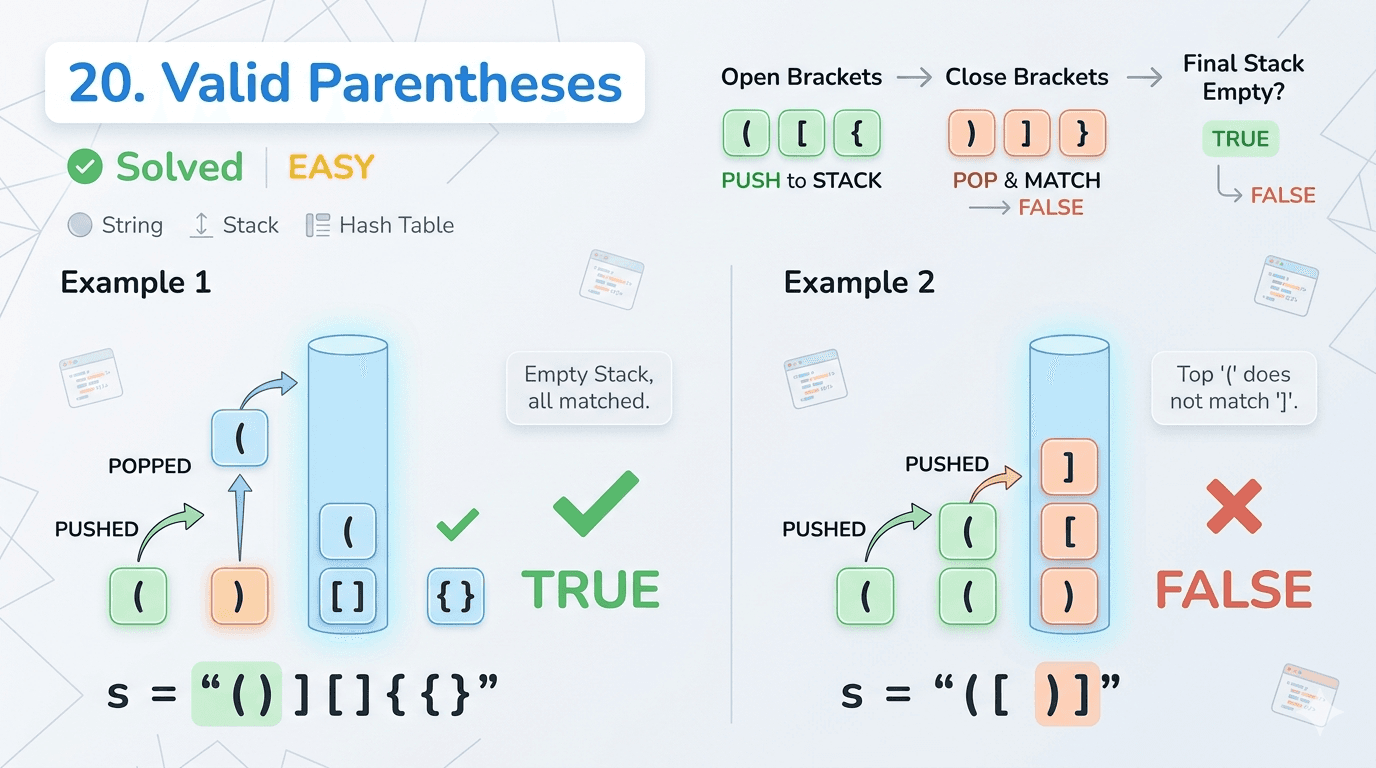
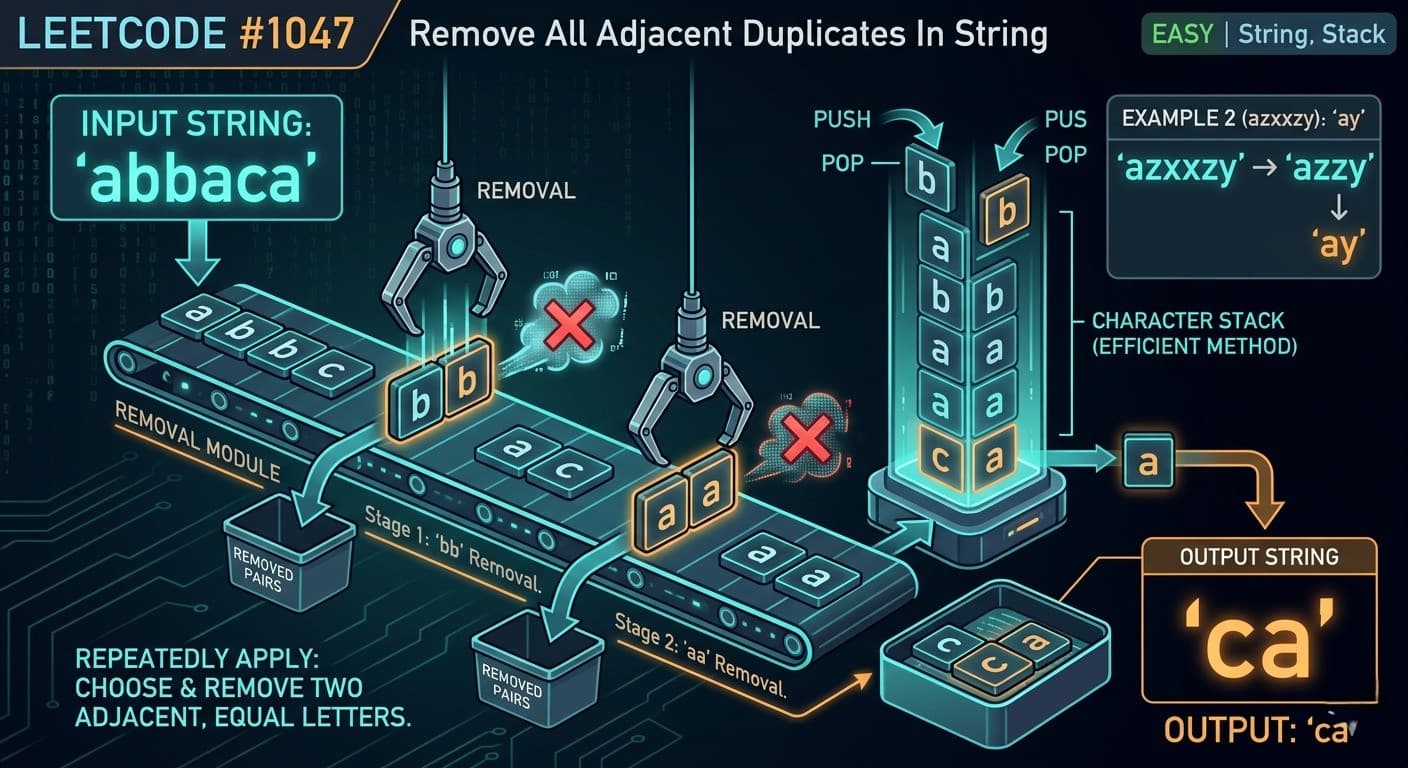
IntroductionLeetCode 20 Valid Parentheses is arguably the single most asked Easy problem in coding interviews. It appears at Google, Amazon, Microsoft, Meta, and virtually every company that does technical interviews. It is the textbook introduction to the Stack data structure and teaches you a pattern that shows up in compilers, code editors, HTML parsers, and mathematical expression evaluators.Here is the Link of Question -: LeetCode 20In this article we cover plain English explanation, real life analogy, the optimal stack solution with detailed dry run, all tricky edge cases, complexity analysis, common mistakes, and FAQs.What Is the Problem Really Asking?You are given a string containing only bracket characters — (, ), {, }, [, ]. You need to check if the brackets are correctly matched and nested.Three rules must hold:Every opening bracket must be closed by the same type of closing bracketBrackets must be closed in the correct order — the most recently opened must be closed firstEvery closing bracket must have a corresponding opening bracketReal Life Analogy — Russian Nesting DollsThink of Russian nesting dolls. You open the biggest doll first, then a medium one inside it, then a small one inside that. To close them back, you must close the smallest first, then medium, then biggest. You cannot close the biggest doll while the smallest is still open inside.That is exactly how brackets work. The last opened bracket must be the first one closed. This Last In First Out behavior is precisely what a Stack is built for.Another analogy — think of a text editor like VS Code. When you type (, it automatically adds ). If you try to close with ] instead, the editor highlights an error. This problem is essentially building that validation logic.The Only Approach You Need: StackThe IdeaScan the string left to rightIf you see an opening bracket → push it onto the stackIf you see a closing bracket → check the top of the stack. If the top is the matching opening bracket, pop it. Otherwise the string is invalid.At the end, if the stack is empty → all brackets matched → return true. If stack still has elements → some brackets were never closed → return false.public boolean isValid(String s) {if (s.length() == 1) return false; // single char can never be validStack<Character> st = new Stack<>();for (int i = 0; i < s.length(); i++) {char c = s.charAt(i);if (c == '(' || c == '{' || c == '[') {st.push(c); // opening bracket — push and wait for its match} else {if (!st.empty()) {// check if top of stack is the matching openerif ((c == ')' && st.peek() != '(') ||(c == '}' && st.peek() != '{') ||(c == ']' && st.peek() != '[')) {return false; // wrong type of closing bracket} else {st.pop(); // matched! remove the opener}} else {return false; // closing bracket with nothing open}}}return st.empty(); // true only if all openers were matched}Detailed Dry Run — s = "([)]"This is the trickiest example. Looks balanced at first glance but is actually invalid.( → opening, push → stack: [(][ → opening, push → stack: [(, []) → closing, peek is [, but ) needs ( → mismatch → return false ✅The stack correctly catches that [ was opened after ( but we tried to close ( before closing [ — wrong order!Dry Run — s = "([{}])"( → push → stack: [(][ → push → stack: [(, []{ → push → stack: [(, [, {]} → peek is {, match! pop → stack: [(, []] → peek is [, match! pop → stack: [(]) → peek is (, match! pop → stack: []Stack is empty → return true ✅Dry Run — s = "(["( → push → stack: [(][ → push → stack: [(, []Loop ends. Stack is NOT empty → return false ✅Two brackets were opened but never closed.All the Edge Cases You Must KnowSingle character like "(" or ")" A single character can never be valid — an opener has nothing to close it, a closer has nothing before it. The early return if (s.length() == 1) return false handles this cleanly.Only closing brackets like "))" The stack is empty when the first ) arrives → return false immediately.Only opening brackets like "(((" All get pushed, nothing gets popped, stack is not empty at end → return false.Interleaved wrong types like "([)]" Caught by the mismatch check when the closing bracket does not match the stack top.Empty string Stack stays empty → st.empty() returns true → returns true. An empty string is technically valid since there are no unmatched brackets. The constraints say length ≥ 1 so this is just good to know.A Cleaner Variation Using HashMapSome developers prefer using a HashMap to store bracket pairs, making the matching condition more readable:public boolean isValid(String s) {Stack<Character> st = new Stack<>();Map<Character, Character> map = new HashMap<>();map.put(')', '(');map.put('}', '{');map.put(']', '[');for (char c : s.toCharArray()) {if (map.containsKey(c)) {// closing bracketif (st.empty() || st.peek() != map.get(c)) {return false;}st.pop();} else {st.push(c); // opening bracket}}return st.empty();}The HashMap maps each closing bracket to its expected opening bracket. This makes adding new bracket types trivial — just add one line to the map. Great for extensibility in real world code.Both versions are O(n) time and O(n) space. Choose whichever feels more readable to you.Time Complexity: O(n) — single pass through the string Space Complexity: O(n) — stack holds at most n/2 opening bracketsWhy Stack Is the Perfect Data Structure HereThe key property this problem exploits is LIFO — Last In First Out. The most recently opened bracket must be the first one closed. That is literally the definition of a stack's behavior.Any time you see a problem where the most recently seen item determines what comes next — think Stack immediately. Valid Parentheses is the purest example of this principle.How This Fits Into the Bigger Stack PatternLooking at everything you have solved so far, notice the pattern evolution:844 Backspace String Compare — # pops the last character 1047 Remove Adjacent Duplicates — matching character pops itself 2390 Removing Stars — * pops the last character 3174 Clear Digits — digit pops the last character 20 Valid Parentheses — closing bracket pops its matching openerAll of these are stack simulations. The difference here is that instead of any character being popped, only the correct matching opener is popped. This matching condition is what makes Valid Parentheses a step up in logic from the previous problems.Common Mistakes to AvoidNot checking if stack is empty before peeking If a closing bracket arrives and the stack is empty, calling peek() throws an EmptyStackException. Always check !st.empty() before peeking or popping.Returning true without checking if stack is empty Even if the loop completes without returning false, unclosed openers remain on the stack. Always return st.empty() at the end, not just true.Pushing closing brackets onto the stack Only push opening brackets. Pushing closing brackets gives completely wrong results and is the most common beginner mistake.Not handling odd length strings If s.length() is odd, it is impossible for all brackets to be matched — you can add if (s.length() % 2 != 0) return false as an early exit for a small optimization.FAQs — People Also AskQ1. Why is a Stack used to solve Valid Parentheses? Because the problem requires LIFO matching — the most recently opened bracket must be the first one closed. Stack's Last In First Out behavior maps perfectly to this requirement, making it the natural and optimal data structure choice.Q2. What is the time complexity of LeetCode 20? O(n) time where n is the length of the string. We make a single pass through the string, and each character is pushed and popped at most once. Space complexity is O(n) in the worst case when all characters are opening brackets.Q3. Can LeetCode 20 be solved without a Stack? Technically yes for simple cases using counters, but only when dealing with a single type of bracket. With three types of brackets that can be nested, a Stack is the only clean solution. Counter-based approaches break down on cases like "([)]".Q4. Is LeetCode 20 asked in FAANG interviews? Absolutely. It is one of the most commonly asked problems across all major tech companies. It tests understanding of the Stack data structure and is often used as a warmup before harder stack problems like Largest Rectangle in Histogram or Decode String.Q5. What happens if the input string has an odd length? An odd-length string can never be valid since brackets always come in pairs. You can add if (s.length() % 2 != 0) return false as an early optimization, though the stack logic handles this correctly on its own.Similar LeetCode Problems to Practice Next1047. Remove All Adjacent Duplicates In String — Easy — stack pattern with characters394. Decode String — Medium — nested brackets with encoding678. Valid Parenthesis String — Medium — wildcards added32. Longest Valid Parentheses — Hard — longest valid substring1249. Minimum Remove to Make Valid Parentheses — Medium — remove minimum brackets to make validConclusionLeetCode 20 Valid Parentheses is the definitive introduction to the Stack data structure in competitive programming and technical interviews. The logic is elegant — push openers, pop on matching closers, check empty at the end. Three rules, one data structure, one pass.Master this problem thoroughly, understand every edge case, and you will have a rock-solid foundation for every stack problem that follows — from Decode String to Largest Rectangle in Histogram.
StringStackEasyLeetCode
LeetCode 2390: Removing Stars From a String — Java Solution With All Approaches Explained

LeetCode 2390: Removing Stars From a String — Java Solution With All Approaches Explained

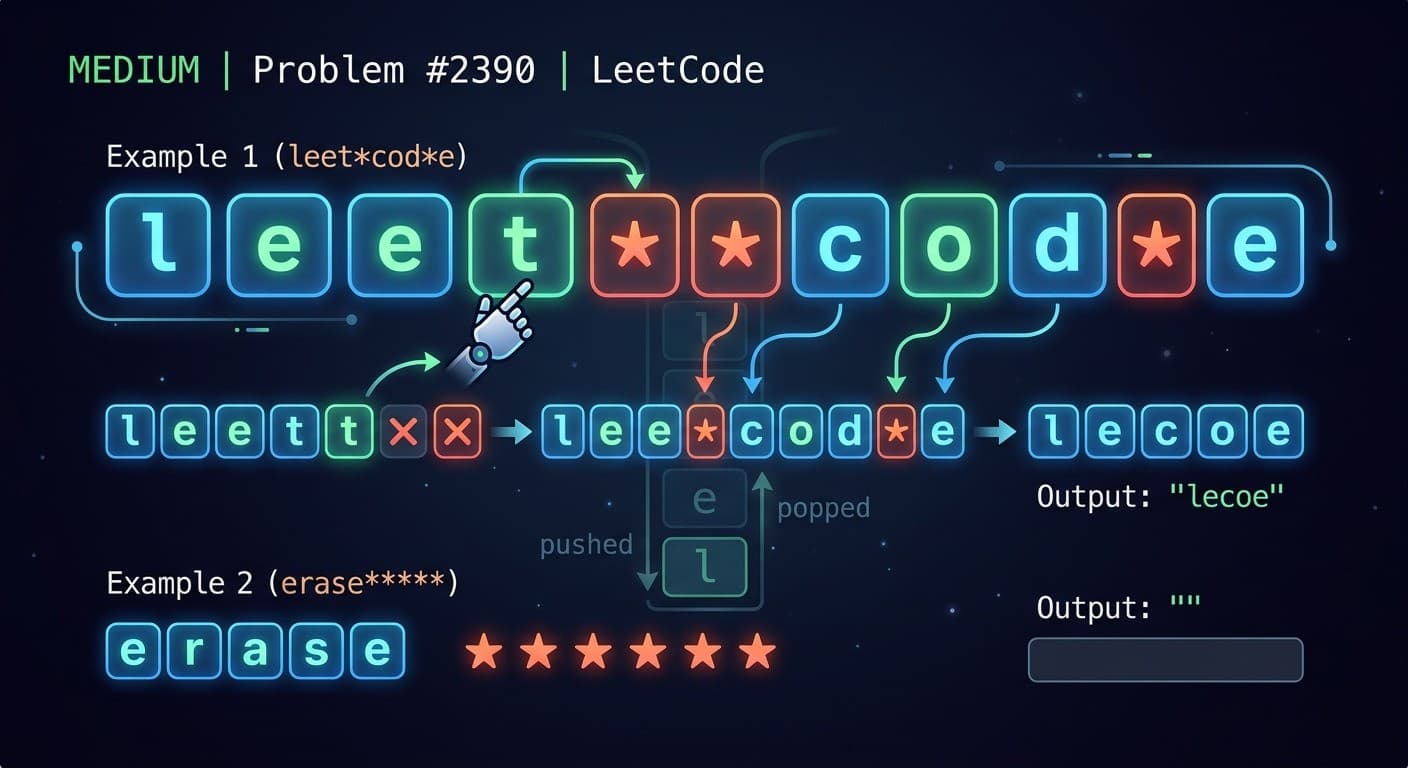
Introduction: What Is LeetCode 2390 Removing Stars From a String?If you are preparing for coding interviews at companies like Google, Amazon, or Microsoft, LeetCode 2390 Removing Stars From a String is a must-solve problem. It tests your understanding of the stack data structure and string manipulation — two of the most frequently tested topics in technical interviews.In this article, we will cover:What the problem is asking in plain English3 different Java approaches (Brute Force, Stack, StringBuilder)Step-by-step dry run with examplesTime and space complexity for each approachCommon mistakes to avoidFAQs that appear in Google's People Also AskLet's dive in!Problem Statement SummaryYou are given a string s containing lowercase letters and stars *. In one operation:Choose any * in the stringRemove the * itself AND the closest non-star character to its leftRepeat until all stars are removed and return the final string.Example:Input: s = "leet**cod*e"Output: "lecoe"Real Life Analogy — Think of It as a Backspace KeyImagine you are typing on a keyboard. Every * acts as your backspace key — it deletes itself and the character just before it.You type "leet" and press backspace twice:Backspace 1 → deletes t → "lee"Backspace 2 → deletes e → "le"That is exactly what this problem simulates! Once you see it this way, the solution becomes very obvious.Approach 1: Brute Force Simulation (Beginner Friendly)IdeaDirectly simulate the process the problem describes:Scan the string from left to rightFind the first *Remove it and the character just before itRepeat until no stars remainJava Codepublic String removeStars(String s) {StringBuilder sb = new StringBuilder(s);int i = 0;while (i < sb.length()) {if (sb.charAt(i) == '*') {sb.deleteCharAt(i); // remove the starif (i > 0) {sb.deleteCharAt(i - 1); // remove closest left characteri--;}} else {i++;}}return sb.toString();}Time and Space ComplexityComplexityValueReasonTimeO(n²)Each deletion shifts all remaining charactersSpaceO(n)StringBuilder storage⚠️ Important WarningThis problem has n up to 100,000. Brute force will get Time Limit Exceeded (TLE) on LeetCode. Use this only to understand the concept, never in production or interviews.Approach 2: Stack Based Solution (Interview Favorite)IdeaA stack is the perfect data structure here because:We always remove the most recently added letter when a * appearsThat is the definition of Last In First Out (LIFO) — exactly what a stack doesAlgorithm:Letter → push onto stack* → pop from stack (removes closest left character)At the end, build result from stack contentsJava Codepublic String removeStars(String s) {Stack<Character> st = new Stack<>();for (int i = 0; i < s.length(); i++) {char c = s.charAt(i);if (c == '*') {if (!st.empty()) {st.pop();}} else {st.push(c);}}StringBuilder sb = new StringBuilder();while (!st.empty()) {sb.append(st.pop());}return sb.reverse().toString();}Step-by-Step Dry Run — "leet**cod*e"StepCharacterActionStack State1lpush[l]2epush[l,e]3epush[l,e,e]4tpush[l,e,e,t]5*pop t[l,e,e]6*pop e[l,e]7cpush[l,e,c]8opush[l,e,c,o]9dpush[l,e,c,o,d]10*pop d[l,e,c,o]11epush[l,e,c,o,e]✅ Final Answer: "lecoe"Time and Space ComplexityComplexityValueReasonTimeO(n)Single pass through the stringSpaceO(n)Stack holds up to n charactersApproach 3: StringBuilder as Stack (Optimal Solution) ✅IdeaThis is the best and most optimized approach. A StringBuilder can act as a stack:append(c) → works like pushdeleteCharAt(sb.length() - 1) → works like popNo reverse needed at the end unlike the Stack approachJava Codepublic String removeStars(String s) {StringBuilder sb = new StringBuilder();for (int i = 0; i < s.length(); i++) {char c = s.charAt(i);if (c == '*') {if (sb.length() > 0) {sb.deleteCharAt(sb.length() - 1);}} else {sb.append(c);}}return sb.toString();}Step-by-Step Dry Run — "erase*****"StepCharacterActionStringBuilder1eappend"e"2rappend"er"3aappend"era"4sappend"eras"5eappend"erase"6*delete last"eras"7*delete last"era"8*delete last"er"9*delete last"e"10*delete last""✅ Final Answer: ""Why StringBuilder Beats Stack in JavaFactorStack<Character>StringBuilderMemoryBoxes char → Character objectWorks on primitives directlyReverse neededYesNoCode lengthMore verboseCleaner and shorterPerformanceSlightly slowerFasterTime and Space ComplexityComplexityValueReasonTimeO(n)One pass, each character processed onceSpaceO(n)StringBuilder storageAll Approaches Comparison TableApproachTimeSpacePasses LeetCode?Best ForBrute ForceO(n²)O(n)❌ TLEUnderstanding conceptStackO(n)O(n)✅ YesInterview explanationStringBuilderO(n)O(n)✅ YesBest solutionHow This Relates to LeetCode 3174 Clear DigitsIf you have already solved LeetCode 3174 Clear Digits, you will notice this problem is nearly identical:Feature3174 Clear Digits2390 Removing StarsTriggerDigit 0-9Star *RemovesClosest left non-digitClosest left non-starDifficultyEasyMediumBest approachStringBuilderStringBuilderThe exact same solution pattern works for both. This is why learning patterns matters more than memorizing individual solutions!Common Mistakes to Avoid1. Not checking sb.length() > 0 before deleting Even though the problem guarantees valid input, always add this guard. It shows clean, defensive coding in interviews.2. Forgetting to reverse when using Stack Stack gives you characters in reverse order. If you forget .reverse(), your answer will be backwards.3. Using Brute Force for large inputs With n up to 100,000, O(n²) will time out. Always use the O(n) approach.FAQs — People Also AskQ1. What data structure is best for LeetCode 2390? A Stack or StringBuilder used as a stack is the best data structure. Both give O(n) time complexity. StringBuilder is slightly more optimal in Java because it avoids object boxing overhead.Q2. Why does a star remove the closest left character? Because the problem defines it that way — think of * as a backspace key on a keyboard. It always deletes the character immediately before the cursor position.Q3. What is the time complexity of LeetCode 2390? The optimal solution runs in O(n) time and O(n) space, where n is the length of the input string.Q4. Is LeetCode 2390 asked in Google interviews? Yes, this type of stack simulation problem is commonly asked at Google, Amazon, Microsoft, and Meta interviews as it tests understanding of LIFO operations and string manipulation.Q5. What is the difference between LeetCode 2390 and LeetCode 844? Both use the same backspace simulation pattern. In 844 Backspace String Compare, # is the backspace character and you compare two strings. In 2390, * is the backspace and you return the final string.Similar LeetCode Problems to Practice NextProblemDifficultyPattern844. Backspace String CompareEasyStack simulation1047. Remove All Adjacent Duplicates In StringEasyStack simulation3174. Clear DigitsEasyStack simulation20. Valid ParenthesesEasyClassic stack735. Asteroid CollisionMediumStack simulationConclusionLeetCode 2390 Removing Stars From a String is a classic stack simulation problem that every developer preparing for coding interviews should master. The key insight is recognizing that * behaves exactly like a backspace key, which makes a stack or StringBuilder the perfect tool.Quick Recap:Brute force works conceptually but TLEs on large inputsStack solution is clean and great for explaining in interviewsStringBuilder solution is the most optimal in Java — no boxing, no reversal

StringStackMediumLeetCode
Reverse a Stack Without Extra Space | Java Recursive Solution

Reverse a Stack Without Extra Space | Java Recursive Solution

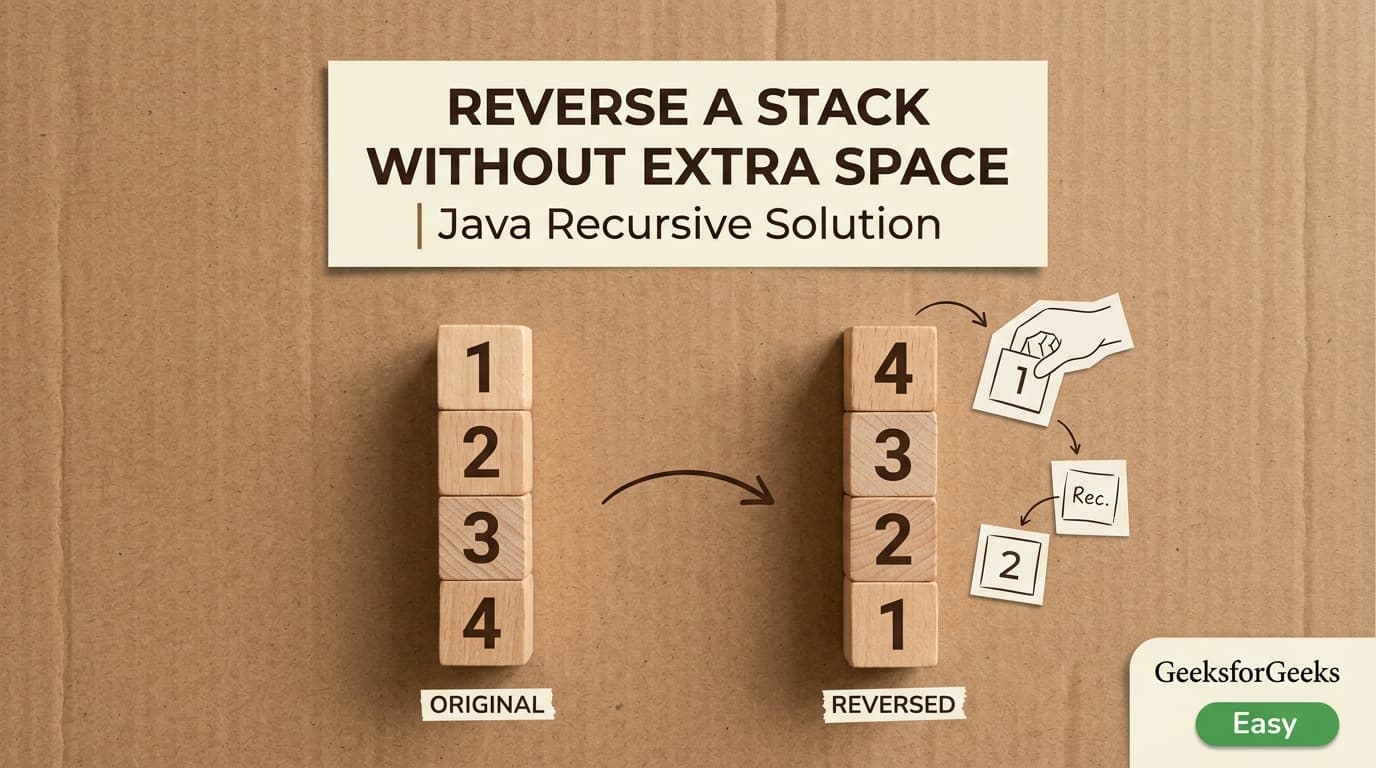
IntroductionReversing a stack is a classic data structures problem that frequently appears in coding interviews and competitive programming. While it may seem straightforward, the challenge lies in reversing the stack without using any additional data structure.This problem is a great way to understand the power of recursion and stack manipulation.In this article, we will explore an intuitive recursive approach, understand how it works step by step, and also briefly discuss alternative methods.Link of Problem: GeeksforGeeks – Reverse a StackProblem StatementYou are given a stack st[]. The task is to reverse the stack.Important NotesThe input array represents the stack from bottom to topThe last element is considered the topOutput should display elements from top to bottom after reversalExamplesExample 1Input:st = [1, 2, 3, 4]Output:[1, 2, 3, 4]Explanation:After reversing, the internal order becomes [4, 3, 2, 1],so when printed from top → bottom, it appears as [1, 2, 3, 4].Example 2Input:st = [3, 2, 1]Output:[3, 2, 1]Explanation:Reversed stack becomes [1, 2, 3] internally.Key InsightA stack only allows:push() → insert at toppop() → remove from topChallengeWe cannot directly insert an element at the bottom of the stack.Solution StrategyUse recursion to:Remove all elements from the stackInsert each element back at the bottomThis effectively reverses the stack.Approach: Recursive SolutionIdeaPop the top elementReverse the remaining stack recursivelyInsert the popped element at the bottomCode (Java)import java.util.Stack;class Solution {static void rever(Stack<Integer> s) {if (s.size() == 1) return;int temp = s.pop();// Reverse remaining stackrever(s);// Insert element at bottominsre(s, temp);}static void insre(Stack<Integer> s, int val) {// Base condition: empty stackif (s.empty()) {s.push(val);return;}int temp = s.pop();// Recursive callinsre(s, val);// Push back previous elementss.push(temp);}public static void reverseStack(Stack<Integer> st) {rever(st);}}Step-by-Step Dry RunLet’s take:Stack (bottom → top): [1, 2, 3, 4]Execution Flow:Pop 4 → reverse [1, 2, 3]Pop 3 → reverse [1, 2]Pop 2 → reverse [1]Insert elements at bottom in orderFinal Stack:[4, 3, 2, 1]Complexity AnalysisTime Complexity: O(n²)Each insertion at bottom takes O(n)Auxiliary Space: O(n)Due to recursion call stackWhy This Approach WorksRecursion helps access deeper elements of the stackThe helper function inserts elements at the bottomMaintains order while reversing without extra structuresAlternative Approaches1. Using Two StacksTransfer elements between stacks multiple timesEasy but uses extra space2. Using Array/ListStore elements in a listPush them back into stack⚠️ These methods violate the constraint of not using extra data structures.Key TakeawaysStack problems often require creative recursionReversing a stack without extra space is a common interview patternUnderstanding insert at bottom is crucialTime complexity is higher due to repeated insert operationsWhen This Problem Is AskedThis question is commonly seen in:Technical interviewsStack and recursion problem setsPlatforms like GeeksforGeeksIt evaluates:Understanding of stack operationsRecursive thinkingProblem-solving under constraintsConclusionReversing a stack without using extra space is a great example of how recursion can simplify complex constraints. While the solution may not be the most optimal in terms of time complexity, it is elegant and widely accepted in interviews.Mastering this pattern will help you solve many similar problems involving stack manipulation.Frequently Asked Questions (FAQs)1. Why is the time complexity O(n²)?Because inserting an element at the bottom takes O(n), and this is done for each element.2. Can this be optimized further?Not without using extra data structures. The recursive approach is optimal under constraints.3. What is the key concept to learn here?Understanding how to insert an element at the bottom of a stack using recursion.
JavaGeeksofGeeksStackRecursionReverse
LeetCode 187 – Repeated DNA Sequences (Java Solution with Sliding Window and HashSet)

LeetCode 187 – Repeated DNA Sequences (Java Solution with Sliding Window and HashSet)

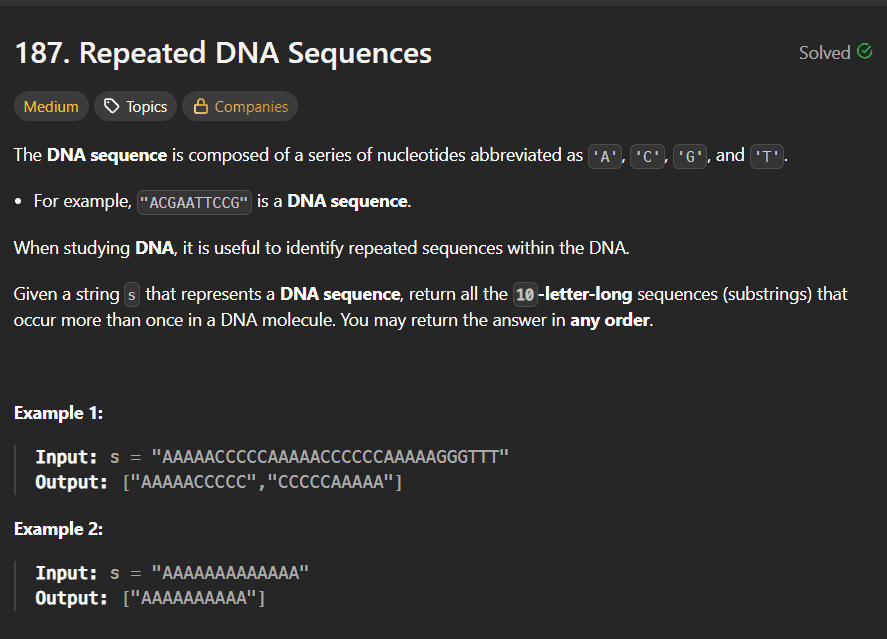
IntroductionIn this article, we will solve LeetCode 187: Repeated DNA Sequences using Java. This is a popular string problem that tests your understanding of the sliding window technique and efficient use of hash-based data structures.DNA sequences are composed of four characters:A (Adenine)C (Cytosine)G (Guanine)T (Thymine)The goal is to identify all 10-letter-long substrings that appear more than once in a given DNA string.You can try solving the problem directly on LeetCode here: https://leetcode.com/problems/repeated-dna-sequences/Problem StatementGiven a string s that represents a DNA sequence, return all the 10-letter-long substrings that occur more than once.Example 1Input: s = "AAAAACCCCCAAAAACCCCCCAAAAAGGGTTT"Output: ["AAAAACCCCC", "CCCCCAAAAA"]Example 2Input: s = "AAAAAAAAAAAAA"Output: ["AAAAAAAAAA"]Key ObservationsWe only need substrings of fixed length 10.The maximum length of the string can be up to 10^5.A brute-force solution checking all substrings multiple times would be inefficient.This problem can be solved efficiently using a sliding window and hash-based data structures.Approach 1: Sliding Window with HashSet (Given Solution)IdeaUse two pointers (i and j) to maintain a sliding window.Build a substring of size 10 dynamically.Store previously seen substrings in a HashSet.If a substring is already present in the set:Check if it is already in the result list.If not, add it to the result list.Slide the window forward and continue.Java Code (Your Implementation)class Solution { public List<String> findRepeatedDnaSequences(String s) { HashSet<String> ms = new HashSet<>(); List<String> lis = new ArrayList<>(); int i = 0; int j = 0; String tes = ""; while (j < s.length()) { tes += s.charAt(j); if (j - i + 1 < 10) { j++; } else { if (j - i + 1 == 10) { if (ms.contains(tes)) { boolean fl = false; for (String a : lis) { if (a.equals(tes)) { fl = true; } } if (!fl) { lis.add(tes); } } else { ms.add(tes); } tes = tes.substring(1); i++; j++; } } } return lis; }}ExplanationThe variable tes maintains the current substring.ms stores all previously seen substrings of length 10.If a substring already exists in ms, we manually check whether it has already been added to the result list.This avoids duplicate entries in the final output.Time ComplexitySliding through the string: O(n)Checking duplicates in the result list: O(n) in the worst caseOverall worst-case complexity: O(n²)Space ComplexityHashSet storage: O(n)Limitation of Approach 1The manual duplicate check using a loop inside the result list introduces unnecessary overhead. This makes the solution less efficient.We can improve this by using another HashSet to automatically handle duplicates.Approach 2: Optimized Solution Using Two HashSetsIdeaUse one HashSet called seen to track all substrings of length 10.Use another HashSet called repeated to store substrings that appear more than once.Iterate from index 0 to s.length() - 10.Extract substring of length 10.If adding to seen fails, it means it has appeared before.Add it directly to repeated.This removes the need for a nested loop.Optimized Java Codeclass Solution { public List<String> findRepeatedDnaSequences(String s) { Set<String> seen = new HashSet<>(); Set<String> repeated = new HashSet<>(); for (int i = 0; i <= s.length() - 10; i++) { String substring = s.substring(i, i + 10); if (!seen.add(substring)) { repeated.add(substring); } } return new ArrayList<>(repeated); }}Why This Approach is BetterNo manual duplicate checking.Cleaner and more readable code.Uses HashSet properties efficiently.Each substring is processed only once.Time Complexity (Optimized)Single traversal of the string: O(n)Substring extraction of fixed length 10: O(1)Overall time complexity: O(n)Space ComplexityTwo HashSets storing substrings: O(n)ConclusionLeetCode 187 is a classic example of combining the sliding window technique with hash-based data structures.The first approach works but has unnecessary overhead due to manual duplicate checks.The second approach is more optimal, cleaner, and recommended for interviews.Always leverage the properties of HashSet to avoid redundant checks.This problem highlights the importance of choosing the right data structure to optimize performance.

JavaSliding WindowMedium
Understanding HashMap and Hashing Techniques: A Complete Guide

Understanding HashMap and Hashing Techniques: A Complete Guide

What is HashMap?HashMap is a non-linear data structure that lives inside Java's collection framework, alongside other structures like Trees and Graphs (see the generated image above). What makes it special? It uses a clever technique called hashing to store and retrieve data at blazing speeds.Think of hashing as a smart address system. It converts large keys (like long strings or big numbers) into smaller values that work as array indices. This simple trick transforms your data lookup from slow O(n)O(n) or O(log⁡n)O(logn) operations into lightning-fast O(1)O(1) access times!Understanding Hashing MappingsBefore diving deeper, let's understand the four types of hashing mappings:One-to-one mapping — Each key maps to exactly one indexMany-to-one mapping — Multiple keys can map to the same indexOne-to-many mapping — One key maps to multiple indicesMany-to-many mapping — Multiple keys map to multiple indicesHashMap primarily uses one-to-one and many-to-one mapping strategies to achieve its performance goals.The Problem: Why Not Just Use Arrays?Let's say you want to store 7 elements with keys: 1, 5, 23, 57, 234, 678, and 1000.Using direct indexing (where key = array index), you'd need an array of size 1000 just to store 7 items! That leaves 993 empty slots wasting precious memory. Imagine having a parking lot with 1000 spaces for just 7 cars — totally inefficient!This is the exact problem hash functions solve.Hash Functions: The SolutionA hash function takes your key and calculates which array index to use. The beauty? You can now store those same 7 elements in an array of just size 10!The most common hash function uses the modulus operator:hash(key)=keymod array sizehash(key)=keymodarray sizeExample: With array size = 10:Key 57 → Index: 57mod 10=757mod10=7Key 234 → Index: 234mod 10=4234mod10=4Key 1000 → Index: 1000mod 10=01000mod10=0Now you only need an array of size 10 instead of 1000. Problem solved!Three Popular Hash Function TypesModulus MethodThe most widely used technique. Divide the key by array size (or a prime number) and use the remainder as the index.index=keymod sizeindex=keymodsizeMid Square MethodSquare the key value, then extract the middle digits to form your hash value.Example: Key = 57 → 572=3249572=3249 → Extract middle digits "24"Folding HashingDivide the key into equal parts, add them together, then apply modulus.Example: Key = 123456Split into: 12, 34, 56Sum: 12+34+56=10212+34+56=102Apply modulus: 102mod 10=2102mod10=2The Collision ProblemHere's the catch: sometimes two different keys produce the same index. This is called a collision.Example:Key 27 → 27mod 10=727mod10=7Key 57 → 57mod 10=757mod10=7Both keys want index 7! We need smart strategies to handle this.Collision Resolution: Two Main TechniquesTechnique 1: Open Chaining (Separate Chaining)Mapping Type: Many-to-oneWhen a collision happens, create a linked list at that index and store all colliding values in sorted order.Example: Keys 22 and 32 both map to index 2:Index 2: [22] → [32] → nullAdvantage: Simple and works well in practiceDrawback: If too many collisions occur, the linked list becomes long and searching degrades to O(n)O(n). However, Java's collection framework uses highly optimized hash functions that achieve amortized O(1)O(1) time complexity.Technique 2: Closed Addressing (Open Addressing)Mapping Type: One-to-manyInstead of creating a list, find another empty slot in the array. There are three approaches:Linear ProbingWhen collision occurs, check the next index. If it's occupied, keep checking the next one until you find an empty slot.Hash Function:h(x)=xmod sizeh(x)=xmodsizeOn Collision:h(x)=(h(x)+i)mod sizeh(x)=(h(x)+i)modsizewhere i=0,1,2,3,…i=0,1,2,3,…Example: Keys 22 and 32 both map to index 2:Store 22 at index 2Try 32 at index 2 → occupiedCheck index 3 → empty, store 32 thereProblems:Clustering: Keys bunch together in adjacent indices, slowing down searchesDeleted Slot Problem: When you delete a key, it creates an empty slot that breaks the search chainThe Deleted Slot Problem Explained:Keys 22 and 32 are at indices 2 and 3Delete key 22 from index 2Now when searching for key 32, the algorithm reaches index 2 (empty), thinks key 32 doesn't exist, and stops searching!Solution: Mark deleted slots with a special marker (like -1) or perform rehashing after deletions.Quadratic ProbingSame concept as linear probing, but instead of checking consecutive slots, jump in quadratic increments: 1, 4, 9, 16, 25...Hash Function:h(x)=xmod sizeh(x)=xmodsizeOn Collision:h(x)=(h(x)+i2)mod sizeh(x)=(h(x)+i2)modsizewhere i=0,1,2,3,…i=0,1,2,3,…Advantage: Significantly reduces clusteringDrawback: Still suffers from the deleted slot problemDouble HashingThe most sophisticated approach! Uses two different hash functions to create unique probe sequences for each key.First Hash Function:h1(x)=xmod sizeh1(x)=xmodsizeSecond Hash Function:h2(x)=prime−(xmod prime)h2(x)=prime−(xmodprime)On Collision:h(x)=(h1(x)+i×h2(x))mod sizeh(x)=(h1(x)+i×h2(x))modsizewhere i=0,1,2,3,…i=0,1,2,3,…Advantage: Effectively avoids clustering and provides the best performance among probing techniquesLoad Factor: The Performance IndicatorThe load factor tells you how full your hash table is:Load Factor=Number of elementsArray sizeLoad Factor=Array sizeNumber of elementsPerformance GuidelinesLoad Factor ≤ 0.5 → Good performance, fast operations Load Factor > 0.7 → Poor performance, time to rehash ExamplesBad Load Factor:Array size = 10, Elements = 8Load Factor = 8/10=0.88/10=0.8Action: Rehash the array (typically double the size)Good Load Factor:Array size = 200, Elements = 100Load Factor = 100/200=0.5100/200=0.5Action: No changes needed, performing optimallyWhat is Rehashing?When the load factor exceeds the threshold (usually 0.7), the hash table is resized — typically doubled in size. All existing elements are then rehashed and redistributed into the new larger array. This maintains optimal performance as your data grows.Performance SummaryHashMap delivers exceptional average-case performance:Insertion: O(1)O(1)Deletion: O(1)O(1)Search: O(1)O(1)However, in the worst case (many collisions with poor hash functions), operations can degrade to O(n)O(n).The key to maintaining O(1)O(1) performance:Use a good hash functionChoose an appropriate collision resolution strategyMonitor and maintain a healthy load factorRehash when necessaryConclusionHashMap is one of the most powerful and frequently used data structures in programming. By understanding hashing techniques, collision resolution strategies, and load factors, you can write more efficient code and make better design decisions.Whether you're building a cache, implementing a frequency counter, or solving complex algorithm problems, HashMap is your go-to tool for fast data access!

hashmapdata-structureshashingjavaalgorithmscollision-resolutiontime-complexity
LeetCode 682 Baseball Game - Java Solution Explained

LeetCode 682 Baseball Game - Java Solution Explained

IntroductionLeetCode 682 Baseball Game is one of the cleanest and most beginner-friendly stack simulation problems on LeetCode. It does not require any fancy algorithm or deep insight — it purely tests whether you can carefully read the rules and simulate them faithfully using the right data structure.But do not let "Easy" fool you. This problem is a great place to practice thinking about which data structure fits best and why. We will solve it three different ways — Stack, ArrayList, and Deque — so you can see the tradeoffs and pick the one that makes most sense to you.You can find the problem here — LeetCode 682 Baseball Game.What Is the Problem Really Asking?You are keeping score for a baseball game with four special rules. You process a list of operations one by one and maintain a record of scores. At the end, return the total sum of all scores in the record.The four operations are:A number (like "5" or "-2") — just add that number as a new score to the record."C" — the last score was invalid, remove it from the record."D" — add a new score that is double the most recent score."+" — add a new score that is the sum of the two most recent scores.That is it. Four rules, simulate them in order, sum up what is left.Real Life Analogy — A Scoreboard With CorrectionsImagine a scoreboard operator at a sports event. They write scores on a whiteboard as the game progresses:A player scores 5 points → write 5Another player scores 2 → write 2Referee says last score was invalid → erase the last number (C)Special bonus rule kicks in → double the last valid score (D)Two scores combine → add the last two scores as one entry (+)At the end, add up everything on the whiteboard. The stack is your whiteboard — you write on top and erase from the top.Why Stack Is the Natural FitAll four operations only ever look at or modify the most recently added scores. C removes the last one. D doubles the last one. + uses the last two. This "most recent first" access pattern is the definition of LIFO — Last In First Out — which is exactly what a Stack provides.Any time a problem says "the previous score" or "the last two scores," your brain should immediately think Stack.Approach 1: Stack (Your Solution) ✅The IdeaUse a Stack of integers. For each operation:Number → parse and pushC → pop the topD → peek the top, push doubled value+ → pop top two, push both back, push their sumpublic int calPoints(String[] operations) { Stack<Integer> st = new Stack<>(); for (int i = 0; i < operations.length; i++) { String op = operations[i]; if (op.equals("C")) { st.pop(); // remove last score } else if (op.equals("D")) { st.push(st.peek() * 2); // double of last score } else if (op.equals("+")) { int prev1 = st.pop(); // most recent score int prev2 = st.pop(); // second most recent score int sum = prev1 + prev2; st.push(prev2); // put them back st.push(prev1); st.push(sum); // push the new score } else { st.push(Integer.parseInt(op)); // regular number } } // sum all remaining scores int total = 0; while (!st.empty()) { total += st.pop(); } return total;}One small improvement over your original solution — using op.equals("C") instead of op.charAt(0) == 'C'. This is cleaner and handles edge cases better since negative numbers like "-2" also start with - not a digit, so charAt(0) comparisons can get tricky. Using equals is always safer for string operations.Why the + Operation Needs Pop-Push-PopThe trickiest part is the + operation. You need the two most recent scores. Stack only lets you see the top. So you pop the first, then the second, compute the sum, then push both back before pushing the sum. This restores the record correctly — the previous two scores stay, and the new sum score is added on top.Detailed Dry Run — ops = ["5","2","C","D","+"]Let us trace every step carefully:"5" → number, parse and push Stack: [5]"2" → number, parse and push Stack: [5, 2]"C" → remove last score, pop Stack: [5]"D" → double last score, peek=5, push 10 Stack: [5, 10]"+" → sum of last two:pop prev1 = 10pop prev2 = 5sum = 15push prev2=5, push prev1=10, push sum=15 Stack: [5, 10, 15]Sum all: 5 + 10 + 15 = 30 ✅Detailed Dry Run — ops = ["5","-2","4","C","D","9","+","+"]"5" → push 5. Stack: [5]"-2" → push -2. Stack: [5, -2]"4" → push 4. Stack: [5, -2, 4]"C" → pop 4. Stack: [5, -2]"D" → peek=-2, push -4. Stack: [5, -2, -4]"9" → push 9. Stack: [5, -2, -4, 9]"+" → prev1=9, prev2=-4, sum=5. Push -4, 9, 5. Stack: [5, -2, -4, 9, 5]"+" → prev1=5, prev2=9, sum=14. Push 9, 5, 14. Stack: [5, -2, -4, 9, 5, 14]Sum: 5 + (-2) + (-4) + 9 + 5 + 14 = 27 ✅Approach 2: ArrayList (Most Readable)The IdeaArrayList gives you index-based access which makes the + operation much cleaner — no need to pop and push back. Just access the last two elements directly using size()-1 and size()-2.public int calPoints(String[] operations) { ArrayList<Integer> record = new ArrayList<>(); for (String op : operations) { int n = record.size(); if (op.equals("C")) { record.remove(n - 1); // remove last element } else if (op.equals("D")) { record.add(record.get(n - 1) * 2); // double last } else if (op.equals("+")) { // sum of last two — no need to remove and re-add! record.add(record.get(n - 1) + record.get(n - 2)); } else { record.add(Integer.parseInt(op)); } } int total = 0; for (int score : record) { total += score; } return total;}See how the + operation becomes a single line with ArrayList? record.get(n-1) + record.get(n-2) directly accesses the last two elements without any pop-push gymnastics.Dry Run — ops = ["5","2","C","D","+"]"5" → add 5. List: [5]"2" → add 2. List: [5, 2]"C" → remove last. List: [5]"D" → 5×2=10, add 10. List: [5, 10]"+" → get(0)+get(1) = 5+10=15, add 15. List: [5, 10, 15]Sum: 30 ✅Time Complexity: O(n) — single pass through operations Space Complexity: O(n) — ArrayList stores at most n scoresThe one tradeoff — remove(n-1) on an ArrayList is O(1) for the last element (no shifting needed). And get() is O(1). So this is fully O(n) overall and arguably the cleanest solution to read and understand.Approach 3: Deque (ArrayDeque — Fastest in Java)The IdeaArrayDeque is faster than Stack in Java because Stack is synchronized (thread-safe overhead) and ArrayDeque is not. For single-threaded LeetCode problems, ArrayDeque is always the better choice over Stack.public int calPoints(String[] operations) { Deque<Integer> deque = new ArrayDeque<>(); for (String op : operations) { if (op.equals("C")) { deque.pollLast(); // remove last } else if (op.equals("D")) { deque.offerLast(deque.peekLast() * 2); // double last } else if (op.equals("+")) { int prev1 = deque.pollLast(); int prev2 = deque.pollLast(); int sum = prev1 + prev2; deque.offerLast(prev2); // restore deque.offerLast(prev1); // restore deque.offerLast(sum); // new score } else { deque.offerLast(Integer.parseInt(op)); } } int total = 0; for (int score : deque) { total += score; } return total;}The logic is identical to the Stack approach. The only difference is the method names — offerLast instead of push, pollLast instead of pop, peekLast instead of peek.Time Complexity: O(n) Space Complexity: O(n)For iterating a Deque to sum, you can use a for-each loop directly — no need to pop everything out like with Stack.Approach ComparisonApproachTimeSpaceBest ForStackO(n)O(n)Classic interview answer, clear LIFO intentArrayListO(n)O(n)Cleanest code, easiest to readArrayDequeO(n)O(n)Best performance, preferred in productionAll three approaches have identical time and space complexity. The difference is purely in code style and readability. In an interview, any of these is perfectly acceptable. Mention that ArrayDeque is preferred over Stack in Java for performance if you want to impress.Why op.equals() Is Better Than op.charAt(0)Your original solution uses operations[i].charAt(0) == 'C' to check operations. This works but has a subtle risk — the + character check with charAt(0) is fine, but imagine if a future test had a number starting with C or D (it will not in this problem but defensive coding is a good habit). More importantly, "-2".charAt(0) is '-' which is fine, but using equals is semantically clearer — you are comparing the whole string, not just the first character. This shows cleaner coding habits in interviews.Edge Cases to KnowNegative numbers like "-2" Integer.parseInt("-2") handles negatives perfectly. The D operation on -2 gives -4. The + operation works correctly with negatives too. No special handling needed."C" after a "+" that added a score The problem guarantees C always has at least one score to remove. So after + adds a score, a C removes just that one new score — the previous two scores that + used remain intact. This is correct behavior and our solution handles it automatically.All scores removed If all operations are numbers followed by C operations removing every score, the stack ends up empty and the sum is 0. Our while loop handles this correctly — it simply never executes and returns 0.Only one operation A single number like ["5"] → push 5, sum is 5. Works fine.Common Mistakes to AvoidIn the + operation, forgetting to push both numbers back When you pop prev1 and prev2 to compute the sum, you must push them back onto the stack before pushing the sum. If you only push the sum without restoring prev1 and prev2, those scores disappear from the record permanently — which is wrong. The + operation only adds a new score, it does not remove the previous ones.Using charAt(0) comparison for detecting numbers Negative numbers start with -, not a digit. If you check charAt(0) >= '0' && charAt(0) <= '9' to detect numbers, you will miss negatives. The safest approach is to check for C, D, and + explicitly using equals, and fall through to the else for everything else (which covers both positive and negative numbers).Calling st.peek() or st.pop() without checking empty The problem guarantees valid operations — C always has something to remove, + always has two previous scores, D always has one. But in real code and defensive interview solutions, adding empty checks shows good habits even when the constraints guarantee safety.FAQs — People Also AskQ1. Why is Stack a good choice for LeetCode 682 Baseball Game? Because all four operations only access the most recently added scores — the last score for C and D, the last two for +. This "most recent first" access pattern is exactly what LIFO (Last In First Out) provides. Stack's push, pop, and peek all run in O(1) making it perfectly efficient.Q2. What is the time complexity of LeetCode 682? O(n) time where n is the number of operations. Each operation performs a constant number of stack operations (at most 3 pushes/pops for the + case). Space complexity is O(n) for storing scores.Q3. Why does the + operation need to pop and push back in the Stack approach? Stack only gives direct access to the top element. To get the second most recent score, you must pop the first one, peek/pop the second, then push the first one back. The ArrayList approach avoids this by using index-based access directly.Q4. What is the difference between Stack and ArrayDeque in Java for this problem? Both work correctly. ArrayDeque is faster because Stack is a legacy class that extends Vector and is synchronized (thread-safe), adding unnecessary overhead for single-threaded use. ArrayDeque has no synchronization overhead. For LeetCode and interviews, either is acceptable but ArrayDeque is technically better.Q5. Is LeetCode 682 asked in coding interviews? It appears occasionally as a warmup or screening problem. Its main value is testing whether you can carefully simulate rules without making logical errors — a skill that matters in systems programming, game development, and any domain with complex state management.Similar LeetCode Problems to Practice Next71. Simplify Path — Medium — stack simulation with path operations1047. Remove All Adjacent Duplicates In String — Easy — stack simulation735. Asteroid Collision — Medium — stack simulation with conditions150. Evaluate Reverse Polish Notation — Medium — stack with arithmetic operations, very similar pattern227. Basic Calculator II — Medium — stack with operator precedenceConclusionLeetCode 682 Baseball Game is a perfect problem to build confidence with stack simulation. The four operations are clearly defined, the rules are unambiguous, and the stack maps naturally to every operation. Once you understand why pop-push-back is needed for + in the stack approach and how ArrayList simplifies that with index access, you have genuinely understood the tradeoffs between these data structures.If you are newer to stacks, start with the ArrayList solution for clarity. Once that clicks, rewrite it with Stack to understand the LIFO mechanics. Then try ArrayDeque to understand why it is preferred in modern Java code.

LeetCodeJavaStackArrayListDequeEasy
Sort a Stack Using Recursion - Java Solution Explained

Sort a Stack Using Recursion - Java Solution Explained

IntroductionSort a Stack is one of those problems that feels impossible at first — you only have access to the top of a stack, you cannot index into it, and the only tools you have are push, pop, and peek. How do you sort something with such limited access?The answer is recursion. And this problem is a perfect example of how recursion can do something elegant that feels like it should require much more complex logic.You can find this problem here — Sort a Stack — GeeksForGeeksThis article explains the complete intuition, both recursive functions in detail, a thorough dry run, all approaches, and complexity analysis.What Is the Problem Really Asking?You have a stack of integers. Sort it so that the smallest element is at the bottom and the largest element is at the top.Input: [41, 3, 32, 2, 11] (11 is at top)Output: [41, 32, 11, 3, 2] (2 is at top, 41 at bottom)Wait — if smallest is at bottom and largest at top, then popping gives you the smallest first. So the stack is sorted in ascending order from top to bottom when you pop.The constraints make this interesting — you can only use stack operations (push, pop, peek, isEmpty). No arrays, no sorting algorithms directly on the data, no random access.Real Life Analogy — Sorting a Stack of BooksImagine a stack of books of different thicknesses on your desk. You want the thinnest book on top and thickest at the bottom. But you can only take from the top.Here is what you do — pick up books one by one from the top and set them aside. Once you have removed enough, place each book back in its correct position. If the book you are placing is thicker than what is currently on top, slide the top books aside temporarily, place the thick book down, then put the others back.That is exactly what the recursive sort does — take elements out one by one, and insert each back into the correct position.The Core Idea — Two Recursive Functions Working TogetherThe solution uses two recursive functions that work hand in hand:sortStack(st) — removes elements one by one until the stack is empty, then inserts each back using insertinsert(st, temp) — inserts a single element into its correct sorted position in an already-sorted stackThink of it like this — sortStack is the manager that empties the stack recursively, and insert is the worker that places each element in the right position on the way back.Function 1: sortStack — The Main Recursive Driverpublic void sortStack(Stack<Integer> st) { // base case — empty or single element is already sorted if (st.empty() || st.size() == 1) return; // Step 1: remove the top element int temp = st.pop(); // Step 2: recursively sort the remaining stack sortStack(st); // Step 3: insert the removed element in correct position insert(st, temp);}How to Think About ThisThe leap of faith here — trust that sortStack correctly sorts whatever is below. After the recursive call, the remaining stack is perfectly sorted. Now your only job is to insert temp (the element you removed) into its correct position in that sorted stack.This is the classic "solve smaller, fix current" recursion pattern. Reduce the problem by one element, trust recursion for the rest, then fix the current element's position.Function 2: insert — Placing an Element in Sorted Positionvoid insert(Stack<Integer> st, int temp) { // base case 1: stack is empty — just push // base case 2: top element is smaller or equal — push on top if (st.empty() || st.peek() <= temp) { st.push(temp); return; } // top element is greater than temp // temp needs to go below the top element int val = st.pop(); // temporarily remove the top insert(st, temp); // try inserting temp deeper st.push(val); // restore the removed element on top}How to Think About ThisYou want to insert temp in sorted order. The stack is already sorted (largest on top). So:If the top is smaller than or equal to temp → temp belongs on top. Push it.If the top is greater than temp → temp needs to go below the top. So pop the top temporarily, try inserting temp deeper, then push the top back.This is the same "pop, recurse deeper, push back" pattern you saw in the Baseball Game problem — when you need to access elements below the top without permanent removal.Complete Solutionclass Solution { // insert temp into its correct position in sorted stack void insert(Stack<Integer> st, int temp) { if (st.empty() || st.peek() <= temp) { st.push(temp); return; } int val = st.pop(); insert(st, temp); st.push(val); } // sort the stack using recursion public void sortStack(Stack<Integer> st) { if (st.empty() || st.size() == 1) return; int temp = st.pop(); // remove top sortStack(st); // sort remaining insert(st, temp); // insert top in correct position }}Detailed Dry Run — st = [3, 2, 1] (1 at top)Let us trace every single call carefully.sortStack calls (going in):sortStack([3, 2, 1]) temp = 1, remaining = [3, 2] call sortStack([3, 2]) temp = 2, remaining = [3] call sortStack([3]) size == 1, return ← base case now insert(st=[3], temp=2) peek=3 > 2, pop val=3 insert(st=[], temp=2) st empty, push 2 ← base case push val=3 back stack is now [2, 3] (3 on top) sortStack([3,2]) done → stack = [2, 3] now insert(st=[2,3], temp=1) peek=3 > 1, pop val=3 insert(st=[2], temp=1) peek=2 > 1, pop val=2 insert(st=[], temp=1) st empty, push 1 ← base case push val=2 back stack = [1, 2] push val=3 back stack = [1, 2, 3] (3 on top)sortStack done → stack = [1, 2, 3]✅ Final stack (3 on top, 1 at bottom): largest at top, smallest at bottom — correctly sorted!Detailed Dry Run — st = [41, 3, 32, 2, 11] (11 at top)Let us trace at a higher level to see the pattern:sortStack calls unwinding (popping phase):sortStack([41, 3, 32, 2, 11]) pop 11, sortStack([41, 3, 32, 2]) pop 2, sortStack([41, 3, 32]) pop 32, sortStack([41, 3]) pop 3, sortStack([41]) base case — return insert([41], 3) → [3, 41] (41 on top) insert([3, 41], 32) → [3, 32, 41] (41 on top) insert([3, 32, 41], 2) → [2, 3, 32, 41] (41 on top) insert([2, 3, 32, 41], 11) → [2, 3, 11, 32, 41] (41 on top)✅ Final: [2, 3, 11, 32, 41] with 41 at top, 2 at bottom — correct!Let us verify the insert([3, 32, 41], 2) step in detail since it involves multiple pops:insert(st=[3, 32, 41], temp=2) peek=41 > 2, pop val=41 insert(st=[3, 32], temp=2) peek=32 > 2, pop val=32 insert(st=[3], temp=2) peek=3 > 2, pop val=3 insert(st=[], temp=2) st empty, push 2 push val=3 back → [2, 3] push val=32 back → [2, 3, 32] push val=41 back → [2, 3, 32, 41]Beautiful chain of pops followed by a chain of pushes — recursion handling what would be very messy iterative logic.Approach 2: Using an Additional Stack (Iterative)If recursion is not allowed or you want an iterative solution, you can use a second stack.public void sortStack(Stack<Integer> st) { Stack<Integer> tempStack = new Stack<>(); while (!st.empty()) { int curr = st.pop(); // move elements from tempStack back to st // until we find the right position for curr while (!tempStack.empty() && tempStack.peek() > curr) { st.push(tempStack.pop()); } tempStack.push(curr); } // move everything back to original stack while (!tempStack.empty()) { st.push(tempStack.pop()); }}How This WorkstempStack is maintained in sorted order (smallest on top). For each element popped from st, we move elements from tempStack back to st until we find the right position, then push. At the end, transfer everything back.Time Complexity: O(n²) — same as recursive approach Space Complexity: O(n) — explicit extra stackApproach 3: Using Collections.sort (Cheat — Not Recommended)public void sortStack(Stack<Integer> st) { List<Integer> list = new ArrayList<>(st); Collections.sort(list); // ascending st.clear(); for (int num : list) { st.push(num); // smallest pushed first = smallest at bottom }}This gives the right answer but completely defeats the purpose of the problem. Never use this in an interview — it shows you do not understand the problem's intent.Time Complexity: O(n log n) Space Complexity: O(n)Approach ComparisonApproachTimeSpaceAllowed in InterviewCode ComplexityRecursive (Two Functions)O(n²)O(n)✅ Best answerMediumIterative (Two Stacks)O(n²)O(n)✅ Good alternativeMediumCollections.sortO(n log n)O(n)❌ Defeats purposeEasyTime and Space Complexity AnalysisRecursive ApproachTime Complexity: O(n²)For each of the n elements popped by sortStack, the insert function may traverse the entire stack to find the correct position — O(n) per insert. Total: O(n) × O(n) = O(n²).This is similar to insertion sort — and in fact, this recursive approach IS essentially insertion sort implemented on a stack using recursion.Space Complexity: O(n)No extra data structure is used. But the call stack holds up to n frames for sortStack and up to n additional frames for insert. In the worst case, total recursion depth is O(n) + O(n) = O(n) space.The Connection to Insertion SortIf you have studied sorting algorithms, this solution will look very familiar. It is Insertion Sort implemented recursively on a stack:sortStack is like the outer loop — take one element at a timeinsert is like the inner loop — find the correct position by comparing and shiftingThe key difference from array-based insertion sort is that "shifting" in an array is done by moving elements right. Here, "shifting" is done by temporarily popping elements off the stack, inserting at the right depth, then pushing back. Recursion handles the "shift" naturally.Common Mistakes to AvoidWrong base case in insert The base case is st.empty() || st.peek() <= temp. Both conditions are needed. Without st.empty(), you call peek() on an empty stack and get an exception. Without st.peek() <= temp, you never stop even when you find the right position.Using < instead of <= in insert Using strictly less than means equal elements get treated as "wrong position" and cause unnecessary recursion. Using <= correctly handles duplicates — equal elements stay in their current relative order.Calling sortStack instead of insert inside insert insert should only call itself recursively. Calling sortStack inside insert re-sorts an already-sorted stack — completely wrong and causes incorrect results.Not pushing val back after the recursive insert call This is the most common bug. After insert(st, temp) places temp in the correct position, you must push val back on top. Forgetting this loses elements from the stack permanently.FAQs — People Also AskQ1. How do you sort a stack without using extra space in Java? Using recursion — the call stack itself serves as temporary storage. sortStack removes elements one by one and insert places each back in its correct sorted position. No explicit extra data structure is needed, but O(n) implicit call stack space is used.Q2. What is the time complexity of sorting a stack using recursion? O(n²) in all cases — for each of the n elements, the insert function traverses up to n elements to find the correct position. This is equivalent to insertion sort applied to a stack.Q3. Can you sort a stack without recursion? Yes — using a second auxiliary stack. Pop elements from the original stack one by one and insert each into the correct position in the second stack by temporarily moving elements back. Transfer everything back to the original stack at the end.Q4. Why does the insert function need to push val back after the recursive call? Because the goal of insert is to place temp in the correct position WITHOUT losing any existing elements. When we pop val temporarily to go deeper, we must restore it after temp has been placed. Not restoring it means permanently losing that element from the stack.Q5. Is sorting a stack asked in coding interviews? Yes, it appears frequently at companies like Amazon, Adobe, and in platforms like GeeksForGeeks and InterviewBit. It tests whether you understand recursion deeply enough to use it as a mechanism for reordering — not just for computation.Similar Problems to Practice NextDelete Middle Element of a Stack — use same recursive pop-recurse-push patternReverse a Stack — very similar recursive approach, great warmup84. Largest Rectangle in Histogram — advanced stack problem946. Validate Stack Sequences — stack simulation150. Evaluate Reverse Polish Notation — stack with operationsConclusionSort a Stack Using Recursion is a beautiful problem that demonstrates the true power of recursion — using the call stack itself as temporary storage to perform operations that would otherwise require extra data structures.The key insight is splitting the problem into two clean responsibilities. sortStack handles one job — peel elements off one by one until the base case, then trigger insert on the way back up. insert handles one job — place a single element into its correct position in an already-sorted stack by temporarily moving larger elements aside.Once you see those two responsibilities clearly, the code almost writes itself. And once this pattern clicks, it directly prepares you for more advanced recursive problems like reversing a stack, deleting the middle element, and even understanding how recursive backtracking works at a deeper level.

StackRecursionJavaGeeksForGeeksMedium
Reverse a Stack — GFG Problem Solved (3 Approaches Explained)

Reverse a Stack — GFG Problem Solved (3 Approaches Explained)

What Is This Problem About?This is a classic stack problem from GeeksForGeeks — "Reverse a Stack" (Medium | 4 Points). You can find it on GFG by Reverse a Stack.You are given a stack. Your job is simple — reverse it. The element that was at the bottom should now be at the top, and vice versa.Example:Input: [1, 2, 3, 4] → bottom to top, so 4 is on topOutput: [1, 2, 3, 4] → after reversal, 1 is on topWait — the input and output look the same? That is because GFG displays the result top to bottom after reversal. So after reversing, 1 comes to the top, and printing top to bottom gives [1, 2, 3, 4]. The stack is indeed reversed internally.Approach 1 — Using Two Extra StacksIntuition: Pop everything from the original stack into Stack 1 — this reverses the order once. Then pop everything from Stack 1 into Stack 2 — this reverses it again, back to original order. Now push everything from Stack 2 back into the original stack. The result? The original stack is reversed.Why does this work? Two reversals cancel each other out to give you... wait, that sounds wrong. Let us trace it:Original: [1, 2, 3, 4] → top is 4After → S1: [4, 3, 2, 1] → top is 1After → S2: [1, 2, 3, 4] → top is 4Push S2 back → st: [1, 2, 3, 4] → top is 4Hmm, that brings it back to the same thing. This approach with two stacks actually does NOT work correctly — it ends up restoring the original order. This is why the approach was commented out in the original code. Good observation to catch in an interview.Lesson: Two full reversals = no change. One reversal = what we want. Keep this in mind.Approach 2 — Using an ArrayList (Clean & Simple) ✅Intuition: Pop all elements from the stack into an ArrayList. At this point, the ArrayList holds elements in reverse order (because popping reverses). Then push them back from index 0 to end. This is the clean, working solution.Stack: [1, 2, 3, 4] → top is 4Pop into ArrayList: [4, 3, 2, 1]Push back index 0→end: push 4 → st: [4] push 3 → st: [4, 3] push 2 → st: [4, 3, 2] push 1 → st: [4, 3, 2, 1] → top is now 1 ✓The stack is now reversed. 1 is on top.public static void reverseStack(Stack<Integer> st) { if (st.empty()) return; ArrayList<Integer> list = new ArrayList<>(); // Pop all elements — goes in reverse order into list while (!st.empty()) { list.add(st.pop()); } // Push back from index 0 — restores in reversed order for (int i = 0; i < list.size(); i++) { st.push(list.get(i)); }}Time Complexity: O(n) — one pass to pop, one pass to push.Space Complexity: O(n) — for the ArrayList.Why this works: When you pop all elements into a list, the top element (last inserted) goes to index 0. When you push back from index 0, that element goes in first and ends up at the bottom. The bottom element (first inserted) was popped last, sits at the end of the list, and gets pushed last — ending up on top. That is a perfect reversal.Approach 3 — Using Recursion (No Extra Space) ✅This is the most elegant approach and the one interviewers love to ask about.Intuition: Use two recursive functions:reverseStack — pops the top element, recursively reverses the rest, then inserts the popped element at the bottom.insertAtBottom — holds all elements out while inserting one element at the very bottom, then restores everything.// Insert an item at the bottom of the stackstatic void insertAtBottom(Stack<Integer> st, int item) { if (st.empty()) { st.push(item); return; } int top = st.pop(); insertAtBottom(st, item); st.push(top);}// Reverse the stackpublic static void reverseStack(Stack<Integer> st) { if (st.empty()) return; int top = st.pop(); reverseStack(st); // reverse remaining stack insertAtBottom(st, top); // put popped element at the bottom}```**Dry Run with [1, 2, 3]:**```reverseStack([1,2,3]) → pop 3, reverseStack([1,2]) reverseStack([1,2]) → pop 2, reverseStack([1]) reverseStack([1]) → pop 1, reverseStack([]) base case → return insertAtBottom([], 1) → push 1 → [1] insertAtBottom([1], 2) → 2 < 1? no → pop 1, insert 2, push 1 → [2,1]insertAtBottom([2,1], 3) → pop 1, pop 2, push 3, push 2, push 1 → [3,2,1]Final stack top → 3... wait, let us recheck display.Top is 3, which was originally at bottom. ✓ Reversed!Time Complexity: O(n²) — for each of n elements, insertAtBottom takes O(n).Space Complexity: O(n) — recursive call stack.Which Approach Should You Use?ApproachTimeSpaceSimplicityInterview ValueTwo Extra Stacks❌ Does not workO(n)SimpleLowArrayListO(n)O(n)Very EasyMediumRecursionO(n²)O(n)ModerateHighFor a coding interview, always mention the recursive approach — it shows you understand stack mechanics deeply. For production code, the ArrayList approach is cleaner and faster.Key TakeawayReversing a stack is fundamentally about understanding LIFO. Because a stack only allows access from the top, you need a systematic way to invert the order — whether that is using auxiliary storage like an ArrayList, or using the call stack itself via recursion. Both are valid. Both teach you something different about how stacks behave.The next time you see a problem that involves reversing, reordering, or inserting at the bottom of a stack — your first instinct should be recursion with insertAtBottom. It is a pattern that appears again and again in DSA.And if you want to understand Stack from Scratch?If you are just getting started with stacks or want a complete reference — I have written a detailed in-depth guide on the Stack Data Structure in Java covering everything from what a stack is, how LIFO works, all three implementations (Array, ArrayList, LinkedList), every operation explained with code, time complexity, advantages, disadvantages, real-world use cases, and six practice problems with full solutions.Check it out here → Stack Data Structure in Java: The Complete GuideIt is the perfect companion to this problem walkthrough — start there if you want the full picture, then come back here for the problem-solving side.

StackProblemsJavaMediumGeeksForGeeksReverseStack
Stack Problems Explained: NGR, NGL, NSR, NSL — The Four-Problem Family You Must Master

Stack Problems Explained: NGR, NGL, NSR, NSL — The Four-Problem Family You Must Master

IntroductionAmong all the problems built around the Stack data structure, four stand out as a family — they appear repeatedly in coding interviews, competitive programming, and real-world software systems. These four are the Next Greater to the Right (NGR), Next Greater to the Left (NGL), Next Smaller to the Right (NSR), and Next Smaller to the Left (NSL).What makes them special is not just their individual solutions — it is the fact that all four are solved by a single elegant technique called the Monotonic Stack. Learn the pattern once, and you have all four in your toolkit permanently.This guide breaks down each problem with a full solution, step-by-step dry run, edge cases, and the exact reasoning behind every decision in the code. Whether you are preparing for a technical interview or simply want to deeply understand this pattern — you are in the right place.The Story That Makes This ClickBefore any code, let us understand this family of problems with one real-world story.Imagine you are standing in a queue at a cricket stadium. Everyone in the queue has a different height. You are standing somewhere in the middle. You look to your right and ask — who is the first person taller than me? That is your Next Greater Element to the Right (NGR).Now you look to your left — who is the first person taller than me on this side? That is your Next Greater to the Left (NGL).Now instead of taller, you ask shorter — who is the first shorter person to my right? That is Next Smaller to the Right (NSR).And shorter to your left? That is Next Smaller to the Left (NSL).Same queue. Same people. Four different questions. Four different answers. This is exactly what these four problems are about — and they all share the same solution pattern.What Is a Monotonic Stack?A monotonic stack is just a regular stack with one rule — elements inside it are always maintained in a specific order, either always increasing or always decreasing from bottom to top.You never enforce this rule explicitly. It happens naturally as you pop elements that violate the order before pushing a new one. This popping step is the key insight — the moment you pop an element, you have found its answer for the current element being processed.This one pattern solves all four problems. Only two small details change between them — the direction of traversal and the comparison condition inside the while loop.The Four Problems — Quick ReferenceProblemDirectionWhat You WantProblem LinksNGRTraverse Right to LeftFirst greater on right"Next Greater Element GFG"NGLTraverse Left to RightFirst greater on left"Previous Greater Element GFG"NSRTraverse Right to LeftFirst smaller on right"Next Smaller Element GFG"NSLTraverse Left to RightFirst smaller on left"Previous Smaller Element GFG"Problem 1 — Next Greater Element to Right (NGR)GFG Problem: Search "Next Greater Element" on GeeksForGeeks Difficulty: Medium | Accuracy: 32.95% | Submissions: 515K+The QuestionFor each element in the array, find the first element to its right that is strictly greater than it. If none exists, return -1.Input: [1, 3, 2, 4] Output: [3, 4, 4, -1]Input: [6, 8, 0, 1, 3] Output: [8, -1, 1, 3, -1]Real World ExampleThink of the stock market. You have daily closing prices: [1, 3, 2, 4]. For each day, you want to know — on which future day will the price first exceed today's price? Day 1 has price 1, first exceeded on Day 2 with price 3. Day 2 has price 3, first exceeded on Day 4 with price 4. Day 3 has price 2, also first exceeded on Day 4 with price 4. Day 4 has no future day, so -1. This is exactly NGR — and it is literally used in financial software to detect price breakout points.The IntuitionThe brute force is obvious — for every element, scan everything to its right and find the first greater one. That works but it is O(n²). For an array of 10⁶ elements that becomes 10¹² operations. It will time out on any large input.The stack insight is this — traverse right to left. As you move left, the stack always holds elements you have already seen on the right side. These are the candidates for being the next greater element. Before pushing the current element, pop all stack elements that are smaller than or equal to it. Why? Because the current element is blocking them — for any future element to the left, the current element will always be encountered first, so those smaller popped elements can never be an answer for anything. Whatever remains on top of the stack after popping is the answer for the current element.Step-by-Step Dry RunArray: [1, 3, 2, 4], traversing right to left.i=3, element is 4. Stack is empty. Answer for index 3 is -1. Push 4. Stack: [4]i=2, element is 2. Top of stack is 4, which is greater than 2. Answer for index 2 is 4. Push 2. Stack: [4, 2]i=1, element is 3. Top of stack is 2, which is not greater than 3. Pop 2. Top is now 4, which is greater than 3. Answer for index 1 is 4. Push 3. Stack: [4, 3]i=0, element is 1. Top of stack is 3, which is greater than 1. Answer for index 0 is 3. Push 1. Stack: [4, 3, 1]Answers collected right to left: [-1, 4, 4, 3] After Collections.reverse(): [3, 4, 4, -1] ✓The Code// NGR — Next Greater Element to Rightclass Solution {public ArrayList<Integer> nextLargerElement(int[] arr) {ArrayList<Integer> result = new ArrayList<>();Stack<Integer> st = new Stack<>();// Traverse from RIGHT to LEFTfor (int i = arr.length - 1; i >= 0; i--) {// Pop all elements smaller than or equal to current// They can never be the answer for any element to the leftwhile (!st.empty() && arr[i] >= st.peek()) {st.pop();}// Whatever is on top now is the next greater elementif (st.empty()) {result.add(-1);} else {result.add(st.peek());}// Push current — it is a candidate for elements to the leftst.push(arr[i]);}// Collected answers right to left, so reverse before returningCollections.reverse(result);return result;}}Edge CasesAll elements decreasing — Input: [5, 4, 3, 2, 1] Output: [-1, -1, -1, -1, -1] Every element has no greater element to its right. Traversing right to left, each new element is larger than everything already in the stack, so the stack gets cleared and the answer is always -1.All elements increasing — Input: [1, 2, 3, 4, 5] Output: [2, 3, 4, 5, -1] Each element's next greater is simply the next element in the array. The last element always gets -1 since nothing exists to its right.All elements equal — Input: [3, 3, 3, 3] Output: [-1, -1, -1, -1] Equal elements do not count as greater. The pop condition uses >= so equals get removed from the stack, ensuring duplicates never answer each other.Single element — Input: [7] Output: [-1] Nothing to the right, always -1.Why only 32.95% accuracy on GFG? Most people either forget to reverse the result at the end, use the wrong comparison in the while loop, or submit a brute force O(n²) solution that times out on large inputs.Problem 2 — Next Greater Element to Left / Previous Greater Element (NGL)GFG Problem: Search "Previous Greater Element" on GeeksForGeeks Difficulty: Medium | Accuracy: 68.93% | Submissions: 7K+The QuestionFor each element in the array, find the first element to its left that is strictly greater than it. If none exists, return -1.Input: [10, 4, 2, 20, 40, 12, 30] Output: [-1, 10, 4, -1, -1, 40, 40]Real World ExampleImagine you are a junior employee at a company. For each person in the office, you want to know — who is the first senior person sitting to their left who earns more? This is NGL. It is used in organizational hierarchy systems, salary band analysis tools, and even in database query optimizers to find the nearest dominant record on the left side.The IntuitionThis is the mirror image of NGR. Instead of traversing right to left, we traverse left to right. The stack holds elements we have already seen from the left side — these are candidates for being the previous greater element. For each new element, pop everything from the stack that is smaller than or equal to it. Whatever remains on top is the first greater element to its left. Then push the current element for future use.No reverse is needed here because we are already going left to right and building the result in order.Step-by-Step Dry RunArray: [10, 4, 2, 20, 40, 12, 30], traversing left to right.i=0, element is 10. Stack is empty. Answer is -1. Push 10. Stack: [10]i=1, element is 4. Top is 10, greater than 4. Answer is 10. Push 4. Stack: [10, 4]i=2, element is 2. Top is 4, greater than 2. Answer is 4. Push 2. Stack: [10, 4, 2]i=3, element is 20. Top is 2, not greater than 20. Pop 2. Top is 4, not greater. Pop 4. Top is 10, not greater. Pop 10. Stack is empty. Answer is -1. Push 20. Stack: [20]i=4, element is 40. Top is 20, not greater. Pop 20. Stack empty. Answer is -1. Push 40. Stack: [40]i=5, element is 12. Top is 40, greater than 12. Answer is 40. Push 12. Stack: [40, 12]i=6, element is 30. Top is 12, not greater than 30. Pop 12. Top is 40, greater than 30. Answer is 40. Push 30. Stack: [40, 30]Result: [-1, 10, 4, -1, -1, 40, 40] ✓ No reverse needed.The Code// NGL — Next Greater Element to Left (Previous Greater Element)class Solution {static ArrayList<Integer> preGreaterEle(int[] arr) {Stack<Integer> st = new Stack<>();ArrayList<Integer> result = new ArrayList<>();// Traverse LEFT to RIGHT — no reverse neededfor (int i = 0; i <= arr.length - 1; i++) {// Pop all elements smaller than or equal to currentwhile (!st.empty() && arr[i] >= st.peek()) {st.pop();}// Top of stack is the previous greater elementif (!st.empty() && st.peek() > arr[i]) {result.add(st.peek());} else {result.add(-1);}// Push current for future elementsst.push(arr[i]);}return result;}}Edge CasesStrictly increasing array — Input: [10, 20, 30, 40] Output: [-1, -1, -1, -1] Each new element is larger than everything before it, so the stack always gets fully cleared. No previous greater exists for any element.First element is always -1 — regardless of its value, the first element has nothing to its left. The stack is empty at i=0, so the answer is always -1 for index 0. This is guaranteed by the logic.Duplicate values — Input: [5, 5, 5] Output: [-1, -1, -1] Equal elements do not qualify as greater. The pop condition uses >= so duplicates get removed from the stack and never answer each other.Problem 3 — Next Smaller Element to Right (NSR)GFG Problem: Search "Next Smaller Element" on GeeksForGeeks Difficulty: Medium | Accuracy: 36.26% | Submissions: 225K+The QuestionFor each element in the array, find the first element to its right that is strictly smaller than it. If none exists, return -1.Input: [4, 8, 5, 2, 25] Output: [2, 5, 2, -1, -1]Input: [13, 7, 6, 12] Output: [7, 6, -1, -1]Real World ExampleYou work at a warehouse. Shelves have items of weights: [4, 8, 5, 2, 25] kg. For each item, the system needs to find the first lighter item sitting to its right on the shelf — this is used to optimize load balancing and shelf arrangement algorithms. Item of 4 kg — first lighter to the right is 2 kg. Item of 8 kg — first lighter is 5 kg. Item of 5 kg — first lighter is 2 kg. Items of 2 kg and 25 kg have no lighter item to their right, so -1.The IntuitionNSR is structurally identical to NGR — we traverse right to left and collect answers, then reverse. The only change is the pop condition. In NGR we popped elements smaller than or equal to current because we wanted greater. Here we want smaller, so we pop elements greater than or equal to current. After popping, whatever remains on top is the first smaller element to the right.Step-by-Step Dry RunArray: [4, 8, 5, 2, 25], traversing right to left.i=4, element is 25. Stack is empty. Answer is -1. Push 25. Stack: [25]i=3, element is 2. Top is 25, which is greater than or equal to 2. Pop 25. Stack is empty. Answer is -1. Push 2. Stack: [2]i=2, element is 5. Top is 2, which is less than 5. Answer is 2. Push 5. Stack: [2, 5]i=1, element is 8. Top is 5, which is less than 8. Answer is 5. Push 8. Stack: [2, 5, 8]i=0, element is 4. Top is 8, which is greater than or equal to 4. Pop 8. Top is 5, which is greater than or equal to 4. Pop 5. Top is 2, which is less than 4. Answer is 2. Push 4. Stack: [2, 4]Answers collected right to left: [-1, -1, 2, 5, 2] After Collections.reverse(): [2, 5, 2, -1, -1] ✓The Code// NSR — Next Smaller Element to Rightclass Solution {static ArrayList<Integer> nextSmallerEle(int[] arr) {Stack<Integer> st = new Stack<>();ArrayList<Integer> result = new ArrayList<>();// Traverse RIGHT to LEFTfor (int i = arr.length - 1; i >= 0; i--) {// Pop elements greater than or equal to current// Opposite of NGR — we want smaller, so clear the bigger oneswhile (!st.empty() && arr[i] <= st.peek()) {st.pop();}// Top is now the next smaller elementif (!st.empty() && st.peek() < arr[i]) {result.add(st.peek());} else {result.add(-1);}st.push(arr[i]);}Collections.reverse(result);return result;}}Edge CasesStrictly decreasing array — Input: [5, 4, 3, 2, 1] Output: [4, 3, 2, 1, -1] Each element's next smaller is simply the next element in the array. Last element is always -1.Strictly increasing array — Input: [1, 2, 3, 4, 5] Output: [-1, -1, -1, -1, -1] No element has a smaller element to its right since the array only grows.Last element is always -1 — nothing exists to its right regardless of its value.Single element — Input: [42] Output: [-1]Why 36.26% accuracy on GFG? The most common mistake is keeping the NGR pop condition (arr[i] >= st.peek()) and only changing the problem description in your head. The pop condition must flip to arr[i] <= st.peek() for NSR. Forgetting this gives completely wrong answers that look plausible, which makes the bug hard to spot.Problem 4 — Next Smaller Element to Left / Previous Smaller Element (NSL)GFG Problem: Search "Previous Smaller Element" on GeeksForGeeksThe QuestionFor each element in the array, find the first element to its left that is strictly smaller than it. If none exists, return -1.Input: [4, 8, 5, 2, 25] Output: [-1, 4, 4, -1, 2]Real World ExampleSame warehouse. Now the system looks left instead of right. For the item weighing 8 kg, the first lighter item to its left is 4 kg. For 25 kg, the first lighter to its left is 2 kg. For 4 kg, nothing lighter exists to its left so -1. For 2 kg, nothing lighter to its left so -1. This kind of lookback query appears in time-series analysis, price history tracking, and sensor data processing.The IntuitionNSL is the mirror of NSR, exactly as NGL was the mirror of NGR. We traverse left to right (no reverse needed). We maintain a stack of candidates from the left. For each element, pop all elements greater than or equal to it — they cannot be the answer since they are not smaller. Whatever remains on top is the first smaller element to the left. Push current and move on.Step-by-Step Dry RunArray: [4, 8, 5, 2, 25], traversing left to right.i=0, element is 4. Stack is empty. Answer is -1. Push 4. Stack: [4]i=1, element is 8. Top is 4, which is less than 8. Answer is 4. Push 8. Stack: [4, 8]i=2, element is 5. Top is 8, which is greater than or equal to 5. Pop 8. Top is 4, which is less than 5. Answer is 4. Push 5. Stack: [4, 5]i=3, element is 2. Top is 5, greater than or equal to 2. Pop 5. Top is 4, greater than or equal to 2. Pop 4. Stack is empty. Answer is -1. Push 2. Stack: [2]i=4, element is 25. Top is 2, which is less than 25. Answer is 2. Push 25. Stack: [2, 25]Result: [-1, 4, 4, -1, 2] ✓ No reverse needed.The Code// NSL — Next Smaller Element to Left (Previous Smaller Element)class Solution {static ArrayList<Integer> prevSmallerEle(int[] arr) {Stack<Integer> st = new Stack<>();ArrayList<Integer> result = new ArrayList<>();// Traverse LEFT to RIGHT — no reverse neededfor (int i = 0; i < arr.length; i++) {// Pop elements greater than or equal to currentwhile (!st.empty() && arr[i] <= st.peek()) {st.pop();}// Top is the previous smaller elementif (!st.empty() && st.peek() < arr[i]) {result.add(st.peek());} else {result.add(-1);}st.push(arr[i]);}return result;}}Edge CasesFirst element is always -1 — nothing exists to its left. Stack is empty at i=0 every time.All same elements — Input: [5, 5, 5, 5] Output: [-1, -1, -1, -1] Equal elements do not qualify as smaller. The condition arr[i] <= st.peek() ensures equals are popped and never answer each other.Single element — Input: [9] Output: [-1]The Master Cheat SheetThis is the one table to save and refer to whenever you encounter any of these four problems.VariantTraverse DirectionPop ConditionReverse Result?NGR — Next Greater RightRight to Leftarr[i] >= st.peek()YesNGL — Next Greater LeftLeft to Rightarr[i] >= st.peek()NoNSR — Next Smaller RightRight to Leftarr[i] <= st.peek()YesNSL — Next Smaller LeftLeft to Rightarr[i] <= st.peek()NoTwo rules to remember forever:Rule 1 — Direction. If you are looking to the right, traverse right to left and reverse at the end. If you are looking to the left, traverse left to right and no reverse is needed.Rule 2 — Pop Condition. If you want a greater element, pop when arr[i] >= st.peek() to clear out smaller useless candidates. If you want a smaller element, pop when arr[i] <= st.peek() to clear out bigger useless candidates.Mix these two rules and you derive all four variants instantly without memorizing anything separately.Common Mistakes to AvoidWrong pop condition — Using > instead of >= in the while loop. This causes duplicate values to wrongly answer each other. Always use >= for greater problems and <= for smaller problems inside the while loop.Forgetting to reverse — For right-to-left traversals (NGR and NSR), you collect answers from right to left. You must call Collections.reverse() before returning. Skipping this is the single most common reason for wrong answers on these problems.Not checking empty stack before peek — Always check !st.empty() before calling st.peek(). An empty stack peek throws EmptyStackException at runtime and will crash your solution.Wrong if-condition after the while loop — After the while loop, the if-condition must use strict comparison. For NGR use st.peek() > arr[i]. For NSR use st.peek() < arr[i]. These must be strict — no equals sign here.Confusing traversal direction with answer direction — You traverse right to left for NGR but the answer array is filled left to right. The reverse at the end handles this. Do not try to index directly into the result array to compensate — just use reverse.Time and Space ComplexityAll four problems run in O(n) time and use O(n) space.Even though there is a while loop nested inside the for loop, each element is pushed into the stack exactly once and popped from the stack at most once. So across the entire traversal, the total number of push and pop operations combined is at most 2n — which gives O(n) overall. This is the beauty of the monotonic stack.Why These Four Problems Matter Beyond GFGThese four patterns are not just textbook exercises. They appear as the hidden sub-problem inside some of the hardest stack questions:-Largest Rectangle in Histogram uses NSR and NSL to find the left and right boundaries of each bar.Trapping Rain Water uses NGR and NGL to determine the water level above each position.Stock Span Problem is literally NGL applied directly to stock prices.Sum of Subarray Minimums uses NSR and NSL together to count contributions of each element.Once you master these four patterns deeply, a whole family of hard problems that previously seemed unapproachable suddenly becomes a matter of recognizing the pattern and applying it.Also on This BlogIf you are building your stack foundation from scratch, check out the complete deep-dive here → Stack Data Structure in Java: The Complete Guide — covering everything from what a stack is, LIFO principle, all three implementations, every operation with code, and six practice problems.

MonotonicStackNextGreaterElementStackProblemsJavaGeeksForGeeksStackPattern
LeetCode 1047: Remove All Adjacent Duplicates In String — Java Solution With All Approaches Explained

LeetCode 1047: Remove All Adjacent Duplicates In String — Java Solution With All Approaches Explained

Introduction: What Is LeetCode 1047 Remove All Adjacent Duplicates In String?If you are grinding LeetCode for coding interviews at companies like Google, Amazon, or Microsoft, LeetCode 1047 Remove All Adjacent Duplicates In String is a problem you cannot skip. It is one of the most elegant examples of the stack simulation pattern and appears frequently as a warmup or follow-up question in technical rounds.In this article we will cover everything you need — plain English explanation, real life analogy, 3 Java approaches with dry runs, complexity analysis, common mistakes, FAQs, and similar problems to practice next.Here is the problem link-: Leetcode 1047 What Is the Problem Really Asking?You are given a string. Keep scanning it and whenever you find two same letters sitting next to each other, remove both of them. After removing, the letters around them might now become adjacent and form a new pair — so you keep doing this until no more adjacent duplicates exist.Example walkthrough for "abbaca":"abbaca" → bb are adjacent duplicates → remove → "aaca""aaca" → aa are adjacent duplicates → remove → "ca""ca" → no adjacent duplicates → done!✅ Output: "ca"Real Life Analogy — Think of Popping BubblesImagine a row of colored bubbles. Whenever two bubbles of the same color are next to each other, they pop and disappear. After they pop, the bubbles on either side might now touch each other — and if they are the same color, they pop too! You keep going until no two same-colored bubbles are touching.That chain reaction is exactly what this problem simulates. And the best tool to handle that chain reaction? A stack.Approach 1: Brute Force (Beginner Friendly)The IdeaScan the string repeatedly. Every time you find two adjacent equal characters, remove them. Keep doing this until a full pass finds nothing to remove.public String removeDuplicates(String s) { StringBuilder sb = new StringBuilder(s); boolean found = true; while (found) { found = false; for (int i = 0; i < sb.length() - 1; i++) { if (sb.charAt(i) == sb.charAt(i + 1)) { sb.deleteCharAt(i); sb.deleteCharAt(i); found = true; break; } } } return sb.toString();}This is easy to understand but very slow. For each pair found, you restart the entire scan. With n up to 100,000, this will get Time Limit Exceeded on LeetCode. Use it only to build intuition.Time Complexity: O(n²) — repeated passes over the string Space Complexity: O(n) — StringBuilder storageApproach 2: Stack Based Solution (Classic Interview Approach)The IdeaA stack is perfect here because of one key observation — when you remove a pair, the character that was before the pair is now adjacent to the character after the pair. That is a Last In First Out situation, which is exactly what a stack handles naturally.Algorithm:If the current character matches the top of the stack → pop (they cancel each other)Otherwise → push the current character onto the stackAt the end, the stack contains your final answerpublic String removeDuplicates(String s) { Stack<Character> st = new Stack<>(); StringBuilder sb = new StringBuilder(); for (int i = 0; i < s.length(); i++) { char c = s.charAt(i); if (!st.empty() && c == st.peek()) { st.pop(); // adjacent duplicate found, cancel both } else { st.push(c); } } while (!st.empty()) { sb.append(st.pop()); } return sb.reverse().toString();}Dry Run — "abbaca"We go character by character and check against the top of the stack:a → stack empty, push → stack: [a]b → top is a, not equal, push → stack: [a, b]b → top is b, equal! pop → stack: [a]a → top is a, equal! pop → stack: []c → stack empty, push → stack: [c]a → top is c, not equal, push → stack: [c, a]Stack remaining: [c, a] → reverse → ✅ "ca"Notice how after removing bb, the two as automatically become adjacent and get caught — the stack handles this chain reaction naturally without any extra logic!Time Complexity: O(n) — single pass through the string Space Complexity: O(n) — stack holds up to n charactersApproach 3: StringBuilder as Stack (Optimal Solution) ✅The IdeaThis is your own solution and the best one! Instead of using a separate Stack<Character>, we use StringBuilder itself as a stack:sb.append(c) acts as pushsb.deleteCharAt(sb.length() - 1) acts as popsb.charAt(sb.length() - 1) acts as peekNo extra data structure, no boxing of char into Character objects, and no reversal needed at the end. Clean, fast, and minimal.public String removeDuplicates(String s) { StringBuilder sb = new StringBuilder(); for (int i = 0; i < s.length(); i++) { char c = s.charAt(i); if (sb.length() != 0 && c == sb.charAt(sb.length() - 1)) { sb.deleteCharAt(sb.length() - 1); // adjacent duplicate, remove both } else { sb.append(c); } } return sb.toString();}Dry Run — "azxxzy"a → sb empty, append → "a"z → last char is a, not equal, append → "az"x → last char is z, not equal, append → "azx"x → last char is x, equal! delete → "az"z → last char is z, equal! delete → "a"y → last char is a, not equal, append → "ay"✅ Final Answer: "ay"Again, notice the chain reaction — after xx was removed, z and z became adjacent and got removed too. The StringBuilder handles this perfectly in a single pass!Time Complexity: O(n) — one pass, every character processed exactly once Space Complexity: O(n) — StringBuilder storageWhy StringBuilder Beats Stack in JavaWhen you use Stack<Character> in Java, every char primitive gets auto-boxed into a Character object. That means extra memory allocation for every single character. With StringBuilder, you work directly on the underlying char array — faster and leaner. Plus you skip the reversal step entirely.For an interview, the Stack approach is great for explaining your thought process clearly. But for the final submitted solution, StringBuilder is the way to go.Common Mistakes to AvoidNot checking sb.length() != 0 before peeking If the StringBuilder is empty and you call sb.charAt(sb.length() - 1), you will get a StringIndexOutOfBoundsException. Always guard this check — even if the problem guarantees valid input, it shows clean coding habits.Thinking you need multiple passes Many beginners think you need to scan the string multiple times because of chain reactions. The stack handles chain reactions automatically in a single pass. Trust the process!Forgetting to reverse when using Stack Since a stack gives you characters in reverse order when you pop them, you must call .reverse() at the end. With StringBuilder you do not need this.How This Fits Into the Stack Simulation PatternBy now you might be noticing a theme across multiple problems:LeetCode 3174 Clear Digits — digit acts as backspace, deletes closest left non-digit LeetCode 2390 Removing Stars — star acts as backspace, deletes closest left non-star LeetCode 1047 Remove Adjacent Duplicates — character cancels itself if it matches the top of stackAll three use the exact same StringBuilder-as-stack pattern. The only difference is the condition that triggers a deletion. This is why pattern recognition is the real skill — once you internalize this pattern, you can solve a whole family of problems in minutes.FAQs — People Also AskQ1. What is the best approach for LeetCode 1047 in Java? The StringBuilder approach is the best. It runs in O(n) time, uses O(n) space, requires no extra data structure, and avoids the reversal step needed with a Stack.Q2. Why does a stack work for removing adjacent duplicates? Because whenever you remove a pair, the characters around them become the new neighbors. A stack naturally keeps track of the most recently seen character, so it catches these chain reactions without any extra logic.Q3. What is the time complexity of LeetCode 1047? The optimal solution runs in O(n) time and O(n) space, where n is the length of the input string.Q4. Is LeetCode 1047 asked in coding interviews? Yes, it is commonly asked as a warmup problem or follow-up at companies like Google, Amazon, and Adobe. It tests your understanding of stack-based string manipulation.Q5. What is the difference between LeetCode 1047 and LeetCode 1209? LeetCode 1047 removes pairs of adjacent duplicates. LeetCode 1209 is the harder version — it removes groups of k adjacent duplicates, requiring you to store counts alongside characters in the stack.Similar LeetCode Problems to Practice Next2390. Removing Stars From a String — Medium — star as backspace3174. Clear Digits — Easy — digit as backspace844. Backspace String Compare — Easy — compare two strings after backspaces1209. Remove All Adjacent Duplicates in String II — Medium — harder version with k duplicates735. Asteroid Collision — Medium — stack simulation with collision logicConclusionLeetCode 1047 Remove All Adjacent Duplicates In String is a beautiful problem that teaches you one of the most powerful and reusable patterns in DSA — stack simulation. The moment you spot that a removal can cause a chain reaction of more removals, you know a stack is your best friend.The StringBuilder solution is clean, optimal, and interview-ready. Master it, understand why it works, and you will be able to tackle the entire family of stack simulation problems with confidence.Found this helpful? Share it with friends preparing for coding interviews

LeetCodeJavaStackStringEasy
LeetCode 143 Reorder List - Java Solution Explained

LeetCode 143 Reorder List - Java Solution Explained

IntroductionLeetCode 143 Reorder List is one of those problems that looks simple when you read it but immediately makes you wonder — where do I even start? There is no single trick that solves it. Instead it combines three separate linked list techniques into one clean solution. Mastering this problem means you have genuinely understood linked lists at an intermediate level.You can find the problem here — LeetCode 143 Reorder List.This article walks through everything — what the problem wants, the intuition behind each step, all three techniques used, a detailed dry run, complexity analysis, and common mistakes beginners make.What Is the Problem Really Asking?You have a linked list: L0 → L1 → L2 → ... → LnYou need to reorder it to: L0 → Ln → L1 → Ln-1 → L2 → Ln-2 → ...In plain English — take one node from the front, then one from the back, then one from the front, then one from the back, and keep alternating until all nodes are used.Example:Input: 1 → 2 → 3 → 4 → 5Output: 1 → 5 → 2 → 4 → 3Node 1 from front, Node 5 from back, Node 2 from front, Node 4 from back, Node 3 stays in middle.Real Life Analogy — Dealing Cards From Both EndsImagine you have a deck of cards laid out in a line face up: 1, 2, 3, 4, 5. Now you deal them by alternately picking from the left end and the right end of the line:Pick 1 from left → placePick 5 from right → place after 1Pick 2 from left → place after 5Pick 4 from right → place after 2Pick 3 (only one left) → place after 4Result: 1, 5, 2, 4, 3That is exactly what the problem wants. The challenge is doing this efficiently on a singly linked list where you cannot just index from the back.Why This Problem Is Hard for BeginnersIn an array you can just use two pointers — one at the start and one at the end — and swap/interleave easily. But a singly linked list only goes forward. You cannot go backwards. You cannot easily access the last element.This is why the problem requires a three-step approach that cleverly works around the limitations of a singly linked list.The Three Step ApproachEvery experienced developer solves this problem in exactly three steps:Step 1 — Find the middle of the linked list using the Fast & Slow Pointer techniqueStep 2 — Reverse the second half of the linked listStep 3 — Merge the two halves by alternating nodes from eachLet us understand each step deeply before looking at code.Step 1: Finding the Middle — Fast & Slow PointerThe Fast & Slow Pointer technique (also called Floyd's algorithm) uses two pointers moving at different speeds through the list:slow moves one step at a timefast moves two steps at a timeWhen fast reaches the end, slow is exactly at the middle. This works because fast covers twice the distance of slow in the same number of steps.ListNode fast = head;ListNode slow = head;while (fast.next != null && fast.next.next != null) { fast = fast.next.next; slow = slow.next;}// slow is now at the middleFor 1 → 2 → 3 → 4 → 5:Start: slow=1, fast=1Step 1: slow=2, fast=3Step 2: slow=3, fast=5 (fast.next is null, stop)Middle is node 3For 1 → 2 → 3 → 4:Start: slow=1, fast=1Step 1: slow=2, fast=3Step 2: fast.next.next is null, stopslow=2, middle is node 2After finding the middle, we cut the list in two by setting slow.next = null. This disconnects the first half from the second half.Step 2: Reversing the Second HalfOnce we have the second half starting from slow.next, we reverse it. After reversal, what was the last node becomes the first — giving us easy access to the back elements of the original list.public ListNode reverse(ListNode head) { ListNode curr = head; ListNode prev = null; while (curr != null) { ListNode next = curr.next; // save next curr.next = prev; // reverse the link prev = curr; // move prev forward curr = next; // move curr forward } return prev; // prev is the new head}For second half 3 → 4 → 5 (from the first example):Reverse → 5 → 4 → 3Now we have:First half: 1 → 2 → 3 (but 3 is the end since we cut at slow)Wait — actually after cutting at slow=3: first half is 1 → 2 → 3, second half reversed is 5 → 4Let us be precise. For 1 → 2 → 3 → 4 → 5, slow stops at 3. slow.next = null cuts to give:First half: 1 → 2 → 3 → nullSecond half before reverse: 4 → 5Second half after reverse: 5 → 4Step 3: Merging Two HalvesNow we have two lists and we merge them by alternately taking one node from each:Take from first half, take from second half, take from first half, take from second half...ListNode orig = head; // pointer for first halfListNode newhead = second; // pointer for reversed second halfwhile (newhead != null) { ListNode temp1 = orig.next; // save next of first half ListNode temp2 = newhead.next; // save next of second half orig.next = newhead; // first → second newhead.next = temp1; // second → next of first orig = temp1; // advance first half pointer newhead = temp2; // advance second half pointer}Why do we loop on newhead != null and not orig != null? Because the second half is always equal to or shorter than the first half (we cut at middle). Once the second half is exhausted, the remaining first half nodes are already in the correct position.Complete Solutionclass Solution { public ListNode reverse(ListNode head) { ListNode curr = head; ListNode prev = null; while (curr != null) { ListNode next = curr.next; curr.next = prev; prev = curr; curr = next; } return prev; } public void reorderList(ListNode head) { // Step 1: Find middle using fast & slow pointer ListNode fast = head; ListNode slow = head; while (fast.next != null && fast.next.next != null) { fast = fast.next.next; slow = slow.next; } // Step 2: Reverse second half ListNode newhead = reverse(slow.next); slow.next = null; // cut the list into two halves // Step 3: Merge two halves alternately ListNode orig = head; while (newhead != null) { ListNode temp1 = orig.next; ListNode temp2 = newhead.next; orig.next = newhead; newhead.next = temp1; orig = temp1; newhead = temp2; } }}Complete Dry Run — head = [1, 2, 3, 4, 5]Step 1: Find MiddleList: 1 → 2 → 3 → 4 → 5Initial: slow=1, fast=1Iteration 1: slow=2, fast=3Iteration 2: fast.next=4, fast.next.next=5 → slow=3, fast=5fast.next is null → stopslow is at node 3Step 2: Cut and ReverseCut: slow.next = nullFirst half: 1 → 2 → 3 → nullSecond half: 4 → 5Reverse second half 4 → 5:prev=null, curr=4 → next=5, 4.next=null, prev=4, curr=5prev=4, curr=5 → next=null, 5.next=4, prev=5, curr=nullReturn prev=5Reversed second half: 5 → 4 → nullStep 3: Mergeorig=1, newhead=5Iteration 1:temp1 = orig.next = 2temp2 = newhead.next = 4orig.next = newhead → 1.next = 5newhead.next = temp1 → 5.next = 2orig = temp1 = 2newhead = temp2 = 4List so far: 1 → 5 → 2 → 3Iteration 2:temp1 = orig.next = 3temp2 = newhead.next = nullorig.next = newhead → 2.next = 4newhead.next = temp1 → 4.next = 3orig = temp1 = 3newhead = temp2 = nullList so far: 1 → 5 → 2 → 4 → 3newhead is null → loop endsFinal result: 1 → 5 → 2 → 4 → 3 ✅Dry Run — head = [1, 2, 3, 4]Step 1: Find MiddleInitial: slow=1, fast=1Iteration 1: slow=2, fast=3fast.next=4, fast.next.next=null → stopslow is at node 2Step 2: Cut and ReverseFirst half: 1 → 2 → nullSecond half: 3 → 4Reversed: 4 → 3 → nullStep 3: Mergeorig=1, newhead=4Iteration 1:temp1=2, temp2=31.next=4, 4.next=2orig=2, newhead=3List: 1 → 4 → 2 → 3Iteration 2:temp1=null (2.next was originally 3 but we cut at slow=2, so 2.next = null... wait)Actually after cutting at slow=2, first half is 1 → 2 → null, so orig when it becomes 2, orig.next = null.temp1 = orig.next = nulltemp2 = newhead.next = null2.next = 3, 3.next = nullorig = null, newhead = nullnewhead is null → stopFinal result: 1 → 4 → 2 → 3 ✅Why slow.next = null Must Come After Saving newheadThis is a subtle but critical ordering detail in the code. Look at this sequence:ListNode newhead = reverse(slow.next); // save reversed second half FIRSTslow.next = null; // THEN cut the listIf you cut first (slow.next = null) and then try to reverse, you lose the reference to the second half entirely because slow.next is already null. Always save the second half reference before cutting.Time and Space ComplexityTime Complexity: O(n) — each of the three steps (find middle, reverse, merge) makes a single pass through the list. Total is 3 passes = O(3n) = O(n).Space Complexity: O(1) — everything is done by rearranging pointers in place. No extra arrays, no recursion stack, no additional data structures. Just a handful of pointer variables.This is the optimal solution — linear time and constant space.Alternative Approach — Using ArrayList (Simpler but O(n) Space)If you find the three-step approach hard to implement under interview pressure, here is a simpler approach using extra space:public void reorderList(ListNode head) { // store all nodes in ArrayList for random access List<ListNode> nodes = new ArrayList<>(); ListNode curr = head; while (curr != null) { nodes.add(curr); curr = curr.next; } int left = 0; int right = nodes.size() - 1; while (left < right) { nodes.get(left).next = nodes.get(right); left++; if (left == right) break; // odd number of nodes nodes.get(right).next = nodes.get(left); right--; } nodes.get(left).next = null; // terminate the list}This is much easier to understand and code. Store all nodes in an ArrayList, use two pointers from both ends, and wire up the next pointers.Time Complexity: O(n) Space Complexity: O(n) — ArrayList stores all nodesThis is acceptable in most interviews. Mention the O(1) space approach as the optimal solution if asked.Common Mistakes to AvoidNot cutting the list before merging If you do not set slow.next = null after finding the middle, the first half still points into the second half. During merging, this creates cycles and infinite loops. Always cut before merging.Wrong loop condition for finding the middle The condition fast.next != null && fast.next.next != null ensures fast does not go out of bounds when jumping two steps. Using just fast != null && fast.next != null moves slow one step too far for even-length lists.Looping on orig instead of newhead The merge loop should run while newhead != null, not while orig != null. The second half is always shorter or equal to the first half. Once the second half is done, the remaining first half is already correctly placed.Forgetting to save both temp pointers before rewiring In the merge step, you must save both orig.next and newhead.next before changing any pointers. Changing orig.next first and then trying to access orig.next to save it gives you the wrong node.How This Problem Combines Multiple PatternsThis problem is special because it does not rely on a single technique. It is a combination of three fundamental linked list operations:Fast & Slow Pointer — you saw this concept in problems like finding the middle of a list and detecting cycles (LeetCode 141, 142).Reverse a Linked List — the most fundamental linked list operation, appears in LeetCode 206 and as a subtask in dozens of problems.Merge Two Lists — similar to merging two sorted lists (LeetCode 21) but here order is not sorted, it is alternating.Solving this problem proves you are comfortable with all three patterns individually and can combine them when needed.FAQs — People Also AskQ1. What is the most efficient approach for LeetCode 143 Reorder List? The three-step approach — find middle with fast/slow pointer, reverse second half, merge alternately — runs in O(n) time and O(1) space. It is the optimal solution. The ArrayList approach is O(n) time and O(n) space but simpler to code.Q2. Why use fast and slow pointer to find the middle? Because a singly linked list has no way to access elements by index. You cannot just do list[length/2]. The fast and slow pointer technique finds the middle in a single pass without knowing the length beforehand.Q3. Why reverse the second half instead of the first half? The problem wants front-to-back alternation. If you reverse the second half, its first node is the original last node — exactly what you need to interleave with the front of the first half. Reversing the first half would give the wrong order.Q4. What is the time complexity of LeetCode 143? O(n) time for three linear passes (find middle, reverse, merge). O(1) space since all operations are in-place pointer manipulations with no extra data structures.Q5. Is LeetCode 143 asked in coding interviews? Yes, frequently at companies like Amazon, Google, Facebook, and Microsoft. It is considered a benchmark problem for linked list mastery because it requires combining three separate techniques cleanly under pressure.Similar LeetCode Problems to Practice Next206. Reverse Linked List — Easy — foundation for step 2 of this problem876. Middle of the Linked List — Easy — fast & slow pointer isolated21. Merge Two Sorted Lists — Easy — merging technique foundation234. Palindrome Linked List — Easy — also uses find middle + reverse second half148. Sort List — Medium — merge sort on linked list, uses same split techniqueConclusionLeetCode 143 Reorder List is one of the best Medium linked list problems because it forces you to think in multiple steps and combine techniques rather than apply a single pattern. The fast/slow pointer finds the middle efficiently without knowing the length. Reversing the second half turns the "cannot go backwards" limitation of singly linked lists into a non-issue. And the alternating merge weaves everything together cleanly.Work through the dry runs carefully — especially the pointer saving step in the merge. Once you see why each step is necessary and how they connect, this problem will always feel approachable no matter when it shows up in an interview.

LeetCodeJavaLinked ListTwo PointerFast Slow PointerMedium
LeetCode 102: Binary Tree Level Order Traversal – Java BFS Solution Explained

LeetCode 102: Binary Tree Level Order Traversal – Java BFS Solution Explained

IntroductionLeetCode 102 – Binary Tree Level Order Traversal is one of the most important Binary Tree traversal problems for coding interviews.This problem introduces:Breadth First Search (BFS)Queue data structureLevel-by-level traversalTree traversal patternsInterview-level BFS thinkingUnlike DFS traversals like preorder, inorder, and postorder, this problem explores the tree level by level.This traversal is widely used in:Graph traversalShortest path problemsTree serializationZigzag traversalBFS-based interview questionsProblem Link🔗 https://leetcode.com/problems/binary-tree-level-order-traversal/Problem StatementGiven the root of a binary tree, return the level order traversal of its nodes' values.Traversal should happen:Level by levelLeft to rightExampleInputroot = [3,9,20,null,null,15,7]Tree Structure: 3 / \ 9 20 / \ 15 7Level Order TraversalLevel 1:[3]Level 2:[9,20]Level 3:[15,7]Final Output:[[3],[9,20],[15,7]]Understanding the ProblemThe main challenge is:Process nodes level by level.This is exactly what:Breadth First Search (BFS)is designed for.Why Queue is Used?A queue follows:First In First Out (FIFO)This ensures:Nodes are processed in insertion orderParent nodes are processed before child nodesLevels are traversed correctlyBrute Force IntuitionOne brute force idea is:Calculate height of treeTraverse each level separatelyStore nodes level by levelBrute Force ComplexityThis approach becomes inefficient because:Each level traversal may revisit nodesComplexity may become:O(N²)for skewed trees.Optimal BFS IntuitionInstead of traversing each level separately:Use a queueProcess nodes level by level naturallyAt every level:Store queue sizeProcess exactly those many nodesAdd children into queueMove to next levelKey BFS ObservationBefore processing a level:int size = queue.size();This tells us:How many nodes belong to the current level.BFS AlgorithmSteps1. Initialize QueueInsert root node.2. Process Until Queue Becomes EmptyWhile queue is not empty:Find current level sizeTraverse current levelStore valuesPush child nodes3. Store Current LevelAfter processing one level:ans.add(levelList);Java BFS Solution/** * Definition for a binary tree node. * public class TreeNode { * int val; * TreeNode left; * TreeNode right; * } */class Solution { public List<List<Integer>> levelOrder(TreeNode root) { List<List<Integer>> ans = new ArrayList<>(); Queue<TreeNode> queue = new LinkedList<>(); if(root == null) return ans; queue.offer(root); while(!queue.isEmpty()) { int size = queue.size(); List<Integer> level = new ArrayList<>(); for(int i = 0; i < size; i++) { root = queue.poll(); level.add(root.val); if(root.left != null) queue.offer(root.left); if(root.right != null) queue.offer(root.right); } ans.add(level); } return ans; }}Dry RunInputroot = [3,9,20,null,null,15,7]Tree: 3 / \ 9 20 / \ 15 7Initial Queue[3]Level 1Queue size:1Process:3Add children:9, 20Level result:[3]Queue now:[9,20]Level 2Queue size:2Process:9, 20Add children:15, 7Level result:[9,20]Queue now:[15,7]Level 3Queue size:2Process:15, 7Level result:[15,7]Queue becomes empty.Final Answer[[3],[9,20],[15,7]]Time Complexity AnalysisTime ComplexityO(N)Every node is visited exactly once.Space ComplexityO(N)Queue may store an entire level of nodes.DFS Alternative ApproachThis problem can also be solved using DFS recursion.Idea:Pass current level during recursionCreate new list when level appears first timeAdd node into correct level listJava DFS Solutionclass Solution { public void dfs(TreeNode root, int level, List<List<Integer>> ans) { if(root == null) return; if(level == ans.size()) { ans.add(new ArrayList<>()); } ans.get(level).add(root.val); dfs(root.left, level + 1, ans); dfs(root.right, level + 1, ans); } public List<List<Integer>> levelOrder(TreeNode root) { List<List<Integer>> ans = new ArrayList<>(); dfs(root, 0, ans); return ans; }}BFS vs DFS for Level Order TraversalApproachAdvantagesDisadvantagesBFSNatural level traversalUses queueDFSRecursive solutionSlightly harder intuitionInterview ExplanationIn interviews, explain:Level order traversal is a BFS problem because we process nodes level by level. A queue naturally supports this traversal order.This demonstrates strong BFS understanding.Common Mistakes1. Forgetting Queue SizeWithout storing:int size = queue.size();levels cannot be separated correctly.2. Using DFS IncorrectlySimple DFS alone does not guarantee level ordering.3. Forgetting Null CheckAlways handle:if(root == null)FAQsQ1. Why is BFS preferred here?Because BFS naturally processes nodes level by level.Q2. Can this problem be solved recursively?Yes.Using DFS with level tracking.Q3. What data structure is mainly used?Queue.Q4. Is Level Order Traversal important?Yes.It is one of the most frequently asked BFS tree problems.Related ProblemsAfter mastering this problem, practice:Binary Tree Zigzag Level Order TraversalAverage of Levels in Binary TreeRight Side View of Binary TreeBinary Tree Vertical Order TraversalMaximum Depth of Binary TreeConclusionLeetCode 102 is one of the most important BFS tree traversal problems.It teaches:BFS traversalQueue usageLevel-by-level processingTree traversal fundamentalsThe key idea is:Use queue size to separate levels.Once this intuition becomes clear, many BFS-based tree interview problems become much easier.

LeetCodeBinary Tree Level Order TraversalBFSQueueBinary TreeJavaTree TraversalMedium
LeetCode 36: Valid Sudoku Explained – Java Solutions, Intuition & Formula Dry Run

LeetCode 36: Valid Sudoku Explained – Java Solutions, Intuition & Formula Dry Run

IntroductionSudoku is a universally beloved puzzle, but validating a Sudoku boardalgorithmically is a classic technical interview question. In this post, we aregoing to dive deep into LeetCode 36: Valid Sudoku.We won't just look at the code; we will explore the intuition behind the problemso you don't have to memorize anything. We’ll cover an ingenious in-placevalidation approach, break down the complex math formula used to check3 \times 3 sub-boxes, and look at an alternative optimal solution usingHashSets.Let's dive in!Understanding the ProblemThe problem asks us to determine if a partially filled 9 \times 9 Sudoku boardis valid. To be valid, the filled cells must follow three straightforward rules:1. Each row must contain the digits 1-9 without repetition.2. Each column must contain the digits 1-9 without repetition.3. Each of the nine 3 \times 3 sub-boxes must contain the digits 1-9 withoutrepetition.Important Note: A valid board doesn't mean the board is fully solvable! We onlycare about checking the numbers that are currently on the board.Intuition: How to Think About the ProblemBefore writing code, how do we, as humans, check if a Sudoku board is valid? Ifyou place a 5 in a cell, you quickly scan horizontally (its row), vertically(its column), and within its small 3 \times 3 square. If you see another 5, theboard is invalid.To translate this to code, we have two choices:1. The Simulation Approach: Go cell by cell. Pick up the number, hide it, andcheck its row, column, and 3 \times 3 box to see if that number existsanywhere else. (This is the approach we will look at first).2. The Memory Approach: Go cell by cell, but keep a "notebook" (like a HashTable) of everything we have seen so far. If we see a number we've alreadywritten down for a specific row, column, or box, it's invalid.Approach 1: The In-Place Validation (Space-Optimized)Here is a brilliant solution that validates the board without using any extradata structures.The Logic: Iterate through every cell on the board. When we find a number, wetemporarily replace it with a . (empty space). Then, we iterate 9 times to checkits entire row, column, and sub-box. If the number is found, we return false.Otherwise, we put the number back and move to the next cell.The Java Codeclass Solution {public boolean isvalid(char[][] board, int i, int j, char k) {for(int m = 0; m < 9; m++) {// Check rowif(board[i][m] == k) return false;// Check columnif(board[m][j] == k) return false;// Check 3x3 sub-boxif(board[3 * (i / 3) + m / 3][3 * (j / 3) + m % 3] == k) return false;}return true;}public boolean isValidSudoku(char[][] board) {for(int i = 0; i < board.length; i++) {for(int j = 0; j < board[0].length; j++) {if(board[i][j] != '.') {char temp = board[i][j];board[i][j] = '.'; // Temporarily remove the numberif(!isvalid(board, i, j, temp)) {return false;}board[i][j] = temp; // Put the number back}}}return true;}}The Math Breakdown: Demystifying the 3 \times 3 Grid FormulaThe hardest part of this code to understand is this exact line: board[3*(i/3) +m/3][3*(j/3) + m%3]How does a single loop variable m (from 0 to 8) traverse a 3 \times 3 grid?Let’s do a dry run.Step 1: Finding the Starting Point of the BoxThe grid is 9 \times 9, broken into nine 3 \times 3 boxes. If we are at a randomcell, say row i = 4, col j = 5, which box are we in? Because integer division inJava drops the decimal:i / 3 = 4 / 3 = 1j / 3 = 5 / 3 = 1Now multiply by 3 to get the actual starting coordinates (top-left corner) ofthat specific sub-box:3 * 1 = 3 (Row offset)3 * 1 = 3 (Col offset) So, the 3 \times 3 box starts at row 3, col 3.Step 2: Traversing the Box (Dry Run)Now, as m goes from 0 to 8, we use m / 3 for rows and m % 3 for columns:m = 0: row offset 0/3 = 0, col offset 0%3 = 0 \rightarrow Checks (3+0, 3+0) = (3, 3)m = 1: row offset 1/3 = 0, col offset 1%3 = 1 \rightarrow Checks (3+0, 3+1) = (3, 4)m = 2: row offset 2/3 = 0, col offset 2%3 = 2 \rightarrow Checks (3+0, 3+2) = (3, 5)m = 3: row offset 3/3 = 1, col offset 3%3 = 0 \rightarrow Checks (3+1, 3+0) = (4, 3)m = 4: row offset 4/3 = 1, col offset 4%3 = 1 \rightarrow Checks (3+1, 3+1) = (4, 4)...and so on up to m = 8.This brilliant math formula maps a 1D loop (0 to 8) directly onto a 2D3 \times 3 grid perfectly! No nested loops needed inside the isvalid function.Approach 2: The HashSet Solution (Single Pass)While the first approach is highly space-efficient, it does a bit of redundantchecking. An alternative approach that interviewers love is using a HashSet.Instead of checking rows and columns every time we see a number, we generate aunique "string signature" for every number and attempt to add it to a HashSet.If we see a 5 at row 0 and col 1, we create three strings:1. "5 in row 0"2. "5 in col 1"3. "5 in block 0-0"The HashSet.add() method returns false if the item already exists in the set. Ifit returns false, we instantly know the board is invalid!HashSet Java Code:class Solution {public boolean isValidSudoku(char[][] board) {HashSet<String> seen = new HashSet<>();for (int i = 0; i < 9; i++) {for (int j = 0; j < 9; j++) {char number = board[i][j];if (number != '.') {// HashSet.add() returns false if the element already existsif (!seen.add(number + " in row " + i) ||!seen.add(number + " in col " + j) ||!seen.add(number + " in block " + i/3 + "-" + j/3)) {return false;}}}}return true;}}Notice how we use i/3 + "-" + j/3 to identify the blocks. Top-left is block 0-0,bottom-right is block 2-2.Time and Space Complexity BreakdownInterviewers will always ask for your complexity analysis. Because a Sudokuboard is strictly fixed at 9 \times 9, the strict Big-O is actually constant.However, let's look at it conceptually as if the board were N \times N.Approach 1: In-Place Validation (Your Solution)Time Complexity: O(1) (Strictly speaking). We traverse 81 cells, and foreach cell, we do at most 9 iterations. 81 \times 9 = 729 operations. Since729 is a constant, it's O(1). (If the board was N \times N, time complexitywould be O(N^3) because for N^2 cells, we iterate N times).Space Complexity: O(1). We only use primitive variables (i, j, k, m, temp).No extra memory is allocated.Approach 2: HashSet ApproachTime Complexity: O(1). We traverse the 81 cells exactly once. Generatingstrings and adding to a HashSet takes O(1) time. (If the board wasN \times N, time complexity would be O(N^2)).Space Complexity: O(1). The HashSet will store a maximum of81 \times 3 = 243 strings. Since this upper limit is fixed, space isconstant.ConclusionThe Valid Sudoku problem is a fantastic exercise in matrix traversal andcoordinate math.When solving this in an interview:1. Use the first approach if you want to impress the interviewer with O(1)space complexity and your deep understanding of math formulas (the /3 and %3trick).2. Use the second approach (HashSet) if you want to show off your knowledge ofdata structures and write highly readable, clean, and clever code.I hope this breakdown gives you the intuition needed so you never have tomemorize the code for LeetCode 36!Happy Coding! Keep Learning🤟

LeetCodeJavaMatrixHash TableRecursionBacktrackingMedium
Find the Difference – Smart ASCII Sum Trick (LeetCode 389)

Find the Difference – Smart ASCII Sum Trick (LeetCode 389)

🔗 Problem LinkLeetCode 389 – Find the Difference 👉 https://leetcode.com/problems/find-the-difference/IntroductionThis is a very clever problem.At first glance, you might think:Use a HashMapCount frequenciesCompare both stringsBut there’s a much smarter and cleaner way to solve it using character arithmetic (ASCII values).This problem teaches an important lesson:Sometimes math can replace extra space.Let’s break it down.📌 Problem UnderstandingYou are given two strings:stString t is created by:Shuffling string sAdding one extra character at a random positionYour task:Return the extra character added to t.Example 1Input: s = "abcd" t = "abcde"Output: "e"Example 2Input: s = "" t = "y"Output: "y"🧠 First Intuition (Brute Force Thinking)When solving this for the first time, a common approach would be:Count frequency of characters in sCount frequency of characters in tCompare bothThe one with extra count is the answerThat works in O(n) time and O(26) space.But we can do better.🚀 Smarter Approach – ASCII Sum Trick💡 Key InsightCharacters are stored as integer ASCII values.If:We add all ASCII values of characters in tSubtract all ASCII values of characters in sWhat remains?👉 The ASCII value of the extra character.Because:All matching characters cancel out.Only the added character remains.💻 Your Codeclass Solution { public char findTheDifference(String s, String t) { int tot = 0; for(int i = 0; i < t.length(); i++){ tot += (int)t.charAt(i); } for(int i = 0; i < s.length(); i++){ tot -= (int)s.charAt(i); } return (char)tot; }}🔍 Step-by-Step Explanation1️⃣ Initialize Totalint tot = 0;This will store the running ASCII difference.2️⃣ Add All Characters of ttot += (int)t.charAt(i);We add ASCII values of every character in t.3️⃣ Subtract All Characters of stot -= (int)s.charAt(i);We subtract ASCII values of every character in s.4️⃣ Return Remaining Characterreturn (char)tot;After subtraction, only the extra character’s ASCII value remains.We convert it back to char.🎯 Why This WorksLet’s take example:s = "abcd"t = "abcde"ASCII Sum:t = a + b + c + d + es = a + b + c + dSubtract:(t sum) - (s sum) = eEverything cancels except the extra letter.Simple and powerful.⏱ Complexity AnalysisTime Complexity: O(n)One loop over tOne loop over sSpace Complexity: O(1)No extra data structure used.🔥 Even Smarter Approach – XOR TrickAnother elegant method is using XOR:Why XOR Works?Properties:a ^ a = 0a ^ 0 = aXOR is commutativeIf we XOR all characters in both strings:Matching characters cancel out.Only the extra character remains.XOR Versionclass Solution { public char findTheDifference(String s, String t) { char result = 0; for(char c : s.toCharArray()){ result ^= c; } for(char c : t.toCharArray()){ result ^= c; } return result; }}This is considered the most elegant solution.🏁 Final ThoughtsThis problem teaches:Thinking beyond brute forceUsing mathematical propertiesUnderstanding ASCII representationUsing XOR smartlySometimes the best solution is not about data structures — it’s about recognizing hidden math patterns.

StringMath TrickASCIIBit ManipulationLeetCodeEasy
LeetCode 1283 — Find the Smallest Divisor Given a Threshold | Binary Search on Answer Explained

LeetCode 1283 — Find the Smallest Divisor Given a Threshold | Binary Search on Answer Explained

🚀 Try This Problem First!Before reading the solution, attempt it yourself on LeetCode — you'll retain the concept far better.🔗 Problem Link: https://leetcode.com/problems/find-the-smallest-divisor-given-a-threshold/Understanding the ProblemYou are given an array of integers nums and an integer threshold. You must choose a positive integer divisor, divide every element of the array by it (rounding up to the nearest integer), sum all the results, and make sure that sum is ≤ threshold.Goal: Find the smallest possible divisor that keeps the sum within the threshold.Important detail — Ceiling Division: Every division rounds up, not down. So 7 ÷ 3 = 3 (not 2), and 10 ÷ 2 = 5.Constraints:1 ≤ nums.length ≤ 5 × 10⁴1 ≤ nums[i] ≤ 10⁶nums.length ≤ threshold ≤ 10⁶Two Key Observations (Before Writing a Single Line of Code)Minimum possible divisor: The divisor must be at least 1. Dividing by anything less than 1 isn't a positive integer. So:low = 1Maximum possible divisor: If divisor = max(nums), then every element divided by it gives at most 1 (due to ceiling), so the sum equals nums.length, which is always ≤ threshold (guaranteed by constraints). So:high = max(nums)Our answer lies in the range [1, max(nums)]. This is the search space for Binary Search.Intuition — Why Binary Search?Ask yourself: what happens as the divisor increases?As divisor gets larger, each divided value gets smaller (or stays the same), so the total sum decreases or stays the same. This is a monotonic relationship — the green flag for Binary Search on the Answer.Instead of trying every divisor from 1 to max(nums), we binary search over divisor values. For each candidate mid, we ask:"Does dividing all elements by mid (ceiling) give a sum ≤ threshold?"This feasibility check runs in O(N), making the whole approach O(N log(max(nums))).The Feasibility Check — Ceiling Sum SimulationGiven a divisor mid, compute the sum of ⌈arr[i] / mid⌉ for all elements. If the total sum ≤ threshold, then mid is a valid divisor.In Java, ceiling division of integers is done as:Math.ceil((double) arr[i] / mid)Binary Search StrategyIf canDivide(mid) is true → mid might be the answer, but try smaller. Set ans = mid, high = mid - 1.If canDivide(mid) is false → divisor is too small, increase it. Set low = mid + 1.Dry Run — Example 1 (Step by Step)Input: nums = [1, 2, 5, 9], threshold = 6We start with low = 1 and high = 9 (max element in array).Iteration 1: mid = 1 + (9 - 1) / 2 = 5Compute ceiling sum with divisor 5: ⌈1/5⌉ + ⌈2/5⌉ + ⌈5/5⌉ + ⌈9/5⌉ = 1 + 1 + 1 + 2 = 55 ≤ 6 → ✅ Valid. Record ans = 5, search smaller → high = 4.Iteration 2: mid = 1 + (4 - 1) / 2 = 2Compute ceiling sum with divisor 2: ⌈1/2⌉ + ⌈2/2⌉ + ⌈5/2⌉ + ⌈9/2⌉ = 1 + 1 + 3 + 5 = 1010 > 6 → ❌ Too large. Increase divisor → low = 3.Iteration 3: mid = 3 + (4 - 3) / 2 = 3Compute ceiling sum with divisor 3: ⌈1/3⌉ + ⌈2/3⌉ + ⌈5/3⌉ + ⌈9/3⌉ = 1 + 1 + 2 + 3 = 77 > 6 → ❌ Too large. Increase divisor → low = 4.Iteration 4: mid = 4 + (4 - 4) / 2 = 4Compute ceiling sum with divisor 4: ⌈1/4⌉ + ⌈2/4⌉ + ⌈5/4⌉ + ⌈9/4⌉ = 1 + 1 + 2 + 3 = 77 > 6 → ❌ Too large. Increase divisor → low = 5.Loop ends: low (5) > high (4). Binary search terminates.Output: ans = 5 ✅The Code Implementationclass Solution {/*** Feasibility Check (Helper Function)** Given a divisor 'mid', this function computes the ceiling sum of* all elements divided by 'mid' and checks if it is within threshold.** @param mid - candidate divisor to test* @param arr - input array* @param thresh - the allowed threshold for the sum* @return true if the ceiling division sum <= threshold, false otherwise*/public boolean canDivide(int mid, int[] arr, int thresh) {int sumOfDiv = 0;for (int i = 0; i < arr.length; i++) {// Ceiling division: Math.ceil(arr[i] / mid)// Cast to double to avoid integer division truncationsumOfDiv += Math.ceil((double) arr[i] / mid);}// If total sum is within threshold, this divisor is validreturn sumOfDiv <= thresh;}/*** Main Function — Binary Search on the Answer** Search range: [1, max(nums)]* - low = 1 → smallest valid positive divisor* - high = max(nums) → guarantees every ceil(num/divisor) = 1,* so sum = nums.length <= threshold (always valid)** @param nums - input array* @param threshold - maximum allowed sum after ceiling division* @return smallest divisor such that the ceiling division sum <= threshold*/public int smallestDivisor(int[] nums, int threshold) {int min = 1; // Lower bound: divisor starts at 1int max = Integer.MIN_VALUE; // Will become max(nums)int ans = 1;// Find the upper bound of binary search (max element)for (int a : nums) {max = Math.max(max, a);}// Binary Search over the divisor spacewhile (min <= max) {int mid = min + (max - min) / 2; // Safe midpoint, avoids overflowif (canDivide(mid, nums, threshold)) {// mid is valid — record it and try a smaller divisorans = mid;max = mid - 1;} else {// mid is too small — the sum exceeded threshold, go highermin = mid + 1;}}return ans; // Smallest valid divisor}}Code Walkthrough — Step by StepSetting bounds: We iterate through nums once to find max — this becomes our upper bound high. The lower bound low = 1 because divisors must be positive integers.Binary Search loop: We pick mid = min + (max - min) / 2 as the candidate divisor. We check if using mid as the divisor keeps the ceiling sum ≤ threshold.Feasibility helper (canDivide): For each element, we compute Math.ceil((double) arr[i] / mid) and accumulate the total. The cast to double is critical — without it, Java performs integer division (which truncates, not rounds up).Narrowing the search: If the sum is within threshold → record ans = mid, try smaller (max = mid - 1). If the sum exceeds threshold → divisor is too small, increase it (min = mid + 1).A Critical Bug to Watch Out For — The return min vs return ans TrapIn your original code, the final line was return min instead of return ans. This is a subtle bug. After the loop ends, min has overshot past the answer (it's now ans + 1). Always store the answer in a dedicated variable ans and return that. Using return min would return the wrong result in most cases.Common Mistakes to AvoidWrong lower bound: Setting low = min(nums) instead of low = 1 seems intuitive but is wrong. A divisor smaller than the minimum element is still valid — for example, dividing [5, 9] by 3 gives ⌈5/3⌉ + ⌈9/3⌉ = 2 + 3 = 5, which could be within threshold.Forgetting ceiling division: Using arr[i] / mid (integer division, which truncates) instead of Math.ceil((double) arr[i] / mid) is wrong. The problem explicitly states results are rounded up.Returning min instead of ans: After the binary search loop ends, min > max, meaning min has already gone past the valid answer. Always return the stored ans.Integer overflow in midpoint: Always use mid = min + (max - min) / 2 instead of (min + max) / 2. When both values are large (up to 10⁶), their sum can overflow an int.Complexity AnalysisTime Complexity: O(N × log(max(nums)))Binary search runs over [1, max(nums)] → at most log₂(10⁶) ≈ 20 iterations.Each iteration calls canDivide which is O(N).Total: O(N log M) where M = max(nums).Space Complexity: O(1) No extra data structures — only a few integer variables are used throughout.How This Relates to LeetCode 1011This problem and LeetCode 1011 (Ship Packages Within D Days) are almost identical in structure:🔗 LeetCode 1011 #Search space: [max(weights), sum(weights)]Feasibility check: Can we ship in ≤ D days?Monotonic property: More capacity → fewer daysGoal: Minimize capacityLeetCode 1283Search space: [1, max(nums)]Feasibility check: Is ceiling sum ≤ threshold?Monotonic property: Larger divisor → smaller sumGoal: Minimize divisorOnce you deeply understand one, the other takes minutes to solve.Similar Problems (Same Pattern — Binary Search on Answer)LeetCode 875 — Koko Eating Bananas [ Blog is also avaliable on this - Read Now ]LeetCode 1011 — Capacity To Ship Packages Within D Days [ Blog is also avaliable on this - Read Now ]LeetCode 410 — Split Array Largest SumLeetCode 2064 — Minimized Maximum of Products Distributed to Any StoreAll follow the same template: identify a monotonic answer space, write an O(N) feasibility check, and binary search over it.Key Takeaways✅ When the problem asks "find the minimum value such that a condition holds" — think Binary Search on the Answer.✅ The lower bound is the most constrained valid value (1 here, since divisors must be positive).✅ The upper bound is the least constrained valid value (max element, guarantees sum = length ≤ threshold).✅ Ceiling division in Java requires casting to double: Math.ceil((double) a / b).✅ Always store the answer in a separate ans variable — never return min or max directly after a binary search loop.Happy Coding! Smash that upvote if this helped you crack the pattern. 🚀

LeetCodeBinary SearchMediumJavaBinary Search on AnswerArraysCeiling Division
Building an AI Art Detective: From Kaggle Data to Deployed Vision Transformer (ViT)

Building an AI Art Detective: From Kaggle Data to Deployed Vision Transformer (ViT)

IntroductionThe rise of generative AI has created a new frontier for verification. As developers, we are no longer just building features; we are building filters for reality. This project explores how to fine-tune Google’s Vision Transformer (ViT) to detect the subtle "fingerprints" of AI-generated art.By the end of this guide, you will understand how to orchestrate a full ML lifecycle: data ingestion, model fine-tuning, threshold calibration, and cloud deployment.1. Data Engineering: The "Super Dataset"A model is only as good as its training data. For this project, I used the AI Generated vs Real Images dataset (2.5GB).To ensure a reproducible pipeline, I automated the download and extraction directly within the environment. This is a critical step for "Headless" training in cloud environments like Google Colab or Kaggle Kernels.import osimport zipfile# Automating Data Ingestion via Kaggle APIdataset_name = "cashbowman/ai-generated-images-vs-real-images"zip_path = "ai-generated-images-vs-real-images.zip"target_dir = 'super_dataset'print("Downloading 2.5GB high-quality dataset...")!kaggle datasets download -d {dataset_name}if os.path.exists(zip_path):with zipfile.ZipFile(zip_path, 'r') as z:z.extractall(target_dir)os.remove(zip_path) # Storage optimization: remove zip after extractionprint(f"Success! Data structure ready in /{target_dir}")2. Architecture Deep Dive: Why ViT?Standard Convolutional Neural Networks (CNNs) process images through local filters, which are great for textures but often miss "global" errors (like lighting inconsistency or anatomical impossible structures).I chose the google/vit-base-patch16-224 model because it treats an image like a sequence of tokens, similar to how BERT treats words:Patching: The 224x224 image is sliced into 196 patches (each 16x16 pixels).Linear Projection: Each patch is flattened into a 768-dimensional vector.Self-Attention: 12 attention heads allow the model to compare every patch against every other patch. This "global view" helps the model realize that while a texture looks "real," the overall structure is "AI-generated."3. The Training Loop & The "Safety Threshold"Training involved Transfer Learning. We froze the base "knowledge" of the model and only trained the final classification head to recognize the specific artifacts of generative AI.The Critical Logic: Confidence ThresholdingIn a production setting, a "False Positive" (calling a real artist's work AI) is a disaster for user trust. I implemented a 0.75 Confidence Threshold:AI Generated: Only if Probability > 0.75Real Art: The default if the model is uncertain.# The inference logic in app.pydef predict(image):inputs = processor(images=image, return_tensors="pt")outputs = model(**inputs)probs = torch.nn.functional.softmax(outputs.logits, dim=-1)ai_score = probs[0][0].item()real_score = probs[0][1].item()# Custom safety gatelabel = "AI Generated" if ai_score > 0.75 else "Real Art"return label, {"AI": ai_score, "Real": real_score}4. Deployment MLOps: Navigating "Dependency Hell"Deploying on Hugging Face Spaces sounds easy, but it often involves complex version conflicts. Here is the "Stability Recipe" used to overcome common runtime errors (like the audioop removal in Python 3.13):The Requirements RecipeTo ensure the Space remains "Running," we pinned specific versions in requirements.txt:torch --index-url https://download.pytorch.org/whl/cputransformers==4.44.2huggingface_hub==0.24.7gradio==4.44.1pydantic==2.10.6Git LFS (Large File Storage)Since the model weights are ~350MB, standard Git won't track them. We used Git LFS to ensure the binary files were uploaded correctly to the Hugging Face Hub.5. The Full-Stack IntegrationOne of the most powerful features of this deployment is the automatic API. Any modern application can now consume this model as a microservice.Example: Integrating with a React Frontendimport { Client } from "@gradio/client";async function checkArt(imageBlob) {const app = await Client.connect("hugua/vit");const result = await app.predict("/predict", [imageBlob]);console.log("Verdict:", result.data[0]);}Here are the demonstrations of it:Like can you tell is it a Ai image or Real ImageHere is our model prediction you can cross check this image from this youtube video-:Youtube video from where image takenSimilarly here is another exampleHere is our model prediction:Conclusion & Next StepsThis project bridges the gap between raw data science and full-stack engineering. We moved from a 2.5GB raw ZIP file to a live, globally accessible API.The next evolution of this project would be to implement Explainability using Attention Maps, allowing users to see exactly which parts of the image (e.g., the eyes or the background) triggered the "AI" flag.Resources:Dataset: AI vs Real Images (Kaggle)Live Demo: Live LinkDocumentation: Hugging Face Transformers GuideGoogle Collab: Link

MachineLearningComputerVisionNextJSPythonAIVisionTransformer
LeetCode 144: Binary Tree Preorder Traversal – Java Recursive & Iterative Solution Explained

LeetCode 144: Binary Tree Preorder Traversal – Java Recursive & Iterative Solution Explained

IntroductionLeetCode 144 – Binary Tree Preorder Traversal is one of the most important beginner-friendly tree traversal problems in Data Structures and Algorithms.This problem helps you understand:Binary Tree TraversalDepth First Search (DFS)RecursionStack-based traversalTree traversal patternsPreorder traversal is widely used in:Tree copyingSerializationExpression treesDFS-based problemsHierarchical data processingIt is also one of the most commonly asked tree problems in coding interviews.Problem Link🔗 ProblemLeetCode 144: Binary Tree Preorder TraversalOfficial Problem:LeetCode Problem LinkProblem StatementGiven the root of a binary tree, return the preorder traversal of its nodes' values.What is Preorder Traversal?In preorder traversal, nodes are visited in this order:Root → Left → RightThe root node is processed first before traversing subtrees.ExampleInputroot = [1,null,2,3]Tree Structure:1\2/3Preorder TraversalTraversal order:1 → 2 → 3Output:[1,2,3]Recursive Approach (Most Common)IntuitionIn preorder traversal:Visit current nodeTraverse left subtreeTraverse right subtreeThis naturally fits recursion because trees themselves are recursive structures.Recursive DFS VisualizationTraversal pattern:Root → Left → RightRecursive function:visit(node)preorder(node.left)preorder(node.right)Java Recursive Solution/*** Definition for a binary tree node.* public class TreeNode {* int val;* TreeNode left;* TreeNode right;* }*/class Solution {public void solve(List<Integer> list, TreeNode root) {if(root == null) return;list.add(root.val);solve(list, root.left);solve(list, root.right);}public List<Integer> preorderTraversal(TreeNode root) {List<Integer> list = new ArrayList<>();solve(list, root);return list;}}Dry Run – Recursive ApproachTree:1\2/3Step 1Start at:1Add:1Move right to:2Step 2Add:2Move left to:3Step 3Add:3Final Answer[1,2,3]Time Complexity – RecursiveTime ComplexityO(N)Every node is visited once.Space ComplexityO(H)Where:H = height of treeRecursive call stack uses extra spaceWorst case:O(N)for skewed trees.Iterative Approach (Interview Follow-Up)The follow-up asks:Can you solve it iteratively?Yes.We use a stack to simulate recursion.Iterative Preorder IntuitionPreorder traversal order is:Root → Left → RightUsing a stack:Process current node immediatelyPush right child firstPush left child secondWhy?Because stacks follow:Last In First Out (LIFO)So left subtree gets processed first.Stack-Based Iterative LogicAlgorithmPush root into stack.Pop node.Add node value.Push right child.Push left child.Repeat until stack becomes empty.Java Iterative Solutionclass Solution {public List<Integer> preorderTraversal(TreeNode root) {List<Integer> ans = new ArrayList<>();if(root == null) return ans;Stack<TreeNode> stack = new Stack<>();stack.push(root);while(!stack.isEmpty()) {TreeNode node = stack.pop();ans.add(node.val);if(node.right != null) {stack.push(node.right);}if(node.left != null) {stack.push(node.left);}}return ans;}}Dry Run – Iterative ApproachTree:1\2/3Step 1Push:1Step 2Pop:1Add:[1]Push right child:2Step 3Pop:2Add:[1,2]Push left child:3Step 4Pop:3Add:[1,2,3]Final Answer[1,2,3]Comparison of ApproachesApproachAdvantagesDisadvantagesRecursiveEasy to understandUses recursion stackIterativeBetter interview practiceSlightly harder logicInterview ExplanationIn interviews, explain:Preorder traversal processes nodes in Root → Left → Right order. Recursion naturally handles this traversal. Iteratively, we use a stack and push the right child before the left child so the left subtree gets processed first.This demonstrates strong DFS and stack understanding.Common Mistakes1. Wrong Traversal OrderIncorrect:Left → Root → RightThat is inorder traversal.Correct preorder:Root → Left → Right2. Forgetting Null Base CaseAlways check:if(root == null) return;3. Wrong Stack Push OrderFor iterative traversal:Push right firstPush left secondOtherwise traversal order becomes incorrect.FAQsQ1. Why is preorder traversal useful?It is heavily used in:Tree cloningSerializationDFS traversalExpression treesQ2. Which approach is preferred in interviews?Recursive is simpler.Iterative is often asked as a follow-up.Q3. Can preorder traversal be done without stack or recursion?Yes.Using Morris Traversal.Q4. What is the difference between preorder, inorder, and postorder?TraversalOrderPreorderRoot → Left → RightInorderLeft → Root → RightPostorderLeft → Right → RootBonus: Morris Preorder TraversalMorris traversal performs preorder traversal using:O(1)extra space.This is considered an advanced interview topic.ConclusionLeetCode 144 is one of the most fundamental binary tree traversal problems.It teaches:DFS traversalRecursionStack simulationBinary tree fundamentalsThe key preorder pattern is:Root → Left → RightMastering this traversal builds a strong foundation for advanced tree problems such as:Tree serializationDFS-based problemsTree reconstructionExpression treesMorris traversal

LeetCodeBinary Tree Preorder TraversalBinary TreeTree TraversalJavaDFSStackRecursionEasy
Recursion in Java - Complete Guide With Examples and Practice Problems

Recursion in Java - Complete Guide With Examples and Practice Problems

IntroductionIf there is one topic in programming that confuses beginners more than anything else, it is recursion. Most people read the definition, nod their head, and then immediately freeze when they have to write recursive code themselves.The problem is not that recursion is genuinely hard. The problem is that most explanations start with code before building the right mental model. Once you have the right mental model, recursion clicks permanently and you start seeing it everywhere — in tree problems, graph problems, backtracking, dynamic programming, divide and conquer, and more.This guide covers everything from the ground up. What recursion is, how the call stack works, how to identify base cases and recursive cases, every type of recursion, common patterns, time and space complexity analysis, the most common mistakes, and the top LeetCode problems to practice.By the end of this article, recursion will not feel like magic anymore. It will feel like a natural tool you reach for confidently.What Is Recursion?Recursion is when a function calls itself to solve a smaller version of the same problem.That is the complete definition. But let us make it concrete.Imagine you want to count down from 5 to 1. One way is a loop. Another way is — print 5, then solve the exact same problem for counting down from 4 to 1. Then print 4, solve for 3. And so on until you reach the base — there is nothing left to count down.void countDown(int n) { if (n == 0) return; // stop here System.out.println(n); countDown(n - 1); // solve the smaller version}The function countDown calls itself with a smaller input each time. Eventually it reaches 0 and stops. That stopping condition is the most important part of any recursive function — the base case.The Two Parts Every Recursive Function Must HaveEvery correctly written recursive function has exactly two parts. Without both, the function either gives wrong answers or runs forever.Part 1: Base CaseThe base case is the condition under which the function stops calling itself and returns a direct answer. It is the smallest version of the problem that you can solve without any further recursion.Without a base case, recursion never stops and you get a StackOverflowError — Java's way of telling you the call stack ran out of memory.Part 2: Recursive CaseThe recursive case is where the function calls itself with a smaller or simpler input — moving closer to the base case with each call. If your recursive case does not make the problem smaller, you have an infinite loop.Think of it like a staircase. The base case is the ground floor. The recursive case is each step going down. Every step must genuinely bring you one level closer to the ground.How Recursion Works — The Call StackThis is the mental model that most explanations skip, and it is the reason recursion confuses people.Every time a function is called in Java, a new stack frame is created and pushed onto the call stack. This frame stores the function's local variables, parameters, and where to return to when the function finishes.When a recursive function calls itself, a new frame is pushed on top. When that call finishes, its frame is popped and execution returns to the previous frame.Let us trace countDown(3) through the call stack:countDown(3) called → frame pushed prints 3 calls countDown(2) → frame pushed prints 2 calls countDown(1) → frame pushed prints 1 calls countDown(0) → frame pushed n == 0, return → frame popped back in countDown(1), return → frame popped back in countDown(2), return → frame popped back in countDown(3), return → frame poppedOutput: 3, 2, 1The call stack grows as calls go deeper, then shrinks as calls return. This is why recursion uses O(n) space for n levels deep — each level occupies one stack frame in memory.Your First Real Recursive Function — FactorialFactorial is the classic first recursion example. n! = n × (n-1) × (n-2) × ... × 1Notice the pattern — n! = n × (n-1)!. The factorial of n is n times the factorial of n-1. That recursive structure makes it perfect for recursion.public int factorial(int n) { // base case if (n == 0 || n == 1) return 1; // recursive case return n * factorial(n - 1);}Dry Run — factorial(4)factorial(4)= 4 * factorial(3)= 4 * 3 * factorial(2)= 4 * 3 * 2 * factorial(1)= 4 * 3 * 2 * 1= 24The call stack builds up going in, then multiplications happen coming back out. This "coming back out" phase is called the return phase or unwinding of the stack.Time Complexity: O(n) — n recursive calls Space Complexity: O(n) — n frames on the call stackThe Two Phases of RecursionEvery recursive function has two phases and understanding both is critical.Phase 1: The Call Phase (Going In)This happens as the function keeps calling itself with smaller inputs. Things you do before the recursive call happen in this phase — in order from the outermost call to the innermost.Phase 2: The Return Phase (Coming Back Out)This happens as each call finishes and returns to its caller. Things you do after the recursive call happen in this phase — in reverse order, from the innermost call back to the outermost.This distinction explains why the output order can be surprising:void printBothPhases(int n) { if (n == 0) return; System.out.println("Going in: " + n); // call phase printBothPhases(n - 1); System.out.println("Coming out: " + n); // return phase}For printBothPhases(3):Going in: 3Going in: 2Going in: 1Coming out: 1Coming out: 2Coming out: 3This two-phase understanding is what makes problems like reversing a string or printing a linked list backwards via recursion feel natural.Types of RecursionRecursion is not one-size-fits-all. There are several distinct types and knowing which type applies to a problem shapes how you write the solution.1. Direct RecursionThe function calls itself directly. This is the most common type — what we have seen so far.void direct(int n) { if (n == 0) return; direct(n - 1); // calls itself}2. Indirect RecursionFunction A calls Function B which calls Function A. They form a cycle.void funcA(int n) { if (n <= 0) return; System.out.println("A: " + n); funcB(n - 1);}void funcB(int n) { if (n <= 0) return; System.out.println("B: " + n); funcA(n - 1);}Used in: state machines, mutual recursion in parsers, certain mathematical sequences.3. Tail RecursionThe recursive call is the last operation in the function. Nothing happens after the recursive call returns — no multiplication, no addition, nothing.// NOT tail recursive — multiplication happens after returnint factorial(int n) { if (n == 1) return 1; return n * factorial(n - 1); // multiply after return — not tail}// Tail recursive — recursive call is the last thingint factorialTail(int n, int accumulator) { if (n == 1) return accumulator; return factorialTail(n - 1, n * accumulator); // last operation}Why does tail recursion matter? In languages that support tail call optimization (like Scala, Kotlin, and many functional languages), tail recursive functions can be converted to iteration internally — no stack frame accumulation, O(1) space. Java does NOT perform tail call optimization, but understanding tail recursion is still important for interviews and functional programming concepts.4. Head RecursionThe recursive call happens first, before any other processing. All processing happens in the return phase.void headRecursion(int n) { if (n == 0) return; headRecursion(n - 1); // call first System.out.println(n); // process after}// Output: 1 2 3 4 5 (processes in reverse order of calls)5. Tree RecursionThe function makes more than one recursive call per invocation. This creates a tree of calls rather than a linear chain. Fibonacci is the classic example.int fibonacci(int n) { if (n <= 1) return n; return fibonacci(n - 1) + fibonacci(n - 2); // TWO recursive calls}The call tree for fibonacci(4): fib(4) / \ fib(3) fib(2) / \ / \ fib(2) fib(1) fib(1) fib(0) / \ fib(1) fib(0)Time Complexity: O(2ⁿ) — exponential! Each call spawns two more. Space Complexity: O(n) — maximum depth of the call treeThis is why memoization (caching results) is so important for tree recursion — it converts O(2ⁿ) to O(n) by never recomputing the same subproblem twice.6. Mutual RecursionA specific form of indirect recursion where two functions call each other alternately to solve a problem. Different from indirect recursion in that the mutual calls are the core mechanism of the solution.// Check if a number is even or odd using mutual recursionboolean isEven(int n) { if (n == 0) return true; return isOdd(n - 1);}boolean isOdd(int n) { if (n == 0) return false; return isEven(n - 1);}Common Recursion Patterns in DSAThese are the patterns you will see over and over in interview problems. Recognizing them is more important than memorizing solutions.Pattern 1: Linear Recursion (Do Something, Recurse on Rest)Process the current element, then recurse on the remaining problem.// Sum of arrayint arraySum(int[] arr, int index) { if (index == arr.length) return 0; // base case return arr[index] + arraySum(arr, index + 1); // current + rest}Pattern 2: Divide and Conquer (Split Into Two Halves)Split the problem into two halves, solve each recursively, combine results.// Merge Sortvoid mergeSort(int[] arr, int left, int right) { if (left >= right) return; // base case — single element int mid = (left + right) / 2; mergeSort(arr, left, mid); // sort left half mergeSort(arr, mid + 1, right); // sort right half merge(arr, left, mid, right); // combine}Pattern 3: Backtracking (Try, Recurse, Undo)Try a choice, recurse to explore it, undo the choice when backtracking.// Generate all subsetsvoid subsets(int[] nums, int index, List<Integer> current, List<List<Integer>> result) { if (index == nums.length) { result.add(new ArrayList<>(current)); return; } // Choice 1: include nums[index] current.add(nums[index]); subsets(nums, index + 1, current, result); current.remove(current.size() - 1); // undo // Choice 2: exclude nums[index] subsets(nums, index + 1, current, result);}Pattern 4: Tree Recursion (Left, Right, Combine)Recurse on left subtree, recurse on right subtree, combine or process results.// Height of binary treeint height(TreeNode root) { if (root == null) return 0; // base case int leftHeight = height(root.left); // solve left int rightHeight = height(root.right); // solve right return 1 + Math.max(leftHeight, rightHeight); // combine}Pattern 5: Memoization (Cache Recursive Results)Store results of recursive calls so the same subproblem is never solved twice.Map<Integer, Integer> memo = new HashMap<>();int fibonacci(int n) { if (n <= 1) return n; if (memo.containsKey(n)) return memo.get(n); // return cached int result = fibonacci(n - 1) + fibonacci(n - 2); memo.put(n, result); // cache before returning return result;}This converts Fibonacci from O(2ⁿ) to O(n) time with O(n) space — a massive improvement.Recursion vs Iteration — When to Use WhichThis is one of the most common interview questions about recursion. Here is a clear breakdown:Use Recursion when:The problem has a naturally recursive structure (trees, graphs, divide and conquer)The solution is significantly cleaner and easier to understand recursivelyThe problem involves exploring multiple paths or choices (backtracking)The depth of recursion is manageable (not too deep to cause stack overflow)Use Iteration when:The problem is linear and a loop is equally clearMemory is a concern (iteration uses O(1) stack space vs O(n) for recursion)Performance is critical and function call overhead mattersJava's stack size limit could be hit (default around 500-1000 frames for deep recursion)The key rule: Every recursive solution can be converted to an iterative one (usually using an explicit stack). But recursive solutions for tree and graph problems are almost always cleaner to write and understand.Time and Space Complexity of Recursive FunctionsAnalyzing complexity for recursive functions requires a specific approach.The Recurrence Relation MethodExpress the time complexity as a recurrence relation and solve it.Factorial:T(n) = T(n-1) + O(1) = T(n-2) + O(1) + O(1) = T(1) + n×O(1) = O(n)Fibonacci (naive):T(n) = T(n-1) + T(n-2) + O(1) ≈ 2×T(n-1) = O(2ⁿ)Binary Search:T(n) = T(n/2) + O(1) = O(log n) [by Master Theorem]Merge Sort:T(n) = 2×T(n/2) + O(n) = O(n log n) [by Master Theorem]Space Complexity Rule for RecursionSpace complexity of a recursive function = maximum depth of the call stack × space per frameLinear recursion (factorial, sum): O(n) spaceBinary recursion (Fibonacci naive): O(n) space (maximum depth, not number of nodes)Divide and conquer (merge sort): O(log n) space (depth of recursion tree)Memoized Fibonacci: O(n) space (memo table + call stack)Classic Recursive Problems With SolutionsProblem 1: Reverse a StringString reverse(String s) { if (s.length() <= 1) return s; // base case // last char + reverse of everything before last char return s.charAt(s.length() - 1) + reverse(s.substring(0, s.length() - 1));}Dry run for "hello":reverse("hello") = 'o' + reverse("hell")reverse("hell") = 'l' + reverse("hel")reverse("hel") = 'l' + reverse("he")reverse("he") = 'e' + reverse("h")reverse("h") = "h"Unwinding: "h" → "he" → "leh" → "lleh" → "olleh" ✅Problem 2: Power Function (x^n)double power(double x, int n) { if (n == 0) return 1; // base case if (n < 0) return 1.0 / power(x, -n); // handle negative if (n % 2 == 0) { double half = power(x, n / 2); return half * half; // x^n = (x^(n/2))^2 } else { return x * power(x, n - 1); }}This is the fast power algorithm — O(log n) time instead of O(n).Problem 3: Fibonacci With Memoizationint[] memo = new int[100];Arrays.fill(memo, -1);int fib(int n) { if (n <= 1) return n; if (memo[n] != -1) return memo[n]; memo[n] = fib(n - 1) + fib(n - 2); return memo[n];}Time: O(n) — each value computed once Space: O(n) — memo array + call stackProblem 4: Tower of HanoiThe classic recursion teaching problem. Move n disks from source to destination using a helper rod.void hanoi(int n, char source, char destination, char helper) { if (n == 1) { System.out.println("Move disk 1 from " + source + " to " + destination); return; } // Move n-1 disks from source to helper hanoi(n - 1, source, helper, destination); // Move the largest disk from source to destination System.out.println("Move disk " + n + " from " + source + " to " + destination); // Move n-1 disks from helper to destination hanoi(n - 1, helper, destination, source);}Time Complexity: O(2ⁿ) — minimum moves required is 2ⁿ - 1 Space Complexity: O(n) — call stack depthProblem 5: Generate All Subsets (Power Set)void generateSubsets(int[] nums, int index, List<Integer> current, List<List<Integer>> result) { result.add(new ArrayList<>(current)); // add current subset for (int i = index; i < nums.length; i++) { current.add(nums[i]); // include generateSubsets(nums, i + 1, current, result); // recurse current.remove(current.size() - 1); // exclude (backtrack) }}For [1, 2, 3] — generates all 8 subsets: [], [1], [1,2], [1,2,3], [1,3], [2], [2,3], [3]Time: O(2ⁿ) — 2ⁿ subsets Space: O(n) — recursion depthProblem 6: Binary Search Recursivelyint binarySearch(int[] arr, int target, int left, int right) { if (left > right) return -1; // base case — not found int mid = left + (right - left) / 2; if (arr[mid] == target) return mid; else if (arr[mid] < target) return binarySearch(arr, target, mid + 1, right); else return binarySearch(arr, target, left, mid - 1);}Time: O(log n) — halving the search space each time Space: O(log n) — log n frames on the call stackRecursion on Trees — The Natural HabitatTrees are where recursion truly shines. Every tree problem becomes elegant with recursion because a tree is itself a recursive structure — each node's left and right children are trees themselves.// Maximum depth of binary treeint maxDepth(TreeNode root) { if (root == null) return 0; return 1 + Math.max(maxDepth(root.left), maxDepth(root.right));}// Check if tree is symmetricboolean isSymmetric(TreeNode left, TreeNode right) { if (left == null && right == null) return true; if (left == null || right == null) return false; return left.val == right.val && isSymmetric(left.left, right.right) && isSymmetric(left.right, right.left);}// Path sum — does any root-to-leaf path sum to target?boolean hasPathSum(TreeNode root, int target) { if (root == null) return false; if (root.left == null && root.right == null) return root.val == target; return hasPathSum(root.left, target - root.val) || hasPathSum(root.right, target - root.val);}Notice the pattern in all three — base case handles null, recursive case handles left and right subtrees, result combines both.How to Think About Any Recursive Problem — Step by StepThis is the framework you should apply to every new recursive problem you encounter:Step 1 — Identify the base case What is the smallest input where you know the answer directly without any recursion? For arrays it is usually empty array or single element. For trees it is null node. For numbers it is 0 or 1.Step 2 — Trust the recursive call Assume your function already works correctly for smaller inputs. Do not trace through the entire recursion mentally — just trust it. This is the Leap of Faith and it is what makes recursion feel natural.Step 3 — Express the current problem in terms of smaller problems How does the answer for size n relate to the answer for size n-1 (or n/2, or subtrees)? This relationship is your recursive case.Step 4 — Make sure each call moves toward the base case The input must become strictly smaller with each call. If it does not, you have infinite recursion.Step 5 — Write the base case first, then the recursive case Always. Writing the recursive case first leads to bugs because you have not defined when to stop.Common Mistakes and How to Avoid ThemMistake 1: Missing or wrong base case The most common mistake. Missing the base case causes StackOverflowError. Wrong base case causes wrong answers.Always ask — what is the simplest possible input, and what should the function return for it? Write that case first.Mistake 2: Not moving toward the base case If you call factorial(n) inside factorial(n) without reducing n, you loop forever. Every recursive call must make the problem strictly smaller.Mistake 3: Trusting your brain to trace deep recursion Do not try to trace 10 levels of recursion in your head. Trust the recursive call, verify the base case, and check that each call reduces the problem. That is all you need.Mistake 4: Forgetting to return the recursive result// WRONG — result is computed but not returnedint sum(int n) { if (n == 0) return 0; sum(n - 1) + n; // computed but discarded!}// CORRECTint sum(int n) { if (n == 0) return 0; return sum(n - 1) + n;}Mistake 5: Modifying shared state without backtracking In backtracking problems, if you add something to a list before a recursive call, you must remove it after the call returns. Forgetting to backtrack leads to incorrect results and is one of the trickiest bugs to find.Mistake 6: Recomputing the same subproblems Naive Fibonacci computes fib(3) multiple times when computing fib(5). Use memoization whenever you notice overlapping subproblems in your recursion tree.Top LeetCode Problems on RecursionThese are organized by pattern — work through them in this order for maximum learning:Pure Recursion Basics:509. Fibonacci Number — Easy — start here, implement with and without memoization344. Reverse String — Easy — recursion on arrays206. Reverse Linked List — Easy — recursion on linked list50. Pow(x, n) — Medium — fast power with recursionTree Recursion (Most Important):104. Maximum Depth of Binary Tree — Easy — simplest tree recursion112. Path Sum — Easy — decision recursion on tree101. Symmetric Tree — Easy — mutual recursion on tree110. Balanced Binary Tree — Easy — bottom-up recursion236. Lowest Common Ancestor of a Binary Tree — Medium — classic tree recursion124. Binary Tree Maximum Path Sum — Hard — advanced tree recursionDivide and Conquer:148. Sort List — Medium — merge sort on linked list240. Search a 2D Matrix II — Medium — divide and conquerBacktracking:78. Subsets — Medium — generate all subsets46. Permutations — Medium — generate all permutations77. Combinations — Medium — generate combinations79. Word Search — Medium — backtracking on grid51. N-Queens — Hard — classic backtrackingMemoization / Dynamic Programming:70. Climbing Stairs — Easy — Fibonacci variant with memoization322. Coin Change — Medium — recursion with memoization to DP139. Word Break — Medium — memoized recursionRecursion Cheat Sheet// Linear recursion templatereturnType solve(input) { if (baseCase) return directAnswer; // process current return solve(smallerInput);}// Tree recursion templatereturnType solve(TreeNode root) { if (root == null) return baseValue; returnType left = solve(root.left); returnType right = solve(root.right); return combine(left, right, root.val);}// Backtracking templatevoid backtrack(choices, current, result) { if (goalReached) { result.add(copy of current); return; } for (choice : choices) { make(choice); // add to current backtrack(...); // recurse undo(choice); // remove from current }}// Memoization templateMap<Input, Output> memo = new HashMap<>();returnType solve(input) { if (baseCase) return directAnswer; if (memo.containsKey(input)) return memo.get(input); returnType result = solve(smallerInput); memo.put(input, result); return result;}FAQs — People Also AskQ1. What is recursion in Java with a simple example? Recursion is when a function calls itself to solve a smaller version of the same problem. A simple example is factorial — factorial(5) = 5 × factorial(4) = 5 × 4 × factorial(3) and so on until factorial(1) returns 1 directly.Q2. What is the difference between recursion and iteration? Iteration uses loops (for, while) and runs in O(1) space. Recursion uses function calls and uses O(n) stack space for n levels deep. Recursion is often cleaner for tree and graph problems. Iteration is better when memory is a concern or the problem is inherently linear.Q3. What causes StackOverflowError in Java recursion? StackOverflowError happens when recursion goes too deep — too many frames accumulate on the call stack before any of them return. This is caused by missing base case, wrong base case, or input too large for Java's default stack size limit.Q4. What is the difference between recursion and dynamic programming? Recursion solves a problem by breaking it into subproblems. Dynamic programming is recursion plus memoization — storing results of subproblems so they are never computed twice. DP converts exponential recursive solutions into polynomial ones by eliminating redundant computation.Q5. What is tail recursion and does Java support tail call optimization? Tail recursion is when the recursive call is the absolute last operation in the function. Java does NOT support tail call optimization — Java always creates a new stack frame for each call even if it is tail recursive. Languages like Scala and Kotlin (on the JVM) do support it with the tailrec keyword.Q6. How do you convert recursion to iteration? Every recursive solution can be converted to iterative using an explicit stack data structure. The call stack's behavior is replicated manually — push the initial call, loop while stack is not empty, pop, process, and push sub-calls. Tree traversals are a common example of this conversion.ConclusionRecursion is not magic. It is a systematic way of solving problems by expressing them in terms of smaller versions of themselves. Once you internalize the two parts (base case and recursive case), understand the call stack mentally, and learn to trust the recursive call rather than trace it completely, everything clicks.The learning path from here is clear — start with simple problems like Fibonacci and array sum. Move to tree problems where recursion is most natural. Then tackle backtracking. Finally add memoization to bridge into dynamic programming.Every hour you spend understanding recursion deeply pays dividends across the entire rest of your DSA journey. Trees, graphs, divide and conquer, backtracking, dynamic programming — all of them build on this foundation.

RecursionJavaBase CaseCall StackBacktrackingDynamic Programming
Climbing Stairs Problem (LeetCode 70) – Complete Guide with Optimized Solutions

Climbing Stairs Problem (LeetCode 70) – Complete Guide with Optimized Solutions

IntroductionThe Climbing Stairs problem is one of the most commonly asked coding interview questions for beginners. It is a perfect example to understand recursion, memoization, and dynamic programming (DP).In this article, we will break down the problem step by step and explore multiple approaches—from brute force recursion to an optimized space-efficient solution.Link of Problem: LeetCode – Climbing StairsProblem StatementYou are climbing a staircase that has n steps.Each time, you can either climb 1 step or 2 steps.The goal is to calculate the total number of distinct ways to reach the top.ExampleInput:n = 2Output:2Explanation:1 + 12Input:n = 3Output:3Explanation:1 + 1 + 11 + 22 + 1Key InsightTo reach step n, there are only two possibilities:From step n-1 (taking 1 step)From step n-2 (taking 2 steps)So, the recurrence relation becomes:ways(n) = ways(n-1) + ways(n-2)This is identical to the Fibonacci sequence, making this problem a classic DP question.Approach 1: Recursive Solution (Brute Force)IdeaBreak the problem into smaller subproblems:Count ways to reach n-1Count ways to reach n-2Add both resultsCodeclass Solution { public int climbStairs(int n) { if(n == 0) return 1; if(n < 0) return 0; return climbStairs(n-1) + climbStairs(n-2); }}ComplexityTime Complexity: O(2^n)Space Complexity: O(n)DrawbackThis solution recalculates the same subproblems multiple times, leading to Time Limit Exceeded (TLE) for larger values.Approach 2: Recursion with Memoization (Top-Down DP)IdeaTo optimize recursion, store already computed results using a HashMap.Avoid repeated calculationsConvert exponential time into linear timeCodeimport java.util.HashMap;class Solution { private HashMap<Integer, Integer> memo = new HashMap<>(); public int climbStairs(int n) { if(n == 0) return 1; if(n < 0) return 0; if(memo.containsKey(n)) { return memo.get(n); } int result = climbStairs(n-1) + climbStairs(n-2); memo.put(n, result); return result; }}ComplexityTime Complexity: O(n)Space Complexity: O(n)Why It WorksMemoization ensures each subproblem is solved only once, making recursion efficient and practical.Approach 3: Dynamic Programming (Bottom-Up)IdeaInstead of recursion, build the solution iteratively:Use an array dp[]Store results for each stepBuild from smaller values to larger onesCodeclass Solution { public int climbStairs(int n) { if(n == 1) return n; if(n == 2) return n; if(n == 3) return n; int dp[] = new int[n+1]; dp[0] = 0; dp[1] = 1; dp[2] = 2; for(int i = 3; i <= n; i++) { dp[i] = dp[i-1] + dp[i-2]; } return dp[n]; }}ComplexityTime Complexity: O(n)Space Complexity: O(n)Approach 4: Optimal Solution (Space Optimized)IdeaWe only need the last two values instead of the whole array.Codeclass Solution { public int climbStairs(int n) { if(n <= 2) return n; int prev1 = 1; int prev2 = 2; for(int i = 3; i <= n; i++) { int current = prev1 + prev2; prev1 = prev2; prev2 = current; } return prev2; }}ComplexityTime Complexity: O(n)Space Complexity: O(1)Key TakeawaysThe problem follows a Fibonacci-like patternBrute force recursion is simple but inefficientMemoization converts recursion into an efficient solutionDynamic programming avoids recursion completelySpace optimization reduces memory usage to constant spaceWhen This Problem Is AskedThis question is frequently asked in:Coding interviews (product-based companies)Data Structures & Algorithms examsOnline coding platformsIt evaluates:Problem-solving abilityUnderstanding of recursionOptimization skillsConclusionThe Climbing Stairs problem is a foundational example for learning dynamic programming. Starting with recursion and improving it using memoization and iterative DP demonstrates how to optimize algorithms effectively.Understanding this pattern will help solve many similar problems related to sequences and decision-making.Frequently Asked Questions (FAQs)1. Is this problem related to Fibonacci?Yes, the recurrence relation is exactly the same as the Fibonacci sequence.2. Why does recursion fail for large inputs?Because it recalculates the same values repeatedly, leading to exponential time complexity.3. What is the best approach?The space-optimized approach is the most efficient with O(n) time and O(1) space.

EasyJavaLeetCodeRecursionMemoization
LeetCode 3174: Clear Digits — Multiple Approaches Explained

LeetCode 3174: Clear Digits — Multiple Approaches Explained

What's the Problem Really Asking?Imagine you're editing a text document and every time you type a number, it acts like a backspace key — it deletes itself AND the character just before it. That's exactly what this problem is!Given a string like "cb34":3 deletes b → "c4"4 deletes c → ""Simple idea, right? Let's look at all the ways to solve it.Here is the problem link-: Leetcode 3174Approach 1: Using a Stack (Classic & Intuitive)The IdeaA stack is the most natural fit here. Think of it like a stack of plates:If the character is a letter → push it onto the stack (add a plate)If the character is a digit → pop from the stack (remove the top plate, the digit deletes itself too)At the end, whatever's left on the stack is your answer.Codepublic String clearDigits(String s) { Stack<Character> st = new Stack<>(); for (int i = 0; i < s.length(); i++) { char c = s.charAt(i); if (c >= '0' && c <= '9') { if (!st.empty()) { st.pop(); // digit eats the closest left non-digit } } else { st.push(c); // letter goes in } } StringBuilder sb = new StringBuilder(); while (!st.empty()) { sb.append(st.pop()); } return sb.reverse().toString(); // stack gives reverse order}Real Life AnalogyThink of a Jenga tower. Every time a digit appears, it pulls out the topmost block (the closest left letter). At the end, whatever blocks remain standing — that's your result.ComplexityTime: O(n) — single pass through the stringSpace: O(n) — stack can hold up to n characters in worst case (no digits)Approach 2: StringBuilder as a Stack (Optimal & Clean) ✅The IdeaThis is the smartest approach and the one you already have in your solution. A StringBuilder naturally behaves like a stack:Append letters to the endWhen a digit appears, delete the last character (.deleteCharAt(sb.length() - 1))No extra data structure needed!Codepublic String clearDigits(String s) { StringBuilder sb = new StringBuilder(); for (int i = 0; i < s.length(); i++) { char c = s.charAt(i); if (c >= '0' && c <= '9') { sb.deleteCharAt(sb.length() - 1); // digit acts as backspace } else { sb.append(c); // letter gets added } } return sb.toString();}Walkthrough with ExampleLet's trace "cb34" step by step:StepCharacterActionStringBuilder1cappend"c"2bappend"cb"33delete last"c"44delete last""Final answer: ""Another example — "a1b2c3":StepCharacterActionStringBuilder1aappend"a"21delete last""3bappend"b"42delete last""5cappend"c"63delete last""Final answer: ""ComplexityTime: O(n) — one pass, each character processed onceSpace: O(n) — StringBuilder storageApproach 3: Brute Force / Simulation (Beginner-Friendly)The IdeaJust simulate exactly what the problem says — find the first digit, remove it and its closest left non-digit, repeat.public String clearDigits(String s) { StringBuilder sb = new StringBuilder(s); boolean found = true; while (found) { found = false; for (int i = 0; i < sb.length(); i++) { if (Character.isDigit(sb.charAt(i))) { sb.deleteCharAt(i); // delete the digit if (i > 0) { sb.deleteCharAt(i - 1); // delete closest left non-digit } found = true; break; // restart the search } } } return sb.toString();}ComplexityTime: O(n²) — for each digit found, we restart scanning from the beginningSpace: O(n) — StringBuilder storageThis works fine for the given constraints (n ≤ 100), but it's not scalable for large inputs.Approach ComparisonApproachTimeSpaceCode SimplicityBest ForBrute ForceO(n²)O(n)⭐⭐⭐Understanding the problemStackO(n)O(n)⭐⭐⭐⭐Interviews (clear intent)StringBuilderO(n)O(n)⭐⭐⭐⭐⭐Production / Best solutionKey Takeaways1. Recognize the Stack Pattern Anytime a problem says "delete the closest left element," your brain should immediately scream stack. This pattern appears in many problems like Valid Parentheses, Asteroid Collision, and Backspace String Compare.2. StringBuilder is a hidden stack In Java, StringBuilder supports append() (push) and deleteCharAt(length-1) (pop). Using it directly instead of a Stack<Character> saves you the overhead of boxing/unboxing characters and the extra reverse step.3. The problem guarantees all digits can be deleted This means you'll never call deleteCharAt on an empty StringBuilder. In a real interview, you'd still want to add a guard check (if (sb.length() > 0)) to be safe and show defensive coding habits.Similar Problems to Practice844. Backspace String Compare — almost identical concept1047. Remove All Adjacent Duplicates In String — same stack pattern2390. Removing Stars From a String — stars act as backspace, same idea

StringStackString BuilderEasyLeetCode
Search in Rotated Sorted Array II – Binary Search with Duplicates Explained (LeetCode 81)

Search in Rotated Sorted Array II – Binary Search with Duplicates Explained (LeetCode 81)

Try the QuestionBefore reading the explanation, try solving the problem yourself:👉 https://leetcode.com/problems/search-in-rotated-sorted-array-ii/Practicing the problem first helps develop stronger problem-solving intuition, especially for binary search variations.Problem StatementYou are given an integer array nums that is sorted in non-decreasing order.Example of a sorted array:[0,1,2,4,4,4,5,6,6,7]Before being passed to your function, the array may be rotated at some pivot index k.After rotation, the structure becomes:[nums[k], nums[k+1], ..., nums[n-1], nums[0], nums[1], ..., nums[k-1]]Example:Original array[0,1,2,4,4,4,5,6,6,7]Rotated at index 5[4,5,6,6,7,0,1,2,4,4]You are also given an integer target.Your task is to determine:Return true if the target exists in the arrayReturn false if the target does not existThe goal is to minimize the number of operations, which suggests using Binary Search.Example WalkthroughExample 1Inputnums = [2,5,6,0,0,1,2]target = 0OutputtrueExplanation:0 exists in the arrayExample 2Inputnums = [2,5,6,0,0,1,2]target = 3OutputfalseExplanation:3 does not exist in the arrayUnderstanding the Core ChallengeThis problem is very similar to the classic problem:Search in Rotated Sorted Array (LeetCode 33).However, there is an important difference.Difference Between the Two ProblemsProblemArray ValuesRotated Sorted ArrayAll elements are distinctRotated Sorted Array IIArray may contain duplicatesDuplicates introduce ambiguity during binary search.Why Duplicates Make the Problem HarderIn the previous problem, we relied on this rule:If nums[left] <= nums[mid]→ left half is sortedBut duplicates can break this assumption.Example:nums = [1,0,1,1,1]If:left = 0mid = 2right = 4Then:nums[left] = 1nums[mid] = 1nums[right] = 1Here we cannot determine which half is sorted.This is the main complication introduced by duplicates.Key Idea to Handle DuplicatesWhen the values at left, mid, and right are the same, the algorithm cannot decide which half is sorted.To resolve this situation, we shrink the search space:left++right--This gradually removes duplicate values and allows binary search to continue.Modified Binary Search StrategyThe algorithm works as follows:Step 1Calculate the middle index.Step 2If the middle element equals the target:return trueStep 3If duplicates block decision-making:nums[left] == nums[mid] == nums[right]Then move both pointers inward:left++right--Step 4Otherwise, determine which half is sorted and apply normal binary search logic.Java Implementationclass Solution { public boolean search(int[] nums, int target) { int l = 0; int r = nums.length - 1; while (l <= r) { int mid = l + (r - l) / 2; if (nums[mid] == target) return true; // Handle duplicates if (nums[l] == nums[mid] && nums[mid] == nums[r]) { l++; r--; } // Left half sorted else if (nums[l] <= nums[mid]) { if (nums[l] <= target && target < nums[mid]) { r = mid - 1; } else { l = mid + 1; } } // Right half sorted else { if (nums[mid] < target && target <= nums[r]) { l = mid + 1; } else { r = mid - 1; } } } return false; }}Step-by-Step ExampleArray:[2,5,6,0,0,1,2]target = 0Iteration 1mid = 6value = 0Target found immediately.return trueTime ComplexityBest CaseO(log n)When duplicates do not interfere with binary search decisions.Worst CaseO(n)When many duplicate values force the algorithm to shrink the search space one element at a time.Example worst case:[1,1,1,1,1,1,1,1,1]Binary search cannot divide the array effectively.Space ComplexityO(1)The algorithm only uses a few variables and does not require extra memory.Follow-Up: How Do Duplicates Affect Runtime?Without duplicates, binary search always reduces the search space by half.Time Complexity → O(log n)With duplicates, we sometimes cannot determine which half is sorted.In such cases, we shrink the search space linearly:left++right--This may degrade performance to:Worst Case → O(n)However, in most practical cases the algorithm still performs close to logarithmic time.Key Takeaways✔ The array is sorted but rotated✔ Duplicates introduce ambiguity in binary search✔ Special handling is required when nums[left] == nums[mid] == nums[right]✔ The algorithm combines binary search with duplicate handling✔ Worst-case complexity may degrade to O(n)Final ThoughtsThis problem is a natural extension of the rotated sorted array search problem. It tests your ability to adapt binary search to more complex conditions.Understanding this pattern is valuable because similar techniques appear in many interview problems involving:Rotated arraysBinary search edge casesHandling duplicates in sorted data structuresMastering this approach strengthens both algorithmic thinking and interview preparation.

LeetCodeBinary SearchRotated Sorted ArrayJavaMedium
LeetCode 39: Combination Sum – Java Backtracking Solution with Dry Run & Complexity

LeetCode 39: Combination Sum – Java Backtracking Solution with Dry Run & Complexity

IntroductionIf you are preparing for coding interviews or improving your Data Structures and Algorithms skills, LeetCode 39 Combination Sum is one of the most important backtracking problems to learn. This problem helps you understand how recursion explores multiple possibilities and how combinations are generated efficiently. It is a foundational problem that builds strong problem-solving skills and prepares you for many advanced recursion and backtracking questions.Why Should You Solve This Problem?Combination Sum is not just another coding question — it teaches you how to think recursively and break a complex problem into smaller decisions. By solving it, you learn how to manage recursive paths, avoid duplicate combinations, and build interview-level backtracking intuition. Once you understand this pattern, problems like subsets, permutations, N-Queens, and Sudoku Solver become much easier to approach.LeetCode Problem LinkProblem Name: Combination SumProblem Link: Combination SumProblem StatementGiven an array of distinct integers called candidates and a target integer target, you need to return all unique combinations where the chosen numbers sum to the target.Important rules:You can use the same number unlimited times.Only unique combinations should be returned.Order of combinations does not matter.ExampleExample 1Input:candidates = [2,3,6,7]target = 7Output:[[2,2,3],[7]]Explanation2 + 2 + 3 = 77 itself equals targetUnderstanding the Problem in Simple WordsWe are given some numbers.We need to:Pick numbers from the arrayAdd them togetherReach the target sumUse numbers multiple times if neededAvoid duplicate combinationsThis problem belongs to the Backtracking + Recursion category.Real-Life AnalogyImagine you have coins of different values.You want to make an exact payment.You can reuse coins multiple times.You need to find every possible valid coin combination.This is exactly what Combination Sum does.Intuition Behind the SolutionAt every index, we have two choices:Pick the current numberSkip the current numberSince numbers can be reused unlimited times, when we pick a number, we stay at the same index.This creates a recursion tree.We continue until:Target becomes 0 → valid answerTarget becomes negative → invalid pathArray ends → stop recursionWhy Backtracking Works HereBacktracking helps us:Explore all possible combinationsUndo previous decisionsTry another pathIt is useful whenever we need:All combinationsAll subsetsPath explorationRecursive searchingApproach 1: Backtracking Using Pick and SkipCore IdeaAt every element:Either take itOr move to next elementJava Code (Pick and Skip Method)class Solution {List<List<Integer>> result = new ArrayList<>();public void solve(int[] candidates, int index, int target, List<Integer> current) {if (target == 0) {result.add(new ArrayList<>(current));return;}if (index == candidates.length) {return;}if (candidates[index] <= target) {current.add(candidates[index]);solve(candidates, index, target - candidates[index], current);current.remove(current.size() - 1);}solve(candidates, index + 1, target, current);}public List<List<Integer>> combinationSum(int[] candidates, int target) {solve(candidates, 0, target, new ArrayList<>());return result;}}Approach 2: Backtracking Using Loop (Optimized)This is the cleaner and more optimized version.Your code belongs to this category.Java Code (Loop-Based Backtracking)class Solution {List<List<Integer>> result = new ArrayList<>();public void solve(int[] arr, int index, int target, List<Integer> current) {if (target == 0) {result.add(new ArrayList<>(current));return;}if (index == arr.length) {return;}for (int i = index; i < arr.length; i++) {if (arr[i] > target) {continue;}current.add(arr[i]);solve(arr, i, target - arr[i], current);current.remove(current.size() - 1);}}public List<List<Integer>> combinationSum(int[] candidates, int target) {solve(candidates, 0, target, new ArrayList<>());return result;}}Dry Run of the AlgorithmInputcandidates = [2,3,6,7]target = 7Step-by-Step ExecutionStart:solve([2,3,6,7], index=0, target=7, [])Pick 2[2]target = 5Pick 2 again:[2,2]target = 3Pick 2 again:[2,2,2]target = 1No valid choice possible.Backtrack.Try 3[2,2,3]target = 0Valid answer found.Add:[2,2,3]Try 7[7]target = 0Valid answer found.Add:[7]Final Output[[2,2,3],[7]]Recursion Tree Visualization[]/ | | \2 3 6 7/2/2/3Every branch explores a different combination.Time Complexity AnalysisTime ComplexityO(2^Target)More accurately:O(N^(Target/minValue))Where:N = Number of candidatesTarget = Required sumReason:Every number can be picked multiple times.This creates many recursive branches.Space ComplexityO(Target)Reason:Recursion stack stores elements.Maximum recursion depth depends on target.Why We Pass Same Index AgainNotice this line:solve(arr, i, target - arr[i], current);We pass i, not i+1.Why?Because we can reuse the same number unlimited times.If we used i+1, we would move forward and lose repetition.Why Duplicate Combinations Are Not CreatedWe start loop from current index.This guarantees:[2,3]and[3,2]are not both generated.Order remains controlled.Common Mistakes Beginners Make1. Using i+1 Instead of iWrong:solve(arr, i+1, target-arr[i], current)This prevents reuse.2. Forgetting Backtracking StepWrong:current.remove(current.size()-1)Without removing, recursion keeps incorrect values.3. Missing Target == 0 Base CaseThis is where valid answer is stored.Important Interview InsightCombination Sum is a foundational problem.It helps build understanding for:Combination Sum IISubsetsPermutationsN-QueensWord SearchSudoku SolverThis question is frequently asked in coding interviews.Pattern RecognitionUse Backtracking when problem says:Find all combinationsGenerate all subsetsFind all pathsUse recursionExplore possibilitiesOptimized Thinking StrategyWhenever you see:Target sumRepeated selectionMultiple combinationsThink:Backtracking + DFSEdge CasesCase 1candidates = [2]target = 1Output:[]No possible answer.Case 2candidates = [1]target = 3Output:[[1,1,1]]Interview Answer in One Line“We use backtracking to recursively try all candidate numbers while reducing the target and backtrack whenever a path becomes invalid.”Final Java Codeclass Solution {List<List<Integer>> result = new ArrayList<>();public void solve(int[] arr, int index, int target, List<Integer> current) {if (target == 0) {result.add(new ArrayList<>(current));return;}for (int i = index; i < arr.length; i++) {if (arr[i] > target) {continue;}current.add(arr[i]);solve(arr, i, target - arr[i], current);current.remove(current.size() - 1);}}public List<List<Integer>> combinationSum(int[] candidates, int target) {solve(candidates, 0, target, new ArrayList<>());return result;}}Key TakeawaysCombination Sum uses Backtracking.Reuse same element by passing same index.Target becomes smaller in recursion.Backtracking removes last element.Very important for interview preparation.Frequently Asked QuestionsIs Combination Sum DP or Backtracking?It is primarily solved using Backtracking.Dynamic Programming can also solve it but recursion is more common.Why is this Medium difficulty?Because:Requires recursion understandingRequires backtracking logicRequires duplicate preventionCan we sort the array?Yes.Sorting can help with pruning.ConclusionLeetCode 39 Combination Sum is one of the best problems to learn recursion and backtracking.Once you understand this pattern, many interview problems become easier.The loop-based recursive solution is clean, optimized, and interview-friendly.If you master this question, you gain strong understanding of recursive decision trees and combination generation.

LeetcodeMediumRecursionBacktrackingJava
LeetCode 1011 — Capacity To Ship Packages Within D Days | Binary Search on Answer Explained

LeetCode 1011 — Capacity To Ship Packages Within D Days | Binary Search on Answer Explained

🚀 Try This Problem First!Before reading the solution, attempt it yourself on LeetCode — you'll retain the concept far better.🔗 Problem Link: https://leetcode.com/problems/capacity-to-ship-packages-within-d-days/1. Understanding the ProblemYou have a conveyor belt carrying N packages, each with a given weight. A ship must transport all of them within at most D days. Every day, you load packages in order (no rearranging allowed), and you cannot exceed the ship's weight capacity in a single day.Goal: Find the minimum weight capacity of the ship such that all packages are delivered within D days.Constraints:1 ≤ days ≤ weights.length ≤ 5 × 10⁴1 ≤ weights[i] ≤ 5002. Two Key Observations (Before Writing a Single Line of Code)Before jumping to code, anchor yourself with these two facts:Minimum possible capacity: The ship must at least be able to carry the single heaviest package. If it can't, that package can never be shipped. So:low = max(weights)Maximum possible capacity: If the ship can carry everything at once, it finishes in 1 day — always valid. So:high = sum(weights)Our answer lies somewhere in the range [max(weights), sum(weights)]. This is the classic setup for Binary Search on the Answer.3. Intuition — Why Binary Search?Ask yourself: what happens as ship capacity increases?The number of days needed decreases or stays the same. This is a monotonic relationship — and monotonicity is the green flag for Binary Search.Instead of checking every capacity from 1 to sum(weights) (which is huge), we binary search over the capacity space and for each candidate capacity mid, we ask:"Can all packages be shipped in ≤ D days with this capacity?"This feasibility check runs in O(N) using a greedy simulation, making the whole approach O(N log(sum(weights))).4. The Feasibility Check — Greedy LoadingGiven a capacity mid, simulate loading the ship greedily:Keep adding packages to today's load.The moment adding the next package would exceed mid, start a new day and reset the current load to that package.Count total days used.If days used ≤ D, capacity mid is feasible.5. Binary Search StrategyIf canShip(mid) is true → mid might be the answer, but try smaller. Set ans = mid, high = mid - 1.If canShip(mid) is false → capacity is too small, increase it. Set low = mid + 1.6. Dry Run — Example 1Input: weights = [1, 2, 3, 4, 5, 6, 7, 8, 9, 10], days = 5low = 10 (max weight), high = 55 (sum of weights)IterationlowhighmidDays NeededFeasible?ans11055322✅ Yes3221031203✅ Yes2031019146❌ No2041519175✅ Yes1751516155✅ Yes1561514—loop ends—15Output: 15 ✅7. The Code Implementationclass Solution { /** * Feasibility Check (Helper Function) * * Given a ship capacity 'mid', this function simulates loading packages * greedily and returns true if all packages can be shipped within 'days' days. * * @param mid - candidate ship capacity to test * @param arr - weights array * @param days - allowed number of days * @return true if shipping is possible within 'days' days, false otherwise */ public boolean canShip(int mid, int[] arr, int days) { int daysNeeded = 1; // We always need at least 1 day int currentLoad = 0; // Weight loaded on the ship today for (int i = 0; i < arr.length; i++) { // If adding this package exceeds today's capacity, // start a new day and carry this package on the new day if (currentLoad + arr[i] > mid) { currentLoad = arr[i]; // This package starts the new day's load daysNeeded++; // Increment day count } else { // Package fits — add it to today's load currentLoad += arr[i]; } } // If days needed is within the allowed limit, this capacity is feasible return daysNeeded <= days; } /** * Main Function — Binary Search on the Answer * * Search range: [max(weights), sum(weights)] * - low = max(weights) → ship must carry the heaviest package at minimum * - high = sum(weights) → ship carries everything in one day (upper bound) * * @param weights - array of package weights * @param days - maximum allowed days * @return minimum ship capacity to deliver all packages within 'days' days */ public int shipWithinDays(int[] weights, int days) { int high = 0; // Will become sum(weights) int low = Integer.MIN_VALUE; // Will become max(weights) int ans = 0; // Calculate the binary search bounds for (int a : weights) { high += a; // sum of all weights → upper bound low = Math.max(low, a); // max single weight → lower bound } // Binary Search over the capacity space while (low <= high) { int mid = low + (high - low) / 2; // Avoids integer overflow if (canShip(mid, weights, days)) { // mid works — record it as a potential answer // and try to find a smaller valid capacity ans = mid; high = mid - 1; } else { // mid is too small — increase the capacity low = mid + 1; } } return ans; // Minimum feasible capacity }}8. Code Walkthrough — Step by StepStep 1 — Setting bounds: We iterate through the weights array once to compute low = max(weights) and high = sum(weights). These are our binary search boundaries.Step 2 — Binary Search loop: We pick mid = low + (high - low) / 2 (safe overflow-free midpoint). We check if capacity mid can ship all packages in ≤ D days.Step 3 — Feasibility helper (canShip): We simulate a greedy day-by-day loading. We start with daysNeeded = 1 and currentLoad = 0. For each package, if it fits in today's load, we add it. If not, we start a new day. The key line is:if (currentLoad + arr[i] > mid) { currentLoad = arr[i]; // new day starts with this package daysNeeded++;}Step 4 — Narrowing the search: If feasible → ans = mid, high = mid - 1 (try smaller). If not feasible → low = mid + 1 (try larger).9. Common Mistakes to AvoidMistake 1 — Wrong lower bound: Using low = 1 instead of low = max(weights) works but is far slower since you binary search over a much larger range unnecessarily.Mistake 2 — Wrong condition in canShip: The return should be daysNeeded <= days (not < days). If days needed equals D, it's still valid.Mistake 3 — Off-by-one in greedy loading: When a package doesn't fit, you start a new day with that package as the first item: currentLoad = arr[i]. Do NOT set currentLoad = 0 — that package must still be accounted for.Mistake 4 — Integer overflow in midpoint: Always use mid = low + (high - low) / 2 instead of (low + high) / 2 to avoid overflow when low and high are large.10. Complexity AnalysisTime Complexity: O(N × log(sum(weights)))Binary search runs over the range [max(weights), sum(weights)], which has at most sum(weights) ≈ 500 × 50000 = 25,000,000 values → about log₂(25,000,000) ≈ 25 iterations.Each iteration calls canShip which is O(N).Total: O(N log S) where S = sum(weights).Space Complexity: O(1)No extra data structures. Only a handful of integer variables are used.11. Similar Problems (Same Pattern — Binary Search on Answer)Once you understand this pattern, the following problems become very similar:LeetCode 410 — Split Array Largest SumLeetCode 875 — Koko Eating Bananas [ Blog is also avaliable on this - Read Now ]LeetCode 1283 — Find the Smallest Divisor Given a ThresholdLeetCode 2064 — Minimized Maximum of Products Distributed to Any StoreAll of these follow the same template: define a feasibility check, identify a monotonic answer space, and binary search over it.12. Key Takeaways✅ When you see "find the minimum/maximum value such that a condition holds" — think Binary Search on the Answer.✅ The lower bound of the search space is the most constrained valid value (max weight here).✅ The upper bound is the least constrained valid value (total weight here).✅ The feasibility check must be O(N) or better to keep the overall complexity efficient.✅ Greedy loading (pack as much as possible each day) is optimal here since packages must go in order.Happy Coding! If this helped you, share it with a friend who's grinding LeetCode. 🚀

LeetCodeBinary SearchMediumJavaBinary Search on AnswerArrays
LeetCode 735: Asteroid Collision — Java Solution Explained

LeetCode 735: Asteroid Collision — Java Solution Explained

IntroductionIf you have been building your stack skills through problems like Valid Parentheses, Next Greater Element, and Backspace String Compare, then LeetCode 735 Asteroid Collision is the problem where everything comes together. It is one of the most satisfying Medium problems on LeetCode because it feels like a real simulation — you are literally modelling asteroids flying through space and crashing into each other.You can find the problem here — LeetCode 735 Asteroid Collision.This article breaks everything down in plain English so that anyone — beginner or experienced — can understand exactly what is happening and why the stack is the perfect tool for this problem.What Is the Problem Really Asking?You have a row of asteroids moving through space. Each asteroid has a size and a direction:Positive number → asteroid moving to the rightNegative number → asteroid moving to the leftAll asteroids move at the same speed. When a right-moving asteroid and a left-moving asteroid meet head-on, they collide:The smaller one explodesIf they are the same size, both explodeThe bigger one survives and keeps movingTwo asteroids moving in the same direction never meet, so they never collide.Return the final state of all surviving asteroids after every possible collision has happened.Real Life Analogy — Cars on a HighwayImagine a highway with cars driving in both directions. Cars going right are in one lane, cars going left are in another lane. Now imagine the lanes overlap at some point.A small car going right crashes into a big truck going left — the car gets destroyed, the truck keeps going. Two equally sized cars crash — both are destroyed. A massive truck going right demolishes everything coming from the left until it meets something bigger or nothing at all.That is exactly the asteroid problem. The stack helps us track which asteroids are still "alive" and moving right, waiting to potentially collide with the next left-moving asteroid that comes along.Why Stack Is the Perfect Data Structure HereThe key observation is this — only a right-moving asteroid followed by a left-moving asteroid can collide. A left-moving asteroid might destroy several right-moving ones in a chain before it either survives or gets destroyed itself.This chain reaction behavior — where the outcome of one collision immediately triggers the possibility of another — is exactly what a stack handles naturally. The stack holds right-moving asteroids that are still alive and waiting. When a left-moving asteroid arrives, it battles the top of the stack repeatedly until either it is destroyed or no more collisions are possible.All Possible Collision ScenariosBefore looking at code it is important to understand every case that can happen:Case 1 — Right-moving asteroid (ast[i] > 0) No collision possible immediately. Push it onto the stack and move on.Case 2 — Left-moving asteroid, stack is empty Nothing to collide with. Push it onto the stack.Case 3 — Left-moving asteroid, top of stack is also left-moving (negative) Two asteroids going the same direction never meet. Push it onto the stack.Case 4 — Left-moving asteroid meets right-moving asteroid (collision!) Three sub-cases:Stack top is bigger → left-moving asteroid explodes, stack top survivesStack top is smaller → stack top explodes, left-moving asteroid continues (loop again)Same size → both explodeThe Solution — Stack Simulationpublic int[] asteroidCollision(int[] ast) { Stack<Integer> st = new Stack<>(); for (int i = 0; i < ast.length; i++) { boolean survived = true; // assume current asteroid survives // collision only happens when stack top is positive // and current asteroid is negative while (!st.empty() && st.peek() > 0 && ast[i] < 0) { if (st.peek() > Math.abs(ast[i])) { // stack top is bigger — current asteroid explodes survived = false; break; } else if (st.peek() < Math.abs(ast[i])) { // current asteroid is bigger — stack top explodes // current asteroid keeps going, check next stack element st.pop(); } else { // equal size — both explode st.pop(); survived = false; break; } } if (survived) { st.push(ast[i]); } } // build result array from stack (stack gives reverse order) int[] ans = new int[st.size()]; for (int i = ans.length - 1; i >= 0; i--) { ans[i] = st.pop(); } return ans;}Step-by-Step Dry Run — asteroids = [10, 2, -5]Let us trace exactly what happens:Processing 10:Stack is empty, no collision possiblesurvived = true → push 10Stack: [10]Processing 2:Stack top is 10 (positive), current is 2 (positive) — same direction, no collisionsurvived = true → push 2Stack: [10, 2]Processing -5:Stack top is 2 (positive), current is -5 (negative) — collision!2 < 5 → stack top smaller, pop 2. survived stays trueStack: [10]Stack top is 10 (positive), current is -5 (negative) — collision again!10 > 5 → stack top bigger, current asteroid destroyed. survived = false, breakStack: [10]survived = false → do not push -5Final stack: [10] → output: [10] ✅Step-by-Step Dry Run — asteroids = [3, 5, -6, 2, -1, 4]Processing 3: stack empty → push. Stack: [3]Processing 5: both positive, same direction → push. Stack: [3, 5]Processing -6:Collision with 5: 5 < 6 → pop 5. Stack: [3]Collision with 3: 3 < 6 → pop 3. Stack: []Stack empty → survived = true → push -6Stack: [-6]Processing 2: stack top is -6 (negative), current is 2 (positive) — same direction check fails, no collision → push. Stack: [-6, 2]Processing -1:Collision with 2: 2 > 1 → stack top bigger, -1 explodes. survived = falseStack: [-6, 2]Processing 4: stack top is 2 (positive), current is 4 (positive) — same direction → push. Stack: [-6, 2, 4]Final stack: [-6, 2, 4] → output: [-6, 2, 4] ✅Understanding the survived FlagThe survived boolean flag is the most important design decision in this solution. It tracks whether the current asteroid makes it through all collisions.It starts as true — we assume the asteroid survives until proven otherwise. It only becomes false in two situations — when the stack top is bigger (current asteroid destroyed) or when both are equal size (mutual destruction). If survived is still true after the while loop, the asteroid either won all its battles or never had any — either way it gets pushed onto the stack.This flag eliminates the need for complicated nested conditions and makes the logic clean and readable.Building the Result ArrayOne important detail — when you pop everything from a stack to build an array, the order is reversed. The stack gives you elements from top to bottom (last to first). So we fill the result array from the end to the beginning using i = ans.length - 1 going down to 0. This preserves the original left-to-right order of surviving asteroids.Time and Space ComplexityTime Complexity: O(n) — each asteroid is pushed onto the stack at most once and popped at most once. Even though there is a while loop inside the for loop, each element participates in at most one push and one pop across the entire run. Total operations stay linear.Space Complexity: O(n) — in the worst case (all asteroids moving right, no collisions) all n asteroids sit on the stack simultaneously.Common Mistakes to AvoidForgetting that same-direction asteroids never collide The collision condition is specifically st.peek() > 0 && ast[i] < 0. Two positive asteroids, two negative asteroids, or a negative followed by a positive — none of these collide. Only right then left.Not using a loop for chain collisions A single left-moving asteroid can destroy multiple right-moving ones in sequence. If you only check the stack top once instead of looping, you will miss chain destructions like in the [3, 5, -6] example.Forgetting the survived flag and always pushing Without the flag, a destroyed asteroid still gets pushed onto the stack, giving wrong results.Wrong array reconstruction from stack Forgetting that stack order is reversed and filling the array from left to right gives a backwards answer. Always fill from the last index downward.How This Problem Differs From Previous Stack ProblemsEvery previous stack problem in this series had a simple push-or-pop decision per character. Asteroid Collision introduces something new — a while loop inside the for loop. This is because one incoming asteroid can trigger multiple consecutive pops (chain collisions). The stack is no longer just storing history — it is actively participating in a simulation where multiple stored elements can be affected by a single incoming element.This is the defining characteristic of harder stack problems and is exactly what appears in problems like Largest Rectangle in Histogram and Trapping Rain Water.FAQs — People Also AskQ1. Why is a Stack used to solve LeetCode 735 Asteroid Collision? Because right-moving asteroids wait on the stack until a left-moving asteroid arrives. The left-moving asteroid battles the top of the stack repeatedly — this LIFO chain reaction behavior is exactly what a stack handles naturally and efficiently.Q2. What is the time complexity of LeetCode 735? O(n) time because each asteroid is pushed and popped at most once regardless of how many chain collisions happen. Space complexity is O(n) for the stack in the worst case.Q3. When do two asteroids NOT collide in LeetCode 735? Two asteroids never collide when both move right (both positive), both move left (both negative), or when a left-moving asteroid comes before a right-moving one — they move away from each other in that case.Q4. Is LeetCode 735 asked in coding interviews? Yes, it is commonly asked at companies like Amazon, Google, and Microsoft as a Medium stack problem. It tests whether you can handle simulation problems with multiple conditional branches and chain reactions — skills that translate directly to real world system design thinking.Q5. What is the difference between LeetCode 735 and LeetCode 496 Next Greater Element? Both use a stack and involve comparing elements. In Next Greater Element, you search forward for something bigger. In Asteroid Collision, collisions happen between the current element and stack contents, and the current element might destroy multiple previous elements in a chain before settling. The collision logic in 735 is more complex.Similar LeetCode Problems to Practice Next496. Next Greater Element I — Easy — monotonic stack pattern739. Daily Temperatures — Medium — next greater with index distance1047. Remove All Adjacent Duplicates In String — Easy — chain removal with stack84. Largest Rectangle in Histogram — Hard — advanced stack simulation503. Next Greater Element II — Medium — circular array with monotonic stackConclusionLeetCode 735 Asteroid Collision is a wonderful problem that takes the stack simulation pattern to the next level. The key insight is recognizing that only right-then-left asteroid pairs can collide, that chain collisions require a while loop not just an if statement, and that the survived flag keeps the logic clean across all cases.Work through every dry run in this article carefully — especially the [3, 5, -6, 2, -1, 4] example — because seeing chain collisions play out step by step is what makes this pattern click permanently.Once this problem makes sense, you are genuinely ready for the harder stack problems that follow. Keep going!

LeetCodeJavaStackArrayMedium
LeetCode 2095. Delete the Middle Node of a Linked List – Fast and Slow Pointer Approach

LeetCode 2095. Delete the Middle Node of a Linked List – Fast and Slow Pointer Approach

🔗 Try This Problemhttps://leetcode.com/problems/delete-the-middle-node-of-a-linked-list/🎥 Video ExplanationProblem ExplanationYou are given the head of a singly linked list. The task is to remove the middle node and return the updated list.The middle node is defined using 0-based indexing:Middle Index = ⌊n / 2⌋Where n is the total number of nodes.ExampleInput: [1, 3, 4, 7, 1, 2, 6]Index: 0 1 2 3 4 5 6n = 7Middle index = 3Node to remove = 7Output: [1, 3, 4, 1, 2, 6]Approach 1: Brute Force (Two Traversals)IdeaTraverse the list to count total nodesCompute middle indexTraverse again to delete that nodeComplexityTime Complexity: O(n)Space Complexity: O(1)LimitationThis approach requires two passes, which is not optimal when a single traversal solution exists.Approach 2: Fast and Slow Pointer (Optimal)IntuitionUse two pointers:Slow pointer moves one step at a timeFast pointer moves two steps at a timeWhen the fast pointer reaches the end of the list:Slow pointer will be at the middle nodeImportant DetailTo remove the middle node, access to the previous node is required.Therefore, maintain an additional pointer:prev → tracks node before slowAlgorithm StepsInitialize:slow = headfast = headprev = nullTraverse:Move fast by 2 stepsMove slow by 1 stepUpdate prev = slow (before moving slow)When loop ends:slow points to middle nodeprev points to node before middleDelete node:prev.next = slow.nextDetailed Dry RunInput1 → 3 → 4 → 7 → 1 → 2 → 6Initial Stateslow = 1fast = 1prev = nullIteration 1fast → 4slow → 3prev → 1Iteration 2fast → 1slow → 4prev → 3Iteration 3fast → nullslow → 7prev → 4After Loopslow = 7 (middle node)prev = 4Deletionprev.next = slow.nextResult:1 → 3 → 4 → 1 → 2 → 6Optimized Code (Java)class Solution {public ListNode deleteMiddle(ListNode head) {// Edge case: single nodeif(head == null) return head;if(head.next == null) return null;ListNode slow = head;ListNode fast = head;ListNode prev = null;// Traverse using fast and slow pointerwhile(fast != null && fast.next != null){fast = fast.next.next;prev = slow;slow = slow.next;}// Remove middle nodeprev.next = slow.next;return head;}}Complexity AnalysisTime Complexity: O(n)Space Complexity: O(1)Only one traversal of the linked listNo extra data structures usedEdge CasesSingle NodeInput: [1]Output: []Two NodesInput: [2, 1]Output: [2]Even Length ListInput: [1, 2, 3, 4]n = 4Middle index = 2Node removed = 3Key TakeawaysFast and slow pointer reduces two-pass solution to one-passTracking the previous node is necessary for deletionWorks efficiently for large linked listsA fundamental pattern used in multiple linked list problemsConclusionThe fast and slow pointer technique provides an elegant and efficient way to identify and remove the middle node in a linked list. By leveraging different traversal speeds, the problem can be solved in a single pass with constant space, making it optimal for both interviews and practical implementations.

LeetCodeMediumLinked ListFast and Slow Pointer
LeetCode 258 — Add Digits | Brute Force to O(1) Digital Root Trick Explained in Java

LeetCode 258 — Add Digits | Brute Force to O(1) Digital Root Trick Explained in Java

IntroductionSome problems on LeetCode look too simple to teach you anything meaningful. LeetCode 258 — Add Digits is one of those problems that tricks you with its simplicity. The simulation is beginner-friendly and easy to code in five minutes, but hiding right underneath the surface is a beautiful piece of number theory that lets you solve the entire thing in a single arithmetic expression — no loops, no recursion, pure O(1) math.Whether you are just starting your DSA journey or preparing for coding interviews, this problem is worth understanding deeply. Not just for the answer, but for the mathematical intuition that produces it. By the end of this article, you will not just know the formula — you will understand exactly why it works, where it comes from, and how to derive it yourself even if you forget it during an interview.Problem LinkLeetCode 258 — Add Digits https://leetcode.com/problems/add-digits/Problem StatementGiven an integer num, repeatedly add all its digits until the result has only one digit, and return it.The follow-up asks: can you solve this in O(1) time without any loop or recursion?Approach 1 — Simulation (The Intuitive Way)IntuitionThe problem statement itself tells you exactly what to do. Keep summing the digits of the number until you are left with a single digit. You simulate this literally using nested loops.To extract digits from any integer, two operations do all the work:num % 10 isolates the rightmost digit. For 38, that gives 8.num / 10 removes the rightmost digit. For 38, that leaves 3.You accumulate the digits into a sum, replace num with that sum, and repeat the whole process until num drops below 10.Dry Runnum = 38Outer loop iteration 1:38 % 10 = 8 → sum = 8, num = 33 % 10 = 3 → sum = 11, num = 0Inner loop ends. num = 11Outer loop iteration 2:11 % 10 = 1 → sum = 1, num = 11 % 10 = 1 → sum = 2, num = 0Inner loop ends. num = 2num < 10 → outer loop exits → return 2 ✅Codeclass Solution { public int addDigits(int num) { // If already a single digit, return immediately — no work needed if (num < 10) return num; // Keep repeating the digit sum process until num becomes single digit while (num >= 10) { int sum = 0; // Extract each digit from right to left using modulo and division while (num > 0) { int dig = num % 10; // isolate the last digit num = num / 10; // strip the last digit off sum = sum + dig; // accumulate into running sum } // Replace num with the sum of its digits and check again num = sum; } return num; }}ComplexityTime Complexity: O(log n) — Each iteration reduces the number to the sum of its digits, shrinking it dramatically. The number of passes is very small even for large inputs.Space Complexity: O(1) — Only a handful of integer variables. No extra memory allocated.This passes all test cases cleanly. But the follow-up challenges you to eliminate the loop entirely. That is where things get genuinely interesting.Approach 2 — O(1) Digital Root Formula (The Mathematical Way)Starting With ObservationBefore jumping to the formula, let us build the intuition from scratch the way a mathematician would — by looking at small cases and hunting for a pattern.Let us compute the result for every number from 0 to 27 manually:num → result0 → 01 → 12 → 23 → 34 → 45 → 56 → 67 → 78 → 89 → 910 → 1 (1+0)11 → 2 (1+1)12 → 3 (1+2)13 → 4 (1+3)14 → 5 (1+4)15 → 6 (1+5)16 → 7 (1+6)17 → 8 (1+7)18 → 9 (1+8)19 → 1 (1+9=10, then 1+0=1)20 → 2 (2+0)21 → 3 (2+1)22 → 4 (2+2)23 → 5 (2+3)24 → 6 (2+4)25 → 7 (2+5)26 → 8 (2+6)27 → 9 (2+7)The pattern is impossible to miss. After 0, the results cycle through 1, 2, 3, 4, 5, 6, 7, 8, 9 and then repeat, endlessly, with a period of exactly 9.Now the question is — why? Why does the digit sum cycle with period 9? To understand that, we need to talk about what happens to a number modulo 9.The Core Mathematical Property — Why Digits and Modulo 9 Are ConnectedHere is the fundamental theorem that powers this entire solution:Any positive integer is congruent to the sum of its digits modulo 9.In plain English: if you take a number, divide it by 9, and note the remainder — that remainder is the same as the remainder you get when you divide the sum of its digits by 9.Let us prove this properly so it actually makes sense rather than just being a thing you memorize.Take any two-digit number. You can write it as:num = 10a + bWhere a is the tens digit and b is the units digit. For example, 38 = 10(3) + 8.Now notice that 10 = 9 + 1, so:num = (9 + 1)a + b = 9a + a + bWhen you compute num % 9:num % 9 = (9a + a + b) % 9 = (9a % 9) + (a + b) % 9 = 0 + (a + b) % 9 = (a + b) % 9And a + b is exactly the digit sum. So num % 9 = digitSum % 9. They share the same remainder modulo 9.This same logic extends to three-digit numbers. Write num = 100a + 10b + c. Since 100 = 99 + 1 and 10 = 9 + 1:num = (99 + 1)a + (9 + 1)b + c = 99a + 9b + a + b + cWhen you take % 9, the 99a and 9b parts vanish because they are divisible by 9, and you are left with (a + b + c) % 9 — which is again just the digit sum modulo 9.This pattern holds for numbers of any length. Every power of 10 is just 1 more than a multiple of 9 — 10 = 9+1, 100 = 99+1, 1000 = 999+1 — so all the place-value multipliers disappear modulo 9, leaving only the digit sum behind.This is the reason the digit sum process produces the same final result as the original number modulo 9. The digit sum operation preserves the residue modulo 9 at every step.Why the Cycle Has Period 9Now that we know num ≡ digitSum (mod 9), the cycling pattern makes total sense.Every time you apply the digit sum operation, the result changes but the residue modulo 9 stays the same. You keep applying it until you hit a single digit. The single-digit numbers are 0 through 9. Among those, the residue modulo 9 of each single digit is just the digit itself — except 9, whose residue is 0.So the final single digit you land on is determined entirely by what num % 9 is:num % 9 == 0 → result is 9 (for any positive num)num % 9 == 1 → result is 1num % 9 == 2 → result is 2...num % 9 == 8 → result is 8The only exception is num = 0 itself, which is a genuine zero, not a nine.Translating This Into a FormulaIf we tried to write this directly as num % 9, there is one problem: multiples of 9 like 9, 18, 27 give a remainder of 0, but the correct answer for all of them is 9, not 0.We need a formula that maps every positive integer to a value in 1..9 cyclically, rather than 0..8.The standard trick for shifting a zero-indexed cycle to a one-indexed cycle is to subtract 1 before taking the modulo and add 1 after:result = 1 + (num - 1) % 9Let us verify this on a few cases:num = 9: 1 + (9-1) % 9 = 1 + 8 % 9 = 1 + 8 = 9 ✅num = 18: 1 + (18-1) % 9 = 1 + 17 % 9 = 1 + 8 = 9 ✅num = 1: 1 + (1-1) % 9 = 1 + 0 = 1 ✅num = 10: 1 + (10-1) % 9 = 1 + 9 % 9 = 1 + 0 = 1 ✅num = 38: 1 + (38-1) % 9 = 1 + 37 % 9 = 1 + 1 = 2 ✅The only number this formula does not cover is num = 0, which is a special case handled separately since 0 has no digit sum cycle — it simply returns 0.Connecting It Back to the ObservationNow look at the table we built earlier through the lens of this formula. Numbers 1 through 9 map to themselves. Then 10 gives 1 + 0 = 1, same as 1. Numbers 10 through 18 are just 1 through 9 offset by 9. Then 19 wraps back to 1. The cycle length of 9 follows directly from the modulo-9 arithmetic. It is not a coincidence at all — it is the inevitable consequence of how place-value and modular arithmetic interact.Codeclass Solution { public int addDigits(int num) { // Special case: 0 is not part of the 1-9 cycle, it simply returns 0 if (num == 0) return 0; // Digital root formula derived from the congruence property modulo 9. // (num - 1) % 9 maps the range to 0..8 instead of the raw 0..8 cycle // that would make multiples of 9 return 0 incorrectly. // Adding 1 at the end shifts it back to the correct 1..9 range. return 1 + (num - 1) % 9; }}ComplexityTime Complexity: O(1) — A fixed number of arithmetic operations regardless of the size of num.Space Complexity: O(1) — No variables, no data structures, nothing allocated.Approach ComparisonApproachTimeSpaceLoop / RecursionSimulationO(log n)O(1)YesDigital Root FormulaO(1)O(1)NoBoth approaches are entirely correct and both pass all test cases. The simulation is more readable and immediately obvious to anyone reading the code. The digital root formula is what an interviewer is hoping you know when they ask the follow-up — and more importantly, if you understand the modulo-9 proof above, you can derive it on the spot rather than hoping you remembered it.Key TakeawaysThe most important thing this problem teaches you is not the formula itself. It is the habit of asking a deeper question when you see a repeated process: is there a closed-form mathematical pattern hiding inside this repetition?The digit sum operation looks like pure computation at first glance. But underneath it is modular arithmetic, and modular arithmetic has structure that can often be collapsed into a direct formula. That same insight — that repeated digit operations connect to modulo 9 — shows up in divisibility rules you learned in school. A number is divisible by 9 if and only if its digit sum is divisible by 9. A number is divisible by 3 if and only if its digit sum is divisible by 3. Both of those rules are the exact same theorem we used to derive the digital root formula here.Once you internalize this connection between digit sums and modulo 9, you will recognize it surfacing in other problems across number theory, checksum algorithms, and competitive programming. The formula is a one-liner. The understanding behind it is something you carry with you permanently.

Digital RootLeetCode EasyJavaNumber TheoryMath
LeetCode 94: Binary Tree Inorder Traversal – Java Recursive & Iterative Solution Explained

LeetCode 94: Binary Tree Inorder Traversal – Java Recursive & Iterative Solution Explained

IntroductionLeetCode 94 – Binary Tree Inorder Traversal is one of the most important beginner-friendly tree problems in Data Structures and Algorithms.This problem helps you understand:Binary tree traversalDepth First Search (DFS)RecursionStack-based traversalTree interview fundamentalsIt is commonly asked in coding interviews because tree traversal forms the foundation of many advanced tree problems.Problem Link🔗 ProblemLeetCode 94: Binary Tree Inorder TraversalOfficial Problem:LeetCode Problem LinkProblem StatementGiven the root of a binary tree, return the inorder traversal of its nodes' values.What is Inorder Traversal?In inorder traversal, we visit nodes in this order:Left → Root → RightExampleInputroot = [1,null,2,3]Tree Structure:1\2/3Inorder TraversalStep-by-step:1 → 3 → 2Output:[1,3,2]Recursive Approach (Most Common)IntuitionIn inorder traversal:Traverse left subtreeVisit current nodeTraverse right subtreeThis naturally fits recursion because trees themselves are recursive structures.Recursive DFS VisualizationTraversal order:Left → Node → RightRecursive function:inorder(node.left)visit(node)inorder(node.right)Java Recursive Solution/*** Definition for a binary tree node.* public class TreeNode {* int val;* TreeNode left;* TreeNode right;* }*/class Solution {public void solve(List<Integer> list, TreeNode root) {if(root == null) return;solve(list, root.left);list.add(root.val);solve(list, root.right);}public List<Integer> inorderTraversal(TreeNode root) {List<Integer> list = new ArrayList<>();solve(list, root);return list;}}Dry Run – Recursive ApproachTree:1\2/3Step 1Start at:1Move left:nullReturn back.Add:1Step 2Move right to:2Move left to:3Add:3Return back.Add:2Final Answer[1,3,2]Time Complexity – RecursiveTime ComplexityO(N)Every node is visited once.Space ComplexityO(H)Where:H = height of treeRecursive call stack uses extra spaceWorst case:O(N)for skewed trees.Iterative Approach (Interview Follow-Up)The follow-up asks:Can you solve it iteratively?Yes.We use a stack to simulate recursion.Iterative Inorder IntuitionThe recursive order is:Left → Node → RightSo iteratively:Keep pushing left nodes into stackProcess current nodeMove to right subtreeStack-Based Traversal LogicAlgorithmWhile current node exists OR stack is not empty:Push all left nodesPop top nodeAdd node valueMove to right subtreeJava Iterative Solutionclass Solution {public List<Integer> inorderTraversal(TreeNode root) {List<Integer> ans = new ArrayList<>();Stack<TreeNode> stack = new Stack<>();TreeNode curr = root;while(curr != null || !stack.isEmpty()) {while(curr != null) {stack.push(curr);curr = curr.left;}curr = stack.pop();ans.add(curr.val);curr = curr.right;}return ans;}}Dry Run – Iterative ApproachTree:1\2/3Step 1Push:1Stack:[1]Step 2Pop:1Add:1Move right to:2Step 3Push:23Stack:[2,3]Step 4Pop:3Add:3Step 5Pop:2Add:2Final Answer[1,3,2]Comparison of ApproachesApproachAdvantagesDisadvantagesRecursiveEasy to write and understandUses recursion stackIterativeBetter interview practiceSlightly harder logicInterview ExplanationIn interviews, explain:In inorder traversal, we process nodes in Left → Root → Right order. Recursion naturally fits this traversal. For iterative traversal, we use a stack to simulate recursive calls.This demonstrates strong tree traversal understanding.Common Mistakes1. Wrong Traversal OrderIncorrect:Root → Left → RightThat is preorder traversal.Correct inorder:Left → Root → Right2. Forgetting Null Base CaseAlways check:if(root == null) return;3. Stack Handling ErrorsIn iterative traversal:Push all left nodes firstThen process nodeThen move rightFAQsQ1. Why is inorder traversal important?It is heavily used in:Binary Search TreesExpression treesTree reconstruction problemsQ2. What is the inorder traversal of a BST?It produces values in sorted order.Q3. Which approach is better for interviews?Recursive is easier.Iterative is preferred for deeper interview rounds.Q4. Can inorder traversal be done without stack or recursion?Yes.Using Morris Traversal with:O(1)space.Bonus: Morris Traversal (Advanced)Morris Traversal performs inorder traversal without recursion or stack.ComplexityTime ComplexityO(N)Space ComplexityO(1)This is an advanced interview optimization.ConclusionLeetCode 94 is one of the most fundamental tree traversal problems.It teaches:DFS traversalRecursionStack simulationBinary tree fundamentalsThe key inorder pattern is:Left → Root → RightMastering this problem builds a strong foundation for advanced tree interview questions like:BST validationTree iteratorsTree reconstructionMorris traversalKth smallest in BST

LeetCodeBinary Tree Inorder TraversalBinary TreeTree TraversalJavaDFSStackRecursionEasy
LeetCode 145: Binary Tree Postorder Traversal – Java Recursive & Iterative Solution Explained

LeetCode 145: Binary Tree Postorder Traversal – Java Recursive & Iterative Solution Explained

IntroductionLeetCode 145 – Binary Tree Postorder Traversal is one of the most important tree traversal problems for beginners learning Data Structures and Algorithms.This problem teaches:Binary Tree TraversalDepth First Search (DFS)RecursionStack-based traversalTree traversal patternsPostorder traversal is extremely useful in advanced tree problems such as:Tree deletionExpression tree evaluationBottom-up computationsDynamic programming on treesProblem Link🔗 https://leetcode.com/problems/binary-tree-postorder-traversal/Problem StatementGiven the root of a binary tree, return the postorder traversal of its nodes' values.What is Postorder Traversal?In postorder traversal, nodes are visited in this order:Left → Right → RootUnlike preorder or inorder traversal, the root node is processed at the end.ExampleInputroot = [1,null,2,3]Tree Structure:1\2/3Postorder TraversalTraversal order:3 → 2 → 1Output:[3,2,1]Recursive Approach (Most Common)IntuitionIn postorder traversal:Traverse left subtreeTraverse right subtreeVisit current nodeThis naturally fits recursion because trees themselves are recursive structures.Recursive DFS VisualizationTraversal pattern:Left → Right → RootRecursive function:postorder(node.left)postorder(node.right)visit(node)Java Recursive Solution/*** Definition for a binary tree node.* public class TreeNode {* int val;* TreeNode left;* TreeNode right;* }*/class Solution {public void solve(List<Integer> list, TreeNode root) {if(root == null) return;solve(list, root.left);solve(list, root.right);list.add(root.val);}public List<Integer> postorderTraversal(TreeNode root) {List<Integer> list = new ArrayList<>();solve(list, root);return list;}}Dry Run – Recursive ApproachTree:1\2/3Step 1Start at:1Move left:nullReturn back.Step 2Move right to:2Move left to:3Left and right of 3 are null.Add:3Step 3Return to:2Add:2Step 4Return to:1Add:1Final Answer[3,2,1]Time Complexity – RecursiveTime ComplexityO(N)Every node is visited once.Space ComplexityO(H)Where:H = height of the treeRecursive call stack uses extra spaceWorst case:O(N)for skewed trees.Iterative Approach (Interview Follow-Up)The follow-up asks:Can you solve it iteratively?Yes.We use stacks to simulate recursion.Iterative Postorder IntuitionPostorder traversal order is:Left → Right → RootOne common trick is:Traverse in modified preorder:Root → Right → LeftReverse the result.After reversing, we get:Left → Right → Rootwhich is postorder traversal.Stack-Based Iterative LogicAlgorithmPush root into stack.Pop node.Add node value to answer.Push left child.Push right child.Reverse final answer.Java Iterative Solutionclass Solution {public List<Integer> postorderTraversal(TreeNode root) {LinkedList<Integer> ans = new LinkedList<>();if(root == null) return ans;Stack<TreeNode> stack = new Stack<>();stack.push(root);while(!stack.isEmpty()) {TreeNode node = stack.pop();ans.addFirst(node.val);if(node.left != null) {stack.push(node.left);}if(node.right != null) {stack.push(node.right);}}return ans;}}Dry Run – Iterative ApproachTree:1\2/3Step 1Push:1Step 2Pop:1Add at front:[1]Push right child:2Step 3Pop:2Add at front:[2,1]Push left child:3Step 4Pop:3Add at front:[3,2,1]Final Answer[3,2,1]Comparison of ApproachesApproachAdvantagesDisadvantagesRecursiveEasy to understandUses recursion stackIterativeBetter interview practiceSlightly harder logicInterview ExplanationIn interviews, explain:Postorder traversal processes nodes in Left → Right → Root order. Recursion naturally handles this traversal. Iteratively, we simulate recursion using a stack and reverse traversal order.This demonstrates strong tree traversal understanding.Common Mistakes1. Wrong Traversal OrderIncorrect:Root → Left → RightThat is preorder traversal.Correct postorder:Left → Right → Root2. Forgetting Null Base CaseAlways check:if(root == null) return;3. Incorrect Stack Push OrderFor iterative solution:Push left firstPush right secondbecause we reverse the result later.FAQsQ1. Why is postorder traversal useful?It is used in:Tree deletionExpression tree evaluationBottom-up dynamic programmingCalculating subtree informationQ2. Which approach is preferred in interviews?Recursive is simpler.Iterative is often asked as a follow-up.Q3. Can postorder traversal be done without stack or recursion?Yes.Using Morris Traversal.Q4. What is the difference between preorder, inorder, and postorder?TraversalOrderPreorderRoot → Left → RightInorderLeft → Root → RightPostorderLeft → Right → RootBonus: Morris Postorder TraversalMorris traversal performs tree traversal using:O(1)extra space.This is considered an advanced interview topic.ConclusionLeetCode 145 is an excellent beginner-friendly tree traversal problem.It teaches:DFS traversalRecursionStack simulationBinary tree fundamentalsThe key postorder pattern is:Left → Right → RootMastering this traversal helps in solving many advanced tree problems such as:Tree DPTree deletionExpression evaluationSubtree calculationsAdvanced DFS problems

LeetCodeBinary Tree Postorder TraversalBinary TreeTree TraversalJavaDFSStackRecursionEasy
OOPs in Java - Complete Guide With Simple Examples

OOPs in Java - Complete Guide With Simple Examples

IntroductionObject Oriented Programming — or OOPs — is the foundation of Java. Almost every Java program you will ever write or read is built around OOPs concepts. The good news is these concepts are not complicated at all. They are actually modeled after how we think about real life things.By the end of this article you will understand every core OOPs concept clearly — not just enough to answer interview questions, but enough to actually use them confidently in your code.What Is Object Oriented Programming?Before OOPs, programmers wrote procedural code — a long sequence of instructions executed top to bottom. As programs grew bigger, this became a nightmare to manage. You could not organize related data and behavior together, reuse code cleanly, or model real world things naturally.OOPs solved this by organizing code around objects — just like the real world is organized around things. A car, a person, a bank account — each is a thing with properties and behaviors. OOPs lets you model these things directly in code.Java is a purely object oriented language (almost everything in Java is an object). That is why understanding OOPs is not optional in Java — it is essential.Class — The BlueprintA class is a blueprint or template. It defines what properties and behaviors an object of that type will have. The class itself is not an actual thing — it is just the design.Think of a class like an architectural blueprint of a house. The blueprint is not a house. But from one blueprint you can build many houses.class Car { // properties (what a car HAS) String brand; String color; int speed; // behaviors (what a car DOES) void accelerate() { System.out.println(brand + " is speeding up!"); } void brake() { System.out.println(brand + " is slowing down!"); }}Car is the blueprint. It defines that every car has a brand, color, speed, and can accelerate and brake. No actual car exists yet — this is just the design.Object — The Real ThingAn object is an actual instance created from a class. When you create an object, you are building a real house from the blueprint.public class Main { public static void main(String[] args) { // creating objects from the Car class Car car1 = new Car(); car1.brand = "Toyota"; car1.color = "Red"; car1.speed = 120; Car car2 = new Car(); car2.brand = "BMW"; car2.color = "Black"; car2.speed = 200; car1.accelerate(); // Toyota is speeding up! car2.brake(); // BMW is slowing down! }}car1 and car2 are two different objects from the same Car blueprint. Each has its own data but shares the same structure and behaviors.Constructor — The Object InitializerA constructor is a special method that runs automatically when an object is created. It is used to set initial values.class Car { String brand; String color; int speed; // constructor — same name as class, no return type Car(String brand, String color, int speed) { this.brand = brand; this.color = color; this.speed = speed; } void accelerate() { System.out.println(brand + " is speeding up!"); }}// Now creating objects is cleanerCar car1 = new Car("Toyota", "Red", 120);Car car2 = new Car("BMW", "Black", 200);The this keyword refers to the current object — it distinguishes between the parameter brand and the object's field brand.The Four Pillars of OOPsEverything in OOPs builds on four core concepts. These are what interviewers ask about and what real code is organized around.Pillar 1: Encapsulation — Wrapping and Protecting DataEncapsulation means bundling data (fields) and the methods that work on that data together in one class — and controlling access from outside.Think of a capsule pill. The medicine inside is protected by the outer shell. You do not mess with the medicine directly — you just swallow the capsule.In Java, encapsulation is achieved using access modifiers (private, public) and getters/setters.class BankAccount { private double balance; // private — no direct access from outside private String owner; BankAccount(String owner, double initialBalance) { this.owner = owner; this.balance = initialBalance; } // getter — read the balance public double getBalance() { return balance; } // setter with validation — controlled access public void deposit(double amount) { if (amount > 0) { balance += amount; System.out.println("Deposited: " + amount); } else { System.out.println("Invalid amount!"); } } public void withdraw(double amount) { if (amount > 0 && amount <= balance) { balance -= amount; } else { System.out.println("Insufficient funds!"); } }}BankAccount account = new BankAccount("Alice", 1000);// account.balance = -5000; // ERROR — private, cannot access directlyaccount.deposit(500); // controlled access through methodSystem.out.println(account.getBalance()); // 1500.0Why encapsulation matters: Without it, anyone could set balance = -999999 directly. With it, you control exactly how data can be changed — protecting your object's integrity.Pillar 2: Inheritance — Reusing Code Through Parent-Child RelationshipInheritance allows one class to acquire the properties and behaviors of another class. The child class gets everything the parent has and can add its own things on top.Think of it like genetics. A child inherits traits from their parents but also develops their own unique characteristics.In Java, inheritance uses the extends keyword.// Parent classclass Animal { String name; Animal(String name) { this.name = name; } void eat() { System.out.println(name + " is eating."); } void sleep() { System.out.println(name + " is sleeping."); }}// Child class inherits from Animalclass Dog extends Animal { String breed; Dog(String name, String breed) { super(name); // calls Animal's constructor this.breed = breed; } // Dog's own behavior void bark() { System.out.println(name + " says: Woof!"); }}class Cat extends Animal { Cat(String name) { super(name); } void meow() { System.out.println(name + " says: Meow!"); }}Dog dog = new Dog("Buddy", "Labrador");dog.eat(); // inherited from Animal — Buddy is eating.dog.sleep(); // inherited from Animal — Buddy is sleeping.dog.bark(); // Dog's own method — Buddy says: Woof!Cat cat = new Cat("Whiskers");cat.eat(); // inherited — Whiskers is eating.cat.meow(); // Cat's own — Whiskers says: Meow!super() calls the parent class constructor. super.methodName() calls a parent class method.Why inheritance matters: You write eat() and sleep() once in Animal and every animal class gets them for free. No repetition, clean organization.Pillar 3: Polymorphism — One Interface, Many FormsPolymorphism means the same method name behaves differently depending on the object calling it. It comes in two flavors.The word itself means "many forms" — same action, different results based on who is doing it.Think of a "speak" command given to different animals. You tell a dog to speak — it barks. You tell a cat to speak — it meows. Same command, different behavior.Method Overriding (Runtime Polymorphism)A child class provides its own version of a method already defined in the parent class.class Animal { String name; Animal(String name) { this.name = name; } void makeSound() { System.out.println(name + " makes a sound."); }}class Dog extends Animal { Dog(String name) { super(name); } @Override void makeSound() { System.out.println(name + " says: Woof!"); }}class Cat extends Animal { Cat(String name) { super(name); } @Override void makeSound() { System.out.println(name + " says: Meow!"); }}class Cow extends Animal { Cow(String name) { super(name); } @Override void makeSound() { System.out.println(name + " says: Moo!"); }}Animal[] animals = { new Dog("Buddy"), new Cat("Whiskers"), new Cow("Bella")};for (Animal a : animals) { a.makeSound(); // different behavior for each!}// Buddy says: Woof!// Whiskers says: Meow!// Bella says: Moo!Same makeSound() call on an Animal reference — but the actual behavior depends on what the object really is at runtime. That is runtime polymorphism.Method Overloading (Compile-Time Polymorphism)Same method name, different parameters in the same class.class Calculator { int add(int a, int b) { return a + b; } double add(double a, double b) { return a + b; } int add(int a, int b, int c) { return a + b + c; }}Calculator calc = new Calculator();calc.add(2, 3); // calls first method — 5calc.add(2.5, 3.5); // calls second method — 6.0calc.add(1, 2, 3); // calls third method — 6Java decides which version to call at compile time based on the argument types and count.Pillar 4: Abstraction — Hiding Complexity, Showing EssentialsAbstraction means showing only the necessary details to the user and hiding the internal complexity. You expose what something does, not how it does it.Think of driving a car. You know the steering wheel turns the car and the pedal accelerates it. You do not need to know how the engine combustion works internally. The complexity is hidden — only what you need to use is exposed.Java achieves abstraction through abstract classes and interfaces.Abstract ClassAn abstract class cannot be instantiated directly. It can have abstract methods (no body — child must implement) and regular methods (with body).abstract class Shape { String color; Shape(String color) { this.color = color; } // abstract method — no body, child MUST implement abstract double calculateArea(); // regular method — shared behavior void displayColor() { System.out.println("Color: " + color); }}class Circle extends Shape { double radius; Circle(String color, double radius) { super(color); this.radius = radius; } @Override double calculateArea() { return Math.PI * radius * radius; }}class Rectangle extends Shape { double width, height; Rectangle(String color, double width, double height) { super(color); this.width = width; this.height = height; } @Override double calculateArea() { return width * height; }}Shape circle = new Circle("Red", 5);Shape rect = new Rectangle("Blue", 4, 6);circle.displayColor(); // Color: RedSystem.out.println(circle.calculateArea()); // 78.53...System.out.println(rect.calculateArea()); // 24.0InterfaceAn interface is a 100% abstract contract — it only defines what methods a class must have, with no implementation (in older Java). A class can implement multiple interfaces.interface Flyable { void fly(); // every class implementing this MUST define fly()}interface Swimmable { void swim();}class Duck implements Flyable, Swimmable { @Override public void fly() { System.out.println("Duck is flying!"); } @Override public void swim() { System.out.println("Duck is swimming!"); }}Duck duck = new Duck();duck.fly(); // Duck is flying!duck.swim(); // Duck is swimming!Key difference between abstract class and interface:A class can extend only one abstract class but can implement multiple interfaces. Use abstract class when classes share common code. Use interface when you want to define a contract that unrelated classes can follow.Access Modifiers — Quick ReferenceAccess modifiers control who can access your class members:ModifierSame ClassSame PackageSubclassEverywhereprivate✅❌❌❌default✅✅❌❌protected✅✅✅❌public✅✅✅✅General rule — make fields private, make methods public unless there is a reason not to. This is encapsulation in practice.Quick Summary — All OOPs Concepts in One PlaceClass — Blueprint/template that defines structure and behaviorObject — Real instance created from a class using newConstructor — Special method that initializes an object when createdEncapsulation — Bundle data and methods together, control access with private/publicInheritance — Child class gets parent's properties and behaviors using extendsPolymorphism — Same method name behaves differently (overriding = runtime, overloading = compile time)Abstraction — Hide complexity, show only essentials using abstract class or interfaceFAQs — People Also AskQ1. What is the difference between a class and an object in Java? A class is the blueprint — it defines structure but does not exist in memory as a usable thing. An object is a real instance created from that blueprint using new. You can create many objects from one class, just like building many houses from one blueprint.Q2. What is the difference between abstract class and interface in Java? An abstract class can have both abstract (no body) and concrete (with body) methods, and a class can extend only one. An interface traditionally has only abstract methods and a class can implement multiple interfaces. Use abstract class for shared code, interface for defining contracts.Q3. What is the difference between method overriding and overloading? Overriding happens in a parent-child relationship — the child redefines a parent method with the same name and parameters. Overloading happens in the same class — same method name but different parameters. Overriding is resolved at runtime, overloading at compile time.Q4. Why is OOPs important in Java? Java is built entirely around OOPs. Every piece of Java code lives inside a class. OOPs enables code reuse through inheritance, data protection through encapsulation, flexibility through polymorphism, and simplicity through abstraction — all essential for building large, maintainable applications.ConclusionOOPs in Java is not a collection of confusing terms — it is a natural way of thinking about and organizing code. Classes are blueprints, objects are real things, encapsulation protects data, inheritance reuses code, polymorphism provides flexibility, and abstraction hides complexity.Once these four pillars feel natural, you will start seeing them everywhere — in every Java library, every framework, every codebase. That is when Java truly starts to click.

OOPsJavaClassesObjectsInheritancePolymorphismEncapsulationAbstraction
I Published My First npm Package: Karos

I Published My First npm Package: Karos

IntroductionPublishing your first npm package is not about building something revolutionary.If you think it is, you’ll either overbuild it or never ship it.Karos exists because I kept running into the same boring, frustrating problem across backend projects — inconsistent API responses and messy error handling.The Problem I Kept SeeingIn most Express or Node.js backends:Every route formats responses differentlySome errors are strings, some are objects, some leak stack tracesStatus codes are inconsistent or guessedFrontend logic becomes defensive and conditional-heavyTeams rewrite the same response boilerplate in every projectThere is no enforced backend–frontend contract.Just “best practices” that slowly decay over time.Why I Didn’t Use Existing SolutionsThere are libraries that help with errors.There are frameworks that encourage conventions.But most of them:Add heavy abstractionsRequire configuration filesLock you into a framework styleMix business logic with infrastructureI didn’t want help.I wanted enforcement — and nothing more.What Karos Does (And Only This)Karos enforces one predictable JSON response contract across your API.That’s it.Success Response{"success": true,"data": {}}Error Response{"success": false,"error": {"code": "NOT_FOUND","message": "User not found"}}No special cases.No custom shapes per route.If a response doesn’t match this structure, it’s wrong.Stop Returning Errors. Start Throwing Them.Instead of this pattern everywhere:if (!user) {return res.status(404).json({ error: 'User not found' });}Karos forces a different mindset:if (!user) {notFoundError('User not found');}The error is thrown, not returned.A single global handler catches it, formats it, and sends the response.No repeated try/catchNo duplicated error formattingNo forgotten status codesKarosError: One Error Model to Rule Them AllAt the core of Karos is a single class: KarosError.Every error has:A strict error code (TypeScript-safe)An explicit HTTP statusOptional structured detailsA guaranteed JSON shapeThis makes backend behavior predictable and frontend handling trivial.Database Errors Are Normalized AutomaticallyRaw database errors should never reach the client.Karos automatically detects and normalizes common DB errors:Prisma unique constraint → CONFLICT (409)Prisma record not found → NOT_FOUND (404)MongoDB duplicate key → CONFLICT (409)Mongoose validation errors → VALIDATION_FAILED (400)The frontend never needs to know which database you’re using.It only cares about the contract.Express and Next.js Share the Same ContractKaros supports:Express via middlewareNext.js (App Router) via Web-standard helpersBoth produce the exact same response format.That means you can switch frameworks or mix them — and your frontend logic stays unchanged.Karos API – All Methods in One PlaceCore API ReferenceCategoryFunction / ClassDescriptionSuccessok(res, data, message?, meta?)Sends a standardized success response (Express)Error BaseKarosErrorBase error class with code, status, detailsError HelpersnotFoundError()Throws 404 NOT_FOUNDvalidationError()Throws 400 VALIDATION_FAILEDunauthorizedError()Throws 401 UNAUTHORIZEDforbiddenError()Throws 403 FORBIDDENconflictError()Throws 409 CONFLICTinternalError()Throws 500 INTERNAL_ERRORhttpError()Custom error with any statusMiddlewareerrorHandlerGlobal Express error handlerDB HandlingresolveDbError()Normalizes Prisma/Mongo errorsNext.jsnextOk()Success response for App RouternextFail()Error response for App RouterhandleNextError()Global Next.js error handlerTypesErrorCodeEnum-style error codesTypesApiSuccessResponseSuccess response typeTypesApiErrorResponseError response typeWhat Karos Is NotThis matters more than features.Karos is not:A validation libraryA logging frameworkA request lifecycle managerA replacement for good architectureA silver bulletIt solves one problem and refuses to grow beyond that.How You Can Publish Your First npm Package TooIf you’re thinking “this looks doable” — it is.Here are the actual steps, no fluff.1. Create an npm AccountGo to https://www.npmjs.comSign up and verify your email2. Prepare Your Packagenpm initMake sure:name is uniquemain points to your build outputtypes points to .d.ts if using TypeScript3. Build Your Packagenpm run build(Usually outputs to dist/)4. Login to npmnpm loginEnter:UsernamePasswordEmailOTP (if 2FA enabled)5. Publishnpm publishThat’s it.No approval process. No gatekeepers.You are officially an npm package author.LinksGitHub Repository: https://github.com/Krishna-Shrivastava-1/Karosnpm Package: https://www.npmjs.com/package/karosWhy Shipping This Mattered to MeKaros won’t make headlines.It won’t go viral.But it forced me to:Design a real API contractThink about DX instead of just codeHandle edge cases like DB errors properlyShip something other people can actually useFor a first npm package, that’s a win.Final ThoughtMost backend bugs don’t come from complex logic.They come from inconsistency.Karos doesn’t make your API smarter.It makes it disciplined.And sometimes, that’s exactly what you need.

npmexpressnextjserror-handlingtypescriptopen-sourcefirst-npm-package
Efficient & Ethical: How to Scrape API Data Continuously Using Python

Efficient & Ethical: How to Scrape API Data Continuously Using Python

In the world of data science, the data you need isn't always available in a neat, downloadable package. Often, it sits behind an API that requires individual queries for every piece of information.If you try to "blast" an API with thousands of requests per second, you’ll likely trigger a DDoS (Distributed Denial of Service) protection system, resulting in a blocked IP or a banned account. Today, we’ll walk through a professional Python template designed to fetch data sequentially, respect server limits, and save the results into a clean CSV file.The Strategy: "Slow and Steady Wins the Race"When scraping an API, we want to mimic human behavior. Our script follows three golden rules:Iterative Logic: Loop through a range of IDs (or "Bib numbers" in this case).Defensive Timing: Introduce a random delay between requests.Graceful Error Handling: Ensure one failed request doesn't crash the whole script.The Python ImplementationBelow is the generalized template. Notice how we use the requests library for communication and pandas for data organization.Python Code Snippet:import requestsimport jsonimport timeimport randomimport pandas as pd# --- 1. Configuration ---# Use placeholders for sensitive informationAPI_URL = "https://api.example.com/v1/search"HEADERS = { 'accept': 'application/json', 'apikey': 'YOUR_API_KEY_HERE', # Keep your keys private! 'user-agent': 'DataCollector/1.0'}# Define the range of data you want to fetchSTART_ID = 10001END_ID = 11000OUTPUT_FILE = "collected_data.csv"all_data = []print(f"Starting data fetch from ID {START_ID} to {END_ID}...")# --- 2. The Request Loop ---for current_id in range(START_ID, END_ID + 1): payload = {"id": str(current_id)} try: # Sending the POST request response = requests.post(API_URL, headers=HEADERS, json=payload) if response.status_code == 200: result = response.json() # Check if the data key exists and has content if result.get("status") and result.get("data"): for entry in result["data"]: # Flatten the JSON response into a clean dictionary record = { "id": current_id, "name": entry.get("name"), "category": entry.get("category"), "rank": entry.get("rank"), # Add or remove fields as per your API response } all_data.append(record) print(f"Success: ID {current_id}") else: print(f"No data found for ID {current_id}") else: print(f"Error {response.status_code} for ID {current_id}") except Exception as e: print(f"Failed to fetch ID {current_id}: {e}") # --- 3. The Anti-Blocking Mechanism --- # We use a random delay to prevent being flagged as a bot/DoS attack wait_time = random.uniform(1.0, 3.0) time.sleep(wait_time)# --- 4. Data Storage ---if all_data: df = pd.DataFrame(all_data) df.to_csv(OUTPUT_FILE, index=False) print(f"\nTask complete! Data saved to {OUTPUT_FILE}")else: print("\nNo data was collected.")Deep Dive: Why This Works1. Randomized Delays (The time.sleep Trick)Most security systems look for "rhythmic" behavior (e.g., a request exactly every 0.5 seconds). By using random.uniform(1.0, 3.0), the interval between requests is always different. This makes your script look less like a bot and more like an organic user.2. The Power of HeadersIn the HEADERS dictionary, we include a user-agent. This tells the server what "browser" is visiting. Without this, some APIs block requests because they see them as "unidentified scripts."3. Data Flattening with PandasAPIs often return deeply nested JSON. By extracting only the fields we need (like name and rank) and putting them into a list of dictionaries, we make it incredibly easy for Pandas to convert that list into a structured table (CSV).4. Safety FirstThe try...except block is your safety net. If your internet flickers or the server hiccups, the script won't stop; it will simply log the error and move on to the next ID.ConclusionAutomating data collection is a superpower for any developer or analyst. By using this template, you can gather thousands of records while staying on the "good side" of the API providers. Just remember: always check a website’s robots.txt or Terms of Service before you start scraping!

PythonWebScrapingAutomationAPIsPandas
Mastering the Linux Infrastructure: A Comprehensive Guide to Raw Deployment

Mastering the Linux Infrastructure: A Comprehensive Guide to Raw Deployment

The transition from a local development environment to a production-ready server represents one of the most significant milestones in a developer's journey. While modern automated platforms offer seamless "one-click" deployments, they often abstract away the fundamental mechanics of the web. True technical autonomy is found in mastering the Linux process—the ability to configure, secure, and maintain the raw infrastructure that powers the modern internet.The Architecture of ProductionStandard development workflows typically involve local coding followed by a push to a version control system like GitHub. However, the professional landscape requires a deeper understanding of what happens beyond the repository.At the core of this transition is the Virtual Private Server (VPS). Unlike a local machine, a VPS is a persistent, globally accessible environment. To deploy "raw" means to manually bridge the gap between your code and the server's operating system. This approach provides total control over the environment, allowing for custom optimizations and deep troubleshooting that automated tools cannot provide.Remote Access and Environment NavigationInteracting with a production server requires proficiency in SSH (Secure Shell), which provides a secure, encrypted tunnel to your remote machine. Once connected, the terminal becomes your primary interface.Effective server management starts with high-visibility navigation. While basic commands are common knowledge, their professional application involves specific flags to reveal the true state of the system:Advanced Listing: Using ls -la is essential for identifying hidden configuration files such as .env or .ssh, while also displaying ownership and permission metadata.Path Validation: Frequent use of pwd (Print Working Directory) ensures that administrative actions are executed in the correct context, preventing accidental modification of system files.Structural Setup: Commands like mkdir for directory hierarchies and touch for file initialization are used to build the scaffolding required for the application runtime.The Security Hierarchy: Users and PermissionsSecurity is the cornerstone of professional deployment. Linux utilizes a robust permission model to protect data integrity.Privilege Escalation The "Root" user possesses absolute authority, which makes it a significant security risk if compromised. A professional deployment strategy involves creating a standard user and utilizing sudo (SuperUser Do) for administrative tasks. This creates an audit trail and prevents catastrophic accidental commands.File Permissions and Ownership Every file and directory on a Linux system is governed by a set of permissions: Read (r), Write (w), and Execute (x).Chmod: This command modifies who can interact with a file. For instance, sensitive configuration files should be restricted so that only the application owner can read them.Chown: This manages ownership, ensuring that web servers (like Nginx or Apache) have the specific rights they need to serve files without granting them excessive system access.Process Management and System LongevityIn a production setting, an application must exist as a persistent process that survives terminal disconnections and system reboots.Real-Time Monitoring To maintain system health, developers must monitor resource allocation. Tools like top or the more visual htop provide real-time data on CPU cycles, memory consumption, and active processes. This allows for the identification of memory leaks or runaway scripts before they impact user experience.Persistent Execution Unlike local development where a script might run in an active window, production applications are managed as background services. This involves configuring the system to treat the application as a "daemon"—a process that starts automatically on boot and recovers instantly if a crash occurs.Log Analysis: The Developer's Diagnostic ToolWhen a deployment fails, the terminal's output is often the only source of truth. Mastering the ability to read and "tail" log files is a non-negotiable skill. Using tail -f allows a developer to watch server logs in real-time, providing immediate feedback on incoming requests, database errors, or unauthorized access attempts.Conclusion: Why the Raw Approach PrevailsWhile abstraction layers and automated deployment tools have their place in rapid prototyping, they cannot replace the foundational knowledge of Linux. Understanding the raw deployment process grants a developer three distinct advantages: Cost Efficiency, Infrastructure Independence, and Diagnostic Power. By learning to manage the server manually, you move from being a user of tools to an architect of systems.The most effective way to internalize these concepts is through hands-on practice. Deploying a simple application on a raw Linux instance, configuring the firewall, and managing the application lifecycle manually is the definitive path to becoming a production-ready engineer.

LinuxWebDevelopmentDevOpsDeploymentServerManagementSystemAdministration
My 2025 Year Rewind: Krishna Shrivastava

My 2025 Year Rewind: Krishna Shrivastava

My 2025 Builder Rewind: From Overthinking to Getting it Done2025 wasn't the year where everything suddenly worked out for me.No big announcements. No viral launches.But this was the year I stopped staying in perpetual learning mode and started building real things.Instead of waiting to be "ready," I shipped projects. Some were small, some were complex, and some broke more times than I expected — but every one of them taught me something real about what it actually takes to build software that works beyond localhost.Here's a rewind of what I built this year and why each one mattered.Brillicode — Online Code IDE & CompilerTry Brillicode →Brillicode is a browser-based code editor where you can write and compile code in multiple programming languages without setting up anything locally.I built this because environment setup is still one of the biggest blockers for beginners — and even experienced devs sometimes just want to test an idea quickly without spinning up Docker containers or installing dependencies.What this project taught me:Running untrusted user code is risky and complex. Sandboxing, resource limits, and security aren't nice-to-haves — they're critical from day one. One infinite loop could crash the entire server if not properly isolated.Edge cases are not actually edge cases. Syntax errors, empty inputs, massive files, concurrent requests — these happen constantly in production and need proper handling.This was my first real push beyond frontend thinking into building systems that need to handle unpredictable user behavior reliably.Mokai — Online Mock Test PlatformTake a Mock Test →Mokai is an online mock test platform where users can take role-based mock tests, track their test history over time, and compete using a leaderboard system.This wasn't just about creating another quiz app. I deliberately focused on things that are usually ignored in side projects but critical in production systems:Security — Never trusting client-side data blindly. Validation happens on the server, answers are verified server-side, and timing is controlled backend-first.Caching — Implementing smart caching strategies to reduce database load and improve response times without serving stale data.Fair and consistent test evaluation — Ensuring the scoring system works identically for all users regardless of network conditions or device performance.This project made one thing crystal clear to me: "It works on my machine" is not the same as "it works correctly for real users."Working on Mokai taught me about database optimization, proper API design, AI integration and why authentication/authorization patterns exist the way they do.Krido Studio — Code Writing Video GeneratorGenerate Your Video →Krido Studio turns plain code into professional code-writing videos:Paste your codeGenerate smooth typing animationAdd voice-over and customize timingExport and post directly to YouTube or social mediaI built this because creating coding content is harder than it should be. Screen recording, editing, syncing audio, re-recording when you make typos — it's all slow, manual, and exhausting.What made Krido challenging:Animation timing — Making the typing speed feel natural, not robotic. Too fast feels fake, too slow loses viewer attention.UX details that break easily if done wrong — Things like preview accuracy, progress indicators, and error messages when generation fails.A cool idea on paper, but way harder in execution — and that's exactly why it was worth building. Krido Studio attracted 100+ visitors organically and taught me that solving real creator pain points matters more than technical complexity.My First Mobile App — Calculator (React Native + Expo)Download APK → | GitHub →This was a simple calculator app built using React Native with Expo, packaged into a real APK and installed on actual Android devices.I didn't build this to innovate or disrupt the calculator market.I built it to understand mobile app development — from writing React Native code to generating a working APK that real people can download and use.What I learned:Mobile apps have their own constraints. Touch targets, screen sizes, keyboard behavior, app lifecycle — everything behaves differently from the web.Packaging and builds are real challenges. Gradle errors, dependency conflicts, signing certificates — the "boring" DevOps side of mobile is where beginners get stuck.Cross-platform doesn't mean zero platform knowledge. You still need to understand Android/iOS differences, even when using React Native.This project removed my hesitation around mobile development completely. Now I know that shipping mobile apps is very achievable, not some mystical separate skill tree.Karos — My First Published NPM PackageInstall: npm install karos → | GitHub → | BlogKaros is a Node.js utility package that standardizes API responses and error handling for Express applications.I built it because every backend project ends up doing the same thing manually:Different JSON response formats across routesInconsistent HTTP status codesMessy error handling with try-catch everywhereNo predictable structure for frontend developersInstead of rewriting the same wrapper functions again and again, I packaged it into a reusable library with TypeScript support and clean documentation.What publishing Karos taught me:Small, boring tools can still be valuable. Not every package needs to be a framework. Solving one specific pain point well is enough.Documentation matters more than clever code. If other developers can't understand how to use it in 2 minutes, they'll just write their own version.Shipping something is more important than perfect design. I can always publish v2 with improvements. Version 1 just needs to work and solve the core problem.Publishing Karos was a huge personal milestone — it's one thing to write code for yourself, another to write code that others trust enough to install in their projects.What This Year Actually ChangedThis year didn't make me an expert.But it did something more important.It forced me to:Stop hiding behind tutorials and actually finish what I startThink in terms of systems, not just features — considering failure modes, scale, and maintainabilityAccept that breaking things is part of building things — bugs aren't failures, they're feedbackShip imperfect products instead of perfect plans that never launchMost of what I built won't go viral — and that's completely okay.What matters is that I now understand how real projects behave in the real world: how users break assumptions, how systems fail under load, and how to recover gracefully when things go wrong.On to 2026Next year isn't about building more projects just to build them.It's about:Taking existing projects deeper (scaling Krido, improving Mokai's backend architecture)Contributing to open source beyond my own packagesWriting more technical content sharing what I've learnedFocusing on fewer things, but executing them at a higher levelIf you've been stuck in tutorial hell or afraid to ship something "not good enough yet" — this is your sign.Pick one idea. Scope it down brutally. Build it. Ship it. Learn from it.The version you release today will always teach you more than the perfect version that never leaves your localhost.Happy New Year 🎉Connect with me:📝 Read more on my blog: KodeSword💻 GitHub:Github Krishna Shrivastava🔗 LinkedIn: LinkedIn Krishna Shrivastava📦 NPM: NPM Pakcage KAROS📩 Contact me: Reach Out Me

YearInReview2025Rewind
Ai Assistant Kas