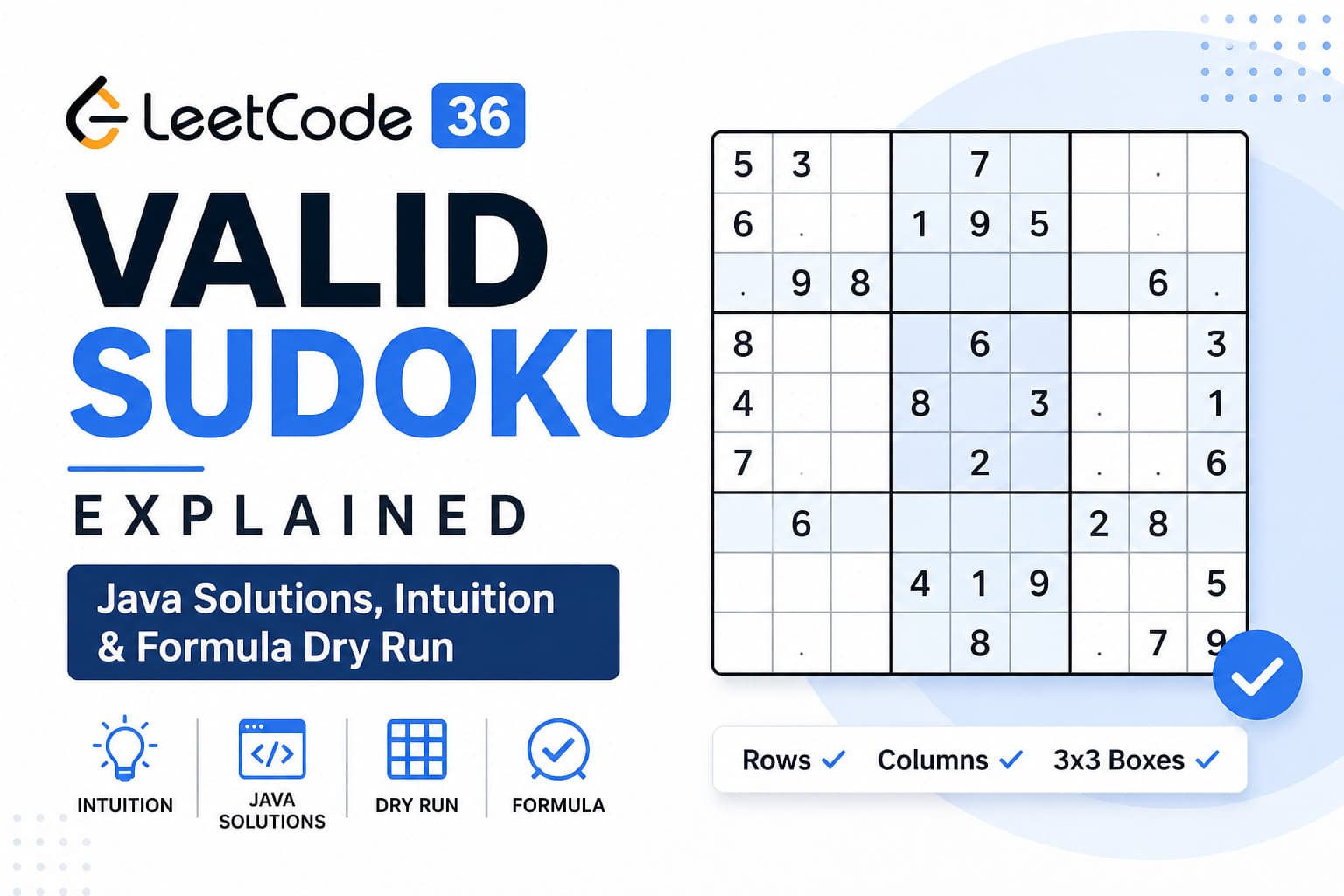
Introduction
Sudoku is a universally beloved puzzle, but validating a Sudoku board
algorithmically is a classic technical interview question. In this post, we are
going to dive deep into LeetCode 36: Valid Sudoku.
We won't just look at the code; we will explore the intuition behind the problem
so you don't have to memorize anything. We’ll cover an ingenious in-place
validation approach, break down the complex math formula used to check
3 \times 3 sub-boxes, and look at an alternative optimal solution using
HashSets.
Let's dive in!
Understanding the Problem
The problem asks us to determine if a partially filled 9 \times 9 Sudoku board
is valid. To be valid, the filled cells must follow three straightforward rules:
1. Each row must contain the digits 1-9 without repetition.
2. Each column must contain the digits 1-9 without repetition.
3. Each of the nine 3 \times 3 sub-boxes must contain the digits 1-9 without
repetition.
Important Note: A valid board doesn't mean the board is fully solvable! We only
care about checking the numbers that are currently on the board.
Intuition: How to Think About the Problem
Before writing code, how do we, as humans, check if a Sudoku board is valid? If
you place a 5 in a cell, you quickly scan horizontally (its row), vertically
(its column), and within its small 3 \times 3 square. If you see another 5, the
board is invalid.
To translate this to code, we have two choices:
1. The Simulation Approach: Go cell by cell. Pick up the number, hide it, and
check its row, column, and 3 \times 3 box to see if that number exists
anywhere else. (This is the approach we will look at first).
2. The Memory Approach: Go cell by cell, but keep a "notebook" (like a Hash
Table) of everything we have seen so far. If we see a number we've already
written down for a specific row, column, or box, it's invalid.
Approach 1: The In-Place Validation (Space-Optimized)
Here is a brilliant solution that validates the board without using any extra
data structures.
The Logic: Iterate through every cell on the board. When we find a number, we
temporarily replace it with a . (empty space). Then, we iterate 9 times to check
its entire row, column, and sub-box. If the number is found, we return false.
Otherwise, we put the number back and move to the next cell.
The Java Code
The Math Breakdown: Demystifying the 3 \times 3 Grid Formula
The hardest part of this code to understand is this exact line: board[3*(i/3) +
m/3][3*(j/3) + m%3]
How does a single loop variable m (from 0 to 8) traverse a 3 \times 3 grid?
Let’s do a dry run.
Step 1: Finding the Starting Point of the Box
The grid is 9 \times 9, broken into nine 3 \times 3 boxes. If we are at a random
cell, say row i = 4, col j = 5, which box are we in? Because integer division in
Java drops the decimal:
- i / 3 = 4 / 3 = 1
- j / 3 = 5 / 3 = 1
Now multiply by 3 to get the actual starting coordinates (top-left corner) of
that specific sub-box:
- 3 * 1 = 3 (Row offset)
- 3 * 1 = 3 (Col offset) So, the 3 \times 3 box starts at row 3, col 3.
Step 2: Traversing the Box (Dry Run)
Now, as m goes from 0 to 8, we use m / 3 for rows and m % 3 for columns:
- m = 0: row offset 0/3 = 0, col offset 0%3 = 0 \rightarrow Checks (3+0, 3+0) = (3, 3)
- m = 1: row offset 1/3 = 0, col offset 1%3 = 1 \rightarrow Checks (3+0, 3+1) = (3, 4)
- m = 2: row offset 2/3 = 0, col offset 2%3 = 2 \rightarrow Checks (3+0, 3+2) = (3, 5)
- m = 3: row offset 3/3 = 1, col offset 3%3 = 0 \rightarrow Checks (3+1, 3+0) = (4, 3)
- m = 4: row offset 4/3 = 1, col offset 4%3 = 1 \rightarrow Checks (3+1, 3+1) = (4, 4)
- ...and so on up to m = 8.
This brilliant math formula maps a 1D loop (0 to 8) directly onto a 2D
3 \times 3 grid perfectly! No nested loops needed inside the isvalid function.
Approach 2: The HashSet Solution (Single Pass)
While the first approach is highly space-efficient, it does a bit of redundant
checking. An alternative approach that interviewers love is using a HashSet.
Instead of checking rows and columns every time we see a number, we generate a
unique "string signature" for every number and attempt to add it to a HashSet.
If we see a 5 at row 0 and col 1, we create three strings:
1. "5 in row 0"
2. "5 in col 1"
3. "5 in block 0-0"
The HashSet.add() method returns false if the item already exists in the set. If
it returns false, we instantly know the board is invalid!
HashSet Java Code:
Notice how we use i/3 + "-" + j/3 to identify the blocks. Top-left is block 0-0,
bottom-right is block 2-2.
Time and Space Complexity Breakdown
Interviewers will always ask for your complexity analysis. Because a Sudoku
board is strictly fixed at 9 \times 9, the strict Big-O is actually constant.
However, let's look at it conceptually as if the board were N \times N.
Approach 1: In-Place Validation (Your Solution)
- Time Complexity: O(1) (Strictly speaking). We traverse 81 cells, and for
each cell, we do at most 9 iterations. 81 \times 9 = 729 operations. Since
729 is a constant, it's O(1). (If the board was N \times N, time complexity
would be O(N^3) because for N^2 cells, we iterate N times).
- Space Complexity: O(1). We only use primitive variables (i, j, k, m, temp).
No extra memory is allocated.
Approach 2: HashSet Approach
- Time Complexity: O(1). We traverse the 81 cells exactly once. Generating
strings and adding to a HashSet takes O(1) time. (If the board was
N \times N, time complexity would be O(N^2)).
- Space Complexity: O(1). The HashSet will store a maximum of
81 \times 3 = 243 strings. Since this upper limit is fixed, space is
constant.
Conclusion
The Valid Sudoku problem is a fantastic exercise in matrix traversal and
coordinate math.
When solving this in an interview:
1. Use the first approach if you want to impress the interviewer with O(1)
space complexity and your deep understanding of math formulas (the /3 and %3
trick).
2. Use the second approach (HashSet) if you want to show off your knowledge of
data structures and write highly readable, clean, and clever code.
I hope this breakdown gives you the intuition needed so you never have to
memorize the code for LeetCode 36!
Happy Coding! Keep Learning🤟