Introduction
Binary tree construction problems are extremely common in coding interviews because they test multiple concepts together:
- Tree data structures
- HashMap usage
- Parent-child relationships
- Graph-style thinking
- Root identification
LeetCode 2196 is an excellent medium-level problem that focuses on constructing a binary tree from parent-child descriptions efficiently.
In this article, we will deeply understand:
- How the tree is formed
- How to identify the root node
- Why HashMap is useful here
- Step-by-step dry run
- Time and space complexity
- Complete optimized Java solution
Problem Statement
You are given a 2D array:
Where:
parentis the parent nodechildis the child nodeisLeft == 1means left childisLeft == 0means right child
Your task is to:
- Construct the binary tree
- Return the root node
Here is the Link to try it now -: Create Binary Tree From Descriptions
Example
Input
Output
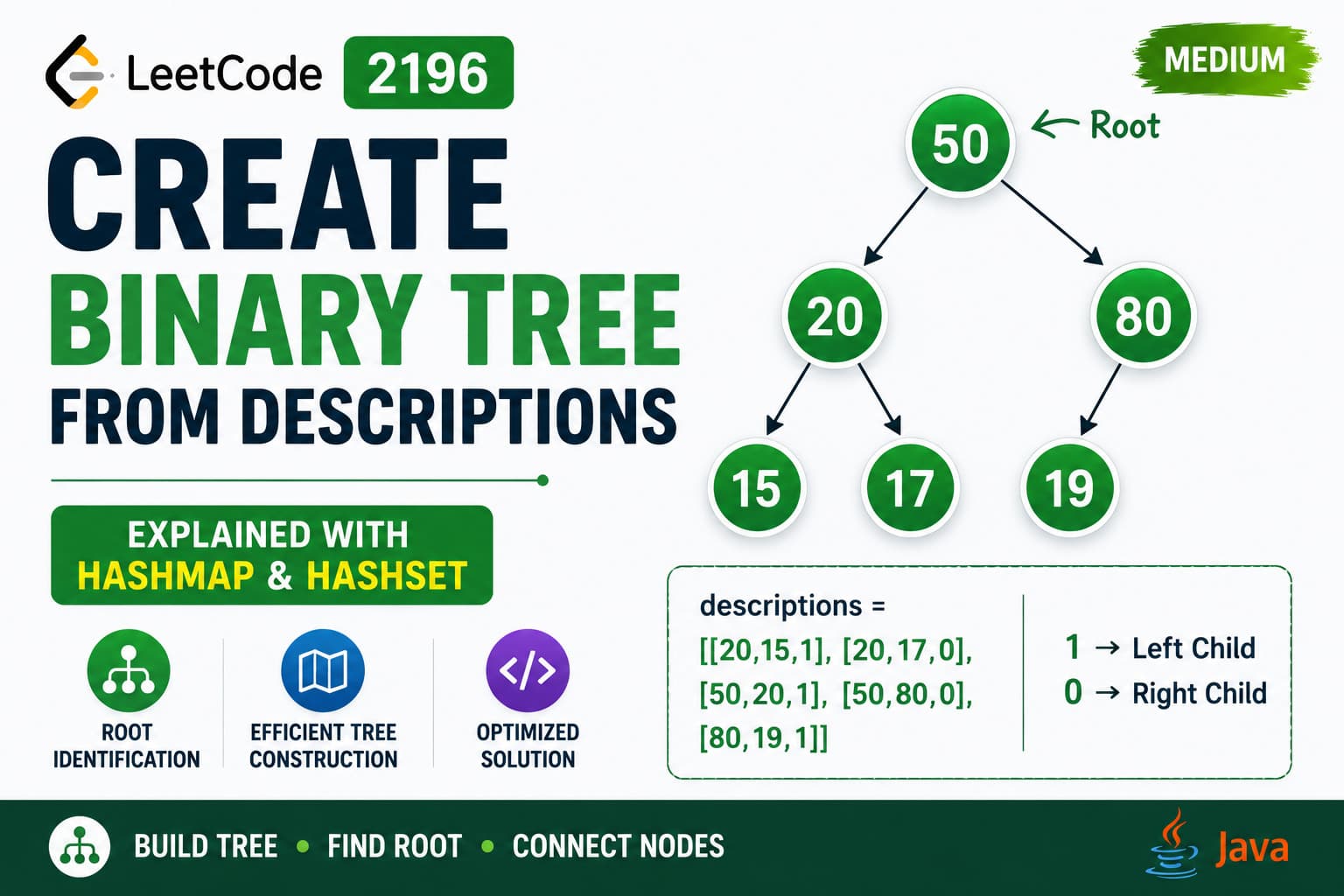
Visual Representation
Key Observation
Every node except the root appears as a child exactly once.
This means:
- Root node never appears in child positions
- If we store all child nodes,
- The node not present in the child set becomes the root
This is the core trick of the problem.
Approach Overview
We solve the problem in 3 steps:
Step 1: Find the Root Node
Store every child node in a HashSet.
Then iterate through descriptions again:
- The parent that never appears as a child is the root.
Step 2: Create Tree Nodes
Use a HashMap:
This prevents duplicate node creation.
Step 3: Connect Parent and Child
Based on:
attach nodes accordingly.
Optimized Java Solution
Step-by-Step Explanation
Step 1: Store All Child Nodes
Every child is stored.
Since root never becomes a child,
it will not exist inside this set.
Step 2: Identify Root
This finds the node that only acts as parent.
That node becomes the root.
Step 3: Create Unique Tree Nodes
Avoids duplicate node creation.
Each value maps to exactly one TreeNode.
Step 4: Connect Parent and Child
or
depending on:
Dry Run
Input
Child Set
Root Detection
Check parents:
- 20 → exists in child set
- 50 → NOT in child set
So:
Tree Construction
50
- left → 20
- right → 80
20
- left → 15
- right → 17
80
- left → 19
Final tree becomes:
Time Complexity
Building Child Set
Finding Root
Constructing Tree
Total Time Complexity
Efficient for large constraints.
Space Complexity
HashMap + HashSet
Why This Problem is Important
This problem teaches:
- Tree construction
- Parent-child mapping
- Root identification
- Efficient object reuse
- HashMap optimization
It is frequently asked in interviews because it combines multiple concepts in one clean implementation.
Common Mistakes
1. Creating Duplicate Nodes
Wrong:
every time.
Always reuse nodes through HashMap.
2. Incorrect Root Detection
Remember:
Root never appears as child.
3. Forgetting Left vs Right Child
Always check:
before attaching.
Interview Tips
In interviews explain:
We first identify the root using a child set, then use a HashMap to create and reuse TreeNode objects efficiently while connecting parent-child relationships.
This demonstrates:
- Strong data structure understanding
- Efficient memory usage
- Clean tree construction logic
Related Problems
Practice these next:
- Construct Binary Tree from Traversals
- Validate Binary Search Tree
- Serialize and Deserialize Binary Tree
- Lowest Common Ancestor
- Binary Tree Level Order Traversal
Conclusion
LeetCode 2196 is a clean and elegant binary tree construction problem.
The major insight is:
The root node is the only node that never appears as a child.
Combined with HashMap-based node reuse, we can construct the entire tree efficiently in linear time.
This is an excellent interview problem for mastering tree construction patterns.