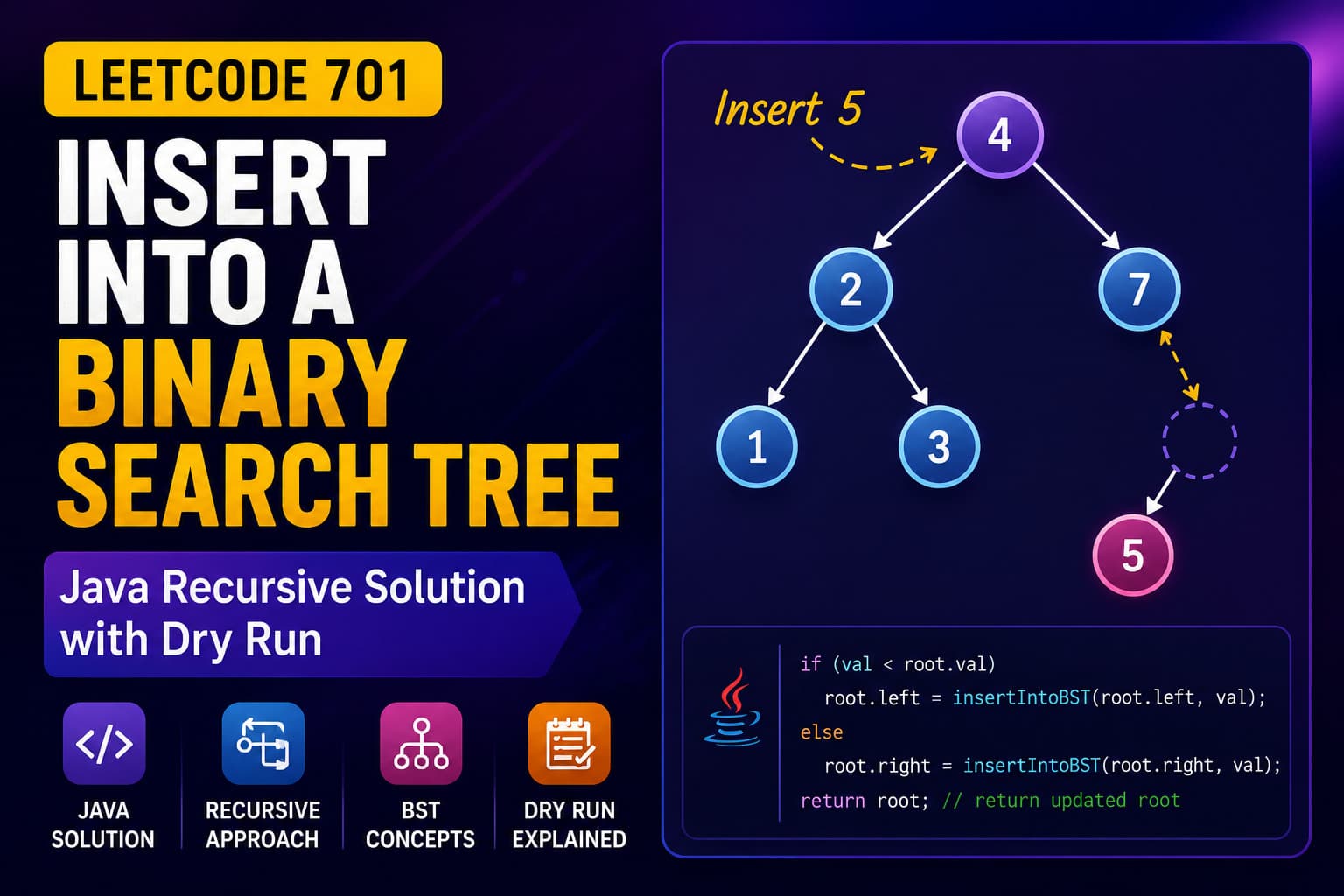
Introduction
LeetCode 701 – Insert into a Binary Search Tree is one of the most important Binary Search Tree problems for coding interviews.
This problem helps developers understand:
- BST properties
- Recursive traversal
- Tree modification
- Node insertion logic
- DFS recursion
It is frequently asked because BST insertion is a foundational concept used in:
- Search operations
- Tree balancing
- Database indexing
- Ordered data structures
Problem Link
🔗 https://leetcode.com/problems/insert-into-a-binary-search-tree/
Problem Statement
You are given:
- Root of a Binary Search Tree
- A value to insert
Return:
The inserted value is guaranteed to be unique.
What is a Binary Search Tree?
A BST follows this rule:
Example:
If we insert:
It becomes:
Key Observation
While traversing:
- If value is smaller → go left
- If value is larger → go right
Eventually:
That is the insertion point.
Intuition
BST insertion behaves exactly like BST search.
We recursively move:
until we find:
Then create the new node there.
Brute Force Thinking
A beginner might think:
- Store tree in array
- Insert value
- Sort again
- Rebuild BST
But rebuilding the tree is unnecessary and inefficient.
BST already provides ordered traversal naturally.
Optimized Recursive Approach
Idea
At every node:
- If value is smaller → insert into left subtree
- Else → insert into right subtree
When root becomes:
create a new node.
Java Solution
Cleaner Recursive Version
Why This Works
BST property guarantees:
So recursion naturally finds the correct insertion position.
When recursion reaches:
we create the new node.
Dry Run
Input
Step 1
Current node:
Since:
move right.
Step 2
Current node:
Since:
move left.
Step 3
Left child is:
Insert:
Final Tree
Time Complexity Analysis
Average Case
Time Complexity
Balanced BST height remains logarithmic.
Space Complexity
due to recursion stack.
Worst Case
If BST becomes skewed:
Then:
Time Complexity
Space Complexity
Recursive vs Iterative
| Approach | Time Complexity | Space Complexity |
| Recursive | O(H) | O(H) |
| Iterative | O(H) | O(1) |
Where:
Iterative Java Solution
Interview Explanation
In interviews, explain:
Binary Search Tree insertion follows BST ordering rules. We recursively traverse left or right depending on the value until we reach a null node, where the new node is inserted.
This demonstrates:
- BST understanding
- Recursive traversal
- Tree manipulation
- DFS logic
Common Mistakes
1. Forgetting to Return Root
Always return original root after insertion.
2. Breaking BST Property
Incorrect comparisons can violate BST ordering.
Correct logic:
3. Missing Base Case
Without:
recursion never stops.
4. Rebuilding Entire Tree
Insertion should modify existing BST directly.
FAQs
Q1. Why use recursion?
BST naturally divides into smaller subtrees.
Recursion simplifies traversal logic.
Q2. Can insertion be iterative?
Yes.
Using loops avoids recursion stack usage.
Q3. Why does BST insertion work efficiently?
Because BST reduces search space at every step.
Q4. Is this problem important for interviews?
Absolutely.
BST insertion is one of the most frequently asked tree concepts.
Conclusion
LeetCode 701 is an excellent BST problem for learning:
- Recursive tree traversal
- BST properties
- Node insertion logic
- DFS recursion
The core insight is:
Move left for smaller values and right for larger values until a null position is found.
Once this becomes intuitive, most BST operations become much easier to solve.