Introduction
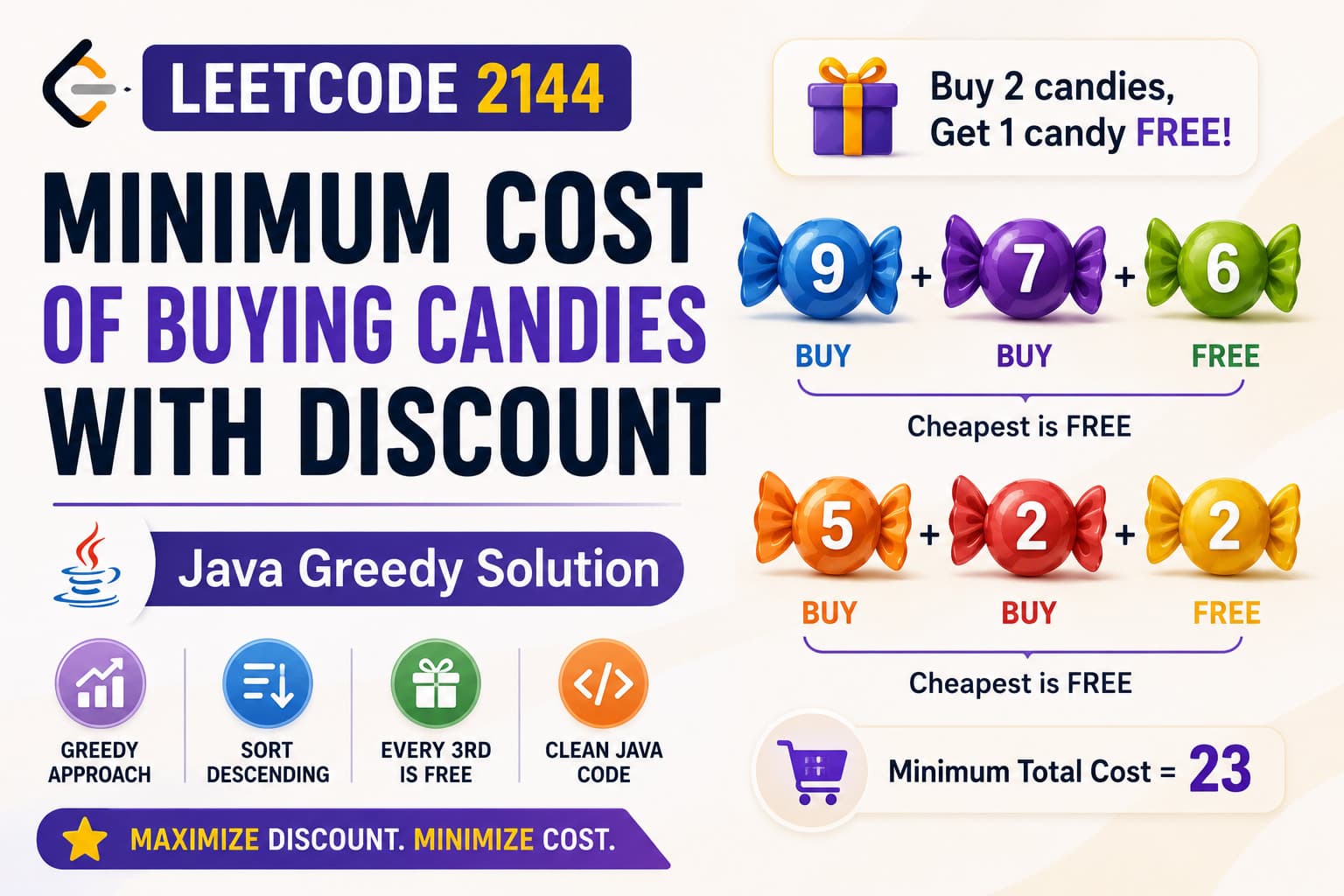
LeetCode 2144 – Minimum Cost of Buying Candies With Discount is a classic greedy + sorting problem.
The question looks simple initially, but the key challenge is understanding:
- Which candies should be free?
- How can we minimize the total payment?
- Why sorting helps?
This is a good beginner-friendly greedy interview problem that teaches how to maximize discounts strategically.
Problem Link
🔗 Minimum Cost of Buying Candies With Discount
Problem Statement
A candy shop offers a discount:
For every two candies bought, you can get one additional candy for free.
Condition:
- The free candy’s price must be less than or equal to the cheaper purchased candy.
You are given an array:
representing candy prices.
Return the minimum total amount needed to buy all candies.
Example 1
Input
Output
Explanation
Buy:
Get:
Total:
Example 2
Input
Output
Intuition
To maximize savings:
The most expensive candies should be grouped together.
Why?
Because every third candy becomes free.
So we want:
- Expensive candies paid
- Cheapest among the group free
Key Greedy Observation
If we sort candies in descending order:
Then:
- Pay 9
- Pay 7
- Get 6 free
Then:
- Pay 5
- Pay 2
- Get 2 free
This produces maximum discount.
Brute Force Approach
Idea
Try every grouping combination:
- Select 2 candies
- Choose possible free candy
- Compute total minimum
Why Brute Force is Bad
The number of combinations becomes huge.
Time complexity becomes exponential.
Not suitable for interviews.
Optimized Greedy Approach
Steps
- Sort candies in descending order
- Traverse array
- Skip every 3rd candy
- Add remaining candies to answer
Java Solution
Cleaner Optimized Version
You can simplify the logic further:
Why This Works
After descending sorting:
Every 3rd candy becomes free.
This guarantees:
Dry Run
Input
Step 1: Sort Descending
Step 2: Traverse
Group 1
Total:
Group 2
Total:
Final Answer
Time Complexity Analysis
Sorting
Traversal
Total Complexity
Space Complexity
Because of extra reversed array.
Optimized Version
Ignoring sorting space.
Interview Explanation
In interviews explain:
To maximize savings, we should make the free candies as expensive as possible. Sorting in descending order ensures every third candy is the maximum eligible free candy.
This demonstrates:
- Greedy thinking
- Sorting optimization
- Mathematical observation skills
Common Mistakes
1. Sorting Ascending
Ascending order gives smaller discounts.
Descending order is necessary.
2. Forgetting Every 3rd Candy is Free
Correct pattern:
Pay, Pay, Free
3. Using Extra Arrays Unnecessarily
You can directly traverse sorted array backward.
4. Incorrect Grouping
Always group expensive candies together.
FAQs
Q1. Why descending sorting?
To maximize free candy value.
Q2. Why skip every third candy?
Because the offer gives:
1 free candy after buying 2
Q3. Can this be solved without sorting?
Not optimally.
Sorting guarantees best grouping.
Q4. Is this a greedy problem?
Yes.
This is a classic greedy sorting optimization problem.
Conclusion
LeetCode 2144 is an excellent beginner greedy problem.
Main learning points:
- Sorting strategy
- Greedy grouping
- Maximizing discounts
- Efficient array traversal
The core insight is:
Sort candies from largest to smallest and make every third candy free.
Once this pattern becomes intuitive, many greedy interview problems become easier to solve.