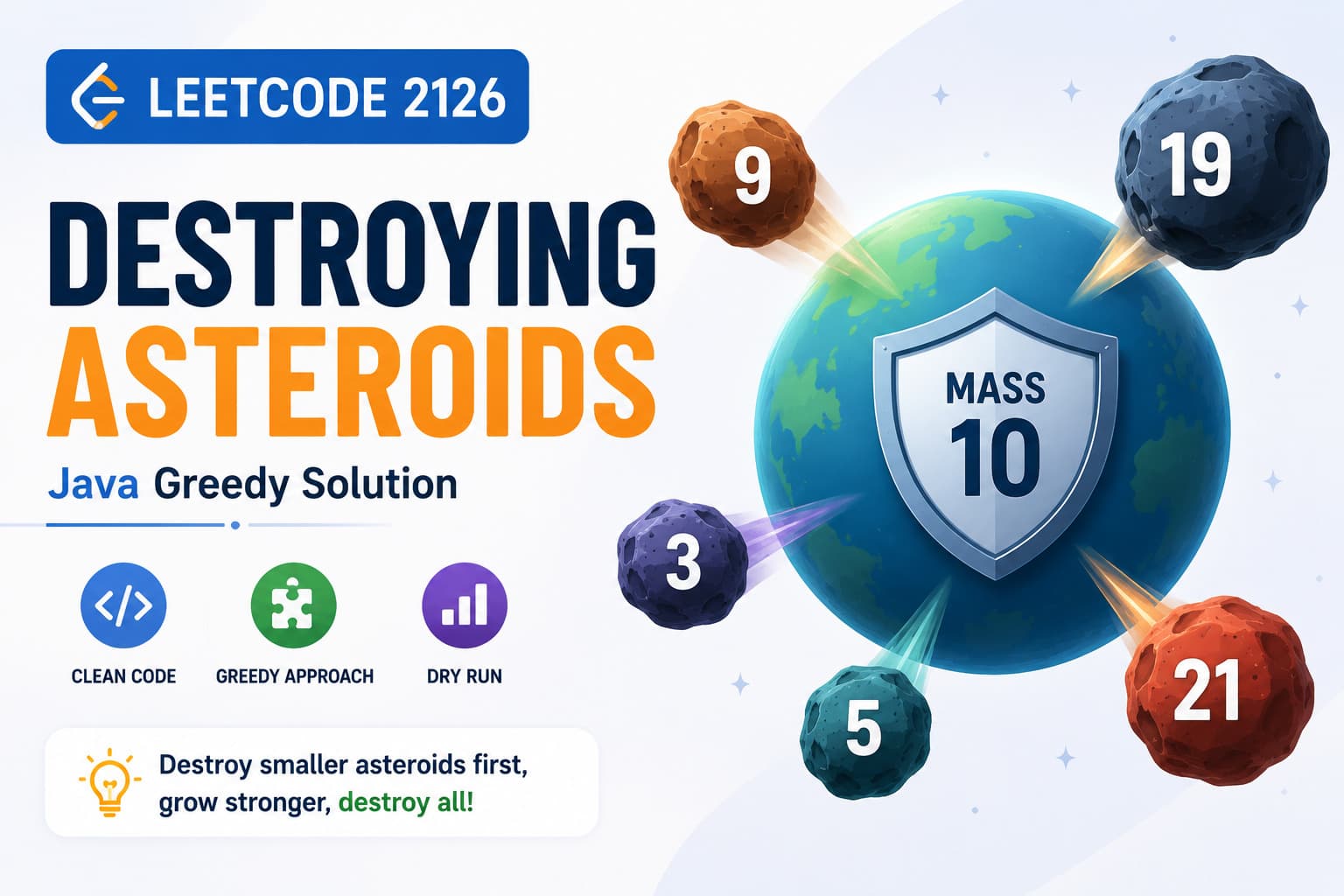
Introduction
LeetCode 2126 – Destroying Asteroids is a classic greedy algorithm problem that tests your ability to:
- Recognize optimal ordering
- Use sorting effectively
- Apply greedy decision-making
- Handle large integer growth
- Understand simulation problems
This is a very interview-friendly problem because the optimal strategy is not immediately obvious.
Problem Link
🔗 https://leetcode.com/problems/destroying-asteroids/
Problem Statement
You are given:
- An integer
massrepresenting the planet’s initial mass - An array
asteroids
Rules:
- If planet mass ≥ asteroid mass → asteroid is destroyed
- Planet gains asteroid mass
- Otherwise → planet gets destroyed
Return:
Example
Input
Output
Key Observation
The most important insight:
Destroy smaller asteroids first.
Why?
Because every destroyed asteroid increases planet mass.
So destroying smaller asteroids early helps you grow enough to destroy larger ones later.
Intuition
Suppose:
If you attack:
You instantly lose.
But if you destroy:
Your mass becomes:
Still not enough for 100.
So answer remains false.
This demonstrates:
Ordering matters.
Greedy Strategy
The optimal strategy is:
Step 1
Sort asteroids in ascending order.
Step 2
Destroy the smallest asteroid possible first.
Step 3
Keep increasing mass.
Why Sorting Works
If you cannot destroy the smallest remaining asteroid:
That is why sorting guarantees the optimal greedy order.
Java Solution
Cleaner Optimized Version
One important improvement:
Use long instead of int.
Why?
Because mass can grow very large.
Optimized Java Solution
Why Use Long?
Constraints allow:
Mass can exceed:
Using long prevents overflow issues.
Dry Run
Input
Step 1: Sort
Step 2: Destroy Asteroids
Destroy 3
Destroy 5
Destroy 9
Destroy 19
Destroy 21
All asteroids destroyed.
Final Output
Brute Force Approach
A brute force approach would try:
This means:
Which is impossible for:
So brute force is completely infeasible.
Why Greedy Is Optimal
Greedy works because:
- Smaller asteroids are easiest to destroy
- They increase mass
- Increased mass helps destroy bigger asteroids
This creates a natural optimal progression.
Time Complexity Analysis
Sorting
Traversal
Total Time Complexity
Space Complexity
Ignoring sorting space.
Interview Explanation
In interviews, explain:
Since destroying an asteroid increases our mass, the optimal strategy is to destroy smaller asteroids first. Sorting ensures we always maximize future growth opportunities.
This demonstrates:
- Greedy thinking
- Sorting optimization
- Simulation handling
- Proof of correctness
Common Mistakes
1. Not Sorting
Without sorting:
2. Using int Instead of long
Mass can overflow.
Always use:
3. Brute Force Permutations
Trying all orders leads to:
which is impossible.
4. Incorrect Early Return
Your logic should only fail when:
FAQs
Q1. Why is sorting necessary?
Sorting guarantees we always destroy the smallest possible asteroid first.
Q2. Is this a greedy problem?
Yes.
The optimal local decision:
leads to global optimality.
Q3. Why use long?
Because mass can grow beyond integer limits.
Q4. Is this asked in interviews?
Yes.
It is a common greedy + sorting interview problem.
Conclusion
LeetCode 2126 is an excellent greedy problem for mastering:
- Sorting-based optimization
- Greedy decision-making
- Simulation problems
- Overflow handling
- Interview reasoning
The key insight is:
Always destroy smaller asteroids first to maximize future mass growth.
Once this greedy intuition becomes natural, many scheduling and optimization problems become easier to solve.