Introduction
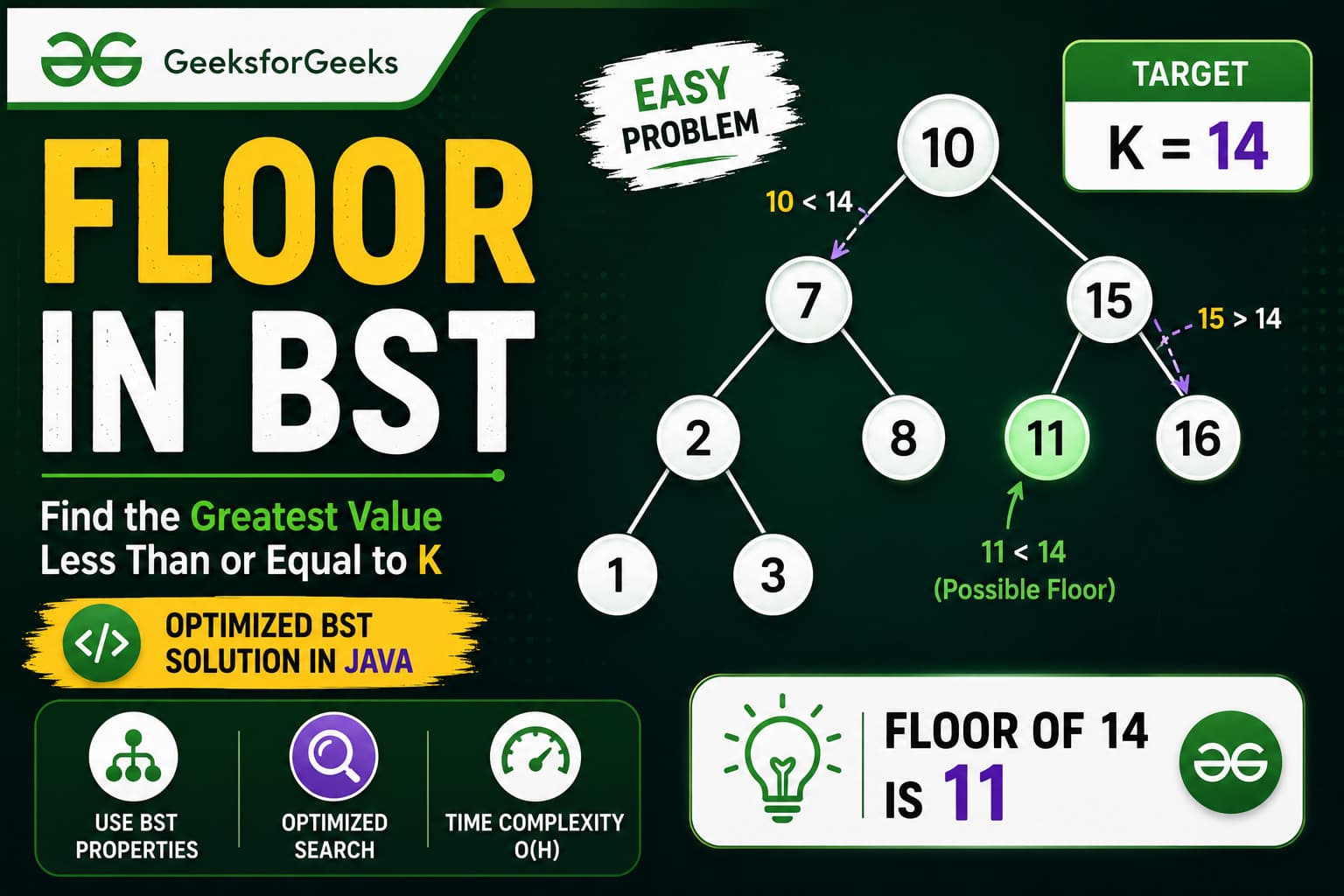
The Floor in BST problem is one of the most important Binary Search Tree interview questions for beginners.
This problem helps you understand:
- BST traversal
- Recursive searching
- Tree optimization
- Decision making using BST properties
- Efficient searching techniques
The main idea is to efficiently find the:
Greatest value smaller than or equal to k.
Problem Link
🔗 GeeksforGeeks – Floor in BST
Problem Statement
Given the root of a Binary Search Tree and an integer:
find the:
The floor of a number is:
The greatest value in the BST that is less than or equal to k.
If no such value exists:
Example 1
Input
Output
Explanation
The largest value smaller than or equal to:
is:
Example 2
Input
Output
Key Observation
Binary Search Tree follows:
This ordering allows optimized searching.
Intuition
Suppose:
and current node is:
Since:
this node can potentially be the floor.
But maybe there exists a larger valid floor in the right subtree.
So:
- Store current node as possible answer
- Move right
BST Logic
Case 1
If:
then exact floor exists.
Return immediately.
Case 2
If:
current node cannot be floor.
Move left.
Case 3
If:
current node becomes possible floor.
Move right to search for larger valid answer.
Brute Force Approach
Idea
Traverse the entire BST:
- Store all values smaller than or equal to k
- Return maximum among them
Brute Force Complexity
Time Complexity
Space Complexity
If storing nodes.
Optimized Recursive BST Approach
Using BST properties:
- Ignore unnecessary branches
- Search efficiently
- Reduce traversal operations
Java Solution
How the Solution Works
Whenever:
the node becomes a possible floor candidate.
But there may exist a larger valid floor in the right subtree.
So:
- Save current node
- Move right
Dry Run
Input
Step 1
Current node:
Since:
Possible floor:
Move right.
Step 2
Current node:
Since:
Move left.
Step 3
Current node:
Since:
Update floor:
Move right.
Step 4
Right child is null.
Return:
Final Answer
Optimized Iterative Approach
The same problem can also be solved iteratively.
Iterative Java Solution
Why Iterative Approach is Better
Advantages:
- Avoids recursion stack
- More memory efficient
- Better for skewed trees
- Preferred in some interviews
Time Complexity Analysis
Best Case
Balanced BST.
Worst Case
Skewed BST.
Space Complexity
Recursive
where H is tree height.
Iterative
extra space.
Interview Explanation
In interviews explain:
Whenever we encounter a node smaller than k, it becomes a possible floor candidate. Then we move right to search for a larger valid floor.
This demonstrates:
- BST property understanding
- Search optimization
- Recursive reasoning
- Efficient traversal
Common Mistakes
1. Traversing Entire Tree
BST ordering already helps reduce search space.
2. Forgetting to Update Floor
Always update:
before moving right.
3. Returning First Smaller Value
Need the:
not any smaller value.
4. Ignoring Exact Match
If:
return immediately.
FAQs
Q1. What is floor in BST?
Largest value smaller than or equal to k.
Q2. Why move right after finding smaller value?
To search for a larger valid floor.
Q3. Can this be solved iteratively?
Yes.
Iterative solution is highly optimized.
Q4. What if floor does not exist?
Return:
Related BST Problems
Practice these next:
Conclusion
Floor in BST is an excellent problem for understanding:
- BST traversal
- Recursive searching
- Search space optimization
- Interview tree concepts
The key insight is:
Whenever a node is smaller than k, it becomes a possible floor candidate, but a larger valid floor may still exist in the right subtree.
Mastering this logic makes many BST interview problems much easier.