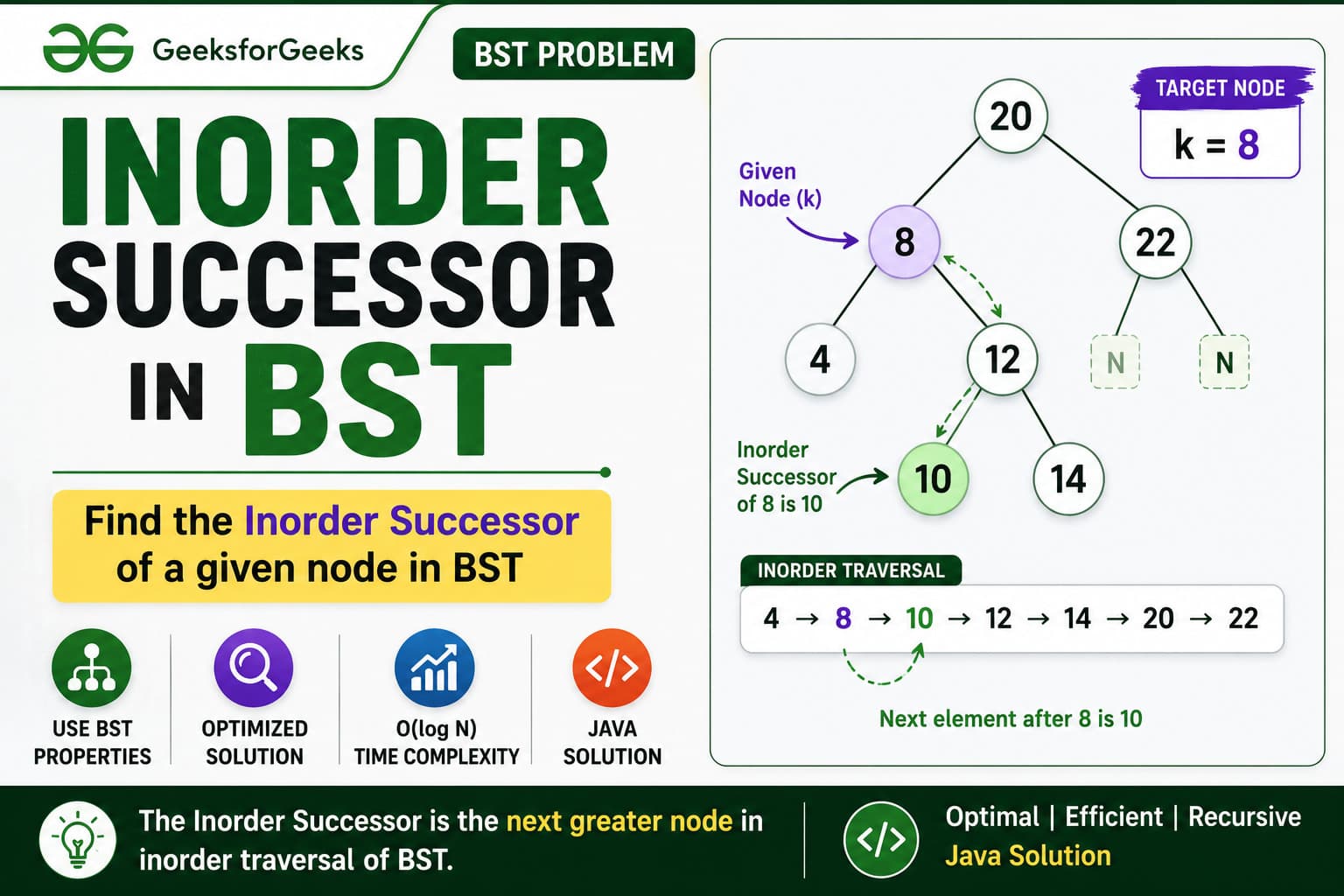
Introduction
The Inorder Successor in BST problem is one of the most important Binary Search Tree interview questions asked in coding interviews and online coding platforms like GeeksforGeeks.
This problem tests your understanding of:
- Binary Search Tree properties
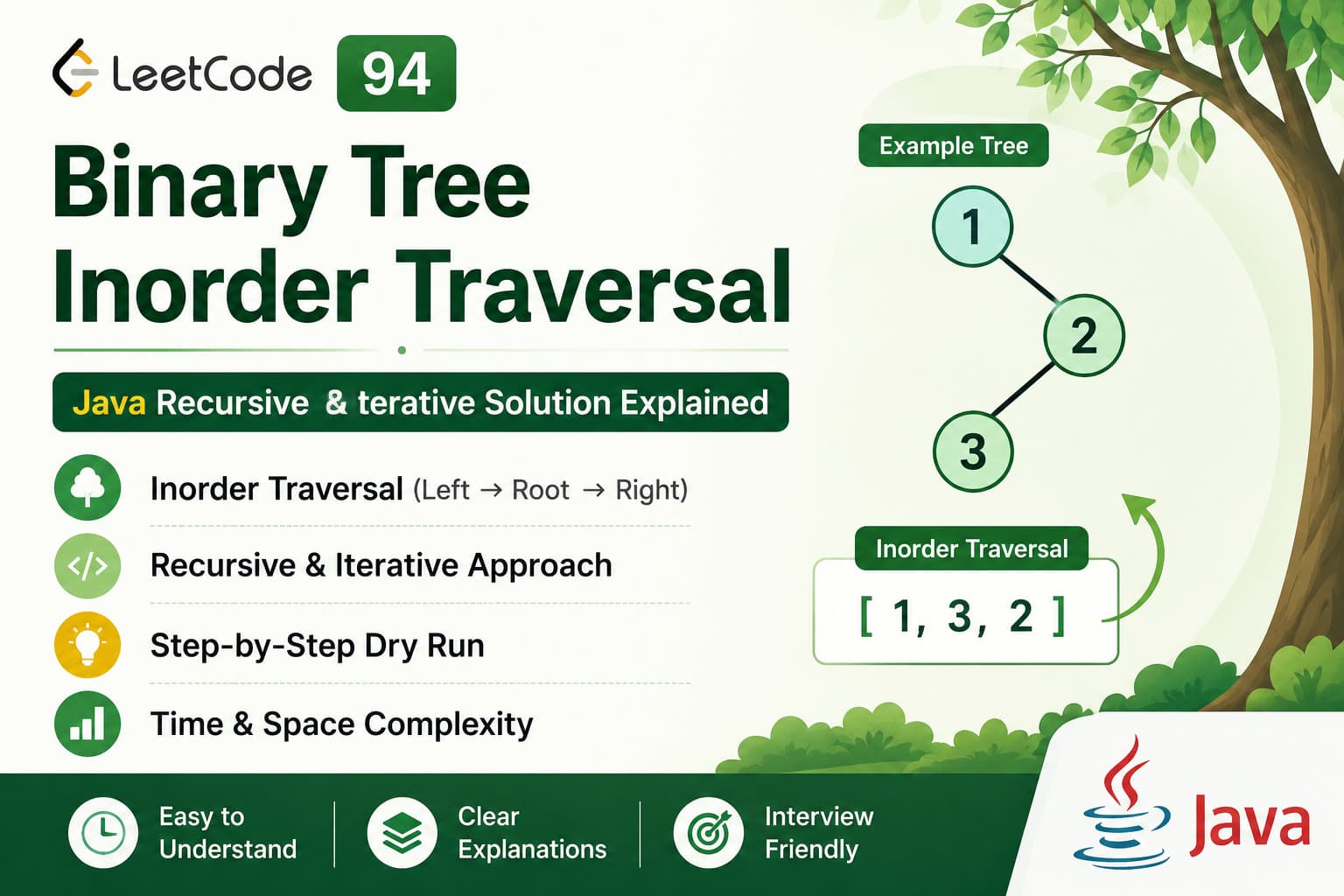
- Inorder traversal
- Recursive searching
- Tree optimization techniques
- Successor logic in BST
Understanding this problem properly helps in solving many advanced BST questions efficiently.
Problem Link
🔗 GeeksforGeeks – Inorder Successor in BST
Problem Statement
Given:
- A Binary Search Tree
- A reference node
k
Find the:
of that node.
What is Inorder Successor?
The inorder successor of a node is:
The next greater node in the inorder traversal of the BST.
Example 1
Input
Inorder Traversal
Output
Example 2
Input
Inorder Traversal
Output
Key BST Observation
In a BST:
The inorder traversal of BST is always:
This property helps us optimize the search.
Intuition
Suppose:
and current node is:
Since:
this node can potentially be the inorder successor.
But there may exist a smaller valid successor in the left subtree.
So:
- Store current node as possible answer
- Move left
Brute Force Approach
Idea
- Perform inorder traversal
- Store traversal in list
- Find node
k - Return next element
Brute Force Java Solution
Brute Force Complexity
Time Complexity
Space Complexity
because of traversal list.
Optimized BST Approach
Instead of traversing the entire tree:
- Use BST properties
- Reduce unnecessary traversal
- Search efficiently
Optimized Java Solution
How This Solution Works
Whenever:
the current node becomes a possible successor candidate.
But there may exist a smaller valid successor in the left subtree.
So:
- Store current node
- Move left
Why Move Right Otherwise?
If:
then current node cannot be successor.
Move right to search for larger values.
Dry Run
Input
Step 1
Current node:
Since:
possible successor:
Move left.
Step 2
Current node:
Since:
Move right.
Step 3
Current node:
Since:
update successor:
Move left.
Step 4
Current node:
Since:
update successor:
Move left.
Step 5
Node becomes null.
Return:
Final Answer
Alternative Inorder Traversal Approach
Another common approach:
- Perform inorder traversal
- Track previous node
- When previous node becomes
k, current node is successor
Alternative Recursive Solution
Time Complexity Analysis
Optimized BST Solution
Best Case
Balanced BST.
Worst Case
Skewed BST.
Space Complexity
Recursive Stack
where:
Interview Explanation
In interviews explain:
Whenever we encounter a node greater than k, it becomes a possible inorder successor candidate. Then we move left to search for a smaller valid successor.
This demonstrates:
- BST optimization understanding
- Recursive traversal logic
- Efficient searching skills
Common Mistakes
1. Traversing Entire Tree Unnecessarily
BST property already reduces search space.
2. Returning First Greater Node
Need the:
not any greater node.
3. Forgetting Candidate Update
Always update candidate before moving left.
4. Confusing Floor/Ceil Logic
Successor logic is different from:
- Floor
- Ceil
- Predecessor
FAQs
Q1. What is inorder successor?
The next greater node in inorder traversal.
Q2. Why BST helps optimization?
BST ordering allows skipping unnecessary branches.
Q3. Can inorder successor be absent?
Yes.
If node is largest element, answer is:
Q4. Can this be solved iteratively?
Yes.
Iterative solution is also common in interviews.
Related BST Problems
Practice these next:
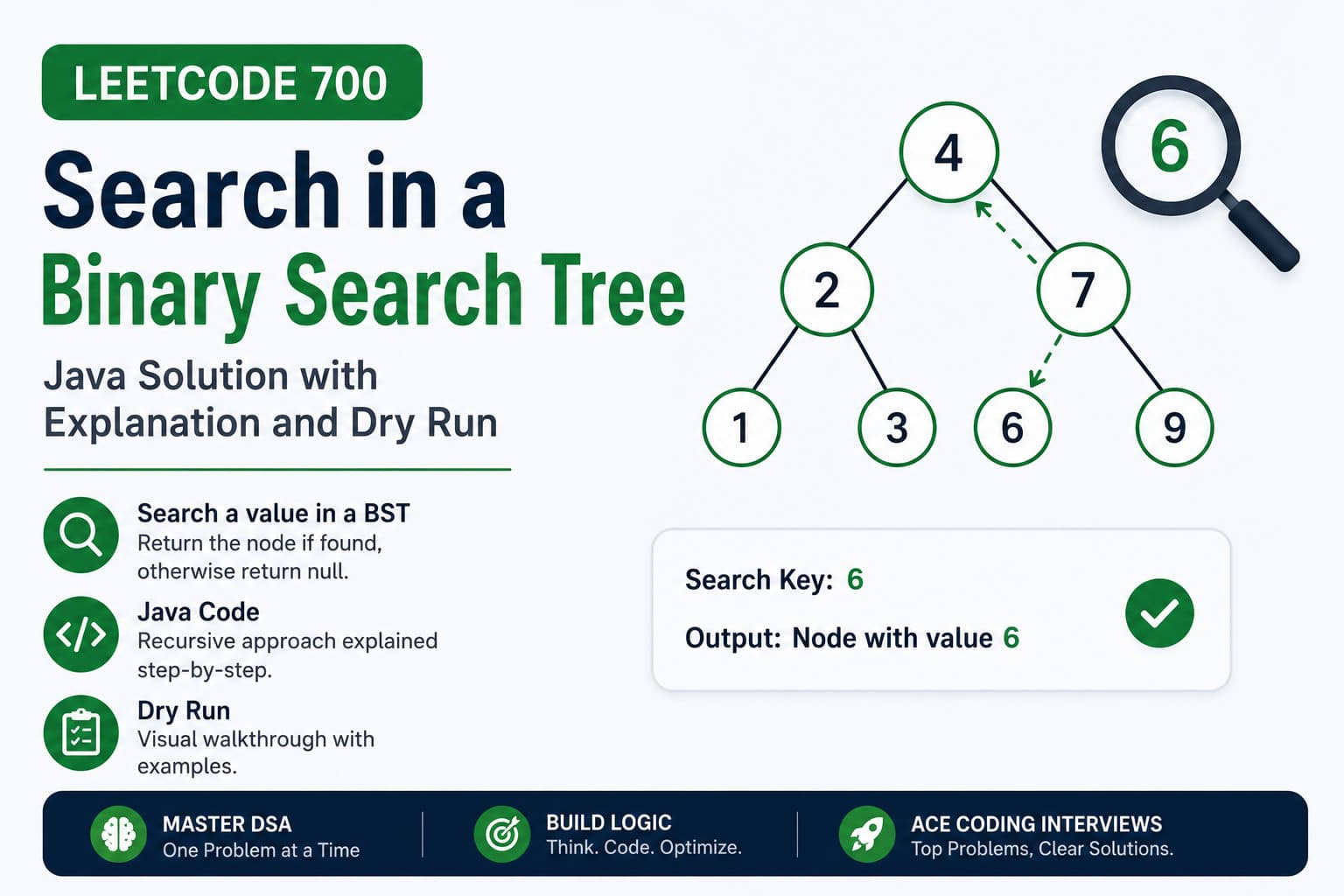
- Search in BST
- Ceil in BST
- Floor in BST
- Validate BST
- Lowest Common Ancestor in BST
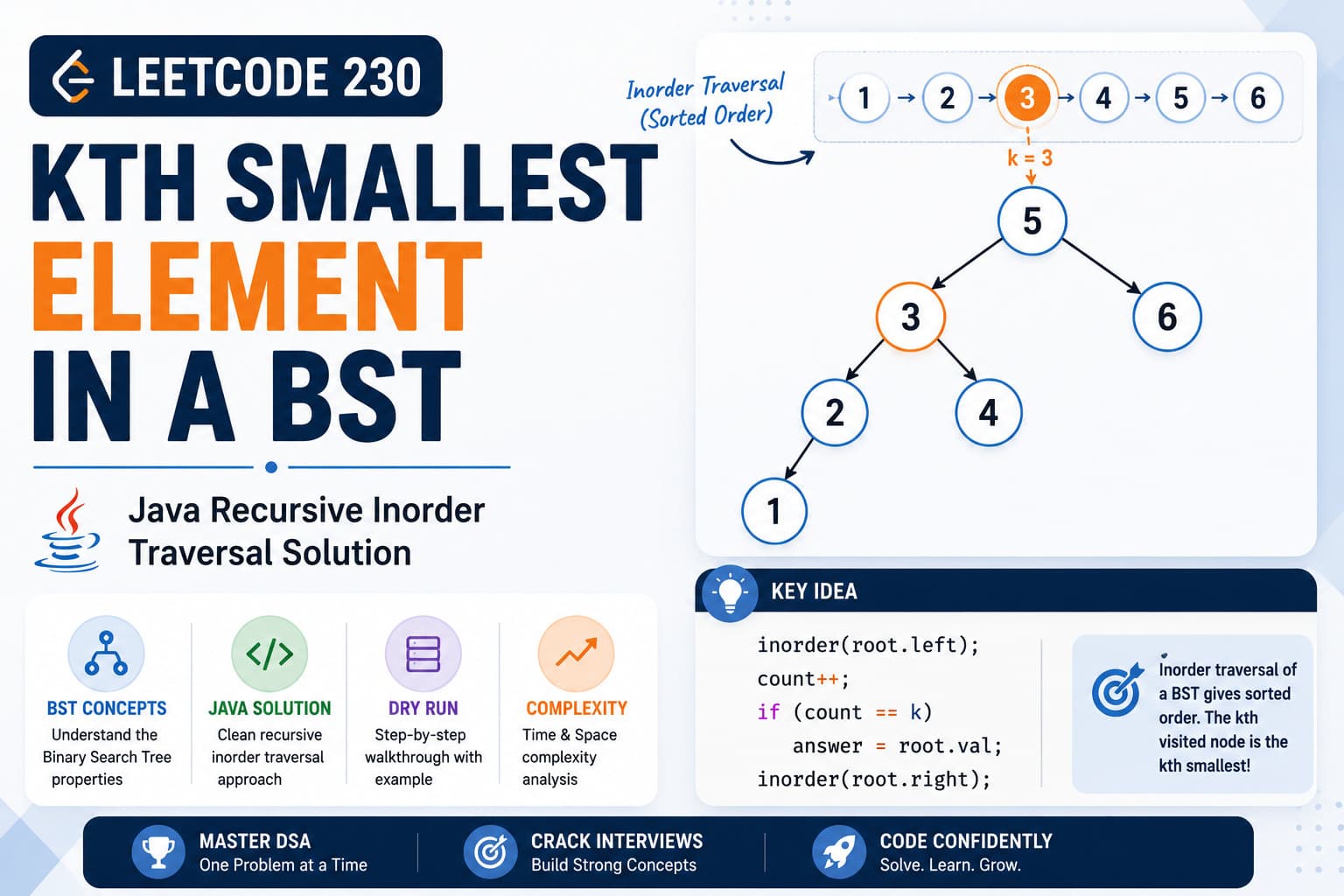
- Kth Smallest Element in BST
Conclusion
Inorder Successor in BST is a very important interview problem because it teaches:
- BST optimization
- Recursive searching
- Successor logic
- Tree traversal efficiency
The key idea is:
Whenever a node is greater than k, it becomes a possible successor candidate, but a smaller valid successor may still exist in the left subtree.
Mastering this logic makes advanced BST problems significantly easier.