Search Blogs

Showing results for "Iterative Approach"

Found 50 results

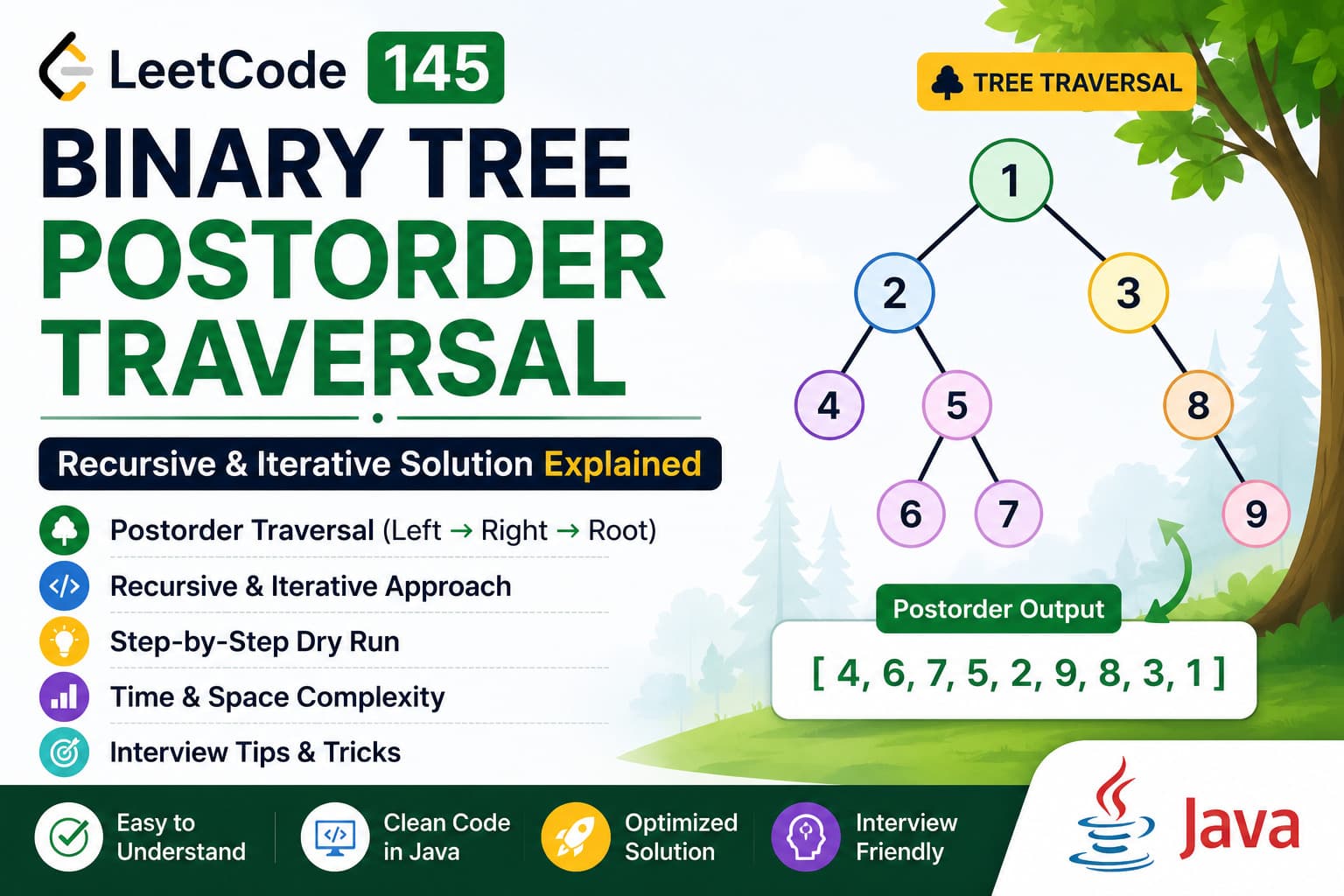
Subsets Problem (LeetCode 78) Explained | Recursion, Iterative & Bit Manipulation

Subsets Problem (LeetCode 78) Explained | Recursion, Iterative & Bit Manipulation

IntroductionThe Subsets problem (LeetCode 78) is one of the most fundamental and frequently asked questions in coding interviews. It introduces the concept of generating a power set, which is a core idea in recursion, backtracking, and combinatorics.Mastering this problem helps in solving a wide range of advanced problems like combinations, permutations, and decision-based recursion.In this article, we will explore:Intuition behind subsetsRecursive (backtracking) approachIterative (loop-based) approachBit manipulation approachTime and space complexity analysisProblem StatementGiven an integer array nums of unique elements, return all possible subsets (the power set).Key PointsEach element can either be included or excludedNo duplicate subsetsReturn subsets in any orderExamplesExample 1Input:nums = [1, 2, 3]Output:[[], [1], [2], [1,2], [3], [1,3], [2,3], [1,2,3]]Example 2Input:nums = [0]Output:[[], [0]]Key InsightFor each element, there are two choices:Include it OR Exclude itSo total subsets:2^nThis makes it a binary decision tree problem, very similar to:Permutation with SpacesBinary choices recursionBacktracking problemsApproach 1: Recursion + Backtracking (Most Important)IntuitionAt each index:Skip the elementInclude the elementBuild subsets step by step and backtrack.Java Code (With Explanation)import java.util.*;class Solution { List<List<Integer>> liss = new ArrayList<>(); void solve(int[] an, int ind, List<Integer> lis) { // Base case: reached end → one subset formed if (ind == an.length) { liss.add(new ArrayList<>(lis)); // store copy return; } // Choice 1: Do NOT include current element solve(an, ind + 1, lis); // Choice 2: Include current element lis.add(an[ind]); solve(an, ind + 1, lis); // Backtrack: remove last added element lis.remove(lis.size() - 1); } public List<List<Integer>> subsets(int[] nums) { List<Integer> lis = new ArrayList<>(); solve(nums, 0, lis); return liss; }}Dry Run (nums = [1,2])Start: [] → skip 1 → [] → skip 2 → [] → take 2 → [2] → take 1 → [1] → skip 2 → [1] → take 2 → [1,2]Final Output:[], [2], [1], [1,2]Approach 2: Iterative (Loop-Based)IntuitionStart with an empty subset:[ [] ]For each element:Add it to all existing subsetsCodeimport java.util.*;class Solution { public List<List<Integer>> subsets(int[] nums) { List<List<Integer>> result = new ArrayList<>(); result.add(new ArrayList<>()); for (int num : nums) { int size = result.size(); for (int i = 0; i < size; i++) { List<Integer> temp = new ArrayList<>(result.get(i)); temp.add(num); result.add(temp); } } return result; }}How It WorksFor [1,2,3]:Start: [[]]Add 1 → [[], [1]]Add 2 → [[], [1], [2], [1,2]]Add 3 → [[], [1], [2], [1,2], [3], [1,3], [2,3], [1,2,3]]Approach 3: Bit ManipulationIntuitionEach subset can be represented using a binary number:For n = 3:000 → []001 → [1]010 → [2]011 → [1,2]...Codeimport java.util.*;class Solution { public List<List<Integer>> subsets(int[] nums) { List<List<Integer>> result = new ArrayList<>(); int n = nums.length; int total = 1 << n; // 2^n for (int i = 0; i < total; i++) { List<Integer> subset = new ArrayList<>(); for (int j = 0; j < n; j++) { if ((i & (1 << j)) != 0) { subset.add(nums[j]); } } result.add(subset); } return result; }}Complexity AnalysisApproachTime ComplexitySpace ComplexityRecursionO(2^n)O(n) stackIterativeO(2^n)O(2^n)Bit ManipulationO(2^n)O(2^n)Why All Approaches Are O(2ⁿ)Because:Total subsets = 2ⁿEach subset takes up to O(n) to constructWhen to Use Which ApproachRecursion / Backtracking → Best for interviews (easy to explain)Iterative → Clean and beginner-friendlyBit Manipulation → Best for optimization & advanced understandingKey TakeawaysSubsets = power set problemEvery element → 2 choicesThink in terms of decision treesBacktracking = build + undo (add/remove)Common Interview VariationsSubsets with duplicatesCombination sumPermutationsK-sized subsetsConclusionThe Subsets problem is a foundational DSA concept that appears across many interview questions. Understanding all approaches—especially recursion and iterative expansion—gives a strong base for solving complex backtracking problems.If you master this pattern, you unlock a whole category of problems in recursion and combinatorics.Frequently Asked Questions (FAQs)1. Why are there 2ⁿ subsets?Because each element has 2 choices: include or exclude.2. Which approach is best for interviews?Recursion + backtracking is the most preferred.3. Is bit manipulation important?Yes, it helps in optimizing and understanding binary patterns.
LeetCodeMediumJavaRecursionBacktracking
LeetCode 145: Binary Tree Postorder Traversal – Java Recursive & Iterative Solution Explained

LeetCode 145: Binary Tree Postorder Traversal – Java Recursive & Iterative Solution Explained

IntroductionLeetCode 145 – Binary Tree Postorder Traversal is one of the most important tree traversal problems for beginners learning Data Structures and Algorithms.This problem teaches:Binary Tree TraversalDepth First Search (DFS)RecursionStack-based traversalTree traversal patternsPostorder traversal is extremely useful in advanced tree problems such as:Tree deletionExpression tree evaluationBottom-up computationsDynamic programming on treesProblem Link🔗 https://leetcode.com/problems/binary-tree-postorder-traversal/Problem StatementGiven the root of a binary tree, return the postorder traversal of its nodes' values.What is Postorder Traversal?In postorder traversal, nodes are visited in this order:Left → Right → RootUnlike preorder or inorder traversal, the root node is processed at the end.ExampleInputroot = [1,null,2,3]Tree Structure:1\2/3Postorder TraversalTraversal order:3 → 2 → 1Output:[3,2,1]Recursive Approach (Most Common)IntuitionIn postorder traversal:Traverse left subtreeTraverse right subtreeVisit current nodeThis naturally fits recursion because trees themselves are recursive structures.Recursive DFS VisualizationTraversal pattern:Left → Right → RootRecursive function:postorder(node.left)postorder(node.right)visit(node)Java Recursive Solution/*** Definition for a binary tree node.* public class TreeNode {* int val;* TreeNode left;* TreeNode right;* }*/class Solution {public void solve(List<Integer> list, TreeNode root) {if(root == null) return;solve(list, root.left);solve(list, root.right);list.add(root.val);}public List<Integer> postorderTraversal(TreeNode root) {List<Integer> list = new ArrayList<>();solve(list, root);return list;}}Dry Run – Recursive ApproachTree:1\2/3Step 1Start at:1Move left:nullReturn back.Step 2Move right to:2Move left to:3Left and right of 3 are null.Add:3Step 3Return to:2Add:2Step 4Return to:1Add:1Final Answer[3,2,1]Time Complexity – RecursiveTime ComplexityO(N)Every node is visited once.Space ComplexityO(H)Where:H = height of the treeRecursive call stack uses extra spaceWorst case:O(N)for skewed trees.Iterative Approach (Interview Follow-Up)The follow-up asks:Can you solve it iteratively?Yes.We use stacks to simulate recursion.Iterative Postorder IntuitionPostorder traversal order is:Left → Right → RootOne common trick is:Traverse in modified preorder:Root → Right → LeftReverse the result.After reversing, we get:Left → Right → Rootwhich is postorder traversal.Stack-Based Iterative LogicAlgorithmPush root into stack.Pop node.Add node value to answer.Push left child.Push right child.Reverse final answer.Java Iterative Solutionclass Solution {public List<Integer> postorderTraversal(TreeNode root) {LinkedList<Integer> ans = new LinkedList<>();if(root == null) return ans;Stack<TreeNode> stack = new Stack<>();stack.push(root);while(!stack.isEmpty()) {TreeNode node = stack.pop();ans.addFirst(node.val);if(node.left != null) {stack.push(node.left);}if(node.right != null) {stack.push(node.right);}}return ans;}}Dry Run – Iterative ApproachTree:1\2/3Step 1Push:1Step 2Pop:1Add at front:[1]Push right child:2Step 3Pop:2Add at front:[2,1]Push left child:3Step 4Pop:3Add at front:[3,2,1]Final Answer[3,2,1]Comparison of ApproachesApproachAdvantagesDisadvantagesRecursiveEasy to understandUses recursion stackIterativeBetter interview practiceSlightly harder logicInterview ExplanationIn interviews, explain:Postorder traversal processes nodes in Left → Right → Root order. Recursion naturally handles this traversal. Iteratively, we simulate recursion using a stack and reverse traversal order.This demonstrates strong tree traversal understanding.Common Mistakes1. Wrong Traversal OrderIncorrect:Root → Left → RightThat is preorder traversal.Correct postorder:Left → Right → Root2. Forgetting Null Base CaseAlways check:if(root == null) return;3. Incorrect Stack Push OrderFor iterative solution:Push left firstPush right secondbecause we reverse the result later.FAQsQ1. Why is postorder traversal useful?It is used in:Tree deletionExpression tree evaluationBottom-up dynamic programmingCalculating subtree informationQ2. Which approach is preferred in interviews?Recursive is simpler.Iterative is often asked as a follow-up.Q3. Can postorder traversal be done without stack or recursion?Yes.Using Morris Traversal.Q4. What is the difference between preorder, inorder, and postorder?TraversalOrderPreorderRoot → Left → RightInorderLeft → Root → RightPostorderLeft → Right → RootBonus: Morris Postorder TraversalMorris traversal performs tree traversal using:O(1)extra space.This is considered an advanced interview topic.ConclusionLeetCode 145 is an excellent beginner-friendly tree traversal problem.It teaches:DFS traversalRecursionStack simulationBinary tree fundamentalsThe key postorder pattern is:Left → Right → RootMastering this traversal helps in solving many advanced tree problems such as:Tree DPTree deletionExpression evaluationSubtree calculationsAdvanced DFS problems

LeetCodeBinary Tree Postorder TraversalBinary TreeTree TraversalJavaDFSStackRecursionEasy
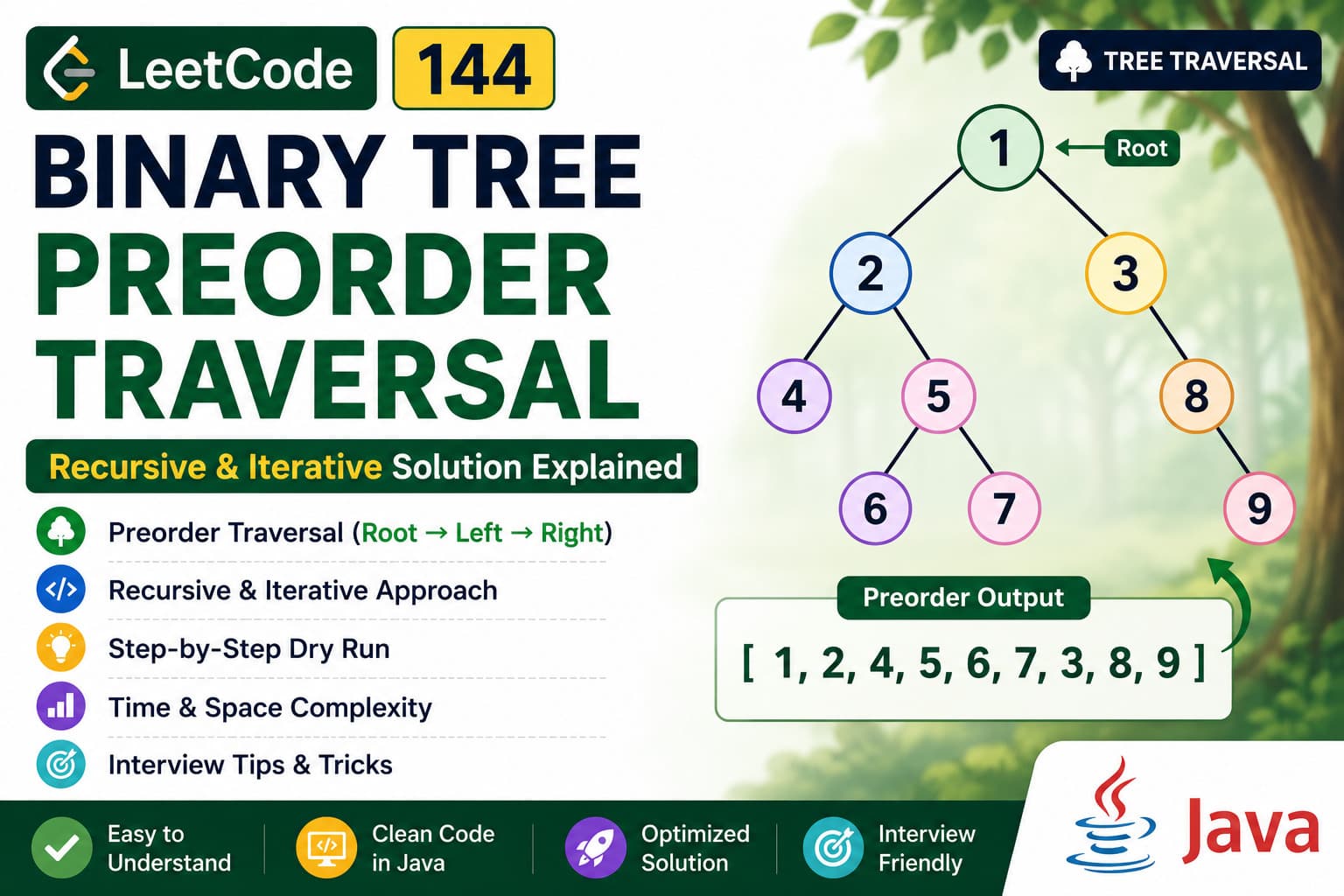
LeetCode 144: Binary Tree Preorder Traversal – Java Recursive & Iterative Solution Explained

LeetCode 144: Binary Tree Preorder Traversal – Java Recursive & Iterative Solution Explained

IntroductionLeetCode 144 – Binary Tree Preorder Traversal is one of the most important beginner-friendly tree traversal problems in Data Structures and Algorithms.This problem helps you understand:Binary Tree TraversalDepth First Search (DFS)RecursionStack-based traversalTree traversal patternsPreorder traversal is widely used in:Tree copyingSerializationExpression treesDFS-based problemsHierarchical data processingIt is also one of the most commonly asked tree problems in coding interviews.Problem Link🔗 ProblemLeetCode 144: Binary Tree Preorder TraversalOfficial Problem:LeetCode Problem LinkProblem StatementGiven the root of a binary tree, return the preorder traversal of its nodes' values.What is Preorder Traversal?In preorder traversal, nodes are visited in this order:Root → Left → RightThe root node is processed first before traversing subtrees.ExampleInputroot = [1,null,2,3]Tree Structure:1\2/3Preorder TraversalTraversal order:1 → 2 → 3Output:[1,2,3]Recursive Approach (Most Common)IntuitionIn preorder traversal:Visit current nodeTraverse left subtreeTraverse right subtreeThis naturally fits recursion because trees themselves are recursive structures.Recursive DFS VisualizationTraversal pattern:Root → Left → RightRecursive function:visit(node)preorder(node.left)preorder(node.right)Java Recursive Solution/*** Definition for a binary tree node.* public class TreeNode {* int val;* TreeNode left;* TreeNode right;* }*/class Solution {public void solve(List<Integer> list, TreeNode root) {if(root == null) return;list.add(root.val);solve(list, root.left);solve(list, root.right);}public List<Integer> preorderTraversal(TreeNode root) {List<Integer> list = new ArrayList<>();solve(list, root);return list;}}Dry Run – Recursive ApproachTree:1\2/3Step 1Start at:1Add:1Move right to:2Step 2Add:2Move left to:3Step 3Add:3Final Answer[1,2,3]Time Complexity – RecursiveTime ComplexityO(N)Every node is visited once.Space ComplexityO(H)Where:H = height of treeRecursive call stack uses extra spaceWorst case:O(N)for skewed trees.Iterative Approach (Interview Follow-Up)The follow-up asks:Can you solve it iteratively?Yes.We use a stack to simulate recursion.Iterative Preorder IntuitionPreorder traversal order is:Root → Left → RightUsing a stack:Process current node immediatelyPush right child firstPush left child secondWhy?Because stacks follow:Last In First Out (LIFO)So left subtree gets processed first.Stack-Based Iterative LogicAlgorithmPush root into stack.Pop node.Add node value.Push right child.Push left child.Repeat until stack becomes empty.Java Iterative Solutionclass Solution {public List<Integer> preorderTraversal(TreeNode root) {List<Integer> ans = new ArrayList<>();if(root == null) return ans;Stack<TreeNode> stack = new Stack<>();stack.push(root);while(!stack.isEmpty()) {TreeNode node = stack.pop();ans.add(node.val);if(node.right != null) {stack.push(node.right);}if(node.left != null) {stack.push(node.left);}}return ans;}}Dry Run – Iterative ApproachTree:1\2/3Step 1Push:1Step 2Pop:1Add:[1]Push right child:2Step 3Pop:2Add:[1,2]Push left child:3Step 4Pop:3Add:[1,2,3]Final Answer[1,2,3]Comparison of ApproachesApproachAdvantagesDisadvantagesRecursiveEasy to understandUses recursion stackIterativeBetter interview practiceSlightly harder logicInterview ExplanationIn interviews, explain:Preorder traversal processes nodes in Root → Left → Right order. Recursion naturally handles this traversal. Iteratively, we use a stack and push the right child before the left child so the left subtree gets processed first.This demonstrates strong DFS and stack understanding.Common Mistakes1. Wrong Traversal OrderIncorrect:Left → Root → RightThat is inorder traversal.Correct preorder:Root → Left → Right2. Forgetting Null Base CaseAlways check:if(root == null) return;3. Wrong Stack Push OrderFor iterative traversal:Push right firstPush left secondOtherwise traversal order becomes incorrect.FAQsQ1. Why is preorder traversal useful?It is heavily used in:Tree cloningSerializationDFS traversalExpression treesQ2. Which approach is preferred in interviews?Recursive is simpler.Iterative is often asked as a follow-up.Q3. Can preorder traversal be done without stack or recursion?Yes.Using Morris Traversal.Q4. What is the difference between preorder, inorder, and postorder?TraversalOrderPreorderRoot → Left → RightInorderLeft → Root → RightPostorderLeft → Right → RootBonus: Morris Preorder TraversalMorris traversal performs preorder traversal using:O(1)extra space.This is considered an advanced interview topic.ConclusionLeetCode 144 is one of the most fundamental binary tree traversal problems.It teaches:DFS traversalRecursionStack simulationBinary tree fundamentalsThe key preorder pattern is:Root → Left → RightMastering this traversal builds a strong foundation for advanced tree problems such as:Tree serializationDFS-based problemsTree reconstructionExpression treesMorris traversal

LeetCodeBinary Tree Preorder TraversalBinary TreeTree TraversalJavaDFSStackRecursionEasy
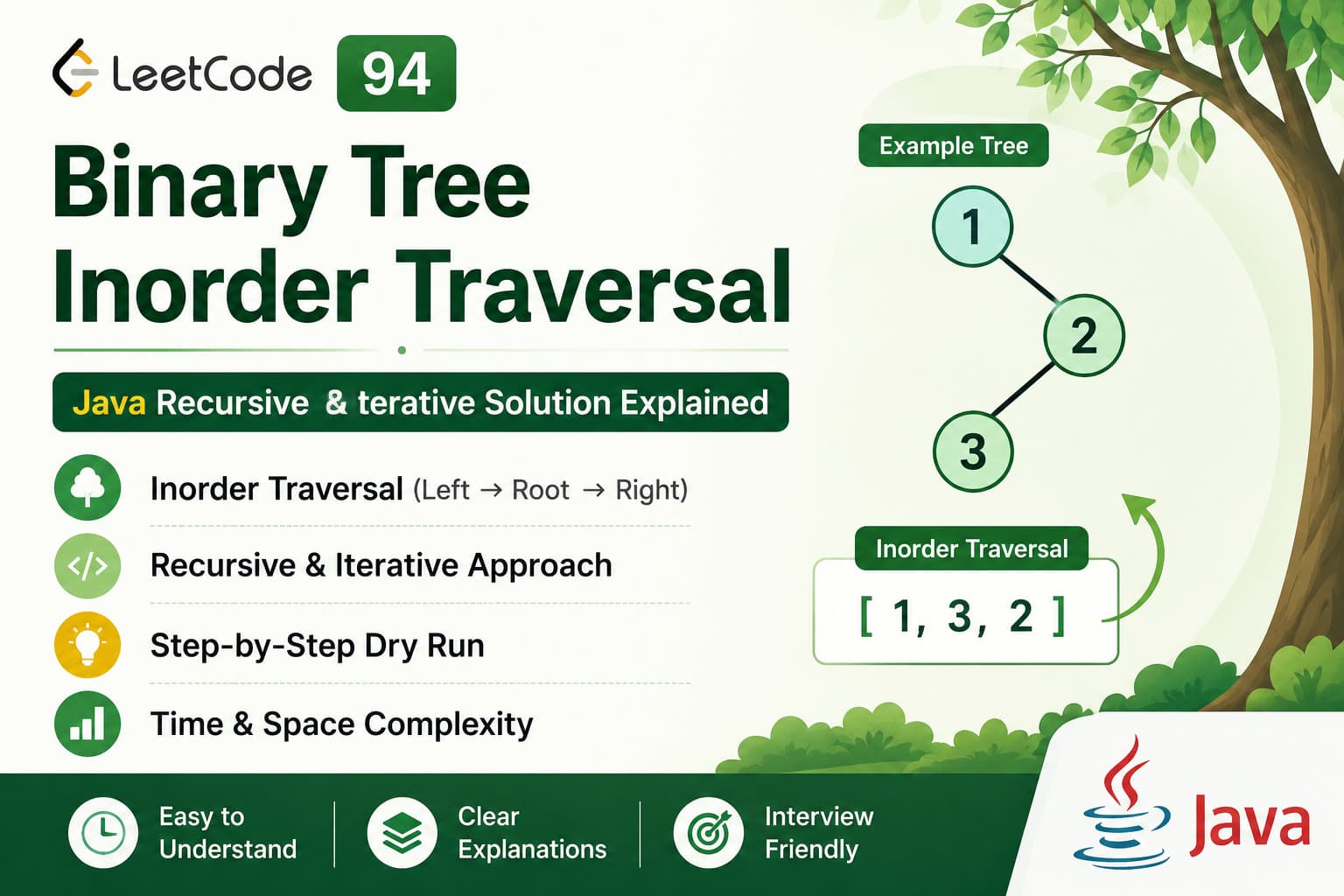
LeetCode 94: Binary Tree Inorder Traversal – Java Recursive & Iterative Solution Explained

LeetCode 94: Binary Tree Inorder Traversal – Java Recursive & Iterative Solution Explained

IntroductionLeetCode 94 – Binary Tree Inorder Traversal is one of the most important beginner-friendly tree problems in Data Structures and Algorithms.This problem helps you understand:Binary tree traversalDepth First Search (DFS)RecursionStack-based traversalTree interview fundamentalsIt is commonly asked in coding interviews because tree traversal forms the foundation of many advanced tree problems.Problem Link🔗 ProblemLeetCode 94: Binary Tree Inorder TraversalOfficial Problem:LeetCode Problem LinkProblem StatementGiven the root of a binary tree, return the inorder traversal of its nodes' values.What is Inorder Traversal?In inorder traversal, we visit nodes in this order:Left → Root → RightExampleInputroot = [1,null,2,3]Tree Structure:1\2/3Inorder TraversalStep-by-step:1 → 3 → 2Output:[1,3,2]Recursive Approach (Most Common)IntuitionIn inorder traversal:Traverse left subtreeVisit current nodeTraverse right subtreeThis naturally fits recursion because trees themselves are recursive structures.Recursive DFS VisualizationTraversal order:Left → Node → RightRecursive function:inorder(node.left)visit(node)inorder(node.right)Java Recursive Solution/*** Definition for a binary tree node.* public class TreeNode {* int val;* TreeNode left;* TreeNode right;* }*/class Solution {public void solve(List<Integer> list, TreeNode root) {if(root == null) return;solve(list, root.left);list.add(root.val);solve(list, root.right);}public List<Integer> inorderTraversal(TreeNode root) {List<Integer> list = new ArrayList<>();solve(list, root);return list;}}Dry Run – Recursive ApproachTree:1\2/3Step 1Start at:1Move left:nullReturn back.Add:1Step 2Move right to:2Move left to:3Add:3Return back.Add:2Final Answer[1,3,2]Time Complexity – RecursiveTime ComplexityO(N)Every node is visited once.Space ComplexityO(H)Where:H = height of treeRecursive call stack uses extra spaceWorst case:O(N)for skewed trees.Iterative Approach (Interview Follow-Up)The follow-up asks:Can you solve it iteratively?Yes.We use a stack to simulate recursion.Iterative Inorder IntuitionThe recursive order is:Left → Node → RightSo iteratively:Keep pushing left nodes into stackProcess current nodeMove to right subtreeStack-Based Traversal LogicAlgorithmWhile current node exists OR stack is not empty:Push all left nodesPop top nodeAdd node valueMove to right subtreeJava Iterative Solutionclass Solution {public List<Integer> inorderTraversal(TreeNode root) {List<Integer> ans = new ArrayList<>();Stack<TreeNode> stack = new Stack<>();TreeNode curr = root;while(curr != null || !stack.isEmpty()) {while(curr != null) {stack.push(curr);curr = curr.left;}curr = stack.pop();ans.add(curr.val);curr = curr.right;}return ans;}}Dry Run – Iterative ApproachTree:1\2/3Step 1Push:1Stack:[1]Step 2Pop:1Add:1Move right to:2Step 3Push:23Stack:[2,3]Step 4Pop:3Add:3Step 5Pop:2Add:2Final Answer[1,3,2]Comparison of ApproachesApproachAdvantagesDisadvantagesRecursiveEasy to write and understandUses recursion stackIterativeBetter interview practiceSlightly harder logicInterview ExplanationIn interviews, explain:In inorder traversal, we process nodes in Left → Root → Right order. Recursion naturally fits this traversal. For iterative traversal, we use a stack to simulate recursive calls.This demonstrates strong tree traversal understanding.Common Mistakes1. Wrong Traversal OrderIncorrect:Root → Left → RightThat is preorder traversal.Correct inorder:Left → Root → Right2. Forgetting Null Base CaseAlways check:if(root == null) return;3. Stack Handling ErrorsIn iterative traversal:Push all left nodes firstThen process nodeThen move rightFAQsQ1. Why is inorder traversal important?It is heavily used in:Binary Search TreesExpression treesTree reconstruction problemsQ2. What is the inorder traversal of a BST?It produces values in sorted order.Q3. Which approach is better for interviews?Recursive is easier.Iterative is preferred for deeper interview rounds.Q4. Can inorder traversal be done without stack or recursion?Yes.Using Morris Traversal with:O(1)space.Bonus: Morris Traversal (Advanced)Morris Traversal performs inorder traversal without recursion or stack.ComplexityTime ComplexityO(N)Space ComplexityO(1)This is an advanced interview optimization.ConclusionLeetCode 94 is one of the most fundamental tree traversal problems.It teaches:DFS traversalRecursionStack simulationBinary tree fundamentalsThe key inorder pattern is:Left → Root → RightMastering this problem builds a strong foundation for advanced tree interview questions like:BST validationTree iteratorsTree reconstructionMorris traversalKth smallest in BST

LeetCodeBinary Tree Inorder TraversalBinary TreeTree TraversalJavaDFSStackRecursionEasy
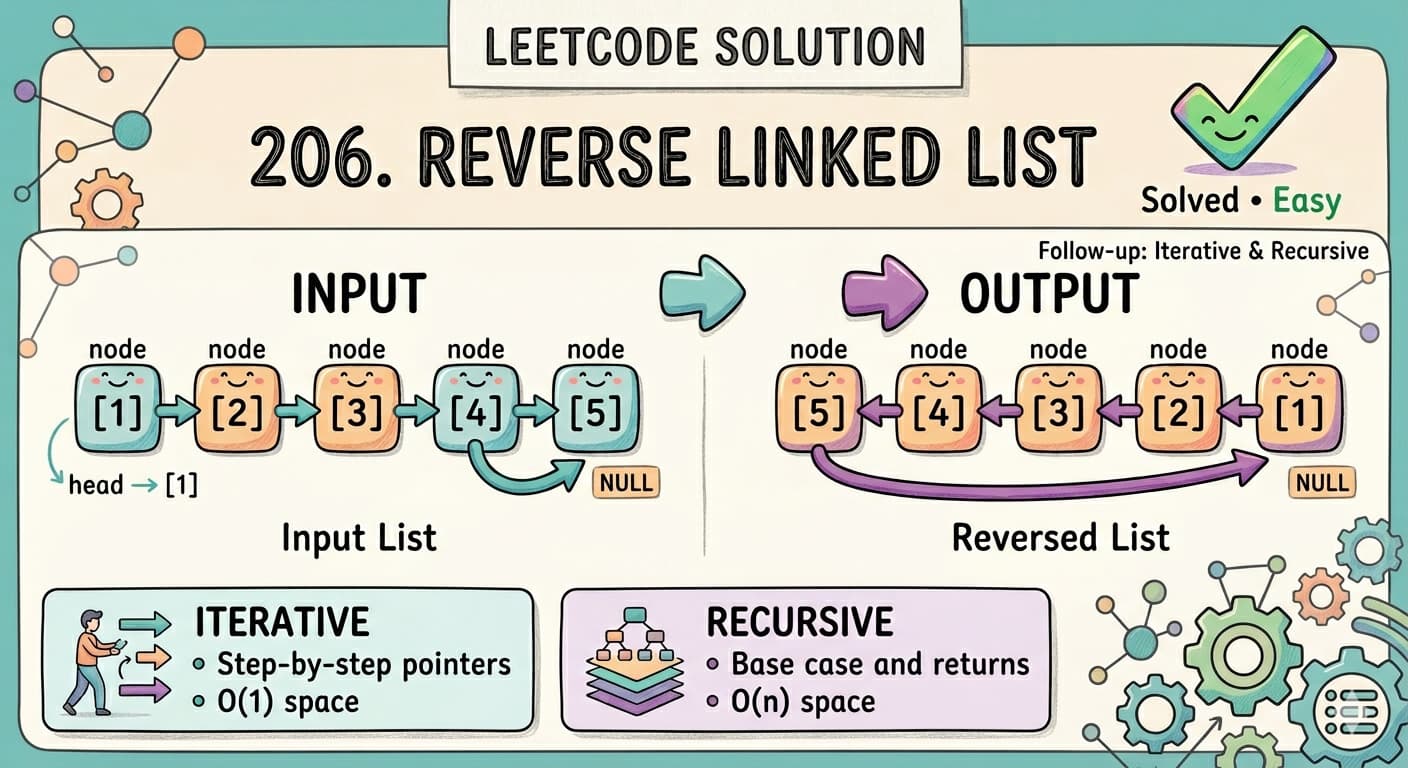
Reverse LinkedList (LeetCode 206) – The One Trick That Changes Everything

Reverse LinkedList (LeetCode 206) – The One Trick That Changes Everything

🚀 Try the ProblemPractice here:https://leetcode.com/problems/reverse-linked-list/🤔 Let’s Start With a Simple Question…What happens if you take this:1 → 2 → 3 → 4 → 5…and try to reverse it?You want:5 → 4 → 3 → 2 → 1Sounds easy, right?But here’s the catch:👉 You can only move forward in a linked list👉 There is no backward pointerSo how do we reverse something that only goes one way?🧠 The Core Problem (In Simple Words)You are given the head of a linked list.👉 Reverse the list👉 Return the new head📦 Constraints0 <= number of nodes <= 5000-5000 <= Node.val <= 5000🔍 Before Jumping to Code — Think Like ThisWhen solving this, your brain might go:Can I store values somewhere and reverse? ❌ (extra space)Can I rebuild the list? ❌ (unnecessary)Can I just change links? ✅ (YES, THIS IS THE KEY)⚡ The Breakthrough Idea👉 Instead of moving nodes👉 We reverse the direction of pointers🎯 Visual Intuition (Very Important)Let’s take:1 → 2 → 3 → 4 → nullWe want:null ← 1 ← 2 ← 3 ← 4But how?🧩 The 3-Pointer Magic TrickWe use 3 pointers:prev → stores previous nodecurr → current nodenext → stores next node🔄 Step-by-Step TransformationInitial State:prev = nullcurr = 1 → 2 → 3 → 4Step 1:Save next nodeReverse linkf = 21 → nullMove pointers:prev = 1curr = 2Step 2:f = 32 → 1Move:prev = 2curr = 3Continue…Eventually:4 → 3 → 2 → 1 → null💡 Final Insight👉 Each step reverses one link👉 At the end, prev becomes the new head✅ Clean Java Code (Iterative Approach)class Solution {public ListNode reverseList(ListNode head) {// Previous pointer starts as nullListNode prev = null;// Current pointer starts from headListNode curr = head;while (curr != null) {// Store next nodeListNode f = curr.next;// Reverse the linkcurr.next = prev;// Move prev forwardprev = curr;// Move curr forwardcurr = f;}// New head is prevreturn prev;}}⏱️ ComplexityTime ComplexityO(n)We traverse the list once.Space ComplexityO(1)No extra space used.🔁 Another Way: Recursive ApproachNow let’s think differently…👉 What if we reverse the rest of the list first, then fix the current node?🧠 Recursive IdeaFor:1 → 2 → 3 → 4We:Reverse from 2 → 3 → 4Then fix 1💻 Recursive Codeclass Solution {public ListNode reverseList(ListNode head) {// Base caseif(head == null || head.next == null)return head;// Reverse restListNode newHead = reverseList(head.next);// Fix current nodehead.next.next = head;head.next = null;return newHead;}}⚖️ Iterative vs RecursiveApproachProsConsIterativeFast, O(1) spaceSlightly tricky to understandRecursiveElegant, clean logicUses stack (O(n) space)❌ Common MistakesForgetting to store next nodeLosing reference to rest of listNot updating pointers correctlyReturning wrong node🔥 Real Interview InsightThis problem is not just about reversing a list.It teaches:👉 Pointer manipulation👉 In-place updates👉 Thinking in steps👉 Breaking problems into small operations🧠 Final ThoughtAt first, this problem feels tricky…But once you understand this line:curr.next = prev👉 Everything clicks.🚀 ConclusionThe Reverse Linked List problem is one of the most important foundational problems in DSA.Mastering it will:Boost your confidenceStrengthen pointer logicHelp in many advanced problems👉 Tip: Practice this until you can visualize pointer movement in your head — that’s when you truly master linked lists.

Linked ListPointer ManipulationIterative ApproachRecursionLeetCodeEasy
Merge Sort Algorithm Explained | Java Implementation, Intuition & Complexity

Merge Sort Algorithm Explained | Java Implementation, Intuition & Complexity

IntroductionSorting is one of the most fundamental operations in computer science, and Merge Sort is among the most efficient and widely used sorting algorithms.It follows the Divide and Conquer approach, making it highly scalable and predictable even for large datasets.In this article, we will cover:Intuition behind Merge SortStep-by-step breakdownMultiple approachesJava implementation with commentsTime & space complexity analysis🔗 Problem LinkGeeksforGeeks: Merge SortProblem StatementGiven an array arr[] with starting index l and ending index r, sort the array using the Merge Sort algorithm.ExamplesExample 1Input:arr = [4, 1, 3, 9, 7]Output:[1, 3, 4, 7, 9]Example 2Input:arr = [10, 9, 8, 7, 6, 5, 4, 3, 2, 1]Output:[1, 2, 3, 4, 5, 6, 7, 8, 9, 10]Key InsightMerge Sort works by:Divide → Conquer → CombineDivide the array into two halvesRecursively sort each halfMerge both sorted halvesIntuition (Visual Understanding)For:[4, 1, 3, 9, 7]Step 1: Divide[4, 1, 3] [9, 7][4, 1] [3] [9] [7][4] [1]Step 2: Merge[4] [1] → [1, 4][1, 4] [3] → [1, 3, 4][9] [7] → [7, 9]Step 3: Final Merge[1, 3, 4] + [7, 9] → [1, 3, 4, 7, 9]Approach 1: Recursive Merge Sort (Top-Down)IdeaKeep dividing until single elements remainMerge sorted subarraysJava Codeclass Solution { // Function to merge two sorted halves void merge(int[] arr, int l, int mid, int h) { // Temporary array to store merged result int[] temp = new int[h - l + 1]; int i = l; // pointer for left half int j = mid + 1; // pointer for right half int k = 0; // pointer for temp array // Compare elements from both halves while (i <= mid && j <= h) { if (arr[i] <= arr[j]) { temp[k] = arr[i]; i++; } else { temp[k] = arr[j]; j++; } k++; } // Copy remaining elements from left half while (i <= mid) { temp[k] = arr[i]; i++; k++; } // Copy remaining elements from right half while (j <= h) { temp[k] = arr[j]; j++; k++; } // Copy sorted elements back to original array for (int m = 0; m < temp.length; m++) { arr[l + m] = temp[m]; } } // Recursive merge sort function void mergeSort(int arr[], int l, int h) { // Base case: single element if (l >= h) return; int mid = l + (h - l) / 2; // Sort left half mergeSort(arr, l, mid); // Sort right half mergeSort(arr, mid + 1, h); // Merge both halves merge(arr, l, mid, h); }}Approach 2: Iterative Merge Sort (Bottom-Up)IdeaStart with subarrays of size 1Merge pairsIncrease size graduallyCodeclass Solution { void merge(int[] arr, int l, int mid, int h) { int[] temp = new int[h - l + 1]; int i = l, j = mid + 1, k = 0; while (i <= mid && j <= h) { if (arr[i] <= arr[j]) temp[k++] = arr[i++]; else temp[k++] = arr[j++]; } while (i <= mid) temp[k++] = arr[i++]; while (j <= h) temp[k++] = arr[j++]; for (int m = 0; m < temp.length; m++) { arr[l + m] = temp[m]; } } void mergeSort(int[] arr, int n) { for (int size = 1; size < n; size *= 2) { for (int l = 0; l < n - size; l += 2 * size) { int mid = l + size - 1; int h = Math.min(l + 2 * size - 1, n - 1); merge(arr, l, mid, h); } } }}Approach 3: Using Built-in Sorting (For Comparison)Arrays.sort(arr);👉 Internally uses optimized algorithms (TimSort in Java)Complexity AnalysisTime ComplexityCaseComplexityBestO(n log n)AverageO(n log n)WorstO(n log n)Space ComplexityO(n) (extra array for merging)Why Merge Sort is PowerfulStable sorting algorithmWorks efficiently on large datasetsPredictable performanceUsed in external sorting (large files)❌ Why Not Use Bubble/Selection Sort?AlgorithmTime ComplexityBubble SortO(n²)Selection SortO(n²)Merge SortO(n log n) ✅Key TakeawaysMerge Sort uses divide and conquerRecursion splits problem into smaller partsMerging is the key stepAlways O(n log n), regardless of inputWhen to Use Merge SortLarge datasetsLinked lists (very efficient)Stable sorting requiredExternal sortingConclusionMerge Sort is one of the most reliable and efficient sorting algorithms. Understanding its recursive structure and merging process is essential for mastering advanced algorithms.Once you grasp the divide-and-conquer pattern, it becomes easier to solve many complex problems.Frequently Asked Questions (FAQs)1. Is Merge Sort stable?Yes, it maintains the relative order of equal elements.2. Why is extra space required?Because we use a temporary array during merging.3. Can it be done in-place?Not efficiently; standard merge sort requires extra space.

GeekfOfGeeksMediumSortingMerge SortJava
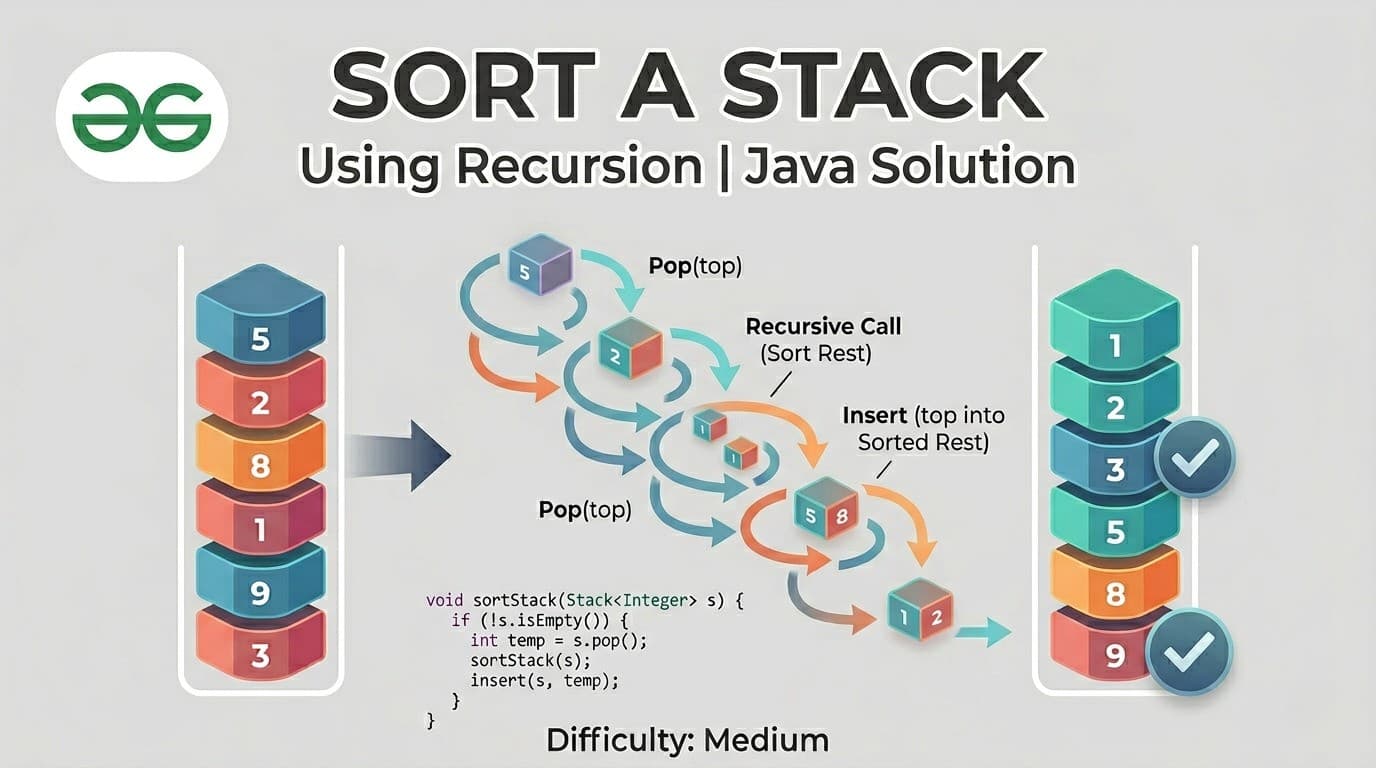
Sort a Stack Using Recursion - Java Solution Explained

Sort a Stack Using Recursion - Java Solution Explained

IntroductionSort a Stack is one of those problems that feels impossible at first — you only have access to the top of a stack, you cannot index into it, and the only tools you have are push, pop, and peek. How do you sort something with such limited access?The answer is recursion. And this problem is a perfect example of how recursion can do something elegant that feels like it should require much more complex logic.You can find this problem here — Sort a Stack — GeeksForGeeksThis article explains the complete intuition, both recursive functions in detail, a thorough dry run, all approaches, and complexity analysis.What Is the Problem Really Asking?You have a stack of integers. Sort it so that the smallest element is at the bottom and the largest element is at the top.Input: [41, 3, 32, 2, 11] (11 is at top)Output: [41, 32, 11, 3, 2] (2 is at top, 41 at bottom)Wait — if smallest is at bottom and largest at top, then popping gives you the smallest first. So the stack is sorted in ascending order from top to bottom when you pop.The constraints make this interesting — you can only use stack operations (push, pop, peek, isEmpty). No arrays, no sorting algorithms directly on the data, no random access.Real Life Analogy — Sorting a Stack of BooksImagine a stack of books of different thicknesses on your desk. You want the thinnest book on top and thickest at the bottom. But you can only take from the top.Here is what you do — pick up books one by one from the top and set them aside. Once you have removed enough, place each book back in its correct position. If the book you are placing is thicker than what is currently on top, slide the top books aside temporarily, place the thick book down, then put the others back.That is exactly what the recursive sort does — take elements out one by one, and insert each back into the correct position.The Core Idea — Two Recursive Functions Working TogetherThe solution uses two recursive functions that work hand in hand:sortStack(st) — removes elements one by one until the stack is empty, then inserts each back using insertinsert(st, temp) — inserts a single element into its correct sorted position in an already-sorted stackThink of it like this — sortStack is the manager that empties the stack recursively, and insert is the worker that places each element in the right position on the way back.Function 1: sortStack — The Main Recursive Driverpublic void sortStack(Stack<Integer> st) { // base case — empty or single element is already sorted if (st.empty() || st.size() == 1) return; // Step 1: remove the top element int temp = st.pop(); // Step 2: recursively sort the remaining stack sortStack(st); // Step 3: insert the removed element in correct position insert(st, temp);}How to Think About ThisThe leap of faith here — trust that sortStack correctly sorts whatever is below. After the recursive call, the remaining stack is perfectly sorted. Now your only job is to insert temp (the element you removed) into its correct position in that sorted stack.This is the classic "solve smaller, fix current" recursion pattern. Reduce the problem by one element, trust recursion for the rest, then fix the current element's position.Function 2: insert — Placing an Element in Sorted Positionvoid insert(Stack<Integer> st, int temp) { // base case 1: stack is empty — just push // base case 2: top element is smaller or equal — push on top if (st.empty() || st.peek() <= temp) { st.push(temp); return; } // top element is greater than temp // temp needs to go below the top element int val = st.pop(); // temporarily remove the top insert(st, temp); // try inserting temp deeper st.push(val); // restore the removed element on top}How to Think About ThisYou want to insert temp in sorted order. The stack is already sorted (largest on top). So:If the top is smaller than or equal to temp → temp belongs on top. Push it.If the top is greater than temp → temp needs to go below the top. So pop the top temporarily, try inserting temp deeper, then push the top back.This is the same "pop, recurse deeper, push back" pattern you saw in the Baseball Game problem — when you need to access elements below the top without permanent removal.Complete Solutionclass Solution { // insert temp into its correct position in sorted stack void insert(Stack<Integer> st, int temp) { if (st.empty() || st.peek() <= temp) { st.push(temp); return; } int val = st.pop(); insert(st, temp); st.push(val); } // sort the stack using recursion public void sortStack(Stack<Integer> st) { if (st.empty() || st.size() == 1) return; int temp = st.pop(); // remove top sortStack(st); // sort remaining insert(st, temp); // insert top in correct position }}Detailed Dry Run — st = [3, 2, 1] (1 at top)Let us trace every single call carefully.sortStack calls (going in):sortStack([3, 2, 1]) temp = 1, remaining = [3, 2] call sortStack([3, 2]) temp = 2, remaining = [3] call sortStack([3]) size == 1, return ← base case now insert(st=[3], temp=2) peek=3 > 2, pop val=3 insert(st=[], temp=2) st empty, push 2 ← base case push val=3 back stack is now [2, 3] (3 on top) sortStack([3,2]) done → stack = [2, 3] now insert(st=[2,3], temp=1) peek=3 > 1, pop val=3 insert(st=[2], temp=1) peek=2 > 1, pop val=2 insert(st=[], temp=1) st empty, push 1 ← base case push val=2 back stack = [1, 2] push val=3 back stack = [1, 2, 3] (3 on top)sortStack done → stack = [1, 2, 3]✅ Final stack (3 on top, 1 at bottom): largest at top, smallest at bottom — correctly sorted!Detailed Dry Run — st = [41, 3, 32, 2, 11] (11 at top)Let us trace at a higher level to see the pattern:sortStack calls unwinding (popping phase):sortStack([41, 3, 32, 2, 11]) pop 11, sortStack([41, 3, 32, 2]) pop 2, sortStack([41, 3, 32]) pop 32, sortStack([41, 3]) pop 3, sortStack([41]) base case — return insert([41], 3) → [3, 41] (41 on top) insert([3, 41], 32) → [3, 32, 41] (41 on top) insert([3, 32, 41], 2) → [2, 3, 32, 41] (41 on top) insert([2, 3, 32, 41], 11) → [2, 3, 11, 32, 41] (41 on top)✅ Final: [2, 3, 11, 32, 41] with 41 at top, 2 at bottom — correct!Let us verify the insert([3, 32, 41], 2) step in detail since it involves multiple pops:insert(st=[3, 32, 41], temp=2) peek=41 > 2, pop val=41 insert(st=[3, 32], temp=2) peek=32 > 2, pop val=32 insert(st=[3], temp=2) peek=3 > 2, pop val=3 insert(st=[], temp=2) st empty, push 2 push val=3 back → [2, 3] push val=32 back → [2, 3, 32] push val=41 back → [2, 3, 32, 41]Beautiful chain of pops followed by a chain of pushes — recursion handling what would be very messy iterative logic.Approach 2: Using an Additional Stack (Iterative)If recursion is not allowed or you want an iterative solution, you can use a second stack.public void sortStack(Stack<Integer> st) { Stack<Integer> tempStack = new Stack<>(); while (!st.empty()) { int curr = st.pop(); // move elements from tempStack back to st // until we find the right position for curr while (!tempStack.empty() && tempStack.peek() > curr) { st.push(tempStack.pop()); } tempStack.push(curr); } // move everything back to original stack while (!tempStack.empty()) { st.push(tempStack.pop()); }}How This WorkstempStack is maintained in sorted order (smallest on top). For each element popped from st, we move elements from tempStack back to st until we find the right position, then push. At the end, transfer everything back.Time Complexity: O(n²) — same as recursive approach Space Complexity: O(n) — explicit extra stackApproach 3: Using Collections.sort (Cheat — Not Recommended)public void sortStack(Stack<Integer> st) { List<Integer> list = new ArrayList<>(st); Collections.sort(list); // ascending st.clear(); for (int num : list) { st.push(num); // smallest pushed first = smallest at bottom }}This gives the right answer but completely defeats the purpose of the problem. Never use this in an interview — it shows you do not understand the problem's intent.Time Complexity: O(n log n) Space Complexity: O(n)Approach ComparisonApproachTimeSpaceAllowed in InterviewCode ComplexityRecursive (Two Functions)O(n²)O(n)✅ Best answerMediumIterative (Two Stacks)O(n²)O(n)✅ Good alternativeMediumCollections.sortO(n log n)O(n)❌ Defeats purposeEasyTime and Space Complexity AnalysisRecursive ApproachTime Complexity: O(n²)For each of the n elements popped by sortStack, the insert function may traverse the entire stack to find the correct position — O(n) per insert. Total: O(n) × O(n) = O(n²).This is similar to insertion sort — and in fact, this recursive approach IS essentially insertion sort implemented on a stack using recursion.Space Complexity: O(n)No extra data structure is used. But the call stack holds up to n frames for sortStack and up to n additional frames for insert. In the worst case, total recursion depth is O(n) + O(n) = O(n) space.The Connection to Insertion SortIf you have studied sorting algorithms, this solution will look very familiar. It is Insertion Sort implemented recursively on a stack:sortStack is like the outer loop — take one element at a timeinsert is like the inner loop — find the correct position by comparing and shiftingThe key difference from array-based insertion sort is that "shifting" in an array is done by moving elements right. Here, "shifting" is done by temporarily popping elements off the stack, inserting at the right depth, then pushing back. Recursion handles the "shift" naturally.Common Mistakes to AvoidWrong base case in insert The base case is st.empty() || st.peek() <= temp. Both conditions are needed. Without st.empty(), you call peek() on an empty stack and get an exception. Without st.peek() <= temp, you never stop even when you find the right position.Using < instead of <= in insert Using strictly less than means equal elements get treated as "wrong position" and cause unnecessary recursion. Using <= correctly handles duplicates — equal elements stay in their current relative order.Calling sortStack instead of insert inside insert insert should only call itself recursively. Calling sortStack inside insert re-sorts an already-sorted stack — completely wrong and causes incorrect results.Not pushing val back after the recursive insert call This is the most common bug. After insert(st, temp) places temp in the correct position, you must push val back on top. Forgetting this loses elements from the stack permanently.FAQs — People Also AskQ1. How do you sort a stack without using extra space in Java? Using recursion — the call stack itself serves as temporary storage. sortStack removes elements one by one and insert places each back in its correct sorted position. No explicit extra data structure is needed, but O(n) implicit call stack space is used.Q2. What is the time complexity of sorting a stack using recursion? O(n²) in all cases — for each of the n elements, the insert function traverses up to n elements to find the correct position. This is equivalent to insertion sort applied to a stack.Q3. Can you sort a stack without recursion? Yes — using a second auxiliary stack. Pop elements from the original stack one by one and insert each into the correct position in the second stack by temporarily moving elements back. Transfer everything back to the original stack at the end.Q4. Why does the insert function need to push val back after the recursive call? Because the goal of insert is to place temp in the correct position WITHOUT losing any existing elements. When we pop val temporarily to go deeper, we must restore it after temp has been placed. Not restoring it means permanently losing that element from the stack.Q5. Is sorting a stack asked in coding interviews? Yes, it appears frequently at companies like Amazon, Adobe, and in platforms like GeeksForGeeks and InterviewBit. It tests whether you understand recursion deeply enough to use it as a mechanism for reordering — not just for computation.Similar Problems to Practice NextDelete Middle Element of a Stack — use same recursive pop-recurse-push patternReverse a Stack — very similar recursive approach, great warmup84. Largest Rectangle in Histogram — advanced stack problem946. Validate Stack Sequences — stack simulation150. Evaluate Reverse Polish Notation — stack with operationsConclusionSort a Stack Using Recursion is a beautiful problem that demonstrates the true power of recursion — using the call stack itself as temporary storage to perform operations that would otherwise require extra data structures.The key insight is splitting the problem into two clean responsibilities. sortStack handles one job — peel elements off one by one until the base case, then trigger insert on the way back up. insert handles one job — place a single element into its correct position in an already-sorted stack by temporarily moving larger elements aside.Once you see those two responsibilities clearly, the code almost writes itself. And once this pattern clicks, it directly prepares you for more advanced recursive problems like reversing a stack, deleting the middle element, and even understanding how recursive backtracking works at a deeper level.

StackRecursionJavaGeeksForGeeksMedium
LeetCode 3761 Minimum Absolute Distance Between Mirror Pairs | Java HashMap Solution

LeetCode 3761 Minimum Absolute Distance Between Mirror Pairs | Java HashMap Solution

IntroductionSome problems look simple at first—but hide a clever trick inside.LeetCode 3761 – Minimum Absolute Distance Between Mirror Pairs is one such problem. It combines:Number manipulation (digit reversal)HashingEfficient searchingIf approached naively, this problem can easily lead to O(n²) time complexity—which is not feasible for large inputs.In this article, we will walk through:Problem intuitionNaive approach (and why it fails)Optimized HashMap solutionStep-by-step explanationClean Java code with comments🔗 Problem LinkLeetCode: Minimum Absolute Distance Between Mirror PairsTo gain a deeper understanding of the problem, it is highly recommended that you review this similar problem Closest Equal Element Queries here is the link of the article. Both cases follow a nearly identical pattern, and studying the initial example will provide valuable context for the current task.Problem StatementYou are given an integer array nums.A mirror pair (i, j) satisfies:0 ≤ i < j < nums.lengthreverse(nums[i]) == nums[j]👉 Your task is to find:The minimum absolute distance between such pairsIf no mirror pair exists, return -1.ExamplesExample 1Input:nums = [12, 21, 45, 33, 54]Output:1Explanation:(0,1) → reverse(12) = 21 → distance = 1(2,4) → reverse(45) = 54 → distance = 2✔ Minimum = 1Example 2Input:nums = [120, 21]Output:1Example 3Input:nums = [21, 120]Output:-1Key InsightThe core idea is:Instead of checking every pair,store reversed values and match on the fly.❌ Naive Approach (Brute Force)IdeaCheck all pairs (i, j)Reverse nums[i]Compare with nums[j]ComplexityTime: O(n²) ❌Space: O(1)ProblemWith n ≤ 100000, this approach will definitely cause TLE.✅ Optimized Approach (HashMap)IntuitionWhile iterating through the array:Reverse the current numberCheck if this number was already seen as a reversed valueIf yes → we found a mirror pairKey TrickInstead of storing original numbers:👉 Store reversed values as keysThis allows instant lookup.Java Code (With Detailed Comments)import java.util.*;class Solution {// Function to reverse digits of a numberpublic int reverse(int m) {int rev = 0;while (m != 0) {int dig = m % 10; // extract last digitm = m / 10; // remove last digitrev = rev * 10 + dig; // build reversed number}return rev;}public int minMirrorPairDistance(int[] nums) {// Map to store reversed values and their indicesHashMap<Integer, Integer> mp = new HashMap<>();int min = Integer.MAX_VALUE;for (int i = 0; i < nums.length; i++) {// Check if current number exists in map// Meaning: some previous number had reverse equal to thisif (mp.containsKey(nums[i])) {// Calculate distanceint prevIndex = mp.get(nums[i]);min = Math.min(min, Math.abs(i - prevIndex));}// Reverse current numberint revVal = reverse(nums[i]);// Store reversed value with indexmp.put(revVal, i);}// If no pair found, return -1return min == Integer.MAX_VALUE ? -1 : min;}}Step-by-Step Dry RunInput:nums = [12, 21, 45, 33, 54]Execution:IndexValueReverseMap CheckAction01221not foundstore (21 → 0)12112founddistance = 124554not foundstore (54 → 2)33333not foundstore (33 → 3)45445founddistance = 2👉 Minimum = 1Complexity AnalysisTime ComplexityReversing number → O(digits) ≈ O(log n)Loop → O(n)👉 Overall: O(n)Space ComplexityHashMap stores at most n elements👉 O(n)Why This Approach WorksAvoids unnecessary pair comparisonsUses hashing for constant-time lookupProcesses array in a single passKey TakeawaysAlways think of hashing when matching conditions existReversing numbers can convert the problem into a lookup problemAvoid brute force when constraints are largeThis is a classic “store & check” patternCommon Interview PatternThis problem is similar to:Two Sum (hashing)Reverse pairsMatching transformationsConclusionThe Minimum Absolute Distance Between Mirror Pairs problem is a great example of how a simple optimization (using a HashMap) can reduce complexity from O(n²) → O(n).Understanding this pattern will help you solve many similar problems involving:TransformationsMatching conditionsEfficient lookupsFrequently Asked Questions (FAQs)1. Why store reversed value instead of original?Because we want to quickly check if a number matches the reverse of a previous number.2. What if multiple same reversed values exist?The map stores the latest index, ensuring minimum distance is considered.3. Can this be solved without HashMap?Yes, but it will result in inefficient O(n²) time.

LeetCodeArrayJavaMediumHashMap
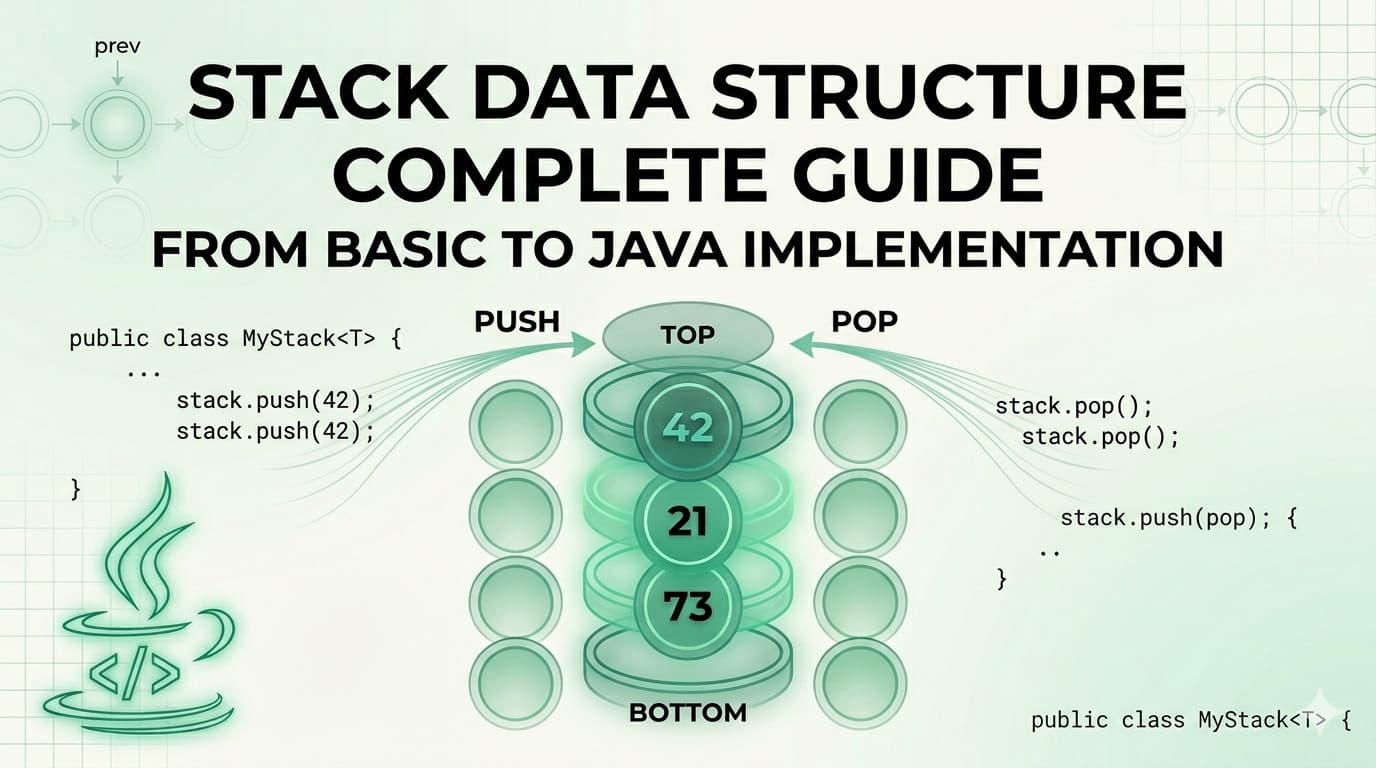
Stack Data Structure in Java: The Complete In-Depth Guide

Stack Data Structure in Java: The Complete In-Depth Guide

1. What Is a Stack?A Stack is a linear data structure that stores elements in a sequential order, but with one strict rule — you can only insert or remove elements from one end, called the top.It is one of the simplest yet most powerful data structures in computer science. Its strength comes from its constraint. Because everything happens at one end, the behavior of a stack is completely predictable.The formal definition: A Stack is a linear data structure that follows the Last In, First Out (LIFO) principle — the element inserted last is the first one to be removed.Here is what a stack looks like visually: ┌──────────┐ │ 50 │ ← TOP (last inserted, first removed) ├──────────┤ │ 40 │ ├──────────┤ │ 30 │ ├──────────┤ │ 20 │ ├──────────┤ │ 10 │ ← BOTTOM (first inserted, last removed) └──────────┘When you push 60 onto this stack, it goes on top. When you pop, 60 comes out first. That is LIFO.2. Real-World AnalogiesBefore writing a single line of code, it helps to see stacks in the real world. These analogies will make the concept permanently stick.A Pile of Plates In a cafeteria, clean plates are stacked on top of each other. You always pick the top plate. You always place a new plate on top. You never reach into the middle. This is a stack.Browser Back Button Every time you visit a new webpage, it gets pushed onto a history stack. When you press the Back button, the browser pops the most recent page off the stack and takes you there. The page you visited first is at the bottom — you only reach it after going back through everything else.Undo Feature in Text Editors When you type in a document and press Ctrl+Z, the most recent action is undone first. That is because every action you perform is pushed onto a stack. Undo simply pops from that stack.Call Stack in Programming When a function calls another function, the current function's state is pushed onto the call stack. When the inner function finishes, it is popped off and execution returns to the outer function. This is the literal stack your programs run on.A Stack of Books Put five books on a table, one on top of another. You can only take the top book without knocking the pile over. That is a stack.3. The LIFO Principle ExplainedLIFO stands for Last In, First Out.It means whatever you put in last is the first thing to come out. This is the exact opposite of a Queue (which is FIFO — First In, First Out).Let us trace through an example step by step:Start: Stack is empty → []Push 10 → [10] (10 is at the top)Push 20 → [10, 20] (20 is at the top)Push 30 → [10, 20, 30] (30 is at the top)Pop → returns 30 (30 was last in, first out) Stack: [10, 20]Pop → returns 20 Stack: [10]Peek → returns 10 (just looks, does not remove) Stack: [10]Pop → returns 10 Stack: [] (stack is now empty)Every single operation happens only at the top. The bottom of the stack is never directly accessible.4. Stack Operations & Time ComplexityA stack supports the following core operations:OperationDescriptionTime Complexitypush(x)Insert element x onto the top of the stackO(1)pop()Remove and return the top elementO(1)peek() / top()Return the top element without removing itO(1)isEmpty()Check if the stack has no elementsO(1)isFull()Check if the stack has reached its capacity (Array only)O(1)size()Return the number of elements in the stackO(1)search(x)Find position of element from top (Java built-in only)O(n)All primary stack operations — push, pop, peek, isEmpty — run in O(1) constant time. This is what makes the stack so efficient. It does not matter whether the stack has 10 elements or 10 million — these operations are always instant.Space complexity for a stack holding n elements is O(n).5. Implementation 1 — Using a Static ArrayThis is the most fundamental way to implement a stack. We use a fixed-size array and a variable called top to track where the top of the stack currently is.How it works:top starts at -1 (stack is empty)On push: increment top, then place the element at arr[top]On pop: return arr[top], then decrement topOn peek: return arr[top] without changing it// StackUsingArray.javapublic class StackUsingArray { private int[] arr; private int top; private int capacity; // Constructor — initialize with a fixed capacity public StackUsingArray(int capacity) { this.capacity = capacity; arr = new int[capacity]; top = -1; } // Push: add element to the top public void push(int value) { if (isFull()) { System.out.println("Stack Overflow! Cannot push " + value); return; } arr[++top] = value; System.out.println("Pushed: " + value); } // Pop: remove and return top element public int pop() { if (isEmpty()) { System.out.println("Stack Underflow! Stack is empty."); return -1; } return arr[top--]; } // Peek: view the top element without removing public int peek() { if (isEmpty()) { System.out.println("Stack is empty."); return -1; } return arr[top]; } // Check if stack is empty public boolean isEmpty() { return top == -1; } // Check if stack is full public boolean isFull() { return top == capacity - 1; } // Return current size public int size() { return top + 1; } // Display all elements public void display() { if (isEmpty()) { System.out.println("Stack is empty."); return; } System.out.print("Stack (top → bottom): "); for (int i = top; i >= 0; i--) { System.out.print(arr[i] + " "); } System.out.println(); } // Main method to test public static void main(String[] args) { StackUsingArray stack = new StackUsingArray(5); stack.push(10); stack.push(20); stack.push(30); stack.push(40); stack.push(50); stack.push(60); // This will trigger Stack Overflow stack.display(); System.out.println("Peek: " + stack.peek()); System.out.println("Pop: " + stack.pop()); System.out.println("Pop: " + stack.pop()); stack.display(); System.out.println("Size: " + stack.size()); }}```**Output:**```Pushed: 10Pushed: 20Pushed: 30Pushed: 40Pushed: 50Stack Overflow! Cannot push 60Stack (top → bottom): 50 40 30 20 10Peek: 50Pop: 50Pop: 40Stack (top → bottom): 30 20 10Size: 3Key Points about Array Implementation:Fixed size — you must declare capacity upfrontVery fast — direct array index accessStack Overflow is possible if capacity is exceededMemory is pre-allocated even if stack is not full6. Implementation 2 — Using an ArrayListAn ArrayList-based stack removes the fixed-size limitation. The ArrayList grows dynamically, so you never have to worry about stack overflow due to capacity.How it works:The end of the ArrayList acts as the topadd() is used for pushremove(size - 1) is used for popget(size - 1) is used for peek// StackUsingArrayList.javaimport java.util.ArrayList;public class StackUsingArrayList { private ArrayList<Integer> list; // Constructor public StackUsingArrayList() { list = new ArrayList<>(); } // Push: add to the end (which is our top) public void push(int value) { list.add(value); System.out.println("Pushed: " + value); } // Pop: remove and return the last element public int pop() { if (isEmpty()) { System.out.println("Stack Underflow! Stack is empty."); return -1; } int top = list.get(list.size() - 1); list.remove(list.size() - 1); return top; } // Peek: view the last element public int peek() { if (isEmpty()) { System.out.println("Stack is empty."); return -1; } return list.get(list.size() - 1); } // Check if stack is empty public boolean isEmpty() { return list.isEmpty(); } // Return size public int size() { return list.size(); } // Display elements from top to bottom public void display() { if (isEmpty()) { System.out.println("Stack is empty."); return; } System.out.print("Stack (top → bottom): "); for (int i = list.size() - 1; i >= 0; i--) { System.out.print(list.get(i) + " "); } System.out.println(); } // Main method to test public static void main(String[] args) { StackUsingArrayList stack = new StackUsingArrayList(); stack.push(5); stack.push(15); stack.push(25); stack.push(35); stack.display(); System.out.println("Peek: " + stack.peek()); System.out.println("Pop: " + stack.pop()); System.out.println("Pop: " + stack.pop()); stack.display(); System.out.println("Is Empty: " + stack.isEmpty()); System.out.println("Size: " + stack.size()); }}```**Output:**```Pushed: 5Pushed: 15Pushed: 25Pushed: 35Stack (top → bottom): 35 25 15 5Peek: 35Pop: 35Pop: 25Stack (top → bottom): 15 5Is Empty: falseSize: 2Key Points about ArrayList Implementation:Dynamic size — grows automatically as neededNo overflow riskSlight overhead compared to raw array due to ArrayList internalsExcellent for most practical use cases7. Implementation 3 — Using a LinkedListA LinkedList-based stack is the most memory-efficient approach when you do not know the stack size in advance. Each element (node) holds data and a pointer to the next node. The head of the LinkedList acts as the top of the stack.How it works:Each node stores a value and a reference to the node below itPush creates a new node and makes it the new headPop removes the head node and returns its valuePeek returns the head node's value without removing it// StackUsingLinkedList.javapublic class StackUsingLinkedList { // Inner Node class private static class Node { int data; Node next; Node(int data) { this.data = data; this.next = null; } } private Node top; // Head of the linked list = top of stack private int size; // Constructor public StackUsingLinkedList() { top = null; size = 0; } // Push: create new node and link it to top public void push(int value) { Node newNode = new Node(value); newNode.next = top; // new node points to current top top = newNode; // new node becomes the new top size++; System.out.println("Pushed: " + value); } // Pop: remove and return top node's data public int pop() { if (isEmpty()) { System.out.println("Stack Underflow! Stack is empty."); return -1; } int value = top.data; top = top.next; // move top pointer to next node size--; return value; } // Peek: return top node's data without removing public int peek() { if (isEmpty()) { System.out.println("Stack is empty."); return -1; } return top.data; } // Check if empty public boolean isEmpty() { return top == null; } // Return size public int size() { return size; } // Display elements from top to bottom public void display() { if (isEmpty()) { System.out.println("Stack is empty."); return; } System.out.print("Stack (top → bottom): "); Node current = top; while (current != null) { System.out.print(current.data + " "); current = current.next; } System.out.println(); } // Main method to test public static void main(String[] args) { StackUsingLinkedList stack = new StackUsingLinkedList(); stack.push(100); stack.push(200); stack.push(300); stack.push(400); stack.display(); System.out.println("Peek: " + stack.peek()); System.out.println("Pop: " + stack.pop()); System.out.println("Pop: " + stack.pop()); stack.display(); System.out.println("Size: " + stack.size()); }}```**Output:**```Pushed: 100Pushed: 200Pushed: 300Pushed: 400Stack (top → bottom): 400 300 200 100Peek: 400Pop: 400Pop: 300Stack (top → bottom): 200 100Size: 2Key Points about LinkedList Implementation:Truly dynamic — each node allocated only when neededNo wasted memory from pre-allocationSlightly more memory per element (each node carries a pointer)Ideal for stacks where size is completely unknown8. Java's Built-in Stack ClassJava provides a ready-made Stack class inside java.util. It extends Vector and is thread-safe by default.// JavaBuiltinStack.javaimport java.util.Stack;public class JavaBuiltinStack { public static void main(String[] args) { Stack<Integer> stack = new Stack<>(); // Push elements stack.push(10); stack.push(20); stack.push(30); stack.push(40); System.out.println("Stack: " + stack); // Peek — look at top without removing System.out.println("Peek: " + stack.peek()); // Pop — remove top System.out.println("Pop: " + stack.pop()); System.out.println("After pop: " + stack); // Search — returns 1-based position from top System.out.println("Search 20: position " + stack.search(20)); // isEmpty System.out.println("Is Empty: " + stack.isEmpty()); // Size System.out.println("Size: " + stack.size()); }}```**Output:**```Stack: [10, 20, 30, 40]Peek: 40Pop: 40After pop: [10, 20, 30]Search 20: position 2Is Empty: falseSize: 3Important Note: In modern Java development, it is often recommended to use Deque (specifically ArrayDeque) instead of Stack for better performance, since Stack is synchronized and carries the overhead of Vector.// Using ArrayDeque as a stack (modern preferred approach)import java.util.ArrayDeque;import java.util.Deque;public class ModernStack { public static void main(String[] args) { Deque<Integer> stack = new ArrayDeque<>(); stack.push(10); // pushes to front stack.push(20); stack.push(30); System.out.println("Top: " + stack.peek()); System.out.println("Pop: " + stack.pop()); System.out.println("Stack: " + stack); }}9. Comparison of All ImplementationsFeatureArrayArrayListLinkedListJava StackArrayDequeSizeFixedDynamicDynamicDynamicDynamicStack Overflow RiskYesNoNoNoNoMemory UsagePre-allocatedAuto-growsPer-node overheadAuto-growsAuto-growsPush TimeO(1)O(1) amortizedO(1)O(1)O(1)Pop TimeO(1)O(1)O(1)O(1)O(1)Peek TimeO(1)O(1)O(1)O(1)O(1)Thread SafeNoNoNoYesNoBest ForKnown size, max speedGeneral useUnknown/huge sizeLegacy codeModern Java10. Advantages & DisadvantagesAdvantagesAdvantageExplanationSimple to implementVery few rules and operations to worry aboutO(1) operationsPush, pop, and peek are all constant timeMemory efficientNo extra pointers needed (array-based)Supports recursionThe call stack is itself a stackEasy undo/redoNatural fit for reversible action trackingBacktrackingPerfectly suited for maze, puzzle, and game solvingExpression evaluationPowers compilers and calculatorsDisadvantagesDisadvantageExplanationLimited accessCannot access elements in the middle directlyFixed size (array)Array-based stacks overflow if size is exceededNo random accessYou cannot do stack[2] — only top is accessibleMemory waste (array)Pre-allocated array wastes space if underusedNot suitable for all problemsMany problems need queues, trees, or graphs insteadStack overflow in recursionVery deep recursion can overflow the JVM call stack11. Real-World Use Cases of StackUnderstanding when to use a stack is just as important as knowing how to implement one. Here is where stacks show up in real software:Function Call Management (Call Stack) Every time your Java program calls a method, the JVM pushes that method's frame onto the call stack. When the method returns, the frame is popped. This is why you see "StackOverflowError" when you write infinite recursion.Undo and Redo Operations Text editors, image editors (Photoshop), and IDEs use two stacks — one for undo history and one for redo history. Every action pushes onto the undo stack. Ctrl+Z pops from it and pushes to the redo stack.Browser Navigation Your browser maintains a back-stack and a forward-stack. Visiting a new page pushes to the back-stack. Pressing Back pops from it and pushes to the forward-stack.Expression Evaluation and Conversion Compilers use stacks to evaluate arithmetic expressions and convert between infix, prefix, and postfix notations. For example: 3 + 4 * 2 must be evaluated considering operator precedence — this is done with a stack.Balanced Parentheses Checking Linters, compilers, and IDEs use stacks to check if brackets are balanced: {[()]} is valid, {[(])} is not.Backtracking Algorithms Maze solving, N-Queens, Sudoku solvers, and depth-first search all use stacks (explicitly or via recursion) to backtrack to previous states when a path fails.Syntax Parsing Compilers parse source code using stacks to match opening and closing constructs like if/else, try/catch, { and }.12. Practice Problems with Full SolutionsHere is where things get really interesting. These problems will sharpen your stack intuition and prepare you for coding interviews.Problem 1 — Reverse a String Using a StackDifficulty: EasyProblem: Write a Java program to reverse a string using a Stack.Approach: Push every character of the string onto a stack, then pop them all. Since LIFO reverses the order, the characters come out reversed.// ReverseString.javaimport java.util.Stack;public class ReverseString { public static String reverse(String str) { Stack<Character> stack = new Stack<>(); // Push all characters for (char c : str.toCharArray()) { stack.push(c); } // Pop all characters to build reversed string StringBuilder reversed = new StringBuilder(); while (!stack.isEmpty()) { reversed.append(stack.pop()); } return reversed.toString(); } public static void main(String[] args) { System.out.println(reverse("hello")); // olleh System.out.println(reverse("java")); // avaj System.out.println(reverse("racecar")); // racecar (palindrome) System.out.println(reverse("datastructure")); // erutcurtasatad }}Problem 2 — Check Balanced ParenthesesDifficulty: Easy–MediumProblem: Given a string containing (, ), {, }, [, ], determine if the brackets are balanced.Approach: Push every opening bracket onto the stack. When you see a closing bracket, check if it matches the top of the stack. If it does, pop. If it does not, the string is unbalanced.// BalancedParentheses.javaimport java.util.Stack;public class BalancedParentheses { public static boolean isBalanced(String expr) { Stack<Character> stack = new Stack<>(); for (char c : expr.toCharArray()) { // Push all opening brackets if (c == '(' || c == '{' || c == '[') { stack.push(c); } // For closing brackets, check the top of stack else if (c == ')' || c == '}' || c == ']') { if (stack.isEmpty()) return false; char top = stack.pop(); if (c == ')' && top != '(') return false; if (c == '}' && top != '{') return false; if (c == ']' && top != '[') return false; } } // Stack must be empty at the end for a balanced expression return stack.isEmpty(); } public static void main(String[] args) { System.out.println(isBalanced("{[()]}")); // true System.out.println(isBalanced("{[(])}")); // false System.out.println(isBalanced("((()))")); // true System.out.println(isBalanced("{]")); // false System.out.println(isBalanced("")); // true (empty is balanced) }}Problem 3 — Reverse a Stack (Without Extra Data Structure)Difficulty: Medium–HardProblem: Reverse all elements of a stack using only recursion — no array or extra stack allowed.Approach: This is a classic recursion problem. You need two recursive functions:insertAtBottom(stack, item) — inserts an element at the very bottom of the stackreverseStack(stack) — pops all elements, reverses, and uses insertAtBottom to rebuild// ReverseStack.javaimport java.util.Stack;public class ReverseStack { // Insert an element at the bottom of the stack public static void insertAtBottom(Stack<Integer> stack, int item) { if (stack.isEmpty()) { stack.push(item); return; } int top = stack.pop(); insertAtBottom(stack, item); stack.push(top); } // Reverse the stack using insertAtBottom public static void reverseStack(Stack<Integer> stack) { if (stack.isEmpty()) return; int top = stack.pop(); reverseStack(stack); // reverse the remaining stack insertAtBottom(stack, top); // insert popped element at bottom } public static void main(String[] args) { Stack<Integer> stack = new Stack<>(); stack.push(1); stack.push(2); stack.push(3); stack.push(4); stack.push(5); System.out.println("Before: " + stack); // [1, 2, 3, 4, 5] reverseStack(stack); System.out.println("After: " + stack); // [5, 4, 3, 2, 1] }}Problem 4 — Evaluate a Postfix ExpressionDifficulty: MediumProblem: Evaluate a postfix (Reverse Polish Notation) expression. Example: "2 3 4 * +" should return 14 because it is 2 + (3 * 4).Approach: Scan left to right. If you see a number, push it. If you see an operator, pop two numbers, apply the operator, and push the result.// PostfixEvaluation.javaimport java.util.Stack;public class PostfixEvaluation { public static int evaluate(String expression) { Stack<Integer> stack = new Stack<>(); String[] tokens = expression.split(" "); for (String token : tokens) { // If it's a number, push it if (token.matches("-?\\d+")) { stack.push(Integer.parseInt(token)); } // If it's an operator, pop two and apply else { int b = stack.pop(); // second operand int a = stack.pop(); // first operand switch (token) { case "+": stack.push(a + b); break; case "-": stack.push(a - b); break; case "*": stack.push(a * b); break; case "/": stack.push(a / b); break; } } } return stack.pop(); } public static void main(String[] args) { System.out.println(evaluate("2 3 4 * +")); // 14 → 2 + (3*4) System.out.println(evaluate("5 1 2 + 4 * + 3 -")); // 14 → 5+((1+2)*4)-3 System.out.println(evaluate("3 4 +")); // 7 }}Problem 5 — Next Greater ElementDifficulty: MediumProblem: For each element in an array, find the next greater element to its right. If none exists, output -1.Example: Input: [4, 5, 2, 10, 8] → Output: [5, 10, 10, -1, -1]Approach: Iterate right to left. Maintain a stack of candidates. For each element, pop all stack elements that are smaller than or equal to it — they can never be the answer for any element to the left. The top of the stack (if not empty) is the next greater element.// NextGreaterElement.javaimport java.util.Stack;import java.util.Arrays;public class NextGreaterElement { public static int[] nextGreater(int[] arr) { int n = arr.length; int[] result = new int[n]; Stack<Integer> stack = new Stack<>(); // stores elements, not indices // Traverse from right to left for (int i = n - 1; i >= 0; i--) { // Pop elements smaller than or equal to current while (!stack.isEmpty() && stack.peek() <= arr[i]) { stack.pop(); } // Next greater element result[i] = stack.isEmpty() ? -1 : stack.peek(); // Push current element for future comparisons stack.push(arr[i]); } return result; } public static void main(String[] args) { int[] arr1 = {4, 5, 2, 10, 8}; System.out.println(Arrays.toString(nextGreater(arr1))); // [5, 10, 10, -1, -1] int[] arr2 = {1, 3, 2, 4}; System.out.println(Arrays.toString(nextGreater(arr2))); // [3, 4, 4, -1] int[] arr3 = {5, 4, 3, 2, 1}; System.out.println(Arrays.toString(nextGreater(arr3))); // [-1, -1, -1, -1, -1] }}Problem 6 — Sort a Stack Using RecursionDifficulty: HardProblem: Sort a stack in ascending order (smallest on top) using only recursion — no loops, no extra data structure.// SortStack.javaimport java.util.Stack;public class SortStack { // Insert element in correct sorted position public static void sortedInsert(Stack<Integer> stack, int item) { if (stack.isEmpty() || item > stack.peek()) { stack.push(item); return; } int top = stack.pop(); sortedInsert(stack, item); stack.push(top); } // Sort the stack public static void sortStack(Stack<Integer> stack) { if (stack.isEmpty()) return; int top = stack.pop(); sortStack(stack); // sort remaining sortedInsert(stack, top); // insert top in sorted position } public static void main(String[] args) { Stack<Integer> stack = new Stack<>(); stack.push(34); stack.push(3); stack.push(31); stack.push(98); stack.push(92); stack.push(23); System.out.println("Before sort: " + stack); sortStack(stack); System.out.println("After sort: " + stack); // smallest on top }}13. Summary & Key TakeawaysA stack is a simple, elegant, and powerful data structure. Here is everything in one place:What it is: A linear data structure that follows LIFO — Last In, First Out.Core operations: push (add to top), pop (remove from top), peek (view top), isEmpty — all in O(1) time.Three ways to implement it in Java:Array-based: fast, fixed size, risk of overflowArrayList-based: dynamic, easy, slightly more overheadLinkedList-based: truly dynamic, memory-efficient per-element, best for unknown sizesWhen to use it:Undo/redo systemsBrowser navigationBalancing brackets and parenthesesEvaluating mathematical expressionsBacktracking problemsManaging recursive function callsDepth-first searchWhen NOT to use it:When you need random access to elementsWhen insertion/deletion is needed from both ends (use Deque)When you need to search efficiently (use HashMap or BST)Modern Java recommendation: Prefer ArrayDeque over the legacy Stack class for non-thread-safe scenarios. Use Stack only when you need synchronized access.The stack is one of those data structures that once you truly understand, you start seeing it everywhere — in your browser, in your IDE, in recursive algorithms, and deep within the operating system itself.This article covered everything from the fundamentals of the Stack data structure to multiple Java implementations, time complexity analysis, real-world applications, and six practice problems of increasing difficulty. Bookmark it as a reference and revisit the practice problems regularly — they are the real test of your understanding.

DataStructuresJavaStackDataStructureLIFO
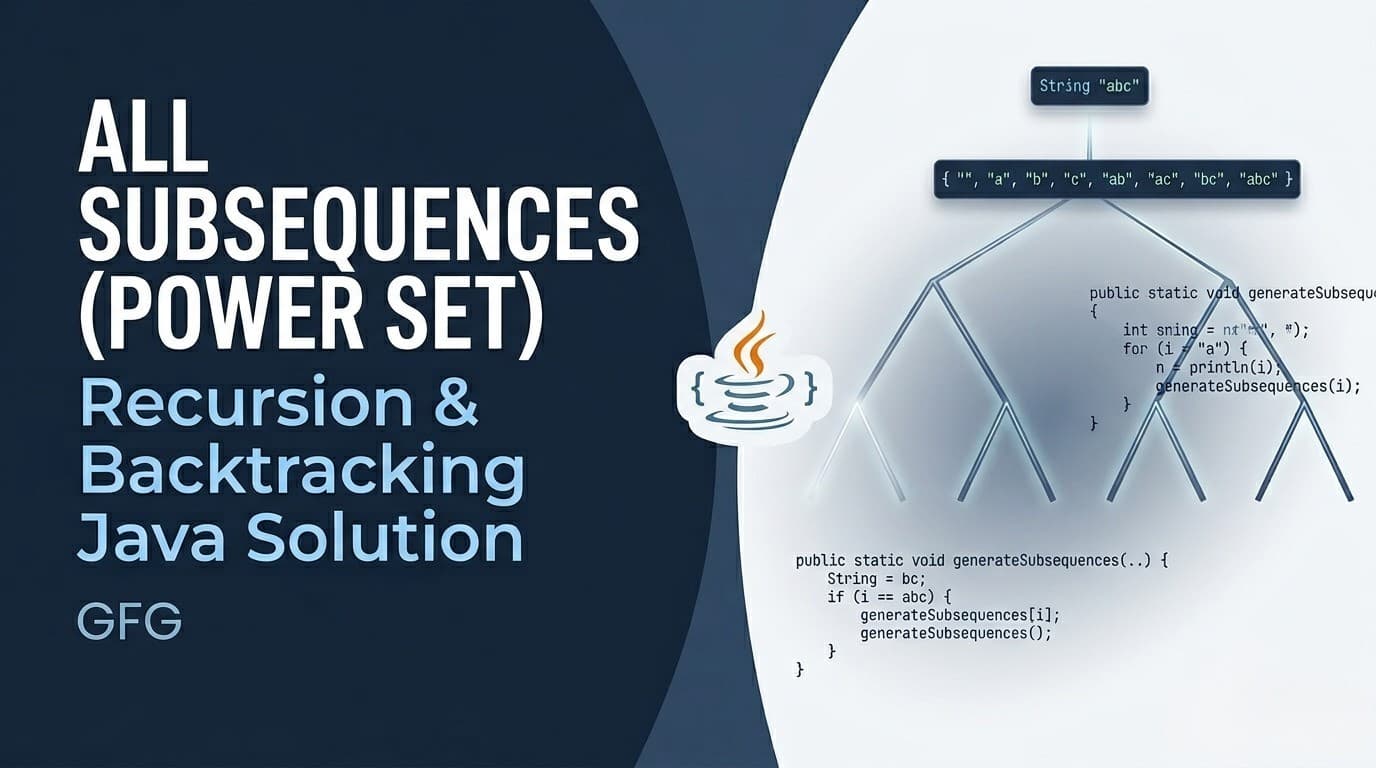
All Subsequences of a String (Power Set) | Recursion & Backtracking Java Solution

All Subsequences of a String (Power Set) | Recursion & Backtracking Java Solution

IntroductionThe Power Set problem for strings is a classic question in recursion and backtracking, frequently asked in coding interviews and platforms like GeeksforGeeks.In this problem, instead of numbers, we deal with strings and generate all possible subsequences (not substrings). This makes it slightly more interesting and practical for real-world applications like pattern matching, text processing, and combinatorics.In this article, we will cover:Intuition behind subsequencesRecursive (backtracking) approachSorting for lexicographical orderAlternative approachesComplexity analysisProblem StatementGiven a string s of length n, generate all non-empty subsequences of the string.RequirementsReturn only non-empty subsequencesOutput must be in lexicographically sorted orderExamplesExample 1Input:s = "abc"Output:a ab abc ac b bc cExample 2Input:s = "aa"Output:a a aaSubsequence vs Substring (Important)Substring: Continuous charactersSubsequence: Characters can be skippedExample for "abc":Subsequences → a, b, c, ab, ac, bc, abcKey InsightFor every character, we have two choices:Include it OR Exclude itSo total subsequences:2^nWe generate all and then remove the empty string.Approach 1: Recursion (Backtracking)IntuitionAt each index:Skip the characterInclude the characterBuild all combinations recursivelyJava Code (With Explanation)import java.util.*;class Solution { // List to store all subsequences List<String> a = new ArrayList<>(); void sub(String s, int ind, String curr) { // Base case: reached end of string if (ind == s.length()) { a.add(curr); // add current subsequence return; } // Choice 1: Exclude current character sub(s, ind + 1, curr); // Choice 2: Include current character sub(s, ind + 1, curr + s.charAt(ind)); } public List<String> AllPossibleStrings(String s) { // Start recursion sub(s, 0, ""); // Remove empty string (not allowed) a.remove(""); // Sort lexicographically Collections.sort(a); return a; }}Step-by-Step Dry Run (s = "abc")Start: ""→ Exclude 'a' → "" → Exclude 'b' → "" → Exclude 'c' → "" → Include 'c' → "c" → Include 'b' → "b" → Exclude 'c' → "b" → Include 'c' → "bc"→ Include 'a' → "a" → Exclude 'b' → "a" → Exclude 'c' → "a" → Include 'c' → "ac" → Include 'b' → "ab" → Exclude 'c' → "ab" → Include 'c' → "abc"Final Output (After Sorting)a ab abc ac b bc cApproach 2: Bit ManipulationIntuitionEach subsequence can be represented using binary numbers:0 → exclude1 → includeCodeimport java.util.*;class Solution { public List<String> AllPossibleStrings(String s) { List<String> result = new ArrayList<>(); int n = s.length(); int total = 1 << n; // 2^n for (int i = 1; i < total; i++) { // start from 1 to avoid empty StringBuilder sb = new StringBuilder(); for (int j = 0; j < n; j++) { if ((i & (1 << j)) != 0) { sb.append(s.charAt(j)); } } result.add(sb.toString()); } Collections.sort(result); return result; }}Approach 3: Iterative (Expanding List)IdeaStart with empty listFor each character:Add it to all existing subsequencesCodeimport java.util.*;class Solution { public List<String> AllPossibleStrings(String s) { List<String> result = new ArrayList<>(); result.add(""); for (char ch : s.toCharArray()) { int size = result.size(); for (int i = 0; i < size; i++) { result.add(result.get(i) + ch); } } result.remove(""); Collections.sort(result); return result; }}Complexity AnalysisTime Complexity: O(n × 2ⁿ)Space Complexity: O(n × 2ⁿ)Why?Total subsequences = 2ⁿEach subsequence takes O(n) to buildWhy Sorting is RequiredThe recursion generates subsequences in random order, so we sort them:Collections.sort(result);This ensures lexicographical order as required.Key TakeawaysThis is a power set problem for stringsEach character → 2 choicesRecursion = most intuitive approachBit manipulation = most optimized thinkingAlways remove empty string if requiredCommon Interview VariationsSubsets of arrayPermutations of stringCombination sumSubsequence with conditionsConclusionThe Power Set problem is a fundamental building block in recursion and combinatorics. Once you understand the include/exclude pattern, you can solve a wide range of problems efficiently.Mastering this will significantly improve your ability to tackle backtracking and decision tree problems.Frequently Asked Questions (FAQs)1. Why is the empty string removed?Because the problem requires only non-empty subsequences.2. Why is time complexity O(n × 2ⁿ)?Because there are 2ⁿ subsequences and each takes O(n) time to construct.3. Which approach is best?Recursion → best for understandingBit manipulation → best for optimization

GeeksforGeeksRecursionJavaBacktrackingMedium
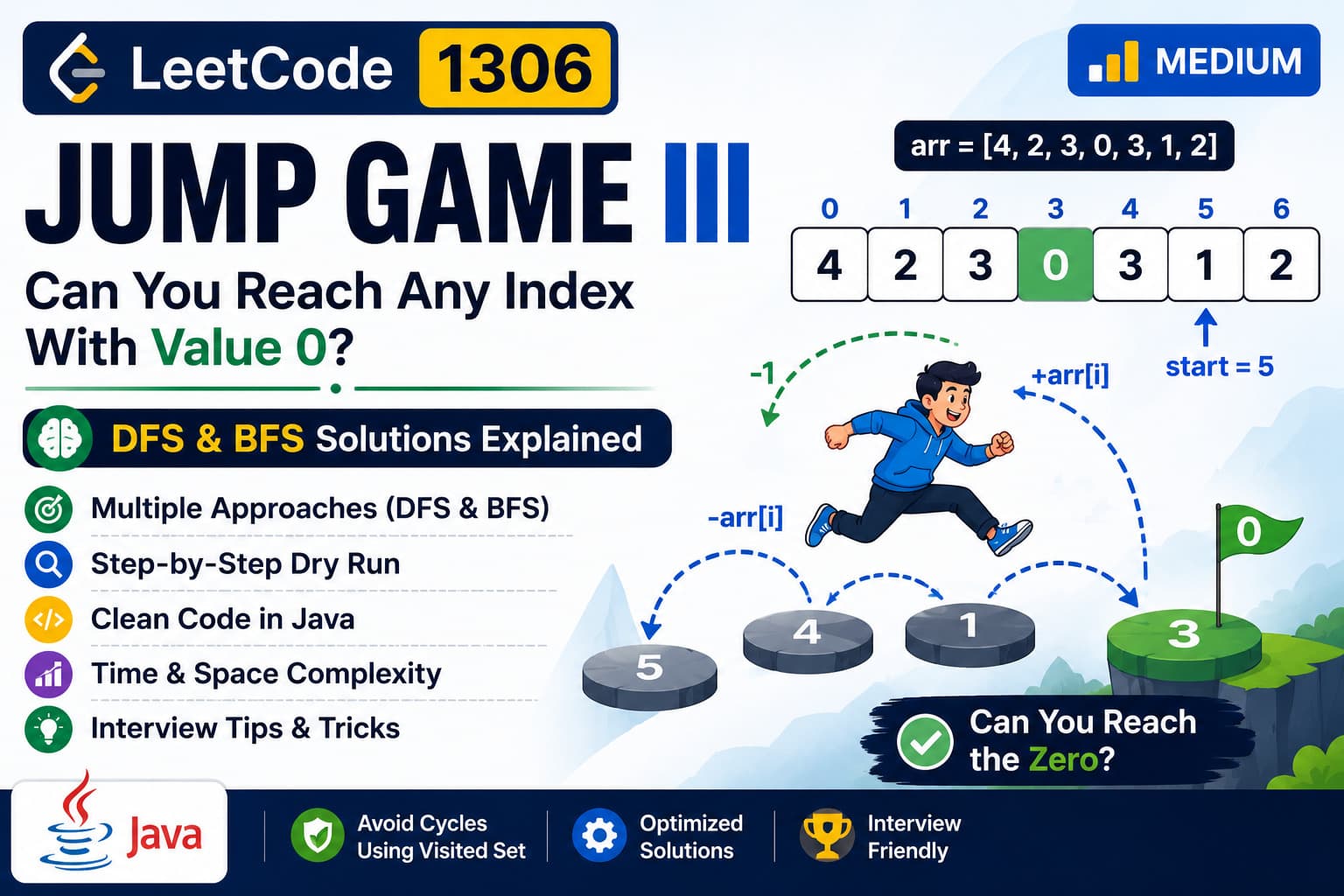
LeetCode 1306: Jump Game III – Java DFS & Graph Traversal Solution Explained

LeetCode 1306: Jump Game III – Java DFS & Graph Traversal Solution Explained

IntroductionLeetCode 1306 – Jump Game III is an interesting graph traversal problem that combines:Depth First Search (DFS)Breadth First Search (BFS)RecursionVisited trackingCycle detectionAt first glance, this problem looks like an array problem.But internally, it behaves exactly like a graph traversal problem where:Each index acts like a nodeEach jump acts like an edgeThis problem is commonly asked in coding interviews because it tests:Recursive thinkingGraph traversal intuitionAvoiding infinite loopsState trackingProblem Link🔗 https://leetcode.com/problems/jump-game-iii/Problem StatementYou are given:An array arrA starting index startFrom index i, you can jump:i + arr[i]ori - arr[i]Your goal is to determine whether you can reach any index having value:0ExampleInputarr = [4,2,3,0,3,1,2]start = 5OutputtrueExplanationPossible path:5 → 4 → 1 → 3At index:3Value becomes:0So answer is:trueUnderstanding the ProblemThink of every index as a graph node.From each node:index iwe have two possible edges:i + arr[i]andi - arr[i]The goal is simply:Can we reach any node containing value 0?Brute Force IntuitionA naive recursive solution would:Try both forward and backward jumpsContinue recursivelyStop when we find zeroWhy Brute Force FailsWithout tracking visited indices, recursion may enter infinite loops.Example:1 → 3 → 1 → 3 → 1...This creates cycles.So we must track visited nodes.DFS IntuitionWe perform DFS traversal from the starting index.At every index:Check boundariesCheck if already visitedCheck if value is zeroExplore both possible jumpsKey DFS ObservationEach index should only be visited once.Why?Because revisiting creates cycles and unnecessary computation.So we use:HashSet<Integer> visitedorboolean[] visitedRecursive DFS ApproachSteps1. Boundary CheckIf index goes outside array:return false2. Visited CheckIf already visited:return false3. Found ZeroIf current index contains:0Return:true4. Explore Both DirectionsTry:start + arr[start]andstart - arr[start]Java DFS Solutionclass Solution { public boolean solve(HashSet<Integer> zeroIndexes, HashSet<Integer> visited, int start, int[] arr) { if(start >= arr.length || start < 0) return false; if(visited.contains(start)) return false; visited.add(start); if(zeroIndexes.contains(start)) return true; return solve(zeroIndexes, visited, start + arr[start], arr) || solve(zeroIndexes, visited, start - arr[start], arr); } public boolean canReach(int[] arr, int start) { HashSet<Integer> visited = new HashSet<>(); HashSet<Integer> zeroIndexes = new HashSet<>(); for(int i = 0; i < arr.length; i++) { if(arr[i] == 0) { zeroIndexes.add(i); } } return solve(zeroIndexes, visited, start, arr); }}Simpler Optimized DFS SolutionWe actually do not need a separate set for zero indexes.We can directly check:arr[start] == 0Cleaner Java DFS Solutionclass Solution { public boolean dfs(int[] arr, boolean[] visited, int start) { if(start < 0 || start >= arr.length) return false; if(visited[start]) return false; if(arr[start] == 0) return true; visited[start] = true; return dfs(arr, visited, start + arr[start]) || dfs(arr, visited, start - arr[start]); } public boolean canReach(int[] arr, int start) { return dfs(arr, new boolean[arr.length], start); }}Dry RunInputarr = [4,2,3,0,3,1,2]start = 5Step 1Current index:5Value:1Possible jumps:5 + 1 = 65 - 1 = 4Step 2Visit index:4Value:3Possible jumps:4 + 3 = 7 (invalid)4 - 3 = 1Step 3Visit index:1Value:2Possible jumps:1 + 2 = 31 - 2 = -1 (invalid)Step 4Visit index:3Value:0Return:trueBFS ApproachThis problem can also be solved using BFS.Instead of recursion:Use queueExplore neighbors level by levelJava BFS Solutionclass Solution { public boolean canReach(int[] arr, int start) { Queue<Integer> queue = new LinkedList<>(); boolean[] visited = new boolean[arr.length]; queue.offer(start); while(!queue.isEmpty()) { int index = queue.poll(); if(index < 0 || index >= arr.length) continue; if(visited[index]) continue; if(arr[index] == 0) return true; visited[index] = true; queue.offer(index + arr[index]); queue.offer(index - arr[index]); } return false; }}Time Complexity AnalysisDFS ComplexityTime ComplexityO(N)Each index is visited at most once.Space ComplexityO(N)Due to recursion stack and visited array.BFS ComplexityTime ComplexityO(N)Space ComplexityO(N)DFS vs BFSApproachAdvantagesDisadvantagesDFSSimple recursive logicRecursion stackBFSIterative solutionQueue managementInterview ExplanationIn interviews, explain:This problem behaves like graph traversal where each index acts as a node and jumps act as edges. We use DFS or BFS with visited tracking to avoid infinite cycles.This demonstrates strong graph intuition.Common Mistakes1. Forgetting Visited TrackingThis causes infinite recursion.2. Missing Boundary ChecksAlways check:start < 0 || start >= arr.length3. Revisiting NodesAvoid processing already visited indices.FAQsQ1. Is this an array problem or graph problem?Internally it is a graph traversal problem.Q2. Which is better: DFS or BFS?Both are valid.DFS is usually simpler for this problem.Q3. Why do we need visited tracking?To avoid infinite loops caused by cycles.Q4. Can this be solved greedily?No.Because multiple paths must be explored.ConclusionLeetCode 1306 is an excellent beginner-friendly graph traversal problem.It teaches:DFS traversalBFS traversalCycle detectionRecursive thinkingVisited state managementThe most important insight is:Treat every index as a graph node.Once you understand this idea, many graph and traversal interview problems become much easier.

LeetCodeMediumDFSBFSGraph TraversalJavaRecursion
Search in Rotated Sorted Array – Binary Search Explained with Java Solution (LeetCode 33)

Search in Rotated Sorted Array – Binary Search Explained with Java Solution (LeetCode 33)

Try the QuestionBefore reading the solution, try solving the problem yourself:👉 https://leetcode.com/problems/search-in-rotated-sorted-array/Attempting the problem first helps build strong algorithmic intuition, which is extremely valuable during coding interviews.Problem StatementYou are given an integer array nums that was originally sorted in ascending order with distinct elements.Example of a sorted array:[0,1,2,4,5,6,7]Before the array is provided to the function, it may have been rotated at some pivot index k.After rotation, the array structure becomes:[nums[k], nums[k+1], ..., nums[n-1], nums[0], nums[1], ..., nums[k-1]]For example:Original Array[0,1,2,4,5,6,7]Rotated by 3 positions[4,5,6,7,0,1,2]You are also given an integer target.The goal is to return the index of the target element in the array.If the element does not exist, return:-1Important ConstraintThe algorithm must run in O(log n) time complexity, which strongly suggests using Binary Search.Example WalkthroughExample 1Inputnums = [4,5,6,7,0,1,2]target = 0Output4Explanation:0 exists at index 4Example 2Inputnums = [4,5,6,7,0,1,2]target = 3Output-1Explanation:3 does not exist in the arrayExample 3Inputnums = [1]target = 0Output-1Understanding the Core ChallengeIf the array were fully sorted, the problem would be straightforward because binary search could directly be applied.Example:[1,2,3,4,5,6,7]However, due to rotation:[4,5,6,7,0,1,2]the array is no longer globally sorted.But an important observation makes the problem solvable.Key ObservationEven after rotation:At least one half of the array is always sorted.For example:[4,5,6,7,0,1,2] Left part → sorted Right part → sortedThis property allows the use of binary search with additional conditions.Approach 1 — Linear Scan (Brute Force)The simplest method is to iterate through the entire array and check each element.AlgorithmTraverse the array from start to end.Compare every element with the target.Return the index if found.Codefor(int i = 0; i < nums.length; i++){ if(nums[i] == target){ return i; }}return -1;Time ComplexityO(n)Space ComplexityO(1)Although simple, this solution does not satisfy the required O(log n) complexity.Approach 2 — Modified Binary SearchA better solution uses binary search with sorted half detection.IdeaAt every step:Calculate the middle index.Determine which half of the array is sorted.Check if the target lies inside that sorted half.Adjust the search range accordingly.Implementationpublic int search(int[] nums, int target) { int l = 0; int r = nums.length - 1; while(l <= r){ int mid = l + (r - l) / 2; if(nums[mid] == target){ return mid; } // left half sorted if(nums[l] <= nums[mid]){ if(nums[l] <= target && target < nums[mid]){ r = mid - 1; }else{ l = mid + 1; } } // right half sorted else{ if(nums[mid] < target && target <= nums[r]){ l = mid + 1; }else{ r = mid - 1; } } } return -1;}Time ComplexityO(log n)Space ComplexityO(1)This is the most common interview solution.Approach 3 — Find Rotation Point Then Apply Binary SearchAnother elegant strategy is to first locate the minimum element in the rotated array, which represents the rotation index (pivot).Once the pivot is known, the array can be logically split into two sorted subarrays.Example:[4,5,6,7,0,1,2] ^ pivotTwo sorted sections exist:[4,5,6,7][0,1,2]After identifying the pivot:Decide which part may contain the target.Apply standard binary search on that portion.Step 1 — Finding the Minimum Element (Rotation Pivot)The smallest element indicates where the rotation happened.Function to Find Minimum Valuepublic int findMinIndex(int[] nums){ int l = 0; int r = nums.length - 1; while(l < r){ int mid = l + (r - l) / 2; if(nums[mid] > nums[r]){ l = mid + 1; }else{ r = mid; } } return l;}Why This WorksIf:nums[mid] > nums[r]the minimum element must be on the right side.Otherwise, it lies on the left side (including mid).Step 2 — Standard Binary SearchAfter determining which half contains the target, a normal binary search is applied.public int binarySearch(int[] nums, int l, int r, int target){ while(l <= r){ int mid = l + (r - l) / 2; if(nums[mid] == target){ return mid; } else if(nums[mid] < target){ l = mid + 1; } else{ r = mid - 1; } } return -1;}Complete Solution (Pivot + Binary Search)class Solution { public int findMinIndex(int[] nums){ int l = 0; int r = nums.length - 1; while(l < r){ int mid = l + (r - l) / 2; if(nums[mid] > nums[r]){ l = mid + 1; }else{ r = mid; } } return l; } public int binarySearch(int[] nums, int l, int r, int target){ while(l <= r){ int mid = l + (r - l) / 2; if(nums[mid] == target){ return mid; } else if(nums[mid] < target){ l = mid + 1; } else{ r = mid - 1; } } return -1; } public int search(int[] nums, int target) { int pivot = findMinIndex(nums); if(nums[pivot] <= target && target <= nums[nums.length - 1]){ return binarySearch(nums, pivot, nums.length - 1, target); } return binarySearch(nums, 0, pivot - 1, target); }}Time ComplexityFinding pivot:O(log n)Binary search:O(log n)Total complexity:O(log n)Space ComplexityO(1)No additional memory is used.Key Takeaways✔ The array is sorted but rotated✔ A rotation creates two sorted sections✔ Binary search can still be applied✔ Either detect the sorted half directly or locate the pivot first✔ Both optimized approaches achieve O(log n) complexityFinal ThoughtsThis problem is a classic binary search variation frequently asked in coding interviews. It evaluates the ability to:Recognize structural patterns in arraysAdapt binary search to non-standard conditionsMaintain optimal algorithmic complexityUnderstanding this pattern also helps solve related problems such as:Find Minimum in Rotated Sorted ArraySearch in Rotated Sorted Array IIFind Rotation Count in ArrayMastering these concepts significantly strengthens binary search problem-solving skills for technical interviews.

Binary SearchJavaRotated Sorted ArrayLeetCodeMedium
LeetCode 290: Word Pattern – Multiple Ways to Verify Bijection Between Pattern Characters and Words

LeetCode 290: Word Pattern – Multiple Ways to Verify Bijection Between Pattern Characters and Words

Try the ProblemYou can practice the problem here:https://leetcode.com/problems/word-pattern/Problem DescriptionYou are given:A string patternA string sThe string s consists of words separated by spaces.Your task is to determine whether s follows the same pattern defined by the string pattern.To follow the pattern, there must be a bijection between pattern characters and words.Understanding the Meaning of BijectionA bijection means a one-to-one relationship between two sets.For this problem it means:Every character in the pattern maps to exactly one word.Every word maps to exactly one pattern character.Two characters cannot map to the same word.Two words cannot map to the same character.This ensures the mapping is unique in both directions.Example WalkthroughExample 1Inputpattern = "abba"s = "dog cat cat dog"OutputtrueExplanationMapping:a → dogb → catPattern:a b b aWords:dog cat cat dogThe mapping is perfectly consistent.Example 2Inputpattern = "abba"s = "dog cat cat fish"OutputfalseExplanationThe last word "fish" breaks the pattern because "a" was already mapped to "dog".Example 3Inputpattern = "aaaa"s = "dog cat cat dog"OutputfalseExplanationPattern requires:a → same word every timeBut the words differ.Constraints1 <= pattern.length <= 300pattern contains lowercase English letters1 <= s.length <= 3000s contains lowercase letters and spaceswords are separated by a single spaceno leading or trailing spacesCore ObservationBefore applying any algorithm, we should verify one simple condition.If the number of pattern characters does not match the number of words, then the pattern cannot match.Example:pattern = "abba"s = "dog cat dog"Pattern length = 4Words = 3This automatically returns false.Thinking About Possible ApproachesWhile solving this problem, several strategies may come to mind:Use one HashMap to store pattern → word mapping and check duplicates manually.Use two HashMaps to enforce bijection from both directions.Track first occurrence indices of pattern characters and words.Compare mapping patterns using arrays or maps.Let’s explore these approaches one by one.Approach 1: Single HashMap (Your Solution)IdeaWe store mapping:pattern character → wordWhile iterating:If the character already exists in the map→ check if it maps to the same word.If it does not exist→ ensure that no other character already maps to that word.This ensures bijection.Java Implementationclass Solution { public boolean wordPattern(String pattern, String s) { String words[] = s.split(" "); // Length mismatch means impossible mapping if(pattern.length() != words.length) return false; HashMap<Character,String> mp = new HashMap<>(); for(int i = 0; i < words.length; i++){ char ch = pattern.charAt(i); if(mp.containsKey(ch)){ if(!mp.get(ch).equals(words[i])){ return false; } }else{ // Prevent two characters mapping to same word if(mp.containsValue(words[i])){ return false; } } mp.put(ch, words[i]); } return true; }}Time ComplexityO(n²)Because containsValue() can take O(n) time in worst case.Space ComplexityO(n)Approach 2: Two HashMaps (Cleaner Bijection Enforcement)IdeaInstead of checking containsValue, we maintain two maps.pattern → wordword → patternThis ensures bijection naturally.Java Implementationclass Solution { public boolean wordPattern(String pattern, String s) { String[] words = s.split(" "); if(pattern.length() != words.length) return false; HashMap<Character, String> map1 = new HashMap<>(); HashMap<String, Character> map2 = new HashMap<>(); for(int i = 0; i < pattern.length(); i++){ char ch = pattern.charAt(i); String word = words[i]; if(map1.containsKey(ch) && !map1.get(ch).equals(word)) return false; if(map2.containsKey(word) && map2.get(word) != ch) return false; map1.put(ch, word); map2.put(word, ch); } return true; }}Time ComplexityO(n)Because both maps allow constant-time lookups.Space ComplexityO(n)Approach 3: Index Mapping Technique (Elegant Trick)IdeaAnother clever technique is to compare first occurrence indices.Example:pattern = abbawords = dog cat cat dogPattern index sequence:a → 0b → 1b → 1a → 0Words index sequence:dog → 0cat → 1cat → 1dog → 0If the index sequences match, then the pattern holds.Java Implementationclass Solution { public boolean wordPattern(String pattern, String s) { String[] words = s.split(" "); if(pattern.length() != words.length) return false; HashMap<Character,Integer> map1 = new HashMap<>(); HashMap<String,Integer> map2 = new HashMap<>(); for(int i = 0; i < pattern.length(); i++){ char ch = pattern.charAt(i); String word = words[i]; if(!map1.getOrDefault(ch, -1) .equals(map2.getOrDefault(word, -1))){ return false; } map1.put(ch, i); map2.put(word, i); } return true; }}Time ComplexityO(n)Space ComplexityO(n)Comparison of ApproachesApproachTime ComplexitySpace ComplexityNotesSingle HashMapO(n²)O(n)Simple but slowerTwo HashMapsO(n)O(n)Cleaner bijection enforcementIndex MappingO(n)O(n)Elegant and interview-friendlyKey Interview InsightProblems like this test your understanding of:Bijection MappingSimilar problems include:Isomorphic StringsWord Pattern IISubstitution Cipher ProblemsUnderstanding how to enforce one-to-one mappings is a powerful technique.ConclusionThe Word Pattern problem is an excellent example of how HashMaps can enforce relationships between two datasets.While a simple HashMap solution works, more optimized methods like two-way mapping or index comparison provide cleaner and more efficient implementations.Mastering these techniques will help you solve many pattern-matching and mapping problems commonly asked in coding interviews.

HashMapString ManipulationBijection MappingTwo HashMapsIndex MappingLeetCode Easy
Climbing Stairs Problem (LeetCode 70) – Complete Guide with Optimized Solutions

Climbing Stairs Problem (LeetCode 70) – Complete Guide with Optimized Solutions

IntroductionThe Climbing Stairs problem is one of the most commonly asked coding interview questions for beginners. It is a perfect example to understand recursion, memoization, and dynamic programming (DP).In this article, we will break down the problem step by step and explore multiple approaches—from brute force recursion to an optimized space-efficient solution.Link of Problem: LeetCode – Climbing StairsProblem StatementYou are climbing a staircase that has n steps.Each time, you can either climb 1 step or 2 steps.The goal is to calculate the total number of distinct ways to reach the top.ExampleInput:n = 2Output:2Explanation:1 + 12Input:n = 3Output:3Explanation:1 + 1 + 11 + 22 + 1Key InsightTo reach step n, there are only two possibilities:From step n-1 (taking 1 step)From step n-2 (taking 2 steps)So, the recurrence relation becomes:ways(n) = ways(n-1) + ways(n-2)This is identical to the Fibonacci sequence, making this problem a classic DP question.Approach 1: Recursive Solution (Brute Force)IdeaBreak the problem into smaller subproblems:Count ways to reach n-1Count ways to reach n-2Add both resultsCodeclass Solution { public int climbStairs(int n) { if(n == 0) return 1; if(n < 0) return 0; return climbStairs(n-1) + climbStairs(n-2); }}ComplexityTime Complexity: O(2^n)Space Complexity: O(n)DrawbackThis solution recalculates the same subproblems multiple times, leading to Time Limit Exceeded (TLE) for larger values.Approach 2: Recursion with Memoization (Top-Down DP)IdeaTo optimize recursion, store already computed results using a HashMap.Avoid repeated calculationsConvert exponential time into linear timeCodeimport java.util.HashMap;class Solution { private HashMap<Integer, Integer> memo = new HashMap<>(); public int climbStairs(int n) { if(n == 0) return 1; if(n < 0) return 0; if(memo.containsKey(n)) { return memo.get(n); } int result = climbStairs(n-1) + climbStairs(n-2); memo.put(n, result); return result; }}ComplexityTime Complexity: O(n)Space Complexity: O(n)Why It WorksMemoization ensures each subproblem is solved only once, making recursion efficient and practical.Approach 3: Dynamic Programming (Bottom-Up)IdeaInstead of recursion, build the solution iteratively:Use an array dp[]Store results for each stepBuild from smaller values to larger onesCodeclass Solution { public int climbStairs(int n) { if(n == 1) return n; if(n == 2) return n; if(n == 3) return n; int dp[] = new int[n+1]; dp[0] = 0; dp[1] = 1; dp[2] = 2; for(int i = 3; i <= n; i++) { dp[i] = dp[i-1] + dp[i-2]; } return dp[n]; }}ComplexityTime Complexity: O(n)Space Complexity: O(n)Approach 4: Optimal Solution (Space Optimized)IdeaWe only need the last two values instead of the whole array.Codeclass Solution { public int climbStairs(int n) { if(n <= 2) return n; int prev1 = 1; int prev2 = 2; for(int i = 3; i <= n; i++) { int current = prev1 + prev2; prev1 = prev2; prev2 = current; } return prev2; }}ComplexityTime Complexity: O(n)Space Complexity: O(1)Key TakeawaysThe problem follows a Fibonacci-like patternBrute force recursion is simple but inefficientMemoization converts recursion into an efficient solutionDynamic programming avoids recursion completelySpace optimization reduces memory usage to constant spaceWhen This Problem Is AskedThis question is frequently asked in:Coding interviews (product-based companies)Data Structures & Algorithms examsOnline coding platformsIt evaluates:Problem-solving abilityUnderstanding of recursionOptimization skillsConclusionThe Climbing Stairs problem is a foundational example for learning dynamic programming. Starting with recursion and improving it using memoization and iterative DP demonstrates how to optimize algorithms effectively.Understanding this pattern will help solve many similar problems related to sequences and decision-making.Frequently Asked Questions (FAQs)1. Is this problem related to Fibonacci?Yes, the recurrence relation is exactly the same as the Fibonacci sequence.2. Why does recursion fail for large inputs?Because it recalculates the same values repeatedly, leading to exponential time complexity.3. What is the best approach?The space-optimized approach is the most efficient with O(n) time and O(1) space.

EasyJavaLeetCodeRecursionMemoization
LeetCode 121 — Best Time to Buy and Sell Stock I | Two Pointer / Sliding Window Explained

LeetCode 121 — Best Time to Buy and Sell Stock I | Two Pointer / Sliding Window Explained

🚀 Try This Problem First!Before reading the solution, attempt it yourself on LeetCode — you'll retain the concept far better.🔗 Problem Link: https://leetcode.com/problems/best-time-to-buy-and-sell-stock/Understanding the ProblemYou are given an array prices where prices[i] is the stock price on day i. You can buy on one day and sell on a later day. You want to maximize your profit.Goal: Return the maximum profit possible. If no profit can be made, return 0.Key Rules:You must buy before you sell — no going back in time.You can only make one transaction (one buy, one sell).If prices only go down, profit is impossible — return 0.Constraints:1 ≤ prices.length ≤ 10⁵0 ≤ prices[i] ≤ 10⁴Understanding the Problem With a Real-World AnalogyImagine you're watching a stock ticker for a week. You want to pick the single best day to buy and a later day to sell. You can't predict the future — you just have historical prices. The question is: looking back at all the prices, what was the best single buy-sell pair you could have chosen?Key Observation (Before Writing a Single Line of Code)The profit on any given pair of days is:profit = prices[sell_day] - prices[buy_day]To maximize profit, for every potential sell day, we want the lowest possible buy price seen so far to the left of it. This is the core insight that drives the efficient solution.If at any point the current price is lower than our tracked minimum, there is no point keeping the old minimum — the new one is strictly better for any future sell day.Intuition — The Two Pointer ApproachWe use two pointers i (buy pointer) and j (sell pointer), both starting at the beginning with i = 0 and j = 1.At every step we ask: is prices[j] greater than prices[i]?If yes → this is a profitable pair. Compute the profit and update the maximum if it's better.If no → prices[j] is cheaper than prices[i]. There's no reason to keep i where it is — any future sell day would be better served by buying at j instead. So we move i to j.Either way, j always moves forward by 1 until it reaches the end of the array.Why Moving i to j is CorrectThis is the most important conceptual point. When prices[j] < prices[i], you might wonder — why not just skip j and move on? Why move i?Because for any future day k > j, the profit buying at j is:prices[k] - prices[j]And the profit buying at i is:prices[k] - prices[i]Since prices[j] < prices[i], buying at j will always give a higher or equal profit for the same sell day k. So we update i = j — there is no scenario where keeping the old i is better.Dry Run — Example 1 (Step by Step)Input: prices = [7, 1, 5, 3, 6, 4]We start with i = 0, j = 1, maxP = 0.Step 1: i = 0, j = 1 → prices[i] = 7, prices[j] = 17 > 1 → prices[j] is cheaper. Move i to j. i = 1, j moves to 2. maxP = 0.Step 2: i = 1, j = 2 → prices[i] = 1, prices[j] = 51 < 5 → Profitable! profit = 5 - 1 = 4. 4 > 0 → update maxP = 4. j moves to 3.Step 3: i = 1, j = 3 → prices[i] = 1, prices[j] = 31 < 3 → Profitable! profit = 3 - 1 = 2. 2 < 4 → maxP stays 4. j moves to 4.Step 4: i = 1, j = 4 → prices[i] = 1, prices[j] = 61 < 6 → Profitable! profit = 6 - 1 = 5. 5 > 4 → update maxP = 5. j moves to 5.Step 5: i = 1, j = 5 → prices[i] = 1, prices[j] = 41 < 4 → Profitable! profit = 4 - 1 = 3. 3 < 5 → maxP stays 5. j moves to 6. j = 6 = prices.length → loop ends.Output: maxP = 5 ✅ (Buy at day 2 price=1, sell at day 5 price=6)Dry Run — Example 2 (Step by Step)Input: prices = [7, 6, 4, 3, 1]We start with i = 0, j = 1, maxP = 0.Step 1: i = 0, j = 1 → prices[i] = 7, prices[j] = 67 > 6 → Move i to j. i = 1, j moves to 2. maxP = 0.Step 2: i = 1, j = 2 → prices[i] = 6, prices[j] = 46 > 4 → Move i to j. i = 2, j moves to 3. maxP = 0.Step 3: i = 2, j = 3 → prices[i] = 4, prices[j] = 34 > 3 → Move i to j. i = 3, j moves to 4. maxP = 0.Step 4: i = 3, j = 4 → prices[i] = 3, prices[j] = 13 > 1 → Move i to j. i = 4, j moves to 5. j = 5 = prices.length → loop ends.Output: maxP = 0 ✅ (Prices only went down, no profitable transaction exists)The Code — Implementationclass Solution {public int maxProfit(int[] prices) {int i = 0; // Buy pointer — points to the current minimum price dayint j = 1; // Sell pointer — scans forward through the arrayint maxP = 0; // Tracks the maximum profit seen so far// j scans from day 1 to the end of the arraywhile (i < j && j < prices.length) {if (prices[i] > prices[j]) {// prices[j] is cheaper than current buy price// Move buy pointer to j — buying here is strictly better// for any future sell dayi = j;} else {// prices[j] > prices[i] — this is a profitable pair// Calculate profit and update maxP if it's the best so farint profit = prices[j] - prices[i];if (profit > maxP) {maxP = profit;}}// Always move the sell pointer forwardj++;}// If no profitable transaction was found, maxP remains 0return maxP;}}Code Walkthrough — Step by StepInitialization: i = 0 acts as our buy day pointer (always pointing to the lowest price seen so far). j = 1 is our sell day pointer scanning forward. maxP = 0 is our answer — defaulting to 0 handles the case where no profit is possible.The loop condition: i < j ensures we never sell before buying. j < prices.length ensures we don't go out of bounds.When prices[i] > prices[j]: The current sell day price is cheaper than our buy day. We update i = j, because buying at j dominates buying at i for all future sell days.When prices[j] >= prices[i]: We have a potential profit. We compute it and update maxP if it beats the current best.j always increments: Regardless of which branch we take, j++ moves the sell pointer forward every iteration — this is what drives the loop to completion.Common Mistakes to AvoidNot returning 0 for no-profit cases: If prices are strictly decreasing, maxP never gets updated and stays 0. The initialization maxP = 0 handles this correctly — never initialize it to a negative number.Using a nested loop (brute force): A common first instinct is two nested loops checking every pair. That is O(N²) and will TLE on large inputs. The two pointer approach solves it in O(N).Thinking you need to sort: Sorting destroys the order of days, which is fundamental to the problem. Never sort the prices array here.Moving i forward by 1 instead of to j: When prices[j] < prices[i], some people write i++ instead of i = j. This is wrong — you might miss the new minimum entirely and waste iterations.Complexity AnalysisTime Complexity: O(N) The j pointer traverses the array exactly once from index 1 to the end. The i pointer only moves forward and never exceeds j. So the entire algorithm is a single linear pass — O(N).Space Complexity: O(1) No extra arrays, maps, or stacks are used. Only three integer variables — i, j, and maxP.Alternative Way to Think About It (Min Tracking)Some people write this problem using a minPrice variable instead of two pointers. Both approaches are equivalent — the two pointer framing is slightly more intuitive visually, but here is the min-tracking version for reference:int minPrice = Integer.MAX_VALUE;int maxProfit = 0;for (int price : prices) {if (price < minPrice) {minPrice = price;} else if (price - minPrice > maxProfit) {maxProfit = price - minPrice;}}return maxProfit;The logic is the same — always track the cheapest buy day seen so far, and for each day compute what profit would look like if you sold today.Similar Problems (Build on This Foundation)LeetCode 122 — Best Time to Buy and Sell Stock II (multiple transactions allowed) [ Blog is also avaliable on this - Read Now ]LeetCode 123 — Best Time to Buy and Sell Stock III (at most 2 transactions) [ Blog is also avaliable on this - Read Now ]LeetCode 188 — Best Time to Buy and Sell Stock IV (at most k transactions)LeetCode 309 — Best Time to Buy and Sell Stock with CooldownLeetCode 714 — Best Time to Buy and Sell Stock with Transaction FeeLeetCode 121 is the foundation. Master this one deeply before moving to the others — they all build on the same core idea.Key Takeaways✅ For every potential sell day, the best buy day is always the minimum price seen to its left — this drives the whole approach.✅ When the sell pointer finds a cheaper price than the buy pointer, always move the buy pointer there — it strictly dominates the old buy day for all future sells.✅ Initialize maxP = 0 so that no-profit scenarios (prices only going down) are handled automatically.✅ The two pointer approach solves this in a single linear pass — O(N) time and O(1) space.✅ j always increments every iteration — i only moves when a cheaper price is found.Happy Coding! If this clicked for you, the entire Stock series on LeetCode will feel much more approachable.

LeetCodeTwo PointersEasyJavaDSA
LeetCode 1980: Find Unique Binary String – Multiple Ways to Generate a Missing Binary Combination

LeetCode 1980: Find Unique Binary String – Multiple Ways to Generate a Missing Binary Combination

Try the ProblemYou can solve the problem here:https://leetcode.com/problems/find-unique-binary-string/Problem DescriptionYou are given an array nums containing n unique binary strings, where each string has length n.Your task is to return any binary string of length n that does not appear in the array.Important ConditionsEach string consists only of '0' and '1'.Every string in the array is unique.The output must be a binary string of length n.If multiple valid answers exist, any one of them is acceptable.ExamplesExample 1Inputnums = ["01","10"]Output"11"ExplanationPossible binary strings of length 2:00011011Since "01" and "10" are already present, valid answers could be:00 or 11Example 2Inputnums = ["00","01"]Output"11"Another valid output could be:10Example 3Inputnums = ["111","011","001"]Output101Other valid answers include:000010100110Constraintsn == nums.length1 <= n <= 16nums[i].length == nnums[i] consists only of '0' and '1'All strings in nums are uniqueImportant ObservationThe total number of binary strings of length n is:2^nBut the array contains only:n stringsSince 2^n grows very quickly and n ≤ 16, there are many possible binary strings missing from the array. Our goal is simply to construct one of those missing strings.Thinking About the ProblemBefore jumping into coding, it's useful to think about different strategies that could help us generate a binary string that does not appear in the array.Possible Ways to Think About the ProblemWhen approaching this problem, several ideas may come to mind:Generate all possible binary strings of length n and check which one is missing.Store all strings in a HashSet or HashMap and construct a candidate string to verify whether it exists.Manipulate existing strings by flipping bits to create new combinations.Use a mathematical trick that guarantees the new string is different from every string in the list.Each of these approaches leads to a different solution strategy.In this article, we will walk through these approaches and understand how they work.Approach 1: Brute Force – Generate All Binary StringsIdeaThe simplest idea is to generate every possible binary string of length n and check whether it exists in the given array.Since there are:2^n possible binary stringsWe can generate them one by one and return the first string that does not appear in nums.StepsConvert numbers from 0 to (2^n - 1) into binary strings.Pad the binary string with leading zeros so its length becomes n.Check if that string exists in the array.If not, return it.Time ComplexityO(2^n * n)This works because n is at most 16, but it is still not the most elegant approach.Approach 2: HashMap + Bit Flipping (My Approach)IdeaWhile solving this problem, another idea is to store all given binary strings inside a HashMap for quick lookup.Then we can try to construct a new binary string by flipping bits from the existing strings.The intuition is simple:If the current character is '0', change it to '1'.If the current character is '1', change it to '0'.By flipping bits at different positions, we attempt to build a new binary combination.Once the string is constructed, we check whether it already exists in the map.If the generated string does not exist, we return it as our answer.Java Implementation (My Solution)class Solution { public String findDifferentBinaryString(String[] nums) { int len = nums[0].length(); // HashMap to store all given binary strings HashMap<String, Integer> mp = new HashMap<>(); for(int i = 0; i < nums.length; i++){ mp.put(nums[i], i); } int cou = 0; String ans = ""; for(int i = 0; i < nums.length; i++){ if(cou < len){ // Flip the current bit if(nums[i].charAt(cou) == '0'){ ans += '1'; cou++; } else{ ans += '0'; cou++; } }else{ // If generated string does not exist in map if(!mp.containsKey(ans)){ return ans; } // Reset and try building again ans = ""; cou = 0; } } return ans; }}Time ComplexityO(n²)Because we iterate through the array and perform string operations.Space ComplexityO(n)For storing the strings in the HashMap.Approach 3: Cantor’s Diagonalization (Optimal Solution)IdeaA clever mathematical observation allows us to construct a string that must differ from every string in the array.We build a new string such that:The first character differs from the first string.The second character differs from the second string.The third character differs from the third string.And so on.By ensuring that the generated string differs from each string at least at one position, it is guaranteed not to exist in the array.This technique is known as Cantor’s Diagonalization.Java Implementationclass Solution { public String findDifferentBinaryString(String[] nums) { int n = nums.length; StringBuilder result = new StringBuilder(); for(int i = 0; i < n; i++){ // Flip the diagonal bit if(nums[i].charAt(i) == '0'){ result.append('1'); } else{ result.append('0'); } } return result.toString(); }}Time ComplexityO(n)We only traverse the array once.Space ComplexityO(n)For storing the resulting string.Comparison of ApproachesApproachTime ComplexitySpace ComplexityNotesBrute ForceO(2^n * n)O(n)Simple but inefficientHashMap + Bit FlippingO(n²)O(n)Constructive approachCantor DiagonalizationO(n)O(n)Optimal and elegantKey TakeawaysThis problem highlights an interesting concept in algorithm design:Sometimes the best solution is not searching for the answer but constructing one directly.By understanding the structure of the input, we can generate a result that is guaranteed to be unique.ConclusionThe Find Unique Binary String problem can be solved using multiple strategies, ranging from brute force enumeration to clever mathematical construction.While brute force works due to the small constraint (n ≤ 16), more elegant solutions exist. Using hashing or constructive approaches improves efficiency and demonstrates deeper algorithmic thinking.Among all approaches, the Cantor Diagonalization technique provides the most efficient and mathematically guaranteed solution.Understanding problems like this helps strengthen skills in string manipulation, hashing, and constructive algorithms, which are commonly tested in coding interviews.

Binary StringsHashingCantor DiagonalizationLeetCodeMedium
LeetCode 36: Valid Sudoku Explained – Java Solutions, Intuition & Formula Dry Run

LeetCode 36: Valid Sudoku Explained – Java Solutions, Intuition & Formula Dry Run

IntroductionSudoku is a universally beloved puzzle, but validating a Sudoku boardalgorithmically is a classic technical interview question. In this post, we aregoing to dive deep into LeetCode 36: Valid Sudoku.We won't just look at the code; we will explore the intuition behind the problemso you don't have to memorize anything. We’ll cover an ingenious in-placevalidation approach, break down the complex math formula used to check3 \times 3 sub-boxes, and look at an alternative optimal solution usingHashSets.Let's dive in!Understanding the ProblemThe problem asks us to determine if a partially filled 9 \times 9 Sudoku boardis valid. To be valid, the filled cells must follow three straightforward rules:1. Each row must contain the digits 1-9 without repetition.2. Each column must contain the digits 1-9 without repetition.3. Each of the nine 3 \times 3 sub-boxes must contain the digits 1-9 withoutrepetition.Important Note: A valid board doesn't mean the board is fully solvable! We onlycare about checking the numbers that are currently on the board.Intuition: How to Think About the ProblemBefore writing code, how do we, as humans, check if a Sudoku board is valid? Ifyou place a 5 in a cell, you quickly scan horizontally (its row), vertically(its column), and within its small 3 \times 3 square. If you see another 5, theboard is invalid.To translate this to code, we have two choices:1. The Simulation Approach: Go cell by cell. Pick up the number, hide it, andcheck its row, column, and 3 \times 3 box to see if that number existsanywhere else. (This is the approach we will look at first).2. The Memory Approach: Go cell by cell, but keep a "notebook" (like a HashTable) of everything we have seen so far. If we see a number we've alreadywritten down for a specific row, column, or box, it's invalid.Approach 1: The In-Place Validation (Space-Optimized)Here is a brilliant solution that validates the board without using any extradata structures.The Logic: Iterate through every cell on the board. When we find a number, wetemporarily replace it with a . (empty space). Then, we iterate 9 times to checkits entire row, column, and sub-box. If the number is found, we return false.Otherwise, we put the number back and move to the next cell.The Java Codeclass Solution {public boolean isvalid(char[][] board, int i, int j, char k) {for(int m = 0; m < 9; m++) {// Check rowif(board[i][m] == k) return false;// Check columnif(board[m][j] == k) return false;// Check 3x3 sub-boxif(board[3 * (i / 3) + m / 3][3 * (j / 3) + m % 3] == k) return false;}return true;}public boolean isValidSudoku(char[][] board) {for(int i = 0; i < board.length; i++) {for(int j = 0; j < board[0].length; j++) {if(board[i][j] != '.') {char temp = board[i][j];board[i][j] = '.'; // Temporarily remove the numberif(!isvalid(board, i, j, temp)) {return false;}board[i][j] = temp; // Put the number back}}}return true;}}The Math Breakdown: Demystifying the 3 \times 3 Grid FormulaThe hardest part of this code to understand is this exact line: board[3*(i/3) +m/3][3*(j/3) + m%3]How does a single loop variable m (from 0 to 8) traverse a 3 \times 3 grid?Let’s do a dry run.Step 1: Finding the Starting Point of the BoxThe grid is 9 \times 9, broken into nine 3 \times 3 boxes. If we are at a randomcell, say row i = 4, col j = 5, which box are we in? Because integer division inJava drops the decimal:i / 3 = 4 / 3 = 1j / 3 = 5 / 3 = 1Now multiply by 3 to get the actual starting coordinates (top-left corner) ofthat specific sub-box:3 * 1 = 3 (Row offset)3 * 1 = 3 (Col offset) So, the 3 \times 3 box starts at row 3, col 3.Step 2: Traversing the Box (Dry Run)Now, as m goes from 0 to 8, we use m / 3 for rows and m % 3 for columns:m = 0: row offset 0/3 = 0, col offset 0%3 = 0 \rightarrow Checks (3+0, 3+0) = (3, 3)m = 1: row offset 1/3 = 0, col offset 1%3 = 1 \rightarrow Checks (3+0, 3+1) = (3, 4)m = 2: row offset 2/3 = 0, col offset 2%3 = 2 \rightarrow Checks (3+0, 3+2) = (3, 5)m = 3: row offset 3/3 = 1, col offset 3%3 = 0 \rightarrow Checks (3+1, 3+0) = (4, 3)m = 4: row offset 4/3 = 1, col offset 4%3 = 1 \rightarrow Checks (3+1, 3+1) = (4, 4)...and so on up to m = 8.This brilliant math formula maps a 1D loop (0 to 8) directly onto a 2D3 \times 3 grid perfectly! No nested loops needed inside the isvalid function.Approach 2: The HashSet Solution (Single Pass)While the first approach is highly space-efficient, it does a bit of redundantchecking. An alternative approach that interviewers love is using a HashSet.Instead of checking rows and columns every time we see a number, we generate aunique "string signature" for every number and attempt to add it to a HashSet.If we see a 5 at row 0 and col 1, we create three strings:1. "5 in row 0"2. "5 in col 1"3. "5 in block 0-0"The HashSet.add() method returns false if the item already exists in the set. Ifit returns false, we instantly know the board is invalid!HashSet Java Code:class Solution {public boolean isValidSudoku(char[][] board) {HashSet<String> seen = new HashSet<>();for (int i = 0; i < 9; i++) {for (int j = 0; j < 9; j++) {char number = board[i][j];if (number != '.') {// HashSet.add() returns false if the element already existsif (!seen.add(number + " in row " + i) ||!seen.add(number + " in col " + j) ||!seen.add(number + " in block " + i/3 + "-" + j/3)) {return false;}}}}return true;}}Notice how we use i/3 + "-" + j/3 to identify the blocks. Top-left is block 0-0,bottom-right is block 2-2.Time and Space Complexity BreakdownInterviewers will always ask for your complexity analysis. Because a Sudokuboard is strictly fixed at 9 \times 9, the strict Big-O is actually constant.However, let's look at it conceptually as if the board were N \times N.Approach 1: In-Place Validation (Your Solution)Time Complexity: O(1) (Strictly speaking). We traverse 81 cells, and foreach cell, we do at most 9 iterations. 81 \times 9 = 729 operations. Since729 is a constant, it's O(1). (If the board was N \times N, time complexitywould be O(N^3) because for N^2 cells, we iterate N times).Space Complexity: O(1). We only use primitive variables (i, j, k, m, temp).No extra memory is allocated.Approach 2: HashSet ApproachTime Complexity: O(1). We traverse the 81 cells exactly once. Generatingstrings and adding to a HashSet takes O(1) time. (If the board wasN \times N, time complexity would be O(N^2)).Space Complexity: O(1). The HashSet will store a maximum of81 \times 3 = 243 strings. Since this upper limit is fixed, space isconstant.ConclusionThe Valid Sudoku problem is a fantastic exercise in matrix traversal andcoordinate math.When solving this in an interview:1. Use the first approach if you want to impress the interviewer with O(1)space complexity and your deep understanding of math formulas (the /3 and %3trick).2. Use the second approach (HashSet) if you want to show off your knowledge ofdata structures and write highly readable, clean, and clever code.I hope this breakdown gives you the intuition needed so you never have tomemorize the code for LeetCode 36!Happy Coding! Keep Learning🤟

LeetCodeJavaMatrixHash TableRecursionBacktrackingMedium
Minimum Changes to Make Alternating Binary String – LeetCode 1758 Explained

Minimum Changes to Make Alternating Binary String – LeetCode 1758 Explained

Try This QuestionBefore reading the solution, try solving the problem yourself on LeetCode:👉 https://leetcode.com/problems/minimum-changes-to-make-alternating-binary-string/Problem StatementYou are given a binary string s consisting only of characters '0' and '1'.In one operation, you can change any '0' to '1' or '1' to '0'.A string is called alternating if no two adjacent characters are the same.Example of Alternating Strings01010101011010Example of Non-Alternating Strings0001001111101Your task is to return the minimum number of operations required to make the string alternating.Example WalkthroughExample 1Inputs = "0100"Possible fix:0101Only the last character needs to change, so the answer is:Output1Example 2Inputs = "10"The string is already alternating.Output0Example 3Inputs = "1111"Possible alternating strings:01011010Minimum operations needed = 2Output2Key ObservationAn alternating binary string can only have two possible patterns:Pattern 10101010101...Pattern 21010101010...So instead of trying many combinations, we only need to check:1️⃣ How many changes are required to convert s → "010101..."2️⃣ How many changes are required to convert s → "101010..."Then we return the minimum of the two.ApproachStep 1Generate two possible alternating strings:s1 = "010101..."s2 = "101010..."Both will be of the same length as the input string.Step 2Compare the original string with both patterns.Count mismatches.For example:s = 0100s1 = 0101Mismatch count = 1Step 3Repeat for the second pattern.Finally return:min(mismatch1, mismatch2)Intuition Behind the SolutionInstead of flipping characters randomly, we compare the string with the two valid alternating possibilities.Why only two?Because:Alternating strings must start with either 0 or 1After that, the pattern is fixed.So we simply compute which pattern requires fewer changes.This makes the solution efficient and simple.Java Implementationclass Solution { public int minOperations(String s) { int co1 = 0; int co2 = 0; String s1 = ""; String s2 = ""; for(int i = 0; i < s.length(); i++){ if(i % 2 == 0){ s1 += "0"; } else { s1 += "1"; } } for(int i = 0; i < s.length(); i++){ if(i % 2 == 0){ s2 += "1"; } else { s2 += "0"; } } for(int i = 0; i < s.length(); i++){ if(s.charAt(i) != s1.charAt(i)){ co1++; } } for(int i = 0; i < s.length(); i++){ if(s.charAt(i) != s2.charAt(i)){ co2++; } } return Math.min(co1, co2); }}Complexity AnalysisTime ComplexityO(n)We iterate through the string a few times.Space ComplexityO(n)Because we create two extra strings of size n.Optimized Approach (Better Interview Answer)We can avoid creating extra strings and calculate mismatches directly.Optimized Java Codeclass Solution { public int minOperations(String s) { int pattern1 = 0; int pattern2 = 0; for(int i = 0; i < s.length(); i++){ char expected1 = (i % 2 == 0) ? '0' : '1'; char expected2 = (i % 2 == 0) ? '1' : '0'; if(s.charAt(i) != expected1) pattern1++; if(s.charAt(i) != expected2) pattern2++; } return Math.min(pattern1, pattern2); }}Space Complexity NowO(1)No extra strings required.Why This Problem Is ImportantThis problem teaches important interview concepts:✔ Pattern observation✔ Greedy thinking✔ String manipulation✔ Optimization techniquesMany companies ask similar pattern-based string problems.Final ThoughtsThe trick in this problem is realizing that only two alternating patterns exist. Once you identify that, the problem becomes straightforward.Instead of trying multiple modifications, you simply compare and count mismatches.This leads to a clean and efficient O(n) solution.If you are preparing for coding interviews, practicing problems like this will improve your pattern recognition skills, which is a key skill for solving medium and hard problems later.Happy Coding 🚀

LeetCodeBinary StringGreedy AlgorithmJavaEasy
LeetCode 682 Baseball Game - Java Solution Explained

LeetCode 682 Baseball Game - Java Solution Explained

IntroductionLeetCode 682 Baseball Game is one of the cleanest and most beginner-friendly stack simulation problems on LeetCode. It does not require any fancy algorithm or deep insight — it purely tests whether you can carefully read the rules and simulate them faithfully using the right data structure.But do not let "Easy" fool you. This problem is a great place to practice thinking about which data structure fits best and why. We will solve it three different ways — Stack, ArrayList, and Deque — so you can see the tradeoffs and pick the one that makes most sense to you.You can find the problem here — LeetCode 682 Baseball Game.What Is the Problem Really Asking?You are keeping score for a baseball game with four special rules. You process a list of operations one by one and maintain a record of scores. At the end, return the total sum of all scores in the record.The four operations are:A number (like "5" or "-2") — just add that number as a new score to the record."C" — the last score was invalid, remove it from the record."D" — add a new score that is double the most recent score."+" — add a new score that is the sum of the two most recent scores.That is it. Four rules, simulate them in order, sum up what is left.Real Life Analogy — A Scoreboard With CorrectionsImagine a scoreboard operator at a sports event. They write scores on a whiteboard as the game progresses:A player scores 5 points → write 5Another player scores 2 → write 2Referee says last score was invalid → erase the last number (C)Special bonus rule kicks in → double the last valid score (D)Two scores combine → add the last two scores as one entry (+)At the end, add up everything on the whiteboard. The stack is your whiteboard — you write on top and erase from the top.Why Stack Is the Natural FitAll four operations only ever look at or modify the most recently added scores. C removes the last one. D doubles the last one. + uses the last two. This "most recent first" access pattern is the definition of LIFO — Last In First Out — which is exactly what a Stack provides.Any time a problem says "the previous score" or "the last two scores," your brain should immediately think Stack.Approach 1: Stack (Your Solution) ✅The IdeaUse a Stack of integers. For each operation:Number → parse and pushC → pop the topD → peek the top, push doubled value+ → pop top two, push both back, push their sumpublic int calPoints(String[] operations) { Stack<Integer> st = new Stack<>(); for (int i = 0; i < operations.length; i++) { String op = operations[i]; if (op.equals("C")) { st.pop(); // remove last score } else if (op.equals("D")) { st.push(st.peek() * 2); // double of last score } else if (op.equals("+")) { int prev1 = st.pop(); // most recent score int prev2 = st.pop(); // second most recent score int sum = prev1 + prev2; st.push(prev2); // put them back st.push(prev1); st.push(sum); // push the new score } else { st.push(Integer.parseInt(op)); // regular number } } // sum all remaining scores int total = 0; while (!st.empty()) { total += st.pop(); } return total;}One small improvement over your original solution — using op.equals("C") instead of op.charAt(0) == 'C'. This is cleaner and handles edge cases better since negative numbers like "-2" also start with - not a digit, so charAt(0) comparisons can get tricky. Using equals is always safer for string operations.Why the + Operation Needs Pop-Push-PopThe trickiest part is the + operation. You need the two most recent scores. Stack only lets you see the top. So you pop the first, then the second, compute the sum, then push both back before pushing the sum. This restores the record correctly — the previous two scores stay, and the new sum score is added on top.Detailed Dry Run — ops = ["5","2","C","D","+"]Let us trace every step carefully:"5" → number, parse and push Stack: [5]"2" → number, parse and push Stack: [5, 2]"C" → remove last score, pop Stack: [5]"D" → double last score, peek=5, push 10 Stack: [5, 10]"+" → sum of last two:pop prev1 = 10pop prev2 = 5sum = 15push prev2=5, push prev1=10, push sum=15 Stack: [5, 10, 15]Sum all: 5 + 10 + 15 = 30 ✅Detailed Dry Run — ops = ["5","-2","4","C","D","9","+","+"]"5" → push 5. Stack: [5]"-2" → push -2. Stack: [5, -2]"4" → push 4. Stack: [5, -2, 4]"C" → pop 4. Stack: [5, -2]"D" → peek=-2, push -4. Stack: [5, -2, -4]"9" → push 9. Stack: [5, -2, -4, 9]"+" → prev1=9, prev2=-4, sum=5. Push -4, 9, 5. Stack: [5, -2, -4, 9, 5]"+" → prev1=5, prev2=9, sum=14. Push 9, 5, 14. Stack: [5, -2, -4, 9, 5, 14]Sum: 5 + (-2) + (-4) + 9 + 5 + 14 = 27 ✅Approach 2: ArrayList (Most Readable)The IdeaArrayList gives you index-based access which makes the + operation much cleaner — no need to pop and push back. Just access the last two elements directly using size()-1 and size()-2.public int calPoints(String[] operations) { ArrayList<Integer> record = new ArrayList<>(); for (String op : operations) { int n = record.size(); if (op.equals("C")) { record.remove(n - 1); // remove last element } else if (op.equals("D")) { record.add(record.get(n - 1) * 2); // double last } else if (op.equals("+")) { // sum of last two — no need to remove and re-add! record.add(record.get(n - 1) + record.get(n - 2)); } else { record.add(Integer.parseInt(op)); } } int total = 0; for (int score : record) { total += score; } return total;}See how the + operation becomes a single line with ArrayList? record.get(n-1) + record.get(n-2) directly accesses the last two elements without any pop-push gymnastics.Dry Run — ops = ["5","2","C","D","+"]"5" → add 5. List: [5]"2" → add 2. List: [5, 2]"C" → remove last. List: [5]"D" → 5×2=10, add 10. List: [5, 10]"+" → get(0)+get(1) = 5+10=15, add 15. List: [5, 10, 15]Sum: 30 ✅Time Complexity: O(n) — single pass through operations Space Complexity: O(n) — ArrayList stores at most n scoresThe one tradeoff — remove(n-1) on an ArrayList is O(1) for the last element (no shifting needed). And get() is O(1). So this is fully O(n) overall and arguably the cleanest solution to read and understand.Approach 3: Deque (ArrayDeque — Fastest in Java)The IdeaArrayDeque is faster than Stack in Java because Stack is synchronized (thread-safe overhead) and ArrayDeque is not. For single-threaded LeetCode problems, ArrayDeque is always the better choice over Stack.public int calPoints(String[] operations) { Deque<Integer> deque = new ArrayDeque<>(); for (String op : operations) { if (op.equals("C")) { deque.pollLast(); // remove last } else if (op.equals("D")) { deque.offerLast(deque.peekLast() * 2); // double last } else if (op.equals("+")) { int prev1 = deque.pollLast(); int prev2 = deque.pollLast(); int sum = prev1 + prev2; deque.offerLast(prev2); // restore deque.offerLast(prev1); // restore deque.offerLast(sum); // new score } else { deque.offerLast(Integer.parseInt(op)); } } int total = 0; for (int score : deque) { total += score; } return total;}The logic is identical to the Stack approach. The only difference is the method names — offerLast instead of push, pollLast instead of pop, peekLast instead of peek.Time Complexity: O(n) Space Complexity: O(n)For iterating a Deque to sum, you can use a for-each loop directly — no need to pop everything out like with Stack.Approach ComparisonApproachTimeSpaceBest ForStackO(n)O(n)Classic interview answer, clear LIFO intentArrayListO(n)O(n)Cleanest code, easiest to readArrayDequeO(n)O(n)Best performance, preferred in productionAll three approaches have identical time and space complexity. The difference is purely in code style and readability. In an interview, any of these is perfectly acceptable. Mention that ArrayDeque is preferred over Stack in Java for performance if you want to impress.Why op.equals() Is Better Than op.charAt(0)Your original solution uses operations[i].charAt(0) == 'C' to check operations. This works but has a subtle risk — the + character check with charAt(0) is fine, but imagine if a future test had a number starting with C or D (it will not in this problem but defensive coding is a good habit). More importantly, "-2".charAt(0) is '-' which is fine, but using equals is semantically clearer — you are comparing the whole string, not just the first character. This shows cleaner coding habits in interviews.Edge Cases to KnowNegative numbers like "-2" Integer.parseInt("-2") handles negatives perfectly. The D operation on -2 gives -4. The + operation works correctly with negatives too. No special handling needed."C" after a "+" that added a score The problem guarantees C always has at least one score to remove. So after + adds a score, a C removes just that one new score — the previous two scores that + used remain intact. This is correct behavior and our solution handles it automatically.All scores removed If all operations are numbers followed by C operations removing every score, the stack ends up empty and the sum is 0. Our while loop handles this correctly — it simply never executes and returns 0.Only one operation A single number like ["5"] → push 5, sum is 5. Works fine.Common Mistakes to AvoidIn the + operation, forgetting to push both numbers back When you pop prev1 and prev2 to compute the sum, you must push them back onto the stack before pushing the sum. If you only push the sum without restoring prev1 and prev2, those scores disappear from the record permanently — which is wrong. The + operation only adds a new score, it does not remove the previous ones.Using charAt(0) comparison for detecting numbers Negative numbers start with -, not a digit. If you check charAt(0) >= '0' && charAt(0) <= '9' to detect numbers, you will miss negatives. The safest approach is to check for C, D, and + explicitly using equals, and fall through to the else for everything else (which covers both positive and negative numbers).Calling st.peek() or st.pop() without checking empty The problem guarantees valid operations — C always has something to remove, + always has two previous scores, D always has one. But in real code and defensive interview solutions, adding empty checks shows good habits even when the constraints guarantee safety.FAQs — People Also AskQ1. Why is Stack a good choice for LeetCode 682 Baseball Game? Because all four operations only access the most recently added scores — the last score for C and D, the last two for +. This "most recent first" access pattern is exactly what LIFO (Last In First Out) provides. Stack's push, pop, and peek all run in O(1) making it perfectly efficient.Q2. What is the time complexity of LeetCode 682? O(n) time where n is the number of operations. Each operation performs a constant number of stack operations (at most 3 pushes/pops for the + case). Space complexity is O(n) for storing scores.Q3. Why does the + operation need to pop and push back in the Stack approach? Stack only gives direct access to the top element. To get the second most recent score, you must pop the first one, peek/pop the second, then push the first one back. The ArrayList approach avoids this by using index-based access directly.Q4. What is the difference between Stack and ArrayDeque in Java for this problem? Both work correctly. ArrayDeque is faster because Stack is a legacy class that extends Vector and is synchronized (thread-safe), adding unnecessary overhead for single-threaded use. ArrayDeque has no synchronization overhead. For LeetCode and interviews, either is acceptable but ArrayDeque is technically better.Q5. Is LeetCode 682 asked in coding interviews? It appears occasionally as a warmup or screening problem. Its main value is testing whether you can carefully simulate rules without making logical errors — a skill that matters in systems programming, game development, and any domain with complex state management.Similar LeetCode Problems to Practice Next71. Simplify Path — Medium — stack simulation with path operations1047. Remove All Adjacent Duplicates In String — Easy — stack simulation735. Asteroid Collision — Medium — stack simulation with conditions150. Evaluate Reverse Polish Notation — Medium — stack with arithmetic operations, very similar pattern227. Basic Calculator II — Medium — stack with operator precedenceConclusionLeetCode 682 Baseball Game is a perfect problem to build confidence with stack simulation. The four operations are clearly defined, the rules are unambiguous, and the stack maps naturally to every operation. Once you understand why pop-push-back is needed for + in the stack approach and how ArrayList simplifies that with index access, you have genuinely understood the tradeoffs between these data structures.If you are newer to stacks, start with the ArrayList solution for clarity. Once that clicks, rewrite it with Stack to understand the LIFO mechanics. Then try ArrayDeque to understand why it is preferred in modern Java code.

LeetCodeJavaStackArrayListDequeEasy
Longest Substring with K Unique Characters – Efficient Sliding Window Solution

Longest Substring with K Unique Characters – Efficient Sliding Window Solution

IntroductionFinding substrings with unique characters is a common problem in string manipulation and interview questions.GFG’s Longest Substring with K Unique Characters problem challenges you to find the length of the longest substring containing exactly K distinct characters.The focus is not just on brute-force solutions, but on using sliding window with a HashMap to efficiently track character frequencies and window boundaries.If you’d like to try solving the problem first, you can attempt it here: Try the problem on GeeksforGeeks: https://leetcode.com/problems/max-consecutive-ones-iii/Problem UnderstandingYou are given:A string s of lowercase lettersAn integer kYour task: Return the length of the longest substring containing exactly k distinct characters.Examples:Input: s = "aabacbebebe", k = 3Output: 7Explanation: "cbebebe" is the longest substring with 3 distinct characters.Input: s = "aaaa", k = 2Output: -1Explanation: No substring contains exactly 2 distinct characters.Input: s = "aabaaab", k = 2Output: 7Explanation: "aabaaab" has exactly 2 unique characters.A naive approach would try all possible substrings, count unique characters, and track the max length.Time Complexity: O(n²)Inefficient for large stringsKey Idea: Sliding Window + HashMapInstead of recomputing the unique characters for every substring:Use a HashMap to store character frequencies in the current windowUse two pointers (i and j) to maintain the windowExpand the window by moving j and add characters to the mapShrink the window from the left when the number of unique characters exceeds kUpdate the max length whenever the window has exactly k unique charactersThis ensures each character is processed only once, giving a linear solution.Approach (Step-by-Step)Initialize a HashMap mp to store character countsUse two pointers i (window start) and j (window end)Iterate over the string with jAdd s[j] to the map and update its countCheck the map size:If size < k → move j forwardIf size == k → update max length, move j forwardIf size > k → shrink window from i until map size <= kAfter iterating, return max (or -1 if no valid substring exists)Optimization:Using a HashMap avoids recalculating the number of unique characters for every substringSliding window ensures O(n) complexityImplementation (Java)class Solution {public int longestKSubstr(String s, int k) {HashMap<Character,Integer> mp = new HashMap<>();int i = 0, j = 0;int max = -1;while (j < s.length()) {// Add current character to mapmp.put(s.charAt(j), mp.getOrDefault(s.charAt(j), 0) + 1);if (mp.size() < k) {j++;}else if (mp.size() == k) {// Update max length when exactly k unique charactersmax = Math.max(max, j - i + 1);j++;}else {// Shrink window until map size <= kwhile (mp.size() > k) {mp.put(s.charAt(i), mp.get(s.charAt(i)) - 1);if (mp.get(s.charAt(i)) == 0) {mp.remove(s.charAt(i));}i++;}max = Math.max(max, j - i + 1);j++;}}return max;}}Dry Run ExampleInput:s = "aabacbebebe", k = 3Execution:Window [0-4] = "aaba" → unique = 2 → continueWindow [1-6] = "abacb" → unique = 3 → max = 5Window [4-10] = "cbebebe" → unique = 3 → max = 7Output:7Complexity AnalysisTime Complexity: O(n) → Each character enters and leaves the window onceSpace Complexity: O(k) → HashMap stores at most k unique charactersEdge Cases Consideredk greater than number of unique characters → return -1Entire string has exactly k unique charactersString with repeated characters onlyMinimum string length (1)Sliding Window Pattern ImportanceThis problem reinforces a common sliding window + hashmap pattern used in:Longest substring problems with constraintsCounting substrings with exactly K conditionsOptimizing brute-force approaches to linear solutionsConclusionBy combining sliding window with HashMap frequency tracking, we reduce an O(n²) problem to O(n).Once you master this approach, many string and substring problems with constraints on unique characters become much easier to solve efficiently.

SlidingWindowHashMapStringsGFG
Max Consecutive Ones III – Sliding Window with Limited Flips

Max Consecutive Ones III – Sliding Window with Limited Flips

IntroductionLeetCode 1004: Max Consecutive Ones III is a classic sliding window problem that challenges your understanding of arrays, window manipulation, and frequency counting.The goal is to find the longest subarray of consecutive 1's in a binary array if you are allowed to flip at most K zeros to 1’s.This problem is an excellent example of transforming a brute-force solution into a linear-time efficient approach using the sliding window pattern.If you’d like to try solving the problem first, you can attempt it here: Try the problem on LeetCode: https://leetcode.com/problems/max-consecutive-ones-iii/Problem UnderstandingYou are given:A binary array nums containing only 0's and 1'sAn integer k representing the maximum number of zeros you can flipYou need to return the length of the longest contiguous subarray of 1's after flipping at most k zeros.Examples:Input: nums = [1,1,1,0,0,0,1,1,1,1,0], k = 2Output: 6Explanation: Flip two zeros to get [1,1,1,0,0,1,1,1,1,1,1].Longest consecutive ones = 6.Input: nums = [0,0,1,1,0,0,1,1,1,0,1,1,0,0,0,1,1,1,1], k = 3Output: 10Explanation: Flip three zeros to get longest consecutive ones of length 10.A naive approach would check every possible subarray, flip zeros, and count consecutive ones:Time Complexity: O(n²) → too slow for large arraysInefficient for constraints up to 10⁵ elementsKey Idea: Sliding Window with Zero CountInstead of brute-force, notice that:We only care about how many zeros are in the current windowWe can maintain a sliding window [i, j]Keep a counter z for zeros in the windowExpand the window by moving jIf z exceeds k, shrink the window from the left by moving i and decrementing z for each zero removedIntuition:The window always contains at most k zerosThe length of the window gives the maximum consecutive ones achievable with flipsThis allows linear traversal of the array with O(1) space, making it optimal.Approach (Step-by-Step)Initialize pointers: i = 0, j = 0Initialize z = 0 (zeros count in current window) and co = 0 (max length)Iterate j from 0 to nums.length - 1:If nums[j] == 0, increment zCheck z:If z <= k: window is valid → update co = max(co, j - i + 1)Else: shrink window by moving i until z <= k, decrement z for zeros leaving windowContinue expanding window with jReturn co as the maximum consecutive onesOptimization:Only need one variable for zeros countAvoids recomputing sums or scanning subarrays repeatedlyImplementation (Java)class Solution { public int longestOnes(int[] nums, int k) { int co = 0; // maximum length of valid window int i = 0, j = 0; // window pointers int z = 0; // count of zeros in current window while (j < nums.length) { if (nums[j] == 0) { z++; // increment zeros count } if (z <= k) { co = Math.max(co, j - i + 1); // valid window j++; } else { // shrink window until zeros <= k while (z > k) { if (nums[i] == 0) { z--; } i++; } co = Math.max(co, j - i + 1); j++; } } return co; }}Dry Run ExampleInput:nums = [1,1,1,0,0,0,1,1,1,1,0], k = 2Execution:Window [i, j]Zeros zValid?Max length co[0,0] → [1]0Yes1[0,2] → [1,1,1]0Yes3[0,3] → [1,1,1,0]1Yes4[0,4] → [1,1,1,0,0]2Yes5[0,5] → [1,1,1,0,0,0]3No → shrink i5[3,8] → [0,0,1,1,1,1]2Yes6Output:6Complexity AnalysisTime Complexity: O(n) → Each element is visited at most twice (once when j moves, once when i moves)Space Complexity: O(1) → Only counters and pointers usedEdge Cases Consideredk = 0 → cannot flip any zeros, just count consecutive onesArray with all 1’s → return full lengthArray with all 0’s → return min(k, length)Single element arrays → works correctlySliding Window Pattern ImportanceThis problem is a perfect example of the sliding window pattern:Use a window to track a condition (max zeros allowed)Expand and shrink dynamically based on constraintsEfficiently computes maximum/minimum contiguous subarray lengthsIt also demonstrates counting with limited violations – a key interview concept.ConclusionBy tracking zeros with a sliding window, we convert a naive O(n²) problem into O(n) linear time.Understanding this pattern allows you to solve:Max consecutive ones/zeros problemsLongest substring/subarray with constraintsSubarray problems with limited replacements or violationsOnce mastered, this approach applies to many binary array and string problems efficiently.

SlidingWindowBinaryArrayLeetCodeMedium
Fruit Into Baskets – Sliding Window with Two Types

Fruit Into Baskets – Sliding Window with Two Types

IntroductionLeetCode 904: Fruit Into Baskets is a classic sliding window problem that tests your ability to track a limited number of distinct elements in a subarray.The problem can be rephrased as:Find the longest subarray containing at most 2 distinct types of elements.This is a great example of using HashMap + sliding window to efficiently track counts of elements while expanding and shrinking the window.If you’d like to try solving the problem first, you can attempt it here:Try the problem on LeetCode:https://leetcode.com/problems/fruit-into-baskets/Problem UnderstandingYou are given:An array fruits where fruits[i] represents the type of fruit from tree iTwo baskets, each can hold only one type of fruitRules:Start at any tree and move only to the rightPick exactly one fruit from each tree while movingStop when a tree’s fruit cannot fit in your basketsGoal: Return the maximum number of fruits you can pick.Examples:Input: fruits = [1,2,1]Output: 3Explanation: Pick all fruits [1,2,1].Input: fruits = [0,1,2,2]Output: 3Explanation: Best subarray [1,2,2].Input: fruits = [1,2,3,2,2]Output: 4Explanation: Best subarray [2,3,2,2].A naive approach would check all subarrays, count distinct fruits, and pick the max →Time Complexity: O(n²) → too slow for fruits.length up to 10⁵Key Idea: Sliding Window with At Most Two TypesInstead of brute-force:Track the number of each fruit type in the current window using a HashMapUse two pointers i and j for the windowExpand j by adding fruits[j] to the mapIf the number of distinct types mp.size() exceeds 2:Shrink the window from the left (i) until mp.size() <= 2The window length j - i + 1 gives the max fruits collected so farIntuition:Only two baskets → window can contain at most 2 distinct fruitsThe sliding window efficiently finds the longest subarray with ≤ 2 distinct elementsApproach (Step-by-Step)Initialize i = 0, j = 0 for window pointersInitialize HashMap mp to store fruit countsInitialize co = 0 → maximum fruits collectedIterate j over fruits:Add fruits[j] to the mapCheck mp.size():If ≤ 2 → update co = max(co, j - i + 1)If > 2 → shrink window from i until mp.size() <= 2Continue expanding the windowReturn co as the maximum fruits collectedOptimization:HashMap keeps track of counts → no need to scan subarray repeatedlySliding window ensures linear traversalImplementation (Java)class Solution {public int totalFruit(int[] nums) {HashMap<Integer,Integer> mp = new HashMap<>();int i = 0, j = 0; // window pointersint co = 0; // max fruits collectedwhile (j < nums.length) {// Add current fruit to mapmp.put(nums[j], mp.getOrDefault(nums[j], 0) + 1);if (mp.size() <= 2) {co = Math.max(co, j - i + 1); // valid windowj++;} else {// Shrink window until at most 2 types of fruitswhile (mp.size() > 2) {mp.put(nums[i], mp.get(nums[i]) - 1);if (mp.get(nums[i]) == 0) {mp.remove(nums[i]);}i++;}co = Math.max(co, j - i + 1);j++;}}return co;}}Dry Run ExampleInput:fruits = [1,2,3,2,2]Execution:Window [i, j]Fruit counts mpDistinct TypesValid?Max co[0,0] → [1]{1:1}1Yes1[0,1] → [1,2]{1:1,2:1}2Yes2[0,2] → [1,2,3]{1:1,2:1,3:1}3No → shrink2[1,2] → [2,3]{2:1,3:1}2Yes2[1,3] → [2,3,2]{2:2,3:1}2Yes3[1,4] → [2,3,2,2]{2:3,3:1}2Yes4Output:4Complexity AnalysisTime Complexity: O(n) → Each element is added and removed at most onceSpace Complexity: O(1) → HashMap stores at most 2 types of fruitsEdge Cases ConsideredArray with ≤ 2 types → entire array can be pickedArray with all same type → window length = array lengthZeros or non-continuous fruit types → handled by sliding windowLarge arrays up to 10⁵ elements → O(n) solution works efficientlySliding Window Pattern ImportanceThis problem demonstrates the sliding window + frequency map pattern:Track limited number of distinct elementsExpand/shrink window dynamicallyEfficiently compute max subarray length with constraintsIt’s directly related to problems like:Max consecutive ones with flipsLongest substring with k distinct charactersFruit collection / subarray problems with type limitsConclusionBy tracking fruit counts with a HashMap in a sliding window, we efficiently find the maximum fruits collectible in O(n) time.Mastering this pattern allows solving many array and string problems with constraints on distinct elements in a linear and elegant way.

SlidingWindowHashMapLeetCodeMedium
Length of Longest Subarray With At Most K Frequency – Sliding Window Approach

Length of Longest Subarray With At Most K Frequency – Sliding Window Approach

IntroductionLeetCode 2958: Length of Longest Subarray With at Most K Frequency is an excellent problem to understand how sliding window with frequency counting works in arrays with duplicates.The problem asks us to find the longest contiguous subarray such that no element occurs more than K times.If you’d like to try solving the problem first, you can attempt it here:Try the problem on LeetCode:https://leetcode.com/problems/length-of-longest-subarray-with-at-most-k-frequency/Problem UnderstandingYou are given:An integer array numsAn integer kA good subarray is defined as a subarray where the frequency of each element is ≤ k.Goal: Return the length of the longest good subarray.Examples:Input: nums = [1,2,3,1,2,3,1,2], k = 2Output: 6Explanation: Longest good subarray = [1,2,3,1,2,3]Input: nums = [1,2,1,2,1,2,1,2], k = 1Output: 2Explanation: Longest good subarray = [1,2]Input: nums = [5,5,5,5,5,5,5], k = 4Output: 4Explanation: Longest good subarray = [5,5,5,5]A naive approach would check all subarrays and count frequencies →Time Complexity: O(n²) → too slow for nums.length up to 10⁵Key Idea: Sliding Window with Frequency MapInstead of brute-force:Use a sliding window [i, j] to track the current subarrayUse a HashMap mp to store the frequency of each element in the windowExpand j by adding nums[j] to the mapIf mp.get(nums[j]) > k, shrink the window from the left (i) until mp.get(nums[j]) <= kAt each step, update the maximum length of the valid windowIntuition:We allow each element to appear at most K timesBy shrinking the window whenever a frequency exceeds k, we always maintain a valid subarraySliding window ensures linear traversalApproach (Step-by-Step)Initialize i = 0, j = 0 → window pointersInitialize co = 0 → maximum lengthInitialize HashMap mp to store frequencies of elements in the windowIterate j from 0 to nums.length - 1:Increment frequency of nums[j] in mpWhile mp.get(nums[j]) > k:Shrink window from the left by decrementing mp[nums[i]] and incrementing iUpdate co = max(co, j - i + 1)Return co as the length of the longest good subarrayImplementation (Java)class Solution {public int maxSubarrayLength(int[] nums, int k) {int i = 0, j = 0; // window pointersint co = 0; // max length of good subarrayHashMap<Integer, Integer> mp = new HashMap<>(); // frequency mapwhile (j < nums.length) {mp.put(nums[j], mp.getOrDefault(nums[j], 0) + 1);// Shrink window until all frequencies <= kwhile (mp.get(nums[j]) > k) {mp.put(nums[i], mp.get(nums[i]) - 1);i++;}co = Math.max(co, j - i + 1);j++;}return co;}}Dry Run ExampleInput:nums = [1,2,3,1,2,3,1,2], k = 2Execution:Window [i, j]Frequency Map mpValid?Max length co[0,0] → [1]{1:1}Yes1[0,1] → [1,2]{1:1,2:1}Yes2[0,2] → [1,2,3]{1:1,2:1,3:1}Yes3[0,3] → [1,2,3,1]{1:2,2:1,3:1}Yes4[0,4] → [1,2,3,1,2]{1:2,2:2,3:1}Yes5[0,5] → [1,2,3,1,2,3]{1:2,2:2,3:2}Yes6[0,6] → [1,2,3,1,2,3,1]{1:3,2:2,3:2}No → shrink6Output:6Complexity AnalysisTime Complexity: O(n) → Each element enters and leaves the window at most onceSpace Complexity: O(n) → HashMap stores frequencies of elements in the window (worst-case all distinct)Edge Cases ConsideredAll elements occur ≤ k → entire array is validAll elements occur > k → max subarray length = kSingle-element arrays → return 1 if k ≥ 1Large arrays up to 10⁵ elements → O(n) solution works efficientlySliding Window Pattern ImportanceThis problem demonstrates sliding window with frequency map, useful for:Subarrays with frequency constraintsLongest subarray with limited duplicatesSimilar to "max consecutive ones with flips" and "fruit into baskets"By mastering this approach, you can efficiently solve many array and subarray problems with constraints.ConclusionUsing HashMap + sliding window, we reduce a naive O(n²) approach to O(n) while keeping the solution intuitive and easy to implement.Understanding this pattern allows solving complex frequency-constrained subarray problems efficiently in interviews.

SlidingWindowHashMapLeetCodeMedium
Find All Duplicates in an Array

Find All Duplicates in an Array

LeetCode Problem 448 – Find All Numbers Disappeared in an ArrayProblem Link: LinkProblem StatementYou are given an array nums of length n, where each element nums[i] lies in the range [1, n]. Your task is to return all numbers in the range [1, n] that do not appear in the array.Example 1Inputnums = [4, 3, 2, 7, 8, 2, 3, 1]Output[5, 6]Example 2Inputnums = [1, 1]Output[2]Constraintsn == nums.length1 ≤ n ≤ 10⁵1 ≤ nums[i] ≤ nApproachThe goal is to identify numbers within the range 1 to n that are missing from the given array.One straightforward way to solve this problem is by using a HashMap to track the presence of each number:Traverse the array and store each element in a HashMap.Iterate through the range 1 to n.For each number, check whether it exists in the HashMap.If a number is not present, add it to the result list.This approach ensures that:Each element is processed only once.Lookup operations are efficient.Time and Space ComplexityTime Complexity: O(n)Space Complexity: O(n) (due to the HashMap)Solution Code (Java)public List<Integer> findDisappearedNumbers(int[] nums) { HashMap<Integer, Integer> map = new HashMap<>(); List<Integer> result = new ArrayList<>(); // Store all elements in the HashMap for (int num : nums) { map.put(num, 0); } // Check for missing numbers in the range [1, n] for (int i = 1; i <= nums.length; i++) { if (!map.containsKey(i)) { result.add(i); } } return result;}Final NotesWhile this solution is simple and easy to understand, it uses additional space.LeetCode also offers a constant space solution by modifying the input array in-place, which is worth exploring for optimization.

LeetCodeMediumHashMap
Longest Subarray of 1's After Deleting One Element – Sliding Window Approach

Longest Subarray of 1's After Deleting One Element – Sliding Window Approach

IntroductionLeetCode 1493: Longest Subarray of 1's After Deleting One Element is a neat sliding window problem that tests your ability to dynamically adjust a window while handling a constraint: deleting exactly one element.The task is to find the longest subarray of 1's you can get after deleting one element from the array.This problem is an excellent example of how sliding window with zero counting can convert a potentially brute-force solution into an O(n) linear solution.If you’d like to try solving the problem first, you can attempt it here:Try the problem on LeetCode:https://leetcode.com/problems/longest-subarray-of-1s-after-deleting-one-element/Problem UnderstandingYou are given:A binary array nums containing only 0’s and 1’sYou must delete exactly one elementYour task: Return the length of the longest non-empty subarray of 1’s after deleting one element.Examples:Input: nums = [1,1,0,1]Output: 3Explanation: Delete element at index 2 → [1,1,1]. Longest subarray of 1's = 3.Input: nums = [0,1,1,1,0,1,1,0,1]Output: 5Explanation: Delete element at index 4 → [0,1,1,1,1,1,0,1]. Longest subarray of 1's = 5.Input: nums = [1,1,1]Output: 2Explanation: Must delete one element → longest subarray = 2.A naive approach would try removing each element and scanning for the longest subarray →Time Complexity: O(n²) → too slow for nums.length up to 10⁵Inefficient for large arraysKey Idea: Sliding Window with At Most One ZeroNotice the following:Deleting one element is equivalent to allowing at most one zero in the subarrayWe can use a sliding window [i, j] and a counter z for zeros in the windowExpand j while z <= 1If z > 1, shrink the window from the left until z <= 1The length of the window (j - i) gives the maximum length of consecutive 1’s after deleting one elementIntuition:Only one zero is allowed in the window because deleting that zero would turn the window into all 1'sThis converts the problem into a linear sliding window problem with zero countingApproach (Step-by-Step)Initialize i = 0, j = 0 for window pointersInitialize z = 0 → number of zeros in current windowInitialize co = 0 → maximum length of valid subarrayIterate j over nums:If nums[j] == 0, increment zCheck z:If z <= 1: window is valid → update co = max(co, j - i)If z > 1: shrink window from i until z <= 1Continue expanding the windowReturn co as the maximum length after deleting one elementOptimization:Only need one zero counter and window pointersAvoid recomputing subarray lengths repeatedlyImplementation (Java)class Solution {public int longestSubarray(int[] nums) {int i = 0, j = 0; // window pointersint co = 0; // max lengthint z = 0; // count of zeros in windowwhile (j < nums.length) {if (nums[j] == 0) {z++; // increment zero count}if (z <= 1) {co = Math.max(co, j - i); // valid windowj++;} else {// shrink window until at most one zerowhile (z > 1) {if (nums[i] == 0) {z--;}i++;}co = Math.max(co, j - i);j++;}}return co;}}Dry Run ExampleInput:nums = [1,1,0,1]Execution:Window [i, j]Zeros zValid?Max length co[0,0] → [1]0Yes0[0,1] → [1,1]0Yes1[0,2] → [1,1,0]1Yes2[0,3] → [1,1,0,1]1Yes3Output:3Complexity AnalysisTime Complexity: O(n) → Each element is visited at most twice (i and j)Space Complexity: O(1) → Only counters and pointers usedEdge Cases ConsideredArray of all 1’s → must delete one → max length = n - 1Array of all 0’s → return 0Single element arrays → return 0 (because deletion required)Zeros at the start/end of array → handled by sliding windowSliding Window Pattern ImportanceThis problem is a great example of sliding window with limited violations:Maintain a window satisfying a constraint (at most one zero)Expand/shrink dynamicallyCompute max length without scanning all subarraysIt’s directly related to problems like:Max consecutive ones with k flipsLongest substring with at most k distinct charactersSubarray problems with limited replacementsConclusionBy tracking zeros with a sliding window, we efficiently find the longest subarray of 1’s after deleting one element in O(n) time.This pattern is reusable in many binary array and string problems, making it a must-know technique for coding interviews.

SlidingWindowBinaryArrayLeetCodeMedium
LeetCode 187 – Repeated DNA Sequences (Java Solution with Sliding Window and HashSet)

LeetCode 187 – Repeated DNA Sequences (Java Solution with Sliding Window and HashSet)

IntroductionIn this article, we will solve LeetCode 187: Repeated DNA Sequences using Java. This is a popular string problem that tests your understanding of the sliding window technique and efficient use of hash-based data structures.DNA sequences are composed of four characters:A (Adenine)C (Cytosine)G (Guanine)T (Thymine)The goal is to identify all 10-letter-long substrings that appear more than once in a given DNA string.You can try solving the problem directly on LeetCode here: https://leetcode.com/problems/repeated-dna-sequences/Problem StatementGiven a string s that represents a DNA sequence, return all the 10-letter-long substrings that occur more than once.Example 1Input: s = "AAAAACCCCCAAAAACCCCCCAAAAAGGGTTT"Output: ["AAAAACCCCC", "CCCCCAAAAA"]Example 2Input: s = "AAAAAAAAAAAAA"Output: ["AAAAAAAAAA"]Key ObservationsWe only need substrings of fixed length 10.The maximum length of the string can be up to 10^5.A brute-force solution checking all substrings multiple times would be inefficient.This problem can be solved efficiently using a sliding window and hash-based data structures.Approach 1: Sliding Window with HashSet (Given Solution)IdeaUse two pointers (i and j) to maintain a sliding window.Build a substring of size 10 dynamically.Store previously seen substrings in a HashSet.If a substring is already present in the set:Check if it is already in the result list.If not, add it to the result list.Slide the window forward and continue.Java Code (Your Implementation)class Solution { public List<String> findRepeatedDnaSequences(String s) { HashSet<String> ms = new HashSet<>(); List<String> lis = new ArrayList<>(); int i = 0; int j = 0; String tes = ""; while (j < s.length()) { tes += s.charAt(j); if (j - i + 1 < 10) { j++; } else { if (j - i + 1 == 10) { if (ms.contains(tes)) { boolean fl = false; for (String a : lis) { if (a.equals(tes)) { fl = true; } } if (!fl) { lis.add(tes); } } else { ms.add(tes); } tes = tes.substring(1); i++; j++; } } } return lis; }}ExplanationThe variable tes maintains the current substring.ms stores all previously seen substrings of length 10.If a substring already exists in ms, we manually check whether it has already been added to the result list.This avoids duplicate entries in the final output.Time ComplexitySliding through the string: O(n)Checking duplicates in the result list: O(n) in the worst caseOverall worst-case complexity: O(n²)Space ComplexityHashSet storage: O(n)Limitation of Approach 1The manual duplicate check using a loop inside the result list introduces unnecessary overhead. This makes the solution less efficient.We can improve this by using another HashSet to automatically handle duplicates.Approach 2: Optimized Solution Using Two HashSetsIdeaUse one HashSet called seen to track all substrings of length 10.Use another HashSet called repeated to store substrings that appear more than once.Iterate from index 0 to s.length() - 10.Extract substring of length 10.If adding to seen fails, it means it has appeared before.Add it directly to repeated.This removes the need for a nested loop.Optimized Java Codeclass Solution { public List<String> findRepeatedDnaSequences(String s) { Set<String> seen = new HashSet<>(); Set<String> repeated = new HashSet<>(); for (int i = 0; i <= s.length() - 10; i++) { String substring = s.substring(i, i + 10); if (!seen.add(substring)) { repeated.add(substring); } } return new ArrayList<>(repeated); }}Why This Approach is BetterNo manual duplicate checking.Cleaner and more readable code.Uses HashSet properties efficiently.Each substring is processed only once.Time Complexity (Optimized)Single traversal of the string: O(n)Substring extraction of fixed length 10: O(1)Overall time complexity: O(n)Space ComplexityTwo HashSets storing substrings: O(n)ConclusionLeetCode 187 is a classic example of combining the sliding window technique with hash-based data structures.The first approach works but has unnecessary overhead due to manual duplicate checks.The second approach is more optimal, cleaner, and recommended for interviews.Always leverage the properties of HashSet to avoid redundant checks.This problem highlights the importance of choosing the right data structure to optimize performance.

JavaSliding WindowMedium
Recursion in Java - Complete Guide With Examples and Practice Problems

Recursion in Java - Complete Guide With Examples and Practice Problems

IntroductionIf there is one topic in programming that confuses beginners more than anything else, it is recursion. Most people read the definition, nod their head, and then immediately freeze when they have to write recursive code themselves.The problem is not that recursion is genuinely hard. The problem is that most explanations start with code before building the right mental model. Once you have the right mental model, recursion clicks permanently and you start seeing it everywhere — in tree problems, graph problems, backtracking, dynamic programming, divide and conquer, and more.This guide covers everything from the ground up. What recursion is, how the call stack works, how to identify base cases and recursive cases, every type of recursion, common patterns, time and space complexity analysis, the most common mistakes, and the top LeetCode problems to practice.By the end of this article, recursion will not feel like magic anymore. It will feel like a natural tool you reach for confidently.What Is Recursion?Recursion is when a function calls itself to solve a smaller version of the same problem.That is the complete definition. But let us make it concrete.Imagine you want to count down from 5 to 1. One way is a loop. Another way is — print 5, then solve the exact same problem for counting down from 4 to 1. Then print 4, solve for 3. And so on until you reach the base — there is nothing left to count down.void countDown(int n) { if (n == 0) return; // stop here System.out.println(n); countDown(n - 1); // solve the smaller version}The function countDown calls itself with a smaller input each time. Eventually it reaches 0 and stops. That stopping condition is the most important part of any recursive function — the base case.The Two Parts Every Recursive Function Must HaveEvery correctly written recursive function has exactly two parts. Without both, the function either gives wrong answers or runs forever.Part 1: Base CaseThe base case is the condition under which the function stops calling itself and returns a direct answer. It is the smallest version of the problem that you can solve without any further recursion.Without a base case, recursion never stops and you get a StackOverflowError — Java's way of telling you the call stack ran out of memory.Part 2: Recursive CaseThe recursive case is where the function calls itself with a smaller or simpler input — moving closer to the base case with each call. If your recursive case does not make the problem smaller, you have an infinite loop.Think of it like a staircase. The base case is the ground floor. The recursive case is each step going down. Every step must genuinely bring you one level closer to the ground.How Recursion Works — The Call StackThis is the mental model that most explanations skip, and it is the reason recursion confuses people.Every time a function is called in Java, a new stack frame is created and pushed onto the call stack. This frame stores the function's local variables, parameters, and where to return to when the function finishes.When a recursive function calls itself, a new frame is pushed on top. When that call finishes, its frame is popped and execution returns to the previous frame.Let us trace countDown(3) through the call stack:countDown(3) called → frame pushed prints 3 calls countDown(2) → frame pushed prints 2 calls countDown(1) → frame pushed prints 1 calls countDown(0) → frame pushed n == 0, return → frame popped back in countDown(1), return → frame popped back in countDown(2), return → frame popped back in countDown(3), return → frame poppedOutput: 3, 2, 1The call stack grows as calls go deeper, then shrinks as calls return. This is why recursion uses O(n) space for n levels deep — each level occupies one stack frame in memory.Your First Real Recursive Function — FactorialFactorial is the classic first recursion example. n! = n × (n-1) × (n-2) × ... × 1Notice the pattern — n! = n × (n-1)!. The factorial of n is n times the factorial of n-1. That recursive structure makes it perfect for recursion.public int factorial(int n) { // base case if (n == 0 || n == 1) return 1; // recursive case return n * factorial(n - 1);}Dry Run — factorial(4)factorial(4)= 4 * factorial(3)= 4 * 3 * factorial(2)= 4 * 3 * 2 * factorial(1)= 4 * 3 * 2 * 1= 24The call stack builds up going in, then multiplications happen coming back out. This "coming back out" phase is called the return phase or unwinding of the stack.Time Complexity: O(n) — n recursive calls Space Complexity: O(n) — n frames on the call stackThe Two Phases of RecursionEvery recursive function has two phases and understanding both is critical.Phase 1: The Call Phase (Going In)This happens as the function keeps calling itself with smaller inputs. Things you do before the recursive call happen in this phase — in order from the outermost call to the innermost.Phase 2: The Return Phase (Coming Back Out)This happens as each call finishes and returns to its caller. Things you do after the recursive call happen in this phase — in reverse order, from the innermost call back to the outermost.This distinction explains why the output order can be surprising:void printBothPhases(int n) { if (n == 0) return; System.out.println("Going in: " + n); // call phase printBothPhases(n - 1); System.out.println("Coming out: " + n); // return phase}For printBothPhases(3):Going in: 3Going in: 2Going in: 1Coming out: 1Coming out: 2Coming out: 3This two-phase understanding is what makes problems like reversing a string or printing a linked list backwards via recursion feel natural.Types of RecursionRecursion is not one-size-fits-all. There are several distinct types and knowing which type applies to a problem shapes how you write the solution.1. Direct RecursionThe function calls itself directly. This is the most common type — what we have seen so far.void direct(int n) { if (n == 0) return; direct(n - 1); // calls itself}2. Indirect RecursionFunction A calls Function B which calls Function A. They form a cycle.void funcA(int n) { if (n <= 0) return; System.out.println("A: " + n); funcB(n - 1);}void funcB(int n) { if (n <= 0) return; System.out.println("B: " + n); funcA(n - 1);}Used in: state machines, mutual recursion in parsers, certain mathematical sequences.3. Tail RecursionThe recursive call is the last operation in the function. Nothing happens after the recursive call returns — no multiplication, no addition, nothing.// NOT tail recursive — multiplication happens after returnint factorial(int n) { if (n == 1) return 1; return n * factorial(n - 1); // multiply after return — not tail}// Tail recursive — recursive call is the last thingint factorialTail(int n, int accumulator) { if (n == 1) return accumulator; return factorialTail(n - 1, n * accumulator); // last operation}Why does tail recursion matter? In languages that support tail call optimization (like Scala, Kotlin, and many functional languages), tail recursive functions can be converted to iteration internally — no stack frame accumulation, O(1) space. Java does NOT perform tail call optimization, but understanding tail recursion is still important for interviews and functional programming concepts.4. Head RecursionThe recursive call happens first, before any other processing. All processing happens in the return phase.void headRecursion(int n) { if (n == 0) return; headRecursion(n - 1); // call first System.out.println(n); // process after}// Output: 1 2 3 4 5 (processes in reverse order of calls)5. Tree RecursionThe function makes more than one recursive call per invocation. This creates a tree of calls rather than a linear chain. Fibonacci is the classic example.int fibonacci(int n) { if (n <= 1) return n; return fibonacci(n - 1) + fibonacci(n - 2); // TWO recursive calls}The call tree for fibonacci(4): fib(4) / \ fib(3) fib(2) / \ / \ fib(2) fib(1) fib(1) fib(0) / \ fib(1) fib(0)Time Complexity: O(2ⁿ) — exponential! Each call spawns two more. Space Complexity: O(n) — maximum depth of the call treeThis is why memoization (caching results) is so important for tree recursion — it converts O(2ⁿ) to O(n) by never recomputing the same subproblem twice.6. Mutual RecursionA specific form of indirect recursion where two functions call each other alternately to solve a problem. Different from indirect recursion in that the mutual calls are the core mechanism of the solution.// Check if a number is even or odd using mutual recursionboolean isEven(int n) { if (n == 0) return true; return isOdd(n - 1);}boolean isOdd(int n) { if (n == 0) return false; return isEven(n - 1);}Common Recursion Patterns in DSAThese are the patterns you will see over and over in interview problems. Recognizing them is more important than memorizing solutions.Pattern 1: Linear Recursion (Do Something, Recurse on Rest)Process the current element, then recurse on the remaining problem.// Sum of arrayint arraySum(int[] arr, int index) { if (index == arr.length) return 0; // base case return arr[index] + arraySum(arr, index + 1); // current + rest}Pattern 2: Divide and Conquer (Split Into Two Halves)Split the problem into two halves, solve each recursively, combine results.// Merge Sortvoid mergeSort(int[] arr, int left, int right) { if (left >= right) return; // base case — single element int mid = (left + right) / 2; mergeSort(arr, left, mid); // sort left half mergeSort(arr, mid + 1, right); // sort right half merge(arr, left, mid, right); // combine}Pattern 3: Backtracking (Try, Recurse, Undo)Try a choice, recurse to explore it, undo the choice when backtracking.// Generate all subsetsvoid subsets(int[] nums, int index, List<Integer> current, List<List<Integer>> result) { if (index == nums.length) { result.add(new ArrayList<>(current)); return; } // Choice 1: include nums[index] current.add(nums[index]); subsets(nums, index + 1, current, result); current.remove(current.size() - 1); // undo // Choice 2: exclude nums[index] subsets(nums, index + 1, current, result);}Pattern 4: Tree Recursion (Left, Right, Combine)Recurse on left subtree, recurse on right subtree, combine or process results.// Height of binary treeint height(TreeNode root) { if (root == null) return 0; // base case int leftHeight = height(root.left); // solve left int rightHeight = height(root.right); // solve right return 1 + Math.max(leftHeight, rightHeight); // combine}Pattern 5: Memoization (Cache Recursive Results)Store results of recursive calls so the same subproblem is never solved twice.Map<Integer, Integer> memo = new HashMap<>();int fibonacci(int n) { if (n <= 1) return n; if (memo.containsKey(n)) return memo.get(n); // return cached int result = fibonacci(n - 1) + fibonacci(n - 2); memo.put(n, result); // cache before returning return result;}This converts Fibonacci from O(2ⁿ) to O(n) time with O(n) space — a massive improvement.Recursion vs Iteration — When to Use WhichThis is one of the most common interview questions about recursion. Here is a clear breakdown:Use Recursion when:The problem has a naturally recursive structure (trees, graphs, divide and conquer)The solution is significantly cleaner and easier to understand recursivelyThe problem involves exploring multiple paths or choices (backtracking)The depth of recursion is manageable (not too deep to cause stack overflow)Use Iteration when:The problem is linear and a loop is equally clearMemory is a concern (iteration uses O(1) stack space vs O(n) for recursion)Performance is critical and function call overhead mattersJava's stack size limit could be hit (default around 500-1000 frames for deep recursion)The key rule: Every recursive solution can be converted to an iterative one (usually using an explicit stack). But recursive solutions for tree and graph problems are almost always cleaner to write and understand.Time and Space Complexity of Recursive FunctionsAnalyzing complexity for recursive functions requires a specific approach.The Recurrence Relation MethodExpress the time complexity as a recurrence relation and solve it.Factorial:T(n) = T(n-1) + O(1) = T(n-2) + O(1) + O(1) = T(1) + n×O(1) = O(n)Fibonacci (naive):T(n) = T(n-1) + T(n-2) + O(1) ≈ 2×T(n-1) = O(2ⁿ)Binary Search:T(n) = T(n/2) + O(1) = O(log n) [by Master Theorem]Merge Sort:T(n) = 2×T(n/2) + O(n) = O(n log n) [by Master Theorem]Space Complexity Rule for RecursionSpace complexity of a recursive function = maximum depth of the call stack × space per frameLinear recursion (factorial, sum): O(n) spaceBinary recursion (Fibonacci naive): O(n) space (maximum depth, not number of nodes)Divide and conquer (merge sort): O(log n) space (depth of recursion tree)Memoized Fibonacci: O(n) space (memo table + call stack)Classic Recursive Problems With SolutionsProblem 1: Reverse a StringString reverse(String s) { if (s.length() <= 1) return s; // base case // last char + reverse of everything before last char return s.charAt(s.length() - 1) + reverse(s.substring(0, s.length() - 1));}Dry run for "hello":reverse("hello") = 'o' + reverse("hell")reverse("hell") = 'l' + reverse("hel")reverse("hel") = 'l' + reverse("he")reverse("he") = 'e' + reverse("h")reverse("h") = "h"Unwinding: "h" → "he" → "leh" → "lleh" → "olleh" ✅Problem 2: Power Function (x^n)double power(double x, int n) { if (n == 0) return 1; // base case if (n < 0) return 1.0 / power(x, -n); // handle negative if (n % 2 == 0) { double half = power(x, n / 2); return half * half; // x^n = (x^(n/2))^2 } else { return x * power(x, n - 1); }}This is the fast power algorithm — O(log n) time instead of O(n).Problem 3: Fibonacci With Memoizationint[] memo = new int[100];Arrays.fill(memo, -1);int fib(int n) { if (n <= 1) return n; if (memo[n] != -1) return memo[n]; memo[n] = fib(n - 1) + fib(n - 2); return memo[n];}Time: O(n) — each value computed once Space: O(n) — memo array + call stackProblem 4: Tower of HanoiThe classic recursion teaching problem. Move n disks from source to destination using a helper rod.void hanoi(int n, char source, char destination, char helper) { if (n == 1) { System.out.println("Move disk 1 from " + source + " to " + destination); return; } // Move n-1 disks from source to helper hanoi(n - 1, source, helper, destination); // Move the largest disk from source to destination System.out.println("Move disk " + n + " from " + source + " to " + destination); // Move n-1 disks from helper to destination hanoi(n - 1, helper, destination, source);}Time Complexity: O(2ⁿ) — minimum moves required is 2ⁿ - 1 Space Complexity: O(n) — call stack depthProblem 5: Generate All Subsets (Power Set)void generateSubsets(int[] nums, int index, List<Integer> current, List<List<Integer>> result) { result.add(new ArrayList<>(current)); // add current subset for (int i = index; i < nums.length; i++) { current.add(nums[i]); // include generateSubsets(nums, i + 1, current, result); // recurse current.remove(current.size() - 1); // exclude (backtrack) }}For [1, 2, 3] — generates all 8 subsets: [], [1], [1,2], [1,2,3], [1,3], [2], [2,3], [3]Time: O(2ⁿ) — 2ⁿ subsets Space: O(n) — recursion depthProblem 6: Binary Search Recursivelyint binarySearch(int[] arr, int target, int left, int right) { if (left > right) return -1; // base case — not found int mid = left + (right - left) / 2; if (arr[mid] == target) return mid; else if (arr[mid] < target) return binarySearch(arr, target, mid + 1, right); else return binarySearch(arr, target, left, mid - 1);}Time: O(log n) — halving the search space each time Space: O(log n) — log n frames on the call stackRecursion on Trees — The Natural HabitatTrees are where recursion truly shines. Every tree problem becomes elegant with recursion because a tree is itself a recursive structure — each node's left and right children are trees themselves.// Maximum depth of binary treeint maxDepth(TreeNode root) { if (root == null) return 0; return 1 + Math.max(maxDepth(root.left), maxDepth(root.right));}// Check if tree is symmetricboolean isSymmetric(TreeNode left, TreeNode right) { if (left == null && right == null) return true; if (left == null || right == null) return false; return left.val == right.val && isSymmetric(left.left, right.right) && isSymmetric(left.right, right.left);}// Path sum — does any root-to-leaf path sum to target?boolean hasPathSum(TreeNode root, int target) { if (root == null) return false; if (root.left == null && root.right == null) return root.val == target; return hasPathSum(root.left, target - root.val) || hasPathSum(root.right, target - root.val);}Notice the pattern in all three — base case handles null, recursive case handles left and right subtrees, result combines both.How to Think About Any Recursive Problem — Step by StepThis is the framework you should apply to every new recursive problem you encounter:Step 1 — Identify the base case What is the smallest input where you know the answer directly without any recursion? For arrays it is usually empty array or single element. For trees it is null node. For numbers it is 0 or 1.Step 2 — Trust the recursive call Assume your function already works correctly for smaller inputs. Do not trace through the entire recursion mentally — just trust it. This is the Leap of Faith and it is what makes recursion feel natural.Step 3 — Express the current problem in terms of smaller problems How does the answer for size n relate to the answer for size n-1 (or n/2, or subtrees)? This relationship is your recursive case.Step 4 — Make sure each call moves toward the base case The input must become strictly smaller with each call. If it does not, you have infinite recursion.Step 5 — Write the base case first, then the recursive case Always. Writing the recursive case first leads to bugs because you have not defined when to stop.Common Mistakes and How to Avoid ThemMistake 1: Missing or wrong base case The most common mistake. Missing the base case causes StackOverflowError. Wrong base case causes wrong answers.Always ask — what is the simplest possible input, and what should the function return for it? Write that case first.Mistake 2: Not moving toward the base case If you call factorial(n) inside factorial(n) without reducing n, you loop forever. Every recursive call must make the problem strictly smaller.Mistake 3: Trusting your brain to trace deep recursion Do not try to trace 10 levels of recursion in your head. Trust the recursive call, verify the base case, and check that each call reduces the problem. That is all you need.Mistake 4: Forgetting to return the recursive result// WRONG — result is computed but not returnedint sum(int n) { if (n == 0) return 0; sum(n - 1) + n; // computed but discarded!}// CORRECTint sum(int n) { if (n == 0) return 0; return sum(n - 1) + n;}Mistake 5: Modifying shared state without backtracking In backtracking problems, if you add something to a list before a recursive call, you must remove it after the call returns. Forgetting to backtrack leads to incorrect results and is one of the trickiest bugs to find.Mistake 6: Recomputing the same subproblems Naive Fibonacci computes fib(3) multiple times when computing fib(5). Use memoization whenever you notice overlapping subproblems in your recursion tree.Top LeetCode Problems on RecursionThese are organized by pattern — work through them in this order for maximum learning:Pure Recursion Basics:509. Fibonacci Number — Easy — start here, implement with and without memoization344. Reverse String — Easy — recursion on arrays206. Reverse Linked List — Easy — recursion on linked list50. Pow(x, n) — Medium — fast power with recursionTree Recursion (Most Important):104. Maximum Depth of Binary Tree — Easy — simplest tree recursion112. Path Sum — Easy — decision recursion on tree101. Symmetric Tree — Easy — mutual recursion on tree110. Balanced Binary Tree — Easy — bottom-up recursion236. Lowest Common Ancestor of a Binary Tree — Medium — classic tree recursion124. Binary Tree Maximum Path Sum — Hard — advanced tree recursionDivide and Conquer:148. Sort List — Medium — merge sort on linked list240. Search a 2D Matrix II — Medium — divide and conquerBacktracking:78. Subsets — Medium — generate all subsets46. Permutations — Medium — generate all permutations77. Combinations — Medium — generate combinations79. Word Search — Medium — backtracking on grid51. N-Queens — Hard — classic backtrackingMemoization / Dynamic Programming:70. Climbing Stairs — Easy — Fibonacci variant with memoization322. Coin Change — Medium — recursion with memoization to DP139. Word Break — Medium — memoized recursionRecursion Cheat Sheet// Linear recursion templatereturnType solve(input) { if (baseCase) return directAnswer; // process current return solve(smallerInput);}// Tree recursion templatereturnType solve(TreeNode root) { if (root == null) return baseValue; returnType left = solve(root.left); returnType right = solve(root.right); return combine(left, right, root.val);}// Backtracking templatevoid backtrack(choices, current, result) { if (goalReached) { result.add(copy of current); return; } for (choice : choices) { make(choice); // add to current backtrack(...); // recurse undo(choice); // remove from current }}// Memoization templateMap<Input, Output> memo = new HashMap<>();returnType solve(input) { if (baseCase) return directAnswer; if (memo.containsKey(input)) return memo.get(input); returnType result = solve(smallerInput); memo.put(input, result); return result;}FAQs — People Also AskQ1. What is recursion in Java with a simple example? Recursion is when a function calls itself to solve a smaller version of the same problem. A simple example is factorial — factorial(5) = 5 × factorial(4) = 5 × 4 × factorial(3) and so on until factorial(1) returns 1 directly.Q2. What is the difference between recursion and iteration? Iteration uses loops (for, while) and runs in O(1) space. Recursion uses function calls and uses O(n) stack space for n levels deep. Recursion is often cleaner for tree and graph problems. Iteration is better when memory is a concern or the problem is inherently linear.Q3. What causes StackOverflowError in Java recursion? StackOverflowError happens when recursion goes too deep — too many frames accumulate on the call stack before any of them return. This is caused by missing base case, wrong base case, or input too large for Java's default stack size limit.Q4. What is the difference between recursion and dynamic programming? Recursion solves a problem by breaking it into subproblems. Dynamic programming is recursion plus memoization — storing results of subproblems so they are never computed twice. DP converts exponential recursive solutions into polynomial ones by eliminating redundant computation.Q5. What is tail recursion and does Java support tail call optimization? Tail recursion is when the recursive call is the absolute last operation in the function. Java does NOT support tail call optimization — Java always creates a new stack frame for each call even if it is tail recursive. Languages like Scala and Kotlin (on the JVM) do support it with the tailrec keyword.Q6. How do you convert recursion to iteration? Every recursive solution can be converted to iterative using an explicit stack data structure. The call stack's behavior is replicated manually — push the initial call, loop while stack is not empty, pop, process, and push sub-calls. Tree traversals are a common example of this conversion.ConclusionRecursion is not magic. It is a systematic way of solving problems by expressing them in terms of smaller versions of themselves. Once you internalize the two parts (base case and recursive case), understand the call stack mentally, and learn to trust the recursive call rather than trace it completely, everything clicks.The learning path from here is clear — start with simple problems like Fibonacci and array sum. Move to tree problems where recursion is most natural. Then tackle backtracking. Finally add memoization to bridge into dynamic programming.Every hour you spend understanding recursion deeply pays dividends across the entire rest of your DSA journey. Trees, graphs, divide and conquer, backtracking, dynamic programming — all of them build on this foundation.

RecursionJavaBase CaseCall StackBacktrackingDynamic Programming
LeetCode 328: Odd Even Linked List – Clean and Easy Explanation with Multiple Approaches

LeetCode 328: Odd Even Linked List – Clean and Easy Explanation with Multiple Approaches

Try the ProblemYou can practice the problem here:https://leetcode.com/problems/odd-even-linked-list/Problem Description (In Very Simple Words)You are given the head of a linked list.Your task is:👉 Rearrange the list such that:All nodes at odd positions come firstFollowed by all nodes at even positionsImportant Clarification❗ This problem is about positions (indices), NOT values.1st node → Odd2nd node → Even3rd node → Odd4th node → EvenExample WalkthroughExample 1Input:[1,2,3,4,5]Positions:1(odd), 2(even), 3(odd), 4(even), 5(odd)Output:[1,3,5,2,4]Example 2Input:[2,1,3,5,6,4,7]Output:[2,3,6,7,1,5,4]Constraints0 <= number of nodes <= 10^4-10^6 <= Node.val <= 10^6Core Idea of the ProblemWe need to:Separate nodes into two groups:Odd index nodesEven index nodesMaintain their original orderFinally:👉 Attach even list after odd listThinking About Different ApproachesWhen solving this problem, multiple approaches may come to mind:Approach 1: Create New ListsIdeaTraverse the listCreate new nodes for odd and even positionsBuild two separate listsMerge themProblem with This Approach❌ Uses extra space❌ Not optimal (violates O(1) space requirement)❌ Code becomes messy and harder to maintainYour approach is logically correct, but:👉 It is not optimal and can be simplified a lot.Approach 2: Brute Force Using Array/ListIdeaStore nodes in an arrayRearrange based on indicesRebuild linked listComplexityTime: O(n)Space: O(n) ❌ (Not allowed)Approach 3: Optimal In-Place Approach (Best Solution)This is the cleanest and most important approach.Optimal Approach: Two Pointer Technique (In-Place)IdeaInstead of creating new nodes:👉 We rearrange the existing nodesWe maintain:odd → points to odd nodeseven → points to even nodesevenHead → stores start of even listVisualizationInput:1 → 2 → 3 → 4 → 5We separate into:Odd: 1 → 3 → 5Even: 2 → 4Final:1 → 3 → 5 → 2 → 4Step-by-Step LogicStep 1: Initialize pointersodd = headeven = head.nextevenHead = head.nextStep 2: Traverse the listWhile:even != null && even.next != nullUpdate:odd.next = odd.next.nexteven.next = even.next.nextMove pointers forward:odd = odd.nexteven = even.nextStep 3: Mergeodd.next = evenHeadClean Java Implementation (Optimal)class Solution { public ListNode oddEvenList(ListNode head) { // Edge case if(head == null || head.next == null) return head; // Initialize pointers ListNode odd = head; ListNode even = head.next; ListNode evenHead = even; // Rearranging nodes while(even != null && even.next != null){ odd.next = odd.next.next; // Link next odd even.next = even.next.next; // Link next even odd = odd.next; even = even.next; } // Attach even list after odd list odd.next = evenHead; return head; }}Dry Run (Important)Input:1 → 2 → 3 → 4 → 5Steps:Iteration 1:odd → 1, even → 2Link:1 → 32 → 4Iteration 2:odd → 3, even → 4Link:3 → 54 → nullFinal connection:5 → 2Result:1 → 3 → 5 → 2 → 4Time ComplexityO(n)We traverse the list once.Space ComplexityO(1)No extra space used.Why This Approach is BestFeatureResultExtra Space❌ NoneClean Code✅ YesEfficient✅ O(n)Interview Friendly✅ HighlyCommon Mistakes❌ Confusing values with positions❌ Creating new nodes unnecessarily❌ Forgetting to connect even list at the end❌ Breaking the list accidentallyKey LearningThis problem teaches:In-place linked list manipulationPointer handlingList partitioningFinal ThoughtsThe Odd Even Linked List problem is a classic example of how powerful pointer manipulation can be.Even though creating new nodes might seem easier at first, the in-place approach is:👉 Faster👉 Cleaner👉 Interview optimized👉 Tip: Whenever you are asked to rearrange a linked list, always think:"Can I solve this by just changing pointers instead of creating new nodes?"That’s the key to mastering linked list problems 🚀

Linked ListPointer ManipulationIn-Place AlgorithmTwo PointersLeetCode Medium
Contains Duplicate

Contains Duplicate

LeetCode Problem 217Link of the Problem to try -: LinkGiven an integer array nums, return true if any value appears at least twice in the array, and return false if every element is distinct.Example 1:Input: nums = [1,2,3,1]Output: trueExplanation:The element 1 occurs at the indices 0 and 3.Example 2:Input: nums = [1,2,3,4]Output: falseExplanation:All elements are distinct.Example 3:Input: nums = [1,1,1,3,3,4,3,2,4,2]Output: trueConstraints:1 <= nums.length <= 105-109 <= nums[i] <= 109Solution:1. The HashMap ApproachUsing a HashMap is a highly effective way to track occurrences. Although we are only checking for the existence of a value, the HashMap logic allows us to store the element as a "Key" and its frequency as a "Value."Logic:Iterate through the nums array.Before inserting an element, check if the HashMap already contains that key.If it exists, you've found your duplicate—return true.Otherwise, put the value into the map and continue.Code:public boolean containsDuplicate(int[] nums) {HashMap<Integer, Integer> map = new HashMap<>();for (int i = 0; i < nums.length; i++) {// Check if the current number is already a key in our mapif (map.containsKey(nums[i])) {return true;}// Map the number to its count (1)map.put(nums[i], 1);}return false;}2. The HashSet Approach (Optimized for Storage)While similar to the HashMap, the HashSet is often more appropriate for this specific problem because we only care if a number exists, not how many times it appears or what its index is.Logic:We initialize an empty HashSet.As we loop through the array, we check ms.contains(nums[i]).If the set already has the number, it's a duplicate.This approach is preferred over HashMap for this problem because it uses less memory and has cleaner syntax.Code:public boolean containsDuplicate(int[] nums) {HashSet<Integer> ms = new HashSet<>();for (int i = 0; i < nums.length; i++) {if (ms.contains(nums[i])) {return true;}ms.add(nums[i]);}return false;}3. The Sorting & Two-Pointer ApproachIf you want to avoid using extra memory (like a Set or Map), you can use the Two-Pointer method combined with Sorting.Logic:First, we sort the array. This ensures that any duplicate values are placed next to each other.We use two pointers: j (the previous element) and i (the current element).By moving these pointers across the array, we compare the values. If nums[i] == nums[j], a duplicate exists.Code:public boolean containsDuplicate(int[] nums) {// Step 1: Sort the arrayArrays.sort(nums);// Step 2: Use two pointers to compare adjacent elementsint j = 0;for (int i = 1; i < nums.length; i++) {if (nums[i] == nums[j]) {return true; // Duplicate found}j++; // Move the previous pointer forward}return false;}Performance SummaryApproachTime ComplexitySpace ComplexityRecommendationHashSetO(n)O(n)Best Overall – Fastest performance.HashMapO(n)O(n)Good, but HashSet is cleaner for this use case.Two PointerO(n \log n)O(1)Best for Memory – Use if space is limited.Final ThoughtsChoosing the right approach depends on whether you want to prioritize speed (HashSet) or memory efficiency (Two-Pointer). For most coding interviews, the HashSet solution is the "Gold Standard" due to its linear time complexity.

LeetCodeEasyHashMap
Left and Right Sum Differences

Left and Right Sum Differences

LeetCode 2574: Left and Right Sum Differences (Java)The Left and Right Sum Difference problem is a classic array manipulation challenge. It tests your ability to efficiently calculate prefix and suffix values—a skill essential for more advanced algorithms like "Product of Array Except Self."🔗 ResourcesProblem Link: LeetCode 2574 - Left and Right Sum Differences📝 Problem StatementYou are given a 0-indexed integer array nums. You need to return an array answer of the same length where:answer[i] = |leftSum[i] - rightSum[i]|leftSum[i] is the sum of elements to the left of index i.rightSum[i] is the sum of elements to the right of index i.💡 Approach 1: The Three-Array Method (Beginner Friendly)This approach is highly intuitive. We pre-calculate all left sums and all right sums in separate arrays before computing the final difference.The LogicPrefix Array: Fill pref[] by adding the previous element to the cumulative sum.Suffix Array: Fill suff[] by iterating backward from the end of the array.Result: Loop one last time to calculate Math.abs(pref[i] - suff[i]).Java Implementationpublic int[] leftRightDifference(int[] nums) {int n = nums.length;int[] pref = new int[n];int[] suff = new int[n];int[] ans = new int[n];// Calculate Left Sums (Prefix)for (int i = 1; i < n; i++) {pref[i] = pref[i - 1] + nums[i - 1];}// Calculate Right Sums (Suffix)for (int i = n - 2; i >= 0; i--) {suff[i] = suff[i + 1] + nums[i + 1];}// Combine resultsfor (int i = 0; i < n; i++) {ans[i] = Math.abs(pref[i] - suff[i]);}return ans;}Time Complexity: O(n)Space Complexity: O(n) (Uses extra space for pref and suff arrays).🚀 Approach 2: The Running Sum Method (Space Optimized)In technical interviews, you should aim for O(1) extra space. Instead of storing every suffix sum, we calculate the Total Sum first and derive the right sum using logic.The LogicWe use the mathematical property:Right Sum = Total Sum - Left Sum - Current ElementBy maintaining a single variable leftSum that updates as we iterate, we can calculate the result using only the output array.Java Implementationpublic int[] leftRightDifference(int[] nums) {int n = nums.length;int[] ans = new int[n];int totalSum = 0;int leftSum = 0;// 1. Get the total sum of all elementsfor (int num : nums) {totalSum += num;}// 2. Calculate rightSum and difference on the flyfor (int i = 0; i < n; i++) {int rightSum = totalSum - leftSum - nums[i];ans[i] = Math.abs(leftSum - rightSum);// Update leftSum for the next indexleftSum += nums[i];}return ans;}Time Complexity: O(n)Space Complexity: O(1) (Excluding the output array).📊 Summary ComparisonFeatureApproach 1Approach 2Space ComplexityO(n) (Higher)O(1) (Optimal)Logic TypeStorage-basedMathematicalUse CaseBeginnersInterviewsKey TakeawayWhile Approach 1 is easier to visualize, Approach 2 is more professional. It shows you can handle data efficiently without unnecessary memory allocation, which is critical when dealing with large-scale systems.

LeetCodePrefixSuffix
Maximum Subarray

Maximum Subarray

LeetCode Problem 53Link of the Problem to try -: LinkGiven an integer array nums, find the subarray with the largest sum, and return its sum.Example 1:Input: nums = [-2,1,-3,4,-1,2,1,-5,4]Output: 6Explanation: The subarray [4,-1,2,1] has the largest sum 6.Example 2:Input: nums = [1]Output: 1Explanation: The subarray [1] has the largest sum 1.Example 3:Input: nums = [5,4,-1,7,8]Output: 23Explanation: The subarray [5,4,-1,7,8] has the largest sum 23.Constraints:1 <= nums.length <= 105-104 <= nums[i] <= 104Follow up: If you have figured out the O(n) solution, try coding another solution using the divide and conquer approach, which is more subtle.My Approach -: I successfully addressed this problem by implementing nested loops to generate the required subarrays. My approach effectively handles the subarray creation logic as specified. Please find the implementation code below.int ans=0;for(int i=0;i<nums.length;i++){int sum =0;for(int j =i;j<nums.length;j++){sum += nums[j];ans = Math.max(sum,ans);}}return ans;Although this solution passed local tests, it encountered a 'Time Limit Exceeded' (TLE) error on LeetCode due to the constraints of the problem. While the nested loop approach is logically sound, further optimization is required to improve its time complexity for larger test cases.Optimized Algorithm (Kadane's Algorithm)This algorithm is highly efficient, solving the problem in a single pass with a time complexity of O(n), not O(1) constant time, as the algorithm must iterate through all n elements of the input array.The core principle is based on the idea that any negative prefix sum acts as a 'debt' that subsequent positive numbers must overcome. The strategy is to always pursue the maximum sum. If the running sum becomes negative at any point, it is reset to zero, effectively 'discarding' the previous negative sequence, and the search for a new maximum sum begins with the next element.Here is a video for more better understandingMy Understanding Steps to solve this QuestionTo solve this problem efficiently in (O(n)) time, I implemented the following steps:Initialization: Define two integer variables: currentSum (initialized to 0) and maxSum (initialized to Integer.MIN_VALUE). currentSum tracks the running total, while maxSum stores the overall maximum subarray sum found so far.Iteration: Traverse the array using a single for loop.Update Running Sum: At each element, add its value to currentSum.Update Maximum: Compare currentSum with maxSum. If currentSum is greater, update maxSum with this new value.Reset Negative Sums: If currentSum drops below zero, reset it to 0. This effectively "discards" a negative prefix that would otherwise reduce the sum of subsequent subarrays.Return Result: After the loop completes, return maxSum as the final result.Here is the Code:int sum = 0;int max = Integer.MIN_VALUE;for(int i=0;i <nums.length;i++){sum +=nums[i];max =Math.max(sum,max);if(sum < 0){sum =0;}}return max;(Note this same solution can also write in another way as well)Here is another way to write this same solution:int sum = 0;int max = Integer.MIN_VALUE;for(int i=0;i <nums.length;i++){// sum +=nums[i];sum = Math.max(sum+nums[i],nums[i]); // Here we are ensuring that sum will alwaays be grestest in all time so that it will not be negative or smaller ass previously we directly putting value in it.max =Math.max(sum,max);// if(sum < 0){ We don't need this as we already ensure that sum will never be negative and always a positive number// sum =0;// }}return max;

LeetCodeArrayMedium
LeetCode 1365: How Many Numbers Are Smaller Than the Current Number | Java Solution, Intuition, Dry Run & Complexity Analysis

LeetCode 1365: How Many Numbers Are Smaller Than the Current Number | Java Solution, Intuition, Dry Run & Complexity Analysis

IntroductionIn this problem, we are given an integer array nums.For every element in the array, we must calculate how many numbers are smaller than the current number.The result should be stored in another array where:Each index contains the count of smaller numbersComparison must be done against every other elementWe cannot count the element itselfThis is a beginner-friendly array problem that teaches comparison logic and nested loop thinking.Problem StatementGiven the array nums, return an array answer such that:answer[i] = count of numbers smaller than nums[i]Question LinkProblem Link -: Leetcode 1365ExampleInputnums = [8,1,2,2,3]Output[4,0,1,1,3]Explanation8 → four smaller numbers → 1,2,2,31 → no smaller number2 → one smaller number → 12 → one smaller number → 13 → three smaller numbers → 1,2,2Understanding the ProblemWe need to check:For every element:How many values in the array are smaller than it?This means:Compare one number with all other numbersCount valid smaller valuesStore count in answer arrayIntuitionThe simplest idea is:Pick one numberCompare it with every elementCount smaller numbersSave resultRepeat for all indicesSince constraints are small:nums.length <= 500Brute force works perfectly.ApproachWe use two loops:Outer loop → selects current numberInner loop → compares with all numbersIf:nums[j] < nums[i]Then increase count.Java Solutionclass Solution { public int[] smallerNumbersThanCurrent(int[] nums) { int i = 0; int j = 1; int ans[] = new int[nums.length]; int cou = 0; while(i < nums.length){ if(i != j && nums[i] > nums[j]){ cou++; } j++; if(j == nums.length){ ans[i] = cou; i++; cou = 0; j = 0; } } return ans; }}Code ExplanationVariablesiCurrent element index.jUsed for comparison.couStores count of smaller numbers.ans[]Final result array.Step-by-Step LogicStep 1Pick current number using:iStep 2Compare with every number using:jStep 3If another value is smaller:nums[i] > nums[j]Increase count.Step 4Store count.Step 5Move to next element.Dry RunInputnums = [8,1,2,2,3]First Element = 8Compare with:NumberSmaller?1Yes2Yes2Yes3YesCount = 4ans[0] = 4Second Element = 1No smaller number.ans[1] = 0Third Element = 2Smaller number:1Count = 1ans[2] = 1Final Answer[4,0,1,1,3]Time ComplexityWe compare every element with every other element.ComplexityO(N²)Because:Outer loop = NInner loop = NTotal:N × NSpace ComplexityWe only store output array.ComplexityO(N)Better Clean Version (Recommended)Your logic works, but interviewers usually prefer readable code.class Solution { public int[] smallerNumbersThanCurrent(int[] nums) { int n = nums.length; int[] ans = new int[n]; for(int i = 0; i < n; i++) { int count = 0; for(int j = 0; j < n; j++) { if(i != j && nums[j] < nums[i]) { count++; } } ans[i] = count; } return ans; }}Optimized ApproachSince:0 <= nums[i] <= 100We can use frequency counting.This gives:O(N + K)Where:N = array sizeK = range of valuesCommon Mistakes1. Comparing Same IndexWrong:nums[i] > nums[i]Correct:i != j2. Forgetting Reset CountWrong:count keeps increasingCorrect:count = 0after each iteration.3. Index Out Of BoundsAlways ensure:j < nums.lengthInterview TipsThis problem teaches:Nested loopsArray traversalCounting logicComparison problemsBrute force thinkingInterviewers may ask:Can you optimize it?Answer:Use counting sort or prefix frequency.FAQsIs this problem easy?Yes. It is beginner-friendly.Is brute force accepted?Yes.Constraints are small.Can we optimize?Yes.Using counting frequency array.Is this asked in interviews?Yes.Especially for beginners.Final ThoughtsLeetCode 1365 is a simple array problem that helps build strong fundamentals.You learn:How comparisons workHow nested loops solve counting problemsHow to convert logic into output arrays

LeetCodeEasyTwo PointerArrayJava
What Is Dynamic Programming? Origin Story, Real-Life Uses, LeetCode Problems & Complete Beginner Guide

What Is Dynamic Programming? Origin Story, Real-Life Uses, LeetCode Problems & Complete Beginner Guide

Introduction — Why Dynamic Programming Feels Hard (And Why It Isn't)If you've ever stared at a LeetCode problem, read the solution, understood every single line, and still had absolutely no idea how someone arrived at it — welcome. You've just experienced the classic Dynamic Programming (DP) confusion.DP has a reputation. People treat it like some dark art reserved for competitive programmers or Google engineers. The truth? Dynamic Programming is one of the most logical, learnable, and satisfying techniques in all of computer science. Once it clicks, it really clicks.This guide will take you from zero to genuinely confident. We'll cover where DP came from, how it works, what patterns to learn, how to recognize DP problems, real-world places it shows up, LeetCode problems to practice, time complexity analysis, and the mistakes that trip up even experienced developers.Let's go.The Origin Story — Who Invented Dynamic Programming and Why?The term "Dynamic Programming" was coined by Richard Bellman in the early 1950s while working at RAND Corporation. Here's the funny part: the name was deliberately chosen to sound impressive and vague.Bellman was doing mathematical research that his employer — the US Secretary of Defense, Charles Wilson — would have found difficult to fund if described accurately. Wilson had a well-known distaste for the word "research." So Bellman invented a name that sounded suitably grand and mathematical: Dynamic Programming.In his autobiography, Bellman wrote that he picked the word "dynamic" because it had a precise technical meaning and was also impossible to use negatively. "Programming" referred to the mathematical sense — planning and decision-making — not computer programming.The underlying idea? Break a complex problem into overlapping subproblems, solve each subproblem once, and store the result so you never solve it twice.Bellman's foundational contribution was the Bellman Equation, which underpins not just algorithms but also economics, operations research, and modern reinforcement learning.So the next time DP feels frustrating, remember — even its inventor named it specifically to confuse people. You're in good company.What Is Dynamic Programming? (Simple Definition)Dynamic Programming is an algorithmic technique used to solve problems by:Breaking them down into smaller overlapping subproblemsSolving each subproblem only onceStoring the result (memoization or tabulation)Building up the final solution from those stored resultsThe key insight is overlapping subproblems + optimal substructure.Overlapping subproblems means the same smaller problems come up again and again. Instead of solving them every time (like plain recursion does), DP solves them once and caches the answer.Optimal substructure means the optimal solution to the whole problem can be built from optimal solutions to its subproblems.If a problem has both these properties — it's a DP problem.The Two Approaches to Dynamic Programming1. Top-Down with Memoization (Recursive + Cache)You write a recursive solution exactly as you would naturally, but add a cache (usually a dictionary or array) to store results you've already computed.fib(n):if n in cache: return cache[n]if n <= 1: return ncache[n] = fib(n-1) + fib(n-2)return cache[n]This is called memoization — remember what you computed so you don't repeat yourself.Pros: Natural to write, mirrors the recursive thinking, easy to reason about. Cons: Stack overhead from recursion, risk of stack overflow on large inputs.2. Bottom-Up with Tabulation (Iterative)You figure out the order in which subproblems need to be solved, then solve them iteratively from the smallest up, filling a table.fib(n):dp = [0, 1]for i from 2 to n:dp[i] = dp[i-1] + dp[i-2]return dp[n]This is called tabulation — fill a table, cell by cell, bottom to top.Pros: No recursion overhead, usually faster in practice, easier to optimize space. Cons: Requires thinking about the order of computation upfront.🧩 Dynamic Programming Template CodeBefore diving into how to recognize DP problems, here are ready-to-use Java templates for every major DP pattern. Think of these as your reusable blueprints — every DP problem you ever solve will fit into one of these structures. Just define your state, plug in your recurrence relation, and you are good to go.Template 1 — Top-Down (Memoization)import java.util.HashMap;import java.util.Map;public class TopDownDP {Map<Integer, Integer> memo = new HashMap<>();public int solve(int n) {// Base caseif (n <= 1) return n;// Check cacheif (memo.containsKey(n)) return memo.get(n);// Recurrence relation — change this part for your problemint result = solve(n - 1) + solve(n - 2);// Store in cachememo.put(n, result);return result;}}Template 2 — Bottom-Up (Tabulation)public class BottomUpDP {public int solve(int n) {// Create DP tableint[] dp = new int[n + 1];// Base casesdp[0] = 0;dp[1] = 1;// Fill the table bottom-upfor (int i = 2; i <= n; i++) {// Recurrence relation — change this part for your problemdp[i] = dp[i - 1] + dp[i - 2];}return dp[n];}}Template 3 — Bottom-Up with Space Optimizationpublic class SpaceOptimizedDP {public int solve(int n) {// Only keep last two values instead of full tableint prev2 = 0;int prev1 = 1;for (int i = 2; i <= n; i++) {// Recurrence relation — change this part for your problemint curr = prev1 + prev2;prev2 = prev1;prev1 = curr;}return prev1;}}Template 4 — 2D DP (Two Sequences or Grid)public class TwoDimensionalDP {public int solve(String s1, String s2) {int m = s1.length();int n = s2.length();// Create 2D DP tableint[][] dp = new int[m + 1][n + 1];// Base cases — first row and columnfor (int i = 0; i <= m; i++) dp[i][0] = i;for (int j = 0; j <= n; j++) dp[0][j] = j;// Fill table cell by cellfor (int i = 1; i <= m; i++) {for (int j = 1; j <= n; j++) {// Recurrence relation — change this part for your problemif (s1.charAt(i - 1) == s2.charAt(j - 1)) {dp[i][j] = dp[i - 1][j - 1];} else {dp[i][j] = 1 + Math.min(dp[i - 1][j],Math.min(dp[i][j - 1], dp[i - 1][j - 1]));}}}return dp[m][n];}}Template 5 — Knapsack Patternpublic class KnapsackDP {public int solve(int[] weights, int[] values, int capacity) {int n = weights.length;// dp[i][w] = max value using first i items with capacity wint[][] dp = new int[n + 1][capacity + 1];for (int i = 1; i <= n; i++) {for (int w = 0; w <= capacity; w++) {// Don't take item idp[i][w] = dp[i - 1][w];// Take item i if it fitsif (weights[i - 1] <= w) {dp[i][w] = Math.max(dp[i][w],values[i - 1] + dp[i - 1][w - weights[i - 1]]);}}}return dp[n][capacity];}}💡 How to use these templates:Step 1 — Identify which pattern your problem fits into. Step 2 — Define what dp[i] or dp[i][j] means in plain English before writing any code. Step 3 — Write your recurrence relation on paper first. Step 4 — Plug it into the matching template above. Step 5 — Handle your specific base cases carefully.🎥 Visual Learning Resource — Watch This Before Moving ForwardIf you prefer learning by watching before reading, this free full-length course by freeCodeCamp is one of the best Dynamic Programming resources on the internet. Watch it alongside this guide for maximum understanding.Credit: freeCodeCamp — a free, nonprofit coding education platform.How to Recognize a Dynamic Programming ProblemAsk yourself these four questions:1. Can I define the problem in terms of smaller versions of itself? If you can write a recursive formula (recurrence relation), DP might apply.2. Do the subproblems overlap? If a naive recursive solution would recompute the same thing many times, DP is the right tool.3. Is there an optimal substructure? Is the best answer to the big problem made up of best answers to smaller problems?4. Are you looking for a count, minimum, maximum, or yes/no answer? DP problems often ask: "What is the minimum cost?", "How many ways?", "Can we achieve X?"Red flag words in problem statements: minimum, maximum, shortest, longest, count the number of ways, can we reach, is it possible, fewest steps.The Core DP Patterns You Must LearnMastering DP is really about recognizing patterns. Here are the most important ones:Pattern 1 — 1D DP (Linear) Problems where the state depends on previous elements in a single sequence. Examples: Fibonacci, Climbing Stairs, House Robber.Pattern 2 — 2D DP (Grid / Two-sequence) Problems with two dimensions of state, often grids or two strings. Examples: Longest Common Subsequence, Edit Distance, Unique Paths.Pattern 3 — Interval DP You consider all possible intervals or subarrays and build solutions from them. Examples: Matrix Chain Multiplication, Burst Balloons, Palindrome Partitioning.Pattern 4 — Knapsack DP (0/1 and Unbounded) You decide whether to include or exclude items under a capacity constraint. Examples: 0/1 Knapsack, Coin Change, Partition Equal Subset Sum.Pattern 5 — DP on Trees State is defined per node; you combine results from children. Examples: Diameter of Binary Tree, House Robber III, Maximum Path Sum.Pattern 6 — DP on Subsets / Bitmask DP State includes a bitmask representing which elements have been chosen. Examples: Travelling Salesman Problem, Shortest Superstring.Pattern 7 — DP on Strings Matching, editing, or counting arrangements within strings. Examples: Longest Palindromic Subsequence, Regular Expression Matching, Wildcard Matching.Top LeetCode Problems to Practice Dynamic Programming (With Links)Here are the essential problems, organized by difficulty and pattern. Solve them in this order.Beginner — Warm UpProblemPatternLinkClimbing Stairs1D DPhttps://leetcode.com/problems/climbing-stairs/Fibonacci Number1D DPhttps://leetcode.com/problems/fibonacci-number/House Robber1D DPhttps://leetcode.com/problems/house-robber/Min Cost Climbing Stairs1D DPhttps://leetcode.com/problems/min-cost-climbing-stairs/Best Time to Buy and Sell Stock1D DPhttps://leetcode.com/problems/best-time-to-buy-and-sell-stock/Intermediate — Core PatternsProblemPatternLinkCoin ChangeKnapsackhttps://leetcode.com/problems/coin-change/Longest Increasing Subsequence1D DPhttps://leetcode.com/problems/longest-increasing-subsequence/Longest Common Subsequence2D DPhttps://leetcode.com/problems/longest-common-subsequence/0/1 Knapsack (via Subset Sum)Knapsackhttps://leetcode.com/problems/partition-equal-subset-sum/Unique Paths2D Grid DPhttps://leetcode.com/problems/unique-paths/Jump Game1D DP / Greedyhttps://leetcode.com/problems/jump-game/Word BreakString DPhttps://leetcode.com/problems/word-break/Decode Ways1D DPhttps://leetcode.com/problems/decode-ways/Edit Distance2D String DPhttps://leetcode.com/problems/edit-distance/Triangle2D DPhttps://leetcode.com/problems/triangle/Advanced — Interview LevelProblemPatternLinkBurst BalloonsInterval DPhttps://leetcode.com/problems/burst-balloons/Regular Expression MatchingString DPhttps://leetcode.com/problems/regular-expression-matching/Wildcard MatchingString DPhttps://leetcode.com/problems/wildcard-matching/Palindrome Partitioning IIInterval DPhttps://leetcode.com/problems/palindrome-partitioning-ii/Maximum Profit in Job SchedulingDP + Binary Searchhttps://leetcode.com/problems/maximum-profit-in-job-scheduling/Distinct Subsequences2D DPhttps://leetcode.com/problems/distinct-subsequences/Cherry Pickup3D DPhttps://leetcode.com/problems/cherry-pickup/Real-World Use Cases of Dynamic ProgrammingDP is not just for coding interviews. It is deeply embedded in the technology you use every day.1. Google Maps & Navigation (Shortest Path) The routing engines behind GPS apps use DP-based algorithms like Dijkstra and Bellman-Ford to find the shortest or fastest path between two points across millions of nodes.2. Spell Checkers & Autocorrect (Edit Distance) When your phone corrects "teh" to "the," it is computing Edit Distance — a classic DP problem — between what you typed and every word in the dictionary.3. DNA Sequence Alignment (Bioinformatics) Researchers use the Needleman-Wunsch and Smith-Waterman algorithms — both DP — to align DNA and protein sequences and find similarities between species or identify mutations.4. Video Compression (MPEG, H.264) Modern video codecs use DP to determine the most efficient way to encode video frames, deciding which frames to store as full images and which to store as differences from the previous frame.5. Financial Portfolio Optimization Investment algorithms use DP to find the optimal allocation of assets under risk constraints — essentially a variant of the knapsack problem.6. Natural Language Processing (NLP) The Viterbi algorithm — used in speech recognition, part-of-speech tagging, and machine translation — is a DP algorithm. Every time Siri or Google Assistant understands your sentence, DP played a role.7. Game AI (Chess, Checkers) Game trees and minimax algorithms with memoization use DP to evaluate board positions and find the best move without recomputing already-seen positions.8. Compiler Optimization Compilers use DP to decide the optimal order of operations and instruction scheduling to generate the most efficient machine code.9. Text Justification (Word Processors) Microsoft Word and LaTeX use DP to optimally break paragraphs into lines — minimizing raggedness and maximizing visual appeal.10. Resource Scheduling in Cloud Computing AWS, Google Cloud, and Azure use DP-based scheduling to assign computational tasks to servers in the most cost-efficient way possible.Time Complexity Analysis of Common DP ProblemsUnderstanding the time complexity of DP is critical for interviews and for building scalable systems.ProblemTime ComplexitySpace ComplexityNotesFibonacci (naive recursion)O(2ⁿ)O(n)Exponential — terribleFibonacci (DP)O(n)O(1) with optimizationLinear — excellentLongest Common SubsequenceO(m × n)O(m × n)m, n = lengths of two stringsEdit DistanceO(m × n)O(m × n)Can optimize space to O(n)0/1 KnapsackO(n × W)O(n × W)n = items, W = capacityCoin ChangeO(n × amount)O(amount)Classic tabulationLongest Increasing SubsequenceO(n²) or O(n log n)O(n)Binary search version is fasterMatrix Chain MultiplicationO(n³)O(n²)Interval DPTravelling Salesman (bitmask)O(2ⁿ × n²)O(2ⁿ × n)Still exponential but manageable for small nThe general rule: DP trades time for space. You use memory to avoid recomputation. The time complexity equals the number of unique states multiplied by the work done per state.How to Learn and Master Dynamic Programming — Step by StepHere is an honest, structured path to mastery:Step 1 — Get recursion absolutely solid first. DP is memoized recursion at its core. If you cannot write clean recursive solutions confidently, DP will remain confusing. Practice at least 20 pure recursion problems first.Step 2 — Start with the classics. Fibonacci → Climbing Stairs → House Robber → Coin Change. These teach you the core pattern of defining state and transition without overwhelming you.Step 3 — Learn to define state explicitly. Before writing any code, ask: "What does dp[i] represent?" Write it in plain English. "dp[i] = the minimum cost to reach step i." This single habit separates good DP thinkers from struggling ones.Step 4 — Write the recurrence relation before coding. On paper or in a comment. Example: dp[i] = min(dp[i-1] + cost[i-1], dp[i-2] + cost[i-2]). If you can write the recurrence, the code writes itself.Step 5 — Master one pattern at a time. Don't jump between knapsack and interval DP in the same week. Spend a few days on each pattern until it feels intuitive.Step 6 — Solve the same problem both ways. Top-down and bottom-up. This builds deep understanding of what DP is actually doing.Step 7 — Optimize space after getting correctness. Many 2D DP solutions can use a single row instead of a full matrix. Learn this optimization after you understand the full solution.Step 8 — Do timed practice under interview conditions. Give yourself 35 minutes per problem. Review what you got wrong. DP is a muscle — it builds with reps.Common Mistakes in Dynamic Programming (And How to Avoid Them)Mistake 1 — Jumping to code before defining state. The most common DP error. Always define what dp[i] or dp[i][j] means before writing a single line of code.Mistake 2 — Wrong base cases. A single wrong base case corrupts every answer built on top of it. Trace through your base cases manually on a tiny example before running code.Mistake 3 — Off-by-one errors in indexing. Whether your dp array is 0-indexed or 1-indexed must be 100% consistent throughout. This causes more bugs in DP than almost anything else.Mistake 4 — Confusing top-down with bottom-up state order. In bottom-up DP, you must ensure that when you compute dp[i], all values it depends on are already filled. If you compute in the wrong order, you get garbage answers.Mistake 5 — Memoizing in the wrong dimension. In 2D problems, some people cache only one dimension when the state actually requires two. Always identify all variables that affect the outcome.Mistake 6 — Using global mutable state in recursion. If you use a shared array and don't clear it between test cases, you'll get wrong answers on subsequent inputs. Always scope your cache correctly.Mistake 7 — Not considering the full state space. In problems like Knapsack, forgetting that the state is (item index, remaining capacity) — not just item index — leads to fundamentally wrong solutions.Mistake 8 — Giving up after not recognizing the pattern immediately. DP problems don't announce themselves. The skill is learning to ask "is there overlapping subproblems here?" on every problem. This takes time. Don't mistake unfamiliarity for inability.Frequently Asked Questions About Dynamic ProgrammingQ: Is Dynamic Programming the same as recursion? Not exactly. Recursion is a technique for breaking problems into smaller pieces. DP is recursion plus memoization — or iterative tabulation. All DP can be written recursively, but not all recursion is DP.Q: What is the difference between DP and Divide and Conquer? Divide and Conquer (like Merge Sort) breaks problems into non-overlapping subproblems. DP is used when subproblems overlap — meaning the same subproblem is solved multiple times in a naive approach.Q: How do I know when NOT to use DP? If the subproblems don't overlap (no repeated computation), greedy or divide-and-conquer may be better. If the problem has no optimal substructure, DP won't give a correct answer.Q: Do I need to memorize DP solutions for interviews? No. You need to recognize patterns and be able to derive the recurrence relation. Memorizing solutions without understanding them will fail you in interviews. Focus on the thinking process.Q: How long does it take to get good at DP? Most people start to feel genuinely comfortable after solving 40–60 varied DP problems with deliberate practice. The first 10 feel impossible. The next 20 feel hard. After 50, patterns start feeling obvious.Q: What programming language is best for DP? Any language works. Python is often used for learning because its dictionaries make memoization trivial. C++ is preferred in competitive programming for its speed. For interviews, use whatever language you're most comfortable in.Q: What is space optimization in DP? Many DP problems only look back one or two rows to compute the current row. In those cases, you can replace an n×m table with just two arrays (or even one), reducing space complexity from O(n×m) to O(m). This is called space optimization or rolling array technique.Q: Can DP be applied to graph problems? Absolutely. Shortest path algorithms like Bellman-Ford are DP. Longest path in a DAG is DP. DP on trees is a rich subfield. Anywhere you have states and transitions, DP can potentially apply.Q: Is Greedy a type of Dynamic Programming? Greedy is related but distinct. Greedy makes locally optimal choices without reconsidering. DP considers all choices and picks the globally optimal one. Some DP solutions reduce to greedy when the structure allows, but they are different techniques.Q: What resources should I use to learn DP? For structured learning: Neetcode.io (organized problem list), Striver's DP Series on YouTube, and the book "Introduction to Algorithms" (CLRS) for theoretical depth. For practice: LeetCode's Dynamic Programming study plan and Codeforces for competitive DP.Final Thoughts — Dynamic Programming Is a SuperpowerDynamic Programming is genuinely one of the most powerful ideas in computer science. It shows up in your GPS, your autocorrect, your streaming video, your bank's risk models, and the AI assistants you talk to daily.The path to mastering it is not memorization. It is developing the habit of asking: can I break this into smaller problems that overlap? And then learning to define state clearly, write the recurrence, and trust the process.Start with Climbing Stairs. Write dp[i] in plain English before every problem. Solve everything twice — top-down and bottom-up. Do 50 problems with genuine reflection, not just accepted solutions.The click moment will come. And when it does, you'll wonder why it ever felt hard.
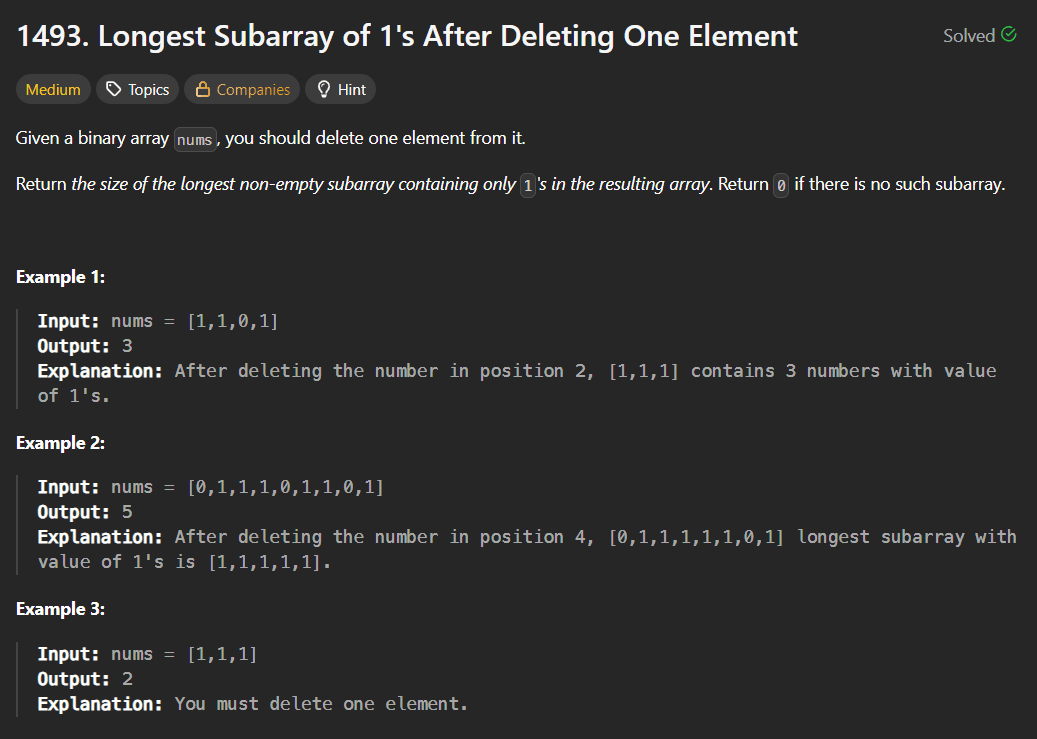
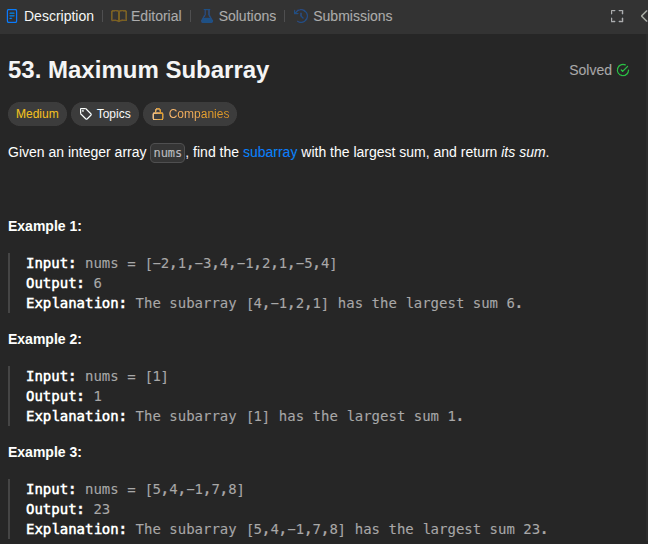
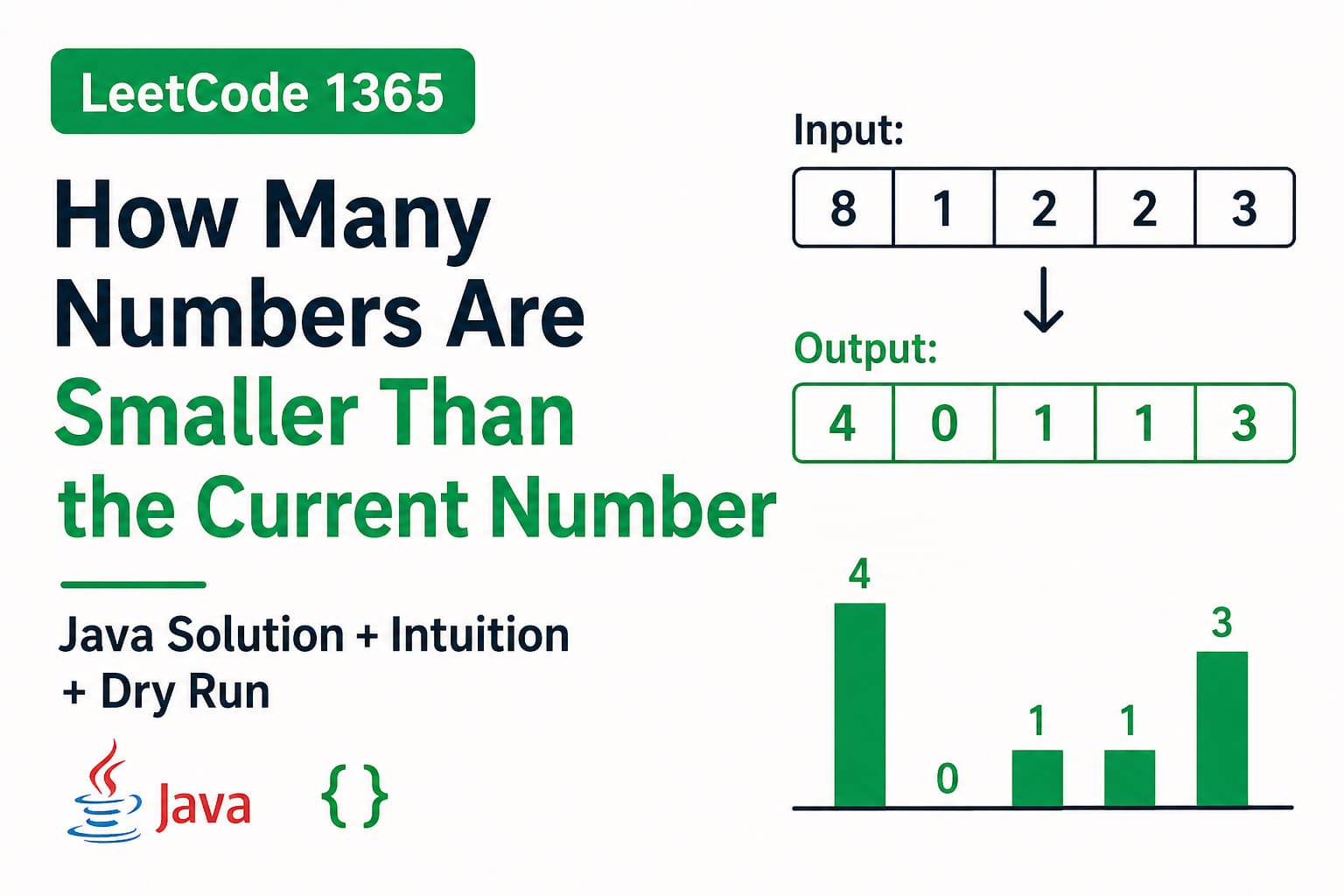
Dynamic ProgrammingMemoizationTabulationJavaOrigin StoryRichard Bellman
Mastering Binary Search – LeetCode 704 Explained

Mastering Binary Search – LeetCode 704 Explained

IntroductionBinary Search is one of the most fundamental and powerful algorithms in computer science. If you're preparing for coding interviews, mastering Binary Search is absolutely essential.In this blog, we’ll break down LeetCode 704 – Binary Search, explain the algorithm in detail, walk through your Java implementation, analyze complexity, and recommend additional problems to strengthen your understanding.You can try this problem -: Problem Link📌 Problem OverviewYou are given:A sorted array of integers nums (ascending order)An integer targetYour task is to return the index of target if it exists in the array. Otherwise, return -1.Example 1Input: nums = [-1,0,3,5,9,12], target = 9Output: 4Example 2Input: nums = [-1,0,3,5,9,12], target = 2Output: -1Constraints1 <= nums.length <= 10⁴All integers are uniqueThe array is sorted in ascending orderRequired Time Complexity: O(log n)🚀 Understanding the Binary Search AlgorithmBinary Search works only on sorted arrays.Instead of checking each element one by one (like Linear Search), Binary Search:Finds the middle element.Compares it with the target.Eliminates half of the search space.Repeats until the element is found or the search space is empty.Why is it Efficient?Every iteration cuts the search space in half.If the array size is n, the number of operations becomes:log₂(n)This makes it extremely efficient compared to linear search (O(n)).🧠 Step-by-Step AlgorithmInitialize two pointers:low = 0high = nums.length - 1While low <= high:Calculate middle index:mid = low + (high - low) / 2If nums[mid] == target, return midIf target > nums[mid], search right half → low = mid + 1Else search left half → high = mid - 1If loop ends, return -1💻 Your Java Code ExplainedHere is your implementation:class Solution {public int search(int[] nums, int target) {int high = nums.length-1;int low = 0;while(low <= high){int mid = low+(high-low)/2;if(target == nums[mid] ){return mid;}else if(target > nums[mid]){low = mid+1;}else{high = mid-1;}}return -1;}}🔍 Code Breakdown1️⃣ Initialize Boundariesint high = nums.length - 1;int low = 0;You define the search space from index 0 to n-1.2️⃣ Loop Conditionwhile(low <= high)The loop continues as long as there is a valid search range.3️⃣ Safe Mid Calculationint mid = low + (high - low) / 2;This is preferred over:(low + high) / 2Why?Because (low + high) may cause integer overflow in large arrays.Your approach prevents that.4️⃣ Comparison Logicif(target == nums[mid])If found → return index.else if(target > nums[mid])low = mid + 1;Search in right half.elsehigh = mid - 1;Search in left half.5️⃣ Not Found Casereturn -1;If the loop finishes without finding the target.⏱ Time and Space ComplexityTime Complexity: O(log n)Each iteration halves the search space.Space Complexity: O(1)No extra space used — purely iterative.🔥 Why This Problem Is ImportantLeetCode 704 is:The foundation of all Binary Search problemsA template questionFrequently asked in interviewsRequired to understand advanced problems like:Search in Rotated Sorted ArrayFind First and Last PositionPeak ElementBinary Search on Answer📚 Recommended Binary Search Practice ProblemsAfter solving this, practice these in order:🟢 Easy35. Search Insert Position69. Sqrt(x)278. First Bad Version🟡 Medium34. Find First and Last Position of Element in Sorted Array33. Search in Rotated Sorted Array74. Search a 2D Matrix875. Koko Eating Bananas (Binary Search on Answer)🔴 Advanced Pattern Practice1011. Capacity To Ship Packages Within D Days410. Split Array Largest SumThese will help you master:Lower bound / upper boundBinary search on monotonic functionsSearching in rotated arraysSearching in 2D matricesBinary search on answer pattern🎯 Final ThoughtsBinary Search is not just a single algorithm — it’s a pattern.If you truly understand:How the search space shrinksWhen to move left vs rightHow to calculate mid safelyLoop conditions (low <= high vs low < high)You can solve 50+ interview problems easily.LeetCode 704 is the perfect starting point.Master this template, and you unlock an entire category of problems.

Binary SearchLeetCodeEasy
LeetCode 258 — Add Digits | Brute Force to O(1) Digital Root Trick Explained in Java

LeetCode 258 — Add Digits | Brute Force to O(1) Digital Root Trick Explained in Java

IntroductionSome problems on LeetCode look too simple to teach you anything meaningful. LeetCode 258 — Add Digits is one of those problems that tricks you with its simplicity. The simulation is beginner-friendly and easy to code in five minutes, but hiding right underneath the surface is a beautiful piece of number theory that lets you solve the entire thing in a single arithmetic expression — no loops, no recursion, pure O(1) math.Whether you are just starting your DSA journey or preparing for coding interviews, this problem is worth understanding deeply. Not just for the answer, but for the mathematical intuition that produces it. By the end of this article, you will not just know the formula — you will understand exactly why it works, where it comes from, and how to derive it yourself even if you forget it during an interview.Problem LinkLeetCode 258 — Add Digits https://leetcode.com/problems/add-digits/Problem StatementGiven an integer num, repeatedly add all its digits until the result has only one digit, and return it.The follow-up asks: can you solve this in O(1) time without any loop or recursion?Approach 1 — Simulation (The Intuitive Way)IntuitionThe problem statement itself tells you exactly what to do. Keep summing the digits of the number until you are left with a single digit. You simulate this literally using nested loops.To extract digits from any integer, two operations do all the work:num % 10 isolates the rightmost digit. For 38, that gives 8.num / 10 removes the rightmost digit. For 38, that leaves 3.You accumulate the digits into a sum, replace num with that sum, and repeat the whole process until num drops below 10.Dry Runnum = 38Outer loop iteration 1:38 % 10 = 8 → sum = 8, num = 33 % 10 = 3 → sum = 11, num = 0Inner loop ends. num = 11Outer loop iteration 2:11 % 10 = 1 → sum = 1, num = 11 % 10 = 1 → sum = 2, num = 0Inner loop ends. num = 2num < 10 → outer loop exits → return 2 ✅Codeclass Solution { public int addDigits(int num) { // If already a single digit, return immediately — no work needed if (num < 10) return num; // Keep repeating the digit sum process until num becomes single digit while (num >= 10) { int sum = 0; // Extract each digit from right to left using modulo and division while (num > 0) { int dig = num % 10; // isolate the last digit num = num / 10; // strip the last digit off sum = sum + dig; // accumulate into running sum } // Replace num with the sum of its digits and check again num = sum; } return num; }}ComplexityTime Complexity: O(log n) — Each iteration reduces the number to the sum of its digits, shrinking it dramatically. The number of passes is very small even for large inputs.Space Complexity: O(1) — Only a handful of integer variables. No extra memory allocated.This passes all test cases cleanly. But the follow-up challenges you to eliminate the loop entirely. That is where things get genuinely interesting.Approach 2 — O(1) Digital Root Formula (The Mathematical Way)Starting With ObservationBefore jumping to the formula, let us build the intuition from scratch the way a mathematician would — by looking at small cases and hunting for a pattern.Let us compute the result for every number from 0 to 27 manually:num → result0 → 01 → 12 → 23 → 34 → 45 → 56 → 67 → 78 → 89 → 910 → 1 (1+0)11 → 2 (1+1)12 → 3 (1+2)13 → 4 (1+3)14 → 5 (1+4)15 → 6 (1+5)16 → 7 (1+6)17 → 8 (1+7)18 → 9 (1+8)19 → 1 (1+9=10, then 1+0=1)20 → 2 (2+0)21 → 3 (2+1)22 → 4 (2+2)23 → 5 (2+3)24 → 6 (2+4)25 → 7 (2+5)26 → 8 (2+6)27 → 9 (2+7)The pattern is impossible to miss. After 0, the results cycle through 1, 2, 3, 4, 5, 6, 7, 8, 9 and then repeat, endlessly, with a period of exactly 9.Now the question is — why? Why does the digit sum cycle with period 9? To understand that, we need to talk about what happens to a number modulo 9.The Core Mathematical Property — Why Digits and Modulo 9 Are ConnectedHere is the fundamental theorem that powers this entire solution:Any positive integer is congruent to the sum of its digits modulo 9.In plain English: if you take a number, divide it by 9, and note the remainder — that remainder is the same as the remainder you get when you divide the sum of its digits by 9.Let us prove this properly so it actually makes sense rather than just being a thing you memorize.Take any two-digit number. You can write it as:num = 10a + bWhere a is the tens digit and b is the units digit. For example, 38 = 10(3) + 8.Now notice that 10 = 9 + 1, so:num = (9 + 1)a + b = 9a + a + bWhen you compute num % 9:num % 9 = (9a + a + b) % 9 = (9a % 9) + (a + b) % 9 = 0 + (a + b) % 9 = (a + b) % 9And a + b is exactly the digit sum. So num % 9 = digitSum % 9. They share the same remainder modulo 9.This same logic extends to three-digit numbers. Write num = 100a + 10b + c. Since 100 = 99 + 1 and 10 = 9 + 1:num = (99 + 1)a + (9 + 1)b + c = 99a + 9b + a + b + cWhen you take % 9, the 99a and 9b parts vanish because they are divisible by 9, and you are left with (a + b + c) % 9 — which is again just the digit sum modulo 9.This pattern holds for numbers of any length. Every power of 10 is just 1 more than a multiple of 9 — 10 = 9+1, 100 = 99+1, 1000 = 999+1 — so all the place-value multipliers disappear modulo 9, leaving only the digit sum behind.This is the reason the digit sum process produces the same final result as the original number modulo 9. The digit sum operation preserves the residue modulo 9 at every step.Why the Cycle Has Period 9Now that we know num ≡ digitSum (mod 9), the cycling pattern makes total sense.Every time you apply the digit sum operation, the result changes but the residue modulo 9 stays the same. You keep applying it until you hit a single digit. The single-digit numbers are 0 through 9. Among those, the residue modulo 9 of each single digit is just the digit itself — except 9, whose residue is 0.So the final single digit you land on is determined entirely by what num % 9 is:num % 9 == 0 → result is 9 (for any positive num)num % 9 == 1 → result is 1num % 9 == 2 → result is 2...num % 9 == 8 → result is 8The only exception is num = 0 itself, which is a genuine zero, not a nine.Translating This Into a FormulaIf we tried to write this directly as num % 9, there is one problem: multiples of 9 like 9, 18, 27 give a remainder of 0, but the correct answer for all of them is 9, not 0.We need a formula that maps every positive integer to a value in 1..9 cyclically, rather than 0..8.The standard trick for shifting a zero-indexed cycle to a one-indexed cycle is to subtract 1 before taking the modulo and add 1 after:result = 1 + (num - 1) % 9Let us verify this on a few cases:num = 9: 1 + (9-1) % 9 = 1 + 8 % 9 = 1 + 8 = 9 ✅num = 18: 1 + (18-1) % 9 = 1 + 17 % 9 = 1 + 8 = 9 ✅num = 1: 1 + (1-1) % 9 = 1 + 0 = 1 ✅num = 10: 1 + (10-1) % 9 = 1 + 9 % 9 = 1 + 0 = 1 ✅num = 38: 1 + (38-1) % 9 = 1 + 37 % 9 = 1 + 1 = 2 ✅The only number this formula does not cover is num = 0, which is a special case handled separately since 0 has no digit sum cycle — it simply returns 0.Connecting It Back to the ObservationNow look at the table we built earlier through the lens of this formula. Numbers 1 through 9 map to themselves. Then 10 gives 1 + 0 = 1, same as 1. Numbers 10 through 18 are just 1 through 9 offset by 9. Then 19 wraps back to 1. The cycle length of 9 follows directly from the modulo-9 arithmetic. It is not a coincidence at all — it is the inevitable consequence of how place-value and modular arithmetic interact.Codeclass Solution { public int addDigits(int num) { // Special case: 0 is not part of the 1-9 cycle, it simply returns 0 if (num == 0) return 0; // Digital root formula derived from the congruence property modulo 9. // (num - 1) % 9 maps the range to 0..8 instead of the raw 0..8 cycle // that would make multiples of 9 return 0 incorrectly. // Adding 1 at the end shifts it back to the correct 1..9 range. return 1 + (num - 1) % 9; }}ComplexityTime Complexity: O(1) — A fixed number of arithmetic operations regardless of the size of num.Space Complexity: O(1) — No variables, no data structures, nothing allocated.Approach ComparisonApproachTimeSpaceLoop / RecursionSimulationO(log n)O(1)YesDigital Root FormulaO(1)O(1)NoBoth approaches are entirely correct and both pass all test cases. The simulation is more readable and immediately obvious to anyone reading the code. The digital root formula is what an interviewer is hoping you know when they ask the follow-up — and more importantly, if you understand the modulo-9 proof above, you can derive it on the spot rather than hoping you remembered it.Key TakeawaysThe most important thing this problem teaches you is not the formula itself. It is the habit of asking a deeper question when you see a repeated process: is there a closed-form mathematical pattern hiding inside this repetition?The digit sum operation looks like pure computation at first glance. But underneath it is modular arithmetic, and modular arithmetic has structure that can often be collapsed into a direct formula. That same insight — that repeated digit operations connect to modulo 9 — shows up in divisibility rules you learned in school. A number is divisible by 9 if and only if its digit sum is divisible by 9. A number is divisible by 3 if and only if its digit sum is divisible by 3. Both of those rules are the exact same theorem we used to derive the digital root formula here.Once you internalize this connection between digit sums and modulo 9, you will recognize it surfacing in other problems across number theory, checksum algorithms, and competitive programming. The formula is a one-liner. The understanding behind it is something you carry with you permanently.

Digital RootLeetCode EasyJavaNumber TheoryMath
Master LeetCode 92: Reverse Linked List II | Detailed Java Solution & Explanation

Master LeetCode 92: Reverse Linked List II | Detailed Java Solution & Explanation

If you are preparing for software engineering interviews, you already know that Linked Lists are a favourite topic among interviewers. While reversing an entire linked list is a standard beginner problem, reversing only a specific section of it requires a bit more pointer magic.In this blog post, we will tackle LeetCode 92. Reverse Linked List II. We will break down the problem in plain English, walk through a highly intuitive modular approach, and then look at an optimized one-pass technique.Let’s dive in!Understanding the ProblemQuestion Statement:Given the head of a singly linked list and two integers left and right where left <= right, reverse the nodes of the list from position left to position right, and return the reversed list.Example:Input: head = [1,2,3,4,5], left = 2, right = 4Output: [1,4,3,2,5]In Simple Words:Imagine a chain of connected boxes. You don't want to flip the whole chain backwards. You only want to flip a specific middle section (from the 2nd box to the 4th box), while keeping the first and last boxes exactly where they are.Approach 1: The Intuitive Modular Approach (Find, Reverse, Connect)When solving complex linked list problems, breaking the problem into smaller helper functions is an excellent software engineering practice.In this approach, we will:Use a Dummy Node. This is a lifesaver when left = 1 (meaning we have to reverse from the very first node).Traverse the list to find the exact boundaries: the node just before the reversal (slow), the start of the reversal (leftNode), and the end of the reversal (rightNode).Pass the sub-list to a helper function that reverses it.Reconnect the newly reversed sub-list back to the main list.Here is the Java code for this approach:/** * Definition for singly-linked list. * public class ListNode { * int val; * ListNode next; * ListNode() {} * ListNode(int val) { this.val = val; } * ListNode(int val, ListNode next) { this.val = val; this.next = next; } * } */class Solution { // Helper function to reverse a portion of the list public ListNode reverse(ListNode LeftHead, ListNode rightHead){ ListNode curr = LeftHead; ListNode prev = rightHead; // Standard linked list reversal logic while(curr != rightHead){ ListNode newnode = curr.next; curr.next = prev; prev = curr; curr = newnode; } return prev; } public ListNode reverseBetween(ListNode head, int left, int right) { if(left == 1 && right == 1) return head; // Dummy node helps handle edge cases easily ListNode dummy = new ListNode(-1); dummy.next = head; ListNode leftNode = null; ListNode rightNode = null; ListNode curr = head; int leftC = 1; int rightC = 1; ListNode slow = dummy; // Traverse to find the exact bounds of our sublist while(curr != null){ if(leftC == left - 1){ slow = curr; // 'slow' is the node just before the reversed section } if(leftC == left){ leftNode = curr; } if(rightC == right){ rightNode = curr; } if(leftC == left && rightC == right){ break; // We found both bounds, no need to traverse further } leftC++; rightC++; curr = curr.next; } // Reverse the sublist and connect it back ListNode rev = reverse(leftNode, rightNode.next); slow.next = rev; return dummy.next; }}🔍 Dry Run of Approach 1Let’s trace head = [1, 2, 3, 4, 5], left = 2, right = 4.Step 1: Initializationdummy = -1 -> 1 -> 2 -> 3 -> 4 -> 5slow = -1 (dummy node)Step 2: Finding Bounds (While Loop)We move curr through the list.When curr is at 1 (Position 1): left - 1 is 1, so slow becomes node 1.When curr is at 2 (Position 2): leftNode becomes node 2.When curr is at 4 (Position 4): rightNode becomes node 4. We break the loop.Step 3: The Helper ReversalWe call reverse(leftNode, rightNode.next), which means reverse(Node 2, Node 5).Inside the helper, we reverse the links for 2, 3, and 4.Because we initialized prev as rightHead (Node 5), Node 2's next becomes Node 5.The helper returns Node 4 as the new head of this reversed chunk. The chunk now looks like: 4 -> 3 -> 2 -> 5.Step 4: ReconnectionBack in the main function, slow (Node 1) is connected to the returned reversed list: slow.next = rev.Final List: dummy -> 1 -> 4 -> 3 -> 2 -> 5.Return dummy.next!Time & Space Complexity:Time Complexity: O(N). We traverse the list to find the pointers, and then the helper traverses the sub-list to reverse it. Since we visit nodes a maximum of two times, it is linear time.Space Complexity: O(1). We are only creating a few pointers (dummy, slow, curr, etc.), requiring no extra dynamic memory.Approach 2: The Optimized One-Pass SolutionLeetCode includes a follow-up challenge: "Could you do it in one pass?"While the first approach is incredibly readable, we can optimize it to reverse the nodes as we traverse them, eliminating the need for a separate helper function or a second sub-list traversal.In this approach, we:Move a prev pointer to the node just before left.Keep a curr pointer at left.Use a for loop to extract the node immediately after curr and move it to the front of the reversed sub-list. We do this exactly right - left times.class Solution { public ListNode reverseBetween(ListNode head, int left, int right) { if (head == null || left == right) return head; ListNode dummy = new ListNode(0); dummy.next = head; ListNode prev = dummy; // Step 1: Reach the node just before 'left' for (int i = 0; i < left - 1; i++) { prev = prev.next; } // Step 2: Start the reversal process ListNode curr = prev.next; for (int i = 0; i < right - left; i++) { ListNode nextNode = curr.next; // Node to be moved to the front curr.next = nextNode.next; // Detach nextNode nextNode.next = prev.next; // Point nextNode to the current front of sublist prev.next = nextNode; // Make nextNode the new front of the sublist } return dummy.next; }}🔍 Why this works (The Pointer Magic)If we are reversing [1, 2, 3, 4, 5] from 2 to 4:prev is at 1. curr is at 2.Iteration 1: Grab 3, put it after 1. List: [1, 3, 2, 4, 5].Iteration 2: Grab 4, put it after 1. List: [1, 4, 3, 2, 5].Done! We achieved the reversal in a strict single pass.Time & Space Complexity:Time Complexity: O(N). We touch each node exactly once.Space Complexity: O(1). Done entirely in-place.ConclusionReversing a portion of a linked list is a fantastic way to test your understanding of pointer manipulation.Approach 1 is amazing for interviews because it shows you can modularize code and break big problems into smaller, testable functions.Approach 2 is the perfect "flex" to show the interviewer that you understand optimization and single-pass algorithms.I highly recommend writing down the dry run on a piece of paper and drawing arrows to see how the pointers shift. That is the secret to mastering Linked Lists!Happy Coding! 💻🚀

LeetCodeLinkedListJavaReverse LinkedList II
Find Minimum in Rotated Sorted Array – Binary Search Explained | LeetCode Medium 153

Find Minimum in Rotated Sorted Array – Binary Search Explained | LeetCode Medium 153

🔗 Try This Problem FirstPlatform: LeetCodeProblem Number: 153👉 Practice here: https://leetcode.com/problems/find-minimum-in-rotated-sorted-array/🧠 Problem UnderstandingYou are given a sorted array that has been rotated between 1 and n times.Example:Original sorted array:[0,1,2,4,5,6,7]After rotation:[4,5,6,7,0,1,2]Your task: 👉 Return the minimum element from this rotated array. 👉 Time complexity must be O(log n). 👉 All elements are unique.🔍 Key ObservationIn a rotated sorted array:The array is divided into two sorted halves.The minimum element is the pivot point where rotation happened.One half will always be sorted.We can use Binary Search to find where the sorted order breaks.Example:[4,5,6,7,0,1,2] ↑ Minimum🚀 Approach 1: Brute Force (Not Allowed by Constraint)IdeaScan entire array and track minimum.int min = nums[0];for(int i = 1; i < nums.length; i++){ min = Math.min(min, nums[i]);}return min;ComplexityTime: O(n)Space: O(1)❌ Not acceptable because problem requires O(log n).🚀 Approach 2: Binary Search (Optimal – O(log n))💡 Core IdeaCompare nums[mid] with nums[right].There are only two possibilities:Case 1: nums[mid] > nums[right]Minimum is in right half.[4,5,6,7,0,1,2]mid rMove left pointer:l = mid + 1Case 2: nums[mid] <= nums[right]Minimum is in left half including mid.[4,5,6,7,0,1,2]mid rMove right pointer:r = mid✅ Optimized Codeclass Solution { public int findMin(int[] nums) { int l = 0; int r = nums.length - 1; while (l < r) { int mid = l + (r - l) / 2; if (nums[mid] > nums[r]) { l = mid + 1; } else { r = mid; } } return nums[r]; }}📊 Dry RunInput:nums = [4,5,6,7,0,1,2]Steplrmidnums[mid]Action106377 > 2 → l = 4246511 <= 2 → r = 5345400 <= 1 → r = 4Stop44--Return nums[4]✅ Output = 0🧩 Why This WorksIf middle element is greater than rightmost, rotation point is to the right.If middle element is smaller than or equal to rightmost, minimum is on the left side.We continuously shrink search space until l == r.That position holds the minimum element.⏱ Time & Space ComplexityMetricValueTime ComplexityO(log n)Space ComplexityO(1)Because:We eliminate half of the array each iteration.No extra space is used.⚠️ Important Edge CasesArray size = 1[10] → 10Already sorted (no visible rotation)[11,13,15,17] → 11Rotation at last position[1,2,3,4,5] → 1🎯 Interview InsightThis problem teaches:Modified Binary SearchIdentifying sorted halvesHandling rotated arraysUnderstanding pivot logicThis is a very common FAANG interview question and often appears in variations like:Search in Rotated Sorted ArrayFind Peak ElementMinimum in Rotated Array with Duplicates🏁 Final TakeawayBrute force works but violates constraint.Binary search is the correct approach.Compare mid with right.Shrink search space until pointers meet.Return nums[l] or nums[r].

LeetcodeMediumBinary Search
LeetCode 875: Koko Eating Bananas – Find the Minimum Eating Speed Using Binary Search

LeetCode 875: Koko Eating Bananas – Find the Minimum Eating Speed Using Binary Search

Try the ProblemYou can practice the problem here:https://leetcode.com/problems/koko-eating-bananas/Problem DescriptionKoko loves eating bananas 🍌.You are given n piles of bananas, where the i-th pile contains piles[i] bananas.The guards have left and will return after h hours. Koko wants to finish eating all the bananas before the guards come back.Koko can choose her banana-eating speed k bananas per hour.However, there are some important rules:Every hour, Koko chooses one pile of bananas.She eats k bananas from that pile.If the pile contains fewer than k bananas, she eats all of them and stops for that hour.She cannot move to another pile in the same hour.Your task is to determine the minimum integer value of k such that Koko can finish all the bananas within h hours.Example WalkthroughExample 1Inputpiles = [3,6,7,11]h = 8Output4Explanation:If Koko eats 4 bananas per hour, the time taken for each pile is:3 bananas → 1 hour6 bananas → 2 hours7 bananas → 2 hours11 bananas → 3 hoursTotal time required:1 + 2 + 2 + 3 = 8 hoursSince Koko finishes all bananas within 8 hours, the minimum speed is 4 bananas per hour.Example 2Inputpiles = [30,11,23,4,20]h = 5Output30Example 3Inputpiles = [30,11,23,4,20]h = 6Output23Constraints1 <= piles.length <= 10^4piles.length <= h <= 10^91 <= piles[i] <= 10^9Important observations:A pile may contain up to one billion bananas.The number of hours can also be extremely large.A naive solution may become computationally expensive.Intuition Behind the ProblemThe key observation in this problem is the relationship between eating speed and required hours.If Koko eats slowly, she needs more hours.If she eats faster, she needs fewer hours.This creates a monotonic relationship:Eating Speed ↑ → Hours Required ↓Because of this property, we can apply Binary Search on the answer.Instead of testing every possible eating speed, we can efficiently search the correct speed using binary search.Approach 1: Brute ForceIdeaTry every possible eating speed:k = 1 → max(piles)For each speed:Calculate the total hours required.If the hours are less than or equal to h, return that speed.DrawbackThe maximum pile size can be:10^9Trying all speeds up to 10^9 would take too long.Time ComplexityO(max(pile) × n)This approach is not feasible for large inputs.Approach 2: Binary Search on Answer (Optimal Solution)Since the answer lies between 1 and the maximum pile size, we can apply binary search.Search SpaceMinimum possible speed:1 banana/hourMaximum possible speed:max(piles)Binary Search StrategyChoose a middle value mid as the candidate eating speed.Calculate how many hours Koko needs at this speed.If the hours are less than or equal to h, try a smaller speed.If the hours are greater than h, increase the speed.This continues until we find the minimum valid speed.Java Implementationclass Solution { // Function to calculate total hours needed // if Koko eats bananas at a given speed public int hourCalculate(int[] piles, int speed){ int hours = 0; // Traverse through each pile for(int i = 0; i < piles.length; i++){ // Calculate hours needed for this pile // Using ceiling division hours += Math.ceil((double)piles[i] / speed); } return hours; } public int minEatingSpeed(int[] piles, int h) { // Minimum possible eating speed int low = 1; // Maximum possible speed int high = Integer.MIN_VALUE; // Find the maximum pile for(int pile : piles){ high = Math.max(high, pile); } int answer = high; // Binary Search while(low <= high){ int mid = low + (high - low) / 2; // Calculate required hours at speed mid int requiredHours = hourCalculate(piles, mid); if(requiredHours <= h){ // mid is a valid answer answer = mid; // Try smaller speed high = mid - 1; } else{ // Speed too slow low = mid + 1; } } return answer; }}Time ComplexityBinary Search runs in:O(log(max(pile)))Each iteration calculates hours in:O(n)Overall complexity:O(n log(max(pile)))Space ComplexityO(1)No extra memory is required.Key TakeawayThis problem is a classic example of Binary Search on Answer.Whenever a problem asks:“Find the minimum or maximum value such that a condition is satisfied”You should consider applying Binary Search on the answer space.ConclusionInstead of testing every possible eating speed, we used Binary Search to efficiently find the minimum speed that allows Koko to finish the bananas within the given number of hours.This approach dramatically improves performance and is a common technique used in many coding interview problems involving optimization and search space reduction.

Binary SearchBinary Search on AnswerArraysLeetCodeMediumJava
Intersection of Two Linked Lists – The Smart Trick Most People Miss (LeetCode 160)

Intersection of Two Linked Lists – The Smart Trick Most People Miss (LeetCode 160)

🚀 Try the ProblemPractice here:https://leetcode.com/problems/intersection-of-two-linked-lists/🤔 Let’s Start With a ThoughtImagine two roads:Road A: 4 → 1 → 8 → 4 → 5 Road B: 5 → 6 → 1 → 8 → 4 → 5At some point… both roads merge into one.👉 That merging point is the intersection node🧠 Problem in Simple WordsYou are given:Head of List AHead of List B👉 Find the node where both linked lists intersect👉 If no intersection exists → return null⚠️ Important Clarification👉 Intersection means:Same memory node (same reference)NOT:Same value ❌📌 Example InsightList A: 1 → 9 → 1 → 2 → 4 List B: 3 → 2 → 4Even though both lists have 2 and 4:👉 They intersect ONLY if they point to the same node in memory📦 Constraints1 <= m, n <= 3 * 10^41 <= Node.val <= 10^5No cycles in the list🔍 First Thought (Brute Force)IdeaFor every node in List A:👉 Traverse entire List B and check if nodes matchComplexityTime: O(m * n) ❌Space: O(1)Too slow.🧩 Better Approach: Length Difference MethodIdeaFind length of both listsMove the longer list ahead by the differenceNow traverse both togetherWhy This Works👉 After skipping extra nodes, both pointers are equally far from intersectionComplexityTime: O(m + n)Space: O(1)🚀 Optimal Approach: Two Pointer Switching TrickNow comes the most beautiful trick 🔥🧠 Core IdeaWe use two pointers:pointerA → starts from headApointerB → starts from headB🎯 The Magic Trick👉 When a pointer reaches end → switch it to the other list🔄 VisualizationLet’s say:Length A = mLength B = nPointer paths:pointerA travels: A → BpointerB travels: B → ASo both travel:m + n distance💡 Why They Meet👉 If intersection exists → they meet at intersection👉 If not → both reach null at same time🔥 Step-by-Step ExampleA: 4 → 1 → 8 → 4 → 5 B: 5 → 6 → 1 → 8 → 4 → 5Iteration:A pointer: 4 → 1 → 8 → 4 → 5 → null → 5 → 6 → 1 → 8 B pointer: 5 → 6 → 1 → 8 → 4 → 5 → null → 4 → 1 → 8👉 They meet at 8💻 Clean Java Code (Optimal Solution)public class Solution { public ListNode getIntersectionNode(ListNode headA, ListNode headB) { ListNode tempa = headA; ListNode tempb = headB; // Traverse until both pointers meet while(tempa != tempb){ // Move pointer A if(tempa != null) tempa = tempa.next; else tempa = headB; // Move pointer B if(tempb != null) tempb = tempb.next; else tempb = headA; } // Either intersection node OR null return tempa; }}⏱️ ComplexityTime ComplexityO(m + n)Space ComplexityO(1)⚖️ Approach ComparisonApproachTimeSpaceNotesBrute ForceO(m*n)O(1)Too slowLength DifferenceO(m+n)O(1)GoodTwo Pointer SwitchO(m+n)O(1)Best & elegant❌ Common MistakesComparing values instead of nodes ❌Forgetting to switch listsNot handling null correctlyAssuming intersection always exists🔥 Interview InsightThis is one of the most clever pointer problems.It teaches:👉 How to equalize paths without extra memory👉 How pointer switching solves alignment problems🧠 Final ThoughtAt first, this trick feels like magic…But actually it’s just:Equalizing path lengths🚀 ConclusionThe Intersection of Two Linked Lists problem is a perfect example of:Smart thinking > brute forceClean logic > complex code👉 Tip: Whenever two lists need alignment, think:"Can I make both pointers travel equal distance?"That’s where the magic begins ✨

Linked ListTwo PointersIntersectionPointer SwitchingDSALeetCodeEasy
LeetCode 143 Reorder List - Java Solution Explained

LeetCode 143 Reorder List - Java Solution Explained

IntroductionLeetCode 143 Reorder List is one of those problems that looks simple when you read it but immediately makes you wonder — where do I even start? There is no single trick that solves it. Instead it combines three separate linked list techniques into one clean solution. Mastering this problem means you have genuinely understood linked lists at an intermediate level.You can find the problem here — LeetCode 143 Reorder List.This article walks through everything — what the problem wants, the intuition behind each step, all three techniques used, a detailed dry run, complexity analysis, and common mistakes beginners make.What Is the Problem Really Asking?You have a linked list: L0 → L1 → L2 → ... → LnYou need to reorder it to: L0 → Ln → L1 → Ln-1 → L2 → Ln-2 → ...In plain English — take one node from the front, then one from the back, then one from the front, then one from the back, and keep alternating until all nodes are used.Example:Input: 1 → 2 → 3 → 4 → 5Output: 1 → 5 → 2 → 4 → 3Node 1 from front, Node 5 from back, Node 2 from front, Node 4 from back, Node 3 stays in middle.Real Life Analogy — Dealing Cards From Both EndsImagine you have a deck of cards laid out in a line face up: 1, 2, 3, 4, 5. Now you deal them by alternately picking from the left end and the right end of the line:Pick 1 from left → placePick 5 from right → place after 1Pick 2 from left → place after 5Pick 4 from right → place after 2Pick 3 (only one left) → place after 4Result: 1, 5, 2, 4, 3That is exactly what the problem wants. The challenge is doing this efficiently on a singly linked list where you cannot just index from the back.Why This Problem Is Hard for BeginnersIn an array you can just use two pointers — one at the start and one at the end — and swap/interleave easily. But a singly linked list only goes forward. You cannot go backwards. You cannot easily access the last element.This is why the problem requires a three-step approach that cleverly works around the limitations of a singly linked list.The Three Step ApproachEvery experienced developer solves this problem in exactly three steps:Step 1 — Find the middle of the linked list using the Fast & Slow Pointer techniqueStep 2 — Reverse the second half of the linked listStep 3 — Merge the two halves by alternating nodes from eachLet us understand each step deeply before looking at code.Step 1: Finding the Middle — Fast & Slow PointerThe Fast & Slow Pointer technique (also called Floyd's algorithm) uses two pointers moving at different speeds through the list:slow moves one step at a timefast moves two steps at a timeWhen fast reaches the end, slow is exactly at the middle. This works because fast covers twice the distance of slow in the same number of steps.ListNode fast = head;ListNode slow = head;while (fast.next != null && fast.next.next != null) { fast = fast.next.next; slow = slow.next;}// slow is now at the middleFor 1 → 2 → 3 → 4 → 5:Start: slow=1, fast=1Step 1: slow=2, fast=3Step 2: slow=3, fast=5 (fast.next is null, stop)Middle is node 3For 1 → 2 → 3 → 4:Start: slow=1, fast=1Step 1: slow=2, fast=3Step 2: fast.next.next is null, stopslow=2, middle is node 2After finding the middle, we cut the list in two by setting slow.next = null. This disconnects the first half from the second half.Step 2: Reversing the Second HalfOnce we have the second half starting from slow.next, we reverse it. After reversal, what was the last node becomes the first — giving us easy access to the back elements of the original list.public ListNode reverse(ListNode head) { ListNode curr = head; ListNode prev = null; while (curr != null) { ListNode next = curr.next; // save next curr.next = prev; // reverse the link prev = curr; // move prev forward curr = next; // move curr forward } return prev; // prev is the new head}For second half 3 → 4 → 5 (from the first example):Reverse → 5 → 4 → 3Now we have:First half: 1 → 2 → 3 (but 3 is the end since we cut at slow)Wait — actually after cutting at slow=3: first half is 1 → 2 → 3, second half reversed is 5 → 4Let us be precise. For 1 → 2 → 3 → 4 → 5, slow stops at 3. slow.next = null cuts to give:First half: 1 → 2 → 3 → nullSecond half before reverse: 4 → 5Second half after reverse: 5 → 4Step 3: Merging Two HalvesNow we have two lists and we merge them by alternately taking one node from each:Take from first half, take from second half, take from first half, take from second half...ListNode orig = head; // pointer for first halfListNode newhead = second; // pointer for reversed second halfwhile (newhead != null) { ListNode temp1 = orig.next; // save next of first half ListNode temp2 = newhead.next; // save next of second half orig.next = newhead; // first → second newhead.next = temp1; // second → next of first orig = temp1; // advance first half pointer newhead = temp2; // advance second half pointer}Why do we loop on newhead != null and not orig != null? Because the second half is always equal to or shorter than the first half (we cut at middle). Once the second half is exhausted, the remaining first half nodes are already in the correct position.Complete Solutionclass Solution { public ListNode reverse(ListNode head) { ListNode curr = head; ListNode prev = null; while (curr != null) { ListNode next = curr.next; curr.next = prev; prev = curr; curr = next; } return prev; } public void reorderList(ListNode head) { // Step 1: Find middle using fast & slow pointer ListNode fast = head; ListNode slow = head; while (fast.next != null && fast.next.next != null) { fast = fast.next.next; slow = slow.next; } // Step 2: Reverse second half ListNode newhead = reverse(slow.next); slow.next = null; // cut the list into two halves // Step 3: Merge two halves alternately ListNode orig = head; while (newhead != null) { ListNode temp1 = orig.next; ListNode temp2 = newhead.next; orig.next = newhead; newhead.next = temp1; orig = temp1; newhead = temp2; } }}Complete Dry Run — head = [1, 2, 3, 4, 5]Step 1: Find MiddleList: 1 → 2 → 3 → 4 → 5Initial: slow=1, fast=1Iteration 1: slow=2, fast=3Iteration 2: fast.next=4, fast.next.next=5 → slow=3, fast=5fast.next is null → stopslow is at node 3Step 2: Cut and ReverseCut: slow.next = nullFirst half: 1 → 2 → 3 → nullSecond half: 4 → 5Reverse second half 4 → 5:prev=null, curr=4 → next=5, 4.next=null, prev=4, curr=5prev=4, curr=5 → next=null, 5.next=4, prev=5, curr=nullReturn prev=5Reversed second half: 5 → 4 → nullStep 3: Mergeorig=1, newhead=5Iteration 1:temp1 = orig.next = 2temp2 = newhead.next = 4orig.next = newhead → 1.next = 5newhead.next = temp1 → 5.next = 2orig = temp1 = 2newhead = temp2 = 4List so far: 1 → 5 → 2 → 3Iteration 2:temp1 = orig.next = 3temp2 = newhead.next = nullorig.next = newhead → 2.next = 4newhead.next = temp1 → 4.next = 3orig = temp1 = 3newhead = temp2 = nullList so far: 1 → 5 → 2 → 4 → 3newhead is null → loop endsFinal result: 1 → 5 → 2 → 4 → 3 ✅Dry Run — head = [1, 2, 3, 4]Step 1: Find MiddleInitial: slow=1, fast=1Iteration 1: slow=2, fast=3fast.next=4, fast.next.next=null → stopslow is at node 2Step 2: Cut and ReverseFirst half: 1 → 2 → nullSecond half: 3 → 4Reversed: 4 → 3 → nullStep 3: Mergeorig=1, newhead=4Iteration 1:temp1=2, temp2=31.next=4, 4.next=2orig=2, newhead=3List: 1 → 4 → 2 → 3Iteration 2:temp1=null (2.next was originally 3 but we cut at slow=2, so 2.next = null... wait)Actually after cutting at slow=2, first half is 1 → 2 → null, so orig when it becomes 2, orig.next = null.temp1 = orig.next = nulltemp2 = newhead.next = null2.next = 3, 3.next = nullorig = null, newhead = nullnewhead is null → stopFinal result: 1 → 4 → 2 → 3 ✅Why slow.next = null Must Come After Saving newheadThis is a subtle but critical ordering detail in the code. Look at this sequence:ListNode newhead = reverse(slow.next); // save reversed second half FIRSTslow.next = null; // THEN cut the listIf you cut first (slow.next = null) and then try to reverse, you lose the reference to the second half entirely because slow.next is already null. Always save the second half reference before cutting.Time and Space ComplexityTime Complexity: O(n) — each of the three steps (find middle, reverse, merge) makes a single pass through the list. Total is 3 passes = O(3n) = O(n).Space Complexity: O(1) — everything is done by rearranging pointers in place. No extra arrays, no recursion stack, no additional data structures. Just a handful of pointer variables.This is the optimal solution — linear time and constant space.Alternative Approach — Using ArrayList (Simpler but O(n) Space)If you find the three-step approach hard to implement under interview pressure, here is a simpler approach using extra space:public void reorderList(ListNode head) { // store all nodes in ArrayList for random access List<ListNode> nodes = new ArrayList<>(); ListNode curr = head; while (curr != null) { nodes.add(curr); curr = curr.next; } int left = 0; int right = nodes.size() - 1; while (left < right) { nodes.get(left).next = nodes.get(right); left++; if (left == right) break; // odd number of nodes nodes.get(right).next = nodes.get(left); right--; } nodes.get(left).next = null; // terminate the list}This is much easier to understand and code. Store all nodes in an ArrayList, use two pointers from both ends, and wire up the next pointers.Time Complexity: O(n) Space Complexity: O(n) — ArrayList stores all nodesThis is acceptable in most interviews. Mention the O(1) space approach as the optimal solution if asked.Common Mistakes to AvoidNot cutting the list before merging If you do not set slow.next = null after finding the middle, the first half still points into the second half. During merging, this creates cycles and infinite loops. Always cut before merging.Wrong loop condition for finding the middle The condition fast.next != null && fast.next.next != null ensures fast does not go out of bounds when jumping two steps. Using just fast != null && fast.next != null moves slow one step too far for even-length lists.Looping on orig instead of newhead The merge loop should run while newhead != null, not while orig != null. The second half is always shorter or equal to the first half. Once the second half is done, the remaining first half is already correctly placed.Forgetting to save both temp pointers before rewiring In the merge step, you must save both orig.next and newhead.next before changing any pointers. Changing orig.next first and then trying to access orig.next to save it gives you the wrong node.How This Problem Combines Multiple PatternsThis problem is special because it does not rely on a single technique. It is a combination of three fundamental linked list operations:Fast & Slow Pointer — you saw this concept in problems like finding the middle of a list and detecting cycles (LeetCode 141, 142).Reverse a Linked List — the most fundamental linked list operation, appears in LeetCode 206 and as a subtask in dozens of problems.Merge Two Lists — similar to merging two sorted lists (LeetCode 21) but here order is not sorted, it is alternating.Solving this problem proves you are comfortable with all three patterns individually and can combine them when needed.FAQs — People Also AskQ1. What is the most efficient approach for LeetCode 143 Reorder List? The three-step approach — find middle with fast/slow pointer, reverse second half, merge alternately — runs in O(n) time and O(1) space. It is the optimal solution. The ArrayList approach is O(n) time and O(n) space but simpler to code.Q2. Why use fast and slow pointer to find the middle? Because a singly linked list has no way to access elements by index. You cannot just do list[length/2]. The fast and slow pointer technique finds the middle in a single pass without knowing the length beforehand.Q3. Why reverse the second half instead of the first half? The problem wants front-to-back alternation. If you reverse the second half, its first node is the original last node — exactly what you need to interleave with the front of the first half. Reversing the first half would give the wrong order.Q4. What is the time complexity of LeetCode 143? O(n) time for three linear passes (find middle, reverse, merge). O(1) space since all operations are in-place pointer manipulations with no extra data structures.Q5. Is LeetCode 143 asked in coding interviews? Yes, frequently at companies like Amazon, Google, Facebook, and Microsoft. It is considered a benchmark problem for linked list mastery because it requires combining three separate techniques cleanly under pressure.Similar LeetCode Problems to Practice Next206. Reverse Linked List — Easy — foundation for step 2 of this problem876. Middle of the Linked List — Easy — fast & slow pointer isolated21. Merge Two Sorted Lists — Easy — merging technique foundation234. Palindrome Linked List — Easy — also uses find middle + reverse second half148. Sort List — Medium — merge sort on linked list, uses same split techniqueConclusionLeetCode 143 Reorder List is one of the best Medium linked list problems because it forces you to think in multiple steps and combine techniques rather than apply a single pattern. The fast/slow pointer finds the middle efficiently without knowing the length. Reversing the second half turns the "cannot go backwards" limitation of singly linked lists into a non-issue. And the alternating merge weaves everything together cleanly.Work through the dry runs carefully — especially the pointer saving step in the merge. Once you see why each step is necessary and how they connect, this problem will always feel approachable no matter when it shows up in an interview.

LeetCodeJavaLinked ListTwo PointerFast Slow PointerMedium
LeetCode 203: Remove Linked List Elements – Step-by-Step Guide for Beginners

LeetCode 203: Remove Linked List Elements – Step-by-Step Guide for Beginners

Try the ProblemYou can practice the problem here:https://leetcode.com/problems/remove-linked-list-elements/Problem Description (In Very Simple Words)You are given:The head of a linked listAn integer value valYour task is:👉 Remove all nodes from the linked list whose value is equal to val.👉 Return the updated head of the linked list.What is a Linked List? (Quick Recap)A linked list is a chain of nodes where each node contains:value + pointer to next nodeExample:1 → 2 → 6 → 3 → 4 → 5 → 6 → nullExample WalkthroughExample 1Input:head = [1,2,6,3,4,5,6]val = 6Output:[1,2,3,4,5]ExplanationWe remove all nodes with value 6.1 → 2 → ❌6 → 3 → 4 → 5 → ❌6Final list:1 → 2 → 3 → 4 → 5Example 2Input:head = []val = 1Output:[]Example 3Input:head = [7,7,7,7]val = 7Output:[]All nodes are removed.Constraints0 <= number of nodes <= 10^41 <= Node.val <= 500 <= val <= 50Understanding the Problem DeeplyThe tricky part is:👉 Nodes can appear anywhere:At the beginningIn the middleAt the endOr all nodes👉 Linked list does NOT allow backward traversalSo we must carefully handle pointers.Thinking About the SolutionWhen solving this problem, multiple approaches may come to mind:Possible ApproachesTraverse the list and remove nodes manually.Handle head separately, then process the rest.Use a dummy node to simplify logic.Use recursion (less preferred for beginners).Approach 1: Without Dummy Node (Manual Handling)IdeaFirst, remove nodes from the start (head) if they match val.Then traverse the list using two pointers:prev → previous nodecurr → current nodeKey ChallengeHandling head separately makes code more complex.Codeclass Solution { public ListNode removeElements(ListNode head, int val) { // Step 1: Remove matching nodes from the beginning while(head != null && head.val == val){ head = head.next; } // If list becomes empty if(head == null) return null; ListNode prev = head; ListNode curr = head.next; while(curr != null){ if(curr.val == val){ // Skip the node prev.next = curr.next; } else { // Move prev only when node is not removed prev = curr; } curr = curr.next; } return head; }}Why This WorksWe ensure prev always points to the last valid nodeWhen we find a node to delete:prev.next = curr.nextThis skips the unwanted nodeProblem With This Approach👉 Too many edge cases:Removing head nodesEmpty listAll nodes equalApproach 2: Dummy Node (Best & Clean Approach)IdeaWe create a fake node (dummy) before the head.dummy → head → rest of listThis helps us:👉 Treat head like a normal node👉 Avoid special casesVisualizationOriginal:1 → 2 → 6 → 3After dummy:-1 → 1 → 2 → 6 → 3Java Implementation (Best Approach)class Solution { public ListNode removeElements(ListNode head, int val) { // Step 1: Create dummy node ListNode dumm = new ListNode(-1, head); // Step 2: Start from dummy ListNode curr = dumm; while(curr.next != null){ // If next node needs to be removed if(curr.next.val == val){ // Skip that node curr.next = curr.next.next; } else { // Move forward only when no deletion curr = curr.next; } } // Step 3: Return new head return dumm.next; }}Step-by-Step Dry RunInput:1 → 2 → 6 → 3 → 4 → 5 → 6val = 6After dummy:-1 → 1 → 2 → 6 → 3 → 4 → 5 → 6Traversal:curr = -1 → 1 (keep)curr = 1 → 2 (keep)curr = 2 → 6 (remove)curr = 2 → 3 (keep)curr = 3 → 4 (keep)curr = 4 → 5 (keep)curr = 5 → 6 (remove)Final:1 → 2 → 3 → 4 → 5Time ComplexityO(n)We traverse the list once.Space ComplexityO(1)No extra space used.Why Dummy Node is PreferredWithout DummyWith DummyComplex edge casesClean logicSpecial handling for headNo special handlingError-proneSafe and readableApproach 3: Recursive Solution (Conceptual)IdeaWe process one node at a time and recursively solve for the rest.Codeclass Solution { public ListNode removeElements(ListNode head, int val) { if(head == null) return null; head.next = removeElements(head.next, val); if(head.val == val){ return head.next; } else { return head; } }}Time ComplexityO(n)Space ComplexityO(n)(due to recursion stack)Key TakeawaysLinked list problems are all about pointer manipulationAlways think about edge cases (especially head)Dummy node simplifies almost every linked list problemConclusionThe Remove Linked List Elements problem is perfect for understanding how linked lists work in real scenarios.While the manual approach works, the dummy node technique provides a much cleaner and safer solution.If you master this pattern, you will be able to solve many linked list problems easily in interviews.👉 Tip: Whenever you feel stuck in linked list problems, try adding a dummy node — it often simplifies everything!

Linked ListIterationDummy NodePointer ManipulationLeetCodeEasy
Find Peak Element – Binary Search Explained with Java Solution (LeetCode 162)

Find Peak Element – Binary Search Explained with Java Solution (LeetCode 162)

Try the QuestionBefore reading the explanation, try solving the problem yourself:👉 https://leetcode.com/problems/find-peak-element/Attempting the problem first helps develop algorithmic intuition, especially for binary search problems.Problem StatementYou are given a 0-indexed integer array nums.Your task is to find the index of a peak element.What is a Peak Element?A peak element is an element that is strictly greater than its immediate neighbors.For an element nums[i] to be a peak:nums[i] > nums[i-1]nums[i] > nums[i+1]However, the array boundaries have a special rule.Boundary RuleYou can imagine that:nums[-1] = -∞nums[n] = -∞This means:The first element only needs to be greater than the second element.The last element only needs to be greater than the second last element.Constraints1 <= nums.length <= 1000-2^31 <= nums[i] <= 2^31 - 1nums[i] != nums[i + 1] for all valid iImportant implications:Adjacent elements are never equal.The array always has at least one peak.Understanding the Problem with ExamplesExample 1Inputnums = [1,2,3,1]Visualization1 2 3 1^Here:3 > 23 > 1So 3 is a peak element.Output2(index of value 3)Example 2Inputnums = [1,2,1,3,5,6,4]Visualization1 2 1 3 5 6 4^ ^Possible peaks:26Valid outputs:1 or 5Either peak index is acceptable.Key ObservationsImportant facts about peak elements:Every array must contain at least one peak.If numbers keep increasing, the last element will be a peak.If numbers keep decreasing, the first element will be a peak.If the array has ups and downs, peaks exist in the middle.This guarantees a solution exists.Approach 1 — Linear Scan (Brute Force)The simplest approach is to check each element and see whether it satisfies the peak condition.AlgorithmTraverse the array.Check if the current element is greater than neighbors.Return the index if found.Examplenums = [1,2,3,1]Check:1 < 22 < 33 > 2 and 3 > 1 → PeakImplementationpublic int findPeakElement(int[] nums) {for(int i = 0; i < nums.length; i++){boolean left = (i == 0) || nums[i] > nums[i-1];boolean right = (i == nums.length-1) || nums[i] > nums[i+1];if(left && right){return i;}}return -1;}Time ComplexityO(n)Space ComplexityO(1)Although simple, this solution does not satisfy the required O(log n) complexity.Approach 2 — Binary Search Using Peak ConditionsInstead of scanning the entire array, we can use binary search.Key IdeaIf we are at index mid, compare it with the neighbors.Three situations may occur.Case 1 — Peak Foundnums[mid-1] < nums[mid] > nums[mid+1]Then:mid is the peakCase 2 — Increasing Slopenums[mid] < nums[mid+1]Example:1 3 5 7^This means the peak must exist on the right side.Move search to the right.Case 3 — Decreasing Slopenums[mid] < nums[mid-1]Example:7 5 3 1^Peak exists on the left side.Move search to the left.Implementationint i = 1;int j = nums.length - 2;while(i <= j){int mid = i + (j - i)/2;if(nums[mid-1] < nums[mid] && nums[mid] > nums[mid+1]){return mid;}else if(nums[mid] < nums[mid+1]){i = mid + 1;}else{j = mid - 1;}}Time ComplexityO(log n)Space ComplexityO(1)Approach 3 — Optimized Binary Search (Most Elegant Solution)A simpler and more elegant version of binary search exists.Core IntuitionCompare:nums[mid]nums[mid + 1]Two possibilities exist.Case 1 — Increasing Slopenums[mid] < nums[mid+1]Example:1 2 3 4^The peak must exist on the right side.Move:left = mid + 1Case 2 — Decreasing Slopenums[mid] > nums[mid+1]Example:4 3 2 1^Peak exists on the left side including mid.Move:right = midThis gradually narrows down to the peak.Final Optimized Implementationclass Solution {public int findPeakElement(int[] nums) {int i = 0;int j = nums.length - 1;while(i < j){int mid = i + (j - i) / 2;if(nums[mid] < nums[mid + 1]){i = mid + 1;}else{j = mid;}}return i;}}Step-by-Step ExampleArray[1,2,1,3,5,6,4]Iteration 1mid = 3nums[mid] = 3nums[mid+1] = 5Increasing slope → move right.Iteration 2mid = 5nums[mid] = 6nums[mid+1] = 4Decreasing slope → move left.Eventually:peak index = 5Value:6Why This Binary Search WorksThe array behaves like a mountain landscape.Example visualization:/\/ \/ \__If you stand at mid:If the right side is higher, go right.If the left side is higher, go left.This guarantees that you will eventually reach a peak.Time ComplexityO(log n)Each iteration cuts the search space in half.Space ComplexityO(1)Only a few variables are used.Key Takeaways✔ A peak element is greater than its neighbors✔ The array always contains at least one peak✔ Binary search can be applied using slope comparison✔ The optimized solution only compares nums[mid] and nums[mid+1]✔ The final algorithm runs in O(log n) timeFinal ThoughtsThis problem is an excellent example of applying binary search beyond sorted arrays.Instead of searching for a value, binary search is used here to locate a structural property of the array (a peak).Understanding this pattern is extremely valuable because similar logic appears in many interview problems involving:Mountain arraysBitonic arraysOptimization search problemsMastering this approach will significantly improve your binary search problem-solving skills for technical interviews.

LeetCodeBinary SearchMediumJava
LeetCode 2095. Delete the Middle Node of a Linked List – Fast and Slow Pointer Approach

LeetCode 2095. Delete the Middle Node of a Linked List – Fast and Slow Pointer Approach

🔗 Try This Problemhttps://leetcode.com/problems/delete-the-middle-node-of-a-linked-list/🎥 Video ExplanationProblem ExplanationYou are given the head of a singly linked list. The task is to remove the middle node and return the updated list.The middle node is defined using 0-based indexing:Middle Index = ⌊n / 2⌋Where n is the total number of nodes.ExampleInput: [1, 3, 4, 7, 1, 2, 6]Index: 0 1 2 3 4 5 6n = 7Middle index = 3Node to remove = 7Output: [1, 3, 4, 1, 2, 6]Approach 1: Brute Force (Two Traversals)IdeaTraverse the list to count total nodesCompute middle indexTraverse again to delete that nodeComplexityTime Complexity: O(n)Space Complexity: O(1)LimitationThis approach requires two passes, which is not optimal when a single traversal solution exists.Approach 2: Fast and Slow Pointer (Optimal)IntuitionUse two pointers:Slow pointer moves one step at a timeFast pointer moves two steps at a timeWhen the fast pointer reaches the end of the list:Slow pointer will be at the middle nodeImportant DetailTo remove the middle node, access to the previous node is required.Therefore, maintain an additional pointer:prev → tracks node before slowAlgorithm StepsInitialize:slow = headfast = headprev = nullTraverse:Move fast by 2 stepsMove slow by 1 stepUpdate prev = slow (before moving slow)When loop ends:slow points to middle nodeprev points to node before middleDelete node:prev.next = slow.nextDetailed Dry RunInput1 → 3 → 4 → 7 → 1 → 2 → 6Initial Stateslow = 1fast = 1prev = nullIteration 1fast → 4slow → 3prev → 1Iteration 2fast → 1slow → 4prev → 3Iteration 3fast → nullslow → 7prev → 4After Loopslow = 7 (middle node)prev = 4Deletionprev.next = slow.nextResult:1 → 3 → 4 → 1 → 2 → 6Optimized Code (Java)class Solution {public ListNode deleteMiddle(ListNode head) {// Edge case: single nodeif(head == null) return head;if(head.next == null) return null;ListNode slow = head;ListNode fast = head;ListNode prev = null;// Traverse using fast and slow pointerwhile(fast != null && fast.next != null){fast = fast.next.next;prev = slow;slow = slow.next;}// Remove middle nodeprev.next = slow.next;return head;}}Complexity AnalysisTime Complexity: O(n)Space Complexity: O(1)Only one traversal of the linked listNo extra data structures usedEdge CasesSingle NodeInput: [1]Output: []Two NodesInput: [2, 1]Output: [2]Even Length ListInput: [1, 2, 3, 4]n = 4Middle index = 2Node removed = 3Key TakeawaysFast and slow pointer reduces two-pass solution to one-passTracking the previous node is necessary for deletionWorks efficiently for large linked listsA fundamental pattern used in multiple linked list problemsConclusionThe fast and slow pointer technique provides an elegant and efficient way to identify and remove the middle node in a linked list. By leveraging different traversal speeds, the problem can be solved in a single pass with constant space, making it optimal for both interviews and practical implementations.

LeetCodeMediumLinked ListFast and Slow Pointer
Peak Index in a Mountain Array – Brute Force to Binary Search (LeetCode 852)

Peak Index in a Mountain Array – Brute Force to Binary Search (LeetCode 852)

Try the QuestionBefore reading the explanation, try solving the problem yourself:👉 https://leetcode.com/problems/peak-index-in-a-mountain-array/Solving it first helps strengthen your problem-solving intuition, especially for binary search problems.Problem StatementYou are given an integer array arr that is guaranteed to be a mountain array.A mountain array is defined as an array where:Elements strictly increase until a peak element.After the peak, elements strictly decrease.Example:[0, 2, 5, 7, 6, 3, 1] ^ peakYour task is to return the index of the peak element.Constraints3 <= arr.length <= 10^50 <= arr[i] <= 10^6arr is guaranteed to be a mountain arrayImportant implications:The peak always exists.There will be exactly one peak.The array strictly increases before the peak and strictly decreases after it.Example WalkthroughExample 1Inputarr = [0,1,0]Visualization0 1 0 ^Output1Example 2Inputarr = [0,2,1,0]Visualization0 2 1 0 ^Output1Example 3Inputarr = [0,10,5,2]Visualization0 10 5 2 ^Output1Understanding the Mountain Array StructureA mountain array always looks like this:increasing → peak → decreasingGraphically: peak /\ / \ / \Because of this structure:Before the peak → numbers increaseAfter the peak → numbers decreaseThis property makes the problem perfect for binary search.Approach 1 — Brute Force (Check Every Element)The simplest way is to check every element and determine if it is greater than its neighbors.AlgorithmTraverse the array from index 1 to n-2.For each element check:arr[i] > arr[i-1] AND arr[i] > arr[i+1]If true, return i.Implementationpublic int peakIndexInMountainArray(int[] arr) { for(int i = 1; i < arr.length - 1; i++){ if(arr[i] > arr[i-1] && arr[i] > arr[i+1]){ return i; } } return -1;}Time ComplexityO(n)We may need to check every element.Space ComplexityO(1)Approach 2 — Linear Scan Using Increasing TrendSince the array first increases then decreases, we can detect where the increase stops.Key IdeaTraverse the array and check when:arr[i] > arr[i+1]This means we reached the peak.Implementationpublic int peakIndexInMountainArray(int[] arr) { for(int i = 0; i < arr.length - 1; i++){ if(arr[i] > arr[i+1]){ return i; } } return -1;}Example0 2 5 7 6 3 1 ^At index 3:7 > 6So index 3 is the peak.Time ComplexityO(n)Space ComplexityO(1)Approach 3 — Modified Binary Search (Optimal Solution)Because the array has a mountain structure, binary search can be used.Core IntuitionCompare:arr[mid]arr[mid+1]Two situations are possible.Case 1 — Increasing Slopearr[mid] < arr[mid+1]Example:1 3 5 7 ^This means the peak is on the right side.Move the search space to the right.left = mid + 1Case 2 — Decreasing Slopearr[mid] > arr[mid+1]Example:7 5 3 1 ^This means the peak lies on the left side including mid.right = midOptimal Java Implementationclass Solution { public int peakIndexInMountainArray(int[] arr) { int i = 0; int j = arr.length - 1; while(i < j){ int mid = i + (j - i) / 2; if(arr[mid] < arr[mid + 1]){ i = mid + 1; } else{ j = mid; } } return i; }}Step-by-Step ExampleArray[0,2,5,7,6,3,1]Iteration 1mid = 3arr[mid] = 7arr[mid+1] = 6Decreasing slope → move left.Iteration 2Search space narrows until:peak index = 3Time ComplexityO(log n)Binary search halves the search space each iteration.Space ComplexityO(1)No extra memory is required.Why Binary Search Works HereBecause the array behaves like a mountain curve.If you are standing at index mid:If the right side is higher, go right.If the left side is higher, go left.Eventually you will reach the top of the mountain (the peak).Key Takeaways✔ A mountain array increases then decreases✔ There is exactly one peak✔ Brute force and linear scan work in O(n) time✔ Binary search exploits the mountain structure✔ Optimal solution runs in O(log n) timeFinal ThoughtsThis problem is a classic example of binary search applied to array patterns rather than sorted values.Understanding the slope comparison technique used here will help solve other problems such as:Find Peak ElementMountain Array SearchBitonic Array ProblemsMastering these patterns significantly improves binary search problem-solving skills for coding interviews.

LeetCodeBinary SearchMountain ArrayMediumJava
LeetCode 3488 — Closest Equal Element Queries: A Complete Walkthrough from Brute Force to Optimal

LeetCode 3488 — Closest Equal Element Queries: A Complete Walkthrough from Brute Force to Optimal

If you have been grinding LeetCode lately, you have probably run into problems where your first clean-looking solution times out and forces you to rethink from scratch. LeetCode 3488 is exactly that kind of problem. This article walks through the complete thought process — from the naive approach that got me TLE, to the intuition shift, to the final optimized solution in Java.You can find the original problem here: LeetCode 3488 — Closest Equal Element Queries at Problem LinkUnderstanding the ProblemYou are given a circular array nums and an array of queries. For each query queries[i], you must find the minimum distance between the element at index queries[i] and any other index j such that nums[j] == nums[queries[i]]. If no such other index exists, the answer is -1.The critical detail here is the word circular. The array wraps around, which means the distance between two indices i and j in an array of length n is not simply |i - j|. It is:min( |i - j| , n - |i - j| )You can travel either clockwise or counterclockwise, and you take whichever path is shorter.Breaking Down the ExamplesExample 1nums = [1, 3, 1, 4, 1, 3, 2], queries = [0, 3, 5]For query index 0, the value is 1. Other indices holding 1 are 2 and 4. Circular distances are min(2, 5) = 2 and min(4, 3) = 3. The minimum is 2.For query index 3, the value is 4. It appears nowhere else in the array. Answer is -1.For query index 5, the value is 3. The other 3 sits at index 1. Circular distance is min(4, 3) = 3. Answer is 3.Output: [2, -1, 3]Example 2nums = [1, 2, 3, 4], queries = [0, 1, 2, 3]Every element is unique. Every query returns -1.Output: [-1, -1, -1, -1]First Attempt — Brute ForceMy first instinct was straightforward. For each query, scan the entire array, collect every index that matches the queried value, compute the circular distance to each, and return the minimum. Clean logic, easy to reason about, and dead simple to implement.while (i != queries.length) { int max = Integer.MAX_VALUE; for (int j = 0; j < nums.length; j++) { int target = nums[queries[i]]; if (nums[j] == target && j != queries[i]) { // Linear distance between the two indices int right = Math.abs(j - queries[i]); // Distance going the other direction around the ring int left = nums.length - right; // True circular distance is the shorter of the two int dist = Math.min(right, left); max = Math.min(max, dist); } } lis.add(max == Integer.MAX_VALUE ? -1 : max); i++;}This got TLE immediately, and once you look at the constraints it is obvious why. Both nums.length and queries.length can be up to 10^5. For every query you are scanning every element, giving you O(n × q) time — which in the worst case is 10 billion operations. No judge is going to wait for that.Rethinking the Approach — Where Is the Waste?After the TLE, the question I asked myself was: what work is being repeated unnecessarily?The answer was obvious in hindsight. Every time a query asks about a value like 3, the brute force scans the entire array again looking for every index that holds 3. If ten different queries all ask about value 3, you are doing that scan ten times. You are finding the same indices over and over.The fix is to do that work exactly once, before any query is processed. You precompute a map from each value to all the indices where it appears. Then for every query you simply look up the relevant list and work within it.That observation reduces the precomputation to O(n) — one pass through the array. The question then becomes: once you have that sorted list of indices for a given value, how do you find the closest one to your query index efficiently?The Key Insight — You Only Need Two NeighboursHere is the insight that makes this problem elegant. The index list for any value is sorted in ascending order because you build it by iterating left to right through the array. If your query index sits at position mid inside that sorted list, then by definition every index to the left of mid - 1 is farther away than arr[mid - 1], and every index to the right of mid + 1 is farther away than arr[mid + 1].This means you never need to compare against all duplicates. You only ever need to check the immediate left and right neighbours of your query index within the sorted list.The one subtlety is the circular wrap. Because the array itself is circular, the left neighbour of the very first element in the list is actually the last element in the list, since you can wrap around the ring. This is handled cleanly with modular arithmetic: (mid - 1 + n) % n for the left neighbour and (mid + 1) % n for the right.The Optimized Solution — HashMap + Binary SearchStep 1 — Precompute the index mapIterate through nums once and build a HashMap mapping each value to a list of all indices where it appears. The lists are sorted by construction since you insert indices in order.Step 2 — Binary search to locate the query indexFor a given query at index q, look up the index list for nums[q]. Binary search the list to find the position of q within it. This runs in O(log n) rather than O(n).Step 3 — Check immediate neighbours and compute circular distancesOnce you have the position mid, fetch arr[(mid + 1) % n] and arr[(mid - 1 + n) % n]. For each, compute the circular distance using min(|diff|, totalLength - |diff|). Return the smaller of the two.Full Annotated Java Solutionclass Solution { public List<Integer> solveQueries(int[] nums, int[] queries) { int c = 0; // Precompute: map each value to the sorted list of indices where it appears. // Since we iterate left to right, the list is sorted by construction. HashMap<Integer, List<Integer>> mp = new HashMap<>(); for (int i = 0; i < nums.length; i++) { mp.computeIfAbsent(nums[i], k -> new ArrayList<>()).add(i); } List<Integer> lis = new ArrayList<>(); while (c != queries.length) { // Retrieve the sorted index list for the value at the queried position List<Integer> arr = mp.get(nums[queries[c]]); int n = arr.size(); int i = 0; int j = n - 1; int min = -1; while (i <= j) { int mid = i + (j - i) / 2; if (arr.get(mid) == queries[c]) { // Only one occurrence in the entire array — no duplicate exists if (n == 1) { min = -1; } else { // Circular neighbour to the right within the index list int right = arr.get((mid + 1) % n); // Circular neighbour to the left within the index list int left = arr.get((mid - 1 + n) % n); // Compute circular distance to the right neighbour int d1 = Math.abs(right - queries[c]); int distRight = Math.min(d1, nums.length - d1); // Compute circular distance to the left neighbour int d2 = Math.abs(left - queries[c]); int distLeft = Math.min(d2, nums.length - d2); // The answer is the closer of the two neighbours min = Math.min(distLeft, distRight); } break; } else if (arr.get(mid) > queries[c]) { // Query index is smaller — search the left half j = mid - 1; } else { // Query index is larger — search the right half i = mid + 1; } } lis.add(min); c++; } return lis; }}Complexity AnalysisTime Complexity: O(n log n)Building the HashMap takes O(n). For each of the q queries, binary search over the index list takes O(log n) in the worst case. Total: O(n + q log n), which simplifies to O(n log n) given the constraint that q ≤ n.Space Complexity: O(n)The HashMap stores every index exactly once across all its lists, so total space used is O(n).Compared to the brute force O(n × q), this is the difference between ~1.7 million operations and ~10 billion operations at the constraint limits.Common PitfallsMixing up the two values of n. Inside the solution, n refers to arr.size() — the number of occurrences of a particular value. But when computing circular distance, you need nums.length — the full array length. These are different numbers and swapping them silently produces wrong answers.Forgetting the + n in the left neighbour formula. Writing (mid - 1) % n when mid is 0 produces -1 in Java, since Java's modulo preserves the sign of the dividend. Always write (mid - 1 + n) % n.Not handling the single-occurrence case. If a value appears only once, n == 1, and the neighbour formula wraps around to the element itself, giving a distance of zero — which is completely wrong. Guard against this explicitly before running the neighbour logic.What This Problem Teaches YouThe journey from brute force to optimal here follows a pattern worth internalizing.The brute force was correct but repeated work. Recognizing that repeated work and lifting it into a precomputation step is the single move that makes this problem tractable. The HashMap does that.Once you have a sorted structure, binary search is almost always the right tool to find a position within it. And once you have a position in a sorted structure, you only ever need to look at adjacent elements to find the nearest one — checking anything further is redundant by definition.These are not tricks specific to this problem. They are transferable patterns that appear across dozens of medium and hard problems on the platform. Internalizing them — rather than memorizing solutions — is what actually builds problem-solving ability over time.

ArraysHashMapBinary SearchCircular ArraysMediumLeetCodeJava
LeetCode 1283 — Find the Smallest Divisor Given a Threshold | Binary Search on Answer Explained

LeetCode 1283 — Find the Smallest Divisor Given a Threshold | Binary Search on Answer Explained

🚀 Try This Problem First!Before reading the solution, attempt it yourself on LeetCode — you'll retain the concept far better.🔗 Problem Link: https://leetcode.com/problems/find-the-smallest-divisor-given-a-threshold/Understanding the ProblemYou are given an array of integers nums and an integer threshold. You must choose a positive integer divisor, divide every element of the array by it (rounding up to the nearest integer), sum all the results, and make sure that sum is ≤ threshold.Goal: Find the smallest possible divisor that keeps the sum within the threshold.Important detail — Ceiling Division: Every division rounds up, not down. So 7 ÷ 3 = 3 (not 2), and 10 ÷ 2 = 5.Constraints:1 ≤ nums.length ≤ 5 × 10⁴1 ≤ nums[i] ≤ 10⁶nums.length ≤ threshold ≤ 10⁶Two Key Observations (Before Writing a Single Line of Code)Minimum possible divisor: The divisor must be at least 1. Dividing by anything less than 1 isn't a positive integer. So:low = 1Maximum possible divisor: If divisor = max(nums), then every element divided by it gives at most 1 (due to ceiling), so the sum equals nums.length, which is always ≤ threshold (guaranteed by constraints). So:high = max(nums)Our answer lies in the range [1, max(nums)]. This is the search space for Binary Search.Intuition — Why Binary Search?Ask yourself: what happens as the divisor increases?As divisor gets larger, each divided value gets smaller (or stays the same), so the total sum decreases or stays the same. This is a monotonic relationship — the green flag for Binary Search on the Answer.Instead of trying every divisor from 1 to max(nums), we binary search over divisor values. For each candidate mid, we ask:"Does dividing all elements by mid (ceiling) give a sum ≤ threshold?"This feasibility check runs in O(N), making the whole approach O(N log(max(nums))).The Feasibility Check — Ceiling Sum SimulationGiven a divisor mid, compute the sum of ⌈arr[i] / mid⌉ for all elements. If the total sum ≤ threshold, then mid is a valid divisor.In Java, ceiling division of integers is done as:Math.ceil((double) arr[i] / mid)Binary Search StrategyIf canDivide(mid) is true → mid might be the answer, but try smaller. Set ans = mid, high = mid - 1.If canDivide(mid) is false → divisor is too small, increase it. Set low = mid + 1.Dry Run — Example 1 (Step by Step)Input: nums = [1, 2, 5, 9], threshold = 6We start with low = 1 and high = 9 (max element in array).Iteration 1: mid = 1 + (9 - 1) / 2 = 5Compute ceiling sum with divisor 5: ⌈1/5⌉ + ⌈2/5⌉ + ⌈5/5⌉ + ⌈9/5⌉ = 1 + 1 + 1 + 2 = 55 ≤ 6 → ✅ Valid. Record ans = 5, search smaller → high = 4.Iteration 2: mid = 1 + (4 - 1) / 2 = 2Compute ceiling sum with divisor 2: ⌈1/2⌉ + ⌈2/2⌉ + ⌈5/2⌉ + ⌈9/2⌉ = 1 + 1 + 3 + 5 = 1010 > 6 → ❌ Too large. Increase divisor → low = 3.Iteration 3: mid = 3 + (4 - 3) / 2 = 3Compute ceiling sum with divisor 3: ⌈1/3⌉ + ⌈2/3⌉ + ⌈5/3⌉ + ⌈9/3⌉ = 1 + 1 + 2 + 3 = 77 > 6 → ❌ Too large. Increase divisor → low = 4.Iteration 4: mid = 4 + (4 - 4) / 2 = 4Compute ceiling sum with divisor 4: ⌈1/4⌉ + ⌈2/4⌉ + ⌈5/4⌉ + ⌈9/4⌉ = 1 + 1 + 2 + 3 = 77 > 6 → ❌ Too large. Increase divisor → low = 5.Loop ends: low (5) > high (4). Binary search terminates.Output: ans = 5 ✅The Code Implementationclass Solution {/*** Feasibility Check (Helper Function)** Given a divisor 'mid', this function computes the ceiling sum of* all elements divided by 'mid' and checks if it is within threshold.** @param mid - candidate divisor to test* @param arr - input array* @param thresh - the allowed threshold for the sum* @return true if the ceiling division sum <= threshold, false otherwise*/public boolean canDivide(int mid, int[] arr, int thresh) {int sumOfDiv = 0;for (int i = 0; i < arr.length; i++) {// Ceiling division: Math.ceil(arr[i] / mid)// Cast to double to avoid integer division truncationsumOfDiv += Math.ceil((double) arr[i] / mid);}// If total sum is within threshold, this divisor is validreturn sumOfDiv <= thresh;}/*** Main Function — Binary Search on the Answer** Search range: [1, max(nums)]* - low = 1 → smallest valid positive divisor* - high = max(nums) → guarantees every ceil(num/divisor) = 1,* so sum = nums.length <= threshold (always valid)** @param nums - input array* @param threshold - maximum allowed sum after ceiling division* @return smallest divisor such that the ceiling division sum <= threshold*/public int smallestDivisor(int[] nums, int threshold) {int min = 1; // Lower bound: divisor starts at 1int max = Integer.MIN_VALUE; // Will become max(nums)int ans = 1;// Find the upper bound of binary search (max element)for (int a : nums) {max = Math.max(max, a);}// Binary Search over the divisor spacewhile (min <= max) {int mid = min + (max - min) / 2; // Safe midpoint, avoids overflowif (canDivide(mid, nums, threshold)) {// mid is valid — record it and try a smaller divisorans = mid;max = mid - 1;} else {// mid is too small — the sum exceeded threshold, go highermin = mid + 1;}}return ans; // Smallest valid divisor}}Code Walkthrough — Step by StepSetting bounds: We iterate through nums once to find max — this becomes our upper bound high. The lower bound low = 1 because divisors must be positive integers.Binary Search loop: We pick mid = min + (max - min) / 2 as the candidate divisor. We check if using mid as the divisor keeps the ceiling sum ≤ threshold.Feasibility helper (canDivide): For each element, we compute Math.ceil((double) arr[i] / mid) and accumulate the total. The cast to double is critical — without it, Java performs integer division (which truncates, not rounds up).Narrowing the search: If the sum is within threshold → record ans = mid, try smaller (max = mid - 1). If the sum exceeds threshold → divisor is too small, increase it (min = mid + 1).A Critical Bug to Watch Out For — The return min vs return ans TrapIn your original code, the final line was return min instead of return ans. This is a subtle bug. After the loop ends, min has overshot past the answer (it's now ans + 1). Always store the answer in a dedicated variable ans and return that. Using return min would return the wrong result in most cases.Common Mistakes to AvoidWrong lower bound: Setting low = min(nums) instead of low = 1 seems intuitive but is wrong. A divisor smaller than the minimum element is still valid — for example, dividing [5, 9] by 3 gives ⌈5/3⌉ + ⌈9/3⌉ = 2 + 3 = 5, which could be within threshold.Forgetting ceiling division: Using arr[i] / mid (integer division, which truncates) instead of Math.ceil((double) arr[i] / mid) is wrong. The problem explicitly states results are rounded up.Returning min instead of ans: After the binary search loop ends, min > max, meaning min has already gone past the valid answer. Always return the stored ans.Integer overflow in midpoint: Always use mid = min + (max - min) / 2 instead of (min + max) / 2. When both values are large (up to 10⁶), their sum can overflow an int.Complexity AnalysisTime Complexity: O(N × log(max(nums)))Binary search runs over [1, max(nums)] → at most log₂(10⁶) ≈ 20 iterations.Each iteration calls canDivide which is O(N).Total: O(N log M) where M = max(nums).Space Complexity: O(1) No extra data structures — only a few integer variables are used throughout.How This Relates to LeetCode 1011This problem and LeetCode 1011 (Ship Packages Within D Days) are almost identical in structure:🔗 LeetCode 1011 #Search space: [max(weights), sum(weights)]Feasibility check: Can we ship in ≤ D days?Monotonic property: More capacity → fewer daysGoal: Minimize capacityLeetCode 1283Search space: [1, max(nums)]Feasibility check: Is ceiling sum ≤ threshold?Monotonic property: Larger divisor → smaller sumGoal: Minimize divisorOnce you deeply understand one, the other takes minutes to solve.Similar Problems (Same Pattern — Binary Search on Answer)LeetCode 875 — Koko Eating Bananas [ Blog is also avaliable on this - Read Now ]LeetCode 1011 — Capacity To Ship Packages Within D Days [ Blog is also avaliable on this - Read Now ]LeetCode 410 — Split Array Largest SumLeetCode 2064 — Minimized Maximum of Products Distributed to Any StoreAll follow the same template: identify a monotonic answer space, write an O(N) feasibility check, and binary search over it.Key Takeaways✅ When the problem asks "find the minimum value such that a condition holds" — think Binary Search on the Answer.✅ The lower bound is the most constrained valid value (1 here, since divisors must be positive).✅ The upper bound is the least constrained valid value (max element, guarantees sum = length ≤ threshold).✅ Ceiling division in Java requires casting to double: Math.ceil((double) a / b).✅ Always store the answer in a separate ans variable — never return min or max directly after a binary search loop.Happy Coding! Smash that upvote if this helped you crack the pattern. 🚀

LeetCodeBinary SearchMediumJavaBinary Search on AnswerArraysCeiling Division
LeetCode 2: Add Two Numbers – Step-by-Step Linked List Addition Explained Clearly

LeetCode 2: Add Two Numbers – Step-by-Step Linked List Addition Explained Clearly

Try the ProblemYou can practice the problem here:https://leetcode.com/problems/add-two-numbers/Problem Description (In Simple Words)You are given two linked lists, where:Each node contains a single digit (0–9)The digits are stored in reverse order👉 That means:[2,4,3] represents 342[5,6,4] represents 465Your task is:👉 Add these two numbers👉 Return the result as a linked list (also in reverse order)Important Points to UnderstandEach node contains only one digitNumbers are stored in reverse orderYou must return the answer as a linked listYou must handle carry just like normal additionExample WalkthroughExample 1Input:l1 = [2,4,3]l2 = [5,6,4]Interpretation:342 + 465 = 807Output:[7,0,8]Example 2Input:l1 = [0]l2 = [0]Output:[0]Example 3Input:l1 = [9,9,9,9,9,9,9]l2 = [9,9,9,9]Output:[8,9,9,9,0,0,0,1]Constraints1 <= number of nodes <= 1000 <= Node.val <= 9No leading zeros except the number 0Understanding the Core IdeaThis problem is essentially:👉 Adding two numbers digit by digitBut instead of arrays or integers, the digits are stored in linked lists.How Addition Works (Real-Life Analogy)Let’s add:342 + 465We normally add from right to left:2 + 5 = 74 + 6 = 10 → write 0, carry 13 + 4 + 1 = 8Now notice something important:👉 Linked list is already in reverse order👉 So we can directly process from left to rightThinking About the SolutionBefore coding, let’s think of possible approaches:Possible Ways to SolveConvert linked lists into numbers → add → convert back (Not safe due to overflow)Store digits in arrays and simulate additionTraverse both lists and simulate addition directly (best approach)Optimal Approach: Simulate Addition (Digit by Digit)Key IdeaWe traverse both linked lists and:Add corresponding digitsMaintain a carryCreate a new node for each digit of resultStep-by-Step LogicStep 1: InitializeCreate a dummy node (to simplify result building)Create a pointer curr to build the result listInitialize carry = 0Step 2: Traverse Both ListsContinue while:l1 != null OR l2 != nullAt each step:Start with carry:sum = carryAdd value from l1 (if exists)Add value from l2 (if exists)Step 3: Create New NodeDigit to store:sum % 10New carry:sum / 10Step 4: Move ForwardMove l1 and l2 if they existMove curr forwardStep 5: Handle Remaining CarryIf carry is not zero after loop:👉 Add one more nodeStep 6: Return ResultReturn:dummy.nextCode Implementation (With Explanation)class Solution { public ListNode addTwoNumbers(ListNode l1, ListNode l2) { // Dummy node to simplify result construction ListNode dumm = new ListNode(-1); ListNode curr = dumm; int sum = 0; int carr = 0; // Traverse both lists while(l1 != null || l2 != null){ // Start with carry sum = carr; // Add l1 value if exists if(l1 != null){ sum += l1.val; l1 = l1.next; } // Add l2 value if exists if(l2 != null){ sum += l2.val; l2 = l2.next; } // Create new node with digit ListNode newNode = new ListNode(sum % 10); // Update carry carr = sum / 10; // Attach node curr.next = newNode; curr = curr.next; } // If carry remains if(carr != 0){ curr.next = new ListNode(carr); } return dumm.next; }}Dry Run (Important for Understanding)Input:l1 = [2,4,3]l2 = [5,6,4]Step-by-step:Step 1:2 + 5 = 7 → node(7), carry = 0Step 2:4 + 6 = 10 → node(0), carry = 1Step 3:3 + 4 + 1 = 8 → node(8), carry = 0Final:7 → 0 → 8Time ComplexityO(max(n, m))Where:n = length of l1m = length of l2Space ComplexityO(max(n, m))For storing the result linked list.Why Dummy Node is ImportantWithout dummy node:You need to handle first node separatelyWith dummy node:Code becomes clean and consistentNo special cases requiredCommon Mistakes to Avoid❌ Forgetting to handle carry❌ Not checking if l1 or l2 is null❌ Missing last carry node❌ Incorrect pointer movementKey TakeawaysThis is a simulation problemLinked list problems become easier with dummy nodesAlways think in terms of real-world analogy (addition)ConclusionThe Add Two Numbers problem is one of the most important linked list problems for interviews.It teaches:Pointer manipulationCarry handlingIterative traversalClean code using dummy nodesOnce you understand this pattern, many other linked list problems become much easier to solve.👉 Tip: Whenever you see problems involving numbers in linked lists, think of digit-by-digit simulation with carry.

Linked ListMathSimulationCarry HandlingDummy NodeLeetCode Medium
LeetCode 154: Find Minimum in Rotated Sorted Array II – Java Binary Search Solution Explained

LeetCode 154: Find Minimum in Rotated Sorted Array II – Java Binary Search Solution Explained

IntroductionLeetCode 154 – Find Minimum in Rotated Sorted Array II is a classic binary search interview problem.This problem is an advanced version of:Find Minimum in Rotated Sorted ArrayThe major difference is:The array may contain duplicates.That small change makes the problem much harder because duplicates can break normal binary search logic.This problem teaches:Modified binary searchRotated array conceptsHandling duplicatesEdge case optimizationInterview problem-solving techniquesProblem Link🔗 ProblemLeetCode 154: Find Minimum in Rotated Sorted Array IIOfficial Problem: LeetCode Problem LinkProblem StatementAn ascending sorted array is rotated between 1 and n times.Example:[0,1,4,4,5,6,7]may become:[4,5,6,7,0,1,4]or[0,1,4,4,5,6,7]Given the rotated sorted array nums that may contain duplicates, return the minimum element.ExampleExample 1Input:nums = [1,3,5]Output:1Example 2Input:nums = [2,2,2,0,1]Output:0Understanding Rotated Sorted ArraysNormally a sorted array looks like:[1,2,3,4,5]After rotation:[4,5,1,2,3]The minimum element becomes the pivot point.Our goal is to efficiently find this pivot.Brute Force ApproachIntuitionTraverse the entire array and keep track of the smallest element.AlgorithmInitialize minimum as first element.Traverse the array.Update minimum whenever a smaller element appears.Return minimum.Java Code – Brute Forceclass Solution { public int findMin(int[] nums) { int min = nums[0]; for(int num : nums) { min = Math.min(min, num); } return min; }}Dry Run – Brute ForceInput:[2,2,2,0,1]Traversal:ElementMinimum2222220010Final answer:0Complexity Analysis – Brute ForceTime ComplexityO(N)Space ComplexityO(1)Can We Do Better?Yes.Since the array is sorted and rotated, we can use Binary Search.However, duplicates make the problem tricky.Binary Search IntuitionIn a rotated sorted array:One half is always sorted.The minimum lies in the unsorted half.Without duplicates, binary search becomes straightforward.But duplicates create ambiguity.Example:[2,2,2,0,2]If:nums[mid] == nums[right]we cannot determine which side contains the minimum.So we shrink the search space carefully.Key Binary Search ObservationsCase 1If:nums[mid]<nums[right]nums[mid] < nums[right]nums[mid]<nums[right]then the right half is sorted, and minimum may lie at mid or left side.Move:right = midCase 2If:nums[mid]>nums[right]nums[mid] > nums[right]nums[mid]>nums[right]then minimum lies in the right half.Move:left = mid + 1Case 3If:nums[mid]=nums[right]nums[mid] = nums[right]nums[mid]=nums[right]we cannot identify the correct side.Safely reduce search space:right--Optimized Binary Search ApproachStepsInitialize two pointers:leftrightFind middle element.Compare nums[mid] with nums[right].Narrow the search space accordingly.Continue until pointers meet.Java Binary Search Solutionclass Solution { public int findMin(int[] nums) { if(nums.length == 1) return nums[0]; int left = 0; int right = nums.length - 1; int min = Integer.MAX_VALUE; while(left <= right) { int mid = left + (right - left) / 2; if(nums[mid] < nums[right]) { right = mid; min = Math.min(min, nums[right]); } else if(nums[mid] > nums[right]) { min = Math.min(min, nums[right]); left = mid + 1; } else { right--; } min = Math.min(min, nums[mid]); } return min; }}Dry Run – Binary SearchInputnums = [2,2,2,0,1]Initial StateLeftRight04Iteration 1Midmid = 2Value:nums[mid] = 2nums[right] = 1Since:2>12 > 12>1Move:left = mid + 1Now:LeftRight34Iteration 2Midmid = 3Value:nums[mid] = 0nums[right] = 1Since:0<10 < 10<1Move:right = midNow:LeftRight33Final Answer0Time Complexity AnalysisAverage CaseO(log N)Worst CaseDue to duplicates:O(N)Why Worst Case Becomes O(N)Consider:[1,1,1,1,1]Every comparison becomes:nums[mid] == nums[right]We can only shrink by one element:right--This degrades binary search to linear complexity.Interview ExplanationIn interviews, explain:Duplicates destroy the ability to always determine the sorted half uniquely. When nums[mid] == nums[right], we cannot confidently eliminate one side, so we reduce the search space by one element.This is the key insight interviewers look for.Common Mistakes1. Using Standard Binary Search LogicStandard rotated-array logic fails with duplicates.2. Ignoring Duplicate CaseThis condition is essential:else { right--;}3. Infinite Loop ErrorsAlways update pointers carefully.Alternative Simpler Binary SearchA cleaner version:class Solution { public int findMin(int[] nums) { int left = 0; int right = nums.length - 1; while(left < right) { int mid = left + (right - left) / 2; if(nums[mid] < nums[right]) { right = mid; } else if(nums[mid] > nums[right]) { left = mid + 1; } else { right--; } } return nums[left]; }}This is the most common interview solution.FAQsQ1. Why does binary search become O(N)?Duplicates prevent us from discarding half the search space confidently.Q2. Why compare with nums[right]?It helps identify whether the minimum lies on the left or right side.Q3. Is this problem important for interviews?Yes.It is a very popular advanced binary search interview problem.ConclusionLeetCode 154 is an excellent problem for mastering:Modified binary searchRotated sorted arraysDuplicate handlingSearch optimizationThe key challenge is handling:nums[mid]=nums[right]nums[mid] = nums[right]nums[mid]=nums[right]correctly.Once you understand this pattern, many advanced binary search interview problems become much easier.

HardBinary SearchRotated Sorted ArrayJavaLeetCode
LeetCode 784 Letter Case Permutation | Recursion & Backtracking Java Solution

LeetCode 784 Letter Case Permutation | Recursion & Backtracking Java Solution

IntroductionThe Letter Case Permutation problem is a classic example of recursion and backtracking, often asked in coding interviews and frequently searched by learners preparing for platforms like LeetCode.This problem helps in understanding:Decision-making at each stepRecursive branchingString manipulationIn this article, we’ll break down the intuition, visualize the decision process using your decision tree, and implement an efficient Java solution.🔗 Problem LinkLeetCode: Letter Case PermutationProblem StatementGiven a string s, you can transform each alphabet character into:LowercaseUppercaseDigits remain unchanged.👉 Return all possible strings formed by these transformations.ExamplesExample 1Input:s = "a1b2"Output:["a1b2","a1B2","A1b2","A1B2"]Example 2Input:s = "3z4"Output:["3z4","3Z4"]Key InsightAt each character:If it's a digit → only one choiceIf it's a letter → two choices:lowercase OR uppercaseSo total combinations:2^(number of letters)Intuition (Using Your Decision Tree)For input: "a1b2"Start from index 0: "" / \ "a" "A" | | "a1" "A1" / \ / \ "a1b" "a1B" "A1b" "A1B" | | | | "a1b2" "a1B2" "A1b2" "A1B2"Understanding the TreeAt 'a' → branch into 'a' and 'A''1' → no branching (digit)'b' → again branching'2' → no branching📌 Leaf nodes = final answersApproach: Recursion + BacktrackingIdeaTraverse the string character by characterIf digit → move forwardIf letter → branch into:lowercaseuppercaseJava Codeimport java.util.*;class Solution { // List to store all results List<String> lis = new ArrayList<>(); public void solve(String s, int ind, String ans) { // Base case: reached end of string if (ind == s.length()) { lis.add(ans); // store generated string return; } char ch = s.charAt(ind); // If character is a digit → only one option if (ch >= '0' && ch <= '9') { solve(s, ind + 1, ans + ch); } else { // Choice 1: convert to lowercase solve(s, ind + 1, ans + Character.toLowerCase(ch)); // Choice 2: convert to uppercase solve(s, ind + 1, ans + Character.toUpperCase(ch)); } } public List<String> letterCasePermutation(String s) { solve(s, 0, ""); // start recursion return lis; }}Step-by-Step ExecutionFor "a1b2":Start → ""'a' → "a", "A"'1' → "a1", "A1"'b' → "a1b", "a1B", "A1b", "A1B"'2' → final stringsComplexity AnalysisTime Complexity: O(2^n)(n = number of letters)Space Complexity: O(2^n)(for storing results)Why This Approach WorksRecursion explores all possibilitiesEach letter creates a branching pointDigits pass through unchangedBacktracking ensures all combinations are generatedKey TakeawaysThis is a binary decision recursion problemLetters → 2 choicesDigits → 1 choiceDecision tree directly maps to recursionPattern similar to:SubsetsPermutations with conditionsWhen This Problem Is AskedCommon in:Coding interviewsRecursion/backtracking roundsString manipulation problemsConclusionThe Letter Case Permutation problem is a perfect example of how recursion can be used to explore all possible combinations efficiently.Once the decision tree is clear, the implementation becomes straightforward. This pattern is widely used in many advanced problems, making it essential to master.Frequently Asked Questions (FAQs)1. Why don’t digits create branches?Because they have only one valid form.2. What is the main concept used?Recursion with decision-making (backtracking).3. Can this be solved iteratively?Yes, using BFS or iterative expansion, but recursion is more intuitive.

LeetCodeMediumJavaRecursion
LeetCode 1011 — Capacity To Ship Packages Within D Days | Binary Search on Answer Explained

LeetCode 1011 — Capacity To Ship Packages Within D Days | Binary Search on Answer Explained

🚀 Try This Problem First!Before reading the solution, attempt it yourself on LeetCode — you'll retain the concept far better.🔗 Problem Link: https://leetcode.com/problems/capacity-to-ship-packages-within-d-days/1. Understanding the ProblemYou have a conveyor belt carrying N packages, each with a given weight. A ship must transport all of them within at most D days. Every day, you load packages in order (no rearranging allowed), and you cannot exceed the ship's weight capacity in a single day.Goal: Find the minimum weight capacity of the ship such that all packages are delivered within D days.Constraints:1 ≤ days ≤ weights.length ≤ 5 × 10⁴1 ≤ weights[i] ≤ 5002. Two Key Observations (Before Writing a Single Line of Code)Before jumping to code, anchor yourself with these two facts:Minimum possible capacity: The ship must at least be able to carry the single heaviest package. If it can't, that package can never be shipped. So:low = max(weights)Maximum possible capacity: If the ship can carry everything at once, it finishes in 1 day — always valid. So:high = sum(weights)Our answer lies somewhere in the range [max(weights), sum(weights)]. This is the classic setup for Binary Search on the Answer.3. Intuition — Why Binary Search?Ask yourself: what happens as ship capacity increases?The number of days needed decreases or stays the same. This is a monotonic relationship — and monotonicity is the green flag for Binary Search.Instead of checking every capacity from 1 to sum(weights) (which is huge), we binary search over the capacity space and for each candidate capacity mid, we ask:"Can all packages be shipped in ≤ D days with this capacity?"This feasibility check runs in O(N) using a greedy simulation, making the whole approach O(N log(sum(weights))).4. The Feasibility Check — Greedy LoadingGiven a capacity mid, simulate loading the ship greedily:Keep adding packages to today's load.The moment adding the next package would exceed mid, start a new day and reset the current load to that package.Count total days used.If days used ≤ D, capacity mid is feasible.5. Binary Search StrategyIf canShip(mid) is true → mid might be the answer, but try smaller. Set ans = mid, high = mid - 1.If canShip(mid) is false → capacity is too small, increase it. Set low = mid + 1.6. Dry Run — Example 1Input: weights = [1, 2, 3, 4, 5, 6, 7, 8, 9, 10], days = 5low = 10 (max weight), high = 55 (sum of weights)IterationlowhighmidDays NeededFeasible?ans11055322✅ Yes3221031203✅ Yes2031019146❌ No2041519175✅ Yes1751516155✅ Yes1561514—loop ends—15Output: 15 ✅7. The Code Implementationclass Solution { /** * Feasibility Check (Helper Function) * * Given a ship capacity 'mid', this function simulates loading packages * greedily and returns true if all packages can be shipped within 'days' days. * * @param mid - candidate ship capacity to test * @param arr - weights array * @param days - allowed number of days * @return true if shipping is possible within 'days' days, false otherwise */ public boolean canShip(int mid, int[] arr, int days) { int daysNeeded = 1; // We always need at least 1 day int currentLoad = 0; // Weight loaded on the ship today for (int i = 0; i < arr.length; i++) { // If adding this package exceeds today's capacity, // start a new day and carry this package on the new day if (currentLoad + arr[i] > mid) { currentLoad = arr[i]; // This package starts the new day's load daysNeeded++; // Increment day count } else { // Package fits — add it to today's load currentLoad += arr[i]; } } // If days needed is within the allowed limit, this capacity is feasible return daysNeeded <= days; } /** * Main Function — Binary Search on the Answer * * Search range: [max(weights), sum(weights)] * - low = max(weights) → ship must carry the heaviest package at minimum * - high = sum(weights) → ship carries everything in one day (upper bound) * * @param weights - array of package weights * @param days - maximum allowed days * @return minimum ship capacity to deliver all packages within 'days' days */ public int shipWithinDays(int[] weights, int days) { int high = 0; // Will become sum(weights) int low = Integer.MIN_VALUE; // Will become max(weights) int ans = 0; // Calculate the binary search bounds for (int a : weights) { high += a; // sum of all weights → upper bound low = Math.max(low, a); // max single weight → lower bound } // Binary Search over the capacity space while (low <= high) { int mid = low + (high - low) / 2; // Avoids integer overflow if (canShip(mid, weights, days)) { // mid works — record it as a potential answer // and try to find a smaller valid capacity ans = mid; high = mid - 1; } else { // mid is too small — increase the capacity low = mid + 1; } } return ans; // Minimum feasible capacity }}8. Code Walkthrough — Step by StepStep 1 — Setting bounds: We iterate through the weights array once to compute low = max(weights) and high = sum(weights). These are our binary search boundaries.Step 2 — Binary Search loop: We pick mid = low + (high - low) / 2 (safe overflow-free midpoint). We check if capacity mid can ship all packages in ≤ D days.Step 3 — Feasibility helper (canShip): We simulate a greedy day-by-day loading. We start with daysNeeded = 1 and currentLoad = 0. For each package, if it fits in today's load, we add it. If not, we start a new day. The key line is:if (currentLoad + arr[i] > mid) { currentLoad = arr[i]; // new day starts with this package daysNeeded++;}Step 4 — Narrowing the search: If feasible → ans = mid, high = mid - 1 (try smaller). If not feasible → low = mid + 1 (try larger).9. Common Mistakes to AvoidMistake 1 — Wrong lower bound: Using low = 1 instead of low = max(weights) works but is far slower since you binary search over a much larger range unnecessarily.Mistake 2 — Wrong condition in canShip: The return should be daysNeeded <= days (not < days). If days needed equals D, it's still valid.Mistake 3 — Off-by-one in greedy loading: When a package doesn't fit, you start a new day with that package as the first item: currentLoad = arr[i]. Do NOT set currentLoad = 0 — that package must still be accounted for.Mistake 4 — Integer overflow in midpoint: Always use mid = low + (high - low) / 2 instead of (low + high) / 2 to avoid overflow when low and high are large.10. Complexity AnalysisTime Complexity: O(N × log(sum(weights)))Binary search runs over the range [max(weights), sum(weights)], which has at most sum(weights) ≈ 500 × 50000 = 25,000,000 values → about log₂(25,000,000) ≈ 25 iterations.Each iteration calls canShip which is O(N).Total: O(N log S) where S = sum(weights).Space Complexity: O(1)No extra data structures. Only a handful of integer variables are used.11. Similar Problems (Same Pattern — Binary Search on Answer)Once you understand this pattern, the following problems become very similar:LeetCode 410 — Split Array Largest SumLeetCode 875 — Koko Eating Bananas [ Blog is also avaliable on this - Read Now ]LeetCode 1283 — Find the Smallest Divisor Given a ThresholdLeetCode 2064 — Minimized Maximum of Products Distributed to Any StoreAll of these follow the same template: define a feasibility check, identify a monotonic answer space, and binary search over it.12. Key Takeaways✅ When you see "find the minimum/maximum value such that a condition holds" — think Binary Search on the Answer.✅ The lower bound of the search space is the most constrained valid value (max weight here).✅ The upper bound is the least constrained valid value (total weight here).✅ The feasibility check must be O(N) or better to keep the overall complexity efficient.✅ Greedy loading (pack as much as possible each day) is optimal here since packages must go in order.Happy Coding! If this helped you, share it with a friend who's grinding LeetCode. 🚀

LeetCodeBinary SearchMediumJavaBinary Search on AnswerArrays
Ai Assistant Kas