Introduction
LeetCode 1306 – Jump Game III is an interesting graph traversal problem that combines:
- Depth First Search (DFS)
- Breadth First Search (BFS)
- Recursion
- Visited tracking
- Cycle detection
At first glance, this problem looks like an array problem.
But internally, it behaves exactly like a graph traversal problem where:
- Each index acts like a node
- Each jump acts like an edge
This problem is commonly asked in coding interviews because it tests:
- Recursive thinking
- Graph traversal intuition
- Avoiding infinite loops
- State tracking
Problem Link
🔗 https://leetcode.com/problems/jump-game-iii/
Problem Statement
You are given:
- An array
arr - A starting index
start
From index i, you can jump:
or
Your goal is to determine whether you can reach any index having value:
Example
Input
Output
Explanation
Possible path:
At index:
Value becomes:
So answer is:
Understanding the Problem
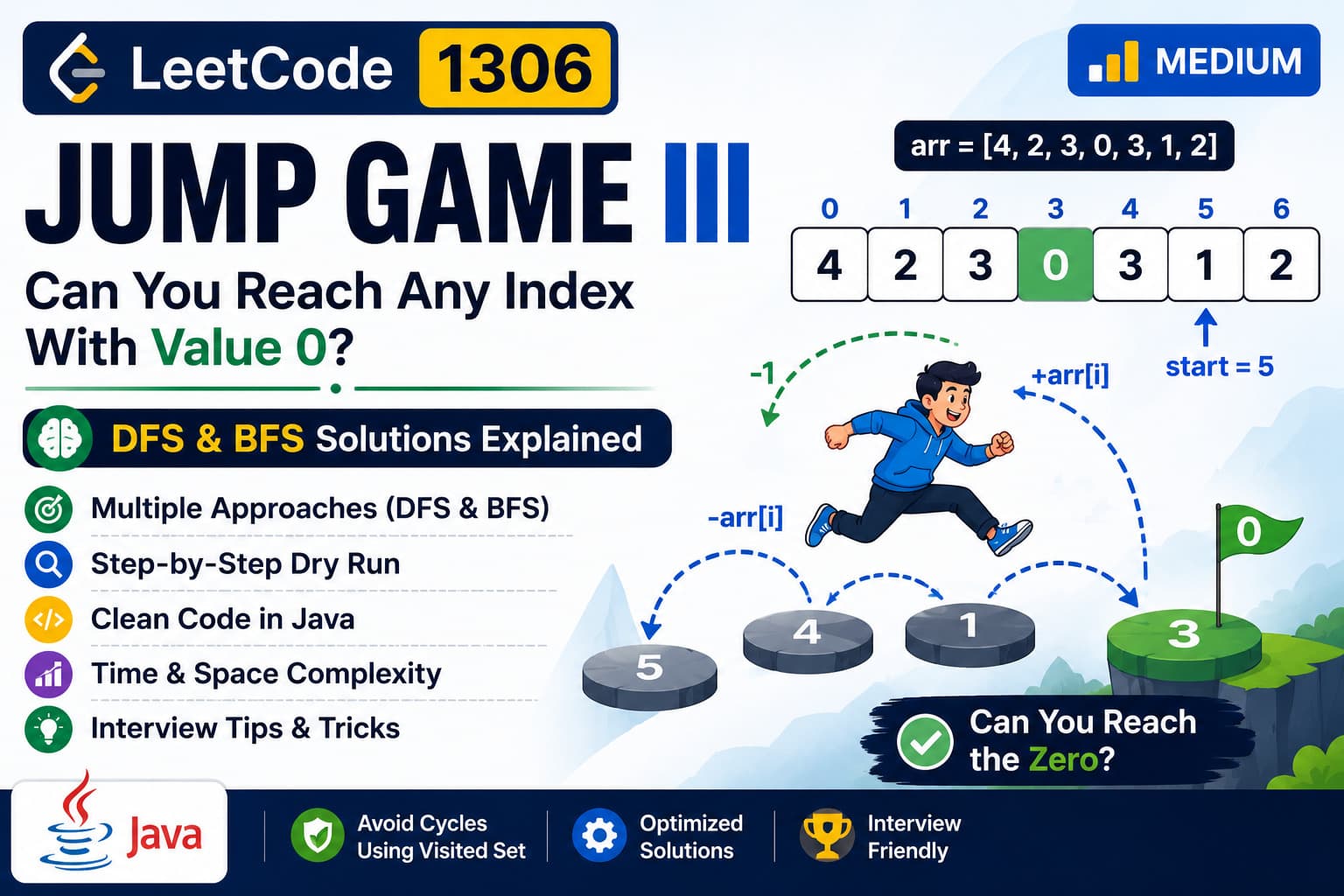
Think of every index as a graph node.
From each node:
we have two possible edges:
and
The goal is simply:
Can we reach any node containing value 0?
Brute Force Intuition
A naive recursive solution would:
- Try both forward and backward jumps
- Continue recursively
- Stop when we find zero
Why Brute Force Fails
Without tracking visited indices, recursion may enter infinite loops.
Example:
This creates cycles.
So we must track visited nodes.
DFS Intuition
We perform DFS traversal from the starting index.
At every index:
- Check boundaries
- Check if already visited
- Check if value is zero
- Explore both possible jumps
Key DFS Observation
Each index should only be visited once.
Why?
Because revisiting creates cycles and unnecessary computation.
So we use:
or
Recursive DFS Approach
Steps
1. Boundary Check
If index goes outside array:
2. Visited Check
If already visited:
3. Found Zero
If current index contains:
Return:
4. Explore Both Directions
Try:
and
Java DFS Solution
Simpler Optimized DFS Solution
We actually do not need a separate set for zero indexes.
We can directly check:
Cleaner Java DFS Solution
Dry Run
Input
Step 1
Current index:
Value:
Possible jumps:
Step 2
Visit index:
Value:
Possible jumps:
Step 3
Visit index:
Value:
Possible jumps:
Step 4
Visit index:
Value:
Return:
BFS Approach
This problem can also be solved using BFS.
Instead of recursion:
- Use queue
- Explore neighbors level by level
Java BFS Solution
Time Complexity Analysis
DFS Complexity
Time Complexity
Each index is visited at most once.
Space Complexity
Due to recursion stack and visited array.
BFS Complexity
Time Complexity
Space Complexity
DFS vs BFS
| Approach | Advantages | Disadvantages |
| DFS | Simple recursive logic | Recursion stack |
| BFS | Iterative solution | Queue management |
Interview Explanation
In interviews, explain:
This problem behaves like graph traversal where each index acts as a node and jumps act as edges. We use DFS or BFS with visited tracking to avoid infinite cycles.
This demonstrates strong graph intuition.
Common Mistakes
1. Forgetting Visited Tracking
This causes infinite recursion.
2. Missing Boundary Checks
Always check:
3. Revisiting Nodes
Avoid processing already visited indices.
FAQs
Q1. Is this an array problem or graph problem?
Internally it is a graph traversal problem.
Q2. Which is better: DFS or BFS?
Both are valid.
DFS is usually simpler for this problem.
Q3. Why do we need visited tracking?
To avoid infinite loops caused by cycles.
Q4. Can this be solved greedily?
No.
Because multiple paths must be explored.
Conclusion
LeetCode 1306 is an excellent beginner-friendly graph traversal problem.
It teaches:
- DFS traversal
- BFS traversal
- Cycle detection
- Recursive thinking
- Visited state management
The most important insight is:
Treat every index as a graph node.
Once you understand this idea, many graph and traversal interview problems become much easier.