LeetCode 1306: Jump Game III – Java DFS & Graph Traversal Solution Explained
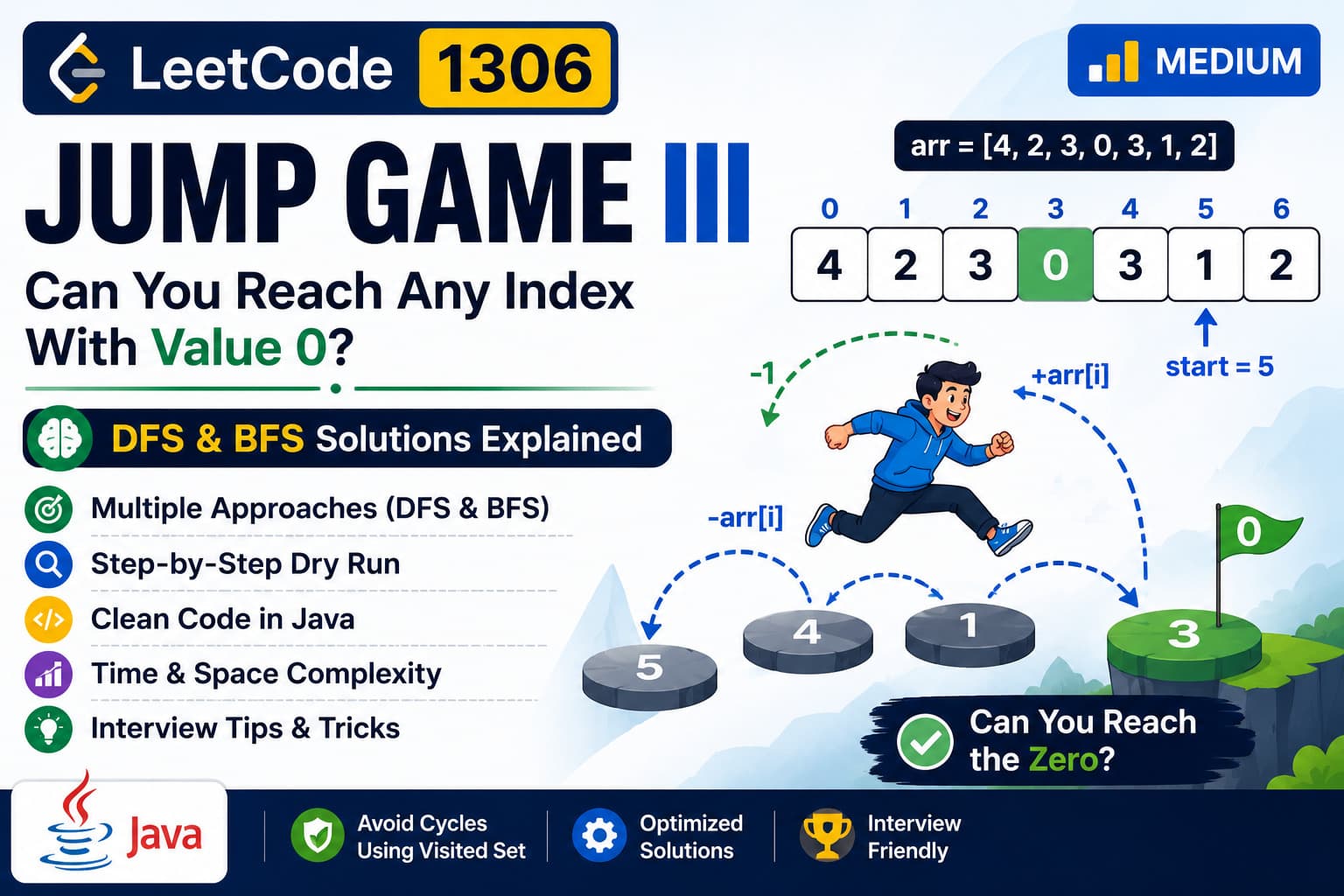
IntroductionLeetCode 1306 – Jump Game III is an interesting graph traversal problem that combines:Depth First Search (DFS)Breadth First Search (BFS)RecursionVisited trackingCycle detectionAt first glance, this problem looks like an array problem.But internally, it behaves exactly like a graph traversal problem where:Each index acts like a nodeEach jump acts like an edgeThis problem is commonly asked in coding interviews because it tests:Recursive thinkingGraph traversal intuitionAvoiding infinite loopsState trackingProblem Link🔗 https://leetcode.com/problems/jump-game-iii/Problem StatementYou are given:An array arrA starting index startFrom index i, you can jump:i + arr[i]ori - arr[i]Your goal is to determine whether you can reach any index having value:0ExampleInputarr = [4,2,3,0,3,1,2]start = 5OutputtrueExplanationPossible path:5 → 4 → 1 → 3At index:3Value becomes:0So answer is:trueUnderstanding the ProblemThink of every index as a graph node.From each node:index iwe have two possible edges:i + arr[i]andi - arr[i]The goal is simply:Can we reach any node containing value 0?Brute Force IntuitionA naive recursive solution would:Try both forward and backward jumpsContinue recursivelyStop when we find zeroWhy Brute Force FailsWithout tracking visited indices, recursion may enter infinite loops.Example:1 → 3 → 1 → 3 → 1...This creates cycles.So we must track visited nodes.DFS IntuitionWe perform DFS traversal from the starting index.At every index:Check boundariesCheck if already visitedCheck if value is zeroExplore both possible jumpsKey DFS ObservationEach index should only be visited once.Why?Because revisiting creates cycles and unnecessary computation.So we use:HashSet<Integer> visitedorboolean[] visitedRecursive DFS ApproachSteps1. Boundary CheckIf index goes outside array:return false2. Visited CheckIf already visited:return false3. Found ZeroIf current index contains:0Return:true4. Explore Both DirectionsTry:start + arr[start]andstart - arr[start]Java DFS Solutionclass Solution { public boolean solve(HashSet<Integer> zeroIndexes, HashSet<Integer> visited, int start, int[] arr) { if(start >= arr.length || start < 0) return false; if(visited.contains(start)) return false; visited.add(start); if(zeroIndexes.contains(start)) return true; return solve(zeroIndexes, visited, start + arr[start], arr) || solve(zeroIndexes, visited, start - arr[start], arr); } public boolean canReach(int[] arr, int start) { HashSet<Integer> visited = new HashSet<>(); HashSet<Integer> zeroIndexes = new HashSet<>(); for(int i = 0; i < arr.length; i++) { if(arr[i] == 0) { zeroIndexes.add(i); } } return solve(zeroIndexes, visited, start, arr); }}Simpler Optimized DFS SolutionWe actually do not need a separate set for zero indexes.We can directly check:arr[start] == 0Cleaner Java DFS Solutionclass Solution { public boolean dfs(int[] arr, boolean[] visited, int start) { if(start < 0 || start >= arr.length) return false; if(visited[start]) return false; if(arr[start] == 0) return true; visited[start] = true; return dfs(arr, visited, start + arr[start]) || dfs(arr, visited, start - arr[start]); } public boolean canReach(int[] arr, int start) { return dfs(arr, new boolean[arr.length], start); }}Dry RunInputarr = [4,2,3,0,3,1,2]start = 5Step 1Current index:5Value:1Possible jumps:5 + 1 = 65 - 1 = 4Step 2Visit index:4Value:3Possible jumps:4 + 3 = 7 (invalid)4 - 3 = 1Step 3Visit index:1Value:2Possible jumps:1 + 2 = 31 - 2 = -1 (invalid)Step 4Visit index:3Value:0Return:trueBFS ApproachThis problem can also be solved using BFS.Instead of recursion:Use queueExplore neighbors level by levelJava BFS Solutionclass Solution { public boolean canReach(int[] arr, int start) { Queue<Integer> queue = new LinkedList<>(); boolean[] visited = new boolean[arr.length]; queue.offer(start); while(!queue.isEmpty()) { int index = queue.poll(); if(index < 0 || index >= arr.length) continue; if(visited[index]) continue; if(arr[index] == 0) return true; visited[index] = true; queue.offer(index + arr[index]); queue.offer(index - arr[index]); } return false; }}Time Complexity AnalysisDFS ComplexityTime ComplexityO(N)Each index is visited at most once.Space ComplexityO(N)Due to recursion stack and visited array.BFS ComplexityTime ComplexityO(N)Space ComplexityO(N)DFS vs BFSApproachAdvantagesDisadvantagesDFSSimple recursive logicRecursion stackBFSIterative solutionQueue managementInterview ExplanationIn interviews, explain:This problem behaves like graph traversal where each index acts as a node and jumps act as edges. We use DFS or BFS with visited tracking to avoid infinite cycles.This demonstrates strong graph intuition.Common Mistakes1. Forgetting Visited TrackingThis causes infinite recursion.2. Missing Boundary ChecksAlways check:start < 0 || start >= arr.length3. Revisiting NodesAvoid processing already visited indices.FAQsQ1. Is this an array problem or graph problem?Internally it is a graph traversal problem.Q2. Which is better: DFS or BFS?Both are valid.DFS is usually simpler for this problem.Q3. Why do we need visited tracking?To avoid infinite loops caused by cycles.Q4. Can this be solved greedily?No.Because multiple paths must be explored.ConclusionLeetCode 1306 is an excellent beginner-friendly graph traversal problem.It teaches:DFS traversalBFS traversalCycle detectionRecursive thinkingVisited state managementThe most important insight is:Treat every index as a graph node.Once you understand this idea, many graph and traversal interview problems become much easier.