Introduction
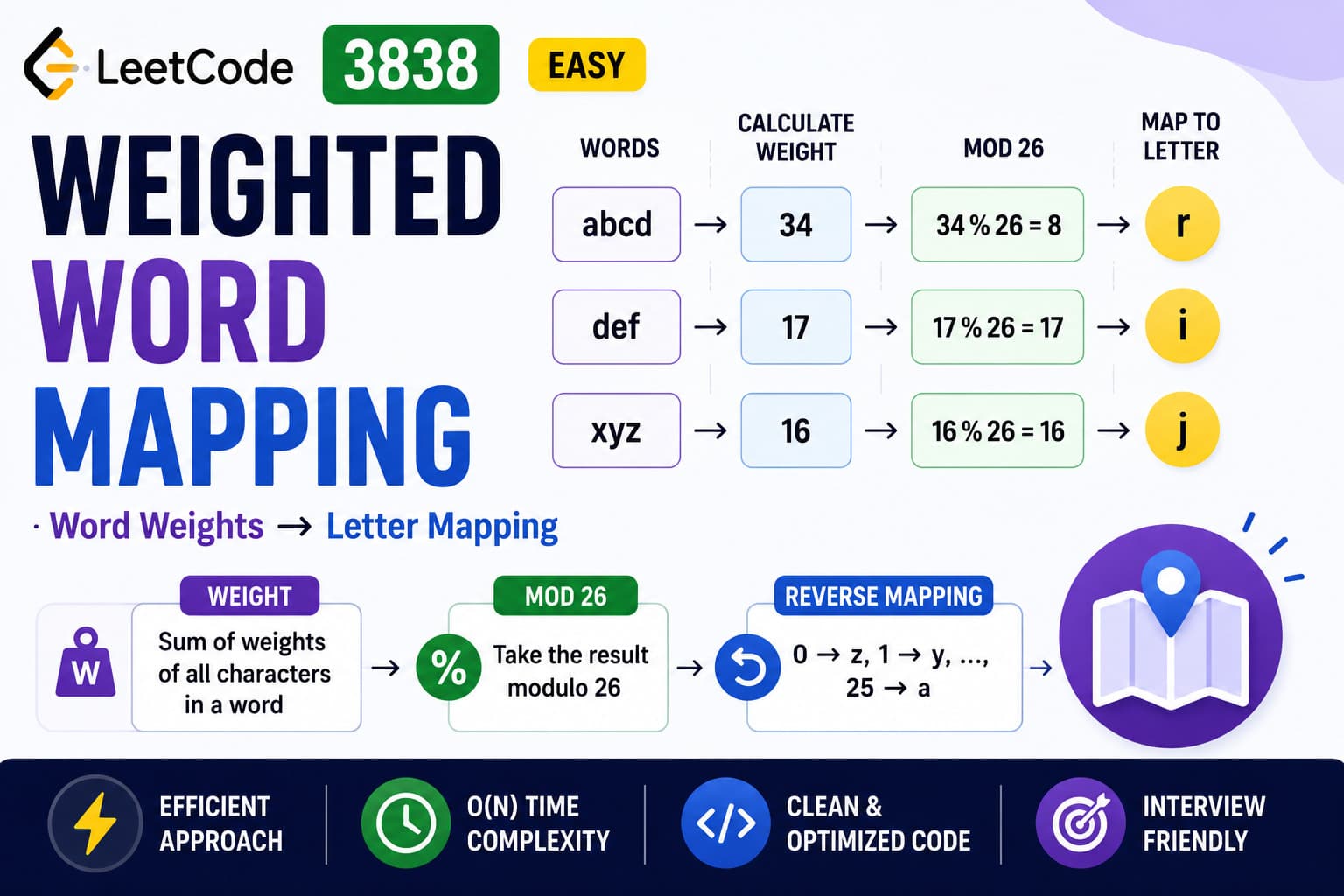
LeetCode 3838, Weighted Word Mapping, is a straightforward yet interesting problem that combines several fundamental programming concepts:
- Character mapping
- Hashing
- Modular arithmetic
- String processing
- Optimization techniques
At first glance, the problem appears to be a simple implementation exercise. However, it provides a great opportunity to discuss different approaches and understand how fixed-size alphabets can help us write more efficient code.
In this article, we'll explore the problem step-by-step, discuss multiple solutions, perform a dry run, and analyze the complexity of each approach.
Problem Link -: Weighted Word Mapping
Problem Statement
You are given:
- An array of strings
words - An integer array
weightsof length 26
Each index in the weights array corresponds to a lowercase English letter.
For every word:
- Calculate the sum of character weights.
- Take the result modulo 26.
- Convert the modulo result into a letter using reverse alphabetical order:
Return a string formed by concatenating all mapped letters.
Example
Input
Output
Explanation
For the word "abcd":
For "def":
For "xyz":
Final Answer:
Understanding the Core Idea
The problem consists of three independent operations:
Step 1: Calculate Word Weight
For each word:
Example:
Step 2: Apply Modulo 26
The problem requires:
This guarantees that the result always lies between:
Step 3: Reverse Alphabet Mapping
Unlike normal alphabet indexing:
the problem uses:
This reverse mapping generates the final encoded character.
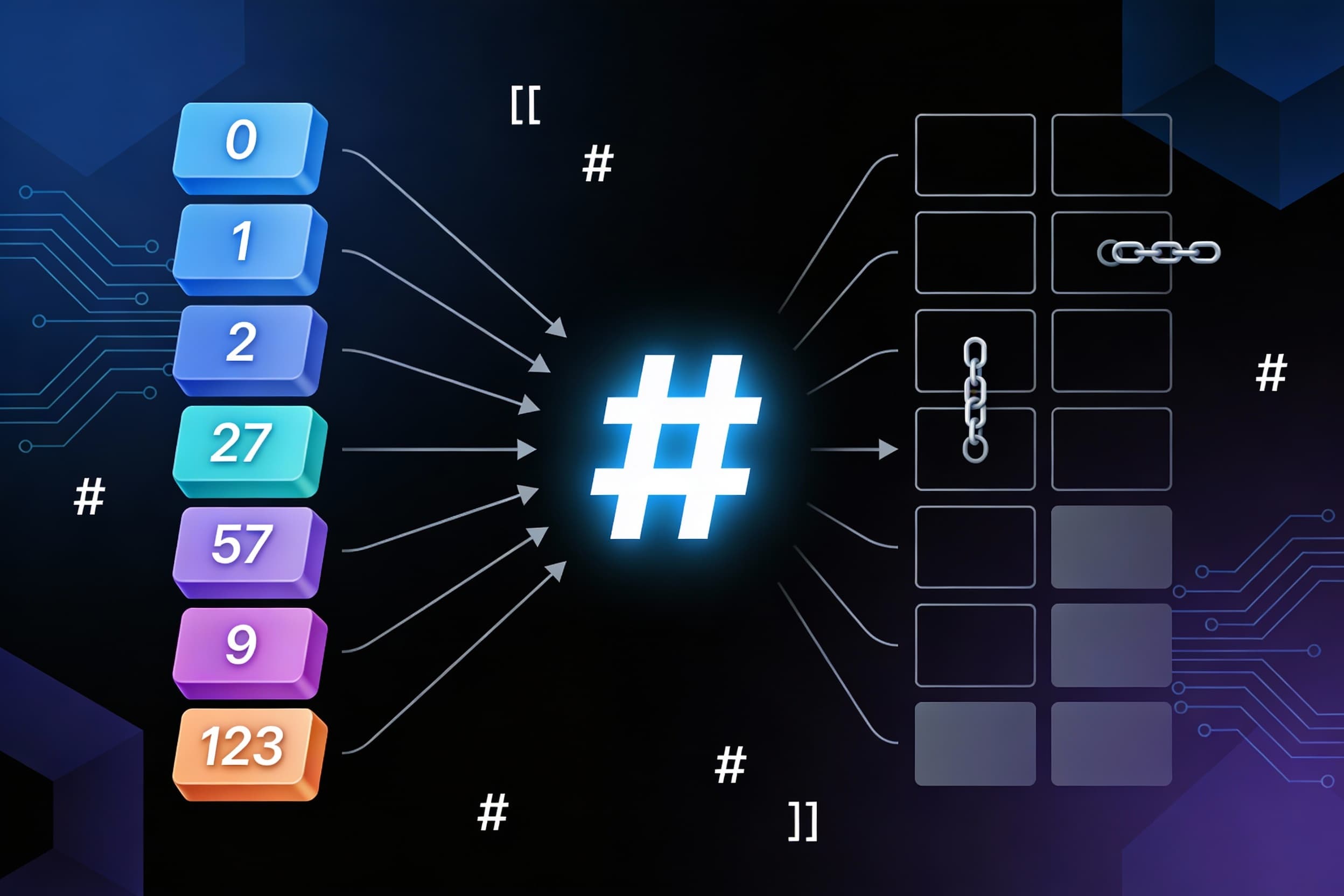
Approach 1: HashMap-Based Solution
Intuition
Create:
Map 1
Example:
Map 2
Example:
Then process each word and build the answer.
Java Implementation
Approach 2: Optimized Array Solution
Observation
The English alphabet contains only 26 letters.
Instead of using HashMaps:
we can directly access:
This eliminates hashing overhead entirely.
Why Is This Better?
HashMap operations are O(1) on average, but they still involve:
- Hash computation
- Bucket lookup
- Internal object handling
Array indexing is faster because it directly accesses memory.
Optimized Java Solution
Dry Run
Input
Assume:
Calculate Weight
Apply Modulo
Reverse Mapping
Result:
Complexity Analysis
HashMap Solution
Time Complexity
where T is the total number of characters across all words.
Space Complexity
Only fixed-size maps of 26 elements are stored.
Optimized Array Solution
Time Complexity
Space Complexity
No additional data structures are required.
Which Solution Should You Use?
| Approach | Time | Space | Interview Preference |
| HashMap | O(T) | O(1) | Good |
| Direct Array | O(T) | O(1) | Best |
Both solutions are efficient.
However, the array-based approach is typically preferred in coding interviews because:
- Simpler implementation
- Faster execution
- Lower memory overhead
- No unnecessary hashing
Interview Discussion
A common follow-up question is:
Can we eliminate both HashMaps?
Yes.
Since:
are contiguous ASCII characters, we can directly compute:
Similarly:
can generate the reverse mapping without storing another lookup table.
This reduces code complexity while maintaining the same asymptotic performance.
Key Takeaways
- Fixed-size alphabets often allow array-based optimizations.
- HashMaps improve readability but may not always be necessary.
- Modular arithmetic is useful for reducing values into a bounded range.
- Character arithmetic can replace lookup tables in many string problems.
- Always look for opportunities to replace generic data structures with direct indexing when the input domain is small and fixed.
Conclusion
LeetCode 3838: Weighted Word Mapping is an excellent beginner-friendly problem that demonstrates the practical use of hashing, modular arithmetic, and character manipulation.
While a HashMap-based solution is intuitive and easy to understand, recognizing that the alphabet size is fixed allows us to develop a cleaner and more optimized array-based solution.
Understanding both approaches not only helps solve this problem efficiently but also strengthens the problem-solving mindset needed for technical interviews and competitive programming.