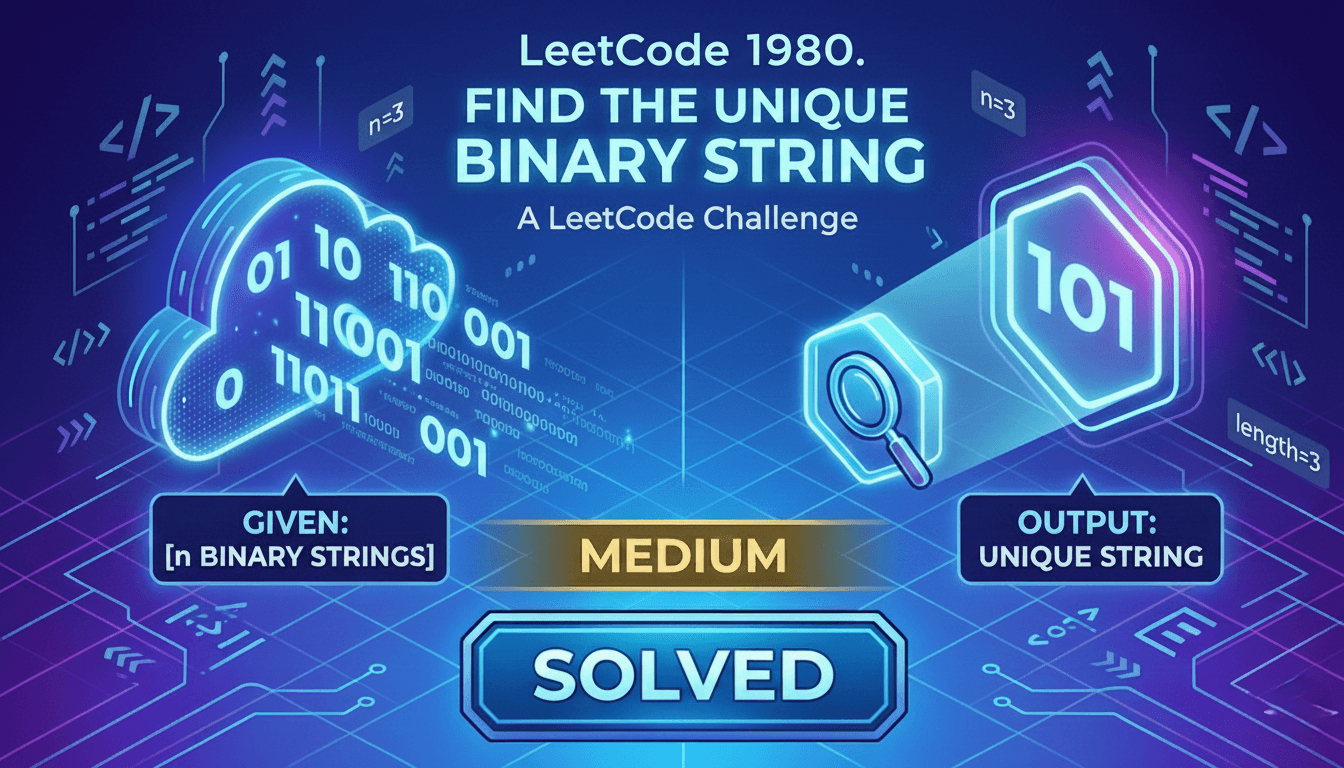
LeetCode 1980: Find Unique Binary String – Multiple Ways to Generate a Missing Binary Combination
Try the ProblemYou can solve the problem here:https://leetcode.com/problems/find-unique-binary-string/Problem DescriptionYou are given an array nums containing n unique binary strings, where each string has length n.Your task is to return any binary string of length n that does not appear in the array.Important ConditionsEach string consists only of '0' and '1'.Every string in the array is unique.The output must be a binary string of length n.If multiple valid answers exist, any one of them is acceptable.ExamplesExample 1Inputnums = ["01","10"]Output"11"ExplanationPossible binary strings of length 2:00011011Since "01" and "10" are already present, valid answers could be:00 or 11Example 2Inputnums = ["00","01"]Output"11"Another valid output could be:10Example 3Inputnums = ["111","011","001"]Output101Other valid answers include:000010100110Constraintsn == nums.length1 <= n <= 16nums[i].length == nnums[i] consists only of '0' and '1'All strings in nums are uniqueImportant ObservationThe total number of binary strings of length n is:2^nBut the array contains only:n stringsSince 2^n grows very quickly and n ≤ 16, there are many possible binary strings missing from the array. Our goal is simply to construct one of those missing strings.Thinking About the ProblemBefore jumping into coding, it's useful to think about different strategies that could help us generate a binary string that does not appear in the array.Possible Ways to Think About the ProblemWhen approaching this problem, several ideas may come to mind:Generate all possible binary strings of length n and check which one is missing.Store all strings in a HashSet or HashMap and construct a candidate string to verify whether it exists.Manipulate existing strings by flipping bits to create new combinations.Use a mathematical trick that guarantees the new string is different from every string in the list.Each of these approaches leads to a different solution strategy.In this article, we will walk through these approaches and understand how they work.Approach 1: Brute Force – Generate All Binary StringsIdeaThe simplest idea is to generate every possible binary string of length n and check whether it exists in the given array.Since there are:2^n possible binary stringsWe can generate them one by one and return the first string that does not appear in nums.StepsConvert numbers from 0 to (2^n - 1) into binary strings.Pad the binary string with leading zeros so its length becomes n.Check if that string exists in the array.If not, return it.Time ComplexityO(2^n * n)This works because n is at most 16, but it is still not the most elegant approach.Approach 2: HashMap + Bit Flipping (My Approach)IdeaWhile solving this problem, another idea is to store all given binary strings inside a HashMap for quick lookup.Then we can try to construct a new binary string by flipping bits from the existing strings.The intuition is simple:If the current character is '0', change it to '1'.If the current character is '1', change it to '0'.By flipping bits at different positions, we attempt to build a new binary combination.Once the string is constructed, we check whether it already exists in the map.If the generated string does not exist, we return it as our answer.Java Implementation (My Solution)class Solution { public String findDifferentBinaryString(String[] nums) { int len = nums[0].length(); // HashMap to store all given binary strings HashMap<String, Integer> mp = new HashMap<>(); for(int i = 0; i < nums.length; i++){ mp.put(nums[i], i); } int cou = 0; String ans = ""; for(int i = 0; i < nums.length; i++){ if(cou < len){ // Flip the current bit if(nums[i].charAt(cou) == '0'){ ans += '1'; cou++; } else{ ans += '0'; cou++; } }else{ // If generated string does not exist in map if(!mp.containsKey(ans)){ return ans; } // Reset and try building again ans = ""; cou = 0; } } return ans; }}Time ComplexityO(n²)Because we iterate through the array and perform string operations.Space ComplexityO(n)For storing the strings in the HashMap.Approach 3: Cantor’s Diagonalization (Optimal Solution)IdeaA clever mathematical observation allows us to construct a string that must differ from every string in the array.We build a new string such that:The first character differs from the first string.The second character differs from the second string.The third character differs from the third string.And so on.By ensuring that the generated string differs from each string at least at one position, it is guaranteed not to exist in the array.This technique is known as Cantor’s Diagonalization.Java Implementationclass Solution { public String findDifferentBinaryString(String[] nums) { int n = nums.length; StringBuilder result = new StringBuilder(); for(int i = 0; i < n; i++){ // Flip the diagonal bit if(nums[i].charAt(i) == '0'){ result.append('1'); } else{ result.append('0'); } } return result.toString(); }}Time ComplexityO(n)We only traverse the array once.Space ComplexityO(n)For storing the resulting string.Comparison of ApproachesApproachTime ComplexitySpace ComplexityNotesBrute ForceO(2^n * n)O(n)Simple but inefficientHashMap + Bit FlippingO(n²)O(n)Constructive approachCantor DiagonalizationO(n)O(n)Optimal and elegantKey TakeawaysThis problem highlights an interesting concept in algorithm design:Sometimes the best solution is not searching for the answer but constructing one directly.By understanding the structure of the input, we can generate a result that is guaranteed to be unique.ConclusionThe Find Unique Binary String problem can be solved using multiple strategies, ranging from brute force enumeration to clever mathematical construction.While brute force works due to the small constraint (n ≤ 16), more elegant solutions exist. Using hashing or constructive approaches improves efficiency and demonstrates deeper algorithmic thinking.Among all approaches, the Cantor Diagonalization technique provides the most efficient and mathematically guaranteed solution.Understanding problems like this helps strengthen skills in string manipulation, hashing, and constructive algorithms, which are commonly tested in coding interviews.