LeetCode 3761 Minimum Absolute Distance Between Mirror Pairs | Java HashMap Solution
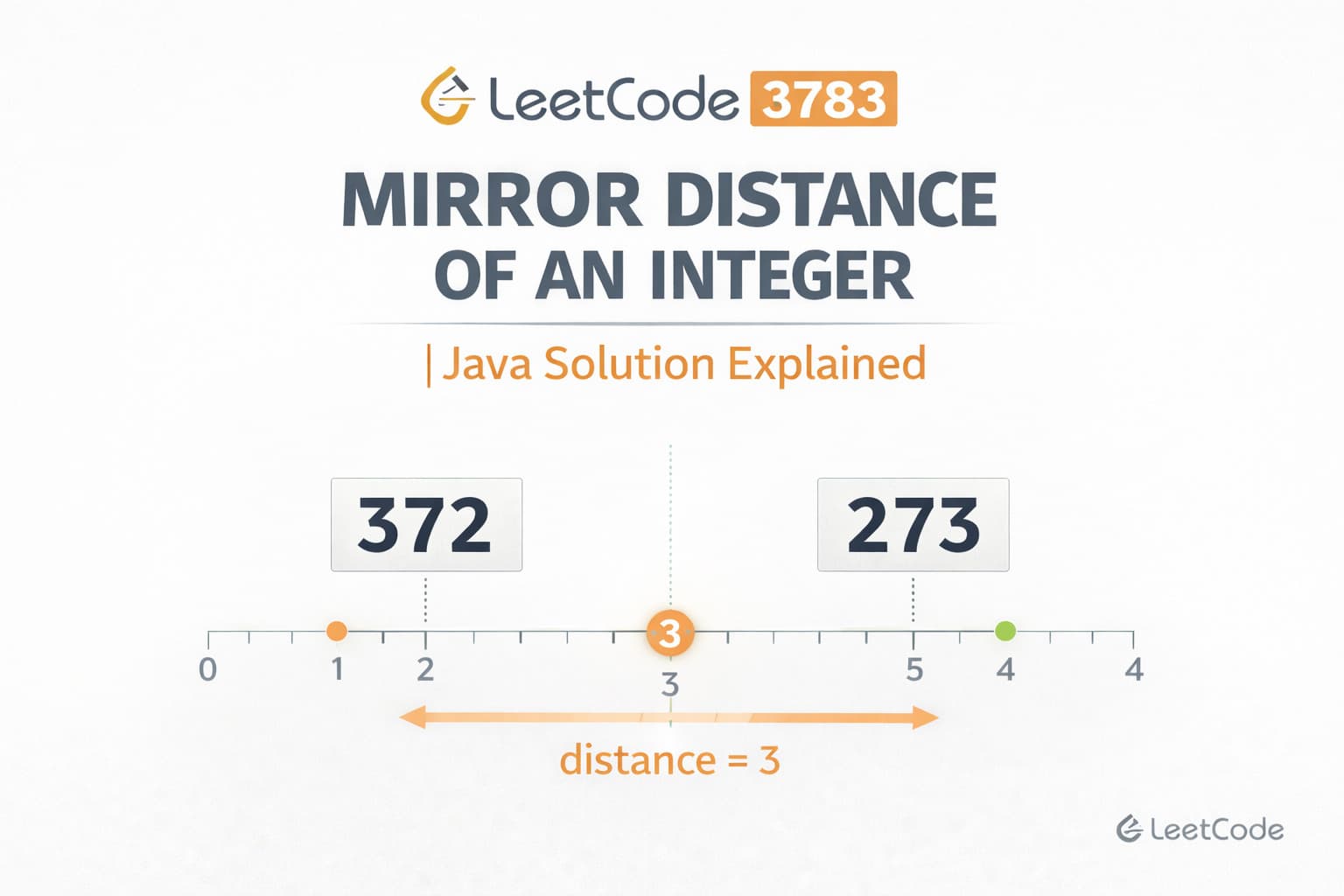
IntroductionSome problems look simple at first—but hide a clever trick inside.LeetCode 3761 – Minimum Absolute Distance Between Mirror Pairs is one such problem. It combines:Number manipulation (digit reversal)HashingEfficient searchingIf approached naively, this problem can easily lead to O(n²) time complexity—which is not feasible for large inputs.In this article, we will walk through:Problem intuitionNaive approach (and why it fails)Optimized HashMap solutionStep-by-step explanationClean Java code with comments🔗 Problem LinkLeetCode: Minimum Absolute Distance Between Mirror PairsTo gain a deeper understanding of the problem, it is highly recommended that you review this similar problem Closest Equal Element Queries here is the link of the article. Both cases follow a nearly identical pattern, and studying the initial example will provide valuable context for the current task.Problem StatementYou are given an integer array nums.A mirror pair (i, j) satisfies:0 ≤ i < j < nums.lengthreverse(nums[i]) == nums[j]👉 Your task is to find:The minimum absolute distance between such pairsIf no mirror pair exists, return -1.ExamplesExample 1Input:nums = [12, 21, 45, 33, 54]Output:1Explanation:(0,1) → reverse(12) = 21 → distance = 1(2,4) → reverse(45) = 54 → distance = 2✔ Minimum = 1Example 2Input:nums = [120, 21]Output:1Example 3Input:nums = [21, 120]Output:-1Key InsightThe core idea is:Instead of checking every pair,store reversed values and match on the fly.❌ Naive Approach (Brute Force)IdeaCheck all pairs (i, j)Reverse nums[i]Compare with nums[j]ComplexityTime: O(n²) ❌Space: O(1)ProblemWith n ≤ 100000, this approach will definitely cause TLE.✅ Optimized Approach (HashMap)IntuitionWhile iterating through the array:Reverse the current numberCheck if this number was already seen as a reversed valueIf yes → we found a mirror pairKey TrickInstead of storing original numbers:👉 Store reversed values as keysThis allows instant lookup.Java Code (With Detailed Comments)import java.util.*;class Solution {// Function to reverse digits of a numberpublic int reverse(int m) {int rev = 0;while (m != 0) {int dig = m % 10; // extract last digitm = m / 10; // remove last digitrev = rev * 10 + dig; // build reversed number}return rev;}public int minMirrorPairDistance(int[] nums) {// Map to store reversed values and their indicesHashMap<Integer, Integer> mp = new HashMap<>();int min = Integer.MAX_VALUE;for (int i = 0; i < nums.length; i++) {// Check if current number exists in map// Meaning: some previous number had reverse equal to thisif (mp.containsKey(nums[i])) {// Calculate distanceint prevIndex = mp.get(nums[i]);min = Math.min(min, Math.abs(i - prevIndex));}// Reverse current numberint revVal = reverse(nums[i]);// Store reversed value with indexmp.put(revVal, i);}// If no pair found, return -1return min == Integer.MAX_VALUE ? -1 : min;}}Step-by-Step Dry RunInput:nums = [12, 21, 45, 33, 54]Execution:IndexValueReverseMap CheckAction01221not foundstore (21 → 0)12112founddistance = 124554not foundstore (54 → 2)33333not foundstore (33 → 3)45445founddistance = 2👉 Minimum = 1Complexity AnalysisTime ComplexityReversing number → O(digits) ≈ O(log n)Loop → O(n)👉 Overall: O(n)Space ComplexityHashMap stores at most n elements👉 O(n)Why This Approach WorksAvoids unnecessary pair comparisonsUses hashing for constant-time lookupProcesses array in a single passKey TakeawaysAlways think of hashing when matching conditions existReversing numbers can convert the problem into a lookup problemAvoid brute force when constraints are largeThis is a classic “store & check” patternCommon Interview PatternThis problem is similar to:Two Sum (hashing)Reverse pairsMatching transformationsConclusionThe Minimum Absolute Distance Between Mirror Pairs problem is a great example of how a simple optimization (using a HashMap) can reduce complexity from O(n²) → O(n).Understanding this pattern will help you solve many similar problems involving:TransformationsMatching conditionsEfficient lookupsFrequently Asked Questions (FAQs)1. Why store reversed value instead of original?Because we want to quickly check if a number matches the reverse of a previous number.2. What if multiple same reversed values exist?The map stores the latest index, ensuring minimum distance is considered.3. Can this be solved without HashMap?Yes, but it will result in inefficient O(n²) time.