Introduction
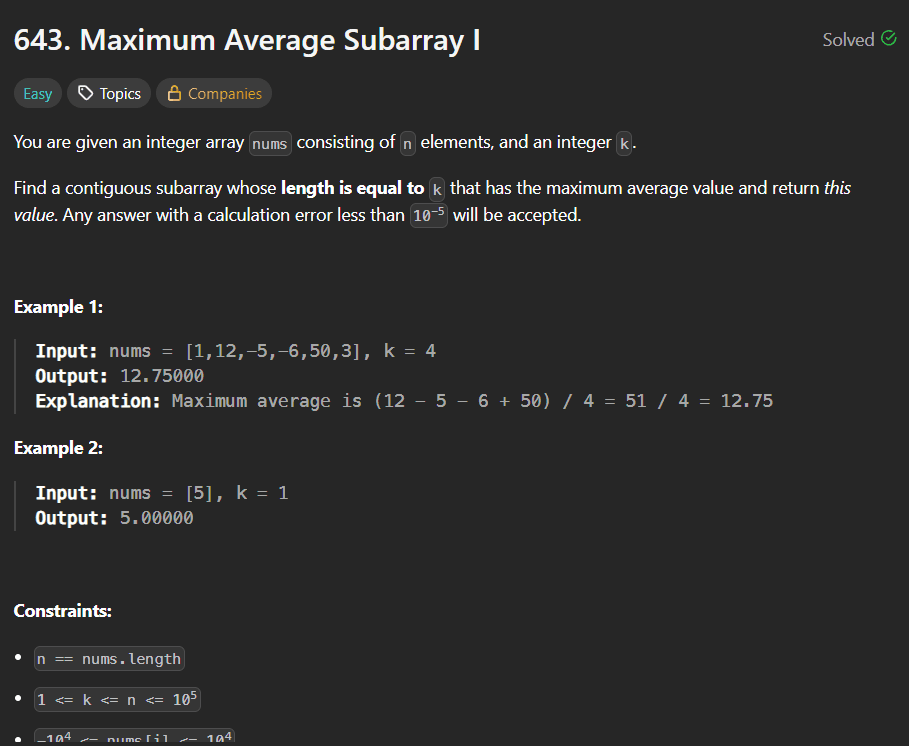
LeetCode Problem 643: Maximum Average Subarray I is a classic problem that tests understanding of arrays and the sliding window technique.
The task is simple in description but requires optimization to work efficiently for large inputs.
We are given:
- An integer array
nums - An integer
k
We must find a contiguous subarray of length k that has the maximum average value, and return that average.
If you want to try solving the problem yourself before reading further, you can attempt it here:
👉 Try the problem on LeetCode:
https://leetcode.com/problems/maximum-average-subarray-i/
Problem Understanding
A brute-force solution would compute the sum for every subarray of length k and track the maximum average. However, recalculating sums repeatedly results in O(n × k) time complexity, which becomes inefficient for large arrays.
Instead, we can use the sliding window technique to optimize the process.
Key Idea: Sliding Window
Instead of recomputing sums:
- Compute the sum of the first window of size
k. - Slide the window forward by:
- Adding the next element
- Removing the element leaving the window
- Update the maximum average at each step.
This reduces time complexity to O(n).
Approach
- Maintain two pointers representing the window.
- Keep adding elements until window size becomes
k. - Compute average and update maximum.
- Slide the window by removing the left element.
- Continue until the end of the array.
Implementation (Java)
Dry Run Example
Input:
Windows examined:
Maximum average = 12.75
Complexity Analysis
Time Complexity: O(n)
Each element enters and leaves the window once.
Space Complexity: O(1)
No extra space is used apart from variables.
Edge Cases Considered
- Single element array (
k = 1) - All negative numbers
- Large input size
- Large positive or negative values
Why Sliding Window Matters
Sliding window is a crucial technique used in many interview problems:
- Subarray sum problems
- Longest substring problems
- Fixed or variable window size optimizations
Mastering this pattern greatly improves coding interview performance.
Conclusion
This problem demonstrates how recognizing patterns like sliding window can transform a slow brute-force solution into an efficient one.
If you are preparing for coding interviews, mastering sliding window problems is essential since they appear frequently.