Introduction
Finding the smallest positive integer missing from an unsorted array appears simple at first, but the problem becomes significantly more interesting because of its strict constraints.
Problem Link -: First Missing Positive
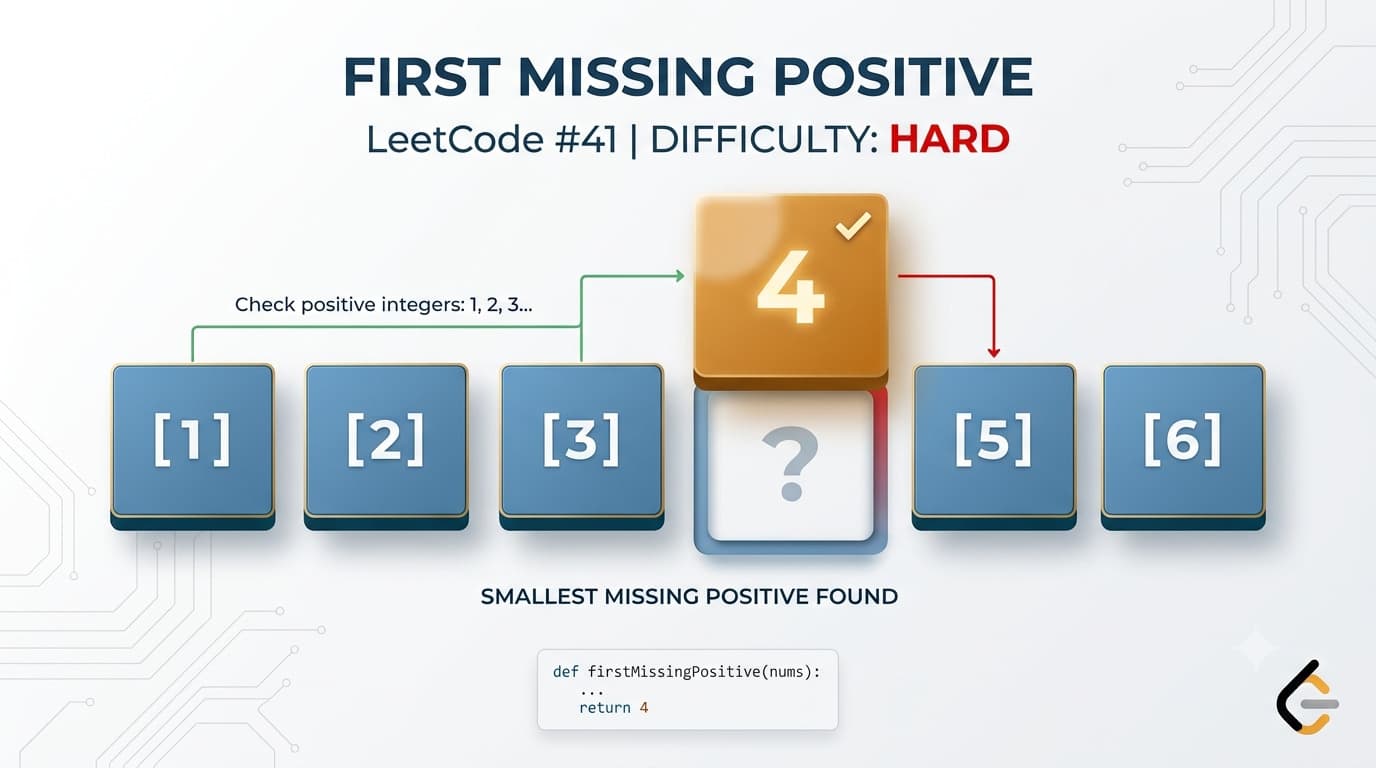
Given an unsorted integer array nums, the task is to return the smallest positive integer that does not appear in the array.
For example:
The positive integers begin with:
Both 1 and 2 are present, while 3 is missing.
Therefore, the answer is:
The challenge is that the solution must run in:
This rules out several common approaches such as sorting and using a HashSet.
Problem Statement
Given an unsorted integer array nums, return the smallest positive integer that is not present in the array.
Example
The positive integers are:
1 exists in the array, but 2 does not.
Therefore:
Another example:
Since 1 itself is missing, the answer is immediately:
Understanding the Important Observation
For an array of length n, the answer can never be greater than:
Consider:
The first three positive integers are present:
Therefore, the smallest missing positive integer is:
Since n = 3:
This observation is the key to the optimal solution.
Numbers that are:
or
cannot directly determine the smallest missing positive number.
The useful values are only:
The Submitted HashSet Approach
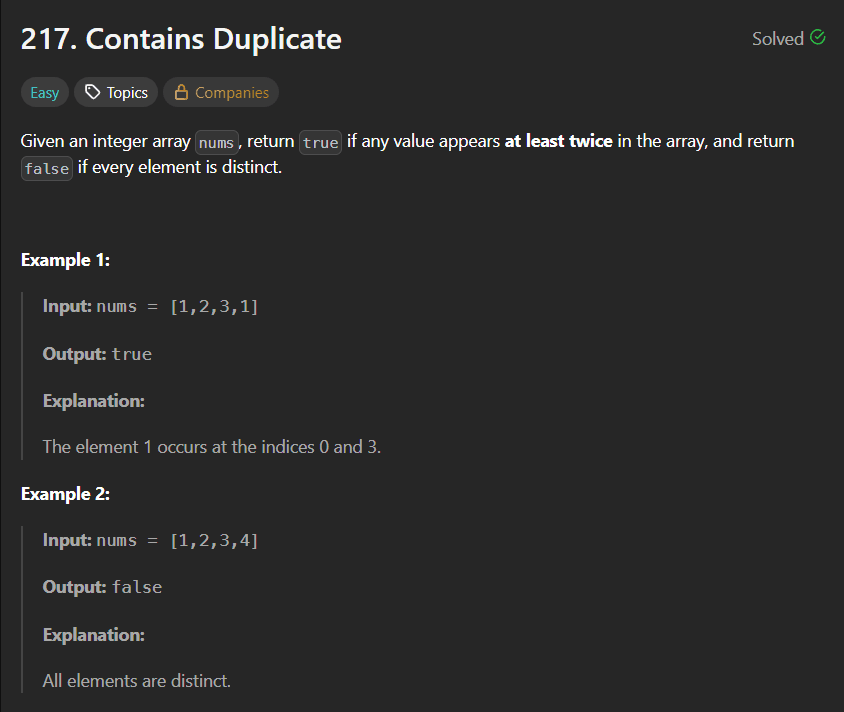
A straightforward approach is to store every value in a HashSet and then search for the first missing positive integer.
The basic idea is:
The submitted implementation follows this idea:
This approach is logically valid for finding the answer, but it does not satisfy the required constraints.
Space Complexity
The HashSet can store up to n elements.
Therefore:
The problem requires:
So a different technique is required.
Why Sorting Is Also Not Enough
Sorting the array might appear to solve the problem easily.
For example:
After sorting:
The missing positive integer can then be identified by scanning the array.
However, sorting requires:
time in the general case.
The problem specifically requires:
time.
Therefore, sorting does not satisfy the required complexity either.
The Core Idea: Put Every Number in Its Correct Position
The optimal solution uses an in-place cyclic placement technique.
The important relationship is:
In general:
Consider:
The desired arrangement for useful values is:
After placing the valid values into their corresponding positions, the array can become:
Index 1 should contain:
but it contains -1.
Therefore:
This transforms the problem from:
Search for a missing number.
into:
Place every useful number at the position where it belongs, then find the first incorrect position.
Which Numbers Should Be Placed?
For an array of length n, only values satisfying:
need to be placed.
Why?
Suppose:
The answer can only be one of:
A value such as:
cannot be the answer.
Similarly:
cannot prevent 1...6 from determining the answer.
Therefore, values outside the range [1,n] can safely remain where they are.
The Cyclic Placement Process
For every index i, check the current value:
If it belongs to the range:
its correct index is:
So the value should be swapped into:
The process continues until the current position contains a value that either:
- is outside the useful range, or
- is already in its correct position.
Why the Duplicate Check Is Necessary
Consider:
The value 1 belongs at index 0.
The first element is already correct.
At index 1, the value is again 1.
Trying to swap it repeatedly would cause an infinite loop because another 1 already occupies its correct position.
Therefore, the swap condition must also ensure:
This duplicate check is extremely important.
Optimized Java Solution
Dry Run
Consider:
Array length:
Initial Array
At index 0:
The correct index for 3 is:
Swap:
The value at index 0 is now -1.
Since -1 is outside [1,4], no further placement is required for this index.
At index 1:
Correct index:
Swap:
Now:
The correct index of 1 is 0.
Swap:
Now index 1 contains -1, so placement stops.
Final Arrangement
The expected value at each index is:
The first incorrect position is:
Therefore:
Another Example
Consider:
The values 1 and 2 are already in their correct positions:
Expected arrangement:
The first incorrect position is index 2.
Therefore:
Edge Case: All Positive Numbers Are Present
Consider:
Every position contains the expected value:
No missing value exists between 1 and n.
Therefore, the smallest missing positive integer is:
So:
Edge Case: The Answer Is 1
Consider:
All values are greater than 1.
After the placement phase, there is no 1 at index 0.
Therefore:
Complexity Analysis
The algorithm uses the array itself to store values in their correct positions.
Time Complexity
Although the algorithm contains a nested while loop, the total number of swaps is bounded by O(n) because every successful swap places a useful value into its correct position.
Therefore:
Space Complexity
No additional data structure proportional to the input size is used.
Only a few variables are required:
This satisfies the required constraints.
Why the Algorithm Works
The central invariant is:
Whenever a valuexlies in the range[1,n], the algorithm attempts to place it at indexx-1.
After the placement phase, every value that can occupy a meaningful position is either:
or
Therefore, scanning from left to right provides a direct answer.
If:
then i + 1 is missing.
If every position is correct, then all values from:
exist, making:
the smallest missing positive integer.
Interview Insight
This problem is an important example of in-place array positioning.
The key pattern is:
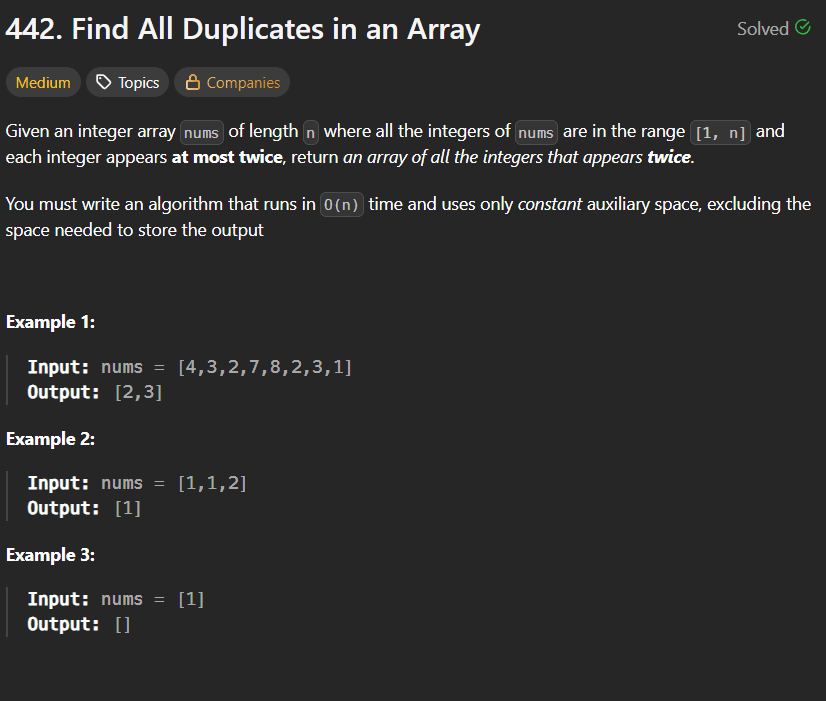
Whenever an array problem asks for a missing, duplicate, or misplaced number within a known range, it is worth checking whether the values themselves can be mapped directly to indices.
This technique appears in several interview problems involving:
- Missing numbers
- Duplicate numbers
- Cyclic sort
- In-place rearrangement
- Frequency representation without extra memory
The biggest clue in this problem is the combination of:
That combination strongly suggests an in-place index/value mapping strategy.
Conclusion
LeetCode 41, First Missing Positive, is a classic example of turning the array itself into auxiliary storage.
A HashSet provides an easy solution but requires O(n) extra space. Sorting simplifies the search but requires O(n log n) time. The optimal solution instead uses the relationship:
to rearrange useful values directly inside the input array.
After this placement, the first index whose value does not match index + 1 identifies the smallest missing positive integer.
The final complexity is:
making the approach suitable for the strict constraints and an important pattern to recognize in technical interviews.