LeetCode Problem 217
Link of the Problem to try -: Link
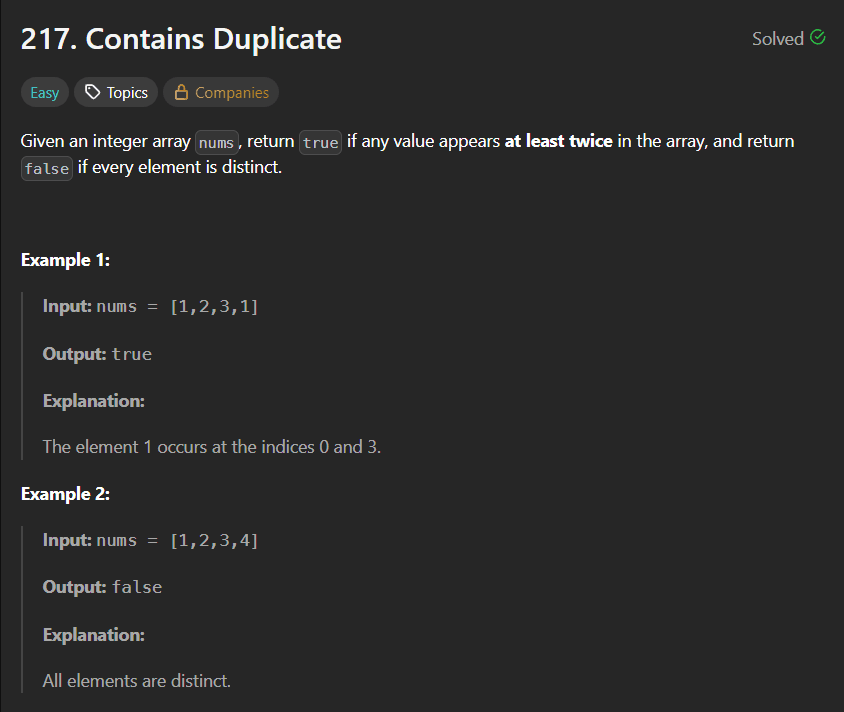
Given an integer array nums, return true if any value appears at least twice in the array, and return false if every element is distinct.
Example 1:
Input: nums = [1,2,3,1]
Output: true
Explanation:
The element 1 occurs at the indices 0 and 3.
Example 2:
Input: nums = [1,2,3,4]
Output: false
Explanation:
All elements are distinct.
Example 3:
Input: nums = [1,1,1,3,3,4,3,2,4,2]
Output: true
Constraints:
1 <= nums.length <= 105-109 <= nums[i] <= 109
Solution:
1. The HashMap Approach
Using a HashMap is a highly effective way to track occurrences. Although we are only checking for the existence of a value, the HashMap logic allows us to store the element as a "Key" and its frequency as a "Value."
Logic:
- Iterate through the
numsarray. - Before inserting an element, check if the HashMap already contains that key.
- If it exists, you've found your duplicate—return
true. - Otherwise, put the value into the map and continue.
Code:
2. The HashSet Approach (Optimized for Storage)
While similar to the HashMap, the HashSet is often more appropriate for this specific problem because we only care if a number exists, not how many times it appears or what its index is.
Logic:
- We initialize an empty
HashSet. - As we loop through the array, we check
ms.contains(nums[i]). - If the set already has the number, it's a duplicate.
- This approach is preferred over HashMap for this problem because it uses less memory and has cleaner syntax.
Code:
3. The Sorting & Two-Pointer Approach
If you want to avoid using extra memory (like a Set or Map), you can use the Two-Pointer method combined with Sorting.
Logic:
- First, we sort the array. This ensures that any duplicate values are placed next to each other.
- We use two pointers:
j(the previous element) andi(the current element). - By moving these pointers across the array, we compare the values. If
nums[i] == nums[j], a duplicate exists.
Code:
Performance Summary
| Approach | Time Complexity | Space Complexity | Recommendation |
| HashSet | O(n) | O(n) | Best Overall – Fastest performance. |
| HashMap | O(n) | O(n) | Good, but HashSet is cleaner for this use case. |
| Two Pointer | O(n \log n) | O(1) | Best for Memory – Use if space is limited. |
Final Thoughts
Choosing the right approach depends on whether you want to prioritize speed (HashSet) or memory efficiency (Two-Pointer). For most coding interviews, the HashSet solution is the "Gold Standard" due to its linear time complexity.