Maximum Average Subarray I — Efficient Solution Using Sliding Window (LeetCode 643)
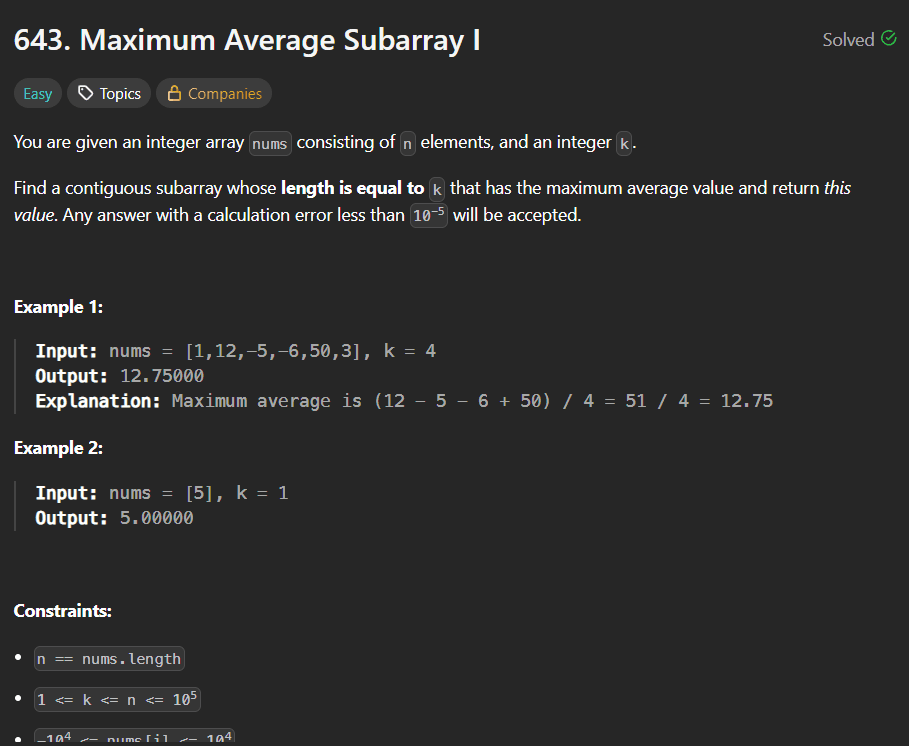
IntroductionLeetCode Problem 643: Maximum Average Subarray I is a classic problem that tests understanding of arrays and the sliding window technique.The task is simple in description but requires optimization to work efficiently for large inputs.We are given:An integer array numsAn integer kWe must find a contiguous subarray of length k that has the maximum average value, and return that average.If you want to try solving the problem yourself before reading further, you can attempt it here:👉 Try the problem on LeetCode: https://leetcode.com/problems/maximum-average-subarray-i/Problem UnderstandingA brute-force solution would compute the sum for every subarray of length k and track the maximum average. However, recalculating sums repeatedly results in O(n × k) time complexity, which becomes inefficient for large arrays.Instead, we can use the sliding window technique to optimize the process.Key Idea: Sliding WindowInstead of recomputing sums:Compute the sum of the first window of size k.Slide the window forward by:Adding the next elementRemoving the element leaving the windowUpdate the maximum average at each step.This reduces time complexity to O(n).ApproachMaintain two pointers representing the window.Keep adding elements until window size becomes k.Compute average and update maximum.Slide the window by removing the left element.Continue until the end of the array.Implementation (Java)class Solution { public double findMaxAverage(int[] nums, int k) { double ans = Integer.MIN_VALUE; int i = 0; int j = 0; int sum = 0; while (j < nums.length) { sum += nums[j]; if (j - i + 1 < k) { j++; } else { ans = Math.max(ans, (double) sum / k); sum -= nums[i]; i++; j++; } } return ans; }}Dry Run ExampleInput:nums = [1,12,-5,-6,50,3], k = 4Windows examined:[1,12,-5,-6] → avg = 0.5[12,-5,-6,50] → avg = 12.75 (maximum)[-5,-6,50,3] → avg = 10.5Maximum average = 12.75Complexity AnalysisTime Complexity: O(n) Each element enters and leaves the window once.Space Complexity: O(1) No extra space is used apart from variables.Edge Cases ConsideredSingle element array (k = 1)All negative numbersLarge input sizeLarge positive or negative valuesWhy Sliding Window MattersSliding window is a crucial technique used in many interview problems:Subarray sum problemsLongest substring problemsFixed or variable window size optimizationsMastering this pattern greatly improves coding interview performance.ConclusionThis problem demonstrates how recognizing patterns like sliding window can transform a slow brute-force solution into an efficient one.If you are preparing for coding interviews, mastering sliding window problems is essential since they appear frequently.