Search Blogs

Showing results for "Simulation"

Found 16 results

LeetCode 2390: Removing Stars From a String — Java Solution With All Approaches Explained

LeetCode 2390: Removing Stars From a String — Java Solution With All Approaches Explained

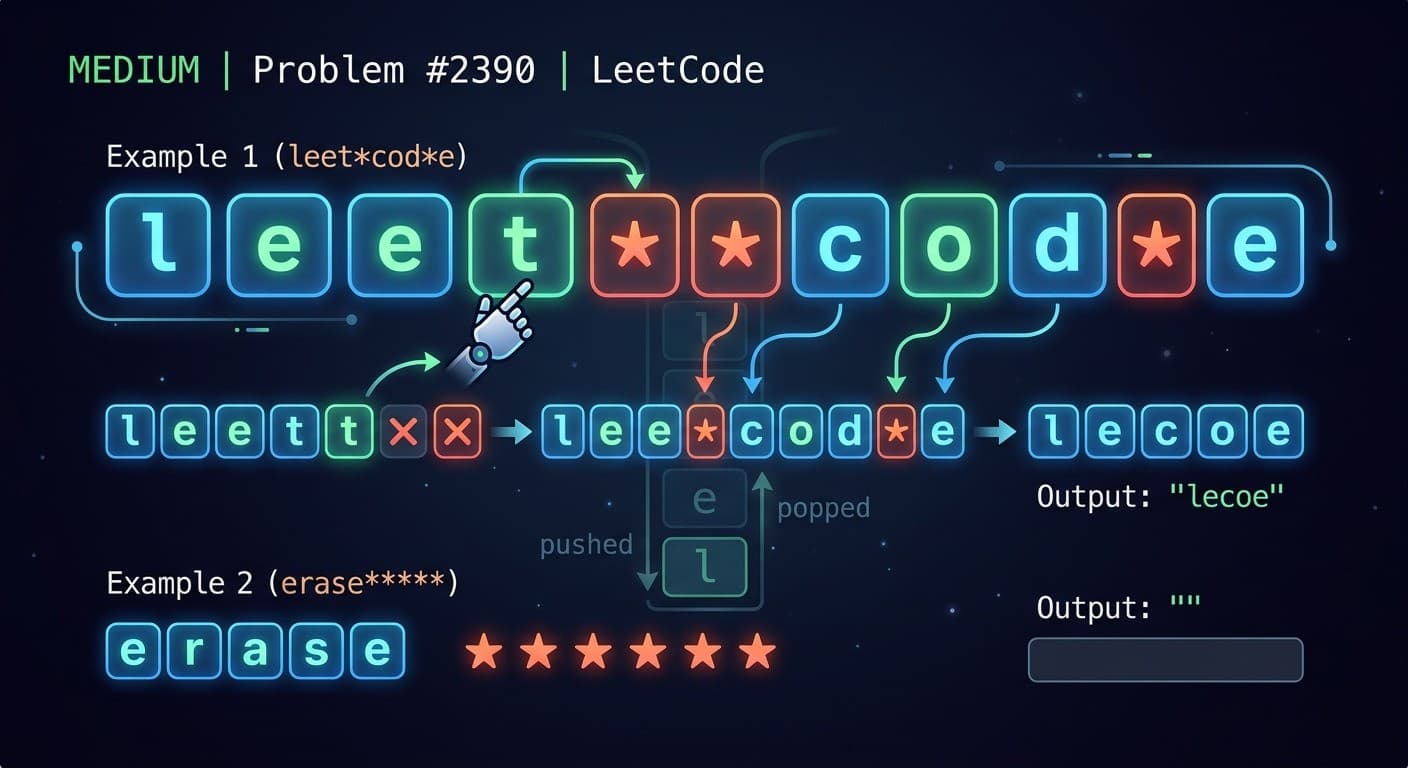
Introduction: What Is LeetCode 2390 Removing Stars From a String?If you are preparing for coding interviews at companies like Google, Amazon, or Microsoft, LeetCode 2390 Removing Stars From a String is a must-solve problem. It tests your understanding of the stack data structure and string manipulation — two of the most frequently tested topics in technical interviews.In this article, we will cover:What the problem is asking in plain English3 different Java approaches (Brute Force, Stack, StringBuilder)Step-by-step dry run with examplesTime and space complexity for each approachCommon mistakes to avoidFAQs that appear in Google's People Also AskLet's dive in!Problem Statement SummaryYou are given a string s containing lowercase letters and stars *. In one operation:Choose any * in the stringRemove the * itself AND the closest non-star character to its leftRepeat until all stars are removed and return the final string.Example:Input: s = "leet**cod*e"Output: "lecoe"Real Life Analogy — Think of It as a Backspace KeyImagine you are typing on a keyboard. Every * acts as your backspace key — it deletes itself and the character just before it.You type "leet" and press backspace twice:Backspace 1 → deletes t → "lee"Backspace 2 → deletes e → "le"That is exactly what this problem simulates! Once you see it this way, the solution becomes very obvious.Approach 1: Brute Force Simulation (Beginner Friendly)IdeaDirectly simulate the process the problem describes:Scan the string from left to rightFind the first *Remove it and the character just before itRepeat until no stars remainJava Codepublic String removeStars(String s) {StringBuilder sb = new StringBuilder(s);int i = 0;while (i < sb.length()) {if (sb.charAt(i) == '*') {sb.deleteCharAt(i); // remove the starif (i > 0) {sb.deleteCharAt(i - 1); // remove closest left characteri--;}} else {i++;}}return sb.toString();}Time and Space ComplexityComplexityValueReasonTimeO(n²)Each deletion shifts all remaining charactersSpaceO(n)StringBuilder storage⚠️ Important WarningThis problem has n up to 100,000. Brute force will get Time Limit Exceeded (TLE) on LeetCode. Use this only to understand the concept, never in production or interviews.Approach 2: Stack Based Solution (Interview Favorite)IdeaA stack is the perfect data structure here because:We always remove the most recently added letter when a * appearsThat is the definition of Last In First Out (LIFO) — exactly what a stack doesAlgorithm:Letter → push onto stack* → pop from stack (removes closest left character)At the end, build result from stack contentsJava Codepublic String removeStars(String s) {Stack<Character> st = new Stack<>();for (int i = 0; i < s.length(); i++) {char c = s.charAt(i);if (c == '*') {if (!st.empty()) {st.pop();}} else {st.push(c);}}StringBuilder sb = new StringBuilder();while (!st.empty()) {sb.append(st.pop());}return sb.reverse().toString();}Step-by-Step Dry Run — "leet**cod*e"StepCharacterActionStack State1lpush[l]2epush[l,e]3epush[l,e,e]4tpush[l,e,e,t]5*pop t[l,e,e]6*pop e[l,e]7cpush[l,e,c]8opush[l,e,c,o]9dpush[l,e,c,o,d]10*pop d[l,e,c,o]11epush[l,e,c,o,e]✅ Final Answer: "lecoe"Time and Space ComplexityComplexityValueReasonTimeO(n)Single pass through the stringSpaceO(n)Stack holds up to n charactersApproach 3: StringBuilder as Stack (Optimal Solution) ✅IdeaThis is the best and most optimized approach. A StringBuilder can act as a stack:append(c) → works like pushdeleteCharAt(sb.length() - 1) → works like popNo reverse needed at the end unlike the Stack approachJava Codepublic String removeStars(String s) {StringBuilder sb = new StringBuilder();for (int i = 0; i < s.length(); i++) {char c = s.charAt(i);if (c == '*') {if (sb.length() > 0) {sb.deleteCharAt(sb.length() - 1);}} else {sb.append(c);}}return sb.toString();}Step-by-Step Dry Run — "erase*****"StepCharacterActionStringBuilder1eappend"e"2rappend"er"3aappend"era"4sappend"eras"5eappend"erase"6*delete last"eras"7*delete last"era"8*delete last"er"9*delete last"e"10*delete last""✅ Final Answer: ""Why StringBuilder Beats Stack in JavaFactorStack<Character>StringBuilderMemoryBoxes char → Character objectWorks on primitives directlyReverse neededYesNoCode lengthMore verboseCleaner and shorterPerformanceSlightly slowerFasterTime and Space ComplexityComplexityValueReasonTimeO(n)One pass, each character processed onceSpaceO(n)StringBuilder storageAll Approaches Comparison TableApproachTimeSpacePasses LeetCode?Best ForBrute ForceO(n²)O(n)❌ TLEUnderstanding conceptStackO(n)O(n)✅ YesInterview explanationStringBuilderO(n)O(n)✅ YesBest solutionHow This Relates to LeetCode 3174 Clear DigitsIf you have already solved LeetCode 3174 Clear Digits, you will notice this problem is nearly identical:Feature3174 Clear Digits2390 Removing StarsTriggerDigit 0-9Star *RemovesClosest left non-digitClosest left non-starDifficultyEasyMediumBest approachStringBuilderStringBuilderThe exact same solution pattern works for both. This is why learning patterns matters more than memorizing individual solutions!Common Mistakes to Avoid1. Not checking sb.length() > 0 before deleting Even though the problem guarantees valid input, always add this guard. It shows clean, defensive coding in interviews.2. Forgetting to reverse when using Stack Stack gives you characters in reverse order. If you forget .reverse(), your answer will be backwards.3. Using Brute Force for large inputs With n up to 100,000, O(n²) will time out. Always use the O(n) approach.FAQs — People Also AskQ1. What data structure is best for LeetCode 2390? A Stack or StringBuilder used as a stack is the best data structure. Both give O(n) time complexity. StringBuilder is slightly more optimal in Java because it avoids object boxing overhead.Q2. Why does a star remove the closest left character? Because the problem defines it that way — think of * as a backspace key on a keyboard. It always deletes the character immediately before the cursor position.Q3. What is the time complexity of LeetCode 2390? The optimal solution runs in O(n) time and O(n) space, where n is the length of the input string.Q4. Is LeetCode 2390 asked in Google interviews? Yes, this type of stack simulation problem is commonly asked at Google, Amazon, Microsoft, and Meta interviews as it tests understanding of LIFO operations and string manipulation.Q5. What is the difference between LeetCode 2390 and LeetCode 844? Both use the same backspace simulation pattern. In 844 Backspace String Compare, # is the backspace character and you compare two strings. In 2390, * is the backspace and you return the final string.Similar LeetCode Problems to Practice NextProblemDifficultyPattern844. Backspace String CompareEasyStack simulation1047. Remove All Adjacent Duplicates In StringEasyStack simulation3174. Clear DigitsEasyStack simulation20. Valid ParenthesesEasyClassic stack735. Asteroid CollisionMediumStack simulationConclusionLeetCode 2390 Removing Stars From a String is a classic stack simulation problem that every developer preparing for coding interviews should master. The key insight is recognizing that * behaves exactly like a backspace key, which makes a stack or StringBuilder the perfect tool.Quick Recap:Brute force works conceptually but TLEs on large inputsStack solution is clean and great for explaining in interviewsStringBuilder solution is the most optimal in Java — no boxing, no reversal
StringStackMediumLeetCode
LeetCode 682 Baseball Game - Java Solution Explained

LeetCode 682 Baseball Game - Java Solution Explained

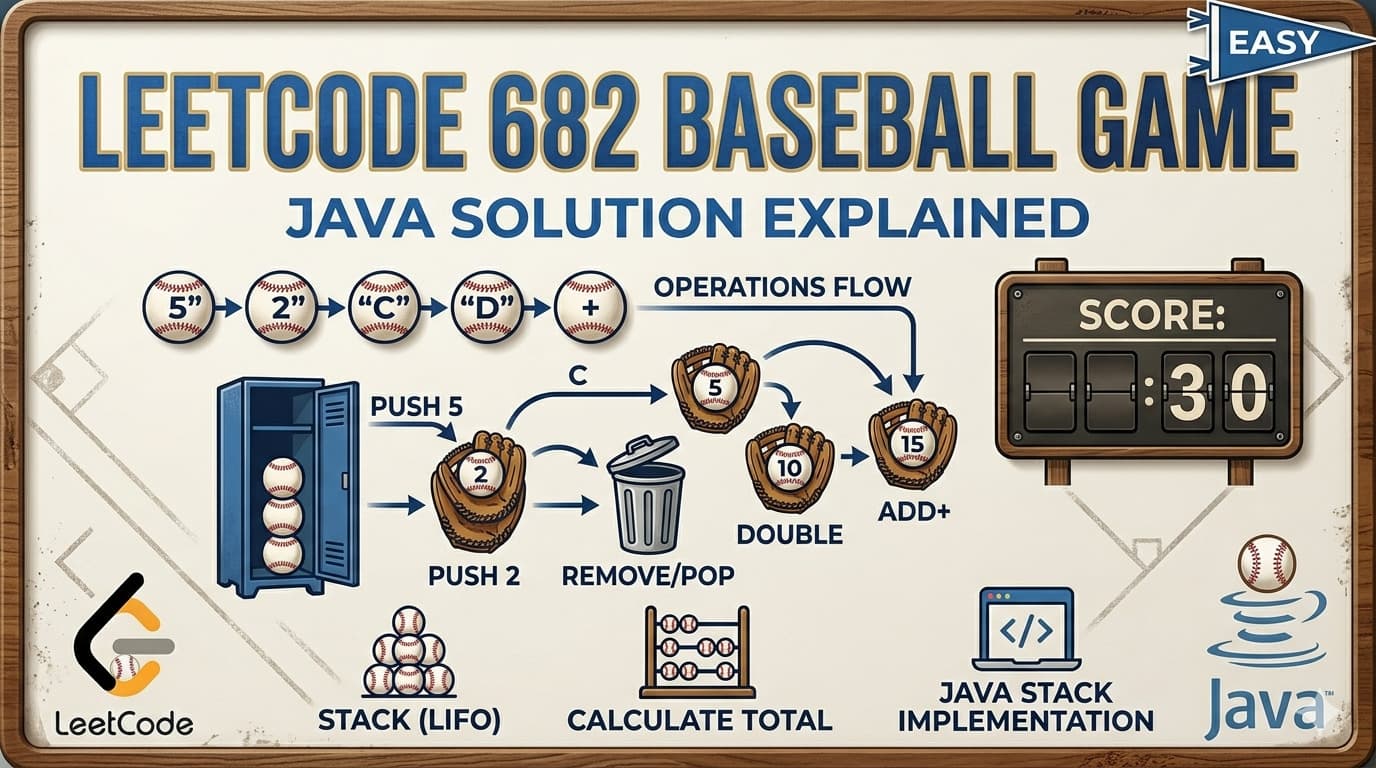
IntroductionLeetCode 682 Baseball Game is one of the cleanest and most beginner-friendly stack simulation problems on LeetCode. It does not require any fancy algorithm or deep insight — it purely tests whether you can carefully read the rules and simulate them faithfully using the right data structure.But do not let "Easy" fool you. This problem is a great place to practice thinking about which data structure fits best and why. We will solve it three different ways — Stack, ArrayList, and Deque — so you can see the tradeoffs and pick the one that makes most sense to you.You can find the problem here — LeetCode 682 Baseball Game.What Is the Problem Really Asking?You are keeping score for a baseball game with four special rules. You process a list of operations one by one and maintain a record of scores. At the end, return the total sum of all scores in the record.The four operations are:A number (like "5" or "-2") — just add that number as a new score to the record."C" — the last score was invalid, remove it from the record."D" — add a new score that is double the most recent score."+" — add a new score that is the sum of the two most recent scores.That is it. Four rules, simulate them in order, sum up what is left.Real Life Analogy — A Scoreboard With CorrectionsImagine a scoreboard operator at a sports event. They write scores on a whiteboard as the game progresses:A player scores 5 points → write 5Another player scores 2 → write 2Referee says last score was invalid → erase the last number (C)Special bonus rule kicks in → double the last valid score (D)Two scores combine → add the last two scores as one entry (+)At the end, add up everything on the whiteboard. The stack is your whiteboard — you write on top and erase from the top.Why Stack Is the Natural FitAll four operations only ever look at or modify the most recently added scores. C removes the last one. D doubles the last one. + uses the last two. This "most recent first" access pattern is the definition of LIFO — Last In First Out — which is exactly what a Stack provides.Any time a problem says "the previous score" or "the last two scores," your brain should immediately think Stack.Approach 1: Stack (Your Solution) ✅The IdeaUse a Stack of integers. For each operation:Number → parse and pushC → pop the topD → peek the top, push doubled value+ → pop top two, push both back, push their sumpublic int calPoints(String[] operations) { Stack<Integer> st = new Stack<>(); for (int i = 0; i < operations.length; i++) { String op = operations[i]; if (op.equals("C")) { st.pop(); // remove last score } else if (op.equals("D")) { st.push(st.peek() * 2); // double of last score } else if (op.equals("+")) { int prev1 = st.pop(); // most recent score int prev2 = st.pop(); // second most recent score int sum = prev1 + prev2; st.push(prev2); // put them back st.push(prev1); st.push(sum); // push the new score } else { st.push(Integer.parseInt(op)); // regular number } } // sum all remaining scores int total = 0; while (!st.empty()) { total += st.pop(); } return total;}One small improvement over your original solution — using op.equals("C") instead of op.charAt(0) == 'C'. This is cleaner and handles edge cases better since negative numbers like "-2" also start with - not a digit, so charAt(0) comparisons can get tricky. Using equals is always safer for string operations.Why the + Operation Needs Pop-Push-PopThe trickiest part is the + operation. You need the two most recent scores. Stack only lets you see the top. So you pop the first, then the second, compute the sum, then push both back before pushing the sum. This restores the record correctly — the previous two scores stay, and the new sum score is added on top.Detailed Dry Run — ops = ["5","2","C","D","+"]Let us trace every step carefully:"5" → number, parse and push Stack: [5]"2" → number, parse and push Stack: [5, 2]"C" → remove last score, pop Stack: [5]"D" → double last score, peek=5, push 10 Stack: [5, 10]"+" → sum of last two:pop prev1 = 10pop prev2 = 5sum = 15push prev2=5, push prev1=10, push sum=15 Stack: [5, 10, 15]Sum all: 5 + 10 + 15 = 30 ✅Detailed Dry Run — ops = ["5","-2","4","C","D","9","+","+"]"5" → push 5. Stack: [5]"-2" → push -2. Stack: [5, -2]"4" → push 4. Stack: [5, -2, 4]"C" → pop 4. Stack: [5, -2]"D" → peek=-2, push -4. Stack: [5, -2, -4]"9" → push 9. Stack: [5, -2, -4, 9]"+" → prev1=9, prev2=-4, sum=5. Push -4, 9, 5. Stack: [5, -2, -4, 9, 5]"+" → prev1=5, prev2=9, sum=14. Push 9, 5, 14. Stack: [5, -2, -4, 9, 5, 14]Sum: 5 + (-2) + (-4) + 9 + 5 + 14 = 27 ✅Approach 2: ArrayList (Most Readable)The IdeaArrayList gives you index-based access which makes the + operation much cleaner — no need to pop and push back. Just access the last two elements directly using size()-1 and size()-2.public int calPoints(String[] operations) { ArrayList<Integer> record = new ArrayList<>(); for (String op : operations) { int n = record.size(); if (op.equals("C")) { record.remove(n - 1); // remove last element } else if (op.equals("D")) { record.add(record.get(n - 1) * 2); // double last } else if (op.equals("+")) { // sum of last two — no need to remove and re-add! record.add(record.get(n - 1) + record.get(n - 2)); } else { record.add(Integer.parseInt(op)); } } int total = 0; for (int score : record) { total += score; } return total;}See how the + operation becomes a single line with ArrayList? record.get(n-1) + record.get(n-2) directly accesses the last two elements without any pop-push gymnastics.Dry Run — ops = ["5","2","C","D","+"]"5" → add 5. List: [5]"2" → add 2. List: [5, 2]"C" → remove last. List: [5]"D" → 5×2=10, add 10. List: [5, 10]"+" → get(0)+get(1) = 5+10=15, add 15. List: [5, 10, 15]Sum: 30 ✅Time Complexity: O(n) — single pass through operations Space Complexity: O(n) — ArrayList stores at most n scoresThe one tradeoff — remove(n-1) on an ArrayList is O(1) for the last element (no shifting needed). And get() is O(1). So this is fully O(n) overall and arguably the cleanest solution to read and understand.Approach 3: Deque (ArrayDeque — Fastest in Java)The IdeaArrayDeque is faster than Stack in Java because Stack is synchronized (thread-safe overhead) and ArrayDeque is not. For single-threaded LeetCode problems, ArrayDeque is always the better choice over Stack.public int calPoints(String[] operations) { Deque<Integer> deque = new ArrayDeque<>(); for (String op : operations) { if (op.equals("C")) { deque.pollLast(); // remove last } else if (op.equals("D")) { deque.offerLast(deque.peekLast() * 2); // double last } else if (op.equals("+")) { int prev1 = deque.pollLast(); int prev2 = deque.pollLast(); int sum = prev1 + prev2; deque.offerLast(prev2); // restore deque.offerLast(prev1); // restore deque.offerLast(sum); // new score } else { deque.offerLast(Integer.parseInt(op)); } } int total = 0; for (int score : deque) { total += score; } return total;}The logic is identical to the Stack approach. The only difference is the method names — offerLast instead of push, pollLast instead of pop, peekLast instead of peek.Time Complexity: O(n) Space Complexity: O(n)For iterating a Deque to sum, you can use a for-each loop directly — no need to pop everything out like with Stack.Approach ComparisonApproachTimeSpaceBest ForStackO(n)O(n)Classic interview answer, clear LIFO intentArrayListO(n)O(n)Cleanest code, easiest to readArrayDequeO(n)O(n)Best performance, preferred in productionAll three approaches have identical time and space complexity. The difference is purely in code style and readability. In an interview, any of these is perfectly acceptable. Mention that ArrayDeque is preferred over Stack in Java for performance if you want to impress.Why op.equals() Is Better Than op.charAt(0)Your original solution uses operations[i].charAt(0) == 'C' to check operations. This works but has a subtle risk — the + character check with charAt(0) is fine, but imagine if a future test had a number starting with C or D (it will not in this problem but defensive coding is a good habit). More importantly, "-2".charAt(0) is '-' which is fine, but using equals is semantically clearer — you are comparing the whole string, not just the first character. This shows cleaner coding habits in interviews.Edge Cases to KnowNegative numbers like "-2" Integer.parseInt("-2") handles negatives perfectly. The D operation on -2 gives -4. The + operation works correctly with negatives too. No special handling needed."C" after a "+" that added a score The problem guarantees C always has at least one score to remove. So after + adds a score, a C removes just that one new score — the previous two scores that + used remain intact. This is correct behavior and our solution handles it automatically.All scores removed If all operations are numbers followed by C operations removing every score, the stack ends up empty and the sum is 0. Our while loop handles this correctly — it simply never executes and returns 0.Only one operation A single number like ["5"] → push 5, sum is 5. Works fine.Common Mistakes to AvoidIn the + operation, forgetting to push both numbers back When you pop prev1 and prev2 to compute the sum, you must push them back onto the stack before pushing the sum. If you only push the sum without restoring prev1 and prev2, those scores disappear from the record permanently — which is wrong. The + operation only adds a new score, it does not remove the previous ones.Using charAt(0) comparison for detecting numbers Negative numbers start with -, not a digit. If you check charAt(0) >= '0' && charAt(0) <= '9' to detect numbers, you will miss negatives. The safest approach is to check for C, D, and + explicitly using equals, and fall through to the else for everything else (which covers both positive and negative numbers).Calling st.peek() or st.pop() without checking empty The problem guarantees valid operations — C always has something to remove, + always has two previous scores, D always has one. But in real code and defensive interview solutions, adding empty checks shows good habits even when the constraints guarantee safety.FAQs — People Also AskQ1. Why is Stack a good choice for LeetCode 682 Baseball Game? Because all four operations only access the most recently added scores — the last score for C and D, the last two for +. This "most recent first" access pattern is exactly what LIFO (Last In First Out) provides. Stack's push, pop, and peek all run in O(1) making it perfectly efficient.Q2. What is the time complexity of LeetCode 682? O(n) time where n is the number of operations. Each operation performs a constant number of stack operations (at most 3 pushes/pops for the + case). Space complexity is O(n) for storing scores.Q3. Why does the + operation need to pop and push back in the Stack approach? Stack only gives direct access to the top element. To get the second most recent score, you must pop the first one, peek/pop the second, then push the first one back. The ArrayList approach avoids this by using index-based access directly.Q4. What is the difference between Stack and ArrayDeque in Java for this problem? Both work correctly. ArrayDeque is faster because Stack is a legacy class that extends Vector and is synchronized (thread-safe), adding unnecessary overhead for single-threaded use. ArrayDeque has no synchronization overhead. For LeetCode and interviews, either is acceptable but ArrayDeque is technically better.Q5. Is LeetCode 682 asked in coding interviews? It appears occasionally as a warmup or screening problem. Its main value is testing whether you can carefully simulate rules without making logical errors — a skill that matters in systems programming, game development, and any domain with complex state management.Similar LeetCode Problems to Practice Next71. Simplify Path — Medium — stack simulation with path operations1047. Remove All Adjacent Duplicates In String — Easy — stack simulation735. Asteroid Collision — Medium — stack simulation with conditions150. Evaluate Reverse Polish Notation — Medium — stack with arithmetic operations, very similar pattern227. Basic Calculator II — Medium — stack with operator precedenceConclusionLeetCode 682 Baseball Game is a perfect problem to build confidence with stack simulation. The four operations are clearly defined, the rules are unambiguous, and the stack maps naturally to every operation. Once you understand why pop-push-back is needed for + in the stack approach and how ArrayList simplifies that with index access, you have genuinely understood the tradeoffs between these data structures.If you are newer to stacks, start with the ArrayList solution for clarity. Once that clicks, rewrite it with Stack to understand the LIFO mechanics. Then try ArrayDeque to understand why it is preferred in modern Java code.

LeetCodeJavaStackArrayListDequeEasy
LeetCode 1047: Remove All Adjacent Duplicates In String — Java Solution With All Approaches Explained

LeetCode 1047: Remove All Adjacent Duplicates In String — Java Solution With All Approaches Explained

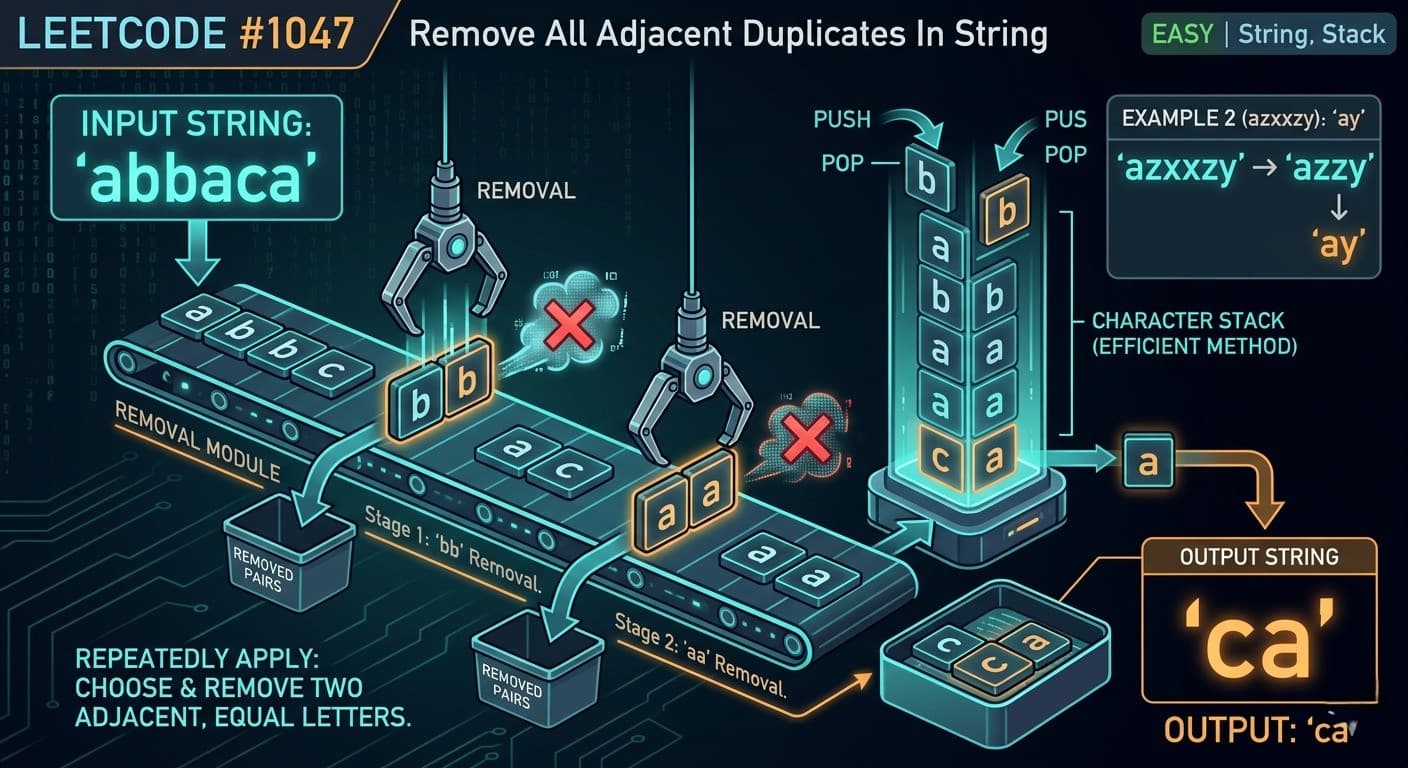
Introduction: What Is LeetCode 1047 Remove All Adjacent Duplicates In String?If you are grinding LeetCode for coding interviews at companies like Google, Amazon, or Microsoft, LeetCode 1047 Remove All Adjacent Duplicates In String is a problem you cannot skip. It is one of the most elegant examples of the stack simulation pattern and appears frequently as a warmup or follow-up question in technical rounds.In this article we will cover everything you need — plain English explanation, real life analogy, 3 Java approaches with dry runs, complexity analysis, common mistakes, FAQs, and similar problems to practice next.Here is the problem link-: Leetcode 1047 What Is the Problem Really Asking?You are given a string. Keep scanning it and whenever you find two same letters sitting next to each other, remove both of them. After removing, the letters around them might now become adjacent and form a new pair — so you keep doing this until no more adjacent duplicates exist.Example walkthrough for "abbaca":"abbaca" → bb are adjacent duplicates → remove → "aaca""aaca" → aa are adjacent duplicates → remove → "ca""ca" → no adjacent duplicates → done!✅ Output: "ca"Real Life Analogy — Think of Popping BubblesImagine a row of colored bubbles. Whenever two bubbles of the same color are next to each other, they pop and disappear. After they pop, the bubbles on either side might now touch each other — and if they are the same color, they pop too! You keep going until no two same-colored bubbles are touching.That chain reaction is exactly what this problem simulates. And the best tool to handle that chain reaction? A stack.Approach 1: Brute Force (Beginner Friendly)The IdeaScan the string repeatedly. Every time you find two adjacent equal characters, remove them. Keep doing this until a full pass finds nothing to remove.public String removeDuplicates(String s) { StringBuilder sb = new StringBuilder(s); boolean found = true; while (found) { found = false; for (int i = 0; i < sb.length() - 1; i++) { if (sb.charAt(i) == sb.charAt(i + 1)) { sb.deleteCharAt(i); sb.deleteCharAt(i); found = true; break; } } } return sb.toString();}This is easy to understand but very slow. For each pair found, you restart the entire scan. With n up to 100,000, this will get Time Limit Exceeded on LeetCode. Use it only to build intuition.Time Complexity: O(n²) — repeated passes over the string Space Complexity: O(n) — StringBuilder storageApproach 2: Stack Based Solution (Classic Interview Approach)The IdeaA stack is perfect here because of one key observation — when you remove a pair, the character that was before the pair is now adjacent to the character after the pair. That is a Last In First Out situation, which is exactly what a stack handles naturally.Algorithm:If the current character matches the top of the stack → pop (they cancel each other)Otherwise → push the current character onto the stackAt the end, the stack contains your final answerpublic String removeDuplicates(String s) { Stack<Character> st = new Stack<>(); StringBuilder sb = new StringBuilder(); for (int i = 0; i < s.length(); i++) { char c = s.charAt(i); if (!st.empty() && c == st.peek()) { st.pop(); // adjacent duplicate found, cancel both } else { st.push(c); } } while (!st.empty()) { sb.append(st.pop()); } return sb.reverse().toString();}Dry Run — "abbaca"We go character by character and check against the top of the stack:a → stack empty, push → stack: [a]b → top is a, not equal, push → stack: [a, b]b → top is b, equal! pop → stack: [a]a → top is a, equal! pop → stack: []c → stack empty, push → stack: [c]a → top is c, not equal, push → stack: [c, a]Stack remaining: [c, a] → reverse → ✅ "ca"Notice how after removing bb, the two as automatically become adjacent and get caught — the stack handles this chain reaction naturally without any extra logic!Time Complexity: O(n) — single pass through the string Space Complexity: O(n) — stack holds up to n charactersApproach 3: StringBuilder as Stack (Optimal Solution) ✅The IdeaThis is your own solution and the best one! Instead of using a separate Stack<Character>, we use StringBuilder itself as a stack:sb.append(c) acts as pushsb.deleteCharAt(sb.length() - 1) acts as popsb.charAt(sb.length() - 1) acts as peekNo extra data structure, no boxing of char into Character objects, and no reversal needed at the end. Clean, fast, and minimal.public String removeDuplicates(String s) { StringBuilder sb = new StringBuilder(); for (int i = 0; i < s.length(); i++) { char c = s.charAt(i); if (sb.length() != 0 && c == sb.charAt(sb.length() - 1)) { sb.deleteCharAt(sb.length() - 1); // adjacent duplicate, remove both } else { sb.append(c); } } return sb.toString();}Dry Run — "azxxzy"a → sb empty, append → "a"z → last char is a, not equal, append → "az"x → last char is z, not equal, append → "azx"x → last char is x, equal! delete → "az"z → last char is z, equal! delete → "a"y → last char is a, not equal, append → "ay"✅ Final Answer: "ay"Again, notice the chain reaction — after xx was removed, z and z became adjacent and got removed too. The StringBuilder handles this perfectly in a single pass!Time Complexity: O(n) — one pass, every character processed exactly once Space Complexity: O(n) — StringBuilder storageWhy StringBuilder Beats Stack in JavaWhen you use Stack<Character> in Java, every char primitive gets auto-boxed into a Character object. That means extra memory allocation for every single character. With StringBuilder, you work directly on the underlying char array — faster and leaner. Plus you skip the reversal step entirely.For an interview, the Stack approach is great for explaining your thought process clearly. But for the final submitted solution, StringBuilder is the way to go.Common Mistakes to AvoidNot checking sb.length() != 0 before peeking If the StringBuilder is empty and you call sb.charAt(sb.length() - 1), you will get a StringIndexOutOfBoundsException. Always guard this check — even if the problem guarantees valid input, it shows clean coding habits.Thinking you need multiple passes Many beginners think you need to scan the string multiple times because of chain reactions. The stack handles chain reactions automatically in a single pass. Trust the process!Forgetting to reverse when using Stack Since a stack gives you characters in reverse order when you pop them, you must call .reverse() at the end. With StringBuilder you do not need this.How This Fits Into the Stack Simulation PatternBy now you might be noticing a theme across multiple problems:LeetCode 3174 Clear Digits — digit acts as backspace, deletes closest left non-digit LeetCode 2390 Removing Stars — star acts as backspace, deletes closest left non-star LeetCode 1047 Remove Adjacent Duplicates — character cancels itself if it matches the top of stackAll three use the exact same StringBuilder-as-stack pattern. The only difference is the condition that triggers a deletion. This is why pattern recognition is the real skill — once you internalize this pattern, you can solve a whole family of problems in minutes.FAQs — People Also AskQ1. What is the best approach for LeetCode 1047 in Java? The StringBuilder approach is the best. It runs in O(n) time, uses O(n) space, requires no extra data structure, and avoids the reversal step needed with a Stack.Q2. Why does a stack work for removing adjacent duplicates? Because whenever you remove a pair, the characters around them become the new neighbors. A stack naturally keeps track of the most recently seen character, so it catches these chain reactions without any extra logic.Q3. What is the time complexity of LeetCode 1047? The optimal solution runs in O(n) time and O(n) space, where n is the length of the input string.Q4. Is LeetCode 1047 asked in coding interviews? Yes, it is commonly asked as a warmup problem or follow-up at companies like Google, Amazon, and Adobe. It tests your understanding of stack-based string manipulation.Q5. What is the difference between LeetCode 1047 and LeetCode 1209? LeetCode 1047 removes pairs of adjacent duplicates. LeetCode 1209 is the harder version — it removes groups of k adjacent duplicates, requiring you to store counts alongside characters in the stack.Similar LeetCode Problems to Practice Next2390. Removing Stars From a String — Medium — star as backspace3174. Clear Digits — Easy — digit as backspace844. Backspace String Compare — Easy — compare two strings after backspaces1209. Remove All Adjacent Duplicates in String II — Medium — harder version with k duplicates735. Asteroid Collision — Medium — stack simulation with collision logicConclusionLeetCode 1047 Remove All Adjacent Duplicates In String is a beautiful problem that teaches you one of the most powerful and reusable patterns in DSA — stack simulation. The moment you spot that a removal can cause a chain reaction of more removals, you know a stack is your best friend.The StringBuilder solution is clean, optimal, and interview-ready. Master it, understand why it works, and you will be able to tackle the entire family of stack simulation problems with confidence.Found this helpful? Share it with friends preparing for coding interviews

LeetCodeJavaStackStringEasy
LeetCode 2: Add Two Numbers – Step-by-Step Linked List Addition Explained Clearly

LeetCode 2: Add Two Numbers – Step-by-Step Linked List Addition Explained Clearly

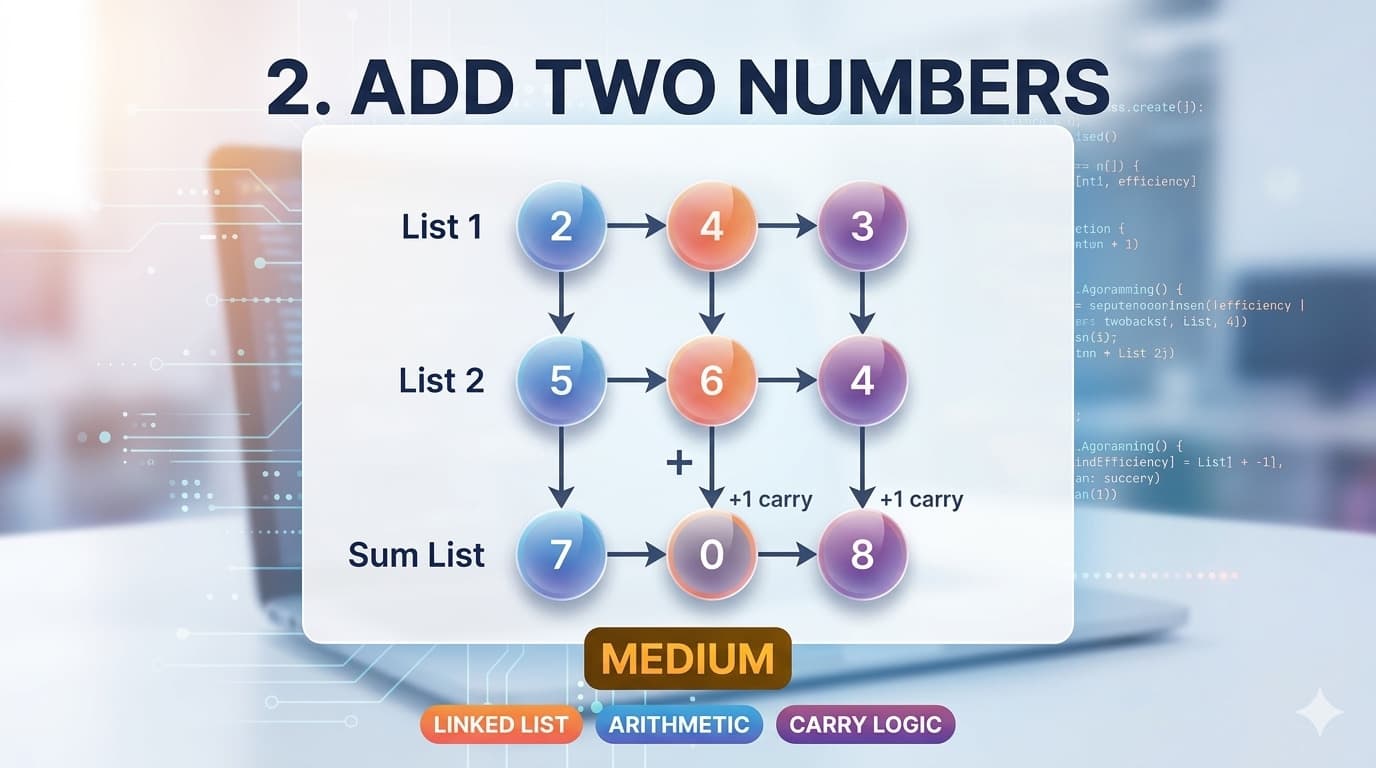
Try the ProblemYou can practice the problem here:https://leetcode.com/problems/add-two-numbers/Problem Description (In Simple Words)You are given two linked lists, where:Each node contains a single digit (0–9)The digits are stored in reverse order👉 That means:[2,4,3] represents 342[5,6,4] represents 465Your task is:👉 Add these two numbers👉 Return the result as a linked list (also in reverse order)Important Points to UnderstandEach node contains only one digitNumbers are stored in reverse orderYou must return the answer as a linked listYou must handle carry just like normal additionExample WalkthroughExample 1Input:l1 = [2,4,3]l2 = [5,6,4]Interpretation:342 + 465 = 807Output:[7,0,8]Example 2Input:l1 = [0]l2 = [0]Output:[0]Example 3Input:l1 = [9,9,9,9,9,9,9]l2 = [9,9,9,9]Output:[8,9,9,9,0,0,0,1]Constraints1 <= number of nodes <= 1000 <= Node.val <= 9No leading zeros except the number 0Understanding the Core IdeaThis problem is essentially:👉 Adding two numbers digit by digitBut instead of arrays or integers, the digits are stored in linked lists.How Addition Works (Real-Life Analogy)Let’s add:342 + 465We normally add from right to left:2 + 5 = 74 + 6 = 10 → write 0, carry 13 + 4 + 1 = 8Now notice something important:👉 Linked list is already in reverse order👉 So we can directly process from left to rightThinking About the SolutionBefore coding, let’s think of possible approaches:Possible Ways to SolveConvert linked lists into numbers → add → convert back (Not safe due to overflow)Store digits in arrays and simulate additionTraverse both lists and simulate addition directly (best approach)Optimal Approach: Simulate Addition (Digit by Digit)Key IdeaWe traverse both linked lists and:Add corresponding digitsMaintain a carryCreate a new node for each digit of resultStep-by-Step LogicStep 1: InitializeCreate a dummy node (to simplify result building)Create a pointer curr to build the result listInitialize carry = 0Step 2: Traverse Both ListsContinue while:l1 != null OR l2 != nullAt each step:Start with carry:sum = carryAdd value from l1 (if exists)Add value from l2 (if exists)Step 3: Create New NodeDigit to store:sum % 10New carry:sum / 10Step 4: Move ForwardMove l1 and l2 if they existMove curr forwardStep 5: Handle Remaining CarryIf carry is not zero after loop:👉 Add one more nodeStep 6: Return ResultReturn:dummy.nextCode Implementation (With Explanation)class Solution { public ListNode addTwoNumbers(ListNode l1, ListNode l2) { // Dummy node to simplify result construction ListNode dumm = new ListNode(-1); ListNode curr = dumm; int sum = 0; int carr = 0; // Traverse both lists while(l1 != null || l2 != null){ // Start with carry sum = carr; // Add l1 value if exists if(l1 != null){ sum += l1.val; l1 = l1.next; } // Add l2 value if exists if(l2 != null){ sum += l2.val; l2 = l2.next; } // Create new node with digit ListNode newNode = new ListNode(sum % 10); // Update carry carr = sum / 10; // Attach node curr.next = newNode; curr = curr.next; } // If carry remains if(carr != 0){ curr.next = new ListNode(carr); } return dumm.next; }}Dry Run (Important for Understanding)Input:l1 = [2,4,3]l2 = [5,6,4]Step-by-step:Step 1:2 + 5 = 7 → node(7), carry = 0Step 2:4 + 6 = 10 → node(0), carry = 1Step 3:3 + 4 + 1 = 8 → node(8), carry = 0Final:7 → 0 → 8Time ComplexityO(max(n, m))Where:n = length of l1m = length of l2Space ComplexityO(max(n, m))For storing the result linked list.Why Dummy Node is ImportantWithout dummy node:You need to handle first node separatelyWith dummy node:Code becomes clean and consistentNo special cases requiredCommon Mistakes to Avoid❌ Forgetting to handle carry❌ Not checking if l1 or l2 is null❌ Missing last carry node❌ Incorrect pointer movementKey TakeawaysThis is a simulation problemLinked list problems become easier with dummy nodesAlways think in terms of real-world analogy (addition)ConclusionThe Add Two Numbers problem is one of the most important linked list problems for interviews.It teaches:Pointer manipulationCarry handlingIterative traversalClean code using dummy nodesOnce you understand this pattern, many other linked list problems become much easier to solve.👉 Tip: Whenever you see problems involving numbers in linked lists, think of digit-by-digit simulation with carry.

Linked ListMathSimulationCarry HandlingDummy NodeLeetCode Medium
LeetCode 735: Asteroid Collision — Java Solution Explained

LeetCode 735: Asteroid Collision — Java Solution Explained

IntroductionIf you have been building your stack skills through problems like Valid Parentheses, Next Greater Element, and Backspace String Compare, then LeetCode 735 Asteroid Collision is the problem where everything comes together. It is one of the most satisfying Medium problems on LeetCode because it feels like a real simulation — you are literally modelling asteroids flying through space and crashing into each other.You can find the problem here — LeetCode 735 Asteroid Collision.This article breaks everything down in plain English so that anyone — beginner or experienced — can understand exactly what is happening and why the stack is the perfect tool for this problem.What Is the Problem Really Asking?You have a row of asteroids moving through space. Each asteroid has a size and a direction:Positive number → asteroid moving to the rightNegative number → asteroid moving to the leftAll asteroids move at the same speed. When a right-moving asteroid and a left-moving asteroid meet head-on, they collide:The smaller one explodesIf they are the same size, both explodeThe bigger one survives and keeps movingTwo asteroids moving in the same direction never meet, so they never collide.Return the final state of all surviving asteroids after every possible collision has happened.Real Life Analogy — Cars on a HighwayImagine a highway with cars driving in both directions. Cars going right are in one lane, cars going left are in another lane. Now imagine the lanes overlap at some point.A small car going right crashes into a big truck going left — the car gets destroyed, the truck keeps going. Two equally sized cars crash — both are destroyed. A massive truck going right demolishes everything coming from the left until it meets something bigger or nothing at all.That is exactly the asteroid problem. The stack helps us track which asteroids are still "alive" and moving right, waiting to potentially collide with the next left-moving asteroid that comes along.Why Stack Is the Perfect Data Structure HereThe key observation is this — only a right-moving asteroid followed by a left-moving asteroid can collide. A left-moving asteroid might destroy several right-moving ones in a chain before it either survives or gets destroyed itself.This chain reaction behavior — where the outcome of one collision immediately triggers the possibility of another — is exactly what a stack handles naturally. The stack holds right-moving asteroids that are still alive and waiting. When a left-moving asteroid arrives, it battles the top of the stack repeatedly until either it is destroyed or no more collisions are possible.All Possible Collision ScenariosBefore looking at code it is important to understand every case that can happen:Case 1 — Right-moving asteroid (ast[i] > 0) No collision possible immediately. Push it onto the stack and move on.Case 2 — Left-moving asteroid, stack is empty Nothing to collide with. Push it onto the stack.Case 3 — Left-moving asteroid, top of stack is also left-moving (negative) Two asteroids going the same direction never meet. Push it onto the stack.Case 4 — Left-moving asteroid meets right-moving asteroid (collision!) Three sub-cases:Stack top is bigger → left-moving asteroid explodes, stack top survivesStack top is smaller → stack top explodes, left-moving asteroid continues (loop again)Same size → both explodeThe Solution — Stack Simulationpublic int[] asteroidCollision(int[] ast) { Stack<Integer> st = new Stack<>(); for (int i = 0; i < ast.length; i++) { boolean survived = true; // assume current asteroid survives // collision only happens when stack top is positive // and current asteroid is negative while (!st.empty() && st.peek() > 0 && ast[i] < 0) { if (st.peek() > Math.abs(ast[i])) { // stack top is bigger — current asteroid explodes survived = false; break; } else if (st.peek() < Math.abs(ast[i])) { // current asteroid is bigger — stack top explodes // current asteroid keeps going, check next stack element st.pop(); } else { // equal size — both explode st.pop(); survived = false; break; } } if (survived) { st.push(ast[i]); } } // build result array from stack (stack gives reverse order) int[] ans = new int[st.size()]; for (int i = ans.length - 1; i >= 0; i--) { ans[i] = st.pop(); } return ans;}Step-by-Step Dry Run — asteroids = [10, 2, -5]Let us trace exactly what happens:Processing 10:Stack is empty, no collision possiblesurvived = true → push 10Stack: [10]Processing 2:Stack top is 10 (positive), current is 2 (positive) — same direction, no collisionsurvived = true → push 2Stack: [10, 2]Processing -5:Stack top is 2 (positive), current is -5 (negative) — collision!2 < 5 → stack top smaller, pop 2. survived stays trueStack: [10]Stack top is 10 (positive), current is -5 (negative) — collision again!10 > 5 → stack top bigger, current asteroid destroyed. survived = false, breakStack: [10]survived = false → do not push -5Final stack: [10] → output: [10] ✅Step-by-Step Dry Run — asteroids = [3, 5, -6, 2, -1, 4]Processing 3: stack empty → push. Stack: [3]Processing 5: both positive, same direction → push. Stack: [3, 5]Processing -6:Collision with 5: 5 < 6 → pop 5. Stack: [3]Collision with 3: 3 < 6 → pop 3. Stack: []Stack empty → survived = true → push -6Stack: [-6]Processing 2: stack top is -6 (negative), current is 2 (positive) — same direction check fails, no collision → push. Stack: [-6, 2]Processing -1:Collision with 2: 2 > 1 → stack top bigger, -1 explodes. survived = falseStack: [-6, 2]Processing 4: stack top is 2 (positive), current is 4 (positive) — same direction → push. Stack: [-6, 2, 4]Final stack: [-6, 2, 4] → output: [-6, 2, 4] ✅Understanding the survived FlagThe survived boolean flag is the most important design decision in this solution. It tracks whether the current asteroid makes it through all collisions.It starts as true — we assume the asteroid survives until proven otherwise. It only becomes false in two situations — when the stack top is bigger (current asteroid destroyed) or when both are equal size (mutual destruction). If survived is still true after the while loop, the asteroid either won all its battles or never had any — either way it gets pushed onto the stack.This flag eliminates the need for complicated nested conditions and makes the logic clean and readable.Building the Result ArrayOne important detail — when you pop everything from a stack to build an array, the order is reversed. The stack gives you elements from top to bottom (last to first). So we fill the result array from the end to the beginning using i = ans.length - 1 going down to 0. This preserves the original left-to-right order of surviving asteroids.Time and Space ComplexityTime Complexity: O(n) — each asteroid is pushed onto the stack at most once and popped at most once. Even though there is a while loop inside the for loop, each element participates in at most one push and one pop across the entire run. Total operations stay linear.Space Complexity: O(n) — in the worst case (all asteroids moving right, no collisions) all n asteroids sit on the stack simultaneously.Common Mistakes to AvoidForgetting that same-direction asteroids never collide The collision condition is specifically st.peek() > 0 && ast[i] < 0. Two positive asteroids, two negative asteroids, or a negative followed by a positive — none of these collide. Only right then left.Not using a loop for chain collisions A single left-moving asteroid can destroy multiple right-moving ones in sequence. If you only check the stack top once instead of looping, you will miss chain destructions like in the [3, 5, -6] example.Forgetting the survived flag and always pushing Without the flag, a destroyed asteroid still gets pushed onto the stack, giving wrong results.Wrong array reconstruction from stack Forgetting that stack order is reversed and filling the array from left to right gives a backwards answer. Always fill from the last index downward.How This Problem Differs From Previous Stack ProblemsEvery previous stack problem in this series had a simple push-or-pop decision per character. Asteroid Collision introduces something new — a while loop inside the for loop. This is because one incoming asteroid can trigger multiple consecutive pops (chain collisions). The stack is no longer just storing history — it is actively participating in a simulation where multiple stored elements can be affected by a single incoming element.This is the defining characteristic of harder stack problems and is exactly what appears in problems like Largest Rectangle in Histogram and Trapping Rain Water.FAQs — People Also AskQ1. Why is a Stack used to solve LeetCode 735 Asteroid Collision? Because right-moving asteroids wait on the stack until a left-moving asteroid arrives. The left-moving asteroid battles the top of the stack repeatedly — this LIFO chain reaction behavior is exactly what a stack handles naturally and efficiently.Q2. What is the time complexity of LeetCode 735? O(n) time because each asteroid is pushed and popped at most once regardless of how many chain collisions happen. Space complexity is O(n) for the stack in the worst case.Q3. When do two asteroids NOT collide in LeetCode 735? Two asteroids never collide when both move right (both positive), both move left (both negative), or when a left-moving asteroid comes before a right-moving one — they move away from each other in that case.Q4. Is LeetCode 735 asked in coding interviews? Yes, it is commonly asked at companies like Amazon, Google, and Microsoft as a Medium stack problem. It tests whether you can handle simulation problems with multiple conditional branches and chain reactions — skills that translate directly to real world system design thinking.Q5. What is the difference between LeetCode 735 and LeetCode 496 Next Greater Element? Both use a stack and involve comparing elements. In Next Greater Element, you search forward for something bigger. In Asteroid Collision, collisions happen between the current element and stack contents, and the current element might destroy multiple previous elements in a chain before settling. The collision logic in 735 is more complex.Similar LeetCode Problems to Practice Next496. Next Greater Element I — Easy — monotonic stack pattern739. Daily Temperatures — Medium — next greater with index distance1047. Remove All Adjacent Duplicates In String — Easy — chain removal with stack84. Largest Rectangle in Histogram — Hard — advanced stack simulation503. Next Greater Element II — Medium — circular array with monotonic stackConclusionLeetCode 735 Asteroid Collision is a wonderful problem that takes the stack simulation pattern to the next level. The key insight is recognizing that only right-then-left asteroid pairs can collide, that chain collisions require a while loop not just an if statement, and that the survived flag keeps the logic clean across all cases.Work through every dry run in this article carefully — especially the [3, 5, -6, 2, -1, 4] example — because seeing chain collisions play out step by step is what makes this pattern click permanently.Once this problem makes sense, you are genuinely ready for the harder stack problems that follow. Keep going!

LeetCodeJavaStackArrayMedium
LeetCode 122 — Best Time to Buy and Sell Stock II | Every Approach Explained

LeetCode 122 — Best Time to Buy and Sell Stock II | Every Approach Explained

🚀 Try This Problem First!Before reading the solution, attempt it yourself on LeetCode — you'll retain the concept far better.🔗 Problem Link: https://leetcode.com/problems/best-time-to-buy-and-sell-stock-ii/Understanding the ProblemYou are given an array prices where prices[i] is the stock price on day i. Unlike the classic version, here you can make as many transactions as you want — but you can only hold one share at a time. You may buy and sell on the same day.Goal: Return the maximum total profit achievable.Key Rules:You can buy and sell multiple times.You cannot hold more than one share at a time — you must sell before buying again.If no profit is possible, return 0.Constraints:1 ≤ prices.length ≤ 3 × 10⁴0 ≤ prices[i] ≤ 10⁴How This Differs From LeetCode 121 #In LeetCode 121, you were limited to exactly one buy-sell transaction. Here, the restriction is lifted — you can participate in as many transactions as you want. This fundamentally changes the strategy. Instead of hunting for the single best pair, you want to capture every profitable price movement in the array.The Core InsightLook at the price chart mentally. Every time the price goes up from one day to the next, that's money on the table. The question is — how do you collect all of it?The answer is surprisingly simple: add every single upward price difference to your profit. If prices go up three days in a row from 1 → 3 → 5 → 8, you collect (3-1) + (5-3) + (8-5) = 7, which is exactly the same as buying at 1 and selling at 8. You never miss a gain.This is the foundation of all approaches below.Approach 1 — Simple Greedy (Collect Every Upward Move)Intuition: Every time prices[i] > prices[i-1], add the difference to profit. You are essentially buying at every valley and selling at every peak, collecting each individual daily gain without explicitly tracking buy/sell days.Why it works: The total gain from buying at day 0 and selling at day N is mathematically equal to the sum of all positive daily differences in between. You never lose anything by collecting gains day by day.Example: prices = [1, 2, 3, 4, 5] Daily gains: (2-1) + (3-2) + (4-3) + (5-4) = 1+1+1+1 = 4 Same as buying at 1 and selling at 5 directly.class Solution {public int maxProfit(int[] prices) {int maxProfit = 0;for (int i = 1; i < prices.length; i++) {if (prices[i] > prices[i - 1]) {maxProfit += prices[i] - prices[i - 1];}}return maxProfit;}}Time Complexity: O(N) — single pass through the array. Space Complexity: O(1) — no extra space used.This is the cleanest and most recommended solution for this problem.Approach 2 — Peak Valley ApproachIntuition: Instead of collecting every daily gain, explicitly find every valley (local minimum) to buy at and every peak (local maximum) to sell at. You buy when price stops falling and sell when price stops rising.How it works: Scan through the array. When you find a valley (prices[i] ≤ prices[i+1]), that is your buy point. Then keep going until you find a peak (prices[i] ≥ prices[i+1]) — that is your sell point. Add the peak minus valley to profit. Repeat.Example: prices = [7, 1, 5, 3, 6, 4]Valley at index 1 (price = 1), Peak at index 2 (price = 5) → profit += 4 Valley at index 3 (price = 3), Peak at index 4 (price = 6) → profit += 3 Total = 7 ✅class Solution {public int maxProfit(int[] prices) {int i = 0;int maxProfit = 0;int valley, peak;while (i < prices.length - 1) {while (i < prices.length - 1 && prices[i] >= prices[i + 1]) {i++;}valley = prices[i];while (i < prices.length - 1 && prices[i] <= prices[i + 1]) {i++;}peak = prices[i];maxProfit += peak - valley;}return maxProfit;}}Time Complexity: O(N) — each element is visited at most twice. Space Complexity: O(1) — no extra space used.This approach is more explicit and easier to visualize on a graph, though the code is slightly more involved than Approach 1.Approach 3 — Two PointerIntuition: Use two pointers i (buy day) and j (sell day). Move j forward one step at a time. Whenever prices[j] > prices[i], you have a profitable window — add the profit and immediately move i to j (simulate selling and rebuying at the same price on the same day). Whenever prices[j] < prices[i], just move i to j since a cheaper buy day has been found.Why moving i to j after every profitable sale works: Selling at j and immediately rebuying at j costs nothing (profit of 0 for that rebuy). But it positions i at the latest price so you can catch the next upward movement. This correctly simulates collecting every upward segment.Example: prices = [7, 1, 5, 3, 6, 4]i=0, j=1 → 7 > 1, move i to 1. j=2. i=1, j=2 → 1 < 5, profit += 4, move i to 2. j=3. i=2, j=3 → 5 > 3, move i to 3. j=4. i=3, j=4 → 3 < 6, profit += 3, move i to 4. j=5. i=4, j=5 → 6 > 4, move i to 5. j=6. Loop ends. Total profit = 7 ✅class Solution {public int maxProfit(int[] prices) {int i = 0;int j = 1;int maxProfit = 0;while (i < j && j < prices.length) {if (prices[i] > prices[j]) {i = j;} else {maxProfit += prices[j] - prices[i];i = j;}j++;}return maxProfit;}}Time Complexity: O(N) — j traverses the array exactly once. Space Complexity: O(1) — only three integer variables.This approach is functionally identical to Approach 1 — both collect every upward daily movement. The two pointer framing makes the buy/sell simulation more explicit.Approach 4 — Dynamic ProgrammingIntuition: At any point in time, you are in one of two states — either you hold a stock or you do not hold a stock. Define two DP values updated each day:hold = maximum profit if you are currently holding a stock at the end of this day.cash = maximum profit if you are not holding any stock at the end of this day.Transitions:To hold on day i: either you already held yesterday, or you buy today. hold = max(hold, cash - prices[i])To have cash on day i: either you already had cash yesterday, or you sell today. cash = max(cash, hold + prices[i])Initialization:hold = -prices[0] (you bought on day 0)cash = 0 (you did nothing on day 0)class Solution {public int maxProfit(int[] prices) {int hold = -prices[0];int cash = 0;for (int i = 1; i < prices.length; i++) {hold = Math.max(hold, cash - prices[i]);cash = Math.max(cash, hold + prices[i]);}return cash;}}Time Complexity: O(N) — single pass. Space Complexity: O(1) — only two variables maintained at each step.This approach is the most powerful because it extends naturally to harder variants of this problem — like LeetCode 309 (with cooldown) and LeetCode 714 (with transaction fee) — where greedy no longer works and you need explicit state tracking.Dry Run — All Approaches on Example 1Input: prices = [7, 1, 5, 3, 6, 4], Expected Output: 7Approach 1 (Simple Greedy): Day 1→2: 1 - 7 = -6, skip. Day 2→3: 5 - 1 = 4, add. profit = 4. Day 3→4: 3 - 5 = -2, skip. Day 4→5: 6 - 3 = 3, add. profit = 7. Day 5→6: 4 - 6 = -2, skip. Result = 7 ✅Approach 4 (DP): Start: hold = -7, cash = 0. Day 1 (price=1): hold = max(-7, 0-1) = -1. cash = max(0, -1+1) = 0. Day 2 (price=5): hold = max(-1, 0-5) = -1. cash = max(0, -1+5) = 4. Day 3 (price=3): hold = max(-1, 4-3) = 1. cash = max(4, 1+3) = 4. Day 4 (price=6): hold = max(1, 4-6) = 1. cash = max(4, 1+6) = 7. Day 5 (price=4): hold = max(1, 7-4) = 3. cash = max(7, 3+4) = 7. Result = 7 ✅Comparison of All ApproachesApproach 1 — Simple Greedy Code simplicity: Simplest possible. Best for interviews — clean and readable. Does not extend to constrained variants.Approach 2 — Peak Valley Code simplicity: Moderate. Best for visual/conceptual understanding. Slightly verbose but maps directly to a chart.Approach 3 — Two Pointer Code simplicity: Simple. Explicit simulation of buy/sell actions. Functionally identical to Approach 1.Approach 4 — Dynamic Programming Code simplicity: Moderate. Most powerful — extends to cooldown, fee, and k-transaction variants. Worth mastering for the full stock problem series.Common Mistakes to AvoidThinking you need to find exact buy/sell days: The problem only asks for maximum profit — you do not need to output which days you traded. This frees you to use the simple greedy sum approach.Trying to find the global minimum and maximum: Unlike LeetCode 121, the single best buy-sell pair is not always optimal here. You need to capture multiple smaller movements, not one big one.Holding more than one share: You cannot buy twice in a row without selling in between. In Approach 3, moving i = j after every transaction ensures you always sell before the next buy.Not handling a flat or decreasing array: If prices never go up, all approaches correctly return 0 — the greedy sum adds nothing, peak-valley finds no valid pairs, and DP's cash stays at 0.Complexity SummaryAll four approaches run in O(N) time and O(1) space. The difference between them is conceptual clarity and extensibility, not raw performance.The Full Stock Problem Series on LeetCodeThis problem is part of a six-problem series. Understanding them in order builds intuition progressively:LeetCode 121 — One transaction only. Two pointer / min tracking greedy. [ Blog is also avaliable on this - Read Now]LeetCode 123 — At most 2 transactions. DP with explicit state for two transactions. [ Blog is also avaliable on this - Read Now]LeetCode 188 — At most k transactions. Generalized DP.LeetCode 309 — Unlimited transactions with cooldown after selling. DP with three states.LeetCode 714 — Unlimited transactions with a fee per transaction. DP with adjusted transitions.Each problem adds one constraint on top of the previous. If you understand the DP state machine from Approach 4 deeply, every problem in this series becomes a small modification of the same framework.Key Takeaways✅ When transactions are unlimited, collect every upward daily price movement — that is the global optimum.✅ The sum of all positive daily differences equals the sum of all peak-valley differences. Both are provably optimal.✅ The two pointer approach explicitly simulates buy and sell events — moving i = j after a sale means selling and immediately rebuying at the same price to stay positioned for the next gain.✅ The DP approach with hold and cash states is the most versatile — it is the foundation for every harder variant in the stock series.✅ Always initialize maxProfit = 0 so that the no-profit case (prices only falling) is handled correctly without extra conditions.Happy Coding! Once you have this problem locked down, the rest of the stock series will feel like natural extensions rather than new problems entirely. 🚀

LeetCodeGreedyTwo PointersDynamic ProgrammingMediumJavaArrays
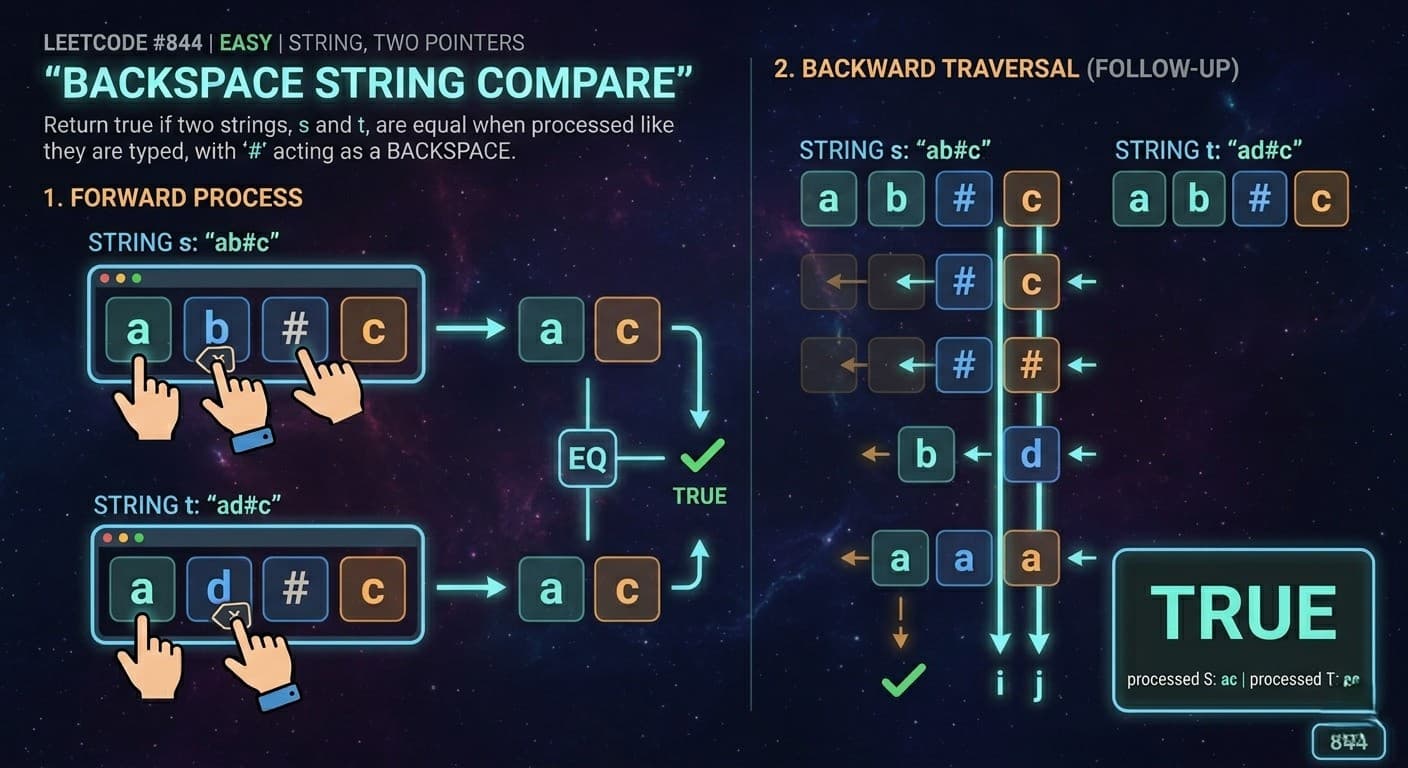
LeetCode 844: Backspace String Compare — Java Solution With All Approaches Explained

LeetCode 844: Backspace String Compare — Java Solution With All Approaches Explained

IntroductionLeetCode 844 Backspace String Compare is a fantastic problem that shows up frequently in coding interviews. It combines string manipulation, stack simulation, and even has a follow-up that challenges you to solve it in O(1) space — which is what separates a good candidate from a great one.Here is the Link of Question -: LeetCode 844In this article we cover a plain English explanation, real life analogy, 3 Java approaches including the O(1) space two pointer solution, dry runs, complexity analysis, common mistakes, and FAQs.What Is the Problem Really Asking?You are given two strings s and t. Both contain lowercase letters and # characters. Think of # as the backspace key on your keyboard — it deletes the character just before it. If there is nothing to delete, it does nothing.Process both strings through these backspace operations and check if the resulting strings are equal. Return true if equal, false otherwise.Quick Example:s = "ab#c" → # deletes b → becomes "ac"t = "ad#c" → # deletes d → becomes "ac"Both equal "ac" → return true ✅Real Life Analogy — The Keyboard TypoYou are typing a message. You type "ab", realize you made a typo, hit backspace, and type "c". Your friend types "ad", hits backspace, and types "c". Even though you both typed differently, the final message on screen is the same — "ac".That is exactly what this problem is about. Two people typing differently but ending up with the same result.Approach 1: StringBuilder as Stack (Optimal & Clean) ✅The IdeaThis is your own solution and the best O(n) approach. Process each string independently using a StringBuilder as a stack:Letter → append to StringBuilder (push)# → delete last character if StringBuilder is not empty (pop)Then simply compare the two resulting StringBuilders.public boolean backspaceCompare(String s, String t) { return process(s).equals(process(t));}private String process(String str) { StringBuilder sb = new StringBuilder(); for (int i = 0; i < str.length(); i++) { char c = str.charAt(i); if (c == '#') { if (sb.length() > 0) { sb.deleteCharAt(sb.length() - 1); } } else { sb.append(c); } } return sb.toString();}Notice how extracting a process() helper method makes the code cleaner and avoids repeating the same loop twice — a great habit to show in interviews!Dry Run — s = "ab##", t = "c#d#"Processing s = "ab##":a → append → "a"b → append → "ab"# → delete last → "a"# → delete last → ""Processing t = "c#d#":c → append → "c"# → delete last → ""d → append → "d"# → delete last → ""Both result in "" → return true ✅Time Complexity: O(n + m) — where n and m are lengths of s and t Space Complexity: O(n + m) — two StringBuilders storing processed stringsApproach 2: Stack Based Solution (Interview Classic)The IdeaSame logic as above but using explicit Stack<Character> objects. Great for explaining your thought process clearly in an interview even though StringBuilder is cleaner.public boolean backspaceCompare(String s, String t) { return processStack(s).equals(processStack(t));}private String processStack(String str) { Stack<Character> st = new Stack<>(); for (int i = 0; i < str.length(); i++) { char c = str.charAt(i); if (c == '#') { if (!st.empty()) { st.pop(); } } else { st.push(c); } } StringBuilder sb = new StringBuilder(); while (!st.empty()) { sb.append(st.pop()); } return sb.reverse().toString();}Dry Run — s = "a#c", t = "b"Processing s = "a#c":a → push → stack: [a]# → pop → stack: []c → push → stack: [c]Result: "c"Processing t = "b":b → push → stack: [b]Result: "b""c" does not equal "b" → return false ✅Time Complexity: O(n + m) Space Complexity: O(n + m)Approach 3: Two Pointer — O(1) Space (Follow-Up Solution) 🔥This is the follow-up the problem asks about — can you solve it in O(n) time and O(1) space? This means no extra StringBuilder or Stack allowed.The IdeaInstead of building processed strings, traverse both strings from right to left simultaneously. Keep a count of pending backspaces. Skip characters that would be deleted and compare characters that survive.Why right to left? Because # affects characters to its left, so processing from the end lets us know upfront how many characters to skip.public boolean backspaceCompare(String s, String t) { int i = s.length() - 1; int j = t.length() - 1; int skipS = 0, skipT = 0; while (i >= 0 || j >= 0) { // Find next valid character in s while (i >= 0) { if (s.charAt(i) == '#') { skipS++; i--; } else if (skipS > 0) { skipS--; i--; } else { break; } } // Find next valid character in t while (j >= 0) { if (t.charAt(j) == '#') { skipT++; j--; } else if (skipT > 0) { skipT--; j--; } else { break; } } // Compare the valid characters if (i >= 0 && j >= 0) { if (s.charAt(i) != t.charAt(j)) { return false; } } else if (i >= 0 || j >= 0) { return false; // one string still has chars, other doesn't } i--; j--; } return true;}Dry Run — s = "ab#c", t = "ad#c"Starting from the right end of both strings:Round 1:s[3] = 'c' → valid, no skips → stopt[3] = 'c' → valid, no skips → stopCompare 'c' == 'c' ✅ → move both pointers leftRound 2:s[2] = '#' → skipS = 1, move lefts[1] = 'b' → skipS > 0, skipS = 0, move lefts[0] = 'a' → valid, stopt[2] = '#' → skipT = 1, move leftt[1] = 'd' → skipT > 0, skipT = 0, move leftt[0] = 'a' → valid, stopCompare 'a' == 'a' ✅ → move both pointers leftBoth pointers exhausted → return true ✅Time Complexity: O(n + m) — each character visited at most once Space Complexity: O(1) — only pointer and counter variables, no extra storage!Approach ComparisonThe StringBuilder approach is the easiest to write and explain. The Stack approach is slightly more verbose but shows clear intent. The Two Pointer approach is the hardest to code but the most impressive — it solves the follow-up and uses zero extra space.In an interview, start with the StringBuilder solution, explain it clearly, then mention the Two Pointer approach as the O(1) space optimization if asked.How This Fits the Stack Simulation PatternYou have now seen this same pattern across four problems:3174 Clear Digits — digit deletes closest left non-digit 2390 Removing Stars — star deletes closest left non-star 1047 Remove Adjacent Duplicates — character cancels matching top of stack 844 Backspace String Compare — # deletes closest left character, then compare two stringsAll four use the same StringBuilder-as-stack core. The only differences are the trigger character and what you do with the result. This is the power of pattern recognition in DSA.Common Mistakes to AvoidNot handling backspace on empty string When # appears but the StringBuilder is already empty, do nothing. Always guard with sb.length() > 0 before calling deleteCharAt. The problem explicitly states backspace on empty text keeps it empty.Using Stack and forgetting to handle # when stack is empty In the Stack approach, only pop if the stack is not empty. Pushing # onto the stack when it is empty is a common bug that gives wrong answers.In Two Pointer, comparing before both pointers find valid characters Make sure both inner while loops fully complete before comparing. Comparing too early is the most common mistake in the O(1) space solution.FAQs — People Also AskQ1. What is the best approach for LeetCode 844 in Java? For most interviews, the StringBuilder approach is the best — clean, readable, and O(n) time. If the interviewer asks for O(1) space, switch to the Two Pointer approach traversing from right to left.Q2. How does the O(1) space solution work for LeetCode 844? It uses two pointers starting from the end of both strings, keeping a skip counter to track pending backspaces. Characters that would be deleted are skipped, and only surviving characters are compared.Q3. What is the time complexity of LeetCode 844? All three approaches run in O(n + m) time where n and m are the lengths of the two strings. The Two Pointer approach achieves this with O(1) space instead of O(n + m).Q4. Why traverse from right to left in the Two Pointer approach? Because # affects characters to its left. Scanning from the right lets you know upfront how many characters to skip before you reach them, avoiding the need to store anything.Q5. Is LeetCode 844 asked in Google interviews? Yes, it is commonly used as a warmup or screening problem. The follow-up O(1) space solution is what makes it interesting for senior-level interviews.Similar LeetCode Problems to Practice Next1047. Remove All Adjacent Duplicates In String — Easy — same stack pattern2390. Removing Stars From a String — Medium — star as backspace3174. Clear Digits — Easy — digit as backspace1209. Remove All Adjacent Duplicates in String II — Medium — k adjacent duplicates678. Valid Parenthesis String — Medium — stack with wildcardsConclusionLeetCode 844 Backspace String Compare is a well-rounded problem that tests string manipulation, stack simulation, and space optimization all in one. The StringBuilder solution is your go-to for interviews. But always be ready to explain the Two Pointer O(1) space follow-up — that is what shows real depth of understanding.Check out these problems alongside 1047, 2390, and 3174 and you will have the entire stack simulation pattern locked down for any coding interview.

StringStackTwo PointerString Builder
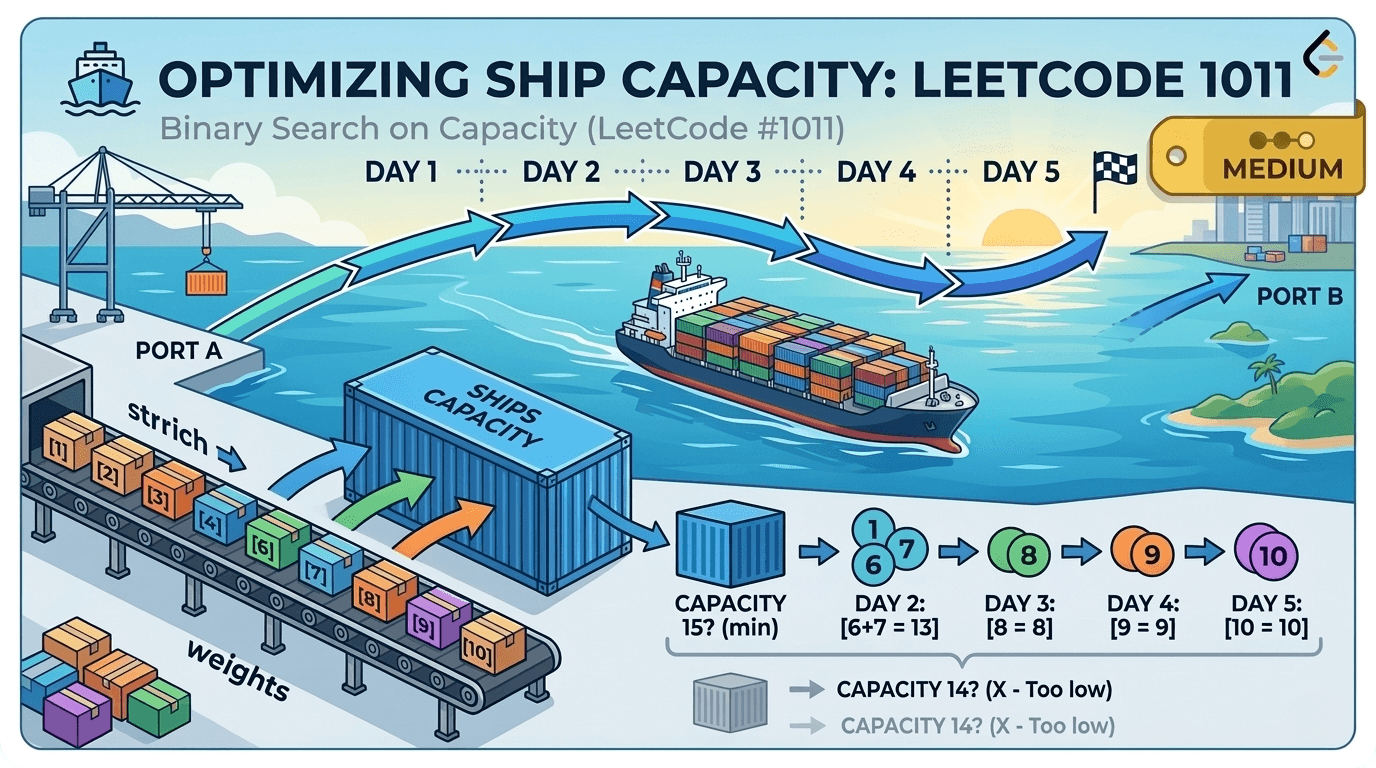
LeetCode 1011 — Capacity To Ship Packages Within D Days | Binary Search on Answer Explained

LeetCode 1011 — Capacity To Ship Packages Within D Days | Binary Search on Answer Explained

🚀 Try This Problem First!Before reading the solution, attempt it yourself on LeetCode — you'll retain the concept far better.🔗 Problem Link: https://leetcode.com/problems/capacity-to-ship-packages-within-d-days/1. Understanding the ProblemYou have a conveyor belt carrying N packages, each with a given weight. A ship must transport all of them within at most D days. Every day, you load packages in order (no rearranging allowed), and you cannot exceed the ship's weight capacity in a single day.Goal: Find the minimum weight capacity of the ship such that all packages are delivered within D days.Constraints:1 ≤ days ≤ weights.length ≤ 5 × 10⁴1 ≤ weights[i] ≤ 5002. Two Key Observations (Before Writing a Single Line of Code)Before jumping to code, anchor yourself with these two facts:Minimum possible capacity: The ship must at least be able to carry the single heaviest package. If it can't, that package can never be shipped. So:low = max(weights)Maximum possible capacity: If the ship can carry everything at once, it finishes in 1 day — always valid. So:high = sum(weights)Our answer lies somewhere in the range [max(weights), sum(weights)]. This is the classic setup for Binary Search on the Answer.3. Intuition — Why Binary Search?Ask yourself: what happens as ship capacity increases?The number of days needed decreases or stays the same. This is a monotonic relationship — and monotonicity is the green flag for Binary Search.Instead of checking every capacity from 1 to sum(weights) (which is huge), we binary search over the capacity space and for each candidate capacity mid, we ask:"Can all packages be shipped in ≤ D days with this capacity?"This feasibility check runs in O(N) using a greedy simulation, making the whole approach O(N log(sum(weights))).4. The Feasibility Check — Greedy LoadingGiven a capacity mid, simulate loading the ship greedily:Keep adding packages to today's load.The moment adding the next package would exceed mid, start a new day and reset the current load to that package.Count total days used.If days used ≤ D, capacity mid is feasible.5. Binary Search StrategyIf canShip(mid) is true → mid might be the answer, but try smaller. Set ans = mid, high = mid - 1.If canShip(mid) is false → capacity is too small, increase it. Set low = mid + 1.6. Dry Run — Example 1Input: weights = [1, 2, 3, 4, 5, 6, 7, 8, 9, 10], days = 5low = 10 (max weight), high = 55 (sum of weights)IterationlowhighmidDays NeededFeasible?ans11055322✅ Yes3221031203✅ Yes2031019146❌ No2041519175✅ Yes1751516155✅ Yes1561514—loop ends—15Output: 15 ✅7. The Code Implementationclass Solution { /** * Feasibility Check (Helper Function) * * Given a ship capacity 'mid', this function simulates loading packages * greedily and returns true if all packages can be shipped within 'days' days. * * @param mid - candidate ship capacity to test * @param arr - weights array * @param days - allowed number of days * @return true if shipping is possible within 'days' days, false otherwise */ public boolean canShip(int mid, int[] arr, int days) { int daysNeeded = 1; // We always need at least 1 day int currentLoad = 0; // Weight loaded on the ship today for (int i = 0; i < arr.length; i++) { // If adding this package exceeds today's capacity, // start a new day and carry this package on the new day if (currentLoad + arr[i] > mid) { currentLoad = arr[i]; // This package starts the new day's load daysNeeded++; // Increment day count } else { // Package fits — add it to today's load currentLoad += arr[i]; } } // If days needed is within the allowed limit, this capacity is feasible return daysNeeded <= days; } /** * Main Function — Binary Search on the Answer * * Search range: [max(weights), sum(weights)] * - low = max(weights) → ship must carry the heaviest package at minimum * - high = sum(weights) → ship carries everything in one day (upper bound) * * @param weights - array of package weights * @param days - maximum allowed days * @return minimum ship capacity to deliver all packages within 'days' days */ public int shipWithinDays(int[] weights, int days) { int high = 0; // Will become sum(weights) int low = Integer.MIN_VALUE; // Will become max(weights) int ans = 0; // Calculate the binary search bounds for (int a : weights) { high += a; // sum of all weights → upper bound low = Math.max(low, a); // max single weight → lower bound } // Binary Search over the capacity space while (low <= high) { int mid = low + (high - low) / 2; // Avoids integer overflow if (canShip(mid, weights, days)) { // mid works — record it as a potential answer // and try to find a smaller valid capacity ans = mid; high = mid - 1; } else { // mid is too small — increase the capacity low = mid + 1; } } return ans; // Minimum feasible capacity }}8. Code Walkthrough — Step by StepStep 1 — Setting bounds: We iterate through the weights array once to compute low = max(weights) and high = sum(weights). These are our binary search boundaries.Step 2 — Binary Search loop: We pick mid = low + (high - low) / 2 (safe overflow-free midpoint). We check if capacity mid can ship all packages in ≤ D days.Step 3 — Feasibility helper (canShip): We simulate a greedy day-by-day loading. We start with daysNeeded = 1 and currentLoad = 0. For each package, if it fits in today's load, we add it. If not, we start a new day. The key line is:if (currentLoad + arr[i] > mid) { currentLoad = arr[i]; // new day starts with this package daysNeeded++;}Step 4 — Narrowing the search: If feasible → ans = mid, high = mid - 1 (try smaller). If not feasible → low = mid + 1 (try larger).9. Common Mistakes to AvoidMistake 1 — Wrong lower bound: Using low = 1 instead of low = max(weights) works but is far slower since you binary search over a much larger range unnecessarily.Mistake 2 — Wrong condition in canShip: The return should be daysNeeded <= days (not < days). If days needed equals D, it's still valid.Mistake 3 — Off-by-one in greedy loading: When a package doesn't fit, you start a new day with that package as the first item: currentLoad = arr[i]. Do NOT set currentLoad = 0 — that package must still be accounted for.Mistake 4 — Integer overflow in midpoint: Always use mid = low + (high - low) / 2 instead of (low + high) / 2 to avoid overflow when low and high are large.10. Complexity AnalysisTime Complexity: O(N × log(sum(weights)))Binary search runs over the range [max(weights), sum(weights)], which has at most sum(weights) ≈ 500 × 50000 = 25,000,000 values → about log₂(25,000,000) ≈ 25 iterations.Each iteration calls canShip which is O(N).Total: O(N log S) where S = sum(weights).Space Complexity: O(1)No extra data structures. Only a handful of integer variables are used.11. Similar Problems (Same Pattern — Binary Search on Answer)Once you understand this pattern, the following problems become very similar:LeetCode 410 — Split Array Largest SumLeetCode 875 — Koko Eating Bananas [ Blog is also avaliable on this - Read Now ]LeetCode 1283 — Find the Smallest Divisor Given a ThresholdLeetCode 2064 — Minimized Maximum of Products Distributed to Any StoreAll of these follow the same template: define a feasibility check, identify a monotonic answer space, and binary search over it.12. Key Takeaways✅ When you see "find the minimum/maximum value such that a condition holds" — think Binary Search on the Answer.✅ The lower bound of the search space is the most constrained valid value (max weight here).✅ The upper bound is the least constrained valid value (total weight here).✅ The feasibility check must be O(N) or better to keep the overall complexity efficient.✅ Greedy loading (pack as much as possible each day) is optimal here since packages must go in order.Happy Coding! If this helped you, share it with a friend who's grinding LeetCode. 🚀

LeetCodeBinary SearchMediumJavaBinary Search on AnswerArrays
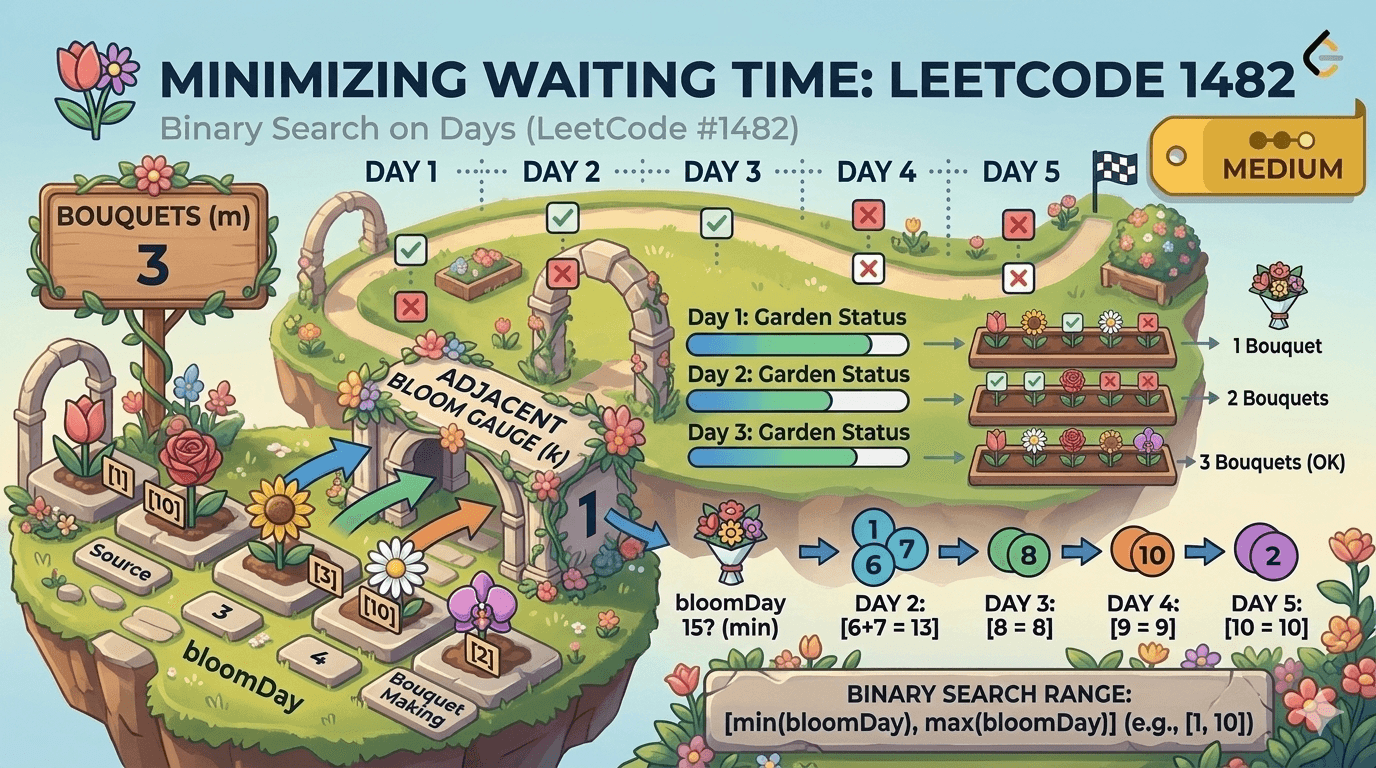
LeetCode 1482: Minimum Number of Days to Make m Bouquets – Binary Search on the Earliest Day

LeetCode 1482: Minimum Number of Days to Make m Bouquets – Binary Search on the Earliest Day

Try the ProblemYou can practice the problem here:https://leetcode.com/problems/minimum-number-of-days-to-make-m-bouquets/Problem DescriptionYou are given an integer array bloomDay, where:bloomDay[i]represents the day on which the i-th flower blooms.You are also given two integers:m → number of bouquets requiredk → number of adjacent flowers needed for one bouquetRulesTo create one bouquet, you must use:k adjacent flowersImportant constraints:A flower can only be used once.Only flowers that have already bloomed can be used.Flowers must be adjacent in the array.Your goal is to determine the minimum number of days required so that it becomes possible to create m bouquets.If it is impossible, return:-1Example WalkthroughExample 1InputbloomDay = [1,10,3,10,2]m = 3k = 1Output3ExplanationWe need:3 bouquets1 flower eachGarden progress:Day 1[x, _, _, _, _]Bouquets possible = 1Day 2[x, _, _, _, x]Bouquets possible = 2Day 3[x, _, x, _, x]Bouquets possible = 3 ✅Minimum day = 3Example 2InputbloomDay = [1,10,3,10,2]m = 3k = 2Output-1Explanation:We need:3 bouquets × 2 flowers = 6 flowersBut we only have:5 flowersSo it is impossible.Example 3InputbloomDay = [7,7,7,7,12,7,7]m = 2k = 3Output12Explanation:Day 7[x,x,x,x,_,x,x]Only 1 bouquet can be made.Day 12[x,x,x,x,x,x,x]Now 2 bouquets can be formed.Minimum day = 12Constraints1 <= n <= 10^51 <= bloomDay[i] <= 10^91 <= m <= 10^61 <= k <= nImportant observations:bloomDay[i] can be very largeThe array size can be 100,000A brute force simulation for every day would be too slowThinking About the ProblemAt first glance, the problem may look like a simulation problem, where we check the garden day by day.However, this approach quickly becomes inefficient because the maximum bloom day can be as large as:10^9So instead of checking every day sequentially, we need to search intelligently for the minimum valid day.Key ObservationIf we wait for more days, more flowers will bloom.Which means:Days ↑ → Flowers available ↑ → Bouquets possible ↑This means the function is monotonic.If it is possible to make m bouquets on day X, then it will also be possible on any day after X.This type of pattern strongly suggests using:Binary Search on AnswerApproach: Binary Search on Minimum DayInstead of checking every day, we search between:minimum bloom day → maximum bloom dayFor each candidate day mid:Assume we wait until day mid.Count how many bouquets we can make.If we can make at least m bouquets, try smaller days.Otherwise, increase the day.How We Count BouquetsWhile scanning the garden:If the flower has bloomed (bloomDay[i] <= mid)→ increase adjacent flower countIf a flower has not bloomed yet→ reset the adjacent counterWhenever we have:k adjacent flowerswe form one bouquet.Your Java Implementation (Binary Search + Greedy Counting)class Solution {// Function to check if we can make m bouquets// if we wait until 'mid' dayspublic boolean binaryS(int mid, int[] arr, int m, int k){int flower = 0;int bouq = 0;for(int i = 0; i < arr.length; i++){// Flower has bloomedif(arr[i] <= mid){flower++;}else{// Calculate bouquets from collected flowersbouq += flower / k;// Reset adjacent counterflower = 0;}}// Handle remaining flowers after loopbouq += flower / k;return bouq >= m;}public int minDays(int[] bloomDay, int m, int k) {// If required flowers exceed total flowersif((long)m * k > bloomDay.length)return -1;int min = Integer.MAX_VALUE;int max = Integer.MIN_VALUE;// Find search rangefor(int a : bloomDay){min = Math.min(min, a);max = Math.max(max, a);}int ans = -1;// Binary Searchwhile(min <= max){int mid = min + (max - min) / 2;if(binaryS(mid, bloomDay, m, k)){ans = mid;// Try smaller daymax = mid - 1;}else{// Need more daysmin = mid + 1;}}return ans;}}Dry Run ExamplebloomDay = [1,10,3,10,2]m = 3k = 1Search range:1 → 10Binary search steps:mid = 5Possible bouquets = 3 → validTry smaller:mid = 2Bouquets = 2 → not enoughIncrease day:mid = 3Bouquets = 3 → validMinimum day:3Time ComplexityBinary search runs:O(log(maxDay - minDay))For each check we scan the array:O(n)Total complexity:O(n log(10^9))Which is efficient for n = 10^5.Space ComplexityO(1)No extra space is required.Key TakeawayThis problem is a classic example of:Binary Search on AnswerWhenever a problem asks:Find the minimum value such that a condition becomes trueBinary search is often the best solution.ConclusionThe Minimum Number of Days to Make m Bouquets problem teaches an important interview technique: transforming a simulation problem into a search problem.By recognizing the monotonic nature of the problem, we can apply binary search on the answer space and efficiently determine the minimum day required to create the desired number of bouquets.Mastering problems like this will significantly improve your understanding of binary search patterns, which are extremely common in coding interviews.

Binary SearchArraysBinary Search on AnswerLeetCodeMedium
LeetCode 3174: Clear Digits — Multiple Approaches Explained

LeetCode 3174: Clear Digits — Multiple Approaches Explained

What's the Problem Really Asking?Imagine you're editing a text document and every time you type a number, it acts like a backspace key — it deletes itself AND the character just before it. That's exactly what this problem is!Given a string like "cb34":3 deletes b → "c4"4 deletes c → ""Simple idea, right? Let's look at all the ways to solve it.Here is the problem link-: Leetcode 3174Approach 1: Using a Stack (Classic & Intuitive)The IdeaA stack is the most natural fit here. Think of it like a stack of plates:If the character is a letter → push it onto the stack (add a plate)If the character is a digit → pop from the stack (remove the top plate, the digit deletes itself too)At the end, whatever's left on the stack is your answer.Codepublic String clearDigits(String s) { Stack<Character> st = new Stack<>(); for (int i = 0; i < s.length(); i++) { char c = s.charAt(i); if (c >= '0' && c <= '9') { if (!st.empty()) { st.pop(); // digit eats the closest left non-digit } } else { st.push(c); // letter goes in } } StringBuilder sb = new StringBuilder(); while (!st.empty()) { sb.append(st.pop()); } return sb.reverse().toString(); // stack gives reverse order}Real Life AnalogyThink of a Jenga tower. Every time a digit appears, it pulls out the topmost block (the closest left letter). At the end, whatever blocks remain standing — that's your result.ComplexityTime: O(n) — single pass through the stringSpace: O(n) — stack can hold up to n characters in worst case (no digits)Approach 2: StringBuilder as a Stack (Optimal & Clean) ✅The IdeaThis is the smartest approach and the one you already have in your solution. A StringBuilder naturally behaves like a stack:Append letters to the endWhen a digit appears, delete the last character (.deleteCharAt(sb.length() - 1))No extra data structure needed!Codepublic String clearDigits(String s) { StringBuilder sb = new StringBuilder(); for (int i = 0; i < s.length(); i++) { char c = s.charAt(i); if (c >= '0' && c <= '9') { sb.deleteCharAt(sb.length() - 1); // digit acts as backspace } else { sb.append(c); // letter gets added } } return sb.toString();}Walkthrough with ExampleLet's trace "cb34" step by step:StepCharacterActionStringBuilder1cappend"c"2bappend"cb"33delete last"c"44delete last""Final answer: ""Another example — "a1b2c3":StepCharacterActionStringBuilder1aappend"a"21delete last""3bappend"b"42delete last""5cappend"c"63delete last""Final answer: ""ComplexityTime: O(n) — one pass, each character processed onceSpace: O(n) — StringBuilder storageApproach 3: Brute Force / Simulation (Beginner-Friendly)The IdeaJust simulate exactly what the problem says — find the first digit, remove it and its closest left non-digit, repeat.public String clearDigits(String s) { StringBuilder sb = new StringBuilder(s); boolean found = true; while (found) { found = false; for (int i = 0; i < sb.length(); i++) { if (Character.isDigit(sb.charAt(i))) { sb.deleteCharAt(i); // delete the digit if (i > 0) { sb.deleteCharAt(i - 1); // delete closest left non-digit } found = true; break; // restart the search } } } return sb.toString();}ComplexityTime: O(n²) — for each digit found, we restart scanning from the beginningSpace: O(n) — StringBuilder storageThis works fine for the given constraints (n ≤ 100), but it's not scalable for large inputs.Approach ComparisonApproachTimeSpaceCode SimplicityBest ForBrute ForceO(n²)O(n)⭐⭐⭐Understanding the problemStackO(n)O(n)⭐⭐⭐⭐Interviews (clear intent)StringBuilderO(n)O(n)⭐⭐⭐⭐⭐Production / Best solutionKey Takeaways1. Recognize the Stack Pattern Anytime a problem says "delete the closest left element," your brain should immediately scream stack. This pattern appears in many problems like Valid Parentheses, Asteroid Collision, and Backspace String Compare.2. StringBuilder is a hidden stack In Java, StringBuilder supports append() (push) and deleteCharAt(length-1) (pop). Using it directly instead of a Stack<Character> saves you the overhead of boxing/unboxing characters and the extra reverse step.3. The problem guarantees all digits can be deleted This means you'll never call deleteCharAt on an empty StringBuilder. In a real interview, you'd still want to add a guard check (if (sb.length() > 0)) to be safe and show defensive coding habits.Similar Problems to Practice844. Backspace String Compare — almost identical concept1047. Remove All Adjacent Duplicates In String — same stack pattern2390. Removing Stars From a String — stars act as backspace, same idea

StringStackString BuilderEasyLeetCode
LeetCode 20: Valid Parentheses — Java Solution Explained

LeetCode 20: Valid Parentheses — Java Solution Explained

IntroductionLeetCode 20 Valid Parentheses is arguably the single most asked Easy problem in coding interviews. It appears at Google, Amazon, Microsoft, Meta, and virtually every company that does technical interviews. It is the textbook introduction to the Stack data structure and teaches you a pattern that shows up in compilers, code editors, HTML parsers, and mathematical expression evaluators.Here is the Link of Question -: LeetCode 20In this article we cover plain English explanation, real life analogy, the optimal stack solution with detailed dry run, all tricky edge cases, complexity analysis, common mistakes, and FAQs.What Is the Problem Really Asking?You are given a string containing only bracket characters — (, ), {, }, [, ]. You need to check if the brackets are correctly matched and nested.Three rules must hold:Every opening bracket must be closed by the same type of closing bracketBrackets must be closed in the correct order — the most recently opened must be closed firstEvery closing bracket must have a corresponding opening bracketReal Life Analogy — Russian Nesting DollsThink of Russian nesting dolls. You open the biggest doll first, then a medium one inside it, then a small one inside that. To close them back, you must close the smallest first, then medium, then biggest. You cannot close the biggest doll while the smallest is still open inside.That is exactly how brackets work. The last opened bracket must be the first one closed. This Last In First Out behavior is precisely what a Stack is built for.Another analogy — think of a text editor like VS Code. When you type (, it automatically adds ). If you try to close with ] instead, the editor highlights an error. This problem is essentially building that validation logic.The Only Approach You Need: StackThe IdeaScan the string left to rightIf you see an opening bracket → push it onto the stackIf you see a closing bracket → check the top of the stack. If the top is the matching opening bracket, pop it. Otherwise the string is invalid.At the end, if the stack is empty → all brackets matched → return true. If stack still has elements → some brackets were never closed → return false.public boolean isValid(String s) {if (s.length() == 1) return false; // single char can never be validStack<Character> st = new Stack<>();for (int i = 0; i < s.length(); i++) {char c = s.charAt(i);if (c == '(' || c == '{' || c == '[') {st.push(c); // opening bracket — push and wait for its match} else {if (!st.empty()) {// check if top of stack is the matching openerif ((c == ')' && st.peek() != '(') ||(c == '}' && st.peek() != '{') ||(c == ']' && st.peek() != '[')) {return false; // wrong type of closing bracket} else {st.pop(); // matched! remove the opener}} else {return false; // closing bracket with nothing open}}}return st.empty(); // true only if all openers were matched}Detailed Dry Run — s = "([)]"This is the trickiest example. Looks balanced at first glance but is actually invalid.( → opening, push → stack: [(][ → opening, push → stack: [(, []) → closing, peek is [, but ) needs ( → mismatch → return false ✅The stack correctly catches that [ was opened after ( but we tried to close ( before closing [ — wrong order!Dry Run — s = "([{}])"( → push → stack: [(][ → push → stack: [(, []{ → push → stack: [(, [, {]} → peek is {, match! pop → stack: [(, []] → peek is [, match! pop → stack: [(]) → peek is (, match! pop → stack: []Stack is empty → return true ✅Dry Run — s = "(["( → push → stack: [(][ → push → stack: [(, []Loop ends. Stack is NOT empty → return false ✅Two brackets were opened but never closed.All the Edge Cases You Must KnowSingle character like "(" or ")" A single character can never be valid — an opener has nothing to close it, a closer has nothing before it. The early return if (s.length() == 1) return false handles this cleanly.Only closing brackets like "))" The stack is empty when the first ) arrives → return false immediately.Only opening brackets like "(((" All get pushed, nothing gets popped, stack is not empty at end → return false.Interleaved wrong types like "([)]" Caught by the mismatch check when the closing bracket does not match the stack top.Empty string Stack stays empty → st.empty() returns true → returns true. An empty string is technically valid since there are no unmatched brackets. The constraints say length ≥ 1 so this is just good to know.A Cleaner Variation Using HashMapSome developers prefer using a HashMap to store bracket pairs, making the matching condition more readable:public boolean isValid(String s) {Stack<Character> st = new Stack<>();Map<Character, Character> map = new HashMap<>();map.put(')', '(');map.put('}', '{');map.put(']', '[');for (char c : s.toCharArray()) {if (map.containsKey(c)) {// closing bracketif (st.empty() || st.peek() != map.get(c)) {return false;}st.pop();} else {st.push(c); // opening bracket}}return st.empty();}The HashMap maps each closing bracket to its expected opening bracket. This makes adding new bracket types trivial — just add one line to the map. Great for extensibility in real world code.Both versions are O(n) time and O(n) space. Choose whichever feels more readable to you.Time Complexity: O(n) — single pass through the string Space Complexity: O(n) — stack holds at most n/2 opening bracketsWhy Stack Is the Perfect Data Structure HereThe key property this problem exploits is LIFO — Last In First Out. The most recently opened bracket must be the first one closed. That is literally the definition of a stack's behavior.Any time you see a problem where the most recently seen item determines what comes next — think Stack immediately. Valid Parentheses is the purest example of this principle.How This Fits Into the Bigger Stack PatternLooking at everything you have solved so far, notice the pattern evolution:844 Backspace String Compare — # pops the last character 1047 Remove Adjacent Duplicates — matching character pops itself 2390 Removing Stars — * pops the last character 3174 Clear Digits — digit pops the last character 20 Valid Parentheses — closing bracket pops its matching openerAll of these are stack simulations. The difference here is that instead of any character being popped, only the correct matching opener is popped. This matching condition is what makes Valid Parentheses a step up in logic from the previous problems.Common Mistakes to AvoidNot checking if stack is empty before peeking If a closing bracket arrives and the stack is empty, calling peek() throws an EmptyStackException. Always check !st.empty() before peeking or popping.Returning true without checking if stack is empty Even if the loop completes without returning false, unclosed openers remain on the stack. Always return st.empty() at the end, not just true.Pushing closing brackets onto the stack Only push opening brackets. Pushing closing brackets gives completely wrong results and is the most common beginner mistake.Not handling odd length strings If s.length() is odd, it is impossible for all brackets to be matched — you can add if (s.length() % 2 != 0) return false as an early exit for a small optimization.FAQs — People Also AskQ1. Why is a Stack used to solve Valid Parentheses? Because the problem requires LIFO matching — the most recently opened bracket must be the first one closed. Stack's Last In First Out behavior maps perfectly to this requirement, making it the natural and optimal data structure choice.Q2. What is the time complexity of LeetCode 20? O(n) time where n is the length of the string. We make a single pass through the string, and each character is pushed and popped at most once. Space complexity is O(n) in the worst case when all characters are opening brackets.Q3. Can LeetCode 20 be solved without a Stack? Technically yes for simple cases using counters, but only when dealing with a single type of bracket. With three types of brackets that can be nested, a Stack is the only clean solution. Counter-based approaches break down on cases like "([)]".Q4. Is LeetCode 20 asked in FAANG interviews? Absolutely. It is one of the most commonly asked problems across all major tech companies. It tests understanding of the Stack data structure and is often used as a warmup before harder stack problems like Largest Rectangle in Histogram or Decode String.Q5. What happens if the input string has an odd length? An odd-length string can never be valid since brackets always come in pairs. You can add if (s.length() % 2 != 0) return false as an early optimization, though the stack logic handles this correctly on its own.Similar LeetCode Problems to Practice Next1047. Remove All Adjacent Duplicates In String — Easy — stack pattern with characters394. Decode String — Medium — nested brackets with encoding678. Valid Parenthesis String — Medium — wildcards added32. Longest Valid Parentheses — Hard — longest valid substring1249. Minimum Remove to Make Valid Parentheses — Medium — remove minimum brackets to make validConclusionLeetCode 20 Valid Parentheses is the definitive introduction to the Stack data structure in competitive programming and technical interviews. The logic is elegant — push openers, pop on matching closers, check empty at the end. Three rules, one data structure, one pass.Master this problem thoroughly, understand every edge case, and you will have a rock-solid foundation for every stack problem that follows — from Decode String to Largest Rectangle in Histogram.

StringStackEasyLeetCode
LeetCode 1283 — Find the Smallest Divisor Given a Threshold | Binary Search on Answer Explained

LeetCode 1283 — Find the Smallest Divisor Given a Threshold | Binary Search on Answer Explained

🚀 Try This Problem First!Before reading the solution, attempt it yourself on LeetCode — you'll retain the concept far better.🔗 Problem Link: https://leetcode.com/problems/find-the-smallest-divisor-given-a-threshold/Understanding the ProblemYou are given an array of integers nums and an integer threshold. You must choose a positive integer divisor, divide every element of the array by it (rounding up to the nearest integer), sum all the results, and make sure that sum is ≤ threshold.Goal: Find the smallest possible divisor that keeps the sum within the threshold.Important detail — Ceiling Division: Every division rounds up, not down. So 7 ÷ 3 = 3 (not 2), and 10 ÷ 2 = 5.Constraints:1 ≤ nums.length ≤ 5 × 10⁴1 ≤ nums[i] ≤ 10⁶nums.length ≤ threshold ≤ 10⁶Two Key Observations (Before Writing a Single Line of Code)Minimum possible divisor: The divisor must be at least 1. Dividing by anything less than 1 isn't a positive integer. So:low = 1Maximum possible divisor: If divisor = max(nums), then every element divided by it gives at most 1 (due to ceiling), so the sum equals nums.length, which is always ≤ threshold (guaranteed by constraints). So:high = max(nums)Our answer lies in the range [1, max(nums)]. This is the search space for Binary Search.Intuition — Why Binary Search?Ask yourself: what happens as the divisor increases?As divisor gets larger, each divided value gets smaller (or stays the same), so the total sum decreases or stays the same. This is a monotonic relationship — the green flag for Binary Search on the Answer.Instead of trying every divisor from 1 to max(nums), we binary search over divisor values. For each candidate mid, we ask:"Does dividing all elements by mid (ceiling) give a sum ≤ threshold?"This feasibility check runs in O(N), making the whole approach O(N log(max(nums))).The Feasibility Check — Ceiling Sum SimulationGiven a divisor mid, compute the sum of ⌈arr[i] / mid⌉ for all elements. If the total sum ≤ threshold, then mid is a valid divisor.In Java, ceiling division of integers is done as:Math.ceil((double) arr[i] / mid)Binary Search StrategyIf canDivide(mid) is true → mid might be the answer, but try smaller. Set ans = mid, high = mid - 1.If canDivide(mid) is false → divisor is too small, increase it. Set low = mid + 1.Dry Run — Example 1 (Step by Step)Input: nums = [1, 2, 5, 9], threshold = 6We start with low = 1 and high = 9 (max element in array).Iteration 1: mid = 1 + (9 - 1) / 2 = 5Compute ceiling sum with divisor 5: ⌈1/5⌉ + ⌈2/5⌉ + ⌈5/5⌉ + ⌈9/5⌉ = 1 + 1 + 1 + 2 = 55 ≤ 6 → ✅ Valid. Record ans = 5, search smaller → high = 4.Iteration 2: mid = 1 + (4 - 1) / 2 = 2Compute ceiling sum with divisor 2: ⌈1/2⌉ + ⌈2/2⌉ + ⌈5/2⌉ + ⌈9/2⌉ = 1 + 1 + 3 + 5 = 1010 > 6 → ❌ Too large. Increase divisor → low = 3.Iteration 3: mid = 3 + (4 - 3) / 2 = 3Compute ceiling sum with divisor 3: ⌈1/3⌉ + ⌈2/3⌉ + ⌈5/3⌉ + ⌈9/3⌉ = 1 + 1 + 2 + 3 = 77 > 6 → ❌ Too large. Increase divisor → low = 4.Iteration 4: mid = 4 + (4 - 4) / 2 = 4Compute ceiling sum with divisor 4: ⌈1/4⌉ + ⌈2/4⌉ + ⌈5/4⌉ + ⌈9/4⌉ = 1 + 1 + 2 + 3 = 77 > 6 → ❌ Too large. Increase divisor → low = 5.Loop ends: low (5) > high (4). Binary search terminates.Output: ans = 5 ✅The Code Implementationclass Solution {/*** Feasibility Check (Helper Function)** Given a divisor 'mid', this function computes the ceiling sum of* all elements divided by 'mid' and checks if it is within threshold.** @param mid - candidate divisor to test* @param arr - input array* @param thresh - the allowed threshold for the sum* @return true if the ceiling division sum <= threshold, false otherwise*/public boolean canDivide(int mid, int[] arr, int thresh) {int sumOfDiv = 0;for (int i = 0; i < arr.length; i++) {// Ceiling division: Math.ceil(arr[i] / mid)// Cast to double to avoid integer division truncationsumOfDiv += Math.ceil((double) arr[i] / mid);}// If total sum is within threshold, this divisor is validreturn sumOfDiv <= thresh;}/*** Main Function — Binary Search on the Answer** Search range: [1, max(nums)]* - low = 1 → smallest valid positive divisor* - high = max(nums) → guarantees every ceil(num/divisor) = 1,* so sum = nums.length <= threshold (always valid)** @param nums - input array* @param threshold - maximum allowed sum after ceiling division* @return smallest divisor such that the ceiling division sum <= threshold*/public int smallestDivisor(int[] nums, int threshold) {int min = 1; // Lower bound: divisor starts at 1int max = Integer.MIN_VALUE; // Will become max(nums)int ans = 1;// Find the upper bound of binary search (max element)for (int a : nums) {max = Math.max(max, a);}// Binary Search over the divisor spacewhile (min <= max) {int mid = min + (max - min) / 2; // Safe midpoint, avoids overflowif (canDivide(mid, nums, threshold)) {// mid is valid — record it and try a smaller divisorans = mid;max = mid - 1;} else {// mid is too small — the sum exceeded threshold, go highermin = mid + 1;}}return ans; // Smallest valid divisor}}Code Walkthrough — Step by StepSetting bounds: We iterate through nums once to find max — this becomes our upper bound high. The lower bound low = 1 because divisors must be positive integers.Binary Search loop: We pick mid = min + (max - min) / 2 as the candidate divisor. We check if using mid as the divisor keeps the ceiling sum ≤ threshold.Feasibility helper (canDivide): For each element, we compute Math.ceil((double) arr[i] / mid) and accumulate the total. The cast to double is critical — without it, Java performs integer division (which truncates, not rounds up).Narrowing the search: If the sum is within threshold → record ans = mid, try smaller (max = mid - 1). If the sum exceeds threshold → divisor is too small, increase it (min = mid + 1).A Critical Bug to Watch Out For — The return min vs return ans TrapIn your original code, the final line was return min instead of return ans. This is a subtle bug. After the loop ends, min has overshot past the answer (it's now ans + 1). Always store the answer in a dedicated variable ans and return that. Using return min would return the wrong result in most cases.Common Mistakes to AvoidWrong lower bound: Setting low = min(nums) instead of low = 1 seems intuitive but is wrong. A divisor smaller than the minimum element is still valid — for example, dividing [5, 9] by 3 gives ⌈5/3⌉ + ⌈9/3⌉ = 2 + 3 = 5, which could be within threshold.Forgetting ceiling division: Using arr[i] / mid (integer division, which truncates) instead of Math.ceil((double) arr[i] / mid) is wrong. The problem explicitly states results are rounded up.Returning min instead of ans: After the binary search loop ends, min > max, meaning min has already gone past the valid answer. Always return the stored ans.Integer overflow in midpoint: Always use mid = min + (max - min) / 2 instead of (min + max) / 2. When both values are large (up to 10⁶), their sum can overflow an int.Complexity AnalysisTime Complexity: O(N × log(max(nums)))Binary search runs over [1, max(nums)] → at most log₂(10⁶) ≈ 20 iterations.Each iteration calls canDivide which is O(N).Total: O(N log M) where M = max(nums).Space Complexity: O(1) No extra data structures — only a few integer variables are used throughout.How This Relates to LeetCode 1011This problem and LeetCode 1011 (Ship Packages Within D Days) are almost identical in structure:🔗 LeetCode 1011 #Search space: [max(weights), sum(weights)]Feasibility check: Can we ship in ≤ D days?Monotonic property: More capacity → fewer daysGoal: Minimize capacityLeetCode 1283Search space: [1, max(nums)]Feasibility check: Is ceiling sum ≤ threshold?Monotonic property: Larger divisor → smaller sumGoal: Minimize divisorOnce you deeply understand one, the other takes minutes to solve.Similar Problems (Same Pattern — Binary Search on Answer)LeetCode 875 — Koko Eating Bananas [ Blog is also avaliable on this - Read Now ]LeetCode 1011 — Capacity To Ship Packages Within D Days [ Blog is also avaliable on this - Read Now ]LeetCode 410 — Split Array Largest SumLeetCode 2064 — Minimized Maximum of Products Distributed to Any StoreAll follow the same template: identify a monotonic answer space, write an O(N) feasibility check, and binary search over it.Key Takeaways✅ When the problem asks "find the minimum value such that a condition holds" — think Binary Search on the Answer.✅ The lower bound is the most constrained valid value (1 here, since divisors must be positive).✅ The upper bound is the least constrained valid value (max element, guarantees sum = length ≤ threshold).✅ Ceiling division in Java requires casting to double: Math.ceil((double) a / b).✅ Always store the answer in a separate ans variable — never return min or max directly after a binary search loop.Happy Coding! Smash that upvote if this helped you crack the pattern. 🚀

LeetCodeBinary SearchMediumJavaBinary Search on AnswerArraysCeiling Division
LeetCode 36: Valid Sudoku Explained – Java Solutions, Intuition & Formula Dry Run

LeetCode 36: Valid Sudoku Explained – Java Solutions, Intuition & Formula Dry Run

IntroductionSudoku is a universally beloved puzzle, but validating a Sudoku boardalgorithmically is a classic technical interview question. In this post, we aregoing to dive deep into LeetCode 36: Valid Sudoku.We won't just look at the code; we will explore the intuition behind the problemso you don't have to memorize anything. We’ll cover an ingenious in-placevalidation approach, break down the complex math formula used to check3 \times 3 sub-boxes, and look at an alternative optimal solution usingHashSets.Let's dive in!Understanding the ProblemThe problem asks us to determine if a partially filled 9 \times 9 Sudoku boardis valid. To be valid, the filled cells must follow three straightforward rules:1. Each row must contain the digits 1-9 without repetition.2. Each column must contain the digits 1-9 without repetition.3. Each of the nine 3 \times 3 sub-boxes must contain the digits 1-9 withoutrepetition.Important Note: A valid board doesn't mean the board is fully solvable! We onlycare about checking the numbers that are currently on the board.Intuition: How to Think About the ProblemBefore writing code, how do we, as humans, check if a Sudoku board is valid? Ifyou place a 5 in a cell, you quickly scan horizontally (its row), vertically(its column), and within its small 3 \times 3 square. If you see another 5, theboard is invalid.To translate this to code, we have two choices:1. The Simulation Approach: Go cell by cell. Pick up the number, hide it, andcheck its row, column, and 3 \times 3 box to see if that number existsanywhere else. (This is the approach we will look at first).2. The Memory Approach: Go cell by cell, but keep a "notebook" (like a HashTable) of everything we have seen so far. If we see a number we've alreadywritten down for a specific row, column, or box, it's invalid.Approach 1: The In-Place Validation (Space-Optimized)Here is a brilliant solution that validates the board without using any extradata structures.The Logic: Iterate through every cell on the board. When we find a number, wetemporarily replace it with a . (empty space). Then, we iterate 9 times to checkits entire row, column, and sub-box. If the number is found, we return false.Otherwise, we put the number back and move to the next cell.The Java Codeclass Solution {public boolean isvalid(char[][] board, int i, int j, char k) {for(int m = 0; m < 9; m++) {// Check rowif(board[i][m] == k) return false;// Check columnif(board[m][j] == k) return false;// Check 3x3 sub-boxif(board[3 * (i / 3) + m / 3][3 * (j / 3) + m % 3] == k) return false;}return true;}public boolean isValidSudoku(char[][] board) {for(int i = 0; i < board.length; i++) {for(int j = 0; j < board[0].length; j++) {if(board[i][j] != '.') {char temp = board[i][j];board[i][j] = '.'; // Temporarily remove the numberif(!isvalid(board, i, j, temp)) {return false;}board[i][j] = temp; // Put the number back}}}return true;}}The Math Breakdown: Demystifying the 3 \times 3 Grid FormulaThe hardest part of this code to understand is this exact line: board[3*(i/3) +m/3][3*(j/3) + m%3]How does a single loop variable m (from 0 to 8) traverse a 3 \times 3 grid?Let’s do a dry run.Step 1: Finding the Starting Point of the BoxThe grid is 9 \times 9, broken into nine 3 \times 3 boxes. If we are at a randomcell, say row i = 4, col j = 5, which box are we in? Because integer division inJava drops the decimal:i / 3 = 4 / 3 = 1j / 3 = 5 / 3 = 1Now multiply by 3 to get the actual starting coordinates (top-left corner) ofthat specific sub-box:3 * 1 = 3 (Row offset)3 * 1 = 3 (Col offset) So, the 3 \times 3 box starts at row 3, col 3.Step 2: Traversing the Box (Dry Run)Now, as m goes from 0 to 8, we use m / 3 for rows and m % 3 for columns:m = 0: row offset 0/3 = 0, col offset 0%3 = 0 \rightarrow Checks (3+0, 3+0) = (3, 3)m = 1: row offset 1/3 = 0, col offset 1%3 = 1 \rightarrow Checks (3+0, 3+1) = (3, 4)m = 2: row offset 2/3 = 0, col offset 2%3 = 2 \rightarrow Checks (3+0, 3+2) = (3, 5)m = 3: row offset 3/3 = 1, col offset 3%3 = 0 \rightarrow Checks (3+1, 3+0) = (4, 3)m = 4: row offset 4/3 = 1, col offset 4%3 = 1 \rightarrow Checks (3+1, 3+1) = (4, 4)...and so on up to m = 8.This brilliant math formula maps a 1D loop (0 to 8) directly onto a 2D3 \times 3 grid perfectly! No nested loops needed inside the isvalid function.Approach 2: The HashSet Solution (Single Pass)While the first approach is highly space-efficient, it does a bit of redundantchecking. An alternative approach that interviewers love is using a HashSet.Instead of checking rows and columns every time we see a number, we generate aunique "string signature" for every number and attempt to add it to a HashSet.If we see a 5 at row 0 and col 1, we create three strings:1. "5 in row 0"2. "5 in col 1"3. "5 in block 0-0"The HashSet.add() method returns false if the item already exists in the set. Ifit returns false, we instantly know the board is invalid!HashSet Java Code:class Solution {public boolean isValidSudoku(char[][] board) {HashSet<String> seen = new HashSet<>();for (int i = 0; i < 9; i++) {for (int j = 0; j < 9; j++) {char number = board[i][j];if (number != '.') {// HashSet.add() returns false if the element already existsif (!seen.add(number + " in row " + i) ||!seen.add(number + " in col " + j) ||!seen.add(number + " in block " + i/3 + "-" + j/3)) {return false;}}}}return true;}}Notice how we use i/3 + "-" + j/3 to identify the blocks. Top-left is block 0-0,bottom-right is block 2-2.Time and Space Complexity BreakdownInterviewers will always ask for your complexity analysis. Because a Sudokuboard is strictly fixed at 9 \times 9, the strict Big-O is actually constant.However, let's look at it conceptually as if the board were N \times N.Approach 1: In-Place Validation (Your Solution)Time Complexity: O(1) (Strictly speaking). We traverse 81 cells, and foreach cell, we do at most 9 iterations. 81 \times 9 = 729 operations. Since729 is a constant, it's O(1). (If the board was N \times N, time complexitywould be O(N^3) because for N^2 cells, we iterate N times).Space Complexity: O(1). We only use primitive variables (i, j, k, m, temp).No extra memory is allocated.Approach 2: HashSet ApproachTime Complexity: O(1). We traverse the 81 cells exactly once. Generatingstrings and adding to a HashSet takes O(1) time. (If the board wasN \times N, time complexity would be O(N^2)).Space Complexity: O(1). The HashSet will store a maximum of81 \times 3 = 243 strings. Since this upper limit is fixed, space isconstant.ConclusionThe Valid Sudoku problem is a fantastic exercise in matrix traversal andcoordinate math.When solving this in an interview:1. Use the first approach if you want to impress the interviewer with O(1)space complexity and your deep understanding of math formulas (the /3 and %3trick).2. Use the second approach (HashSet) if you want to show off your knowledge ofdata structures and write highly readable, clean, and clever code.I hope this breakdown gives you the intuition needed so you never have tomemorize the code for LeetCode 36!Happy Coding! Keep Learning🤟

LeetCodeJavaMatrixHash TableRecursionBacktrackingMedium
Delete Middle Element of Stack Without Extra Space | Java Recursive Solution

Delete Middle Element of Stack Without Extra Space | Java Recursive Solution

IntroductionStack-based problems are a core part of data structures and algorithms (DSA) interviews. One such interesting and frequently asked question is deleting the middle element of a stack without using any additional data structure.At first glance, this problem may seem tricky because stacks only allow access to the top element. However, with the help of recursion, it becomes an elegant and intuitive solution.In this article, we will break down the problem, build the intuition, and implement an efficient recursive approach step by step.Link of Problem: GeeksforGeeks – Delete Middle of a StackProblem StatementGiven a stack s, delete the middle element of the stack without using any additional data structure.Definition of Middle ElementThe middle element is defined as:floor((size_of_stack + 1) / 2)Indexing starts from the bottom of the stack (1-based indexing)ExamplesExample 1Input:s = [10, 20, 30, 40, 50]Output:[50, 40, 20, 10]Explanation:Middle index = (5+1)/2 = 3Middle element = 30 → removedExample 2Input:s = [10, 20, 30, 40]Output:[40, 30, 10]Explanation:Middle index = (4+1)/2 = 2Middle element = 20 → removedKey InsightStacks follow LIFO (Last In, First Out), meaning:You can only access/remove the top elementYou cannot directly access the middleSo how do we solve it?We use recursion to:Pop elements until we reach the middleRemove the middle elementPush back all other elementsThis way, no extra data structure is used—just the recursion call stack.Approach: Recursive SolutionIdeaCalculate the middle positionRecursively remove elements from the topWhen the middle is reached → delete itWhile returning, push elements backCode (Java)import java.util.Stack;class Solution {void findMid(Stack<Integer> s, int mid) {// When current stack size equals middle positionif (s.size() == mid) {s.pop(); // delete middle elementreturn;}int temp = s.pop(); // remove top element// Recursive callfindMid(s, mid);// Push element back after recursions.push(temp);}// Function to delete middle element of a stackpublic void deleteMid(Stack<Integer> s) {int mid = (s.size() + 1) / 2;findMid(s, mid);}}Step-by-Step Dry RunLet’s take:Stack (bottom → top): [10, 20, 30, 40, 50]Middle index = 3Recursion pops: 50 → 40Now stack size = 3 → remove 30Push back: 40 → 50Final Stack:[10, 20, 40, 50]Complexity AnalysisTime Complexity: O(n)Each element is removed and added onceAuxiliary Space: O(n)Due to recursion call stackWhy This Approach WorksRecursion simulates stack behaviorNo extra data structures like arrays or lists are usedMaintains original order after deletionEfficient and interview-friendly solutionKey TakeawaysDirect access to middle is not possible in a stackRecursion is the key to solving such constraintsAlways think of breaking + rebuilding for stack problemsThis pattern is useful in many stack-based interview questionsWhen This Problem Is AskedThis problem is commonly seen in:Technical interviewsCoding platforms like GeeksforGeeksStack and recursion-based problem setsIt evaluates:Understanding of stack operationsRecursive thinkingProblem-solving under constraintsConclusionDeleting the middle element of a stack without extra space is a classic example of using recursion effectively. While the problem may seem restrictive, the recursive approach provides a clean and optimal solution.Mastering this concept will help you tackle more advanced stack and recursion problems with confidence.Frequently Asked Questions (FAQs)1. Can this be solved without recursion?Not efficiently without using another data structure. Recursion is the best approach under given constraints.2. Why not use an array or list?The problem explicitly restricts the use of additional data structures.3. What is the best approach?The recursive approach is optimal with O(n) time and space complexity.

GeeksofGeeksEasyStackRecursionJava
LeetCode 402: Remove K Digits — Java Solution Explained

LeetCode 402: Remove K Digits — Java Solution Explained

IntroductionLeetCode 402 Remove K Digits is one of those problems where the brute force solution feels obvious but completely falls apart at scale — and the optimal solution requires a genuinely clever insight that, once you see it, feels like magic.This problem sits at the intersection of two powerful techniques — Greedy thinking and Monotonic Stack. If you have already solved Next Greater Element and Asteroid Collision, you have all the building blocks you need. This is where those patterns level up.You can find the problem here — LeetCode 402 Remove K Digits.What Is the Problem Really Asking?You are given a number as a string and an integer k. Remove exactly k digits from the number such that the resulting number is as small as possible. Return it as a string without leading zeros.Example:num = "1432219", k = 3We want to remove 3 digits to make the number as small as possibleRemove 4, 3, 2 → remaining is "1219"Output: "1219"Simple goal — smallest possible number after exactly k removals.Real Life Analogy — Choosing the Best Price TagImagine you are reading a price tag digit by digit from left to right. Every time you see a digit that is bigger than the next one coming, you have a chance to remove it and make the price smaller. You have a limited number of removals — use them wisely on the biggest offenders from the left side, because leftmost digits have the most impact on the overall value.Removing a 9 from the front of a number shrinks it far more than removing a 9 from the end. This left-to-right priority with greedy removal is the entire insight of this problem.The Core Greedy InsightHere is the key question — which digit should we remove first to make the number as small as possible?Think about it this way. In the number "1432219", which digit is hurting us the most? It is 4 — because it is large and sits early in the number. After removing 4 we get "132219". Now 3 is the biggest early offender. And so on.More precisely — whenever you see a digit that is greater than the digit immediately after it, removing it makes the number smaller. This is because a larger digit sitting before a smaller digit inflates the overall value.This is the Greedy rule: scan left to right, and whenever the current digit on the stack is greater than the incoming digit, remove it (if we still have removals left).A Monotonic Increasing Stack enforces exactly this — it keeps digits in non-decreasing order, automatically kicking out any digit that is larger than what comes next.The Solution — Monotonic Stackpublic String removeKdigits(String num, int k) { Stack<Character> st = new Stack<>(); // build monotonic increasing stack for (int i = 0; i < num.length(); i++) { // while stack top is greater than current digit and we still have removals while (!st.empty() && k != 0 && st.peek() > num.charAt(i)) { st.pop(); // remove the larger digit — greedy choice k--; } st.push(num.charAt(i)); } // if k removals still remaining, remove from the end (largest digits are at top) while (k != 0) { st.pop(); k--; } // build result string from stack StringBuilder sb = new StringBuilder(); while (!st.empty()) { sb.append(st.pop()); } sb.reverse(); // stack gives reverse order // remove leading zeros while (sb.length() > 0 && sb.charAt(0) == '0') { sb.deleteCharAt(0); } // if nothing left, return "0" return sb.length() == 0 ? "0" : sb.toString();}Step-by-Step Dry Run — num = "1432219", k = 3Processing 1: Stack empty → push. Stack: [1]Processing 4: Stack top 1 < 4 → no pop. Push 4. Stack: [1, 4]Processing 3: Stack top 4 > 3 and k=3 → pop 4, k=2. Stack: [1] Stack top 1 < 3 → stop. Push 3. Stack: [1, 3]Processing 2: Stack top 3 > 2 and k=2 → pop 3, k=1. Stack: [1] Stack top 1 < 2 → stop. Push 2. Stack: [1, 2]Processing 2: Stack top 2 == 2 → not greater, stop. Push 2. Stack: [1, 2, 2]Processing 1: Stack top 2 > 1 and k=1 → pop 2, k=0. Stack: [1, 2] k=0, stop. Push 1. Stack: [1, 2, 1]Processing 9: k=0, no more removals. Push 9. Stack: [1, 2, 1, 9]k is now 0, skip the cleanup loop.Build result: pop all → "9121" → reverse → "1219" No leading zeros. Return "1219" ✅Step-by-Step Dry Run — num = "10200", k = 1Processing 1: stack empty → push. Stack: [1]Processing 0: Stack top 1 > 0 and k=1 → pop 1, k=0. Stack: [] Push 0. Stack: [0]Processing 2: k=0, no removals. Push. Stack: [0, 2]Processing 0: k=0. Push. Stack: [0, 2, 0]Processing 0: k=0. Push. Stack: [0, 2, 0, 0]k=0, skip cleanup.Build result: "0020" → reverse → "0200" Remove leading zero → "200" Return "200" ✅Step-by-Step Dry Run — num = "10", k = 2Processing 1: push. Stack: [1]Processing 0: Stack top 1 > 0 and k=2 → pop 1, k=1. Stack: [] Push 0. Stack: [0]k=1 remaining → cleanup loop → pop 0, k=0. Stack: []Build result: empty string. Remove leading zeros: nothing to remove. Length is 0 → return "0" ✅The Three Tricky Cases You Must HandleCase 1 — k is not fully used after the loop This happens with a non-decreasing number like "12345" with k=2. No element ever gets popped during the loop because no digit is greater than the next one. The stack ends up as [1,2,3,4,5] with k still = 2. The solution is to pop from the top of the stack — which holds the largest digits — until k hits 0.Case 2 — Leading zeros After removing digits, the remaining number might start with zeros. "10200" becomes "0200" after removing 1. We strip leading zeros with a while loop. But we must be careful not to strip the only zero — that is why we check length > 0 before each removal.Case 3 — Empty result If all digits are removed (like "10" with k=2), the StringBuilder ends up empty. We return "0" because an empty number is represented as zero.Why Remaining k Gets Removed From the EndAfter the main loop, if k is still greater than 0, why do we remove from the top of the stack (which corresponds to the end of the number)?Because the stack at this point holds a non-decreasing sequence. In a non-decreasing sequence, the largest values are at the end. Removing from the end removes the largest remaining digits — which is exactly the greedy choice to minimize the number.For example in "12345" with k=2: the stack is [1,2,3,4,5]. Pop top twice → remove 5 and 4 → [1,2,3] → result is "123". Correct!Time and Space ComplexityTime Complexity: O(n) — each digit is pushed onto the stack exactly once and popped at most once. Even with the while loop inside the for loop, total push and pop operations across the entire run never exceed 2n. The leading zero removal is also O(n) in the worst case. Overall stays linear.Space Complexity: O(n) — the stack holds at most n digits in the worst case when no removals happen during the main loop.Common Mistakes to AvoidNot handling remaining k after the loop This is the most common mistake. If the number is already non-decreasing, the loop never pops anything. Forgetting the cleanup loop gives the wrong answer for inputs like "12345" with k=2.Not removing leading zeros After removals, the result might start with zeros. "0200" should be returned as "200". Skipping this step gives wrong output.Returning empty string instead of "0" When all digits are removed, return "0" not "". An empty string is not a valid number representation.Using >= instead of > in the pop condition If you pop on equal digits too, you remove more than necessary and might get wrong results. Only pop when strictly greater — equal digits in sequence are fine to keep.How This Connects to the Monotonic Stack SeriesLooking at the stack problems you have been solving:496 Next Greater Element — monotonic decreasing stack, find first bigger to the right 735 Asteroid Collision — stack simulation, chain reactions 402 Remove K Digits — monotonic increasing stack, greedy removal for minimum numberThe direction of the monotonic stack flips based on what you are optimizing. For "next greater" you keep a decreasing stack. For "smallest number" you keep an increasing stack. Recognizing which direction to go is the skill that connects all these problems.FAQs — People Also AskQ1. Why does a Monotonic Stack give the smallest number in LeetCode 402? A monotonic increasing stack ensures that at every point, the digits we have kept so far are in the smallest possible order. Whenever a smaller digit arrives and the stack top is larger, removing that larger digit can only make the number smaller — this greedy choice is always optimal.Q2. What happens if k is not fully used after the main loop in LeetCode 402? The number is already in non-decreasing order so no removals happened during the loop. The remaining removals should be made from the end of the number (top of stack) since those are the largest values in a non-decreasing sequence.Q3. How are leading zeros handled in LeetCode 402? After building the result string, strip any leading zeros with a while loop. If stripping leaves an empty string, return "0" because the empty case represents zero.Q4. What is the time complexity of LeetCode 402? O(n) time because each digit is pushed and popped at most once across the entire algorithm. Space complexity is O(n) for the stack.Q5. Is LeetCode 402 asked in coding interviews? Yes, it is frequently asked at companies like Google, Amazon, and Microsoft. It tests greedy thinking combined with monotonic stack — two patterns that interviewers love because they require genuine insight rather than memorization.Similar LeetCode Problems to Practice Next496. Next Greater Element I — Easy — monotonic decreasing stack739. Daily Temperatures — Medium — next greater with distances316. Remove Duplicate Letters — Medium — similar greedy stack with constraints1081. Smallest Subsequence of Distinct Characters — Medium — same approach as 31684. Largest Rectangle in Histogram — Hard — advanced monotonic stackConclusionLeetCode 402 Remove K Digits is a beautiful problem that rewards clear thinking. The greedy insight — always remove a digit when a smaller digit comes after it — naturally leads to the monotonic stack solution. The three edge cases (remaining k, leading zeros, empty result) are what separate a buggy solution from a clean, accepted one.Work through all three dry runs carefully. Once you see how the stack stays increasing and how each pop directly corresponds to a greedy removal decision, this pattern will click permanently and carry you through harder stack problems ahead.

LeetCodeJavaStackMonotonic StackGreedyStringMedium
Sort a Stack Using Recursion - Java Solution Explained

Sort a Stack Using Recursion - Java Solution Explained

IntroductionSort a Stack is one of those problems that feels impossible at first — you only have access to the top of a stack, you cannot index into it, and the only tools you have are push, pop, and peek. How do you sort something with such limited access?The answer is recursion. And this problem is a perfect example of how recursion can do something elegant that feels like it should require much more complex logic.You can find this problem here — Sort a Stack — GeeksForGeeksThis article explains the complete intuition, both recursive functions in detail, a thorough dry run, all approaches, and complexity analysis.What Is the Problem Really Asking?You have a stack of integers. Sort it so that the smallest element is at the bottom and the largest element is at the top.Input: [41, 3, 32, 2, 11] (11 is at top)Output: [41, 32, 11, 3, 2] (2 is at top, 41 at bottom)Wait — if smallest is at bottom and largest at top, then popping gives you the smallest first. So the stack is sorted in ascending order from top to bottom when you pop.The constraints make this interesting — you can only use stack operations (push, pop, peek, isEmpty). No arrays, no sorting algorithms directly on the data, no random access.Real Life Analogy — Sorting a Stack of BooksImagine a stack of books of different thicknesses on your desk. You want the thinnest book on top and thickest at the bottom. But you can only take from the top.Here is what you do — pick up books one by one from the top and set them aside. Once you have removed enough, place each book back in its correct position. If the book you are placing is thicker than what is currently on top, slide the top books aside temporarily, place the thick book down, then put the others back.That is exactly what the recursive sort does — take elements out one by one, and insert each back into the correct position.The Core Idea — Two Recursive Functions Working TogetherThe solution uses two recursive functions that work hand in hand:sortStack(st) — removes elements one by one until the stack is empty, then inserts each back using insertinsert(st, temp) — inserts a single element into its correct sorted position in an already-sorted stackThink of it like this — sortStack is the manager that empties the stack recursively, and insert is the worker that places each element in the right position on the way back.Function 1: sortStack — The Main Recursive Driverpublic void sortStack(Stack<Integer> st) { // base case — empty or single element is already sorted if (st.empty() || st.size() == 1) return; // Step 1: remove the top element int temp = st.pop(); // Step 2: recursively sort the remaining stack sortStack(st); // Step 3: insert the removed element in correct position insert(st, temp);}How to Think About ThisThe leap of faith here — trust that sortStack correctly sorts whatever is below. After the recursive call, the remaining stack is perfectly sorted. Now your only job is to insert temp (the element you removed) into its correct position in that sorted stack.This is the classic "solve smaller, fix current" recursion pattern. Reduce the problem by one element, trust recursion for the rest, then fix the current element's position.Function 2: insert — Placing an Element in Sorted Positionvoid insert(Stack<Integer> st, int temp) { // base case 1: stack is empty — just push // base case 2: top element is smaller or equal — push on top if (st.empty() || st.peek() <= temp) { st.push(temp); return; } // top element is greater than temp // temp needs to go below the top element int val = st.pop(); // temporarily remove the top insert(st, temp); // try inserting temp deeper st.push(val); // restore the removed element on top}How to Think About ThisYou want to insert temp in sorted order. The stack is already sorted (largest on top). So:If the top is smaller than or equal to temp → temp belongs on top. Push it.If the top is greater than temp → temp needs to go below the top. So pop the top temporarily, try inserting temp deeper, then push the top back.This is the same "pop, recurse deeper, push back" pattern you saw in the Baseball Game problem — when you need to access elements below the top without permanent removal.Complete Solutionclass Solution { // insert temp into its correct position in sorted stack void insert(Stack<Integer> st, int temp) { if (st.empty() || st.peek() <= temp) { st.push(temp); return; } int val = st.pop(); insert(st, temp); st.push(val); } // sort the stack using recursion public void sortStack(Stack<Integer> st) { if (st.empty() || st.size() == 1) return; int temp = st.pop(); // remove top sortStack(st); // sort remaining insert(st, temp); // insert top in correct position }}Detailed Dry Run — st = [3, 2, 1] (1 at top)Let us trace every single call carefully.sortStack calls (going in):sortStack([3, 2, 1]) temp = 1, remaining = [3, 2] call sortStack([3, 2]) temp = 2, remaining = [3] call sortStack([3]) size == 1, return ← base case now insert(st=[3], temp=2) peek=3 > 2, pop val=3 insert(st=[], temp=2) st empty, push 2 ← base case push val=3 back stack is now [2, 3] (3 on top) sortStack([3,2]) done → stack = [2, 3] now insert(st=[2,3], temp=1) peek=3 > 1, pop val=3 insert(st=[2], temp=1) peek=2 > 1, pop val=2 insert(st=[], temp=1) st empty, push 1 ← base case push val=2 back stack = [1, 2] push val=3 back stack = [1, 2, 3] (3 on top)sortStack done → stack = [1, 2, 3]✅ Final stack (3 on top, 1 at bottom): largest at top, smallest at bottom — correctly sorted!Detailed Dry Run — st = [41, 3, 32, 2, 11] (11 at top)Let us trace at a higher level to see the pattern:sortStack calls unwinding (popping phase):sortStack([41, 3, 32, 2, 11]) pop 11, sortStack([41, 3, 32, 2]) pop 2, sortStack([41, 3, 32]) pop 32, sortStack([41, 3]) pop 3, sortStack([41]) base case — return insert([41], 3) → [3, 41] (41 on top) insert([3, 41], 32) → [3, 32, 41] (41 on top) insert([3, 32, 41], 2) → [2, 3, 32, 41] (41 on top) insert([2, 3, 32, 41], 11) → [2, 3, 11, 32, 41] (41 on top)✅ Final: [2, 3, 11, 32, 41] with 41 at top, 2 at bottom — correct!Let us verify the insert([3, 32, 41], 2) step in detail since it involves multiple pops:insert(st=[3, 32, 41], temp=2) peek=41 > 2, pop val=41 insert(st=[3, 32], temp=2) peek=32 > 2, pop val=32 insert(st=[3], temp=2) peek=3 > 2, pop val=3 insert(st=[], temp=2) st empty, push 2 push val=3 back → [2, 3] push val=32 back → [2, 3, 32] push val=41 back → [2, 3, 32, 41]Beautiful chain of pops followed by a chain of pushes — recursion handling what would be very messy iterative logic.Approach 2: Using an Additional Stack (Iterative)If recursion is not allowed or you want an iterative solution, you can use a second stack.public void sortStack(Stack<Integer> st) { Stack<Integer> tempStack = new Stack<>(); while (!st.empty()) { int curr = st.pop(); // move elements from tempStack back to st // until we find the right position for curr while (!tempStack.empty() && tempStack.peek() > curr) { st.push(tempStack.pop()); } tempStack.push(curr); } // move everything back to original stack while (!tempStack.empty()) { st.push(tempStack.pop()); }}How This WorkstempStack is maintained in sorted order (smallest on top). For each element popped from st, we move elements from tempStack back to st until we find the right position, then push. At the end, transfer everything back.Time Complexity: O(n²) — same as recursive approach Space Complexity: O(n) — explicit extra stackApproach 3: Using Collections.sort (Cheat — Not Recommended)public void sortStack(Stack<Integer> st) { List<Integer> list = new ArrayList<>(st); Collections.sort(list); // ascending st.clear(); for (int num : list) { st.push(num); // smallest pushed first = smallest at bottom }}This gives the right answer but completely defeats the purpose of the problem. Never use this in an interview — it shows you do not understand the problem's intent.Time Complexity: O(n log n) Space Complexity: O(n)Approach ComparisonApproachTimeSpaceAllowed in InterviewCode ComplexityRecursive (Two Functions)O(n²)O(n)✅ Best answerMediumIterative (Two Stacks)O(n²)O(n)✅ Good alternativeMediumCollections.sortO(n log n)O(n)❌ Defeats purposeEasyTime and Space Complexity AnalysisRecursive ApproachTime Complexity: O(n²)For each of the n elements popped by sortStack, the insert function may traverse the entire stack to find the correct position — O(n) per insert. Total: O(n) × O(n) = O(n²).This is similar to insertion sort — and in fact, this recursive approach IS essentially insertion sort implemented on a stack using recursion.Space Complexity: O(n)No extra data structure is used. But the call stack holds up to n frames for sortStack and up to n additional frames for insert. In the worst case, total recursion depth is O(n) + O(n) = O(n) space.The Connection to Insertion SortIf you have studied sorting algorithms, this solution will look very familiar. It is Insertion Sort implemented recursively on a stack:sortStack is like the outer loop — take one element at a timeinsert is like the inner loop — find the correct position by comparing and shiftingThe key difference from array-based insertion sort is that "shifting" in an array is done by moving elements right. Here, "shifting" is done by temporarily popping elements off the stack, inserting at the right depth, then pushing back. Recursion handles the "shift" naturally.Common Mistakes to AvoidWrong base case in insert The base case is st.empty() || st.peek() <= temp. Both conditions are needed. Without st.empty(), you call peek() on an empty stack and get an exception. Without st.peek() <= temp, you never stop even when you find the right position.Using < instead of <= in insert Using strictly less than means equal elements get treated as "wrong position" and cause unnecessary recursion. Using <= correctly handles duplicates — equal elements stay in their current relative order.Calling sortStack instead of insert inside insert insert should only call itself recursively. Calling sortStack inside insert re-sorts an already-sorted stack — completely wrong and causes incorrect results.Not pushing val back after the recursive insert call This is the most common bug. After insert(st, temp) places temp in the correct position, you must push val back on top. Forgetting this loses elements from the stack permanently.FAQs — People Also AskQ1. How do you sort a stack without using extra space in Java? Using recursion — the call stack itself serves as temporary storage. sortStack removes elements one by one and insert places each back in its correct sorted position. No explicit extra data structure is needed, but O(n) implicit call stack space is used.Q2. What is the time complexity of sorting a stack using recursion? O(n²) in all cases — for each of the n elements, the insert function traverses up to n elements to find the correct position. This is equivalent to insertion sort applied to a stack.Q3. Can you sort a stack without recursion? Yes — using a second auxiliary stack. Pop elements from the original stack one by one and insert each into the correct position in the second stack by temporarily moving elements back. Transfer everything back to the original stack at the end.Q4. Why does the insert function need to push val back after the recursive call? Because the goal of insert is to place temp in the correct position WITHOUT losing any existing elements. When we pop val temporarily to go deeper, we must restore it after temp has been placed. Not restoring it means permanently losing that element from the stack.Q5. Is sorting a stack asked in coding interviews? Yes, it appears frequently at companies like Amazon, Adobe, and in platforms like GeeksForGeeks and InterviewBit. It tests whether you understand recursion deeply enough to use it as a mechanism for reordering — not just for computation.Similar Problems to Practice NextDelete Middle Element of a Stack — use same recursive pop-recurse-push patternReverse a Stack — very similar recursive approach, great warmup84. Largest Rectangle in Histogram — advanced stack problem946. Validate Stack Sequences — stack simulation150. Evaluate Reverse Polish Notation — stack with operationsConclusionSort a Stack Using Recursion is a beautiful problem that demonstrates the true power of recursion — using the call stack itself as temporary storage to perform operations that would otherwise require extra data structures.The key insight is splitting the problem into two clean responsibilities. sortStack handles one job — peel elements off one by one until the base case, then trigger insert on the way back up. insert handles one job — place a single element into its correct position in an already-sorted stack by temporarily moving larger elements aside.Once you see those two responsibilities clearly, the code almost writes itself. And once this pattern clicks, it directly prepares you for more advanced recursive problems like reversing a stack, deleting the middle element, and even understanding how recursive backtracking works at a deeper level.

StackRecursionJavaGeeksForGeeksMedium
Ai Assistant Kas