Longest Palindrome – Building the Maximum Length from Given Letters (LeetCode 409)
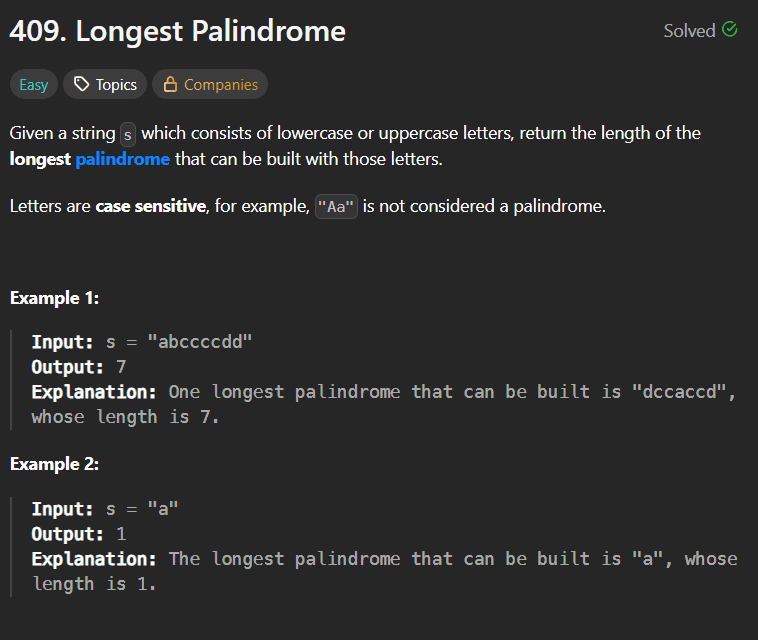
🔗 Problem LinkLeetCode 409 – Longest Palindrome 👉 https://leetcode.com/problems/longest-palindrome/IntroductionThis is one of those problems where you don’t actually need to build the palindrome.You just need to calculate the maximum possible length of a palindrome that can be formed using the given characters.The key idea here is understanding:How palindromes are structured.Once you understand that, the solution becomes straightforward and elegant.📌 Problem UnderstandingYou are given a string s containing:Lowercase lettersUppercase lettersCase-sensitive (meaning 'A' and 'a' are different)You must return:The length of the longest palindrome that can be built using those characters.You can rearrange characters in any order.Example 1Input: s = "abccccdd"Output: 7One possible palindrome:dccaccdLength = 7Example 2Input: s = "a"Output: 1🧠 Key Observation About PalindromesA palindrome:Reads the same forward and backward.Has mirror symmetry.This means:Characters must appear in pairs.At most one character can appear an odd number of times (middle character).🧠 Intuition Behind the ApproachLet’s think step by step:Count frequency of each character.For every character:If frequency is even → use all of them.If frequency is odd → use (frequency - 1).If at least one odd frequency exists → we can place one odd character in the center.That’s it.This is a greedy approach.💻 Your Codeclass Solution { public int longestPalindrome(String s) { if(s.length() == 1) return 1; HashMap<Character,Integer> mp = new HashMap<>(); for(int i =0; i < s.length();i++){ mp.put(s.charAt(i),mp.getOrDefault(s.charAt(i),0)+1); } int len =0; boolean odd = false; for(int a : mp.values()){ if(a%2 == 0){ len+=a; }else{ len+=a-1; odd= true; } } if(odd){ return len+1; } return len; }}🔍 Step-by-Step Explanation1️⃣ Edge Caseif(s.length() == 1) return 1;If there is only one character, the answer is 1.2️⃣ Frequency CountingHashMap<Character,Integer> mp = new HashMap<>();for(int i =0; i < s.length();i++){ mp.put(s.charAt(i),mp.getOrDefault(s.charAt(i),0)+1);}We count how many times each character appears.3️⃣ Build the Palindrome Lengthint len = 0;boolean odd = false;len → stores palindrome lengthodd → tracks whether any odd frequency exists4️⃣ Process Each Frequencyfor(int a : mp.values()){ if(a % 2 == 0){ len += a; }else{ len += a - 1; odd = true; }}If frequency is even → use all characters.If odd:Use a - 1 (which is even)Keep track that we saw an odd number5️⃣ Add Middle Character If Neededif(odd){ return len + 1;}If at least one odd frequency exists → we can place one character in the center.Otherwise → return len.🎯 Why This WorksIn a palindrome:All characters must appear in pairs (mirrored sides).Only one character can be unpaired (center).So we:Use all even counts.Use even portion of odd counts.Add one center character if possible.⏱ Complexity AnalysisTime Complexity: O(n)One pass to count frequenciesOne pass over map (max 52 characters: A–Z, a–z)Space Complexity: O(52) ≈ O(1)At most 52 distinct characters.🔥 Cleaner Optimization IdeaWe don’t even need a boolean variable.We can simply:Add a / 2 * 2 for every frequencyIf total length < original string length → add 1Example optimized version:class Solution { public int longestPalindrome(String s) { HashMap<Character,Integer> mp = new HashMap<>(); for(char ch : s.toCharArray()){ mp.put(ch, mp.getOrDefault(ch, 0) + 1); } int len = 0; for(int count : mp.values()){ len += (count / 2) * 2; } if(len < s.length()){ len += 1; } return len; }}🏁 Final ThoughtsThis problem teaches:Understanding palindrome structureFrequency countingGreedy logicHandling odd and even countsIt’s a simple but powerful pattern question.If you truly understand this, you can easily solve problems like:Palindrome PermutationLongest Palindrome by Concatenating Two Letter WordsCount Palindromic Subsequences