Search Blogs

Showing results for "LinkedList"

Found 8 results

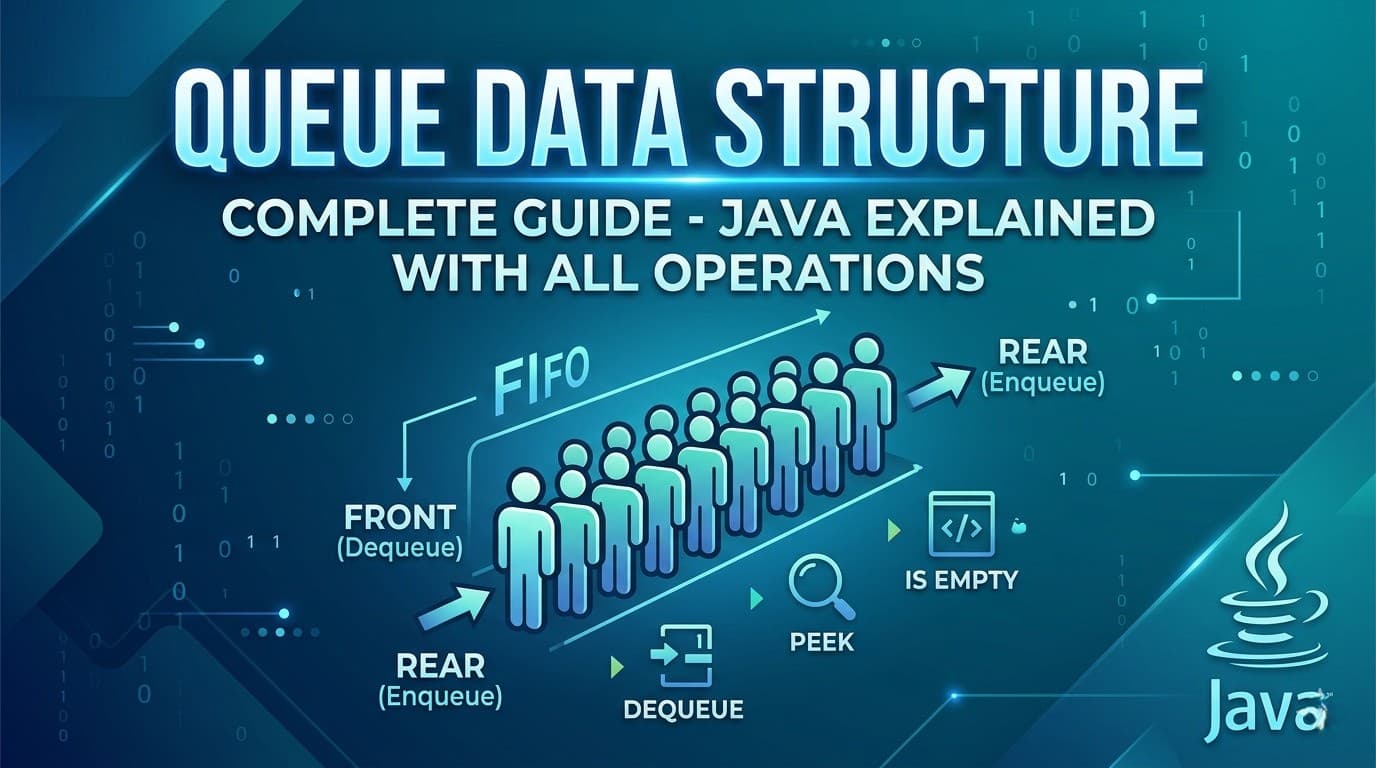
Queue Data Structure Complete Guide - Java Explained With All Operations

Queue Data Structure Complete Guide - Java Explained With All Operations

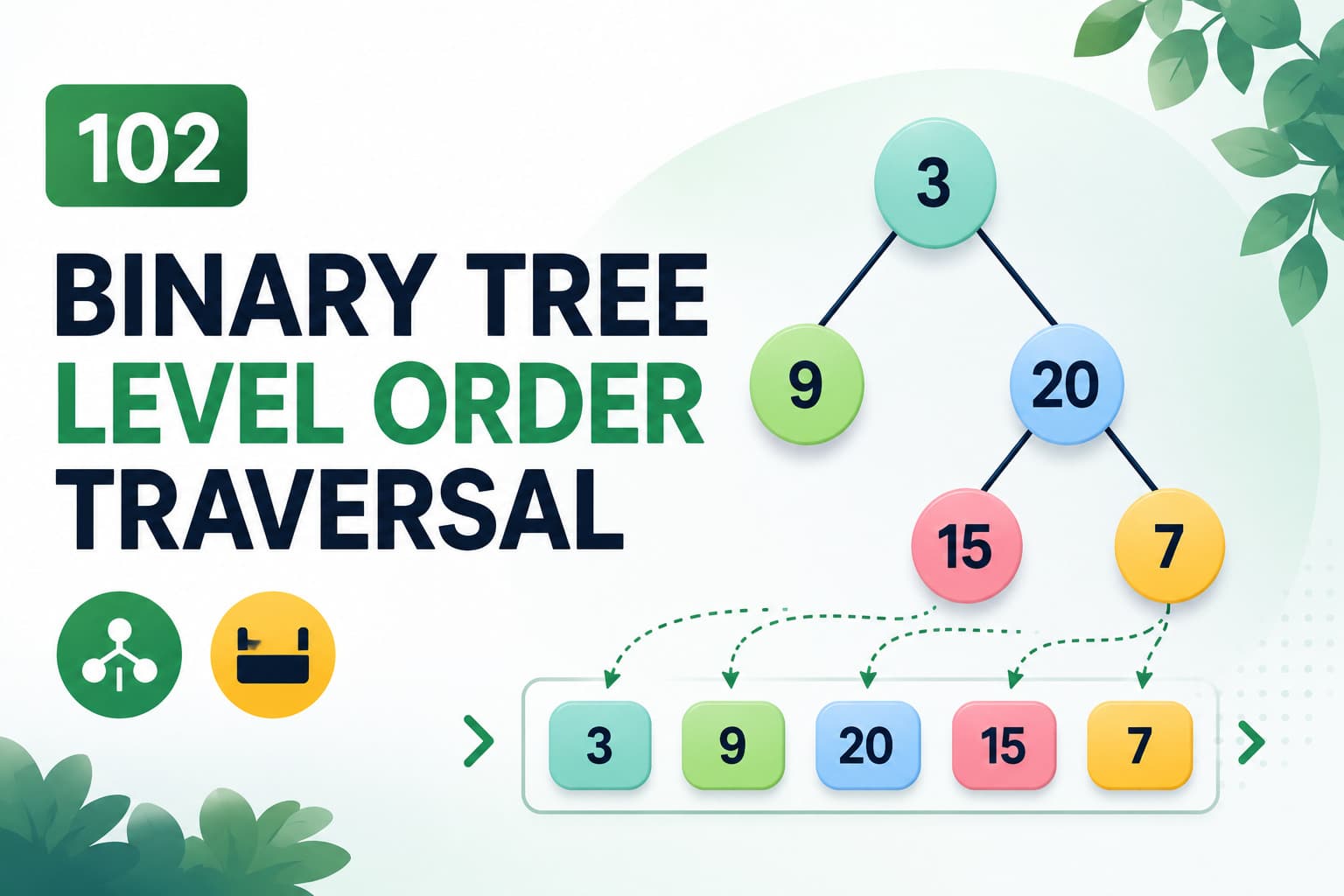
IntroductionIf you have been learning Data Structures and Algorithms, you have probably already spent time with arrays, linked lists, and stacks. Now it is time to meet one of the most important and widely used data structures in computer science — the Queue.Queue is not just a theoretical concept. It powers some of the most critical systems you use every day — from how your printer handles jobs, to how your CPU schedules tasks, to how Google Maps finds the shortest path between two locations. Understanding Queue deeply means understanding how real systems work.In this complete guide we will cover absolutely everything — what a Queue is, how it differs from a Stack, every type of Queue, all operations with code, Java implementations, time and space complexity, common interview questions, and the most important LeetCode problems that use Queue.What Is a Queue?A Queue is a linear data structure that follows the FIFO principle — First In First Out. This means the element that was added first is the one that gets removed first.Think of it exactly like a real-world queue (a line of people). The person who joined the line first gets served first. No cutting in line, no serving from the back — strict order from front to back.This is the fundamental difference between a Queue and a Stack:Stack → LIFO (Last In First Out) — like a stack of plates, you take from the topQueue → FIFO (First In First Out) — like a line of people, you serve from the frontReal Life Examples of QueueBefore writing a single line of code, let us understand where queues appear in real life. This will make every technical concept feel natural.Printer Queue — when you send multiple documents to print, they print in the order they were sent. The first document sent prints first.CPU Task Scheduling — your operating system manages running processes in a queue. Tasks get CPU time in the order they arrive (in basic scheduling).Customer Service Call Center — when you call a helpline and are put on hold, you are placed in a queue. The first caller on hold gets connected first.WhatsApp Messages — messages are delivered in the order they are sent. The first message sent is the first one received.BFS (Breadth First Search) — every time you use Google Maps or any navigation app to find the shortest path, it uses BFS internally which is entirely powered by a Queue.Ticket Booking Systems — online booking portals process requests in the order they arrive. First come first served.Queue Terminology — Key Terms You Must KnowBefore diving into code, let us get the vocabulary right:Front — the end from which elements are removed (dequeued). This is where the "first person in line" stands.Rear (or Back) — the end at which elements are added (enqueued). New arrivals join here.Enqueue — the operation of adding an element to the rear of the queue. Like joining the back of a line.Dequeue — the operation of removing an element from the front of the queue. Like the first person in line being served and leaving.Peek (or Front) — looking at the front element without removing it. Like seeing who is first in line without serving them yet.isEmpty — checking whether the queue has no elements.isFull — relevant for fixed-size queues, checking whether no more elements can be added.Types of QueuesThis is where most beginners get confused. There is not just one type of Queue — there are several variations each designed to solve specific problems.1. Simple Queue (Linear Queue)The most basic form. Elements enter from the rear and leave from the front. Strict FIFO, nothing fancy.Enqueue → [ 1 | 2 | 3 | 4 | 5 ] → Dequeue rear frontProblem with Simple Queue: In array-based implementation, once elements are dequeued from the front, those slots cannot be reused even if there is space. This wastes memory. This is why Circular Queue was invented.2. Circular QueueIn a Circular Queue, the rear wraps around to the front when it reaches the end of the array. The last position connects back to the first, forming a circle. This solves the wasted space problem of simple queues. [1] [2] [3] / \ [6] [4] \ / [5] ← rearUsed in: CPU scheduling, memory management, traffic light systems, streaming buffers.3. Double Ended Queue (Deque)A Deque (pronounced "deck") allows insertion and deletion from both ends — front and rear. It is the most flexible queue type.Enqueue Front → [ 1 | 2 | 3 | 4 | 5 ] → Dequeue FrontEnqueue Rear → [ 1 | 2 | 3 | 4 | 5 ] → Dequeue RearTwo subtypes:Input Restricted Deque — insertion only at rear, deletion from both endsOutput Restricted Deque — deletion only at front, insertion at both endsUsed in: browser history (back and forward), undo-redo operations, sliding window problems.4. Priority QueueElements are not served in FIFO order — instead each element has a priority and the element with the highest priority is served first regardless of when it was added.Think of an emergency room. A patient with a critical injury jumps ahead of someone with a minor cut even if they arrived later.Two types:Max Priority Queue — highest value = highest priorityMin Priority Queue — lowest value = highest priorityUsed in: Dijkstra's shortest path, Huffman encoding, A* search algorithm, task scheduling with priorities.5. Blocking QueueA thread-safe queue used in multi-threading. If the queue is empty, a thread trying to dequeue will wait (block) until an element is available. If the queue is full, a thread trying to enqueue will wait until space is available.Used in: Producer-Consumer problems, thread pool implementations, Java's java.util.concurrent package.Queue Operations and Time ComplexityEvery queue operation has a specific time complexity that you must know cold for interviews.OperationDescriptionTime ComplexityEnqueueAdd element to rearO(1)DequeueRemove element from frontO(1)Peek/FrontView front elementO(1)isEmptyCheck if queue is emptyO(1)SizeNumber of elementsO(1)SearchFind a specific elementO(n)Space Complexity: O(n) — where n is the number of elements stored.All core queue operations are O(1). This is what makes Queue so powerful — no matter how many elements are in the queue, adding and removing always takes constant time.Implementing Queue in Java — All WaysJava gives you multiple ways to use a Queue. Let us go through each one.Way 1: Using LinkedList (Most Common)LinkedList implements the Queue interface in Java. This is the most commonly used Queue implementation.import java.util.LinkedList;import java.util.Queue;Queue<Integer> queue = new LinkedList<>();// Enqueue — add to rearqueue.offer(10);queue.offer(20);queue.offer(30);// Peek — view front without removingSystem.out.println(queue.peek()); // 10// Dequeue — remove from frontSystem.out.println(queue.poll()); // 10System.out.println(queue.poll()); // 20// Check emptySystem.out.println(queue.isEmpty()); // false// SizeSystem.out.println(queue.size()); // 1offer() vs add() — both add to the queue. add() throws an exception if the queue is full (for bounded queues). offer() returns false instead. Always prefer offer().poll() vs remove() — both remove from front. remove() throws an exception if queue is empty. poll() returns null. Always prefer poll().peek() vs element() — both view the front. element() throws exception if empty. peek() returns null. Always prefer peek().Way 2: Using ArrayDeque (Fastest)ArrayDeque is faster than LinkedList for Queue operations because it uses a resizable array internally with no node allocation overhead.import java.util.ArrayDeque;import java.util.Queue;Queue<Integer> queue = new ArrayDeque<>();queue.offer(1);queue.offer(2);queue.offer(3);System.out.println(queue.peek()); // 1System.out.println(queue.poll()); // 1System.out.println(queue.size()); // 2When to use ArrayDeque over LinkedList? Use ArrayDeque whenever possible for Queue or Stack operations. It is faster because it avoids the overhead of node objects that LinkedList creates for every element. In competitive programming and interviews, ArrayDeque is the preferred choice.Way 3: Using Deque (Double Ended Queue)import java.util.ArrayDeque;import java.util.Deque;Deque<Integer> deque = new ArrayDeque<>();// Add to frontdeque.offerFirst(10);// Add to reardeque.offerLast(20);deque.offerLast(30);// Remove from frontSystem.out.println(deque.pollFirst()); // 10// Remove from rearSystem.out.println(deque.pollLast()); // 30// Peek front and rearSystem.out.println(deque.peekFirst()); // 20System.out.println(deque.peekLast()); // 20Way 4: Using PriorityQueueimport java.util.PriorityQueue;// Min Heap — smallest element has highest priorityPriorityQueue<Integer> minPQ = new PriorityQueue<>();minPQ.offer(30);minPQ.offer(10);minPQ.offer(20);System.out.println(minPQ.poll()); // 10 — smallest comes out first// Max Heap — largest element has highest priorityPriorityQueue<Integer> maxPQ = new PriorityQueue<>((a, b) -> b - a);maxPQ.offer(30);maxPQ.offer(10);maxPQ.offer(20);System.out.println(maxPQ.poll()); // 30 — largest comes out firstWay 5: Implementing Queue From Scratch Using ArrayUnderstanding the underlying implementation helps you in interviews when asked to build one from scratch.class MyQueue { private int[] arr; private int front; private int rear; private int size; private int capacity; public MyQueue(int capacity) { this.capacity = capacity; arr = new int[capacity]; front = 0; rear = -1; size = 0; } public void enqueue(int val) { if (size == capacity) { System.out.println("Queue is full!"); return; } rear = (rear + 1) % capacity; // circular wrapping arr[rear] = val; size++; } public int dequeue() { if (isEmpty()) { System.out.println("Queue is empty!"); return -1; } int val = arr[front]; front = (front + 1) % capacity; // circular wrapping size--; return val; } public int peek() { if (isEmpty()) return -1; return arr[front]; } public boolean isEmpty() { return size == 0; } public int size() { return size; }}Notice the % capacity in enqueue and dequeue — that is what makes it a Circular Queue. Without this, once the rear reaches the end of the array, you cannot add more even if front has moved forward and freed up space.Way 6: Implementing Queue Using Two StacksThis is a very popular interview question — implement a Queue using two stacks. The idea is to use one stack for enqueue and another for dequeue.class QueueUsingTwoStacks { Stack<Integer> s1 = new Stack<>(); // for enqueue Stack<Integer> s2 = new Stack<>(); // for dequeue public void enqueue(int val) { s1.push(val); // always push to s1 } public int dequeue() { if (s2.isEmpty()) { // transfer all elements from s1 to s2 // this reverses the order, giving FIFO behavior while (!s1.isEmpty()) { s2.push(s1.pop()); } } return s2.pop(); } public int peek() { if (s2.isEmpty()) { while (!s1.isEmpty()) { s2.push(s1.pop()); } } return s2.peek(); } public boolean isEmpty() { return s1.isEmpty() && s2.isEmpty(); }}Why does this work?When you transfer elements from s1 to s2, the order reverses. The element that was added first to s1 ends up on top of s2 — which means it gets dequeued first. FIFO achieved using two LIFOs!Amortized time complexity: Each element is pushed and popped at most twice (once in s1, once in s2). So dequeue is O(1) amortized even though individual calls might take O(n).This is LeetCode 232 — Implement Queue using Stacks.Queue vs Stack — Side by SideFeatureQueueStackPrincipleFIFO — First In First OutLIFO — Last In First OutInsert atRearTopRemove fromFrontTopReal lifeLine of peopleStack of platesJava classLinkedList, ArrayDequeStack, ArrayDequeMain useBFS, schedulingDFS, backtracking, parsingPeekFront elementTop elementBFS — The Most Important Application of QueueBreadth First Search (BFS) is the single most important algorithm that uses a Queue. Understanding BFS is why Queue matters so much in DSA.BFS explores a graph or tree level by level — all nodes at distance 1 first, then all at distance 2, and so on. A Queue naturally enforces this level-by-level behavior.public void bfs(int start, List<List<Integer>> graph) { Queue<Integer> queue = new LinkedList<>(); boolean[] visited = new boolean[graph.size()]; queue.offer(start); visited[start] = true; while (!queue.isEmpty()) { int node = queue.poll(); // process front node System.out.print(node + " "); for (int neighbor : graph.get(node)) { if (!visited[neighbor]) { visited[neighbor] = true; queue.offer(neighbor); // add unvisited neighbors to rear } } }}Why Queue and not Stack for BFS? Queue ensures you process all neighbors of a node before going deeper. Stack would take you deep into one path first — that is DFS, not BFS. The FIFO property is what guarantees level-by-level exploration.BFS with Queue is used in:Shortest path in unweighted graphsLevel order traversal of treesFinding connected componentsWord ladder problemsRotten oranges, flood fill, and matrix BFS problemsLevel Order Traversal — BFS on TreesOne of the most common Queue problems in interviews is Level Order Traversal of a binary tree.public List<List<Integer>> levelOrder(TreeNode root) { List<List<Integer>> result = new ArrayList<>(); if (root == null) return result; Queue<TreeNode> queue = new LinkedList<>(); queue.offer(root); while (!queue.isEmpty()) { int levelSize = queue.size(); // number of nodes at current level List<Integer> level = new ArrayList<>(); for (int i = 0; i < levelSize; i++) { TreeNode node = queue.poll(); level.add(node.val); if (node.left != null) queue.offer(node.left); if (node.right != null) queue.offer(node.right); } result.add(level); } return result;}The key trick here is using queue.size() at the start of each while loop iteration to know exactly how many nodes belong to the current level. Process exactly that many nodes, then move to the next level.This is LeetCode 102 — Binary Tree Level Order Traversal.Sliding Window Maximum — Monotonic DequeOne of the most impressive Queue applications is the Sliding Window Maximum problem using a Monotonic Deque. This is the queue equivalent of the Monotonic Stack pattern you saw in stack problems.The idea — maintain a deque that stores indices of elements in decreasing order. The front always holds the index of the maximum element in the current window.public int[] maxSlidingWindow(int[] nums, int k) { Deque<Integer> deque = new ArrayDeque<>(); // stores indices int[] result = new int[nums.length - k + 1]; int idx = 0; for (int i = 0; i < nums.length; i++) { // remove indices that are out of the current window while (!deque.isEmpty() && deque.peekFirst() < i - k + 1) { deque.pollFirst(); } // remove indices whose values are smaller than current // they can never be the maximum for any future window while (!deque.isEmpty() && nums[deque.peekLast()] < nums[i]) { deque.pollLast(); } deque.offerLast(i); // window is fully formed, record maximum (front of deque) if (i >= k - 1) { result[idx++] = nums[deque.peekFirst()]; } } return result;}This gives O(n) time for what would otherwise be an O(n×k) problem. This is LeetCode 239 — Sliding Window Maximum.Java Queue Interface — Complete Method ReferenceHere is every method you will ever need from Java's Queue and Deque interfaces:Queue Methods:offer(e) — add to rear, returns false if full (preferred over add) poll() — remove from front, returns null if empty (preferred over remove) peek() — view front without removing, returns null if empty (preferred over element) isEmpty() — returns true if no elements size() — returns number of elements contains(o) — returns true if element existsDeque Additional Methods:offerFirst(e) — add to front offerLast(e) — add to rear pollFirst() — remove from front pollLast() — remove from rear peekFirst() — view front peekLast() — view rearPriorityQueue Specific:offer(e) — add with natural ordering or custom comparator poll() — remove element with highest priority peek() — view highest priority element without removingCommon Interview Questions About QueueThese are the questions interviewers ask to test your understanding of queues conceptually — not just coding.Q1. What is the difference between Queue and Stack? Queue is FIFO — elements are removed in the order they were added. Stack is LIFO — the most recently added element is removed first. Queue removes from the front, Stack removes from the top.Q2. Why is ArrayDeque preferred over LinkedList for Queue in Java? ArrayDeque uses a resizable array internally and has better cache locality and no node allocation overhead. LinkedList creates a new node object for every element added, which means more garbage collection pressure. ArrayDeque is faster in practice for most Queue use cases.Q3. When would you use a PriorityQueue instead of a regular Queue? When the order of processing depends on priority rather than arrival order. For example in a hospital, critical patients are treated before minor cases regardless of when they arrived. Or in Dijkstra's algorithm, always processing the shortest known distance first.Q4. How is Queue used in BFS? BFS uses a Queue to explore nodes level by level. The starting node is enqueued first. Each time a node is dequeued, all its unvisited neighbors are enqueued. Since Queue is FIFO, all neighbors of a node are processed before going deeper — guaranteeing level-by-level exploration.Q5. What is the difference between poll() and remove() in Java Queue? Both remove the front element. remove() throws NoSuchElementException if the queue is empty. poll() returns null instead of throwing. Always use poll() for safer code.Q6. Can a Queue have duplicates? Yes. Queue does not have any restriction on duplicate values unlike Sets. The same value can appear multiple times in a Queue.Q7. What is a Blocking Queue and when is it used? A Blocking Queue is a thread-safe Queue used in multi-threaded applications. When a thread tries to dequeue from an empty queue, it blocks (waits) until an element is available. When a thread tries to enqueue into a full queue, it blocks until space is available. Used in Producer-Consumer patterns.Top LeetCode Problems on QueueHere are the most important LeetCode problems that use Queue — organized from beginner to advanced:Beginner Level:232. Implement Queue using Stacks — implement Queue with two stacks, classic interview question225. Implement Stack using Queues — reverse of 232, implement Stack using Queue933. Number of Recent Calls — sliding window with QueueIntermediate Level:102. Binary Tree Level Order Traversal — BFS on tree, must know107. Binary Tree Level Order Traversal II — same but bottom up994. Rotting Oranges — multi-source BFS on grid1091. Shortest Path in Binary Matrix — BFS shortest path542. 01 Matrix — multi-source BFS, distance to nearest 0127. Word Ladder — BFS on word graph, classicAdvanced Level:239. Sliding Window Maximum — monotonic deque, must know862. Shortest Subarray with Sum at Least K — monotonic deque with prefix sums407. Trapping Rain Water II — 3D BFS with priority queue787. Cheapest Flights Within K Stops — BFS with constraintsQueue Cheat Sheet — Everything at a GlanceCreate a Queue:Queue<Integer> q = new LinkedList<>(); // standardQueue<Integer> q = new ArrayDeque<>(); // faster, preferredDeque<Integer> dq = new ArrayDeque<>(); // double endedPriorityQueue<Integer> pq = new PriorityQueue<>(); // min heapPriorityQueue<Integer> pq = new PriorityQueue<>((a,b) -> b-a); // max heapCore Operations:q.offer(x); // enqueueq.poll(); // dequeueq.peek(); // front elementq.isEmpty(); // check emptyq.size(); // number of elementsDeque Operations:dq.offerFirst(x); // add to frontdq.offerLast(x); // add to reardq.pollFirst(); // remove from frontdq.pollLast(); // remove from reardq.peekFirst(); // view frontdq.peekLast(); // view rearBFS Template:Queue<Integer> queue = new LinkedList<>();queue.offer(start);visited[start] = true;while (!queue.isEmpty()) { int node = queue.poll(); for (int neighbor : graph.get(node)) { if (!visited[neighbor]) { visited[neighbor] = true; queue.offer(neighbor); } }}ConclusionQueue is one of those data structures that appears simple on the surface but has incredible depth once you start exploring its variations and applications. From the basic FIFO concept to Circular Queues, Deques, Priority Queues, Monotonic Deques, and BFS — each layer adds a new tool to your problem-solving arsenal.Here is the learning path to follow based on everything covered in this guide:Start with understanding FIFO vs LIFO and when each applies. Then get comfortable with Java's Queue interface — offer, poll, peek. Practice the BFS template until it feels automatic. Then move to Level Order Traversal problems. Once BFS clicks, tackle multi-source BFS problems like Rotting Oranges. Finally learn the Monotonic Deque pattern for sliding window problems.Master these and you will handle every Queue problem in any coding interview with confidence.
QueueData StructureJavaBFSDequePriority QueueCircular Queue
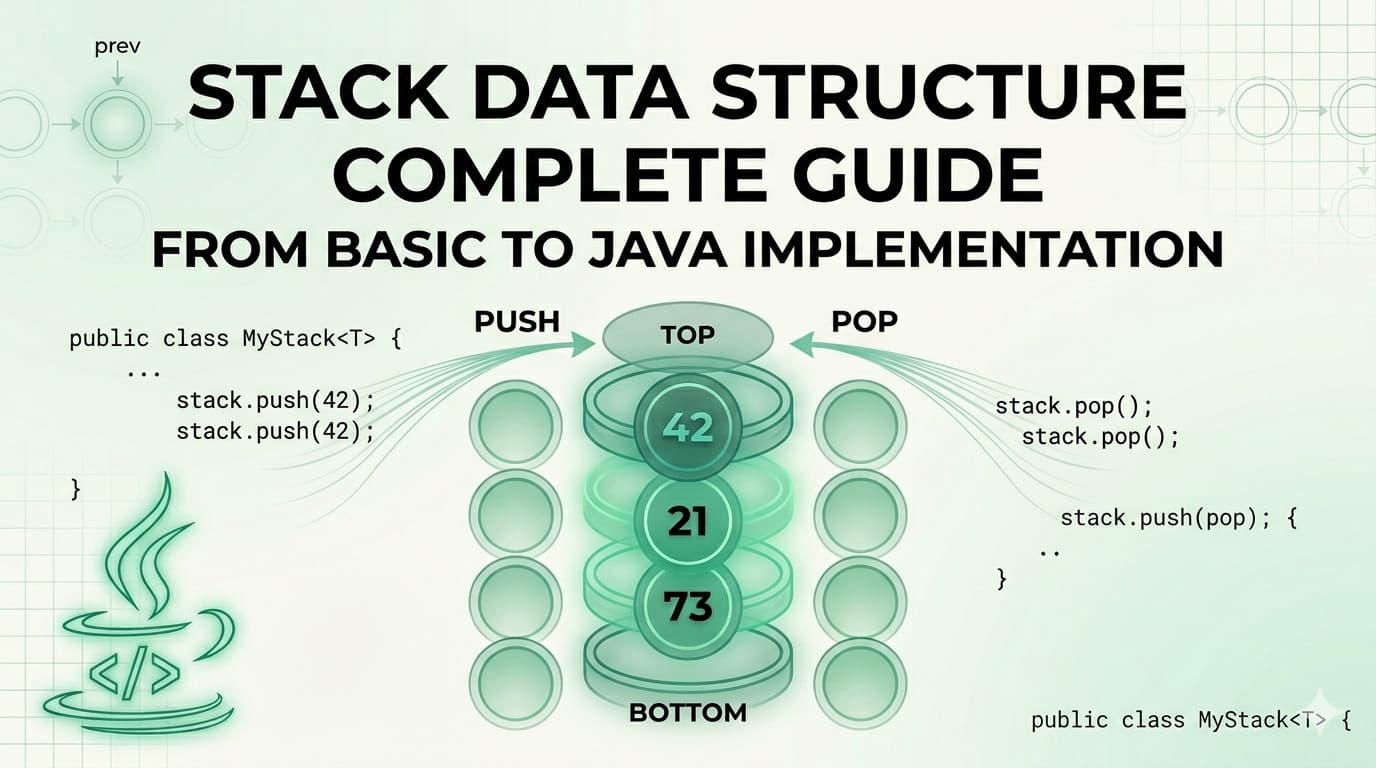
Stack Data Structure in Java: The Complete In-Depth Guide

Stack Data Structure in Java: The Complete In-Depth Guide

1. What Is a Stack?A Stack is a linear data structure that stores elements in a sequential order, but with one strict rule — you can only insert or remove elements from one end, called the top.It is one of the simplest yet most powerful data structures in computer science. Its strength comes from its constraint. Because everything happens at one end, the behavior of a stack is completely predictable.The formal definition: A Stack is a linear data structure that follows the Last In, First Out (LIFO) principle — the element inserted last is the first one to be removed.Here is what a stack looks like visually: ┌──────────┐ │ 50 │ ← TOP (last inserted, first removed) ├──────────┤ │ 40 │ ├──────────┤ │ 30 │ ├──────────┤ │ 20 │ ├──────────┤ │ 10 │ ← BOTTOM (first inserted, last removed) └──────────┘When you push 60 onto this stack, it goes on top. When you pop, 60 comes out first. That is LIFO.2. Real-World AnalogiesBefore writing a single line of code, it helps to see stacks in the real world. These analogies will make the concept permanently stick.A Pile of Plates In a cafeteria, clean plates are stacked on top of each other. You always pick the top plate. You always place a new plate on top. You never reach into the middle. This is a stack.Browser Back Button Every time you visit a new webpage, it gets pushed onto a history stack. When you press the Back button, the browser pops the most recent page off the stack and takes you there. The page you visited first is at the bottom — you only reach it after going back through everything else.Undo Feature in Text Editors When you type in a document and press Ctrl+Z, the most recent action is undone first. That is because every action you perform is pushed onto a stack. Undo simply pops from that stack.Call Stack in Programming When a function calls another function, the current function's state is pushed onto the call stack. When the inner function finishes, it is popped off and execution returns to the outer function. This is the literal stack your programs run on.A Stack of Books Put five books on a table, one on top of another. You can only take the top book without knocking the pile over. That is a stack.3. The LIFO Principle ExplainedLIFO stands for Last In, First Out.It means whatever you put in last is the first thing to come out. This is the exact opposite of a Queue (which is FIFO — First In, First Out).Let us trace through an example step by step:Start: Stack is empty → []Push 10 → [10] (10 is at the top)Push 20 → [10, 20] (20 is at the top)Push 30 → [10, 20, 30] (30 is at the top)Pop → returns 30 (30 was last in, first out) Stack: [10, 20]Pop → returns 20 Stack: [10]Peek → returns 10 (just looks, does not remove) Stack: [10]Pop → returns 10 Stack: [] (stack is now empty)Every single operation happens only at the top. The bottom of the stack is never directly accessible.4. Stack Operations & Time ComplexityA stack supports the following core operations:OperationDescriptionTime Complexitypush(x)Insert element x onto the top of the stackO(1)pop()Remove and return the top elementO(1)peek() / top()Return the top element without removing itO(1)isEmpty()Check if the stack has no elementsO(1)isFull()Check if the stack has reached its capacity (Array only)O(1)size()Return the number of elements in the stackO(1)search(x)Find position of element from top (Java built-in only)O(n)All primary stack operations — push, pop, peek, isEmpty — run in O(1) constant time. This is what makes the stack so efficient. It does not matter whether the stack has 10 elements or 10 million — these operations are always instant.Space complexity for a stack holding n elements is O(n).5. Implementation 1 — Using a Static ArrayThis is the most fundamental way to implement a stack. We use a fixed-size array and a variable called top to track where the top of the stack currently is.How it works:top starts at -1 (stack is empty)On push: increment top, then place the element at arr[top]On pop: return arr[top], then decrement topOn peek: return arr[top] without changing it// StackUsingArray.javapublic class StackUsingArray { private int[] arr; private int top; private int capacity; // Constructor — initialize with a fixed capacity public StackUsingArray(int capacity) { this.capacity = capacity; arr = new int[capacity]; top = -1; } // Push: add element to the top public void push(int value) { if (isFull()) { System.out.println("Stack Overflow! Cannot push " + value); return; } arr[++top] = value; System.out.println("Pushed: " + value); } // Pop: remove and return top element public int pop() { if (isEmpty()) { System.out.println("Stack Underflow! Stack is empty."); return -1; } return arr[top--]; } // Peek: view the top element without removing public int peek() { if (isEmpty()) { System.out.println("Stack is empty."); return -1; } return arr[top]; } // Check if stack is empty public boolean isEmpty() { return top == -1; } // Check if stack is full public boolean isFull() { return top == capacity - 1; } // Return current size public int size() { return top + 1; } // Display all elements public void display() { if (isEmpty()) { System.out.println("Stack is empty."); return; } System.out.print("Stack (top → bottom): "); for (int i = top; i >= 0; i--) { System.out.print(arr[i] + " "); } System.out.println(); } // Main method to test public static void main(String[] args) { StackUsingArray stack = new StackUsingArray(5); stack.push(10); stack.push(20); stack.push(30); stack.push(40); stack.push(50); stack.push(60); // This will trigger Stack Overflow stack.display(); System.out.println("Peek: " + stack.peek()); System.out.println("Pop: " + stack.pop()); System.out.println("Pop: " + stack.pop()); stack.display(); System.out.println("Size: " + stack.size()); }}```**Output:**```Pushed: 10Pushed: 20Pushed: 30Pushed: 40Pushed: 50Stack Overflow! Cannot push 60Stack (top → bottom): 50 40 30 20 10Peek: 50Pop: 50Pop: 40Stack (top → bottom): 30 20 10Size: 3Key Points about Array Implementation:Fixed size — you must declare capacity upfrontVery fast — direct array index accessStack Overflow is possible if capacity is exceededMemory is pre-allocated even if stack is not full6. Implementation 2 — Using an ArrayListAn ArrayList-based stack removes the fixed-size limitation. The ArrayList grows dynamically, so you never have to worry about stack overflow due to capacity.How it works:The end of the ArrayList acts as the topadd() is used for pushremove(size - 1) is used for popget(size - 1) is used for peek// StackUsingArrayList.javaimport java.util.ArrayList;public class StackUsingArrayList { private ArrayList<Integer> list; // Constructor public StackUsingArrayList() { list = new ArrayList<>(); } // Push: add to the end (which is our top) public void push(int value) { list.add(value); System.out.println("Pushed: " + value); } // Pop: remove and return the last element public int pop() { if (isEmpty()) { System.out.println("Stack Underflow! Stack is empty."); return -1; } int top = list.get(list.size() - 1); list.remove(list.size() - 1); return top; } // Peek: view the last element public int peek() { if (isEmpty()) { System.out.println("Stack is empty."); return -1; } return list.get(list.size() - 1); } // Check if stack is empty public boolean isEmpty() { return list.isEmpty(); } // Return size public int size() { return list.size(); } // Display elements from top to bottom public void display() { if (isEmpty()) { System.out.println("Stack is empty."); return; } System.out.print("Stack (top → bottom): "); for (int i = list.size() - 1; i >= 0; i--) { System.out.print(list.get(i) + " "); } System.out.println(); } // Main method to test public static void main(String[] args) { StackUsingArrayList stack = new StackUsingArrayList(); stack.push(5); stack.push(15); stack.push(25); stack.push(35); stack.display(); System.out.println("Peek: " + stack.peek()); System.out.println("Pop: " + stack.pop()); System.out.println("Pop: " + stack.pop()); stack.display(); System.out.println("Is Empty: " + stack.isEmpty()); System.out.println("Size: " + stack.size()); }}```**Output:**```Pushed: 5Pushed: 15Pushed: 25Pushed: 35Stack (top → bottom): 35 25 15 5Peek: 35Pop: 35Pop: 25Stack (top → bottom): 15 5Is Empty: falseSize: 2Key Points about ArrayList Implementation:Dynamic size — grows automatically as neededNo overflow riskSlight overhead compared to raw array due to ArrayList internalsExcellent for most practical use cases7. Implementation 3 — Using a LinkedListA LinkedList-based stack is the most memory-efficient approach when you do not know the stack size in advance. Each element (node) holds data and a pointer to the next node. The head of the LinkedList acts as the top of the stack.How it works:Each node stores a value and a reference to the node below itPush creates a new node and makes it the new headPop removes the head node and returns its valuePeek returns the head node's value without removing it// StackUsingLinkedList.javapublic class StackUsingLinkedList { // Inner Node class private static class Node { int data; Node next; Node(int data) { this.data = data; this.next = null; } } private Node top; // Head of the linked list = top of stack private int size; // Constructor public StackUsingLinkedList() { top = null; size = 0; } // Push: create new node and link it to top public void push(int value) { Node newNode = new Node(value); newNode.next = top; // new node points to current top top = newNode; // new node becomes the new top size++; System.out.println("Pushed: " + value); } // Pop: remove and return top node's data public int pop() { if (isEmpty()) { System.out.println("Stack Underflow! Stack is empty."); return -1; } int value = top.data; top = top.next; // move top pointer to next node size--; return value; } // Peek: return top node's data without removing public int peek() { if (isEmpty()) { System.out.println("Stack is empty."); return -1; } return top.data; } // Check if empty public boolean isEmpty() { return top == null; } // Return size public int size() { return size; } // Display elements from top to bottom public void display() { if (isEmpty()) { System.out.println("Stack is empty."); return; } System.out.print("Stack (top → bottom): "); Node current = top; while (current != null) { System.out.print(current.data + " "); current = current.next; } System.out.println(); } // Main method to test public static void main(String[] args) { StackUsingLinkedList stack = new StackUsingLinkedList(); stack.push(100); stack.push(200); stack.push(300); stack.push(400); stack.display(); System.out.println("Peek: " + stack.peek()); System.out.println("Pop: " + stack.pop()); System.out.println("Pop: " + stack.pop()); stack.display(); System.out.println("Size: " + stack.size()); }}```**Output:**```Pushed: 100Pushed: 200Pushed: 300Pushed: 400Stack (top → bottom): 400 300 200 100Peek: 400Pop: 400Pop: 300Stack (top → bottom): 200 100Size: 2Key Points about LinkedList Implementation:Truly dynamic — each node allocated only when neededNo wasted memory from pre-allocationSlightly more memory per element (each node carries a pointer)Ideal for stacks where size is completely unknown8. Java's Built-in Stack ClassJava provides a ready-made Stack class inside java.util. It extends Vector and is thread-safe by default.// JavaBuiltinStack.javaimport java.util.Stack;public class JavaBuiltinStack { public static void main(String[] args) { Stack<Integer> stack = new Stack<>(); // Push elements stack.push(10); stack.push(20); stack.push(30); stack.push(40); System.out.println("Stack: " + stack); // Peek — look at top without removing System.out.println("Peek: " + stack.peek()); // Pop — remove top System.out.println("Pop: " + stack.pop()); System.out.println("After pop: " + stack); // Search — returns 1-based position from top System.out.println("Search 20: position " + stack.search(20)); // isEmpty System.out.println("Is Empty: " + stack.isEmpty()); // Size System.out.println("Size: " + stack.size()); }}```**Output:**```Stack: [10, 20, 30, 40]Peek: 40Pop: 40After pop: [10, 20, 30]Search 20: position 2Is Empty: falseSize: 3Important Note: In modern Java development, it is often recommended to use Deque (specifically ArrayDeque) instead of Stack for better performance, since Stack is synchronized and carries the overhead of Vector.// Using ArrayDeque as a stack (modern preferred approach)import java.util.ArrayDeque;import java.util.Deque;public class ModernStack { public static void main(String[] args) { Deque<Integer> stack = new ArrayDeque<>(); stack.push(10); // pushes to front stack.push(20); stack.push(30); System.out.println("Top: " + stack.peek()); System.out.println("Pop: " + stack.pop()); System.out.println("Stack: " + stack); }}9. Comparison of All ImplementationsFeatureArrayArrayListLinkedListJava StackArrayDequeSizeFixedDynamicDynamicDynamicDynamicStack Overflow RiskYesNoNoNoNoMemory UsagePre-allocatedAuto-growsPer-node overheadAuto-growsAuto-growsPush TimeO(1)O(1) amortizedO(1)O(1)O(1)Pop TimeO(1)O(1)O(1)O(1)O(1)Peek TimeO(1)O(1)O(1)O(1)O(1)Thread SafeNoNoNoYesNoBest ForKnown size, max speedGeneral useUnknown/huge sizeLegacy codeModern Java10. Advantages & DisadvantagesAdvantagesAdvantageExplanationSimple to implementVery few rules and operations to worry aboutO(1) operationsPush, pop, and peek are all constant timeMemory efficientNo extra pointers needed (array-based)Supports recursionThe call stack is itself a stackEasy undo/redoNatural fit for reversible action trackingBacktrackingPerfectly suited for maze, puzzle, and game solvingExpression evaluationPowers compilers and calculatorsDisadvantagesDisadvantageExplanationLimited accessCannot access elements in the middle directlyFixed size (array)Array-based stacks overflow if size is exceededNo random accessYou cannot do stack[2] — only top is accessibleMemory waste (array)Pre-allocated array wastes space if underusedNot suitable for all problemsMany problems need queues, trees, or graphs insteadStack overflow in recursionVery deep recursion can overflow the JVM call stack11. Real-World Use Cases of StackUnderstanding when to use a stack is just as important as knowing how to implement one. Here is where stacks show up in real software:Function Call Management (Call Stack) Every time your Java program calls a method, the JVM pushes that method's frame onto the call stack. When the method returns, the frame is popped. This is why you see "StackOverflowError" when you write infinite recursion.Undo and Redo Operations Text editors, image editors (Photoshop), and IDEs use two stacks — one for undo history and one for redo history. Every action pushes onto the undo stack. Ctrl+Z pops from it and pushes to the redo stack.Browser Navigation Your browser maintains a back-stack and a forward-stack. Visiting a new page pushes to the back-stack. Pressing Back pops from it and pushes to the forward-stack.Expression Evaluation and Conversion Compilers use stacks to evaluate arithmetic expressions and convert between infix, prefix, and postfix notations. For example: 3 + 4 * 2 must be evaluated considering operator precedence — this is done with a stack.Balanced Parentheses Checking Linters, compilers, and IDEs use stacks to check if brackets are balanced: {[()]} is valid, {[(])} is not.Backtracking Algorithms Maze solving, N-Queens, Sudoku solvers, and depth-first search all use stacks (explicitly or via recursion) to backtrack to previous states when a path fails.Syntax Parsing Compilers parse source code using stacks to match opening and closing constructs like if/else, try/catch, { and }.12. Practice Problems with Full SolutionsHere is where things get really interesting. These problems will sharpen your stack intuition and prepare you for coding interviews.Problem 1 — Reverse a String Using a StackDifficulty: EasyProblem: Write a Java program to reverse a string using a Stack.Approach: Push every character of the string onto a stack, then pop them all. Since LIFO reverses the order, the characters come out reversed.// ReverseString.javaimport java.util.Stack;public class ReverseString { public static String reverse(String str) { Stack<Character> stack = new Stack<>(); // Push all characters for (char c : str.toCharArray()) { stack.push(c); } // Pop all characters to build reversed string StringBuilder reversed = new StringBuilder(); while (!stack.isEmpty()) { reversed.append(stack.pop()); } return reversed.toString(); } public static void main(String[] args) { System.out.println(reverse("hello")); // olleh System.out.println(reverse("java")); // avaj System.out.println(reverse("racecar")); // racecar (palindrome) System.out.println(reverse("datastructure")); // erutcurtasatad }}Problem 2 — Check Balanced ParenthesesDifficulty: Easy–MediumProblem: Given a string containing (, ), {, }, [, ], determine if the brackets are balanced.Approach: Push every opening bracket onto the stack. When you see a closing bracket, check if it matches the top of the stack. If it does, pop. If it does not, the string is unbalanced.// BalancedParentheses.javaimport java.util.Stack;public class BalancedParentheses { public static boolean isBalanced(String expr) { Stack<Character> stack = new Stack<>(); for (char c : expr.toCharArray()) { // Push all opening brackets if (c == '(' || c == '{' || c == '[') { stack.push(c); } // For closing brackets, check the top of stack else if (c == ')' || c == '}' || c == ']') { if (stack.isEmpty()) return false; char top = stack.pop(); if (c == ')' && top != '(') return false; if (c == '}' && top != '{') return false; if (c == ']' && top != '[') return false; } } // Stack must be empty at the end for a balanced expression return stack.isEmpty(); } public static void main(String[] args) { System.out.println(isBalanced("{[()]}")); // true System.out.println(isBalanced("{[(])}")); // false System.out.println(isBalanced("((()))")); // true System.out.println(isBalanced("{]")); // false System.out.println(isBalanced("")); // true (empty is balanced) }}Problem 3 — Reverse a Stack (Without Extra Data Structure)Difficulty: Medium–HardProblem: Reverse all elements of a stack using only recursion — no array or extra stack allowed.Approach: This is a classic recursion problem. You need two recursive functions:insertAtBottom(stack, item) — inserts an element at the very bottom of the stackreverseStack(stack) — pops all elements, reverses, and uses insertAtBottom to rebuild// ReverseStack.javaimport java.util.Stack;public class ReverseStack { // Insert an element at the bottom of the stack public static void insertAtBottom(Stack<Integer> stack, int item) { if (stack.isEmpty()) { stack.push(item); return; } int top = stack.pop(); insertAtBottom(stack, item); stack.push(top); } // Reverse the stack using insertAtBottom public static void reverseStack(Stack<Integer> stack) { if (stack.isEmpty()) return; int top = stack.pop(); reverseStack(stack); // reverse the remaining stack insertAtBottom(stack, top); // insert popped element at bottom } public static void main(String[] args) { Stack<Integer> stack = new Stack<>(); stack.push(1); stack.push(2); stack.push(3); stack.push(4); stack.push(5); System.out.println("Before: " + stack); // [1, 2, 3, 4, 5] reverseStack(stack); System.out.println("After: " + stack); // [5, 4, 3, 2, 1] }}Problem 4 — Evaluate a Postfix ExpressionDifficulty: MediumProblem: Evaluate a postfix (Reverse Polish Notation) expression. Example: "2 3 4 * +" should return 14 because it is 2 + (3 * 4).Approach: Scan left to right. If you see a number, push it. If you see an operator, pop two numbers, apply the operator, and push the result.// PostfixEvaluation.javaimport java.util.Stack;public class PostfixEvaluation { public static int evaluate(String expression) { Stack<Integer> stack = new Stack<>(); String[] tokens = expression.split(" "); for (String token : tokens) { // If it's a number, push it if (token.matches("-?\\d+")) { stack.push(Integer.parseInt(token)); } // If it's an operator, pop two and apply else { int b = stack.pop(); // second operand int a = stack.pop(); // first operand switch (token) { case "+": stack.push(a + b); break; case "-": stack.push(a - b); break; case "*": stack.push(a * b); break; case "/": stack.push(a / b); break; } } } return stack.pop(); } public static void main(String[] args) { System.out.println(evaluate("2 3 4 * +")); // 14 → 2 + (3*4) System.out.println(evaluate("5 1 2 + 4 * + 3 -")); // 14 → 5+((1+2)*4)-3 System.out.println(evaluate("3 4 +")); // 7 }}Problem 5 — Next Greater ElementDifficulty: MediumProblem: For each element in an array, find the next greater element to its right. If none exists, output -1.Example: Input: [4, 5, 2, 10, 8] → Output: [5, 10, 10, -1, -1]Approach: Iterate right to left. Maintain a stack of candidates. For each element, pop all stack elements that are smaller than or equal to it — they can never be the answer for any element to the left. The top of the stack (if not empty) is the next greater element.// NextGreaterElement.javaimport java.util.Stack;import java.util.Arrays;public class NextGreaterElement { public static int[] nextGreater(int[] arr) { int n = arr.length; int[] result = new int[n]; Stack<Integer> stack = new Stack<>(); // stores elements, not indices // Traverse from right to left for (int i = n - 1; i >= 0; i--) { // Pop elements smaller than or equal to current while (!stack.isEmpty() && stack.peek() <= arr[i]) { stack.pop(); } // Next greater element result[i] = stack.isEmpty() ? -1 : stack.peek(); // Push current element for future comparisons stack.push(arr[i]); } return result; } public static void main(String[] args) { int[] arr1 = {4, 5, 2, 10, 8}; System.out.println(Arrays.toString(nextGreater(arr1))); // [5, 10, 10, -1, -1] int[] arr2 = {1, 3, 2, 4}; System.out.println(Arrays.toString(nextGreater(arr2))); // [3, 4, 4, -1] int[] arr3 = {5, 4, 3, 2, 1}; System.out.println(Arrays.toString(nextGreater(arr3))); // [-1, -1, -1, -1, -1] }}Problem 6 — Sort a Stack Using RecursionDifficulty: HardProblem: Sort a stack in ascending order (smallest on top) using only recursion — no loops, no extra data structure.// SortStack.javaimport java.util.Stack;public class SortStack { // Insert element in correct sorted position public static void sortedInsert(Stack<Integer> stack, int item) { if (stack.isEmpty() || item > stack.peek()) { stack.push(item); return; } int top = stack.pop(); sortedInsert(stack, item); stack.push(top); } // Sort the stack public static void sortStack(Stack<Integer> stack) { if (stack.isEmpty()) return; int top = stack.pop(); sortStack(stack); // sort remaining sortedInsert(stack, top); // insert top in sorted position } public static void main(String[] args) { Stack<Integer> stack = new Stack<>(); stack.push(34); stack.push(3); stack.push(31); stack.push(98); stack.push(92); stack.push(23); System.out.println("Before sort: " + stack); sortStack(stack); System.out.println("After sort: " + stack); // smallest on top }}13. Summary & Key TakeawaysA stack is a simple, elegant, and powerful data structure. Here is everything in one place:What it is: A linear data structure that follows LIFO — Last In, First Out.Core operations: push (add to top), pop (remove from top), peek (view top), isEmpty — all in O(1) time.Three ways to implement it in Java:Array-based: fast, fixed size, risk of overflowArrayList-based: dynamic, easy, slightly more overheadLinkedList-based: truly dynamic, memory-efficient per-element, best for unknown sizesWhen to use it:Undo/redo systemsBrowser navigationBalancing brackets and parenthesesEvaluating mathematical expressionsBacktracking problemsManaging recursive function callsDepth-first searchWhen NOT to use it:When you need random access to elementsWhen insertion/deletion is needed from both ends (use Deque)When you need to search efficiently (use HashMap or BST)Modern Java recommendation: Prefer ArrayDeque over the legacy Stack class for non-thread-safe scenarios. Use Stack only when you need synchronized access.The stack is one of those data structures that once you truly understand, you start seeing it everywhere — in your browser, in your IDE, in recursive algorithms, and deep within the operating system itself.This article covered everything from the fundamentals of the Stack data structure to multiple Java implementations, time complexity analysis, real-world applications, and six practice problems of increasing difficulty. Bookmark it as a reference and revisit the practice problems regularly — they are the real test of your understanding.

DataStructuresJavaStackDataStructureLIFO
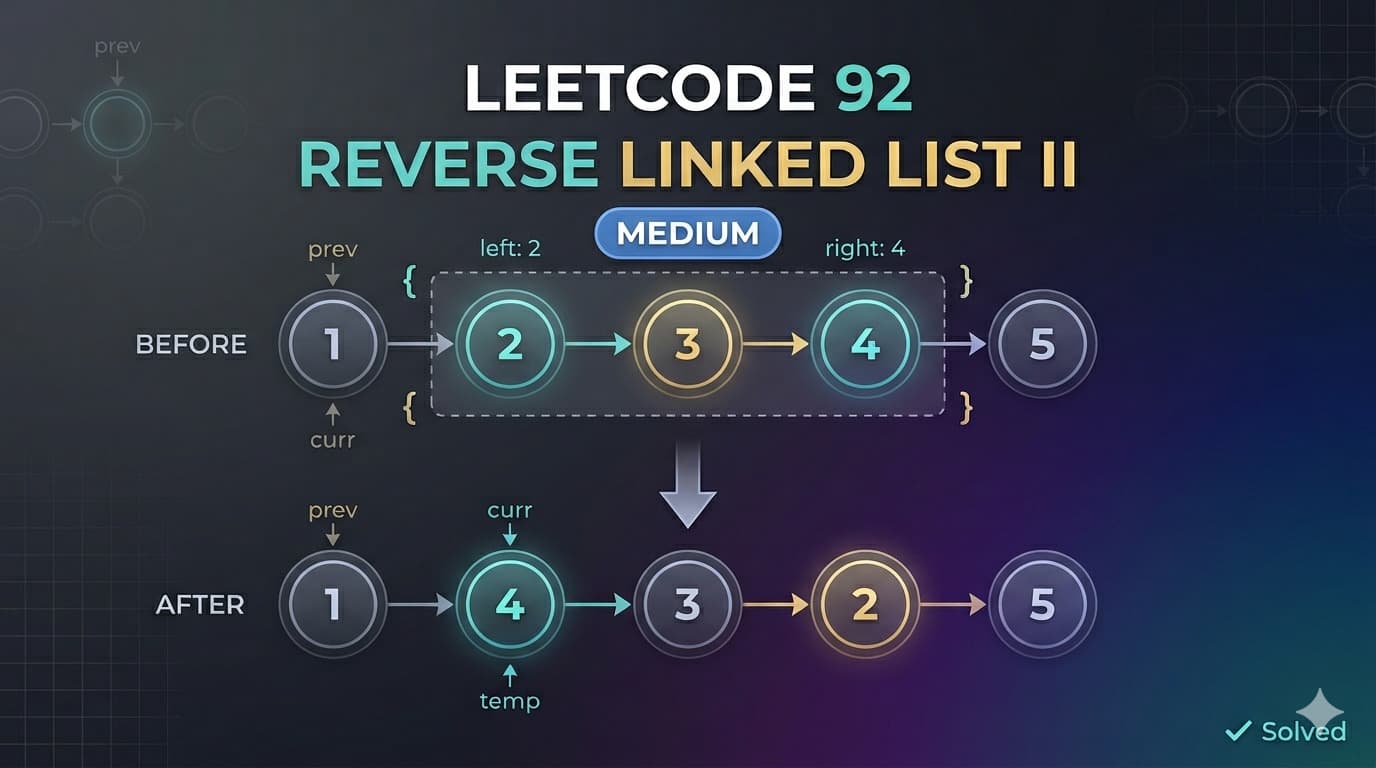
Master LeetCode 92: Reverse Linked List II | Detailed Java Solution & Explanation

Master LeetCode 92: Reverse Linked List II | Detailed Java Solution & Explanation

If you are preparing for software engineering interviews, you already know that Linked Lists are a favourite topic among interviewers. While reversing an entire linked list is a standard beginner problem, reversing only a specific section of it requires a bit more pointer magic.In this blog post, we will tackle LeetCode 92. Reverse Linked List II. We will break down the problem in plain English, walk through a highly intuitive modular approach, and then look at an optimized one-pass technique.Let’s dive in!Understanding the ProblemQuestion Statement:Given the head of a singly linked list and two integers left and right where left <= right, reverse the nodes of the list from position left to position right, and return the reversed list.Example:Input: head = [1,2,3,4,5], left = 2, right = 4Output: [1,4,3,2,5]In Simple Words:Imagine a chain of connected boxes. You don't want to flip the whole chain backwards. You only want to flip a specific middle section (from the 2nd box to the 4th box), while keeping the first and last boxes exactly where they are.Approach 1: The Intuitive Modular Approach (Find, Reverse, Connect)When solving complex linked list problems, breaking the problem into smaller helper functions is an excellent software engineering practice.In this approach, we will:Use a Dummy Node. This is a lifesaver when left = 1 (meaning we have to reverse from the very first node).Traverse the list to find the exact boundaries: the node just before the reversal (slow), the start of the reversal (leftNode), and the end of the reversal (rightNode).Pass the sub-list to a helper function that reverses it.Reconnect the newly reversed sub-list back to the main list.Here is the Java code for this approach:/** * Definition for singly-linked list. * public class ListNode { * int val; * ListNode next; * ListNode() {} * ListNode(int val) { this.val = val; } * ListNode(int val, ListNode next) { this.val = val; this.next = next; } * } */class Solution { // Helper function to reverse a portion of the list public ListNode reverse(ListNode LeftHead, ListNode rightHead){ ListNode curr = LeftHead; ListNode prev = rightHead; // Standard linked list reversal logic while(curr != rightHead){ ListNode newnode = curr.next; curr.next = prev; prev = curr; curr = newnode; } return prev; } public ListNode reverseBetween(ListNode head, int left, int right) { if(left == 1 && right == 1) return head; // Dummy node helps handle edge cases easily ListNode dummy = new ListNode(-1); dummy.next = head; ListNode leftNode = null; ListNode rightNode = null; ListNode curr = head; int leftC = 1; int rightC = 1; ListNode slow = dummy; // Traverse to find the exact bounds of our sublist while(curr != null){ if(leftC == left - 1){ slow = curr; // 'slow' is the node just before the reversed section } if(leftC == left){ leftNode = curr; } if(rightC == right){ rightNode = curr; } if(leftC == left && rightC == right){ break; // We found both bounds, no need to traverse further } leftC++; rightC++; curr = curr.next; } // Reverse the sublist and connect it back ListNode rev = reverse(leftNode, rightNode.next); slow.next = rev; return dummy.next; }}🔍 Dry Run of Approach 1Let’s trace head = [1, 2, 3, 4, 5], left = 2, right = 4.Step 1: Initializationdummy = -1 -> 1 -> 2 -> 3 -> 4 -> 5slow = -1 (dummy node)Step 2: Finding Bounds (While Loop)We move curr through the list.When curr is at 1 (Position 1): left - 1 is 1, so slow becomes node 1.When curr is at 2 (Position 2): leftNode becomes node 2.When curr is at 4 (Position 4): rightNode becomes node 4. We break the loop.Step 3: The Helper ReversalWe call reverse(leftNode, rightNode.next), which means reverse(Node 2, Node 5).Inside the helper, we reverse the links for 2, 3, and 4.Because we initialized prev as rightHead (Node 5), Node 2's next becomes Node 5.The helper returns Node 4 as the new head of this reversed chunk. The chunk now looks like: 4 -> 3 -> 2 -> 5.Step 4: ReconnectionBack in the main function, slow (Node 1) is connected to the returned reversed list: slow.next = rev.Final List: dummy -> 1 -> 4 -> 3 -> 2 -> 5.Return dummy.next!Time & Space Complexity:Time Complexity: O(N). We traverse the list to find the pointers, and then the helper traverses the sub-list to reverse it. Since we visit nodes a maximum of two times, it is linear time.Space Complexity: O(1). We are only creating a few pointers (dummy, slow, curr, etc.), requiring no extra dynamic memory.Approach 2: The Optimized One-Pass SolutionLeetCode includes a follow-up challenge: "Could you do it in one pass?"While the first approach is incredibly readable, we can optimize it to reverse the nodes as we traverse them, eliminating the need for a separate helper function or a second sub-list traversal.In this approach, we:Move a prev pointer to the node just before left.Keep a curr pointer at left.Use a for loop to extract the node immediately after curr and move it to the front of the reversed sub-list. We do this exactly right - left times.class Solution { public ListNode reverseBetween(ListNode head, int left, int right) { if (head == null || left == right) return head; ListNode dummy = new ListNode(0); dummy.next = head; ListNode prev = dummy; // Step 1: Reach the node just before 'left' for (int i = 0; i < left - 1; i++) { prev = prev.next; } // Step 2: Start the reversal process ListNode curr = prev.next; for (int i = 0; i < right - left; i++) { ListNode nextNode = curr.next; // Node to be moved to the front curr.next = nextNode.next; // Detach nextNode nextNode.next = prev.next; // Point nextNode to the current front of sublist prev.next = nextNode; // Make nextNode the new front of the sublist } return dummy.next; }}🔍 Why this works (The Pointer Magic)If we are reversing [1, 2, 3, 4, 5] from 2 to 4:prev is at 1. curr is at 2.Iteration 1: Grab 3, put it after 1. List: [1, 3, 2, 4, 5].Iteration 2: Grab 4, put it after 1. List: [1, 4, 3, 2, 5].Done! We achieved the reversal in a strict single pass.Time & Space Complexity:Time Complexity: O(N). We touch each node exactly once.Space Complexity: O(1). Done entirely in-place.ConclusionReversing a portion of a linked list is a fantastic way to test your understanding of pointer manipulation.Approach 1 is amazing for interviews because it shows you can modularize code and break big problems into smaller, testable functions.Approach 2 is the perfect "flex" to show the interviewer that you understand optimization and single-pass algorithms.I highly recommend writing down the dry run on a piece of paper and drawing arrows to see how the pointers shift. That is the secret to mastering Linked Lists!Happy Coding! 💻🚀

LeetCodeLinkedListJavaReverse LinkedList II
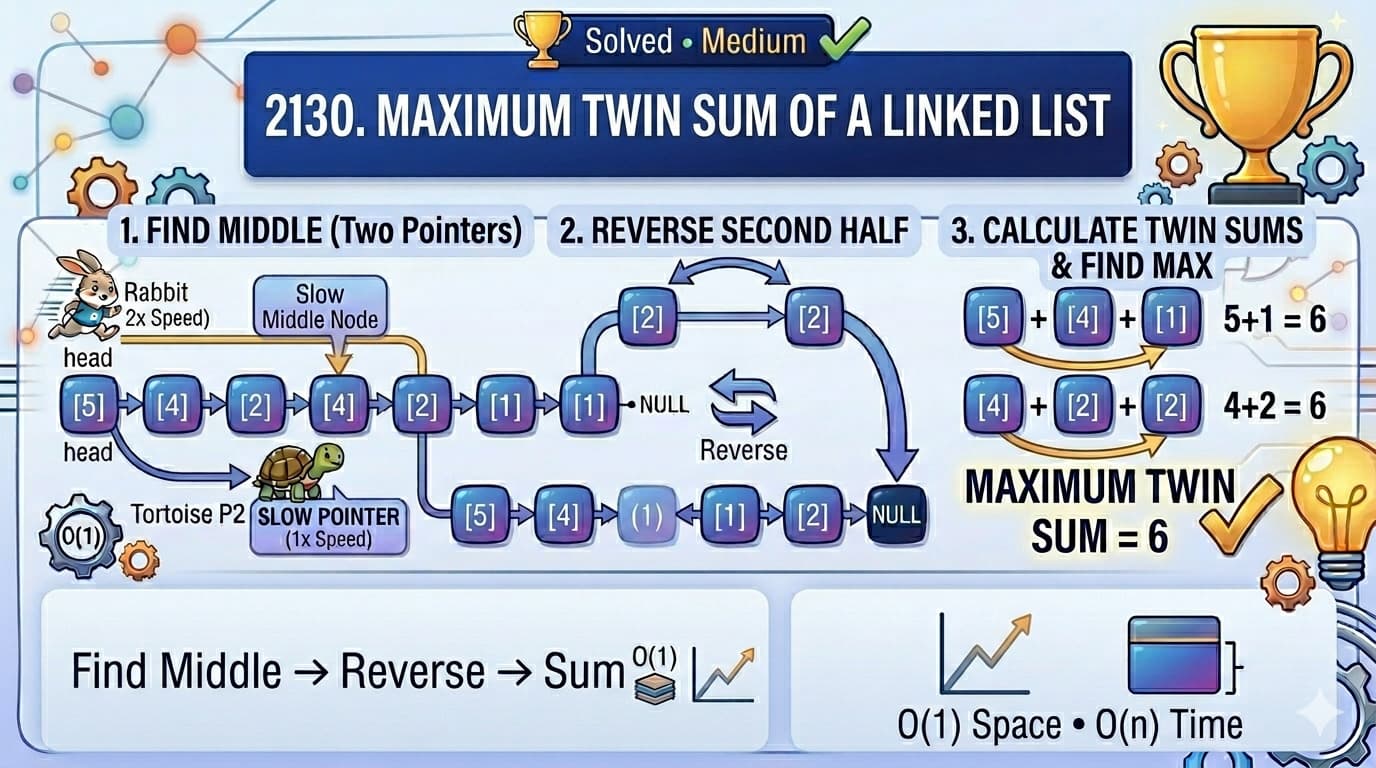
Maximum Twin Sum of a Linked List (LeetCode 2130) — Intuition, Dry Run & Optimal Approach

Maximum Twin Sum of a Linked List (LeetCode 2130) — Intuition, Dry Run & Optimal Approach

🔗 Try This ProblemPractice here:https://leetcode.com/problems/maximum-twin-sum-of-a-linked-list/📌 Problem OverviewYou are given a linked list of even length.Each node has a twin node defined as:Node at index i → Twin is at index (n - 1 - i)👉 Example (n = 4):Index 0 ↔ Index 3Index 1 ↔ Index 2The twin sum is:node[i] + node[n - 1 - i]🎯 Goal:Return the maximum twin sum among all such pairs.🧠 Understanding the ProblemLet’s take a simple example:Input: [4, 2, 2, 3]Pairs:4 + 3 = 72 + 2 = 4👉 So the answer is:7💡 Intuition — How to Think About This ProblemAt first glance, it feels like we need to access:First nodeLast nodeSecond nodeSecond last node👉 This naturally suggests:Two-directional accessBut linked lists don’t allow backward traversal🤔 Possible Thinking Patterns🔹 Idea 1: Use Extra SpaceStore values in an arrayUse two pointers from both ends✔ Works❌ But uses extra space O(n)🔹 Idea 2: Work Directly on Linked List (Better)We need a way to:Reach the middleAccess second half in reverse order👉 That leads to a powerful idea:“What if we reverse the second half of the list?”Now we can compare:First half (forward)Second half (also forward after reversal)🎥 Visual Intuition (Your Explanation Video)👉 In this section, focus only on:ConceptVisualizationThought process❌ Avoid code here✔ Build understanding⚙️ Optimized Approach (Step-by-Step)Step 1: Find MiddleUse two pointers:slow → moves 1 stepfast → moves 2 steps👉 When fast reaches end → slow is at middleStep 2: Reverse Second HalfStart from:slow.nextReverse the listStep 3: Compare Twin PairsNow:One pointer → start of listOne pointer → start of reversed halfCalculate:sum = left.val + right.valTrack maximum🧪 Dry RunExample:Input: [5, 4, 2, 1]Step 1: Find MiddleSlow → 4Fast → EndStep 2: Reverse Second HalfSecond half: 2 → 1Reversed: 1 → 2Step 3: Compare5 + 1 = 64 + 2 = 6✅ Maximum = 6💻 Optimized Code (Java)class Solution {public ListNode reverse(ListNode head){ListNode curr = head;ListNode prev = null;while(curr != null){ListNode next = curr.next;curr.next = prev;prev = curr;curr = next;}return prev;}public int pairSum(ListNode head) {ListNode slow = head;ListNode fast = head;// Find middlewhile(fast.next != null && fast.next.next != null){slow = slow.next;fast = fast.next.next;}// Reverse second halfListNode secondHalf = reverse(slow.next);// Compare pairsListNode firstHalf = head;int max = Integer.MIN_VALUE;while(secondHalf != null){int sum = firstHalf.val + secondHalf.val;max = Math.max(max, sum);firstHalf = firstHalf.next;secondHalf = secondHalf.next;}return max;}}⏱️ Complexity AnalysisTypeValueTime ComplexityO(n)Space ComplexityO(1)🧩 Key TakeawaysLinked list problems often require restructuring instead of extra spaceReversing half is a powerful trickFast & slow pointer is essential for mid-finding🏁 Final ThoughtsThis problem is a perfect example of:Combining multiple conceptsOptimizing spaceThinking beyond direct access👉 Once you understand this pattern, many linked list problems become easier.

LeetcodeMediumLinkedListFast and Slow Pointer
LeetCode 234: Palindrome Linked List (Java) | Intuition, Dry Run & O(1) Space Solution

LeetCode 234: Palindrome Linked List (Java) | Intuition, Dry Run & O(1) Space Solution

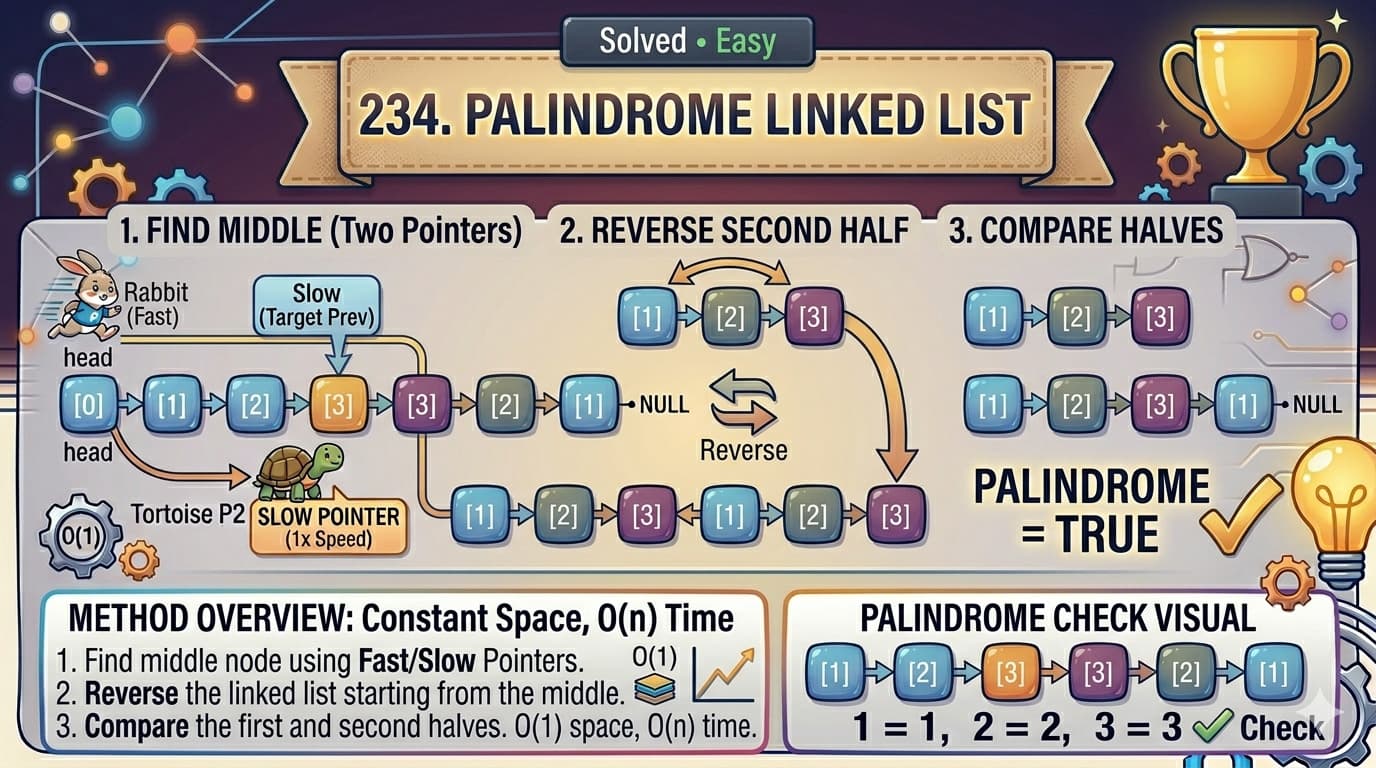
🧩 Problem OverviewGiven the head of a singly linked list, determine whether it is a palindrome.A palindrome means the sequence reads the same forward and backward.Example:Input: [1,2,2,1] → Output: trueInput: [1,2] → Output: false🎯 Why This Problem MattersThis problem tests:Linked list traversalTwo-pointer technique (slow & fast)In-place reversalIt’s a must-know pattern for interviews.🧠 IntuitionA simple approach is to copy elements into an array and check for palindrome.But that uses extra space O(n).Optimal Idea:We can solve this in O(1) space by:Finding the middle of the linked listReversing the second halfComparing both halves🎥 Dry Run (Step-by-Step Explanation)👉 Watch the complete dry run and pointer movement below:This video explains how slow and fast pointers work and how the comparison is performed.⚙️ ApproachStep 1: Handle Edge CasesIf list has one node → return trueStep 2: Find MiddleUse slow and fast pointersFast moves 2 steps, slow moves 1Step 3: Reverse Second HalfReverse the list starting from the middleStep 4: Compare Both HalvesCompare values from:start of liststart of reversed half💻 Java Solutionclass Solution {public ListNode reverse(ListNode head) {ListNode curr = head;ListNode prev = null;while (curr != null) {ListNode next = curr.next;curr.next = prev;prev = curr;curr = next;}return prev;}public boolean isPalindrome(ListNode head) {if (head == null) return false;if (head.next == null) return true;ListNode slow = head;ListNode fast = head;// Find middlewhile (fast != null && fast.next != null) {fast = fast.next.next;slow = slow.next;}// Reverse second halfListNode secondHalf = reverse(slow);// Compare both halvesListNode firstHalf = head;while (secondHalf != null) {if (secondHalf.val != firstHalf.val) {return false;}secondHalf = secondHalf.next;firstHalf = firstHalf.next;}return true;}}🔍 Dry Run (Quick Summary)Example:1 → 2 → 2 → 1Middle foundSecond half reversedCompare values one by oneResult → Palindrome ✅⏱️ Time and Space ComplexityTime Complexity: O(n)Space Complexity: O(1)⚠️ Edge CasesSingle nodeTwo nodesOdd length listEven length list💡 Key TakeawaysFast & slow pointer technique is essentialReversing linked list is a reusable patternHelps optimize space complexity🚀 Final ThoughtsThis is a classic interview problem combining multiple linked list techniques.Make sure you understand:Pointer movementReversal logicComparison step👉 For full clarity, don’t skip the video explanation above.

LinkedListFast and Slow PointerPalindromeEasy
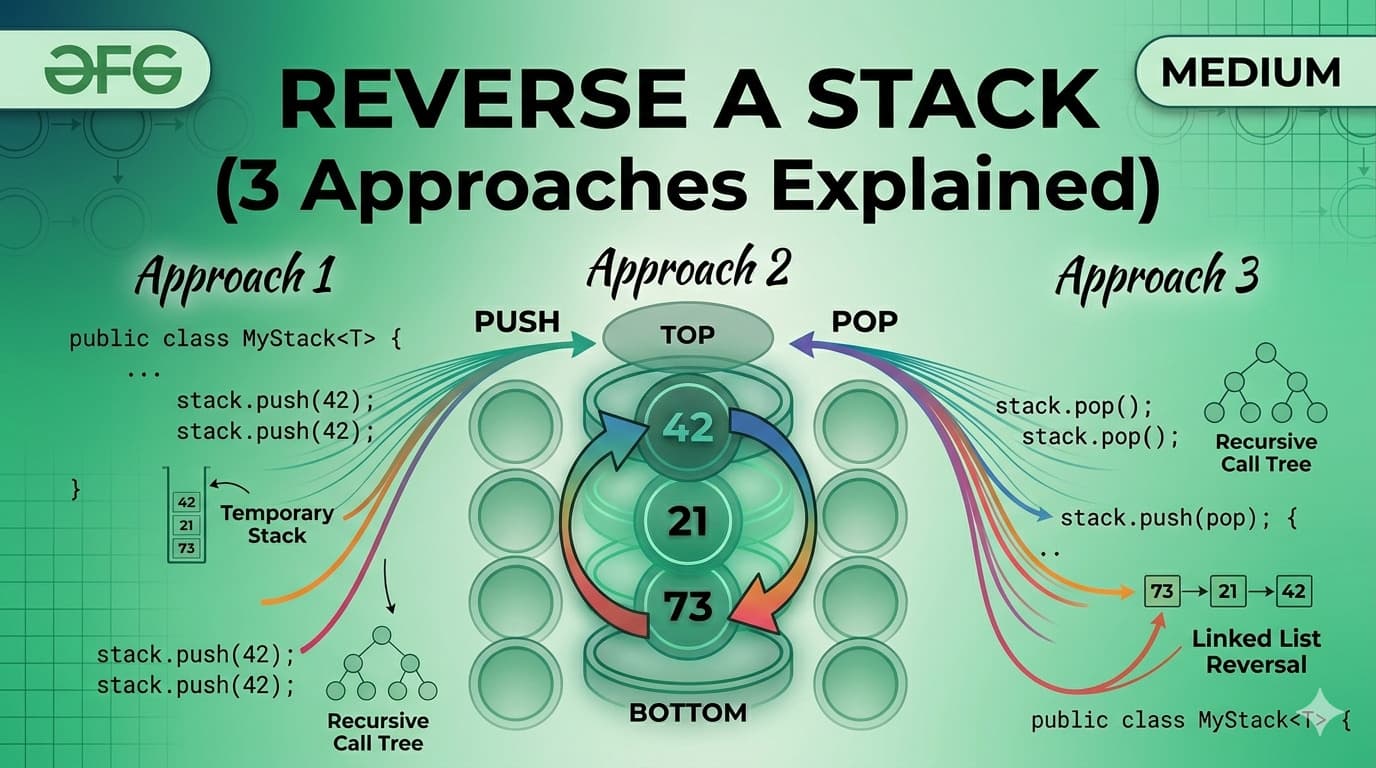
Reverse a Stack — GFG Problem Solved (3 Approaches Explained)

Reverse a Stack — GFG Problem Solved (3 Approaches Explained)

What Is This Problem About?This is a classic stack problem from GeeksForGeeks — "Reverse a Stack" (Medium | 4 Points). You can find it on GFG by Reverse a Stack.You are given a stack. Your job is simple — reverse it. The element that was at the bottom should now be at the top, and vice versa.Example:Input: [1, 2, 3, 4] → bottom to top, so 4 is on topOutput: [1, 2, 3, 4] → after reversal, 1 is on topWait — the input and output look the same? That is because GFG displays the result top to bottom after reversal. So after reversing, 1 comes to the top, and printing top to bottom gives [1, 2, 3, 4]. The stack is indeed reversed internally.Approach 1 — Using Two Extra StacksIntuition: Pop everything from the original stack into Stack 1 — this reverses the order once. Then pop everything from Stack 1 into Stack 2 — this reverses it again, back to original order. Now push everything from Stack 2 back into the original stack. The result? The original stack is reversed.Why does this work? Two reversals cancel each other out to give you... wait, that sounds wrong. Let us trace it:Original: [1, 2, 3, 4] → top is 4After → S1: [4, 3, 2, 1] → top is 1After → S2: [1, 2, 3, 4] → top is 4Push S2 back → st: [1, 2, 3, 4] → top is 4Hmm, that brings it back to the same thing. This approach with two stacks actually does NOT work correctly — it ends up restoring the original order. This is why the approach was commented out in the original code. Good observation to catch in an interview.Lesson: Two full reversals = no change. One reversal = what we want. Keep this in mind.Approach 2 — Using an ArrayList (Clean & Simple) ✅Intuition: Pop all elements from the stack into an ArrayList. At this point, the ArrayList holds elements in reverse order (because popping reverses). Then push them back from index 0 to end. This is the clean, working solution.Stack: [1, 2, 3, 4] → top is 4Pop into ArrayList: [4, 3, 2, 1]Push back index 0→end: push 4 → st: [4] push 3 → st: [4, 3] push 2 → st: [4, 3, 2] push 1 → st: [4, 3, 2, 1] → top is now 1 ✓The stack is now reversed. 1 is on top.public static void reverseStack(Stack<Integer> st) { if (st.empty()) return; ArrayList<Integer> list = new ArrayList<>(); // Pop all elements — goes in reverse order into list while (!st.empty()) { list.add(st.pop()); } // Push back from index 0 — restores in reversed order for (int i = 0; i < list.size(); i++) { st.push(list.get(i)); }}Time Complexity: O(n) — one pass to pop, one pass to push.Space Complexity: O(n) — for the ArrayList.Why this works: When you pop all elements into a list, the top element (last inserted) goes to index 0. When you push back from index 0, that element goes in first and ends up at the bottom. The bottom element (first inserted) was popped last, sits at the end of the list, and gets pushed last — ending up on top. That is a perfect reversal.Approach 3 — Using Recursion (No Extra Space) ✅This is the most elegant approach and the one interviewers love to ask about.Intuition: Use two recursive functions:reverseStack — pops the top element, recursively reverses the rest, then inserts the popped element at the bottom.insertAtBottom — holds all elements out while inserting one element at the very bottom, then restores everything.// Insert an item at the bottom of the stackstatic void insertAtBottom(Stack<Integer> st, int item) { if (st.empty()) { st.push(item); return; } int top = st.pop(); insertAtBottom(st, item); st.push(top);}// Reverse the stackpublic static void reverseStack(Stack<Integer> st) { if (st.empty()) return; int top = st.pop(); reverseStack(st); // reverse remaining stack insertAtBottom(st, top); // put popped element at the bottom}```**Dry Run with [1, 2, 3]:**```reverseStack([1,2,3]) → pop 3, reverseStack([1,2]) reverseStack([1,2]) → pop 2, reverseStack([1]) reverseStack([1]) → pop 1, reverseStack([]) base case → return insertAtBottom([], 1) → push 1 → [1] insertAtBottom([1], 2) → 2 < 1? no → pop 1, insert 2, push 1 → [2,1]insertAtBottom([2,1], 3) → pop 1, pop 2, push 3, push 2, push 1 → [3,2,1]Final stack top → 3... wait, let us recheck display.Top is 3, which was originally at bottom. ✓ Reversed!Time Complexity: O(n²) — for each of n elements, insertAtBottom takes O(n).Space Complexity: O(n) — recursive call stack.Which Approach Should You Use?ApproachTimeSpaceSimplicityInterview ValueTwo Extra Stacks❌ Does not workO(n)SimpleLowArrayListO(n)O(n)Very EasyMediumRecursionO(n²)O(n)ModerateHighFor a coding interview, always mention the recursive approach — it shows you understand stack mechanics deeply. For production code, the ArrayList approach is cleaner and faster.Key TakeawayReversing a stack is fundamentally about understanding LIFO. Because a stack only allows access from the top, you need a systematic way to invert the order — whether that is using auxiliary storage like an ArrayList, or using the call stack itself via recursion. Both are valid. Both teach you something different about how stacks behave.The next time you see a problem that involves reversing, reordering, or inserting at the bottom of a stack — your first instinct should be recursion with insertAtBottom. It is a pattern that appears again and again in DSA.And if you want to understand Stack from Scratch?If you are just getting started with stacks or want a complete reference — I have written a detailed in-depth guide on the Stack Data Structure in Java covering everything from what a stack is, how LIFO works, all three implementations (Array, ArrayList, LinkedList), every operation explained with code, time complexity, advantages, disadvantages, real-world use cases, and six practice problems with full solutions.Check it out here → Stack Data Structure in Java: The Complete GuideIt is the perfect companion to this problem walkthrough — start there if you want the full picture, then come back here for the problem-solving side.

StackProblemsJavaMediumGeeksForGeeksReverseStack
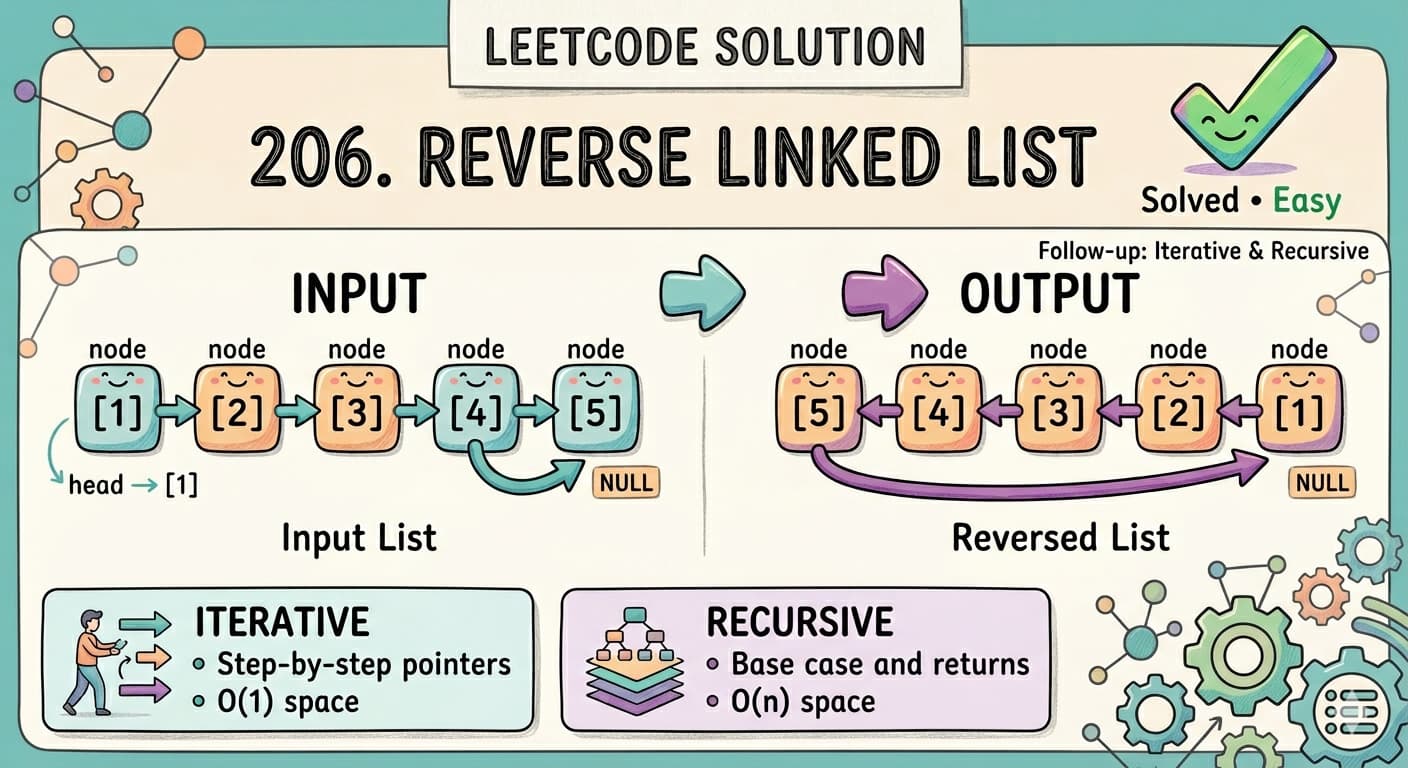
Reverse LinkedList (LeetCode 206) – The One Trick That Changes Everything

Reverse LinkedList (LeetCode 206) – The One Trick That Changes Everything

🚀 Try the ProblemPractice here:https://leetcode.com/problems/reverse-linked-list/🤔 Let’s Start With a Simple Question…What happens if you take this:1 → 2 → 3 → 4 → 5…and try to reverse it?You want:5 → 4 → 3 → 2 → 1Sounds easy, right?But here’s the catch:👉 You can only move forward in a linked list👉 There is no backward pointerSo how do we reverse something that only goes one way?🧠 The Core Problem (In Simple Words)You are given the head of a linked list.👉 Reverse the list👉 Return the new head📦 Constraints0 <= number of nodes <= 5000-5000 <= Node.val <= 5000🔍 Before Jumping to Code — Think Like ThisWhen solving this, your brain might go:Can I store values somewhere and reverse? ❌ (extra space)Can I rebuild the list? ❌ (unnecessary)Can I just change links? ✅ (YES, THIS IS THE KEY)⚡ The Breakthrough Idea👉 Instead of moving nodes👉 We reverse the direction of pointers🎯 Visual Intuition (Very Important)Let’s take:1 → 2 → 3 → 4 → nullWe want:null ← 1 ← 2 ← 3 ← 4But how?🧩 The 3-Pointer Magic TrickWe use 3 pointers:prev → stores previous nodecurr → current nodenext → stores next node🔄 Step-by-Step TransformationInitial State:prev = nullcurr = 1 → 2 → 3 → 4Step 1:Save next nodeReverse linkf = 21 → nullMove pointers:prev = 1curr = 2Step 2:f = 32 → 1Move:prev = 2curr = 3Continue…Eventually:4 → 3 → 2 → 1 → null💡 Final Insight👉 Each step reverses one link👉 At the end, prev becomes the new head✅ Clean Java Code (Iterative Approach)class Solution {public ListNode reverseList(ListNode head) {// Previous pointer starts as nullListNode prev = null;// Current pointer starts from headListNode curr = head;while (curr != null) {// Store next nodeListNode f = curr.next;// Reverse the linkcurr.next = prev;// Move prev forwardprev = curr;// Move curr forwardcurr = f;}// New head is prevreturn prev;}}⏱️ ComplexityTime ComplexityO(n)We traverse the list once.Space ComplexityO(1)No extra space used.🔁 Another Way: Recursive ApproachNow let’s think differently…👉 What if we reverse the rest of the list first, then fix the current node?🧠 Recursive IdeaFor:1 → 2 → 3 → 4We:Reverse from 2 → 3 → 4Then fix 1💻 Recursive Codeclass Solution {public ListNode reverseList(ListNode head) {// Base caseif(head == null || head.next == null)return head;// Reverse restListNode newHead = reverseList(head.next);// Fix current nodehead.next.next = head;head.next = null;return newHead;}}⚖️ Iterative vs RecursiveApproachProsConsIterativeFast, O(1) spaceSlightly tricky to understandRecursiveElegant, clean logicUses stack (O(n) space)❌ Common MistakesForgetting to store next nodeLosing reference to rest of listNot updating pointers correctlyReturning wrong node🔥 Real Interview InsightThis problem is not just about reversing a list.It teaches:👉 Pointer manipulation👉 In-place updates👉 Thinking in steps👉 Breaking problems into small operations🧠 Final ThoughtAt first, this problem feels tricky…But once you understand this line:curr.next = prev👉 Everything clicks.🚀 ConclusionThe Reverse Linked List problem is one of the most important foundational problems in DSA.Mastering it will:Boost your confidenceStrengthen pointer logicHelp in many advanced problems👉 Tip: Practice this until you can visualize pointer movement in your head — that’s when you truly master linked lists.

Linked ListPointer ManipulationIterative ApproachRecursionLeetCodeEasy
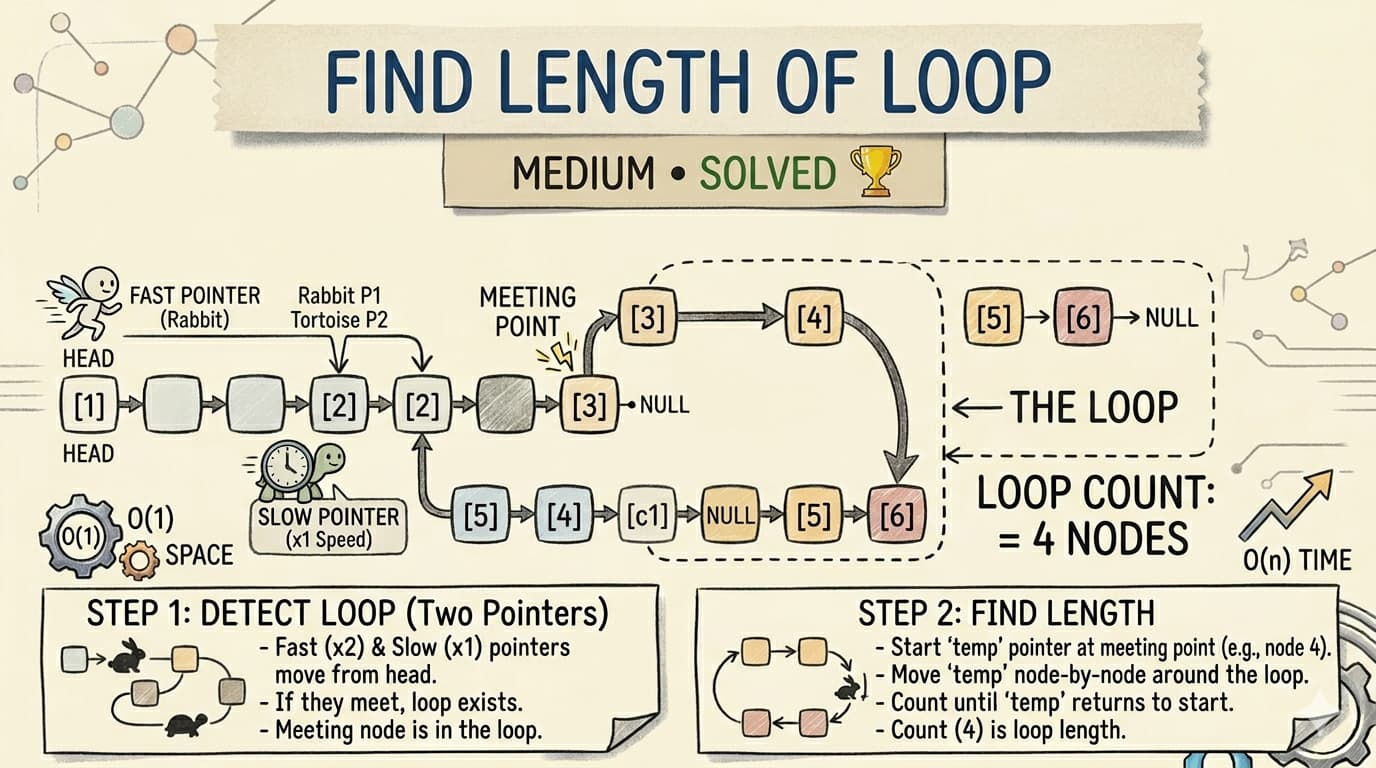
Find Length of Loop in Linked List — Complete Guide with Intuition, Dry Run & Floyd’s Cycle Algorithm

Find Length of Loop in Linked List — Complete Guide with Intuition, Dry Run & Floyd’s Cycle Algorithm

🔗 Try This ProblemPractice here:GeeksforGeeks link📌 Problem OverviewYou are given the head of a singly linked list.Your task is:Detect whether a loop (cycle) existsIf a loop exists → return the length of the loopIf no loop exists → return 0🧠 Understanding the ProblemA loop in a linked list means:👉 A node’s next pointer is pointing to a previous node, forming a cycle.Example1 → 2 → 3 → 4 → 5↑ ↓← ← ← ←Here:Loop starts at node 3Loop nodes = 3 → 4 → 5Loop length = 3💡 Intuition — How to Think About This ProblemThere are two main challenges:🔹 1. Detect if a loop exists🔹 2. Find the length of that loop🤔 Brute Force ThinkingStore visited nodes in a HashSetIf node repeats → loop detected✔ Works❌ Extra space O(n)🚀 Optimized Thinking (Floyd’s Cycle Detection)We use:Slow pointer → moves 1 stepFast pointer → moves 2 steps🧠 Key Idea👉 If a loop exists:Fast pointer will eventually meet slow pointer👉 If no loop:Fast pointer reaches null🎥 Visual Intuition & Dry Run⚙️ Optimized Approach (Step-by-Step)Step 1: Detect LoopInitialize:slow = headfast = headMove:slow → 1 stepfast → 2 stepsIf:slow == fast → loop existsStep 2: Find Length of LoopOnce loop is detected:Keep one pointer fixedMove another pointer until it comes backCount stepsWhy This Works?Because:Inside a loop, traversal becomes circularSo eventually, we will return to the same node🧪 Dry Run (Manual Understanding)Example:Loop: 3 → 4 → 5 → 3Step 1: Detect LoopSlow and fast meet inside loopStep 2: Count Loop LengthStart from meeting point:Move one pointer:3 → 4 → 5 → 3Count = 3💻 Code (Java)class Solution {public int lengthOfLoop(Node head) {Node slow = head;Node fast = head;// Step 1: Detect loopwhile(fast != null && fast.next != null){slow = slow.next;fast = fast.next.next;if(fast == slow){// Step 2: Count loop lengthint length = 1;Node temp = slow.next;while(temp != slow){temp = temp.next;length++;}return length;}}return 0; // No loop}}⏱️ Complexity AnalysisTypeValueTime ComplexityO(n)Space ComplexityO(1)🔍 Deep Insight — Why Fast Meets Slow?Fast moves twice as fast as slowInside a loop → paths become circularDifference in speed guarantees collision👉 This is a mathematical certainty in cyclic structures⚠️ Edge CasesNo loop → return 0Single node loop → return 1Large loop → still works efficiently🧩 Key TakeawaysFloyd’s Cycle Detection is powerfulLoop detection + loop length can be done in one traversalNo extra space needed🏁 Final ThoughtsThis problem is a classic linked list concept and very important for interviews.👉 Once you master this:Detect cycleFind loop lengthFind loop starting nodeAll become easier.

GeeksforGeeksLinkedListMediumFast and Slow Pointer
Ai Assistant Kas