Search Blogs

Showing results for "LeetCode Easy"

Found 30 results

LeetCode 20: Valid Parentheses — Java Solution Explained

LeetCode 20: Valid Parentheses — Java Solution Explained

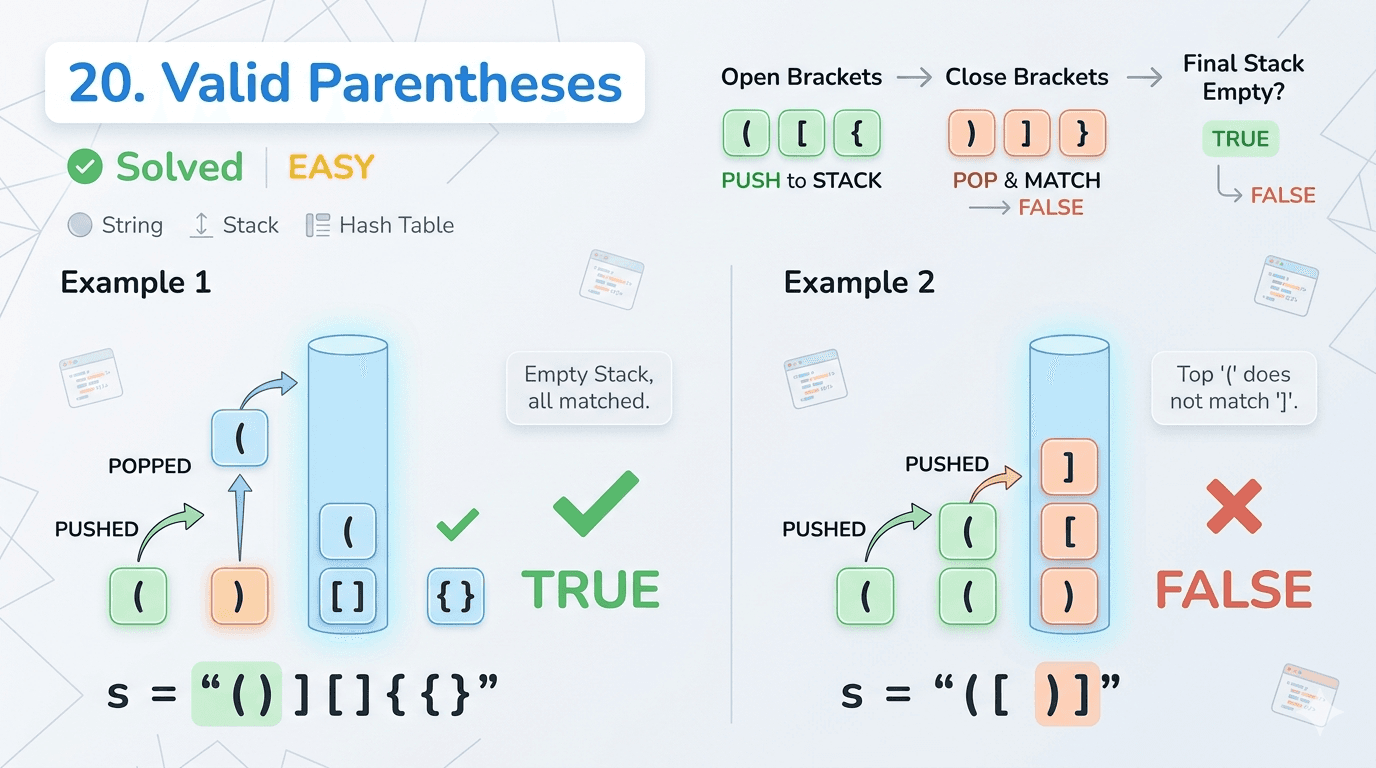
IntroductionLeetCode 20 Valid Parentheses is arguably the single most asked Easy problem in coding interviews. It appears at Google, Amazon, Microsoft, Meta, and virtually every company that does technical interviews. It is the textbook introduction to the Stack data structure and teaches you a pattern that shows up in compilers, code editors, HTML parsers, and mathematical expression evaluators.Here is the Link of Question -: LeetCode 20In this article we cover plain English explanation, real life analogy, the optimal stack solution with detailed dry run, all tricky edge cases, complexity analysis, common mistakes, and FAQs.What Is the Problem Really Asking?You are given a string containing only bracket characters — (, ), {, }, [, ]. You need to check if the brackets are correctly matched and nested.Three rules must hold:Every opening bracket must be closed by the same type of closing bracketBrackets must be closed in the correct order — the most recently opened must be closed firstEvery closing bracket must have a corresponding opening bracketReal Life Analogy — Russian Nesting DollsThink of Russian nesting dolls. You open the biggest doll first, then a medium one inside it, then a small one inside that. To close them back, you must close the smallest first, then medium, then biggest. You cannot close the biggest doll while the smallest is still open inside.That is exactly how brackets work. The last opened bracket must be the first one closed. This Last In First Out behavior is precisely what a Stack is built for.Another analogy — think of a text editor like VS Code. When you type (, it automatically adds ). If you try to close with ] instead, the editor highlights an error. This problem is essentially building that validation logic.The Only Approach You Need: StackThe IdeaScan the string left to rightIf you see an opening bracket → push it onto the stackIf you see a closing bracket → check the top of the stack. If the top is the matching opening bracket, pop it. Otherwise the string is invalid.At the end, if the stack is empty → all brackets matched → return true. If stack still has elements → some brackets were never closed → return false.public boolean isValid(String s) {if (s.length() == 1) return false; // single char can never be validStack<Character> st = new Stack<>();for (int i = 0; i < s.length(); i++) {char c = s.charAt(i);if (c == '(' || c == '{' || c == '[') {st.push(c); // opening bracket — push and wait for its match} else {if (!st.empty()) {// check if top of stack is the matching openerif ((c == ')' && st.peek() != '(') ||(c == '}' && st.peek() != '{') ||(c == ']' && st.peek() != '[')) {return false; // wrong type of closing bracket} else {st.pop(); // matched! remove the opener}} else {return false; // closing bracket with nothing open}}}return st.empty(); // true only if all openers were matched}Detailed Dry Run — s = "([)]"This is the trickiest example. Looks balanced at first glance but is actually invalid.( → opening, push → stack: [(][ → opening, push → stack: [(, []) → closing, peek is [, but ) needs ( → mismatch → return false ✅The stack correctly catches that [ was opened after ( but we tried to close ( before closing [ — wrong order!Dry Run — s = "([{}])"( → push → stack: [(][ → push → stack: [(, []{ → push → stack: [(, [, {]} → peek is {, match! pop → stack: [(, []] → peek is [, match! pop → stack: [(]) → peek is (, match! pop → stack: []Stack is empty → return true ✅Dry Run — s = "(["( → push → stack: [(][ → push → stack: [(, []Loop ends. Stack is NOT empty → return false ✅Two brackets were opened but never closed.All the Edge Cases You Must KnowSingle character like "(" or ")" A single character can never be valid — an opener has nothing to close it, a closer has nothing before it. The early return if (s.length() == 1) return false handles this cleanly.Only closing brackets like "))" The stack is empty when the first ) arrives → return false immediately.Only opening brackets like "(((" All get pushed, nothing gets popped, stack is not empty at end → return false.Interleaved wrong types like "([)]" Caught by the mismatch check when the closing bracket does not match the stack top.Empty string Stack stays empty → st.empty() returns true → returns true. An empty string is technically valid since there are no unmatched brackets. The constraints say length ≥ 1 so this is just good to know.A Cleaner Variation Using HashMapSome developers prefer using a HashMap to store bracket pairs, making the matching condition more readable:public boolean isValid(String s) {Stack<Character> st = new Stack<>();Map<Character, Character> map = new HashMap<>();map.put(')', '(');map.put('}', '{');map.put(']', '[');for (char c : s.toCharArray()) {if (map.containsKey(c)) {// closing bracketif (st.empty() || st.peek() != map.get(c)) {return false;}st.pop();} else {st.push(c); // opening bracket}}return st.empty();}The HashMap maps each closing bracket to its expected opening bracket. This makes adding new bracket types trivial — just add one line to the map. Great for extensibility in real world code.Both versions are O(n) time and O(n) space. Choose whichever feels more readable to you.Time Complexity: O(n) — single pass through the string Space Complexity: O(n) — stack holds at most n/2 opening bracketsWhy Stack Is the Perfect Data Structure HereThe key property this problem exploits is LIFO — Last In First Out. The most recently opened bracket must be the first one closed. That is literally the definition of a stack's behavior.Any time you see a problem where the most recently seen item determines what comes next — think Stack immediately. Valid Parentheses is the purest example of this principle.How This Fits Into the Bigger Stack PatternLooking at everything you have solved so far, notice the pattern evolution:844 Backspace String Compare — # pops the last character 1047 Remove Adjacent Duplicates — matching character pops itself 2390 Removing Stars — * pops the last character 3174 Clear Digits — digit pops the last character 20 Valid Parentheses — closing bracket pops its matching openerAll of these are stack simulations. The difference here is that instead of any character being popped, only the correct matching opener is popped. This matching condition is what makes Valid Parentheses a step up in logic from the previous problems.Common Mistakes to AvoidNot checking if stack is empty before peeking If a closing bracket arrives and the stack is empty, calling peek() throws an EmptyStackException. Always check !st.empty() before peeking or popping.Returning true without checking if stack is empty Even if the loop completes without returning false, unclosed openers remain on the stack. Always return st.empty() at the end, not just true.Pushing closing brackets onto the stack Only push opening brackets. Pushing closing brackets gives completely wrong results and is the most common beginner mistake.Not handling odd length strings If s.length() is odd, it is impossible for all brackets to be matched — you can add if (s.length() % 2 != 0) return false as an early exit for a small optimization.FAQs — People Also AskQ1. Why is a Stack used to solve Valid Parentheses? Because the problem requires LIFO matching — the most recently opened bracket must be the first one closed. Stack's Last In First Out behavior maps perfectly to this requirement, making it the natural and optimal data structure choice.Q2. What is the time complexity of LeetCode 20? O(n) time where n is the length of the string. We make a single pass through the string, and each character is pushed and popped at most once. Space complexity is O(n) in the worst case when all characters are opening brackets.Q3. Can LeetCode 20 be solved without a Stack? Technically yes for simple cases using counters, but only when dealing with a single type of bracket. With three types of brackets that can be nested, a Stack is the only clean solution. Counter-based approaches break down on cases like "([)]".Q4. Is LeetCode 20 asked in FAANG interviews? Absolutely. It is one of the most commonly asked problems across all major tech companies. It tests understanding of the Stack data structure and is often used as a warmup before harder stack problems like Largest Rectangle in Histogram or Decode String.Q5. What happens if the input string has an odd length? An odd-length string can never be valid since brackets always come in pairs. You can add if (s.length() % 2 != 0) return false as an early optimization, though the stack logic handles this correctly on its own.Similar LeetCode Problems to Practice Next1047. Remove All Adjacent Duplicates In String — Easy — stack pattern with characters394. Decode String — Medium — nested brackets with encoding678. Valid Parenthesis String — Medium — wildcards added32. Longest Valid Parentheses — Hard — longest valid substring1249. Minimum Remove to Make Valid Parentheses — Medium — remove minimum brackets to make validConclusionLeetCode 20 Valid Parentheses is the definitive introduction to the Stack data structure in competitive programming and technical interviews. The logic is elegant — push openers, pop on matching closers, check empty at the end. Three rules, one data structure, one pass.Master this problem thoroughly, understand every edge case, and you will have a rock-solid foundation for every stack problem that follows — from Decode String to Largest Rectangle in Histogram.
StringStackEasyLeetCode
Left and Right Sum Differences

Left and Right Sum Differences

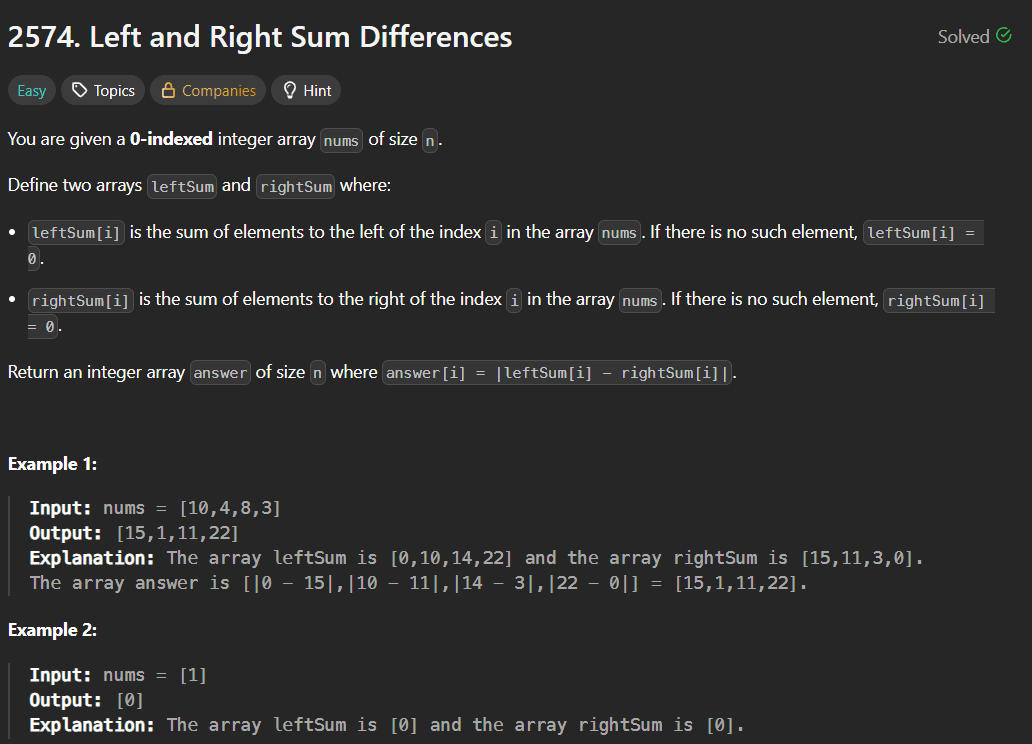
LeetCode 2574: Left and Right Sum Differences (Java)The Left and Right Sum Difference problem is a classic array manipulation challenge. It tests your ability to efficiently calculate prefix and suffix values—a skill essential for more advanced algorithms like "Product of Array Except Self."🔗 ResourcesProblem Link: LeetCode 2574 - Left and Right Sum Differences📝 Problem StatementYou are given a 0-indexed integer array nums. You need to return an array answer of the same length where:answer[i] = |leftSum[i] - rightSum[i]|leftSum[i] is the sum of elements to the left of index i.rightSum[i] is the sum of elements to the right of index i.💡 Approach 1: The Three-Array Method (Beginner Friendly)This approach is highly intuitive. We pre-calculate all left sums and all right sums in separate arrays before computing the final difference.The LogicPrefix Array: Fill pref[] by adding the previous element to the cumulative sum.Suffix Array: Fill suff[] by iterating backward from the end of the array.Result: Loop one last time to calculate Math.abs(pref[i] - suff[i]).Java Implementationpublic int[] leftRightDifference(int[] nums) {int n = nums.length;int[] pref = new int[n];int[] suff = new int[n];int[] ans = new int[n];// Calculate Left Sums (Prefix)for (int i = 1; i < n; i++) {pref[i] = pref[i - 1] + nums[i - 1];}// Calculate Right Sums (Suffix)for (int i = n - 2; i >= 0; i--) {suff[i] = suff[i + 1] + nums[i + 1];}// Combine resultsfor (int i = 0; i < n; i++) {ans[i] = Math.abs(pref[i] - suff[i]);}return ans;}Time Complexity: O(n)Space Complexity: O(n) (Uses extra space for pref and suff arrays).🚀 Approach 2: The Running Sum Method (Space Optimized)In technical interviews, you should aim for O(1) extra space. Instead of storing every suffix sum, we calculate the Total Sum first and derive the right sum using logic.The LogicWe use the mathematical property:Right Sum = Total Sum - Left Sum - Current ElementBy maintaining a single variable leftSum that updates as we iterate, we can calculate the result using only the output array.Java Implementationpublic int[] leftRightDifference(int[] nums) {int n = nums.length;int[] ans = new int[n];int totalSum = 0;int leftSum = 0;// 1. Get the total sum of all elementsfor (int num : nums) {totalSum += num;}// 2. Calculate rightSum and difference on the flyfor (int i = 0; i < n; i++) {int rightSum = totalSum - leftSum - nums[i];ans[i] = Math.abs(leftSum - rightSum);// Update leftSum for the next indexleftSum += nums[i];}return ans;}Time Complexity: O(n)Space Complexity: O(1) (Excluding the output array).📊 Summary ComparisonFeatureApproach 1Approach 2Space ComplexityO(n) (Higher)O(1) (Optimal)Logic TypeStorage-basedMathematicalUse CaseBeginnersInterviewsKey TakeawayWhile Approach 1 is easier to visualize, Approach 2 is more professional. It shows you can handle data efficiently without unnecessary memory allocation, which is critical when dealing with large-scale systems.

LeetCodePrefixSuffix
Range Sum Query - Immutable

Range Sum Query - Immutable

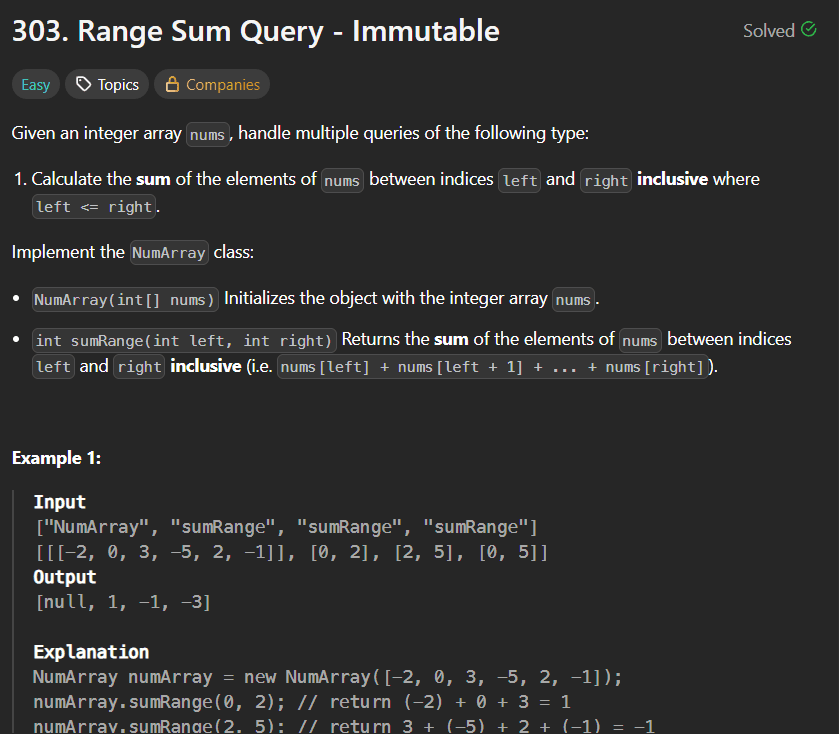
LeetCode Problem 303Link of the Problem to try -: LinkGiven an integer array nums, handle multiple queries of the following type:Calculate the sum of the elements of nums between indices left and right inclusive where left <= right.Implement the NumArray class:NumArray(int[] nums) Initializes the object with the integer array nums.int sumRange(int left, int right) Returns the sum of the elements of nums between indices left and right inclusive (i.e. nums[left] + nums[left + 1] + ... + nums[right]).Example 1:Input["NumArray", "sumRange", "sumRange", "sumRange"][[[-2, 0, 3, -5, 2, -1]], [0, 2], [2, 5], [0, 5]]Output[null, 1, -1, -3]ExplanationNumArray numArray = new NumArray([-2, 0, 3, -5, 2, -1]);numArray.sumRange(0, 2); // return (-2) + 0 + 3 = 1numArray.sumRange(2, 5); // return 3 + (-5) + 2 + (-1) = -1numArray.sumRange(0, 5); // return (-2) + 0 + 3 + (-5) + 2 + (-1) = -3Constraints:1 <= nums.length <= 104-105 <= nums[i] <= 1050 <= left <= right < nums.lengthAt most 104 calls will be made to sumRange.Solution:Efficient Range Sum Queries using Prefix SumsWhile this problem may initially seem challenging, the solution is remarkably elegant. The key is to shift the heavy lifting from the query phase to the initialization phase using a Prefix Sum array.The StrategyInstead of calculating the sum from scratch every time a range is requested, we use two steps:The Constructor: During initialization, we create a Prefix Sum array. Each index i in this new array stores the cumulative sum of all elements from the beginning of the original array up to i.The sumRange Method: To find the sum between a left and right pointer, we simply use the precalculated values. The sum of the range is calculated as:Sum(left, right) = PrefixSum[right] - PrefixSum[left - 1]Why This is BetterBy pre-calculating the sums in the constructor, we transform the sumRange operation from a slow O(n) search into a lightning-fast O(1) constant-time lookup. This approach is highly efficient for applications where the data remains the same but the number of queries is high.Code:class NumArray {int[] ans ;public NumArray(int[] nums) {ans = new int[nums.length];int pre =0;for(int i=0;i<nums.length;i++){pre += nums[i];ans[i] = pre;}}public int sumRange(int left, int right) {if(left == 0) return ans[right];return ans[right]-ans[left-1];}}/*** Your NumArray object will be instantiated and called as such:* NumArray obj = new NumArray(nums);* int param_1 = obj.sumRange(left,right);*/

LeetCodeEasyPrefix Sum
Intersection of Two Arrays II

Intersection of Two Arrays II

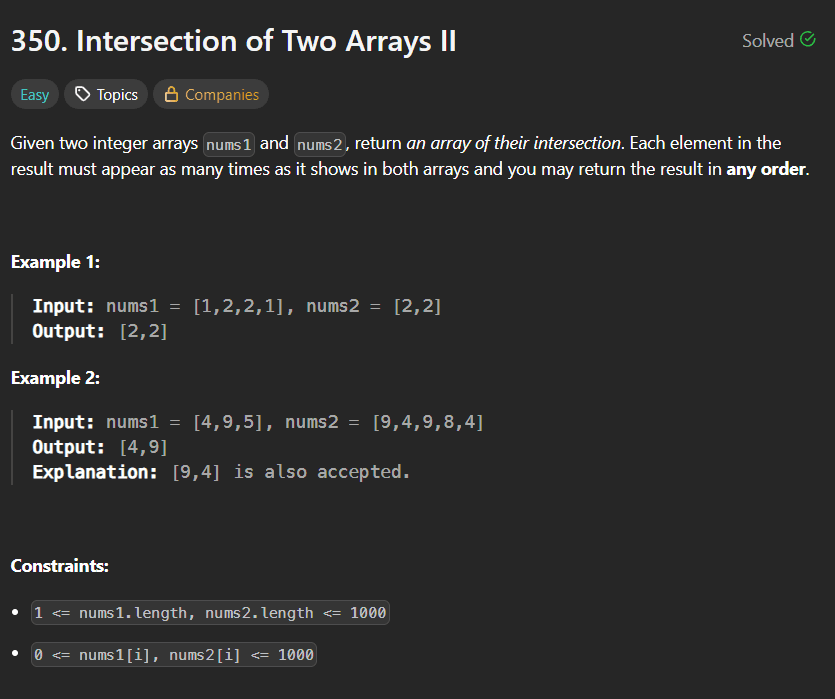
LeetCode Problem 350Link of the Problem to try -: LinkGiven two integer arrays nums1 and nums2, return an array of their intersection. Each element in the result must appear as many times as it shows in both arrays and you may return the result in any order. Example 1:Input: nums1 = [1,2,2,1], nums2 = [2,2]Output: [2,2]Example 2:Input: nums1 = [4,9,5], nums2 = [9,4,9,8,4]Output: [4,9]Explanation: [9,4] is also accepted. Constraints:1 <= nums1.length, nums2.length <= 10000 <= nums1[i], nums2[i] <= 1000Solution:In this question we can build a frequency HashMap of each element and then add into the array as per it's frequency is that is a very important thing in this question to do.For creating frequency we will use getOrDefault() method in HashMap that is very useful for creating frequency as this method returns the value of that key if that key is not exist then whatever value we give that value is considered as default value for us.So, back to question here we simply create a map creating frequency of each element and if the element came again we simply increase the frequency of it then we create a ArrayList because we don't know about the size of array here so we use ArrayList after this we will iterate again on the second array and try to find that element in the map also we check it's frequency should be more than 0 and we add in the List also we decreasing the frequency of the element in the loop.At last we simply take all the elements of ArrayList and put into a array of size of that ArrayList because our questions want's ans in array that's why we have to do this step otherwise our ans is in the ArrayList and this is how we find duplicates of the number of times that element appears in both array.Code: public int[] intersect(int[] nums1, int[] nums2) { HashMap<Integer, Integer> mp = new HashMap<>(); for (int i = 0; i < nums1.length; i++) { // If you are not interested in writing getOrDefault then you can write via if statement as well // int cou =1; // if(mp.containsKey(nums1[i])){ // // int nu = mp.get(nums1[i]); // mp.put(nums1[i],mp.get(nums1[i])+1); // continue; // } // mp.put(nums1[i],cou); // Another way mp.put(nums1[i], mp.getOrDefault(nums1[i], 0) + 1); } List<Integer> lis = new ArrayList<>(); for (int i = 0; i < nums2.length; i++) { if (mp.containsKey(nums2[i]) && mp.get(nums2[i]) > 0) { lis.add(nums2[i]); } mp.put(nums2[i], mp.getOrDefault(nums2[i], 0) - 1); } int[] ans = new int[lis.size()]; for (int i = 0; i < ans.length; i++) { ans[i] = lis.get(i); } return ans; }

LeetcodeEasyHashMapHashSet
Contains Duplicate

Contains Duplicate

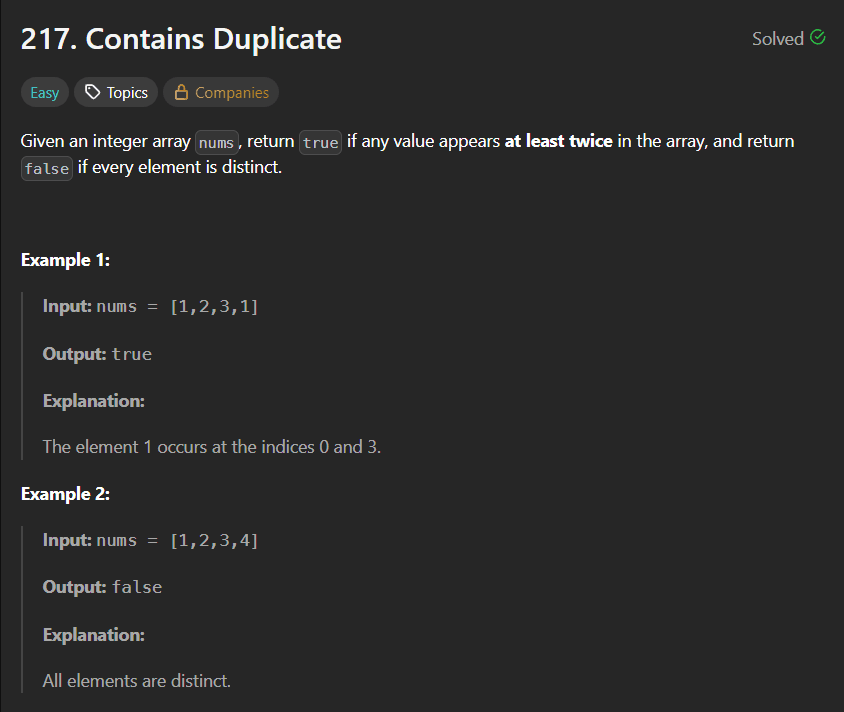
LeetCode Problem 217Link of the Problem to try -: LinkGiven an integer array nums, return true if any value appears at least twice in the array, and return false if every element is distinct.Example 1:Input: nums = [1,2,3,1]Output: trueExplanation:The element 1 occurs at the indices 0 and 3.Example 2:Input: nums = [1,2,3,4]Output: falseExplanation:All elements are distinct.Example 3:Input: nums = [1,1,1,3,3,4,3,2,4,2]Output: trueConstraints:1 <= nums.length <= 105-109 <= nums[i] <= 109Solution:1. The HashMap ApproachUsing a HashMap is a highly effective way to track occurrences. Although we are only checking for the existence of a value, the HashMap logic allows us to store the element as a "Key" and its frequency as a "Value."Logic:Iterate through the nums array.Before inserting an element, check if the HashMap already contains that key.If it exists, you've found your duplicate—return true.Otherwise, put the value into the map and continue.Code:public boolean containsDuplicate(int[] nums) {HashMap<Integer, Integer> map = new HashMap<>();for (int i = 0; i < nums.length; i++) {// Check if the current number is already a key in our mapif (map.containsKey(nums[i])) {return true;}// Map the number to its count (1)map.put(nums[i], 1);}return false;}2. The HashSet Approach (Optimized for Storage)While similar to the HashMap, the HashSet is often more appropriate for this specific problem because we only care if a number exists, not how many times it appears or what its index is.Logic:We initialize an empty HashSet.As we loop through the array, we check ms.contains(nums[i]).If the set already has the number, it's a duplicate.This approach is preferred over HashMap for this problem because it uses less memory and has cleaner syntax.Code:public boolean containsDuplicate(int[] nums) {HashSet<Integer> ms = new HashSet<>();for (int i = 0; i < nums.length; i++) {if (ms.contains(nums[i])) {return true;}ms.add(nums[i]);}return false;}3. The Sorting & Two-Pointer ApproachIf you want to avoid using extra memory (like a Set or Map), you can use the Two-Pointer method combined with Sorting.Logic:First, we sort the array. This ensures that any duplicate values are placed next to each other.We use two pointers: j (the previous element) and i (the current element).By moving these pointers across the array, we compare the values. If nums[i] == nums[j], a duplicate exists.Code:public boolean containsDuplicate(int[] nums) {// Step 1: Sort the arrayArrays.sort(nums);// Step 2: Use two pointers to compare adjacent elementsint j = 0;for (int i = 1; i < nums.length; i++) {if (nums[i] == nums[j]) {return true; // Duplicate found}j++; // Move the previous pointer forward}return false;}Performance SummaryApproachTime ComplexitySpace ComplexityRecommendationHashSetO(n)O(n)Best Overall – Fastest performance.HashMapO(n)O(n)Good, but HashSet is cleaner for this use case.Two PointerO(n \log n)O(1)Best for Memory – Use if space is limited.Final ThoughtsChoosing the right approach depends on whether you want to prioritize speed (HashSet) or memory efficiency (Two-Pointer). For most coding interviews, the HashSet solution is the "Gold Standard" due to its linear time complexity.

LeetCodeEasyHashMap
Find All Numbers Disappeared in an Array

Find All Numbers Disappeared in an Array

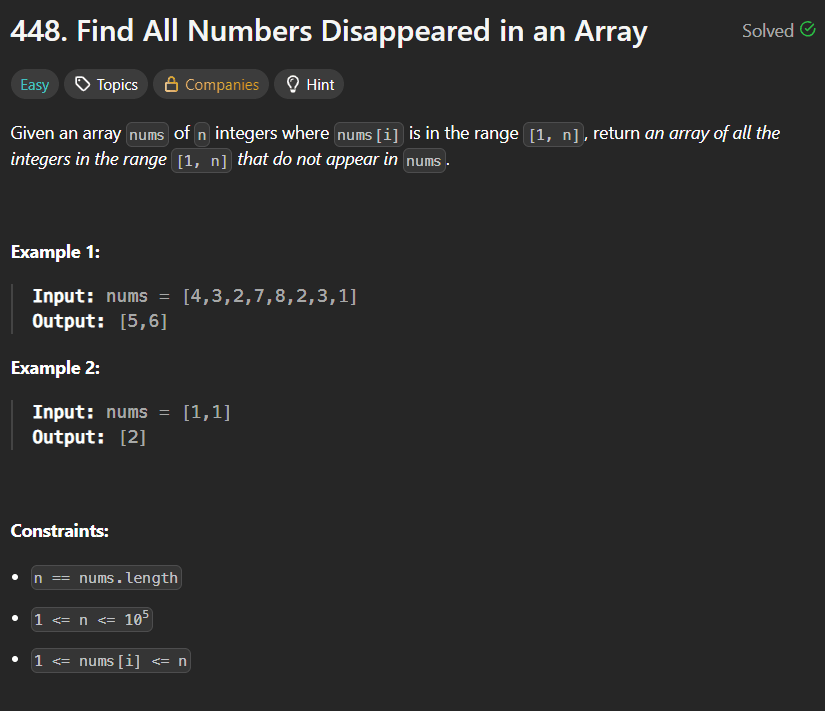
LeetCode Problem 448Link of the Problem to try -: LinkGiven an array nums of n integers where nums[i] is in the range [1, n], return an array of all the integers in the range [1, n] that do not appear in nums. Example 1:Input: nums = [4,3,2,7,8,2,3,1]Output: [5,6]Example 2:Input: nums = [1,1]Output: [2] Constraints:n == nums.length1 <= n <= 1051 <= nums[i] <= nSolution:In this question as the question suggests we have to find the missing element from the array that is not in the array but comes in that range of 1 to array.length and we can solve this by creating an HashMap where we simply store all the elements and then run the loop again from 1 to array.length and then check is that element present if not then store it on our ArrayList and return it this is how we can solve this question easily in O(n) Time Complexity.Code: public List<Integer> findDisappearedNumbers(int[] nums) { HashMap<Integer,Integer> mp = new HashMap<>(); List<Integer> lis = new ArrayList<>(); for(int i =0;i<nums.length;i++){ mp.put(nums[i],0); } for(int i = 1;i<=nums.length;i++){ if(!mp.containsKey(i)){ lis.add(i); } } return lis; }

LeetCodeHashMapEasy
Intersection of Two Arrays

Intersection of Two Arrays

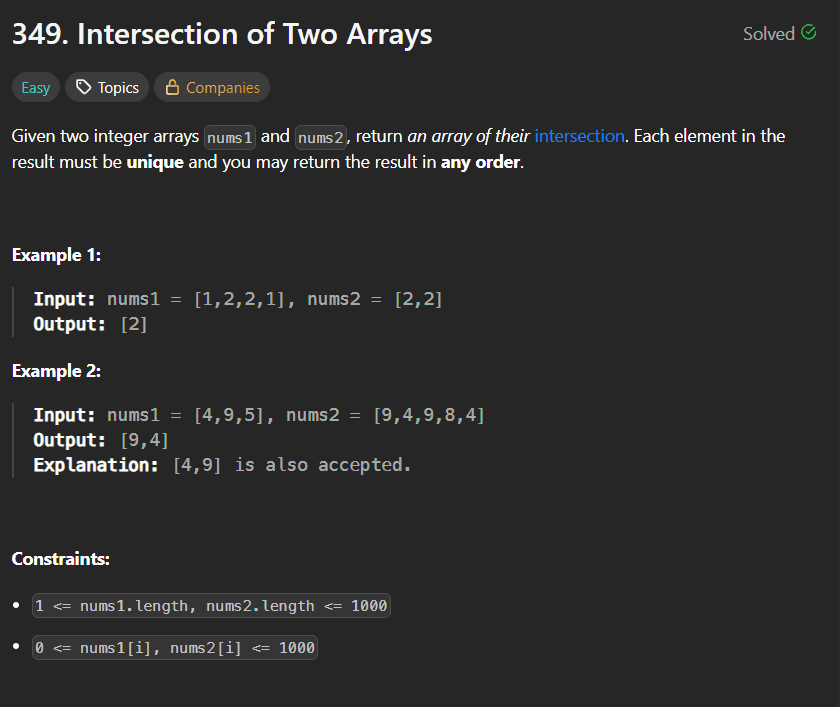
LeetCode Problem 349Link of the Problem to try -: LinkGiven two integer arrays nums1 and nums2, return an array of their intersection. Each element in the result must be unique and you may return the result in any order. Example 1:Input: nums1 = [1,2,2,1], nums2 = [2,2]Output: [2]Example 2:Input: nums1 = [4,9,5], nums2 = [9,4,9,8,4]Output: [9,4]Explanation: [4,9] is also accepted. Constraints:1 <= nums1.length, nums2.length <= 10000 <= nums1[i], nums2[i] <= 1000Solution: Using HashMap and HashSet for IntersectionCore Objective: The primary goal of this problem is to identify common elements between two arrays and return them as a unique set. To achieve this efficiently, we utilize a combination of a HashMap for quick lookup and a HashSet to handle uniqueness in the result.Logic & Implementation:Populate Lookup Table: We begin by iterating through the first array (nums1) and storing its elements in a HashMap. This allows us to verify the existence of any number in $O(1)$ average time.Identify Intersection: Next, we iterate through the second array (nums2). For each element, we check if it exists within our HashMap.Handle Uniqueness: If a match is found, we add the element to a HashSet. This is a crucial step because the problem requires the output to contain unique elements, even if a common number appears multiple times in the input arrays.Final Conversion: Since the required return type is an array, we determine the size of our HashSet to initialize the result array. Using a for-each loop, we transfer the values from the Set into the array and return it as the final answer.Code Implementation:public int[] intersection(int[] nums1, int[] nums2) { // HashMap to store elements from the first array for lookup HashMap<Integer, Integer> mp = new HashMap<>(); // HashSet to store unique common elements HashSet<Integer> ms = new HashSet<>(); // Populate the map with elements from nums1 for (int i = 0; i < nums1.length; i++) { if (mp.containsKey(nums1[i])) { continue; } mp.put(nums1[i], i); } // Check for common elements in nums2 for (int i = 0; i < nums2.length; i++) { if (mp.containsKey(nums2[i])) { ms.add(nums2[i]); // HashSet ensures duplicates are not added } } // Convert the HashSet to the final integer array int[] ans = new int[ms.size()]; int co = 0; for (int i : ms) { ans[co] = i; co++; } return ans;}

LeetCodeArrayEasyHashMap
LeetCode 1614: Maximum Nesting Depth of Parentheses — Java Solution Explained

LeetCode 1614: Maximum Nesting Depth of Parentheses — Java Solution Explained

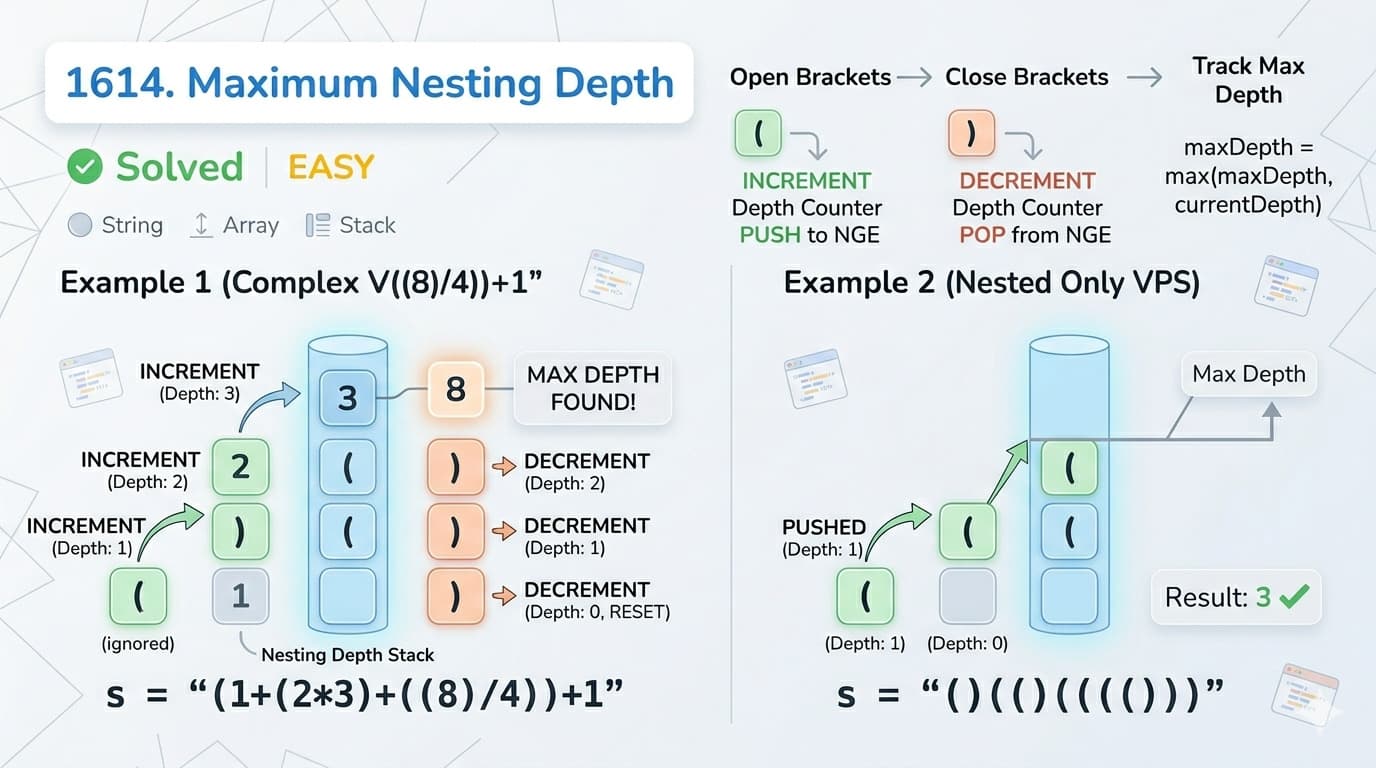
IntroductionLeetCode 1614 Maximum Nesting Depth of Parentheses is a natural follow-up to LeetCode 20 Valid Parentheses. While LeetCode 20 asks "are the brackets valid?", this problem asks "how deeply are they nested?" It is a clean, focused problem that teaches you how to think about bracket depth — a concept that appears in compilers, parsers, JSON validators, and XML processors in real world software.Here is the Link of Question -: LeetCode 1614In this article we cover plain English explanation, real life analogy, two Java approaches with dry runs, complexity analysis, and all the important details you need for interviews.What Is the Problem Really Asking?You are given a valid parentheses string. You need to find the maximum number of nested (not just sequential) open parentheses at any point in the string.The key distinction here is nested vs sequential:"()()()" → depth is 1, brackets are sequential not nested"((()))" → depth is 3, brackets are fully nested inside each other"()(())" → depth is 2, the second pair is nested one level deepReal Life Analogy — Folders Inside FoldersThink of your computer's file system. You have a folder, inside that a subfolder, inside that another subfolder. The depth is how many folders deep you are at the deepest point."(1+(2*3)+((8)/4))+1" is like:Outer folder ( → depth 1Inner folder ( inside it → depth 2Innermost folder (( → depth 3The answer is how deep the deepest file is buried. You do not care about other folders — just the maximum depth reached at any single moment.Approach 1: Stack Based Solution (Classic)The IdeaUse a stack exactly like LeetCode 20. Every time you push an opening bracket, increment a counter. Every time you pop a closing bracket, record the max before decrementing. The stack size at any moment represents current depth.public int maxDepth(String s) { Stack<Character> st = new Stack<>(); int current = 0; int max = 0; for (int i = 0; i < s.length(); i++) { char c = s.charAt(i); if (c == '(') { st.push(c); current++; max = Math.max(max, current); // record depth when going deeper } else if (c == ')') { if (!st.empty() && st.peek() == '(') { max = Math.max(max, current); current--; st.pop(); } } } return max;}Dry Run — s = "()(())((()()))"( → push, current = 1, max = 1) → pop, current = 0( → push, current = 1, max = 1( → push, current = 2, max = 2) → pop, current = 1) → pop, current = 0( → push, current = 1, max = 2( → push, current = 2, max = 2( → push, current = 3, max = 3 ✅) → pop, current = 2( → push, current = 3, max = 3) → pop, current = 2) → pop, current = 1) → pop, current = 0✅ Output: 3Time Complexity: O(n) — single pass Space Complexity: O(n) — stack holds up to n/2 opening bracketsApproach 2: Counter Only — No Stack (Optimal) ✅The IdeaThis is the smartest approach and the real insight of this problem. You do not actually need a stack at all! Think about it — the depth at any moment is simply how many unmatched opening brackets we have seen so far. That is just a counter!( → increment counter, update max) → decrement counterEverything else → ignorepublic int maxDepth(String s) { int current = 0; int max = 0; for (int i = 0; i < s.length(); i++) { if (s.charAt(i) == '(') { current++; max = Math.max(max, current); } else if (s.charAt(i) == ')') { current--; } } return max;}This is beautifully simple. No stack, no extra memory, just two integer variables.Dry Run — s = "(1+(2*3)+((8)/4))+1"Only tracking ( and ), ignoring digits and operators:( → current = 1, max = 1( → current = 2, max = 2) → current = 1( → current = 2, max = 2( → current = 3, max = 3 ✅) → current = 2) → current = 1) → current = 0✅ Output: 3Time Complexity: O(n) — single pass Space Complexity: O(1) — only two integer variables, no extra storage!Why Update Max on ( Not on )?This is the most important implementation detail. You update max when you open a bracket, not when you close it. Why?Because when you encounter (, your depth just increased to a new level — that is when you might have hit a new maximum. When you encounter ), you are going back up — depth is decreasing, so it can never be a new maximum.Always capture the peak on the way down into nesting, not on the way back out.Stack vs Counter — Which to Use?The counter approach is strictly better here — same time complexity but O(1) space instead of O(n). In an interview, start by mentioning the stack approach to show you recognize the stack pattern, then immediately offer the counter optimization to show deeper understanding.This mirrors the same progression as LeetCode 844 Backspace String Compare — where the O(1) two pointer follow-up impressed interviewers more than the standard stack solution.How This Fits the Stack Pattern SeriesLooking at the full series you have been solving:20 Valid Parentheses — are brackets correctly matched? 1614 Maximum Nesting Depth — how deeply are they nested?These two problems are complementary. One validates structure, the other measures depth. Together they cover the two most fundamental questions you can ask about a bracket string. Real world parsers need to answer both — "is this valid?" and "how complex is the nesting?"Common Mistakes to AvoidUpdating max after decrementing on ) If you write current-- before Math.max, you will always be one level too low and miss the true maximum. Always capture max before or at the moment of increment, never after decrement.Counting all characters not just brackets Digits, operators like +, -, *, / must be completely ignored. Only ( and ) affect depth.Using a Stack when a counter suffices Since the problem guarantees a valid parentheses string, you never need to validate matching — just track depth. A Stack adds unnecessary complexity and memory overhead here.FAQs — People Also AskQ1. What is nesting depth in LeetCode 1614? Nesting depth is the maximum number of open parentheses that are simultaneously unclosed at any point in the string. For example "((()))" has depth 3 because at the innermost point, three ( are open at the same time.Q2. What is the best approach for LeetCode 1614 in Java? The counter approach is optimal — O(n) time and O(1) space. Increment a counter on (, update max, decrement on ). No stack needed since the string is guaranteed to be a valid parentheses string.Q3. What is the time complexity of LeetCode 1614? Both approaches are O(n) time. The Stack approach uses O(n) space while the counter approach uses O(1) space, making the counter approach strictly better.Q4. What is the difference between LeetCode 20 and LeetCode 1614? LeetCode 20 validates whether a bracket string is correctly formed. LeetCode 1614 assumes the string is already valid and asks how deeply the brackets are nested. LeetCode 20 needs a stack for matching; LeetCode 1614 only needs a counter.Q5. Is LeetCode 1614 asked in coding interviews? It appears occasionally as a warmup or follow-up after LeetCode 20. The more important skill it tests is recognizing when a stack can be replaced by a simpler counter — that kind of space optimization thinking is valued in interviews.Similar LeetCode Problems to Practice Next20. Valid Parentheses — Easy — validate bracket structure1021. Remove Outermost Parentheses — Easy — depth-based filtering1249. Minimum Remove to Make Valid Parentheses — Medium — remove minimum brackets32. Longest Valid Parentheses — Hard — longest valid substring394. Decode String — Medium — nested brackets with encodingConclusionLeetCode 1614 Maximum Nesting Depth of Parentheses teaches a deceptively simple but important lesson — not every bracket problem needs a stack. When the string is guaranteed valid and you only need to measure depth, a counter is all you need.The progression from LeetCode 20 to 1614 perfectly illustrates how understanding the core problem deeply leads to elegant simplifications. Master both, understand why one needs a stack and the other does not, and you will have a strong foundation for every bracket problem in your interview journey.

StringStackLeetCodeEasy
Roman to Integer – Easy Explanation with Java Solution (LeetCode 13)

Roman to Integer – Easy Explanation with Java Solution (LeetCode 13)

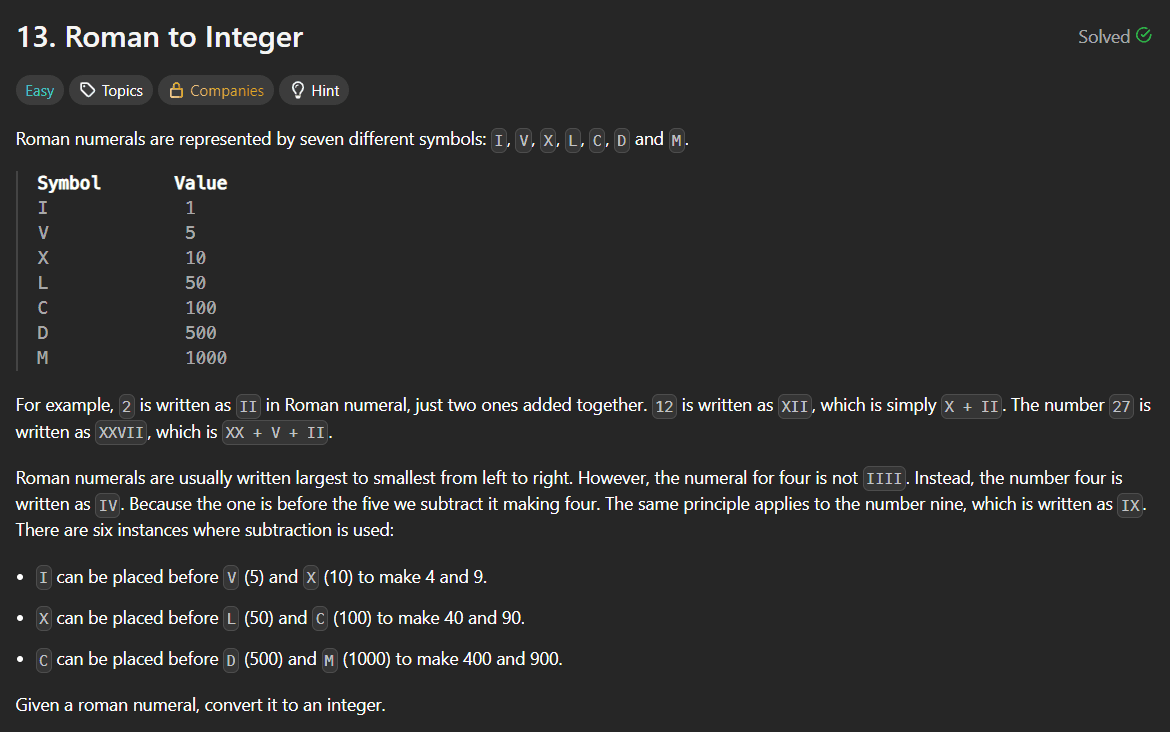
Try the QuestionYou can try solving the problem here before reading the solution:👉 https://leetcode.com/problems/roman-to-integer/Practicing it yourself first helps you understand the logic better.Roman to Integer – Complete GuideRoman numerals are an ancient numbering system used by the Romans. Instead of digits like 1, 2, 3, they used specific characters to represent values.This problem asks us to convert a Roman numeral string into its corresponding integer value.It is a very common interview question and frequently appears in coding platforms like LeetCode, HackerRank, and coding interviews at product-based companies.Roman Numeral SymbolsRoman numerals consist of seven characters, each representing a fixed value.SymbolValueI1V5X10L50C100D500M1000Example conversions:III = 3 → 1 + 1 + 1XII = 12 → 10 + 1 + 1XXVII = 27 → 10 + 10 + 5 + 1 + 1Normally, Roman numerals are written from largest to smallest from left to right.But there is an important exception.The Subtraction RuleIn some cases, Roman numerals use subtraction instead of addition.If a smaller value appears before a larger value, it means we subtract it.Examples:RomanCalculationResultIV5 − 14IX10 − 19XL50 − 1040XC100 − 1090CD500 − 100400CM1000 − 100900These are the only valid subtraction cases.Example WalkthroughExample 1Inputs = "III"ExplanationI + I + I = 1 + 1 + 1 = 3Output3Example 2Inputs = "LVIII"ExplanationL = 50V = 5III = 350 + 5 + 3 = 58Output58Example 3Inputs = "MCMXCIV"ExplanationM = 1000CM = 900XC = 90IV = 4Total = 1994Output1994Intuition Behind the SolutionThe key idea is to compare each Roman numeral with the numeral to its right.Two situations occur:Case 1 — Normal AdditionIf the current value ≥ next valueWe simply add it to the total.ExampleVI5 + 1 = 6Case 2 — Subtraction CaseIf the current value < next valueWe subtract it.ExampleIV5 - 1 = 4Strategy to SolveCreate a HashMap to store Roman numeral values.Start from the rightmost character.Initialize total with the last character's value.Move from right to left.Compare the current numeral with the next numeral.If smaller → subtract.Otherwise → add.Continue until the beginning of the string.This approach works because Roman numerals follow a local comparison rule.Java Implementationclass Solution { public int romanToInt(String s) { HashMap<Character,Integer> mp = new HashMap<>(); mp.put('I',1); mp.put('V',5); mp.put('X',10); mp.put('L',50); mp.put('C',100); mp.put('D',500); mp.put('M',1000); int tot = mp.get(s.charAt(s.length()-1)); char arr[] = s.toCharArray(); int j = s.length()-2; for(int i = arr.length-1; i >= 0; i--){ if(j >= 0){ if(mp.get(arr[j]) < mp.get(arr[i])){ tot -= mp.get(arr[j]); }else if(mp.get(arr[j]) > mp.get(arr[i])){ tot += mp.get(arr[j]); }else{ tot += mp.get(arr[j]); } } j--; } return tot; }}Code ExplanationStep 1 — Store Roman ValuesWe create a HashMap so we can quickly get the numeric value of each Roman character.I → 1V → 5X → 10...This allows O(1) lookup time.Step 2 — Initialize TotalWe start with the last character.int tot = mp.get(s.charAt(s.length()-1));Why?Because the last numeral is always added, never subtracted.Step 3 — Traverse from Right to LeftWe move backward through the string.for(int i = arr.length-1; i >= 0; i--)And compare with the previous character.Step 4 — Apply Roman RulesIf the previous numeral is smaller than the current numeral:tot -= valueExampleIV5 - 1If it is greater or equal:tot += valueExampleVI5 + 1Time ComplexityO(n)Where n = length of the string.We only traverse the string once.Space ComplexityO(1)The HashMap size is constant (only 7 entries).Key Takeaways✔ Roman numerals mostly use addition✔ Subtraction occurs only in six specific cases✔ Comparing current and next value is the simplest approach✔ A single pass solution (O(n)) is enoughThis is why this problem is commonly used to test string processing and logical reasoning in coding interviews.Final ThoughtsThe Roman to Integer problem is a great beginner-friendly problem that teaches:HashMap usageString traversalConditional logicPattern recognitionMastering these simple problems builds a strong foundation for more complex algorithmic questions.If you're preparing for coding interviews, this is definitely a problem you should practice.

LeetCodeJavaString ProblemsEasyRoman Numerals
LeetCode 1021: Remove Outermost Parentheses — Java Solution Explained

LeetCode 1021: Remove Outermost Parentheses — Java Solution Explained

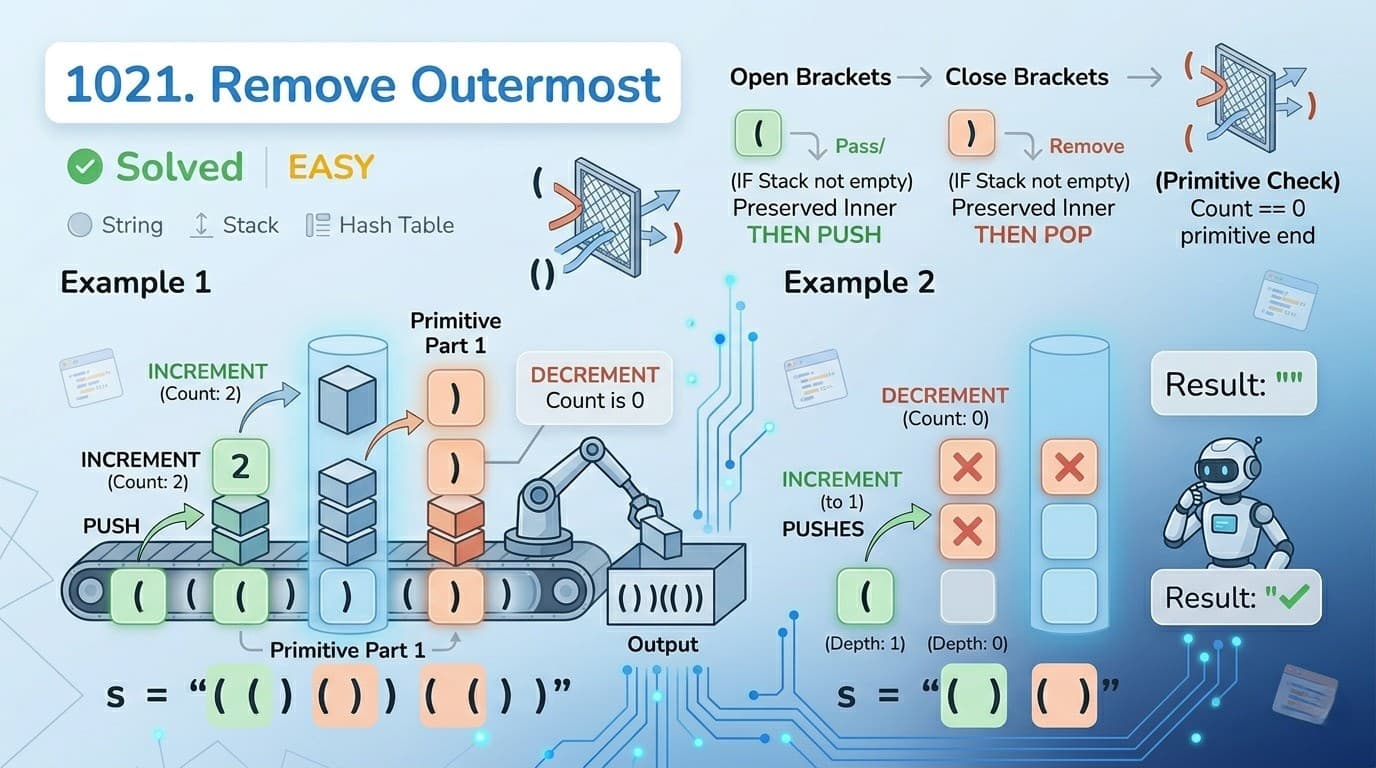
IntroductionLeetCode 1021 Remove Outermost Parentheses sounds intimidating with words like "primitive decomposition" but once you strip away the fancy terminology, it is a beautifully simple problem. It builds directly on the depth-counting technique from LeetCode 1614 and is a perfect example of how one clean insight can collapse a seemingly complex problem into just a few lines of code.Here is the Link of Question -: LeetCode 1021In this article we cover plain English explanation, what "primitive" really means, two Java approaches with detailed dry runs, complexity analysis, and everything you need to ace this in an interview.What Is the Problem Really Asking?Let us ignore the formal definition for a moment and think practically.A primitive string is the smallest self-contained valid bracket group. Think of it as a top-level unit — it opens, closes completely, and is not part of a bigger bracket group.For "(()())(())":"(()())" is one primitive — it opens and fully closes"(())" is another primitive — it opens and fully closes afterNow from each primitive, remove only the outermost opening and closing bracket, keep everything inside."(()())" → remove outer → "()()""(())" → remove outer → "()"Combined → "()()()"That is literally the whole problem!Real Life Analogy — Gift Boxes Inside a Shipping BoxImagine you ordered gifts online. They all arrive in one big shipping box. Inside that box are individual gift boxes. Inside some gift boxes are smaller boxes.The "primitive decomposition" is identifying each individual gift box inside the shipping box. Removing the outermost parentheses is like removing just the outer gift box wrapping but keeping everything inside it intact.You are not unpacking the inner boxes — just peeling off one layer from each top-level group.Understanding Primitive Decomposition VisuallyFor s = "(()())(())(()(()))":( ( ) ( ) ) ( ( ) ) ( ( ) ( ( ) ) )|_________| |_______| |_____________| primitive1 primitive2 primitive3Each group that starts at depth 0 and returns to depth 0 is one primitive. Remove the outermost ( and ) from each and concatenate what remains.The depth analogy from LeetCode 1614 is the key — a primitive starts when depth goes from 0 to 1 and ends when depth returns to 0.Approach 1: Counter With Substring (Your Solution) ✅The IdeaTrack depth with a counter. Use start and end pointers to mark the boundaries of each primitive. When depth hits 0, you have found a complete primitive — append everything between start+1 and end (skipping the outermost brackets) to the result.public String removeOuterParentheses(String s) { StringBuilder sb = new StringBuilder(); int c = 0; int start = 0; int end = 0; for (int i = 0; i < s.length(); i++) { if (s.charAt(i) == '(') { c++; } else { c--; } if (c == 0) { // primitive found from index start to end (inclusive) sb.append(s.substring(start + 1, end)); // skip outermost ( and ) start = end + 1; // next primitive starts after current end } end++; } return sb.toString();}Dry Run — s = "(()())(())"Tracking c, start, end at each step:i=0, ( → c=1, end=1i=1, ( → c=2, end=2i=2, ) → c=1, end=3i=3, ( → c=2, end=4i=4, ) → c=1, end=5i=5, ) → c=0 → primitive found! append s.substring(1, 5) = "()()" → start=6, end=6i=6, ( → c=1, end=7i=7, ( → c=2, end=8i=8, ) → c=1, end=9i=9, ) → c=0 → primitive found! append s.substring(7, 9) = "()" → start=10, end=10Result: "()()" + "()" = "()()()" ✅Time Complexity: O(n) — single pass plus substring operations Space Complexity: O(n) — StringBuilder stores the resultApproach 2: Counter With Depth Filter (Cleaner & More Intuitive)The IdeaInstead of tracking start/end pointers, use depth directly to decide whether to include each character. The insight is:The outermost ( of each primitive is always encountered when c goes from 0 to 1 — skip itThe outermost ) of each primitive is always encountered when c goes from 1 to 0 — skip itEvery other character is inside some primitive — include itpublic String removeOuterParentheses(String s) { StringBuilder sb = new StringBuilder(); int depth = 0; for (char c : s.toCharArray()) { if (c == '(') { if (depth > 0) { sb.append(c); // not the outermost (, include it } depth++; } else { depth--; if (depth > 0) { sb.append(c); // not the outermost ), include it } } } return sb.toString();}This is arguably the most elegant solution. No pointers, no substring, just one rule — if depth is already greater than 0 when you see (, it is not the outer one. If depth is still greater than 0 after decrementing on ), it is not the outer one.Dry Run — s = "()()" (Edge Case)( → depth=0, skip it, depth becomes 1) → depth becomes 0, depth=0 so skip it( → depth=0, skip it, depth becomes 1) → depth becomes 0, depth=0 so skip itResult: "" ✅ Both are primitives "()" and "()", removing outer from each gives empty string.Dry Run — s = "(()())(())(()(()))"Let us trace just which characters get included vs skipped:For the first primitive "(()())":( at depth 0 → skip (outermost opener)( at depth 1 → include) at depth 2→1 → include( at depth 1 → include) at depth 2→1 → include) at depth 1→0 → skip (outermost closer)Inner content "()()" included ✅Same logic applies to each subsequent primitive. Final result: "()()()()(())" ✅Time Complexity: O(n) — single pass Space Complexity: O(n) — StringBuilder stores resultApproach 3: Stack Based (Verbose but Clear)The IdeaUse an explicit stack to track open brackets. When the stack becomes empty after a ), you have found a complete primitive. Collect all characters between the outermost brackets.public String removeOuterParentheses(String s) { StringBuilder sb = new StringBuilder(); Stack<Character> st = new Stack<>(); int start = 0; for (int i = 0; i < s.length(); i++) { if (s.charAt(i) == '(') { st.push('('); } else { st.pop(); } if (st.empty()) { // primitive ends at i, extract inner content sb.append(s.substring(start + 1, i)); start = i + 1; } } return sb.toString();}This is the most verbose but makes the primitive detection very explicit — stack empty means primitive complete. Great for explaining your thought process in an interview before optimizing.Time Complexity: O(n) Space Complexity: O(n) — stack storageApproach ComparisonThe Stack approach is clearest for explaining primitive detection. The pointer-based counter approach (your solution) is direct and efficient. The depth-filter counter approach is the most elegant — no pointers, no substrings, just a single depth check per character. All three are O(n) time. The depth-filter approach wins on code clarity.How This Connects to the Full SeriesLooking at the bracket problem series you have been building:20 Valid Parentheses — is the string valid? 1614 Maximum Nesting Depth — how deep is the nesting? 1021 Remove Outermost Parentheses — identify and strip top-level groupsEach problem adds one more layer of understanding about bracket strings. The depth counter technique from 1614 directly powers the optimal solution here. This is pattern building at its best.Common Mistakes to AvoidOff-by-one in substring indices In your solution, s.substring(start+1, end) skips the outermost ( by using start+1, and end (not end+1) naturally excludes the outermost ) since end points to it. Getting these indices wrong by even one position gives completely wrong output.Appending the outermost brackets in the depth-filter approach The condition order matters — for (, check depth BEFORE incrementing. For ), check depth AFTER decrementing. Flipping these gives wrong results.Forgetting to update start after each primitive In pointer-based approaches, always set start = end + 1 (or start = i + 1) after appending each primitive, otherwise the next primitive's start index is wrong.FAQs — People Also AskQ1. What is a primitive valid parentheses string in LeetCode 1021? A primitive is the smallest self-contained valid bracket group that cannot be split into two smaller valid groups. It starts when depth goes from 0 to 1 and ends when depth returns to 0. For example in "(()())(())", the primitives are "(()())" and "(())".Q2. What is the most elegant solution for LeetCode 1021? The depth-filter counter approach — increment depth on (, decrement on ), and only append characters when depth is greater than 0 for ( and still greater than 0 after decrement for ). This skips outermost brackets naturally without tracking indices.Q3. What is the time complexity of LeetCode 1021? All approaches run in O(n) time with a single pass. Space complexity is O(n) for storing the output string in StringBuilder.Q4. How is LeetCode 1021 different from LeetCode 1614? LeetCode 1614 finds the maximum depth by tracking a counter. LeetCode 1021 uses the same counter technique but to identify primitive boundaries and strip their outermost characters. 1614 returns a number, 1021 returns a modified string.Q5. Is LeetCode 1021 asked in coding interviews? It appears occasionally as a follow-up to Valid Parentheses or Nesting Depth problems. The real skill it tests is understanding primitive decomposition — identifying self-contained units within a bracket string — which appears in real world parser and compiler design.Similar LeetCode Problems to Practice Next20. Valid Parentheses — Easy — validate bracket structure1614. Maximum Nesting Depth of Parentheses — Easy — find max depth1249. Minimum Remove to Make Valid Parentheses — Medium — remove minimum brackets394. Decode String — Medium — nested brackets with encoding32. Longest Valid Parentheses — Hard — longest valid substringConclusionLeetCode 1021 Remove Outermost Parentheses is a satisfying problem once you realize that "primitive decomposition" is just a fancy way of saying "find each top-level bracket group." The depth counter is the key — depth 0 to 1 marks the start of a primitive, depth 1 to 0 marks its end.The depth-filter approach is the cleanest solution — one pass, one counter, one condition. No substring, no pointers, just elegance. Master this alongside LeetCode 20 and 1614 and you will have a complete toolkit for any bracket string problem that comes your way.

StringStackEasyLeetCode
Ransom Note – Frequency Counting Made Simple (LeetCode 383)

Ransom Note – Frequency Counting Made Simple (LeetCode 383)

🔗 Problem LinkLeetCode 383 – Ransom Note 👉 https://leetcode.com/problems/ransom-note/IntroductionThis is a classic frequency-count problem that tests your understanding of:Character countingHashMap usageGreedy validation logicAt first glance, the problem looks very simple — but it’s a very common interview question because it checks whether you can think in terms of resource usage.Here:magazine → available resourcesransomNote → required resourcesWe must check if the available letters are sufficient to construct the ransom note.📌 Problem UnderstandingYou are given:ransomNotemagazineRules:Each letter in magazine can be used only once.Return true if ransomNote can be formed.Otherwise return false.Example 1Input: ransomNote = "a", magazine = "b"Output: falseExample 2Input: ransomNote = "aa", magazine = "ab"Output: falseExample 3Input: ransomNote = "aa", magazine = "aab"Output: true🧠 IntuitionThe logic is straightforward:Count frequency of each character in magazine.For each character in ransomNote:Check if it exists in the map.Check if its frequency is greater than 0.Reduce frequency after using it.If at any point we cannot use a character → return false.This is a greedy approach.💻 Your Codeclass Solution { public boolean canConstruct(String r, String m) { HashMap<Character,Integer> mp = new HashMap<>(); for(int i =0 ; i < m.length();i++){ mp.put(m.charAt(i),mp.getOrDefault(m.charAt(i),0)+1); } for(int i = 0 ; i <r.length();i++){ if(mp.containsKey(r.charAt(i)) && mp.get(r.charAt(i)) > 0){ mp.put(r.charAt(i),mp.get(r.charAt(i)) -1); }else{ return false; } } return true; }}🔍 Step-by-Step Explanation1️⃣ Build Frequency Map from MagazineHashMap<Character,Integer> mp = new HashMap<>();for(int i =0 ; i < m.length();i++){ mp.put(m.charAt(i), mp.getOrDefault(m.charAt(i),0) + 1);}We count how many times each character appears in the magazine.2️⃣ Check Each Character in Ransom Notefor(int i = 0 ; i < r.length();i++){For every character in ransomNote:3️⃣ Validate Availabilityif(mp.containsKey(r.charAt(i)) && mp.get(r.charAt(i)) > 0)If:Character exists in mapFrequency is still availableThen reduce its count:mp.put(r.charAt(i), mp.get(r.charAt(i)) - 1);Otherwise:return false;Immediately stop if we cannot construct.🎯 Why This WorksWe treat:magazine as supplyransomNote as demandWe reduce supply every time we use a character.If supply runs out → construction fails.⏱ Complexity AnalysisTime Complexity: O(n + m)One pass to build map from magazineOne pass to check ransomNoteSpace Complexity: O(26) ≈ O(1)Only lowercase English letters.🔥 Even Better Optimization – Using Array Instead of HashMapSince we know:Only lowercase letters are allowedWe can use an integer array of size 26.This is faster and more memory-efficient.Optimized Versionclass Solution { public boolean canConstruct(String r, String m) { int[] freq = new int[26]; for(char c : m.toCharArray()){ freq[c - 'a']++; } for(char c : r.toCharArray()){ if(freq[c - 'a'] == 0){ return false; } freq[c - 'a']--; } return true; }}This avoids HashMap overhead.🏁 Final ThoughtsThis problem reinforces:Frequency counting patternGreedy character usageEarly exit for optimizationUsing arrays instead of HashMap when character set is limitedIt’s a foundational problem that appears often in interviews.If you master this pattern, you can easily solve:Valid AnagramFind the DifferenceCheck if All Characters Have Equal OccurrencesPermutation in String

HashMapStringFrequency CountGreedyLeetCodeEasy
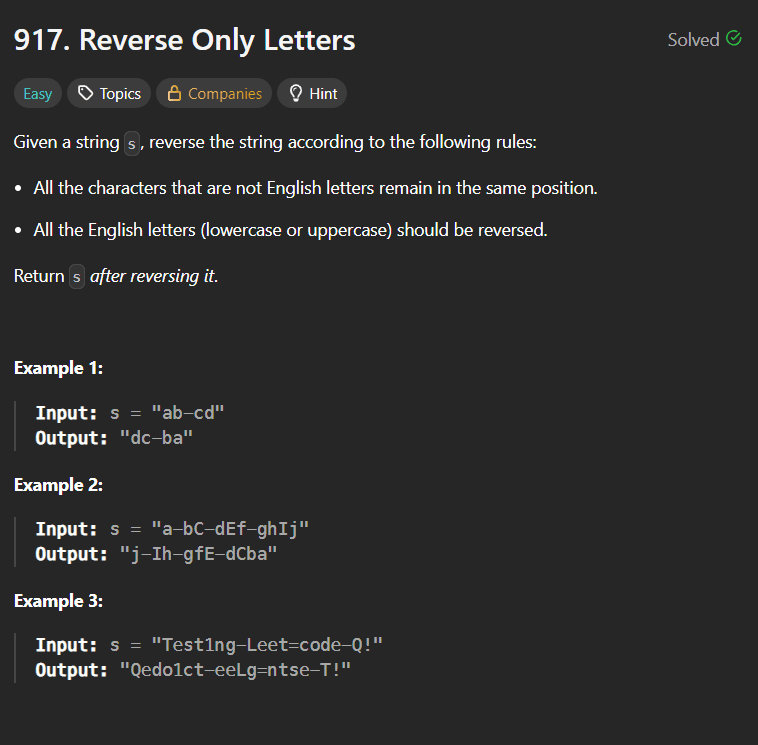
Reverse Only Letters – Two Pointer Strategy Explained (LeetCode 917)

Reverse Only Letters – Two Pointer Strategy Explained (LeetCode 917)

🔗 Problem LinkLeetCode 917 – Reverse Only Letters 👉 https://leetcode.com/problems/reverse-only-letters/IntroductionThis is a very clean two-pointer problem.The challenge is not just reversing a string — it’s reversing only the letters while keeping all non-letter characters in their original positions.This problem strengthens:Two pointer techniqueCharacter validation logicIn-place string manipulationLet’s break it down.📌 Problem UnderstandingYou are given a string s.Rules:All non-English letters must remain at the same index.Only English letters (uppercase or lowercase) should be reversed.Return the modified string.Example 1Input: "ab-cd"Output: "dc-ba"Only letters are reversed. Hyphen stays at same position.Example 2Input: "a-bC-dEf-ghIj"Output: "j-Ih-gfE-dCba"Example 3Input: "Test1ng-Leet=code-Q!"Output: "Qedo1ct-eeLg=ntse-T!"Notice:Numbers, -, =, ! stay fixed.Only letters move.🧠 IntuitionThe first thought might be:Extract all lettersReverse themPut them backBut that would require extra space.Instead, we can solve this efficiently using Two Pointers.🚀 Two Pointer ApproachWe use:i → starting from leftj → starting from rightSteps:Convert string into char array.Move i forward until it points to a letter.Move j backward until it points to a letter.Swap letters.Continue until i < j.💻 Your Codeclass Solution { public String reverseOnlyLetters(String s) { int i = 0; int j = s.length() - 1; char arr[] = s.toCharArray(); while(i < j){ boolean l = ('A' <= s.charAt(i) && s.charAt(i) <= 'Z') || ('a' <= s.charAt(i) && s.charAt(i) <= 'z'); boolean r = ('A' <= s.charAt(j) && s.charAt(j) <= 'Z') || ('a' <= s.charAt(j) && s.charAt(j) <= 'z'); if(l && r){ char temp = arr[i]; arr[i] = arr[j]; arr[j] = temp; i++; j--; }else if(l){ j--; }else if(r){ i++; }else{ i++; j--; } } return new String(arr); }}🔍 Step-by-Step Explanation1️⃣ Convert to Character Arraychar arr[] = s.toCharArray();Strings are immutable in Java. So we convert to char array to modify it.2️⃣ Initialize Two Pointersint i = 0;int j = s.length() - 1;We start from both ends.3️⃣ Check If Characters Are Lettersboolean l = ('A' <= s.charAt(i) && s.charAt(i) <= 'Z') || ('a' <= s.charAt(i) && s.charAt(i) <= 'z');You manually check ASCII ranges for uppercase and lowercase letters.Same logic for r.4️⃣ Swap When Both Are Lettersif(l && r){ char temp = arr[i]; arr[i] = arr[j]; arr[j] = temp; i++; j--;}Only swap letters.5️⃣ Move Pointers When One Is Not LetterIf left is letter but right is not → move jIf right is letter but left is not → move iIf both are not letters → move bothThis ensures:Non-letter characters remain in their positions.🎯 Why This WorksWe never move non-letter characters.We only swap valid letters.Since we use two pointers:Time complexity stays linear.No extra array needed for letters.⏱ Complexity AnalysisTime Complexity: O(n)Each character is visited at most once.Space Complexity: O(n)Because we convert string to char array.(If considering output string creation, still O(n))🔥 Cleaner OptimizationInstead of manually checking ASCII ranges, Java provides:Character.isLetter(c)Cleaner version:class Solution { public String reverseOnlyLetters(String s) { int i = 0, j = s.length() - 1; char[] arr = s.toCharArray(); while(i < j){ if(!Character.isLetter(arr[i])){ i++; }else if(!Character.isLetter(arr[j])){ j--; }else{ char temp = arr[i]; arr[i] = arr[j]; arr[j] = temp; i++; j--; } } return new String(arr); }}Much cleaner and readable.🏁 Final ThoughtsThis problem teaches:Two pointer patternIn-place string reversalCharacter validation logicClean pointer movement strategyIt’s a simple but powerful pattern that appears often in interviews.If you master this, you can easily solve:Reverse Vowels of a StringValid PalindromeReverse String IIPalindrome with One Removal

Two PointersString ManipulationLeetCodeEasy
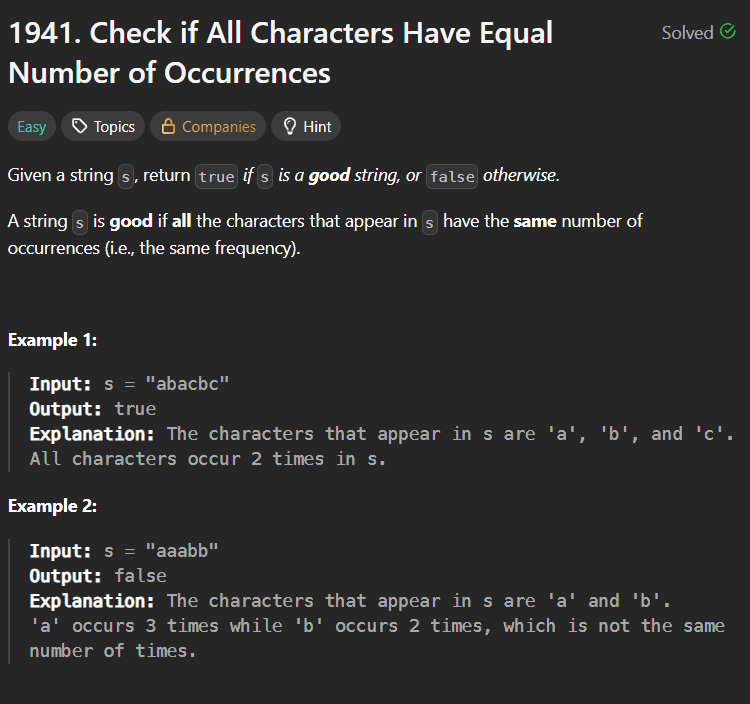
Check if All Characters Have Equal Number of Occurrences – Frequency Map Approach (LeetCode 1941)

Check if All Characters Have Equal Number of Occurrences – Frequency Map Approach (LeetCode 1941)

🔗 Problem LinkLeetCode 1941 – Check if All Characters Have Equal Number of Occurrences 👉 https://leetcode.com/problems/check-if-all-characters-have-equal-number-of-occurrences/IntroductionThis is one of those problems that looks very simple at first glance — and it actually is — but it helps strengthen your understanding of frequency counting using HashMap.The problem asks us to determine whether all characters in a string occur the same number of times.No sliding window. No binary search. Just clean frequency logic.But even simple problems help build strong foundations.📌 Problem UnderstandingA string is considered "good" if:Every character that appears in the stringAppears the same number of timesIf even one character has a different frequency → return false.Example 1Input: s = "abacbc"Output: trueCharacter counts:a → 2b → 2c → 2All equal → ✔ trueExample 2Input: s = "aaabb"Output: falseCharacter counts:a → 3b → 2Not equal → ✘ false🧠 Approach & IntuitionWhen I saw this problem, my thinking was:Count the frequency of every character.Compare all frequencies.If all are equal → return true.The important part is choosing a reference frequency and comparing everything against it.💻 Your Codeclass Solution { public boolean areOccurrencesEqual(String s) { HashMap<Character,Integer> mp = new HashMap<>(); int ref =0; char c = s.charAt(0); for(int i =0 ; i< s.length();i++){ if(c == s.charAt(i)){ ref++; } mp.put(s.charAt(i),mp.getOrDefault(s.charAt(i),0)+1); } for(int a:mp.values()){ if(ref != a){ return false; } } return true; }}🔍 Step-by-Step Explanation1️⃣ Initialize HashMapHashMap<Character,Integer> mp = new HashMap<>();This stores frequency of each character.2️⃣ Choose Reference Characterchar c = s.charAt(0);int ref = 0;You use the first character as a reference.Then count how many times it appears while also building the frequency map.3️⃣ Build Frequency Mapmp.put(s.charAt(i), mp.getOrDefault(s.charAt(i), 0) + 1);This line increases count for each character.4️⃣ Compare Frequenciesfor(int a : mp.values()){ if(ref != a){ return false; }}If any frequency differs from the reference count → return false.Otherwise → true.⏱ Time and Space ComplexityTime Complexity: O(n)One loop to count frequenciesOne loop over at most 26 charactersSpace Complexity: O(26) ≈ O(1)Only lowercase English letters are allowed.🔥 Small Optimization IdeaYour solution works perfectly.However, we can simplify it slightly:Instead of separately counting the reference frequency, we can:First build the entire frequency map.Take the frequency of the first character from the map.Compare all values with it.Cleaner Versionclass Solution { public boolean areOccurrencesEqual(String s) { HashMap<Character,Integer> mp = new HashMap<>(); for(char ch : s.toCharArray()){ mp.put(ch, mp.getOrDefault(ch, 0) + 1); } int ref = mp.get(s.charAt(0)); for(int freq : mp.values()){ if(freq != ref){ return false; } } return true; }}Same logic — slightly cleaner structure.🎯 Key Learning from This ProblemThis problem reinforces:Frequency counting using HashMapUsing a reference value for comparisonClean loop logicEarly return for optimizationEven though it is an easy problem, it builds the base for harder problems like:Valid AnagramGroup AnagramsFirst Unique CharacterRansom Note🏁 Final ThoughtsProblems like this are not about complexity.They are about:Writing clean logicHandling frequency maps properlyThinking clearly about conditionsMastering easy problems makes medium and hard problems much easier later.

HashMapStringFrequency CountLeetCodeEasy
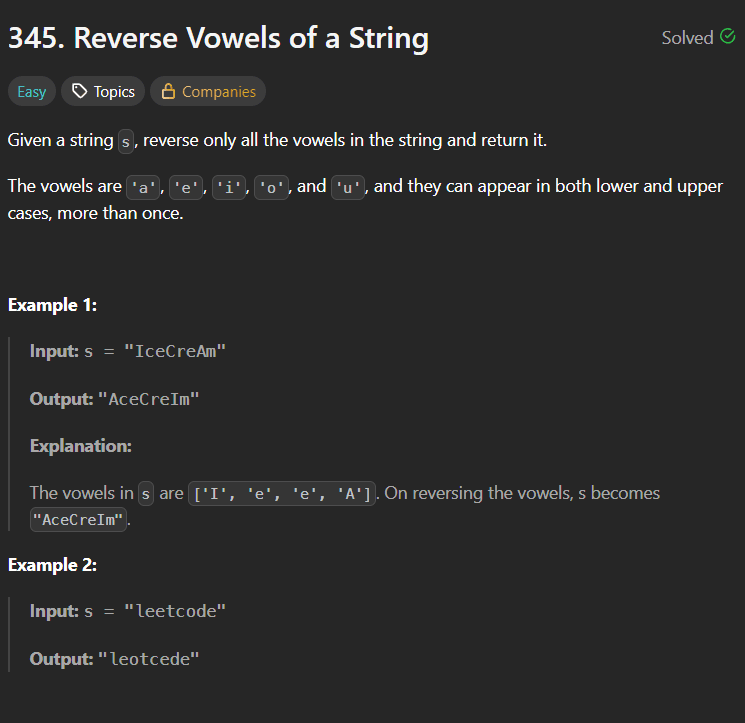
Reverse Vowels of a String – From Extra Space Approach to Two Pointer Optimization (LeetCode 345)

Reverse Vowels of a String – From Extra Space Approach to Two Pointer Optimization (LeetCode 345)

🔗 Problem LinkLeetCode 345 – Reverse Vowels of a String 👉 https://leetcode.com/problems/reverse-vowels-of-a-string/IntroductionThis problem is very similar to Reverse Only Letters, but with a small twist:Instead of reversing all letters, we only reverse the vowels.At first, we might think of extracting vowels, reversing them, and putting them back. That works — but it is not the most optimal approach.In this article, we’ll:Understand the brute-force style approach (your solution)Analyze its time complexityOptimize it using the Two Pointer patternCompare both approaches📌 Problem UnderstandingYou are given a string s.You must:Reverse only the vowelsKeep all other characters in the same positionVowels include:a, e, i, o, uA, E, I, O, UExample 1Input: "IceCreAm"Output: "AceCreIm"Vowels: ['I','e','e','A'] Reversed: ['A','e','e','I']Example 2Input: "leetcode"Output: "leotcede"🧠 Your First Approach – Extract, Reverse, ReplaceYour idea:Extract all vowels into a string.Store their indices.Reverse the vowel string.Replace vowels at stored indices.Let’s look at your code.💻 Your Code (Extract & Replace Method)class Solution { public String reverseVowels(String s) { String vow = ""; List<Integer> lis = new ArrayList<>(); HashMap<Integer,Character> mp = new HashMap<>(); for(int i =0;i<s.length();i++){ if(((s.charAt(i) == 'a') || (s.charAt(i) == 'e') || (s.charAt(i) == 'i') || (s.charAt(i) == 'o') || (s.charAt(i) == 'u') || (s.charAt(i) == 'A') || (s.charAt(i) == 'E') || (s.charAt(i) == 'I') || (s.charAt(i) == 'O') || (s.charAt(i) == 'U')) ){ vow += s.charAt(i); lis.add(i); } } String so = ""; for(int i = vow.length()-1; i >= 0; i--){ so += vow.charAt(i); } for(int i =0; i< lis.size();i++){ mp.put(lis.get(i), so.charAt(i)); } String ans = ""; for(int i =0 ; i< s.length();i++){ if(mp.containsKey(i)){ ans += mp.get(i); }else{ ans += s.charAt(i); } } return ans; }}🔍 How This WorksStep 1 – Extract VowelsStore:Vowel characters in vowTheir indices in lisStep 2 – Reverse the Vowel StringCreate new reversed string so.Step 3 – Map Indices to Reversed VowelsUse a HashMap to store:index → reversed vowelStep 4 – Build Final StringTraverse original string:If index in map → use reversed vowelElse → use original character⚠️ Problem with This ApproachAlthough correct, it has inefficiencies:String concatenation (+=) → O(n²) in worst caseExtra space used:Vowel stringList of indicesHashMapFinal answer stringTime Complexity: O(n²) (due to string concatenation) Space Complexity: O(n)We can do better.🚀 Optimized Approach – Two Pointers (Best Solution)Instead of extracting vowels separately, we can:Convert string into char arrayUse two pointersSwap vowels directlyThis avoids extra structures.💻 Optimized Two Pointer Solutionclass Solution { public String reverseVowels(String s) { int i = 0, j = s.length() - 1; char[] arr = s.toCharArray(); while(i < j){ if(!isVowel(arr[i])){ i++; } else if(!isVowel(arr[j])){ j--; } else{ char temp = arr[i]; arr[i] = arr[j]; arr[j] = temp; i++; j--; } } return new String(arr); } private boolean isVowel(char c){ return c=='a'||c=='e'||c=='i'||c=='o'||c=='u'|| c=='A'||c=='E'||c=='I'||c=='O'||c=='U'; }}🎯 Why This WorksWe:Move left pointer until vowel foundMove right pointer until vowel foundSwapContinueNo extra storage needed.⏱ Complexity ComparisonYour ApproachTime: O(n²) (string concatenation)Space: O(n)Two Pointer ApproachTime: O(n)Space: O(n) (char array)Much cleaner and faster.🔥 Key LearningThis problem reinforces:Two pointer patternIn-place modificationAvoiding unnecessary extra spaceRecognizing optimization opportunitiesWhenever you see:"Reverse something but keep other elements fixed"Think:👉 Two Pointers🏁 Final ThoughtsYour approach shows strong logical thinking:Extract → Reverse → ReplaceThat’s a valid way to solve it.But the optimized two-pointer approach is more interview-friendly.If you master this pattern, you can easily solve:Reverse Only LettersReverse StringValid PalindromeRemove Duplicates from Sorted Array

Two PointersString ManipulationHashMapLeetCodeEasy
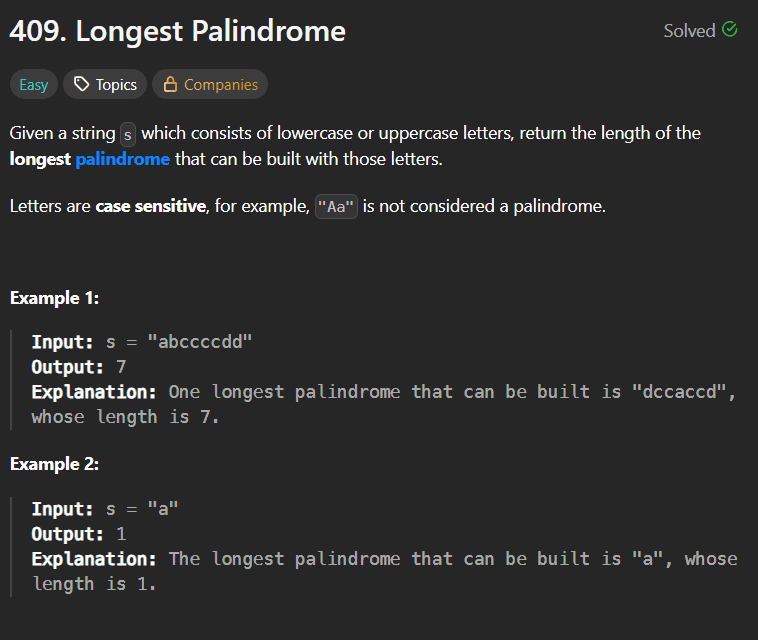
Longest Palindrome – Building the Maximum Length from Given Letters (LeetCode 409)

Longest Palindrome – Building the Maximum Length from Given Letters (LeetCode 409)

🔗 Problem LinkLeetCode 409 – Longest Palindrome 👉 https://leetcode.com/problems/longest-palindrome/IntroductionThis is one of those problems where you don’t actually need to build the palindrome.You just need to calculate the maximum possible length of a palindrome that can be formed using the given characters.The key idea here is understanding:How palindromes are structured.Once you understand that, the solution becomes straightforward and elegant.📌 Problem UnderstandingYou are given a string s containing:Lowercase lettersUppercase lettersCase-sensitive (meaning 'A' and 'a' are different)You must return:The length of the longest palindrome that can be built using those characters.You can rearrange characters in any order.Example 1Input: s = "abccccdd"Output: 7One possible palindrome:dccaccdLength = 7Example 2Input: s = "a"Output: 1🧠 Key Observation About PalindromesA palindrome:Reads the same forward and backward.Has mirror symmetry.This means:Characters must appear in pairs.At most one character can appear an odd number of times (middle character).🧠 Intuition Behind the ApproachLet’s think step by step:Count frequency of each character.For every character:If frequency is even → use all of them.If frequency is odd → use (frequency - 1).If at least one odd frequency exists → we can place one odd character in the center.That’s it.This is a greedy approach.💻 Your Codeclass Solution { public int longestPalindrome(String s) { if(s.length() == 1) return 1; HashMap<Character,Integer> mp = new HashMap<>(); for(int i =0; i < s.length();i++){ mp.put(s.charAt(i),mp.getOrDefault(s.charAt(i),0)+1); } int len =0; boolean odd = false; for(int a : mp.values()){ if(a%2 == 0){ len+=a; }else{ len+=a-1; odd= true; } } if(odd){ return len+1; } return len; }}🔍 Step-by-Step Explanation1️⃣ Edge Caseif(s.length() == 1) return 1;If there is only one character, the answer is 1.2️⃣ Frequency CountingHashMap<Character,Integer> mp = new HashMap<>();for(int i =0; i < s.length();i++){ mp.put(s.charAt(i),mp.getOrDefault(s.charAt(i),0)+1);}We count how many times each character appears.3️⃣ Build the Palindrome Lengthint len = 0;boolean odd = false;len → stores palindrome lengthodd → tracks whether any odd frequency exists4️⃣ Process Each Frequencyfor(int a : mp.values()){ if(a % 2 == 0){ len += a; }else{ len += a - 1; odd = true; }}If frequency is even → use all characters.If odd:Use a - 1 (which is even)Keep track that we saw an odd number5️⃣ Add Middle Character If Neededif(odd){ return len + 1;}If at least one odd frequency exists → we can place one character in the center.Otherwise → return len.🎯 Why This WorksIn a palindrome:All characters must appear in pairs (mirrored sides).Only one character can be unpaired (center).So we:Use all even counts.Use even portion of odd counts.Add one center character if possible.⏱ Complexity AnalysisTime Complexity: O(n)One pass to count frequenciesOne pass over map (max 52 characters: A–Z, a–z)Space Complexity: O(52) ≈ O(1)At most 52 distinct characters.🔥 Cleaner Optimization IdeaWe don’t even need a boolean variable.We can simply:Add a / 2 * 2 for every frequencyIf total length < original string length → add 1Example optimized version:class Solution { public int longestPalindrome(String s) { HashMap<Character,Integer> mp = new HashMap<>(); for(char ch : s.toCharArray()){ mp.put(ch, mp.getOrDefault(ch, 0) + 1); } int len = 0; for(int count : mp.values()){ len += (count / 2) * 2; } if(len < s.length()){ len += 1; } return len; }}🏁 Final ThoughtsThis problem teaches:Understanding palindrome structureFrequency countingGreedy logicHandling odd and even countsIt’s a simple but powerful pattern question.If you truly understand this, you can easily solve problems like:Palindrome PermutationLongest Palindrome by Concatenating Two Letter WordsCount Palindromic Subsequences

HashMapStringGreedyFrequency CountLeetCodeEasy
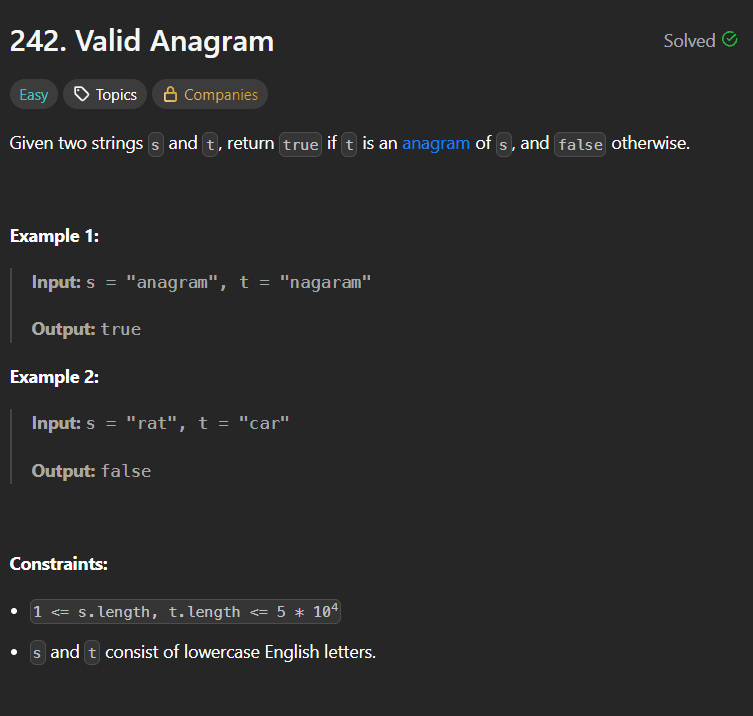
Valid Anagram – Frequency Counting Pattern Explained (LeetCode 242)

Valid Anagram – Frequency Counting Pattern Explained (LeetCode 242)

🔗 Problem LinkLeetCode 242 – Valid Anagram 👉 https://leetcode.com/problems/valid-anagram/IntroductionThis is one of the most important string frequency problems in coding interviews.The idea of checking whether two strings are anagrams appears in many variations:Group AnagramsRansom NoteFind the DifferencePermutation in StringIf you master this pattern, you unlock a whole category of problems.Let’s break it down step by step.📌 Problem UnderstandingTwo strings are anagrams if:They contain the same charactersWith the same frequenciesOrder does not matterExample 1Input: s = "anagram" t = "nagaram"Output: trueBoth contain:a → 3n → 1g → 1r → 1m → 1Example 2Input: s = "rat" t = "car"Output: falseDifferent character frequencies.🧠 IntuitionThe core idea:If two strings are anagrams, their character frequencies must match exactly.So we:Check if lengths are equal.Count frequency of characters in first string.Subtract frequencies using second string.If at any point frequency becomes negative → not anagram.💻 Your Codeclass Solution { public boolean isAnagram(String s, String t) { if(s.length() != t.length()) return false; HashMap<Character,Integer> mp = new HashMap<>(); for(int i =0;i<s.length();i++){ mp.put(s.charAt(i),mp.getOrDefault(s.charAt(i),0)+1); } for(int i =0; i < t.length();i++){ if(mp.containsKey(t.charAt(i)) && mp.get(t.charAt(i)) > 0){ mp.put(t.charAt(i),mp.get(t.charAt(i))-1); }else{ return false; } } return true; }}🔍 Step-by-Step Explanation1️⃣ Length Checkif(s.length() != t.length()) return false;If lengths differ → cannot be anagrams.2️⃣ Build Frequency Mapmp.put(s.charAt(i), mp.getOrDefault(s.charAt(i), 0) + 1);Count occurrences of each character in s.3️⃣ Subtract Using Second Stringif(mp.containsKey(t.charAt(i)) && mp.get(t.charAt(i)) > 0)If character exists and frequency is available → reduce it.Otherwise → return false immediately.🎯 Why This WorksWe treat:First string as frequency builderSecond string as frequency consumerIf all frequencies match perfectly, we return true.⏱ Complexity AnalysisTime Complexity: O(n)One pass to build mapOne pass to compareSpace Complexity: O(26) ≈ O(1)Only lowercase English letters allowed.🔥 Optimized Approach – Using Array Instead of HashMapSince the problem guarantees:s and t consist of lowercase English lettersWe can replace HashMap with an integer array of size 26.This is faster and cleaner.Optimized Versionclass Solution { public boolean isAnagram(String s, String t) { if(s.length() != t.length()) return false; int[] freq = new int[26]; for(char c : s.toCharArray()){ freq[c - 'a']++; } for(char c : t.toCharArray()){ freq[c - 'a']--; if(freq[c - 'a'] < 0){ return false; } } return true; }}🚀 Why This Is BetterNo HashMap overheadDirect index accessCleaner codeFaster in interviews🏁 Final ThoughtsThis problem teaches:Frequency counting patternEarly exit optimizationUsing arrays instead of HashMap when character set is limitedThinking in terms of resource balanceValid Anagram is a foundation problem.Once you master it, you can easily solve:Ransom NoteFind the DifferenceGroup AnagramsCheck Equal Character Occurrences

HashMapStringFrequency CountArraysLeetCodeEasy
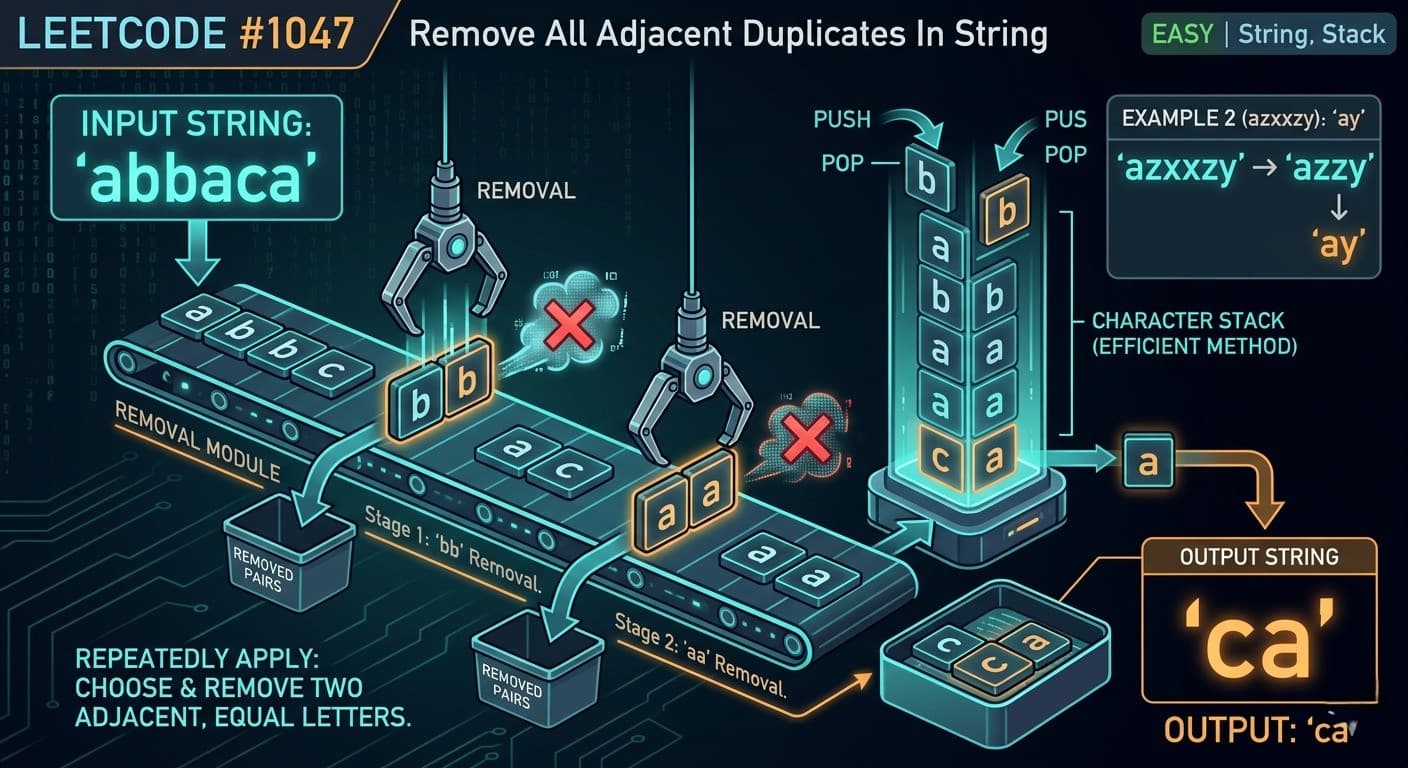
LeetCode 1047: Remove All Adjacent Duplicates In String — Java Solution With All Approaches Explained

LeetCode 1047: Remove All Adjacent Duplicates In String — Java Solution With All Approaches Explained

Introduction: What Is LeetCode 1047 Remove All Adjacent Duplicates In String?If you are grinding LeetCode for coding interviews at companies like Google, Amazon, or Microsoft, LeetCode 1047 Remove All Adjacent Duplicates In String is a problem you cannot skip. It is one of the most elegant examples of the stack simulation pattern and appears frequently as a warmup or follow-up question in technical rounds.In this article we will cover everything you need — plain English explanation, real life analogy, 3 Java approaches with dry runs, complexity analysis, common mistakes, FAQs, and similar problems to practice next.Here is the problem link-: Leetcode 1047 What Is the Problem Really Asking?You are given a string. Keep scanning it and whenever you find two same letters sitting next to each other, remove both of them. After removing, the letters around them might now become adjacent and form a new pair — so you keep doing this until no more adjacent duplicates exist.Example walkthrough for "abbaca":"abbaca" → bb are adjacent duplicates → remove → "aaca""aaca" → aa are adjacent duplicates → remove → "ca""ca" → no adjacent duplicates → done!✅ Output: "ca"Real Life Analogy — Think of Popping BubblesImagine a row of colored bubbles. Whenever two bubbles of the same color are next to each other, they pop and disappear. After they pop, the bubbles on either side might now touch each other — and if they are the same color, they pop too! You keep going until no two same-colored bubbles are touching.That chain reaction is exactly what this problem simulates. And the best tool to handle that chain reaction? A stack.Approach 1: Brute Force (Beginner Friendly)The IdeaScan the string repeatedly. Every time you find two adjacent equal characters, remove them. Keep doing this until a full pass finds nothing to remove.public String removeDuplicates(String s) { StringBuilder sb = new StringBuilder(s); boolean found = true; while (found) { found = false; for (int i = 0; i < sb.length() - 1; i++) { if (sb.charAt(i) == sb.charAt(i + 1)) { sb.deleteCharAt(i); sb.deleteCharAt(i); found = true; break; } } } return sb.toString();}This is easy to understand but very slow. For each pair found, you restart the entire scan. With n up to 100,000, this will get Time Limit Exceeded on LeetCode. Use it only to build intuition.Time Complexity: O(n²) — repeated passes over the string Space Complexity: O(n) — StringBuilder storageApproach 2: Stack Based Solution (Classic Interview Approach)The IdeaA stack is perfect here because of one key observation — when you remove a pair, the character that was before the pair is now adjacent to the character after the pair. That is a Last In First Out situation, which is exactly what a stack handles naturally.Algorithm:If the current character matches the top of the stack → pop (they cancel each other)Otherwise → push the current character onto the stackAt the end, the stack contains your final answerpublic String removeDuplicates(String s) { Stack<Character> st = new Stack<>(); StringBuilder sb = new StringBuilder(); for (int i = 0; i < s.length(); i++) { char c = s.charAt(i); if (!st.empty() && c == st.peek()) { st.pop(); // adjacent duplicate found, cancel both } else { st.push(c); } } while (!st.empty()) { sb.append(st.pop()); } return sb.reverse().toString();}Dry Run — "abbaca"We go character by character and check against the top of the stack:a → stack empty, push → stack: [a]b → top is a, not equal, push → stack: [a, b]b → top is b, equal! pop → stack: [a]a → top is a, equal! pop → stack: []c → stack empty, push → stack: [c]a → top is c, not equal, push → stack: [c, a]Stack remaining: [c, a] → reverse → ✅ "ca"Notice how after removing bb, the two as automatically become adjacent and get caught — the stack handles this chain reaction naturally without any extra logic!Time Complexity: O(n) — single pass through the string Space Complexity: O(n) — stack holds up to n charactersApproach 3: StringBuilder as Stack (Optimal Solution) ✅The IdeaThis is your own solution and the best one! Instead of using a separate Stack<Character>, we use StringBuilder itself as a stack:sb.append(c) acts as pushsb.deleteCharAt(sb.length() - 1) acts as popsb.charAt(sb.length() - 1) acts as peekNo extra data structure, no boxing of char into Character objects, and no reversal needed at the end. Clean, fast, and minimal.public String removeDuplicates(String s) { StringBuilder sb = new StringBuilder(); for (int i = 0; i < s.length(); i++) { char c = s.charAt(i); if (sb.length() != 0 && c == sb.charAt(sb.length() - 1)) { sb.deleteCharAt(sb.length() - 1); // adjacent duplicate, remove both } else { sb.append(c); } } return sb.toString();}Dry Run — "azxxzy"a → sb empty, append → "a"z → last char is a, not equal, append → "az"x → last char is z, not equal, append → "azx"x → last char is x, equal! delete → "az"z → last char is z, equal! delete → "a"y → last char is a, not equal, append → "ay"✅ Final Answer: "ay"Again, notice the chain reaction — after xx was removed, z and z became adjacent and got removed too. The StringBuilder handles this perfectly in a single pass!Time Complexity: O(n) — one pass, every character processed exactly once Space Complexity: O(n) — StringBuilder storageWhy StringBuilder Beats Stack in JavaWhen you use Stack<Character> in Java, every char primitive gets auto-boxed into a Character object. That means extra memory allocation for every single character. With StringBuilder, you work directly on the underlying char array — faster and leaner. Plus you skip the reversal step entirely.For an interview, the Stack approach is great for explaining your thought process clearly. But for the final submitted solution, StringBuilder is the way to go.Common Mistakes to AvoidNot checking sb.length() != 0 before peeking If the StringBuilder is empty and you call sb.charAt(sb.length() - 1), you will get a StringIndexOutOfBoundsException. Always guard this check — even if the problem guarantees valid input, it shows clean coding habits.Thinking you need multiple passes Many beginners think you need to scan the string multiple times because of chain reactions. The stack handles chain reactions automatically in a single pass. Trust the process!Forgetting to reverse when using Stack Since a stack gives you characters in reverse order when you pop them, you must call .reverse() at the end. With StringBuilder you do not need this.How This Fits Into the Stack Simulation PatternBy now you might be noticing a theme across multiple problems:LeetCode 3174 Clear Digits — digit acts as backspace, deletes closest left non-digit LeetCode 2390 Removing Stars — star acts as backspace, deletes closest left non-star LeetCode 1047 Remove Adjacent Duplicates — character cancels itself if it matches the top of stackAll three use the exact same StringBuilder-as-stack pattern. The only difference is the condition that triggers a deletion. This is why pattern recognition is the real skill — once you internalize this pattern, you can solve a whole family of problems in minutes.FAQs — People Also AskQ1. What is the best approach for LeetCode 1047 in Java? The StringBuilder approach is the best. It runs in O(n) time, uses O(n) space, requires no extra data structure, and avoids the reversal step needed with a Stack.Q2. Why does a stack work for removing adjacent duplicates? Because whenever you remove a pair, the characters around them become the new neighbors. A stack naturally keeps track of the most recently seen character, so it catches these chain reactions without any extra logic.Q3. What is the time complexity of LeetCode 1047? The optimal solution runs in O(n) time and O(n) space, where n is the length of the input string.Q4. Is LeetCode 1047 asked in coding interviews? Yes, it is commonly asked as a warmup problem or follow-up at companies like Google, Amazon, and Adobe. It tests your understanding of stack-based string manipulation.Q5. What is the difference between LeetCode 1047 and LeetCode 1209? LeetCode 1047 removes pairs of adjacent duplicates. LeetCode 1209 is the harder version — it removes groups of k adjacent duplicates, requiring you to store counts alongside characters in the stack.Similar LeetCode Problems to Practice Next2390. Removing Stars From a String — Medium — star as backspace3174. Clear Digits — Easy — digit as backspace844. Backspace String Compare — Easy — compare two strings after backspaces1209. Remove All Adjacent Duplicates in String II — Medium — harder version with k duplicates735. Asteroid Collision — Medium — stack simulation with collision logicConclusionLeetCode 1047 Remove All Adjacent Duplicates In String is a beautiful problem that teaches you one of the most powerful and reusable patterns in DSA — stack simulation. The moment you spot that a removal can cause a chain reaction of more removals, you know a stack is your best friend.The StringBuilder solution is clean, optimal, and interview-ready. Master it, understand why it works, and you will be able to tackle the entire family of stack simulation problems with confidence.Found this helpful? Share it with friends preparing for coding interviews

LeetCodeJavaStackStringEasy
Find the Difference – Smart ASCII Sum Trick (LeetCode 389)

Find the Difference – Smart ASCII Sum Trick (LeetCode 389)

🔗 Problem LinkLeetCode 389 – Find the Difference 👉 https://leetcode.com/problems/find-the-difference/IntroductionThis is a very clever problem.At first glance, you might think:Use a HashMapCount frequenciesCompare both stringsBut there’s a much smarter and cleaner way to solve it using character arithmetic (ASCII values).This problem teaches an important lesson:Sometimes math can replace extra space.Let’s break it down.📌 Problem UnderstandingYou are given two strings:stString t is created by:Shuffling string sAdding one extra character at a random positionYour task:Return the extra character added to t.Example 1Input: s = "abcd" t = "abcde"Output: "e"Example 2Input: s = "" t = "y"Output: "y"🧠 First Intuition (Brute Force Thinking)When solving this for the first time, a common approach would be:Count frequency of characters in sCount frequency of characters in tCompare bothThe one with extra count is the answerThat works in O(n) time and O(26) space.But we can do better.🚀 Smarter Approach – ASCII Sum Trick💡 Key InsightCharacters are stored as integer ASCII values.If:We add all ASCII values of characters in tSubtract all ASCII values of characters in sWhat remains?👉 The ASCII value of the extra character.Because:All matching characters cancel out.Only the added character remains.💻 Your Codeclass Solution { public char findTheDifference(String s, String t) { int tot = 0; for(int i = 0; i < t.length(); i++){ tot += (int)t.charAt(i); } for(int i = 0; i < s.length(); i++){ tot -= (int)s.charAt(i); } return (char)tot; }}🔍 Step-by-Step Explanation1️⃣ Initialize Totalint tot = 0;This will store the running ASCII difference.2️⃣ Add All Characters of ttot += (int)t.charAt(i);We add ASCII values of every character in t.3️⃣ Subtract All Characters of stot -= (int)s.charAt(i);We subtract ASCII values of every character in s.4️⃣ Return Remaining Characterreturn (char)tot;After subtraction, only the extra character’s ASCII value remains.We convert it back to char.🎯 Why This WorksLet’s take example:s = "abcd"t = "abcde"ASCII Sum:t = a + b + c + d + es = a + b + c + dSubtract:(t sum) - (s sum) = eEverything cancels except the extra letter.Simple and powerful.⏱ Complexity AnalysisTime Complexity: O(n)One loop over tOne loop over sSpace Complexity: O(1)No extra data structure used.🔥 Even Smarter Approach – XOR TrickAnother elegant method is using XOR:Why XOR Works?Properties:a ^ a = 0a ^ 0 = aXOR is commutativeIf we XOR all characters in both strings:Matching characters cancel out.Only the extra character remains.XOR Versionclass Solution { public char findTheDifference(String s, String t) { char result = 0; for(char c : s.toCharArray()){ result ^= c; } for(char c : t.toCharArray()){ result ^= c; } return result; }}This is considered the most elegant solution.🏁 Final ThoughtsThis problem teaches:Thinking beyond brute forceUsing mathematical propertiesUnderstanding ASCII representationUsing XOR smartlySometimes the best solution is not about data structures — it’s about recognizing hidden math patterns.

StringMath TrickASCIIBit ManipulationLeetCodeEasy
LeetCode 496: Next Greater Element I — Java Solution With All Approaches Explained

LeetCode 496: Next Greater Element I — Java Solution With All Approaches Explained

IntroductionLeetCode 496 Next Greater Element I is your gateway into one of the most important and frequently tested patterns in coding interviews — the Monotonic Stack. Once you understand this problem deeply, problems like Next Greater Element II, Daily Temperatures, and Largest Rectangle in Histogram all start to make sense.Here is the Link of Question -: LeetCode 496This article covers plain English explanation, real life analogy, brute force and optimal approaches in Java, detailed dry runs, complexity analysis, common mistakes, and FAQs.What Is the Problem Really Asking?You have two arrays. nums2 is the main array. nums1 is a smaller subset of nums2. For every element in nums1, find its position in nums2 and look to the right — what is the first element that is strictly greater? If none exists, return -1.Example:nums1 = [4,1,2], nums2 = [1,3,4,2]For 4 in nums2: elements to its right are [2], none greater → -1For 1 in nums2: elements to its right are [3,4,2], first greater is 3For 2 in nums2: no elements to its right → -1Output: [-1, 3, -1]Real Life Analogy — The Taller Person in a QueueImagine you are standing in a queue and you want to know — who is the first person taller than you standing somewhere behind you in the line?You look to your right one by one until you find someone taller. That person is your "next greater element." If everyone behind you is shorter, your answer is -1.Now imagine doing this for every person in the queue efficiently — instead of each person looking one by one, you use a smart system that processes everyone in a single pass. That smart system is the Monotonic Stack.Approach 1: Brute Force (Beginner Friendly)The IdeaFor each element in nums1, find its position in nums2, then scan everything to its right to find the first greater element.javapublic int[] nextGreaterElement(int[] nums1, int[] nums2) { int[] ans = new int[nums1.length]; for (int i = 0; i < nums1.length; i++) { int found = -1; boolean seen = false; for (int j = 0; j < nums2.length; j++) { if (seen && nums2[j] > nums1[i]) { found = nums2[j]; break; } if (nums2[j] == nums1[i]) { seen = true; } } ans[i] = found; } return ans;}Simple to understand but inefficient. For each element in nums1 you scan the entire nums2.Time Complexity: O(m × n) — where m = nums1.length, n = nums2.length Space Complexity: O(1) — ignoring output arrayThis works for the given constraints (n ≤ 1000) but will not scale for larger inputs. The follow-up specifically asks for better.Approach 2: Monotonic Stack + HashMap (Optimal Solution) ✅The IdeaThis is your solution and the best one. The key insight is — instead of answering queries for nums1 elements one by one, precompute the next greater element for every element in nums2 and store results in a HashMap. Then answering nums1 queries becomes just a HashMap lookup.To precompute efficiently, we use a Monotonic Stack — a stack that always stays in decreasing order from bottom to top.Why traverse from right to left? Because we are looking for the next greater element to the right. Starting from the right end, by the time we process any element, we have already seen everything to its right.Algorithm:Traverse nums2 from right to leftMaintain a stack of "candidate" next greater elementsFor current element, pop all stack elements that are smaller or equal — they can never be the next greater for anything to the leftIf stack is empty → next greater is -1, else → top of stack is the answerPush current element onto stackStore result in HashMapLook up each nums1 element in the HashMapjavapublic int[] nextGreaterElement(int[] nums1, int[] nums2) { Stack<Integer> st = new Stack<>(); HashMap<Integer, Integer> mp = new HashMap<>(); // Precompute next greater for every element in nums2 for (int i = nums2.length - 1; i >= 0; i--) { // Pop elements smaller than current — they are useless while (!st.empty() && nums2[i] >= st.peek()) { st.pop(); } // Top of stack is the next greater, or -1 if empty mp.put(nums2[i], st.empty() ? -1 : st.peek()); // Push current element as a candidate for elements to its left st.push(nums2[i]); } // Answer queries for nums1 int[] ans = new int[nums1.length]; for (int i = 0; i < nums1.length; i++) { ans[i] = mp.get(nums1[i]); } return ans;}Why Is the Stack Monotonic?After popping smaller elements, the stack always maintains a decreasing order from bottom to top. This means the top of the stack at any point is always the smallest element seen so far to the right — making it the best candidate for "next greater."This is called a Monotonic Decreasing Stack and it is the heart of this entire pattern.Detailed Dry Run — nums2 = [1,3,4,2]We traverse from right to left:i = 3, nums2[3] = 2Stack is emptyNo elements to popStack empty → mp.put(2, -1)Push 2 → stack: [2]i = 2, nums2[2] = 4Stack top is 2, and 4 >= 2 → pop 2 → stack: []Stack empty → mp.put(4, -1)Push 4 → stack: [4]i = 1, nums2[1] = 3Stack top is 4, and 3 < 4 → stop poppingStack not empty → mp.put(3, 4)Push 3 → stack: [4, 3]i = 0, nums2[0] = 1Stack top is 3, and 1 < 3 → stop poppingStack not empty → mp.put(1, 3)Push 1 → stack: [4, 3, 1]HashMap after processing nums2:1 → 3, 2 → -1, 3 → 4, 4 → -1Now answer nums1 = [4, 1, 2]:nums1[0] = 4 → mp.get(4) = -1nums1[1] = 1 → mp.get(1) = 3nums1[2] = 2 → mp.get(2) = -1✅ Output: [-1, 3, -1]Time Complexity: O(n + m) — n for processing nums2, m for answering nums1 queries Space Complexity: O(n) — HashMap and Stack both store at most n elementsWhy Pop Elements Smaller Than Current?This is the most important thing to understand in this problem. When we are at element x and we see a stack element y where y < x, we pop y. Why?Because x is to the right of everything we will process next (we go right to left), and x is already greater than y. So for any element to the left of x, if they are greater than y, they are definitely also greater than y — meaning y would never be the "next greater" for anything. It becomes useless and gets discarded.This is why the stack stays decreasing — every element we keep is a legitimate candidate for being someone's next greater element.How This Differs From Previous Stack ProblemsYou have been solving stack problems with strings — backspace, stars, adjacent duplicates. This problem introduces the stack for arrays and searching, which is a step up in complexity.The pattern shift is: instead of using the stack to build or reduce a string, we use it to maintain a window of candidates while scanning. This monotonic stack idea is what powers many hard problems like Largest Rectangle in Histogram, Trapping Rain Water, and Daily Temperatures.Common Mistakes to AvoidUsing >= instead of > in the pop condition We pop when nums2[i] >= st.peek(). If you use only >, equal elements stay on the stack and give wrong answers since we need strictly greater.Traversing left to right instead of right to left Going left to right makes it hard to know what is to the right of the current element. Always go right to left for "next greater to the right" problems.Forgetting HashMap lookup handles the nums1 query efficiently Some people recompute inside the nums1 loop. Always precompute in a HashMap — that is the whole point of the optimization.FAQs — People Also AskQ1. What is a Monotonic Stack and why is it used in LeetCode 496? A Monotonic Stack is a stack that maintains its elements in either increasing or decreasing order. In LeetCode 496, a Monotonic Decreasing Stack is used to efficiently find the next greater element for every number in nums2 in a single pass, reducing time complexity from O(n²) to O(n).Q2. What is the time complexity of LeetCode 496 optimal solution? The optimal solution runs in O(n + m) time where n is the length of nums2 and m is the length of nums1. Processing nums2 takes O(n) and answering all nums1 queries via HashMap takes O(m).Q3. Why do we traverse nums2 from right to left? Because we are looking for the next greater element to the right. Starting from the right end means by the time we process any element, we have already seen all elements to its right and stored them in the stack as candidates.Q4. Is LeetCode 496 asked in coding interviews? Yes, it is commonly used as an introduction to the Monotonic Stack pattern at companies like Amazon, Google, and Microsoft. It often appears as a warmup before harder follow-ups like Next Greater Element II (circular array) or Daily Temperatures.Q5. What is the difference between LeetCode 496 and LeetCode 739 Daily Temperatures? Both use the same Monotonic Stack pattern. In 496 you return the actual next greater value. In 739 you return the number of days (index difference) until a warmer temperature. The core stack logic is identical.Similar LeetCode Problems to Practice Next739. Daily Temperatures — Medium — days until warmer temperature, same pattern503. Next Greater Element II — Medium — circular array version901. Online Stock Span — Medium — monotonic stack with span counting84. Largest Rectangle in Histogram — Hard — classic monotonic stack42. Trapping Rain Water — Hard — monotonic stack or two pointerConclusionLeetCode 496 Next Greater Element I is the perfect entry point into the Monotonic Stack pattern. The brute force is easy to understand, but the real learning happens when you see why the stack stays decreasing and how that single insight collapses an O(n²) problem into O(n).Once you truly understand why we pop smaller elements and how the HashMap bridges the gap between precomputation and query answering, the entire family of Next Greater Element problems becomes approachable — including the harder circular and histogram variants.

ArrayStackMonotonic StackHashMapEasyLeetCode
Maximum Average Subarray I — Efficient Solution Using Sliding Window (LeetCode 643)

Maximum Average Subarray I — Efficient Solution Using Sliding Window (LeetCode 643)

IntroductionLeetCode Problem 643: Maximum Average Subarray I is a classic problem that tests understanding of arrays and the sliding window technique.The task is simple in description but requires optimization to work efficiently for large inputs.We are given:An integer array numsAn integer kWe must find a contiguous subarray of length k that has the maximum average value, and return that average.If you want to try solving the problem yourself before reading further, you can attempt it here:👉 Try the problem on LeetCode: https://leetcode.com/problems/maximum-average-subarray-i/Problem UnderstandingA brute-force solution would compute the sum for every subarray of length k and track the maximum average. However, recalculating sums repeatedly results in O(n × k) time complexity, which becomes inefficient for large arrays.Instead, we can use the sliding window technique to optimize the process.Key Idea: Sliding WindowInstead of recomputing sums:Compute the sum of the first window of size k.Slide the window forward by:Adding the next elementRemoving the element leaving the windowUpdate the maximum average at each step.This reduces time complexity to O(n).ApproachMaintain two pointers representing the window.Keep adding elements until window size becomes k.Compute average and update maximum.Slide the window by removing the left element.Continue until the end of the array.Implementation (Java)class Solution { public double findMaxAverage(int[] nums, int k) { double ans = Integer.MIN_VALUE; int i = 0; int j = 0; int sum = 0; while (j < nums.length) { sum += nums[j]; if (j - i + 1 < k) { j++; } else { ans = Math.max(ans, (double) sum / k); sum -= nums[i]; i++; j++; } } return ans; }}Dry Run ExampleInput:nums = [1,12,-5,-6,50,3], k = 4Windows examined:[1,12,-5,-6] → avg = 0.5[12,-5,-6,50] → avg = 12.75 (maximum)[-5,-6,50,3] → avg = 10.5Maximum average = 12.75Complexity AnalysisTime Complexity: O(n) Each element enters and leaves the window once.Space Complexity: O(1) No extra space is used apart from variables.Edge Cases ConsideredSingle element array (k = 1)All negative numbersLarge input sizeLarge positive or negative valuesWhy Sliding Window MattersSliding window is a crucial technique used in many interview problems:Subarray sum problemsLongest substring problemsFixed or variable window size optimizationsMastering this pattern greatly improves coding interview performance.ConclusionThis problem demonstrates how recognizing patterns like sliding window can transform a slow brute-force solution into an efficient one.If you are preparing for coding interviews, mastering sliding window problems is essential since they appear frequently.

LeetCodeSliding WindowEasy
LeetCode 682 Baseball Game - Java Solution Explained

LeetCode 682 Baseball Game - Java Solution Explained

IntroductionLeetCode 682 Baseball Game is one of the cleanest and most beginner-friendly stack simulation problems on LeetCode. It does not require any fancy algorithm or deep insight — it purely tests whether you can carefully read the rules and simulate them faithfully using the right data structure.But do not let "Easy" fool you. This problem is a great place to practice thinking about which data structure fits best and why. We will solve it three different ways — Stack, ArrayList, and Deque — so you can see the tradeoffs and pick the one that makes most sense to you.You can find the problem here — LeetCode 682 Baseball Game.What Is the Problem Really Asking?You are keeping score for a baseball game with four special rules. You process a list of operations one by one and maintain a record of scores. At the end, return the total sum of all scores in the record.The four operations are:A number (like "5" or "-2") — just add that number as a new score to the record."C" — the last score was invalid, remove it from the record."D" — add a new score that is double the most recent score."+" — add a new score that is the sum of the two most recent scores.That is it. Four rules, simulate them in order, sum up what is left.Real Life Analogy — A Scoreboard With CorrectionsImagine a scoreboard operator at a sports event. They write scores on a whiteboard as the game progresses:A player scores 5 points → write 5Another player scores 2 → write 2Referee says last score was invalid → erase the last number (C)Special bonus rule kicks in → double the last valid score (D)Two scores combine → add the last two scores as one entry (+)At the end, add up everything on the whiteboard. The stack is your whiteboard — you write on top and erase from the top.Why Stack Is the Natural FitAll four operations only ever look at or modify the most recently added scores. C removes the last one. D doubles the last one. + uses the last two. This "most recent first" access pattern is the definition of LIFO — Last In First Out — which is exactly what a Stack provides.Any time a problem says "the previous score" or "the last two scores," your brain should immediately think Stack.Approach 1: Stack (Your Solution) ✅The IdeaUse a Stack of integers. For each operation:Number → parse and pushC → pop the topD → peek the top, push doubled value+ → pop top two, push both back, push their sumpublic int calPoints(String[] operations) { Stack<Integer> st = new Stack<>(); for (int i = 0; i < operations.length; i++) { String op = operations[i]; if (op.equals("C")) { st.pop(); // remove last score } else if (op.equals("D")) { st.push(st.peek() * 2); // double of last score } else if (op.equals("+")) { int prev1 = st.pop(); // most recent score int prev2 = st.pop(); // second most recent score int sum = prev1 + prev2; st.push(prev2); // put them back st.push(prev1); st.push(sum); // push the new score } else { st.push(Integer.parseInt(op)); // regular number } } // sum all remaining scores int total = 0; while (!st.empty()) { total += st.pop(); } return total;}One small improvement over your original solution — using op.equals("C") instead of op.charAt(0) == 'C'. This is cleaner and handles edge cases better since negative numbers like "-2" also start with - not a digit, so charAt(0) comparisons can get tricky. Using equals is always safer for string operations.Why the + Operation Needs Pop-Push-PopThe trickiest part is the + operation. You need the two most recent scores. Stack only lets you see the top. So you pop the first, then the second, compute the sum, then push both back before pushing the sum. This restores the record correctly — the previous two scores stay, and the new sum score is added on top.Detailed Dry Run — ops = ["5","2","C","D","+"]Let us trace every step carefully:"5" → number, parse and push Stack: [5]"2" → number, parse and push Stack: [5, 2]"C" → remove last score, pop Stack: [5]"D" → double last score, peek=5, push 10 Stack: [5, 10]"+" → sum of last two:pop prev1 = 10pop prev2 = 5sum = 15push prev2=5, push prev1=10, push sum=15 Stack: [5, 10, 15]Sum all: 5 + 10 + 15 = 30 ✅Detailed Dry Run — ops = ["5","-2","4","C","D","9","+","+"]"5" → push 5. Stack: [5]"-2" → push -2. Stack: [5, -2]"4" → push 4. Stack: [5, -2, 4]"C" → pop 4. Stack: [5, -2]"D" → peek=-2, push -4. Stack: [5, -2, -4]"9" → push 9. Stack: [5, -2, -4, 9]"+" → prev1=9, prev2=-4, sum=5. Push -4, 9, 5. Stack: [5, -2, -4, 9, 5]"+" → prev1=5, prev2=9, sum=14. Push 9, 5, 14. Stack: [5, -2, -4, 9, 5, 14]Sum: 5 + (-2) + (-4) + 9 + 5 + 14 = 27 ✅Approach 2: ArrayList (Most Readable)The IdeaArrayList gives you index-based access which makes the + operation much cleaner — no need to pop and push back. Just access the last two elements directly using size()-1 and size()-2.public int calPoints(String[] operations) { ArrayList<Integer> record = new ArrayList<>(); for (String op : operations) { int n = record.size(); if (op.equals("C")) { record.remove(n - 1); // remove last element } else if (op.equals("D")) { record.add(record.get(n - 1) * 2); // double last } else if (op.equals("+")) { // sum of last two — no need to remove and re-add! record.add(record.get(n - 1) + record.get(n - 2)); } else { record.add(Integer.parseInt(op)); } } int total = 0; for (int score : record) { total += score; } return total;}See how the + operation becomes a single line with ArrayList? record.get(n-1) + record.get(n-2) directly accesses the last two elements without any pop-push gymnastics.Dry Run — ops = ["5","2","C","D","+"]"5" → add 5. List: [5]"2" → add 2. List: [5, 2]"C" → remove last. List: [5]"D" → 5×2=10, add 10. List: [5, 10]"+" → get(0)+get(1) = 5+10=15, add 15. List: [5, 10, 15]Sum: 30 ✅Time Complexity: O(n) — single pass through operations Space Complexity: O(n) — ArrayList stores at most n scoresThe one tradeoff — remove(n-1) on an ArrayList is O(1) for the last element (no shifting needed). And get() is O(1). So this is fully O(n) overall and arguably the cleanest solution to read and understand.Approach 3: Deque (ArrayDeque — Fastest in Java)The IdeaArrayDeque is faster than Stack in Java because Stack is synchronized (thread-safe overhead) and ArrayDeque is not. For single-threaded LeetCode problems, ArrayDeque is always the better choice over Stack.public int calPoints(String[] operations) { Deque<Integer> deque = new ArrayDeque<>(); for (String op : operations) { if (op.equals("C")) { deque.pollLast(); // remove last } else if (op.equals("D")) { deque.offerLast(deque.peekLast() * 2); // double last } else if (op.equals("+")) { int prev1 = deque.pollLast(); int prev2 = deque.pollLast(); int sum = prev1 + prev2; deque.offerLast(prev2); // restore deque.offerLast(prev1); // restore deque.offerLast(sum); // new score } else { deque.offerLast(Integer.parseInt(op)); } } int total = 0; for (int score : deque) { total += score; } return total;}The logic is identical to the Stack approach. The only difference is the method names — offerLast instead of push, pollLast instead of pop, peekLast instead of peek.Time Complexity: O(n) Space Complexity: O(n)For iterating a Deque to sum, you can use a for-each loop directly — no need to pop everything out like with Stack.Approach ComparisonApproachTimeSpaceBest ForStackO(n)O(n)Classic interview answer, clear LIFO intentArrayListO(n)O(n)Cleanest code, easiest to readArrayDequeO(n)O(n)Best performance, preferred in productionAll three approaches have identical time and space complexity. The difference is purely in code style and readability. In an interview, any of these is perfectly acceptable. Mention that ArrayDeque is preferred over Stack in Java for performance if you want to impress.Why op.equals() Is Better Than op.charAt(0)Your original solution uses operations[i].charAt(0) == 'C' to check operations. This works but has a subtle risk — the + character check with charAt(0) is fine, but imagine if a future test had a number starting with C or D (it will not in this problem but defensive coding is a good habit). More importantly, "-2".charAt(0) is '-' which is fine, but using equals is semantically clearer — you are comparing the whole string, not just the first character. This shows cleaner coding habits in interviews.Edge Cases to KnowNegative numbers like "-2" Integer.parseInt("-2") handles negatives perfectly. The D operation on -2 gives -4. The + operation works correctly with negatives too. No special handling needed."C" after a "+" that added a score The problem guarantees C always has at least one score to remove. So after + adds a score, a C removes just that one new score — the previous two scores that + used remain intact. This is correct behavior and our solution handles it automatically.All scores removed If all operations are numbers followed by C operations removing every score, the stack ends up empty and the sum is 0. Our while loop handles this correctly — it simply never executes and returns 0.Only one operation A single number like ["5"] → push 5, sum is 5. Works fine.Common Mistakes to AvoidIn the + operation, forgetting to push both numbers back When you pop prev1 and prev2 to compute the sum, you must push them back onto the stack before pushing the sum. If you only push the sum without restoring prev1 and prev2, those scores disappear from the record permanently — which is wrong. The + operation only adds a new score, it does not remove the previous ones.Using charAt(0) comparison for detecting numbers Negative numbers start with -, not a digit. If you check charAt(0) >= '0' && charAt(0) <= '9' to detect numbers, you will miss negatives. The safest approach is to check for C, D, and + explicitly using equals, and fall through to the else for everything else (which covers both positive and negative numbers).Calling st.peek() or st.pop() without checking empty The problem guarantees valid operations — C always has something to remove, + always has two previous scores, D always has one. But in real code and defensive interview solutions, adding empty checks shows good habits even when the constraints guarantee safety.FAQs — People Also AskQ1. Why is Stack a good choice for LeetCode 682 Baseball Game? Because all four operations only access the most recently added scores — the last score for C and D, the last two for +. This "most recent first" access pattern is exactly what LIFO (Last In First Out) provides. Stack's push, pop, and peek all run in O(1) making it perfectly efficient.Q2. What is the time complexity of LeetCode 682? O(n) time where n is the number of operations. Each operation performs a constant number of stack operations (at most 3 pushes/pops for the + case). Space complexity is O(n) for storing scores.Q3. Why does the + operation need to pop and push back in the Stack approach? Stack only gives direct access to the top element. To get the second most recent score, you must pop the first one, peek/pop the second, then push the first one back. The ArrayList approach avoids this by using index-based access directly.Q4. What is the difference between Stack and ArrayDeque in Java for this problem? Both work correctly. ArrayDeque is faster because Stack is a legacy class that extends Vector and is synchronized (thread-safe), adding unnecessary overhead for single-threaded use. ArrayDeque has no synchronization overhead. For LeetCode and interviews, either is acceptable but ArrayDeque is technically better.Q5. Is LeetCode 682 asked in coding interviews? It appears occasionally as a warmup or screening problem. Its main value is testing whether you can carefully simulate rules without making logical errors — a skill that matters in systems programming, game development, and any domain with complex state management.Similar LeetCode Problems to Practice Next71. Simplify Path — Medium — stack simulation with path operations1047. Remove All Adjacent Duplicates In String — Easy — stack simulation735. Asteroid Collision — Medium — stack simulation with conditions150. Evaluate Reverse Polish Notation — Medium — stack with arithmetic operations, very similar pattern227. Basic Calculator II — Medium — stack with operator precedenceConclusionLeetCode 682 Baseball Game is a perfect problem to build confidence with stack simulation. The four operations are clearly defined, the rules are unambiguous, and the stack maps naturally to every operation. Once you understand why pop-push-back is needed for + in the stack approach and how ArrayList simplifies that with index access, you have genuinely understood the tradeoffs between these data structures.If you are newer to stacks, start with the ArrayList solution for clarity. Once that clicks, rewrite it with Stack to understand the LIFO mechanics. Then try ArrayDeque to understand why it is preferred in modern Java code.

LeetCodeJavaStackArrayListDequeEasy
LeetCode 1365: How Many Numbers Are Smaller Than the Current Number | Java Solution, Intuition, Dry Run & Complexity Analysis

LeetCode 1365: How Many Numbers Are Smaller Than the Current Number | Java Solution, Intuition, Dry Run & Complexity Analysis

IntroductionIn this problem, we are given an integer array nums.For every element in the array, we must calculate how many numbers are smaller than the current number.The result should be stored in another array where:Each index contains the count of smaller numbersComparison must be done against every other elementWe cannot count the element itselfThis is a beginner-friendly array problem that teaches comparison logic and nested loop thinking.Problem StatementGiven the array nums, return an array answer such that:answer[i] = count of numbers smaller than nums[i]Question LinkProblem Link -: Leetcode 1365ExampleInputnums = [8,1,2,2,3]Output[4,0,1,1,3]Explanation8 → four smaller numbers → 1,2,2,31 → no smaller number2 → one smaller number → 12 → one smaller number → 13 → three smaller numbers → 1,2,2Understanding the ProblemWe need to check:For every element:How many values in the array are smaller than it?This means:Compare one number with all other numbersCount valid smaller valuesStore count in answer arrayIntuitionThe simplest idea is:Pick one numberCompare it with every elementCount smaller numbersSave resultRepeat for all indicesSince constraints are small:nums.length <= 500Brute force works perfectly.ApproachWe use two loops:Outer loop → selects current numberInner loop → compares with all numbersIf:nums[j] < nums[i]Then increase count.Java Solutionclass Solution { public int[] smallerNumbersThanCurrent(int[] nums) { int i = 0; int j = 1; int ans[] = new int[nums.length]; int cou = 0; while(i < nums.length){ if(i != j && nums[i] > nums[j]){ cou++; } j++; if(j == nums.length){ ans[i] = cou; i++; cou = 0; j = 0; } } return ans; }}Code ExplanationVariablesiCurrent element index.jUsed for comparison.couStores count of smaller numbers.ans[]Final result array.Step-by-Step LogicStep 1Pick current number using:iStep 2Compare with every number using:jStep 3If another value is smaller:nums[i] > nums[j]Increase count.Step 4Store count.Step 5Move to next element.Dry RunInputnums = [8,1,2,2,3]First Element = 8Compare with:NumberSmaller?1Yes2Yes2Yes3YesCount = 4ans[0] = 4Second Element = 1No smaller number.ans[1] = 0Third Element = 2Smaller number:1Count = 1ans[2] = 1Final Answer[4,0,1,1,3]Time ComplexityWe compare every element with every other element.ComplexityO(N²)Because:Outer loop = NInner loop = NTotal:N × NSpace ComplexityWe only store output array.ComplexityO(N)Better Clean Version (Recommended)Your logic works, but interviewers usually prefer readable code.class Solution { public int[] smallerNumbersThanCurrent(int[] nums) { int n = nums.length; int[] ans = new int[n]; for(int i = 0; i < n; i++) { int count = 0; for(int j = 0; j < n; j++) { if(i != j && nums[j] < nums[i]) { count++; } } ans[i] = count; } return ans; }}Optimized ApproachSince:0 <= nums[i] <= 100We can use frequency counting.This gives:O(N + K)Where:N = array sizeK = range of valuesCommon Mistakes1. Comparing Same IndexWrong:nums[i] > nums[i]Correct:i != j2. Forgetting Reset CountWrong:count keeps increasingCorrect:count = 0after each iteration.3. Index Out Of BoundsAlways ensure:j < nums.lengthInterview TipsThis problem teaches:Nested loopsArray traversalCounting logicComparison problemsBrute force thinkingInterviewers may ask:Can you optimize it?Answer:Use counting sort or prefix frequency.FAQsIs this problem easy?Yes. It is beginner-friendly.Is brute force accepted?Yes.Constraints are small.Can we optimize?Yes.Using counting frequency array.Is this asked in interviews?Yes.Especially for beginners.Final ThoughtsLeetCode 1365 is a simple array problem that helps build strong fundamentals.You learn:How comparisons workHow nested loops solve counting problemsHow to convert logic into output arrays

LeetCodeEasyTwo PointerArrayJava
LeetCode 121 — Best Time to Buy and Sell Stock I | Two Pointer / Sliding Window Explained

LeetCode 121 — Best Time to Buy and Sell Stock I | Two Pointer / Sliding Window Explained

🚀 Try This Problem First!Before reading the solution, attempt it yourself on LeetCode — you'll retain the concept far better.🔗 Problem Link: https://leetcode.com/problems/best-time-to-buy-and-sell-stock/Understanding the ProblemYou are given an array prices where prices[i] is the stock price on day i. You can buy on one day and sell on a later day. You want to maximize your profit.Goal: Return the maximum profit possible. If no profit can be made, return 0.Key Rules:You must buy before you sell — no going back in time.You can only make one transaction (one buy, one sell).If prices only go down, profit is impossible — return 0.Constraints:1 ≤ prices.length ≤ 10⁵0 ≤ prices[i] ≤ 10⁴Understanding the Problem With a Real-World AnalogyImagine you're watching a stock ticker for a week. You want to pick the single best day to buy and a later day to sell. You can't predict the future — you just have historical prices. The question is: looking back at all the prices, what was the best single buy-sell pair you could have chosen?Key Observation (Before Writing a Single Line of Code)The profit on any given pair of days is:profit = prices[sell_day] - prices[buy_day]To maximize profit, for every potential sell day, we want the lowest possible buy price seen so far to the left of it. This is the core insight that drives the efficient solution.If at any point the current price is lower than our tracked minimum, there is no point keeping the old minimum — the new one is strictly better for any future sell day.Intuition — The Two Pointer ApproachWe use two pointers i (buy pointer) and j (sell pointer), both starting at the beginning with i = 0 and j = 1.At every step we ask: is prices[j] greater than prices[i]?If yes → this is a profitable pair. Compute the profit and update the maximum if it's better.If no → prices[j] is cheaper than prices[i]. There's no reason to keep i where it is — any future sell day would be better served by buying at j instead. So we move i to j.Either way, j always moves forward by 1 until it reaches the end of the array.Why Moving i to j is CorrectThis is the most important conceptual point. When prices[j] < prices[i], you might wonder — why not just skip j and move on? Why move i?Because for any future day k > j, the profit buying at j is:prices[k] - prices[j]And the profit buying at i is:prices[k] - prices[i]Since prices[j] < prices[i], buying at j will always give a higher or equal profit for the same sell day k. So we update i = j — there is no scenario where keeping the old i is better.Dry Run — Example 1 (Step by Step)Input: prices = [7, 1, 5, 3, 6, 4]We start with i = 0, j = 1, maxP = 0.Step 1: i = 0, j = 1 → prices[i] = 7, prices[j] = 17 > 1 → prices[j] is cheaper. Move i to j. i = 1, j moves to 2. maxP = 0.Step 2: i = 1, j = 2 → prices[i] = 1, prices[j] = 51 < 5 → Profitable! profit = 5 - 1 = 4. 4 > 0 → update maxP = 4. j moves to 3.Step 3: i = 1, j = 3 → prices[i] = 1, prices[j] = 31 < 3 → Profitable! profit = 3 - 1 = 2. 2 < 4 → maxP stays 4. j moves to 4.Step 4: i = 1, j = 4 → prices[i] = 1, prices[j] = 61 < 6 → Profitable! profit = 6 - 1 = 5. 5 > 4 → update maxP = 5. j moves to 5.Step 5: i = 1, j = 5 → prices[i] = 1, prices[j] = 41 < 4 → Profitable! profit = 4 - 1 = 3. 3 < 5 → maxP stays 5. j moves to 6. j = 6 = prices.length → loop ends.Output: maxP = 5 ✅ (Buy at day 2 price=1, sell at day 5 price=6)Dry Run — Example 2 (Step by Step)Input: prices = [7, 6, 4, 3, 1]We start with i = 0, j = 1, maxP = 0.Step 1: i = 0, j = 1 → prices[i] = 7, prices[j] = 67 > 6 → Move i to j. i = 1, j moves to 2. maxP = 0.Step 2: i = 1, j = 2 → prices[i] = 6, prices[j] = 46 > 4 → Move i to j. i = 2, j moves to 3. maxP = 0.Step 3: i = 2, j = 3 → prices[i] = 4, prices[j] = 34 > 3 → Move i to j. i = 3, j moves to 4. maxP = 0.Step 4: i = 3, j = 4 → prices[i] = 3, prices[j] = 13 > 1 → Move i to j. i = 4, j moves to 5. j = 5 = prices.length → loop ends.Output: maxP = 0 ✅ (Prices only went down, no profitable transaction exists)The Code — Implementationclass Solution {public int maxProfit(int[] prices) {int i = 0; // Buy pointer — points to the current minimum price dayint j = 1; // Sell pointer — scans forward through the arrayint maxP = 0; // Tracks the maximum profit seen so far// j scans from day 1 to the end of the arraywhile (i < j && j < prices.length) {if (prices[i] > prices[j]) {// prices[j] is cheaper than current buy price// Move buy pointer to j — buying here is strictly better// for any future sell dayi = j;} else {// prices[j] > prices[i] — this is a profitable pair// Calculate profit and update maxP if it's the best so farint profit = prices[j] - prices[i];if (profit > maxP) {maxP = profit;}}// Always move the sell pointer forwardj++;}// If no profitable transaction was found, maxP remains 0return maxP;}}Code Walkthrough — Step by StepInitialization: i = 0 acts as our buy day pointer (always pointing to the lowest price seen so far). j = 1 is our sell day pointer scanning forward. maxP = 0 is our answer — defaulting to 0 handles the case where no profit is possible.The loop condition: i < j ensures we never sell before buying. j < prices.length ensures we don't go out of bounds.When prices[i] > prices[j]: The current sell day price is cheaper than our buy day. We update i = j, because buying at j dominates buying at i for all future sell days.When prices[j] >= prices[i]: We have a potential profit. We compute it and update maxP if it beats the current best.j always increments: Regardless of which branch we take, j++ moves the sell pointer forward every iteration — this is what drives the loop to completion.Common Mistakes to AvoidNot returning 0 for no-profit cases: If prices are strictly decreasing, maxP never gets updated and stays 0. The initialization maxP = 0 handles this correctly — never initialize it to a negative number.Using a nested loop (brute force): A common first instinct is two nested loops checking every pair. That is O(N²) and will TLE on large inputs. The two pointer approach solves it in O(N).Thinking you need to sort: Sorting destroys the order of days, which is fundamental to the problem. Never sort the prices array here.Moving i forward by 1 instead of to j: When prices[j] < prices[i], some people write i++ instead of i = j. This is wrong — you might miss the new minimum entirely and waste iterations.Complexity AnalysisTime Complexity: O(N) The j pointer traverses the array exactly once from index 1 to the end. The i pointer only moves forward and never exceeds j. So the entire algorithm is a single linear pass — O(N).Space Complexity: O(1) No extra arrays, maps, or stacks are used. Only three integer variables — i, j, and maxP.Alternative Way to Think About It (Min Tracking)Some people write this problem using a minPrice variable instead of two pointers. Both approaches are equivalent — the two pointer framing is slightly more intuitive visually, but here is the min-tracking version for reference:int minPrice = Integer.MAX_VALUE;int maxProfit = 0;for (int price : prices) {if (price < minPrice) {minPrice = price;} else if (price - minPrice > maxProfit) {maxProfit = price - minPrice;}}return maxProfit;The logic is the same — always track the cheapest buy day seen so far, and for each day compute what profit would look like if you sold today.Similar Problems (Build on This Foundation)LeetCode 122 — Best Time to Buy and Sell Stock II (multiple transactions allowed) [ Blog is also avaliable on this - Read Now ]LeetCode 123 — Best Time to Buy and Sell Stock III (at most 2 transactions) [ Blog is also avaliable on this - Read Now ]LeetCode 188 — Best Time to Buy and Sell Stock IV (at most k transactions)LeetCode 309 — Best Time to Buy and Sell Stock with CooldownLeetCode 714 — Best Time to Buy and Sell Stock with Transaction FeeLeetCode 121 is the foundation. Master this one deeply before moving to the others — they all build on the same core idea.Key Takeaways✅ For every potential sell day, the best buy day is always the minimum price seen to its left — this drives the whole approach.✅ When the sell pointer finds a cheaper price than the buy pointer, always move the buy pointer there — it strictly dominates the old buy day for all future sells.✅ Initialize maxP = 0 so that no-profit scenarios (prices only going down) are handled automatically.✅ The two pointer approach solves this in a single linear pass — O(N) time and O(1) space.✅ j always increments every iteration — i only moves when a cheaper price is found.Happy Coding! If this clicked for you, the entire Stock series on LeetCode will feel much more approachable.

LeetCodeTwo PointersEasyJavaDSA
LeetCode 3174: Clear Digits — Multiple Approaches Explained

LeetCode 3174: Clear Digits — Multiple Approaches Explained

What's the Problem Really Asking?Imagine you're editing a text document and every time you type a number, it acts like a backspace key — it deletes itself AND the character just before it. That's exactly what this problem is!Given a string like "cb34":3 deletes b → "c4"4 deletes c → ""Simple idea, right? Let's look at all the ways to solve it.Here is the problem link-: Leetcode 3174Approach 1: Using a Stack (Classic & Intuitive)The IdeaA stack is the most natural fit here. Think of it like a stack of plates:If the character is a letter → push it onto the stack (add a plate)If the character is a digit → pop from the stack (remove the top plate, the digit deletes itself too)At the end, whatever's left on the stack is your answer.Codepublic String clearDigits(String s) { Stack<Character> st = new Stack<>(); for (int i = 0; i < s.length(); i++) { char c = s.charAt(i); if (c >= '0' && c <= '9') { if (!st.empty()) { st.pop(); // digit eats the closest left non-digit } } else { st.push(c); // letter goes in } } StringBuilder sb = new StringBuilder(); while (!st.empty()) { sb.append(st.pop()); } return sb.reverse().toString(); // stack gives reverse order}Real Life AnalogyThink of a Jenga tower. Every time a digit appears, it pulls out the topmost block (the closest left letter). At the end, whatever blocks remain standing — that's your result.ComplexityTime: O(n) — single pass through the stringSpace: O(n) — stack can hold up to n characters in worst case (no digits)Approach 2: StringBuilder as a Stack (Optimal & Clean) ✅The IdeaThis is the smartest approach and the one you already have in your solution. A StringBuilder naturally behaves like a stack:Append letters to the endWhen a digit appears, delete the last character (.deleteCharAt(sb.length() - 1))No extra data structure needed!Codepublic String clearDigits(String s) { StringBuilder sb = new StringBuilder(); for (int i = 0; i < s.length(); i++) { char c = s.charAt(i); if (c >= '0' && c <= '9') { sb.deleteCharAt(sb.length() - 1); // digit acts as backspace } else { sb.append(c); // letter gets added } } return sb.toString();}Walkthrough with ExampleLet's trace "cb34" step by step:StepCharacterActionStringBuilder1cappend"c"2bappend"cb"33delete last"c"44delete last""Final answer: ""Another example — "a1b2c3":StepCharacterActionStringBuilder1aappend"a"21delete last""3bappend"b"42delete last""5cappend"c"63delete last""Final answer: ""ComplexityTime: O(n) — one pass, each character processed onceSpace: O(n) — StringBuilder storageApproach 3: Brute Force / Simulation (Beginner-Friendly)The IdeaJust simulate exactly what the problem says — find the first digit, remove it and its closest left non-digit, repeat.public String clearDigits(String s) { StringBuilder sb = new StringBuilder(s); boolean found = true; while (found) { found = false; for (int i = 0; i < sb.length(); i++) { if (Character.isDigit(sb.charAt(i))) { sb.deleteCharAt(i); // delete the digit if (i > 0) { sb.deleteCharAt(i - 1); // delete closest left non-digit } found = true; break; // restart the search } } } return sb.toString();}ComplexityTime: O(n²) — for each digit found, we restart scanning from the beginningSpace: O(n) — StringBuilder storageThis works fine for the given constraints (n ≤ 100), but it's not scalable for large inputs.Approach ComparisonApproachTimeSpaceCode SimplicityBest ForBrute ForceO(n²)O(n)⭐⭐⭐Understanding the problemStackO(n)O(n)⭐⭐⭐⭐Interviews (clear intent)StringBuilderO(n)O(n)⭐⭐⭐⭐⭐Production / Best solutionKey Takeaways1. Recognize the Stack Pattern Anytime a problem says "delete the closest left element," your brain should immediately scream stack. This pattern appears in many problems like Valid Parentheses, Asteroid Collision, and Backspace String Compare.2. StringBuilder is a hidden stack In Java, StringBuilder supports append() (push) and deleteCharAt(length-1) (pop). Using it directly instead of a Stack<Character> saves you the overhead of boxing/unboxing characters and the extra reverse step.3. The problem guarantees all digits can be deleted This means you'll never call deleteCharAt on an empty StringBuilder. In a real interview, you'd still want to add a guard check (if (sb.length() > 0)) to be safe and show defensive coding habits.Similar Problems to Practice844. Backspace String Compare — almost identical concept1047. Remove All Adjacent Duplicates In String — same stack pattern2390. Removing Stars From a String — stars act as backspace, same idea

StringStackString BuilderEasyLeetCode
Mastering Binary Search – LeetCode 704 Explained

Mastering Binary Search – LeetCode 704 Explained

IntroductionBinary Search is one of the most fundamental and powerful algorithms in computer science. If you're preparing for coding interviews, mastering Binary Search is absolutely essential.In this blog, we’ll break down LeetCode 704 – Binary Search, explain the algorithm in detail, walk through your Java implementation, analyze complexity, and recommend additional problems to strengthen your understanding.You can try this problem -: Problem Link📌 Problem OverviewYou are given:A sorted array of integers nums (ascending order)An integer targetYour task is to return the index of target if it exists in the array. Otherwise, return -1.Example 1Input: nums = [-1,0,3,5,9,12], target = 9Output: 4Example 2Input: nums = [-1,0,3,5,9,12], target = 2Output: -1Constraints1 <= nums.length <= 10⁴All integers are uniqueThe array is sorted in ascending orderRequired Time Complexity: O(log n)🚀 Understanding the Binary Search AlgorithmBinary Search works only on sorted arrays.Instead of checking each element one by one (like Linear Search), Binary Search:Finds the middle element.Compares it with the target.Eliminates half of the search space.Repeats until the element is found or the search space is empty.Why is it Efficient?Every iteration cuts the search space in half.If the array size is n, the number of operations becomes:log₂(n)This makes it extremely efficient compared to linear search (O(n)).🧠 Step-by-Step AlgorithmInitialize two pointers:low = 0high = nums.length - 1While low <= high:Calculate middle index:mid = low + (high - low) / 2If nums[mid] == target, return midIf target > nums[mid], search right half → low = mid + 1Else search left half → high = mid - 1If loop ends, return -1💻 Your Java Code ExplainedHere is your implementation:class Solution {public int search(int[] nums, int target) {int high = nums.length-1;int low = 0;while(low <= high){int mid = low+(high-low)/2;if(target == nums[mid] ){return mid;}else if(target > nums[mid]){low = mid+1;}else{high = mid-1;}}return -1;}}🔍 Code Breakdown1️⃣ Initialize Boundariesint high = nums.length - 1;int low = 0;You define the search space from index 0 to n-1.2️⃣ Loop Conditionwhile(low <= high)The loop continues as long as there is a valid search range.3️⃣ Safe Mid Calculationint mid = low + (high - low) / 2;This is preferred over:(low + high) / 2Why?Because (low + high) may cause integer overflow in large arrays.Your approach prevents that.4️⃣ Comparison Logicif(target == nums[mid])If found → return index.else if(target > nums[mid])low = mid + 1;Search in right half.elsehigh = mid - 1;Search in left half.5️⃣ Not Found Casereturn -1;If the loop finishes without finding the target.⏱ Time and Space ComplexityTime Complexity: O(log n)Each iteration halves the search space.Space Complexity: O(1)No extra space used — purely iterative.🔥 Why This Problem Is ImportantLeetCode 704 is:The foundation of all Binary Search problemsA template questionFrequently asked in interviewsRequired to understand advanced problems like:Search in Rotated Sorted ArrayFind First and Last PositionPeak ElementBinary Search on Answer📚 Recommended Binary Search Practice ProblemsAfter solving this, practice these in order:🟢 Easy35. Search Insert Position69. Sqrt(x)278. First Bad Version🟡 Medium34. Find First and Last Position of Element in Sorted Array33. Search in Rotated Sorted Array74. Search a 2D Matrix875. Koko Eating Bananas (Binary Search on Answer)🔴 Advanced Pattern Practice1011. Capacity To Ship Packages Within D Days410. Split Array Largest SumThese will help you master:Lower bound / upper boundBinary search on monotonic functionsSearching in rotated arraysSearching in 2D matricesBinary search on answer pattern🎯 Final ThoughtsBinary Search is not just a single algorithm — it’s a pattern.If you truly understand:How the search space shrinksWhen to move left vs rightHow to calculate mid safelyLoop conditions (low <= high vs low < high)You can solve 50+ interview problems easily.LeetCode 704 is the perfect starting point.Master this template, and you unlock an entire category of problems.

Binary SearchLeetCodeEasy
LeetCode 3783 Mirror Distance of an Integer | Java Solution Explained

LeetCode 3783 Mirror Distance of an Integer | Java Solution Explained

IntroductionSome problems test complex algorithms, while others focus on fundamental concepts done right.LeetCode 3783 – Mirror Distance of an Integer falls into the second category.This problem is simple yet important because it builds understanding of:Digit manipulationReversing numbersMathematical operationsIn this article, we’ll break down the problem in a clean and intuitive way, along with an optimized Java solution.🔗 Problem LinkLeetCode: Mirror Distance of an IntegerProblem StatementYou are given an integer n.The mirror distance is defined as:| n - reverse(n) |Where:reverse(n) = number formed by reversing digits of n|x| = absolute value👉 Return the mirror distance.ExamplesExample 1Input:n = 25Output:27Explanation:reverse(25) = 52|25 - 52| = 27Example 2Input:n = 10Output:9Explanation:reverse(10) = 1|10 - 1| = 9Example 3Input:n = 7Output:0Key InsightThe problem consists of two simple steps:1. Reverse the number2. Take absolute differenceIntuitionLet’s take an example:n = 120Step 1: Reverse digits120 → 021 → 21👉 Leading zeros are ignored automatically.Step 2: Compute difference|120 - 21| = 99ApproachStep-by-StepExtract digits using % 10Build reversed numberUse Math.abs() for final resultJava Codeclass Solution { // Function to reverse a number public int reverse(int k) { int rev = 0; while (k != 0) { int dig = k % 10; // get last digit k = k / 10; // remove last digit rev = rev * 10 + dig; // build reversed number } return rev; } public int mirrorDistance(int n) { // Calculate mirror distance return Math.abs(n - reverse(n)); }}Dry RunInput:n = 25Execution:Reverse → 52Difference → |25 - 52| = 27Complexity AnalysisTime ComplexityReversing number → O(d)(d = number of digits)👉 Overall: O(log n)Space Complexity👉 O(1) (no extra space used)Why This WorksDigit extraction ensures correct reversalLeading zeros automatically removedAbsolute difference ensures positive resultEdge Cases to ConsiderSingle digit → result = 0Numbers ending with zero (e.g., 10 → 1)Large numbers (up to 10⁹)Key TakeawaysSimple math problems can test core logicDigit manipulation is a must-know skillAlways handle leading zeros carefullyUse built-in functions like Math.abs() effectivelyReal-World RelevanceConcepts used here are helpful in:Number transformationsPalindrome problemsReverse integer problemsMathematical algorithmsConclusionThe Mirror Distance of an Integer problem is a great example of combining basic operations to form a meaningful solution.While simple, it reinforces important programming fundamentals that are widely used in more complex problems.Frequently Asked Questions (FAQs)1. What happens to leading zeros in reverse?They are automatically removed when stored as an integer.2. Can this be solved using strings?Yes, but integer-based approach is more efficient.3. What is the best approach?Using arithmetic operations (% and /) is optimal.

EasyArrayReverse NumberLeetCodeJava
Intersection of Two Linked Lists – The Smart Trick Most People Miss (LeetCode 160)

Intersection of Two Linked Lists – The Smart Trick Most People Miss (LeetCode 160)

🚀 Try the ProblemPractice here:https://leetcode.com/problems/intersection-of-two-linked-lists/🤔 Let’s Start With a ThoughtImagine two roads:Road A: 4 → 1 → 8 → 4 → 5 Road B: 5 → 6 → 1 → 8 → 4 → 5At some point… both roads merge into one.👉 That merging point is the intersection node🧠 Problem in Simple WordsYou are given:Head of List AHead of List B👉 Find the node where both linked lists intersect👉 If no intersection exists → return null⚠️ Important Clarification👉 Intersection means:Same memory node (same reference)NOT:Same value ❌📌 Example InsightList A: 1 → 9 → 1 → 2 → 4 List B: 3 → 2 → 4Even though both lists have 2 and 4:👉 They intersect ONLY if they point to the same node in memory📦 Constraints1 <= m, n <= 3 * 10^41 <= Node.val <= 10^5No cycles in the list🔍 First Thought (Brute Force)IdeaFor every node in List A:👉 Traverse entire List B and check if nodes matchComplexityTime: O(m * n) ❌Space: O(1)Too slow.🧩 Better Approach: Length Difference MethodIdeaFind length of both listsMove the longer list ahead by the differenceNow traverse both togetherWhy This Works👉 After skipping extra nodes, both pointers are equally far from intersectionComplexityTime: O(m + n)Space: O(1)🚀 Optimal Approach: Two Pointer Switching TrickNow comes the most beautiful trick 🔥🧠 Core IdeaWe use two pointers:pointerA → starts from headApointerB → starts from headB🎯 The Magic Trick👉 When a pointer reaches end → switch it to the other list🔄 VisualizationLet’s say:Length A = mLength B = nPointer paths:pointerA travels: A → BpointerB travels: B → ASo both travel:m + n distance💡 Why They Meet👉 If intersection exists → they meet at intersection👉 If not → both reach null at same time🔥 Step-by-Step ExampleA: 4 → 1 → 8 → 4 → 5 B: 5 → 6 → 1 → 8 → 4 → 5Iteration:A pointer: 4 → 1 → 8 → 4 → 5 → null → 5 → 6 → 1 → 8 B pointer: 5 → 6 → 1 → 8 → 4 → 5 → null → 4 → 1 → 8👉 They meet at 8💻 Clean Java Code (Optimal Solution)public class Solution { public ListNode getIntersectionNode(ListNode headA, ListNode headB) { ListNode tempa = headA; ListNode tempb = headB; // Traverse until both pointers meet while(tempa != tempb){ // Move pointer A if(tempa != null) tempa = tempa.next; else tempa = headB; // Move pointer B if(tempb != null) tempb = tempb.next; else tempb = headA; } // Either intersection node OR null return tempa; }}⏱️ ComplexityTime ComplexityO(m + n)Space ComplexityO(1)⚖️ Approach ComparisonApproachTimeSpaceNotesBrute ForceO(m*n)O(1)Too slowLength DifferenceO(m+n)O(1)GoodTwo Pointer SwitchO(m+n)O(1)Best & elegant❌ Common MistakesComparing values instead of nodes ❌Forgetting to switch listsNot handling null correctlyAssuming intersection always exists🔥 Interview InsightThis is one of the most clever pointer problems.It teaches:👉 How to equalize paths without extra memory👉 How pointer switching solves alignment problems🧠 Final ThoughtAt first, this trick feels like magic…But actually it’s just:Equalizing path lengths🚀 ConclusionThe Intersection of Two Linked Lists problem is a perfect example of:Smart thinking > brute forceClean logic > complex code👉 Tip: Whenever two lists need alignment, think:"Can I make both pointers travel equal distance?"That’s where the magic begins ✨

Linked ListTwo PointersIntersectionPointer SwitchingDSALeetCodeEasy
Reverse LinkedList (LeetCode 206) – The One Trick That Changes Everything

Reverse LinkedList (LeetCode 206) – The One Trick That Changes Everything

🚀 Try the ProblemPractice here:https://leetcode.com/problems/reverse-linked-list/🤔 Let’s Start With a Simple Question…What happens if you take this:1 → 2 → 3 → 4 → 5…and try to reverse it?You want:5 → 4 → 3 → 2 → 1Sounds easy, right?But here’s the catch:👉 You can only move forward in a linked list👉 There is no backward pointerSo how do we reverse something that only goes one way?🧠 The Core Problem (In Simple Words)You are given the head of a linked list.👉 Reverse the list👉 Return the new head📦 Constraints0 <= number of nodes <= 5000-5000 <= Node.val <= 5000🔍 Before Jumping to Code — Think Like ThisWhen solving this, your brain might go:Can I store values somewhere and reverse? ❌ (extra space)Can I rebuild the list? ❌ (unnecessary)Can I just change links? ✅ (YES, THIS IS THE KEY)⚡ The Breakthrough Idea👉 Instead of moving nodes👉 We reverse the direction of pointers🎯 Visual Intuition (Very Important)Let’s take:1 → 2 → 3 → 4 → nullWe want:null ← 1 ← 2 ← 3 ← 4But how?🧩 The 3-Pointer Magic TrickWe use 3 pointers:prev → stores previous nodecurr → current nodenext → stores next node🔄 Step-by-Step TransformationInitial State:prev = nullcurr = 1 → 2 → 3 → 4Step 1:Save next nodeReverse linkf = 21 → nullMove pointers:prev = 1curr = 2Step 2:f = 32 → 1Move:prev = 2curr = 3Continue…Eventually:4 → 3 → 2 → 1 → null💡 Final Insight👉 Each step reverses one link👉 At the end, prev becomes the new head✅ Clean Java Code (Iterative Approach)class Solution {public ListNode reverseList(ListNode head) {// Previous pointer starts as nullListNode prev = null;// Current pointer starts from headListNode curr = head;while (curr != null) {// Store next nodeListNode f = curr.next;// Reverse the linkcurr.next = prev;// Move prev forwardprev = curr;// Move curr forwardcurr = f;}// New head is prevreturn prev;}}⏱️ ComplexityTime ComplexityO(n)We traverse the list once.Space ComplexityO(1)No extra space used.🔁 Another Way: Recursive ApproachNow let’s think differently…👉 What if we reverse the rest of the list first, then fix the current node?🧠 Recursive IdeaFor:1 → 2 → 3 → 4We:Reverse from 2 → 3 → 4Then fix 1💻 Recursive Codeclass Solution {public ListNode reverseList(ListNode head) {// Base caseif(head == null || head.next == null)return head;// Reverse restListNode newHead = reverseList(head.next);// Fix current nodehead.next.next = head;head.next = null;return newHead;}}⚖️ Iterative vs RecursiveApproachProsConsIterativeFast, O(1) spaceSlightly tricky to understandRecursiveElegant, clean logicUses stack (O(n) space)❌ Common MistakesForgetting to store next nodeLosing reference to rest of listNot updating pointers correctlyReturning wrong node🔥 Real Interview InsightThis problem is not just about reversing a list.It teaches:👉 Pointer manipulation👉 In-place updates👉 Thinking in steps👉 Breaking problems into small operations🧠 Final ThoughtAt first, this problem feels tricky…But once you understand this line:curr.next = prev👉 Everything clicks.🚀 ConclusionThe Reverse Linked List problem is one of the most important foundational problems in DSA.Mastering it will:Boost your confidenceStrengthen pointer logicHelp in many advanced problems👉 Tip: Practice this until you can visualize pointer movement in your head — that’s when you truly master linked lists.

Linked ListPointer ManipulationIterative ApproachRecursionLeetCodeEasy
LeetCode 290: Word Pattern – Multiple Ways to Verify Bijection Between Pattern Characters and Words

LeetCode 290: Word Pattern – Multiple Ways to Verify Bijection Between Pattern Characters and Words

Try the ProblemYou can practice the problem here:https://leetcode.com/problems/word-pattern/Problem DescriptionYou are given:A string patternA string sThe string s consists of words separated by spaces.Your task is to determine whether s follows the same pattern defined by the string pattern.To follow the pattern, there must be a bijection between pattern characters and words.Understanding the Meaning of BijectionA bijection means a one-to-one relationship between two sets.For this problem it means:Every character in the pattern maps to exactly one word.Every word maps to exactly one pattern character.Two characters cannot map to the same word.Two words cannot map to the same character.This ensures the mapping is unique in both directions.Example WalkthroughExample 1Inputpattern = "abba"s = "dog cat cat dog"OutputtrueExplanationMapping:a → dogb → catPattern:a b b aWords:dog cat cat dogThe mapping is perfectly consistent.Example 2Inputpattern = "abba"s = "dog cat cat fish"OutputfalseExplanationThe last word "fish" breaks the pattern because "a" was already mapped to "dog".Example 3Inputpattern = "aaaa"s = "dog cat cat dog"OutputfalseExplanationPattern requires:a → same word every timeBut the words differ.Constraints1 <= pattern.length <= 300pattern contains lowercase English letters1 <= s.length <= 3000s contains lowercase letters and spaceswords are separated by a single spaceno leading or trailing spacesCore ObservationBefore applying any algorithm, we should verify one simple condition.If the number of pattern characters does not match the number of words, then the pattern cannot match.Example:pattern = "abba"s = "dog cat dog"Pattern length = 4Words = 3This automatically returns false.Thinking About Possible ApproachesWhile solving this problem, several strategies may come to mind:Use one HashMap to store pattern → word mapping and check duplicates manually.Use two HashMaps to enforce bijection from both directions.Track first occurrence indices of pattern characters and words.Compare mapping patterns using arrays or maps.Let’s explore these approaches one by one.Approach 1: Single HashMap (Your Solution)IdeaWe store mapping:pattern character → wordWhile iterating:If the character already exists in the map→ check if it maps to the same word.If it does not exist→ ensure that no other character already maps to that word.This ensures bijection.Java Implementationclass Solution { public boolean wordPattern(String pattern, String s) { String words[] = s.split(" "); // Length mismatch means impossible mapping if(pattern.length() != words.length) return false; HashMap<Character,String> mp = new HashMap<>(); for(int i = 0; i < words.length; i++){ char ch = pattern.charAt(i); if(mp.containsKey(ch)){ if(!mp.get(ch).equals(words[i])){ return false; } }else{ // Prevent two characters mapping to same word if(mp.containsValue(words[i])){ return false; } } mp.put(ch, words[i]); } return true; }}Time ComplexityO(n²)Because containsValue() can take O(n) time in worst case.Space ComplexityO(n)Approach 2: Two HashMaps (Cleaner Bijection Enforcement)IdeaInstead of checking containsValue, we maintain two maps.pattern → wordword → patternThis ensures bijection naturally.Java Implementationclass Solution { public boolean wordPattern(String pattern, String s) { String[] words = s.split(" "); if(pattern.length() != words.length) return false; HashMap<Character, String> map1 = new HashMap<>(); HashMap<String, Character> map2 = new HashMap<>(); for(int i = 0; i < pattern.length(); i++){ char ch = pattern.charAt(i); String word = words[i]; if(map1.containsKey(ch) && !map1.get(ch).equals(word)) return false; if(map2.containsKey(word) && map2.get(word) != ch) return false; map1.put(ch, word); map2.put(word, ch); } return true; }}Time ComplexityO(n)Because both maps allow constant-time lookups.Space ComplexityO(n)Approach 3: Index Mapping Technique (Elegant Trick)IdeaAnother clever technique is to compare first occurrence indices.Example:pattern = abbawords = dog cat cat dogPattern index sequence:a → 0b → 1b → 1a → 0Words index sequence:dog → 0cat → 1cat → 1dog → 0If the index sequences match, then the pattern holds.Java Implementationclass Solution { public boolean wordPattern(String pattern, String s) { String[] words = s.split(" "); if(pattern.length() != words.length) return false; HashMap<Character,Integer> map1 = new HashMap<>(); HashMap<String,Integer> map2 = new HashMap<>(); for(int i = 0; i < pattern.length(); i++){ char ch = pattern.charAt(i); String word = words[i]; if(!map1.getOrDefault(ch, -1) .equals(map2.getOrDefault(word, -1))){ return false; } map1.put(ch, i); map2.put(word, i); } return true; }}Time ComplexityO(n)Space ComplexityO(n)Comparison of ApproachesApproachTime ComplexitySpace ComplexityNotesSingle HashMapO(n²)O(n)Simple but slowerTwo HashMapsO(n)O(n)Cleaner bijection enforcementIndex MappingO(n)O(n)Elegant and interview-friendlyKey Interview InsightProblems like this test your understanding of:Bijection MappingSimilar problems include:Isomorphic StringsWord Pattern IISubstitution Cipher ProblemsUnderstanding how to enforce one-to-one mappings is a powerful technique.ConclusionThe Word Pattern problem is an excellent example of how HashMaps can enforce relationships between two datasets.While a simple HashMap solution works, more optimized methods like two-way mapping or index comparison provide cleaner and more efficient implementations.Mastering these techniques will help you solve many pattern-matching and mapping problems commonly asked in coding interviews.

HashMapString ManipulationBijection MappingTwo HashMapsIndex MappingLeetCode Easy
LeetCode 203: Remove Linked List Elements – Step-by-Step Guide for Beginners

LeetCode 203: Remove Linked List Elements – Step-by-Step Guide for Beginners

Try the ProblemYou can practice the problem here:https://leetcode.com/problems/remove-linked-list-elements/Problem Description (In Very Simple Words)You are given:The head of a linked listAn integer value valYour task is:👉 Remove all nodes from the linked list whose value is equal to val.👉 Return the updated head of the linked list.What is a Linked List? (Quick Recap)A linked list is a chain of nodes where each node contains:value + pointer to next nodeExample:1 → 2 → 6 → 3 → 4 → 5 → 6 → nullExample WalkthroughExample 1Input:head = [1,2,6,3,4,5,6]val = 6Output:[1,2,3,4,5]ExplanationWe remove all nodes with value 6.1 → 2 → ❌6 → 3 → 4 → 5 → ❌6Final list:1 → 2 → 3 → 4 → 5Example 2Input:head = []val = 1Output:[]Example 3Input:head = [7,7,7,7]val = 7Output:[]All nodes are removed.Constraints0 <= number of nodes <= 10^41 <= Node.val <= 500 <= val <= 50Understanding the Problem DeeplyThe tricky part is:👉 Nodes can appear anywhere:At the beginningIn the middleAt the endOr all nodes👉 Linked list does NOT allow backward traversalSo we must carefully handle pointers.Thinking About the SolutionWhen solving this problem, multiple approaches may come to mind:Possible ApproachesTraverse the list and remove nodes manually.Handle head separately, then process the rest.Use a dummy node to simplify logic.Use recursion (less preferred for beginners).Approach 1: Without Dummy Node (Manual Handling)IdeaFirst, remove nodes from the start (head) if they match val.Then traverse the list using two pointers:prev → previous nodecurr → current nodeKey ChallengeHandling head separately makes code more complex.Codeclass Solution { public ListNode removeElements(ListNode head, int val) { // Step 1: Remove matching nodes from the beginning while(head != null && head.val == val){ head = head.next; } // If list becomes empty if(head == null) return null; ListNode prev = head; ListNode curr = head.next; while(curr != null){ if(curr.val == val){ // Skip the node prev.next = curr.next; } else { // Move prev only when node is not removed prev = curr; } curr = curr.next; } return head; }}Why This WorksWe ensure prev always points to the last valid nodeWhen we find a node to delete:prev.next = curr.nextThis skips the unwanted nodeProblem With This Approach👉 Too many edge cases:Removing head nodesEmpty listAll nodes equalApproach 2: Dummy Node (Best & Clean Approach)IdeaWe create a fake node (dummy) before the head.dummy → head → rest of listThis helps us:👉 Treat head like a normal node👉 Avoid special casesVisualizationOriginal:1 → 2 → 6 → 3After dummy:-1 → 1 → 2 → 6 → 3Java Implementation (Best Approach)class Solution { public ListNode removeElements(ListNode head, int val) { // Step 1: Create dummy node ListNode dumm = new ListNode(-1, head); // Step 2: Start from dummy ListNode curr = dumm; while(curr.next != null){ // If next node needs to be removed if(curr.next.val == val){ // Skip that node curr.next = curr.next.next; } else { // Move forward only when no deletion curr = curr.next; } } // Step 3: Return new head return dumm.next; }}Step-by-Step Dry RunInput:1 → 2 → 6 → 3 → 4 → 5 → 6val = 6After dummy:-1 → 1 → 2 → 6 → 3 → 4 → 5 → 6Traversal:curr = -1 → 1 (keep)curr = 1 → 2 (keep)curr = 2 → 6 (remove)curr = 2 → 3 (keep)curr = 3 → 4 (keep)curr = 4 → 5 (keep)curr = 5 → 6 (remove)Final:1 → 2 → 3 → 4 → 5Time ComplexityO(n)We traverse the list once.Space ComplexityO(1)No extra space used.Why Dummy Node is PreferredWithout DummyWith DummyComplex edge casesClean logicSpecial handling for headNo special handlingError-proneSafe and readableApproach 3: Recursive Solution (Conceptual)IdeaWe process one node at a time and recursively solve for the rest.Codeclass Solution { public ListNode removeElements(ListNode head, int val) { if(head == null) return null; head.next = removeElements(head.next, val); if(head.val == val){ return head.next; } else { return head; } }}Time ComplexityO(n)Space ComplexityO(n)(due to recursion stack)Key TakeawaysLinked list problems are all about pointer manipulationAlways think about edge cases (especially head)Dummy node simplifies almost every linked list problemConclusionThe Remove Linked List Elements problem is perfect for understanding how linked lists work in real scenarios.While the manual approach works, the dummy node technique provides a much cleaner and safer solution.If you master this pattern, you will be able to solve many linked list problems easily in interviews.👉 Tip: Whenever you feel stuck in linked list problems, try adding a dummy node — it often simplifies everything!

Linked ListIterationDummy NodePointer ManipulationLeetCodeEasy
Ai Assistant Kas