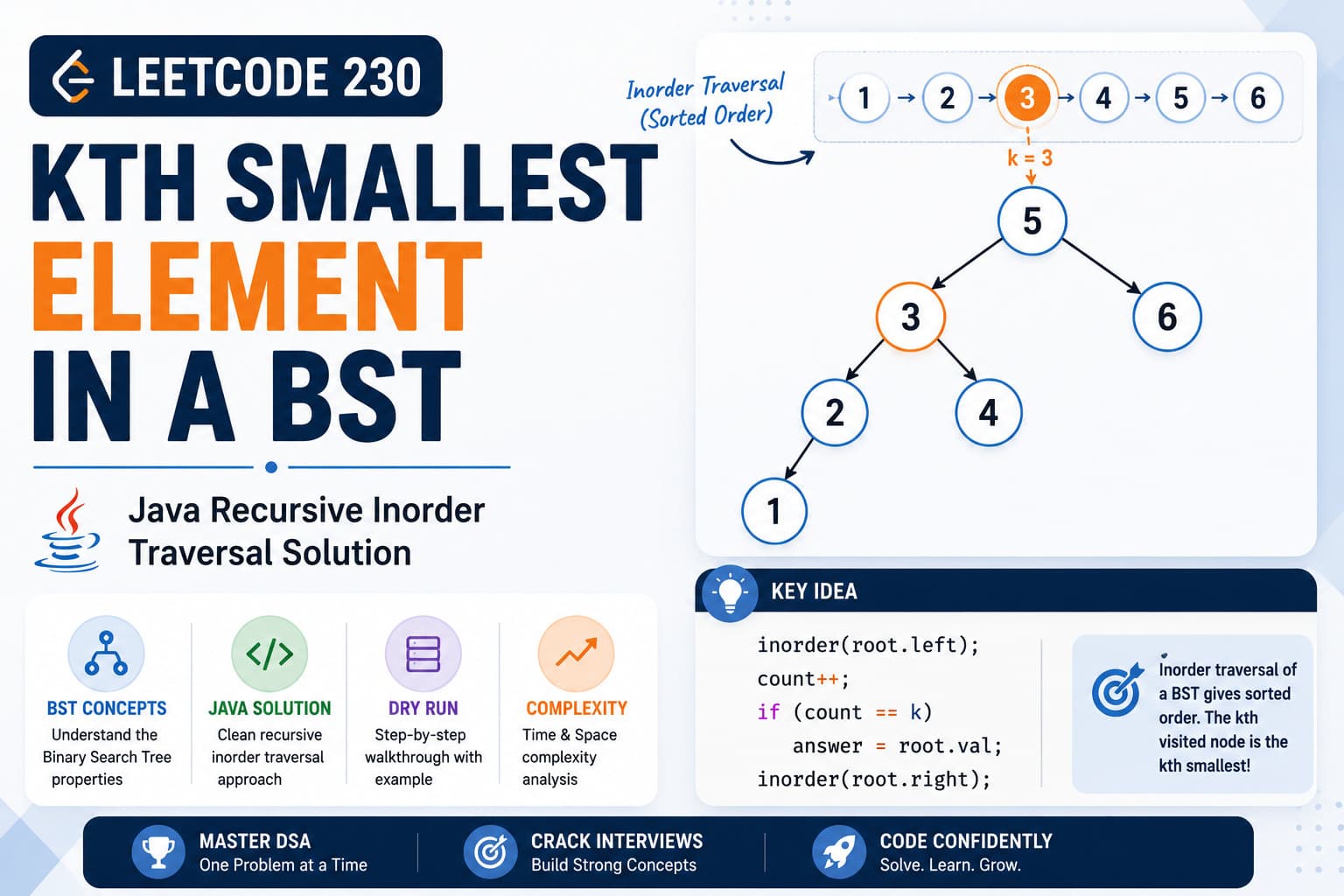
LeetCode 230: Kth Smallest Element in a BST – Java Recursive Inorder Traversal Solution
IntroductionLeetCode 230 – Kth Smallest Element in a BST is one of the most important Binary Search Tree interview problems.This question is popular because it tests:BST propertiesInorder traversalDFS recursionTree traversal optimizationRecursive state managementUnderstanding this problem properly builds a strong foundation for advanced BST problems.Problem Link🔗 https://leetcode.com/problems/kth-smallest-element-in-a-bst/Problem StatementGiven:Root of a Binary Search TreeInteger kReturn:The kth smallest value in the BSTThe indexing is:1-indexedExample 1Inputroot = [3,1,4,null,2]k = 1Output1ExplanationBST inorder traversal becomes:[1,2,3,4]1st smallest element is:1Example 2Inputroot = [5,3,6,2,4,null,null,1]k = 3Output3Key ObservationThe most important BST property:Inorder Traversal of BST gives sorted orderExample:5/ \3 6/ \2 4/1Inorder traversal:1 → 2 → 3 → 4 → 5 → 6So:kth smallest = kth node in inorder traversalIntuitionWe perform:Left → Root → RightWhile traversing:Keep counting visited nodesWhen count becomes kStore answerNo need to traverse entire tree after finding answer.Brute Force ApproachIdeaStore complete inorder traversal in listReturn:list.get(k - 1)Brute Force Java Solutionclass Solution {public void inorder(TreeNode root, List<Integer> list) {if(root == null) return;inorder(root.left, list);list.add(root.val);inorder(root.right, list);}public int kthSmallest(TreeNode root, int k) {List<Integer> list = new ArrayList<>();inorder(root, list);return list.get(k - 1);}}Complexity of Brute ForceTime ComplexityO(N)Space ComplexityO(N)Extra list storage required.Optimized Recursive ApproachIdeaInstead of storing entire traversal:Maintain counterStop when kth node is reachedThis saves unnecessary storage.Java Solutionclass Solution {int coun = 0;int ans = -1;public void inorder(TreeNode root, int k, List<Integer> lis) {if(root == null) return;inorder(root.left, k, lis);coun++;if(coun == k) {ans = root.val;return;}inorder(root.right, k, lis);}public int kthSmallest(TreeNode root, int k) {List<Integer> lis = new ArrayList<>();inorder(root, k, lis);return ans;}}Cleaner Optimized Versionclass Solution {int count = 0;int answer = -1;public void inorder(TreeNode root, int k) {if(root == null) return;inorder(root.left, k);count++;if(count == k) {answer = root.val;return;}inorder(root.right, k);}public int kthSmallest(TreeNode root, int k) {inorder(root, k);return answer;}}Why This WorksBST inorder traversal always visits nodes in:sorted ascending orderSo:1st visited node = smallest2nd visited node = second smallestkth visited node = kth smallestDry RunInputroot = [5,3,6,2,4,null,null,1]k = 3BST Structure5/ \3 6/ \2 4/1Inorder Traversal1 → 2 → 3 → 4 → 5 → 6Counter ProgressNodeCount112233At count = 3:answer = 3Final Output3Iterative Stack ApproachIdeaUse explicit stack instead of recursion.Iterative Java Solutionclass Solution {public int kthSmallest(TreeNode root, int k) {Stack<TreeNode> stack = new Stack<>();while(true) {while(root != null) {stack.push(root);root = root.left;}root = stack.pop();k--;if(k == 0) {return root.val;}root = root.right;}}}Time Complexity AnalysisOptimized RecursiveTime ComplexityO(H + k)Where:H = tree heightWe visit only required nodesWorst case:O(N)Space ComplexityO(H)Recursive stack space.Iterative ComplexityTime ComplexityO(H + k)Space ComplexityO(H)Stack space.Follow-Up OptimizationProblem Follow-UpWhat if BST changes frequently?Example:Insert operationsDelete operationsFrequent kth smallest queriesAdvanced OptimizationStore:size of subtreeinside every node.This allows:O(log N)kth smallest queries.This concept is used in:Order Statistic TreesAugmented BSTsIndexed TreesInterview ExplanationIn interviews, explain:Inorder traversal of a BST gives nodes in sorted order. Therefore, the kth visited node during inorder traversal is the kth smallest element.This demonstrates:BST understandingDFS recursionTree traversal masteryOptimization thinkingCommon Mistakes1. Forgetting BST PropertyThis solution works because BST inorder traversal is sorted.Not true for normal binary trees.2. Using Extra Array UnnecessarilyOptimized approach avoids storing entire traversal.3. Incorrect Counter PlacementCounter must increase:AFTER left traversalBEFORE right traversal4. Forgetting Early ReturnOnce kth element is found:answer should be stored immediatelyFAQsQ1. Why does inorder traversal work?Because BST inorder traversal produces sorted order.Q2. Can this be solved iteratively?Yes.Using stack-based inorder traversal.Q3. Why is BST important here?Without BST ordering property:kth smallest cannot be determined using inorderQ4. Is this frequently asked?Yes.It is one of the most common BST interview questions.ConclusionLeetCode 230 is an excellent BST problem for mastering:Inorder traversalBST propertiesDFS recursionStack traversalTree optimizationThe core insight is:Inorder traversal of a BST always produces sorted order.Once this concept becomes intuitive, many BST interview problems become much easier.