LeetCode 2033: Minimum Operations to Make a Uni-Value Grid | Java Solution Explained (Median Approach)
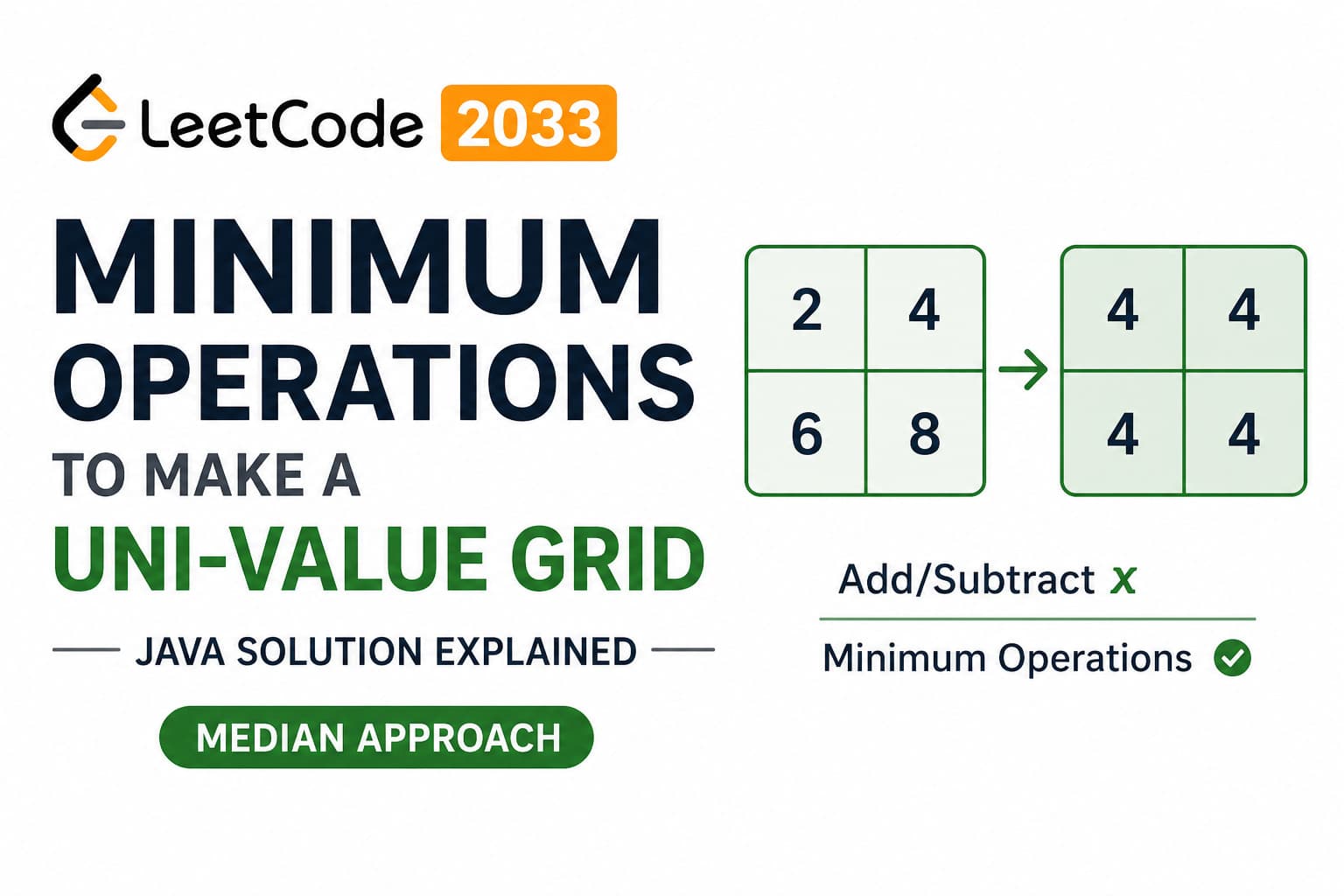
IntroductionIn this problem, we are given a 2D grid and an integer x.We can perform one operation where we either:Add x to any grid elementSubtract x from any grid elementOur goal is to make all elements in the grid equal using the minimum number of operations.If making all values equal is not possible, we return -1.This problem may initially look like a matrix manipulation question, but the actual logic is based on:Array transformationMedian propertyGreedy optimization# Problem LinkProblem StatementYou are given:A 2D integer grid of size m × nAn integer xYou can perform operations where you add or subtract x from any cell.A grid becomes uni-value when all elements become equal.Return the minimum number of operations needed.If impossible, return -1.ExampleExample 1Input:grid = [[2,4],[6,8]]x = 2Output:4Explanation:We can make every element equal to 4.2 → 4 (1 operation)6 → 4 (1 operation)8 → 4 (2 operations)Total = 4 operations.Key ObservationBefore solving the problem, we must understand one important rule.If we can add or subtract only x, then:All numbers must belong to the same remainder group when divided by x.Meaning:value % x must be same for every elementWhy?Because if two numbers have different remainders, they can never become equal using only +x or -x operations.IntuitionWe need to convert all numbers into a single target value.But what target value gives minimum operations?The answer is:MedianFor minimizing total absolute distance, median gives the optimal answer.Since every operation changes value by x, we can:Flatten grid into a listSort the listPick median as targetCalculate operations requiredWhy Median Works?Median minimizes:Sum of absolute differencesFor example:Numbers = [1, 2, 3, 10]If target = 2|1-2| + |2-2| + |3-2| + |10-2| = 10If target = 5|1-5| + |2-5| + |3-5| + |10-5| = 14Median gives minimum total distance.Approach 1: Brute ForceWe can try every possible number as target.For each target:Calculate operations requiredStore minimum answerTime ComplexityO(N²)Where N = total grid elementsThis is slow for large constraints.Approach 2: Optimal Median ApproachThis is the best approach.StepsStep 1: Flatten GridConvert 2D grid into 1D array.Step 2: Sort ArraySorting helps us find median.Step 3: Check ValidityAll values must have same remainder when divided by x.value % x must matchOtherwise return -1.Step 4: Pick MedianMedian minimizes operations.Step 5: Count OperationsFor every element:operations += abs(value - median) / xJava Solutionclass Solution {public int minOperations(int[][] grid, int x) {List<Integer> lis = new ArrayList<>();for (int i = 0; i < grid.length; i++) {for (int j = 0; j < grid[0].length; j++) {lis.add(grid[i][j]);}}Collections.sort(lis);int mid = lis.size() / 2;int remainder = lis.get(0) % x;for (int value : lis) {if (value % x != remainder) {return -1;}}int ans = 0;for (int value : lis) {int diff = Math.abs(lis.get(mid) - value);ans += diff / x;}return ans;}}Code ExplanationStep 1: Flatten Matrixlis.add(grid[i][j]);We convert grid into list.Step 2: Sort ListCollections.sort(lis);Sorting allows median selection.Step 3: Check Possibilityif(value % x != remainder)If remainders differ, answer becomes impossible.Step 4: Select Medianint mid = lis.size()/2;Median becomes target value.Step 5: Calculate Operationsans += diff/x;Difference divided by x gives operations.Dry RunInput:grid = [[2,4],[6,8]]x = 2Flatten:[2,4,6,8]Sort:[2,4,6,8]Median:6Operations:2 → 6 = 2 operations4 → 6 = 1 operation6 → 6 = 0 operation8 → 6 = 1 operationTotal:4 operationsTime ComplexityFlatten GridO(N)SortingO(N log N)Traverse ArrayO(N)Total ComplexityO(N log N)Where:N = m × nSpace ComplexityWe store all elements in list.O(N)Common Mistakes1. Forgetting Mod CheckMany people directly calculate operations.But without checking:value % xanswer may become invalid.2. Choosing Average Instead of MedianAverage does not minimize absolute distance.Median is required.3. Not Sorting Before Finding MedianMedian requires sorted array.4. Forgetting Division by xOperations are not direct difference.Correct formula:abs(target - value) / xEdge CasesCase 1All values already equal.Answer = 0Case 2Different modulo values.Return -1Case 3Single cell grid.No operation neededFAQsQ1. Why do we use median?Median minimizes total absolute difference.Q2. Why not average?Average minimizes squared distance, not absolute operations.Q3. Why modulo condition is important?Because we can only move by multiples of x.Q4. Can we solve without sorting?Sorting is easiest way to get median.Alternative median-finding algorithms exist but are unnecessary here.Interview InsightInterviewers ask this problem to test:Greedy thinkingMedian propertyMathematical observationArray flatteningOptimization logicConclusionLeetCode 2033 is a great problem that combines math with greedy logic.The most important learning points are:Flatten the gridValidate modulo conditionUse median as targetCalculate operations using difference divided by xThis approach is optimal and easy to implement.Once you understand why median works, this problem becomes very straightforward.