Search Blogs

Showing results for "Digit Problems"

Found 18 results

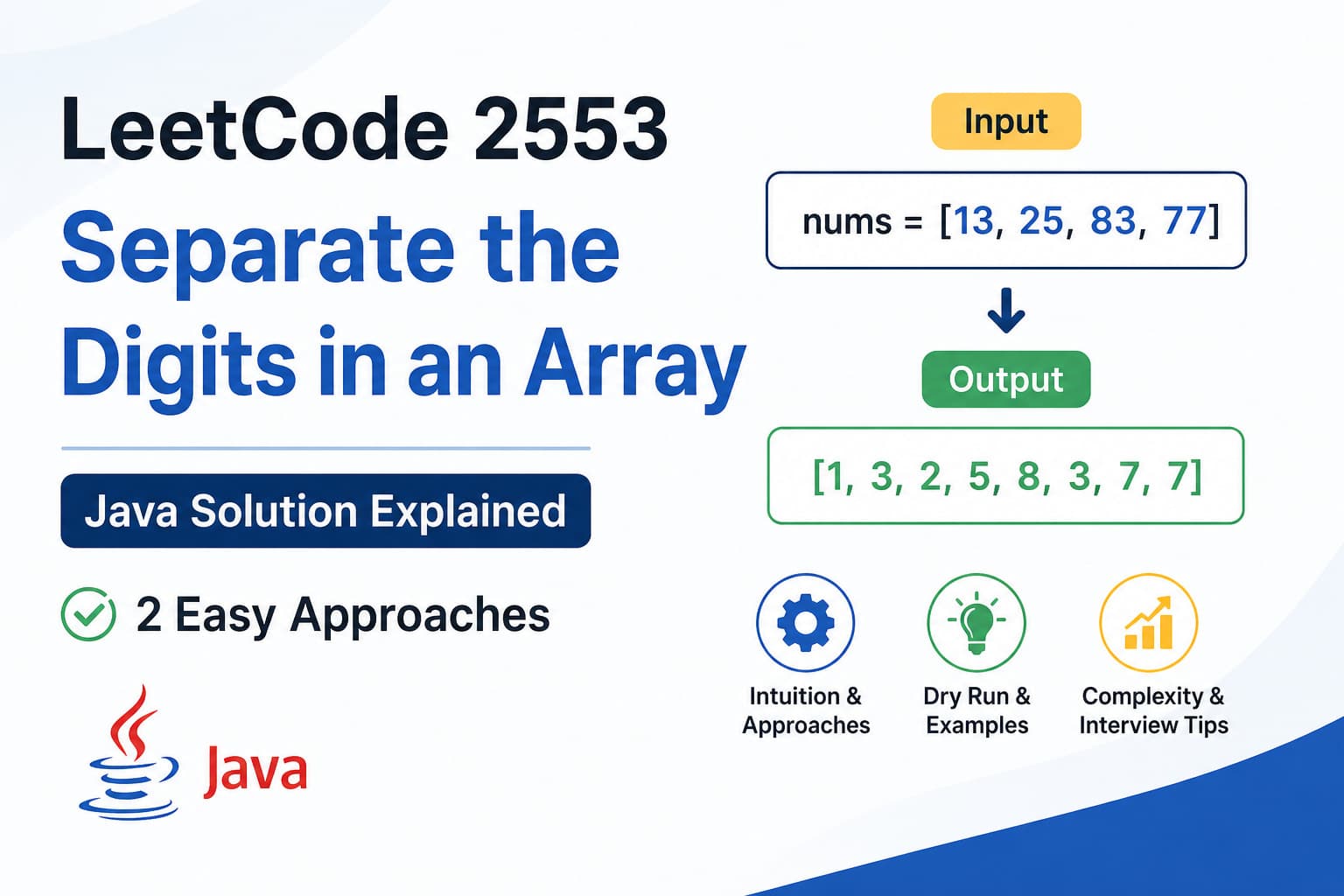
LeetCode 2553: Separate the Digits in an Array – Java Solution Explained (2 Easy Approaches)

LeetCode 2553: Separate the Digits in an Array – Java Solution Explained (2 Easy Approaches)

IntroductionIn coding interviews and competitive programming, many problems test how well you can manipulate numbers and arrays together. One such beginner-friendly problem is LeetCode 2553 – Separate the Digits in an Array.In this problem, we are given an integer array, and we need to separate every digit of every number while maintaining the original order.This problem is excellent for practicing:Array traversalDigit extractionReverse processingArrayList usage in JavaThinking about order preservationProblem LinkπŸ”— ProblemLeetCode 2553: Separate the Digits in an ArrayProblem StatementGiven an array of positive integers nums, return an array containing all digits of each integer in the same order they appear.ExampleInput:nums = [13,25,83,77]Output:[1,3,2,5,8,3,7,7]IntuitionThe main challenge is:Extract digits from each numberPreserve the original left-to-right orderNormally, extracting digits using % 10 gives digits in reverse order.Example:83 β†’ 3 β†’ 8So we need a way to restore the correct order.Approach 1 – Using String ConversionIdeaConvert every number into a string and then traverse each character.This is the simplest and most beginner-friendly approach.AlgorithmTraverse every number in the array.Convert the number into a string.Traverse each character of the string.Convert character back to integer.Store digits into ArrayList.Convert ArrayList to array.Java Code – String Approachclass Solution { public int[] separateDigits(int[] nums) { ArrayList<Integer> list = new ArrayList<>(); for (int num : nums) { String str = String.valueOf(num); for (char ch : str.toCharArray()) { list.add(ch - '0'); } } int[] ans = new int[list.size()]; for (int i = 0; i < list.size(); i++) { ans[i] = list.get(i); } return ans; }}Dry Run (String Approach)Input:nums = [13,25]Step 113 β†’ "13"Digits added:1, 3Step 225 β†’ "25"Digits added:2, 5Final Array:[1,3,2,5]Time Complexity & Space ComplexityTime ComplexityO(N Γ— D)Where:N = number of elementsD = number of digitsSpace ComplexityO(N Γ— D)For storing digits.Approach 2 – Mathematical Digit Extraction (Optimal Without String)This is the approach you implemented in your code.Instead of converting numbers into strings, we extract digits mathematically using:digit = num % 10num = num / 10But digits come in reverse order.To fix this:Traverse the original array from back to frontStore extracted digitsReverse the final resultThis avoids string conversion completely.Intuition Behind Reverse TraversalSuppose:nums = [13,25]If we traverse from the end:25 β†’ 5,213 β†’ 3,1Stored list:[5,2,3,1]Now reverse the list:[1,3,2,5]Correct answer achieved.Java Code – Mathematical Approachclass Solution { public int[] separateDigits(int[] nums) { ArrayList<Integer> list = new ArrayList<>(); for (int i = nums.length - 1; i >= 0; i--) { if (nums[i] < 10) { list.add(nums[i]); } else { int val = nums[i]; while (val != 0) { int digit = val % 10; val = val / 10; list.add(digit); } } } int[] ans = new int[list.size()]; int k = 0; for (int i = list.size() - 1; i >= 0; i--) { ans[k++] = list.get(i); } return ans; }}Dry Run (Mathematical Approach)Input:nums = [13,25,83]Traverse from Back83Digits extracted:3, 8List:[3,8]25Digits extracted:5,2List:[3,8,5,2]13Digits extracted:3,1List:[3,8,5,2,3,1]Reverse Final List[1,3,2,5,8,3]Correct answer.Time Complexity Analysis & Space ComplexityTime ComplexityO(N Γ— D)Because every digit is processed once.Space ComplexityO(N Γ— D)For storing final digits.Which Approach is Better?ApproachAdvantagesDisadvantagesString ConversionEasy to understandUses extra string conversionMathematical ExtractionBetter DSA practiceSlightly harder logicInterview PerspectiveIn interviews:Beginners should first explain the string approach.Then discuss optimization using mathematical extraction.Interviewers like when candidates:Understand digit manipulationThink about order preservationCompare multiple approachesCommon Mistakes1. Forgetting Reverse OrderUsing % 10 extracts digits backward.Example:123 β†’ 3,2,1You must reverse later.2. Not Handling Single Digit NumbersSingle digit numbers should directly be added.3. Character Conversion MistakeWrong:list.add(ch);Correct:list.add(ch - '0');Frequently Asked Questions (FAQs)Q1. Why do digits come in reverse order?Because % 10 always extracts the last digit first.Example:123 % 10 = 3Q2. Can we solve this without ArrayList?Yes, but ArrayList makes dynamic storage easier.Q3. Which approach is more optimal?Both have similar complexity.Mathematical extraction avoids string conversion and is preferred in interviews.Q4. Is this problem important for interviews?Yes. It teaches:Number manipulationOrder handlingArray traversalBasic optimization thinkingConclusionLeetCode 2553 is a simple yet valuable beginner problem for understanding:Digit extractionArray handlingReverse traversalOrder preservationYou learned two approaches:String Conversion ApproachMathematical Digit Extraction ApproachThe mathematical solution is especially useful because it strengthens core DSA concepts and improves problem-solving skills for interviews.If you're preparing for coding interviews in Java, this is a great problem to master before moving to harder digit manipulation questions.
ArrayEasyLeetcodeDigit ExtractionJava
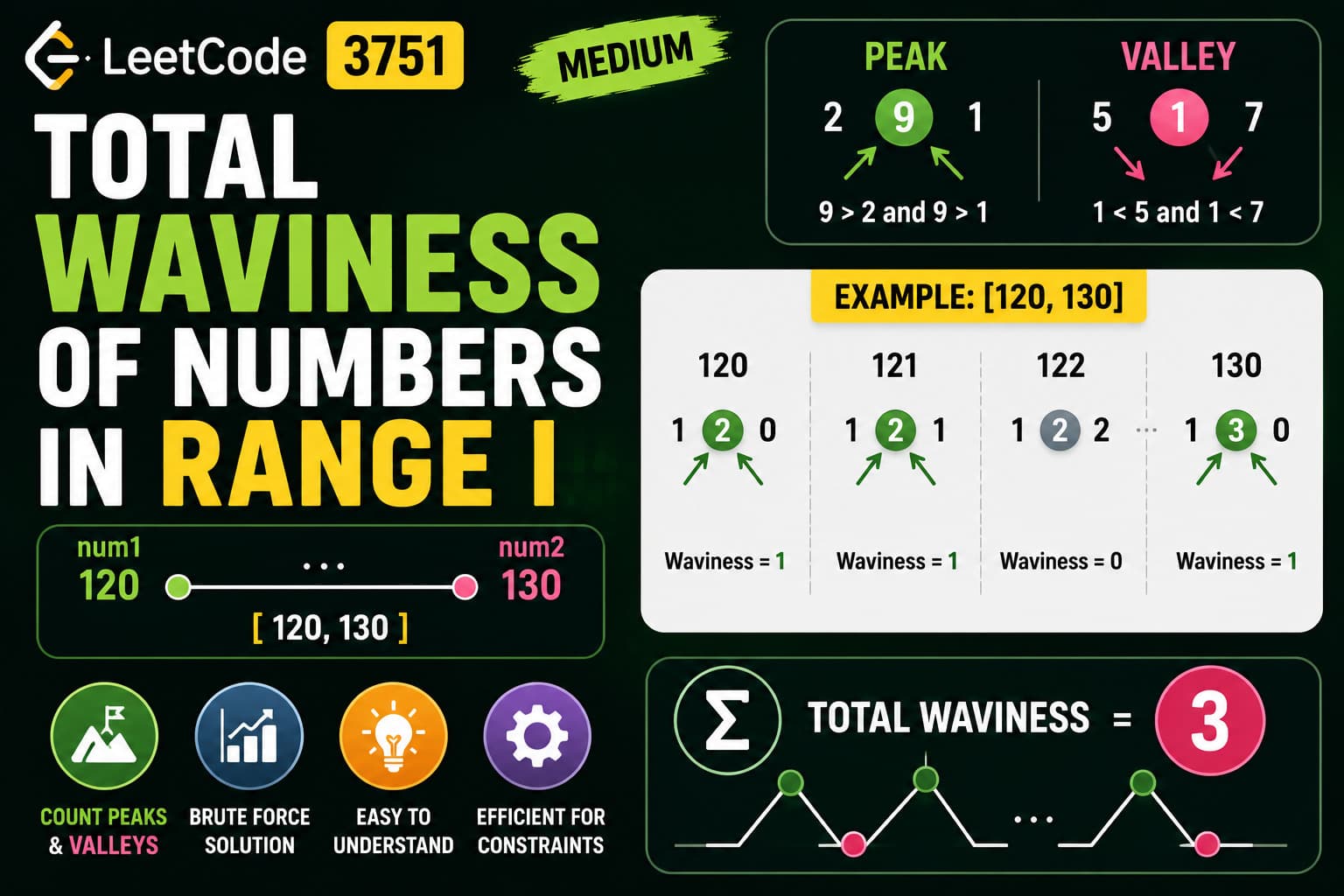
LeetCode 3751: Total Waviness of Numbers in Range I – Java Solution with Dry Run and Explanation

LeetCode 3751: Total Waviness of Numbers in Range I – Java Solution with Dry Run and Explanation

IntroductionLeetCode 3751 introduces an interesting digit-based pattern problem where we calculate the total waviness of numbers inside a given range.This problem combines:Digit traversalPattern recognitionPeaks and valleys logicString manipulationBrute force iterationThe problem is straightforward once we clearly understand how peaks and valleys work.Problem StatementYou are given two integers:num1 and num2representing the inclusive range:[num1, num2]For every number:A digit is called a peak if it is strictly greater than both neighbors.A digit is called a valley if it is strictly smaller than both neighbors.The first and last digits can never be peaks or valleys.Return the total waviness across all numbers in the range.ExampleInputnum1 = 120num2 = 130Output3ExplanationNumbers contributing to waviness:120 β†’ 2 is a peak β†’ waviness = 1121 β†’ 2 is a peak β†’ waviness = 1130 β†’ 3 is a peak β†’ waviness = 1Total:1 + 1 + 1 = 3Understanding Peaks and ValleysPeak ConditionA digit is a peak if:digit > left neighborANDdigit > right neighborExample:484Here:8 > 48 > 4So 8 is a peak.Valley ConditionA digit is a valley if:digit < left neighborANDdigit < right neighborExample:202Here:0 < 20 < 2So 0 is a valley.Key ObservationWe only need to check:index 1 to length-2because:First digit has no left neighborLast digit has no right neighborIntuitionThe simplest way:Iterate through every number in the rangeConvert number into charactersCheck each middle digitCount peaks and valleysAdd to final answerSince constraints are small:num2 <= 10^5a brute force approach works efficiently.Java Solutionclass Solution { public int totalWaviness(int num1, int num2) { int ans = 0; if(num1 == num2) { int temp = num1; String c = Integer.toString(temp); char[] arr = c.toCharArray(); for(int i = 1; i < arr.length - 1; i++) { if((arr[i] < arr[i - 1] && arr[i] < arr[i + 1]) || (arr[i] > arr[i - 1] && arr[i] > arr[i + 1])) { ans++; } } return ans; } for(int i = num1; i <= num2; i++) { String c = Integer.toString(i); char[] carr = c.toCharArray(); for(int j = 1; j < carr.length - 1; j++) { if((carr[j] < carr[j - 1] && carr[j] < carr[j + 1]) || (carr[j] > carr[j - 1] && carr[j] > carr[j + 1])) { ans++; } } } return ans; }}Step-by-Step ExplanationStep 1: Iterate Through Rangefor(int i = num1; i <= num2; i++)Process every number.Step 2: Convert Number to Character ArrayString c = Integer.toString(i);char[] carr = c.toCharArray();This makes digit comparison easier.Step 3: Check Middle Digitsfor(int j = 1; j < carr.length - 1; j++)Skip first and last digits.Step 4: Check Peak or Valley(carr[j] < carr[j-1] && carr[j] < carr[j+1])OR(carr[j] > carr[j-1] && carr[j] > carr[j+1])If true:ans++;Dry RunInputnum1 = 198num2 = 202Number 198Digits:1 9 8Check 9:9 > 19 > 8Peak found.Waviness:1Number 1991 9 99 is not strictly greater than right neighbor.No waviness.Number 2012 0 10 is smaller than both neighbors.Valley found.Number 2022 0 2Again:0 < 20 < 2Valley found.Final Answer198 β†’ 1201 β†’ 1202 β†’ 1Total = 3Time Complexity AnalysisLet:N = num2 - num1 + 1D = number of digitsTime ComplexityO(N Γ— D)At most:D = 6which is very small.Efficient for constraints.Space ComplexityO(D)due to character array conversion.Why Brute Force Works HereConstraints are small:num2 <= 100000So checking every number directly is acceptable.For larger constraints:Digit DP would be needed.But here:Simplicity is better.Common Mistakes1. Including First or Last DigitThese digits cannot be peaks or valleys.2. Using Non-Strict ComparisonWrong:>=<=Correct:><because definition says:strictly greaterstrictly smaller3. Forgetting Both ConditionsNeed to check:PeakValleyEdge CasesSingle Digit NumbersWaviness:0because fewer than 3 digits.Repeated DigitsExample:111No peak or valley.Alternating DigitsExample:4848Produces multiple waviness counts.Interview ExplanationIn interviews explain:Since the constraints are small, we can directly iterate through every number, convert it into digits, and count peaks and valleys by checking neighboring digits.This demonstrates:Observation skillsConstraint analysisClean implementationConclusionLeetCode 3751 is a clean implementation problem focused on:Digit traversalPattern recognitionPeaks and valleysBrute force optimizationThe key insight is:A digit contributes to waviness only if it is strictly greater or strictly smaller than both immediate neighbors.Once this condition is understood, the implementation becomes very straightforward.

LeetCodeJavaStringPeaks and ValleysBrute Force SolutionDigit ProblemsMediumArray
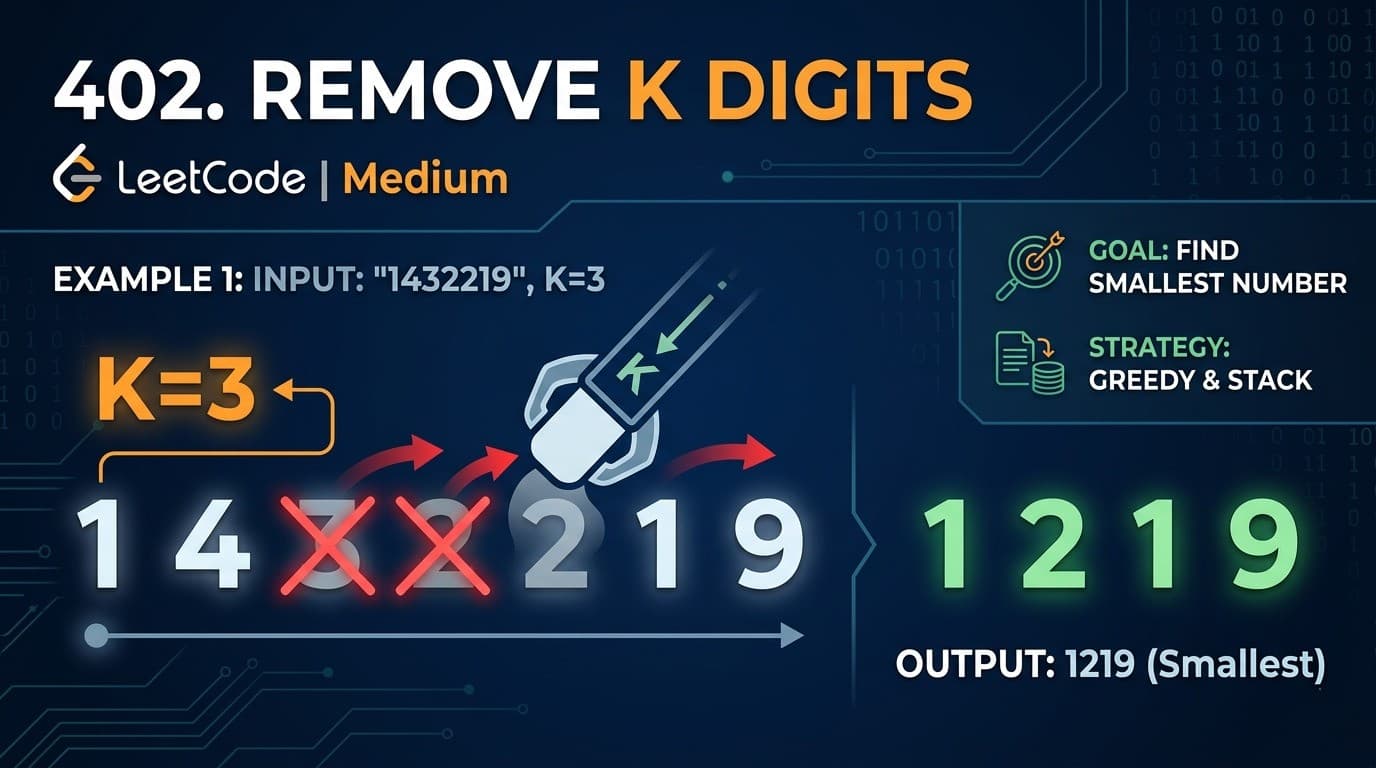
LeetCode 402: Remove K Digits β€” Java Solution Explained

LeetCode 402: Remove K Digits β€” Java Solution Explained

IntroductionLeetCode 402 Remove K Digits is one of those problems where the brute force solution feels obvious but completely falls apart at scale β€” and the optimal solution requires a genuinely clever insight that, once you see it, feels like magic.This problem sits at the intersection of two powerful techniques β€” Greedy thinking and Monotonic Stack. If you have already solved Next Greater Element and Asteroid Collision, you have all the building blocks you need. This is where those patterns level up.You can find the problem here β€” LeetCode 402 Remove K Digits.What Is the Problem Really Asking?You are given a number as a string and an integer k. Remove exactly k digits from the number such that the resulting number is as small as possible. Return it as a string without leading zeros.Example:num = "1432219", k = 3We want to remove 3 digits to make the number as small as possibleRemove 4, 3, 2 β†’ remaining is "1219"Output: "1219"Simple goal β€” smallest possible number after exactly k removals.Real Life Analogy β€” Choosing the Best Price TagImagine you are reading a price tag digit by digit from left to right. Every time you see a digit that is bigger than the next one coming, you have a chance to remove it and make the price smaller. You have a limited number of removals β€” use them wisely on the biggest offenders from the left side, because leftmost digits have the most impact on the overall value.Removing a 9 from the front of a number shrinks it far more than removing a 9 from the end. This left-to-right priority with greedy removal is the entire insight of this problem.The Core Greedy InsightHere is the key question β€” which digit should we remove first to make the number as small as possible?Think about it this way. In the number "1432219", which digit is hurting us the most? It is 4 β€” because it is large and sits early in the number. After removing 4 we get "132219". Now 3 is the biggest early offender. And so on.More precisely β€” whenever you see a digit that is greater than the digit immediately after it, removing it makes the number smaller. This is because a larger digit sitting before a smaller digit inflates the overall value.This is the Greedy rule: scan left to right, and whenever the current digit on the stack is greater than the incoming digit, remove it (if we still have removals left).A Monotonic Increasing Stack enforces exactly this β€” it keeps digits in non-decreasing order, automatically kicking out any digit that is larger than what comes next.The Solution β€” Monotonic Stackpublic String removeKdigits(String num, int k) { Stack<Character> st = new Stack<>(); // build monotonic increasing stack for (int i = 0; i < num.length(); i++) { // while stack top is greater than current digit and we still have removals while (!st.empty() && k != 0 && st.peek() > num.charAt(i)) { st.pop(); // remove the larger digit β€” greedy choice k--; } st.push(num.charAt(i)); } // if k removals still remaining, remove from the end (largest digits are at top) while (k != 0) { st.pop(); k--; } // build result string from stack StringBuilder sb = new StringBuilder(); while (!st.empty()) { sb.append(st.pop()); } sb.reverse(); // stack gives reverse order // remove leading zeros while (sb.length() > 0 && sb.charAt(0) == '0') { sb.deleteCharAt(0); } // if nothing left, return "0" return sb.length() == 0 ? "0" : sb.toString();}Step-by-Step Dry Run β€” num = "1432219", k = 3Processing 1: Stack empty β†’ push. Stack: [1]Processing 4: Stack top 1 < 4 β†’ no pop. Push 4. Stack: [1, 4]Processing 3: Stack top 4 > 3 and k=3 β†’ pop 4, k=2. Stack: [1] Stack top 1 < 3 β†’ stop. Push 3. Stack: [1, 3]Processing 2: Stack top 3 > 2 and k=2 β†’ pop 3, k=1. Stack: [1] Stack top 1 < 2 β†’ stop. Push 2. Stack: [1, 2]Processing 2: Stack top 2 == 2 β†’ not greater, stop. Push 2. Stack: [1, 2, 2]Processing 1: Stack top 2 > 1 and k=1 β†’ pop 2, k=0. Stack: [1, 2] k=0, stop. Push 1. Stack: [1, 2, 1]Processing 9: k=0, no more removals. Push 9. Stack: [1, 2, 1, 9]k is now 0, skip the cleanup loop.Build result: pop all β†’ "9121" β†’ reverse β†’ "1219" No leading zeros. Return "1219" βœ…Step-by-Step Dry Run β€” num = "10200", k = 1Processing 1: stack empty β†’ push. Stack: [1]Processing 0: Stack top 1 > 0 and k=1 β†’ pop 1, k=0. Stack: [] Push 0. Stack: [0]Processing 2: k=0, no removals. Push. Stack: [0, 2]Processing 0: k=0. Push. Stack: [0, 2, 0]Processing 0: k=0. Push. Stack: [0, 2, 0, 0]k=0, skip cleanup.Build result: "0020" β†’ reverse β†’ "0200" Remove leading zero β†’ "200" Return "200" βœ…Step-by-Step Dry Run β€” num = "10", k = 2Processing 1: push. Stack: [1]Processing 0: Stack top 1 > 0 and k=2 β†’ pop 1, k=1. Stack: [] Push 0. Stack: [0]k=1 remaining β†’ cleanup loop β†’ pop 0, k=0. Stack: []Build result: empty string. Remove leading zeros: nothing to remove. Length is 0 β†’ return "0" βœ…The Three Tricky Cases You Must HandleCase 1 β€” k is not fully used after the loop This happens with a non-decreasing number like "12345" with k=2. No element ever gets popped during the loop because no digit is greater than the next one. The stack ends up as [1,2,3,4,5] with k still = 2. The solution is to pop from the top of the stack β€” which holds the largest digits β€” until k hits 0.Case 2 β€” Leading zeros After removing digits, the remaining number might start with zeros. "10200" becomes "0200" after removing 1. We strip leading zeros with a while loop. But we must be careful not to strip the only zero β€” that is why we check length > 0 before each removal.Case 3 β€” Empty result If all digits are removed (like "10" with k=2), the StringBuilder ends up empty. We return "0" because an empty number is represented as zero.Why Remaining k Gets Removed From the EndAfter the main loop, if k is still greater than 0, why do we remove from the top of the stack (which corresponds to the end of the number)?Because the stack at this point holds a non-decreasing sequence. In a non-decreasing sequence, the largest values are at the end. Removing from the end removes the largest remaining digits β€” which is exactly the greedy choice to minimize the number.For example in "12345" with k=2: the stack is [1,2,3,4,5]. Pop top twice β†’ remove 5 and 4 β†’ [1,2,3] β†’ result is "123". Correct!Time and Space ComplexityTime Complexity: O(n) β€” each digit is pushed onto the stack exactly once and popped at most once. Even with the while loop inside the for loop, total push and pop operations across the entire run never exceed 2n. The leading zero removal is also O(n) in the worst case. Overall stays linear.Space Complexity: O(n) β€” the stack holds at most n digits in the worst case when no removals happen during the main loop.Common Mistakes to AvoidNot handling remaining k after the loop This is the most common mistake. If the number is already non-decreasing, the loop never pops anything. Forgetting the cleanup loop gives the wrong answer for inputs like "12345" with k=2.Not removing leading zeros After removals, the result might start with zeros. "0200" should be returned as "200". Skipping this step gives wrong output.Returning empty string instead of "0" When all digits are removed, return "0" not "". An empty string is not a valid number representation.Using >= instead of > in the pop condition If you pop on equal digits too, you remove more than necessary and might get wrong results. Only pop when strictly greater β€” equal digits in sequence are fine to keep.How This Connects to the Monotonic Stack SeriesLooking at the stack problems you have been solving:496 Next Greater Element β€” monotonic decreasing stack, find first bigger to the right 735 Asteroid Collision β€” stack simulation, chain reactions 402 Remove K Digits β€” monotonic increasing stack, greedy removal for minimum numberThe direction of the monotonic stack flips based on what you are optimizing. For "next greater" you keep a decreasing stack. For "smallest number" you keep an increasing stack. Recognizing which direction to go is the skill that connects all these problems.FAQs β€” People Also AskQ1. Why does a Monotonic Stack give the smallest number in LeetCode 402? A monotonic increasing stack ensures that at every point, the digits we have kept so far are in the smallest possible order. Whenever a smaller digit arrives and the stack top is larger, removing that larger digit can only make the number smaller β€” this greedy choice is always optimal.Q2. What happens if k is not fully used after the main loop in LeetCode 402? The number is already in non-decreasing order so no removals happened during the loop. The remaining removals should be made from the end of the number (top of stack) since those are the largest values in a non-decreasing sequence.Q3. How are leading zeros handled in LeetCode 402? After building the result string, strip any leading zeros with a while loop. If stripping leaves an empty string, return "0" because the empty case represents zero.Q4. What is the time complexity of LeetCode 402? O(n) time because each digit is pushed and popped at most once across the entire algorithm. Space complexity is O(n) for the stack.Q5. Is LeetCode 402 asked in coding interviews? Yes, it is frequently asked at companies like Google, Amazon, and Microsoft. It tests greedy thinking combined with monotonic stack β€” two patterns that interviewers love because they require genuine insight rather than memorization.Similar LeetCode Problems to Practice Next496. Next Greater Element I β€” Easy β€” monotonic decreasing stack739. Daily Temperatures β€” Medium β€” next greater with distances316. Remove Duplicate Letters β€” Medium β€” similar greedy stack with constraints1081. Smallest Subsequence of Distinct Characters β€” Medium β€” same approach as 31684. Largest Rectangle in Histogram β€” Hard β€” advanced monotonic stackConclusionLeetCode 402 Remove K Digits is a beautiful problem that rewards clear thinking. The greedy insight β€” always remove a digit when a smaller digit comes after it β€” naturally leads to the monotonic stack solution. The three edge cases (remaining k, leading zeros, empty result) are what separate a buggy solution from a clean, accepted one.Work through all three dry runs carefully. Once you see how the stack stays increasing and how each pop directly corresponds to a greedy removal decision, this pattern will click permanently and carry you through harder stack problems ahead.

LeetCodeJavaStackMonotonic StackGreedyStringMedium
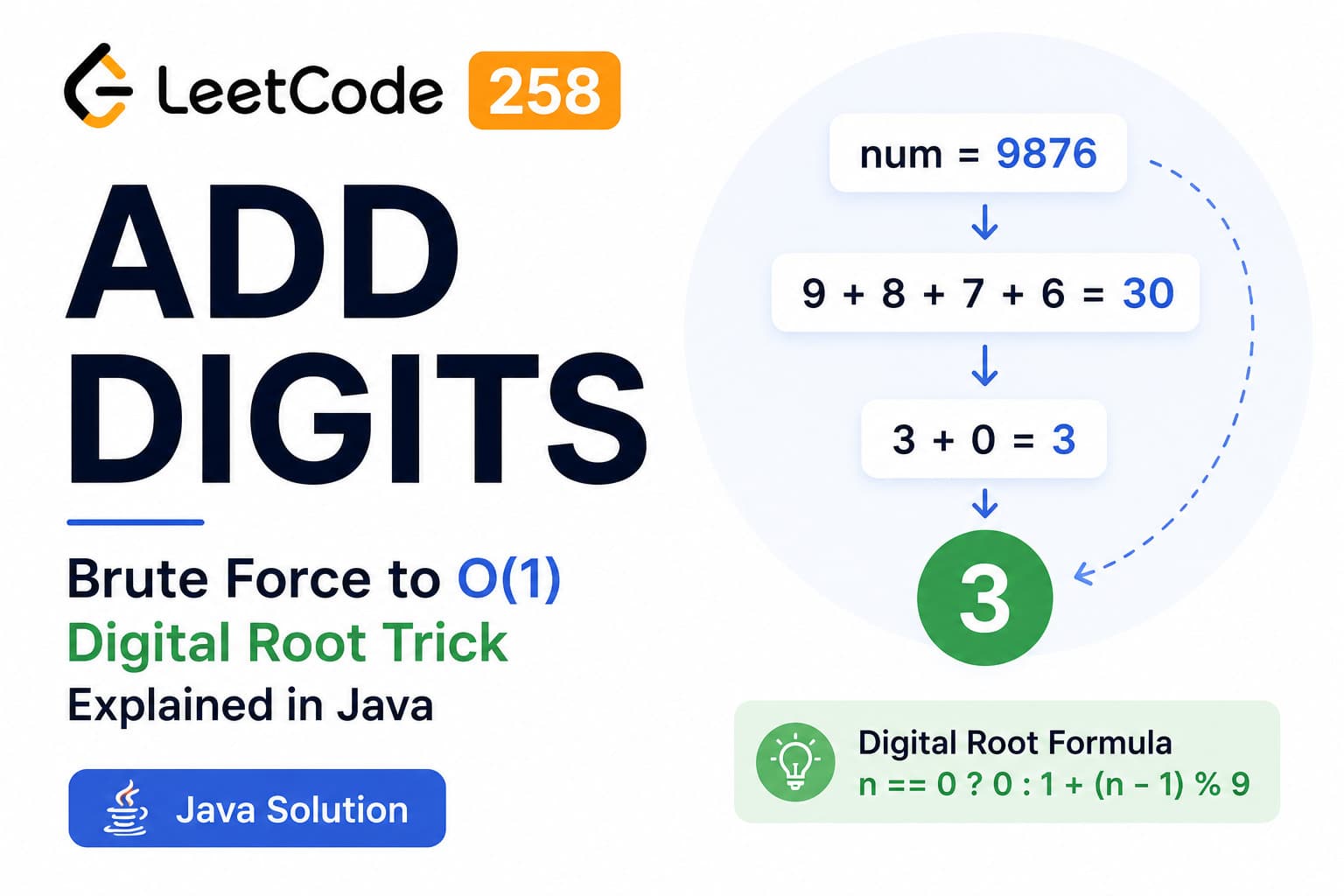
LeetCode 258 β€” Add Digits | Brute Force to O(1) Digital Root Trick Explained in Java

LeetCode 258 β€” Add Digits | Brute Force to O(1) Digital Root Trick Explained in Java

IntroductionSome problems on LeetCode look too simple to teach you anything meaningful. LeetCode 258 β€” Add Digits is one of those problems that tricks you with its simplicity. The simulation is beginner-friendly and easy to code in five minutes, but hiding right underneath the surface is a beautiful piece of number theory that lets you solve the entire thing in a single arithmetic expression β€” no loops, no recursion, pure O(1) math.Whether you are just starting your DSA journey or preparing for coding interviews, this problem is worth understanding deeply. Not just for the answer, but for the mathematical intuition that produces it. By the end of this article, you will not just know the formula β€” you will understand exactly why it works, where it comes from, and how to derive it yourself even if you forget it during an interview.Problem LinkLeetCode 258 β€” Add Digits https://leetcode.com/problems/add-digits/Problem StatementGiven an integer num, repeatedly add all its digits until the result has only one digit, and return it.The follow-up asks: can you solve this in O(1) time without any loop or recursion?Approach 1 β€” Simulation (The Intuitive Way)IntuitionThe problem statement itself tells you exactly what to do. Keep summing the digits of the number until you are left with a single digit. You simulate this literally using nested loops.To extract digits from any integer, two operations do all the work:num % 10 isolates the rightmost digit. For 38, that gives 8.num / 10 removes the rightmost digit. For 38, that leaves 3.You accumulate the digits into a sum, replace num with that sum, and repeat the whole process until num drops below 10.Dry Runnum = 38Outer loop iteration 1:38 % 10 = 8 β†’ sum = 8, num = 33 % 10 = 3 β†’ sum = 11, num = 0Inner loop ends. num = 11Outer loop iteration 2:11 % 10 = 1 β†’ sum = 1, num = 11 % 10 = 1 β†’ sum = 2, num = 0Inner loop ends. num = 2num < 10 β†’ outer loop exits β†’ return 2 βœ…Codeclass Solution { public int addDigits(int num) { // If already a single digit, return immediately β€” no work needed if (num < 10) return num; // Keep repeating the digit sum process until num becomes single digit while (num >= 10) { int sum = 0; // Extract each digit from right to left using modulo and division while (num > 0) { int dig = num % 10; // isolate the last digit num = num / 10; // strip the last digit off sum = sum + dig; // accumulate into running sum } // Replace num with the sum of its digits and check again num = sum; } return num; }}ComplexityTime Complexity: O(log n) β€” Each iteration reduces the number to the sum of its digits, shrinking it dramatically. The number of passes is very small even for large inputs.Space Complexity: O(1) β€” Only a handful of integer variables. No extra memory allocated.This passes all test cases cleanly. But the follow-up challenges you to eliminate the loop entirely. That is where things get genuinely interesting.Approach 2 β€” O(1) Digital Root Formula (The Mathematical Way)Starting With ObservationBefore jumping to the formula, let us build the intuition from scratch the way a mathematician would β€” by looking at small cases and hunting for a pattern.Let us compute the result for every number from 0 to 27 manually:num β†’ result0 β†’ 01 β†’ 12 β†’ 23 β†’ 34 β†’ 45 β†’ 56 β†’ 67 β†’ 78 β†’ 89 β†’ 910 β†’ 1 (1+0)11 β†’ 2 (1+1)12 β†’ 3 (1+2)13 β†’ 4 (1+3)14 β†’ 5 (1+4)15 β†’ 6 (1+5)16 β†’ 7 (1+6)17 β†’ 8 (1+7)18 β†’ 9 (1+8)19 β†’ 1 (1+9=10, then 1+0=1)20 β†’ 2 (2+0)21 β†’ 3 (2+1)22 β†’ 4 (2+2)23 β†’ 5 (2+3)24 β†’ 6 (2+4)25 β†’ 7 (2+5)26 β†’ 8 (2+6)27 β†’ 9 (2+7)The pattern is impossible to miss. After 0, the results cycle through 1, 2, 3, 4, 5, 6, 7, 8, 9 and then repeat, endlessly, with a period of exactly 9.Now the question is β€” why? Why does the digit sum cycle with period 9? To understand that, we need to talk about what happens to a number modulo 9.The Core Mathematical Property β€” Why Digits and Modulo 9 Are ConnectedHere is the fundamental theorem that powers this entire solution:Any positive integer is congruent to the sum of its digits modulo 9.In plain English: if you take a number, divide it by 9, and note the remainder β€” that remainder is the same as the remainder you get when you divide the sum of its digits by 9.Let us prove this properly so it actually makes sense rather than just being a thing you memorize.Take any two-digit number. You can write it as:num = 10a + bWhere a is the tens digit and b is the units digit. For example, 38 = 10(3) + 8.Now notice that 10 = 9 + 1, so:num = (9 + 1)a + b = 9a + a + bWhen you compute num % 9:num % 9 = (9a + a + b) % 9 = (9a % 9) + (a + b) % 9 = 0 + (a + b) % 9 = (a + b) % 9And a + b is exactly the digit sum. So num % 9 = digitSum % 9. They share the same remainder modulo 9.This same logic extends to three-digit numbers. Write num = 100a + 10b + c. Since 100 = 99 + 1 and 10 = 9 + 1:num = (99 + 1)a + (9 + 1)b + c = 99a + 9b + a + b + cWhen you take % 9, the 99a and 9b parts vanish because they are divisible by 9, and you are left with (a + b + c) % 9 β€” which is again just the digit sum modulo 9.This pattern holds for numbers of any length. Every power of 10 is just 1 more than a multiple of 9 β€” 10 = 9+1, 100 = 99+1, 1000 = 999+1 β€” so all the place-value multipliers disappear modulo 9, leaving only the digit sum behind.This is the reason the digit sum process produces the same final result as the original number modulo 9. The digit sum operation preserves the residue modulo 9 at every step.Why the Cycle Has Period 9Now that we know num ≑ digitSum (mod 9), the cycling pattern makes total sense.Every time you apply the digit sum operation, the result changes but the residue modulo 9 stays the same. You keep applying it until you hit a single digit. The single-digit numbers are 0 through 9. Among those, the residue modulo 9 of each single digit is just the digit itself β€” except 9, whose residue is 0.So the final single digit you land on is determined entirely by what num % 9 is:num % 9 == 0 β†’ result is 9 (for any positive num)num % 9 == 1 β†’ result is 1num % 9 == 2 β†’ result is 2...num % 9 == 8 β†’ result is 8The only exception is num = 0 itself, which is a genuine zero, not a nine.Translating This Into a FormulaIf we tried to write this directly as num % 9, there is one problem: multiples of 9 like 9, 18, 27 give a remainder of 0, but the correct answer for all of them is 9, not 0.We need a formula that maps every positive integer to a value in 1..9 cyclically, rather than 0..8.The standard trick for shifting a zero-indexed cycle to a one-indexed cycle is to subtract 1 before taking the modulo and add 1 after:result = 1 + (num - 1) % 9Let us verify this on a few cases:num = 9: 1 + (9-1) % 9 = 1 + 8 % 9 = 1 + 8 = 9 βœ…num = 18: 1 + (18-1) % 9 = 1 + 17 % 9 = 1 + 8 = 9 βœ…num = 1: 1 + (1-1) % 9 = 1 + 0 = 1 βœ…num = 10: 1 + (10-1) % 9 = 1 + 9 % 9 = 1 + 0 = 1 βœ…num = 38: 1 + (38-1) % 9 = 1 + 37 % 9 = 1 + 1 = 2 βœ…The only number this formula does not cover is num = 0, which is a special case handled separately since 0 has no digit sum cycle β€” it simply returns 0.Connecting It Back to the ObservationNow look at the table we built earlier through the lens of this formula. Numbers 1 through 9 map to themselves. Then 10 gives 1 + 0 = 1, same as 1. Numbers 10 through 18 are just 1 through 9 offset by 9. Then 19 wraps back to 1. The cycle length of 9 follows directly from the modulo-9 arithmetic. It is not a coincidence at all β€” it is the inevitable consequence of how place-value and modular arithmetic interact.Codeclass Solution { public int addDigits(int num) { // Special case: 0 is not part of the 1-9 cycle, it simply returns 0 if (num == 0) return 0; // Digital root formula derived from the congruence property modulo 9. // (num - 1) % 9 maps the range to 0..8 instead of the raw 0..8 cycle // that would make multiples of 9 return 0 incorrectly. // Adding 1 at the end shifts it back to the correct 1..9 range. return 1 + (num - 1) % 9; }}ComplexityTime Complexity: O(1) β€” A fixed number of arithmetic operations regardless of the size of num.Space Complexity: O(1) β€” No variables, no data structures, nothing allocated.Approach ComparisonApproachTimeSpaceLoop / RecursionSimulationO(log n)O(1)YesDigital Root FormulaO(1)O(1)NoBoth approaches are entirely correct and both pass all test cases. The simulation is more readable and immediately obvious to anyone reading the code. The digital root formula is what an interviewer is hoping you know when they ask the follow-up β€” and more importantly, if you understand the modulo-9 proof above, you can derive it on the spot rather than hoping you remembered it.Key TakeawaysThe most important thing this problem teaches you is not the formula itself. It is the habit of asking a deeper question when you see a repeated process: is there a closed-form mathematical pattern hiding inside this repetition?The digit sum operation looks like pure computation at first glance. But underneath it is modular arithmetic, and modular arithmetic has structure that can often be collapsed into a direct formula. That same insight β€” that repeated digit operations connect to modulo 9 β€” shows up in divisibility rules you learned in school. A number is divisible by 9 if and only if its digit sum is divisible by 9. A number is divisible by 3 if and only if its digit sum is divisible by 3. Both of those rules are the exact same theorem we used to derive the digital root formula here.Once you internalize this connection between digit sums and modulo 9, you will recognize it surfacing in other problems across number theory, checksum algorithms, and competitive programming. The formula is a one-liner. The understanding behind it is something you carry with you permanently.

Digital RootLeetCode EasyJavaNumber TheoryMath
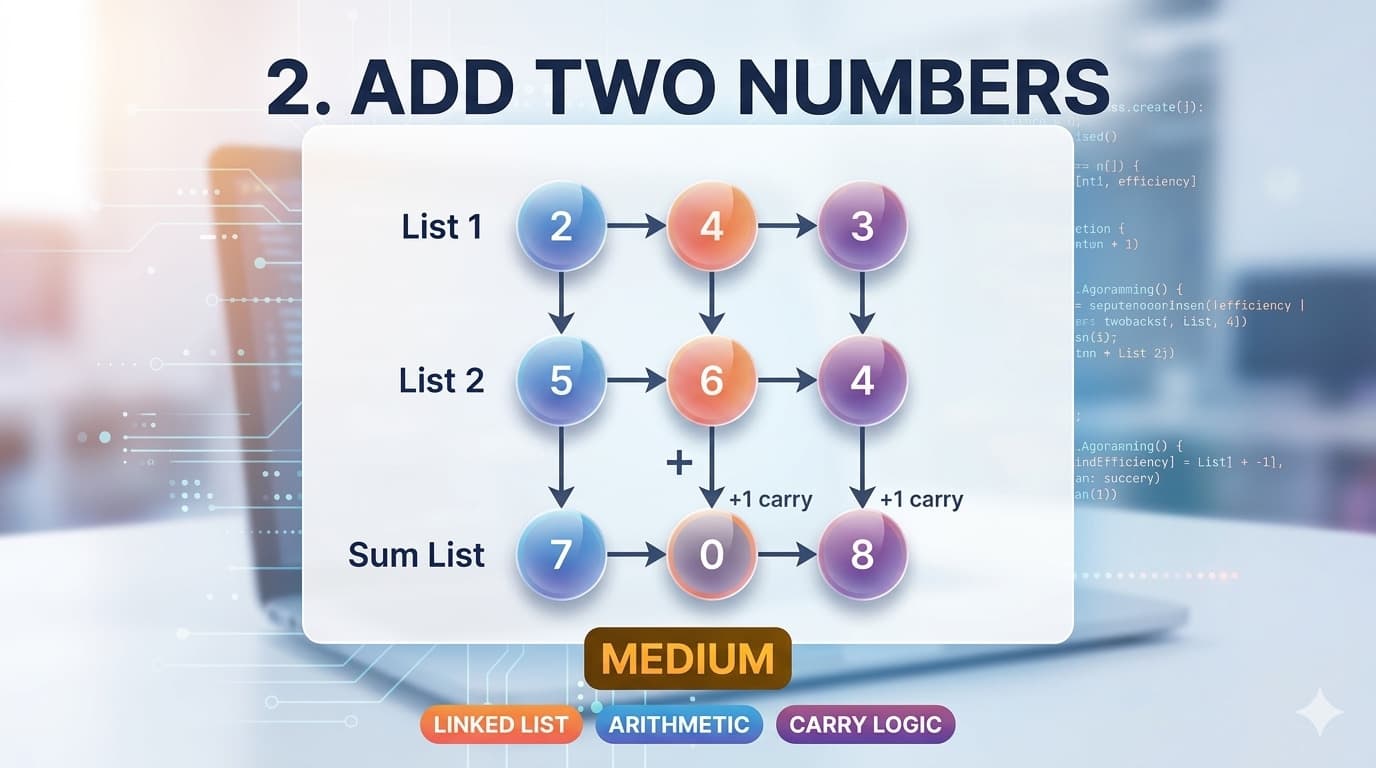
LeetCode 2: Add Two Numbers – Step-by-Step Linked List Addition Explained Clearly

LeetCode 2: Add Two Numbers – Step-by-Step Linked List Addition Explained Clearly

Try the ProblemYou can practice the problem here:https://leetcode.com/problems/add-two-numbers/Problem Description (In Simple Words)You are given two linked lists, where:Each node contains a single digit (0–9)The digits are stored in reverse orderπŸ‘‰ That means:[2,4,3] represents 342[5,6,4] represents 465Your task is:πŸ‘‰ Add these two numbersπŸ‘‰ Return the result as a linked list (also in reverse order)Important Points to UnderstandEach node contains only one digitNumbers are stored in reverse orderYou must return the answer as a linked listYou must handle carry just like normal additionExample WalkthroughExample 1Input:l1 = [2,4,3]l2 = [5,6,4]Interpretation:342 + 465 = 807Output:[7,0,8]Example 2Input:l1 = [0]l2 = [0]Output:[0]Example 3Input:l1 = [9,9,9,9,9,9,9]l2 = [9,9,9,9]Output:[8,9,9,9,0,0,0,1]Constraints1 <= number of nodes <= 1000 <= Node.val <= 9No leading zeros except the number 0Understanding the Core IdeaThis problem is essentially:πŸ‘‰ Adding two numbers digit by digitBut instead of arrays or integers, the digits are stored in linked lists.How Addition Works (Real-Life Analogy)Let’s add:342 + 465We normally add from right to left:2 + 5 = 74 + 6 = 10 β†’ write 0, carry 13 + 4 + 1 = 8Now notice something important:πŸ‘‰ Linked list is already in reverse orderπŸ‘‰ So we can directly process from left to rightThinking About the SolutionBefore coding, let’s think of possible approaches:Possible Ways to SolveConvert linked lists into numbers β†’ add β†’ convert back (Not safe due to overflow)Store digits in arrays and simulate additionTraverse both lists and simulate addition directly (best approach)Optimal Approach: Simulate Addition (Digit by Digit)Key IdeaWe traverse both linked lists and:Add corresponding digitsMaintain a carryCreate a new node for each digit of resultStep-by-Step LogicStep 1: InitializeCreate a dummy node (to simplify result building)Create a pointer curr to build the result listInitialize carry = 0Step 2: Traverse Both ListsContinue while:l1 != null OR l2 != nullAt each step:Start with carry:sum = carryAdd value from l1 (if exists)Add value from l2 (if exists)Step 3: Create New NodeDigit to store:sum % 10New carry:sum / 10Step 4: Move ForwardMove l1 and l2 if they existMove curr forwardStep 5: Handle Remaining CarryIf carry is not zero after loop:πŸ‘‰ Add one more nodeStep 6: Return ResultReturn:dummy.nextCode Implementation (With Explanation)class Solution { public ListNode addTwoNumbers(ListNode l1, ListNode l2) { // Dummy node to simplify result construction ListNode dumm = new ListNode(-1); ListNode curr = dumm; int sum = 0; int carr = 0; // Traverse both lists while(l1 != null || l2 != null){ // Start with carry sum = carr; // Add l1 value if exists if(l1 != null){ sum += l1.val; l1 = l1.next; } // Add l2 value if exists if(l2 != null){ sum += l2.val; l2 = l2.next; } // Create new node with digit ListNode newNode = new ListNode(sum % 10); // Update carry carr = sum / 10; // Attach node curr.next = newNode; curr = curr.next; } // If carry remains if(carr != 0){ curr.next = new ListNode(carr); } return dumm.next; }}Dry Run (Important for Understanding)Input:l1 = [2,4,3]l2 = [5,6,4]Step-by-step:Step 1:2 + 5 = 7 β†’ node(7), carry = 0Step 2:4 + 6 = 10 β†’ node(0), carry = 1Step 3:3 + 4 + 1 = 8 β†’ node(8), carry = 0Final:7 β†’ 0 β†’ 8Time ComplexityO(max(n, m))Where:n = length of l1m = length of l2Space ComplexityO(max(n, m))For storing the result linked list.Why Dummy Node is ImportantWithout dummy node:You need to handle first node separatelyWith dummy node:Code becomes clean and consistentNo special cases requiredCommon Mistakes to Avoid❌ Forgetting to handle carry❌ Not checking if l1 or l2 is null❌ Missing last carry node❌ Incorrect pointer movementKey TakeawaysThis is a simulation problemLinked list problems become easier with dummy nodesAlways think in terms of real-world analogy (addition)ConclusionThe Add Two Numbers problem is one of the most important linked list problems for interviews.It teaches:Pointer manipulationCarry handlingIterative traversalClean code using dummy nodesOnce you understand this pattern, many other linked list problems become much easier to solve.πŸ‘‰ Tip: Whenever you see problems involving numbers in linked lists, think of digit-by-digit simulation with carry.

Linked ListMathSimulationCarry HandlingDummy NodeLeetCode Medium
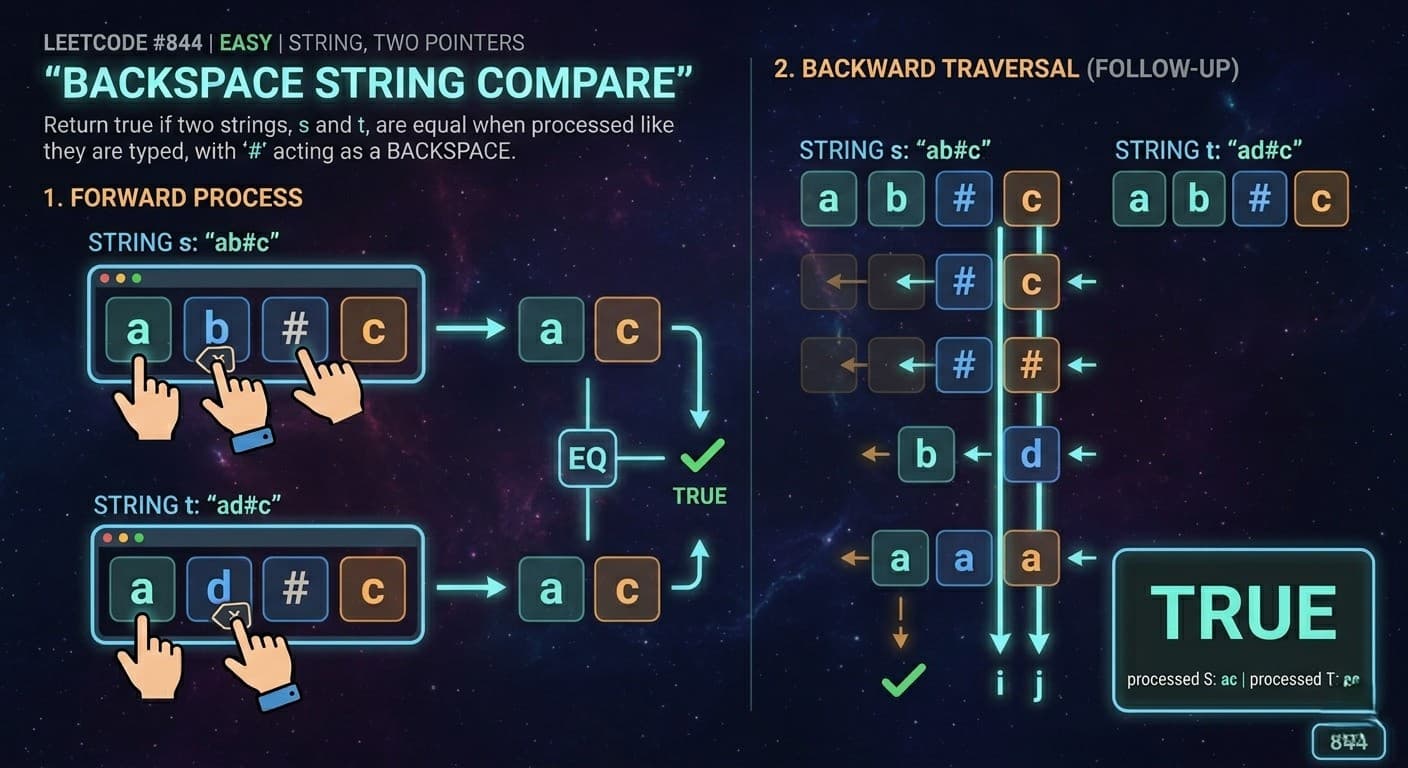
LeetCode 844: Backspace String Compare β€” Java Solution With All Approaches Explained

LeetCode 844: Backspace String Compare β€” Java Solution With All Approaches Explained

IntroductionLeetCode 844 Backspace String Compare is a fantastic problem that shows up frequently in coding interviews. It combines string manipulation, stack simulation, and even has a follow-up that challenges you to solve it in O(1) space β€” which is what separates a good candidate from a great one.Here is the Link of Question -: LeetCode 844In this article we cover a plain English explanation, real life analogy, 3 Java approaches including the O(1) space two pointer solution, dry runs, complexity analysis, common mistakes, and FAQs.What Is the Problem Really Asking?You are given two strings s and t. Both contain lowercase letters and # characters. Think of # as the backspace key on your keyboard β€” it deletes the character just before it. If there is nothing to delete, it does nothing.Process both strings through these backspace operations and check if the resulting strings are equal. Return true if equal, false otherwise.Quick Example:s = "ab#c" β†’ # deletes b β†’ becomes "ac"t = "ad#c" β†’ # deletes d β†’ becomes "ac"Both equal "ac" β†’ return true βœ…Real Life Analogy β€” The Keyboard TypoYou are typing a message. You type "ab", realize you made a typo, hit backspace, and type "c". Your friend types "ad", hits backspace, and types "c". Even though you both typed differently, the final message on screen is the same β€” "ac".That is exactly what this problem is about. Two people typing differently but ending up with the same result.Approach 1: StringBuilder as Stack (Optimal & Clean) βœ…The IdeaThis is your own solution and the best O(n) approach. Process each string independently using a StringBuilder as a stack:Letter β†’ append to StringBuilder (push)# β†’ delete last character if StringBuilder is not empty (pop)Then simply compare the two resulting StringBuilders.public boolean backspaceCompare(String s, String t) { return process(s).equals(process(t));}private String process(String str) { StringBuilder sb = new StringBuilder(); for (int i = 0; i < str.length(); i++) { char c = str.charAt(i); if (c == '#') { if (sb.length() > 0) { sb.deleteCharAt(sb.length() - 1); } } else { sb.append(c); } } return sb.toString();}Notice how extracting a process() helper method makes the code cleaner and avoids repeating the same loop twice β€” a great habit to show in interviews!Dry Run β€” s = "ab##", t = "c#d#"Processing s = "ab##":a β†’ append β†’ "a"b β†’ append β†’ "ab"# β†’ delete last β†’ "a"# β†’ delete last β†’ ""Processing t = "c#d#":c β†’ append β†’ "c"# β†’ delete last β†’ ""d β†’ append β†’ "d"# β†’ delete last β†’ ""Both result in "" β†’ return true βœ…Time Complexity: O(n + m) β€” where n and m are lengths of s and t Space Complexity: O(n + m) β€” two StringBuilders storing processed stringsApproach 2: Stack Based Solution (Interview Classic)The IdeaSame logic as above but using explicit Stack<Character> objects. Great for explaining your thought process clearly in an interview even though StringBuilder is cleaner.public boolean backspaceCompare(String s, String t) { return processStack(s).equals(processStack(t));}private String processStack(String str) { Stack<Character> st = new Stack<>(); for (int i = 0; i < str.length(); i++) { char c = str.charAt(i); if (c == '#') { if (!st.empty()) { st.pop(); } } else { st.push(c); } } StringBuilder sb = new StringBuilder(); while (!st.empty()) { sb.append(st.pop()); } return sb.reverse().toString();}Dry Run β€” s = "a#c", t = "b"Processing s = "a#c":a β†’ push β†’ stack: [a]# β†’ pop β†’ stack: []c β†’ push β†’ stack: [c]Result: "c"Processing t = "b":b β†’ push β†’ stack: [b]Result: "b""c" does not equal "b" β†’ return false βœ…Time Complexity: O(n + m) Space Complexity: O(n + m)Approach 3: Two Pointer β€” O(1) Space (Follow-Up Solution) πŸ”₯This is the follow-up the problem asks about β€” can you solve it in O(n) time and O(1) space? This means no extra StringBuilder or Stack allowed.The IdeaInstead of building processed strings, traverse both strings from right to left simultaneously. Keep a count of pending backspaces. Skip characters that would be deleted and compare characters that survive.Why right to left? Because # affects characters to its left, so processing from the end lets us know upfront how many characters to skip.public boolean backspaceCompare(String s, String t) { int i = s.length() - 1; int j = t.length() - 1; int skipS = 0, skipT = 0; while (i >= 0 || j >= 0) { // Find next valid character in s while (i >= 0) { if (s.charAt(i) == '#') { skipS++; i--; } else if (skipS > 0) { skipS--; i--; } else { break; } } // Find next valid character in t while (j >= 0) { if (t.charAt(j) == '#') { skipT++; j--; } else if (skipT > 0) { skipT--; j--; } else { break; } } // Compare the valid characters if (i >= 0 && j >= 0) { if (s.charAt(i) != t.charAt(j)) { return false; } } else if (i >= 0 || j >= 0) { return false; // one string still has chars, other doesn't } i--; j--; } return true;}Dry Run β€” s = "ab#c", t = "ad#c"Starting from the right end of both strings:Round 1:s[3] = 'c' β†’ valid, no skips β†’ stopt[3] = 'c' β†’ valid, no skips β†’ stopCompare 'c' == 'c' βœ… β†’ move both pointers leftRound 2:s[2] = '#' β†’ skipS = 1, move lefts[1] = 'b' β†’ skipS > 0, skipS = 0, move lefts[0] = 'a' β†’ valid, stopt[2] = '#' β†’ skipT = 1, move leftt[1] = 'd' β†’ skipT > 0, skipT = 0, move leftt[0] = 'a' β†’ valid, stopCompare 'a' == 'a' βœ… β†’ move both pointers leftBoth pointers exhausted β†’ return true βœ…Time Complexity: O(n + m) β€” each character visited at most once Space Complexity: O(1) β€” only pointer and counter variables, no extra storage!Approach ComparisonThe StringBuilder approach is the easiest to write and explain. The Stack approach is slightly more verbose but shows clear intent. The Two Pointer approach is the hardest to code but the most impressive β€” it solves the follow-up and uses zero extra space.In an interview, start with the StringBuilder solution, explain it clearly, then mention the Two Pointer approach as the O(1) space optimization if asked.How This Fits the Stack Simulation PatternYou have now seen this same pattern across four problems:3174 Clear Digits β€” digit deletes closest left non-digit 2390 Removing Stars β€” star deletes closest left non-star 1047 Remove Adjacent Duplicates β€” character cancels matching top of stack 844 Backspace String Compare β€” # deletes closest left character, then compare two stringsAll four use the same StringBuilder-as-stack core. The only differences are the trigger character and what you do with the result. This is the power of pattern recognition in DSA.Common Mistakes to AvoidNot handling backspace on empty string When # appears but the StringBuilder is already empty, do nothing. Always guard with sb.length() > 0 before calling deleteCharAt. The problem explicitly states backspace on empty text keeps it empty.Using Stack and forgetting to handle # when stack is empty In the Stack approach, only pop if the stack is not empty. Pushing # onto the stack when it is empty is a common bug that gives wrong answers.In Two Pointer, comparing before both pointers find valid characters Make sure both inner while loops fully complete before comparing. Comparing too early is the most common mistake in the O(1) space solution.FAQs β€” People Also AskQ1. What is the best approach for LeetCode 844 in Java? For most interviews, the StringBuilder approach is the best β€” clean, readable, and O(n) time. If the interviewer asks for O(1) space, switch to the Two Pointer approach traversing from right to left.Q2. How does the O(1) space solution work for LeetCode 844? It uses two pointers starting from the end of both strings, keeping a skip counter to track pending backspaces. Characters that would be deleted are skipped, and only surviving characters are compared.Q3. What is the time complexity of LeetCode 844? All three approaches run in O(n + m) time where n and m are the lengths of the two strings. The Two Pointer approach achieves this with O(1) space instead of O(n + m).Q4. Why traverse from right to left in the Two Pointer approach? Because # affects characters to its left. Scanning from the right lets you know upfront how many characters to skip before you reach them, avoiding the need to store anything.Q5. Is LeetCode 844 asked in Google interviews? Yes, it is commonly used as a warmup or screening problem. The follow-up O(1) space solution is what makes it interesting for senior-level interviews.Similar LeetCode Problems to Practice Next1047. Remove All Adjacent Duplicates In String β€” Easy β€” same stack pattern2390. Removing Stars From a String β€” Medium β€” star as backspace3174. Clear Digits β€” Easy β€” digit as backspace1209. Remove All Adjacent Duplicates in String II β€” Medium β€” k adjacent duplicates678. Valid Parenthesis String β€” Medium β€” stack with wildcardsConclusionLeetCode 844 Backspace String Compare is a well-rounded problem that tests string manipulation, stack simulation, and space optimization all in one. The StringBuilder solution is your go-to for interviews. But always be ready to explain the Two Pointer O(1) space follow-up β€” that is what shows real depth of understanding.Check out these problems alongside 1047, 2390, and 3174 and you will have the entire stack simulation pattern locked down for any coding interview.

StringStackTwo PointerString Builder
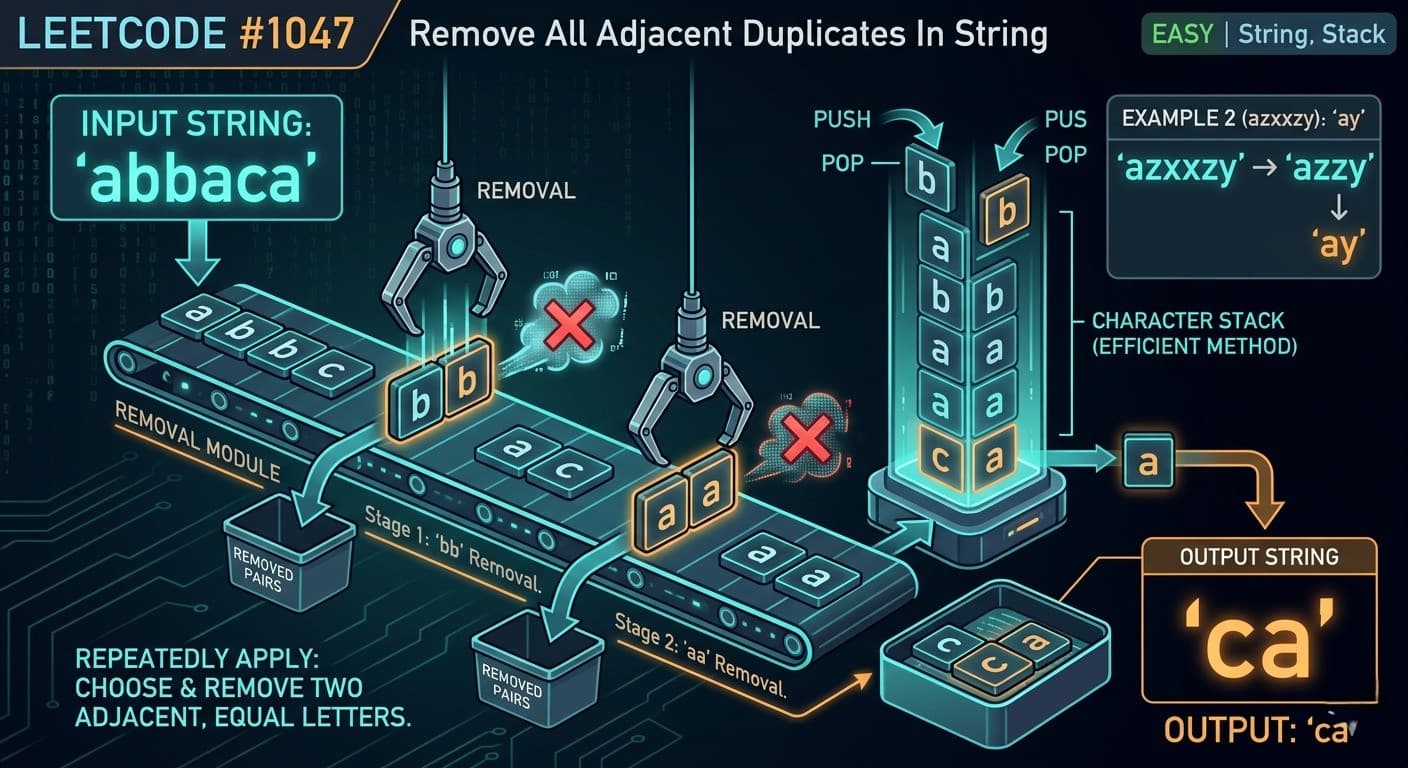
LeetCode 1047: Remove All Adjacent Duplicates In String β€” Java Solution With All Approaches Explained

LeetCode 1047: Remove All Adjacent Duplicates In String β€” Java Solution With All Approaches Explained

Introduction: What Is LeetCode 1047 Remove All Adjacent Duplicates In String?If you are grinding LeetCode for coding interviews at companies like Google, Amazon, or Microsoft, LeetCode 1047 Remove All Adjacent Duplicates In String is a problem you cannot skip. It is one of the most elegant examples of the stack simulation pattern and appears frequently as a warmup or follow-up question in technical rounds.In this article we will cover everything you need β€” plain English explanation, real life analogy, 3 Java approaches with dry runs, complexity analysis, common mistakes, FAQs, and similar problems to practice next.Here is the problem link-: Leetcode 1047 What Is the Problem Really Asking?You are given a string. Keep scanning it and whenever you find two same letters sitting next to each other, remove both of them. After removing, the letters around them might now become adjacent and form a new pair β€” so you keep doing this until no more adjacent duplicates exist.Example walkthrough for "abbaca":"abbaca" β†’ bb are adjacent duplicates β†’ remove β†’ "aaca""aaca" β†’ aa are adjacent duplicates β†’ remove β†’ "ca""ca" β†’ no adjacent duplicates β†’ done!βœ… Output: "ca"Real Life Analogy β€” Think of Popping BubblesImagine a row of colored bubbles. Whenever two bubbles of the same color are next to each other, they pop and disappear. After they pop, the bubbles on either side might now touch each other β€” and if they are the same color, they pop too! You keep going until no two same-colored bubbles are touching.That chain reaction is exactly what this problem simulates. And the best tool to handle that chain reaction? A stack.Approach 1: Brute Force (Beginner Friendly)The IdeaScan the string repeatedly. Every time you find two adjacent equal characters, remove them. Keep doing this until a full pass finds nothing to remove.public String removeDuplicates(String s) { StringBuilder sb = new StringBuilder(s); boolean found = true; while (found) { found = false; for (int i = 0; i < sb.length() - 1; i++) { if (sb.charAt(i) == sb.charAt(i + 1)) { sb.deleteCharAt(i); sb.deleteCharAt(i); found = true; break; } } } return sb.toString();}This is easy to understand but very slow. For each pair found, you restart the entire scan. With n up to 100,000, this will get Time Limit Exceeded on LeetCode. Use it only to build intuition.Time Complexity: O(nΒ²) β€” repeated passes over the string Space Complexity: O(n) β€” StringBuilder storageApproach 2: Stack Based Solution (Classic Interview Approach)The IdeaA stack is perfect here because of one key observation β€” when you remove a pair, the character that was before the pair is now adjacent to the character after the pair. That is a Last In First Out situation, which is exactly what a stack handles naturally.Algorithm:If the current character matches the top of the stack β†’ pop (they cancel each other)Otherwise β†’ push the current character onto the stackAt the end, the stack contains your final answerpublic String removeDuplicates(String s) { Stack<Character> st = new Stack<>(); StringBuilder sb = new StringBuilder(); for (int i = 0; i < s.length(); i++) { char c = s.charAt(i); if (!st.empty() && c == st.peek()) { st.pop(); // adjacent duplicate found, cancel both } else { st.push(c); } } while (!st.empty()) { sb.append(st.pop()); } return sb.reverse().toString();}Dry Run β€” "abbaca"We go character by character and check against the top of the stack:a β†’ stack empty, push β†’ stack: [a]b β†’ top is a, not equal, push β†’ stack: [a, b]b β†’ top is b, equal! pop β†’ stack: [a]a β†’ top is a, equal! pop β†’ stack: []c β†’ stack empty, push β†’ stack: [c]a β†’ top is c, not equal, push β†’ stack: [c, a]Stack remaining: [c, a] β†’ reverse β†’ βœ… "ca"Notice how after removing bb, the two as automatically become adjacent and get caught β€” the stack handles this chain reaction naturally without any extra logic!Time Complexity: O(n) β€” single pass through the string Space Complexity: O(n) β€” stack holds up to n charactersApproach 3: StringBuilder as Stack (Optimal Solution) βœ…The IdeaThis is your own solution and the best one! Instead of using a separate Stack<Character>, we use StringBuilder itself as a stack:sb.append(c) acts as pushsb.deleteCharAt(sb.length() - 1) acts as popsb.charAt(sb.length() - 1) acts as peekNo extra data structure, no boxing of char into Character objects, and no reversal needed at the end. Clean, fast, and minimal.public String removeDuplicates(String s) { StringBuilder sb = new StringBuilder(); for (int i = 0; i < s.length(); i++) { char c = s.charAt(i); if (sb.length() != 0 && c == sb.charAt(sb.length() - 1)) { sb.deleteCharAt(sb.length() - 1); // adjacent duplicate, remove both } else { sb.append(c); } } return sb.toString();}Dry Run β€” "azxxzy"a β†’ sb empty, append β†’ "a"z β†’ last char is a, not equal, append β†’ "az"x β†’ last char is z, not equal, append β†’ "azx"x β†’ last char is x, equal! delete β†’ "az"z β†’ last char is z, equal! delete β†’ "a"y β†’ last char is a, not equal, append β†’ "ay"βœ… Final Answer: "ay"Again, notice the chain reaction β€” after xx was removed, z and z became adjacent and got removed too. The StringBuilder handles this perfectly in a single pass!Time Complexity: O(n) β€” one pass, every character processed exactly once Space Complexity: O(n) β€” StringBuilder storageWhy StringBuilder Beats Stack in JavaWhen you use Stack<Character> in Java, every char primitive gets auto-boxed into a Character object. That means extra memory allocation for every single character. With StringBuilder, you work directly on the underlying char array β€” faster and leaner. Plus you skip the reversal step entirely.For an interview, the Stack approach is great for explaining your thought process clearly. But for the final submitted solution, StringBuilder is the way to go.Common Mistakes to AvoidNot checking sb.length() != 0 before peeking If the StringBuilder is empty and you call sb.charAt(sb.length() - 1), you will get a StringIndexOutOfBoundsException. Always guard this check β€” even if the problem guarantees valid input, it shows clean coding habits.Thinking you need multiple passes Many beginners think you need to scan the string multiple times because of chain reactions. The stack handles chain reactions automatically in a single pass. Trust the process!Forgetting to reverse when using Stack Since a stack gives you characters in reverse order when you pop them, you must call .reverse() at the end. With StringBuilder you do not need this.How This Fits Into the Stack Simulation PatternBy now you might be noticing a theme across multiple problems:LeetCode 3174 Clear Digits β€” digit acts as backspace, deletes closest left non-digit LeetCode 2390 Removing Stars β€” star acts as backspace, deletes closest left non-star LeetCode 1047 Remove Adjacent Duplicates β€” character cancels itself if it matches the top of stackAll three use the exact same StringBuilder-as-stack pattern. The only difference is the condition that triggers a deletion. This is why pattern recognition is the real skill β€” once you internalize this pattern, you can solve a whole family of problems in minutes.FAQs β€” People Also AskQ1. What is the best approach for LeetCode 1047 in Java? The StringBuilder approach is the best. It runs in O(n) time, uses O(n) space, requires no extra data structure, and avoids the reversal step needed with a Stack.Q2. Why does a stack work for removing adjacent duplicates? Because whenever you remove a pair, the characters around them become the new neighbors. A stack naturally keeps track of the most recently seen character, so it catches these chain reactions without any extra logic.Q3. What is the time complexity of LeetCode 1047? The optimal solution runs in O(n) time and O(n) space, where n is the length of the input string.Q4. Is LeetCode 1047 asked in coding interviews? Yes, it is commonly asked as a warmup problem or follow-up at companies like Google, Amazon, and Adobe. It tests your understanding of stack-based string manipulation.Q5. What is the difference between LeetCode 1047 and LeetCode 1209? LeetCode 1047 removes pairs of adjacent duplicates. LeetCode 1209 is the harder version β€” it removes groups of k adjacent duplicates, requiring you to store counts alongside characters in the stack.Similar LeetCode Problems to Practice Next2390. Removing Stars From a String β€” Medium β€” star as backspace3174. Clear Digits β€” Easy β€” digit as backspace844. Backspace String Compare β€” Easy β€” compare two strings after backspaces1209. Remove All Adjacent Duplicates in String II β€” Medium β€” harder version with k duplicates735. Asteroid Collision β€” Medium β€” stack simulation with collision logicConclusionLeetCode 1047 Remove All Adjacent Duplicates In String is a beautiful problem that teaches you one of the most powerful and reusable patterns in DSA β€” stack simulation. The moment you spot that a removal can cause a chain reaction of more removals, you know a stack is your best friend.The StringBuilder solution is clean, optimal, and interview-ready. Master it, understand why it works, and you will be able to tackle the entire family of stack simulation problems with confidence.Found this helpful? Share it with friends preparing for coding interviews

LeetCodeJavaStackStringEasy
LeetCode 2390: Removing Stars From a String β€” Java Solution With All Approaches Explained

LeetCode 2390: Removing Stars From a String β€” Java Solution With All Approaches Explained

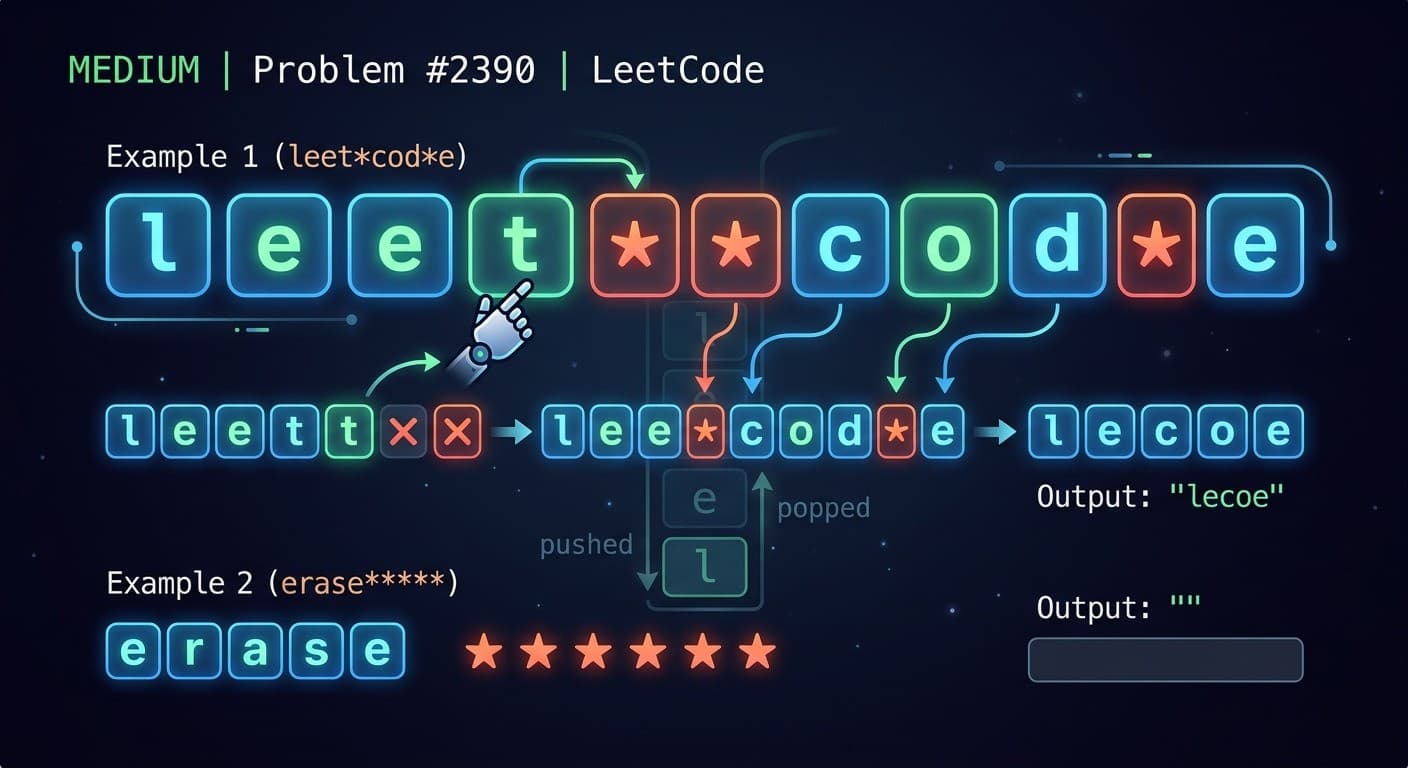
Introduction: What Is LeetCode 2390 Removing Stars From a String?If you are preparing for coding interviews at companies like Google, Amazon, or Microsoft, LeetCode 2390 Removing Stars From a String is a must-solve problem. It tests your understanding of the stack data structure and string manipulation β€” two of the most frequently tested topics in technical interviews.In this article, we will cover:What the problem is asking in plain English3 different Java approaches (Brute Force, Stack, StringBuilder)Step-by-step dry run with examplesTime and space complexity for each approachCommon mistakes to avoidFAQs that appear in Google's People Also AskLet's dive in!Problem Statement SummaryYou are given a string s containing lowercase letters and stars *. In one operation:Choose any * in the stringRemove the * itself AND the closest non-star character to its leftRepeat until all stars are removed and return the final string.Example:Input: s = "leet**cod*e"Output: "lecoe"Real Life Analogy β€” Think of It as a Backspace KeyImagine you are typing on a keyboard. Every * acts as your backspace key β€” it deletes itself and the character just before it.You type "leet" and press backspace twice:Backspace 1 β†’ deletes t β†’ "lee"Backspace 2 β†’ deletes e β†’ "le"That is exactly what this problem simulates! Once you see it this way, the solution becomes very obvious.Approach 1: Brute Force Simulation (Beginner Friendly)IdeaDirectly simulate the process the problem describes:Scan the string from left to rightFind the first *Remove it and the character just before itRepeat until no stars remainJava Codepublic String removeStars(String s) {StringBuilder sb = new StringBuilder(s);int i = 0;while (i < sb.length()) {if (sb.charAt(i) == '*') {sb.deleteCharAt(i); // remove the starif (i > 0) {sb.deleteCharAt(i - 1); // remove closest left characteri--;}} else {i++;}}return sb.toString();}Time and Space ComplexityComplexityValueReasonTimeO(nΒ²)Each deletion shifts all remaining charactersSpaceO(n)StringBuilder storage⚠️ Important WarningThis problem has n up to 100,000. Brute force will get Time Limit Exceeded (TLE) on LeetCode. Use this only to understand the concept, never in production or interviews.Approach 2: Stack Based Solution (Interview Favorite)IdeaA stack is the perfect data structure here because:We always remove the most recently added letter when a * appearsThat is the definition of Last In First Out (LIFO) β€” exactly what a stack doesAlgorithm:Letter β†’ push onto stack* β†’ pop from stack (removes closest left character)At the end, build result from stack contentsJava Codepublic String removeStars(String s) {Stack<Character> st = new Stack<>();for (int i = 0; i < s.length(); i++) {char c = s.charAt(i);if (c == '*') {if (!st.empty()) {st.pop();}} else {st.push(c);}}StringBuilder sb = new StringBuilder();while (!st.empty()) {sb.append(st.pop());}return sb.reverse().toString();}Step-by-Step Dry Run β€” "leet**cod*e"StepCharacterActionStack State1lpush[l]2epush[l,e]3epush[l,e,e]4tpush[l,e,e,t]5*pop t[l,e,e]6*pop e[l,e]7cpush[l,e,c]8opush[l,e,c,o]9dpush[l,e,c,o,d]10*pop d[l,e,c,o]11epush[l,e,c,o,e]βœ… Final Answer: "lecoe"Time and Space ComplexityComplexityValueReasonTimeO(n)Single pass through the stringSpaceO(n)Stack holds up to n charactersApproach 3: StringBuilder as Stack (Optimal Solution) βœ…IdeaThis is the best and most optimized approach. A StringBuilder can act as a stack:append(c) β†’ works like pushdeleteCharAt(sb.length() - 1) β†’ works like popNo reverse needed at the end unlike the Stack approachJava Codepublic String removeStars(String s) {StringBuilder sb = new StringBuilder();for (int i = 0; i < s.length(); i++) {char c = s.charAt(i);if (c == '*') {if (sb.length() > 0) {sb.deleteCharAt(sb.length() - 1);}} else {sb.append(c);}}return sb.toString();}Step-by-Step Dry Run β€” "erase*****"StepCharacterActionStringBuilder1eappend"e"2rappend"er"3aappend"era"4sappend"eras"5eappend"erase"6*delete last"eras"7*delete last"era"8*delete last"er"9*delete last"e"10*delete last""βœ… Final Answer: ""Why StringBuilder Beats Stack in JavaFactorStack<Character>StringBuilderMemoryBoxes char β†’ Character objectWorks on primitives directlyReverse neededYesNoCode lengthMore verboseCleaner and shorterPerformanceSlightly slowerFasterTime and Space ComplexityComplexityValueReasonTimeO(n)One pass, each character processed onceSpaceO(n)StringBuilder storageAll Approaches Comparison TableApproachTimeSpacePasses LeetCode?Best ForBrute ForceO(nΒ²)O(n)❌ TLEUnderstanding conceptStackO(n)O(n)βœ… YesInterview explanationStringBuilderO(n)O(n)βœ… YesBest solutionHow This Relates to LeetCode 3174 Clear DigitsIf you have already solved LeetCode 3174 Clear Digits, you will notice this problem is nearly identical:Feature3174 Clear Digits2390 Removing StarsTriggerDigit 0-9Star *RemovesClosest left non-digitClosest left non-starDifficultyEasyMediumBest approachStringBuilderStringBuilderThe exact same solution pattern works for both. This is why learning patterns matters more than memorizing individual solutions!Common Mistakes to Avoid1. Not checking sb.length() > 0 before deleting Even though the problem guarantees valid input, always add this guard. It shows clean, defensive coding in interviews.2. Forgetting to reverse when using Stack Stack gives you characters in reverse order. If you forget .reverse(), your answer will be backwards.3. Using Brute Force for large inputs With n up to 100,000, O(nΒ²) will time out. Always use the O(n) approach.FAQs β€” People Also AskQ1. What data structure is best for LeetCode 2390? A Stack or StringBuilder used as a stack is the best data structure. Both give O(n) time complexity. StringBuilder is slightly more optimal in Java because it avoids object boxing overhead.Q2. Why does a star remove the closest left character? Because the problem defines it that way β€” think of * as a backspace key on a keyboard. It always deletes the character immediately before the cursor position.Q3. What is the time complexity of LeetCode 2390? The optimal solution runs in O(n) time and O(n) space, where n is the length of the input string.Q4. Is LeetCode 2390 asked in Google interviews? Yes, this type of stack simulation problem is commonly asked at Google, Amazon, Microsoft, and Meta interviews as it tests understanding of LIFO operations and string manipulation.Q5. What is the difference between LeetCode 2390 and LeetCode 844? Both use the same backspace simulation pattern. In 844 Backspace String Compare, # is the backspace character and you compare two strings. In 2390, * is the backspace and you return the final string.Similar LeetCode Problems to Practice NextProblemDifficultyPattern844. Backspace String CompareEasyStack simulation1047. Remove All Adjacent Duplicates In StringEasyStack simulation3174. Clear DigitsEasyStack simulation20. Valid ParenthesesEasyClassic stack735. Asteroid CollisionMediumStack simulationConclusionLeetCode 2390 Removing Stars From a String is a classic stack simulation problem that every developer preparing for coding interviews should master. The key insight is recognizing that * behaves exactly like a backspace key, which makes a stack or StringBuilder the perfect tool.Quick Recap:Brute force works conceptually but TLEs on large inputsStack solution is clean and great for explaining in interviewsStringBuilder solution is the most optimal in Java β€” no boxing, no reversal

StringStackMediumLeetCode
LeetCode 3174: Clear Digits β€” Multiple Approaches Explained

LeetCode 3174: Clear Digits β€” Multiple Approaches Explained

What's the Problem Really Asking?Imagine you're editing a text document and every time you type a number, it acts like a backspace key β€” it deletes itself AND the character just before it. That's exactly what this problem is!Given a string like "cb34":3 deletes b β†’ "c4"4 deletes c β†’ ""Simple idea, right? Let's look at all the ways to solve it.Here is the problem link-: Leetcode 3174Approach 1: Using a Stack (Classic & Intuitive)The IdeaA stack is the most natural fit here. Think of it like a stack of plates:If the character is a letter β†’ push it onto the stack (add a plate)If the character is a digit β†’ pop from the stack (remove the top plate, the digit deletes itself too)At the end, whatever's left on the stack is your answer.Codepublic String clearDigits(String s) { Stack<Character> st = new Stack<>(); for (int i = 0; i < s.length(); i++) { char c = s.charAt(i); if (c >= '0' && c <= '9') { if (!st.empty()) { st.pop(); // digit eats the closest left non-digit } } else { st.push(c); // letter goes in } } StringBuilder sb = new StringBuilder(); while (!st.empty()) { sb.append(st.pop()); } return sb.reverse().toString(); // stack gives reverse order}Real Life AnalogyThink of a Jenga tower. Every time a digit appears, it pulls out the topmost block (the closest left letter). At the end, whatever blocks remain standing β€” that's your result.ComplexityTime: O(n) β€” single pass through the stringSpace: O(n) β€” stack can hold up to n characters in worst case (no digits)Approach 2: StringBuilder as a Stack (Optimal & Clean) βœ…The IdeaThis is the smartest approach and the one you already have in your solution. A StringBuilder naturally behaves like a stack:Append letters to the endWhen a digit appears, delete the last character (.deleteCharAt(sb.length() - 1))No extra data structure needed!Codepublic String clearDigits(String s) { StringBuilder sb = new StringBuilder(); for (int i = 0; i < s.length(); i++) { char c = s.charAt(i); if (c >= '0' && c <= '9') { sb.deleteCharAt(sb.length() - 1); // digit acts as backspace } else { sb.append(c); // letter gets added } } return sb.toString();}Walkthrough with ExampleLet's trace "cb34" step by step:StepCharacterActionStringBuilder1cappend"c"2bappend"cb"33delete last"c"44delete last""Final answer: ""Another example β€” "a1b2c3":StepCharacterActionStringBuilder1aappend"a"21delete last""3bappend"b"42delete last""5cappend"c"63delete last""Final answer: ""ComplexityTime: O(n) β€” one pass, each character processed onceSpace: O(n) β€” StringBuilder storageApproach 3: Brute Force / Simulation (Beginner-Friendly)The IdeaJust simulate exactly what the problem says β€” find the first digit, remove it and its closest left non-digit, repeat.public String clearDigits(String s) { StringBuilder sb = new StringBuilder(s); boolean found = true; while (found) { found = false; for (int i = 0; i < sb.length(); i++) { if (Character.isDigit(sb.charAt(i))) { sb.deleteCharAt(i); // delete the digit if (i > 0) { sb.deleteCharAt(i - 1); // delete closest left non-digit } found = true; break; // restart the search } } } return sb.toString();}ComplexityTime: O(nΒ²) β€” for each digit found, we restart scanning from the beginningSpace: O(n) β€” StringBuilder storageThis works fine for the given constraints (n ≀ 100), but it's not scalable for large inputs.Approach ComparisonApproachTimeSpaceCode SimplicityBest ForBrute ForceO(nΒ²)O(n)⭐⭐⭐Understanding the problemStackO(n)O(n)⭐⭐⭐⭐Interviews (clear intent)StringBuilderO(n)O(n)⭐⭐⭐⭐⭐Production / Best solutionKey Takeaways1. Recognize the Stack Pattern Anytime a problem says "delete the closest left element," your brain should immediately scream stack. This pattern appears in many problems like Valid Parentheses, Asteroid Collision, and Backspace String Compare.2. StringBuilder is a hidden stack In Java, StringBuilder supports append() (push) and deleteCharAt(length-1) (pop). Using it directly instead of a Stack<Character> saves you the overhead of boxing/unboxing characters and the extra reverse step.3. The problem guarantees all digits can be deleted This means you'll never call deleteCharAt on an empty StringBuilder. In a real interview, you'd still want to add a guard check (if (sb.length() > 0)) to be safe and show defensive coding habits.Similar Problems to Practice844. Backspace String Compare β€” almost identical concept1047. Remove All Adjacent Duplicates In String β€” same stack pattern2390. Removing Stars From a String β€” stars act as backspace, same idea

StringStackString BuilderEasyLeetCode
LeetCode 3783 Mirror Distance of an Integer | Java Solution Explained

LeetCode 3783 Mirror Distance of an Integer | Java Solution Explained

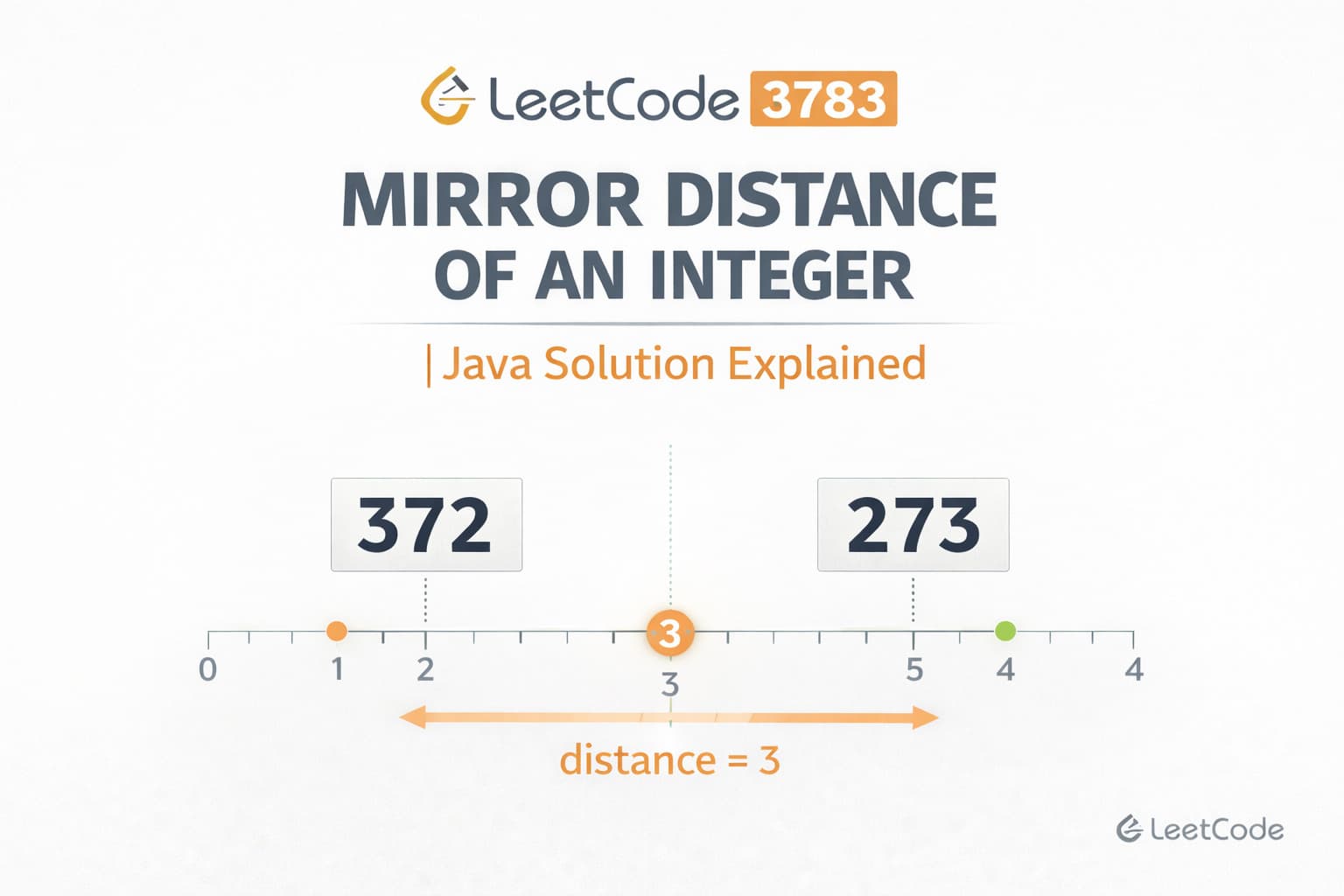
IntroductionSome problems test complex algorithms, while others focus on fundamental concepts done right.LeetCode 3783 – Mirror Distance of an Integer falls into the second category.This problem is simple yet important because it builds understanding of:Digit manipulationReversing numbersMathematical operationsIn this article, we’ll break down the problem in a clean and intuitive way, along with an optimized Java solution.πŸ”— Problem LinkLeetCode: Mirror Distance of an IntegerProblem StatementYou are given an integer n.The mirror distance is defined as:| n - reverse(n) |Where:reverse(n) = number formed by reversing digits of n|x| = absolute valueπŸ‘‰ Return the mirror distance.ExamplesExample 1Input:n = 25Output:27Explanation:reverse(25) = 52|25 - 52| = 27Example 2Input:n = 10Output:9Explanation:reverse(10) = 1|10 - 1| = 9Example 3Input:n = 7Output:0Key InsightThe problem consists of two simple steps:1. Reverse the number2. Take absolute differenceIntuitionLet’s take an example:n = 120Step 1: Reverse digits120 β†’ 021 β†’ 21πŸ‘‰ Leading zeros are ignored automatically.Step 2: Compute difference|120 - 21| = 99ApproachStep-by-StepExtract digits using % 10Build reversed numberUse Math.abs() for final resultJava Codeclass Solution { // Function to reverse a number public int reverse(int k) { int rev = 0; while (k != 0) { int dig = k % 10; // get last digit k = k / 10; // remove last digit rev = rev * 10 + dig; // build reversed number } return rev; } public int mirrorDistance(int n) { // Calculate mirror distance return Math.abs(n - reverse(n)); }}Dry RunInput:n = 25Execution:Reverse β†’ 52Difference β†’ |25 - 52| = 27Complexity AnalysisTime ComplexityReversing number β†’ O(d)(d = number of digits)πŸ‘‰ Overall: O(log n)Space ComplexityπŸ‘‰ O(1) (no extra space used)Why This WorksDigit extraction ensures correct reversalLeading zeros automatically removedAbsolute difference ensures positive resultEdge Cases to ConsiderSingle digit β†’ result = 0Numbers ending with zero (e.g., 10 β†’ 1)Large numbers (up to 10⁹)Key TakeawaysSimple math problems can test core logicDigit manipulation is a must-know skillAlways handle leading zeros carefullyUse built-in functions like Math.abs() effectivelyReal-World RelevanceConcepts used here are helpful in:Number transformationsPalindrome problemsReverse integer problemsMathematical algorithmsConclusionThe Mirror Distance of an Integer problem is a great example of combining basic operations to form a meaningful solution.While simple, it reinforces important programming fundamentals that are widely used in more complex problems.Frequently Asked Questions (FAQs)1. What happens to leading zeros in reverse?They are automatically removed when stored as an integer.2. Can this be solved using strings?Yes, but integer-based approach is more efficient.3. What is the best approach?Using arithmetic operations (% and /) is optimal.

EasyArrayReverse NumberLeetCodeJava
LeetCode 3761 Minimum Absolute Distance Between Mirror Pairs | Java HashMap Solution

LeetCode 3761 Minimum Absolute Distance Between Mirror Pairs | Java HashMap Solution

IntroductionSome problems look simple at firstβ€”but hide a clever trick inside.LeetCode 3761 – Minimum Absolute Distance Between Mirror Pairs is one such problem. It combines:Number manipulation (digit reversal)HashingEfficient searchingIf approached naively, this problem can easily lead to O(nΒ²) time complexityβ€”which is not feasible for large inputs.In this article, we will walk through:Problem intuitionNaive approach (and why it fails)Optimized HashMap solutionStep-by-step explanationClean Java code with commentsπŸ”— Problem LinkLeetCode: Minimum Absolute Distance Between Mirror PairsTo gain a deeper understanding of the problem, it is highly recommended that you review this similar problem Closest Equal Element Queries here is the link of the article. Both cases follow a nearly identical pattern, and studying the initial example will provide valuable context for the current task.Problem StatementYou are given an integer array nums.A mirror pair (i, j) satisfies:0 ≀ i < j < nums.lengthreverse(nums[i]) == nums[j]πŸ‘‰ Your task is to find:The minimum absolute distance between such pairsIf no mirror pair exists, return -1.ExamplesExample 1Input:nums = [12, 21, 45, 33, 54]Output:1Explanation:(0,1) β†’ reverse(12) = 21 β†’ distance = 1(2,4) β†’ reverse(45) = 54 β†’ distance = 2βœ” Minimum = 1Example 2Input:nums = [120, 21]Output:1Example 3Input:nums = [21, 120]Output:-1Key InsightThe core idea is:Instead of checking every pair,store reversed values and match on the fly.❌ Naive Approach (Brute Force)IdeaCheck all pairs (i, j)Reverse nums[i]Compare with nums[j]ComplexityTime: O(nΒ²) ❌Space: O(1)ProblemWith n ≀ 100000, this approach will definitely cause TLE.βœ… Optimized Approach (HashMap)IntuitionWhile iterating through the array:Reverse the current numberCheck if this number was already seen as a reversed valueIf yes β†’ we found a mirror pairKey TrickInstead of storing original numbers:πŸ‘‰ Store reversed values as keysThis allows instant lookup.Java Code (With Detailed Comments)import java.util.*;class Solution {// Function to reverse digits of a numberpublic int reverse(int m) {int rev = 0;while (m != 0) {int dig = m % 10; // extract last digitm = m / 10; // remove last digitrev = rev * 10 + dig; // build reversed number}return rev;}public int minMirrorPairDistance(int[] nums) {// Map to store reversed values and their indicesHashMap<Integer, Integer> mp = new HashMap<>();int min = Integer.MAX_VALUE;for (int i = 0; i < nums.length; i++) {// Check if current number exists in map// Meaning: some previous number had reverse equal to thisif (mp.containsKey(nums[i])) {// Calculate distanceint prevIndex = mp.get(nums[i]);min = Math.min(min, Math.abs(i - prevIndex));}// Reverse current numberint revVal = reverse(nums[i]);// Store reversed value with indexmp.put(revVal, i);}// If no pair found, return -1return min == Integer.MAX_VALUE ? -1 : min;}}Step-by-Step Dry RunInput:nums = [12, 21, 45, 33, 54]Execution:IndexValueReverseMap CheckAction01221not foundstore (21 β†’ 0)12112founddistance = 124554not foundstore (54 β†’ 2)33333not foundstore (33 β†’ 3)45445founddistance = 2πŸ‘‰ Minimum = 1Complexity AnalysisTime ComplexityReversing number β†’ O(digits) β‰ˆ O(log n)Loop β†’ O(n)πŸ‘‰ Overall: O(n)Space ComplexityHashMap stores at most n elementsπŸ‘‰ O(n)Why This Approach WorksAvoids unnecessary pair comparisonsUses hashing for constant-time lookupProcesses array in a single passKey TakeawaysAlways think of hashing when matching conditions existReversing numbers can convert the problem into a lookup problemAvoid brute force when constraints are largeThis is a classic β€œstore & check” patternCommon Interview PatternThis problem is similar to:Two Sum (hashing)Reverse pairsMatching transformationsConclusionThe Minimum Absolute Distance Between Mirror Pairs problem is a great example of how a simple optimization (using a HashMap) can reduce complexity from O(nΒ²) β†’ O(n).Understanding this pattern will help you solve many similar problems involving:TransformationsMatching conditionsEfficient lookupsFrequently Asked Questions (FAQs)1. Why store reversed value instead of original?Because we want to quickly check if a number matches the reverse of a previous number.2. What if multiple same reversed values exist?The map stores the latest index, ensuring minimum distance is considered.3. Can this be solved without HashMap?Yes, but it will result in inefficient O(nΒ²) time.

LeetCodeArrayJavaMediumHashMap
LeetCode 784 Letter Case Permutation | Recursion & Backtracking Java Solution

LeetCode 784 Letter Case Permutation | Recursion & Backtracking Java Solution

IntroductionThe Letter Case Permutation problem is a classic example of recursion and backtracking, often asked in coding interviews and frequently searched by learners preparing for platforms like LeetCode.This problem helps in understanding:Decision-making at each stepRecursive branchingString manipulationIn this article, we’ll break down the intuition, visualize the decision process using your decision tree, and implement an efficient Java solution.πŸ”— Problem LinkLeetCode: Letter Case PermutationProblem StatementGiven a string s, you can transform each alphabet character into:LowercaseUppercaseDigits remain unchanged.πŸ‘‰ Return all possible strings formed by these transformations.ExamplesExample 1Input:s = "a1b2"Output:["a1b2","a1B2","A1b2","A1B2"]Example 2Input:s = "3z4"Output:["3z4","3Z4"]Key InsightAt each character:If it's a digit β†’ only one choiceIf it's a letter β†’ two choices:lowercase OR uppercaseSo total combinations:2^(number of letters)Intuition (Using Your Decision Tree)For input: "a1b2"Start from index 0: "" / \ "a" "A" | | "a1" "A1" / \ / \ "a1b" "a1B" "A1b" "A1B" | | | | "a1b2" "a1B2" "A1b2" "A1B2"Understanding the TreeAt 'a' β†’ branch into 'a' and 'A''1' β†’ no branching (digit)'b' β†’ again branching'2' β†’ no branchingπŸ“Œ Leaf nodes = final answersApproach: Recursion + BacktrackingIdeaTraverse the string character by characterIf digit β†’ move forwardIf letter β†’ branch into:lowercaseuppercaseJava Codeimport java.util.*;class Solution { // List to store all results List<String> lis = new ArrayList<>(); public void solve(String s, int ind, String ans) { // Base case: reached end of string if (ind == s.length()) { lis.add(ans); // store generated string return; } char ch = s.charAt(ind); // If character is a digit β†’ only one option if (ch >= '0' && ch <= '9') { solve(s, ind + 1, ans + ch); } else { // Choice 1: convert to lowercase solve(s, ind + 1, ans + Character.toLowerCase(ch)); // Choice 2: convert to uppercase solve(s, ind + 1, ans + Character.toUpperCase(ch)); } } public List<String> letterCasePermutation(String s) { solve(s, 0, ""); // start recursion return lis; }}Step-by-Step ExecutionFor "a1b2":Start β†’ ""'a' β†’ "a", "A"'1' β†’ "a1", "A1"'b' β†’ "a1b", "a1B", "A1b", "A1B"'2' β†’ final stringsComplexity AnalysisTime Complexity: O(2^n)(n = number of letters)Space Complexity: O(2^n)(for storing results)Why This Approach WorksRecursion explores all possibilitiesEach letter creates a branching pointDigits pass through unchangedBacktracking ensures all combinations are generatedKey TakeawaysThis is a binary decision recursion problemLetters β†’ 2 choicesDigits β†’ 1 choiceDecision tree directly maps to recursionPattern similar to:SubsetsPermutations with conditionsWhen This Problem Is AskedCommon in:Coding interviewsRecursion/backtracking roundsString manipulation problemsConclusionThe Letter Case Permutation problem is a perfect example of how recursion can be used to explore all possible combinations efficiently.Once the decision tree is clear, the implementation becomes straightforward. This pattern is widely used in many advanced problems, making it essential to master.Frequently Asked Questions (FAQs)1. Why don’t digits create branches?Because they have only one valid form.2. What is the main concept used?Recursion with decision-making (backtracking).3. Can this be solved iteratively?Yes, using BFS or iterative expansion, but recursion is more intuitive.

LeetCodeMediumJavaRecursion
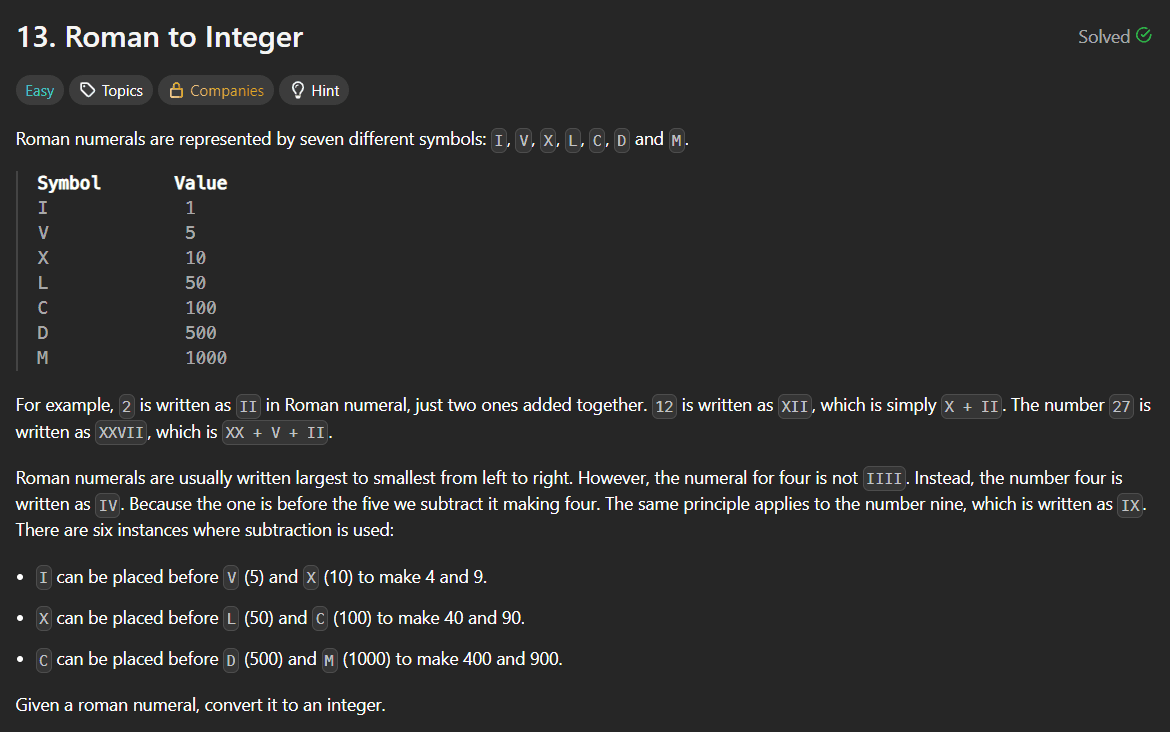
Roman to Integer – Easy Explanation with Java Solution (LeetCode 13)

Roman to Integer – Easy Explanation with Java Solution (LeetCode 13)

Try the QuestionYou can try solving the problem here before reading the solution:πŸ‘‰ https://leetcode.com/problems/roman-to-integer/Practicing it yourself first helps you understand the logic better.Roman to Integer – Complete GuideRoman numerals are an ancient numbering system used by the Romans. Instead of digits like 1, 2, 3, they used specific characters to represent values.This problem asks us to convert a Roman numeral string into its corresponding integer value.It is a very common interview question and frequently appears in coding platforms like LeetCode, HackerRank, and coding interviews at product-based companies.Roman Numeral SymbolsRoman numerals consist of seven characters, each representing a fixed value.SymbolValueI1V5X10L50C100D500M1000Example conversions:III = 3 β†’ 1 + 1 + 1XII = 12 β†’ 10 + 1 + 1XXVII = 27 β†’ 10 + 10 + 5 + 1 + 1Normally, Roman numerals are written from largest to smallest from left to right.But there is an important exception.The Subtraction RuleIn some cases, Roman numerals use subtraction instead of addition.If a smaller value appears before a larger value, it means we subtract it.Examples:RomanCalculationResultIV5 βˆ’ 14IX10 βˆ’ 19XL50 βˆ’ 1040XC100 βˆ’ 1090CD500 βˆ’ 100400CM1000 βˆ’ 100900These are the only valid subtraction cases.Example WalkthroughExample 1Inputs = "III"ExplanationI + I + I = 1 + 1 + 1 = 3Output3Example 2Inputs = "LVIII"ExplanationL = 50V = 5III = 350 + 5 + 3 = 58Output58Example 3Inputs = "MCMXCIV"ExplanationM = 1000CM = 900XC = 90IV = 4Total = 1994Output1994Intuition Behind the SolutionThe key idea is to compare each Roman numeral with the numeral to its right.Two situations occur:Case 1 β€” Normal AdditionIf the current value β‰₯ next valueWe simply add it to the total.ExampleVI5 + 1 = 6Case 2 β€” Subtraction CaseIf the current value < next valueWe subtract it.ExampleIV5 - 1 = 4Strategy to SolveCreate a HashMap to store Roman numeral values.Start from the rightmost character.Initialize total with the last character's value.Move from right to left.Compare the current numeral with the next numeral.If smaller β†’ subtract.Otherwise β†’ add.Continue until the beginning of the string.This approach works because Roman numerals follow a local comparison rule.Java Implementationclass Solution { public int romanToInt(String s) { HashMap<Character,Integer> mp = new HashMap<>(); mp.put('I',1); mp.put('V',5); mp.put('X',10); mp.put('L',50); mp.put('C',100); mp.put('D',500); mp.put('M',1000); int tot = mp.get(s.charAt(s.length()-1)); char arr[] = s.toCharArray(); int j = s.length()-2; for(int i = arr.length-1; i >= 0; i--){ if(j >= 0){ if(mp.get(arr[j]) < mp.get(arr[i])){ tot -= mp.get(arr[j]); }else if(mp.get(arr[j]) > mp.get(arr[i])){ tot += mp.get(arr[j]); }else{ tot += mp.get(arr[j]); } } j--; } return tot; }}Code ExplanationStep 1 β€” Store Roman ValuesWe create a HashMap so we can quickly get the numeric value of each Roman character.I β†’ 1V β†’ 5X β†’ 10...This allows O(1) lookup time.Step 2 β€” Initialize TotalWe start with the last character.int tot = mp.get(s.charAt(s.length()-1));Why?Because the last numeral is always added, never subtracted.Step 3 β€” Traverse from Right to LeftWe move backward through the string.for(int i = arr.length-1; i >= 0; i--)And compare with the previous character.Step 4 β€” Apply Roman RulesIf the previous numeral is smaller than the current numeral:tot -= valueExampleIV5 - 1If it is greater or equal:tot += valueExampleVI5 + 1Time ComplexityO(n)Where n = length of the string.We only traverse the string once.Space ComplexityO(1)The HashMap size is constant (only 7 entries).Key Takeawaysβœ” Roman numerals mostly use additionβœ” Subtraction occurs only in six specific casesβœ” Comparing current and next value is the simplest approachβœ” A single pass solution (O(n)) is enoughThis is why this problem is commonly used to test string processing and logical reasoning in coding interviews.Final ThoughtsThe Roman to Integer problem is a great beginner-friendly problem that teaches:HashMap usageString traversalConditional logicPattern recognitionMastering these simple problems builds a strong foundation for more complex algorithmic questions.If you're preparing for coding interviews, this is definitely a problem you should practice.

LeetCodeJavaString ProblemsEasyRoman Numerals
LeetCode 1614: Maximum Nesting Depth of Parentheses β€” Java Solution Explained

LeetCode 1614: Maximum Nesting Depth of Parentheses β€” Java Solution Explained

IntroductionLeetCode 1614 Maximum Nesting Depth of Parentheses is a natural follow-up to LeetCode 20 Valid Parentheses. While LeetCode 20 asks "are the brackets valid?", this problem asks "how deeply are they nested?" It is a clean, focused problem that teaches you how to think about bracket depth β€” a concept that appears in compilers, parsers, JSON validators, and XML processors in real world software.Here is the Link of Question -: LeetCode 1614In this article we cover plain English explanation, real life analogy, two Java approaches with dry runs, complexity analysis, and all the important details you need for interviews.What Is the Problem Really Asking?You are given a valid parentheses string. You need to find the maximum number of nested (not just sequential) open parentheses at any point in the string.The key distinction here is nested vs sequential:"()()()" β†’ depth is 1, brackets are sequential not nested"((()))" β†’ depth is 3, brackets are fully nested inside each other"()(())" β†’ depth is 2, the second pair is nested one level deepReal Life Analogy β€” Folders Inside FoldersThink of your computer's file system. You have a folder, inside that a subfolder, inside that another subfolder. The depth is how many folders deep you are at the deepest point."(1+(2*3)+((8)/4))+1" is like:Outer folder ( β†’ depth 1Inner folder ( inside it β†’ depth 2Innermost folder (( β†’ depth 3The answer is how deep the deepest file is buried. You do not care about other folders β€” just the maximum depth reached at any single moment.Approach 1: Stack Based Solution (Classic)The IdeaUse a stack exactly like LeetCode 20. Every time you push an opening bracket, increment a counter. Every time you pop a closing bracket, record the max before decrementing. The stack size at any moment represents current depth.public int maxDepth(String s) { Stack<Character> st = new Stack<>(); int current = 0; int max = 0; for (int i = 0; i < s.length(); i++) { char c = s.charAt(i); if (c == '(') { st.push(c); current++; max = Math.max(max, current); // record depth when going deeper } else if (c == ')') { if (!st.empty() && st.peek() == '(') { max = Math.max(max, current); current--; st.pop(); } } } return max;}Dry Run β€” s = "()(())((()()))"( β†’ push, current = 1, max = 1) β†’ pop, current = 0( β†’ push, current = 1, max = 1( β†’ push, current = 2, max = 2) β†’ pop, current = 1) β†’ pop, current = 0( β†’ push, current = 1, max = 2( β†’ push, current = 2, max = 2( β†’ push, current = 3, max = 3 βœ…) β†’ pop, current = 2( β†’ push, current = 3, max = 3) β†’ pop, current = 2) β†’ pop, current = 1) β†’ pop, current = 0βœ… Output: 3Time Complexity: O(n) β€” single pass Space Complexity: O(n) β€” stack holds up to n/2 opening bracketsApproach 2: Counter Only β€” No Stack (Optimal) βœ…The IdeaThis is the smartest approach and the real insight of this problem. You do not actually need a stack at all! Think about it β€” the depth at any moment is simply how many unmatched opening brackets we have seen so far. That is just a counter!( β†’ increment counter, update max) β†’ decrement counterEverything else β†’ ignorepublic int maxDepth(String s) { int current = 0; int max = 0; for (int i = 0; i < s.length(); i++) { if (s.charAt(i) == '(') { current++; max = Math.max(max, current); } else if (s.charAt(i) == ')') { current--; } } return max;}This is beautifully simple. No stack, no extra memory, just two integer variables.Dry Run β€” s = "(1+(2*3)+((8)/4))+1"Only tracking ( and ), ignoring digits and operators:( β†’ current = 1, max = 1( β†’ current = 2, max = 2) β†’ current = 1( β†’ current = 2, max = 2( β†’ current = 3, max = 3 βœ…) β†’ current = 2) β†’ current = 1) β†’ current = 0βœ… Output: 3Time Complexity: O(n) β€” single pass Space Complexity: O(1) β€” only two integer variables, no extra storage!Why Update Max on ( Not on )?This is the most important implementation detail. You update max when you open a bracket, not when you close it. Why?Because when you encounter (, your depth just increased to a new level β€” that is when you might have hit a new maximum. When you encounter ), you are going back up β€” depth is decreasing, so it can never be a new maximum.Always capture the peak on the way down into nesting, not on the way back out.Stack vs Counter β€” Which to Use?The counter approach is strictly better here β€” same time complexity but O(1) space instead of O(n). In an interview, start by mentioning the stack approach to show you recognize the stack pattern, then immediately offer the counter optimization to show deeper understanding.This mirrors the same progression as LeetCode 844 Backspace String Compare β€” where the O(1) two pointer follow-up impressed interviewers more than the standard stack solution.How This Fits the Stack Pattern SeriesLooking at the full series you have been solving:20 Valid Parentheses β€” are brackets correctly matched? 1614 Maximum Nesting Depth β€” how deeply are they nested?These two problems are complementary. One validates structure, the other measures depth. Together they cover the two most fundamental questions you can ask about a bracket string. Real world parsers need to answer both β€” "is this valid?" and "how complex is the nesting?"Common Mistakes to AvoidUpdating max after decrementing on ) If you write current-- before Math.max, you will always be one level too low and miss the true maximum. Always capture max before or at the moment of increment, never after decrement.Counting all characters not just brackets Digits, operators like +, -, *, / must be completely ignored. Only ( and ) affect depth.Using a Stack when a counter suffices Since the problem guarantees a valid parentheses string, you never need to validate matching β€” just track depth. A Stack adds unnecessary complexity and memory overhead here.FAQs β€” People Also AskQ1. What is nesting depth in LeetCode 1614? Nesting depth is the maximum number of open parentheses that are simultaneously unclosed at any point in the string. For example "((()))" has depth 3 because at the innermost point, three ( are open at the same time.Q2. What is the best approach for LeetCode 1614 in Java? The counter approach is optimal β€” O(n) time and O(1) space. Increment a counter on (, update max, decrement on ). No stack needed since the string is guaranteed to be a valid parentheses string.Q3. What is the time complexity of LeetCode 1614? Both approaches are O(n) time. The Stack approach uses O(n) space while the counter approach uses O(1) space, making the counter approach strictly better.Q4. What is the difference between LeetCode 20 and LeetCode 1614? LeetCode 20 validates whether a bracket string is correctly formed. LeetCode 1614 assumes the string is already valid and asks how deeply the brackets are nested. LeetCode 20 needs a stack for matching; LeetCode 1614 only needs a counter.Q5. Is LeetCode 1614 asked in coding interviews? It appears occasionally as a warmup or follow-up after LeetCode 20. The more important skill it tests is recognizing when a stack can be replaced by a simpler counter β€” that kind of space optimization thinking is valued in interviews.Similar LeetCode Problems to Practice Next20. Valid Parentheses β€” Easy β€” validate bracket structure1021. Remove Outermost Parentheses β€” Easy β€” depth-based filtering1249. Minimum Remove to Make Valid Parentheses β€” Medium β€” remove minimum brackets32. Longest Valid Parentheses β€” Hard β€” longest valid substring394. Decode String β€” Medium β€” nested brackets with encodingConclusionLeetCode 1614 Maximum Nesting Depth of Parentheses teaches a deceptively simple but important lesson β€” not every bracket problem needs a stack. When the string is guaranteed valid and you only need to measure depth, a counter is all you need.The progression from LeetCode 20 to 1614 perfectly illustrates how understanding the core problem deeply leads to elegant simplifications. Master both, understand why one needs a stack and the other does not, and you will have a strong foundation for every bracket problem in your interview journey.

StringStackLeetCodeEasy
LeetCode 36: Valid Sudoku Explained – Java Solutions, Intuition & Formula Dry Run

LeetCode 36: Valid Sudoku Explained – Java Solutions, Intuition & Formula Dry Run

IntroductionSudoku is a universally beloved puzzle, but validating a Sudoku boardalgorithmically is a classic technical interview question. In this post, we aregoing to dive deep into LeetCode 36: Valid Sudoku.We won't just look at the code; we will explore the intuition behind the problemso you don't have to memorize anything. We’ll cover an ingenious in-placevalidation approach, break down the complex math formula used to check3 \times 3 sub-boxes, and look at an alternative optimal solution usingHashSets.Let's dive in!Understanding the ProblemThe problem asks us to determine if a partially filled 9 \times 9 Sudoku boardis valid. To be valid, the filled cells must follow three straightforward rules:1. Each row must contain the digits 1-9 without repetition.2. Each column must contain the digits 1-9 without repetition.3. Each of the nine 3 \times 3 sub-boxes must contain the digits 1-9 withoutrepetition.Important Note: A valid board doesn't mean the board is fully solvable! We onlycare about checking the numbers that are currently on the board.Intuition: How to Think About the ProblemBefore writing code, how do we, as humans, check if a Sudoku board is valid? Ifyou place a 5 in a cell, you quickly scan horizontally (its row), vertically(its column), and within its small 3 \times 3 square. If you see another 5, theboard is invalid.To translate this to code, we have two choices:1. The Simulation Approach: Go cell by cell. Pick up the number, hide it, andcheck its row, column, and 3 \times 3 box to see if that number existsanywhere else. (This is the approach we will look at first).2. The Memory Approach: Go cell by cell, but keep a "notebook" (like a HashTable) of everything we have seen so far. If we see a number we've alreadywritten down for a specific row, column, or box, it's invalid.Approach 1: The In-Place Validation (Space-Optimized)Here is a brilliant solution that validates the board without using any extradata structures.The Logic: Iterate through every cell on the board. When we find a number, wetemporarily replace it with a . (empty space). Then, we iterate 9 times to checkits entire row, column, and sub-box. If the number is found, we return false.Otherwise, we put the number back and move to the next cell.The Java Codeclass Solution {public boolean isvalid(char[][] board, int i, int j, char k) {for(int m = 0; m < 9; m++) {// Check rowif(board[i][m] == k) return false;// Check columnif(board[m][j] == k) return false;// Check 3x3 sub-boxif(board[3 * (i / 3) + m / 3][3 * (j / 3) + m % 3] == k) return false;}return true;}public boolean isValidSudoku(char[][] board) {for(int i = 0; i < board.length; i++) {for(int j = 0; j < board[0].length; j++) {if(board[i][j] != '.') {char temp = board[i][j];board[i][j] = '.'; // Temporarily remove the numberif(!isvalid(board, i, j, temp)) {return false;}board[i][j] = temp; // Put the number back}}}return true;}}The Math Breakdown: Demystifying the 3 \times 3 Grid FormulaThe hardest part of this code to understand is this exact line: board[3*(i/3) +m/3][3*(j/3) + m%3]How does a single loop variable m (from 0 to 8) traverse a 3 \times 3 grid?Let’s do a dry run.Step 1: Finding the Starting Point of the BoxThe grid is 9 \times 9, broken into nine 3 \times 3 boxes. If we are at a randomcell, say row i = 4, col j = 5, which box are we in? Because integer division inJava drops the decimal:i / 3 = 4 / 3 = 1j / 3 = 5 / 3 = 1Now multiply by 3 to get the actual starting coordinates (top-left corner) ofthat specific sub-box:3 * 1 = 3 (Row offset)3 * 1 = 3 (Col offset) So, the 3 \times 3 box starts at row 3, col 3.Step 2: Traversing the Box (Dry Run)Now, as m goes from 0 to 8, we use m / 3 for rows and m % 3 for columns:m = 0: row offset 0/3 = 0, col offset 0%3 = 0 \rightarrow Checks (3+0, 3+0) = (3, 3)m = 1: row offset 1/3 = 0, col offset 1%3 = 1 \rightarrow Checks (3+0, 3+1) = (3, 4)m = 2: row offset 2/3 = 0, col offset 2%3 = 2 \rightarrow Checks (3+0, 3+2) = (3, 5)m = 3: row offset 3/3 = 1, col offset 3%3 = 0 \rightarrow Checks (3+1, 3+0) = (4, 3)m = 4: row offset 4/3 = 1, col offset 4%3 = 1 \rightarrow Checks (3+1, 3+1) = (4, 4)...and so on up to m = 8.This brilliant math formula maps a 1D loop (0 to 8) directly onto a 2D3 \times 3 grid perfectly! No nested loops needed inside the isvalid function.Approach 2: The HashSet Solution (Single Pass)While the first approach is highly space-efficient, it does a bit of redundantchecking. An alternative approach that interviewers love is using a HashSet.Instead of checking rows and columns every time we see a number, we generate aunique "string signature" for every number and attempt to add it to a HashSet.If we see a 5 at row 0 and col 1, we create three strings:1. "5 in row 0"2. "5 in col 1"3. "5 in block 0-0"The HashSet.add() method returns false if the item already exists in the set. Ifit returns false, we instantly know the board is invalid!HashSet Java Code:class Solution {public boolean isValidSudoku(char[][] board) {HashSet<String> seen = new HashSet<>();for (int i = 0; i < 9; i++) {for (int j = 0; j < 9; j++) {char number = board[i][j];if (number != '.') {// HashSet.add() returns false if the element already existsif (!seen.add(number + " in row " + i) ||!seen.add(number + " in col " + j) ||!seen.add(number + " in block " + i/3 + "-" + j/3)) {return false;}}}}return true;}}Notice how we use i/3 + "-" + j/3 to identify the blocks. Top-left is block 0-0,bottom-right is block 2-2.Time and Space Complexity BreakdownInterviewers will always ask for your complexity analysis. Because a Sudokuboard is strictly fixed at 9 \times 9, the strict Big-O is actually constant.However, let's look at it conceptually as if the board were N \times N.Approach 1: In-Place Validation (Your Solution)Time Complexity: O(1) (Strictly speaking). We traverse 81 cells, and foreach cell, we do at most 9 iterations. 81 \times 9 = 729 operations. Since729 is a constant, it's O(1). (If the board was N \times N, time complexitywould be O(N^3) because for N^2 cells, we iterate N times).Space Complexity: O(1). We only use primitive variables (i, j, k, m, temp).No extra memory is allocated.Approach 2: HashSet ApproachTime Complexity: O(1). We traverse the 81 cells exactly once. Generatingstrings and adding to a HashSet takes O(1) time. (If the board wasN \times N, time complexity would be O(N^2)).Space Complexity: O(1). The HashSet will store a maximum of81 \times 3 = 243 strings. Since this upper limit is fixed, space isconstant.ConclusionThe Valid Sudoku problem is a fantastic exercise in matrix traversal andcoordinate math.When solving this in an interview:1. Use the first approach if you want to impress the interviewer with O(1)space complexity and your deep understanding of math formulas (the /3 and %3trick).2. Use the second approach (HashSet) if you want to show off your knowledge ofdata structures and write highly readable, clean, and clever code.I hope this breakdown gives you the intuition needed so you never have tomemorize the code for LeetCode 36!Happy Coding! Keep Learning🀟

LeetCodeJavaMatrixHash TableRecursionBacktrackingMedium
Understanding HashMap and Hashing Techniques: A Complete Guide

Understanding HashMap and Hashing Techniques: A Complete Guide

What is HashMap?HashMap is a non-linear data structure that lives inside Java's collection framework, alongside other structures like Trees and Graphs (see the generated image above). What makes it special? It uses a clever technique called hashing to store and retrieve data at blazing speeds.Think of hashing as a smart address system. It converts large keys (like long strings or big numbers) into smaller values that work as array indices. This simple trick transforms your data lookup from slow O(n)O(n) or O(log⁑n)O(logn) operations into lightning-fast O(1)O(1) access times!Understanding Hashing MappingsBefore diving deeper, let's understand the four types of hashing mappings:One-to-one mapping β€” Each key maps to exactly one indexMany-to-one mapping β€” Multiple keys can map to the same indexOne-to-many mapping β€” One key maps to multiple indicesMany-to-many mapping β€” Multiple keys map to multiple indicesHashMap primarily uses one-to-one and many-to-one mapping strategies to achieve its performance goals.The Problem: Why Not Just Use Arrays?Let's say you want to store 7 elements with keys: 1, 5, 23, 57, 234, 678, and 1000.Using direct indexing (where key = array index), you'd need an array of size 1000 just to store 7 items! That leaves 993 empty slots wasting precious memory. Imagine having a parking lot with 1000 spaces for just 7 cars β€” totally inefficient!This is the exact problem hash functions solve.Hash Functions: The SolutionA hash function takes your key and calculates which array index to use. The beauty? You can now store those same 7 elements in an array of just size 10!The most common hash function uses the modulus operator:hash(key)=keymod array sizehash(key)=keymodarray sizeExample: With array size = 10:Key 57 β†’ Index: 57mod 10=757mod10=7Key 234 β†’ Index: 234mod 10=4234mod10=4Key 1000 β†’ Index: 1000mod 10=01000mod10=0Now you only need an array of size 10 instead of 1000. Problem solved!Three Popular Hash Function TypesModulus MethodThe most widely used technique. Divide the key by array size (or a prime number) and use the remainder as the index.index=keymod sizeindex=keymodsizeMid Square MethodSquare the key value, then extract the middle digits to form your hash value.Example: Key = 57 β†’ 572=3249572=3249 β†’ Extract middle digits "24"Folding HashingDivide the key into equal parts, add them together, then apply modulus.Example: Key = 123456Split into: 12, 34, 56Sum: 12+34+56=10212+34+56=102Apply modulus: 102mod 10=2102mod10=2The Collision ProblemHere's the catch: sometimes two different keys produce the same index. This is called a collision.Example:Key 27 β†’ 27mod 10=727mod10=7Key 57 β†’ 57mod 10=757mod10=7Both keys want index 7! We need smart strategies to handle this.Collision Resolution: Two Main TechniquesTechnique 1: Open Chaining (Separate Chaining)Mapping Type: Many-to-oneWhen a collision happens, create a linked list at that index and store all colliding values in sorted order.Example: Keys 22 and 32 both map to index 2:Index 2: [22] β†’ [32] β†’ nullAdvantage: Simple and works well in practiceDrawback: If too many collisions occur, the linked list becomes long and searching degrades to O(n)O(n). However, Java's collection framework uses highly optimized hash functions that achieve amortized O(1)O(1) time complexity.Technique 2: Closed Addressing (Open Addressing)Mapping Type: One-to-manyInstead of creating a list, find another empty slot in the array. There are three approaches:Linear ProbingWhen collision occurs, check the next index. If it's occupied, keep checking the next one until you find an empty slot.Hash Function:h(x)=xmod sizeh(x)=xmodsizeOn Collision:h(x)=(h(x)+i)mod sizeh(x)=(h(x)+i)modsizewhere i=0,1,2,3,…i=0,1,2,3,…Example: Keys 22 and 32 both map to index 2:Store 22 at index 2Try 32 at index 2 β†’ occupiedCheck index 3 β†’ empty, store 32 thereProblems:Clustering: Keys bunch together in adjacent indices, slowing down searchesDeleted Slot Problem: When you delete a key, it creates an empty slot that breaks the search chainThe Deleted Slot Problem Explained:Keys 22 and 32 are at indices 2 and 3Delete key 22 from index 2Now when searching for key 32, the algorithm reaches index 2 (empty), thinks key 32 doesn't exist, and stops searching!Solution: Mark deleted slots with a special marker (like -1) or perform rehashing after deletions.Quadratic ProbingSame concept as linear probing, but instead of checking consecutive slots, jump in quadratic increments: 1, 4, 9, 16, 25...Hash Function:h(x)=xmod sizeh(x)=xmodsizeOn Collision:h(x)=(h(x)+i2)mod sizeh(x)=(h(x)+i2)modsizewhere i=0,1,2,3,…i=0,1,2,3,…Advantage: Significantly reduces clusteringDrawback: Still suffers from the deleted slot problemDouble HashingThe most sophisticated approach! Uses two different hash functions to create unique probe sequences for each key.First Hash Function:h1(x)=xmod sizeh1(x)=xmodsizeSecond Hash Function:h2(x)=primeβˆ’(xmod prime)h2(x)=primeβˆ’(xmodprime)On Collision:h(x)=(h1(x)+iΓ—h2(x))mod sizeh(x)=(h1(x)+iΓ—h2(x))modsizewhere i=0,1,2,3,…i=0,1,2,3,…Advantage: Effectively avoids clustering and provides the best performance among probing techniquesLoad Factor: The Performance IndicatorThe load factor tells you how full your hash table is:Load Factor=Number of elementsArray sizeLoad Factor=Array sizeNumber of elementsPerformance GuidelinesLoad Factor ≀ 0.5 β†’ Good performance, fast operations Load Factor > 0.7 β†’ Poor performance, time to rehash ExamplesBad Load Factor:Array size = 10, Elements = 8Load Factor = 8/10=0.88/10=0.8Action: Rehash the array (typically double the size)Good Load Factor:Array size = 200, Elements = 100Load Factor = 100/200=0.5100/200=0.5Action: No changes needed, performing optimallyWhat is Rehashing?When the load factor exceeds the threshold (usually 0.7), the hash table is resized β€” typically doubled in size. All existing elements are then rehashed and redistributed into the new larger array. This maintains optimal performance as your data grows.Performance SummaryHashMap delivers exceptional average-case performance:Insertion: O(1)O(1)Deletion: O(1)O(1)Search: O(1)O(1)However, in the worst case (many collisions with poor hash functions), operations can degrade to O(n)O(n).The key to maintaining O(1)O(1) performance:Use a good hash functionChoose an appropriate collision resolution strategyMonitor and maintain a healthy load factorRehash when necessaryConclusionHashMap is one of the most powerful and frequently used data structures in programming. By understanding hashing techniques, collision resolution strategies, and load factors, you can write more efficient code and make better design decisions.Whether you're building a cache, implementing a frequency counter, or solving complex algorithm problems, HashMap is your go-to tool for fast data access!

hashmapdata-structureshashingjavaalgorithmscollision-resolutiontime-complexity
LeetCode 20: Valid Parentheses β€” Java Solution Explained

LeetCode 20: Valid Parentheses β€” Java Solution Explained

IntroductionLeetCode 20 Valid Parentheses is arguably the single most asked Easy problem in coding interviews. It appears at Google, Amazon, Microsoft, Meta, and virtually every company that does technical interviews. It is the textbook introduction to the Stack data structure and teaches you a pattern that shows up in compilers, code editors, HTML parsers, and mathematical expression evaluators.Here is the Link of Question -: LeetCode 20In this article we cover plain English explanation, real life analogy, the optimal stack solution with detailed dry run, all tricky edge cases, complexity analysis, common mistakes, and FAQs.What Is the Problem Really Asking?You are given a string containing only bracket characters β€” (, ), {, }, [, ]. You need to check if the brackets are correctly matched and nested.Three rules must hold:Every opening bracket must be closed by the same type of closing bracketBrackets must be closed in the correct order β€” the most recently opened must be closed firstEvery closing bracket must have a corresponding opening bracketReal Life Analogy β€” Russian Nesting DollsThink of Russian nesting dolls. You open the biggest doll first, then a medium one inside it, then a small one inside that. To close them back, you must close the smallest first, then medium, then biggest. You cannot close the biggest doll while the smallest is still open inside.That is exactly how brackets work. The last opened bracket must be the first one closed. This Last In First Out behavior is precisely what a Stack is built for.Another analogy β€” think of a text editor like VS Code. When you type (, it automatically adds ). If you try to close with ] instead, the editor highlights an error. This problem is essentially building that validation logic.The Only Approach You Need: StackThe IdeaScan the string left to rightIf you see an opening bracket β†’ push it onto the stackIf you see a closing bracket β†’ check the top of the stack. If the top is the matching opening bracket, pop it. Otherwise the string is invalid.At the end, if the stack is empty β†’ all brackets matched β†’ return true. If stack still has elements β†’ some brackets were never closed β†’ return false.public boolean isValid(String s) {if (s.length() == 1) return false; // single char can never be validStack<Character> st = new Stack<>();for (int i = 0; i < s.length(); i++) {char c = s.charAt(i);if (c == '(' || c == '{' || c == '[') {st.push(c); // opening bracket β€” push and wait for its match} else {if (!st.empty()) {// check if top of stack is the matching openerif ((c == ')' && st.peek() != '(') ||(c == '}' && st.peek() != '{') ||(c == ']' && st.peek() != '[')) {return false; // wrong type of closing bracket} else {st.pop(); // matched! remove the opener}} else {return false; // closing bracket with nothing open}}}return st.empty(); // true only if all openers were matched}Detailed Dry Run β€” s = "([)]"This is the trickiest example. Looks balanced at first glance but is actually invalid.( β†’ opening, push β†’ stack: [(][ β†’ opening, push β†’ stack: [(, []) β†’ closing, peek is [, but ) needs ( β†’ mismatch β†’ return false βœ…The stack correctly catches that [ was opened after ( but we tried to close ( before closing [ β€” wrong order!Dry Run β€” s = "([{}])"( β†’ push β†’ stack: [(][ β†’ push β†’ stack: [(, []{ β†’ push β†’ stack: [(, [, {]} β†’ peek is {, match! pop β†’ stack: [(, []] β†’ peek is [, match! pop β†’ stack: [(]) β†’ peek is (, match! pop β†’ stack: []Stack is empty β†’ return true βœ…Dry Run β€” s = "(["( β†’ push β†’ stack: [(][ β†’ push β†’ stack: [(, []Loop ends. Stack is NOT empty β†’ return false βœ…Two brackets were opened but never closed.All the Edge Cases You Must KnowSingle character like "(" or ")" A single character can never be valid β€” an opener has nothing to close it, a closer has nothing before it. The early return if (s.length() == 1) return false handles this cleanly.Only closing brackets like "))" The stack is empty when the first ) arrives β†’ return false immediately.Only opening brackets like "(((" All get pushed, nothing gets popped, stack is not empty at end β†’ return false.Interleaved wrong types like "([)]" Caught by the mismatch check when the closing bracket does not match the stack top.Empty string Stack stays empty β†’ st.empty() returns true β†’ returns true. An empty string is technically valid since there are no unmatched brackets. The constraints say length β‰₯ 1 so this is just good to know.A Cleaner Variation Using HashMapSome developers prefer using a HashMap to store bracket pairs, making the matching condition more readable:public boolean isValid(String s) {Stack<Character> st = new Stack<>();Map<Character, Character> map = new HashMap<>();map.put(')', '(');map.put('}', '{');map.put(']', '[');for (char c : s.toCharArray()) {if (map.containsKey(c)) {// closing bracketif (st.empty() || st.peek() != map.get(c)) {return false;}st.pop();} else {st.push(c); // opening bracket}}return st.empty();}The HashMap maps each closing bracket to its expected opening bracket. This makes adding new bracket types trivial β€” just add one line to the map. Great for extensibility in real world code.Both versions are O(n) time and O(n) space. Choose whichever feels more readable to you.Time Complexity: O(n) β€” single pass through the string Space Complexity: O(n) β€” stack holds at most n/2 opening bracketsWhy Stack Is the Perfect Data Structure HereThe key property this problem exploits is LIFO β€” Last In First Out. The most recently opened bracket must be the first one closed. That is literally the definition of a stack's behavior.Any time you see a problem where the most recently seen item determines what comes next β€” think Stack immediately. Valid Parentheses is the purest example of this principle.How This Fits Into the Bigger Stack PatternLooking at everything you have solved so far, notice the pattern evolution:844 Backspace String Compare β€” # pops the last character 1047 Remove Adjacent Duplicates β€” matching character pops itself 2390 Removing Stars β€” * pops the last character 3174 Clear Digits β€” digit pops the last character 20 Valid Parentheses β€” closing bracket pops its matching openerAll of these are stack simulations. The difference here is that instead of any character being popped, only the correct matching opener is popped. This matching condition is what makes Valid Parentheses a step up in logic from the previous problems.Common Mistakes to AvoidNot checking if stack is empty before peeking If a closing bracket arrives and the stack is empty, calling peek() throws an EmptyStackException. Always check !st.empty() before peeking or popping.Returning true without checking if stack is empty Even if the loop completes without returning false, unclosed openers remain on the stack. Always return st.empty() at the end, not just true.Pushing closing brackets onto the stack Only push opening brackets. Pushing closing brackets gives completely wrong results and is the most common beginner mistake.Not handling odd length strings If s.length() is odd, it is impossible for all brackets to be matched β€” you can add if (s.length() % 2 != 0) return false as an early exit for a small optimization.FAQs β€” People Also AskQ1. Why is a Stack used to solve Valid Parentheses? Because the problem requires LIFO matching β€” the most recently opened bracket must be the first one closed. Stack's Last In First Out behavior maps perfectly to this requirement, making it the natural and optimal data structure choice.Q2. What is the time complexity of LeetCode 20? O(n) time where n is the length of the string. We make a single pass through the string, and each character is pushed and popped at most once. Space complexity is O(n) in the worst case when all characters are opening brackets.Q3. Can LeetCode 20 be solved without a Stack? Technically yes for simple cases using counters, but only when dealing with a single type of bracket. With three types of brackets that can be nested, a Stack is the only clean solution. Counter-based approaches break down on cases like "([)]".Q4. Is LeetCode 20 asked in FAANG interviews? Absolutely. It is one of the most commonly asked problems across all major tech companies. It tests understanding of the Stack data structure and is often used as a warmup before harder stack problems like Largest Rectangle in Histogram or Decode String.Q5. What happens if the input string has an odd length? An odd-length string can never be valid since brackets always come in pairs. You can add if (s.length() % 2 != 0) return false as an early optimization, though the stack logic handles this correctly on its own.Similar LeetCode Problems to Practice Next1047. Remove All Adjacent Duplicates In String β€” Easy β€” stack pattern with characters394. Decode String β€” Medium β€” nested brackets with encoding678. Valid Parenthesis String β€” Medium β€” wildcards added32. Longest Valid Parentheses β€” Hard β€” longest valid substring1249. Minimum Remove to Make Valid Parentheses β€” Medium β€” remove minimum brackets to make validConclusionLeetCode 20 Valid Parentheses is the definitive introduction to the Stack data structure in competitive programming and technical interviews. The logic is elegant β€” push openers, pop on matching closers, check empty at the end. Three rules, one data structure, one pass.Master this problem thoroughly, understand every edge case, and you will have a rock-solid foundation for every stack problem that follows β€” from Decode String to Largest Rectangle in Histogram.

StringStackEasyLeetCode
LeetCode 682 Baseball Game - Java Solution Explained

LeetCode 682 Baseball Game - Java Solution Explained

IntroductionLeetCode 682 Baseball Game is one of the cleanest and most beginner-friendly stack simulation problems on LeetCode. It does not require any fancy algorithm or deep insight β€” it purely tests whether you can carefully read the rules and simulate them faithfully using the right data structure.But do not let "Easy" fool you. This problem is a great place to practice thinking about which data structure fits best and why. We will solve it three different ways β€” Stack, ArrayList, and Deque β€” so you can see the tradeoffs and pick the one that makes most sense to you.You can find the problem here β€” LeetCode 682 Baseball Game.What Is the Problem Really Asking?You are keeping score for a baseball game with four special rules. You process a list of operations one by one and maintain a record of scores. At the end, return the total sum of all scores in the record.The four operations are:A number (like "5" or "-2") β€” just add that number as a new score to the record."C" β€” the last score was invalid, remove it from the record."D" β€” add a new score that is double the most recent score."+" β€” add a new score that is the sum of the two most recent scores.That is it. Four rules, simulate them in order, sum up what is left.Real Life Analogy β€” A Scoreboard With CorrectionsImagine a scoreboard operator at a sports event. They write scores on a whiteboard as the game progresses:A player scores 5 points β†’ write 5Another player scores 2 β†’ write 2Referee says last score was invalid β†’ erase the last number (C)Special bonus rule kicks in β†’ double the last valid score (D)Two scores combine β†’ add the last two scores as one entry (+)At the end, add up everything on the whiteboard. The stack is your whiteboard β€” you write on top and erase from the top.Why Stack Is the Natural FitAll four operations only ever look at or modify the most recently added scores. C removes the last one. D doubles the last one. + uses the last two. This "most recent first" access pattern is the definition of LIFO β€” Last In First Out β€” which is exactly what a Stack provides.Any time a problem says "the previous score" or "the last two scores," your brain should immediately think Stack.Approach 1: Stack (Your Solution) βœ…The IdeaUse a Stack of integers. For each operation:Number β†’ parse and pushC β†’ pop the topD β†’ peek the top, push doubled value+ β†’ pop top two, push both back, push their sumpublic int calPoints(String[] operations) { Stack<Integer> st = new Stack<>(); for (int i = 0; i < operations.length; i++) { String op = operations[i]; if (op.equals("C")) { st.pop(); // remove last score } else if (op.equals("D")) { st.push(st.peek() * 2); // double of last score } else if (op.equals("+")) { int prev1 = st.pop(); // most recent score int prev2 = st.pop(); // second most recent score int sum = prev1 + prev2; st.push(prev2); // put them back st.push(prev1); st.push(sum); // push the new score } else { st.push(Integer.parseInt(op)); // regular number } } // sum all remaining scores int total = 0; while (!st.empty()) { total += st.pop(); } return total;}One small improvement over your original solution β€” using op.equals("C") instead of op.charAt(0) == 'C'. This is cleaner and handles edge cases better since negative numbers like "-2" also start with - not a digit, so charAt(0) comparisons can get tricky. Using equals is always safer for string operations.Why the + Operation Needs Pop-Push-PopThe trickiest part is the + operation. You need the two most recent scores. Stack only lets you see the top. So you pop the first, then the second, compute the sum, then push both back before pushing the sum. This restores the record correctly β€” the previous two scores stay, and the new sum score is added on top.Detailed Dry Run β€” ops = ["5","2","C","D","+"]Let us trace every step carefully:"5" β†’ number, parse and push Stack: [5]"2" β†’ number, parse and push Stack: [5, 2]"C" β†’ remove last score, pop Stack: [5]"D" β†’ double last score, peek=5, push 10 Stack: [5, 10]"+" β†’ sum of last two:pop prev1 = 10pop prev2 = 5sum = 15push prev2=5, push prev1=10, push sum=15 Stack: [5, 10, 15]Sum all: 5 + 10 + 15 = 30 βœ…Detailed Dry Run β€” ops = ["5","-2","4","C","D","9","+","+"]"5" β†’ push 5. Stack: [5]"-2" β†’ push -2. Stack: [5, -2]"4" β†’ push 4. Stack: [5, -2, 4]"C" β†’ pop 4. Stack: [5, -2]"D" β†’ peek=-2, push -4. Stack: [5, -2, -4]"9" β†’ push 9. Stack: [5, -2, -4, 9]"+" β†’ prev1=9, prev2=-4, sum=5. Push -4, 9, 5. Stack: [5, -2, -4, 9, 5]"+" β†’ prev1=5, prev2=9, sum=14. Push 9, 5, 14. Stack: [5, -2, -4, 9, 5, 14]Sum: 5 + (-2) + (-4) + 9 + 5 + 14 = 27 βœ…Approach 2: ArrayList (Most Readable)The IdeaArrayList gives you index-based access which makes the + operation much cleaner β€” no need to pop and push back. Just access the last two elements directly using size()-1 and size()-2.public int calPoints(String[] operations) { ArrayList<Integer> record = new ArrayList<>(); for (String op : operations) { int n = record.size(); if (op.equals("C")) { record.remove(n - 1); // remove last element } else if (op.equals("D")) { record.add(record.get(n - 1) * 2); // double last } else if (op.equals("+")) { // sum of last two β€” no need to remove and re-add! record.add(record.get(n - 1) + record.get(n - 2)); } else { record.add(Integer.parseInt(op)); } } int total = 0; for (int score : record) { total += score; } return total;}See how the + operation becomes a single line with ArrayList? record.get(n-1) + record.get(n-2) directly accesses the last two elements without any pop-push gymnastics.Dry Run β€” ops = ["5","2","C","D","+"]"5" β†’ add 5. List: [5]"2" β†’ add 2. List: [5, 2]"C" β†’ remove last. List: [5]"D" β†’ 5Γ—2=10, add 10. List: [5, 10]"+" β†’ get(0)+get(1) = 5+10=15, add 15. List: [5, 10, 15]Sum: 30 βœ…Time Complexity: O(n) β€” single pass through operations Space Complexity: O(n) β€” ArrayList stores at most n scoresThe one tradeoff β€” remove(n-1) on an ArrayList is O(1) for the last element (no shifting needed). And get() is O(1). So this is fully O(n) overall and arguably the cleanest solution to read and understand.Approach 3: Deque (ArrayDeque β€” Fastest in Java)The IdeaArrayDeque is faster than Stack in Java because Stack is synchronized (thread-safe overhead) and ArrayDeque is not. For single-threaded LeetCode problems, ArrayDeque is always the better choice over Stack.public int calPoints(String[] operations) { Deque<Integer> deque = new ArrayDeque<>(); for (String op : operations) { if (op.equals("C")) { deque.pollLast(); // remove last } else if (op.equals("D")) { deque.offerLast(deque.peekLast() * 2); // double last } else if (op.equals("+")) { int prev1 = deque.pollLast(); int prev2 = deque.pollLast(); int sum = prev1 + prev2; deque.offerLast(prev2); // restore deque.offerLast(prev1); // restore deque.offerLast(sum); // new score } else { deque.offerLast(Integer.parseInt(op)); } } int total = 0; for (int score : deque) { total += score; } return total;}The logic is identical to the Stack approach. The only difference is the method names β€” offerLast instead of push, pollLast instead of pop, peekLast instead of peek.Time Complexity: O(n) Space Complexity: O(n)For iterating a Deque to sum, you can use a for-each loop directly β€” no need to pop everything out like with Stack.Approach ComparisonApproachTimeSpaceBest ForStackO(n)O(n)Classic interview answer, clear LIFO intentArrayListO(n)O(n)Cleanest code, easiest to readArrayDequeO(n)O(n)Best performance, preferred in productionAll three approaches have identical time and space complexity. The difference is purely in code style and readability. In an interview, any of these is perfectly acceptable. Mention that ArrayDeque is preferred over Stack in Java for performance if you want to impress.Why op.equals() Is Better Than op.charAt(0)Your original solution uses operations[i].charAt(0) == 'C' to check operations. This works but has a subtle risk β€” the + character check with charAt(0) is fine, but imagine if a future test had a number starting with C or D (it will not in this problem but defensive coding is a good habit). More importantly, "-2".charAt(0) is '-' which is fine, but using equals is semantically clearer β€” you are comparing the whole string, not just the first character. This shows cleaner coding habits in interviews.Edge Cases to KnowNegative numbers like "-2" Integer.parseInt("-2") handles negatives perfectly. The D operation on -2 gives -4. The + operation works correctly with negatives too. No special handling needed."C" after a "+" that added a score The problem guarantees C always has at least one score to remove. So after + adds a score, a C removes just that one new score β€” the previous two scores that + used remain intact. This is correct behavior and our solution handles it automatically.All scores removed If all operations are numbers followed by C operations removing every score, the stack ends up empty and the sum is 0. Our while loop handles this correctly β€” it simply never executes and returns 0.Only one operation A single number like ["5"] β†’ push 5, sum is 5. Works fine.Common Mistakes to AvoidIn the + operation, forgetting to push both numbers back When you pop prev1 and prev2 to compute the sum, you must push them back onto the stack before pushing the sum. If you only push the sum without restoring prev1 and prev2, those scores disappear from the record permanently β€” which is wrong. The + operation only adds a new score, it does not remove the previous ones.Using charAt(0) comparison for detecting numbers Negative numbers start with -, not a digit. If you check charAt(0) >= '0' && charAt(0) <= '9' to detect numbers, you will miss negatives. The safest approach is to check for C, D, and + explicitly using equals, and fall through to the else for everything else (which covers both positive and negative numbers).Calling st.peek() or st.pop() without checking empty The problem guarantees valid operations β€” C always has something to remove, + always has two previous scores, D always has one. But in real code and defensive interview solutions, adding empty checks shows good habits even when the constraints guarantee safety.FAQs β€” People Also AskQ1. Why is Stack a good choice for LeetCode 682 Baseball Game? Because all four operations only access the most recently added scores β€” the last score for C and D, the last two for +. This "most recent first" access pattern is exactly what LIFO (Last In First Out) provides. Stack's push, pop, and peek all run in O(1) making it perfectly efficient.Q2. What is the time complexity of LeetCode 682? O(n) time where n is the number of operations. Each operation performs a constant number of stack operations (at most 3 pushes/pops for the + case). Space complexity is O(n) for storing scores.Q3. Why does the + operation need to pop and push back in the Stack approach? Stack only gives direct access to the top element. To get the second most recent score, you must pop the first one, peek/pop the second, then push the first one back. The ArrayList approach avoids this by using index-based access directly.Q4. What is the difference between Stack and ArrayDeque in Java for this problem? Both work correctly. ArrayDeque is faster because Stack is a legacy class that extends Vector and is synchronized (thread-safe), adding unnecessary overhead for single-threaded use. ArrayDeque has no synchronization overhead. For LeetCode and interviews, either is acceptable but ArrayDeque is technically better.Q5. Is LeetCode 682 asked in coding interviews? It appears occasionally as a warmup or screening problem. Its main value is testing whether you can carefully simulate rules without making logical errors β€” a skill that matters in systems programming, game development, and any domain with complex state management.Similar LeetCode Problems to Practice Next71. Simplify Path β€” Medium β€” stack simulation with path operations1047. Remove All Adjacent Duplicates In String β€” Easy β€” stack simulation735. Asteroid Collision β€” Medium β€” stack simulation with conditions150. Evaluate Reverse Polish Notation β€” Medium β€” stack with arithmetic operations, very similar pattern227. Basic Calculator II β€” Medium β€” stack with operator precedenceConclusionLeetCode 682 Baseball Game is a perfect problem to build confidence with stack simulation. The four operations are clearly defined, the rules are unambiguous, and the stack maps naturally to every operation. Once you understand why pop-push-back is needed for + in the stack approach and how ArrayList simplifies that with index access, you have genuinely understood the tradeoffs between these data structures.If you are newer to stacks, start with the ArrayList solution for clarity. Once that clicks, rewrite it with Stack to understand the LIFO mechanics. Then try ArrayDeque to understand why it is preferred in modern Java code.

LeetCodeJavaStackArrayListDequeEasy
Ai Assistant Kas