Search Blogs

Showing results for "Binary Tree Postorder Traversal"

Found 3 results

LeetCode 145: Binary Tree Postorder Traversal – Java Recursive & Iterative Solution Explained

LeetCode 145: Binary Tree Postorder Traversal – Java Recursive & Iterative Solution Explained

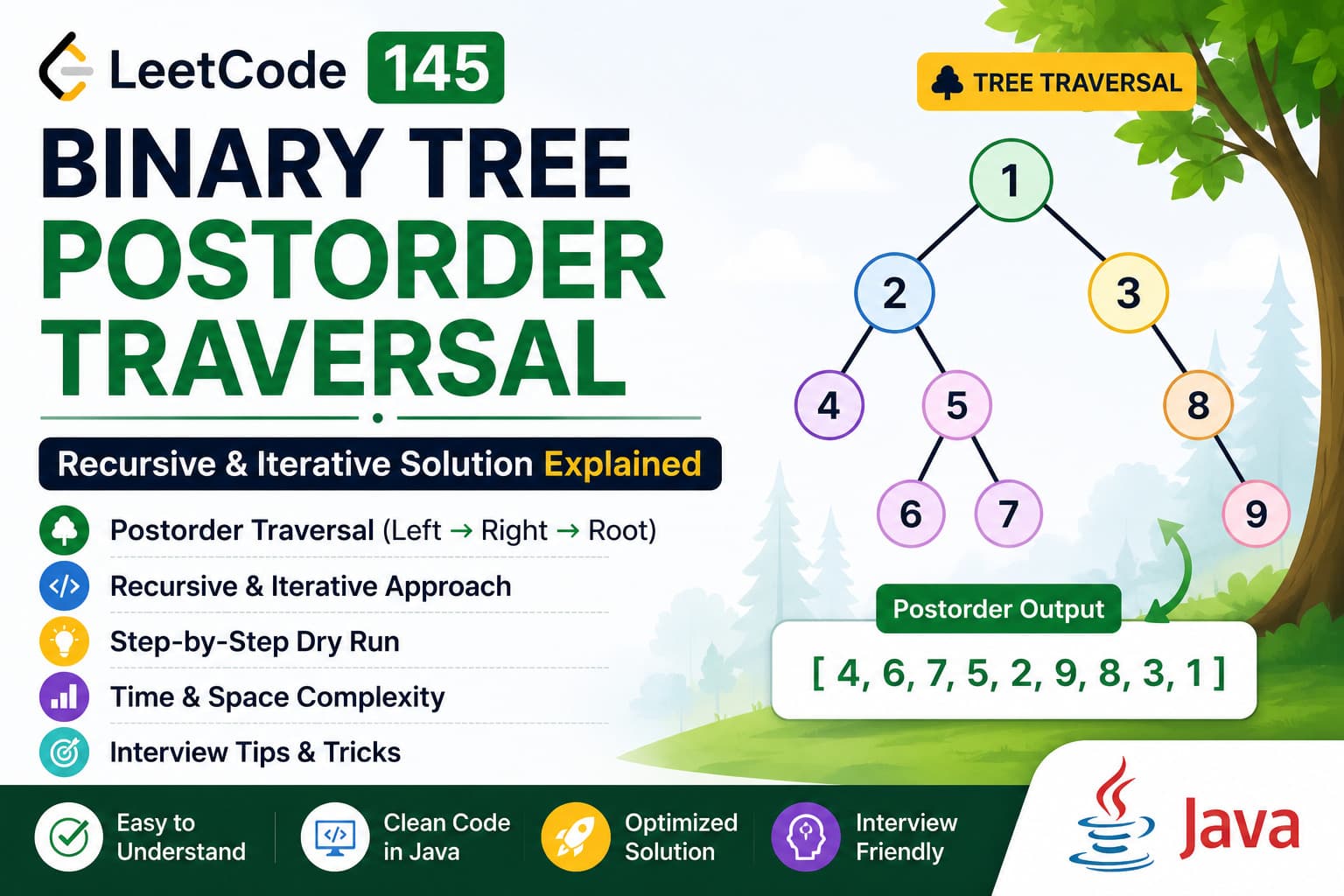
IntroductionLeetCode 145 – Binary Tree Postorder Traversal is one of the most important tree traversal problems for beginners learning Data Structures and Algorithms.This problem teaches:Binary Tree TraversalDepth First Search (DFS)RecursionStack-based traversalTree traversal patternsPostorder traversal is extremely useful in advanced tree problems such as:Tree deletionExpression tree evaluationBottom-up computationsDynamic programming on treesProblem LinkπŸ”— https://leetcode.com/problems/binary-tree-postorder-traversal/Problem StatementGiven the root of a binary tree, return the postorder traversal of its nodes' values.What is Postorder Traversal?In postorder traversal, nodes are visited in this order:Left β†’ Right β†’ RootUnlike preorder or inorder traversal, the root node is processed at the end.ExampleInputroot = [1,null,2,3]Tree Structure:1\2/3Postorder TraversalTraversal order:3 β†’ 2 β†’ 1Output:[3,2,1]Recursive Approach (Most Common)IntuitionIn postorder traversal:Traverse left subtreeTraverse right subtreeVisit current nodeThis naturally fits recursion because trees themselves are recursive structures.Recursive DFS VisualizationTraversal pattern:Left β†’ Right β†’ RootRecursive function:postorder(node.left)postorder(node.right)visit(node)Java Recursive Solution/*** Definition for a binary tree node.* public class TreeNode {* int val;* TreeNode left;* TreeNode right;* }*/class Solution {public void solve(List<Integer> list, TreeNode root) {if(root == null) return;solve(list, root.left);solve(list, root.right);list.add(root.val);}public List<Integer> postorderTraversal(TreeNode root) {List<Integer> list = new ArrayList<>();solve(list, root);return list;}}Dry Run – Recursive ApproachTree:1\2/3Step 1Start at:1Move left:nullReturn back.Step 2Move right to:2Move left to:3Left and right of 3 are null.Add:3Step 3Return to:2Add:2Step 4Return to:1Add:1Final Answer[3,2,1]Time Complexity – RecursiveTime ComplexityO(N)Every node is visited once.Space ComplexityO(H)Where:H = height of the treeRecursive call stack uses extra spaceWorst case:O(N)for skewed trees.Iterative Approach (Interview Follow-Up)The follow-up asks:Can you solve it iteratively?Yes.We use stacks to simulate recursion.Iterative Postorder IntuitionPostorder traversal order is:Left β†’ Right β†’ RootOne common trick is:Traverse in modified preorder:Root β†’ Right β†’ LeftReverse the result.After reversing, we get:Left β†’ Right β†’ Rootwhich is postorder traversal.Stack-Based Iterative LogicAlgorithmPush root into stack.Pop node.Add node value to answer.Push left child.Push right child.Reverse final answer.Java Iterative Solutionclass Solution {public List<Integer> postorderTraversal(TreeNode root) {LinkedList<Integer> ans = new LinkedList<>();if(root == null) return ans;Stack<TreeNode> stack = new Stack<>();stack.push(root);while(!stack.isEmpty()) {TreeNode node = stack.pop();ans.addFirst(node.val);if(node.left != null) {stack.push(node.left);}if(node.right != null) {stack.push(node.right);}}return ans;}}Dry Run – Iterative ApproachTree:1\2/3Step 1Push:1Step 2Pop:1Add at front:[1]Push right child:2Step 3Pop:2Add at front:[2,1]Push left child:3Step 4Pop:3Add at front:[3,2,1]Final Answer[3,2,1]Comparison of ApproachesApproachAdvantagesDisadvantagesRecursiveEasy to understandUses recursion stackIterativeBetter interview practiceSlightly harder logicInterview ExplanationIn interviews, explain:Postorder traversal processes nodes in Left β†’ Right β†’ Root order. Recursion naturally handles this traversal. Iteratively, we simulate recursion using a stack and reverse traversal order.This demonstrates strong tree traversal understanding.Common Mistakes1. Wrong Traversal OrderIncorrect:Root β†’ Left β†’ RightThat is preorder traversal.Correct postorder:Left β†’ Right β†’ Root2. Forgetting Null Base CaseAlways check:if(root == null) return;3. Incorrect Stack Push OrderFor iterative solution:Push left firstPush right secondbecause we reverse the result later.FAQsQ1. Why is postorder traversal useful?It is used in:Tree deletionExpression tree evaluationBottom-up dynamic programmingCalculating subtree informationQ2. Which approach is preferred in interviews?Recursive is simpler.Iterative is often asked as a follow-up.Q3. Can postorder traversal be done without stack or recursion?Yes.Using Morris Traversal.Q4. What is the difference between preorder, inorder, and postorder?TraversalOrderPreorderRoot β†’ Left β†’ RightInorderLeft β†’ Root β†’ RightPostorderLeft β†’ Right β†’ RootBonus: Morris Postorder TraversalMorris traversal performs tree traversal using:O(1)extra space.This is considered an advanced interview topic.ConclusionLeetCode 145 is an excellent beginner-friendly tree traversal problem.It teaches:DFS traversalRecursionStack simulationBinary tree fundamentalsThe key postorder pattern is:Left β†’ Right β†’ RootMastering this traversal helps in solving many advanced tree problems such as:Tree DPTree deletionExpression evaluationSubtree calculationsAdvanced DFS problems
LeetCodeBinary Tree Postorder TraversalBinary TreeTree TraversalJavaDFSStackRecursionEasy
LeetCode 102: Binary Tree Level Order Traversal – Java BFS Solution Explained

LeetCode 102: Binary Tree Level Order Traversal – Java BFS Solution Explained

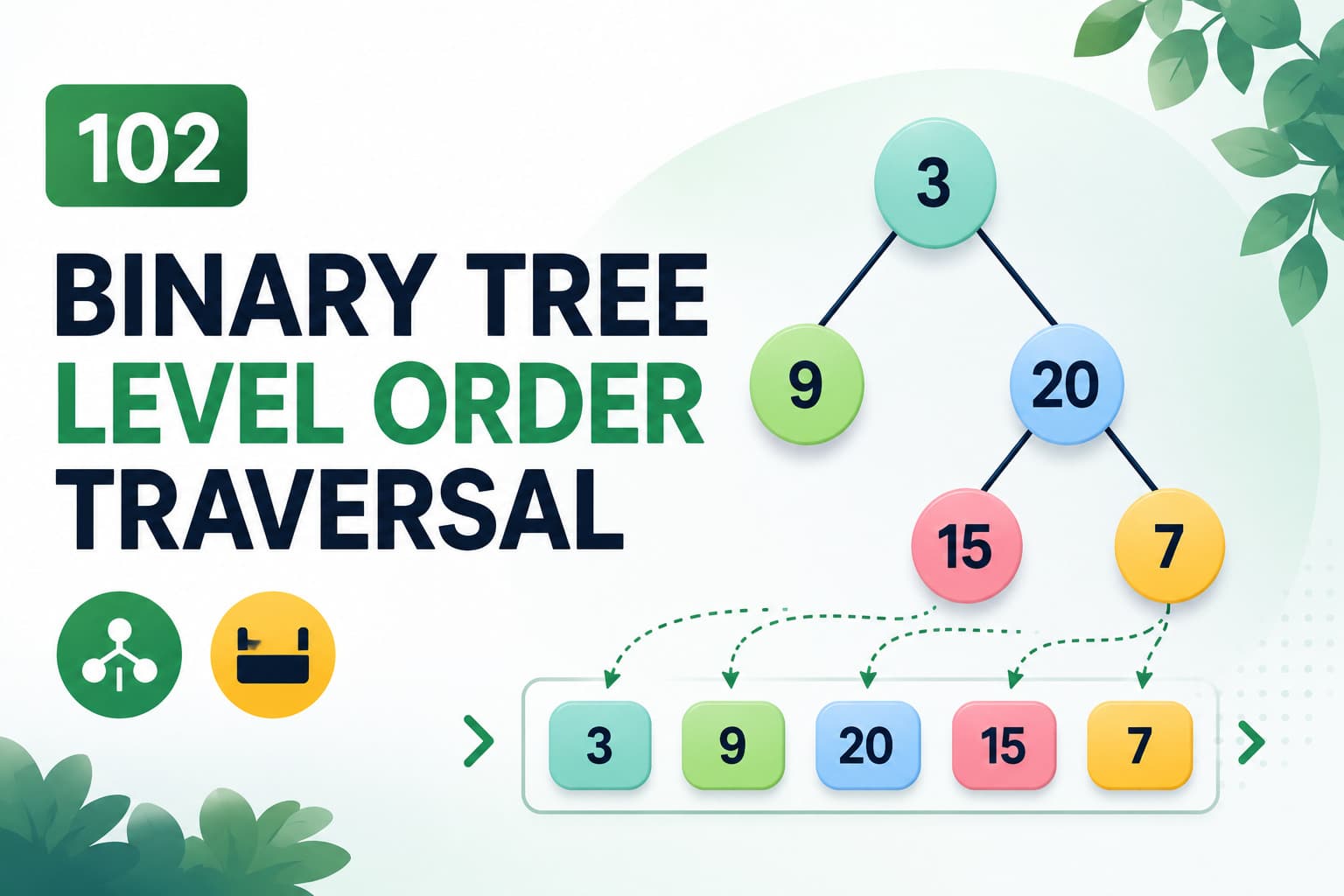
IntroductionLeetCode 102 – Binary Tree Level Order Traversal is one of the most important Binary Tree traversal problems for coding interviews.This problem introduces:Breadth First Search (BFS)Queue data structureLevel-by-level traversalTree traversal patternsInterview-level BFS thinkingUnlike DFS traversals like preorder, inorder, and postorder, this problem explores the tree level by level.This traversal is widely used in:Graph traversalShortest path problemsTree serializationZigzag traversalBFS-based interview questionsProblem LinkπŸ”— https://leetcode.com/problems/binary-tree-level-order-traversal/Problem StatementGiven the root of a binary tree, return the level order traversal of its nodes' values.Traversal should happen:Level by levelLeft to rightExampleInputroot = [3,9,20,null,null,15,7]Tree Structure: 3 / \ 9 20 / \ 15 7Level Order TraversalLevel 1:[3]Level 2:[9,20]Level 3:[15,7]Final Output:[[3],[9,20],[15,7]]Understanding the ProblemThe main challenge is:Process nodes level by level.This is exactly what:Breadth First Search (BFS)is designed for.Why Queue is Used?A queue follows:First In First Out (FIFO)This ensures:Nodes are processed in insertion orderParent nodes are processed before child nodesLevels are traversed correctlyBrute Force IntuitionOne brute force idea is:Calculate height of treeTraverse each level separatelyStore nodes level by levelBrute Force ComplexityThis approach becomes inefficient because:Each level traversal may revisit nodesComplexity may become:O(NΒ²)for skewed trees.Optimal BFS IntuitionInstead of traversing each level separately:Use a queueProcess nodes level by level naturallyAt every level:Store queue sizeProcess exactly those many nodesAdd children into queueMove to next levelKey BFS ObservationBefore processing a level:int size = queue.size();This tells us:How many nodes belong to the current level.BFS AlgorithmSteps1. Initialize QueueInsert root node.2. Process Until Queue Becomes EmptyWhile queue is not empty:Find current level sizeTraverse current levelStore valuesPush child nodes3. Store Current LevelAfter processing one level:ans.add(levelList);Java BFS Solution/** * Definition for a binary tree node. * public class TreeNode { * int val; * TreeNode left; * TreeNode right; * } */class Solution { public List<List<Integer>> levelOrder(TreeNode root) { List<List<Integer>> ans = new ArrayList<>(); Queue<TreeNode> queue = new LinkedList<>(); if(root == null) return ans; queue.offer(root); while(!queue.isEmpty()) { int size = queue.size(); List<Integer> level = new ArrayList<>(); for(int i = 0; i < size; i++) { root = queue.poll(); level.add(root.val); if(root.left != null) queue.offer(root.left); if(root.right != null) queue.offer(root.right); } ans.add(level); } return ans; }}Dry RunInputroot = [3,9,20,null,null,15,7]Tree: 3 / \ 9 20 / \ 15 7Initial Queue[3]Level 1Queue size:1Process:3Add children:9, 20Level result:[3]Queue now:[9,20]Level 2Queue size:2Process:9, 20Add children:15, 7Level result:[9,20]Queue now:[15,7]Level 3Queue size:2Process:15, 7Level result:[15,7]Queue becomes empty.Final Answer[[3],[9,20],[15,7]]Time Complexity AnalysisTime ComplexityO(N)Every node is visited exactly once.Space ComplexityO(N)Queue may store an entire level of nodes.DFS Alternative ApproachThis problem can also be solved using DFS recursion.Idea:Pass current level during recursionCreate new list when level appears first timeAdd node into correct level listJava DFS Solutionclass Solution { public void dfs(TreeNode root, int level, List<List<Integer>> ans) { if(root == null) return; if(level == ans.size()) { ans.add(new ArrayList<>()); } ans.get(level).add(root.val); dfs(root.left, level + 1, ans); dfs(root.right, level + 1, ans); } public List<List<Integer>> levelOrder(TreeNode root) { List<List<Integer>> ans = new ArrayList<>(); dfs(root, 0, ans); return ans; }}BFS vs DFS for Level Order TraversalApproachAdvantagesDisadvantagesBFSNatural level traversalUses queueDFSRecursive solutionSlightly harder intuitionInterview ExplanationIn interviews, explain:Level order traversal is a BFS problem because we process nodes level by level. A queue naturally supports this traversal order.This demonstrates strong BFS understanding.Common Mistakes1. Forgetting Queue SizeWithout storing:int size = queue.size();levels cannot be separated correctly.2. Using DFS IncorrectlySimple DFS alone does not guarantee level ordering.3. Forgetting Null CheckAlways handle:if(root == null)FAQsQ1. Why is BFS preferred here?Because BFS naturally processes nodes level by level.Q2. Can this problem be solved recursively?Yes.Using DFS with level tracking.Q3. What data structure is mainly used?Queue.Q4. Is Level Order Traversal important?Yes.It is one of the most frequently asked BFS tree problems.Related ProblemsAfter mastering this problem, practice:Binary Tree Zigzag Level Order TraversalAverage of Levels in Binary TreeRight Side View of Binary TreeBinary Tree Vertical Order TraversalMaximum Depth of Binary TreeConclusionLeetCode 102 is one of the most important BFS tree traversal problems.It teaches:BFS traversalQueue usageLevel-by-level processingTree traversal fundamentalsThe key idea is:Use queue size to separate levels.Once this intuition becomes clear, many BFS-based tree interview problems become much easier.

LeetCodeBinary Tree Level Order TraversalBFSQueueBinary TreeJavaTree TraversalMedium
LeetCode 144: Binary Tree Preorder Traversal – Java Recursive & Iterative Solution Explained

LeetCode 144: Binary Tree Preorder Traversal – Java Recursive & Iterative Solution Explained

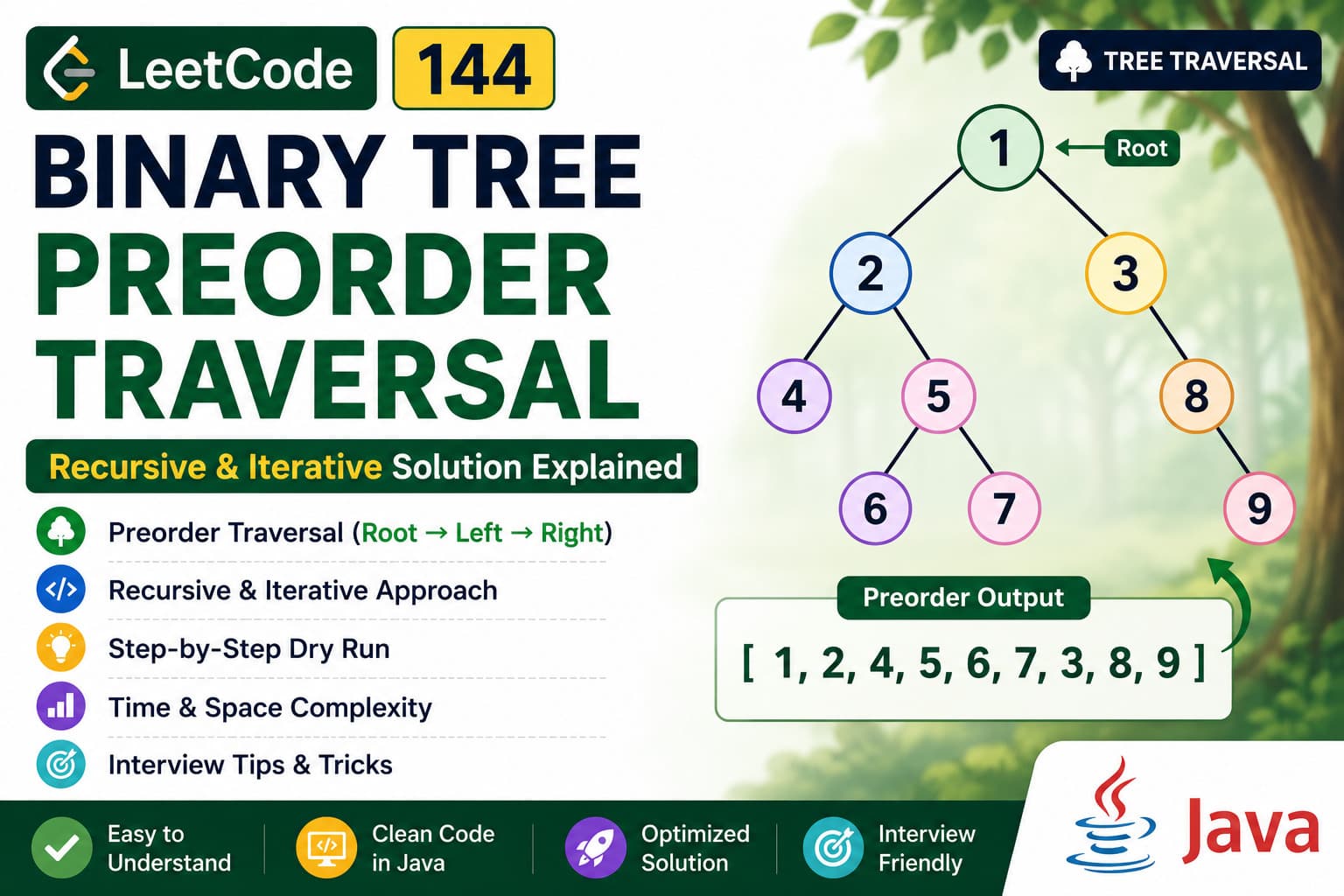
IntroductionLeetCode 144 – Binary Tree Preorder Traversal is one of the most important beginner-friendly tree traversal problems in Data Structures and Algorithms.This problem helps you understand:Binary Tree TraversalDepth First Search (DFS)RecursionStack-based traversalTree traversal patternsPreorder traversal is widely used in:Tree copyingSerializationExpression treesDFS-based problemsHierarchical data processingIt is also one of the most commonly asked tree problems in coding interviews.Problem LinkπŸ”— ProblemLeetCode 144: Binary Tree Preorder TraversalOfficial Problem:LeetCode Problem LinkProblem StatementGiven the root of a binary tree, return the preorder traversal of its nodes' values.What is Preorder Traversal?In preorder traversal, nodes are visited in this order:Root β†’ Left β†’ RightThe root node is processed first before traversing subtrees.ExampleInputroot = [1,null,2,3]Tree Structure:1\2/3Preorder TraversalTraversal order:1 β†’ 2 β†’ 3Output:[1,2,3]Recursive Approach (Most Common)IntuitionIn preorder traversal:Visit current nodeTraverse left subtreeTraverse right subtreeThis naturally fits recursion because trees themselves are recursive structures.Recursive DFS VisualizationTraversal pattern:Root β†’ Left β†’ RightRecursive function:visit(node)preorder(node.left)preorder(node.right)Java Recursive Solution/*** Definition for a binary tree node.* public class TreeNode {* int val;* TreeNode left;* TreeNode right;* }*/class Solution {public void solve(List<Integer> list, TreeNode root) {if(root == null) return;list.add(root.val);solve(list, root.left);solve(list, root.right);}public List<Integer> preorderTraversal(TreeNode root) {List<Integer> list = new ArrayList<>();solve(list, root);return list;}}Dry Run – Recursive ApproachTree:1\2/3Step 1Start at:1Add:1Move right to:2Step 2Add:2Move left to:3Step 3Add:3Final Answer[1,2,3]Time Complexity – RecursiveTime ComplexityO(N)Every node is visited once.Space ComplexityO(H)Where:H = height of treeRecursive call stack uses extra spaceWorst case:O(N)for skewed trees.Iterative Approach (Interview Follow-Up)The follow-up asks:Can you solve it iteratively?Yes.We use a stack to simulate recursion.Iterative Preorder IntuitionPreorder traversal order is:Root β†’ Left β†’ RightUsing a stack:Process current node immediatelyPush right child firstPush left child secondWhy?Because stacks follow:Last In First Out (LIFO)So left subtree gets processed first.Stack-Based Iterative LogicAlgorithmPush root into stack.Pop node.Add node value.Push right child.Push left child.Repeat until stack becomes empty.Java Iterative Solutionclass Solution {public List<Integer> preorderTraversal(TreeNode root) {List<Integer> ans = new ArrayList<>();if(root == null) return ans;Stack<TreeNode> stack = new Stack<>();stack.push(root);while(!stack.isEmpty()) {TreeNode node = stack.pop();ans.add(node.val);if(node.right != null) {stack.push(node.right);}if(node.left != null) {stack.push(node.left);}}return ans;}}Dry Run – Iterative ApproachTree:1\2/3Step 1Push:1Step 2Pop:1Add:[1]Push right child:2Step 3Pop:2Add:[1,2]Push left child:3Step 4Pop:3Add:[1,2,3]Final Answer[1,2,3]Comparison of ApproachesApproachAdvantagesDisadvantagesRecursiveEasy to understandUses recursion stackIterativeBetter interview practiceSlightly harder logicInterview ExplanationIn interviews, explain:Preorder traversal processes nodes in Root β†’ Left β†’ Right order. Recursion naturally handles this traversal. Iteratively, we use a stack and push the right child before the left child so the left subtree gets processed first.This demonstrates strong DFS and stack understanding.Common Mistakes1. Wrong Traversal OrderIncorrect:Left β†’ Root β†’ RightThat is inorder traversal.Correct preorder:Root β†’ Left β†’ Right2. Forgetting Null Base CaseAlways check:if(root == null) return;3. Wrong Stack Push OrderFor iterative traversal:Push right firstPush left secondOtherwise traversal order becomes incorrect.FAQsQ1. Why is preorder traversal useful?It is heavily used in:Tree cloningSerializationDFS traversalExpression treesQ2. Which approach is preferred in interviews?Recursive is simpler.Iterative is often asked as a follow-up.Q3. Can preorder traversal be done without stack or recursion?Yes.Using Morris Traversal.Q4. What is the difference between preorder, inorder, and postorder?TraversalOrderPreorderRoot β†’ Left β†’ RightInorderLeft β†’ Root β†’ RightPostorderLeft β†’ Right β†’ RootBonus: Morris Preorder TraversalMorris traversal performs preorder traversal using:O(1)extra space.This is considered an advanced interview topic.ConclusionLeetCode 144 is one of the most fundamental binary tree traversal problems.It teaches:DFS traversalRecursionStack simulationBinary tree fundamentalsThe key preorder pattern is:Root β†’ Left β†’ RightMastering this traversal builds a strong foundation for advanced tree problems such as:Tree serializationDFS-based problemsTree reconstructionExpression treesMorris traversal

LeetCodeBinary Tree Preorder TraversalBinary TreeTree TraversalJavaDFSStackRecursionEasy
Ai Assistant Kas