🚀 Try the Problem
Practice here:
https://leetcode.com/problems/reverse-linked-list/
🤔 Let’s Start With a Simple Question…
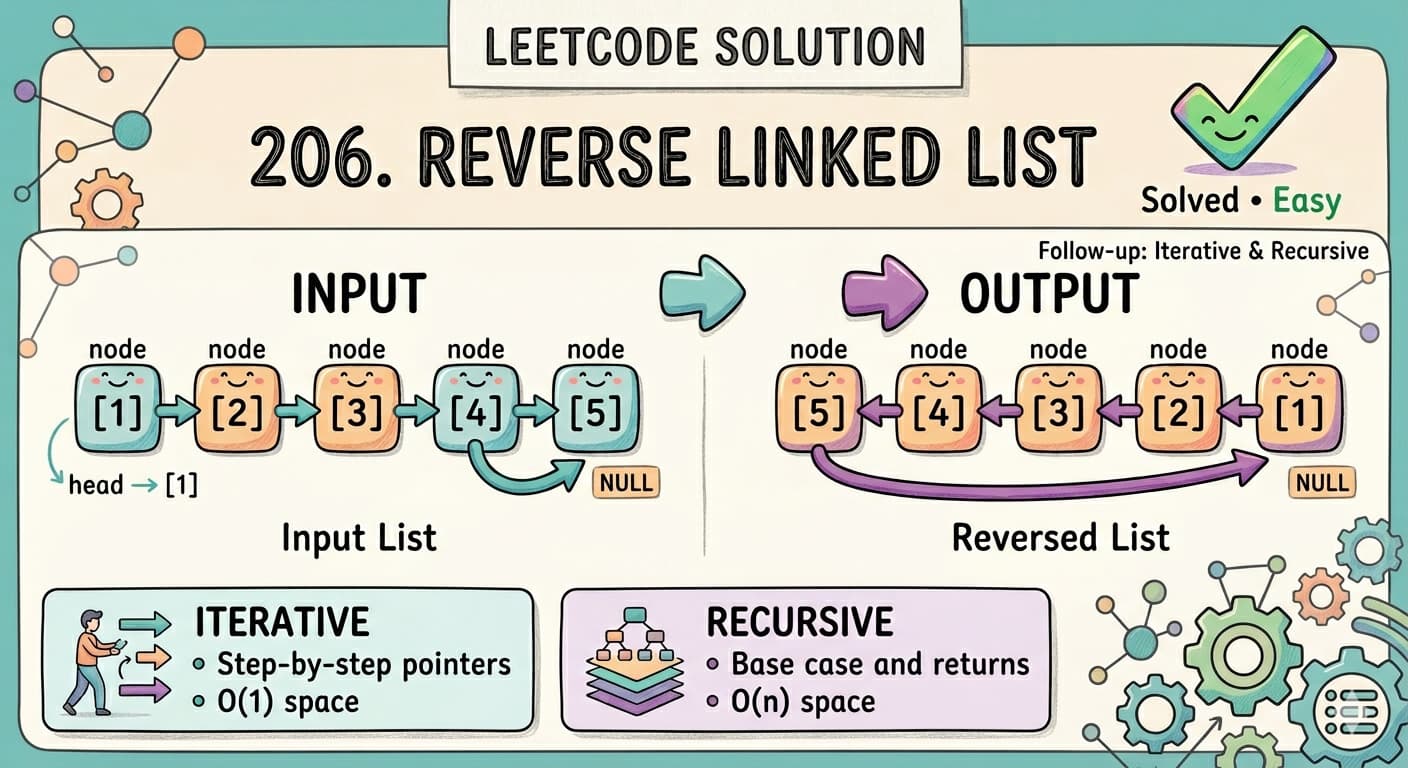
What happens if you take this:
…and try to reverse it?
You want:
Sounds easy, right?
But here’s the catch:
👉 You can only move forward in a linked list
👉 There is no backward pointer
So how do we reverse something that only goes one way?
🧠 The Core Problem (In Simple Words)
You are given the head of a linked list.
👉 Reverse the list
👉 Return the new head
📦 Constraints
🔍 Before Jumping to Code — Think Like This
When solving this, your brain might go:
- Can I store values somewhere and reverse? ❌ (extra space)
- Can I rebuild the list? ❌ (unnecessary)
- Can I just change links? ✅ (YES, THIS IS THE KEY)
⚡ The Breakthrough Idea
👉 Instead of moving nodes
👉 We reverse the direction of pointers
🎯 Visual Intuition (Very Important)
Let’s take:
We want:
But how?
🧩 The 3-Pointer Magic Trick
We use 3 pointers:
🔄 Step-by-Step Transformation
Initial State:
Step 1:
- Save next node
- Reverse link
Move pointers:
Step 2:
Move:
Continue…
Eventually:
💡 Final Insight
👉 Each step reverses one link
👉 At the end, prev becomes the new head
✅ Clean Java Code (Iterative Approach)
⏱️ Complexity
Time Complexity
We traverse the list once.
Space Complexity
No extra space used.
🔁 Another Way: Recursive Approach
Now let’s think differently…
👉 What if we reverse the rest of the list first, then fix the current node?
🧠 Recursive Idea
For:
We:
- Reverse from
2 → 3 → 4 - Then fix
1
💻 Recursive Code
⚖️ Iterative vs Recursive
| Approach | Pros | Cons |
| Iterative | Fast, O(1) space | Slightly tricky to understand |
| Recursive | Elegant, clean logic | Uses stack (O(n) space) |
❌ Common Mistakes
- Forgetting to store next node
- Losing reference to rest of list
- Not updating pointers correctly
- Returning wrong node
🔥 Real Interview Insight
This problem is not just about reversing a list.
It teaches:
👉 Pointer manipulation
👉 In-place updates
👉 Thinking in steps
👉 Breaking problems into small operations
🧠 Final Thought
At first, this problem feels tricky…
But once you understand this line:
👉 Everything clicks.
🚀 Conclusion
The Reverse Linked List problem is one of the most important foundational problems in DSA.
Mastering it will:
- Boost your confidence
- Strengthen pointer logic
- Help in many advanced problems
👉 Tip: Practice this until you can visualize pointer movement in your head — that’s when you truly master linked lists.