Introduction
Binary Search is one of the most fundamental and powerful algorithms in computer science. If you're preparing for coding interviews, mastering Binary Search is absolutely essential.
In this blog, we’ll break down LeetCode 704 – Binary Search, explain the algorithm in detail, walk through your Java implementation, analyze complexity, and recommend additional problems to strengthen your understanding.
You can try this problem -: Problem Link
📌 Problem Overview
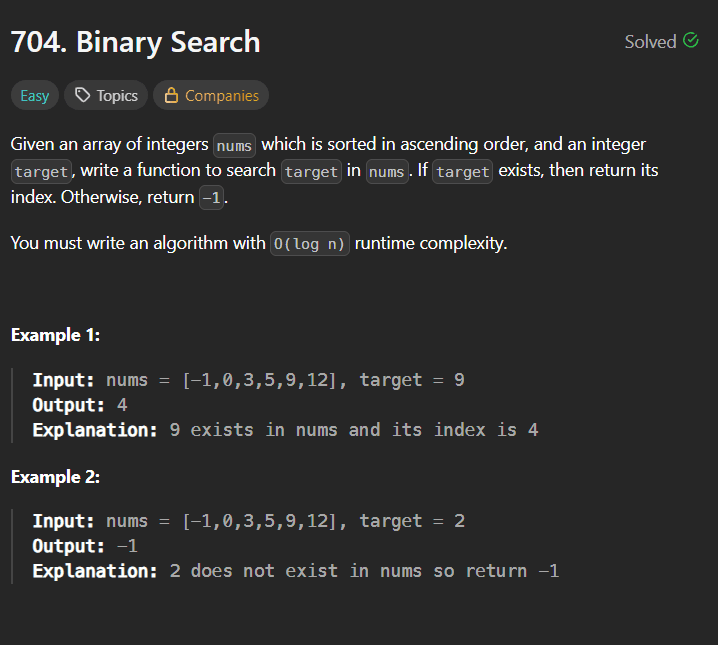
You are given:
- A sorted array of integers
nums(ascending order) - An integer
target
Your task is to return the index of target if it exists in the array. Otherwise, return -1.
Example 1
Example 2
Constraints
- 1 <= nums.length <= 10⁴
- All integers are unique
- The array is sorted in ascending order
- Required Time Complexity: O(log n)
🚀 Understanding the Binary Search Algorithm
Binary Search works only on sorted arrays.
Instead of checking each element one by one (like Linear Search), Binary Search:
- Finds the middle element.
- Compares it with the target.
- Eliminates half of the search space.
- Repeats until the element is found or the search space is empty.
Why is it Efficient?
Every iteration cuts the search space in half.
If the array size is n, the number of operations becomes:
This makes it extremely efficient compared to linear search (O(n)).
🧠 Step-by-Step Algorithm
- Initialize two pointers:
low = 0high = nums.length - 1- While
low <= high: - Calculate middle index:
- If
nums[mid] == target, returnmid - If
target > nums[mid], search right half →low = mid + 1 - Else search left half →
high = mid - 1 - If loop ends, return
-1
💻 Your Java Code Explained
Here is your implementation:
🔍 Code Breakdown
1️⃣ Initialize Boundaries
You define the search space from index 0 to n-1.
2️⃣ Loop Condition
The loop continues as long as there is a valid search range.
3️⃣ Safe Mid Calculation
This is preferred over:
Why?
Because (low + high) may cause integer overflow in large arrays.
Your approach prevents that.
4️⃣ Comparison Logic
If found → return index.
Search in right half.
Search in left half.
5️⃣ Not Found Case
If the loop finishes without finding the target.
⏱ Time and Space Complexity
Time Complexity: O(log n)
Each iteration halves the search space.
Space Complexity: O(1)
No extra space used — purely iterative.
🔥 Why This Problem Is Important
LeetCode 704 is:
- The foundation of all Binary Search problems
- A template question
- Frequently asked in interviews
- Required to understand advanced problems like:
- Search in Rotated Sorted Array
- Find First and Last Position
- Peak Element
- Binary Search on Answer
📚 Recommended Binary Search Practice Problems
After solving this, practice these in order:
🟢 Easy
- 35. Search Insert Position
- 69. Sqrt(x)
- 278. First Bad Version
🟡 Medium
- 34. Find First and Last Position of Element in Sorted Array
- 33. Search in Rotated Sorted Array
- 74. Search a 2D Matrix
- 875. Koko Eating Bananas (Binary Search on Answer)
🔴 Advanced Pattern Practice
- 1011. Capacity To Ship Packages Within D Days
- 410. Split Array Largest Sum
These will help you master:
- Lower bound / upper bound
- Binary search on monotonic functions
- Searching in rotated arrays
- Searching in 2D matrices
- Binary search on answer pattern
🎯 Final Thoughts
Binary Search is not just a single algorithm — it’s a pattern.
If you truly understand:
- How the search space shrinks
- When to move left vs right
- How to calculate mid safely
- Loop conditions (
low <= highvslow < high)
You can solve 50+ interview problems easily.
LeetCode 704 is the perfect starting point.
Master this template, and you unlock an entire category of problems.