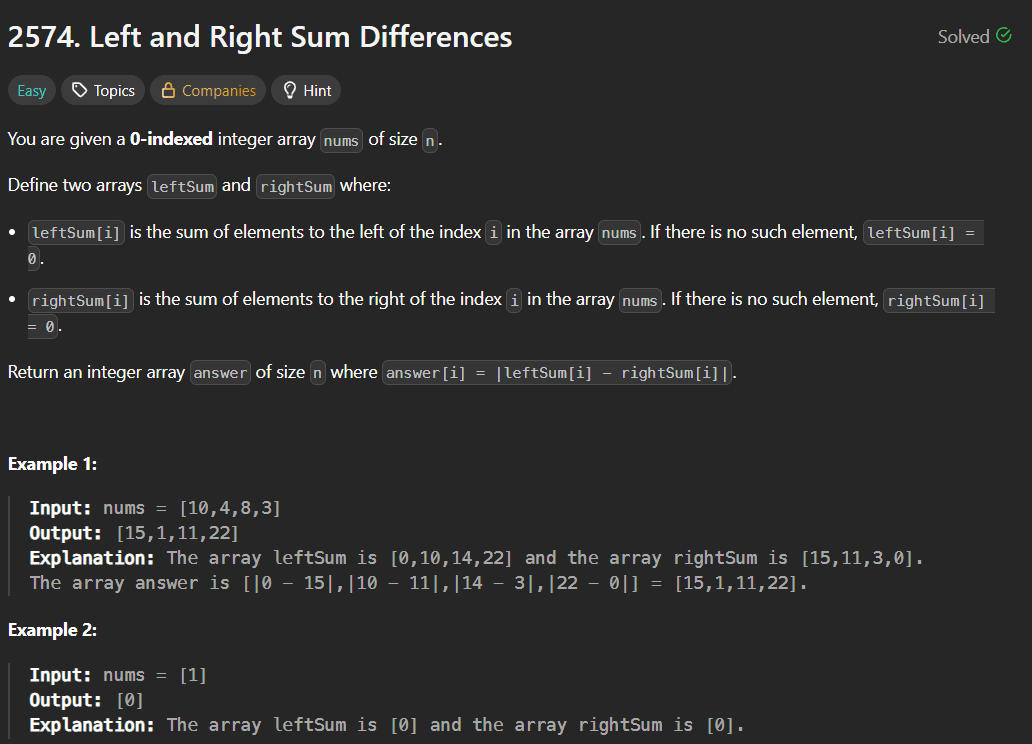
LeetCode 2574: Left and Right Sum Differences (Java)
The Left and Right Sum Difference problem is a classic array manipulation challenge. It tests your ability to efficiently calculate prefix and suffix values—a skill essential for more advanced algorithms like "Product of Array Except Self."
🔗 Resources
- Problem Link: LeetCode 2574 - Left and Right Sum Differences
📝 Problem Statement
You are given a 0-indexed integer array nums. You need to return an array answer of the same length where:
answer[i] = |leftSum[i] - rightSum[i]|leftSum[i]is the sum of elements to the left of indexi.rightSum[i]is the sum of elements to the right of indexi.
💡 Approach 1: The Three-Array Method (Beginner Friendly)
This approach is highly intuitive. We pre-calculate all left sums and all right sums in separate arrays before computing the final difference.
The Logic
- Prefix Array: Fill
pref[]by adding the previous element to the cumulative sum. - Suffix Array: Fill
suff[]by iterating backward from the end of the array. - Result: Loop one last time to calculate
Math.abs(pref[i] - suff[i]).
Java Implementation
- Time Complexity: O(n)
- Space Complexity: O(n) (Uses extra space for
prefandsuffarrays).
🚀 Approach 2: The Running Sum Method (Space Optimized)
In technical interviews, you should aim for O(1) extra space. Instead of storing every suffix sum, we calculate the Total Sum first and derive the right sum using logic.
The Logic
We use the mathematical property:
Right Sum = Total Sum - Left Sum - Current Element
By maintaining a single variable leftSum that updates as we iterate, we can calculate the result using only the output array.
Java Implementation
- Time Complexity: O(n)
- Space Complexity: O(1) (Excluding the output array).
📊 Summary Comparison
| Feature | Approach 1 | Approach 2 |
| Space Complexity | O(n) (Higher) | O(1) (Optimal) |
| Logic Type | Storage-based | Mathematical |
| Use Case | Beginners | Interviews |
Key Takeaway
While Approach 1 is easier to visualize, Approach 2 is more professional. It shows you can handle data efficiently without unnecessary memory allocation, which is critical when dealing with large-scale systems.