Introduction
Publishing your first npm package is not about building something revolutionary.
If you think it is, you’ll either overbuild it or never ship it.
Karos exists because I kept running into the same boring, frustrating problem across backend projects — inconsistent API responses and messy error handling.
The Problem I Kept Seeing
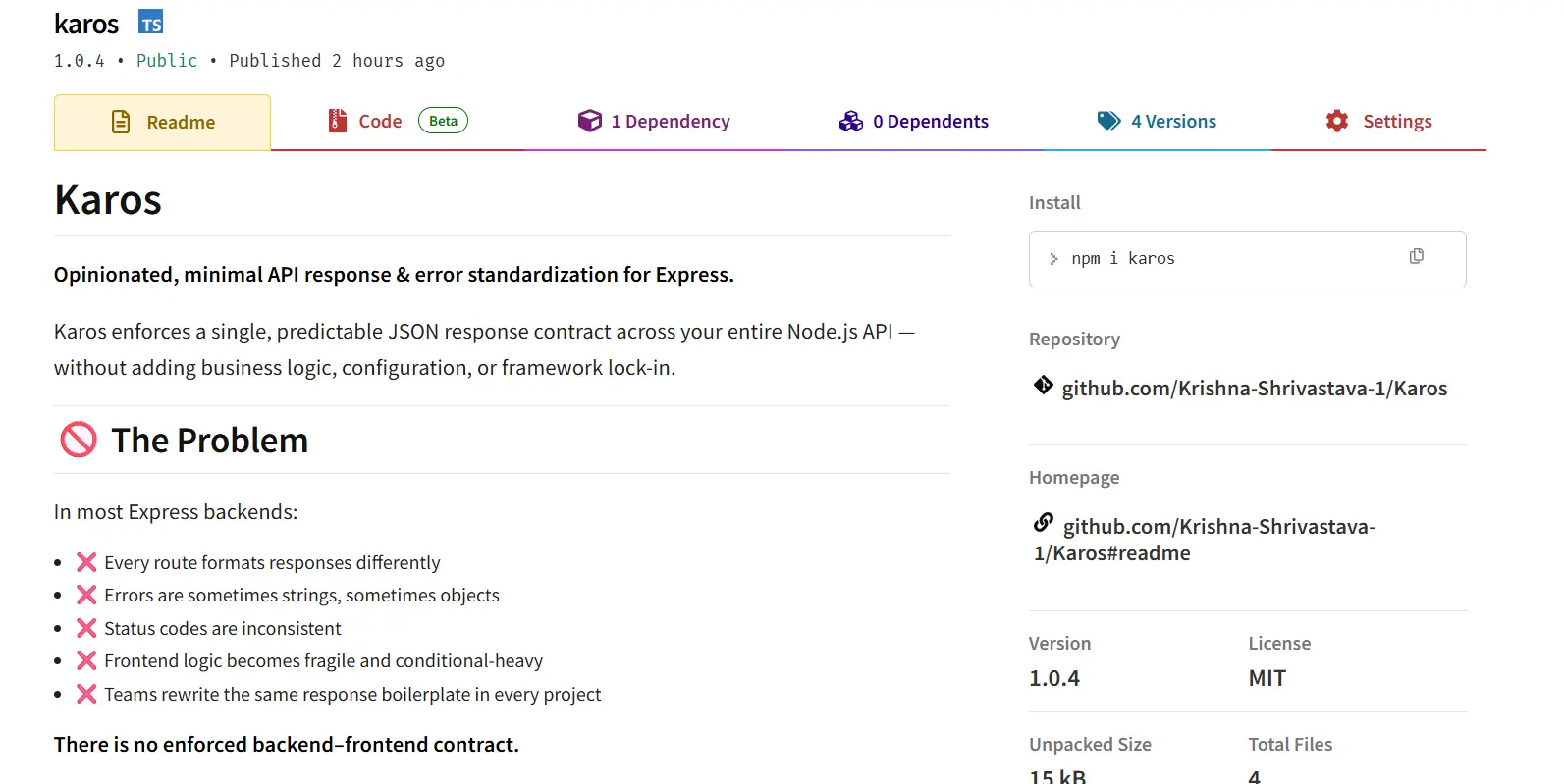
In most Express or Node.js backends:
- Every route formats responses differently
- Some errors are strings, some are objects, some leak stack traces
- Status codes are inconsistent or guessed
- Frontend logic becomes defensive and conditional-heavy
- Teams rewrite the same response boilerplate in every project
There is no enforced backend–frontend contract.
Just “best practices” that slowly decay over time.
Why I Didn’t Use Existing Solutions
There are libraries that help with errors.
There are frameworks that encourage conventions.
But most of them:
- Add heavy abstractions
- Require configuration files
- Lock you into a framework style
- Mix business logic with infrastructure
I didn’t want help.
I wanted enforcement — and nothing more.
What Karos Does (And Only This)
Karos enforces one predictable JSON response contract across your API.
That’s it.
Success Response
Error Response
No special cases.
No custom shapes per route.
If a response doesn’t match this structure, it’s wrong.
Stop Returning Errors. Start Throwing Them.
Instead of this pattern everywhere:
Karos forces a different mindset:
The error is thrown, not returned.
A single global handler catches it, formats it, and sends the response.
- No repeated
try/catch - No duplicated error formatting
- No forgotten status codes
KarosError: One Error Model to Rule Them All
At the core of Karos is a single class: KarosError.
Every error has:
- A strict error code (TypeScript-safe)
- An explicit HTTP status
- Optional structured details
- A guaranteed JSON shape
This makes backend behavior predictable and frontend handling trivial.
Database Errors Are Normalized Automatically
Raw database errors should never reach the client.
Karos automatically detects and normalizes common DB errors:
- Prisma unique constraint →
CONFLICT (409) - Prisma record not found →
NOT_FOUND (404) - MongoDB duplicate key →
CONFLICT (409) - Mongoose validation errors →
VALIDATION_FAILED (400)
The frontend never needs to know which database you’re using.
It only cares about the contract.
Express and Next.js Share the Same Contract
Karos supports:
- Express via middleware
- Next.js (App Router) via Web-standard helpers
Both produce the exact same response format.
That means you can switch frameworks or mix them — and your frontend logic stays unchanged.
Karos API – All Methods in One Place
Core API Reference
| Category | Function / Class | Description |
| Success | ok(res, data, message?, meta?) | Sends a standardized success response (Express) |
| Error Base | KarosError | Base error class with code, status, details |
| Error Helpers | notFoundError() | Throws 404 NOT_FOUND |
validationError() | Throws 400 VALIDATION_FAILED | |
unauthorizedError() | Throws 401 UNAUTHORIZED | |
forbiddenError() | Throws 403 FORBIDDEN | |
conflictError() | Throws 409 CONFLICT | |
internalError() | Throws 500 INTERNAL_ERROR | |
httpError() | Custom error with any status | |
| Middleware | errorHandler | Global Express error handler |
| DB Handling | resolveDbError() | Normalizes Prisma/Mongo errors |
| Next.js | nextOk() | Success response for App Router |
nextFail() | Error response for App Router | |
handleNextError() | Global Next.js error handler | |
| Types | ErrorCode | Enum-style error codes |
| Types | ApiSuccessResponse | Success response type |
| Types | ApiErrorResponse | Error response type |
What Karos Is Not
This matters more than features.
Karos is not:
- A validation library
- A logging framework
- A request lifecycle manager
- A replacement for good architecture
- A silver bullet
It solves one problem and refuses to grow beyond that.
How You Can Publish Your First npm Package Too
If you’re thinking “this looks doable” — it is.
Here are the actual steps, no fluff.
1. Create an npm Account
- Go to https://www.npmjs.com
- Sign up and verify your email
2. Prepare Your Package
Make sure:
nameis uniquemainpoints to your build outputtypespoints to.d.tsif using TypeScript
3. Build Your Package
(Usually outputs to dist/)
4. Login to npm
Enter:
- Username
- Password
- OTP (if 2FA enabled)
5. Publish
That’s it.
No approval process. No gatekeepers.
You are officially an npm package author.
Links
- GitHub Repository: https://github.com/Krishna-Shrivastava-1/Karos
- npm Package: https://www.npmjs.com/package/karos
Why Shipping This Mattered to Me
Karos won’t make headlines.
It won’t go viral.
But it forced me to:
- Design a real API contract
- Think about DX instead of just code
- Handle edge cases like DB errors properly
- Ship something other people can actually use
For a first npm package, that’s a win.
Final Thought
Most backend bugs don’t come from complex logic.
They come from inconsistency.
Karos doesn’t make your API smarter.
It makes it disciplined.