Search Blogs

Showing results for "kadane algorithm"

Found 2 results

Maximum Absolute Sum of Any Subarray

Maximum Absolute Sum of Any Subarray

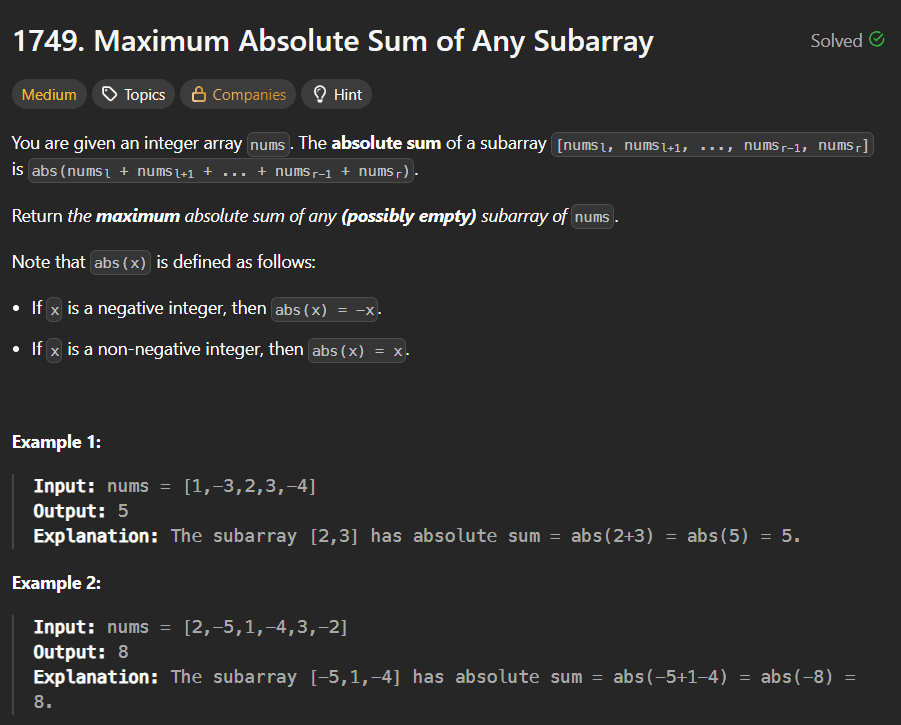
LeetCode Problem 1749Link of the Problem to try -: LinkYou are given an integer array nums. The absolute sum of a subarray [numsl, numsl+1, ..., numsr-1, numsr] is abs(numsl + numsl+1 + ... + numsr-1 + numsr).Return the maximum absolute sum of any (possibly empty) subarray of nums.Note that abs(x) is defined as follows:If x is a negative integer, then abs(x) = -x.If x is a non-negative integer, then abs(x) = x.Example 1:Input: nums = [1,-3,2,3,-4]Output: 5Explanation: The subarray [2,3] has absolute sum = abs(2+3) = abs(5) = 5.Example 2:Input: nums = [2,-5,1,-4,3,-2]Output: 8Explanation: The subarray [-5,1,-4] has absolute sum = abs(-5+1-4) = abs(-8) = 8.Constraints:1 <= nums.length <= 105-104 <= nums[i] <= 104My ThinkingSo, in this question what exactly we have to do what actual logic behind it to solve this question is that like you need to first find out the maximum sum of sub array via kadane's algorithm also find the minimum sum of subarray and then compare both numbers ignore the negative signs of it and then return the maximum number that is what the question want and we have to solve in it.Kadane's AlgorithmThis algorithm is highly efficient, solving the problem in a single pass with a time complexity of O(n), not O(1) constant time, as the algorithm must iterate through all n elements of the input array.The core principle is based on the idea that any negative prefix sum acts as a 'debt' that subsequent positive numbers must overcome. The strategy is to always pursue the maximum sum. If the running sum becomes negative at any point, it is reset to zero, effectively 'discarding' the previous negative sequence, and the search for a new maximum sum begins with the next element.Here is a video for more better understandingSolution:Here is the solution for this quesiton in java by Kadane's Algorithmpublic int maxAbsoluteSum(int[] nums) {int max = Integer.MIN_VALUE;int min = Integer.MAX_VALUE;int maxSum=0;int minSum=0;for(int i =0 ; i< nums.length;i++){maxSum = Math.max(maxSum+nums[i],nums[i]);max = Math.max(max,maxSum);minSum = Math.min(minSum+nums[i],nums[i]);min = Math.min(min,minSum);}return Math.max(max,Math.abs(min));}
leetcodemediumkadane algorithm
Maximum Subarray

Maximum Subarray

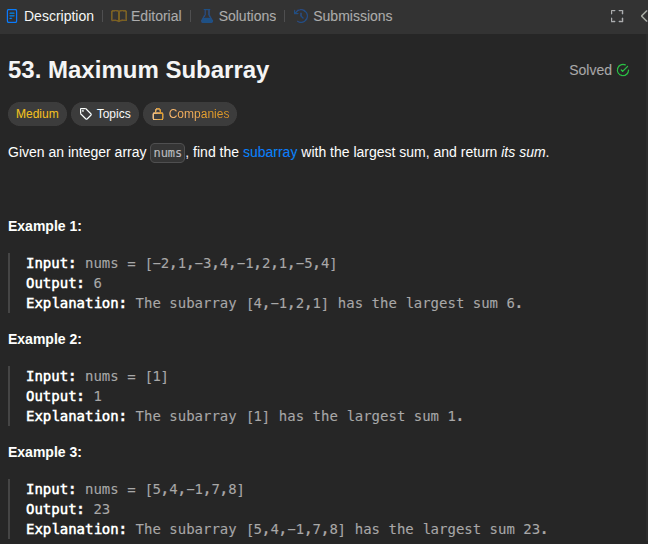
LeetCode Problem 53Link of the Problem to try -: LinkGiven an integer array nums, find the subarray with the largest sum, and return its sum.Example 1:Input: nums = [-2,1,-3,4,-1,2,1,-5,4]Output: 6Explanation: The subarray [4,-1,2,1] has the largest sum 6.Example 2:Input: nums = [1]Output: 1Explanation: The subarray [1] has the largest sum 1.Example 3:Input: nums = [5,4,-1,7,8]Output: 23Explanation: The subarray [5,4,-1,7,8] has the largest sum 23.Constraints:1 <= nums.length <= 105-104 <= nums[i] <= 104Follow up: If you have figured out the O(n) solution, try coding another solution using the divide and conquer approach, which is more subtle.My Approach -: I successfully addressed this problem by implementing nested loops to generate the required subarrays. My approach effectively handles the subarray creation logic as specified. Please find the implementation code below.int ans=0;for(int i=0;i<nums.length;i++){int sum =0;for(int j =i;j<nums.length;j++){sum += nums[j];ans = Math.max(sum,ans);}}return ans;Although this solution passed local tests, it encountered a 'Time Limit Exceeded' (TLE) error on LeetCode due to the constraints of the problem. While the nested loop approach is logically sound, further optimization is required to improve its time complexity for larger test cases.Optimized Algorithm (Kadane's Algorithm)This algorithm is highly efficient, solving the problem in a single pass with a time complexity of O(n), not O(1) constant time, as the algorithm must iterate through all n elements of the input array.The core principle is based on the idea that any negative prefix sum acts as a 'debt' that subsequent positive numbers must overcome. The strategy is to always pursue the maximum sum. If the running sum becomes negative at any point, it is reset to zero, effectively 'discarding' the previous negative sequence, and the search for a new maximum sum begins with the next element.Here is a video for more better understandingMy Understanding Steps to solve this QuestionTo solve this problem efficiently in (O(n)) time, I implemented the following steps:Initialization: Define two integer variables: currentSum (initialized to 0) and maxSum (initialized to Integer.MIN_VALUE). currentSum tracks the running total, while maxSum stores the overall maximum subarray sum found so far.Iteration: Traverse the array using a single for loop.Update Running Sum: At each element, add its value to currentSum.Update Maximum: Compare currentSum with maxSum. If currentSum is greater, update maxSum with this new value.Reset Negative Sums: If currentSum drops below zero, reset it to 0. This effectively "discards" a negative prefix that would otherwise reduce the sum of subsequent subarrays.Return Result: After the loop completes, return maxSum as the final result.Here is the Code:int sum = 0;int max = Integer.MIN_VALUE;for(int i=0;i <nums.length;i++){sum +=nums[i];max =Math.max(sum,max);if(sum < 0){sum =0;}}return max;(Note this same solution can also write in another way as well)Here is another way to write this same solution:int sum = 0;int max = Integer.MIN_VALUE;for(int i=0;i <nums.length;i++){// sum +=nums[i];sum = Math.max(sum+nums[i],nums[i]); // Here we are ensuring that sum will alwaays be grestest in all time so that it will not be negative or smaller ass previously we directly putting value in it.max =Math.max(sum,max);// if(sum < 0){ We don't need this as we already ensure that sum will never be negative and always a positive number// sum =0;// }}return max;

LeetCodeArrayMedium
Ai Assistant Kas