Search Blogs

Showing results for "String Manipulation"

Found 14 results

LeetCode 1980: Find Unique Binary String – Multiple Ways to Generate a Missing Binary Combination

LeetCode 1980: Find Unique Binary String – Multiple Ways to Generate a Missing Binary Combination

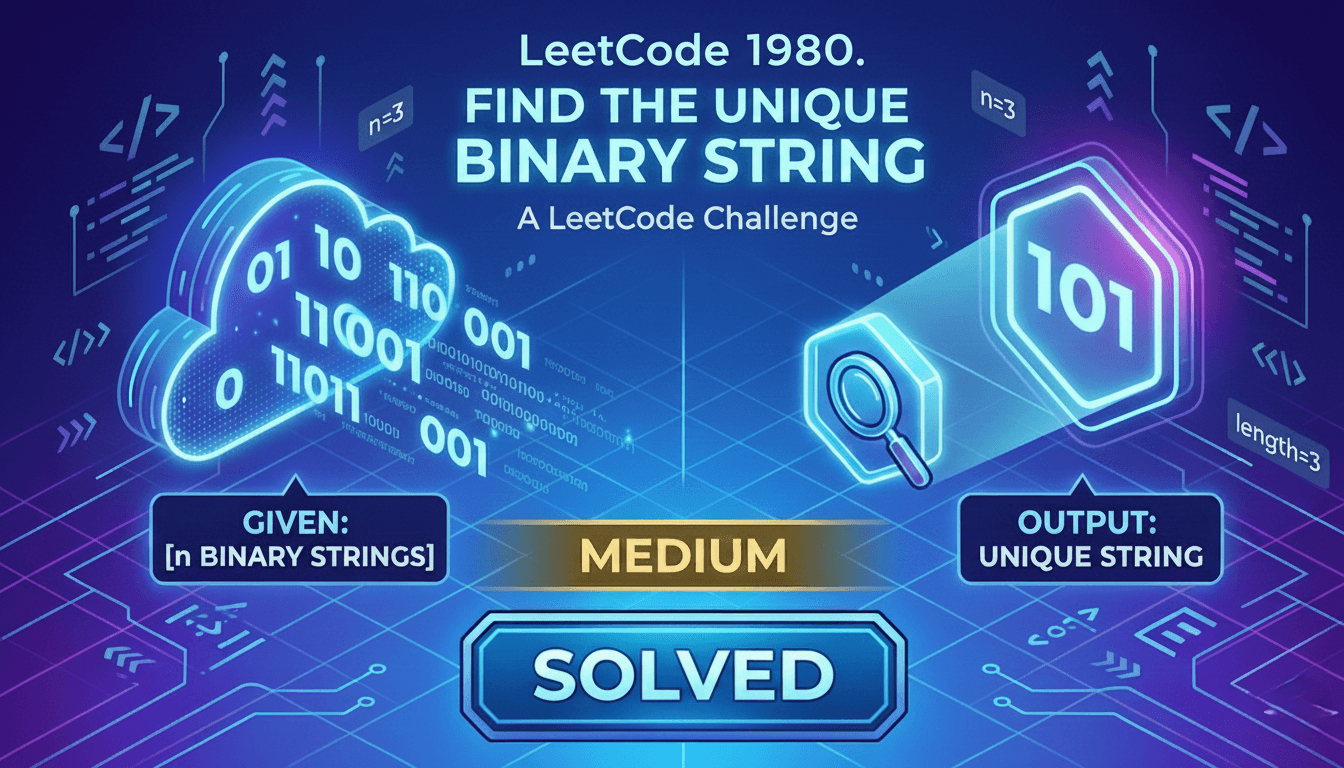
Try the ProblemYou can solve the problem here:https://leetcode.com/problems/find-unique-binary-string/Problem DescriptionYou are given an array nums containing n unique binary strings, where each string has length n.Your task is to return any binary string of length n that does not appear in the array.Important ConditionsEach string consists only of '0' and '1'.Every string in the array is unique.The output must be a binary string of length n.If multiple valid answers exist, any one of them is acceptable.ExamplesExample 1Inputnums = ["01","10"]Output"11"ExplanationPossible binary strings of length 2:00011011Since "01" and "10" are already present, valid answers could be:00 or 11Example 2Inputnums = ["00","01"]Output"11"Another valid output could be:10Example 3Inputnums = ["111","011","001"]Output101Other valid answers include:000010100110Constraintsn == nums.length1 <= n <= 16nums[i].length == nnums[i] consists only of '0' and '1'All strings in nums are uniqueImportant ObservationThe total number of binary strings of length n is:2^nBut the array contains only:n stringsSince 2^n grows very quickly and n ≤ 16, there are many possible binary strings missing from the array. Our goal is simply to construct one of those missing strings.Thinking About the ProblemBefore jumping into coding, it's useful to think about different strategies that could help us generate a binary string that does not appear in the array.Possible Ways to Think About the ProblemWhen approaching this problem, several ideas may come to mind:Generate all possible binary strings of length n and check which one is missing.Store all strings in a HashSet or HashMap and construct a candidate string to verify whether it exists.Manipulate existing strings by flipping bits to create new combinations.Use a mathematical trick that guarantees the new string is different from every string in the list.Each of these approaches leads to a different solution strategy.In this article, we will walk through these approaches and understand how they work.Approach 1: Brute Force – Generate All Binary StringsIdeaThe simplest idea is to generate every possible binary string of length n and check whether it exists in the given array.Since there are:2^n possible binary stringsWe can generate them one by one and return the first string that does not appear in nums.StepsConvert numbers from 0 to (2^n - 1) into binary strings.Pad the binary string with leading zeros so its length becomes n.Check if that string exists in the array.If not, return it.Time ComplexityO(2^n * n)This works because n is at most 16, but it is still not the most elegant approach.Approach 2: HashMap + Bit Flipping (My Approach)IdeaWhile solving this problem, another idea is to store all given binary strings inside a HashMap for quick lookup.Then we can try to construct a new binary string by flipping bits from the existing strings.The intuition is simple:If the current character is '0', change it to '1'.If the current character is '1', change it to '0'.By flipping bits at different positions, we attempt to build a new binary combination.Once the string is constructed, we check whether it already exists in the map.If the generated string does not exist, we return it as our answer.Java Implementation (My Solution)class Solution { public String findDifferentBinaryString(String[] nums) { int len = nums[0].length(); // HashMap to store all given binary strings HashMap<String, Integer> mp = new HashMap<>(); for(int i = 0; i < nums.length; i++){ mp.put(nums[i], i); } int cou = 0; String ans = ""; for(int i = 0; i < nums.length; i++){ if(cou < len){ // Flip the current bit if(nums[i].charAt(cou) == '0'){ ans += '1'; cou++; } else{ ans += '0'; cou++; } }else{ // If generated string does not exist in map if(!mp.containsKey(ans)){ return ans; } // Reset and try building again ans = ""; cou = 0; } } return ans; }}Time ComplexityO(n²)Because we iterate through the array and perform string operations.Space ComplexityO(n)For storing the strings in the HashMap.Approach 3: Cantor’s Diagonalization (Optimal Solution)IdeaA clever mathematical observation allows us to construct a string that must differ from every string in the array.We build a new string such that:The first character differs from the first string.The second character differs from the second string.The third character differs from the third string.And so on.By ensuring that the generated string differs from each string at least at one position, it is guaranteed not to exist in the array.This technique is known as Cantor’s Diagonalization.Java Implementationclass Solution { public String findDifferentBinaryString(String[] nums) { int n = nums.length; StringBuilder result = new StringBuilder(); for(int i = 0; i < n; i++){ // Flip the diagonal bit if(nums[i].charAt(i) == '0'){ result.append('1'); } else{ result.append('0'); } } return result.toString(); }}Time ComplexityO(n)We only traverse the array once.Space ComplexityO(n)For storing the resulting string.Comparison of ApproachesApproachTime ComplexitySpace ComplexityNotesBrute ForceO(2^n * n)O(n)Simple but inefficientHashMap + Bit FlippingO(n²)O(n)Constructive approachCantor DiagonalizationO(n)O(n)Optimal and elegantKey TakeawaysThis problem highlights an interesting concept in algorithm design:Sometimes the best solution is not searching for the answer but constructing one directly.By understanding the structure of the input, we can generate a result that is guaranteed to be unique.ConclusionThe Find Unique Binary String problem can be solved using multiple strategies, ranging from brute force enumeration to clever mathematical construction.While brute force works due to the small constraint (n ≤ 16), more elegant solutions exist. Using hashing or constructive approaches improves efficiency and demonstrates deeper algorithmic thinking.Among all approaches, the Cantor Diagonalization technique provides the most efficient and mathematically guaranteed solution.Understanding problems like this helps strengthen skills in string manipulation, hashing, and constructive algorithms, which are commonly tested in coding interviews.
Binary StringsHashingCantor DiagonalizationLeetCodeMedium
LeetCode 844: Backspace String Compare — Java Solution With All Approaches Explained

LeetCode 844: Backspace String Compare — Java Solution With All Approaches Explained

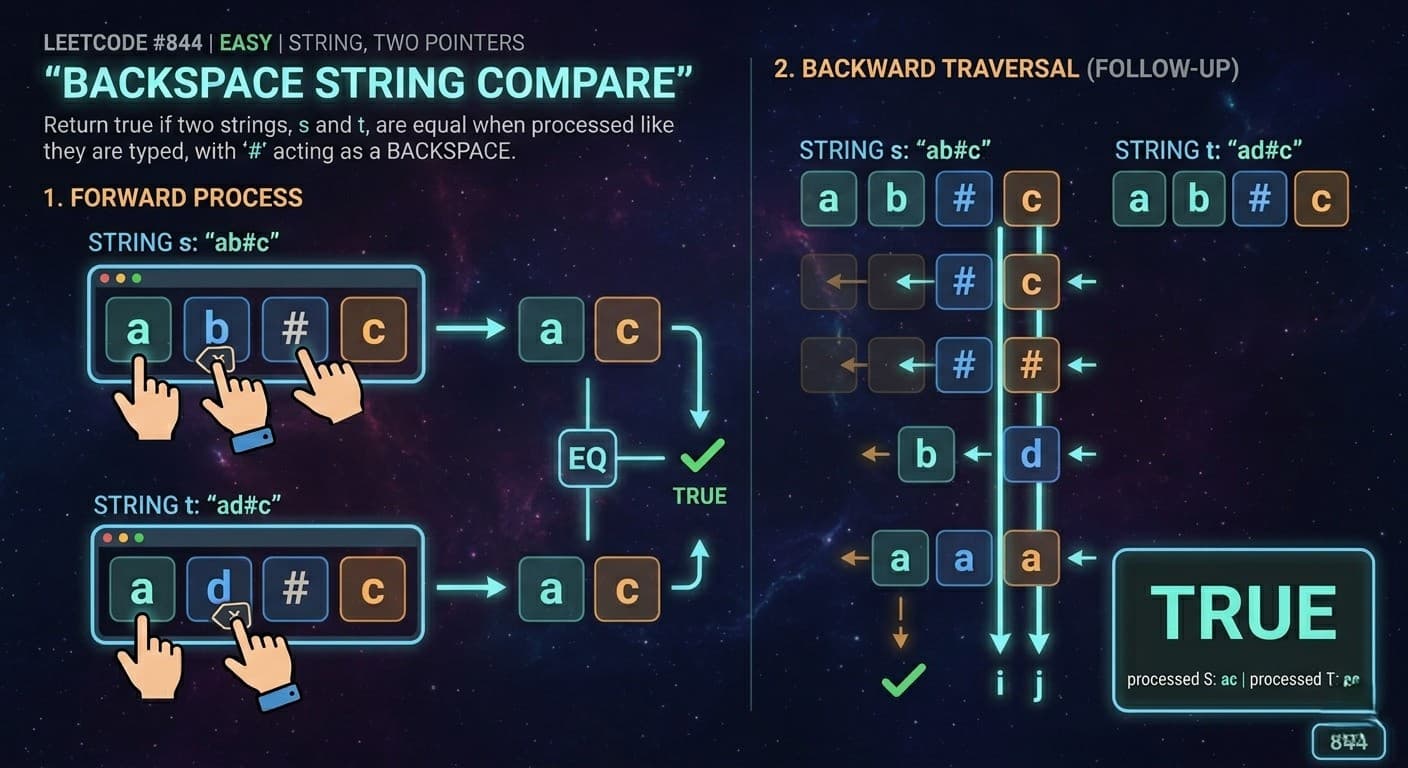
IntroductionLeetCode 844 Backspace String Compare is a fantastic problem that shows up frequently in coding interviews. It combines string manipulation, stack simulation, and even has a follow-up that challenges you to solve it in O(1) space — which is what separates a good candidate from a great one.Here is the Link of Question -: LeetCode 844In this article we cover a plain English explanation, real life analogy, 3 Java approaches including the O(1) space two pointer solution, dry runs, complexity analysis, common mistakes, and FAQs.What Is the Problem Really Asking?You are given two strings s and t. Both contain lowercase letters and # characters. Think of # as the backspace key on your keyboard — it deletes the character just before it. If there is nothing to delete, it does nothing.Process both strings through these backspace operations and check if the resulting strings are equal. Return true if equal, false otherwise.Quick Example:s = "ab#c" → # deletes b → becomes "ac"t = "ad#c" → # deletes d → becomes "ac"Both equal "ac" → return true ✅Real Life Analogy — The Keyboard TypoYou are typing a message. You type "ab", realize you made a typo, hit backspace, and type "c". Your friend types "ad", hits backspace, and types "c". Even though you both typed differently, the final message on screen is the same — "ac".That is exactly what this problem is about. Two people typing differently but ending up with the same result.Approach 1: StringBuilder as Stack (Optimal & Clean) ✅The IdeaThis is your own solution and the best O(n) approach. Process each string independently using a StringBuilder as a stack:Letter → append to StringBuilder (push)# → delete last character if StringBuilder is not empty (pop)Then simply compare the two resulting StringBuilders.public boolean backspaceCompare(String s, String t) { return process(s).equals(process(t));}private String process(String str) { StringBuilder sb = new StringBuilder(); for (int i = 0; i < str.length(); i++) { char c = str.charAt(i); if (c == '#') { if (sb.length() > 0) { sb.deleteCharAt(sb.length() - 1); } } else { sb.append(c); } } return sb.toString();}Notice how extracting a process() helper method makes the code cleaner and avoids repeating the same loop twice — a great habit to show in interviews!Dry Run — s = "ab##", t = "c#d#"Processing s = "ab##":a → append → "a"b → append → "ab"# → delete last → "a"# → delete last → ""Processing t = "c#d#":c → append → "c"# → delete last → ""d → append → "d"# → delete last → ""Both result in "" → return true ✅Time Complexity: O(n + m) — where n and m are lengths of s and t Space Complexity: O(n + m) — two StringBuilders storing processed stringsApproach 2: Stack Based Solution (Interview Classic)The IdeaSame logic as above but using explicit Stack<Character> objects. Great for explaining your thought process clearly in an interview even though StringBuilder is cleaner.public boolean backspaceCompare(String s, String t) { return processStack(s).equals(processStack(t));}private String processStack(String str) { Stack<Character> st = new Stack<>(); for (int i = 0; i < str.length(); i++) { char c = str.charAt(i); if (c == '#') { if (!st.empty()) { st.pop(); } } else { st.push(c); } } StringBuilder sb = new StringBuilder(); while (!st.empty()) { sb.append(st.pop()); } return sb.reverse().toString();}Dry Run — s = "a#c", t = "b"Processing s = "a#c":a → push → stack: [a]# → pop → stack: []c → push → stack: [c]Result: "c"Processing t = "b":b → push → stack: [b]Result: "b""c" does not equal "b" → return false ✅Time Complexity: O(n + m) Space Complexity: O(n + m)Approach 3: Two Pointer — O(1) Space (Follow-Up Solution) 🔥This is the follow-up the problem asks about — can you solve it in O(n) time and O(1) space? This means no extra StringBuilder or Stack allowed.The IdeaInstead of building processed strings, traverse both strings from right to left simultaneously. Keep a count of pending backspaces. Skip characters that would be deleted and compare characters that survive.Why right to left? Because # affects characters to its left, so processing from the end lets us know upfront how many characters to skip.public boolean backspaceCompare(String s, String t) { int i = s.length() - 1; int j = t.length() - 1; int skipS = 0, skipT = 0; while (i >= 0 || j >= 0) { // Find next valid character in s while (i >= 0) { if (s.charAt(i) == '#') { skipS++; i--; } else if (skipS > 0) { skipS--; i--; } else { break; } } // Find next valid character in t while (j >= 0) { if (t.charAt(j) == '#') { skipT++; j--; } else if (skipT > 0) { skipT--; j--; } else { break; } } // Compare the valid characters if (i >= 0 && j >= 0) { if (s.charAt(i) != t.charAt(j)) { return false; } } else if (i >= 0 || j >= 0) { return false; // one string still has chars, other doesn't } i--; j--; } return true;}Dry Run — s = "ab#c", t = "ad#c"Starting from the right end of both strings:Round 1:s[3] = 'c' → valid, no skips → stopt[3] = 'c' → valid, no skips → stopCompare 'c' == 'c' ✅ → move both pointers leftRound 2:s[2] = '#' → skipS = 1, move lefts[1] = 'b' → skipS > 0, skipS = 0, move lefts[0] = 'a' → valid, stopt[2] = '#' → skipT = 1, move leftt[1] = 'd' → skipT > 0, skipT = 0, move leftt[0] = 'a' → valid, stopCompare 'a' == 'a' ✅ → move both pointers leftBoth pointers exhausted → return true ✅Time Complexity: O(n + m) — each character visited at most once Space Complexity: O(1) — only pointer and counter variables, no extra storage!Approach ComparisonThe StringBuilder approach is the easiest to write and explain. The Stack approach is slightly more verbose but shows clear intent. The Two Pointer approach is the hardest to code but the most impressive — it solves the follow-up and uses zero extra space.In an interview, start with the StringBuilder solution, explain it clearly, then mention the Two Pointer approach as the O(1) space optimization if asked.How This Fits the Stack Simulation PatternYou have now seen this same pattern across four problems:3174 Clear Digits — digit deletes closest left non-digit 2390 Removing Stars — star deletes closest left non-star 1047 Remove Adjacent Duplicates — character cancels matching top of stack 844 Backspace String Compare — # deletes closest left character, then compare two stringsAll four use the same StringBuilder-as-stack core. The only differences are the trigger character and what you do with the result. This is the power of pattern recognition in DSA.Common Mistakes to AvoidNot handling backspace on empty string When # appears but the StringBuilder is already empty, do nothing. Always guard with sb.length() > 0 before calling deleteCharAt. The problem explicitly states backspace on empty text keeps it empty.Using Stack and forgetting to handle # when stack is empty In the Stack approach, only pop if the stack is not empty. Pushing # onto the stack when it is empty is a common bug that gives wrong answers.In Two Pointer, comparing before both pointers find valid characters Make sure both inner while loops fully complete before comparing. Comparing too early is the most common mistake in the O(1) space solution.FAQs — People Also AskQ1. What is the best approach for LeetCode 844 in Java? For most interviews, the StringBuilder approach is the best — clean, readable, and O(n) time. If the interviewer asks for O(1) space, switch to the Two Pointer approach traversing from right to left.Q2. How does the O(1) space solution work for LeetCode 844? It uses two pointers starting from the end of both strings, keeping a skip counter to track pending backspaces. Characters that would be deleted are skipped, and only surviving characters are compared.Q3. What is the time complexity of LeetCode 844? All three approaches run in O(n + m) time where n and m are the lengths of the two strings. The Two Pointer approach achieves this with O(1) space instead of O(n + m).Q4. Why traverse from right to left in the Two Pointer approach? Because # affects characters to its left. Scanning from the right lets you know upfront how many characters to skip before you reach them, avoiding the need to store anything.Q5. Is LeetCode 844 asked in Google interviews? Yes, it is commonly used as a warmup or screening problem. The follow-up O(1) space solution is what makes it interesting for senior-level interviews.Similar LeetCode Problems to Practice Next1047. Remove All Adjacent Duplicates In String — Easy — same stack pattern2390. Removing Stars From a String — Medium — star as backspace3174. Clear Digits — Easy — digit as backspace1209. Remove All Adjacent Duplicates in String II — Medium — k adjacent duplicates678. Valid Parenthesis String — Medium — stack with wildcardsConclusionLeetCode 844 Backspace String Compare is a well-rounded problem that tests string manipulation, stack simulation, and space optimization all in one. The StringBuilder solution is your go-to for interviews. But always be ready to explain the Two Pointer O(1) space follow-up — that is what shows real depth of understanding.Check out these problems alongside 1047, 2390, and 3174 and you will have the entire stack simulation pattern locked down for any coding interview.

StringStackTwo PointerString Builder
Reverse Only Letters – Two Pointer Strategy Explained (LeetCode 917)

Reverse Only Letters – Two Pointer Strategy Explained (LeetCode 917)

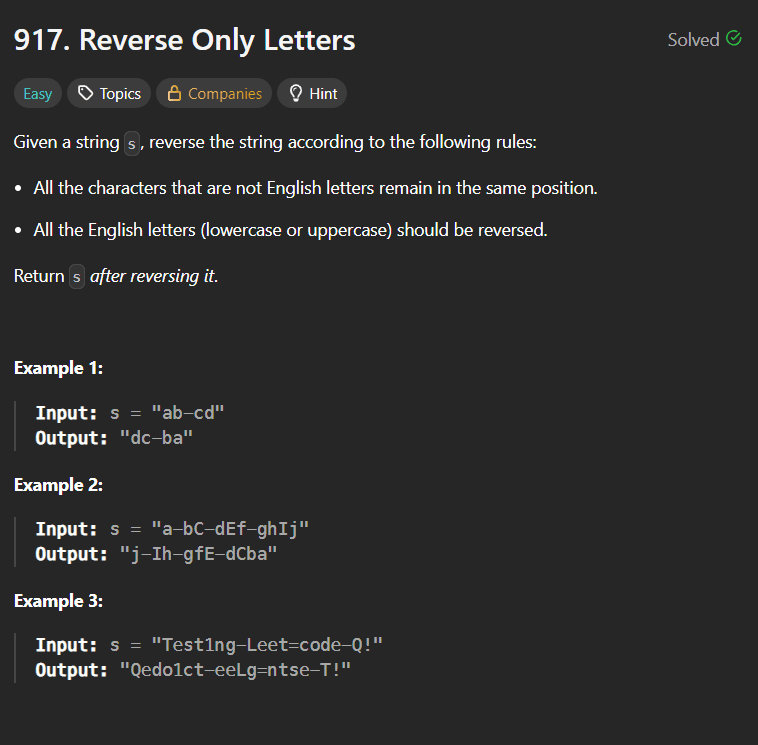
🔗 Problem LinkLeetCode 917 – Reverse Only Letters 👉 https://leetcode.com/problems/reverse-only-letters/IntroductionThis is a very clean two-pointer problem.The challenge is not just reversing a string — it’s reversing only the letters while keeping all non-letter characters in their original positions.This problem strengthens:Two pointer techniqueCharacter validation logicIn-place string manipulationLet’s break it down.📌 Problem UnderstandingYou are given a string s.Rules:All non-English letters must remain at the same index.Only English letters (uppercase or lowercase) should be reversed.Return the modified string.Example 1Input: "ab-cd"Output: "dc-ba"Only letters are reversed. Hyphen stays at same position.Example 2Input: "a-bC-dEf-ghIj"Output: "j-Ih-gfE-dCba"Example 3Input: "Test1ng-Leet=code-Q!"Output: "Qedo1ct-eeLg=ntse-T!"Notice:Numbers, -, =, ! stay fixed.Only letters move.🧠 IntuitionThe first thought might be:Extract all lettersReverse themPut them backBut that would require extra space.Instead, we can solve this efficiently using Two Pointers.🚀 Two Pointer ApproachWe use:i → starting from leftj → starting from rightSteps:Convert string into char array.Move i forward until it points to a letter.Move j backward until it points to a letter.Swap letters.Continue until i < j.💻 Your Codeclass Solution { public String reverseOnlyLetters(String s) { int i = 0; int j = s.length() - 1; char arr[] = s.toCharArray(); while(i < j){ boolean l = ('A' <= s.charAt(i) && s.charAt(i) <= 'Z') || ('a' <= s.charAt(i) && s.charAt(i) <= 'z'); boolean r = ('A' <= s.charAt(j) && s.charAt(j) <= 'Z') || ('a' <= s.charAt(j) && s.charAt(j) <= 'z'); if(l && r){ char temp = arr[i]; arr[i] = arr[j]; arr[j] = temp; i++; j--; }else if(l){ j--; }else if(r){ i++; }else{ i++; j--; } } return new String(arr); }}🔍 Step-by-Step Explanation1️⃣ Convert to Character Arraychar arr[] = s.toCharArray();Strings are immutable in Java. So we convert to char array to modify it.2️⃣ Initialize Two Pointersint i = 0;int j = s.length() - 1;We start from both ends.3️⃣ Check If Characters Are Lettersboolean l = ('A' <= s.charAt(i) && s.charAt(i) <= 'Z') || ('a' <= s.charAt(i) && s.charAt(i) <= 'z');You manually check ASCII ranges for uppercase and lowercase letters.Same logic for r.4️⃣ Swap When Both Are Lettersif(l && r){ char temp = arr[i]; arr[i] = arr[j]; arr[j] = temp; i++; j--;}Only swap letters.5️⃣ Move Pointers When One Is Not LetterIf left is letter but right is not → move jIf right is letter but left is not → move iIf both are not letters → move bothThis ensures:Non-letter characters remain in their positions.🎯 Why This WorksWe never move non-letter characters.We only swap valid letters.Since we use two pointers:Time complexity stays linear.No extra array needed for letters.⏱ Complexity AnalysisTime Complexity: O(n)Each character is visited at most once.Space Complexity: O(n)Because we convert string to char array.(If considering output string creation, still O(n))🔥 Cleaner OptimizationInstead of manually checking ASCII ranges, Java provides:Character.isLetter(c)Cleaner version:class Solution { public String reverseOnlyLetters(String s) { int i = 0, j = s.length() - 1; char[] arr = s.toCharArray(); while(i < j){ if(!Character.isLetter(arr[i])){ i++; }else if(!Character.isLetter(arr[j])){ j--; }else{ char temp = arr[i]; arr[i] = arr[j]; arr[j] = temp; i++; j--; } } return new String(arr); }}Much cleaner and readable.🏁 Final ThoughtsThis problem teaches:Two pointer patternIn-place string reversalCharacter validation logicClean pointer movement strategyIt’s a simple but powerful pattern that appears often in interviews.If you master this, you can easily solve:Reverse Vowels of a StringValid PalindromeReverse String IIPalindrome with One Removal

Two PointersString ManipulationLeetCodeEasy
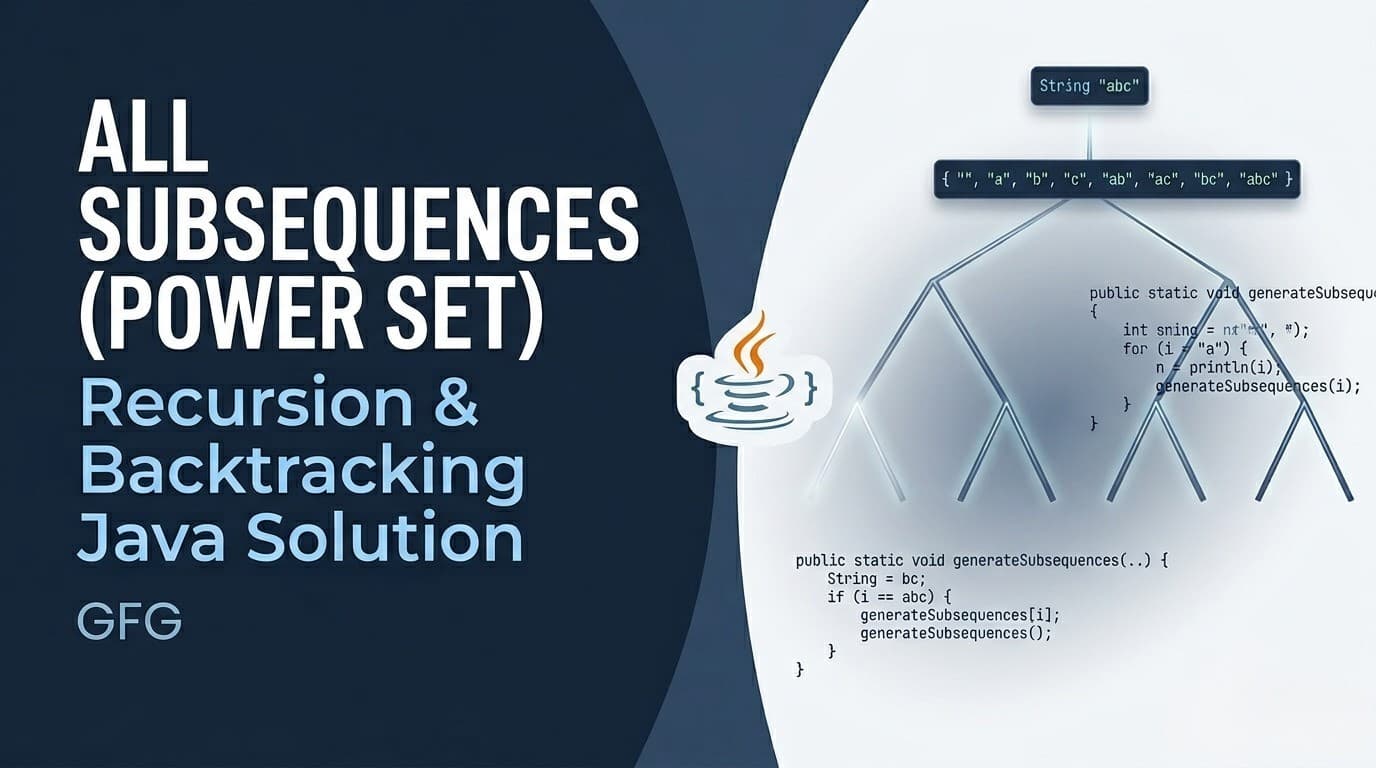
All Subsequences of a String (Power Set) | Recursion & Backtracking Java Solution

All Subsequences of a String (Power Set) | Recursion & Backtracking Java Solution

IntroductionThe Power Set problem for strings is a classic question in recursion and backtracking, frequently asked in coding interviews and platforms like GeeksforGeeks.In this problem, instead of numbers, we deal with strings and generate all possible subsequences (not substrings). This makes it slightly more interesting and practical for real-world applications like pattern matching, text processing, and combinatorics.In this article, we will cover:Intuition behind subsequencesRecursive (backtracking) approachSorting for lexicographical orderAlternative approachesComplexity analysisProblem StatementGiven a string s of length n, generate all non-empty subsequences of the string.RequirementsReturn only non-empty subsequencesOutput must be in lexicographically sorted orderExamplesExample 1Input:s = "abc"Output:a ab abc ac b bc cExample 2Input:s = "aa"Output:a a aaSubsequence vs Substring (Important)Substring: Continuous charactersSubsequence: Characters can be skippedExample for "abc":Subsequences → a, b, c, ab, ac, bc, abcKey InsightFor every character, we have two choices:Include it OR Exclude itSo total subsequences:2^nWe generate all and then remove the empty string.Approach 1: Recursion (Backtracking)IntuitionAt each index:Skip the characterInclude the characterBuild all combinations recursivelyJava Code (With Explanation)import java.util.*;class Solution { // List to store all subsequences List<String> a = new ArrayList<>(); void sub(String s, int ind, String curr) { // Base case: reached end of string if (ind == s.length()) { a.add(curr); // add current subsequence return; } // Choice 1: Exclude current character sub(s, ind + 1, curr); // Choice 2: Include current character sub(s, ind + 1, curr + s.charAt(ind)); } public List<String> AllPossibleStrings(String s) { // Start recursion sub(s, 0, ""); // Remove empty string (not allowed) a.remove(""); // Sort lexicographically Collections.sort(a); return a; }}Step-by-Step Dry Run (s = "abc")Start: ""→ Exclude 'a' → "" → Exclude 'b' → "" → Exclude 'c' → "" → Include 'c' → "c" → Include 'b' → "b" → Exclude 'c' → "b" → Include 'c' → "bc"→ Include 'a' → "a" → Exclude 'b' → "a" → Exclude 'c' → "a" → Include 'c' → "ac" → Include 'b' → "ab" → Exclude 'c' → "ab" → Include 'c' → "abc"Final Output (After Sorting)a ab abc ac b bc cApproach 2: Bit ManipulationIntuitionEach subsequence can be represented using binary numbers:0 → exclude1 → includeCodeimport java.util.*;class Solution { public List<String> AllPossibleStrings(String s) { List<String> result = new ArrayList<>(); int n = s.length(); int total = 1 << n; // 2^n for (int i = 1; i < total; i++) { // start from 1 to avoid empty StringBuilder sb = new StringBuilder(); for (int j = 0; j < n; j++) { if ((i & (1 << j)) != 0) { sb.append(s.charAt(j)); } } result.add(sb.toString()); } Collections.sort(result); return result; }}Approach 3: Iterative (Expanding List)IdeaStart with empty listFor each character:Add it to all existing subsequencesCodeimport java.util.*;class Solution { public List<String> AllPossibleStrings(String s) { List<String> result = new ArrayList<>(); result.add(""); for (char ch : s.toCharArray()) { int size = result.size(); for (int i = 0; i < size; i++) { result.add(result.get(i) + ch); } } result.remove(""); Collections.sort(result); return result; }}Complexity AnalysisTime Complexity: O(n × 2ⁿ)Space Complexity: O(n × 2ⁿ)Why?Total subsequences = 2ⁿEach subsequence takes O(n) to buildWhy Sorting is RequiredThe recursion generates subsequences in random order, so we sort them:Collections.sort(result);This ensures lexicographical order as required.Key TakeawaysThis is a power set problem for stringsEach character → 2 choicesRecursion = most intuitive approachBit manipulation = most optimized thinkingAlways remove empty string if requiredCommon Interview VariationsSubsets of arrayPermutations of stringCombination sumSubsequence with conditionsConclusionThe Power Set problem is a fundamental building block in recursion and combinatorics. Once you understand the include/exclude pattern, you can solve a wide range of problems efficiently.Mastering this will significantly improve your ability to tackle backtracking and decision tree problems.Frequently Asked Questions (FAQs)1. Why is the empty string removed?Because the problem requires only non-empty subsequences.2. Why is time complexity O(n × 2ⁿ)?Because there are 2ⁿ subsequences and each takes O(n) time to construct.3. Which approach is best?Recursion → best for understandingBit manipulation → best for optimization

GeeksforGeeksRecursionJavaBacktrackingMedium
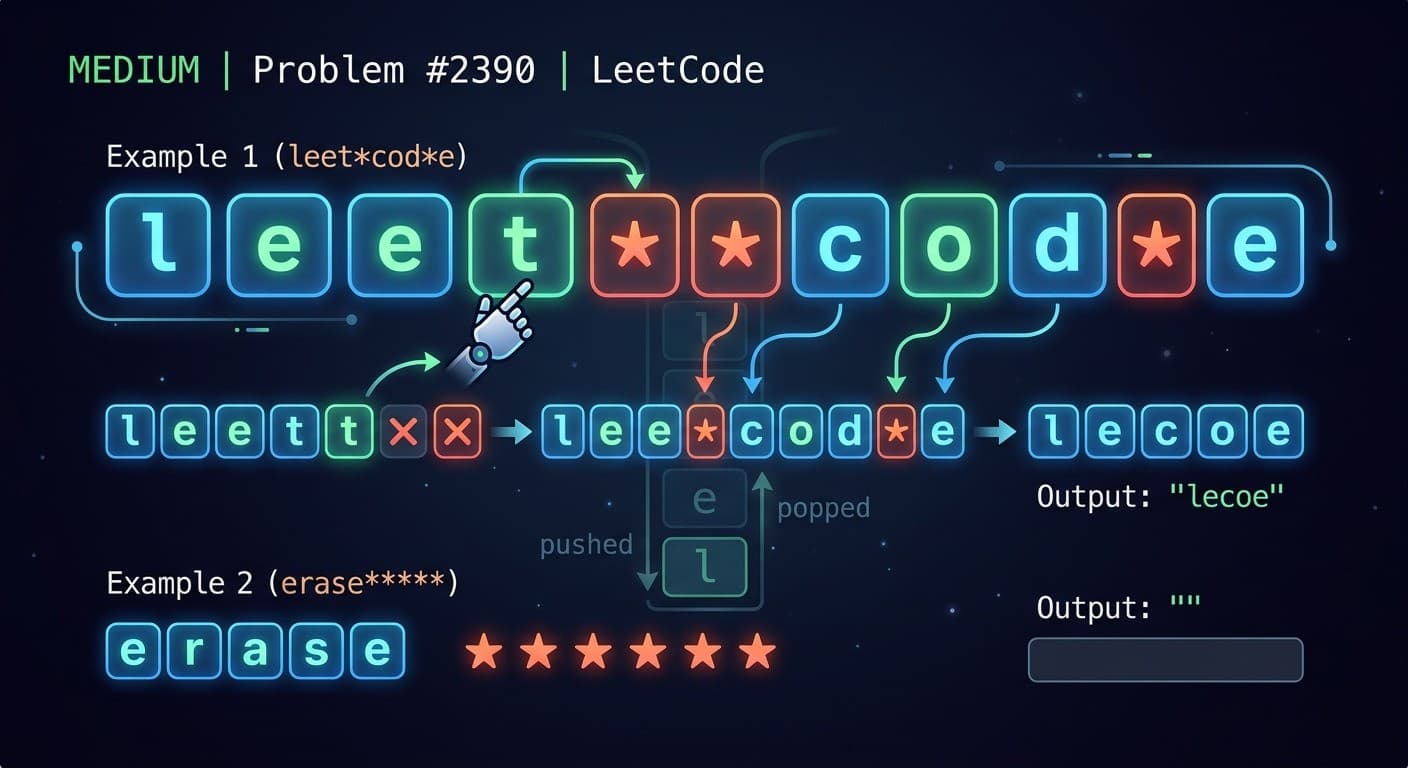
LeetCode 2390: Removing Stars From a String — Java Solution With All Approaches Explained

LeetCode 2390: Removing Stars From a String — Java Solution With All Approaches Explained

Introduction: What Is LeetCode 2390 Removing Stars From a String?If you are preparing for coding interviews at companies like Google, Amazon, or Microsoft, LeetCode 2390 Removing Stars From a String is a must-solve problem. It tests your understanding of the stack data structure and string manipulation — two of the most frequently tested topics in technical interviews.In this article, we will cover:What the problem is asking in plain English3 different Java approaches (Brute Force, Stack, StringBuilder)Step-by-step dry run with examplesTime and space complexity for each approachCommon mistakes to avoidFAQs that appear in Google's People Also AskLet's dive in!Problem Statement SummaryYou are given a string s containing lowercase letters and stars *. In one operation:Choose any * in the stringRemove the * itself AND the closest non-star character to its leftRepeat until all stars are removed and return the final string.Example:Input: s = "leet**cod*e"Output: "lecoe"Real Life Analogy — Think of It as a Backspace KeyImagine you are typing on a keyboard. Every * acts as your backspace key — it deletes itself and the character just before it.You type "leet" and press backspace twice:Backspace 1 → deletes t → "lee"Backspace 2 → deletes e → "le"That is exactly what this problem simulates! Once you see it this way, the solution becomes very obvious.Approach 1: Brute Force Simulation (Beginner Friendly)IdeaDirectly simulate the process the problem describes:Scan the string from left to rightFind the first *Remove it and the character just before itRepeat until no stars remainJava Codepublic String removeStars(String s) {StringBuilder sb = new StringBuilder(s);int i = 0;while (i < sb.length()) {if (sb.charAt(i) == '*') {sb.deleteCharAt(i); // remove the starif (i > 0) {sb.deleteCharAt(i - 1); // remove closest left characteri--;}} else {i++;}}return sb.toString();}Time and Space ComplexityComplexityValueReasonTimeO(n²)Each deletion shifts all remaining charactersSpaceO(n)StringBuilder storage⚠️ Important WarningThis problem has n up to 100,000. Brute force will get Time Limit Exceeded (TLE) on LeetCode. Use this only to understand the concept, never in production or interviews.Approach 2: Stack Based Solution (Interview Favorite)IdeaA stack is the perfect data structure here because:We always remove the most recently added letter when a * appearsThat is the definition of Last In First Out (LIFO) — exactly what a stack doesAlgorithm:Letter → push onto stack* → pop from stack (removes closest left character)At the end, build result from stack contentsJava Codepublic String removeStars(String s) {Stack<Character> st = new Stack<>();for (int i = 0; i < s.length(); i++) {char c = s.charAt(i);if (c == '*') {if (!st.empty()) {st.pop();}} else {st.push(c);}}StringBuilder sb = new StringBuilder();while (!st.empty()) {sb.append(st.pop());}return sb.reverse().toString();}Step-by-Step Dry Run — "leet**cod*e"StepCharacterActionStack State1lpush[l]2epush[l,e]3epush[l,e,e]4tpush[l,e,e,t]5*pop t[l,e,e]6*pop e[l,e]7cpush[l,e,c]8opush[l,e,c,o]9dpush[l,e,c,o,d]10*pop d[l,e,c,o]11epush[l,e,c,o,e]✅ Final Answer: "lecoe"Time and Space ComplexityComplexityValueReasonTimeO(n)Single pass through the stringSpaceO(n)Stack holds up to n charactersApproach 3: StringBuilder as Stack (Optimal Solution) ✅IdeaThis is the best and most optimized approach. A StringBuilder can act as a stack:append(c) → works like pushdeleteCharAt(sb.length() - 1) → works like popNo reverse needed at the end unlike the Stack approachJava Codepublic String removeStars(String s) {StringBuilder sb = new StringBuilder();for (int i = 0; i < s.length(); i++) {char c = s.charAt(i);if (c == '*') {if (sb.length() > 0) {sb.deleteCharAt(sb.length() - 1);}} else {sb.append(c);}}return sb.toString();}Step-by-Step Dry Run — "erase*****"StepCharacterActionStringBuilder1eappend"e"2rappend"er"3aappend"era"4sappend"eras"5eappend"erase"6*delete last"eras"7*delete last"era"8*delete last"er"9*delete last"e"10*delete last""✅ Final Answer: ""Why StringBuilder Beats Stack in JavaFactorStack<Character>StringBuilderMemoryBoxes char → Character objectWorks on primitives directlyReverse neededYesNoCode lengthMore verboseCleaner and shorterPerformanceSlightly slowerFasterTime and Space ComplexityComplexityValueReasonTimeO(n)One pass, each character processed onceSpaceO(n)StringBuilder storageAll Approaches Comparison TableApproachTimeSpacePasses LeetCode?Best ForBrute ForceO(n²)O(n)❌ TLEUnderstanding conceptStackO(n)O(n)✅ YesInterview explanationStringBuilderO(n)O(n)✅ YesBest solutionHow This Relates to LeetCode 3174 Clear DigitsIf you have already solved LeetCode 3174 Clear Digits, you will notice this problem is nearly identical:Feature3174 Clear Digits2390 Removing StarsTriggerDigit 0-9Star *RemovesClosest left non-digitClosest left non-starDifficultyEasyMediumBest approachStringBuilderStringBuilderThe exact same solution pattern works for both. This is why learning patterns matters more than memorizing individual solutions!Common Mistakes to Avoid1. Not checking sb.length() > 0 before deleting Even though the problem guarantees valid input, always add this guard. It shows clean, defensive coding in interviews.2. Forgetting to reverse when using Stack Stack gives you characters in reverse order. If you forget .reverse(), your answer will be backwards.3. Using Brute Force for large inputs With n up to 100,000, O(n²) will time out. Always use the O(n) approach.FAQs — People Also AskQ1. What data structure is best for LeetCode 2390? A Stack or StringBuilder used as a stack is the best data structure. Both give O(n) time complexity. StringBuilder is slightly more optimal in Java because it avoids object boxing overhead.Q2. Why does a star remove the closest left character? Because the problem defines it that way — think of * as a backspace key on a keyboard. It always deletes the character immediately before the cursor position.Q3. What is the time complexity of LeetCode 2390? The optimal solution runs in O(n) time and O(n) space, where n is the length of the input string.Q4. Is LeetCode 2390 asked in Google interviews? Yes, this type of stack simulation problem is commonly asked at Google, Amazon, Microsoft, and Meta interviews as it tests understanding of LIFO operations and string manipulation.Q5. What is the difference between LeetCode 2390 and LeetCode 844? Both use the same backspace simulation pattern. In 844 Backspace String Compare, # is the backspace character and you compare two strings. In 2390, * is the backspace and you return the final string.Similar LeetCode Problems to Practice NextProblemDifficultyPattern844. Backspace String CompareEasyStack simulation1047. Remove All Adjacent Duplicates In StringEasyStack simulation3174. Clear DigitsEasyStack simulation20. Valid ParenthesesEasyClassic stack735. Asteroid CollisionMediumStack simulationConclusionLeetCode 2390 Removing Stars From a String is a classic stack simulation problem that every developer preparing for coding interviews should master. The key insight is recognizing that * behaves exactly like a backspace key, which makes a stack or StringBuilder the perfect tool.Quick Recap:Brute force works conceptually but TLEs on large inputsStack solution is clean and great for explaining in interviewsStringBuilder solution is the most optimal in Java — no boxing, no reversal

StringStackMediumLeetCode
LeetCode 784 Letter Case Permutation | Recursion & Backtracking Java Solution

LeetCode 784 Letter Case Permutation | Recursion & Backtracking Java Solution

IntroductionThe Letter Case Permutation problem is a classic example of recursion and backtracking, often asked in coding interviews and frequently searched by learners preparing for platforms like LeetCode.This problem helps in understanding:Decision-making at each stepRecursive branchingString manipulationIn this article, we’ll break down the intuition, visualize the decision process using your decision tree, and implement an efficient Java solution.🔗 Problem LinkLeetCode: Letter Case PermutationProblem StatementGiven a string s, you can transform each alphabet character into:LowercaseUppercaseDigits remain unchanged.👉 Return all possible strings formed by these transformations.ExamplesExample 1Input:s = "a1b2"Output:["a1b2","a1B2","A1b2","A1B2"]Example 2Input:s = "3z4"Output:["3z4","3Z4"]Key InsightAt each character:If it's a digit → only one choiceIf it's a letter → two choices:lowercase OR uppercaseSo total combinations:2^(number of letters)Intuition (Using Your Decision Tree)For input: "a1b2"Start from index 0: "" / \ "a" "A" | | "a1" "A1" / \ / \ "a1b" "a1B" "A1b" "A1B" | | | | "a1b2" "a1B2" "A1b2" "A1B2"Understanding the TreeAt 'a' → branch into 'a' and 'A''1' → no branching (digit)'b' → again branching'2' → no branching📌 Leaf nodes = final answersApproach: Recursion + BacktrackingIdeaTraverse the string character by characterIf digit → move forwardIf letter → branch into:lowercaseuppercaseJava Codeimport java.util.*;class Solution { // List to store all results List<String> lis = new ArrayList<>(); public void solve(String s, int ind, String ans) { // Base case: reached end of string if (ind == s.length()) { lis.add(ans); // store generated string return; } char ch = s.charAt(ind); // If character is a digit → only one option if (ch >= '0' && ch <= '9') { solve(s, ind + 1, ans + ch); } else { // Choice 1: convert to lowercase solve(s, ind + 1, ans + Character.toLowerCase(ch)); // Choice 2: convert to uppercase solve(s, ind + 1, ans + Character.toUpperCase(ch)); } } public List<String> letterCasePermutation(String s) { solve(s, 0, ""); // start recursion return lis; }}Step-by-Step ExecutionFor "a1b2":Start → ""'a' → "a", "A"'1' → "a1", "A1"'b' → "a1b", "a1B", "A1b", "A1B"'2' → final stringsComplexity AnalysisTime Complexity: O(2^n)(n = number of letters)Space Complexity: O(2^n)(for storing results)Why This Approach WorksRecursion explores all possibilitiesEach letter creates a branching pointDigits pass through unchangedBacktracking ensures all combinations are generatedKey TakeawaysThis is a binary decision recursion problemLetters → 2 choicesDigits → 1 choiceDecision tree directly maps to recursionPattern similar to:SubsetsPermutations with conditionsWhen This Problem Is AskedCommon in:Coding interviewsRecursion/backtracking roundsString manipulation problemsConclusionThe Letter Case Permutation problem is a perfect example of how recursion can be used to explore all possible combinations efficiently.Once the decision tree is clear, the implementation becomes straightforward. This pattern is widely used in many advanced problems, making it essential to master.Frequently Asked Questions (FAQs)1. Why don’t digits create branches?Because they have only one valid form.2. What is the main concept used?Recursion with decision-making (backtracking).3. Can this be solved iteratively?Yes, using BFS or iterative expansion, but recursion is more intuitive.

LeetCodeMediumJavaRecursion
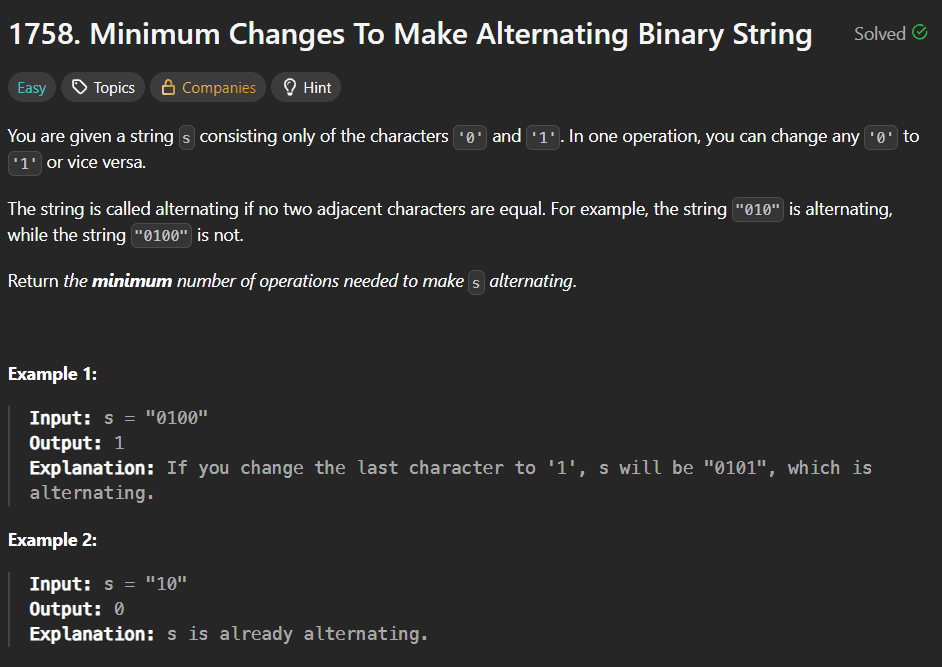
Minimum Changes to Make Alternating Binary String – LeetCode 1758 Explained

Minimum Changes to Make Alternating Binary String – LeetCode 1758 Explained

Try This QuestionBefore reading the solution, try solving the problem yourself on LeetCode:👉 https://leetcode.com/problems/minimum-changes-to-make-alternating-binary-string/Problem StatementYou are given a binary string s consisting only of characters '0' and '1'.In one operation, you can change any '0' to '1' or '1' to '0'.A string is called alternating if no two adjacent characters are the same.Example of Alternating Strings01010101011010Example of Non-Alternating Strings0001001111101Your task is to return the minimum number of operations required to make the string alternating.Example WalkthroughExample 1Inputs = "0100"Possible fix:0101Only the last character needs to change, so the answer is:Output1Example 2Inputs = "10"The string is already alternating.Output0Example 3Inputs = "1111"Possible alternating strings:01011010Minimum operations needed = 2Output2Key ObservationAn alternating binary string can only have two possible patterns:Pattern 10101010101...Pattern 21010101010...So instead of trying many combinations, we only need to check:1️⃣ How many changes are required to convert s → "010101..."2️⃣ How many changes are required to convert s → "101010..."Then we return the minimum of the two.ApproachStep 1Generate two possible alternating strings:s1 = "010101..."s2 = "101010..."Both will be of the same length as the input string.Step 2Compare the original string with both patterns.Count mismatches.For example:s = 0100s1 = 0101Mismatch count = 1Step 3Repeat for the second pattern.Finally return:min(mismatch1, mismatch2)Intuition Behind the SolutionInstead of flipping characters randomly, we compare the string with the two valid alternating possibilities.Why only two?Because:Alternating strings must start with either 0 or 1After that, the pattern is fixed.So we simply compute which pattern requires fewer changes.This makes the solution efficient and simple.Java Implementationclass Solution { public int minOperations(String s) { int co1 = 0; int co2 = 0; String s1 = ""; String s2 = ""; for(int i = 0; i < s.length(); i++){ if(i % 2 == 0){ s1 += "0"; } else { s1 += "1"; } } for(int i = 0; i < s.length(); i++){ if(i % 2 == 0){ s2 += "1"; } else { s2 += "0"; } } for(int i = 0; i < s.length(); i++){ if(s.charAt(i) != s1.charAt(i)){ co1++; } } for(int i = 0; i < s.length(); i++){ if(s.charAt(i) != s2.charAt(i)){ co2++; } } return Math.min(co1, co2); }}Complexity AnalysisTime ComplexityO(n)We iterate through the string a few times.Space ComplexityO(n)Because we create two extra strings of size n.Optimized Approach (Better Interview Answer)We can avoid creating extra strings and calculate mismatches directly.Optimized Java Codeclass Solution { public int minOperations(String s) { int pattern1 = 0; int pattern2 = 0; for(int i = 0; i < s.length(); i++){ char expected1 = (i % 2 == 0) ? '0' : '1'; char expected2 = (i % 2 == 0) ? '1' : '0'; if(s.charAt(i) != expected1) pattern1++; if(s.charAt(i) != expected2) pattern2++; } return Math.min(pattern1, pattern2); }}Space Complexity NowO(1)No extra strings required.Why This Problem Is ImportantThis problem teaches important interview concepts:✔ Pattern observation✔ Greedy thinking✔ String manipulation✔ Optimization techniquesMany companies ask similar pattern-based string problems.Final ThoughtsThe trick in this problem is realizing that only two alternating patterns exist. Once you identify that, the problem becomes straightforward.Instead of trying multiple modifications, you simply compare and count mismatches.This leads to a clean and efficient O(n) solution.If you are preparing for coding interviews, practicing problems like this will improve your pattern recognition skills, which is a key skill for solving medium and hard problems later.Happy Coding 🚀

LeetCodeBinary StringGreedy AlgorithmJavaEasy
Reverse Vowels of a String – From Extra Space Approach to Two Pointer Optimization (LeetCode 345)

Reverse Vowels of a String – From Extra Space Approach to Two Pointer Optimization (LeetCode 345)

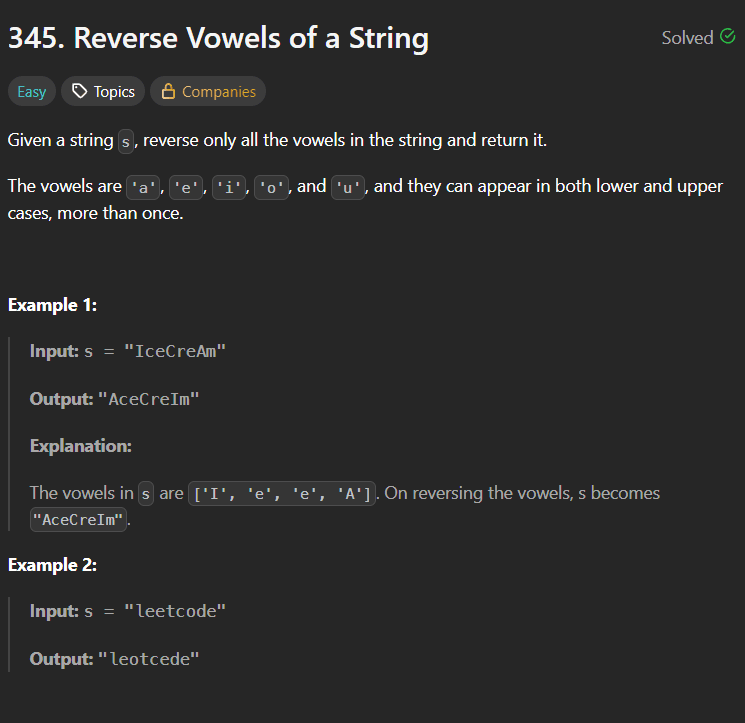
🔗 Problem LinkLeetCode 345 – Reverse Vowels of a String 👉 https://leetcode.com/problems/reverse-vowels-of-a-string/IntroductionThis problem is very similar to Reverse Only Letters, but with a small twist:Instead of reversing all letters, we only reverse the vowels.At first, we might think of extracting vowels, reversing them, and putting them back. That works — but it is not the most optimal approach.In this article, we’ll:Understand the brute-force style approach (your solution)Analyze its time complexityOptimize it using the Two Pointer patternCompare both approaches📌 Problem UnderstandingYou are given a string s.You must:Reverse only the vowelsKeep all other characters in the same positionVowels include:a, e, i, o, uA, E, I, O, UExample 1Input: "IceCreAm"Output: "AceCreIm"Vowels: ['I','e','e','A'] Reversed: ['A','e','e','I']Example 2Input: "leetcode"Output: "leotcede"🧠 Your First Approach – Extract, Reverse, ReplaceYour idea:Extract all vowels into a string.Store their indices.Reverse the vowel string.Replace vowels at stored indices.Let’s look at your code.💻 Your Code (Extract & Replace Method)class Solution { public String reverseVowels(String s) { String vow = ""; List<Integer> lis = new ArrayList<>(); HashMap<Integer,Character> mp = new HashMap<>(); for(int i =0;i<s.length();i++){ if(((s.charAt(i) == 'a') || (s.charAt(i) == 'e') || (s.charAt(i) == 'i') || (s.charAt(i) == 'o') || (s.charAt(i) == 'u') || (s.charAt(i) == 'A') || (s.charAt(i) == 'E') || (s.charAt(i) == 'I') || (s.charAt(i) == 'O') || (s.charAt(i) == 'U')) ){ vow += s.charAt(i); lis.add(i); } } String so = ""; for(int i = vow.length()-1; i >= 0; i--){ so += vow.charAt(i); } for(int i =0; i< lis.size();i++){ mp.put(lis.get(i), so.charAt(i)); } String ans = ""; for(int i =0 ; i< s.length();i++){ if(mp.containsKey(i)){ ans += mp.get(i); }else{ ans += s.charAt(i); } } return ans; }}🔍 How This WorksStep 1 – Extract VowelsStore:Vowel characters in vowTheir indices in lisStep 2 – Reverse the Vowel StringCreate new reversed string so.Step 3 – Map Indices to Reversed VowelsUse a HashMap to store:index → reversed vowelStep 4 – Build Final StringTraverse original string:If index in map → use reversed vowelElse → use original character⚠️ Problem with This ApproachAlthough correct, it has inefficiencies:String concatenation (+=) → O(n²) in worst caseExtra space used:Vowel stringList of indicesHashMapFinal answer stringTime Complexity: O(n²) (due to string concatenation) Space Complexity: O(n)We can do better.🚀 Optimized Approach – Two Pointers (Best Solution)Instead of extracting vowels separately, we can:Convert string into char arrayUse two pointersSwap vowels directlyThis avoids extra structures.💻 Optimized Two Pointer Solutionclass Solution { public String reverseVowels(String s) { int i = 0, j = s.length() - 1; char[] arr = s.toCharArray(); while(i < j){ if(!isVowel(arr[i])){ i++; } else if(!isVowel(arr[j])){ j--; } else{ char temp = arr[i]; arr[i] = arr[j]; arr[j] = temp; i++; j--; } } return new String(arr); } private boolean isVowel(char c){ return c=='a'||c=='e'||c=='i'||c=='o'||c=='u'|| c=='A'||c=='E'||c=='I'||c=='O'||c=='U'; }}🎯 Why This WorksWe:Move left pointer until vowel foundMove right pointer until vowel foundSwapContinueNo extra storage needed.⏱ Complexity ComparisonYour ApproachTime: O(n²) (string concatenation)Space: O(n)Two Pointer ApproachTime: O(n)Space: O(n) (char array)Much cleaner and faster.🔥 Key LearningThis problem reinforces:Two pointer patternIn-place modificationAvoiding unnecessary extra spaceRecognizing optimization opportunitiesWhenever you see:"Reverse something but keep other elements fixed"Think:👉 Two Pointers🏁 Final ThoughtsYour approach shows strong logical thinking:Extract → Reverse → ReplaceThat’s a valid way to solve it.But the optimized two-pointer approach is more interview-friendly.If you master this pattern, you can easily solve:Reverse Only LettersReverse StringValid PalindromeRemove Duplicates from Sorted Array

Two PointersString ManipulationHashMapLeetCodeEasy
Longest Substring with K Unique Characters – Efficient Sliding Window Solution

Longest Substring with K Unique Characters – Efficient Sliding Window Solution

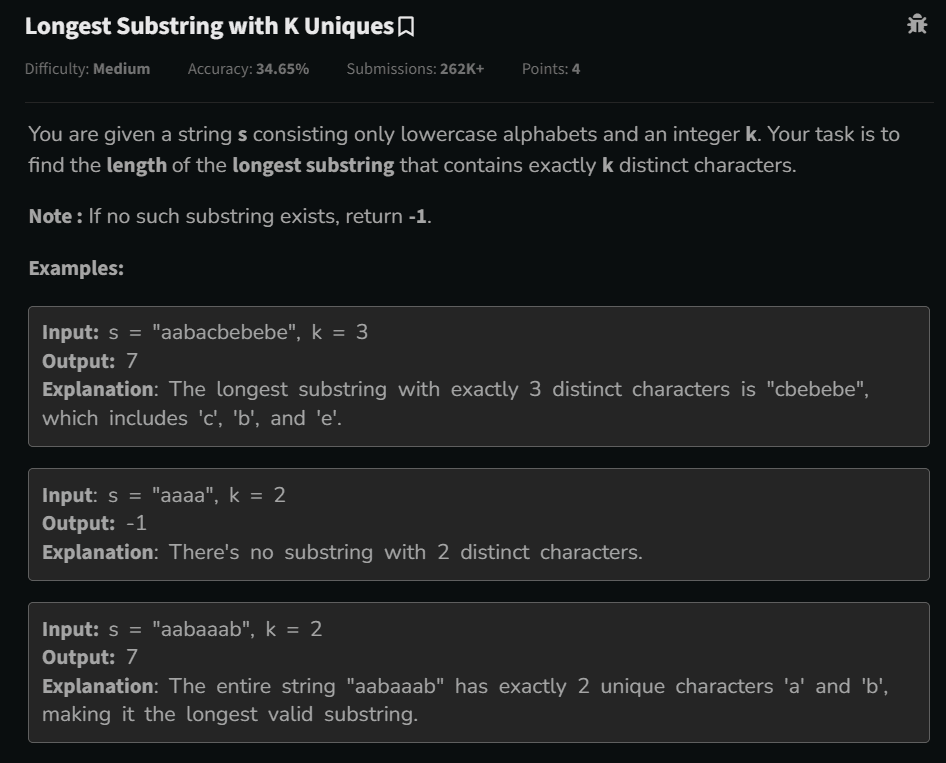
IntroductionFinding substrings with unique characters is a common problem in string manipulation and interview questions.GFG’s Longest Substring with K Unique Characters problem challenges you to find the length of the longest substring containing exactly K distinct characters.The focus is not just on brute-force solutions, but on using sliding window with a HashMap to efficiently track character frequencies and window boundaries.If you’d like to try solving the problem first, you can attempt it here: Try the problem on GeeksforGeeks: https://leetcode.com/problems/max-consecutive-ones-iii/Problem UnderstandingYou are given:A string s of lowercase lettersAn integer kYour task: Return the length of the longest substring containing exactly k distinct characters.Examples:Input: s = "aabacbebebe", k = 3Output: 7Explanation: "cbebebe" is the longest substring with 3 distinct characters.Input: s = "aaaa", k = 2Output: -1Explanation: No substring contains exactly 2 distinct characters.Input: s = "aabaaab", k = 2Output: 7Explanation: "aabaaab" has exactly 2 unique characters.A naive approach would try all possible substrings, count unique characters, and track the max length.Time Complexity: O(n²)Inefficient for large stringsKey Idea: Sliding Window + HashMapInstead of recomputing the unique characters for every substring:Use a HashMap to store character frequencies in the current windowUse two pointers (i and j) to maintain the windowExpand the window by moving j and add characters to the mapShrink the window from the left when the number of unique characters exceeds kUpdate the max length whenever the window has exactly k unique charactersThis ensures each character is processed only once, giving a linear solution.Approach (Step-by-Step)Initialize a HashMap mp to store character countsUse two pointers i (window start) and j (window end)Iterate over the string with jAdd s[j] to the map and update its countCheck the map size:If size < k → move j forwardIf size == k → update max length, move j forwardIf size > k → shrink window from i until map size <= kAfter iterating, return max (or -1 if no valid substring exists)Optimization:Using a HashMap avoids recalculating the number of unique characters for every substringSliding window ensures O(n) complexityImplementation (Java)class Solution {public int longestKSubstr(String s, int k) {HashMap<Character,Integer> mp = new HashMap<>();int i = 0, j = 0;int max = -1;while (j < s.length()) {// Add current character to mapmp.put(s.charAt(j), mp.getOrDefault(s.charAt(j), 0) + 1);if (mp.size() < k) {j++;}else if (mp.size() == k) {// Update max length when exactly k unique charactersmax = Math.max(max, j - i + 1);j++;}else {// Shrink window until map size <= kwhile (mp.size() > k) {mp.put(s.charAt(i), mp.get(s.charAt(i)) - 1);if (mp.get(s.charAt(i)) == 0) {mp.remove(s.charAt(i));}i++;}max = Math.max(max, j - i + 1);j++;}}return max;}}Dry Run ExampleInput:s = "aabacbebebe", k = 3Execution:Window [0-4] = "aaba" → unique = 2 → continueWindow [1-6] = "abacb" → unique = 3 → max = 5Window [4-10] = "cbebebe" → unique = 3 → max = 7Output:7Complexity AnalysisTime Complexity: O(n) → Each character enters and leaves the window onceSpace Complexity: O(k) → HashMap stores at most k unique charactersEdge Cases Consideredk greater than number of unique characters → return -1Entire string has exactly k unique charactersString with repeated characters onlyMinimum string length (1)Sliding Window Pattern ImportanceThis problem reinforces a common sliding window + hashmap pattern used in:Longest substring problems with constraintsCounting substrings with exactly K conditionsOptimizing brute-force approaches to linear solutionsConclusionBy combining sliding window with HashMap frequency tracking, we reduce an O(n²) problem to O(n).Once you master this approach, many string and substring problems with constraints on unique characters become much easier to solve efficiently.

SlidingWindowHashMapStringsGFG
LeetCode 290: Word Pattern – Multiple Ways to Verify Bijection Between Pattern Characters and Words

LeetCode 290: Word Pattern – Multiple Ways to Verify Bijection Between Pattern Characters and Words

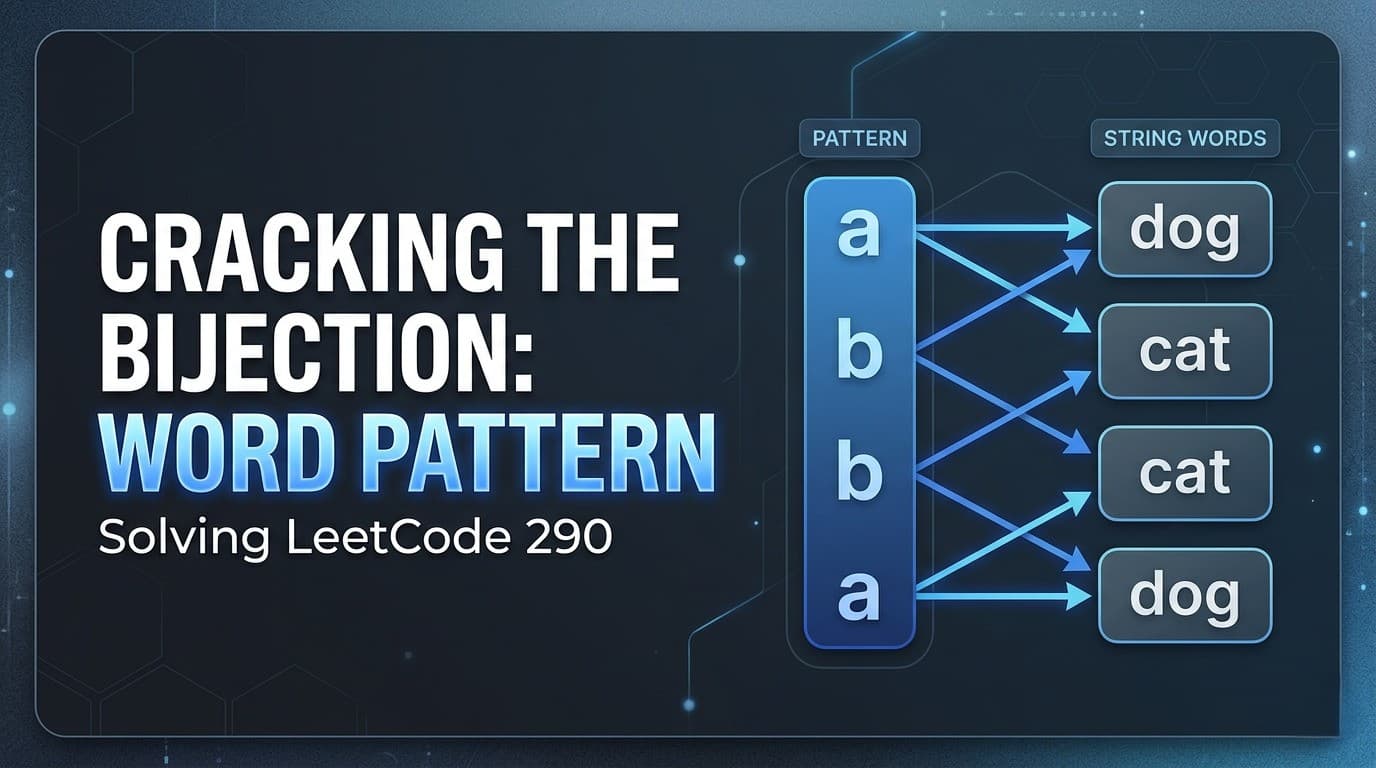
Try the ProblemYou can practice the problem here:https://leetcode.com/problems/word-pattern/Problem DescriptionYou are given:A string patternA string sThe string s consists of words separated by spaces.Your task is to determine whether s follows the same pattern defined by the string pattern.To follow the pattern, there must be a bijection between pattern characters and words.Understanding the Meaning of BijectionA bijection means a one-to-one relationship between two sets.For this problem it means:Every character in the pattern maps to exactly one word.Every word maps to exactly one pattern character.Two characters cannot map to the same word.Two words cannot map to the same character.This ensures the mapping is unique in both directions.Example WalkthroughExample 1Inputpattern = "abba"s = "dog cat cat dog"OutputtrueExplanationMapping:a → dogb → catPattern:a b b aWords:dog cat cat dogThe mapping is perfectly consistent.Example 2Inputpattern = "abba"s = "dog cat cat fish"OutputfalseExplanationThe last word "fish" breaks the pattern because "a" was already mapped to "dog".Example 3Inputpattern = "aaaa"s = "dog cat cat dog"OutputfalseExplanationPattern requires:a → same word every timeBut the words differ.Constraints1 <= pattern.length <= 300pattern contains lowercase English letters1 <= s.length <= 3000s contains lowercase letters and spaceswords are separated by a single spaceno leading or trailing spacesCore ObservationBefore applying any algorithm, we should verify one simple condition.If the number of pattern characters does not match the number of words, then the pattern cannot match.Example:pattern = "abba"s = "dog cat dog"Pattern length = 4Words = 3This automatically returns false.Thinking About Possible ApproachesWhile solving this problem, several strategies may come to mind:Use one HashMap to store pattern → word mapping and check duplicates manually.Use two HashMaps to enforce bijection from both directions.Track first occurrence indices of pattern characters and words.Compare mapping patterns using arrays or maps.Let’s explore these approaches one by one.Approach 1: Single HashMap (Your Solution)IdeaWe store mapping:pattern character → wordWhile iterating:If the character already exists in the map→ check if it maps to the same word.If it does not exist→ ensure that no other character already maps to that word.This ensures bijection.Java Implementationclass Solution { public boolean wordPattern(String pattern, String s) { String words[] = s.split(" "); // Length mismatch means impossible mapping if(pattern.length() != words.length) return false; HashMap<Character,String> mp = new HashMap<>(); for(int i = 0; i < words.length; i++){ char ch = pattern.charAt(i); if(mp.containsKey(ch)){ if(!mp.get(ch).equals(words[i])){ return false; } }else{ // Prevent two characters mapping to same word if(mp.containsValue(words[i])){ return false; } } mp.put(ch, words[i]); } return true; }}Time ComplexityO(n²)Because containsValue() can take O(n) time in worst case.Space ComplexityO(n)Approach 2: Two HashMaps (Cleaner Bijection Enforcement)IdeaInstead of checking containsValue, we maintain two maps.pattern → wordword → patternThis ensures bijection naturally.Java Implementationclass Solution { public boolean wordPattern(String pattern, String s) { String[] words = s.split(" "); if(pattern.length() != words.length) return false; HashMap<Character, String> map1 = new HashMap<>(); HashMap<String, Character> map2 = new HashMap<>(); for(int i = 0; i < pattern.length(); i++){ char ch = pattern.charAt(i); String word = words[i]; if(map1.containsKey(ch) && !map1.get(ch).equals(word)) return false; if(map2.containsKey(word) && map2.get(word) != ch) return false; map1.put(ch, word); map2.put(word, ch); } return true; }}Time ComplexityO(n)Because both maps allow constant-time lookups.Space ComplexityO(n)Approach 3: Index Mapping Technique (Elegant Trick)IdeaAnother clever technique is to compare first occurrence indices.Example:pattern = abbawords = dog cat cat dogPattern index sequence:a → 0b → 1b → 1a → 0Words index sequence:dog → 0cat → 1cat → 1dog → 0If the index sequences match, then the pattern holds.Java Implementationclass Solution { public boolean wordPattern(String pattern, String s) { String[] words = s.split(" "); if(pattern.length() != words.length) return false; HashMap<Character,Integer> map1 = new HashMap<>(); HashMap<String,Integer> map2 = new HashMap<>(); for(int i = 0; i < pattern.length(); i++){ char ch = pattern.charAt(i); String word = words[i]; if(!map1.getOrDefault(ch, -1) .equals(map2.getOrDefault(word, -1))){ return false; } map1.put(ch, i); map2.put(word, i); } return true; }}Time ComplexityO(n)Space ComplexityO(n)Comparison of ApproachesApproachTime ComplexitySpace ComplexityNotesSingle HashMapO(n²)O(n)Simple but slowerTwo HashMapsO(n)O(n)Cleaner bijection enforcementIndex MappingO(n)O(n)Elegant and interview-friendlyKey Interview InsightProblems like this test your understanding of:Bijection MappingSimilar problems include:Isomorphic StringsWord Pattern IISubstitution Cipher ProblemsUnderstanding how to enforce one-to-one mappings is a powerful technique.ConclusionThe Word Pattern problem is an excellent example of how HashMaps can enforce relationships between two datasets.While a simple HashMap solution works, more optimized methods like two-way mapping or index comparison provide cleaner and more efficient implementations.Mastering these techniques will help you solve many pattern-matching and mapping problems commonly asked in coding interviews.
HashMapString ManipulationBijection MappingTwo HashMapsIndex MappingLeetCode Easy
LeetCode 1047: Remove All Adjacent Duplicates In String — Java Solution With All Approaches Explained

LeetCode 1047: Remove All Adjacent Duplicates In String — Java Solution With All Approaches Explained

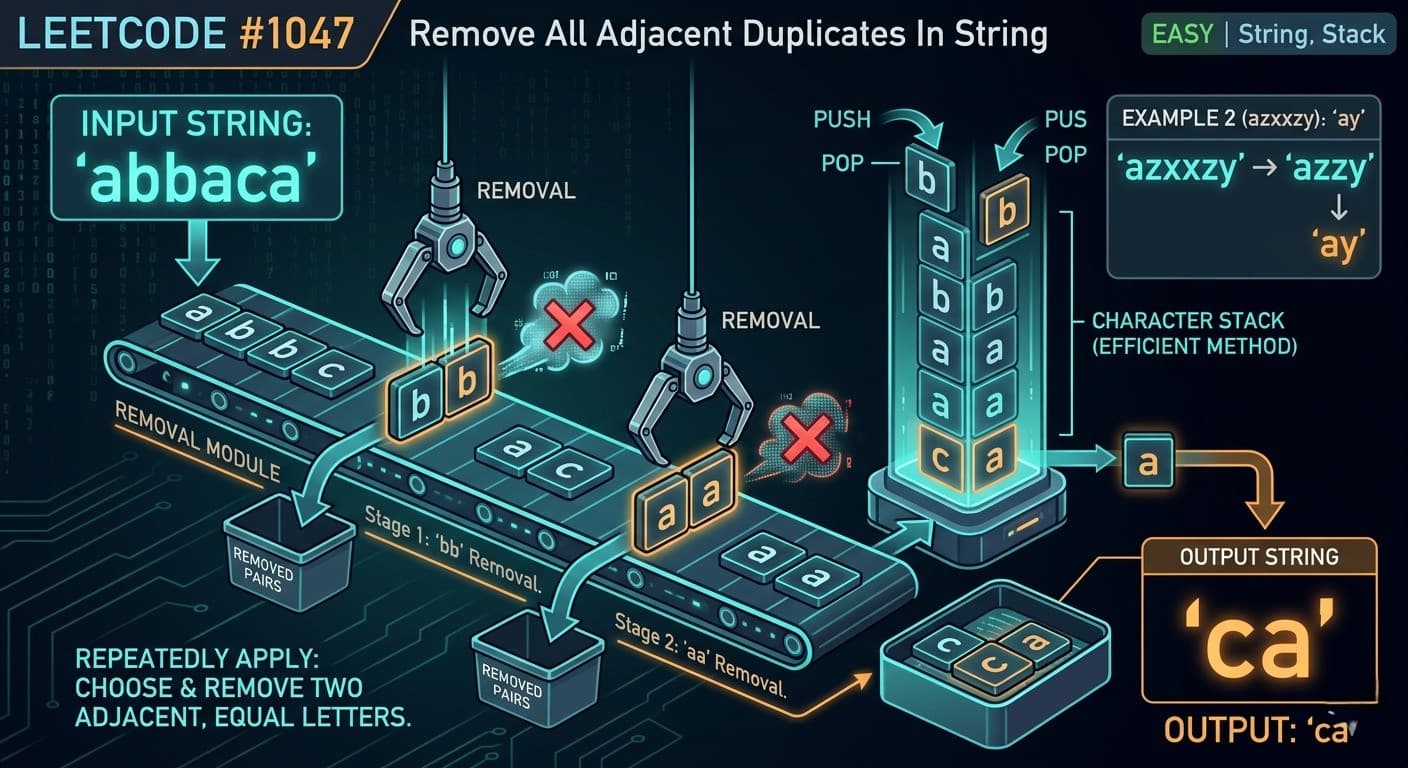
Introduction: What Is LeetCode 1047 Remove All Adjacent Duplicates In String?If you are grinding LeetCode for coding interviews at companies like Google, Amazon, or Microsoft, LeetCode 1047 Remove All Adjacent Duplicates In String is a problem you cannot skip. It is one of the most elegant examples of the stack simulation pattern and appears frequently as a warmup or follow-up question in technical rounds.In this article we will cover everything you need — plain English explanation, real life analogy, 3 Java approaches with dry runs, complexity analysis, common mistakes, FAQs, and similar problems to practice next.Here is the problem link-: Leetcode 1047 What Is the Problem Really Asking?You are given a string. Keep scanning it and whenever you find two same letters sitting next to each other, remove both of them. After removing, the letters around them might now become adjacent and form a new pair — so you keep doing this until no more adjacent duplicates exist.Example walkthrough for "abbaca":"abbaca" → bb are adjacent duplicates → remove → "aaca""aaca" → aa are adjacent duplicates → remove → "ca""ca" → no adjacent duplicates → done!✅ Output: "ca"Real Life Analogy — Think of Popping BubblesImagine a row of colored bubbles. Whenever two bubbles of the same color are next to each other, they pop and disappear. After they pop, the bubbles on either side might now touch each other — and if they are the same color, they pop too! You keep going until no two same-colored bubbles are touching.That chain reaction is exactly what this problem simulates. And the best tool to handle that chain reaction? A stack.Approach 1: Brute Force (Beginner Friendly)The IdeaScan the string repeatedly. Every time you find two adjacent equal characters, remove them. Keep doing this until a full pass finds nothing to remove.public String removeDuplicates(String s) { StringBuilder sb = new StringBuilder(s); boolean found = true; while (found) { found = false; for (int i = 0; i < sb.length() - 1; i++) { if (sb.charAt(i) == sb.charAt(i + 1)) { sb.deleteCharAt(i); sb.deleteCharAt(i); found = true; break; } } } return sb.toString();}This is easy to understand but very slow. For each pair found, you restart the entire scan. With n up to 100,000, this will get Time Limit Exceeded on LeetCode. Use it only to build intuition.Time Complexity: O(n²) — repeated passes over the string Space Complexity: O(n) — StringBuilder storageApproach 2: Stack Based Solution (Classic Interview Approach)The IdeaA stack is perfect here because of one key observation — when you remove a pair, the character that was before the pair is now adjacent to the character after the pair. That is a Last In First Out situation, which is exactly what a stack handles naturally.Algorithm:If the current character matches the top of the stack → pop (they cancel each other)Otherwise → push the current character onto the stackAt the end, the stack contains your final answerpublic String removeDuplicates(String s) { Stack<Character> st = new Stack<>(); StringBuilder sb = new StringBuilder(); for (int i = 0; i < s.length(); i++) { char c = s.charAt(i); if (!st.empty() && c == st.peek()) { st.pop(); // adjacent duplicate found, cancel both } else { st.push(c); } } while (!st.empty()) { sb.append(st.pop()); } return sb.reverse().toString();}Dry Run — "abbaca"We go character by character and check against the top of the stack:a → stack empty, push → stack: [a]b → top is a, not equal, push → stack: [a, b]b → top is b, equal! pop → stack: [a]a → top is a, equal! pop → stack: []c → stack empty, push → stack: [c]a → top is c, not equal, push → stack: [c, a]Stack remaining: [c, a] → reverse → ✅ "ca"Notice how after removing bb, the two as automatically become adjacent and get caught — the stack handles this chain reaction naturally without any extra logic!Time Complexity: O(n) — single pass through the string Space Complexity: O(n) — stack holds up to n charactersApproach 3: StringBuilder as Stack (Optimal Solution) ✅The IdeaThis is your own solution and the best one! Instead of using a separate Stack<Character>, we use StringBuilder itself as a stack:sb.append(c) acts as pushsb.deleteCharAt(sb.length() - 1) acts as popsb.charAt(sb.length() - 1) acts as peekNo extra data structure, no boxing of char into Character objects, and no reversal needed at the end. Clean, fast, and minimal.public String removeDuplicates(String s) { StringBuilder sb = new StringBuilder(); for (int i = 0; i < s.length(); i++) { char c = s.charAt(i); if (sb.length() != 0 && c == sb.charAt(sb.length() - 1)) { sb.deleteCharAt(sb.length() - 1); // adjacent duplicate, remove both } else { sb.append(c); } } return sb.toString();}Dry Run — "azxxzy"a → sb empty, append → "a"z → last char is a, not equal, append → "az"x → last char is z, not equal, append → "azx"x → last char is x, equal! delete → "az"z → last char is z, equal! delete → "a"y → last char is a, not equal, append → "ay"✅ Final Answer: "ay"Again, notice the chain reaction — after xx was removed, z and z became adjacent and got removed too. The StringBuilder handles this perfectly in a single pass!Time Complexity: O(n) — one pass, every character processed exactly once Space Complexity: O(n) — StringBuilder storageWhy StringBuilder Beats Stack in JavaWhen you use Stack<Character> in Java, every char primitive gets auto-boxed into a Character object. That means extra memory allocation for every single character. With StringBuilder, you work directly on the underlying char array — faster and leaner. Plus you skip the reversal step entirely.For an interview, the Stack approach is great for explaining your thought process clearly. But for the final submitted solution, StringBuilder is the way to go.Common Mistakes to AvoidNot checking sb.length() != 0 before peeking If the StringBuilder is empty and you call sb.charAt(sb.length() - 1), you will get a StringIndexOutOfBoundsException. Always guard this check — even if the problem guarantees valid input, it shows clean coding habits.Thinking you need multiple passes Many beginners think you need to scan the string multiple times because of chain reactions. The stack handles chain reactions automatically in a single pass. Trust the process!Forgetting to reverse when using Stack Since a stack gives you characters in reverse order when you pop them, you must call .reverse() at the end. With StringBuilder you do not need this.How This Fits Into the Stack Simulation PatternBy now you might be noticing a theme across multiple problems:LeetCode 3174 Clear Digits — digit acts as backspace, deletes closest left non-digit LeetCode 2390 Removing Stars — star acts as backspace, deletes closest left non-star LeetCode 1047 Remove Adjacent Duplicates — character cancels itself if it matches the top of stackAll three use the exact same StringBuilder-as-stack pattern. The only difference is the condition that triggers a deletion. This is why pattern recognition is the real skill — once you internalize this pattern, you can solve a whole family of problems in minutes.FAQs — People Also AskQ1. What is the best approach for LeetCode 1047 in Java? The StringBuilder approach is the best. It runs in O(n) time, uses O(n) space, requires no extra data structure, and avoids the reversal step needed with a Stack.Q2. Why does a stack work for removing adjacent duplicates? Because whenever you remove a pair, the characters around them become the new neighbors. A stack naturally keeps track of the most recently seen character, so it catches these chain reactions without any extra logic.Q3. What is the time complexity of LeetCode 1047? The optimal solution runs in O(n) time and O(n) space, where n is the length of the input string.Q4. Is LeetCode 1047 asked in coding interviews? Yes, it is commonly asked as a warmup problem or follow-up at companies like Google, Amazon, and Adobe. It tests your understanding of stack-based string manipulation.Q5. What is the difference between LeetCode 1047 and LeetCode 1209? LeetCode 1047 removes pairs of adjacent duplicates. LeetCode 1209 is the harder version — it removes groups of k adjacent duplicates, requiring you to store counts alongside characters in the stack.Similar LeetCode Problems to Practice Next2390. Removing Stars From a String — Medium — star as backspace3174. Clear Digits — Easy — digit as backspace844. Backspace String Compare — Easy — compare two strings after backspaces1209. Remove All Adjacent Duplicates in String II — Medium — harder version with k duplicates735. Asteroid Collision — Medium — stack simulation with collision logicConclusionLeetCode 1047 Remove All Adjacent Duplicates In String is a beautiful problem that teaches you one of the most powerful and reusable patterns in DSA — stack simulation. The moment you spot that a removal can cause a chain reaction of more removals, you know a stack is your best friend.The StringBuilder solution is clean, optimal, and interview-ready. Master it, understand why it works, and you will be able to tackle the entire family of stack simulation problems with confidence.Found this helpful? Share it with friends preparing for coding interviews

LeetCodeJavaStackStringEasy
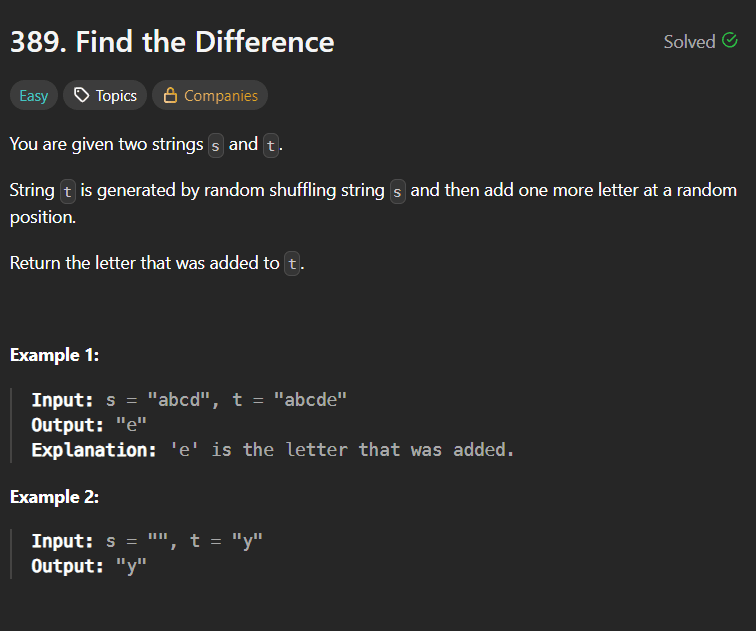
Find the Difference – Smart ASCII Sum Trick (LeetCode 389)

Find the Difference – Smart ASCII Sum Trick (LeetCode 389)

🔗 Problem LinkLeetCode 389 – Find the Difference 👉 https://leetcode.com/problems/find-the-difference/IntroductionThis is a very clever problem.At first glance, you might think:Use a HashMapCount frequenciesCompare both stringsBut there’s a much smarter and cleaner way to solve it using character arithmetic (ASCII values).This problem teaches an important lesson:Sometimes math can replace extra space.Let’s break it down.📌 Problem UnderstandingYou are given two strings:stString t is created by:Shuffling string sAdding one extra character at a random positionYour task:Return the extra character added to t.Example 1Input: s = "abcd" t = "abcde"Output: "e"Example 2Input: s = "" t = "y"Output: "y"🧠 First Intuition (Brute Force Thinking)When solving this for the first time, a common approach would be:Count frequency of characters in sCount frequency of characters in tCompare bothThe one with extra count is the answerThat works in O(n) time and O(26) space.But we can do better.🚀 Smarter Approach – ASCII Sum Trick💡 Key InsightCharacters are stored as integer ASCII values.If:We add all ASCII values of characters in tSubtract all ASCII values of characters in sWhat remains?👉 The ASCII value of the extra character.Because:All matching characters cancel out.Only the added character remains.💻 Your Codeclass Solution { public char findTheDifference(String s, String t) { int tot = 0; for(int i = 0; i < t.length(); i++){ tot += (int)t.charAt(i); } for(int i = 0; i < s.length(); i++){ tot -= (int)s.charAt(i); } return (char)tot; }}🔍 Step-by-Step Explanation1️⃣ Initialize Totalint tot = 0;This will store the running ASCII difference.2️⃣ Add All Characters of ttot += (int)t.charAt(i);We add ASCII values of every character in t.3️⃣ Subtract All Characters of stot -= (int)s.charAt(i);We subtract ASCII values of every character in s.4️⃣ Return Remaining Characterreturn (char)tot;After subtraction, only the extra character’s ASCII value remains.We convert it back to char.🎯 Why This WorksLet’s take example:s = "abcd"t = "abcde"ASCII Sum:t = a + b + c + d + es = a + b + c + dSubtract:(t sum) - (s sum) = eEverything cancels except the extra letter.Simple and powerful.⏱ Complexity AnalysisTime Complexity: O(n)One loop over tOne loop over sSpace Complexity: O(1)No extra data structure used.🔥 Even Smarter Approach – XOR TrickAnother elegant method is using XOR:Why XOR Works?Properties:a ^ a = 0a ^ 0 = aXOR is commutativeIf we XOR all characters in both strings:Matching characters cancel out.Only the extra character remains.XOR Versionclass Solution { public char findTheDifference(String s, String t) { char result = 0; for(char c : s.toCharArray()){ result ^= c; } for(char c : t.toCharArray()){ result ^= c; } return result; }}This is considered the most elegant solution.🏁 Final ThoughtsThis problem teaches:Thinking beyond brute forceUsing mathematical propertiesUnderstanding ASCII representationUsing XOR smartlySometimes the best solution is not about data structures — it’s about recognizing hidden math patterns.

StringMath TrickASCIIBit ManipulationLeetCodeEasy
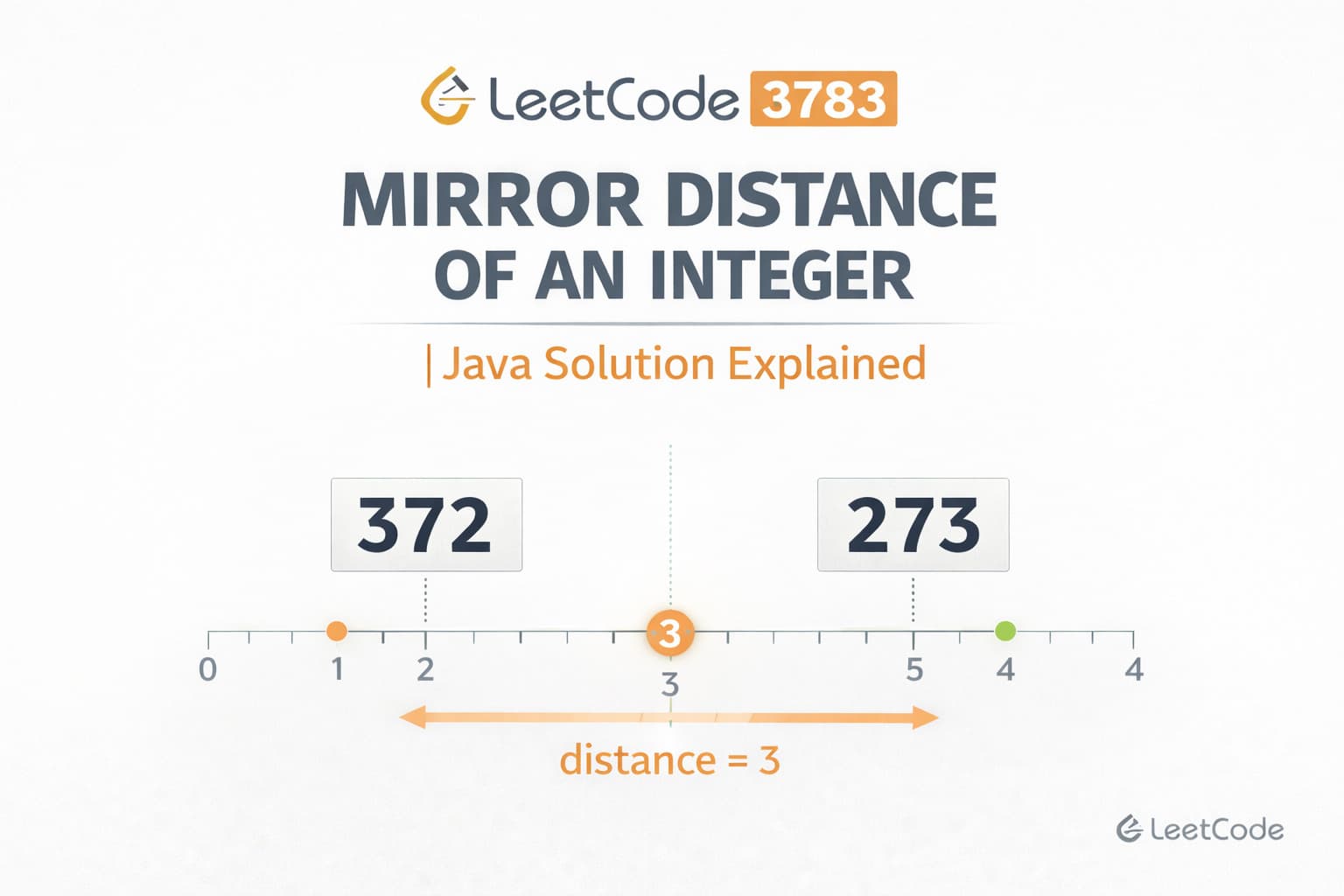
LeetCode 3783 Mirror Distance of an Integer | Java Solution Explained

LeetCode 3783 Mirror Distance of an Integer | Java Solution Explained

IntroductionSome problems test complex algorithms, while others focus on fundamental concepts done right.LeetCode 3783 – Mirror Distance of an Integer falls into the second category.This problem is simple yet important because it builds understanding of:Digit manipulationReversing numbersMathematical operationsIn this article, we’ll break down the problem in a clean and intuitive way, along with an optimized Java solution.🔗 Problem LinkLeetCode: Mirror Distance of an IntegerProblem StatementYou are given an integer n.The mirror distance is defined as:| n - reverse(n) |Where:reverse(n) = number formed by reversing digits of n|x| = absolute value👉 Return the mirror distance.ExamplesExample 1Input:n = 25Output:27Explanation:reverse(25) = 52|25 - 52| = 27Example 2Input:n = 10Output:9Explanation:reverse(10) = 1|10 - 1| = 9Example 3Input:n = 7Output:0Key InsightThe problem consists of two simple steps:1. Reverse the number2. Take absolute differenceIntuitionLet’s take an example:n = 120Step 1: Reverse digits120 → 021 → 21👉 Leading zeros are ignored automatically.Step 2: Compute difference|120 - 21| = 99ApproachStep-by-StepExtract digits using % 10Build reversed numberUse Math.abs() for final resultJava Codeclass Solution { // Function to reverse a number public int reverse(int k) { int rev = 0; while (k != 0) { int dig = k % 10; // get last digit k = k / 10; // remove last digit rev = rev * 10 + dig; // build reversed number } return rev; } public int mirrorDistance(int n) { // Calculate mirror distance return Math.abs(n - reverse(n)); }}Dry RunInput:n = 25Execution:Reverse → 52Difference → |25 - 52| = 27Complexity AnalysisTime ComplexityReversing number → O(d)(d = number of digits)👉 Overall: O(log n)Space Complexity👉 O(1) (no extra space used)Why This WorksDigit extraction ensures correct reversalLeading zeros automatically removedAbsolute difference ensures positive resultEdge Cases to ConsiderSingle digit → result = 0Numbers ending with zero (e.g., 10 → 1)Large numbers (up to 10⁹)Key TakeawaysSimple math problems can test core logicDigit manipulation is a must-know skillAlways handle leading zeros carefullyUse built-in functions like Math.abs() effectivelyReal-World RelevanceConcepts used here are helpful in:Number transformationsPalindrome problemsReverse integer problemsMathematical algorithmsConclusionThe Mirror Distance of an Integer problem is a great example of combining basic operations to form a meaningful solution.While simple, it reinforces important programming fundamentals that are widely used in more complex problems.Frequently Asked Questions (FAQs)1. What happens to leading zeros in reverse?They are automatically removed when stored as an integer.2. Can this be solved using strings?Yes, but integer-based approach is more efficient.3. What is the best approach?Using arithmetic operations (% and /) is optimal.

EasyArrayReverse NumberLeetCodeJava
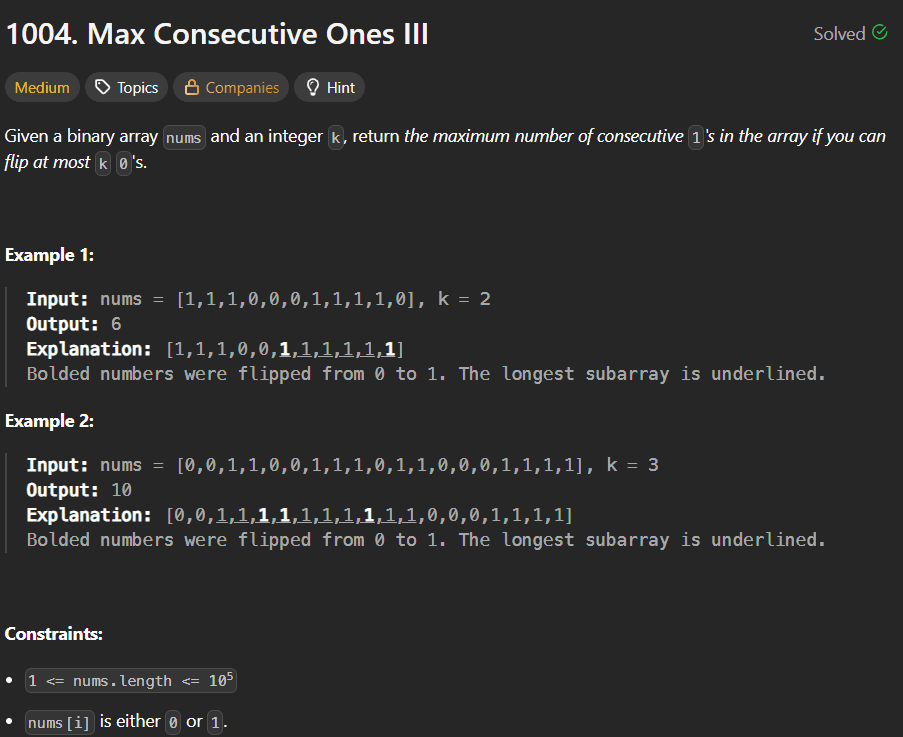
Max Consecutive Ones III – Sliding Window with Limited Flips

Max Consecutive Ones III – Sliding Window with Limited Flips

IntroductionLeetCode 1004: Max Consecutive Ones III is a classic sliding window problem that challenges your understanding of arrays, window manipulation, and frequency counting.The goal is to find the longest subarray of consecutive 1's in a binary array if you are allowed to flip at most K zeros to 1’s.This problem is an excellent example of transforming a brute-force solution into a linear-time efficient approach using the sliding window pattern.If you’d like to try solving the problem first, you can attempt it here: Try the problem on LeetCode: https://leetcode.com/problems/max-consecutive-ones-iii/Problem UnderstandingYou are given:A binary array nums containing only 0's and 1'sAn integer k representing the maximum number of zeros you can flipYou need to return the length of the longest contiguous subarray of 1's after flipping at most k zeros.Examples:Input: nums = [1,1,1,0,0,0,1,1,1,1,0], k = 2Output: 6Explanation: Flip two zeros to get [1,1,1,0,0,1,1,1,1,1,1].Longest consecutive ones = 6.Input: nums = [0,0,1,1,0,0,1,1,1,0,1,1,0,0,0,1,1,1,1], k = 3Output: 10Explanation: Flip three zeros to get longest consecutive ones of length 10.A naive approach would check every possible subarray, flip zeros, and count consecutive ones:Time Complexity: O(n²) → too slow for large arraysInefficient for constraints up to 10⁵ elementsKey Idea: Sliding Window with Zero CountInstead of brute-force, notice that:We only care about how many zeros are in the current windowWe can maintain a sliding window [i, j]Keep a counter z for zeros in the windowExpand the window by moving jIf z exceeds k, shrink the window from the left by moving i and decrementing z for each zero removedIntuition:The window always contains at most k zerosThe length of the window gives the maximum consecutive ones achievable with flipsThis allows linear traversal of the array with O(1) space, making it optimal.Approach (Step-by-Step)Initialize pointers: i = 0, j = 0Initialize z = 0 (zeros count in current window) and co = 0 (max length)Iterate j from 0 to nums.length - 1:If nums[j] == 0, increment zCheck z:If z <= k: window is valid → update co = max(co, j - i + 1)Else: shrink window by moving i until z <= k, decrement z for zeros leaving windowContinue expanding window with jReturn co as the maximum consecutive onesOptimization:Only need one variable for zeros countAvoids recomputing sums or scanning subarrays repeatedlyImplementation (Java)class Solution { public int longestOnes(int[] nums, int k) { int co = 0; // maximum length of valid window int i = 0, j = 0; // window pointers int z = 0; // count of zeros in current window while (j < nums.length) { if (nums[j] == 0) { z++; // increment zeros count } if (z <= k) { co = Math.max(co, j - i + 1); // valid window j++; } else { // shrink window until zeros <= k while (z > k) { if (nums[i] == 0) { z--; } i++; } co = Math.max(co, j - i + 1); j++; } } return co; }}Dry Run ExampleInput:nums = [1,1,1,0,0,0,1,1,1,1,0], k = 2Execution:Window [i, j]Zeros zValid?Max length co[0,0] → [1]0Yes1[0,2] → [1,1,1]0Yes3[0,3] → [1,1,1,0]1Yes4[0,4] → [1,1,1,0,0]2Yes5[0,5] → [1,1,1,0,0,0]3No → shrink i5[3,8] → [0,0,1,1,1,1]2Yes6Output:6Complexity AnalysisTime Complexity: O(n) → Each element is visited at most twice (once when j moves, once when i moves)Space Complexity: O(1) → Only counters and pointers usedEdge Cases Consideredk = 0 → cannot flip any zeros, just count consecutive onesArray with all 1’s → return full lengthArray with all 0’s → return min(k, length)Single element arrays → works correctlySliding Window Pattern ImportanceThis problem is a perfect example of the sliding window pattern:Use a window to track a condition (max zeros allowed)Expand and shrink dynamically based on constraintsEfficiently computes maximum/minimum contiguous subarray lengthsIt also demonstrates counting with limited violations – a key interview concept.ConclusionBy tracking zeros with a sliding window, we convert a naive O(n²) problem into O(n) linear time.Understanding this pattern allows you to solve:Max consecutive ones/zeros problemsLongest substring/subarray with constraintsSubarray problems with limited replacements or violationsOnce mastered, this approach applies to many binary array and string problems efficiently.

SlidingWindowBinaryArrayLeetCodeMedium
Ai Assistant Kas