Search Blogs

Showing results for "Rotated Sorted Array"

Found 4 results

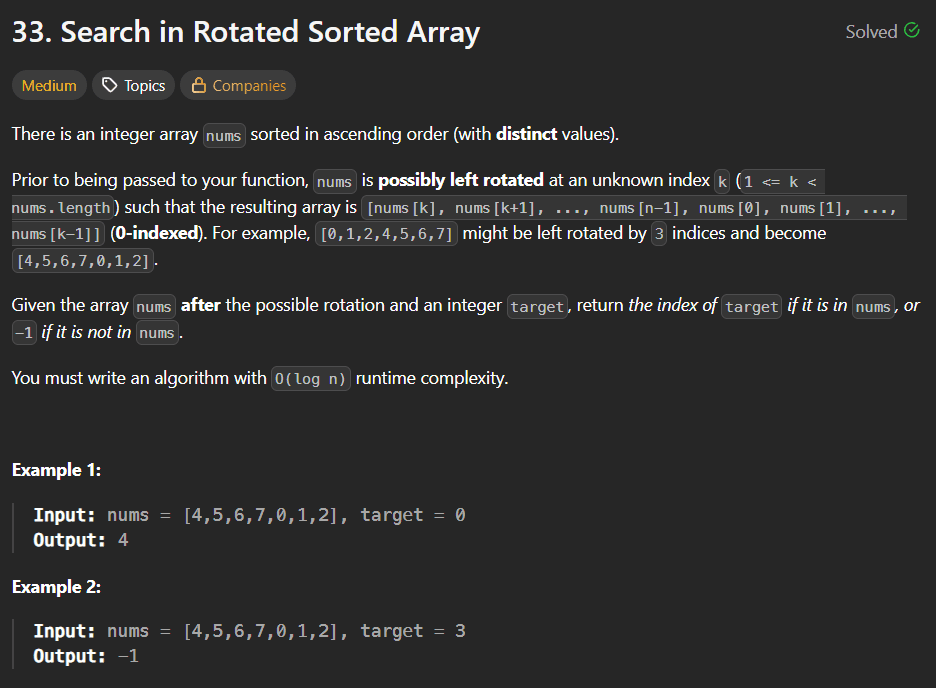
Search in Rotated Sorted Array – Binary Search Explained with Java Solution (LeetCode 33)

Search in Rotated Sorted Array – Binary Search Explained with Java Solution (LeetCode 33)

Try the QuestionBefore reading the solution, try solving the problem yourself:👉 https://leetcode.com/problems/search-in-rotated-sorted-array/Attempting the problem first helps build strong algorithmic intuition, which is extremely valuable during coding interviews.Problem StatementYou are given an integer array nums that was originally sorted in ascending order with distinct elements.Example of a sorted array:[0,1,2,4,5,6,7]Before the array is provided to the function, it may have been rotated at some pivot index k.After rotation, the array structure becomes:[nums[k], nums[k+1], ..., nums[n-1], nums[0], nums[1], ..., nums[k-1]]For example:Original Array[0,1,2,4,5,6,7]Rotated by 3 positions[4,5,6,7,0,1,2]You are also given an integer target.The goal is to return the index of the target element in the array.If the element does not exist, return:-1Important ConstraintThe algorithm must run in O(log n) time complexity, which strongly suggests using Binary Search.Example WalkthroughExample 1Inputnums = [4,5,6,7,0,1,2]target = 0Output4Explanation:0 exists at index 4Example 2Inputnums = [4,5,6,7,0,1,2]target = 3Output-1Explanation:3 does not exist in the arrayExample 3Inputnums = [1]target = 0Output-1Understanding the Core ChallengeIf the array were fully sorted, the problem would be straightforward because binary search could directly be applied.Example:[1,2,3,4,5,6,7]However, due to rotation:[4,5,6,7,0,1,2]the array is no longer globally sorted.But an important observation makes the problem solvable.Key ObservationEven after rotation:At least one half of the array is always sorted.For example:[4,5,6,7,0,1,2] Left part → sorted Right part → sortedThis property allows the use of binary search with additional conditions.Approach 1 — Linear Scan (Brute Force)The simplest method is to iterate through the entire array and check each element.AlgorithmTraverse the array from start to end.Compare every element with the target.Return the index if found.Codefor(int i = 0; i < nums.length; i++){ if(nums[i] == target){ return i; }}return -1;Time ComplexityO(n)Space ComplexityO(1)Although simple, this solution does not satisfy the required O(log n) complexity.Approach 2 — Modified Binary SearchA better solution uses binary search with sorted half detection.IdeaAt every step:Calculate the middle index.Determine which half of the array is sorted.Check if the target lies inside that sorted half.Adjust the search range accordingly.Implementationpublic int search(int[] nums, int target) { int l = 0; int r = nums.length - 1; while(l <= r){ int mid = l + (r - l) / 2; if(nums[mid] == target){ return mid; } // left half sorted if(nums[l] <= nums[mid]){ if(nums[l] <= target && target < nums[mid]){ r = mid - 1; }else{ l = mid + 1; } } // right half sorted else{ if(nums[mid] < target && target <= nums[r]){ l = mid + 1; }else{ r = mid - 1; } } } return -1;}Time ComplexityO(log n)Space ComplexityO(1)This is the most common interview solution.Approach 3 — Find Rotation Point Then Apply Binary SearchAnother elegant strategy is to first locate the minimum element in the rotated array, which represents the rotation index (pivot).Once the pivot is known, the array can be logically split into two sorted subarrays.Example:[4,5,6,7,0,1,2] ^ pivotTwo sorted sections exist:[4,5,6,7][0,1,2]After identifying the pivot:Decide which part may contain the target.Apply standard binary search on that portion.Step 1 — Finding the Minimum Element (Rotation Pivot)The smallest element indicates where the rotation happened.Function to Find Minimum Valuepublic int findMinIndex(int[] nums){ int l = 0; int r = nums.length - 1; while(l < r){ int mid = l + (r - l) / 2; if(nums[mid] > nums[r]){ l = mid + 1; }else{ r = mid; } } return l;}Why This WorksIf:nums[mid] > nums[r]the minimum element must be on the right side.Otherwise, it lies on the left side (including mid).Step 2 — Standard Binary SearchAfter determining which half contains the target, a normal binary search is applied.public int binarySearch(int[] nums, int l, int r, int target){ while(l <= r){ int mid = l + (r - l) / 2; if(nums[mid] == target){ return mid; } else if(nums[mid] < target){ l = mid + 1; } else{ r = mid - 1; } } return -1;}Complete Solution (Pivot + Binary Search)class Solution { public int findMinIndex(int[] nums){ int l = 0; int r = nums.length - 1; while(l < r){ int mid = l + (r - l) / 2; if(nums[mid] > nums[r]){ l = mid + 1; }else{ r = mid; } } return l; } public int binarySearch(int[] nums, int l, int r, int target){ while(l <= r){ int mid = l + (r - l) / 2; if(nums[mid] == target){ return mid; } else if(nums[mid] < target){ l = mid + 1; } else{ r = mid - 1; } } return -1; } public int search(int[] nums, int target) { int pivot = findMinIndex(nums); if(nums[pivot] <= target && target <= nums[nums.length - 1]){ return binarySearch(nums, pivot, nums.length - 1, target); } return binarySearch(nums, 0, pivot - 1, target); }}Time ComplexityFinding pivot:O(log n)Binary search:O(log n)Total complexity:O(log n)Space ComplexityO(1)No additional memory is used.Key Takeaways✔ The array is sorted but rotated✔ A rotation creates two sorted sections✔ Binary search can still be applied✔ Either detect the sorted half directly or locate the pivot first✔ Both optimized approaches achieve O(log n) complexityFinal ThoughtsThis problem is a classic binary search variation frequently asked in coding interviews. It evaluates the ability to:Recognize structural patterns in arraysAdapt binary search to non-standard conditionsMaintain optimal algorithmic complexityUnderstanding this pattern also helps solve related problems such as:Find Minimum in Rotated Sorted ArraySearch in Rotated Sorted Array IIFind Rotation Count in ArrayMastering these concepts significantly strengthens binary search problem-solving skills for technical interviews.

Binary SearchJavaRotated Sorted ArrayLeetCodeMedium
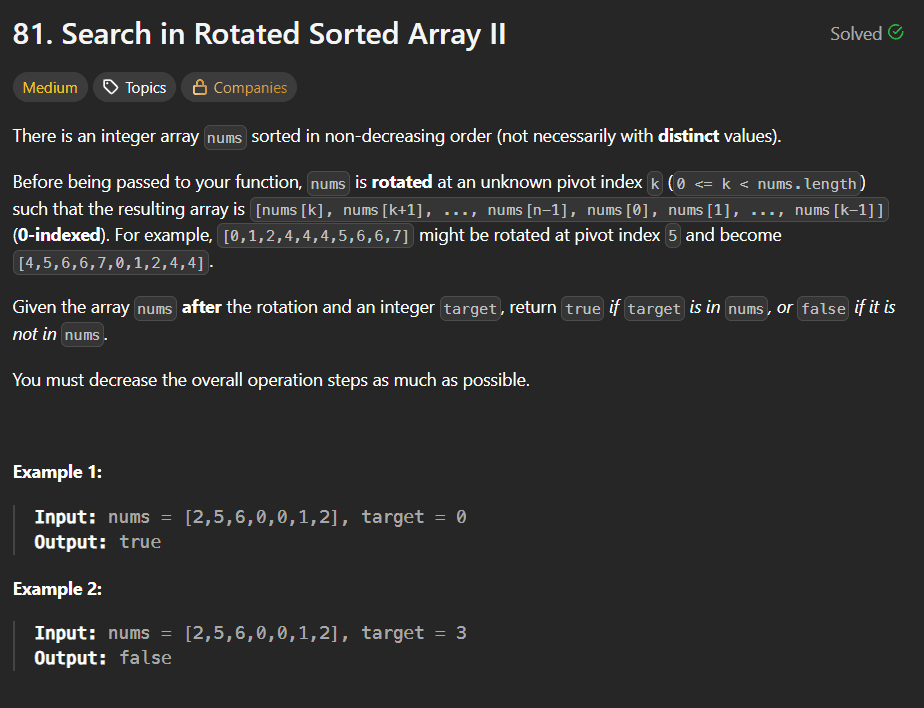
Search in Rotated Sorted Array II – Binary Search with Duplicates Explained (LeetCode 81)

Search in Rotated Sorted Array II – Binary Search with Duplicates Explained (LeetCode 81)

Try the QuestionBefore reading the explanation, try solving the problem yourself:👉 https://leetcode.com/problems/search-in-rotated-sorted-array-ii/Practicing the problem first helps develop stronger problem-solving intuition, especially for binary search variations.Problem StatementYou are given an integer array nums that is sorted in non-decreasing order.Example of a sorted array:[0,1,2,4,4,4,5,6,6,7]Before being passed to your function, the array may be rotated at some pivot index k.After rotation, the structure becomes:[nums[k], nums[k+1], ..., nums[n-1], nums[0], nums[1], ..., nums[k-1]]Example:Original array[0,1,2,4,4,4,5,6,6,7]Rotated at index 5[4,5,6,6,7,0,1,2,4,4]You are also given an integer target.Your task is to determine:Return true if the target exists in the arrayReturn false if the target does not existThe goal is to minimize the number of operations, which suggests using Binary Search.Example WalkthroughExample 1Inputnums = [2,5,6,0,0,1,2]target = 0OutputtrueExplanation:0 exists in the arrayExample 2Inputnums = [2,5,6,0,0,1,2]target = 3OutputfalseExplanation:3 does not exist in the arrayUnderstanding the Core ChallengeThis problem is very similar to the classic problem:Search in Rotated Sorted Array (LeetCode 33).However, there is an important difference.Difference Between the Two ProblemsProblemArray ValuesRotated Sorted ArrayAll elements are distinctRotated Sorted Array IIArray may contain duplicatesDuplicates introduce ambiguity during binary search.Why Duplicates Make the Problem HarderIn the previous problem, we relied on this rule:If nums[left] <= nums[mid]→ left half is sortedBut duplicates can break this assumption.Example:nums = [1,0,1,1,1]If:left = 0mid = 2right = 4Then:nums[left] = 1nums[mid] = 1nums[right] = 1Here we cannot determine which half is sorted.This is the main complication introduced by duplicates.Key Idea to Handle DuplicatesWhen the values at left, mid, and right are the same, the algorithm cannot decide which half is sorted.To resolve this situation, we shrink the search space:left++right--This gradually removes duplicate values and allows binary search to continue.Modified Binary Search StrategyThe algorithm works as follows:Step 1Calculate the middle index.Step 2If the middle element equals the target:return trueStep 3If duplicates block decision-making:nums[left] == nums[mid] == nums[right]Then move both pointers inward:left++right--Step 4Otherwise, determine which half is sorted and apply normal binary search logic.Java Implementationclass Solution { public boolean search(int[] nums, int target) { int l = 0; int r = nums.length - 1; while (l <= r) { int mid = l + (r - l) / 2; if (nums[mid] == target) return true; // Handle duplicates if (nums[l] == nums[mid] && nums[mid] == nums[r]) { l++; r--; } // Left half sorted else if (nums[l] <= nums[mid]) { if (nums[l] <= target && target < nums[mid]) { r = mid - 1; } else { l = mid + 1; } } // Right half sorted else { if (nums[mid] < target && target <= nums[r]) { l = mid + 1; } else { r = mid - 1; } } } return false; }}Step-by-Step ExampleArray:[2,5,6,0,0,1,2]target = 0Iteration 1mid = 6value = 0Target found immediately.return trueTime ComplexityBest CaseO(log n)When duplicates do not interfere with binary search decisions.Worst CaseO(n)When many duplicate values force the algorithm to shrink the search space one element at a time.Example worst case:[1,1,1,1,1,1,1,1,1]Binary search cannot divide the array effectively.Space ComplexityO(1)The algorithm only uses a few variables and does not require extra memory.Follow-Up: How Do Duplicates Affect Runtime?Without duplicates, binary search always reduces the search space by half.Time Complexity → O(log n)With duplicates, we sometimes cannot determine which half is sorted.In such cases, we shrink the search space linearly:left++right--This may degrade performance to:Worst Case → O(n)However, in most practical cases the algorithm still performs close to logarithmic time.Key Takeaways✔ The array is sorted but rotated✔ Duplicates introduce ambiguity in binary search✔ Special handling is required when nums[left] == nums[mid] == nums[right]✔ The algorithm combines binary search with duplicate handling✔ Worst-case complexity may degrade to O(n)Final ThoughtsThis problem is a natural extension of the rotated sorted array search problem. It tests your ability to adapt binary search to more complex conditions.Understanding this pattern is valuable because similar techniques appear in many interview problems involving:Rotated arraysBinary search edge casesHandling duplicates in sorted data structuresMastering this approach strengthens both algorithmic thinking and interview preparation.

LeetCodeBinary SearchRotated Sorted ArrayJavaMedium
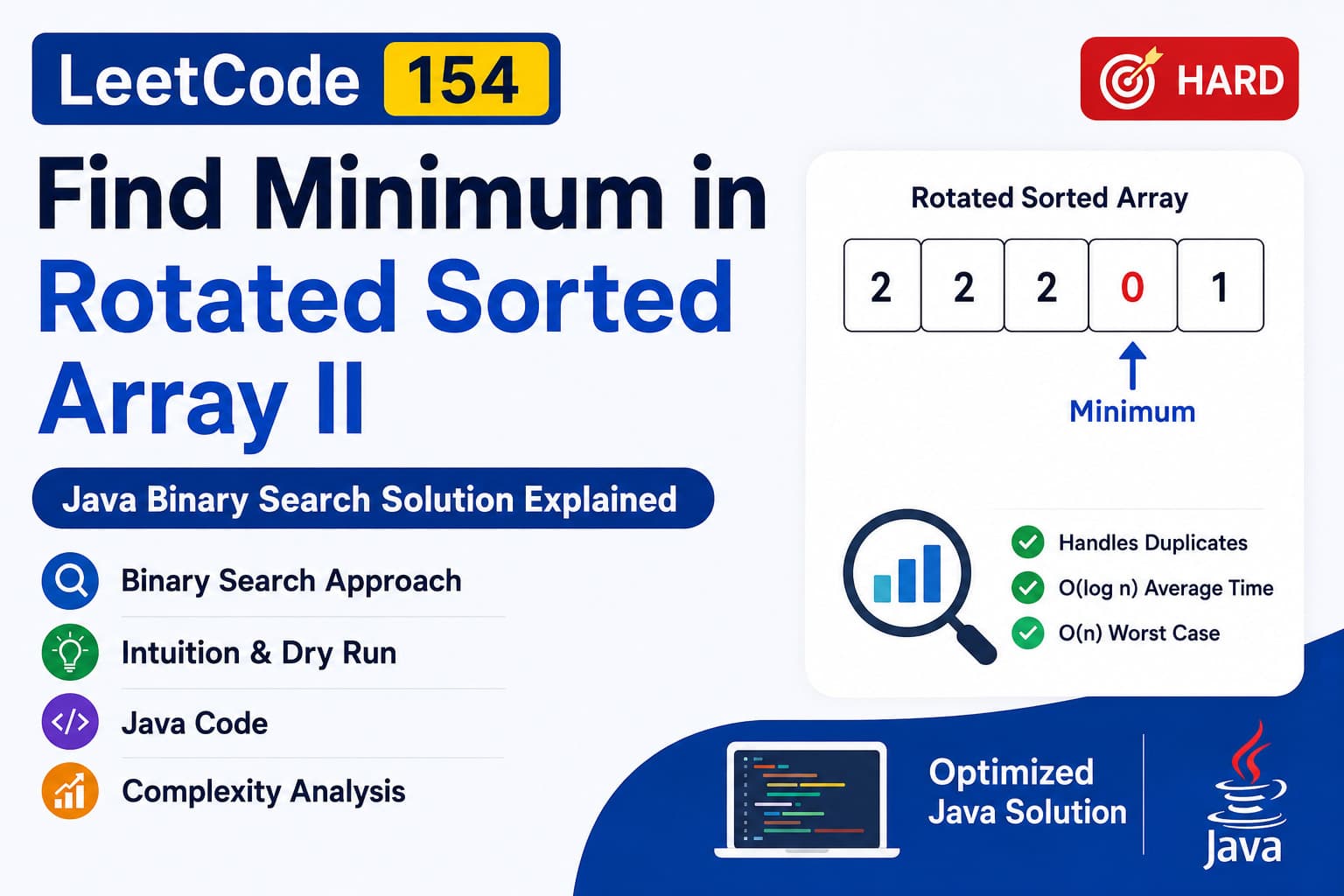
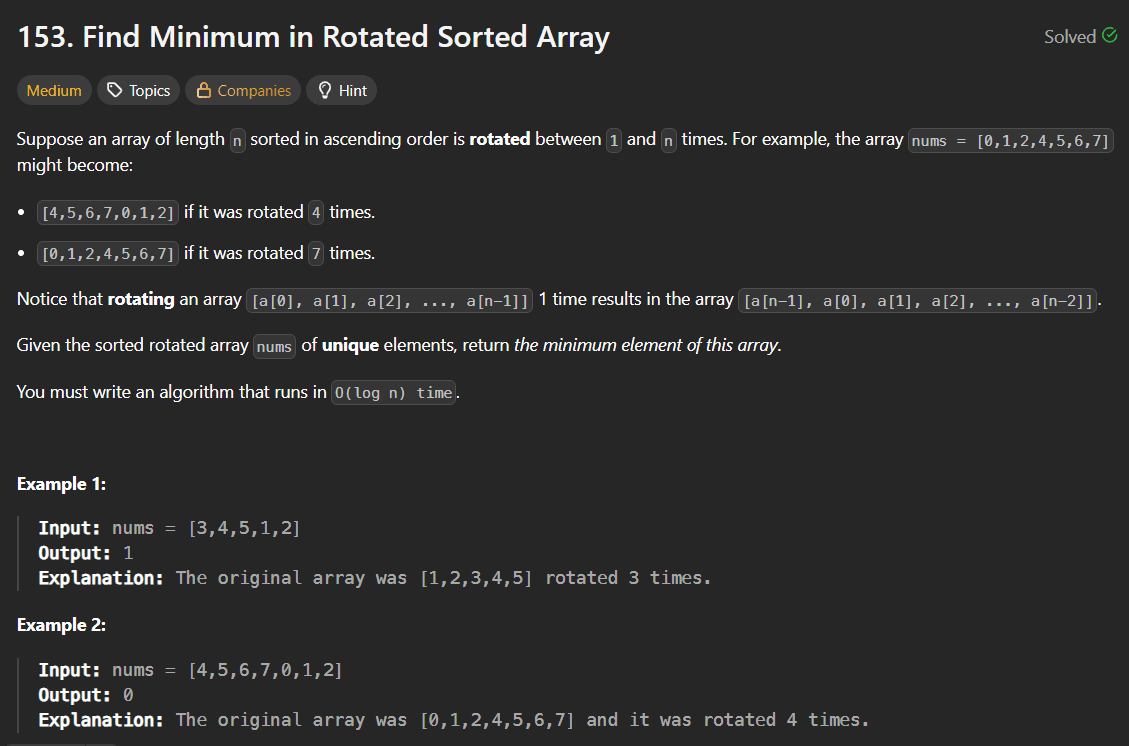
Find Minimum in Rotated Sorted Array – Binary Search Explained | LeetCode Medium 153

Find Minimum in Rotated Sorted Array – Binary Search Explained | LeetCode Medium 153

🔗 Try This Problem FirstPlatform: LeetCodeProblem Number: 153👉 Practice here: https://leetcode.com/problems/find-minimum-in-rotated-sorted-array/🧠 Problem UnderstandingYou are given a sorted array that has been rotated between 1 and n times.Example:Original sorted array:[0,1,2,4,5,6,7]After rotation:[4,5,6,7,0,1,2]Your task: 👉 Return the minimum element from this rotated array. 👉 Time complexity must be O(log n). 👉 All elements are unique.🔍 Key ObservationIn a rotated sorted array:The array is divided into two sorted halves.The minimum element is the pivot point where rotation happened.One half will always be sorted.We can use Binary Search to find where the sorted order breaks.Example:[4,5,6,7,0,1,2] ↑ Minimum🚀 Approach 1: Brute Force (Not Allowed by Constraint)IdeaScan entire array and track minimum.int min = nums[0];for(int i = 1; i < nums.length; i++){ min = Math.min(min, nums[i]);}return min;ComplexityTime: O(n)Space: O(1)❌ Not acceptable because problem requires O(log n).🚀 Approach 2: Binary Search (Optimal – O(log n))💡 Core IdeaCompare nums[mid] with nums[right].There are only two possibilities:Case 1: nums[mid] > nums[right]Minimum is in right half.[4,5,6,7,0,1,2]mid rMove left pointer:l = mid + 1Case 2: nums[mid] <= nums[right]Minimum is in left half including mid.[4,5,6,7,0,1,2]mid rMove right pointer:r = mid✅ Optimized Codeclass Solution { public int findMin(int[] nums) { int l = 0; int r = nums.length - 1; while (l < r) { int mid = l + (r - l) / 2; if (nums[mid] > nums[r]) { l = mid + 1; } else { r = mid; } } return nums[r]; }}📊 Dry RunInput:nums = [4,5,6,7,0,1,2]Steplrmidnums[mid]Action106377 > 2 → l = 4246511 <= 2 → r = 5345400 <= 1 → r = 4Stop44--Return nums[4]✅ Output = 0🧩 Why This WorksIf middle element is greater than rightmost, rotation point is to the right.If middle element is smaller than or equal to rightmost, minimum is on the left side.We continuously shrink search space until l == r.That position holds the minimum element.⏱ Time & Space ComplexityMetricValueTime ComplexityO(log n)Space ComplexityO(1)Because:We eliminate half of the array each iteration.No extra space is used.⚠️ Important Edge CasesArray size = 1[10] → 10Already sorted (no visible rotation)[11,13,15,17] → 11Rotation at last position[1,2,3,4,5] → 1🎯 Interview InsightThis problem teaches:Modified Binary SearchIdentifying sorted halvesHandling rotated arraysUnderstanding pivot logicThis is a very common FAANG interview question and often appears in variations like:Search in Rotated Sorted ArrayFind Peak ElementMinimum in Rotated Array with Duplicates🏁 Final TakeawayBrute force works but violates constraint.Binary search is the correct approach.Compare mid with right.Shrink search space until pointers meet.Return nums[l] or nums[r].

LeetcodeMediumBinary Search
Mastering Binary Search – LeetCode 704 Explained

Mastering Binary Search – LeetCode 704 Explained

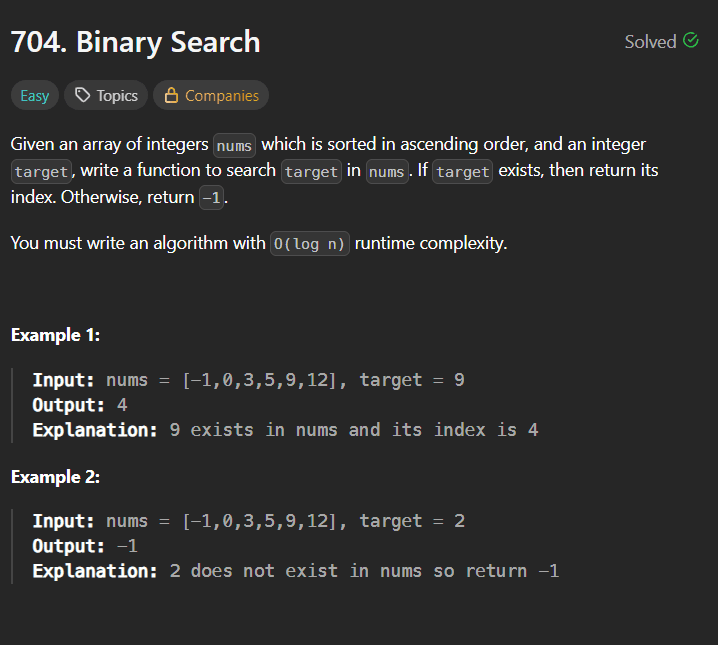
IntroductionBinary Search is one of the most fundamental and powerful algorithms in computer science. If you're preparing for coding interviews, mastering Binary Search is absolutely essential.In this blog, we’ll break down LeetCode 704 – Binary Search, explain the algorithm in detail, walk through your Java implementation, analyze complexity, and recommend additional problems to strengthen your understanding.You can try this problem -: Problem Link📌 Problem OverviewYou are given:A sorted array of integers nums (ascending order)An integer targetYour task is to return the index of target if it exists in the array. Otherwise, return -1.Example 1Input: nums = [-1,0,3,5,9,12], target = 9Output: 4Example 2Input: nums = [-1,0,3,5,9,12], target = 2Output: -1Constraints1 <= nums.length <= 10⁴All integers are uniqueThe array is sorted in ascending orderRequired Time Complexity: O(log n)🚀 Understanding the Binary Search AlgorithmBinary Search works only on sorted arrays.Instead of checking each element one by one (like Linear Search), Binary Search:Finds the middle element.Compares it with the target.Eliminates half of the search space.Repeats until the element is found or the search space is empty.Why is it Efficient?Every iteration cuts the search space in half.If the array size is n, the number of operations becomes:log₂(n)This makes it extremely efficient compared to linear search (O(n)).🧠 Step-by-Step AlgorithmInitialize two pointers:low = 0high = nums.length - 1While low <= high:Calculate middle index:mid = low + (high - low) / 2If nums[mid] == target, return midIf target > nums[mid], search right half → low = mid + 1Else search left half → high = mid - 1If loop ends, return -1💻 Your Java Code ExplainedHere is your implementation:class Solution {public int search(int[] nums, int target) {int high = nums.length-1;int low = 0;while(low <= high){int mid = low+(high-low)/2;if(target == nums[mid] ){return mid;}else if(target > nums[mid]){low = mid+1;}else{high = mid-1;}}return -1;}}🔍 Code Breakdown1️⃣ Initialize Boundariesint high = nums.length - 1;int low = 0;You define the search space from index 0 to n-1.2️⃣ Loop Conditionwhile(low <= high)The loop continues as long as there is a valid search range.3️⃣ Safe Mid Calculationint mid = low + (high - low) / 2;This is preferred over:(low + high) / 2Why?Because (low + high) may cause integer overflow in large arrays.Your approach prevents that.4️⃣ Comparison Logicif(target == nums[mid])If found → return index.else if(target > nums[mid])low = mid + 1;Search in right half.elsehigh = mid - 1;Search in left half.5️⃣ Not Found Casereturn -1;If the loop finishes without finding the target.⏱ Time and Space ComplexityTime Complexity: O(log n)Each iteration halves the search space.Space Complexity: O(1)No extra space used — purely iterative.🔥 Why This Problem Is ImportantLeetCode 704 is:The foundation of all Binary Search problemsA template questionFrequently asked in interviewsRequired to understand advanced problems like:Search in Rotated Sorted ArrayFind First and Last PositionPeak ElementBinary Search on Answer📚 Recommended Binary Search Practice ProblemsAfter solving this, practice these in order:🟢 Easy35. Search Insert Position69. Sqrt(x)278. First Bad Version🟡 Medium34. Find First and Last Position of Element in Sorted Array33. Search in Rotated Sorted Array74. Search a 2D Matrix875. Koko Eating Bananas (Binary Search on Answer)🔴 Advanced Pattern Practice1011. Capacity To Ship Packages Within D Days410. Split Array Largest SumThese will help you master:Lower bound / upper boundBinary search on monotonic functionsSearching in rotated arraysSearching in 2D matricesBinary search on answer pattern🎯 Final ThoughtsBinary Search is not just a single algorithm — it’s a pattern.If you truly understand:How the search space shrinksWhen to move left vs rightHow to calculate mid safelyLoop conditions (low <= high vs low < high)You can solve 50+ interview problems easily.LeetCode 704 is the perfect starting point.Master this template, and you unlock an entire category of problems.

Binary SearchLeetCodeEasy
Ai Assistant Kas