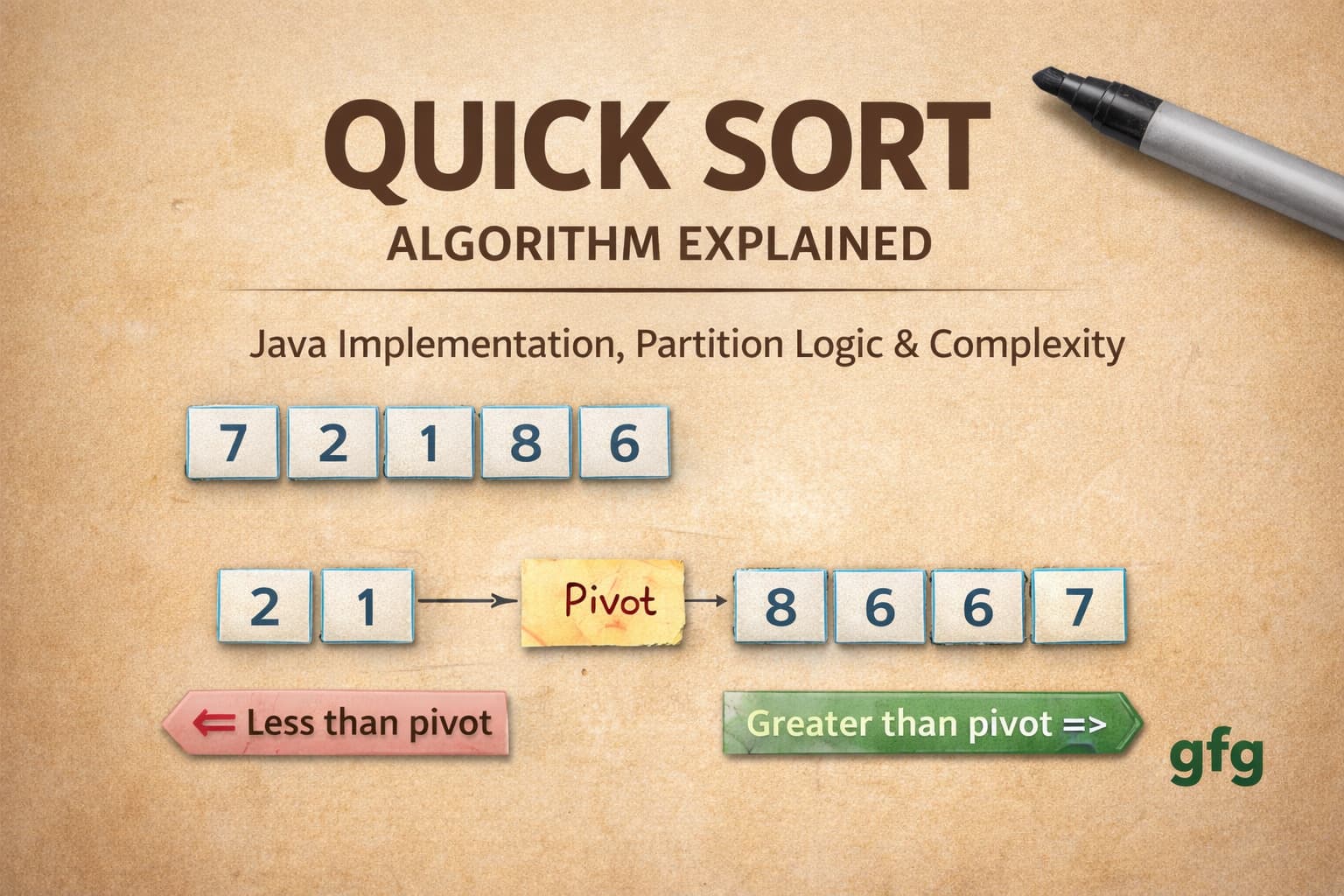
Quick Sort Algorithm Explained | Java Implementation, Partition Logic & Complexity
IntroductionQuick Sort is one of the most powerful and widely used sorting algorithms in computer science. It follows the Divide and Conquer approach and is known for its excellent average-case performance.What makes Quick Sort special is:It sorts in-place (no extra array required)It is faster in practice than many O(n log n) algorithms like Merge SortIt is heavily used in real-world systems and librariesIn this article, we’ll go deep into:Intuition behind Quick SortPartition logic (most important part)Step-by-step dry runJava implementation with commentsTime complexity analysisCommon mistakes and optimizations🔗 Problem LinkGeeksforGeeks: Quick SortProblem StatementGiven an array arr[], sort it in ascending order using Quick Sort.Requirements:Use Divide and ConquerChoose pivot elementPlace pivot in correct positionElements smaller → left sideElements greater → right sideExamplesExample 1Input:arr = [4, 1, 3, 9, 7]Output:[1, 3, 4, 7, 9]Example 2Input:arr = [2, 1, 6, 10, 4, 1, 3, 9, 7]Output:[1, 1, 2, 3, 4, 6, 7, 9, 10]Core Idea of Quick SortPick a pivot → Place it correctly → Recursively sort left & right🔥 Key Insight (Partition is Everything)Quick Sort depends entirely on partitioning:👉 After partition:Pivot is at its correct sorted positionLeft side → smaller elementsRight side → larger elementsIntuition (Visual Understanding)Consider:[4, 1, 3, 9, 7]Step 1: Choose PivotLet’s say pivot = 4Step 2: Rearrange Elements[1, 3] 4 [9, 7]Now:Left → smallerRight → largerStep 3: Apply RecursivelyLeft: [1, 3]Right: [9, 7]Final result:[1, 3, 4, 7, 9]Partition Logic (Most Important)Your implementation uses:Pivot = first elementTwo pointers:i → moves forwardj → moves backwardJava Codeclass Solution { public void quickSort(int[] arr, int low, int high) { // Base case: if array has 1 or 0 elements if (low < high) { // Partition array and get pivot index int pivotInd = partition(arr, low, high); // Sort left part quickSort(arr, low, pivotInd - 1); // Sort right part quickSort(arr, pivotInd + 1, high); } } // Function to swap two elements void swap(int[] arr, int i, int j) { int temp = arr[i]; arr[i] = arr[j]; arr[j] = temp; } private int partition(int[] arr, int low, int high) { int pivot = arr[low]; // choosing first element as pivot int i = low + 1; // start from next element int j = high; // start from end while (i <= j) { // Move i forward until element > pivot while (i <= high && arr[i] <= pivot) { i++; } // Move j backward until element <= pivot while (j >= low && arr[j] > pivot) { j--; } // Swap if pointers haven't crossed if (i < j) { swap(arr, i, j); } } // Place pivot at correct position swap(arr, low, j); return j; // return pivot index }}Step-by-Step Dry RunInput:[4, 1, 3, 9, 7]Execution:Pivot = 4i → moves until element > 4j → moves until element ≤ 4Swaps happen → pivot placed correctlyFinal partition:[1, 3, 4, 9, 7]Complexity AnalysisTime ComplexityCaseComplexityBest CaseO(n log n)Average CaseO(n log n)Worst CaseO(n²)Why Worst Case Happens?When array is:Already sortedReverse sortedPivot always becomes smallest/largest.Space ComplexityO(log n) (recursion stack)❌ Common MistakesWrong partition logicInfinite loops in while conditionsIncorrect pivot placementNot handling duplicates properly⚡ Optimizations1. Random PivotAvoid worst-case:int pivotIndex = low + new Random().nextInt(high - low + 1);swap(arr, low, pivotIndex);2. Median of ThreeChoose better pivot:median(arr[low], arr[mid], arr[high])Quick Sort vs Merge SortFeatureQuick SortMerge Sort link to get moreSpaceO(log n)O(n)SpeedFaster (practical)StableWorst CaseO(n²)O(n log n)Why Quick Sort is PreferredCache-friendlyIn-place sortingFaster in real-world scenariosKey TakeawaysPartition is the heart of Quick SortPivot must be placed correctlyRecursion splits problem efficientlyAvoid worst case using random pivotWhen to Use Quick SortLarge arraysMemory constraints (in-place)Performance-critical applicationsConclusionQuick Sort is one of the most efficient and practical sorting algorithms. Mastering its partition logic is crucial for solving advanced problems and performing well in coding interviews.Understanding how pointers move and how pivot is placed will make this algorithm intuitive and powerful.Frequently Asked Questions (FAQs)1. Is Quick Sort stable?No, it is not stable.2. Why is Quick Sort faster than Merge Sort?Because it avoids extra space and is cache-efficient.3. What is the most important part?👉 Partition logic