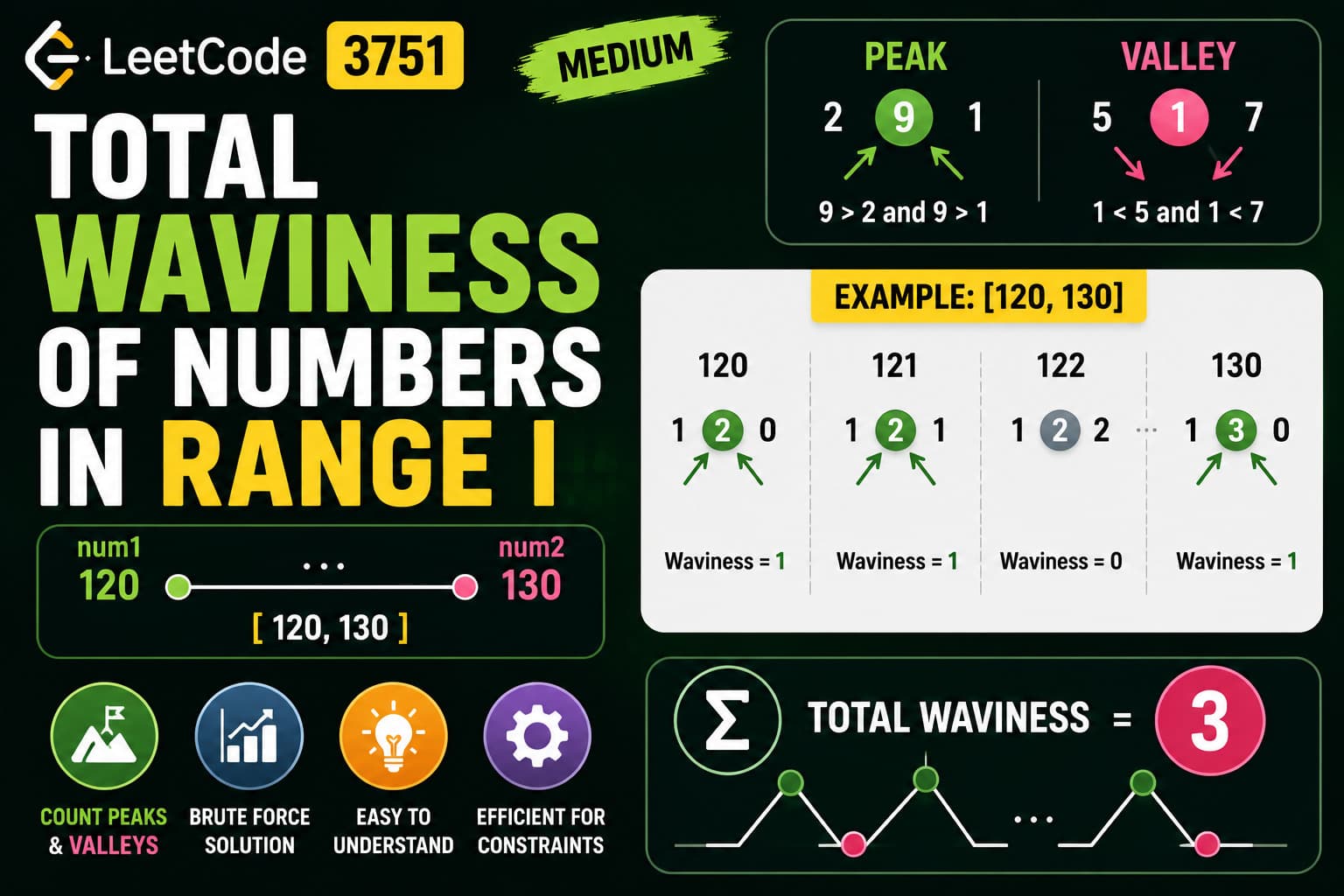
LeetCode 3751: Total Waviness of Numbers in Range I – Java Solution with Dry Run and Explanation
IntroductionLeetCode 3751 introduces an interesting digit-based pattern problem where we calculate the total waviness of numbers inside a given range.This problem combines:Digit traversalPattern recognitionPeaks and valleys logicString manipulationBrute force iterationThe problem is straightforward once we clearly understand how peaks and valleys work.Problem StatementYou are given two integers:num1 and num2representing the inclusive range:[num1, num2]For every number:A digit is called a peak if it is strictly greater than both neighbors.A digit is called a valley if it is strictly smaller than both neighbors.The first and last digits can never be peaks or valleys.Return the total waviness across all numbers in the range.ExampleInputnum1 = 120num2 = 130Output3ExplanationNumbers contributing to waviness:120 → 2 is a peak → waviness = 1121 → 2 is a peak → waviness = 1130 → 3 is a peak → waviness = 1Total:1 + 1 + 1 = 3Understanding Peaks and ValleysPeak ConditionA digit is a peak if:digit > left neighborANDdigit > right neighborExample:484Here:8 > 48 > 4So 8 is a peak.Valley ConditionA digit is a valley if:digit < left neighborANDdigit < right neighborExample:202Here:0 < 20 < 2So 0 is a valley.Key ObservationWe only need to check:index 1 to length-2because:First digit has no left neighborLast digit has no right neighborIntuitionThe simplest way:Iterate through every number in the rangeConvert number into charactersCheck each middle digitCount peaks and valleysAdd to final answerSince constraints are small:num2 <= 10^5a brute force approach works efficiently.Java Solutionclass Solution { public int totalWaviness(int num1, int num2) { int ans = 0; if(num1 == num2) { int temp = num1; String c = Integer.toString(temp); char[] arr = c.toCharArray(); for(int i = 1; i < arr.length - 1; i++) { if((arr[i] < arr[i - 1] && arr[i] < arr[i + 1]) || (arr[i] > arr[i - 1] && arr[i] > arr[i + 1])) { ans++; } } return ans; } for(int i = num1; i <= num2; i++) { String c = Integer.toString(i); char[] carr = c.toCharArray(); for(int j = 1; j < carr.length - 1; j++) { if((carr[j] < carr[j - 1] && carr[j] < carr[j + 1]) || (carr[j] > carr[j - 1] && carr[j] > carr[j + 1])) { ans++; } } } return ans; }}Step-by-Step ExplanationStep 1: Iterate Through Rangefor(int i = num1; i <= num2; i++)Process every number.Step 2: Convert Number to Character ArrayString c = Integer.toString(i);char[] carr = c.toCharArray();This makes digit comparison easier.Step 3: Check Middle Digitsfor(int j = 1; j < carr.length - 1; j++)Skip first and last digits.Step 4: Check Peak or Valley(carr[j] < carr[j-1] && carr[j] < carr[j+1])OR(carr[j] > carr[j-1] && carr[j] > carr[j+1])If true:ans++;Dry RunInputnum1 = 198num2 = 202Number 198Digits:1 9 8Check 9:9 > 19 > 8Peak found.Waviness:1Number 1991 9 99 is not strictly greater than right neighbor.No waviness.Number 2012 0 10 is smaller than both neighbors.Valley found.Number 2022 0 2Again:0 < 20 < 2Valley found.Final Answer198 → 1201 → 1202 → 1Total = 3Time Complexity AnalysisLet:N = num2 - num1 + 1D = number of digitsTime ComplexityO(N × D)At most:D = 6which is very small.Efficient for constraints.Space ComplexityO(D)due to character array conversion.Why Brute Force Works HereConstraints are small:num2 <= 100000So checking every number directly is acceptable.For larger constraints:Digit DP would be needed.But here:Simplicity is better.Common Mistakes1. Including First or Last DigitThese digits cannot be peaks or valleys.2. Using Non-Strict ComparisonWrong:>=<=Correct:><because definition says:strictly greaterstrictly smaller3. Forgetting Both ConditionsNeed to check:PeakValleyEdge CasesSingle Digit NumbersWaviness:0because fewer than 3 digits.Repeated DigitsExample:111No peak or valley.Alternating DigitsExample:4848Produces multiple waviness counts.Interview ExplanationIn interviews explain:Since the constraints are small, we can directly iterate through every number, convert it into digits, and count peaks and valleys by checking neighboring digits.This demonstrates:Observation skillsConstraint analysisClean implementationConclusionLeetCode 3751 is a clean implementation problem focused on:Digit traversalPattern recognitionPeaks and valleysBrute force optimizationThe key insight is:A digit contributes to waviness only if it is strictly greater or strictly smaller than both immediate neighbors.Once this condition is understood, the implementation becomes very straightforward.