Search Blogs

Showing results for "Merge Sort"

Found 8 results

Merge Sort Algorithm Explained | Java Implementation, Intuition & Complexity

Merge Sort Algorithm Explained | Java Implementation, Intuition & Complexity

IntroductionSorting is one of the most fundamental operations in computer science, and Merge Sort is among the most efficient and widely used sorting algorithms.It follows the Divide and Conquer approach, making it highly scalable and predictable even for large datasets.In this article, we will cover:Intuition behind Merge SortStep-by-step breakdownMultiple approachesJava implementation with commentsTime & space complexity analysisπŸ”— Problem LinkGeeksforGeeks: Merge SortProblem StatementGiven an array arr[] with starting index l and ending index r, sort the array using the Merge Sort algorithm.ExamplesExample 1Input:arr = [4, 1, 3, 9, 7]Output:[1, 3, 4, 7, 9]Example 2Input:arr = [10, 9, 8, 7, 6, 5, 4, 3, 2, 1]Output:[1, 2, 3, 4, 5, 6, 7, 8, 9, 10]Key InsightMerge Sort works by:Divide β†’ Conquer β†’ CombineDivide the array into two halvesRecursively sort each halfMerge both sorted halvesIntuition (Visual Understanding)For:[4, 1, 3, 9, 7]Step 1: Divide[4, 1, 3] [9, 7][4, 1] [3] [9] [7][4] [1]Step 2: Merge[4] [1] β†’ [1, 4][1, 4] [3] β†’ [1, 3, 4][9] [7] β†’ [7, 9]Step 3: Final Merge[1, 3, 4] + [7, 9] β†’ [1, 3, 4, 7, 9]Approach 1: Recursive Merge Sort (Top-Down)IdeaKeep dividing until single elements remainMerge sorted subarraysJava Codeclass Solution { // Function to merge two sorted halves void merge(int[] arr, int l, int mid, int h) { // Temporary array to store merged result int[] temp = new int[h - l + 1]; int i = l; // pointer for left half int j = mid + 1; // pointer for right half int k = 0; // pointer for temp array // Compare elements from both halves while (i <= mid && j <= h) { if (arr[i] <= arr[j]) { temp[k] = arr[i]; i++; } else { temp[k] = arr[j]; j++; } k++; } // Copy remaining elements from left half while (i <= mid) { temp[k] = arr[i]; i++; k++; } // Copy remaining elements from right half while (j <= h) { temp[k] = arr[j]; j++; k++; } // Copy sorted elements back to original array for (int m = 0; m < temp.length; m++) { arr[l + m] = temp[m]; } } // Recursive merge sort function void mergeSort(int arr[], int l, int h) { // Base case: single element if (l >= h) return; int mid = l + (h - l) / 2; // Sort left half mergeSort(arr, l, mid); // Sort right half mergeSort(arr, mid + 1, h); // Merge both halves merge(arr, l, mid, h); }}Approach 2: Iterative Merge Sort (Bottom-Up)IdeaStart with subarrays of size 1Merge pairsIncrease size graduallyCodeclass Solution { void merge(int[] arr, int l, int mid, int h) { int[] temp = new int[h - l + 1]; int i = l, j = mid + 1, k = 0; while (i <= mid && j <= h) { if (arr[i] <= arr[j]) temp[k++] = arr[i++]; else temp[k++] = arr[j++]; } while (i <= mid) temp[k++] = arr[i++]; while (j <= h) temp[k++] = arr[j++]; for (int m = 0; m < temp.length; m++) { arr[l + m] = temp[m]; } } void mergeSort(int[] arr, int n) { for (int size = 1; size < n; size *= 2) { for (int l = 0; l < n - size; l += 2 * size) { int mid = l + size - 1; int h = Math.min(l + 2 * size - 1, n - 1); merge(arr, l, mid, h); } } }}Approach 3: Using Built-in Sorting (For Comparison)Arrays.sort(arr);πŸ‘‰ Internally uses optimized algorithms (TimSort in Java)Complexity AnalysisTime ComplexityCaseComplexityBestO(n log n)AverageO(n log n)WorstO(n log n)Space ComplexityO(n) (extra array for merging)Why Merge Sort is PowerfulStable sorting algorithmWorks efficiently on large datasetsPredictable performanceUsed in external sorting (large files)❌ Why Not Use Bubble/Selection Sort?AlgorithmTime ComplexityBubble SortO(nΒ²)Selection SortO(nΒ²)Merge SortO(n log n) βœ…Key TakeawaysMerge Sort uses divide and conquerRecursion splits problem into smaller partsMerging is the key stepAlways O(n log n), regardless of inputWhen to Use Merge SortLarge datasetsLinked lists (very efficient)Stable sorting requiredExternal sortingConclusionMerge Sort is one of the most reliable and efficient sorting algorithms. Understanding its recursive structure and merging process is essential for mastering advanced algorithms.Once you grasp the divide-and-conquer pattern, it becomes easier to solve many complex problems.Frequently Asked Questions (FAQs)1. Is Merge Sort stable?Yes, it maintains the relative order of equal elements.2. Why is extra space required?Because we use a temporary array during merging.3. Can it be done in-place?Not efficiently; standard merge sort requires extra space.
GeekfOfGeeksMediumSortingMerge SortJava
LeetCode 88 Merge Sorted Array Explained: Brute Force to Optimal Java Solution (3 Pointer Approach)

LeetCode 88 Merge Sorted Array Explained: Brute Force to Optimal Java Solution (3 Pointer Approach)

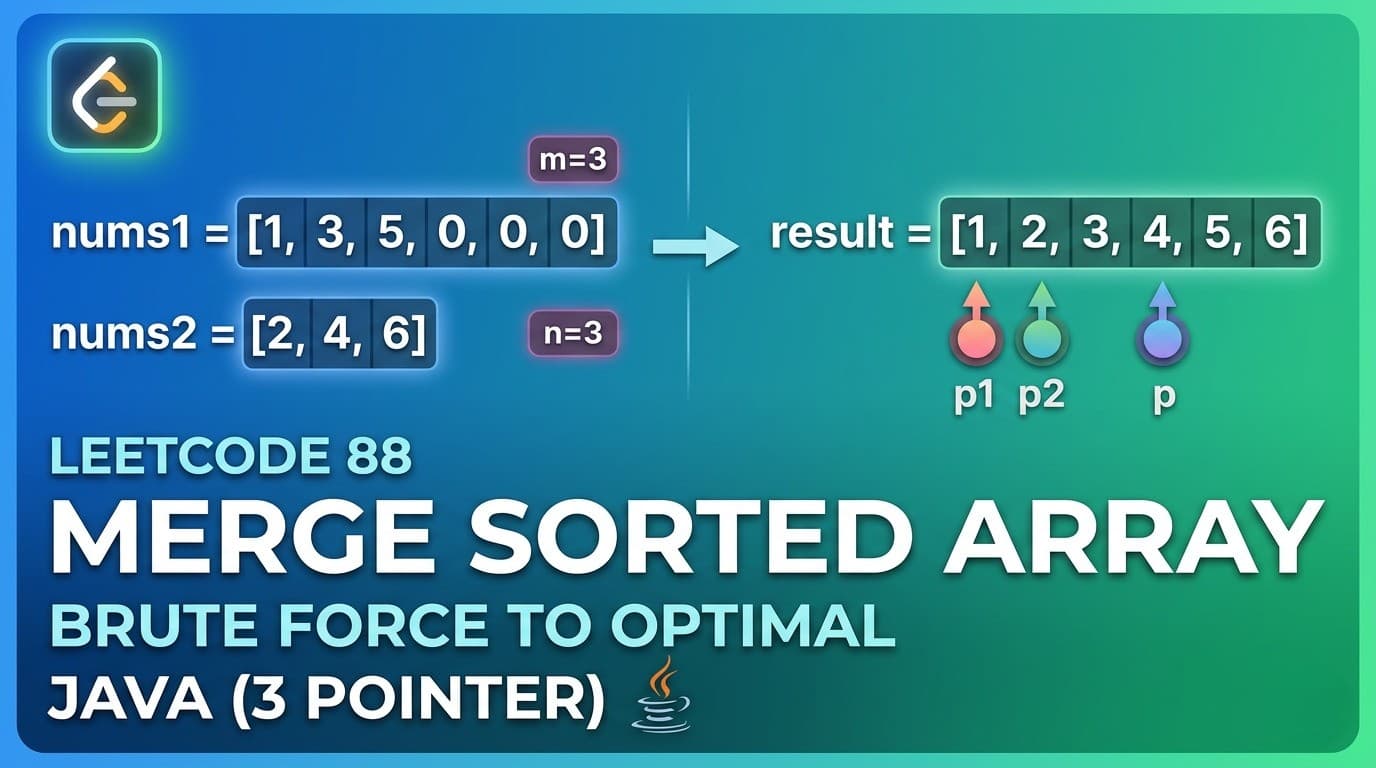
IntroductionLeetCode 88 β€” Merge Sorted Array is one of the most important beginner-friendly array problems asked in coding interviews.At first glance, the problem looks very easy because both arrays are already sorted. But the real challenge is:How do we merge them efficiently without using extra space?This question is commonly asked by companies because it tests:Array manipulationTwo pointer techniqueIn-place modificationEdge case handlingSpace optimizationThe most important learning from this problem is understanding:Why merging from the back is the optimal strategy.In this article, we will cover:Problem understandingBrute force approachBetter approachOptimal 3-pointer solutionStep-by-step dry runTime & space complexityCommon mistakesInterview tipsFAQsBy the end, you will completely understand the logic behind this problem.Try This ProblemπŸ‘‰ https://leetcode.com/problems/merge-sorted-array/Problem StatementYou are given two sorted arrays:nums1nums2Along with two integers:m β†’ valid elements in nums1n β†’ elements in nums2The array nums1 has size:m + nThe last n positions are empty spaces represented by 0.Your task is to merge nums2 into nums1 such that the final array remains sorted.ExampleExample 1Inputnums1 = [1,2,3,0,0,0]m = 3nums2 = [2,5,6]n = 3Output[1,2,2,3,5,6]Understanding the ProblemLet us simplify what the question is asking.We have:nums1 β†’ already sortednums2 β†’ already sortedWe need:one final sorted arrayBut there is one important condition:We must store the answer inside nums1 itself.That means:No returning new arrayModify nums1 directlyWhy This Problem is TrickyMany beginners immediately think:Copy nums2 into nums1Then sort nums1This works.But interviews usually expect a more optimized solution.The challenge is:Can we merge without sorting again?Yes β€” using the Two Pointer technique.Approach 1 β€” Brute Force SolutionIdeaCopy all elements of nums2 into empty positions of nums1Sort the final arrayJava Codeclass Solution { public void merge(int[] nums1, int m, int[] nums2, int n) { // Copy nums2 into nums1 for(int i = 0; i < n; i++) { nums1[m + i] = nums2[i]; } // Sort final array Arrays.sort(nums1); }}Dry Run of Brute ForceInitial:nums1 = [1,2,3,0,0,0]nums2 = [2,5,6]After copying:[1,2,3,2,5,6]After sorting:[1,2,2,3,5,6]Time ComplexityCopyingO(n)SortingO((m+n) log(m+n))Space ComplexityO(1)Drawback of Brute ForceSorting again is unnecessary because:Arrays are already sortedWe can merge smarterApproach 2 β€” Extra Array MergeIdeaUse a third temporary array.This works exactly like merge step in Merge Sort.StepsCompare elements from both arraysInsert smaller one into temp arrayCopy final temp array into nums1Java Codeclass Solution { public void merge(int[] nums1, int m, int[] nums2, int n) { int[] temp = new int[m + n]; int i = 0; int j = 0; int k = 0; while(i < m && j < n) { if(nums1[i] <= nums2[j]) { temp[k++] = nums1[i++]; } else { temp[k++] = nums2[j++]; } } while(i < m) { temp[k++] = nums1[i++]; } while(j < n) { temp[k++] = nums2[j++]; } for(i = 0; i < m + n; i++) { nums1[i] = temp[i]; } }}Time ComplexityO(m + n)Space ComplexityO(m + n)Can We Do Better?Yes.The interview-expected solution uses:Optimal Approach β€” Three Pointers from BackMost Important ObservationThe end of nums1 already contains empty spaces.So instead of merging from front:We merge from the back.This avoids overwriting important elements.Main IdeaWe use 3 pointers:left β†’ last valid element in nums1right β†’ last element in nums2insertPos β†’ last position of nums1We compare:nums1[left]nums2[right]The larger element is placed at:nums1[insertPos]Then move pointers backward.Why Backward Merging WorksSuppose:nums1 = [1,2,3,0,0,0]nums2 = [2,5,6]If we start from front:we overwrite existing valuesBut from back:empty spaces already existSo no data loss occurs.Optimal Java Solutionclass Solution { public void merge(int[] nums1, int m, int[] nums2, int n) { int left = m - 1; int right = n - 1; int insertPos = m + n - 1; for(int i = insertPos; i >= 0; i--) { if(right < 0 || (left >= 0 && nums1[left] >= nums2[right])) { nums1[i] = nums1[left]; left--; } else { nums1[i] = nums2[right]; right--; } } }}Step-by-Step Dry RunInputnums1 = [1,2,3,0,0,0]nums2 = [2,5,6]Initial Pointersleft = 2 β†’ value 3right = 2 β†’ value 6insertPos = 5Step 1Compare:3 vs 66 is larger.Place 6 at end.[1,2,3,0,0,6]Move:right--insertPos--Step 2Compare:3 vs 5Place 5.[1,2,3,0,5,6]Step 3Compare:3 vs 2Place 3.[1,2,3,3,5,6]Step 4Compare:2 vs 2Place 2.[1,2,2,3,5,6]Done.Time ComplexityWe traverse both arrays once.O(m + n)Space ComplexityNo extra space used.O(1)Why This is the Best SolutionThis solution is optimal because:βœ… No sorting required βœ… No extra array required βœ… Single traversal βœ… In-place merging βœ… Interview preferred solutionCommon Mistakes1. Merging from FrontThis overwrites elements in nums1.2. Forgetting Edge CasesExample:m = 0orn = 03. Wrong Pointer InitializationCorrect:left = m - 1right = n - 14. Array Index Out of BoundsAlways check:left >= 0right >= 0Interview TipsIf interviewer asks:β€œWhy merge from back?”Your answer:Because nums1 already has empty spaces at the end. Backward traversal prevents overwriting existing sorted elements.Frequently Asked QuestionsQ1. Why not use sorting?Because arrays are already sorted.Sorting again wastes time.Q2. Why start from end?To safely place larger elements without overwriting.Q3. Is this similar to Merge Sort?Yes.This is essentially the merge step of Merge Sort.Q4. What if nums2 is empty?Then nums1 remains unchanged.Q5. What if nums1 has no valid elements?Then copy all elements from nums2.Final TakeawayThe biggest learning from this problem is:Whenever extra space exists at the end of an array, think about backward traversal.This pattern appears frequently in interview questions.ConclusionLeetCode 88 is one of the best beginner problems to master:Two pointersIn-place array modificationEfficient mergingSpace optimizationAlthough the brute force solution works, the optimal 3-pointer approach is the real interview solution.Once you understand why backward merging works, this problem becomes extremely easy to solve in interviews and coding rounds.

ArraysTwo PointersSortingJavaEasyLeetcode
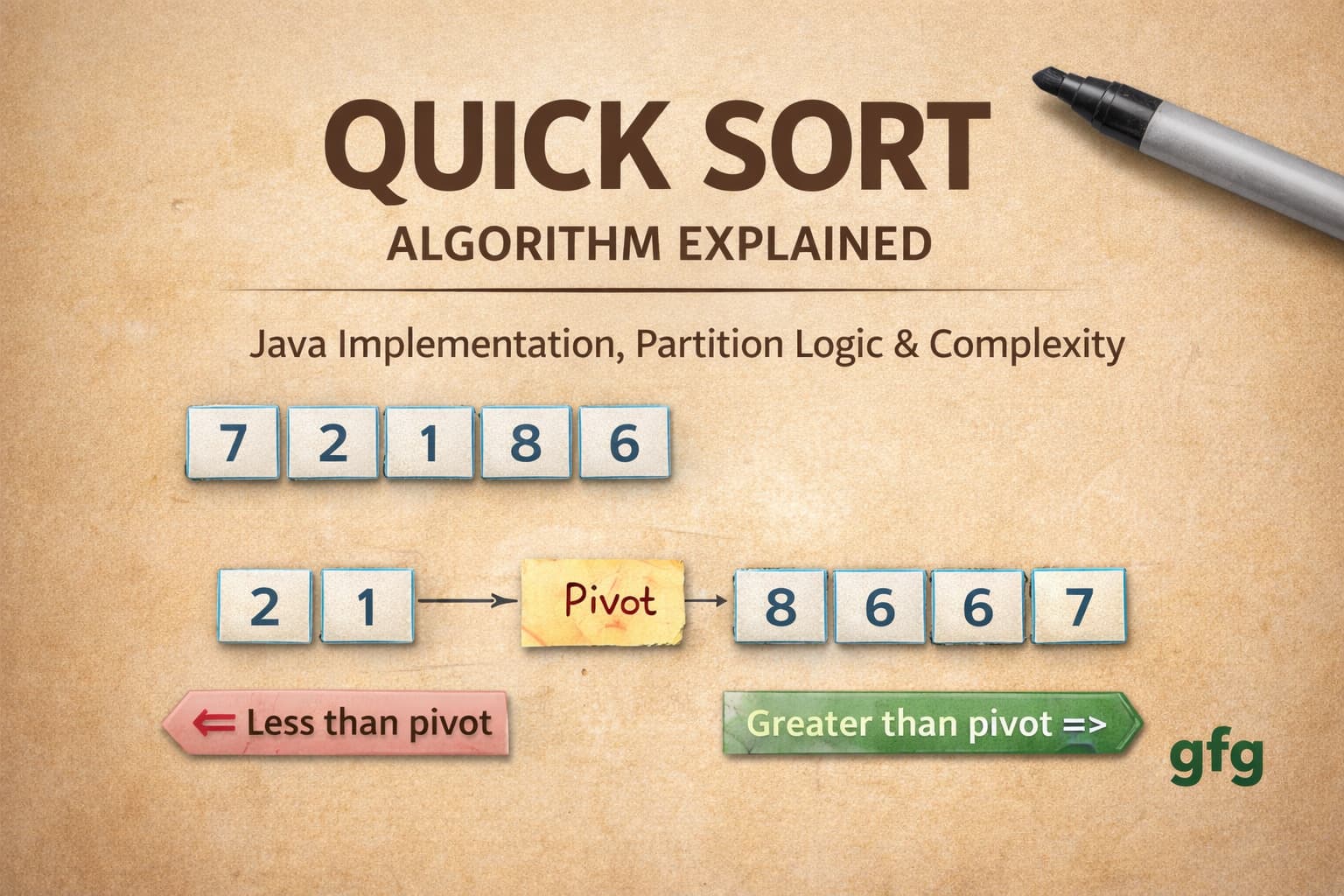
Quick Sort Algorithm Explained | Java Implementation, Partition Logic & Complexity

Quick Sort Algorithm Explained | Java Implementation, Partition Logic & Complexity

IntroductionQuick Sort is one of the most powerful and widely used sorting algorithms in computer science. It follows the Divide and Conquer approach and is known for its excellent average-case performance.What makes Quick Sort special is:It sorts in-place (no extra array required)It is faster in practice than many O(n log n) algorithms like Merge SortIt is heavily used in real-world systems and librariesIn this article, we’ll go deep into:Intuition behind Quick SortPartition logic (most important part)Step-by-step dry runJava implementation with commentsTime complexity analysisCommon mistakes and optimizationsπŸ”— Problem LinkGeeksforGeeks: Quick SortProblem StatementGiven an array arr[], sort it in ascending order using Quick Sort.Requirements:Use Divide and ConquerChoose pivot elementPlace pivot in correct positionElements smaller β†’ left sideElements greater β†’ right sideExamplesExample 1Input:arr = [4, 1, 3, 9, 7]Output:[1, 3, 4, 7, 9]Example 2Input:arr = [2, 1, 6, 10, 4, 1, 3, 9, 7]Output:[1, 1, 2, 3, 4, 6, 7, 9, 10]Core Idea of Quick SortPick a pivot β†’ Place it correctly β†’ Recursively sort left & rightπŸ”₯ Key Insight (Partition is Everything)Quick Sort depends entirely on partitioning:πŸ‘‰ After partition:Pivot is at its correct sorted positionLeft side β†’ smaller elementsRight side β†’ larger elementsIntuition (Visual Understanding)Consider:[4, 1, 3, 9, 7]Step 1: Choose PivotLet’s say pivot = 4Step 2: Rearrange Elements[1, 3] 4 [9, 7]Now:Left β†’ smallerRight β†’ largerStep 3: Apply RecursivelyLeft: [1, 3]Right: [9, 7]Final result:[1, 3, 4, 7, 9]Partition Logic (Most Important)Your implementation uses:Pivot = first elementTwo pointers:i β†’ moves forwardj β†’ moves backwardJava Codeclass Solution { public void quickSort(int[] arr, int low, int high) { // Base case: if array has 1 or 0 elements if (low < high) { // Partition array and get pivot index int pivotInd = partition(arr, low, high); // Sort left part quickSort(arr, low, pivotInd - 1); // Sort right part quickSort(arr, pivotInd + 1, high); } } // Function to swap two elements void swap(int[] arr, int i, int j) { int temp = arr[i]; arr[i] = arr[j]; arr[j] = temp; } private int partition(int[] arr, int low, int high) { int pivot = arr[low]; // choosing first element as pivot int i = low + 1; // start from next element int j = high; // start from end while (i <= j) { // Move i forward until element > pivot while (i <= high && arr[i] <= pivot) { i++; } // Move j backward until element <= pivot while (j >= low && arr[j] > pivot) { j--; } // Swap if pointers haven't crossed if (i < j) { swap(arr, i, j); } } // Place pivot at correct position swap(arr, low, j); return j; // return pivot index }}Step-by-Step Dry RunInput:[4, 1, 3, 9, 7]Execution:Pivot = 4i β†’ moves until element > 4j β†’ moves until element ≀ 4Swaps happen β†’ pivot placed correctlyFinal partition:[1, 3, 4, 9, 7]Complexity AnalysisTime ComplexityCaseComplexityBest CaseO(n log n)Average CaseO(n log n)Worst CaseO(nΒ²)Why Worst Case Happens?When array is:Already sortedReverse sortedPivot always becomes smallest/largest.Space ComplexityO(log n) (recursion stack)❌ Common MistakesWrong partition logicInfinite loops in while conditionsIncorrect pivot placementNot handling duplicates properly⚑ Optimizations1. Random PivotAvoid worst-case:int pivotIndex = low + new Random().nextInt(high - low + 1);swap(arr, low, pivotIndex);2. Median of ThreeChoose better pivot:median(arr[low], arr[mid], arr[high])Quick Sort vs Merge SortFeatureQuick SortMerge Sort link to get moreSpaceO(log n)O(n)SpeedFaster (practical)StableWorst CaseO(nΒ²)O(n log n)Why Quick Sort is PreferredCache-friendlyIn-place sortingFaster in real-world scenariosKey TakeawaysPartition is the heart of Quick SortPivot must be placed correctlyRecursion splits problem efficientlyAvoid worst case using random pivotWhen to Use Quick SortLarge arraysMemory constraints (in-place)Performance-critical applicationsConclusionQuick Sort is one of the most efficient and practical sorting algorithms. Mastering its partition logic is crucial for solving advanced problems and performing well in coding interviews.Understanding how pointers move and how pivot is placed will make this algorithm intuitive and powerful.Frequently Asked Questions (FAQs)1. Is Quick Sort stable?No, it is not stable.2. Why is Quick Sort faster than Merge Sort?Because it avoids extra space and is cache-efficient.3. What is the most important part?πŸ‘‰ Partition logic

MediumJavaSortingQuick SortGeeksofGeeks
Recursion in Java - Complete Guide With Examples and Practice Problems

Recursion in Java - Complete Guide With Examples and Practice Problems

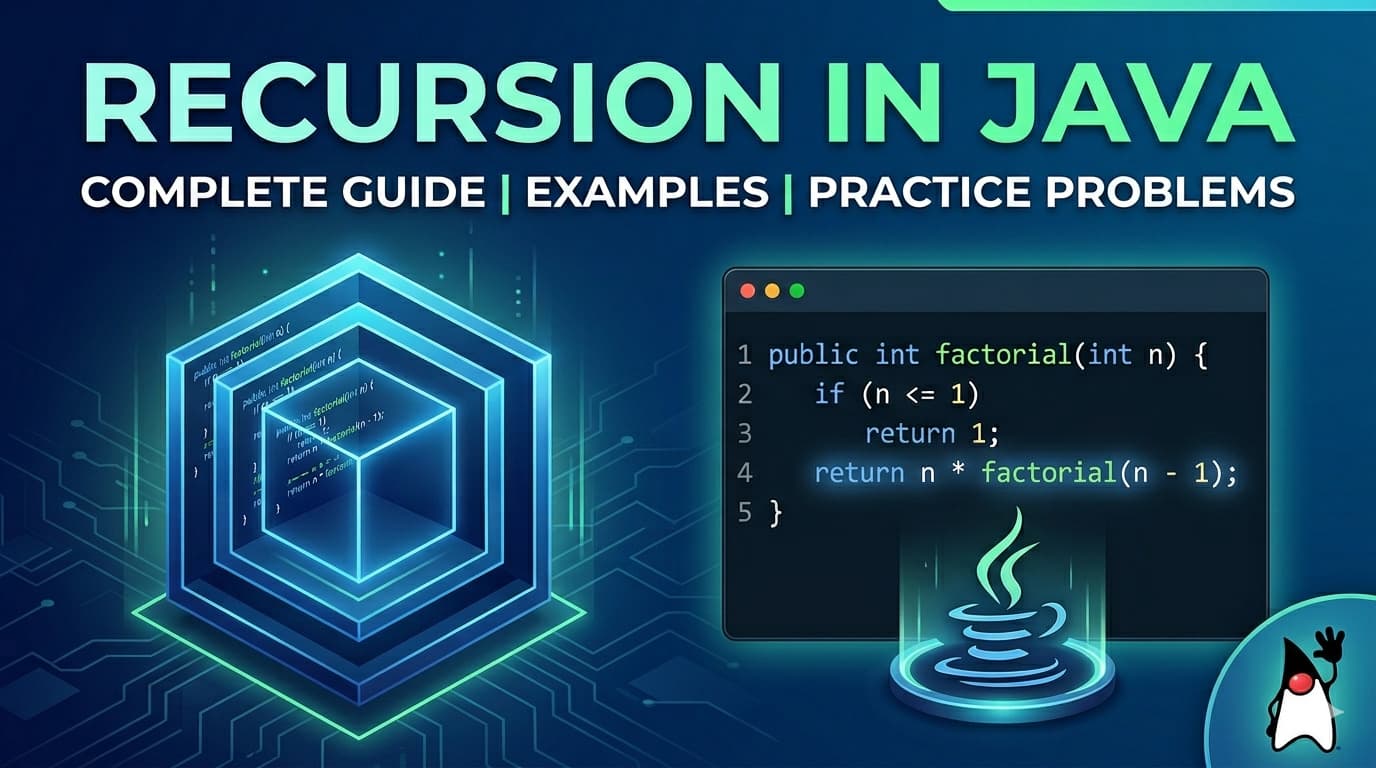
IntroductionIf there is one topic in programming that confuses beginners more than anything else, it is recursion. Most people read the definition, nod their head, and then immediately freeze when they have to write recursive code themselves.The problem is not that recursion is genuinely hard. The problem is that most explanations start with code before building the right mental model. Once you have the right mental model, recursion clicks permanently and you start seeing it everywhere β€” in tree problems, graph problems, backtracking, dynamic programming, divide and conquer, and more.This guide covers everything from the ground up. What recursion is, how the call stack works, how to identify base cases and recursive cases, every type of recursion, common patterns, time and space complexity analysis, the most common mistakes, and the top LeetCode problems to practice.By the end of this article, recursion will not feel like magic anymore. It will feel like a natural tool you reach for confidently.What Is Recursion?Recursion is when a function calls itself to solve a smaller version of the same problem.That is the complete definition. But let us make it concrete.Imagine you want to count down from 5 to 1. One way is a loop. Another way is β€” print 5, then solve the exact same problem for counting down from 4 to 1. Then print 4, solve for 3. And so on until you reach the base β€” there is nothing left to count down.void countDown(int n) { if (n == 0) return; // stop here System.out.println(n); countDown(n - 1); // solve the smaller version}The function countDown calls itself with a smaller input each time. Eventually it reaches 0 and stops. That stopping condition is the most important part of any recursive function β€” the base case.The Two Parts Every Recursive Function Must HaveEvery correctly written recursive function has exactly two parts. Without both, the function either gives wrong answers or runs forever.Part 1: Base CaseThe base case is the condition under which the function stops calling itself and returns a direct answer. It is the smallest version of the problem that you can solve without any further recursion.Without a base case, recursion never stops and you get a StackOverflowError β€” Java's way of telling you the call stack ran out of memory.Part 2: Recursive CaseThe recursive case is where the function calls itself with a smaller or simpler input β€” moving closer to the base case with each call. If your recursive case does not make the problem smaller, you have an infinite loop.Think of it like a staircase. The base case is the ground floor. The recursive case is each step going down. Every step must genuinely bring you one level closer to the ground.How Recursion Works β€” The Call StackThis is the mental model that most explanations skip, and it is the reason recursion confuses people.Every time a function is called in Java, a new stack frame is created and pushed onto the call stack. This frame stores the function's local variables, parameters, and where to return to when the function finishes.When a recursive function calls itself, a new frame is pushed on top. When that call finishes, its frame is popped and execution returns to the previous frame.Let us trace countDown(3) through the call stack:countDown(3) called β†’ frame pushed prints 3 calls countDown(2) β†’ frame pushed prints 2 calls countDown(1) β†’ frame pushed prints 1 calls countDown(0) β†’ frame pushed n == 0, return β†’ frame popped back in countDown(1), return β†’ frame popped back in countDown(2), return β†’ frame popped back in countDown(3), return β†’ frame poppedOutput: 3, 2, 1The call stack grows as calls go deeper, then shrinks as calls return. This is why recursion uses O(n) space for n levels deep β€” each level occupies one stack frame in memory.Your First Real Recursive Function β€” FactorialFactorial is the classic first recursion example. n! = n Γ— (n-1) Γ— (n-2) Γ— ... Γ— 1Notice the pattern β€” n! = n Γ— (n-1)!. The factorial of n is n times the factorial of n-1. That recursive structure makes it perfect for recursion.public int factorial(int n) { // base case if (n == 0 || n == 1) return 1; // recursive case return n * factorial(n - 1);}Dry Run β€” factorial(4)factorial(4)= 4 * factorial(3)= 4 * 3 * factorial(2)= 4 * 3 * 2 * factorial(1)= 4 * 3 * 2 * 1= 24The call stack builds up going in, then multiplications happen coming back out. This "coming back out" phase is called the return phase or unwinding of the stack.Time Complexity: O(n) β€” n recursive calls Space Complexity: O(n) β€” n frames on the call stackThe Two Phases of RecursionEvery recursive function has two phases and understanding both is critical.Phase 1: The Call Phase (Going In)This happens as the function keeps calling itself with smaller inputs. Things you do before the recursive call happen in this phase β€” in order from the outermost call to the innermost.Phase 2: The Return Phase (Coming Back Out)This happens as each call finishes and returns to its caller. Things you do after the recursive call happen in this phase β€” in reverse order, from the innermost call back to the outermost.This distinction explains why the output order can be surprising:void printBothPhases(int n) { if (n == 0) return; System.out.println("Going in: " + n); // call phase printBothPhases(n - 1); System.out.println("Coming out: " + n); // return phase}For printBothPhases(3):Going in: 3Going in: 2Going in: 1Coming out: 1Coming out: 2Coming out: 3This two-phase understanding is what makes problems like reversing a string or printing a linked list backwards via recursion feel natural.Types of RecursionRecursion is not one-size-fits-all. There are several distinct types and knowing which type applies to a problem shapes how you write the solution.1. Direct RecursionThe function calls itself directly. This is the most common type β€” what we have seen so far.void direct(int n) { if (n == 0) return; direct(n - 1); // calls itself}2. Indirect RecursionFunction A calls Function B which calls Function A. They form a cycle.void funcA(int n) { if (n <= 0) return; System.out.println("A: " + n); funcB(n - 1);}void funcB(int n) { if (n <= 0) return; System.out.println("B: " + n); funcA(n - 1);}Used in: state machines, mutual recursion in parsers, certain mathematical sequences.3. Tail RecursionThe recursive call is the last operation in the function. Nothing happens after the recursive call returns β€” no multiplication, no addition, nothing.// NOT tail recursive β€” multiplication happens after returnint factorial(int n) { if (n == 1) return 1; return n * factorial(n - 1); // multiply after return β€” not tail}// Tail recursive β€” recursive call is the last thingint factorialTail(int n, int accumulator) { if (n == 1) return accumulator; return factorialTail(n - 1, n * accumulator); // last operation}Why does tail recursion matter? In languages that support tail call optimization (like Scala, Kotlin, and many functional languages), tail recursive functions can be converted to iteration internally β€” no stack frame accumulation, O(1) space. Java does NOT perform tail call optimization, but understanding tail recursion is still important for interviews and functional programming concepts.4. Head RecursionThe recursive call happens first, before any other processing. All processing happens in the return phase.void headRecursion(int n) { if (n == 0) return; headRecursion(n - 1); // call first System.out.println(n); // process after}// Output: 1 2 3 4 5 (processes in reverse order of calls)5. Tree RecursionThe function makes more than one recursive call per invocation. This creates a tree of calls rather than a linear chain. Fibonacci is the classic example.int fibonacci(int n) { if (n <= 1) return n; return fibonacci(n - 1) + fibonacci(n - 2); // TWO recursive calls}The call tree for fibonacci(4): fib(4) / \ fib(3) fib(2) / \ / \ fib(2) fib(1) fib(1) fib(0) / \ fib(1) fib(0)Time Complexity: O(2ⁿ) β€” exponential! Each call spawns two more. Space Complexity: O(n) β€” maximum depth of the call treeThis is why memoization (caching results) is so important for tree recursion β€” it converts O(2ⁿ) to O(n) by never recomputing the same subproblem twice.6. Mutual RecursionA specific form of indirect recursion where two functions call each other alternately to solve a problem. Different from indirect recursion in that the mutual calls are the core mechanism of the solution.// Check if a number is even or odd using mutual recursionboolean isEven(int n) { if (n == 0) return true; return isOdd(n - 1);}boolean isOdd(int n) { if (n == 0) return false; return isEven(n - 1);}Common Recursion Patterns in DSAThese are the patterns you will see over and over in interview problems. Recognizing them is more important than memorizing solutions.Pattern 1: Linear Recursion (Do Something, Recurse on Rest)Process the current element, then recurse on the remaining problem.// Sum of arrayint arraySum(int[] arr, int index) { if (index == arr.length) return 0; // base case return arr[index] + arraySum(arr, index + 1); // current + rest}Pattern 2: Divide and Conquer (Split Into Two Halves)Split the problem into two halves, solve each recursively, combine results.// Merge Sortvoid mergeSort(int[] arr, int left, int right) { if (left >= right) return; // base case β€” single element int mid = (left + right) / 2; mergeSort(arr, left, mid); // sort left half mergeSort(arr, mid + 1, right); // sort right half merge(arr, left, mid, right); // combine}Pattern 3: Backtracking (Try, Recurse, Undo)Try a choice, recurse to explore it, undo the choice when backtracking.// Generate all subsetsvoid subsets(int[] nums, int index, List<Integer> current, List<List<Integer>> result) { if (index == nums.length) { result.add(new ArrayList<>(current)); return; } // Choice 1: include nums[index] current.add(nums[index]); subsets(nums, index + 1, current, result); current.remove(current.size() - 1); // undo // Choice 2: exclude nums[index] subsets(nums, index + 1, current, result);}Pattern 4: Tree Recursion (Left, Right, Combine)Recurse on left subtree, recurse on right subtree, combine or process results.// Height of binary treeint height(TreeNode root) { if (root == null) return 0; // base case int leftHeight = height(root.left); // solve left int rightHeight = height(root.right); // solve right return 1 + Math.max(leftHeight, rightHeight); // combine}Pattern 5: Memoization (Cache Recursive Results)Store results of recursive calls so the same subproblem is never solved twice.Map<Integer, Integer> memo = new HashMap<>();int fibonacci(int n) { if (n <= 1) return n; if (memo.containsKey(n)) return memo.get(n); // return cached int result = fibonacci(n - 1) + fibonacci(n - 2); memo.put(n, result); // cache before returning return result;}This converts Fibonacci from O(2ⁿ) to O(n) time with O(n) space β€” a massive improvement.Recursion vs Iteration β€” When to Use WhichThis is one of the most common interview questions about recursion. Here is a clear breakdown:Use Recursion when:The problem has a naturally recursive structure (trees, graphs, divide and conquer)The solution is significantly cleaner and easier to understand recursivelyThe problem involves exploring multiple paths or choices (backtracking)The depth of recursion is manageable (not too deep to cause stack overflow)Use Iteration when:The problem is linear and a loop is equally clearMemory is a concern (iteration uses O(1) stack space vs O(n) for recursion)Performance is critical and function call overhead mattersJava's stack size limit could be hit (default around 500-1000 frames for deep recursion)The key rule: Every recursive solution can be converted to an iterative one (usually using an explicit stack). But recursive solutions for tree and graph problems are almost always cleaner to write and understand.Time and Space Complexity of Recursive FunctionsAnalyzing complexity for recursive functions requires a specific approach.The Recurrence Relation MethodExpress the time complexity as a recurrence relation and solve it.Factorial:T(n) = T(n-1) + O(1) = T(n-2) + O(1) + O(1) = T(1) + nΓ—O(1) = O(n)Fibonacci (naive):T(n) = T(n-1) + T(n-2) + O(1) β‰ˆ 2Γ—T(n-1) = O(2ⁿ)Binary Search:T(n) = T(n/2) + O(1) = O(log n) [by Master Theorem]Merge Sort:T(n) = 2Γ—T(n/2) + O(n) = O(n log n) [by Master Theorem]Space Complexity Rule for RecursionSpace complexity of a recursive function = maximum depth of the call stack Γ— space per frameLinear recursion (factorial, sum): O(n) spaceBinary recursion (Fibonacci naive): O(n) space (maximum depth, not number of nodes)Divide and conquer (merge sort): O(log n) space (depth of recursion tree)Memoized Fibonacci: O(n) space (memo table + call stack)Classic Recursive Problems With SolutionsProblem 1: Reverse a StringString reverse(String s) { if (s.length() <= 1) return s; // base case // last char + reverse of everything before last char return s.charAt(s.length() - 1) + reverse(s.substring(0, s.length() - 1));}Dry run for "hello":reverse("hello") = 'o' + reverse("hell")reverse("hell") = 'l' + reverse("hel")reverse("hel") = 'l' + reverse("he")reverse("he") = 'e' + reverse("h")reverse("h") = "h"Unwinding: "h" β†’ "he" β†’ "leh" β†’ "lleh" β†’ "olleh" βœ…Problem 2: Power Function (x^n)double power(double x, int n) { if (n == 0) return 1; // base case if (n < 0) return 1.0 / power(x, -n); // handle negative if (n % 2 == 0) { double half = power(x, n / 2); return half * half; // x^n = (x^(n/2))^2 } else { return x * power(x, n - 1); }}This is the fast power algorithm β€” O(log n) time instead of O(n).Problem 3: Fibonacci With Memoizationint[] memo = new int[100];Arrays.fill(memo, -1);int fib(int n) { if (n <= 1) return n; if (memo[n] != -1) return memo[n]; memo[n] = fib(n - 1) + fib(n - 2); return memo[n];}Time: O(n) β€” each value computed once Space: O(n) β€” memo array + call stackProblem 4: Tower of HanoiThe classic recursion teaching problem. Move n disks from source to destination using a helper rod.void hanoi(int n, char source, char destination, char helper) { if (n == 1) { System.out.println("Move disk 1 from " + source + " to " + destination); return; } // Move n-1 disks from source to helper hanoi(n - 1, source, helper, destination); // Move the largest disk from source to destination System.out.println("Move disk " + n + " from " + source + " to " + destination); // Move n-1 disks from helper to destination hanoi(n - 1, helper, destination, source);}Time Complexity: O(2ⁿ) β€” minimum moves required is 2ⁿ - 1 Space Complexity: O(n) β€” call stack depthProblem 5: Generate All Subsets (Power Set)void generateSubsets(int[] nums, int index, List<Integer> current, List<List<Integer>> result) { result.add(new ArrayList<>(current)); // add current subset for (int i = index; i < nums.length; i++) { current.add(nums[i]); // include generateSubsets(nums, i + 1, current, result); // recurse current.remove(current.size() - 1); // exclude (backtrack) }}For [1, 2, 3] β€” generates all 8 subsets: [], [1], [1,2], [1,2,3], [1,3], [2], [2,3], [3]Time: O(2ⁿ) β€” 2ⁿ subsets Space: O(n) β€” recursion depthProblem 6: Binary Search Recursivelyint binarySearch(int[] arr, int target, int left, int right) { if (left > right) return -1; // base case β€” not found int mid = left + (right - left) / 2; if (arr[mid] == target) return mid; else if (arr[mid] < target) return binarySearch(arr, target, mid + 1, right); else return binarySearch(arr, target, left, mid - 1);}Time: O(log n) β€” halving the search space each time Space: O(log n) β€” log n frames on the call stackRecursion on Trees β€” The Natural HabitatTrees are where recursion truly shines. Every tree problem becomes elegant with recursion because a tree is itself a recursive structure β€” each node's left and right children are trees themselves.// Maximum depth of binary treeint maxDepth(TreeNode root) { if (root == null) return 0; return 1 + Math.max(maxDepth(root.left), maxDepth(root.right));}// Check if tree is symmetricboolean isSymmetric(TreeNode left, TreeNode right) { if (left == null && right == null) return true; if (left == null || right == null) return false; return left.val == right.val && isSymmetric(left.left, right.right) && isSymmetric(left.right, right.left);}// Path sum β€” does any root-to-leaf path sum to target?boolean hasPathSum(TreeNode root, int target) { if (root == null) return false; if (root.left == null && root.right == null) return root.val == target; return hasPathSum(root.left, target - root.val) || hasPathSum(root.right, target - root.val);}Notice the pattern in all three β€” base case handles null, recursive case handles left and right subtrees, result combines both.How to Think About Any Recursive Problem β€” Step by StepThis is the framework you should apply to every new recursive problem you encounter:Step 1 β€” Identify the base case What is the smallest input where you know the answer directly without any recursion? For arrays it is usually empty array or single element. For trees it is null node. For numbers it is 0 or 1.Step 2 β€” Trust the recursive call Assume your function already works correctly for smaller inputs. Do not trace through the entire recursion mentally β€” just trust it. This is the Leap of Faith and it is what makes recursion feel natural.Step 3 β€” Express the current problem in terms of smaller problems How does the answer for size n relate to the answer for size n-1 (or n/2, or subtrees)? This relationship is your recursive case.Step 4 β€” Make sure each call moves toward the base case The input must become strictly smaller with each call. If it does not, you have infinite recursion.Step 5 β€” Write the base case first, then the recursive case Always. Writing the recursive case first leads to bugs because you have not defined when to stop.Common Mistakes and How to Avoid ThemMistake 1: Missing or wrong base case The most common mistake. Missing the base case causes StackOverflowError. Wrong base case causes wrong answers.Always ask β€” what is the simplest possible input, and what should the function return for it? Write that case first.Mistake 2: Not moving toward the base case If you call factorial(n) inside factorial(n) without reducing n, you loop forever. Every recursive call must make the problem strictly smaller.Mistake 3: Trusting your brain to trace deep recursion Do not try to trace 10 levels of recursion in your head. Trust the recursive call, verify the base case, and check that each call reduces the problem. That is all you need.Mistake 4: Forgetting to return the recursive result// WRONG β€” result is computed but not returnedint sum(int n) { if (n == 0) return 0; sum(n - 1) + n; // computed but discarded!}// CORRECTint sum(int n) { if (n == 0) return 0; return sum(n - 1) + n;}Mistake 5: Modifying shared state without backtracking In backtracking problems, if you add something to a list before a recursive call, you must remove it after the call returns. Forgetting to backtrack leads to incorrect results and is one of the trickiest bugs to find.Mistake 6: Recomputing the same subproblems Naive Fibonacci computes fib(3) multiple times when computing fib(5). Use memoization whenever you notice overlapping subproblems in your recursion tree.Top LeetCode Problems on RecursionThese are organized by pattern β€” work through them in this order for maximum learning:Pure Recursion Basics:509. Fibonacci Number β€” Easy β€” start here, implement with and without memoization344. Reverse String β€” Easy β€” recursion on arrays206. Reverse Linked List β€” Easy β€” recursion on linked list50. Pow(x, n) β€” Medium β€” fast power with recursionTree Recursion (Most Important):104. Maximum Depth of Binary Tree β€” Easy β€” simplest tree recursion112. Path Sum β€” Easy β€” decision recursion on tree101. Symmetric Tree β€” Easy β€” mutual recursion on tree110. Balanced Binary Tree β€” Easy β€” bottom-up recursion236. Lowest Common Ancestor of a Binary Tree β€” Medium β€” classic tree recursion124. Binary Tree Maximum Path Sum β€” Hard β€” advanced tree recursionDivide and Conquer:148. Sort List β€” Medium β€” merge sort on linked list240. Search a 2D Matrix II β€” Medium β€” divide and conquerBacktracking:78. Subsets β€” Medium β€” generate all subsets46. Permutations β€” Medium β€” generate all permutations77. Combinations β€” Medium β€” generate combinations79. Word Search β€” Medium β€” backtracking on grid51. N-Queens β€” Hard β€” classic backtrackingMemoization / Dynamic Programming:70. Climbing Stairs β€” Easy β€” Fibonacci variant with memoization322. Coin Change β€” Medium β€” recursion with memoization to DP139. Word Break β€” Medium β€” memoized recursionRecursion Cheat Sheet// Linear recursion templatereturnType solve(input) { if (baseCase) return directAnswer; // process current return solve(smallerInput);}// Tree recursion templatereturnType solve(TreeNode root) { if (root == null) return baseValue; returnType left = solve(root.left); returnType right = solve(root.right); return combine(left, right, root.val);}// Backtracking templatevoid backtrack(choices, current, result) { if (goalReached) { result.add(copy of current); return; } for (choice : choices) { make(choice); // add to current backtrack(...); // recurse undo(choice); // remove from current }}// Memoization templateMap<Input, Output> memo = new HashMap<>();returnType solve(input) { if (baseCase) return directAnswer; if (memo.containsKey(input)) return memo.get(input); returnType result = solve(smallerInput); memo.put(input, result); return result;}FAQs β€” People Also AskQ1. What is recursion in Java with a simple example? Recursion is when a function calls itself to solve a smaller version of the same problem. A simple example is factorial β€” factorial(5) = 5 Γ— factorial(4) = 5 Γ— 4 Γ— factorial(3) and so on until factorial(1) returns 1 directly.Q2. What is the difference between recursion and iteration? Iteration uses loops (for, while) and runs in O(1) space. Recursion uses function calls and uses O(n) stack space for n levels deep. Recursion is often cleaner for tree and graph problems. Iteration is better when memory is a concern or the problem is inherently linear.Q3. What causes StackOverflowError in Java recursion? StackOverflowError happens when recursion goes too deep β€” too many frames accumulate on the call stack before any of them return. This is caused by missing base case, wrong base case, or input too large for Java's default stack size limit.Q4. What is the difference between recursion and dynamic programming? Recursion solves a problem by breaking it into subproblems. Dynamic programming is recursion plus memoization β€” storing results of subproblems so they are never computed twice. DP converts exponential recursive solutions into polynomial ones by eliminating redundant computation.Q5. What is tail recursion and does Java support tail call optimization? Tail recursion is when the recursive call is the absolute last operation in the function. Java does NOT support tail call optimization β€” Java always creates a new stack frame for each call even if it is tail recursive. Languages like Scala and Kotlin (on the JVM) do support it with the tailrec keyword.Q6. How do you convert recursion to iteration? Every recursive solution can be converted to iterative using an explicit stack data structure. The call stack's behavior is replicated manually β€” push the initial call, loop while stack is not empty, pop, process, and push sub-calls. Tree traversals are a common example of this conversion.ConclusionRecursion is not magic. It is a systematic way of solving problems by expressing them in terms of smaller versions of themselves. Once you internalize the two parts (base case and recursive case), understand the call stack mentally, and learn to trust the recursive call rather than trace it completely, everything clicks.The learning path from here is clear β€” start with simple problems like Fibonacci and array sum. Move to tree problems where recursion is most natural. Then tackle backtracking. Finally add memoization to bridge into dynamic programming.Every hour you spend understanding recursion deeply pays dividends across the entire rest of your DSA journey. Trees, graphs, divide and conquer, backtracking, dynamic programming β€” all of them build on this foundation.

RecursionJavaBase CaseCall StackBacktrackingDynamic Programming
LeetCode 143 Reorder List - Java Solution Explained

LeetCode 143 Reorder List - Java Solution Explained

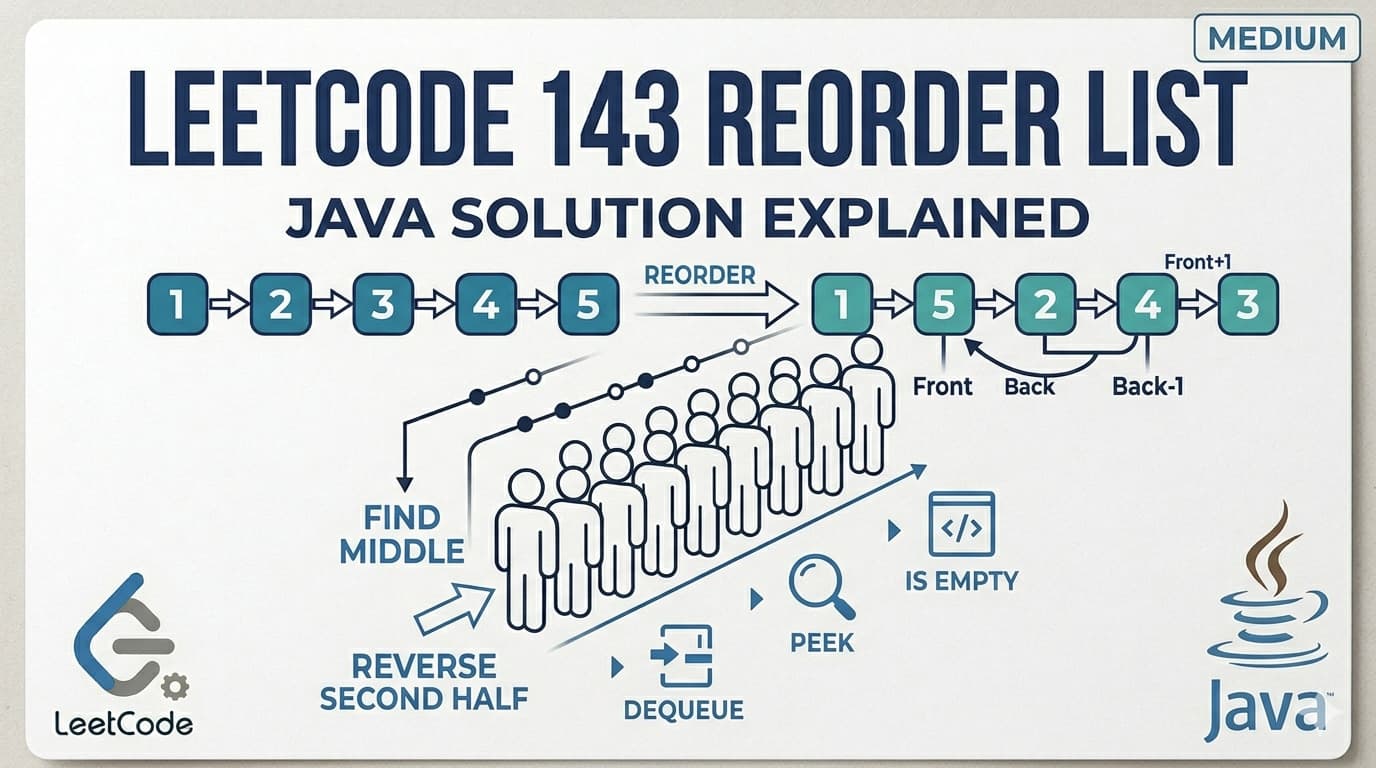
IntroductionLeetCode 143 Reorder List is one of those problems that looks simple when you read it but immediately makes you wonder β€” where do I even start? There is no single trick that solves it. Instead it combines three separate linked list techniques into one clean solution. Mastering this problem means you have genuinely understood linked lists at an intermediate level.You can find the problem here β€” LeetCode 143 Reorder List.This article walks through everything β€” what the problem wants, the intuition behind each step, all three techniques used, a detailed dry run, complexity analysis, and common mistakes beginners make.What Is the Problem Really Asking?You have a linked list: L0 β†’ L1 β†’ L2 β†’ ... β†’ LnYou need to reorder it to: L0 β†’ Ln β†’ L1 β†’ Ln-1 β†’ L2 β†’ Ln-2 β†’ ...In plain English β€” take one node from the front, then one from the back, then one from the front, then one from the back, and keep alternating until all nodes are used.Example:Input: 1 β†’ 2 β†’ 3 β†’ 4 β†’ 5Output: 1 β†’ 5 β†’ 2 β†’ 4 β†’ 3Node 1 from front, Node 5 from back, Node 2 from front, Node 4 from back, Node 3 stays in middle.Real Life Analogy β€” Dealing Cards From Both EndsImagine you have a deck of cards laid out in a line face up: 1, 2, 3, 4, 5. Now you deal them by alternately picking from the left end and the right end of the line:Pick 1 from left β†’ placePick 5 from right β†’ place after 1Pick 2 from left β†’ place after 5Pick 4 from right β†’ place after 2Pick 3 (only one left) β†’ place after 4Result: 1, 5, 2, 4, 3That is exactly what the problem wants. The challenge is doing this efficiently on a singly linked list where you cannot just index from the back.Why This Problem Is Hard for BeginnersIn an array you can just use two pointers β€” one at the start and one at the end β€” and swap/interleave easily. But a singly linked list only goes forward. You cannot go backwards. You cannot easily access the last element.This is why the problem requires a three-step approach that cleverly works around the limitations of a singly linked list.The Three Step ApproachEvery experienced developer solves this problem in exactly three steps:Step 1 β€” Find the middle of the linked list using the Fast & Slow Pointer techniqueStep 2 β€” Reverse the second half of the linked listStep 3 β€” Merge the two halves by alternating nodes from eachLet us understand each step deeply before looking at code.Step 1: Finding the Middle β€” Fast & Slow PointerThe Fast & Slow Pointer technique (also called Floyd's algorithm) uses two pointers moving at different speeds through the list:slow moves one step at a timefast moves two steps at a timeWhen fast reaches the end, slow is exactly at the middle. This works because fast covers twice the distance of slow in the same number of steps.ListNode fast = head;ListNode slow = head;while (fast.next != null && fast.next.next != null) { fast = fast.next.next; slow = slow.next;}// slow is now at the middleFor 1 β†’ 2 β†’ 3 β†’ 4 β†’ 5:Start: slow=1, fast=1Step 1: slow=2, fast=3Step 2: slow=3, fast=5 (fast.next is null, stop)Middle is node 3For 1 β†’ 2 β†’ 3 β†’ 4:Start: slow=1, fast=1Step 1: slow=2, fast=3Step 2: fast.next.next is null, stopslow=2, middle is node 2After finding the middle, we cut the list in two by setting slow.next = null. This disconnects the first half from the second half.Step 2: Reversing the Second HalfOnce we have the second half starting from slow.next, we reverse it. After reversal, what was the last node becomes the first β€” giving us easy access to the back elements of the original list.public ListNode reverse(ListNode head) { ListNode curr = head; ListNode prev = null; while (curr != null) { ListNode next = curr.next; // save next curr.next = prev; // reverse the link prev = curr; // move prev forward curr = next; // move curr forward } return prev; // prev is the new head}For second half 3 β†’ 4 β†’ 5 (from the first example):Reverse β†’ 5 β†’ 4 β†’ 3Now we have:First half: 1 β†’ 2 β†’ 3 (but 3 is the end since we cut at slow)Wait β€” actually after cutting at slow=3: first half is 1 β†’ 2 β†’ 3, second half reversed is 5 β†’ 4Let us be precise. For 1 β†’ 2 β†’ 3 β†’ 4 β†’ 5, slow stops at 3. slow.next = null cuts to give:First half: 1 β†’ 2 β†’ 3 β†’ nullSecond half before reverse: 4 β†’ 5Second half after reverse: 5 β†’ 4Step 3: Merging Two HalvesNow we have two lists and we merge them by alternately taking one node from each:Take from first half, take from second half, take from first half, take from second half...ListNode orig = head; // pointer for first halfListNode newhead = second; // pointer for reversed second halfwhile (newhead != null) { ListNode temp1 = orig.next; // save next of first half ListNode temp2 = newhead.next; // save next of second half orig.next = newhead; // first β†’ second newhead.next = temp1; // second β†’ next of first orig = temp1; // advance first half pointer newhead = temp2; // advance second half pointer}Why do we loop on newhead != null and not orig != null? Because the second half is always equal to or shorter than the first half (we cut at middle). Once the second half is exhausted, the remaining first half nodes are already in the correct position.Complete Solutionclass Solution { public ListNode reverse(ListNode head) { ListNode curr = head; ListNode prev = null; while (curr != null) { ListNode next = curr.next; curr.next = prev; prev = curr; curr = next; } return prev; } public void reorderList(ListNode head) { // Step 1: Find middle using fast & slow pointer ListNode fast = head; ListNode slow = head; while (fast.next != null && fast.next.next != null) { fast = fast.next.next; slow = slow.next; } // Step 2: Reverse second half ListNode newhead = reverse(slow.next); slow.next = null; // cut the list into two halves // Step 3: Merge two halves alternately ListNode orig = head; while (newhead != null) { ListNode temp1 = orig.next; ListNode temp2 = newhead.next; orig.next = newhead; newhead.next = temp1; orig = temp1; newhead = temp2; } }}Complete Dry Run β€” head = [1, 2, 3, 4, 5]Step 1: Find MiddleList: 1 β†’ 2 β†’ 3 β†’ 4 β†’ 5Initial: slow=1, fast=1Iteration 1: slow=2, fast=3Iteration 2: fast.next=4, fast.next.next=5 β†’ slow=3, fast=5fast.next is null β†’ stopslow is at node 3Step 2: Cut and ReverseCut: slow.next = nullFirst half: 1 β†’ 2 β†’ 3 β†’ nullSecond half: 4 β†’ 5Reverse second half 4 β†’ 5:prev=null, curr=4 β†’ next=5, 4.next=null, prev=4, curr=5prev=4, curr=5 β†’ next=null, 5.next=4, prev=5, curr=nullReturn prev=5Reversed second half: 5 β†’ 4 β†’ nullStep 3: Mergeorig=1, newhead=5Iteration 1:temp1 = orig.next = 2temp2 = newhead.next = 4orig.next = newhead β†’ 1.next = 5newhead.next = temp1 β†’ 5.next = 2orig = temp1 = 2newhead = temp2 = 4List so far: 1 β†’ 5 β†’ 2 β†’ 3Iteration 2:temp1 = orig.next = 3temp2 = newhead.next = nullorig.next = newhead β†’ 2.next = 4newhead.next = temp1 β†’ 4.next = 3orig = temp1 = 3newhead = temp2 = nullList so far: 1 β†’ 5 β†’ 2 β†’ 4 β†’ 3newhead is null β†’ loop endsFinal result: 1 β†’ 5 β†’ 2 β†’ 4 β†’ 3 βœ…Dry Run β€” head = [1, 2, 3, 4]Step 1: Find MiddleInitial: slow=1, fast=1Iteration 1: slow=2, fast=3fast.next=4, fast.next.next=null β†’ stopslow is at node 2Step 2: Cut and ReverseFirst half: 1 β†’ 2 β†’ nullSecond half: 3 β†’ 4Reversed: 4 β†’ 3 β†’ nullStep 3: Mergeorig=1, newhead=4Iteration 1:temp1=2, temp2=31.next=4, 4.next=2orig=2, newhead=3List: 1 β†’ 4 β†’ 2 β†’ 3Iteration 2:temp1=null (2.next was originally 3 but we cut at slow=2, so 2.next = null... wait)Actually after cutting at slow=2, first half is 1 β†’ 2 β†’ null, so orig when it becomes 2, orig.next = null.temp1 = orig.next = nulltemp2 = newhead.next = null2.next = 3, 3.next = nullorig = null, newhead = nullnewhead is null β†’ stopFinal result: 1 β†’ 4 β†’ 2 β†’ 3 βœ…Why slow.next = null Must Come After Saving newheadThis is a subtle but critical ordering detail in the code. Look at this sequence:ListNode newhead = reverse(slow.next); // save reversed second half FIRSTslow.next = null; // THEN cut the listIf you cut first (slow.next = null) and then try to reverse, you lose the reference to the second half entirely because slow.next is already null. Always save the second half reference before cutting.Time and Space ComplexityTime Complexity: O(n) β€” each of the three steps (find middle, reverse, merge) makes a single pass through the list. Total is 3 passes = O(3n) = O(n).Space Complexity: O(1) β€” everything is done by rearranging pointers in place. No extra arrays, no recursion stack, no additional data structures. Just a handful of pointer variables.This is the optimal solution β€” linear time and constant space.Alternative Approach β€” Using ArrayList (Simpler but O(n) Space)If you find the three-step approach hard to implement under interview pressure, here is a simpler approach using extra space:public void reorderList(ListNode head) { // store all nodes in ArrayList for random access List<ListNode> nodes = new ArrayList<>(); ListNode curr = head; while (curr != null) { nodes.add(curr); curr = curr.next; } int left = 0; int right = nodes.size() - 1; while (left < right) { nodes.get(left).next = nodes.get(right); left++; if (left == right) break; // odd number of nodes nodes.get(right).next = nodes.get(left); right--; } nodes.get(left).next = null; // terminate the list}This is much easier to understand and code. Store all nodes in an ArrayList, use two pointers from both ends, and wire up the next pointers.Time Complexity: O(n) Space Complexity: O(n) β€” ArrayList stores all nodesThis is acceptable in most interviews. Mention the O(1) space approach as the optimal solution if asked.Common Mistakes to AvoidNot cutting the list before merging If you do not set slow.next = null after finding the middle, the first half still points into the second half. During merging, this creates cycles and infinite loops. Always cut before merging.Wrong loop condition for finding the middle The condition fast.next != null && fast.next.next != null ensures fast does not go out of bounds when jumping two steps. Using just fast != null && fast.next != null moves slow one step too far for even-length lists.Looping on orig instead of newhead The merge loop should run while newhead != null, not while orig != null. The second half is always shorter or equal to the first half. Once the second half is done, the remaining first half is already correctly placed.Forgetting to save both temp pointers before rewiring In the merge step, you must save both orig.next and newhead.next before changing any pointers. Changing orig.next first and then trying to access orig.next to save it gives you the wrong node.How This Problem Combines Multiple PatternsThis problem is special because it does not rely on a single technique. It is a combination of three fundamental linked list operations:Fast & Slow Pointer β€” you saw this concept in problems like finding the middle of a list and detecting cycles (LeetCode 141, 142).Reverse a Linked List β€” the most fundamental linked list operation, appears in LeetCode 206 and as a subtask in dozens of problems.Merge Two Lists β€” similar to merging two sorted lists (LeetCode 21) but here order is not sorted, it is alternating.Solving this problem proves you are comfortable with all three patterns individually and can combine them when needed.FAQs β€” People Also AskQ1. What is the most efficient approach for LeetCode 143 Reorder List? The three-step approach β€” find middle with fast/slow pointer, reverse second half, merge alternately β€” runs in O(n) time and O(1) space. It is the optimal solution. The ArrayList approach is O(n) time and O(n) space but simpler to code.Q2. Why use fast and slow pointer to find the middle? Because a singly linked list has no way to access elements by index. You cannot just do list[length/2]. The fast and slow pointer technique finds the middle in a single pass without knowing the length beforehand.Q3. Why reverse the second half instead of the first half? The problem wants front-to-back alternation. If you reverse the second half, its first node is the original last node β€” exactly what you need to interleave with the front of the first half. Reversing the first half would give the wrong order.Q4. What is the time complexity of LeetCode 143? O(n) time for three linear passes (find middle, reverse, merge). O(1) space since all operations are in-place pointer manipulations with no extra data structures.Q5. Is LeetCode 143 asked in coding interviews? Yes, frequently at companies like Amazon, Google, Facebook, and Microsoft. It is considered a benchmark problem for linked list mastery because it requires combining three separate techniques cleanly under pressure.Similar LeetCode Problems to Practice Next206. Reverse Linked List β€” Easy β€” foundation for step 2 of this problem876. Middle of the Linked List β€” Easy β€” fast & slow pointer isolated21. Merge Two Sorted Lists β€” Easy β€” merging technique foundation234. Palindrome Linked List β€” Easy β€” also uses find middle + reverse second half148. Sort List β€” Medium β€” merge sort on linked list, uses same split techniqueConclusionLeetCode 143 Reorder List is one of the best Medium linked list problems because it forces you to think in multiple steps and combine techniques rather than apply a single pattern. The fast/slow pointer finds the middle efficiently without knowing the length. Reversing the second half turns the "cannot go backwards" limitation of singly linked lists into a non-issue. And the alternating merge weaves everything together cleanly.Work through the dry runs carefully β€” especially the pointer saving step in the merge. Once you see why each step is necessary and how they connect, this problem will always feel approachable no matter when it shows up in an interview.

LeetCodeJavaLinked ListTwo PointerFast Slow PointerMedium
Fast and Slow Pointer Technique in Linked List: Cycle Detection, Proof, and Complete Explanation

Fast and Slow Pointer Technique in Linked List: Cycle Detection, Proof, and Complete Explanation

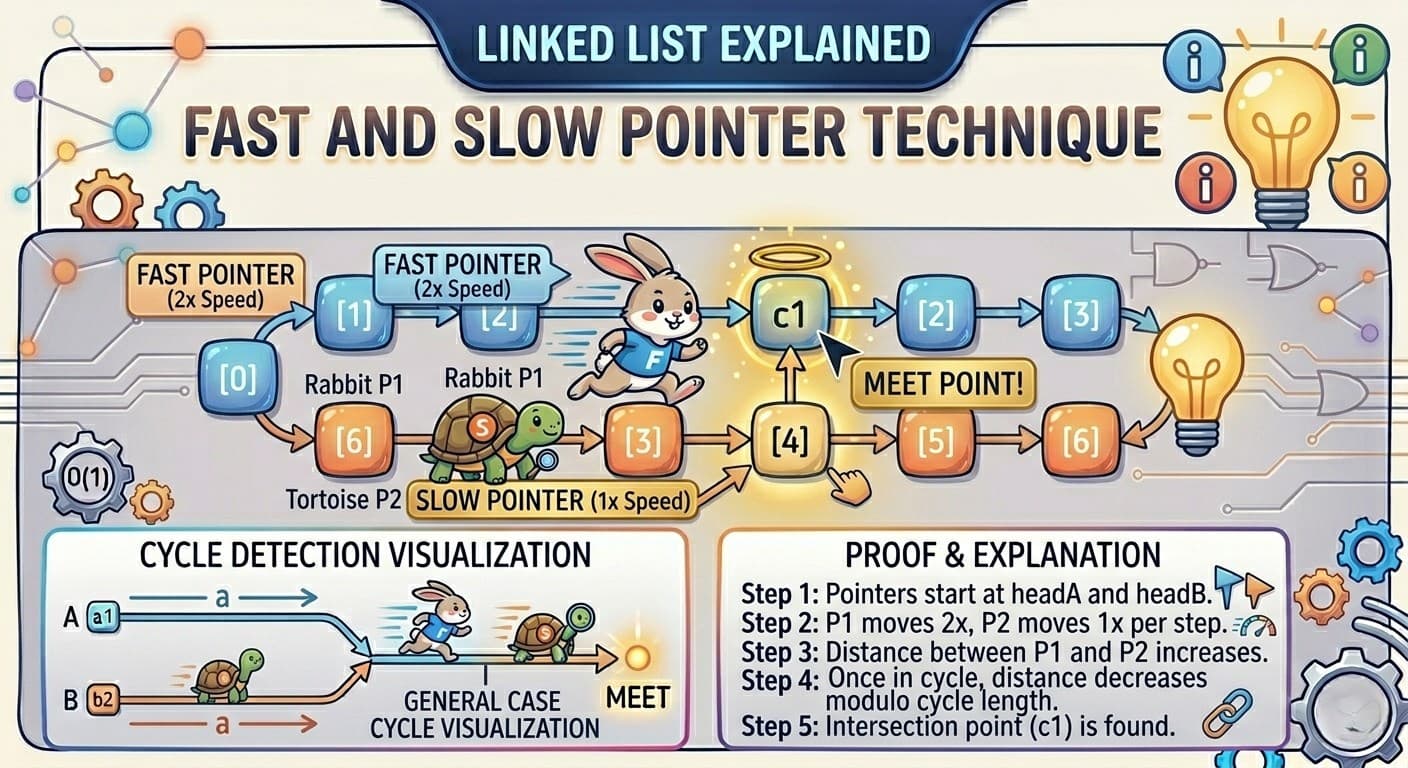
πŸš€ Before We StartTry these problems (optional but helpful):https://leetcode.com/problems/linked-list-cycle/https://leetcode.com/problems/linked-list-cycle-ii/πŸ€” Let’s Talk Honestly…When you first learn this technique, you’re told:πŸ‘‰ β€œSlow moves 1 step, fast moves 2 stepsβ€πŸ‘‰ β€œIf they meet β†’ cycle exists”But your brain asks:❓ Why 2 steps?❓ Why do they meet at all?❓ Why does resetting pointer find cycle start?❓ Is this magic or logic?πŸ‘‰ Let’s answer each doubt one by one.🧩 Doubt 1: Why do we even use two pointers?❓ Question:Why not just use one pointer?βœ… Answer:With one pointer:You can only move forwardYou cannot detect loops efficientlyπŸ‘‰ Two pointers create a relative motionThat relative motion is the key.🧩 Doubt 2: Why fast = 2 steps and slow = 1 step?❓ Question:Why exactly 2 and 1?βœ… Answer:We need:Fast speed > Slow speedSo that:πŸ‘‰ Fast catches up to slow🧠 Think like this:If both move same speed:Slow β†’ 1 stepFast β†’ 1 stepπŸ‘‰ They will NEVER meet ❌If:Slow β†’ 1 stepFast β†’ 2 stepsπŸ‘‰ Fast gains 1 node every stepπŸ”₯ Key Insight:Relative speed = fast - slow = 1πŸ‘‰ This means fast is closing the gap by 1 node every step🧩 Doubt 3: Why do they ALWAYS meet in a cycle?❓ Question:Okay, fast is faster… but why guaranteed meeting?🧠 Imagine a Circular TrackInside a cycle, the list behaves like:Circle of length = Ξ»Now:Slow moves 1 stepFast moves 2 stepsπŸ”„ Gap BehaviorEach step:Gap = Gap - 1Because fast is catching up.Eventually:Gap = 0πŸ‘‰ They meet πŸŽ―πŸ’‘ Simple AnalogyTwo runners on a circular track:One is fasterOne is slowerπŸ‘‰ Faster runner will lap and meet slower runner🧩 Doubt 4: What if there is NO cycle?❓ Question:Why does this fail without cycle?βœ… Answer:If no cycle:List ends β†’ fast reaches nullπŸ‘‰ No loop β†’ no meeting🧩 Doubt 5: Where do they meet?❓ Question:Do they meet at cycle start?❌ Answer:No, not necessarily.They meet somewhere inside the cycle🧩 Doubt 6: Then how do we find the cycle start?Now comes the most important part.🎯 SetupLet’s define:a = distance from head to cycle startb = distance from cycle start to meeting pointc = remaining cycleCycle length:Ξ» = b + c🧠 What happens when they meet?Slow distance:a + bFast distance:2(a + b)Using relation:2(a + b) = a + b + kΞ»Solve:a + b = kΞ»=> a = kΞ» - b=> a = (k-1)Ξ» + (Ξ» - b)πŸ’₯ Final Meaninga = distance from meeting point to cycle startπŸ”₯ BIG CONCLUSIONπŸ‘‰ Distance from head β†’ cycle startπŸ‘‰ = Distance from meeting point β†’ cycle start🧩 Doubt 7: Why resetting pointer works?❓ Question:Why move one pointer to head?βœ… Answer:Because:One pointer is a away from startOther is also a away (via cycle)πŸ‘‰ Move both 1 step:They meet at:Cycle Start πŸŽ―πŸ”„ VisualizationHead β†’ β†’ β†’ Cycle Start β†’ β†’ Meeting Point β†’ β†’ back to StartBoth pointers:One from headOne from meeting pointπŸ‘‰ Same distance β†’ meet at start🧩 Doubt 8: Can we use fast = 3 steps?❓ Question:Will this work?βœ… Answer:Yes, BUT:Math becomes complexHarder to reasonNo extra benefitπŸ‘‰ So we use simplest:2 : 1 ratio🧠 Final Mental ModelThink in 3 steps:1. Different SpeedsFast moves faster β†’ gap reduces2. Circular StructureCycle β†’ positions repeat3. Guaranteed MeetingFinite positions + relative motion β†’ collision🧩 TEMPLATE 1: Detect CycleListNode slow = head;ListNode fast = head;while(fast != null && fast.next != null){ slow = slow.next; fast = fast.next.next; if(slow == fast){ return true; }}return false;🧩 TEMPLATE 2: Find Cycle StartListNode slow = head;ListNode fast = head;while(fast != null && fast.next != null){ slow = slow.next; fast = fast.next.next; if(slow == fast){ slow = head; while(slow != fast){ slow = slow.next; fast = fast.next; } return slow; }}return null;🧩 TEMPLATE 3: Find Middle of Linked List❓ ProblemFind the middle node of a linked list.🧠 IntuitionFast moves twice as fast:When fast reaches end β†’ slow reaches halfπŸ‘‰ Slow = middleπŸ’» CodeListNode slow = head;ListNode fast = head;while(fast != null && fast.next != null){ slow = slow.next; fast = fast.next.next;}return slow;⚠️ Even Length Case1 β†’ 2 β†’ 3 β†’ 4 β†’ 5 β†’ 6πŸ‘‰ Returns 4 (second middle)❓ How to Get First Middle?while(fast.next != null && fast.next.next != null){ slow = slow.next; fast = fast.next.next;}return slow;🧩 Where Else This Technique Is Used?Detect cycleFind cycle startFind middle nodeCheck palindrome (linked list)Split list (merge sort)Intersection problemsβš™οΈ Time & Space ComplexityTime: O(n)Space: O(1)❌ Common MistakesForgetting fast.next != nullThinking meeting point = cycle start ❌Not resetting pointer properly🧠 Final Mental ModelThink in 3 steps:1. Speed DifferenceFast moves faster β†’ gap reduces2. Circular NatureCycle β†’ repeated positions3. Guaranteed MeetingFinite nodes + relative motion β†’ collisionπŸ”₯ One Line to RememberFast catches slow because it reduces the gap inside a loop.πŸš€ ConclusionNow you understand:βœ… Why fast moves fasterβœ… Why they meetβœ… Why meeting proves cycleβœ… Why reset gives cycle startβœ… How to find middle using same logicπŸ‘‰ This is not just a trick…It’s a mathematical guarantee based on motion and cycles.πŸ’‘ Master this once, and you’ll solve multiple linked list problems easily.

Linked ListFast & Slow PointerTwo Pointer TechniqueFloyd AlgorithmDSA PatternsDeep Intuition
What Is Dynamic Programming? Origin Story, Real-Life Uses, LeetCode Problems & Complete Beginner Guide

What Is Dynamic Programming? Origin Story, Real-Life Uses, LeetCode Problems & Complete Beginner Guide

Introduction β€” Why Dynamic Programming Feels Hard (And Why It Isn't)If you've ever stared at a LeetCode problem, read the solution, understood every single line, and still had absolutely no idea how someone arrived at it β€” welcome. You've just experienced the classic Dynamic Programming (DP) confusion.DP has a reputation. People treat it like some dark art reserved for competitive programmers or Google engineers. The truth? Dynamic Programming is one of the most logical, learnable, and satisfying techniques in all of computer science. Once it clicks, it really clicks.This guide will take you from zero to genuinely confident. We'll cover where DP came from, how it works, what patterns to learn, how to recognize DP problems, real-world places it shows up, LeetCode problems to practice, time complexity analysis, and the mistakes that trip up even experienced developers.Let's go.The Origin Story β€” Who Invented Dynamic Programming and Why?The term "Dynamic Programming" was coined by Richard Bellman in the early 1950s while working at RAND Corporation. Here's the funny part: the name was deliberately chosen to sound impressive and vague.Bellman was doing mathematical research that his employer β€” the US Secretary of Defense, Charles Wilson β€” would have found difficult to fund if described accurately. Wilson had a well-known distaste for the word "research." So Bellman invented a name that sounded suitably grand and mathematical: Dynamic Programming.In his autobiography, Bellman wrote that he picked the word "dynamic" because it had a precise technical meaning and was also impossible to use negatively. "Programming" referred to the mathematical sense β€” planning and decision-making β€” not computer programming.The underlying idea? Break a complex problem into overlapping subproblems, solve each subproblem once, and store the result so you never solve it twice.Bellman's foundational contribution was the Bellman Equation, which underpins not just algorithms but also economics, operations research, and modern reinforcement learning.So the next time DP feels frustrating, remember β€” even its inventor named it specifically to confuse people. You're in good company.What Is Dynamic Programming? (Simple Definition)Dynamic Programming is an algorithmic technique used to solve problems by:Breaking them down into smaller overlapping subproblemsSolving each subproblem only onceStoring the result (memoization or tabulation)Building up the final solution from those stored resultsThe key insight is overlapping subproblems + optimal substructure.Overlapping subproblems means the same smaller problems come up again and again. Instead of solving them every time (like plain recursion does), DP solves them once and caches the answer.Optimal substructure means the optimal solution to the whole problem can be built from optimal solutions to its subproblems.If a problem has both these properties β€” it's a DP problem.The Two Approaches to Dynamic Programming1. Top-Down with Memoization (Recursive + Cache)You write a recursive solution exactly as you would naturally, but add a cache (usually a dictionary or array) to store results you've already computed.fib(n):if n in cache: return cache[n]if n <= 1: return ncache[n] = fib(n-1) + fib(n-2)return cache[n]This is called memoization β€” remember what you computed so you don't repeat yourself.Pros: Natural to write, mirrors the recursive thinking, easy to reason about. Cons: Stack overhead from recursion, risk of stack overflow on large inputs.2. Bottom-Up with Tabulation (Iterative)You figure out the order in which subproblems need to be solved, then solve them iteratively from the smallest up, filling a table.fib(n):dp = [0, 1]for i from 2 to n:dp[i] = dp[i-1] + dp[i-2]return dp[n]This is called tabulation β€” fill a table, cell by cell, bottom to top.Pros: No recursion overhead, usually faster in practice, easier to optimize space. Cons: Requires thinking about the order of computation upfront.🧩 Dynamic Programming Template CodeBefore diving into how to recognize DP problems, here are ready-to-use Java templates for every major DP pattern. Think of these as your reusable blueprints β€” every DP problem you ever solve will fit into one of these structures. Just define your state, plug in your recurrence relation, and you are good to go.Template 1 β€” Top-Down (Memoization)import java.util.HashMap;import java.util.Map;public class TopDownDP {Map<Integer, Integer> memo = new HashMap<>();public int solve(int n) {// Base caseif (n <= 1) return n;// Check cacheif (memo.containsKey(n)) return memo.get(n);// Recurrence relation β€” change this part for your problemint result = solve(n - 1) + solve(n - 2);// Store in cachememo.put(n, result);return result;}}Template 2 β€” Bottom-Up (Tabulation)public class BottomUpDP {public int solve(int n) {// Create DP tableint[] dp = new int[n + 1];// Base casesdp[0] = 0;dp[1] = 1;// Fill the table bottom-upfor (int i = 2; i <= n; i++) {// Recurrence relation β€” change this part for your problemdp[i] = dp[i - 1] + dp[i - 2];}return dp[n];}}Template 3 β€” Bottom-Up with Space Optimizationpublic class SpaceOptimizedDP {public int solve(int n) {// Only keep last two values instead of full tableint prev2 = 0;int prev1 = 1;for (int i = 2; i <= n; i++) {// Recurrence relation β€” change this part for your problemint curr = prev1 + prev2;prev2 = prev1;prev1 = curr;}return prev1;}}Template 4 β€” 2D DP (Two Sequences or Grid)public class TwoDimensionalDP {public int solve(String s1, String s2) {int m = s1.length();int n = s2.length();// Create 2D DP tableint[][] dp = new int[m + 1][n + 1];// Base cases β€” first row and columnfor (int i = 0; i <= m; i++) dp[i][0] = i;for (int j = 0; j <= n; j++) dp[0][j] = j;// Fill table cell by cellfor (int i = 1; i <= m; i++) {for (int j = 1; j <= n; j++) {// Recurrence relation β€” change this part for your problemif (s1.charAt(i - 1) == s2.charAt(j - 1)) {dp[i][j] = dp[i - 1][j - 1];} else {dp[i][j] = 1 + Math.min(dp[i - 1][j],Math.min(dp[i][j - 1], dp[i - 1][j - 1]));}}}return dp[m][n];}}Template 5 β€” Knapsack Patternpublic class KnapsackDP {public int solve(int[] weights, int[] values, int capacity) {int n = weights.length;// dp[i][w] = max value using first i items with capacity wint[][] dp = new int[n + 1][capacity + 1];for (int i = 1; i <= n; i++) {for (int w = 0; w <= capacity; w++) {// Don't take item idp[i][w] = dp[i - 1][w];// Take item i if it fitsif (weights[i - 1] <= w) {dp[i][w] = Math.max(dp[i][w],values[i - 1] + dp[i - 1][w - weights[i - 1]]);}}}return dp[n][capacity];}}πŸ’‘ How to use these templates:Step 1 β€” Identify which pattern your problem fits into. Step 2 β€” Define what dp[i] or dp[i][j] means in plain English before writing any code. Step 3 β€” Write your recurrence relation on paper first. Step 4 β€” Plug it into the matching template above. Step 5 β€” Handle your specific base cases carefully.πŸŽ₯ Visual Learning Resource β€” Watch This Before Moving ForwardIf you prefer learning by watching before reading, this free full-length course by freeCodeCamp is one of the best Dynamic Programming resources on the internet. Watch it alongside this guide for maximum understanding.Credit: freeCodeCamp β€” a free, nonprofit coding education platform.How to Recognize a Dynamic Programming ProblemAsk yourself these four questions:1. Can I define the problem in terms of smaller versions of itself? If you can write a recursive formula (recurrence relation), DP might apply.2. Do the subproblems overlap? If a naive recursive solution would recompute the same thing many times, DP is the right tool.3. Is there an optimal substructure? Is the best answer to the big problem made up of best answers to smaller problems?4. Are you looking for a count, minimum, maximum, or yes/no answer? DP problems often ask: "What is the minimum cost?", "How many ways?", "Can we achieve X?"Red flag words in problem statements: minimum, maximum, shortest, longest, count the number of ways, can we reach, is it possible, fewest steps.The Core DP Patterns You Must LearnMastering DP is really about recognizing patterns. Here are the most important ones:Pattern 1 β€” 1D DP (Linear) Problems where the state depends on previous elements in a single sequence. Examples: Fibonacci, Climbing Stairs, House Robber.Pattern 2 β€” 2D DP (Grid / Two-sequence) Problems with two dimensions of state, often grids or two strings. Examples: Longest Common Subsequence, Edit Distance, Unique Paths.Pattern 3 β€” Interval DP You consider all possible intervals or subarrays and build solutions from them. Examples: Matrix Chain Multiplication, Burst Balloons, Palindrome Partitioning.Pattern 4 β€” Knapsack DP (0/1 and Unbounded) You decide whether to include or exclude items under a capacity constraint. Examples: 0/1 Knapsack, Coin Change, Partition Equal Subset Sum.Pattern 5 β€” DP on Trees State is defined per node; you combine results from children. Examples: Diameter of Binary Tree, House Robber III, Maximum Path Sum.Pattern 6 β€” DP on Subsets / Bitmask DP State includes a bitmask representing which elements have been chosen. Examples: Travelling Salesman Problem, Shortest Superstring.Pattern 7 β€” DP on Strings Matching, editing, or counting arrangements within strings. Examples: Longest Palindromic Subsequence, Regular Expression Matching, Wildcard Matching.Top LeetCode Problems to Practice Dynamic Programming (With Links)Here are the essential problems, organized by difficulty and pattern. Solve them in this order.Beginner β€” Warm UpProblemPatternLinkClimbing Stairs1D DPhttps://leetcode.com/problems/climbing-stairs/Fibonacci Number1D DPhttps://leetcode.com/problems/fibonacci-number/House Robber1D DPhttps://leetcode.com/problems/house-robber/Min Cost Climbing Stairs1D DPhttps://leetcode.com/problems/min-cost-climbing-stairs/Best Time to Buy and Sell Stock1D DPhttps://leetcode.com/problems/best-time-to-buy-and-sell-stock/Intermediate β€” Core PatternsProblemPatternLinkCoin ChangeKnapsackhttps://leetcode.com/problems/coin-change/Longest Increasing Subsequence1D DPhttps://leetcode.com/problems/longest-increasing-subsequence/Longest Common Subsequence2D DPhttps://leetcode.com/problems/longest-common-subsequence/0/1 Knapsack (via Subset Sum)Knapsackhttps://leetcode.com/problems/partition-equal-subset-sum/Unique Paths2D Grid DPhttps://leetcode.com/problems/unique-paths/Jump Game1D DP / Greedyhttps://leetcode.com/problems/jump-game/Word BreakString DPhttps://leetcode.com/problems/word-break/Decode Ways1D DPhttps://leetcode.com/problems/decode-ways/Edit Distance2D String DPhttps://leetcode.com/problems/edit-distance/Triangle2D DPhttps://leetcode.com/problems/triangle/Advanced β€” Interview LevelProblemPatternLinkBurst BalloonsInterval DPhttps://leetcode.com/problems/burst-balloons/Regular Expression MatchingString DPhttps://leetcode.com/problems/regular-expression-matching/Wildcard MatchingString DPhttps://leetcode.com/problems/wildcard-matching/Palindrome Partitioning IIInterval DPhttps://leetcode.com/problems/palindrome-partitioning-ii/Maximum Profit in Job SchedulingDP + Binary Searchhttps://leetcode.com/problems/maximum-profit-in-job-scheduling/Distinct Subsequences2D DPhttps://leetcode.com/problems/distinct-subsequences/Cherry Pickup3D DPhttps://leetcode.com/problems/cherry-pickup/Real-World Use Cases of Dynamic ProgrammingDP is not just for coding interviews. It is deeply embedded in the technology you use every day.1. Google Maps & Navigation (Shortest Path) The routing engines behind GPS apps use DP-based algorithms like Dijkstra and Bellman-Ford to find the shortest or fastest path between two points across millions of nodes.2. Spell Checkers & Autocorrect (Edit Distance) When your phone corrects "teh" to "the," it is computing Edit Distance β€” a classic DP problem β€” between what you typed and every word in the dictionary.3. DNA Sequence Alignment (Bioinformatics) Researchers use the Needleman-Wunsch and Smith-Waterman algorithms β€” both DP β€” to align DNA and protein sequences and find similarities between species or identify mutations.4. Video Compression (MPEG, H.264) Modern video codecs use DP to determine the most efficient way to encode video frames, deciding which frames to store as full images and which to store as differences from the previous frame.5. Financial Portfolio Optimization Investment algorithms use DP to find the optimal allocation of assets under risk constraints β€” essentially a variant of the knapsack problem.6. Natural Language Processing (NLP) The Viterbi algorithm β€” used in speech recognition, part-of-speech tagging, and machine translation β€” is a DP algorithm. Every time Siri or Google Assistant understands your sentence, DP played a role.7. Game AI (Chess, Checkers) Game trees and minimax algorithms with memoization use DP to evaluate board positions and find the best move without recomputing already-seen positions.8. Compiler Optimization Compilers use DP to decide the optimal order of operations and instruction scheduling to generate the most efficient machine code.9. Text Justification (Word Processors) Microsoft Word and LaTeX use DP to optimally break paragraphs into lines β€” minimizing raggedness and maximizing visual appeal.10. Resource Scheduling in Cloud Computing AWS, Google Cloud, and Azure use DP-based scheduling to assign computational tasks to servers in the most cost-efficient way possible.Time Complexity Analysis of Common DP ProblemsUnderstanding the time complexity of DP is critical for interviews and for building scalable systems.ProblemTime ComplexitySpace ComplexityNotesFibonacci (naive recursion)O(2ⁿ)O(n)Exponential β€” terribleFibonacci (DP)O(n)O(1) with optimizationLinear β€” excellentLongest Common SubsequenceO(m Γ— n)O(m Γ— n)m, n = lengths of two stringsEdit DistanceO(m Γ— n)O(m Γ— n)Can optimize space to O(n)0/1 KnapsackO(n Γ— W)O(n Γ— W)n = items, W = capacityCoin ChangeO(n Γ— amount)O(amount)Classic tabulationLongest Increasing SubsequenceO(nΒ²) or O(n log n)O(n)Binary search version is fasterMatrix Chain MultiplicationO(nΒ³)O(nΒ²)Interval DPTravelling Salesman (bitmask)O(2ⁿ Γ— nΒ²)O(2ⁿ Γ— n)Still exponential but manageable for small nThe general rule: DP trades time for space. You use memory to avoid recomputation. The time complexity equals the number of unique states multiplied by the work done per state.How to Learn and Master Dynamic Programming β€” Step by StepHere is an honest, structured path to mastery:Step 1 β€” Get recursion absolutely solid first. DP is memoized recursion at its core. If you cannot write clean recursive solutions confidently, DP will remain confusing. Practice at least 20 pure recursion problems first.Step 2 β€” Start with the classics. Fibonacci β†’ Climbing Stairs β†’ House Robber β†’ Coin Change. These teach you the core pattern of defining state and transition without overwhelming you.Step 3 β€” Learn to define state explicitly. Before writing any code, ask: "What does dp[i] represent?" Write it in plain English. "dp[i] = the minimum cost to reach step i." This single habit separates good DP thinkers from struggling ones.Step 4 β€” Write the recurrence relation before coding. On paper or in a comment. Example: dp[i] = min(dp[i-1] + cost[i-1], dp[i-2] + cost[i-2]). If you can write the recurrence, the code writes itself.Step 5 β€” Master one pattern at a time. Don't jump between knapsack and interval DP in the same week. Spend a few days on each pattern until it feels intuitive.Step 6 β€” Solve the same problem both ways. Top-down and bottom-up. This builds deep understanding of what DP is actually doing.Step 7 β€” Optimize space after getting correctness. Many 2D DP solutions can use a single row instead of a full matrix. Learn this optimization after you understand the full solution.Step 8 β€” Do timed practice under interview conditions. Give yourself 35 minutes per problem. Review what you got wrong. DP is a muscle β€” it builds with reps.Common Mistakes in Dynamic Programming (And How to Avoid Them)Mistake 1 β€” Jumping to code before defining state. The most common DP error. Always define what dp[i] or dp[i][j] means before writing a single line of code.Mistake 2 β€” Wrong base cases. A single wrong base case corrupts every answer built on top of it. Trace through your base cases manually on a tiny example before running code.Mistake 3 β€” Off-by-one errors in indexing. Whether your dp array is 0-indexed or 1-indexed must be 100% consistent throughout. This causes more bugs in DP than almost anything else.Mistake 4 β€” Confusing top-down with bottom-up state order. In bottom-up DP, you must ensure that when you compute dp[i], all values it depends on are already filled. If you compute in the wrong order, you get garbage answers.Mistake 5 β€” Memoizing in the wrong dimension. In 2D problems, some people cache only one dimension when the state actually requires two. Always identify all variables that affect the outcome.Mistake 6 β€” Using global mutable state in recursion. If you use a shared array and don't clear it between test cases, you'll get wrong answers on subsequent inputs. Always scope your cache correctly.Mistake 7 β€” Not considering the full state space. In problems like Knapsack, forgetting that the state is (item index, remaining capacity) β€” not just item index β€” leads to fundamentally wrong solutions.Mistake 8 β€” Giving up after not recognizing the pattern immediately. DP problems don't announce themselves. The skill is learning to ask "is there overlapping subproblems here?" on every problem. This takes time. Don't mistake unfamiliarity for inability.Frequently Asked Questions About Dynamic ProgrammingQ: Is Dynamic Programming the same as recursion? Not exactly. Recursion is a technique for breaking problems into smaller pieces. DP is recursion plus memoization β€” or iterative tabulation. All DP can be written recursively, but not all recursion is DP.Q: What is the difference between DP and Divide and Conquer? Divide and Conquer (like Merge Sort) breaks problems into non-overlapping subproblems. DP is used when subproblems overlap β€” meaning the same subproblem is solved multiple times in a naive approach.Q: How do I know when NOT to use DP? If the subproblems don't overlap (no repeated computation), greedy or divide-and-conquer may be better. If the problem has no optimal substructure, DP won't give a correct answer.Q: Do I need to memorize DP solutions for interviews? No. You need to recognize patterns and be able to derive the recurrence relation. Memorizing solutions without understanding them will fail you in interviews. Focus on the thinking process.Q: How long does it take to get good at DP? Most people start to feel genuinely comfortable after solving 40–60 varied DP problems with deliberate practice. The first 10 feel impossible. The next 20 feel hard. After 50, patterns start feeling obvious.Q: What programming language is best for DP? Any language works. Python is often used for learning because its dictionaries make memoization trivial. C++ is preferred in competitive programming for its speed. For interviews, use whatever language you're most comfortable in.Q: What is space optimization in DP? Many DP problems only look back one or two rows to compute the current row. In those cases, you can replace an nΓ—m table with just two arrays (or even one), reducing space complexity from O(nΓ—m) to O(m). This is called space optimization or rolling array technique.Q: Can DP be applied to graph problems? Absolutely. Shortest path algorithms like Bellman-Ford are DP. Longest path in a DAG is DP. DP on trees is a rich subfield. Anywhere you have states and transitions, DP can potentially apply.Q: Is Greedy a type of Dynamic Programming? Greedy is related but distinct. Greedy makes locally optimal choices without reconsidering. DP considers all choices and picks the globally optimal one. Some DP solutions reduce to greedy when the structure allows, but they are different techniques.Q: What resources should I use to learn DP? For structured learning: Neetcode.io (organized problem list), Striver's DP Series on YouTube, and the book "Introduction to Algorithms" (CLRS) for theoretical depth. For practice: LeetCode's Dynamic Programming study plan and Codeforces for competitive DP.Final Thoughts β€” Dynamic Programming Is a SuperpowerDynamic Programming is genuinely one of the most powerful ideas in computer science. It shows up in your GPS, your autocorrect, your streaming video, your bank's risk models, and the AI assistants you talk to daily.The path to mastering it is not memorization. It is developing the habit of asking: can I break this into smaller problems that overlap? And then learning to define state clearly, write the recurrence, and trust the process.Start with Climbing Stairs. Write dp[i] in plain English before every problem. Solve everything twice β€” top-down and bottom-up. Do 50 problems with genuine reflection, not just accepted solutions.The click moment will come. And when it does, you'll wonder why it ever felt hard.

Dynamic ProgrammingMemoizationTabulationJavaOrigin StoryRichard Bellman
LeetCode 2161: Partition Array According to Given Pivot – Java Easy Stable Partition Solution

LeetCode 2161: Partition Array According to Given Pivot – Java Easy Stable Partition Solution

IntroductionLeetCode 2161 is a clean and important array manipulation problem that tests:Array traversalStable partitioningOrder preservationTwo-pass and three-pass approachesLogical grouping of elementsThe interesting part of this problem is that we are not only partitioning the array around a pivot, but we also need to preserve the relative order of elements.This makes the problem slightly different from classical partition algorithms like QuickSort partitioning.In this article, we will understand:The intuition behind stable partitioningWhy order preservation mattersStep-by-step explanationDry runTime and space complexityComplete optimized Java solutionProblem StatementTry this probelm here :- Partition ArrayYou are given:An integer array:numsAn integer:pivotYou must rearrange the array such that:All elements smaller than pivot come firstAll elements equal to pivot come nextAll elements greater than pivot come lastRelative ordering must remain preservedReturn the rearranged array.ExampleInputnums = [9,12,5,10,14,3,10]pivot = 10Output[9,5,3,10,10,12,14]ExplanationElements less than 109, 5, 3Elements equal to 1010, 10Elements greater than 1012, 14All relative orderings are preserved.Key ObservationWe do NOT need sorting.We only need grouping while maintaining original order.This is called:Stable PartitioningApproachWe create a new array and fill it in 3 phases:Phase 1Insert all elements:< pivotPhase 2Insert all elements:== pivotPhase 3Insert all elements:> pivotThis naturally preserves relative ordering because we traverse left-to-right every time.Optimized Java Solutionclass Solution { public int[] pivotArray(int[] nums, int pivot) { int[] ans = new int[nums.length]; int index = 0; // Smaller than pivot for(int i = 0; i < nums.length; i++) { if(nums[i] < pivot) { ans[index] = nums[i]; index++; } } // Equal to pivot for(int i = 0; i < nums.length; i++) { if(nums[i] == pivot) { ans[index] = nums[i]; index++; } } // Greater than pivot for(int i = 0; i < nums.length; i++) { if(nums[i] > pivot) { ans[index] = nums[i]; index++; } } return ans; }}Step-by-Step ExplanationStep 1: Create Answer Arrayint[] ans = new int[nums.length];Stores final partitioned result.Step 2: Insert Smaller Elementsif(nums[i] < pivot)All smaller elements go first.Step 3: Insert Equal Elementsif(nums[i] == pivot)Pivot values are placed in the middle.Step 4: Insert Larger Elementsif(nums[i] > pivot)Larger elements go to the end.Dry RunInputnums = [9,12,5,10,14,3,10]pivot = 10Pass 1: Smaller ElementsAdd:9, 5, 3Current array:[9,5,3]Pass 2: Equal ElementsAdd:10, 10Current array:[9,5,3,10,10]Pass 3: Greater ElementsAdd:12, 14Final array:[9,5,3,10,10,12,14]Time ComplexityWe traverse the array 3 times.Time ComplexityO(N)Because:3N β†’ O(N)Space ComplexityWe use an extra array.Space ComplexityO(N)Why This Problem is ImportantThis problem teaches:Stable partitioningArray groupingRelative order preservationMulti-pass array processingClean implementation strategyThese concepts are frequently used in:Sorting systemsData pipelinesStream processingPartition-based algorithmsCommon Mistakes1. Using QuickSort Partition LogicQuickSort partitioning does NOT preserve order.This problem specifically requires stable ordering.2. Forgetting Equal ElementsSome solutions only handle:< pivotand> pivotBut pivot values must remain in the center.3. Overcomplicating with Two PointersA simple three-pass solution is cleaner and easier to understand.Interview ExplanationIn interviews explain:Since relative order must remain preserved, we cannot use traditional in-place partitioning. Instead, we perform stable partitioning by collecting smaller, equal, and larger elements sequentially.This demonstrates:Understanding of stable operationsStrong array fundamentalsClean coding approachAlternative ApproachAnother approach is using:Three separate listsThen merging themExample:small + equal + largeBut using one answer array is more space efficient.ConclusionLeetCode 2161 is a simple yet important stable partition problem.The key insight is:We must preserve relative ordering while grouping elements around the pivot.Using a clean three-pass traversal gives an elegant and efficient O(N) solution.

LeetCodeJavaMediumArrayArray PartitionPivot
Ai Assistant Kas