LeetCode 462: Minimum Moves to Equal Array Elements II | Java Solution Explained (Median Approach)
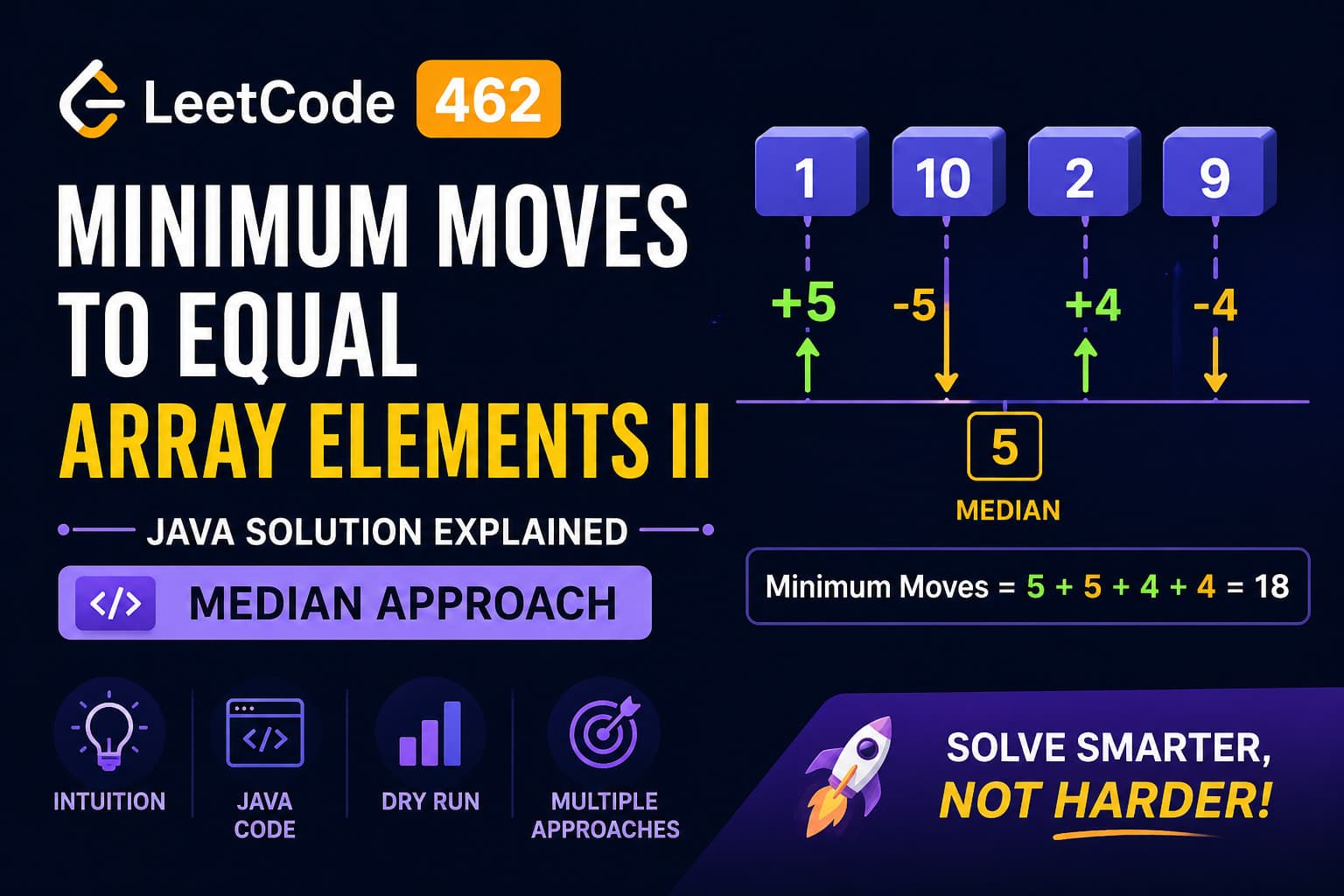
IntroductionLeetCode 462 is a classic mathematical and greedy problem.We are given an integer array where each operation allows us to:Increment an element by 1Decrement an element by 1Our task is to make all numbers equal while using the minimum number of moves.At first glance, this may look like a simple array problem.But the hidden concept behind this question is:Median propertyGreedy optimizationAbsolute difference minimizationThis problem is extremely popular in coding interviews because it tests logical thinking more than coding complexity.# Problem LinkProblem StatementYou are given an integer array nums.In one move:You can increase an element by 1Or decrease an element by 1You must make all array elements equal.Return the minimum number of operations required.Example 1Input:nums = [1,2,3]Output:2Explanation:[1,2,3]→ [2,2,3]→ [2,2,2]Total operations = 2Example 2Input:nums = [1,10,2,9]Output:16Key ObservationWe need to choose one target value such that all numbers move toward it.Question:Which target gives minimum total moves?Answer:MedianMedian minimizes the sum of absolute differences.Why Median Works?Suppose:nums = [1,2,3,10]If target = 2|1-2| + |2-2| + |3-2| + |10-2|= 1 + 0 + 1 + 8= 10If target = 5|1-5| + |2-5| + |3-5| + |10-5|= 4 + 3 + 2 + 5= 14Median gives minimum moves.Approach 1: Brute ForceIn this approach, we try every possible value as target.For each target:Calculate total operations neededStore minimum answerAlgorithmFind minimum and maximum elementTry every value between themCompute total movesReturn minimumJava Code (Brute Force)class Solution {public int minMoves2(int[] nums) {int min = Integer.MAX_VALUE;int max = Integer.MIN_VALUE;for (int num : nums) {min = Math.min(min, num);max = Math.max(max, num);}int result = Integer.MAX_VALUE;for (int target = min; target <= max; target++) {int moves = 0;for (int num : nums) {moves += Math.abs(num - target);}result = Math.min(result, moves);}return result;}}Time ComplexityO(N × Range)Very slow for large values.Approach 2: Sorting + Median (Optimal)This is the best and most commonly used approach.IdeaSort arrayPick median elementCalculate total absolute differenceStepsStep 1: Sort ArraySorting helps us easily find median.Step 2: Pick MedianMedian index = n / 2Step 3: Calculate MovesFor every element:moves += abs(median - value)Optimal Java Solutionclass Solution {public int minMoves2(int[] nums) {Arrays.sort(nums);int mid = nums.length / 2;int ans = 0;for (int i = 0; i < nums.length; i++) {int diff = Math.abs(nums[mid] - nums[i]);ans += diff;}return ans;}}Code ExplanationStep 1: Sort ArrayArrays.sort(nums);Sorting allows median calculation.Step 2: Get Medianint mid = nums.length / 2;Middle element becomes target.Step 3: Compute DifferenceMath.abs(nums[mid] - nums[i])Find distance from median.Step 4: Add All Movesans += diff;Store total moves.Approach 3: Two Pointer OptimizationAfter sorting, we can use two pointers.Instead of calculating absolute difference manually, we can pair smallest and largest values.IdeaAfter sorting:moves += nums[right] - nums[left]Because both numbers will meet toward median.Java Code (Two Pointer)class Solution {public int minMoves2(int[] nums) {Arrays.sort(nums);int left = 0;int right = nums.length - 1;int moves = 0;while (left < right) {moves += nums[right] - nums[left];left++;right--;}return moves;}}Why Two Pointer Works?Because:Median minimizes total distancePairing smallest and largest values gives direct movement cost.Dry RunInput:nums = [1,10,2,9]Sort:[1,2,9,10]Median:9Operations:|1-9| = 8|2-9| = 7|9-9| = 0|10-9| = 1Total:16Time ComplexitySortingO(N log N)TraversingO(N)TotalO(N log N)Space ComplexityO(1)Ignoring sorting stack.Common Mistakes1. Using Average Instead of MedianMany people think average gives minimum.Wrong.Average minimizes squared difference.Median minimizes absolute difference.2. Forgetting SortingMedian requires sorted order.3. Overflow IssueValues can be large.Sometimes use:long ansfor safer calculation.4. Using Wrong Median IndexCorrect:n / 2Edge CasesCase 1Single element array.Answer = 0Case 2All elements already equal.Answer = 0Case 3Negative numbers.Algorithm still works.FAQsQ1. Why median gives minimum moves?Median minimizes total absolute difference.Q2. Can average work?No.Average does not minimize absolute distance.Q3. Is sorting necessary?Yes.Sorting helps us easily find median.Q4. Which approach is best?Sorting + median approach.Interview InsightInterviewers ask this problem to test:Median property understandingGreedy optimizationMathematical thinkingArray manipulationConclusionLeetCode 462 is one of the most important median-based interview questions.The major learning is:Median minimizes total absolute differenceSorting makes finding median easySum of distances gives answerOnce you understand why median works, this question becomes very simple.