Search Blogs

Showing results for "Fast & Slow Pointer"

Found 8 results

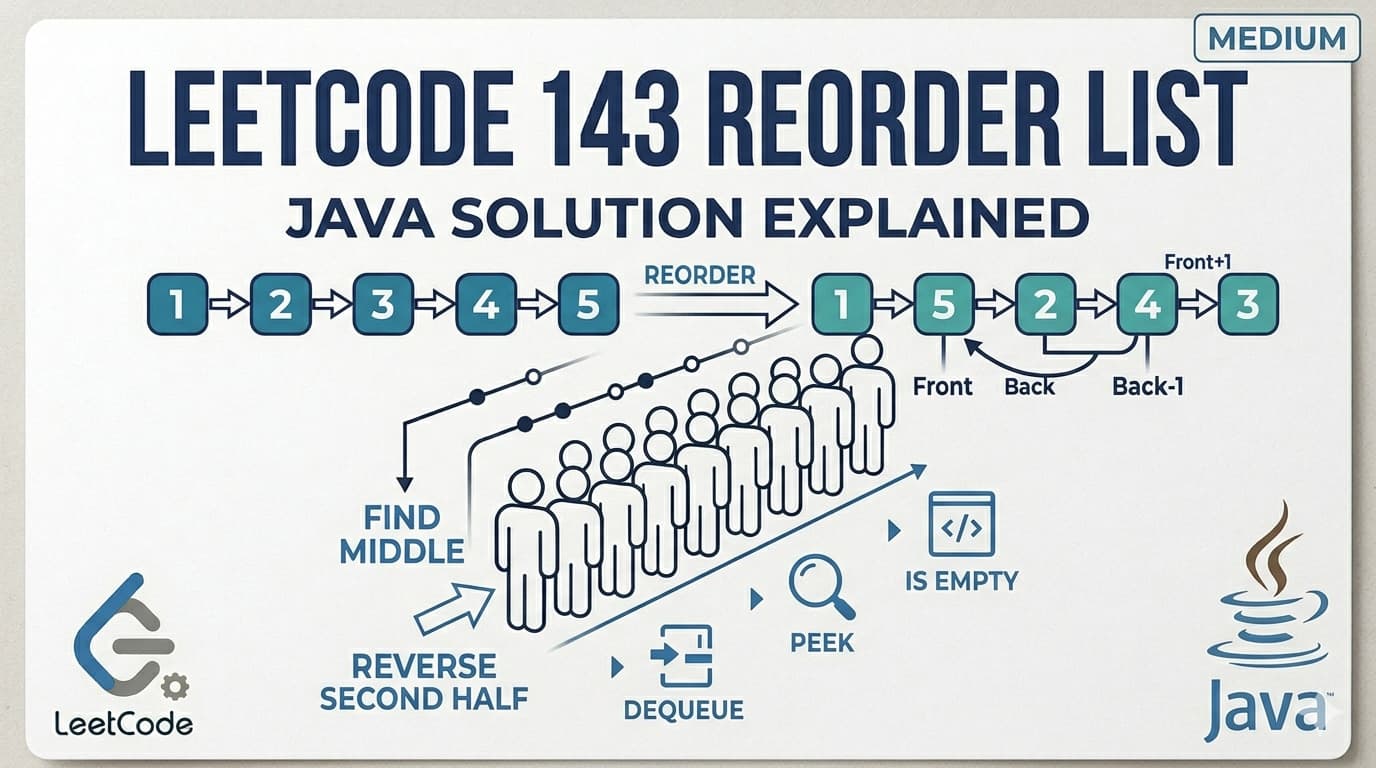
LeetCode 143 Reorder List - Java Solution Explained

LeetCode 143 Reorder List - Java Solution Explained

IntroductionLeetCode 143 Reorder List is one of those problems that looks simple when you read it but immediately makes you wonder — where do I even start? There is no single trick that solves it. Instead it combines three separate linked list techniques into one clean solution. Mastering this problem means you have genuinely understood linked lists at an intermediate level.You can find the problem here — LeetCode 143 Reorder List.This article walks through everything — what the problem wants, the intuition behind each step, all three techniques used, a detailed dry run, complexity analysis, and common mistakes beginners make.What Is the Problem Really Asking?You have a linked list: L0 → L1 → L2 → ... → LnYou need to reorder it to: L0 → Ln → L1 → Ln-1 → L2 → Ln-2 → ...In plain English — take one node from the front, then one from the back, then one from the front, then one from the back, and keep alternating until all nodes are used.Example:Input: 1 → 2 → 3 → 4 → 5Output: 1 → 5 → 2 → 4 → 3Node 1 from front, Node 5 from back, Node 2 from front, Node 4 from back, Node 3 stays in middle.Real Life Analogy — Dealing Cards From Both EndsImagine you have a deck of cards laid out in a line face up: 1, 2, 3, 4, 5. Now you deal them by alternately picking from the left end and the right end of the line:Pick 1 from left → placePick 5 from right → place after 1Pick 2 from left → place after 5Pick 4 from right → place after 2Pick 3 (only one left) → place after 4Result: 1, 5, 2, 4, 3That is exactly what the problem wants. The challenge is doing this efficiently on a singly linked list where you cannot just index from the back.Why This Problem Is Hard for BeginnersIn an array you can just use two pointers — one at the start and one at the end — and swap/interleave easily. But a singly linked list only goes forward. You cannot go backwards. You cannot easily access the last element.This is why the problem requires a three-step approach that cleverly works around the limitations of a singly linked list.The Three Step ApproachEvery experienced developer solves this problem in exactly three steps:Step 1 — Find the middle of the linked list using the Fast & Slow Pointer techniqueStep 2 — Reverse the second half of the linked listStep 3 — Merge the two halves by alternating nodes from eachLet us understand each step deeply before looking at code.Step 1: Finding the Middle — Fast & Slow PointerThe Fast & Slow Pointer technique (also called Floyd's algorithm) uses two pointers moving at different speeds through the list:slow moves one step at a timefast moves two steps at a timeWhen fast reaches the end, slow is exactly at the middle. This works because fast covers twice the distance of slow in the same number of steps.ListNode fast = head;ListNode slow = head;while (fast.next != null && fast.next.next != null) { fast = fast.next.next; slow = slow.next;}// slow is now at the middleFor 1 → 2 → 3 → 4 → 5:Start: slow=1, fast=1Step 1: slow=2, fast=3Step 2: slow=3, fast=5 (fast.next is null, stop)Middle is node 3For 1 → 2 → 3 → 4:Start: slow=1, fast=1Step 1: slow=2, fast=3Step 2: fast.next.next is null, stopslow=2, middle is node 2After finding the middle, we cut the list in two by setting slow.next = null. This disconnects the first half from the second half.Step 2: Reversing the Second HalfOnce we have the second half starting from slow.next, we reverse it. After reversal, what was the last node becomes the first — giving us easy access to the back elements of the original list.public ListNode reverse(ListNode head) { ListNode curr = head; ListNode prev = null; while (curr != null) { ListNode next = curr.next; // save next curr.next = prev; // reverse the link prev = curr; // move prev forward curr = next; // move curr forward } return prev; // prev is the new head}For second half 3 → 4 → 5 (from the first example):Reverse → 5 → 4 → 3Now we have:First half: 1 → 2 → 3 (but 3 is the end since we cut at slow)Wait — actually after cutting at slow=3: first half is 1 → 2 → 3, second half reversed is 5 → 4Let us be precise. For 1 → 2 → 3 → 4 → 5, slow stops at 3. slow.next = null cuts to give:First half: 1 → 2 → 3 → nullSecond half before reverse: 4 → 5Second half after reverse: 5 → 4Step 3: Merging Two HalvesNow we have two lists and we merge them by alternately taking one node from each:Take from first half, take from second half, take from first half, take from second half...ListNode orig = head; // pointer for first halfListNode newhead = second; // pointer for reversed second halfwhile (newhead != null) { ListNode temp1 = orig.next; // save next of first half ListNode temp2 = newhead.next; // save next of second half orig.next = newhead; // first → second newhead.next = temp1; // second → next of first orig = temp1; // advance first half pointer newhead = temp2; // advance second half pointer}Why do we loop on newhead != null and not orig != null? Because the second half is always equal to or shorter than the first half (we cut at middle). Once the second half is exhausted, the remaining first half nodes are already in the correct position.Complete Solutionclass Solution { public ListNode reverse(ListNode head) { ListNode curr = head; ListNode prev = null; while (curr != null) { ListNode next = curr.next; curr.next = prev; prev = curr; curr = next; } return prev; } public void reorderList(ListNode head) { // Step 1: Find middle using fast & slow pointer ListNode fast = head; ListNode slow = head; while (fast.next != null && fast.next.next != null) { fast = fast.next.next; slow = slow.next; } // Step 2: Reverse second half ListNode newhead = reverse(slow.next); slow.next = null; // cut the list into two halves // Step 3: Merge two halves alternately ListNode orig = head; while (newhead != null) { ListNode temp1 = orig.next; ListNode temp2 = newhead.next; orig.next = newhead; newhead.next = temp1; orig = temp1; newhead = temp2; } }}Complete Dry Run — head = [1, 2, 3, 4, 5]Step 1: Find MiddleList: 1 → 2 → 3 → 4 → 5Initial: slow=1, fast=1Iteration 1: slow=2, fast=3Iteration 2: fast.next=4, fast.next.next=5 → slow=3, fast=5fast.next is null → stopslow is at node 3Step 2: Cut and ReverseCut: slow.next = nullFirst half: 1 → 2 → 3 → nullSecond half: 4 → 5Reverse second half 4 → 5:prev=null, curr=4 → next=5, 4.next=null, prev=4, curr=5prev=4, curr=5 → next=null, 5.next=4, prev=5, curr=nullReturn prev=5Reversed second half: 5 → 4 → nullStep 3: Mergeorig=1, newhead=5Iteration 1:temp1 = orig.next = 2temp2 = newhead.next = 4orig.next = newhead → 1.next = 5newhead.next = temp1 → 5.next = 2orig = temp1 = 2newhead = temp2 = 4List so far: 1 → 5 → 2 → 3Iteration 2:temp1 = orig.next = 3temp2 = newhead.next = nullorig.next = newhead → 2.next = 4newhead.next = temp1 → 4.next = 3orig = temp1 = 3newhead = temp2 = nullList so far: 1 → 5 → 2 → 4 → 3newhead is null → loop endsFinal result: 1 → 5 → 2 → 4 → 3 ✅Dry Run — head = [1, 2, 3, 4]Step 1: Find MiddleInitial: slow=1, fast=1Iteration 1: slow=2, fast=3fast.next=4, fast.next.next=null → stopslow is at node 2Step 2: Cut and ReverseFirst half: 1 → 2 → nullSecond half: 3 → 4Reversed: 4 → 3 → nullStep 3: Mergeorig=1, newhead=4Iteration 1:temp1=2, temp2=31.next=4, 4.next=2orig=2, newhead=3List: 1 → 4 → 2 → 3Iteration 2:temp1=null (2.next was originally 3 but we cut at slow=2, so 2.next = null... wait)Actually after cutting at slow=2, first half is 1 → 2 → null, so orig when it becomes 2, orig.next = null.temp1 = orig.next = nulltemp2 = newhead.next = null2.next = 3, 3.next = nullorig = null, newhead = nullnewhead is null → stopFinal result: 1 → 4 → 2 → 3 ✅Why slow.next = null Must Come After Saving newheadThis is a subtle but critical ordering detail in the code. Look at this sequence:ListNode newhead = reverse(slow.next); // save reversed second half FIRSTslow.next = null; // THEN cut the listIf you cut first (slow.next = null) and then try to reverse, you lose the reference to the second half entirely because slow.next is already null. Always save the second half reference before cutting.Time and Space ComplexityTime Complexity: O(n) — each of the three steps (find middle, reverse, merge) makes a single pass through the list. Total is 3 passes = O(3n) = O(n).Space Complexity: O(1) — everything is done by rearranging pointers in place. No extra arrays, no recursion stack, no additional data structures. Just a handful of pointer variables.This is the optimal solution — linear time and constant space.Alternative Approach — Using ArrayList (Simpler but O(n) Space)If you find the three-step approach hard to implement under interview pressure, here is a simpler approach using extra space:public void reorderList(ListNode head) { // store all nodes in ArrayList for random access List<ListNode> nodes = new ArrayList<>(); ListNode curr = head; while (curr != null) { nodes.add(curr); curr = curr.next; } int left = 0; int right = nodes.size() - 1; while (left < right) { nodes.get(left).next = nodes.get(right); left++; if (left == right) break; // odd number of nodes nodes.get(right).next = nodes.get(left); right--; } nodes.get(left).next = null; // terminate the list}This is much easier to understand and code. Store all nodes in an ArrayList, use two pointers from both ends, and wire up the next pointers.Time Complexity: O(n) Space Complexity: O(n) — ArrayList stores all nodesThis is acceptable in most interviews. Mention the O(1) space approach as the optimal solution if asked.Common Mistakes to AvoidNot cutting the list before merging If you do not set slow.next = null after finding the middle, the first half still points into the second half. During merging, this creates cycles and infinite loops. Always cut before merging.Wrong loop condition for finding the middle The condition fast.next != null && fast.next.next != null ensures fast does not go out of bounds when jumping two steps. Using just fast != null && fast.next != null moves slow one step too far for even-length lists.Looping on orig instead of newhead The merge loop should run while newhead != null, not while orig != null. The second half is always shorter or equal to the first half. Once the second half is done, the remaining first half is already correctly placed.Forgetting to save both temp pointers before rewiring In the merge step, you must save both orig.next and newhead.next before changing any pointers. Changing orig.next first and then trying to access orig.next to save it gives you the wrong node.How This Problem Combines Multiple PatternsThis problem is special because it does not rely on a single technique. It is a combination of three fundamental linked list operations:Fast & Slow Pointer — you saw this concept in problems like finding the middle of a list and detecting cycles (LeetCode 141, 142).Reverse a Linked List — the most fundamental linked list operation, appears in LeetCode 206 and as a subtask in dozens of problems.Merge Two Lists — similar to merging two sorted lists (LeetCode 21) but here order is not sorted, it is alternating.Solving this problem proves you are comfortable with all three patterns individually and can combine them when needed.FAQs — People Also AskQ1. What is the most efficient approach for LeetCode 143 Reorder List? The three-step approach — find middle with fast/slow pointer, reverse second half, merge alternately — runs in O(n) time and O(1) space. It is the optimal solution. The ArrayList approach is O(n) time and O(n) space but simpler to code.Q2. Why use fast and slow pointer to find the middle? Because a singly linked list has no way to access elements by index. You cannot just do list[length/2]. The fast and slow pointer technique finds the middle in a single pass without knowing the length beforehand.Q3. Why reverse the second half instead of the first half? The problem wants front-to-back alternation. If you reverse the second half, its first node is the original last node — exactly what you need to interleave with the front of the first half. Reversing the first half would give the wrong order.Q4. What is the time complexity of LeetCode 143? O(n) time for three linear passes (find middle, reverse, merge). O(1) space since all operations are in-place pointer manipulations with no extra data structures.Q5. Is LeetCode 143 asked in coding interviews? Yes, frequently at companies like Amazon, Google, Facebook, and Microsoft. It is considered a benchmark problem for linked list mastery because it requires combining three separate techniques cleanly under pressure.Similar LeetCode Problems to Practice Next206. Reverse Linked List — Easy — foundation for step 2 of this problem876. Middle of the Linked List — Easy — fast & slow pointer isolated21. Merge Two Sorted Lists — Easy — merging technique foundation234. Palindrome Linked List — Easy — also uses find middle + reverse second half148. Sort List — Medium — merge sort on linked list, uses same split techniqueConclusionLeetCode 143 Reorder List is one of the best Medium linked list problems because it forces you to think in multiple steps and combine techniques rather than apply a single pattern. The fast/slow pointer finds the middle efficiently without knowing the length. Reversing the second half turns the "cannot go backwards" limitation of singly linked lists into a non-issue. And the alternating merge weaves everything together cleanly.Work through the dry runs carefully — especially the pointer saving step in the merge. Once you see why each step is necessary and how they connect, this problem will always feel approachable no matter when it shows up in an interview.
LeetCodeJavaLinked ListTwo PointerFast Slow PointerMedium
Fast and Slow Pointer Technique in Linked List: Cycle Detection, Proof, and Complete Explanation

Fast and Slow Pointer Technique in Linked List: Cycle Detection, Proof, and Complete Explanation

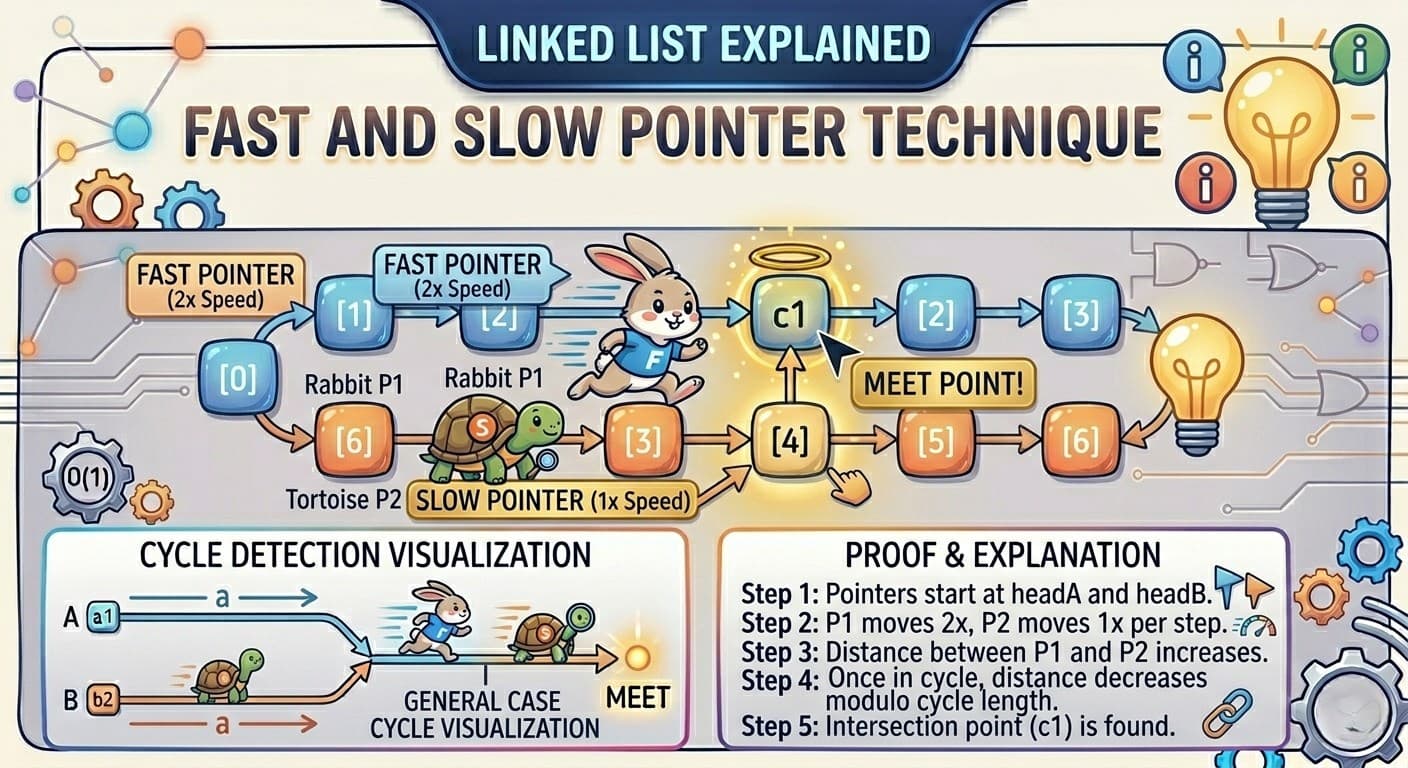
🚀 Before We StartTry these problems (optional but helpful):https://leetcode.com/problems/linked-list-cycle/https://leetcode.com/problems/linked-list-cycle-ii/🤔 Let’s Talk Honestly…When you first learn this technique, you’re told:👉 “Slow moves 1 step, fast moves 2 steps”👉 “If they meet → cycle exists”But your brain asks:❓ Why 2 steps?❓ Why do they meet at all?❓ Why does resetting pointer find cycle start?❓ Is this magic or logic?👉 Let’s answer each doubt one by one.🧩 Doubt 1: Why do we even use two pointers?❓ Question:Why not just use one pointer?✅ Answer:With one pointer:You can only move forwardYou cannot detect loops efficiently👉 Two pointers create a relative motionThat relative motion is the key.🧩 Doubt 2: Why fast = 2 steps and slow = 1 step?❓ Question:Why exactly 2 and 1?✅ Answer:We need:Fast speed > Slow speedSo that:👉 Fast catches up to slow🧠 Think like this:If both move same speed:Slow → 1 stepFast → 1 step👉 They will NEVER meet ❌If:Slow → 1 stepFast → 2 steps👉 Fast gains 1 node every step🔥 Key Insight:Relative speed = fast - slow = 1👉 This means fast is closing the gap by 1 node every step🧩 Doubt 3: Why do they ALWAYS meet in a cycle?❓ Question:Okay, fast is faster… but why guaranteed meeting?🧠 Imagine a Circular TrackInside a cycle, the list behaves like:Circle of length = λNow:Slow moves 1 stepFast moves 2 steps🔄 Gap BehaviorEach step:Gap = Gap - 1Because fast is catching up.Eventually:Gap = 0👉 They meet 🎯💡 Simple AnalogyTwo runners on a circular track:One is fasterOne is slower👉 Faster runner will lap and meet slower runner🧩 Doubt 4: What if there is NO cycle?❓ Question:Why does this fail without cycle?✅ Answer:If no cycle:List ends → fast reaches null👉 No loop → no meeting🧩 Doubt 5: Where do they meet?❓ Question:Do they meet at cycle start?❌ Answer:No, not necessarily.They meet somewhere inside the cycle🧩 Doubt 6: Then how do we find the cycle start?Now comes the most important part.🎯 SetupLet’s define:a = distance from head to cycle startb = distance from cycle start to meeting pointc = remaining cycleCycle length:λ = b + c🧠 What happens when they meet?Slow distance:a + bFast distance:2(a + b)Using relation:2(a + b) = a + b + kλSolve:a + b = kλ=> a = kλ - b=> a = (k-1)λ + (λ - b)💥 Final Meaninga = distance from meeting point to cycle start🔥 BIG CONCLUSION👉 Distance from head → cycle start👉 = Distance from meeting point → cycle start🧩 Doubt 7: Why resetting pointer works?❓ Question:Why move one pointer to head?✅ Answer:Because:One pointer is a away from startOther is also a away (via cycle)👉 Move both 1 step:They meet at:Cycle Start 🎯🔄 VisualizationHead → → → Cycle Start → → Meeting Point → → back to StartBoth pointers:One from headOne from meeting point👉 Same distance → meet at start🧩 Doubt 8: Can we use fast = 3 steps?❓ Question:Will this work?✅ Answer:Yes, BUT:Math becomes complexHarder to reasonNo extra benefit👉 So we use simplest:2 : 1 ratio🧠 Final Mental ModelThink in 3 steps:1. Different SpeedsFast moves faster → gap reduces2. Circular StructureCycle → positions repeat3. Guaranteed MeetingFinite positions + relative motion → collision🧩 TEMPLATE 1: Detect CycleListNode slow = head;ListNode fast = head;while(fast != null && fast.next != null){ slow = slow.next; fast = fast.next.next; if(slow == fast){ return true; }}return false;🧩 TEMPLATE 2: Find Cycle StartListNode slow = head;ListNode fast = head;while(fast != null && fast.next != null){ slow = slow.next; fast = fast.next.next; if(slow == fast){ slow = head; while(slow != fast){ slow = slow.next; fast = fast.next; } return slow; }}return null;🧩 TEMPLATE 3: Find Middle of Linked List❓ ProblemFind the middle node of a linked list.🧠 IntuitionFast moves twice as fast:When fast reaches end → slow reaches half👉 Slow = middle💻 CodeListNode slow = head;ListNode fast = head;while(fast != null && fast.next != null){ slow = slow.next; fast = fast.next.next;}return slow;⚠️ Even Length Case1 → 2 → 3 → 4 → 5 → 6👉 Returns 4 (second middle)❓ How to Get First Middle?while(fast.next != null && fast.next.next != null){ slow = slow.next; fast = fast.next.next;}return slow;🧩 Where Else This Technique Is Used?Detect cycleFind cycle startFind middle nodeCheck palindrome (linked list)Split list (merge sort)Intersection problems⚙️ Time & Space ComplexityTime: O(n)Space: O(1)❌ Common MistakesForgetting fast.next != nullThinking meeting point = cycle start ❌Not resetting pointer properly🧠 Final Mental ModelThink in 3 steps:1. Speed DifferenceFast moves faster → gap reduces2. Circular NatureCycle → repeated positions3. Guaranteed MeetingFinite nodes + relative motion → collision🔥 One Line to RememberFast catches slow because it reduces the gap inside a loop.🚀 ConclusionNow you understand:✅ Why fast moves faster✅ Why they meet✅ Why meeting proves cycle✅ Why reset gives cycle start✅ How to find middle using same logic👉 This is not just a trick…It’s a mathematical guarantee based on motion and cycles.💡 Master this once, and you’ll solve multiple linked list problems easily.

Linked ListFast & Slow PointerTwo Pointer TechniqueFloyd AlgorithmDSA PatternsDeep Intuition
LeetCode 2095. Delete the Middle Node of a Linked List – Fast and Slow Pointer Approach

LeetCode 2095. Delete the Middle Node of a Linked List – Fast and Slow Pointer Approach

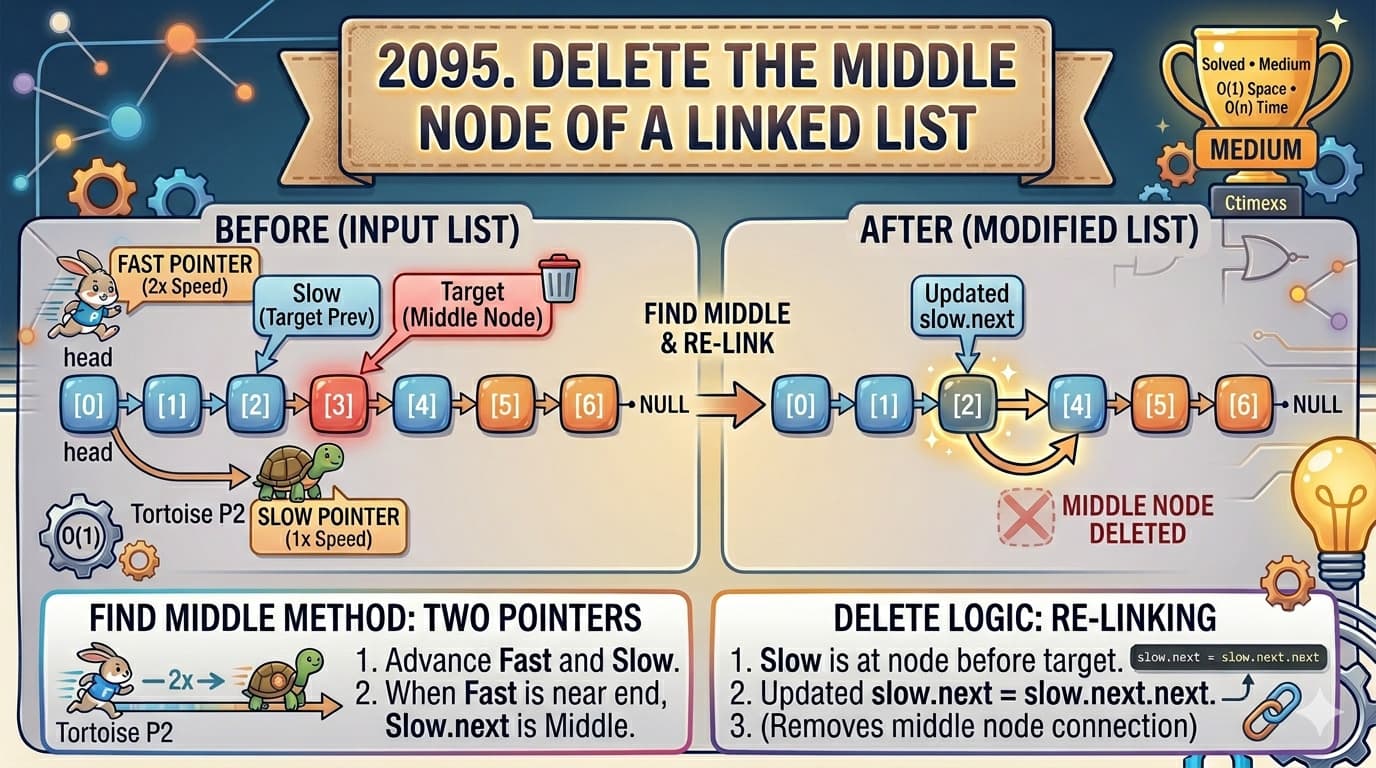
🔗 Try This Problemhttps://leetcode.com/problems/delete-the-middle-node-of-a-linked-list/🎥 Video ExplanationProblem ExplanationYou are given the head of a singly linked list. The task is to remove the middle node and return the updated list.The middle node is defined using 0-based indexing:Middle Index = ⌊n / 2⌋Where n is the total number of nodes.ExampleInput: [1, 3, 4, 7, 1, 2, 6]Index: 0 1 2 3 4 5 6n = 7Middle index = 3Node to remove = 7Output: [1, 3, 4, 1, 2, 6]Approach 1: Brute Force (Two Traversals)IdeaTraverse the list to count total nodesCompute middle indexTraverse again to delete that nodeComplexityTime Complexity: O(n)Space Complexity: O(1)LimitationThis approach requires two passes, which is not optimal when a single traversal solution exists.Approach 2: Fast and Slow Pointer (Optimal)IntuitionUse two pointers:Slow pointer moves one step at a timeFast pointer moves two steps at a timeWhen the fast pointer reaches the end of the list:Slow pointer will be at the middle nodeImportant DetailTo remove the middle node, access to the previous node is required.Therefore, maintain an additional pointer:prev → tracks node before slowAlgorithm StepsInitialize:slow = headfast = headprev = nullTraverse:Move fast by 2 stepsMove slow by 1 stepUpdate prev = slow (before moving slow)When loop ends:slow points to middle nodeprev points to node before middleDelete node:prev.next = slow.nextDetailed Dry RunInput1 → 3 → 4 → 7 → 1 → 2 → 6Initial Stateslow = 1fast = 1prev = nullIteration 1fast → 4slow → 3prev → 1Iteration 2fast → 1slow → 4prev → 3Iteration 3fast → nullslow → 7prev → 4After Loopslow = 7 (middle node)prev = 4Deletionprev.next = slow.nextResult:1 → 3 → 4 → 1 → 2 → 6Optimized Code (Java)class Solution {public ListNode deleteMiddle(ListNode head) {// Edge case: single nodeif(head == null) return head;if(head.next == null) return null;ListNode slow = head;ListNode fast = head;ListNode prev = null;// Traverse using fast and slow pointerwhile(fast != null && fast.next != null){fast = fast.next.next;prev = slow;slow = slow.next;}// Remove middle nodeprev.next = slow.next;return head;}}Complexity AnalysisTime Complexity: O(n)Space Complexity: O(1)Only one traversal of the linked listNo extra data structures usedEdge CasesSingle NodeInput: [1]Output: []Two NodesInput: [2, 1]Output: [2]Even Length ListInput: [1, 2, 3, 4]n = 4Middle index = 2Node removed = 3Key TakeawaysFast and slow pointer reduces two-pass solution to one-passTracking the previous node is necessary for deletionWorks efficiently for large linked listsA fundamental pattern used in multiple linked list problemsConclusionThe fast and slow pointer technique provides an elegant and efficient way to identify and remove the middle node in a linked list. By leveraging different traversal speeds, the problem can be solved in a single pass with constant space, making it optimal for both interviews and practical implementations.

LeetCodeMediumLinked ListFast and Slow Pointer
Remove Nth Node From End – The Smart Way to Solve in One Pass (LeetCode 19)

Remove Nth Node From End – The Smart Way to Solve in One Pass (LeetCode 19)

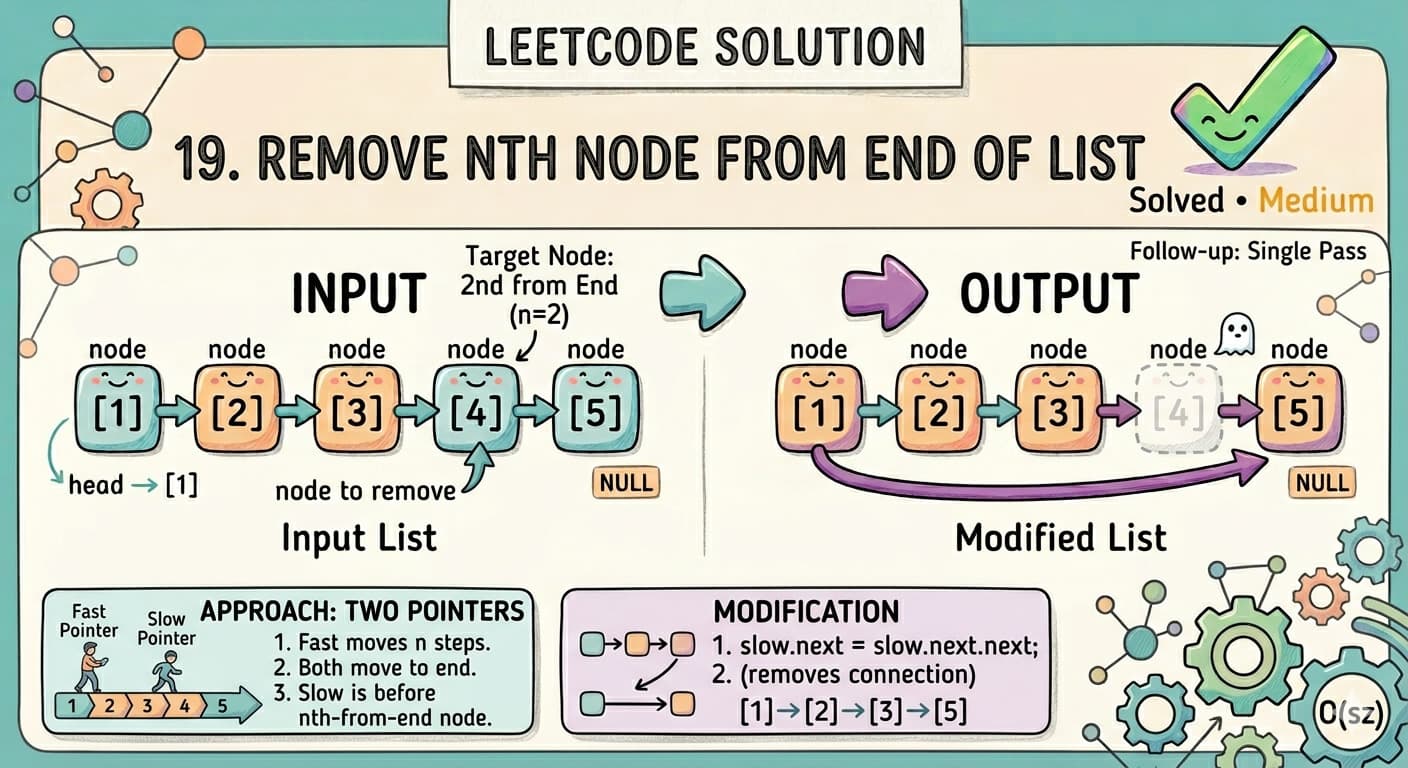
🚀 Try the ProblemPractice here:https://leetcode.com/problems/remove-nth-node-from-end-of-list/🤔 Let’s Think Differently…Imagine this list:1 → 2 → 3 → 4 → 5You are asked:👉 Remove the 2nd node from the endSo counting from end:5 (1st), 4 (2nd) ❌ remove thisFinal list:1 → 2 → 3 → 5🧠 Problem in Simple WordsYou are given:Head of a linked listA number n👉 Remove the nth node from the end👉 Return the updated list📦 Constraints1 <= number of nodes <= 300 <= Node.val <= 1001 <= n <= size of list🧩 First Thought (Counting Method)💡 IdeaCount total nodesFind position from start:position = total - nTraverse again and remove that node✅ Code (Counting Approach)class Solution { public ListNode removeNthFromEnd(ListNode head, int n) { if(head == null) return head; // Step 1: Count nodes int co = 0; ListNode tempHead = head; while(tempHead != null){ co++; tempHead = tempHead.next; } // Step 2: If removing head if(co == n) return head.next; // Step 3: Find node before target int k = co - n; int con = 1; ListNode temp = head; while(con < k){ temp = temp.next; con++; } // Step 4: Remove node temp.next = temp.next.next; return head; }}⏱️ ComplexityTime ComplexityO(n) + O(n) = O(n)(two traversals)Space ComplexityO(1)⚠️ Limitation of This Approach👉 It requires two passesBut the problem asks:Can you solve it in one pass?🚀 Optimal Approach: Two Pointer Technique (One Pass)Now comes the interesting part 🔥🧠 Core IdeaWe use two pointers:fast pointerslow pointer🎯 Trick👉 Move fast pointer n steps aheadThen move both pointers together until:fast reaches endAt that moment:👉 slow will be at the node before the one to remove📌 Why This WorksBecause the gap between fast and slow is always n nodesSo when fast reaches end:👉 slow is exactly where we need it🔥 Step-by-Step VisualizationList:1 → 2 → 3 → 4 → 5n = 2Step 1: Move fast 2 stepsfast → 3slow → 1Step 2: Move both togetherfast → 4, slow → 2fast → 5, slow → 3fast → null, slow → 4👉 Now slow is at node before target🧼 Clean and Safe Approach (Using Dummy Node)Using dummy node avoids edge cases like removing head.💻 Code (Optimal One Pass Solution)class Solution { public ListNode removeNthFromEnd(ListNode head, int n) { // Dummy node to handle edge cases ListNode dummy = new ListNode(0, head); ListNode fast = dummy; ListNode slow = dummy; // Move fast pointer n steps ahead for(int i = 0; i < n; i++){ fast = fast.next; } // Move both pointers while(fast.next != null){ fast = fast.next; slow = slow.next; } // Remove nth node slow.next = slow.next.next; return dummy.next; }}⏱️ ComplexityTime ComplexityO(n)(single pass)Space ComplexityO(1)⚖️ Comparing ApproachesApproachPassesTimeSpaceDifficultyCounting2O(n)O(1)EasyTwo Pointer1O(n)O(1)Optimal❌ Common MistakesForgetting to handle removing head nodeNot using dummy nodeOff-by-one errors in pointer movementMoving fast incorrectly🔥 Interview InsightThis problem is a classic example of:Fast & Slow Pointer TechniqueUsed in many problems like:Cycle DetectionMiddle of Linked ListPalindrome Linked List🧠 Final ThoughtAt first, counting feels natural…But once you learn this trick:"Create a gap and move together"👉 You unlock a powerful pattern.🚀 ConclusionThe Remove Nth Node From End problem is not just about deletion…It teaches:Efficient traversalPointer coordinationOne-pass optimization👉 Tip: Whenever you see “from end”, think:"Can I use two pointers with a gap?"That’s your shortcut to solving these problems like a pro 🚀

Linked ListTwo PointersFast & Slow PointerOne Pass AlgorithmLeetCodeMedium
Find Length of Loop in Linked List — Complete Guide with Intuition, Dry Run & Floyd’s Cycle Algorithm

Find Length of Loop in Linked List — Complete Guide with Intuition, Dry Run & Floyd’s Cycle Algorithm

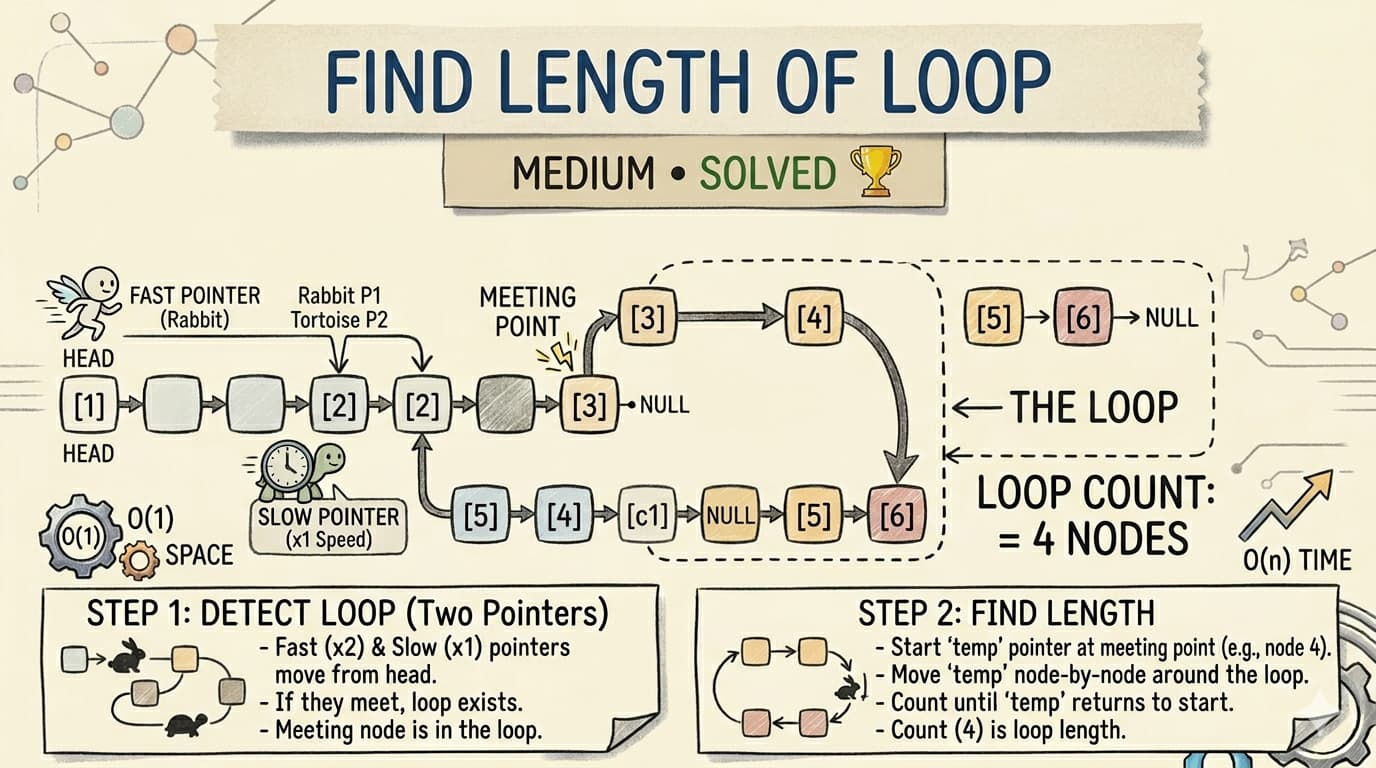
🔗 Try This ProblemPractice here:GeeksforGeeks link📌 Problem OverviewYou are given the head of a singly linked list.Your task is:Detect whether a loop (cycle) existsIf a loop exists → return the length of the loopIf no loop exists → return 0🧠 Understanding the ProblemA loop in a linked list means:👉 A node’s next pointer is pointing to a previous node, forming a cycle.Example1 → 2 → 3 → 4 → 5↑ ↓← ← ← ←Here:Loop starts at node 3Loop nodes = 3 → 4 → 5Loop length = 3💡 Intuition — How to Think About This ProblemThere are two main challenges:🔹 1. Detect if a loop exists🔹 2. Find the length of that loop🤔 Brute Force ThinkingStore visited nodes in a HashSetIf node repeats → loop detected✔ Works❌ Extra space O(n)🚀 Optimized Thinking (Floyd’s Cycle Detection)We use:Slow pointer → moves 1 stepFast pointer → moves 2 steps🧠 Key Idea👉 If a loop exists:Fast pointer will eventually meet slow pointer👉 If no loop:Fast pointer reaches null🎥 Visual Intuition & Dry Run⚙️ Optimized Approach (Step-by-Step)Step 1: Detect LoopInitialize:slow = headfast = headMove:slow → 1 stepfast → 2 stepsIf:slow == fast → loop existsStep 2: Find Length of LoopOnce loop is detected:Keep one pointer fixedMove another pointer until it comes backCount stepsWhy This Works?Because:Inside a loop, traversal becomes circularSo eventually, we will return to the same node🧪 Dry Run (Manual Understanding)Example:Loop: 3 → 4 → 5 → 3Step 1: Detect LoopSlow and fast meet inside loopStep 2: Count Loop LengthStart from meeting point:Move one pointer:3 → 4 → 5 → 3Count = 3💻 Code (Java)class Solution {public int lengthOfLoop(Node head) {Node slow = head;Node fast = head;// Step 1: Detect loopwhile(fast != null && fast.next != null){slow = slow.next;fast = fast.next.next;if(fast == slow){// Step 2: Count loop lengthint length = 1;Node temp = slow.next;while(temp != slow){temp = temp.next;length++;}return length;}}return 0; // No loop}}⏱️ Complexity AnalysisTypeValueTime ComplexityO(n)Space ComplexityO(1)🔍 Deep Insight — Why Fast Meets Slow?Fast moves twice as fast as slowInside a loop → paths become circularDifference in speed guarantees collision👉 This is a mathematical certainty in cyclic structures⚠️ Edge CasesNo loop → return 0Single node loop → return 1Large loop → still works efficiently🧩 Key TakeawaysFloyd’s Cycle Detection is powerfulLoop detection + loop length can be done in one traversalNo extra space needed🏁 Final ThoughtsThis problem is a classic linked list concept and very important for interviews.👉 Once you master this:Detect cycleFind loop lengthFind loop starting nodeAll become easier.

GeeksforGeeksLinkedListMediumFast and Slow Pointer
LeetCode 234: Palindrome Linked List (Java) | Intuition, Dry Run & O(1) Space Solution

LeetCode 234: Palindrome Linked List (Java) | Intuition, Dry Run & O(1) Space Solution

🧩 Problem OverviewGiven the head of a singly linked list, determine whether it is a palindrome.A palindrome means the sequence reads the same forward and backward.Example:Input: [1,2,2,1] → Output: trueInput: [1,2] → Output: false🎯 Why This Problem MattersThis problem tests:Linked list traversalTwo-pointer technique (slow & fast)In-place reversalIt’s a must-know pattern for interviews.🧠 IntuitionA simple approach is to copy elements into an array and check for palindrome.But that uses extra space O(n).Optimal Idea:We can solve this in O(1) space by:Finding the middle of the linked listReversing the second halfComparing both halves🎥 Dry Run (Step-by-Step Explanation)👉 Watch the complete dry run and pointer movement below:This video explains how slow and fast pointers work and how the comparison is performed.⚙️ ApproachStep 1: Handle Edge CasesIf list has one node → return trueStep 2: Find MiddleUse slow and fast pointersFast moves 2 steps, slow moves 1Step 3: Reverse Second HalfReverse the list starting from the middleStep 4: Compare Both HalvesCompare values from:start of liststart of reversed half💻 Java Solutionclass Solution {public ListNode reverse(ListNode head) {ListNode curr = head;ListNode prev = null;while (curr != null) {ListNode next = curr.next;curr.next = prev;prev = curr;curr = next;}return prev;}public boolean isPalindrome(ListNode head) {if (head == null) return false;if (head.next == null) return true;ListNode slow = head;ListNode fast = head;// Find middlewhile (fast != null && fast.next != null) {fast = fast.next.next;slow = slow.next;}// Reverse second halfListNode secondHalf = reverse(slow);// Compare both halvesListNode firstHalf = head;while (secondHalf != null) {if (secondHalf.val != firstHalf.val) {return false;}secondHalf = secondHalf.next;firstHalf = firstHalf.next;}return true;}}🔍 Dry Run (Quick Summary)Example:1 → 2 → 2 → 1Middle foundSecond half reversedCompare values one by oneResult → Palindrome ✅⏱️ Time and Space ComplexityTime Complexity: O(n)Space Complexity: O(1)⚠️ Edge CasesSingle nodeTwo nodesOdd length listEven length list💡 Key TakeawaysFast & slow pointer technique is essentialReversing linked list is a reusable patternHelps optimize space complexity🚀 Final ThoughtsThis is a classic interview problem combining multiple linked list techniques.Make sure you understand:Pointer movementReversal logicComparison step👉 For full clarity, don’t skip the video explanation above.

LinkedListFast and Slow PointerPalindromeEasy
Maximum Twin Sum of a Linked List (LeetCode 2130) — Intuition, Dry Run & Optimal Approach

Maximum Twin Sum of a Linked List (LeetCode 2130) — Intuition, Dry Run & Optimal Approach

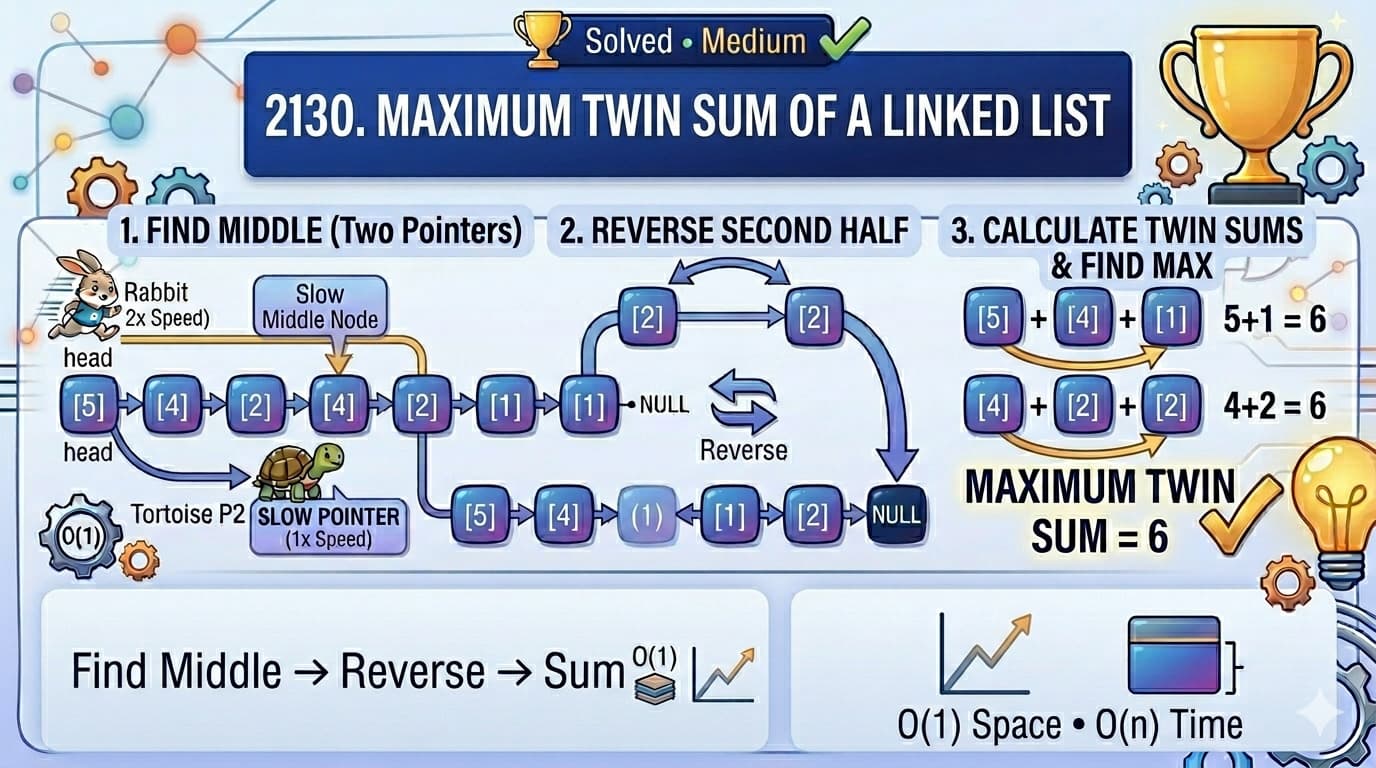
🔗 Try This ProblemPractice here:https://leetcode.com/problems/maximum-twin-sum-of-a-linked-list/📌 Problem OverviewYou are given a linked list of even length.Each node has a twin node defined as:Node at index i → Twin is at index (n - 1 - i)👉 Example (n = 4):Index 0 ↔ Index 3Index 1 ↔ Index 2The twin sum is:node[i] + node[n - 1 - i]🎯 Goal:Return the maximum twin sum among all such pairs.🧠 Understanding the ProblemLet’s take a simple example:Input: [4, 2, 2, 3]Pairs:4 + 3 = 72 + 2 = 4👉 So the answer is:7💡 Intuition — How to Think About This ProblemAt first glance, it feels like we need to access:First nodeLast nodeSecond nodeSecond last node👉 This naturally suggests:Two-directional accessBut linked lists don’t allow backward traversal🤔 Possible Thinking Patterns🔹 Idea 1: Use Extra SpaceStore values in an arrayUse two pointers from both ends✔ Works❌ But uses extra space O(n)🔹 Idea 2: Work Directly on Linked List (Better)We need a way to:Reach the middleAccess second half in reverse order👉 That leads to a powerful idea:“What if we reverse the second half of the list?”Now we can compare:First half (forward)Second half (also forward after reversal)🎥 Visual Intuition (Your Explanation Video)👉 In this section, focus only on:ConceptVisualizationThought process❌ Avoid code here✔ Build understanding⚙️ Optimized Approach (Step-by-Step)Step 1: Find MiddleUse two pointers:slow → moves 1 stepfast → moves 2 steps👉 When fast reaches end → slow is at middleStep 2: Reverse Second HalfStart from:slow.nextReverse the listStep 3: Compare Twin PairsNow:One pointer → start of listOne pointer → start of reversed halfCalculate:sum = left.val + right.valTrack maximum🧪 Dry RunExample:Input: [5, 4, 2, 1]Step 1: Find MiddleSlow → 4Fast → EndStep 2: Reverse Second HalfSecond half: 2 → 1Reversed: 1 → 2Step 3: Compare5 + 1 = 64 + 2 = 6✅ Maximum = 6💻 Optimized Code (Java)class Solution {public ListNode reverse(ListNode head){ListNode curr = head;ListNode prev = null;while(curr != null){ListNode next = curr.next;curr.next = prev;prev = curr;curr = next;}return prev;}public int pairSum(ListNode head) {ListNode slow = head;ListNode fast = head;// Find middlewhile(fast.next != null && fast.next.next != null){slow = slow.next;fast = fast.next.next;}// Reverse second halfListNode secondHalf = reverse(slow.next);// Compare pairsListNode firstHalf = head;int max = Integer.MIN_VALUE;while(secondHalf != null){int sum = firstHalf.val + secondHalf.val;max = Math.max(max, sum);firstHalf = firstHalf.next;secondHalf = secondHalf.next;}return max;}}⏱️ Complexity AnalysisTypeValueTime ComplexityO(n)Space ComplexityO(1)🧩 Key TakeawaysLinked list problems often require restructuring instead of extra spaceReversing half is a powerful trickFast & slow pointer is essential for mid-finding🏁 Final ThoughtsThis problem is a perfect example of:Combining multiple conceptsOptimizing spaceThinking beyond direct access👉 Once you understand this pattern, many linked list problems become easier.

LeetcodeMediumLinkedListFast and Slow Pointer
Range Sum Query - Immutable

Range Sum Query - Immutable

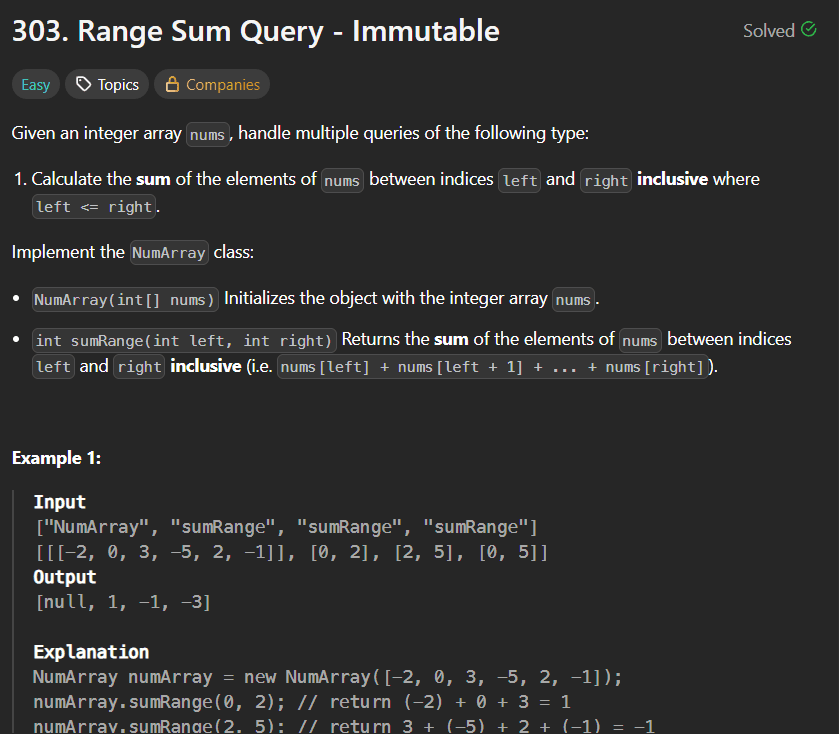
LeetCode Problem 303Link of the Problem to try -: LinkGiven an integer array nums, handle multiple queries of the following type:Calculate the sum of the elements of nums between indices left and right inclusive where left <= right.Implement the NumArray class:NumArray(int[] nums) Initializes the object with the integer array nums.int sumRange(int left, int right) Returns the sum of the elements of nums between indices left and right inclusive (i.e. nums[left] + nums[left + 1] + ... + nums[right]).Example 1:Input["NumArray", "sumRange", "sumRange", "sumRange"][[[-2, 0, 3, -5, 2, -1]], [0, 2], [2, 5], [0, 5]]Output[null, 1, -1, -3]ExplanationNumArray numArray = new NumArray([-2, 0, 3, -5, 2, -1]);numArray.sumRange(0, 2); // return (-2) + 0 + 3 = 1numArray.sumRange(2, 5); // return 3 + (-5) + 2 + (-1) = -1numArray.sumRange(0, 5); // return (-2) + 0 + 3 + (-5) + 2 + (-1) = -3Constraints:1 <= nums.length <= 104-105 <= nums[i] <= 1050 <= left <= right < nums.lengthAt most 104 calls will be made to sumRange.Solution:Efficient Range Sum Queries using Prefix SumsWhile this problem may initially seem challenging, the solution is remarkably elegant. The key is to shift the heavy lifting from the query phase to the initialization phase using a Prefix Sum array.The StrategyInstead of calculating the sum from scratch every time a range is requested, we use two steps:The Constructor: During initialization, we create a Prefix Sum array. Each index i in this new array stores the cumulative sum of all elements from the beginning of the original array up to i.The sumRange Method: To find the sum between a left and right pointer, we simply use the precalculated values. The sum of the range is calculated as:Sum(left, right) = PrefixSum[right] - PrefixSum[left - 1]Why This is BetterBy pre-calculating the sums in the constructor, we transform the sumRange operation from a slow O(n) search into a lightning-fast O(1) constant-time lookup. This approach is highly efficient for applications where the data remains the same but the number of queries is high.Code:class NumArray {int[] ans ;public NumArray(int[] nums) {ans = new int[nums.length];int pre =0;for(int i=0;i<nums.length;i++){pre += nums[i];ans[i] = pre;}}public int sumRange(int left, int right) {if(left == 0) return ans[right];return ans[right]-ans[left-1];}}/*** Your NumArray object will be instantiated and called as such:* NumArray obj = new NumArray(nums);* int param_1 = obj.sumRange(left,right);*/

LeetCodeEasyPrefix Sum
Ai Assistant Kas