Search Blogs

Showing results for "Binary Search"

Found 21 results

Mastering Binary Search – LeetCode 704 Explained

Mastering Binary Search – LeetCode 704 Explained

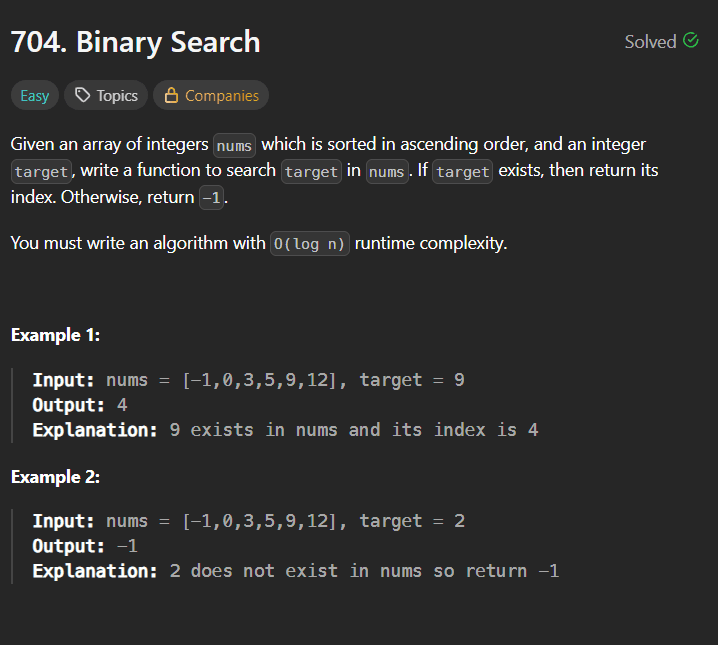
IntroductionBinary Search is one of the most fundamental and powerful algorithms in computer science. If you're preparing for coding interviews, mastering Binary Search is absolutely essential.In this blog, we’ll break down LeetCode 704 – Binary Search, explain the algorithm in detail, walk through your Java implementation, analyze complexity, and recommend additional problems to strengthen your understanding.You can try this problem -: Problem Link📌 Problem OverviewYou are given:A sorted array of integers nums (ascending order)An integer targetYour task is to return the index of target if it exists in the array. Otherwise, return -1.Example 1Input: nums = [-1,0,3,5,9,12], target = 9Output: 4Example 2Input: nums = [-1,0,3,5,9,12], target = 2Output: -1Constraints1 <= nums.length <= 10⁴All integers are uniqueThe array is sorted in ascending orderRequired Time Complexity: O(log n)🚀 Understanding the Binary Search AlgorithmBinary Search works only on sorted arrays.Instead of checking each element one by one (like Linear Search), Binary Search:Finds the middle element.Compares it with the target.Eliminates half of the search space.Repeats until the element is found or the search space is empty.Why is it Efficient?Every iteration cuts the search space in half.If the array size is n, the number of operations becomes:log₂(n)This makes it extremely efficient compared to linear search (O(n)).🧠 Step-by-Step AlgorithmInitialize two pointers:low = 0high = nums.length - 1While low <= high:Calculate middle index:mid = low + (high - low) / 2If nums[mid] == target, return midIf target > nums[mid], search right half → low = mid + 1Else search left half → high = mid - 1If loop ends, return -1💻 Your Java Code ExplainedHere is your implementation:class Solution {public int search(int[] nums, int target) {int high = nums.length-1;int low = 0;while(low <= high){int mid = low+(high-low)/2;if(target == nums[mid] ){return mid;}else if(target > nums[mid]){low = mid+1;}else{high = mid-1;}}return -1;}}🔍 Code Breakdown1️⃣ Initialize Boundariesint high = nums.length - 1;int low = 0;You define the search space from index 0 to n-1.2️⃣ Loop Conditionwhile(low <= high)The loop continues as long as there is a valid search range.3️⃣ Safe Mid Calculationint mid = low + (high - low) / 2;This is preferred over:(low + high) / 2Why?Because (low + high) may cause integer overflow in large arrays.Your approach prevents that.4️⃣ Comparison Logicif(target == nums[mid])If found → return index.else if(target > nums[mid])low = mid + 1;Search in right half.elsehigh = mid - 1;Search in left half.5️⃣ Not Found Casereturn -1;If the loop finishes without finding the target.⏱ Time and Space ComplexityTime Complexity: O(log n)Each iteration halves the search space.Space Complexity: O(1)No extra space used — purely iterative.🔥 Why This Problem Is ImportantLeetCode 704 is:The foundation of all Binary Search problemsA template questionFrequently asked in interviewsRequired to understand advanced problems like:Search in Rotated Sorted ArrayFind First and Last PositionPeak ElementBinary Search on Answer📚 Recommended Binary Search Practice ProblemsAfter solving this, practice these in order:🟢 Easy35. Search Insert Position69. Sqrt(x)278. First Bad Version🟡 Medium34. Find First and Last Position of Element in Sorted Array33. Search in Rotated Sorted Array74. Search a 2D Matrix875. Koko Eating Bananas (Binary Search on Answer)🔴 Advanced Pattern Practice1011. Capacity To Ship Packages Within D Days410. Split Array Largest SumThese will help you master:Lower bound / upper boundBinary search on monotonic functionsSearching in rotated arraysSearching in 2D matricesBinary search on answer pattern🎯 Final ThoughtsBinary Search is not just a single algorithm — it’s a pattern.If you truly understand:How the search space shrinksWhen to move left vs rightHow to calculate mid safelyLoop conditions (low <= high vs low < high)You can solve 50+ interview problems easily.LeetCode 704 is the perfect starting point.Master this template, and you unlock an entire category of problems.
Binary SearchLeetCodeEasy
LeetCode 1283 — Find the Smallest Divisor Given a Threshold | Binary Search on Answer Explained

LeetCode 1283 — Find the Smallest Divisor Given a Threshold | Binary Search on Answer Explained

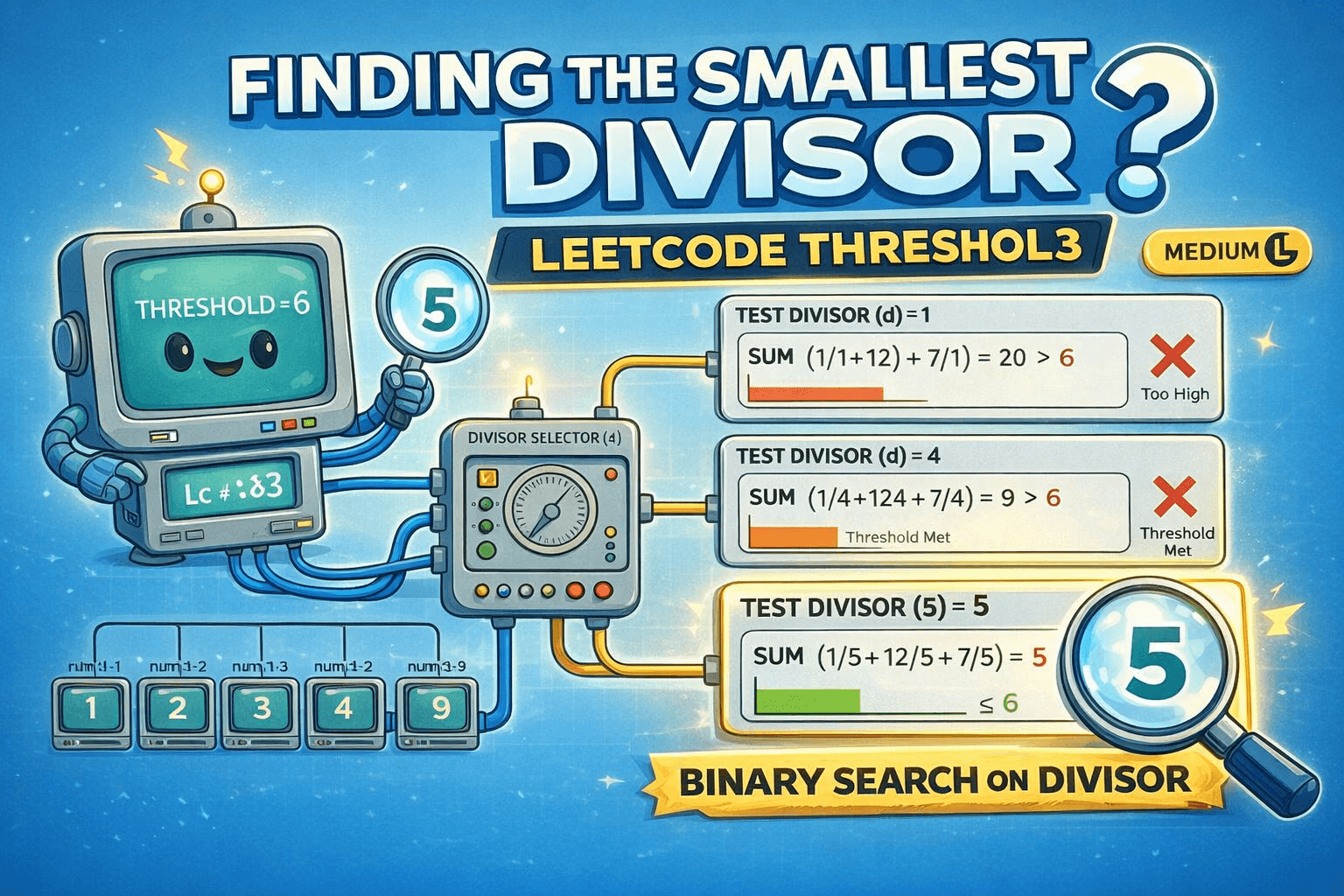
🚀 Try This Problem First!Before reading the solution, attempt it yourself on LeetCode — you'll retain the concept far better.🔗 Problem Link: https://leetcode.com/problems/find-the-smallest-divisor-given-a-threshold/Understanding the ProblemYou are given an array of integers nums and an integer threshold. You must choose a positive integer divisor, divide every element of the array by it (rounding up to the nearest integer), sum all the results, and make sure that sum is ≤ threshold.Goal: Find the smallest possible divisor that keeps the sum within the threshold.Important detail — Ceiling Division: Every division rounds up, not down. So 7 ÷ 3 = 3 (not 2), and 10 ÷ 2 = 5.Constraints:1 ≤ nums.length ≤ 5 × 10⁴1 ≤ nums[i] ≤ 10⁶nums.length ≤ threshold ≤ 10⁶Two Key Observations (Before Writing a Single Line of Code)Minimum possible divisor: The divisor must be at least 1. Dividing by anything less than 1 isn't a positive integer. So:low = 1Maximum possible divisor: If divisor = max(nums), then every element divided by it gives at most 1 (due to ceiling), so the sum equals nums.length, which is always ≤ threshold (guaranteed by constraints). So:high = max(nums)Our answer lies in the range [1, max(nums)]. This is the search space for Binary Search.Intuition — Why Binary Search?Ask yourself: what happens as the divisor increases?As divisor gets larger, each divided value gets smaller (or stays the same), so the total sum decreases or stays the same. This is a monotonic relationship — the green flag for Binary Search on the Answer.Instead of trying every divisor from 1 to max(nums), we binary search over divisor values. For each candidate mid, we ask:"Does dividing all elements by mid (ceiling) give a sum ≤ threshold?"This feasibility check runs in O(N), making the whole approach O(N log(max(nums))).The Feasibility Check — Ceiling Sum SimulationGiven a divisor mid, compute the sum of ⌈arr[i] / mid⌉ for all elements. If the total sum ≤ threshold, then mid is a valid divisor.In Java, ceiling division of integers is done as:Math.ceil((double) arr[i] / mid)Binary Search StrategyIf canDivide(mid) is true → mid might be the answer, but try smaller. Set ans = mid, high = mid - 1.If canDivide(mid) is false → divisor is too small, increase it. Set low = mid + 1.Dry Run — Example 1 (Step by Step)Input: nums = [1, 2, 5, 9], threshold = 6We start with low = 1 and high = 9 (max element in array).Iteration 1: mid = 1 + (9 - 1) / 2 = 5Compute ceiling sum with divisor 5: ⌈1/5⌉ + ⌈2/5⌉ + ⌈5/5⌉ + ⌈9/5⌉ = 1 + 1 + 1 + 2 = 55 ≤ 6 → ✅ Valid. Record ans = 5, search smaller → high = 4.Iteration 2: mid = 1 + (4 - 1) / 2 = 2Compute ceiling sum with divisor 2: ⌈1/2⌉ + ⌈2/2⌉ + ⌈5/2⌉ + ⌈9/2⌉ = 1 + 1 + 3 + 5 = 1010 > 6 → ❌ Too large. Increase divisor → low = 3.Iteration 3: mid = 3 + (4 - 3) / 2 = 3Compute ceiling sum with divisor 3: ⌈1/3⌉ + ⌈2/3⌉ + ⌈5/3⌉ + ⌈9/3⌉ = 1 + 1 + 2 + 3 = 77 > 6 → ❌ Too large. Increase divisor → low = 4.Iteration 4: mid = 4 + (4 - 4) / 2 = 4Compute ceiling sum with divisor 4: ⌈1/4⌉ + ⌈2/4⌉ + ⌈5/4⌉ + ⌈9/4⌉ = 1 + 1 + 2 + 3 = 77 > 6 → ❌ Too large. Increase divisor → low = 5.Loop ends: low (5) > high (4). Binary search terminates.Output: ans = 5 ✅The Code Implementationclass Solution {/*** Feasibility Check (Helper Function)** Given a divisor 'mid', this function computes the ceiling sum of* all elements divided by 'mid' and checks if it is within threshold.** @param mid - candidate divisor to test* @param arr - input array* @param thresh - the allowed threshold for the sum* @return true if the ceiling division sum <= threshold, false otherwise*/public boolean canDivide(int mid, int[] arr, int thresh) {int sumOfDiv = 0;for (int i = 0; i < arr.length; i++) {// Ceiling division: Math.ceil(arr[i] / mid)// Cast to double to avoid integer division truncationsumOfDiv += Math.ceil((double) arr[i] / mid);}// If total sum is within threshold, this divisor is validreturn sumOfDiv <= thresh;}/*** Main Function — Binary Search on the Answer** Search range: [1, max(nums)]* - low = 1 → smallest valid positive divisor* - high = max(nums) → guarantees every ceil(num/divisor) = 1,* so sum = nums.length <= threshold (always valid)** @param nums - input array* @param threshold - maximum allowed sum after ceiling division* @return smallest divisor such that the ceiling division sum <= threshold*/public int smallestDivisor(int[] nums, int threshold) {int min = 1; // Lower bound: divisor starts at 1int max = Integer.MIN_VALUE; // Will become max(nums)int ans = 1;// Find the upper bound of binary search (max element)for (int a : nums) {max = Math.max(max, a);}// Binary Search over the divisor spacewhile (min <= max) {int mid = min + (max - min) / 2; // Safe midpoint, avoids overflowif (canDivide(mid, nums, threshold)) {// mid is valid — record it and try a smaller divisorans = mid;max = mid - 1;} else {// mid is too small — the sum exceeded threshold, go highermin = mid + 1;}}return ans; // Smallest valid divisor}}Code Walkthrough — Step by StepSetting bounds: We iterate through nums once to find max — this becomes our upper bound high. The lower bound low = 1 because divisors must be positive integers.Binary Search loop: We pick mid = min + (max - min) / 2 as the candidate divisor. We check if using mid as the divisor keeps the ceiling sum ≤ threshold.Feasibility helper (canDivide): For each element, we compute Math.ceil((double) arr[i] / mid) and accumulate the total. The cast to double is critical — without it, Java performs integer division (which truncates, not rounds up).Narrowing the search: If the sum is within threshold → record ans = mid, try smaller (max = mid - 1). If the sum exceeds threshold → divisor is too small, increase it (min = mid + 1).A Critical Bug to Watch Out For — The return min vs return ans TrapIn your original code, the final line was return min instead of return ans. This is a subtle bug. After the loop ends, min has overshot past the answer (it's now ans + 1). Always store the answer in a dedicated variable ans and return that. Using return min would return the wrong result in most cases.Common Mistakes to AvoidWrong lower bound: Setting low = min(nums) instead of low = 1 seems intuitive but is wrong. A divisor smaller than the minimum element is still valid — for example, dividing [5, 9] by 3 gives ⌈5/3⌉ + ⌈9/3⌉ = 2 + 3 = 5, which could be within threshold.Forgetting ceiling division: Using arr[i] / mid (integer division, which truncates) instead of Math.ceil((double) arr[i] / mid) is wrong. The problem explicitly states results are rounded up.Returning min instead of ans: After the binary search loop ends, min > max, meaning min has already gone past the valid answer. Always return the stored ans.Integer overflow in midpoint: Always use mid = min + (max - min) / 2 instead of (min + max) / 2. When both values are large (up to 10⁶), their sum can overflow an int.Complexity AnalysisTime Complexity: O(N × log(max(nums)))Binary search runs over [1, max(nums)] → at most log₂(10⁶) ≈ 20 iterations.Each iteration calls canDivide which is O(N).Total: O(N log M) where M = max(nums).Space Complexity: O(1) No extra data structures — only a few integer variables are used throughout.How This Relates to LeetCode 1011This problem and LeetCode 1011 (Ship Packages Within D Days) are almost identical in structure:🔗 LeetCode 1011 #Search space: [max(weights), sum(weights)]Feasibility check: Can we ship in ≤ D days?Monotonic property: More capacity → fewer daysGoal: Minimize capacityLeetCode 1283Search space: [1, max(nums)]Feasibility check: Is ceiling sum ≤ threshold?Monotonic property: Larger divisor → smaller sumGoal: Minimize divisorOnce you deeply understand one, the other takes minutes to solve.Similar Problems (Same Pattern — Binary Search on Answer)LeetCode 875 — Koko Eating Bananas [ Blog is also avaliable on this - Read Now ]LeetCode 1011 — Capacity To Ship Packages Within D Days [ Blog is also avaliable on this - Read Now ]LeetCode 410 — Split Array Largest SumLeetCode 2064 — Minimized Maximum of Products Distributed to Any StoreAll follow the same template: identify a monotonic answer space, write an O(N) feasibility check, and binary search over it.Key Takeaways✅ When the problem asks "find the minimum value such that a condition holds" — think Binary Search on the Answer.✅ The lower bound is the most constrained valid value (1 here, since divisors must be positive).✅ The upper bound is the least constrained valid value (max element, guarantees sum = length ≤ threshold).✅ Ceiling division in Java requires casting to double: Math.ceil((double) a / b).✅ Always store the answer in a separate ans variable — never return min or max directly after a binary search loop.Happy Coding! Smash that upvote if this helped you crack the pattern. 🚀

LeetCodeBinary SearchMediumJavaBinary Search on AnswerArraysCeiling Division
LeetCode 1011 — Capacity To Ship Packages Within D Days | Binary Search on Answer Explained

LeetCode 1011 — Capacity To Ship Packages Within D Days | Binary Search on Answer Explained

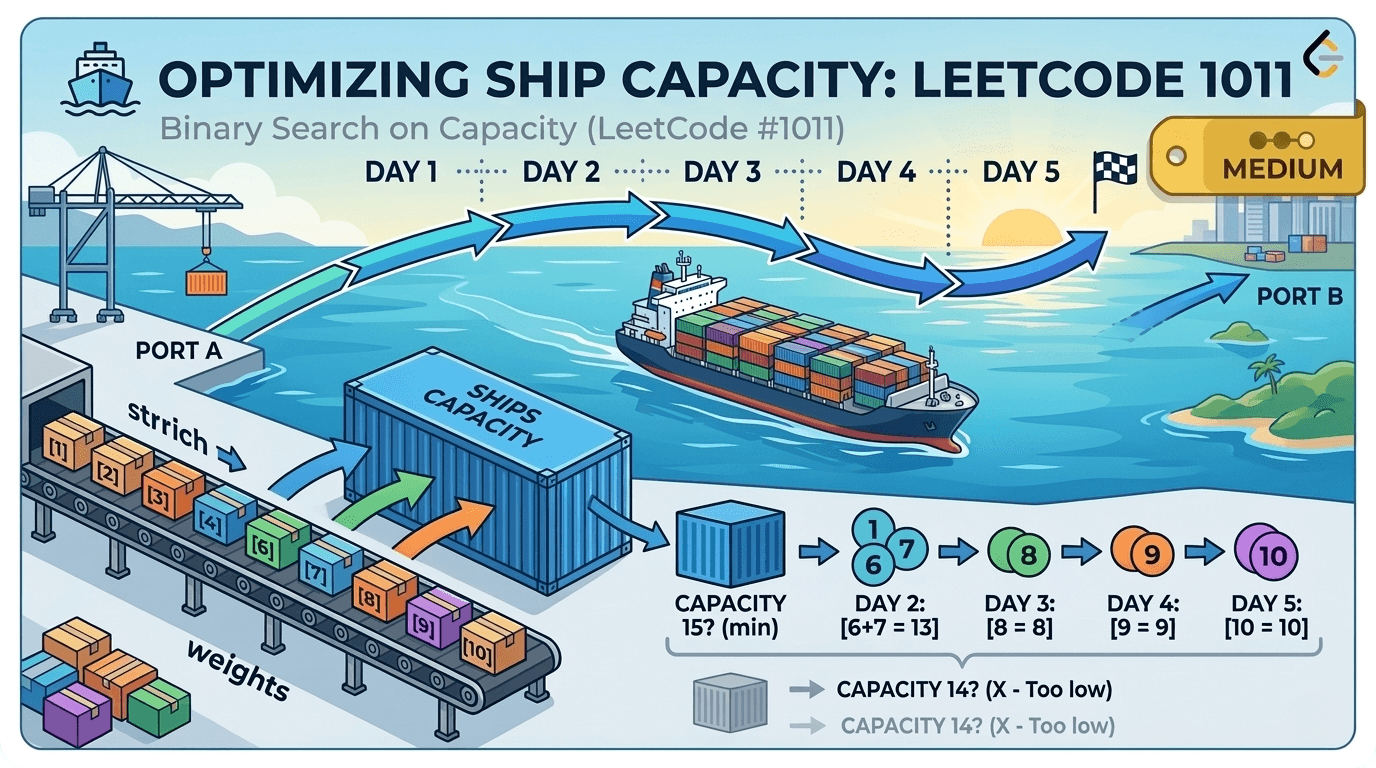
🚀 Try This Problem First!Before reading the solution, attempt it yourself on LeetCode — you'll retain the concept far better.🔗 Problem Link: https://leetcode.com/problems/capacity-to-ship-packages-within-d-days/1. Understanding the ProblemYou have a conveyor belt carrying N packages, each with a given weight. A ship must transport all of them within at most D days. Every day, you load packages in order (no rearranging allowed), and you cannot exceed the ship's weight capacity in a single day.Goal: Find the minimum weight capacity of the ship such that all packages are delivered within D days.Constraints:1 ≤ days ≤ weights.length ≤ 5 × 10⁴1 ≤ weights[i] ≤ 5002. Two Key Observations (Before Writing a Single Line of Code)Before jumping to code, anchor yourself with these two facts:Minimum possible capacity: The ship must at least be able to carry the single heaviest package. If it can't, that package can never be shipped. So:low = max(weights)Maximum possible capacity: If the ship can carry everything at once, it finishes in 1 day — always valid. So:high = sum(weights)Our answer lies somewhere in the range [max(weights), sum(weights)]. This is the classic setup for Binary Search on the Answer.3. Intuition — Why Binary Search?Ask yourself: what happens as ship capacity increases?The number of days needed decreases or stays the same. This is a monotonic relationship — and monotonicity is the green flag for Binary Search.Instead of checking every capacity from 1 to sum(weights) (which is huge), we binary search over the capacity space and for each candidate capacity mid, we ask:"Can all packages be shipped in ≤ D days with this capacity?"This feasibility check runs in O(N) using a greedy simulation, making the whole approach O(N log(sum(weights))).4. The Feasibility Check — Greedy LoadingGiven a capacity mid, simulate loading the ship greedily:Keep adding packages to today's load.The moment adding the next package would exceed mid, start a new day and reset the current load to that package.Count total days used.If days used ≤ D, capacity mid is feasible.5. Binary Search StrategyIf canShip(mid) is true → mid might be the answer, but try smaller. Set ans = mid, high = mid - 1.If canShip(mid) is false → capacity is too small, increase it. Set low = mid + 1.6. Dry Run — Example 1Input: weights = [1, 2, 3, 4, 5, 6, 7, 8, 9, 10], days = 5low = 10 (max weight), high = 55 (sum of weights)IterationlowhighmidDays NeededFeasible?ans11055322✅ Yes3221031203✅ Yes2031019146❌ No2041519175✅ Yes1751516155✅ Yes1561514—loop ends—15Output: 15 ✅7. The Code Implementationclass Solution { /** * Feasibility Check (Helper Function) * * Given a ship capacity 'mid', this function simulates loading packages * greedily and returns true if all packages can be shipped within 'days' days. * * @param mid - candidate ship capacity to test * @param arr - weights array * @param days - allowed number of days * @return true if shipping is possible within 'days' days, false otherwise */ public boolean canShip(int mid, int[] arr, int days) { int daysNeeded = 1; // We always need at least 1 day int currentLoad = 0; // Weight loaded on the ship today for (int i = 0; i < arr.length; i++) { // If adding this package exceeds today's capacity, // start a new day and carry this package on the new day if (currentLoad + arr[i] > mid) { currentLoad = arr[i]; // This package starts the new day's load daysNeeded++; // Increment day count } else { // Package fits — add it to today's load currentLoad += arr[i]; } } // If days needed is within the allowed limit, this capacity is feasible return daysNeeded <= days; } /** * Main Function — Binary Search on the Answer * * Search range: [max(weights), sum(weights)] * - low = max(weights) → ship must carry the heaviest package at minimum * - high = sum(weights) → ship carries everything in one day (upper bound) * * @param weights - array of package weights * @param days - maximum allowed days * @return minimum ship capacity to deliver all packages within 'days' days */ public int shipWithinDays(int[] weights, int days) { int high = 0; // Will become sum(weights) int low = Integer.MIN_VALUE; // Will become max(weights) int ans = 0; // Calculate the binary search bounds for (int a : weights) { high += a; // sum of all weights → upper bound low = Math.max(low, a); // max single weight → lower bound } // Binary Search over the capacity space while (low <= high) { int mid = low + (high - low) / 2; // Avoids integer overflow if (canShip(mid, weights, days)) { // mid works — record it as a potential answer // and try to find a smaller valid capacity ans = mid; high = mid - 1; } else { // mid is too small — increase the capacity low = mid + 1; } } return ans; // Minimum feasible capacity }}8. Code Walkthrough — Step by StepStep 1 — Setting bounds: We iterate through the weights array once to compute low = max(weights) and high = sum(weights). These are our binary search boundaries.Step 2 — Binary Search loop: We pick mid = low + (high - low) / 2 (safe overflow-free midpoint). We check if capacity mid can ship all packages in ≤ D days.Step 3 — Feasibility helper (canShip): We simulate a greedy day-by-day loading. We start with daysNeeded = 1 and currentLoad = 0. For each package, if it fits in today's load, we add it. If not, we start a new day. The key line is:if (currentLoad + arr[i] > mid) { currentLoad = arr[i]; // new day starts with this package daysNeeded++;}Step 4 — Narrowing the search: If feasible → ans = mid, high = mid - 1 (try smaller). If not feasible → low = mid + 1 (try larger).9. Common Mistakes to AvoidMistake 1 — Wrong lower bound: Using low = 1 instead of low = max(weights) works but is far slower since you binary search over a much larger range unnecessarily.Mistake 2 — Wrong condition in canShip: The return should be daysNeeded <= days (not < days). If days needed equals D, it's still valid.Mistake 3 — Off-by-one in greedy loading: When a package doesn't fit, you start a new day with that package as the first item: currentLoad = arr[i]. Do NOT set currentLoad = 0 — that package must still be accounted for.Mistake 4 — Integer overflow in midpoint: Always use mid = low + (high - low) / 2 instead of (low + high) / 2 to avoid overflow when low and high are large.10. Complexity AnalysisTime Complexity: O(N × log(sum(weights)))Binary search runs over the range [max(weights), sum(weights)], which has at most sum(weights) ≈ 500 × 50000 = 25,000,000 values → about log₂(25,000,000) ≈ 25 iterations.Each iteration calls canShip which is O(N).Total: O(N log S) where S = sum(weights).Space Complexity: O(1)No extra data structures. Only a handful of integer variables are used.11. Similar Problems (Same Pattern — Binary Search on Answer)Once you understand this pattern, the following problems become very similar:LeetCode 410 — Split Array Largest SumLeetCode 875 — Koko Eating Bananas [ Blog is also avaliable on this - Read Now ]LeetCode 1283 — Find the Smallest Divisor Given a ThresholdLeetCode 2064 — Minimized Maximum of Products Distributed to Any StoreAll of these follow the same template: define a feasibility check, identify a monotonic answer space, and binary search over it.12. Key Takeaways✅ When you see "find the minimum/maximum value such that a condition holds" — think Binary Search on the Answer.✅ The lower bound of the search space is the most constrained valid value (max weight here).✅ The upper bound is the least constrained valid value (total weight here).✅ The feasibility check must be O(N) or better to keep the overall complexity efficient.✅ Greedy loading (pack as much as possible each day) is optimal here since packages must go in order.Happy Coding! If this helped you, share it with a friend who's grinding LeetCode. 🚀

LeetCodeBinary SearchMediumJavaBinary Search on AnswerArrays
Search in Rotated Sorted Array II – Binary Search with Duplicates Explained (LeetCode 81)

Search in Rotated Sorted Array II – Binary Search with Duplicates Explained (LeetCode 81)

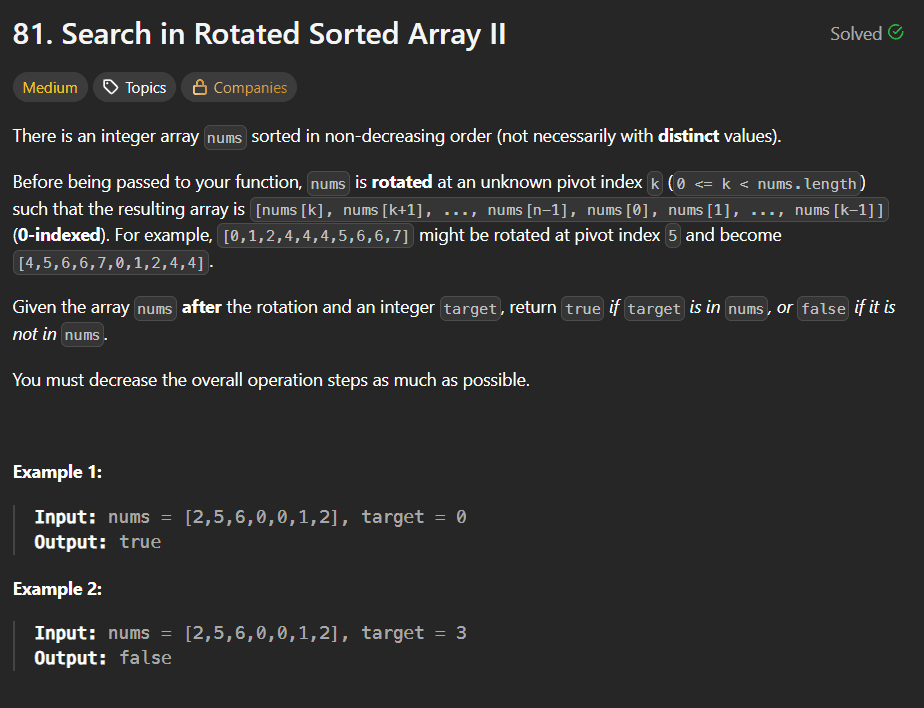
Try the QuestionBefore reading the explanation, try solving the problem yourself:👉 https://leetcode.com/problems/search-in-rotated-sorted-array-ii/Practicing the problem first helps develop stronger problem-solving intuition, especially for binary search variations.Problem StatementYou are given an integer array nums that is sorted in non-decreasing order.Example of a sorted array:[0,1,2,4,4,4,5,6,6,7]Before being passed to your function, the array may be rotated at some pivot index k.After rotation, the structure becomes:[nums[k], nums[k+1], ..., nums[n-1], nums[0], nums[1], ..., nums[k-1]]Example:Original array[0,1,2,4,4,4,5,6,6,7]Rotated at index 5[4,5,6,6,7,0,1,2,4,4]You are also given an integer target.Your task is to determine:Return true if the target exists in the arrayReturn false if the target does not existThe goal is to minimize the number of operations, which suggests using Binary Search.Example WalkthroughExample 1Inputnums = [2,5,6,0,0,1,2]target = 0OutputtrueExplanation:0 exists in the arrayExample 2Inputnums = [2,5,6,0,0,1,2]target = 3OutputfalseExplanation:3 does not exist in the arrayUnderstanding the Core ChallengeThis problem is very similar to the classic problem:Search in Rotated Sorted Array (LeetCode 33).However, there is an important difference.Difference Between the Two ProblemsProblemArray ValuesRotated Sorted ArrayAll elements are distinctRotated Sorted Array IIArray may contain duplicatesDuplicates introduce ambiguity during binary search.Why Duplicates Make the Problem HarderIn the previous problem, we relied on this rule:If nums[left] <= nums[mid]→ left half is sortedBut duplicates can break this assumption.Example:nums = [1,0,1,1,1]If:left = 0mid = 2right = 4Then:nums[left] = 1nums[mid] = 1nums[right] = 1Here we cannot determine which half is sorted.This is the main complication introduced by duplicates.Key Idea to Handle DuplicatesWhen the values at left, mid, and right are the same, the algorithm cannot decide which half is sorted.To resolve this situation, we shrink the search space:left++right--This gradually removes duplicate values and allows binary search to continue.Modified Binary Search StrategyThe algorithm works as follows:Step 1Calculate the middle index.Step 2If the middle element equals the target:return trueStep 3If duplicates block decision-making:nums[left] == nums[mid] == nums[right]Then move both pointers inward:left++right--Step 4Otherwise, determine which half is sorted and apply normal binary search logic.Java Implementationclass Solution { public boolean search(int[] nums, int target) { int l = 0; int r = nums.length - 1; while (l <= r) { int mid = l + (r - l) / 2; if (nums[mid] == target) return true; // Handle duplicates if (nums[l] == nums[mid] && nums[mid] == nums[r]) { l++; r--; } // Left half sorted else if (nums[l] <= nums[mid]) { if (nums[l] <= target && target < nums[mid]) { r = mid - 1; } else { l = mid + 1; } } // Right half sorted else { if (nums[mid] < target && target <= nums[r]) { l = mid + 1; } else { r = mid - 1; } } } return false; }}Step-by-Step ExampleArray:[2,5,6,0,0,1,2]target = 0Iteration 1mid = 6value = 0Target found immediately.return trueTime ComplexityBest CaseO(log n)When duplicates do not interfere with binary search decisions.Worst CaseO(n)When many duplicate values force the algorithm to shrink the search space one element at a time.Example worst case:[1,1,1,1,1,1,1,1,1]Binary search cannot divide the array effectively.Space ComplexityO(1)The algorithm only uses a few variables and does not require extra memory.Follow-Up: How Do Duplicates Affect Runtime?Without duplicates, binary search always reduces the search space by half.Time Complexity → O(log n)With duplicates, we sometimes cannot determine which half is sorted.In such cases, we shrink the search space linearly:left++right--This may degrade performance to:Worst Case → O(n)However, in most practical cases the algorithm still performs close to logarithmic time.Key Takeaways✔ The array is sorted but rotated✔ Duplicates introduce ambiguity in binary search✔ Special handling is required when nums[left] == nums[mid] == nums[right]✔ The algorithm combines binary search with duplicate handling✔ Worst-case complexity may degrade to O(n)Final ThoughtsThis problem is a natural extension of the rotated sorted array search problem. It tests your ability to adapt binary search to more complex conditions.Understanding this pattern is valuable because similar techniques appear in many interview problems involving:Rotated arraysBinary search edge casesHandling duplicates in sorted data structuresMastering this approach strengthens both algorithmic thinking and interview preparation.

LeetCodeBinary SearchRotated Sorted ArrayJavaMedium
Search in Rotated Sorted Array – Binary Search Explained with Java Solution (LeetCode 33)

Search in Rotated Sorted Array – Binary Search Explained with Java Solution (LeetCode 33)

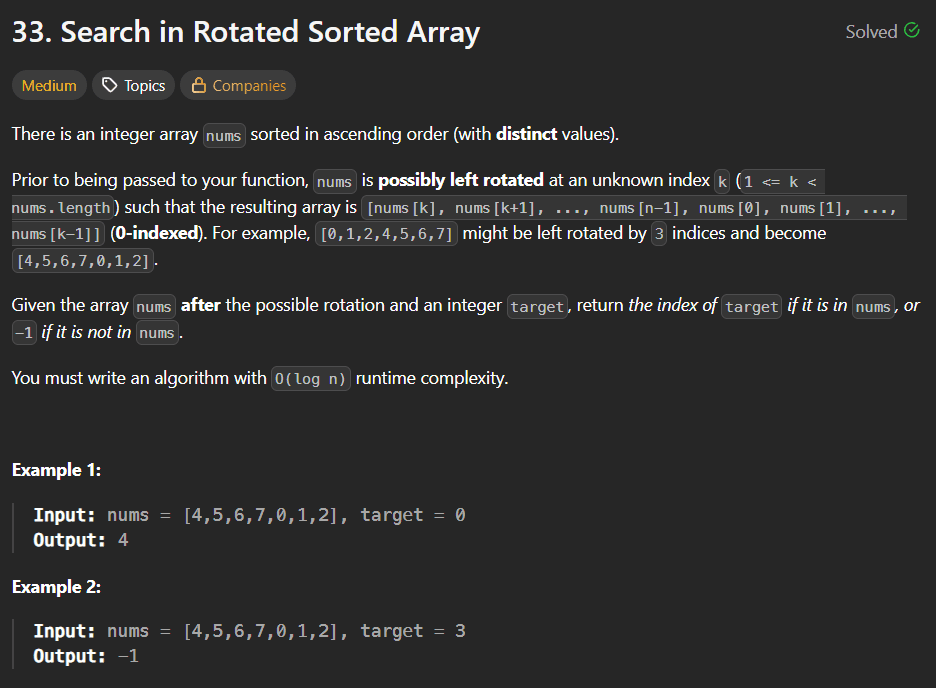
Try the QuestionBefore reading the solution, try solving the problem yourself:👉 https://leetcode.com/problems/search-in-rotated-sorted-array/Attempting the problem first helps build strong algorithmic intuition, which is extremely valuable during coding interviews.Problem StatementYou are given an integer array nums that was originally sorted in ascending order with distinct elements.Example of a sorted array:[0,1,2,4,5,6,7]Before the array is provided to the function, it may have been rotated at some pivot index k.After rotation, the array structure becomes:[nums[k], nums[k+1], ..., nums[n-1], nums[0], nums[1], ..., nums[k-1]]For example:Original Array[0,1,2,4,5,6,7]Rotated by 3 positions[4,5,6,7,0,1,2]You are also given an integer target.The goal is to return the index of the target element in the array.If the element does not exist, return:-1Important ConstraintThe algorithm must run in O(log n) time complexity, which strongly suggests using Binary Search.Example WalkthroughExample 1Inputnums = [4,5,6,7,0,1,2]target = 0Output4Explanation:0 exists at index 4Example 2Inputnums = [4,5,6,7,0,1,2]target = 3Output-1Explanation:3 does not exist in the arrayExample 3Inputnums = [1]target = 0Output-1Understanding the Core ChallengeIf the array were fully sorted, the problem would be straightforward because binary search could directly be applied.Example:[1,2,3,4,5,6,7]However, due to rotation:[4,5,6,7,0,1,2]the array is no longer globally sorted.But an important observation makes the problem solvable.Key ObservationEven after rotation:At least one half of the array is always sorted.For example:[4,5,6,7,0,1,2] Left part → sorted Right part → sortedThis property allows the use of binary search with additional conditions.Approach 1 — Linear Scan (Brute Force)The simplest method is to iterate through the entire array and check each element.AlgorithmTraverse the array from start to end.Compare every element with the target.Return the index if found.Codefor(int i = 0; i < nums.length; i++){ if(nums[i] == target){ return i; }}return -1;Time ComplexityO(n)Space ComplexityO(1)Although simple, this solution does not satisfy the required O(log n) complexity.Approach 2 — Modified Binary SearchA better solution uses binary search with sorted half detection.IdeaAt every step:Calculate the middle index.Determine which half of the array is sorted.Check if the target lies inside that sorted half.Adjust the search range accordingly.Implementationpublic int search(int[] nums, int target) { int l = 0; int r = nums.length - 1; while(l <= r){ int mid = l + (r - l) / 2; if(nums[mid] == target){ return mid; } // left half sorted if(nums[l] <= nums[mid]){ if(nums[l] <= target && target < nums[mid]){ r = mid - 1; }else{ l = mid + 1; } } // right half sorted else{ if(nums[mid] < target && target <= nums[r]){ l = mid + 1; }else{ r = mid - 1; } } } return -1;}Time ComplexityO(log n)Space ComplexityO(1)This is the most common interview solution.Approach 3 — Find Rotation Point Then Apply Binary SearchAnother elegant strategy is to first locate the minimum element in the rotated array, which represents the rotation index (pivot).Once the pivot is known, the array can be logically split into two sorted subarrays.Example:[4,5,6,7,0,1,2] ^ pivotTwo sorted sections exist:[4,5,6,7][0,1,2]After identifying the pivot:Decide which part may contain the target.Apply standard binary search on that portion.Step 1 — Finding the Minimum Element (Rotation Pivot)The smallest element indicates where the rotation happened.Function to Find Minimum Valuepublic int findMinIndex(int[] nums){ int l = 0; int r = nums.length - 1; while(l < r){ int mid = l + (r - l) / 2; if(nums[mid] > nums[r]){ l = mid + 1; }else{ r = mid; } } return l;}Why This WorksIf:nums[mid] > nums[r]the minimum element must be on the right side.Otherwise, it lies on the left side (including mid).Step 2 — Standard Binary SearchAfter determining which half contains the target, a normal binary search is applied.public int binarySearch(int[] nums, int l, int r, int target){ while(l <= r){ int mid = l + (r - l) / 2; if(nums[mid] == target){ return mid; } else if(nums[mid] < target){ l = mid + 1; } else{ r = mid - 1; } } return -1;}Complete Solution (Pivot + Binary Search)class Solution { public int findMinIndex(int[] nums){ int l = 0; int r = nums.length - 1; while(l < r){ int mid = l + (r - l) / 2; if(nums[mid] > nums[r]){ l = mid + 1; }else{ r = mid; } } return l; } public int binarySearch(int[] nums, int l, int r, int target){ while(l <= r){ int mid = l + (r - l) / 2; if(nums[mid] == target){ return mid; } else if(nums[mid] < target){ l = mid + 1; } else{ r = mid - 1; } } return -1; } public int search(int[] nums, int target) { int pivot = findMinIndex(nums); if(nums[pivot] <= target && target <= nums[nums.length - 1]){ return binarySearch(nums, pivot, nums.length - 1, target); } return binarySearch(nums, 0, pivot - 1, target); }}Time ComplexityFinding pivot:O(log n)Binary search:O(log n)Total complexity:O(log n)Space ComplexityO(1)No additional memory is used.Key Takeaways✔ The array is sorted but rotated✔ A rotation creates two sorted sections✔ Binary search can still be applied✔ Either detect the sorted half directly or locate the pivot first✔ Both optimized approaches achieve O(log n) complexityFinal ThoughtsThis problem is a classic binary search variation frequently asked in coding interviews. It evaluates the ability to:Recognize structural patterns in arraysAdapt binary search to non-standard conditionsMaintain optimal algorithmic complexityUnderstanding this pattern also helps solve related problems such as:Find Minimum in Rotated Sorted ArraySearch in Rotated Sorted Array IIFind Rotation Count in ArrayMastering these concepts significantly strengthens binary search problem-solving skills for technical interviews.

Binary SearchJavaRotated Sorted ArrayLeetCodeMedium
LeetCode 1482: Minimum Number of Days to Make m Bouquets – Binary Search on the Earliest Day

LeetCode 1482: Minimum Number of Days to Make m Bouquets – Binary Search on the Earliest Day

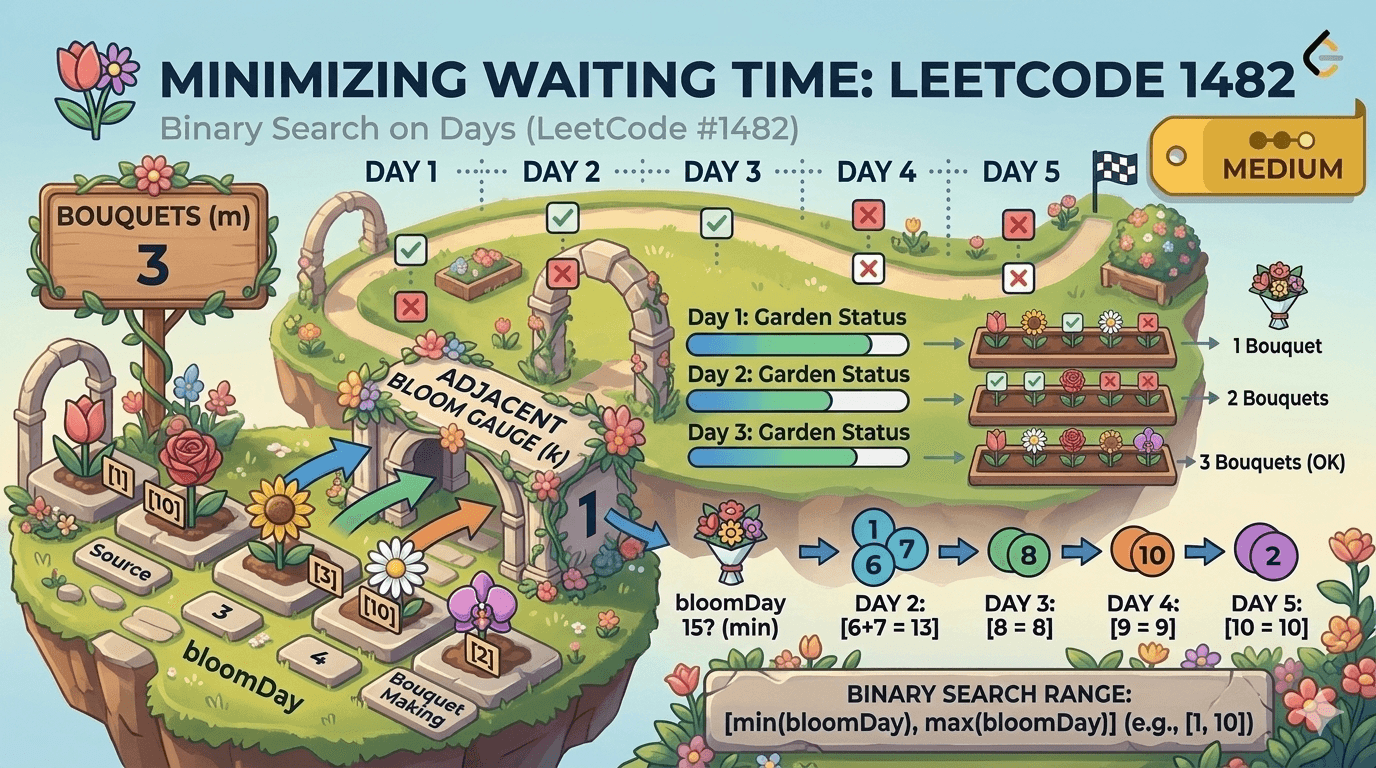
Try the ProblemYou can practice the problem here:https://leetcode.com/problems/minimum-number-of-days-to-make-m-bouquets/Problem DescriptionYou are given an integer array bloomDay, where:bloomDay[i]represents the day on which the i-th flower blooms.You are also given two integers:m → number of bouquets requiredk → number of adjacent flowers needed for one bouquetRulesTo create one bouquet, you must use:k adjacent flowersImportant constraints:A flower can only be used once.Only flowers that have already bloomed can be used.Flowers must be adjacent in the array.Your goal is to determine the minimum number of days required so that it becomes possible to create m bouquets.If it is impossible, return:-1Example WalkthroughExample 1InputbloomDay = [1,10,3,10,2]m = 3k = 1Output3ExplanationWe need:3 bouquets1 flower eachGarden progress:Day 1[x, _, _, _, _]Bouquets possible = 1Day 2[x, _, _, _, x]Bouquets possible = 2Day 3[x, _, x, _, x]Bouquets possible = 3 ✅Minimum day = 3Example 2InputbloomDay = [1,10,3,10,2]m = 3k = 2Output-1Explanation:We need:3 bouquets × 2 flowers = 6 flowersBut we only have:5 flowersSo it is impossible.Example 3InputbloomDay = [7,7,7,7,12,7,7]m = 2k = 3Output12Explanation:Day 7[x,x,x,x,_,x,x]Only 1 bouquet can be made.Day 12[x,x,x,x,x,x,x]Now 2 bouquets can be formed.Minimum day = 12Constraints1 <= n <= 10^51 <= bloomDay[i] <= 10^91 <= m <= 10^61 <= k <= nImportant observations:bloomDay[i] can be very largeThe array size can be 100,000A brute force simulation for every day would be too slowThinking About the ProblemAt first glance, the problem may look like a simulation problem, where we check the garden day by day.However, this approach quickly becomes inefficient because the maximum bloom day can be as large as:10^9So instead of checking every day sequentially, we need to search intelligently for the minimum valid day.Key ObservationIf we wait for more days, more flowers will bloom.Which means:Days ↑ → Flowers available ↑ → Bouquets possible ↑This means the function is monotonic.If it is possible to make m bouquets on day X, then it will also be possible on any day after X.This type of pattern strongly suggests using:Binary Search on AnswerApproach: Binary Search on Minimum DayInstead of checking every day, we search between:minimum bloom day → maximum bloom dayFor each candidate day mid:Assume we wait until day mid.Count how many bouquets we can make.If we can make at least m bouquets, try smaller days.Otherwise, increase the day.How We Count BouquetsWhile scanning the garden:If the flower has bloomed (bloomDay[i] <= mid)→ increase adjacent flower countIf a flower has not bloomed yet→ reset the adjacent counterWhenever we have:k adjacent flowerswe form one bouquet.Your Java Implementation (Binary Search + Greedy Counting)class Solution {// Function to check if we can make m bouquets// if we wait until 'mid' dayspublic boolean binaryS(int mid, int[] arr, int m, int k){int flower = 0;int bouq = 0;for(int i = 0; i < arr.length; i++){// Flower has bloomedif(arr[i] <= mid){flower++;}else{// Calculate bouquets from collected flowersbouq += flower / k;// Reset adjacent counterflower = 0;}}// Handle remaining flowers after loopbouq += flower / k;return bouq >= m;}public int minDays(int[] bloomDay, int m, int k) {// If required flowers exceed total flowersif((long)m * k > bloomDay.length)return -1;int min = Integer.MAX_VALUE;int max = Integer.MIN_VALUE;// Find search rangefor(int a : bloomDay){min = Math.min(min, a);max = Math.max(max, a);}int ans = -1;// Binary Searchwhile(min <= max){int mid = min + (max - min) / 2;if(binaryS(mid, bloomDay, m, k)){ans = mid;// Try smaller daymax = mid - 1;}else{// Need more daysmin = mid + 1;}}return ans;}}Dry Run ExamplebloomDay = [1,10,3,10,2]m = 3k = 1Search range:1 → 10Binary search steps:mid = 5Possible bouquets = 3 → validTry smaller:mid = 2Bouquets = 2 → not enoughIncrease day:mid = 3Bouquets = 3 → validMinimum day:3Time ComplexityBinary search runs:O(log(maxDay - minDay))For each check we scan the array:O(n)Total complexity:O(n log(10^9))Which is efficient for n = 10^5.Space ComplexityO(1)No extra space is required.Key TakeawayThis problem is a classic example of:Binary Search on AnswerWhenever a problem asks:Find the minimum value such that a condition becomes trueBinary search is often the best solution.ConclusionThe Minimum Number of Days to Make m Bouquets problem teaches an important interview technique: transforming a simulation problem into a search problem.By recognizing the monotonic nature of the problem, we can apply binary search on the answer space and efficiently determine the minimum day required to create the desired number of bouquets.Mastering problems like this will significantly improve your understanding of binary search patterns, which are extremely common in coding interviews.

Binary SearchArraysBinary Search on AnswerLeetCodeMedium
Find First and Last Position in Sorted Array – From Brute Force to Binary Search (LeetCode 34)

Find First and Last Position in Sorted Array – From Brute Force to Binary Search (LeetCode 34)

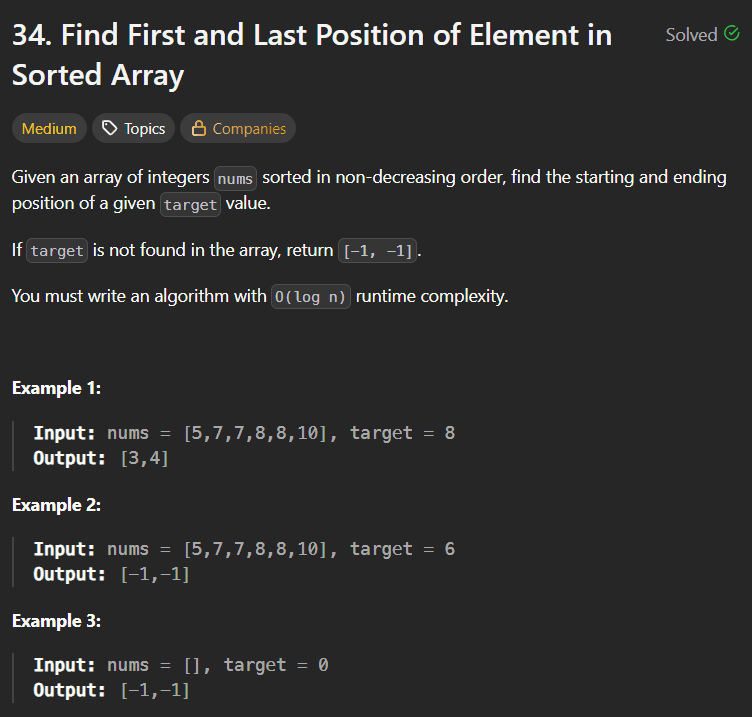
Problem LinkLeetCode 34 – Find First and Last Position of Element in Sorted Array 👉 https://leetcode.com/problems/find-first-and-last-position-of-element-in-sorted-array/📌 Problem OverviewYou are given a sorted array (non-decreasing order) and a target value.Your task:Return the starting and ending index of the target.If target does not exist → return [-1, -1]Required Time Complexity: O(log n)Example 1Input: nums = [5,7,7,8,8,10], target = 8 Output: [3,4]Example 2Input: nums = [5,7,7,8,8,10], target = 6 Output: [-1,-1]🧠 My First Intuition – Brute Force (O(n))When I first saw this problem, my thinking was simple:"Since the array is sorted, I just need to find the first occurrence and the last occurrence."So I used two loops:One loop from left → to find first occurrenceOne loop from right → to find last occurrenceHere is my submitted solution:class Solution { public int[] searchRange(int[] nums, int t) { int arr[] = new int[2]; arr[0] = -1; arr[1] = -1; for(int i = nums.length-1;i >=0 ;i--){ if(nums[i] == t){ arr[1] = i; break; } } for(int i = 0;i <nums.length ;i++){ if(nums[i] == t){ arr[0] = i; break; } } return arr; }}✅ Why This WorksSince the array is sorted, occurrences of the same number are grouped together.First loop (reverse) finds last occurrence.Second loop (forward) finds first occurrence.❌ Problem with This ApproachTime Complexity = O(n)Worst case:Target is not presentWe scan entire array twiceBut the problem clearly states:You must write an algorithm with O(log n) runtime complexity.That means: We must use Binary Search.🚀 Optimized Approach – Binary Search (O(log n))💡 Key IntuitionIf the array is sorted:We can use Binary Search to find the first occurrenceWe can use Binary Search again to find the last occurrenceInstead of stopping when we find the target:For first occurrence → continue searching leftFor last occurrence → continue searching right🧠 Idea Breakdown1️⃣ Find First OccurrenceWhen we find target at mid:Store indexMove left → high = mid - 1Because there might be another occurrence before it2️⃣ Find Last OccurrenceWhen we find target at mid:Store indexMove right → low = mid + 1Because there might be another occurrence after it💻 Optimized Code (Binary Search Approach)class Solution { public int[] searchRange(int[] nums, int target) { int[] result = new int[2]; result[0] = findFirst(nums, target); result[1] = findLast(nums, target); return result; } private int findFirst(int[] nums, int target) { int low = 0, high = nums.length - 1; int index = -1; while (low <= high) { int mid = low + (high - low) / 2; if (nums[mid] == target) { index = mid; high = mid - 1; // move left } else if (nums[mid] < target) { low = mid + 1; } else { high = mid - 1; } } return index; } private int findLast(int[] nums, int target) { int low = 0, high = nums.length - 1; int index = -1; while (low <= high) { int mid = low + (high - low) / 2; if (nums[mid] == target) { index = mid; low = mid + 1; // move right } else if (nums[mid] < target) { low = mid + 1; } else { high = mid - 1; } } return index; }}🔍 Why This WorksBinary Search normally stops when target is found.Here, we modify it slightly:Keep searching even after finding target.Narrow the search space toward the boundary we want.This guarantees:First occurrence → leftmost indexLast occurrence → rightmost index⏱ Complexity AnalysisBrute Force ApproachTime: O(n)Space: O(1)Binary Search ApproachTime: O(log n)Space: O(1)This satisfies the problem constraint.🎯 Key Learning from This ProblemThis problem teaches an important pattern:When array is sorted and you need boundaries → Think Binary Search.It is not just about finding the element.It is about finding:First occurrence (Lower Bound)Last occurrence (Upper Bound)This pattern appears in many interview problems.📚 Similar Problems to Practicehttps://leetcode.com/problems/binary-search/https://leetcode.com/problems/search-insert-position/https://leetcode.com/problems/search-in-rotated-sorted-array/https://leetcode.com/problems/find-minimum-in-rotated-sorted-array/https://leetcode.com/problems/sqrtx/🏁 Final ThoughtsMy journey solving this problem:First thought → Use two loops (works but O(n))Then realized constraint → Must be O(log n)Optimized using two Binary SearchesThis is how problem solving improves:Start with correct solution.Then optimize.Then recognize patterns.LeetCode 34 is one of the most important Binary Search boundary problems.If you master this, you unlock an entire category of advanced Binary Search questions.

Binary SearchLeetCodeMedium
LeetCode 875: Koko Eating Bananas – Find the Minimum Eating Speed Using Binary Search

LeetCode 875: Koko Eating Bananas – Find the Minimum Eating Speed Using Binary Search

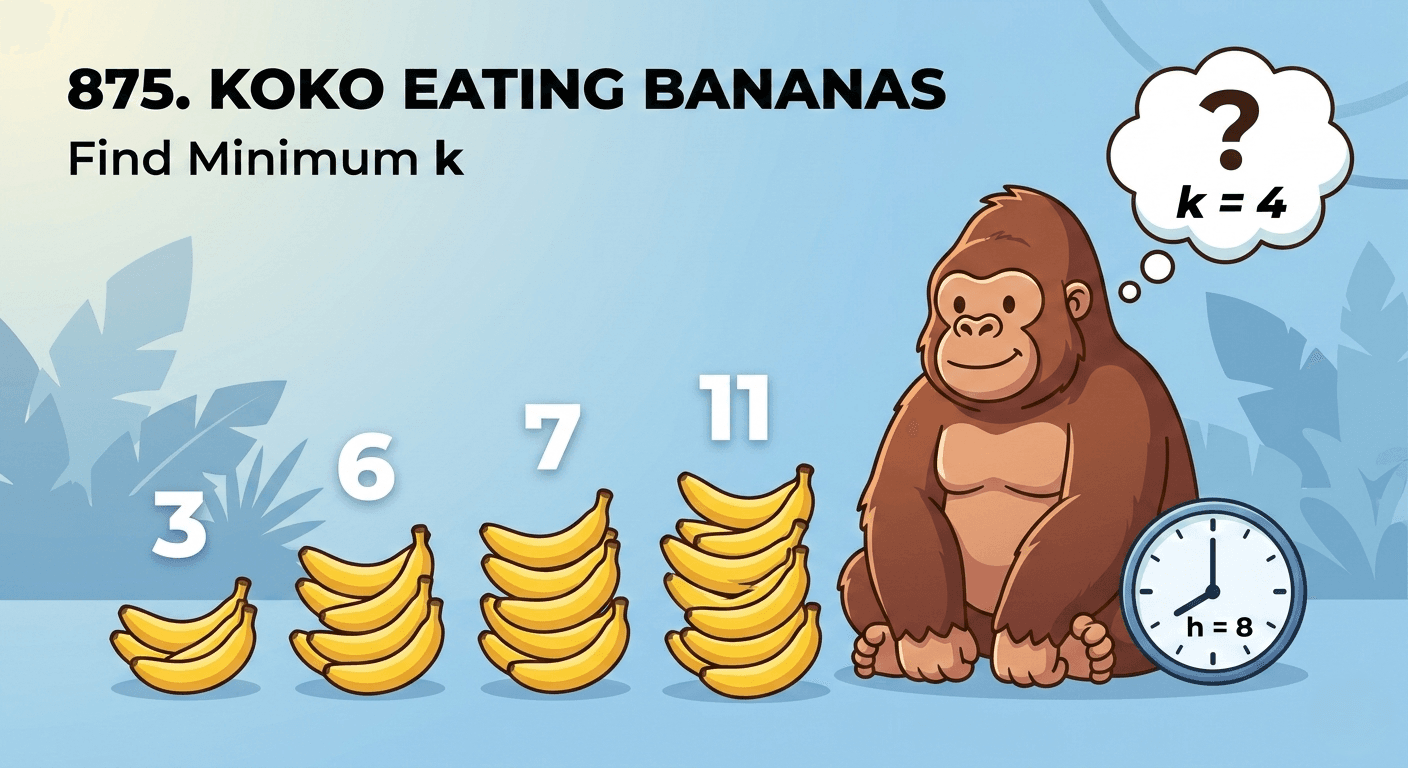
Try the ProblemYou can practice the problem here:https://leetcode.com/problems/koko-eating-bananas/Problem DescriptionKoko loves eating bananas 🍌.You are given n piles of bananas, where the i-th pile contains piles[i] bananas.The guards have left and will return after h hours. Koko wants to finish eating all the bananas before the guards come back.Koko can choose her banana-eating speed k bananas per hour.However, there are some important rules:Every hour, Koko chooses one pile of bananas.She eats k bananas from that pile.If the pile contains fewer than k bananas, she eats all of them and stops for that hour.She cannot move to another pile in the same hour.Your task is to determine the minimum integer value of k such that Koko can finish all the bananas within h hours.Example WalkthroughExample 1Inputpiles = [3,6,7,11]h = 8Output4Explanation:If Koko eats 4 bananas per hour, the time taken for each pile is:3 bananas → 1 hour6 bananas → 2 hours7 bananas → 2 hours11 bananas → 3 hoursTotal time required:1 + 2 + 2 + 3 = 8 hoursSince Koko finishes all bananas within 8 hours, the minimum speed is 4 bananas per hour.Example 2Inputpiles = [30,11,23,4,20]h = 5Output30Example 3Inputpiles = [30,11,23,4,20]h = 6Output23Constraints1 <= piles.length <= 10^4piles.length <= h <= 10^91 <= piles[i] <= 10^9Important observations:A pile may contain up to one billion bananas.The number of hours can also be extremely large.A naive solution may become computationally expensive.Intuition Behind the ProblemThe key observation in this problem is the relationship between eating speed and required hours.If Koko eats slowly, she needs more hours.If she eats faster, she needs fewer hours.This creates a monotonic relationship:Eating Speed ↑ → Hours Required ↓Because of this property, we can apply Binary Search on the answer.Instead of testing every possible eating speed, we can efficiently search the correct speed using binary search.Approach 1: Brute ForceIdeaTry every possible eating speed:k = 1 → max(piles)For each speed:Calculate the total hours required.If the hours are less than or equal to h, return that speed.DrawbackThe maximum pile size can be:10^9Trying all speeds up to 10^9 would take too long.Time ComplexityO(max(pile) × n)This approach is not feasible for large inputs.Approach 2: Binary Search on Answer (Optimal Solution)Since the answer lies between 1 and the maximum pile size, we can apply binary search.Search SpaceMinimum possible speed:1 banana/hourMaximum possible speed:max(piles)Binary Search StrategyChoose a middle value mid as the candidate eating speed.Calculate how many hours Koko needs at this speed.If the hours are less than or equal to h, try a smaller speed.If the hours are greater than h, increase the speed.This continues until we find the minimum valid speed.Java Implementationclass Solution { // Function to calculate total hours needed // if Koko eats bananas at a given speed public int hourCalculate(int[] piles, int speed){ int hours = 0; // Traverse through each pile for(int i = 0; i < piles.length; i++){ // Calculate hours needed for this pile // Using ceiling division hours += Math.ceil((double)piles[i] / speed); } return hours; } public int minEatingSpeed(int[] piles, int h) { // Minimum possible eating speed int low = 1; // Maximum possible speed int high = Integer.MIN_VALUE; // Find the maximum pile for(int pile : piles){ high = Math.max(high, pile); } int answer = high; // Binary Search while(low <= high){ int mid = low + (high - low) / 2; // Calculate required hours at speed mid int requiredHours = hourCalculate(piles, mid); if(requiredHours <= h){ // mid is a valid answer answer = mid; // Try smaller speed high = mid - 1; } else{ // Speed too slow low = mid + 1; } } return answer; }}Time ComplexityBinary Search runs in:O(log(max(pile)))Each iteration calculates hours in:O(n)Overall complexity:O(n log(max(pile)))Space ComplexityO(1)No extra memory is required.Key TakeawayThis problem is a classic example of Binary Search on Answer.Whenever a problem asks:“Find the minimum or maximum value such that a condition is satisfied”You should consider applying Binary Search on the answer space.ConclusionInstead of testing every possible eating speed, we used Binary Search to efficiently find the minimum speed that allows Koko to finish the bananas within the given number of hours.This approach dramatically improves performance and is a common technique used in many coding interview problems involving optimization and search space reduction.

Binary SearchBinary Search on AnswerArraysLeetCodeMediumJava
Floor in a Sorted Array – Binary Search Explained with Story & Visuals | GeeksforGeeks

Floor in a Sorted Array – Binary Search Explained with Story & Visuals | GeeksforGeeks

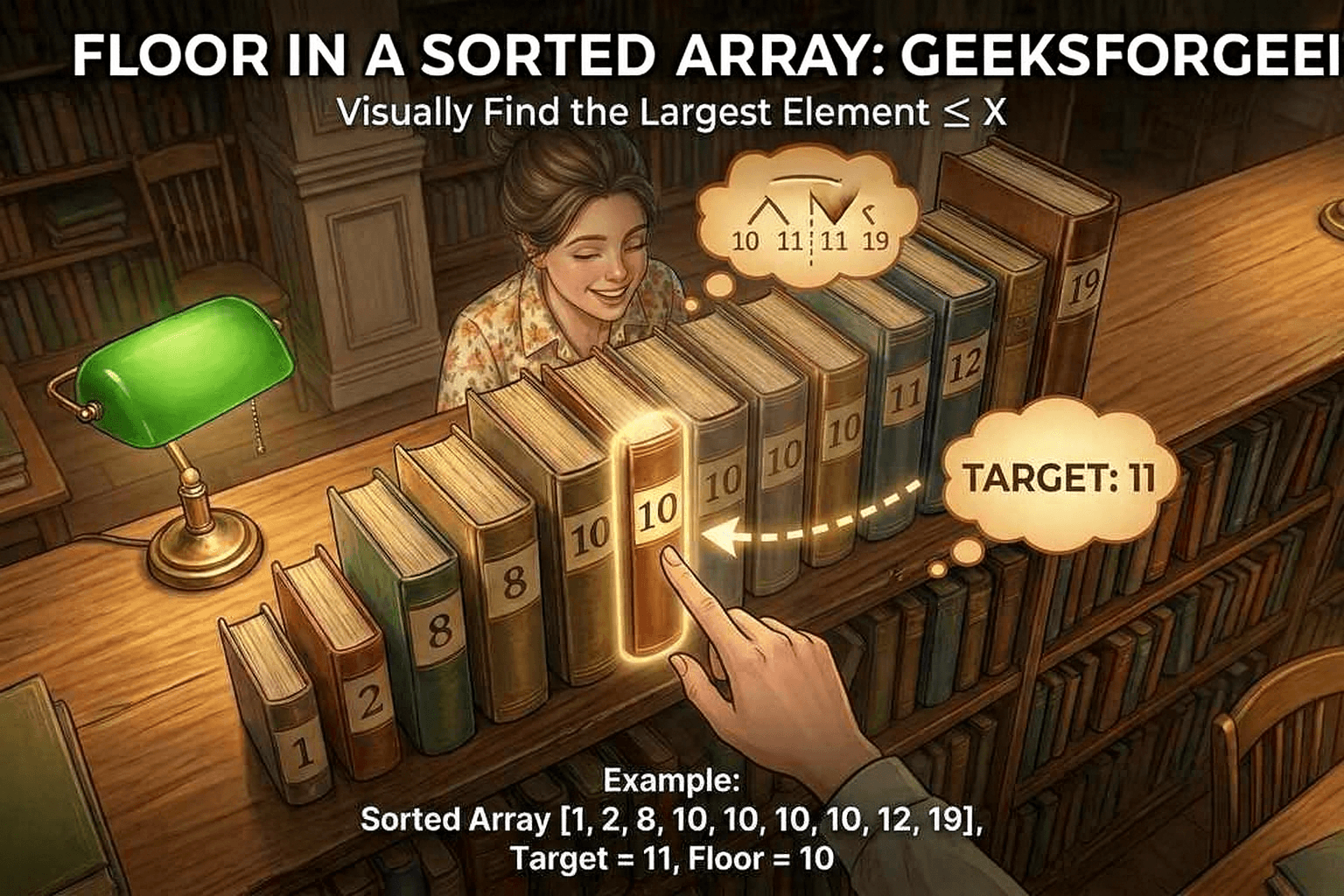
Problem StatementPlatform: GeeksforGeeksYou are given a sorted array arr[] and an integer x. Your task is to find the index of the largest element in the array that is less than or equal to x.Return -1 if no such element exists.If multiple elements equal the floor, return the last occurrence.Example:Input: arr = [1, 2, 8, 10, 10, 12, 19], x = 11Output: 4✅ The largest element ≤ 11 is 10. The last occurrence is at index 4.👉 Try this problem here: GeeksforGeeks – Floor in a Sorted ArrayIntuition: What is “Floor” and Why It MattersImagine climbing stairs:You want to step as high as possible without going past a certain height.That step is your floor – the largest number ≤ x.In arrays:The floor of x is the largest number smaller than or equal to x.Because the array is sorted, we can search efficiently with binary search instead of checking every element.This is faster and helps you handle large arrays with millions of elements.Multiple Approaches1️⃣ Linear Search (Easy but Slow)Check each element from left to right. If it’s ≤ x, update the answer.int ans = -1;for(int i = 0; i < arr.length; i++){if(arr[i] <= x){ans = i; // store last occurrence}}return ans;Time Complexity: O(n) – slow for large arraysSpace Complexity: O(1) – constant memory2️⃣ Binary Search (Fast & Efficient)Binary search cuts the search space in half at every step.int ans = -1;int low = 0, high = arr.length - 1;while(low <= high){int mid = low + (high - low)/2;if(arr[mid] == x){ans = mid; // candidate floorlow = mid + 1; // move right for last occurrence} else if(arr[mid] < x){ans = mid; // candidate floorlow = mid + 1;} else {high = mid - 1; // too large, move left}}return ans;Time Complexity: O(log n) – very fastSpace Complexity: O(1) – no extra spaceDry Run / Step-by-StepInput: arr = [1, 2, 8, 10, 10, 12, 19], x = 11Steplowhighmidarr[mid]ansAction1063103arr[mid] < x → move right2465123arr[mid] > x → move left3444104arr[mid] < x → move right454--4low > high → stop, return 4✅ Finds floor = 10 at index 4.Code Explanation in Simple Wordsans = -1 → stores best candidate for floor.Use low and high as binary search boundaries.mid = low + (high - low)/2 → safe midpoint.If arr[mid] <= x, it can be the floor → move right to find last occurrence.If arr[mid] > x, move left → floor is smaller.Loop ends when low > high, return ans.Edge Cases to Rememberx < arr[0] → return -1 (floor doesn’t exist)x ≥ arr[n-1] → return last index (floor is last element)Duplicates → always return last occurrenceStory-Based Visual Example: “Alice’s Book Shelf Adventure” 📚Scenario:Alice is a librarian.Books are arranged by height on a shelf.She has a new book and wants to place it next to the tallest book shorter than or equal to hers.Instead of checking each book, she uses a binary search approach to find the position quickly."Alice is scanning the bookshelf, which represents a sorted array: [1, 2, 8, 10, 10, 12, 19]. She is thinking where to place her new book labeled 11. This step represents the initial step of the floor algorithm, understanding the array elements.""Alice places the book labeled 11 right after the last 10 on the shelf. This demonstrates finding the floor: the largest number ≤ 11 is 10, and the book is positioned next to it, illustrating the last occurrence logic.""From a top view, Alice is scanning all the books. This shows how binary search would conceptually divide the array: she quickly decides which section the book 11 belongs to without checking every book, demonstrating efficient search.""Alice has successfully placed the book 11 at the correct position. The floor of 11 is 10 (index 4). This visual confirms the algorithm’s result: the new element is positioned immediately after the last element ≤ x, exactly as binary search would determine."Why This Problem is ImportantStrengthens binary search skillsTeaches last occurrence / boundary conditions handlingMakes you think algorithmically, not just about numbersStory-based learning improves retention and understandingConclusionLinear search: easy but slow (O(n))Binary search: fast, elegant (O(log n))Multiple dry run steps make it easy to followStory-based images make abstract concepts concrete and memorable

GeeksforGeeksBinary SearchEasy
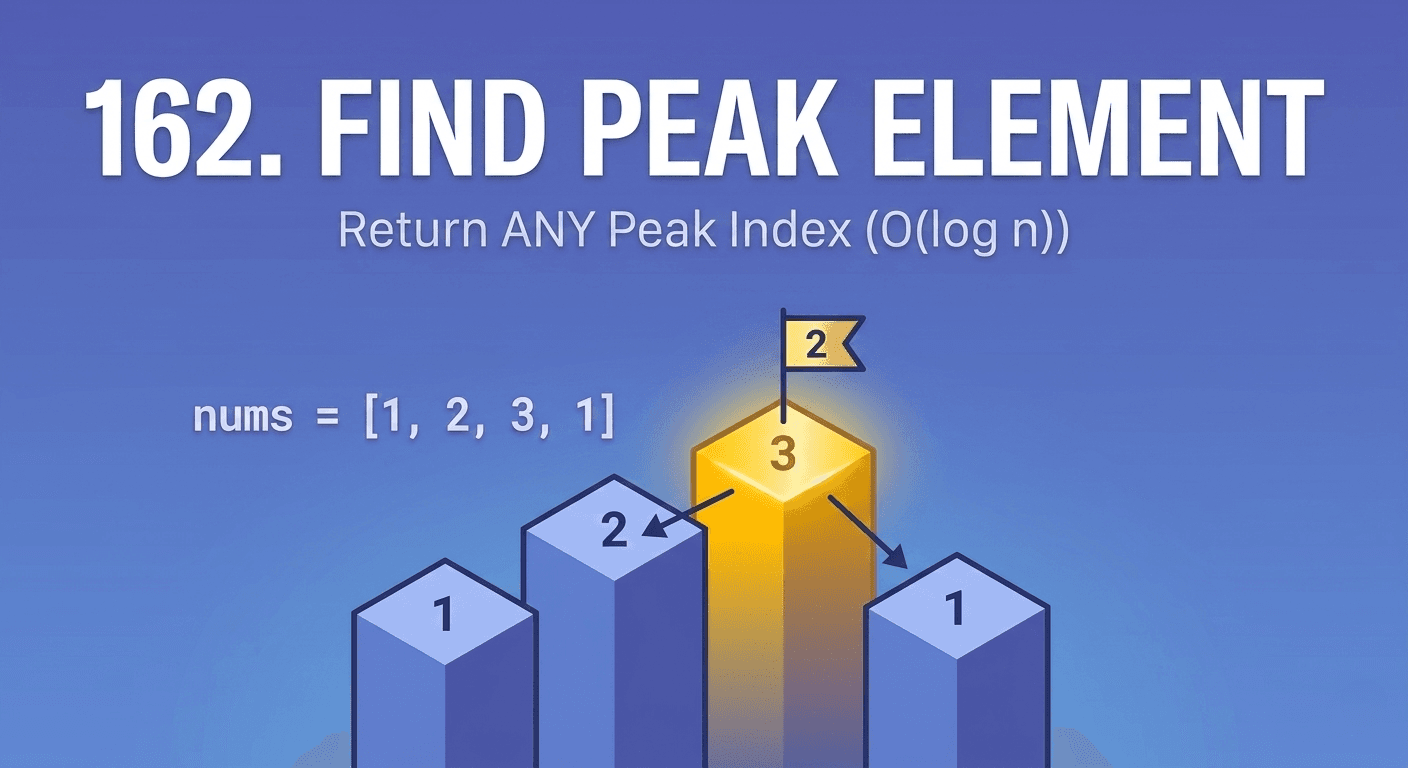
Find Peak Element – Binary Search Explained with Java Solution (LeetCode 162)

Find Peak Element – Binary Search Explained with Java Solution (LeetCode 162)

Try the QuestionBefore reading the explanation, try solving the problem yourself:👉 https://leetcode.com/problems/find-peak-element/Attempting the problem first helps develop algorithmic intuition, especially for binary search problems.Problem StatementYou are given a 0-indexed integer array nums.Your task is to find the index of a peak element.What is a Peak Element?A peak element is an element that is strictly greater than its immediate neighbors.For an element nums[i] to be a peak:nums[i] > nums[i-1]nums[i] > nums[i+1]However, the array boundaries have a special rule.Boundary RuleYou can imagine that:nums[-1] = -∞nums[n] = -∞This means:The first element only needs to be greater than the second element.The last element only needs to be greater than the second last element.Constraints1 <= nums.length <= 1000-2^31 <= nums[i] <= 2^31 - 1nums[i] != nums[i + 1] for all valid iImportant implications:Adjacent elements are never equal.The array always has at least one peak.Understanding the Problem with ExamplesExample 1Inputnums = [1,2,3,1]Visualization1 2 3 1^Here:3 > 23 > 1So 3 is a peak element.Output2(index of value 3)Example 2Inputnums = [1,2,1,3,5,6,4]Visualization1 2 1 3 5 6 4^ ^Possible peaks:26Valid outputs:1 or 5Either peak index is acceptable.Key ObservationsImportant facts about peak elements:Every array must contain at least one peak.If numbers keep increasing, the last element will be a peak.If numbers keep decreasing, the first element will be a peak.If the array has ups and downs, peaks exist in the middle.This guarantees a solution exists.Approach 1 — Linear Scan (Brute Force)The simplest approach is to check each element and see whether it satisfies the peak condition.AlgorithmTraverse the array.Check if the current element is greater than neighbors.Return the index if found.Examplenums = [1,2,3,1]Check:1 < 22 < 33 > 2 and 3 > 1 → PeakImplementationpublic int findPeakElement(int[] nums) {for(int i = 0; i < nums.length; i++){boolean left = (i == 0) || nums[i] > nums[i-1];boolean right = (i == nums.length-1) || nums[i] > nums[i+1];if(left && right){return i;}}return -1;}Time ComplexityO(n)Space ComplexityO(1)Although simple, this solution does not satisfy the required O(log n) complexity.Approach 2 — Binary Search Using Peak ConditionsInstead of scanning the entire array, we can use binary search.Key IdeaIf we are at index mid, compare it with the neighbors.Three situations may occur.Case 1 — Peak Foundnums[mid-1] < nums[mid] > nums[mid+1]Then:mid is the peakCase 2 — Increasing Slopenums[mid] < nums[mid+1]Example:1 3 5 7^This means the peak must exist on the right side.Move search to the right.Case 3 — Decreasing Slopenums[mid] < nums[mid-1]Example:7 5 3 1^Peak exists on the left side.Move search to the left.Implementationint i = 1;int j = nums.length - 2;while(i <= j){int mid = i + (j - i)/2;if(nums[mid-1] < nums[mid] && nums[mid] > nums[mid+1]){return mid;}else if(nums[mid] < nums[mid+1]){i = mid + 1;}else{j = mid - 1;}}Time ComplexityO(log n)Space ComplexityO(1)Approach 3 — Optimized Binary Search (Most Elegant Solution)A simpler and more elegant version of binary search exists.Core IntuitionCompare:nums[mid]nums[mid + 1]Two possibilities exist.Case 1 — Increasing Slopenums[mid] < nums[mid+1]Example:1 2 3 4^The peak must exist on the right side.Move:left = mid + 1Case 2 — Decreasing Slopenums[mid] > nums[mid+1]Example:4 3 2 1^Peak exists on the left side including mid.Move:right = midThis gradually narrows down to the peak.Final Optimized Implementationclass Solution {public int findPeakElement(int[] nums) {int i = 0;int j = nums.length - 1;while(i < j){int mid = i + (j - i) / 2;if(nums[mid] < nums[mid + 1]){i = mid + 1;}else{j = mid;}}return i;}}Step-by-Step ExampleArray[1,2,1,3,5,6,4]Iteration 1mid = 3nums[mid] = 3nums[mid+1] = 5Increasing slope → move right.Iteration 2mid = 5nums[mid] = 6nums[mid+1] = 4Decreasing slope → move left.Eventually:peak index = 5Value:6Why This Binary Search WorksThe array behaves like a mountain landscape.Example visualization:/\/ \/ \__If you stand at mid:If the right side is higher, go right.If the left side is higher, go left.This guarantees that you will eventually reach a peak.Time ComplexityO(log n)Each iteration cuts the search space in half.Space ComplexityO(1)Only a few variables are used.Key Takeaways✔ A peak element is greater than its neighbors✔ The array always contains at least one peak✔ Binary search can be applied using slope comparison✔ The optimized solution only compares nums[mid] and nums[mid+1]✔ The final algorithm runs in O(log n) timeFinal ThoughtsThis problem is an excellent example of applying binary search beyond sorted arrays.Instead of searching for a value, binary search is used here to locate a structural property of the array (a peak).Understanding this pattern is extremely valuable because similar logic appears in many interview problems involving:Mountain arraysBitonic arraysOptimization search problemsMastering this approach will significantly improve your binary search problem-solving skills for technical interviews.

LeetCodeBinary SearchMediumJava
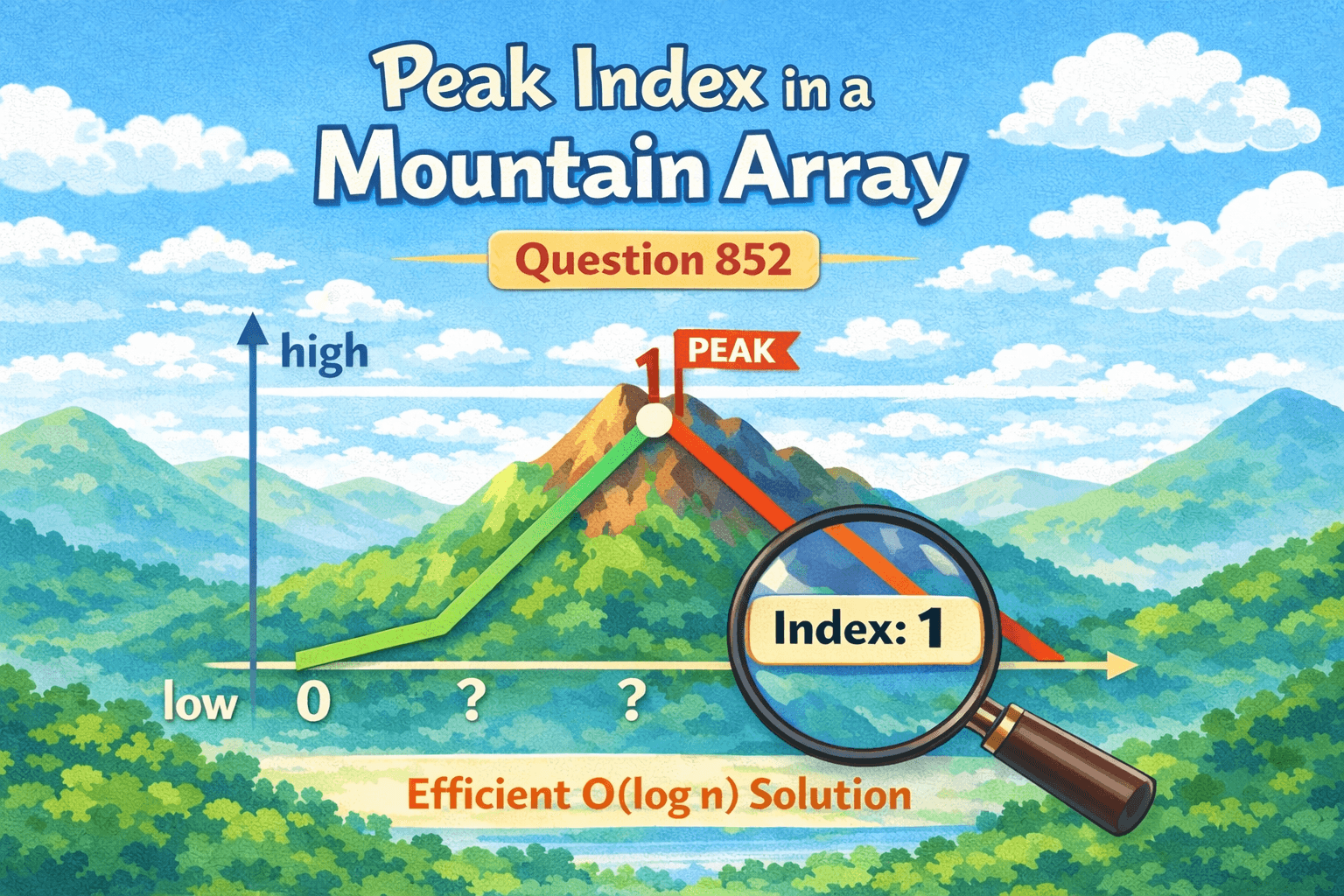
Peak Index in a Mountain Array – Brute Force to Binary Search (LeetCode 852)

Peak Index in a Mountain Array – Brute Force to Binary Search (LeetCode 852)

Try the QuestionBefore reading the explanation, try solving the problem yourself:👉 https://leetcode.com/problems/peak-index-in-a-mountain-array/Solving it first helps strengthen your problem-solving intuition, especially for binary search problems.Problem StatementYou are given an integer array arr that is guaranteed to be a mountain array.A mountain array is defined as an array where:Elements strictly increase until a peak element.After the peak, elements strictly decrease.Example:[0, 2, 5, 7, 6, 3, 1] ^ peakYour task is to return the index of the peak element.Constraints3 <= arr.length <= 10^50 <= arr[i] <= 10^6arr is guaranteed to be a mountain arrayImportant implications:The peak always exists.There will be exactly one peak.The array strictly increases before the peak and strictly decreases after it.Example WalkthroughExample 1Inputarr = [0,1,0]Visualization0 1 0 ^Output1Example 2Inputarr = [0,2,1,0]Visualization0 2 1 0 ^Output1Example 3Inputarr = [0,10,5,2]Visualization0 10 5 2 ^Output1Understanding the Mountain Array StructureA mountain array always looks like this:increasing → peak → decreasingGraphically: peak /\ / \ / \Because of this structure:Before the peak → numbers increaseAfter the peak → numbers decreaseThis property makes the problem perfect for binary search.Approach 1 — Brute Force (Check Every Element)The simplest way is to check every element and determine if it is greater than its neighbors.AlgorithmTraverse the array from index 1 to n-2.For each element check:arr[i] > arr[i-1] AND arr[i] > arr[i+1]If true, return i.Implementationpublic int peakIndexInMountainArray(int[] arr) { for(int i = 1; i < arr.length - 1; i++){ if(arr[i] > arr[i-1] && arr[i] > arr[i+1]){ return i; } } return -1;}Time ComplexityO(n)We may need to check every element.Space ComplexityO(1)Approach 2 — Linear Scan Using Increasing TrendSince the array first increases then decreases, we can detect where the increase stops.Key IdeaTraverse the array and check when:arr[i] > arr[i+1]This means we reached the peak.Implementationpublic int peakIndexInMountainArray(int[] arr) { for(int i = 0; i < arr.length - 1; i++){ if(arr[i] > arr[i+1]){ return i; } } return -1;}Example0 2 5 7 6 3 1 ^At index 3:7 > 6So index 3 is the peak.Time ComplexityO(n)Space ComplexityO(1)Approach 3 — Modified Binary Search (Optimal Solution)Because the array has a mountain structure, binary search can be used.Core IntuitionCompare:arr[mid]arr[mid+1]Two situations are possible.Case 1 — Increasing Slopearr[mid] < arr[mid+1]Example:1 3 5 7 ^This means the peak is on the right side.Move the search space to the right.left = mid + 1Case 2 — Decreasing Slopearr[mid] > arr[mid+1]Example:7 5 3 1 ^This means the peak lies on the left side including mid.right = midOptimal Java Implementationclass Solution { public int peakIndexInMountainArray(int[] arr) { int i = 0; int j = arr.length - 1; while(i < j){ int mid = i + (j - i) / 2; if(arr[mid] < arr[mid + 1]){ i = mid + 1; } else{ j = mid; } } return i; }}Step-by-Step ExampleArray[0,2,5,7,6,3,1]Iteration 1mid = 3arr[mid] = 7arr[mid+1] = 6Decreasing slope → move left.Iteration 2Search space narrows until:peak index = 3Time ComplexityO(log n)Binary search halves the search space each iteration.Space ComplexityO(1)No extra memory is required.Why Binary Search Works HereBecause the array behaves like a mountain curve.If you are standing at index mid:If the right side is higher, go right.If the left side is higher, go left.Eventually you will reach the top of the mountain (the peak).Key Takeaways✔ A mountain array increases then decreases✔ There is exactly one peak✔ Brute force and linear scan work in O(n) time✔ Binary search exploits the mountain structure✔ Optimal solution runs in O(log n) timeFinal ThoughtsThis problem is a classic example of binary search applied to array patterns rather than sorted values.Understanding the slope comparison technique used here will help solve other problems such as:Find Peak ElementMountain Array SearchBitonic Array ProblemsMastering these patterns significantly improves binary search problem-solving skills for coding interviews.

LeetCodeBinary SearchMountain ArrayMediumJava
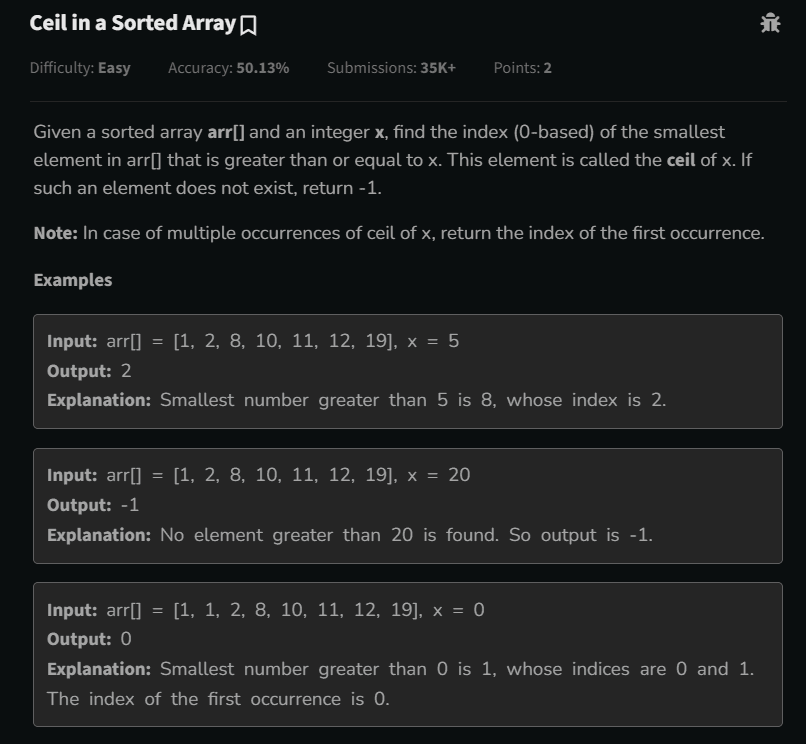
Ceil in a Sorted Array – Binary Search Explained with Story & Visuals | GeeksforGeeks

Ceil in a Sorted Array – Binary Search Explained with Story & Visuals | GeeksforGeeks

Try This Problem FirstPlatform: GeeksforGeeks👉 Try this problem here: Ceil in a Sorted Array – GeeksforGeeksProblem StatementYou are given a sorted array arr[] and an integer x. Your task is to find the index of the smallest element in the array that is greater than or equal to x.If no such element exists, return -1.If multiple elements equal the ceil, return the first occurrence.Example:Input: arr = [1, 2, 8, 10, 11, 12, 19], x = 5Output: 2Explanation: Smallest element ≥ 5 is 8 at index 2.IntuitionThink of the problem as finding the first step you can reach without falling short:The ceil of x is the smallest number ≥ x.Since the array is sorted, we can use binary search to quickly locate the answer instead of checking each element.Linear search is simple but slow for large arrays. Binary search gives an efficient O(log n) solution.Multiple Approaches1️⃣ Linear Search (Easy to Understand)int ans = -1;for(int i = 0; i < arr.length; i++){if(arr[i] >= x){ans = i; // first occurrencebreak;}}return ans;Time Complexity: O(n)Space Complexity: O(1)✅ Works for small arrays❌ Slow for large arrays2️⃣ Binary Search (Optimized & Fast)int ans = -1;int low = 0, high = arr.length - 1;while(low <= high){int mid = low + (high - low)/2;if(arr[mid] == x){ans = mid;high = mid - 1; // move left for first occurrence} else if(arr[mid] > x){ans = mid; // candidate ceilhigh = mid - 1; // move left} else {low = mid + 1; // arr[mid] < x → move right}}return ans;Time Complexity: O(log n)Space Complexity: O(1)✅ Efficient for large arrays✅ Automatically returns first occurrenceDry RunInput: arr = [1, 2, 8, 10, 11, 12, 19], x = 5Steplowhighmidarr[mid]ansAction1063103arr[mid] > x → move left202123arr[mid] < x → move right322282arr[mid] > x → move left421--2low > high → stop, return 2✅ Binary search finds ceil = 8 at index 2.Why This Problem is ImportantTeaches binary search for first occurrenceStrengthens understanding of ceil/floor conceptsVisualization through story improves understanding and retentionPrepares for coding interviews and competitive programmingConclusionLinear search: simple but slow (O(n))Binary search: fast and efficient (O(log n))Story-based visualization helps learn, not just memorizeUsing numbers on books in images makes abstract concepts concrete

GeeksForGeeksEasyBinary SearchSorted Array
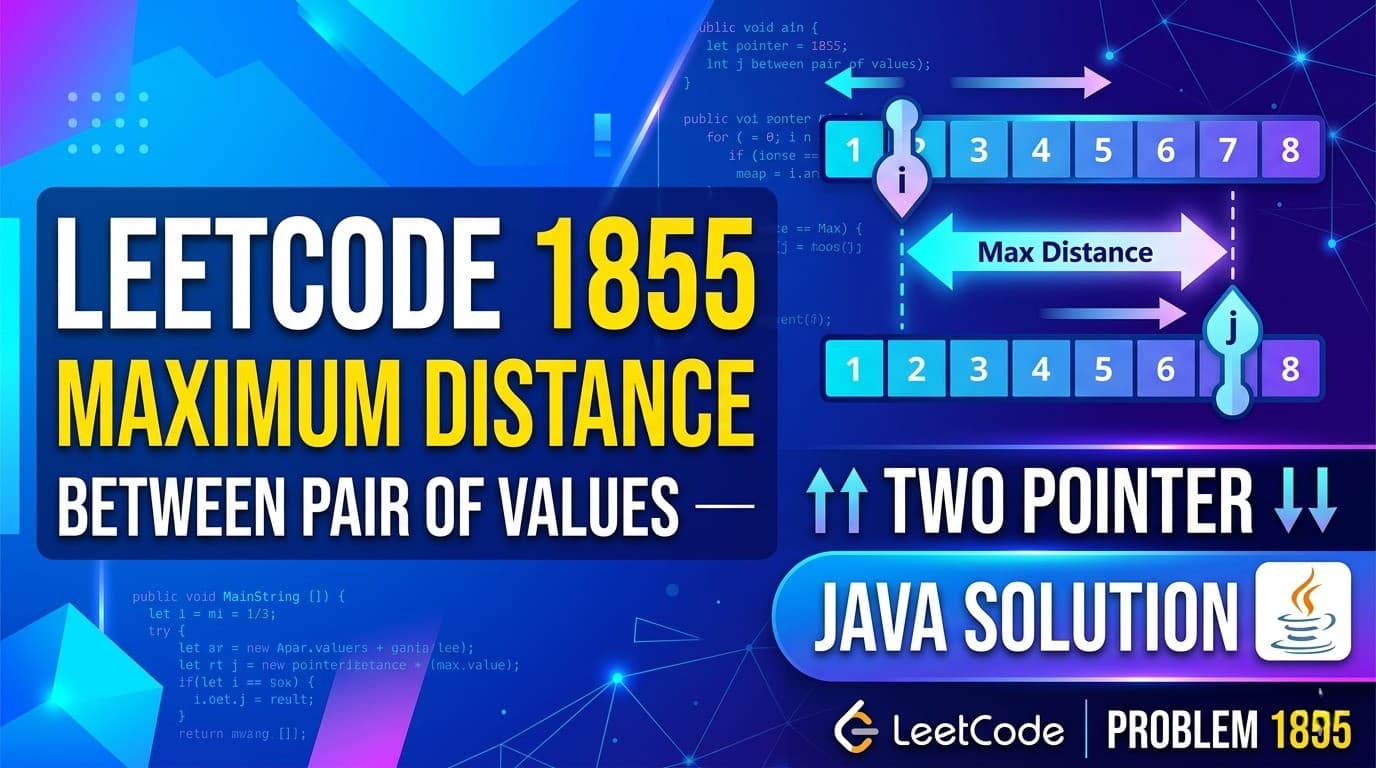
LeetCode 1855 Maximum Distance Between Pair of Values | Two Pointer Java Solution

LeetCode 1855 Maximum Distance Between Pair of Values | Two Pointer Java Solution

IntroductionLeetCode 1855 – Maximum Distance Between a Pair of Values is a classic problem that beautifully demonstrates the power of the Two Pointer technique on sorted (non-increasing) arrays.At first glance, it may feel like a brute-force problem—but using the right observation, it can be solved efficiently in O(n) time.In this article, we will cover:Problem intuitionWhy brute force failsOptimized two-pointer approach (your solution)Alternative approachesTime complexity analysis🔗 Problem LinkLeetCode: Maximum Distance Between a Pair of ValuesProblem StatementYou are given two non-increasing arrays:nums1nums2A pair (i, j) is valid if:i <= jnums1[i] <= nums2[j]👉 Distance = j - iReturn the maximum distance among all valid pairs.ExamplesExample 1Input:nums1 = [55,30,5,4,2]nums2 = [100,20,10,10,5]Output:2Key InsightThe most important observation:Both arrays are NON-INCREASING👉 This allows us to use two pointers efficiently instead of brute force.❌ Naive Approach (Brute Force)IdeaTry all (i, j) pairsCheck conditionsTrack maximumComplexityTime: O(n × m) ❌👉 This will cause TLE for large inputs (up to 10⁵)✅ Optimized Approach: Two PointersIntuitionUse two pointers:i → nums1j → nums2We try to:Expand j as far as possibleMove i only when necessaryKey LogicIf nums1[i] <= nums2[j] → valid → increase jElse → move i forwardJava Codeclass Solution { public int maxDistance(int[] nums1, int[] nums2) { int i = 0; // pointer for nums1 int j = 0; // pointer for nums2 int max = Integer.MIN_VALUE; // Traverse both arrays while (i < nums1.length && j < nums2.length) { // Valid pair condition if (nums1[i] <= nums2[j] && i <= j) { // Update maximum distance max = Math.max(max, j - i); // Try to expand distance by moving j j++; } else if (nums1[i] >= nums2[j]) { // nums1[i] is too large → move i forward i++; } else { // Just move j forward j++; } } // If no valid pair found, return 0 return max == Integer.MIN_VALUE ? 0 : max; }}Step-by-Step Dry RunInput:nums1 = [55,30,5,4,2]nums2 = [100,20,10,10,5]Execution:(0,0) → valid → distance = 0Move j → (0,1) → invalid → move iContinue...Final best pair:(i = 2, j = 4) → distance = 2Why This WorksArrays are sorted (non-increasing)Moving j increases distanceMoving i helps find valid pairs👉 No need to re-check previous elementsComplexity AnalysisTime ComplexityO(n + m)Each pointer moves at most once through the array.Space ComplexityO(1) (no extra space used)Alternative Approach: Binary SearchIdeaFor each i in nums1:Use binary search in nums2Find farthest j such that:nums2[j] >= nums1[i]ComplexityO(n log m)Code (Binary Search Approach)class Solution { public int maxDistance(int[] nums1, int[] nums2) { int max = 0; for (int i = 0; i < nums1.length; i++) { int left = i, right = nums2.length - 1; while (left <= right) { int mid = left + (right - left) / 2; if (nums2[mid] >= nums1[i]) { max = Math.max(max, mid - i); left = mid + 1; } else { right = mid - 1; } } } return max; }}Two Pointer vs Binary SearchApproachTimeSpaceTwo PointerO(n + m) ✅O(1)Binary SearchO(n log m)O(1)👉 Two pointer is optimal hereKey TakeawaysUse two pointers when arrays are sortedAlways look for monotonic propertiesAvoid brute force when constraints are largeGreedy pointer movement can optimize drasticallyCommon Interview PatternsThis problem is related to:Two pointer problemsSliding windowBinary search on arraysGreedy expansionConclusionThe Maximum Distance Between a Pair of Values problem is a great example of how recognizing array properties can drastically simplify the solution.By using the two-pointer technique, we reduce complexity from O(n²) to O(n)—a massive improvement.Frequently Asked Questions (FAQs)1. Why do we use two pointers?Because arrays are sorted, allowing linear traversal.2. Why not brute force?It is too slow for large inputs (10⁵).3. What is the best approach?👉 Two-pointer approach

MediumLeetCodeJavaArrayBinary SearchTwo Pointer
LeetCode 3488 — Closest Equal Element Queries: A Complete Walkthrough from Brute Force to Optimal

LeetCode 3488 — Closest Equal Element Queries: A Complete Walkthrough from Brute Force to Optimal

If you have been grinding LeetCode lately, you have probably run into problems where your first clean-looking solution times out and forces you to rethink from scratch. LeetCode 3488 is exactly that kind of problem. This article walks through the complete thought process — from the naive approach that got me TLE, to the intuition shift, to the final optimized solution in Java.You can find the original problem here: LeetCode 3488 — Closest Equal Element Queries at Problem LinkUnderstanding the ProblemYou are given a circular array nums and an array of queries. For each query queries[i], you must find the minimum distance between the element at index queries[i] and any other index j such that nums[j] == nums[queries[i]]. If no such other index exists, the answer is -1.The critical detail here is the word circular. The array wraps around, which means the distance between two indices i and j in an array of length n is not simply |i - j|. It is:min( |i - j| , n - |i - j| )You can travel either clockwise or counterclockwise, and you take whichever path is shorter.Breaking Down the ExamplesExample 1nums = [1, 3, 1, 4, 1, 3, 2], queries = [0, 3, 5]For query index 0, the value is 1. Other indices holding 1 are 2 and 4. Circular distances are min(2, 5) = 2 and min(4, 3) = 3. The minimum is 2.For query index 3, the value is 4. It appears nowhere else in the array. Answer is -1.For query index 5, the value is 3. The other 3 sits at index 1. Circular distance is min(4, 3) = 3. Answer is 3.Output: [2, -1, 3]Example 2nums = [1, 2, 3, 4], queries = [0, 1, 2, 3]Every element is unique. Every query returns -1.Output: [-1, -1, -1, -1]First Attempt — Brute ForceMy first instinct was straightforward. For each query, scan the entire array, collect every index that matches the queried value, compute the circular distance to each, and return the minimum. Clean logic, easy to reason about, and dead simple to implement.while (i != queries.length) { int max = Integer.MAX_VALUE; for (int j = 0; j < nums.length; j++) { int target = nums[queries[i]]; if (nums[j] == target && j != queries[i]) { // Linear distance between the two indices int right = Math.abs(j - queries[i]); // Distance going the other direction around the ring int left = nums.length - right; // True circular distance is the shorter of the two int dist = Math.min(right, left); max = Math.min(max, dist); } } lis.add(max == Integer.MAX_VALUE ? -1 : max); i++;}This got TLE immediately, and once you look at the constraints it is obvious why. Both nums.length and queries.length can be up to 10^5. For every query you are scanning every element, giving you O(n × q) time — which in the worst case is 10 billion operations. No judge is going to wait for that.Rethinking the Approach — Where Is the Waste?After the TLE, the question I asked myself was: what work is being repeated unnecessarily?The answer was obvious in hindsight. Every time a query asks about a value like 3, the brute force scans the entire array again looking for every index that holds 3. If ten different queries all ask about value 3, you are doing that scan ten times. You are finding the same indices over and over.The fix is to do that work exactly once, before any query is processed. You precompute a map from each value to all the indices where it appears. Then for every query you simply look up the relevant list and work within it.That observation reduces the precomputation to O(n) — one pass through the array. The question then becomes: once you have that sorted list of indices for a given value, how do you find the closest one to your query index efficiently?The Key Insight — You Only Need Two NeighboursHere is the insight that makes this problem elegant. The index list for any value is sorted in ascending order because you build it by iterating left to right through the array. If your query index sits at position mid inside that sorted list, then by definition every index to the left of mid - 1 is farther away than arr[mid - 1], and every index to the right of mid + 1 is farther away than arr[mid + 1].This means you never need to compare against all duplicates. You only ever need to check the immediate left and right neighbours of your query index within the sorted list.The one subtlety is the circular wrap. Because the array itself is circular, the left neighbour of the very first element in the list is actually the last element in the list, since you can wrap around the ring. This is handled cleanly with modular arithmetic: (mid - 1 + n) % n for the left neighbour and (mid + 1) % n for the right.The Optimized Solution — HashMap + Binary SearchStep 1 — Precompute the index mapIterate through nums once and build a HashMap mapping each value to a list of all indices where it appears. The lists are sorted by construction since you insert indices in order.Step 2 — Binary search to locate the query indexFor a given query at index q, look up the index list for nums[q]. Binary search the list to find the position of q within it. This runs in O(log n) rather than O(n).Step 3 — Check immediate neighbours and compute circular distancesOnce you have the position mid, fetch arr[(mid + 1) % n] and arr[(mid - 1 + n) % n]. For each, compute the circular distance using min(|diff|, totalLength - |diff|). Return the smaller of the two.Full Annotated Java Solutionclass Solution { public List<Integer> solveQueries(int[] nums, int[] queries) { int c = 0; // Precompute: map each value to the sorted list of indices where it appears. // Since we iterate left to right, the list is sorted by construction. HashMap<Integer, List<Integer>> mp = new HashMap<>(); for (int i = 0; i < nums.length; i++) { mp.computeIfAbsent(nums[i], k -> new ArrayList<>()).add(i); } List<Integer> lis = new ArrayList<>(); while (c != queries.length) { // Retrieve the sorted index list for the value at the queried position List<Integer> arr = mp.get(nums[queries[c]]); int n = arr.size(); int i = 0; int j = n - 1; int min = -1; while (i <= j) { int mid = i + (j - i) / 2; if (arr.get(mid) == queries[c]) { // Only one occurrence in the entire array — no duplicate exists if (n == 1) { min = -1; } else { // Circular neighbour to the right within the index list int right = arr.get((mid + 1) % n); // Circular neighbour to the left within the index list int left = arr.get((mid - 1 + n) % n); // Compute circular distance to the right neighbour int d1 = Math.abs(right - queries[c]); int distRight = Math.min(d1, nums.length - d1); // Compute circular distance to the left neighbour int d2 = Math.abs(left - queries[c]); int distLeft = Math.min(d2, nums.length - d2); // The answer is the closer of the two neighbours min = Math.min(distLeft, distRight); } break; } else if (arr.get(mid) > queries[c]) { // Query index is smaller — search the left half j = mid - 1; } else { // Query index is larger — search the right half i = mid + 1; } } lis.add(min); c++; } return lis; }}Complexity AnalysisTime Complexity: O(n log n)Building the HashMap takes O(n). For each of the q queries, binary search over the index list takes O(log n) in the worst case. Total: O(n + q log n), which simplifies to O(n log n) given the constraint that q ≤ n.Space Complexity: O(n)The HashMap stores every index exactly once across all its lists, so total space used is O(n).Compared to the brute force O(n × q), this is the difference between ~1.7 million operations and ~10 billion operations at the constraint limits.Common PitfallsMixing up the two values of n. Inside the solution, n refers to arr.size() — the number of occurrences of a particular value. But when computing circular distance, you need nums.length — the full array length. These are different numbers and swapping them silently produces wrong answers.Forgetting the + n in the left neighbour formula. Writing (mid - 1) % n when mid is 0 produces -1 in Java, since Java's modulo preserves the sign of the dividend. Always write (mid - 1 + n) % n.Not handling the single-occurrence case. If a value appears only once, n == 1, and the neighbour formula wraps around to the element itself, giving a distance of zero — which is completely wrong. Guard against this explicitly before running the neighbour logic.What This Problem Teaches YouThe journey from brute force to optimal here follows a pattern worth internalizing.The brute force was correct but repeated work. Recognizing that repeated work and lifting it into a precomputation step is the single move that makes this problem tractable. The HashMap does that.Once you have a sorted structure, binary search is almost always the right tool to find a position within it. And once you have a position in a sorted structure, you only ever need to look at adjacent elements to find the nearest one — checking anything further is redundant by definition.These are not tricks specific to this problem. They are transferable patterns that appear across dozens of medium and hard problems on the platform. Internalizing them — rather than memorizing solutions — is what actually builds problem-solving ability over time.

ArraysHashMapBinary SearchCircular ArraysMediumLeetCodeJava
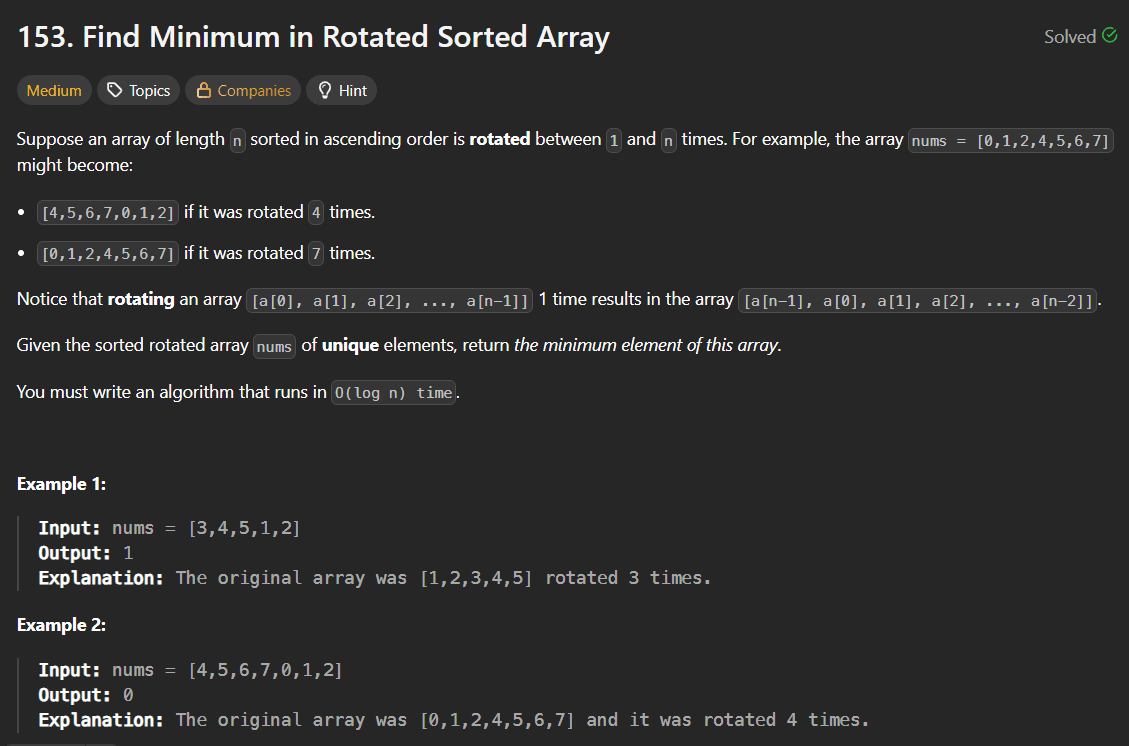
Find Minimum in Rotated Sorted Array – Binary Search Explained | LeetCode Medium 153

Find Minimum in Rotated Sorted Array – Binary Search Explained | LeetCode Medium 153

🔗 Try This Problem FirstPlatform: LeetCodeProblem Number: 153👉 Practice here: https://leetcode.com/problems/find-minimum-in-rotated-sorted-array/🧠 Problem UnderstandingYou are given a sorted array that has been rotated between 1 and n times.Example:Original sorted array:[0,1,2,4,5,6,7]After rotation:[4,5,6,7,0,1,2]Your task: 👉 Return the minimum element from this rotated array. 👉 Time complexity must be O(log n). 👉 All elements are unique.🔍 Key ObservationIn a rotated sorted array:The array is divided into two sorted halves.The minimum element is the pivot point where rotation happened.One half will always be sorted.We can use Binary Search to find where the sorted order breaks.Example:[4,5,6,7,0,1,2] ↑ Minimum🚀 Approach 1: Brute Force (Not Allowed by Constraint)IdeaScan entire array and track minimum.int min = nums[0];for(int i = 1; i < nums.length; i++){ min = Math.min(min, nums[i]);}return min;ComplexityTime: O(n)Space: O(1)❌ Not acceptable because problem requires O(log n).🚀 Approach 2: Binary Search (Optimal – O(log n))💡 Core IdeaCompare nums[mid] with nums[right].There are only two possibilities:Case 1: nums[mid] > nums[right]Minimum is in right half.[4,5,6,7,0,1,2]mid rMove left pointer:l = mid + 1Case 2: nums[mid] <= nums[right]Minimum is in left half including mid.[4,5,6,7,0,1,2]mid rMove right pointer:r = mid✅ Optimized Codeclass Solution { public int findMin(int[] nums) { int l = 0; int r = nums.length - 1; while (l < r) { int mid = l + (r - l) / 2; if (nums[mid] > nums[r]) { l = mid + 1; } else { r = mid; } } return nums[r]; }}📊 Dry RunInput:nums = [4,5,6,7,0,1,2]Steplrmidnums[mid]Action106377 > 2 → l = 4246511 <= 2 → r = 5345400 <= 1 → r = 4Stop44--Return nums[4]✅ Output = 0🧩 Why This WorksIf middle element is greater than rightmost, rotation point is to the right.If middle element is smaller than or equal to rightmost, minimum is on the left side.We continuously shrink search space until l == r.That position holds the minimum element.⏱ Time & Space ComplexityMetricValueTime ComplexityO(log n)Space ComplexityO(1)Because:We eliminate half of the array each iteration.No extra space is used.⚠️ Important Edge CasesArray size = 1[10] → 10Already sorted (no visible rotation)[11,13,15,17] → 11Rotation at last position[1,2,3,4,5] → 1🎯 Interview InsightThis problem teaches:Modified Binary SearchIdentifying sorted halvesHandling rotated arraysUnderstanding pivot logicThis is a very common FAANG interview question and often appears in variations like:Search in Rotated Sorted ArrayFind Peak ElementMinimum in Rotated Array with Duplicates🏁 Final TakeawayBrute force works but violates constraint.Binary search is the correct approach.Compare mid with right.Shrink search space until pointers meet.Return nums[l] or nums[r].

LeetcodeMediumBinary Search
Recursion in Java - Complete Guide With Examples and Practice Problems

Recursion in Java - Complete Guide With Examples and Practice Problems

IntroductionIf there is one topic in programming that confuses beginners more than anything else, it is recursion. Most people read the definition, nod their head, and then immediately freeze when they have to write recursive code themselves.The problem is not that recursion is genuinely hard. The problem is that most explanations start with code before building the right mental model. Once you have the right mental model, recursion clicks permanently and you start seeing it everywhere — in tree problems, graph problems, backtracking, dynamic programming, divide and conquer, and more.This guide covers everything from the ground up. What recursion is, how the call stack works, how to identify base cases and recursive cases, every type of recursion, common patterns, time and space complexity analysis, the most common mistakes, and the top LeetCode problems to practice.By the end of this article, recursion will not feel like magic anymore. It will feel like a natural tool you reach for confidently.What Is Recursion?Recursion is when a function calls itself to solve a smaller version of the same problem.That is the complete definition. But let us make it concrete.Imagine you want to count down from 5 to 1. One way is a loop. Another way is — print 5, then solve the exact same problem for counting down from 4 to 1. Then print 4, solve for 3. And so on until you reach the base — there is nothing left to count down.void countDown(int n) { if (n == 0) return; // stop here System.out.println(n); countDown(n - 1); // solve the smaller version}The function countDown calls itself with a smaller input each time. Eventually it reaches 0 and stops. That stopping condition is the most important part of any recursive function — the base case.The Two Parts Every Recursive Function Must HaveEvery correctly written recursive function has exactly two parts. Without both, the function either gives wrong answers or runs forever.Part 1: Base CaseThe base case is the condition under which the function stops calling itself and returns a direct answer. It is the smallest version of the problem that you can solve without any further recursion.Without a base case, recursion never stops and you get a StackOverflowError — Java's way of telling you the call stack ran out of memory.Part 2: Recursive CaseThe recursive case is where the function calls itself with a smaller or simpler input — moving closer to the base case with each call. If your recursive case does not make the problem smaller, you have an infinite loop.Think of it like a staircase. The base case is the ground floor. The recursive case is each step going down. Every step must genuinely bring you one level closer to the ground.How Recursion Works — The Call StackThis is the mental model that most explanations skip, and it is the reason recursion confuses people.Every time a function is called in Java, a new stack frame is created and pushed onto the call stack. This frame stores the function's local variables, parameters, and where to return to when the function finishes.When a recursive function calls itself, a new frame is pushed on top. When that call finishes, its frame is popped and execution returns to the previous frame.Let us trace countDown(3) through the call stack:countDown(3) called → frame pushed prints 3 calls countDown(2) → frame pushed prints 2 calls countDown(1) → frame pushed prints 1 calls countDown(0) → frame pushed n == 0, return → frame popped back in countDown(1), return → frame popped back in countDown(2), return → frame popped back in countDown(3), return → frame poppedOutput: 3, 2, 1The call stack grows as calls go deeper, then shrinks as calls return. This is why recursion uses O(n) space for n levels deep — each level occupies one stack frame in memory.Your First Real Recursive Function — FactorialFactorial is the classic first recursion example. n! = n × (n-1) × (n-2) × ... × 1Notice the pattern — n! = n × (n-1)!. The factorial of n is n times the factorial of n-1. That recursive structure makes it perfect for recursion.public int factorial(int n) { // base case if (n == 0 || n == 1) return 1; // recursive case return n * factorial(n - 1);}Dry Run — factorial(4)factorial(4)= 4 * factorial(3)= 4 * 3 * factorial(2)= 4 * 3 * 2 * factorial(1)= 4 * 3 * 2 * 1= 24The call stack builds up going in, then multiplications happen coming back out. This "coming back out" phase is called the return phase or unwinding of the stack.Time Complexity: O(n) — n recursive calls Space Complexity: O(n) — n frames on the call stackThe Two Phases of RecursionEvery recursive function has two phases and understanding both is critical.Phase 1: The Call Phase (Going In)This happens as the function keeps calling itself with smaller inputs. Things you do before the recursive call happen in this phase — in order from the outermost call to the innermost.Phase 2: The Return Phase (Coming Back Out)This happens as each call finishes and returns to its caller. Things you do after the recursive call happen in this phase — in reverse order, from the innermost call back to the outermost.This distinction explains why the output order can be surprising:void printBothPhases(int n) { if (n == 0) return; System.out.println("Going in: " + n); // call phase printBothPhases(n - 1); System.out.println("Coming out: " + n); // return phase}For printBothPhases(3):Going in: 3Going in: 2Going in: 1Coming out: 1Coming out: 2Coming out: 3This two-phase understanding is what makes problems like reversing a string or printing a linked list backwards via recursion feel natural.Types of RecursionRecursion is not one-size-fits-all. There are several distinct types and knowing which type applies to a problem shapes how you write the solution.1. Direct RecursionThe function calls itself directly. This is the most common type — what we have seen so far.void direct(int n) { if (n == 0) return; direct(n - 1); // calls itself}2. Indirect RecursionFunction A calls Function B which calls Function A. They form a cycle.void funcA(int n) { if (n <= 0) return; System.out.println("A: " + n); funcB(n - 1);}void funcB(int n) { if (n <= 0) return; System.out.println("B: " + n); funcA(n - 1);}Used in: state machines, mutual recursion in parsers, certain mathematical sequences.3. Tail RecursionThe recursive call is the last operation in the function. Nothing happens after the recursive call returns — no multiplication, no addition, nothing.// NOT tail recursive — multiplication happens after returnint factorial(int n) { if (n == 1) return 1; return n * factorial(n - 1); // multiply after return — not tail}// Tail recursive — recursive call is the last thingint factorialTail(int n, int accumulator) { if (n == 1) return accumulator; return factorialTail(n - 1, n * accumulator); // last operation}Why does tail recursion matter? In languages that support tail call optimization (like Scala, Kotlin, and many functional languages), tail recursive functions can be converted to iteration internally — no stack frame accumulation, O(1) space. Java does NOT perform tail call optimization, but understanding tail recursion is still important for interviews and functional programming concepts.4. Head RecursionThe recursive call happens first, before any other processing. All processing happens in the return phase.void headRecursion(int n) { if (n == 0) return; headRecursion(n - 1); // call first System.out.println(n); // process after}// Output: 1 2 3 4 5 (processes in reverse order of calls)5. Tree RecursionThe function makes more than one recursive call per invocation. This creates a tree of calls rather than a linear chain. Fibonacci is the classic example.int fibonacci(int n) { if (n <= 1) return n; return fibonacci(n - 1) + fibonacci(n - 2); // TWO recursive calls}The call tree for fibonacci(4): fib(4) / \ fib(3) fib(2) / \ / \ fib(2) fib(1) fib(1) fib(0) / \ fib(1) fib(0)Time Complexity: O(2ⁿ) — exponential! Each call spawns two more. Space Complexity: O(n) — maximum depth of the call treeThis is why memoization (caching results) is so important for tree recursion — it converts O(2ⁿ) to O(n) by never recomputing the same subproblem twice.6. Mutual RecursionA specific form of indirect recursion where two functions call each other alternately to solve a problem. Different from indirect recursion in that the mutual calls are the core mechanism of the solution.// Check if a number is even or odd using mutual recursionboolean isEven(int n) { if (n == 0) return true; return isOdd(n - 1);}boolean isOdd(int n) { if (n == 0) return false; return isEven(n - 1);}Common Recursion Patterns in DSAThese are the patterns you will see over and over in interview problems. Recognizing them is more important than memorizing solutions.Pattern 1: Linear Recursion (Do Something, Recurse on Rest)Process the current element, then recurse on the remaining problem.// Sum of arrayint arraySum(int[] arr, int index) { if (index == arr.length) return 0; // base case return arr[index] + arraySum(arr, index + 1); // current + rest}Pattern 2: Divide and Conquer (Split Into Two Halves)Split the problem into two halves, solve each recursively, combine results.// Merge Sortvoid mergeSort(int[] arr, int left, int right) { if (left >= right) return; // base case — single element int mid = (left + right) / 2; mergeSort(arr, left, mid); // sort left half mergeSort(arr, mid + 1, right); // sort right half merge(arr, left, mid, right); // combine}Pattern 3: Backtracking (Try, Recurse, Undo)Try a choice, recurse to explore it, undo the choice when backtracking.// Generate all subsetsvoid subsets(int[] nums, int index, List<Integer> current, List<List<Integer>> result) { if (index == nums.length) { result.add(new ArrayList<>(current)); return; } // Choice 1: include nums[index] current.add(nums[index]); subsets(nums, index + 1, current, result); current.remove(current.size() - 1); // undo // Choice 2: exclude nums[index] subsets(nums, index + 1, current, result);}Pattern 4: Tree Recursion (Left, Right, Combine)Recurse on left subtree, recurse on right subtree, combine or process results.// Height of binary treeint height(TreeNode root) { if (root == null) return 0; // base case int leftHeight = height(root.left); // solve left int rightHeight = height(root.right); // solve right return 1 + Math.max(leftHeight, rightHeight); // combine}Pattern 5: Memoization (Cache Recursive Results)Store results of recursive calls so the same subproblem is never solved twice.Map<Integer, Integer> memo = new HashMap<>();int fibonacci(int n) { if (n <= 1) return n; if (memo.containsKey(n)) return memo.get(n); // return cached int result = fibonacci(n - 1) + fibonacci(n - 2); memo.put(n, result); // cache before returning return result;}This converts Fibonacci from O(2ⁿ) to O(n) time with O(n) space — a massive improvement.Recursion vs Iteration — When to Use WhichThis is one of the most common interview questions about recursion. Here is a clear breakdown:Use Recursion when:The problem has a naturally recursive structure (trees, graphs, divide and conquer)The solution is significantly cleaner and easier to understand recursivelyThe problem involves exploring multiple paths or choices (backtracking)The depth of recursion is manageable (not too deep to cause stack overflow)Use Iteration when:The problem is linear and a loop is equally clearMemory is a concern (iteration uses O(1) stack space vs O(n) for recursion)Performance is critical and function call overhead mattersJava's stack size limit could be hit (default around 500-1000 frames for deep recursion)The key rule: Every recursive solution can be converted to an iterative one (usually using an explicit stack). But recursive solutions for tree and graph problems are almost always cleaner to write and understand.Time and Space Complexity of Recursive FunctionsAnalyzing complexity for recursive functions requires a specific approach.The Recurrence Relation MethodExpress the time complexity as a recurrence relation and solve it.Factorial:T(n) = T(n-1) + O(1) = T(n-2) + O(1) + O(1) = T(1) + n×O(1) = O(n)Fibonacci (naive):T(n) = T(n-1) + T(n-2) + O(1) ≈ 2×T(n-1) = O(2ⁿ)Binary Search:T(n) = T(n/2) + O(1) = O(log n) [by Master Theorem]Merge Sort:T(n) = 2×T(n/2) + O(n) = O(n log n) [by Master Theorem]Space Complexity Rule for RecursionSpace complexity of a recursive function = maximum depth of the call stack × space per frameLinear recursion (factorial, sum): O(n) spaceBinary recursion (Fibonacci naive): O(n) space (maximum depth, not number of nodes)Divide and conquer (merge sort): O(log n) space (depth of recursion tree)Memoized Fibonacci: O(n) space (memo table + call stack)Classic Recursive Problems With SolutionsProblem 1: Reverse a StringString reverse(String s) { if (s.length() <= 1) return s; // base case // last char + reverse of everything before last char return s.charAt(s.length() - 1) + reverse(s.substring(0, s.length() - 1));}Dry run for "hello":reverse("hello") = 'o' + reverse("hell")reverse("hell") = 'l' + reverse("hel")reverse("hel") = 'l' + reverse("he")reverse("he") = 'e' + reverse("h")reverse("h") = "h"Unwinding: "h" → "he" → "leh" → "lleh" → "olleh" ✅Problem 2: Power Function (x^n)double power(double x, int n) { if (n == 0) return 1; // base case if (n < 0) return 1.0 / power(x, -n); // handle negative if (n % 2 == 0) { double half = power(x, n / 2); return half * half; // x^n = (x^(n/2))^2 } else { return x * power(x, n - 1); }}This is the fast power algorithm — O(log n) time instead of O(n).Problem 3: Fibonacci With Memoizationint[] memo = new int[100];Arrays.fill(memo, -1);int fib(int n) { if (n <= 1) return n; if (memo[n] != -1) return memo[n]; memo[n] = fib(n - 1) + fib(n - 2); return memo[n];}Time: O(n) — each value computed once Space: O(n) — memo array + call stackProblem 4: Tower of HanoiThe classic recursion teaching problem. Move n disks from source to destination using a helper rod.void hanoi(int n, char source, char destination, char helper) { if (n == 1) { System.out.println("Move disk 1 from " + source + " to " + destination); return; } // Move n-1 disks from source to helper hanoi(n - 1, source, helper, destination); // Move the largest disk from source to destination System.out.println("Move disk " + n + " from " + source + " to " + destination); // Move n-1 disks from helper to destination hanoi(n - 1, helper, destination, source);}Time Complexity: O(2ⁿ) — minimum moves required is 2ⁿ - 1 Space Complexity: O(n) — call stack depthProblem 5: Generate All Subsets (Power Set)void generateSubsets(int[] nums, int index, List<Integer> current, List<List<Integer>> result) { result.add(new ArrayList<>(current)); // add current subset for (int i = index; i < nums.length; i++) { current.add(nums[i]); // include generateSubsets(nums, i + 1, current, result); // recurse current.remove(current.size() - 1); // exclude (backtrack) }}For [1, 2, 3] — generates all 8 subsets: [], [1], [1,2], [1,2,3], [1,3], [2], [2,3], [3]Time: O(2ⁿ) — 2ⁿ subsets Space: O(n) — recursion depthProblem 6: Binary Search Recursivelyint binarySearch(int[] arr, int target, int left, int right) { if (left > right) return -1; // base case — not found int mid = left + (right - left) / 2; if (arr[mid] == target) return mid; else if (arr[mid] < target) return binarySearch(arr, target, mid + 1, right); else return binarySearch(arr, target, left, mid - 1);}Time: O(log n) — halving the search space each time Space: O(log n) — log n frames on the call stackRecursion on Trees — The Natural HabitatTrees are where recursion truly shines. Every tree problem becomes elegant with recursion because a tree is itself a recursive structure — each node's left and right children are trees themselves.// Maximum depth of binary treeint maxDepth(TreeNode root) { if (root == null) return 0; return 1 + Math.max(maxDepth(root.left), maxDepth(root.right));}// Check if tree is symmetricboolean isSymmetric(TreeNode left, TreeNode right) { if (left == null && right == null) return true; if (left == null || right == null) return false; return left.val == right.val && isSymmetric(left.left, right.right) && isSymmetric(left.right, right.left);}// Path sum — does any root-to-leaf path sum to target?boolean hasPathSum(TreeNode root, int target) { if (root == null) return false; if (root.left == null && root.right == null) return root.val == target; return hasPathSum(root.left, target - root.val) || hasPathSum(root.right, target - root.val);}Notice the pattern in all three — base case handles null, recursive case handles left and right subtrees, result combines both.How to Think About Any Recursive Problem — Step by StepThis is the framework you should apply to every new recursive problem you encounter:Step 1 — Identify the base case What is the smallest input where you know the answer directly without any recursion? For arrays it is usually empty array or single element. For trees it is null node. For numbers it is 0 or 1.Step 2 — Trust the recursive call Assume your function already works correctly for smaller inputs. Do not trace through the entire recursion mentally — just trust it. This is the Leap of Faith and it is what makes recursion feel natural.Step 3 — Express the current problem in terms of smaller problems How does the answer for size n relate to the answer for size n-1 (or n/2, or subtrees)? This relationship is your recursive case.Step 4 — Make sure each call moves toward the base case The input must become strictly smaller with each call. If it does not, you have infinite recursion.Step 5 — Write the base case first, then the recursive case Always. Writing the recursive case first leads to bugs because you have not defined when to stop.Common Mistakes and How to Avoid ThemMistake 1: Missing or wrong base case The most common mistake. Missing the base case causes StackOverflowError. Wrong base case causes wrong answers.Always ask — what is the simplest possible input, and what should the function return for it? Write that case first.Mistake 2: Not moving toward the base case If you call factorial(n) inside factorial(n) without reducing n, you loop forever. Every recursive call must make the problem strictly smaller.Mistake 3: Trusting your brain to trace deep recursion Do not try to trace 10 levels of recursion in your head. Trust the recursive call, verify the base case, and check that each call reduces the problem. That is all you need.Mistake 4: Forgetting to return the recursive result// WRONG — result is computed but not returnedint sum(int n) { if (n == 0) return 0; sum(n - 1) + n; // computed but discarded!}// CORRECTint sum(int n) { if (n == 0) return 0; return sum(n - 1) + n;}Mistake 5: Modifying shared state without backtracking In backtracking problems, if you add something to a list before a recursive call, you must remove it after the call returns. Forgetting to backtrack leads to incorrect results and is one of the trickiest bugs to find.Mistake 6: Recomputing the same subproblems Naive Fibonacci computes fib(3) multiple times when computing fib(5). Use memoization whenever you notice overlapping subproblems in your recursion tree.Top LeetCode Problems on RecursionThese are organized by pattern — work through them in this order for maximum learning:Pure Recursion Basics:509. Fibonacci Number — Easy — start here, implement with and without memoization344. Reverse String — Easy — recursion on arrays206. Reverse Linked List — Easy — recursion on linked list50. Pow(x, n) — Medium — fast power with recursionTree Recursion (Most Important):104. Maximum Depth of Binary Tree — Easy — simplest tree recursion112. Path Sum — Easy — decision recursion on tree101. Symmetric Tree — Easy — mutual recursion on tree110. Balanced Binary Tree — Easy — bottom-up recursion236. Lowest Common Ancestor of a Binary Tree — Medium — classic tree recursion124. Binary Tree Maximum Path Sum — Hard — advanced tree recursionDivide and Conquer:148. Sort List — Medium — merge sort on linked list240. Search a 2D Matrix II — Medium — divide and conquerBacktracking:78. Subsets — Medium — generate all subsets46. Permutations — Medium — generate all permutations77. Combinations — Medium — generate combinations79. Word Search — Medium — backtracking on grid51. N-Queens — Hard — classic backtrackingMemoization / Dynamic Programming:70. Climbing Stairs — Easy — Fibonacci variant with memoization322. Coin Change — Medium — recursion with memoization to DP139. Word Break — Medium — memoized recursionRecursion Cheat Sheet// Linear recursion templatereturnType solve(input) { if (baseCase) return directAnswer; // process current return solve(smallerInput);}// Tree recursion templatereturnType solve(TreeNode root) { if (root == null) return baseValue; returnType left = solve(root.left); returnType right = solve(root.right); return combine(left, right, root.val);}// Backtracking templatevoid backtrack(choices, current, result) { if (goalReached) { result.add(copy of current); return; } for (choice : choices) { make(choice); // add to current backtrack(...); // recurse undo(choice); // remove from current }}// Memoization templateMap<Input, Output> memo = new HashMap<>();returnType solve(input) { if (baseCase) return directAnswer; if (memo.containsKey(input)) return memo.get(input); returnType result = solve(smallerInput); memo.put(input, result); return result;}FAQs — People Also AskQ1. What is recursion in Java with a simple example? Recursion is when a function calls itself to solve a smaller version of the same problem. A simple example is factorial — factorial(5) = 5 × factorial(4) = 5 × 4 × factorial(3) and so on until factorial(1) returns 1 directly.Q2. What is the difference between recursion and iteration? Iteration uses loops (for, while) and runs in O(1) space. Recursion uses function calls and uses O(n) stack space for n levels deep. Recursion is often cleaner for tree and graph problems. Iteration is better when memory is a concern or the problem is inherently linear.Q3. What causes StackOverflowError in Java recursion? StackOverflowError happens when recursion goes too deep — too many frames accumulate on the call stack before any of them return. This is caused by missing base case, wrong base case, or input too large for Java's default stack size limit.Q4. What is the difference between recursion and dynamic programming? Recursion solves a problem by breaking it into subproblems. Dynamic programming is recursion plus memoization — storing results of subproblems so they are never computed twice. DP converts exponential recursive solutions into polynomial ones by eliminating redundant computation.Q5. What is tail recursion and does Java support tail call optimization? Tail recursion is when the recursive call is the absolute last operation in the function. Java does NOT support tail call optimization — Java always creates a new stack frame for each call even if it is tail recursive. Languages like Scala and Kotlin (on the JVM) do support it with the tailrec keyword.Q6. How do you convert recursion to iteration? Every recursive solution can be converted to iterative using an explicit stack data structure. The call stack's behavior is replicated manually — push the initial call, loop while stack is not empty, pop, process, and push sub-calls. Tree traversals are a common example of this conversion.ConclusionRecursion is not magic. It is a systematic way of solving problems by expressing them in terms of smaller versions of themselves. Once you internalize the two parts (base case and recursive case), understand the call stack mentally, and learn to trust the recursive call rather than trace it completely, everything clicks.The learning path from here is clear — start with simple problems like Fibonacci and array sum. Move to tree problems where recursion is most natural. Then tackle backtracking. Finally add memoization to bridge into dynamic programming.Every hour you spend understanding recursion deeply pays dividends across the entire rest of your DSA journey. Trees, graphs, divide and conquer, backtracking, dynamic programming — all of them build on this foundation.

RecursionJavaBase CaseCall StackBacktrackingDynamic Programming
What Is Dynamic Programming? Origin Story, Real-Life Uses, LeetCode Problems & Complete Beginner Guide

What Is Dynamic Programming? Origin Story, Real-Life Uses, LeetCode Problems & Complete Beginner Guide

Introduction — Why Dynamic Programming Feels Hard (And Why It Isn't)If you've ever stared at a LeetCode problem, read the solution, understood every single line, and still had absolutely no idea how someone arrived at it — welcome. You've just experienced the classic Dynamic Programming (DP) confusion.DP has a reputation. People treat it like some dark art reserved for competitive programmers or Google engineers. The truth? Dynamic Programming is one of the most logical, learnable, and satisfying techniques in all of computer science. Once it clicks, it really clicks.This guide will take you from zero to genuinely confident. We'll cover where DP came from, how it works, what patterns to learn, how to recognize DP problems, real-world places it shows up, LeetCode problems to practice, time complexity analysis, and the mistakes that trip up even experienced developers.Let's go.The Origin Story — Who Invented Dynamic Programming and Why?The term "Dynamic Programming" was coined by Richard Bellman in the early 1950s while working at RAND Corporation. Here's the funny part: the name was deliberately chosen to sound impressive and vague.Bellman was doing mathematical research that his employer — the US Secretary of Defense, Charles Wilson — would have found difficult to fund if described accurately. Wilson had a well-known distaste for the word "research." So Bellman invented a name that sounded suitably grand and mathematical: Dynamic Programming.In his autobiography, Bellman wrote that he picked the word "dynamic" because it had a precise technical meaning and was also impossible to use negatively. "Programming" referred to the mathematical sense — planning and decision-making — not computer programming.The underlying idea? Break a complex problem into overlapping subproblems, solve each subproblem once, and store the result so you never solve it twice.Bellman's foundational contribution was the Bellman Equation, which underpins not just algorithms but also economics, operations research, and modern reinforcement learning.So the next time DP feels frustrating, remember — even its inventor named it specifically to confuse people. You're in good company.What Is Dynamic Programming? (Simple Definition)Dynamic Programming is an algorithmic technique used to solve problems by:Breaking them down into smaller overlapping subproblemsSolving each subproblem only onceStoring the result (memoization or tabulation)Building up the final solution from those stored resultsThe key insight is overlapping subproblems + optimal substructure.Overlapping subproblems means the same smaller problems come up again and again. Instead of solving them every time (like plain recursion does), DP solves them once and caches the answer.Optimal substructure means the optimal solution to the whole problem can be built from optimal solutions to its subproblems.If a problem has both these properties — it's a DP problem.The Two Approaches to Dynamic Programming1. Top-Down with Memoization (Recursive + Cache)You write a recursive solution exactly as you would naturally, but add a cache (usually a dictionary or array) to store results you've already computed.fib(n):if n in cache: return cache[n]if n <= 1: return ncache[n] = fib(n-1) + fib(n-2)return cache[n]This is called memoization — remember what you computed so you don't repeat yourself.Pros: Natural to write, mirrors the recursive thinking, easy to reason about. Cons: Stack overhead from recursion, risk of stack overflow on large inputs.2. Bottom-Up with Tabulation (Iterative)You figure out the order in which subproblems need to be solved, then solve them iteratively from the smallest up, filling a table.fib(n):dp = [0, 1]for i from 2 to n:dp[i] = dp[i-1] + dp[i-2]return dp[n]This is called tabulation — fill a table, cell by cell, bottom to top.Pros: No recursion overhead, usually faster in practice, easier to optimize space. Cons: Requires thinking about the order of computation upfront.🧩 Dynamic Programming Template CodeBefore diving into how to recognize DP problems, here are ready-to-use Java templates for every major DP pattern. Think of these as your reusable blueprints — every DP problem you ever solve will fit into one of these structures. Just define your state, plug in your recurrence relation, and you are good to go.Template 1 — Top-Down (Memoization)import java.util.HashMap;import java.util.Map;public class TopDownDP {Map<Integer, Integer> memo = new HashMap<>();public int solve(int n) {// Base caseif (n <= 1) return n;// Check cacheif (memo.containsKey(n)) return memo.get(n);// Recurrence relation — change this part for your problemint result = solve(n - 1) + solve(n - 2);// Store in cachememo.put(n, result);return result;}}Template 2 — Bottom-Up (Tabulation)public class BottomUpDP {public int solve(int n) {// Create DP tableint[] dp = new int[n + 1];// Base casesdp[0] = 0;dp[1] = 1;// Fill the table bottom-upfor (int i = 2; i <= n; i++) {// Recurrence relation — change this part for your problemdp[i] = dp[i - 1] + dp[i - 2];}return dp[n];}}Template 3 — Bottom-Up with Space Optimizationpublic class SpaceOptimizedDP {public int solve(int n) {// Only keep last two values instead of full tableint prev2 = 0;int prev1 = 1;for (int i = 2; i <= n; i++) {// Recurrence relation — change this part for your problemint curr = prev1 + prev2;prev2 = prev1;prev1 = curr;}return prev1;}}Template 4 — 2D DP (Two Sequences or Grid)public class TwoDimensionalDP {public int solve(String s1, String s2) {int m = s1.length();int n = s2.length();// Create 2D DP tableint[][] dp = new int[m + 1][n + 1];// Base cases — first row and columnfor (int i = 0; i <= m; i++) dp[i][0] = i;for (int j = 0; j <= n; j++) dp[0][j] = j;// Fill table cell by cellfor (int i = 1; i <= m; i++) {for (int j = 1; j <= n; j++) {// Recurrence relation — change this part for your problemif (s1.charAt(i - 1) == s2.charAt(j - 1)) {dp[i][j] = dp[i - 1][j - 1];} else {dp[i][j] = 1 + Math.min(dp[i - 1][j],Math.min(dp[i][j - 1], dp[i - 1][j - 1]));}}}return dp[m][n];}}Template 5 — Knapsack Patternpublic class KnapsackDP {public int solve(int[] weights, int[] values, int capacity) {int n = weights.length;// dp[i][w] = max value using first i items with capacity wint[][] dp = new int[n + 1][capacity + 1];for (int i = 1; i <= n; i++) {for (int w = 0; w <= capacity; w++) {// Don't take item idp[i][w] = dp[i - 1][w];// Take item i if it fitsif (weights[i - 1] <= w) {dp[i][w] = Math.max(dp[i][w],values[i - 1] + dp[i - 1][w - weights[i - 1]]);}}}return dp[n][capacity];}}💡 How to use these templates:Step 1 — Identify which pattern your problem fits into. Step 2 — Define what dp[i] or dp[i][j] means in plain English before writing any code. Step 3 — Write your recurrence relation on paper first. Step 4 — Plug it into the matching template above. Step 5 — Handle your specific base cases carefully.🎥 Visual Learning Resource — Watch This Before Moving ForwardIf you prefer learning by watching before reading, this free full-length course by freeCodeCamp is one of the best Dynamic Programming resources on the internet. Watch it alongside this guide for maximum understanding.Credit: freeCodeCamp — a free, nonprofit coding education platform.How to Recognize a Dynamic Programming ProblemAsk yourself these four questions:1. Can I define the problem in terms of smaller versions of itself? If you can write a recursive formula (recurrence relation), DP might apply.2. Do the subproblems overlap? If a naive recursive solution would recompute the same thing many times, DP is the right tool.3. Is there an optimal substructure? Is the best answer to the big problem made up of best answers to smaller problems?4. Are you looking for a count, minimum, maximum, or yes/no answer? DP problems often ask: "What is the minimum cost?", "How many ways?", "Can we achieve X?"Red flag words in problem statements: minimum, maximum, shortest, longest, count the number of ways, can we reach, is it possible, fewest steps.The Core DP Patterns You Must LearnMastering DP is really about recognizing patterns. Here are the most important ones:Pattern 1 — 1D DP (Linear) Problems where the state depends on previous elements in a single sequence. Examples: Fibonacci, Climbing Stairs, House Robber.Pattern 2 — 2D DP (Grid / Two-sequence) Problems with two dimensions of state, often grids or two strings. Examples: Longest Common Subsequence, Edit Distance, Unique Paths.Pattern 3 — Interval DP You consider all possible intervals or subarrays and build solutions from them. Examples: Matrix Chain Multiplication, Burst Balloons, Palindrome Partitioning.Pattern 4 — Knapsack DP (0/1 and Unbounded) You decide whether to include or exclude items under a capacity constraint. Examples: 0/1 Knapsack, Coin Change, Partition Equal Subset Sum.Pattern 5 — DP on Trees State is defined per node; you combine results from children. Examples: Diameter of Binary Tree, House Robber III, Maximum Path Sum.Pattern 6 — DP on Subsets / Bitmask DP State includes a bitmask representing which elements have been chosen. Examples: Travelling Salesman Problem, Shortest Superstring.Pattern 7 — DP on Strings Matching, editing, or counting arrangements within strings. Examples: Longest Palindromic Subsequence, Regular Expression Matching, Wildcard Matching.Top LeetCode Problems to Practice Dynamic Programming (With Links)Here are the essential problems, organized by difficulty and pattern. Solve them in this order.Beginner — Warm UpProblemPatternLinkClimbing Stairs1D DPhttps://leetcode.com/problems/climbing-stairs/Fibonacci Number1D DPhttps://leetcode.com/problems/fibonacci-number/House Robber1D DPhttps://leetcode.com/problems/house-robber/Min Cost Climbing Stairs1D DPhttps://leetcode.com/problems/min-cost-climbing-stairs/Best Time to Buy and Sell Stock1D DPhttps://leetcode.com/problems/best-time-to-buy-and-sell-stock/Intermediate — Core PatternsProblemPatternLinkCoin ChangeKnapsackhttps://leetcode.com/problems/coin-change/Longest Increasing Subsequence1D DPhttps://leetcode.com/problems/longest-increasing-subsequence/Longest Common Subsequence2D DPhttps://leetcode.com/problems/longest-common-subsequence/0/1 Knapsack (via Subset Sum)Knapsackhttps://leetcode.com/problems/partition-equal-subset-sum/Unique Paths2D Grid DPhttps://leetcode.com/problems/unique-paths/Jump Game1D DP / Greedyhttps://leetcode.com/problems/jump-game/Word BreakString DPhttps://leetcode.com/problems/word-break/Decode Ways1D DPhttps://leetcode.com/problems/decode-ways/Edit Distance2D String DPhttps://leetcode.com/problems/edit-distance/Triangle2D DPhttps://leetcode.com/problems/triangle/Advanced — Interview LevelProblemPatternLinkBurst BalloonsInterval DPhttps://leetcode.com/problems/burst-balloons/Regular Expression MatchingString DPhttps://leetcode.com/problems/regular-expression-matching/Wildcard MatchingString DPhttps://leetcode.com/problems/wildcard-matching/Palindrome Partitioning IIInterval DPhttps://leetcode.com/problems/palindrome-partitioning-ii/Maximum Profit in Job SchedulingDP + Binary Searchhttps://leetcode.com/problems/maximum-profit-in-job-scheduling/Distinct Subsequences2D DPhttps://leetcode.com/problems/distinct-subsequences/Cherry Pickup3D DPhttps://leetcode.com/problems/cherry-pickup/Real-World Use Cases of Dynamic ProgrammingDP is not just for coding interviews. It is deeply embedded in the technology you use every day.1. Google Maps & Navigation (Shortest Path) The routing engines behind GPS apps use DP-based algorithms like Dijkstra and Bellman-Ford to find the shortest or fastest path between two points across millions of nodes.2. Spell Checkers & Autocorrect (Edit Distance) When your phone corrects "teh" to "the," it is computing Edit Distance — a classic DP problem — between what you typed and every word in the dictionary.3. DNA Sequence Alignment (Bioinformatics) Researchers use the Needleman-Wunsch and Smith-Waterman algorithms — both DP — to align DNA and protein sequences and find similarities between species or identify mutations.4. Video Compression (MPEG, H.264) Modern video codecs use DP to determine the most efficient way to encode video frames, deciding which frames to store as full images and which to store as differences from the previous frame.5. Financial Portfolio Optimization Investment algorithms use DP to find the optimal allocation of assets under risk constraints — essentially a variant of the knapsack problem.6. Natural Language Processing (NLP) The Viterbi algorithm — used in speech recognition, part-of-speech tagging, and machine translation — is a DP algorithm. Every time Siri or Google Assistant understands your sentence, DP played a role.7. Game AI (Chess, Checkers) Game trees and minimax algorithms with memoization use DP to evaluate board positions and find the best move without recomputing already-seen positions.8. Compiler Optimization Compilers use DP to decide the optimal order of operations and instruction scheduling to generate the most efficient machine code.9. Text Justification (Word Processors) Microsoft Word and LaTeX use DP to optimally break paragraphs into lines — minimizing raggedness and maximizing visual appeal.10. Resource Scheduling in Cloud Computing AWS, Google Cloud, and Azure use DP-based scheduling to assign computational tasks to servers in the most cost-efficient way possible.Time Complexity Analysis of Common DP ProblemsUnderstanding the time complexity of DP is critical for interviews and for building scalable systems.ProblemTime ComplexitySpace ComplexityNotesFibonacci (naive recursion)O(2ⁿ)O(n)Exponential — terribleFibonacci (DP)O(n)O(1) with optimizationLinear — excellentLongest Common SubsequenceO(m × n)O(m × n)m, n = lengths of two stringsEdit DistanceO(m × n)O(m × n)Can optimize space to O(n)0/1 KnapsackO(n × W)O(n × W)n = items, W = capacityCoin ChangeO(n × amount)O(amount)Classic tabulationLongest Increasing SubsequenceO(n²) or O(n log n)O(n)Binary search version is fasterMatrix Chain MultiplicationO(n³)O(n²)Interval DPTravelling Salesman (bitmask)O(2ⁿ × n²)O(2ⁿ × n)Still exponential but manageable for small nThe general rule: DP trades time for space. You use memory to avoid recomputation. The time complexity equals the number of unique states multiplied by the work done per state.How to Learn and Master Dynamic Programming — Step by StepHere is an honest, structured path to mastery:Step 1 — Get recursion absolutely solid first. DP is memoized recursion at its core. If you cannot write clean recursive solutions confidently, DP will remain confusing. Practice at least 20 pure recursion problems first.Step 2 — Start with the classics. Fibonacci → Climbing Stairs → House Robber → Coin Change. These teach you the core pattern of defining state and transition without overwhelming you.Step 3 — Learn to define state explicitly. Before writing any code, ask: "What does dp[i] represent?" Write it in plain English. "dp[i] = the minimum cost to reach step i." This single habit separates good DP thinkers from struggling ones.Step 4 — Write the recurrence relation before coding. On paper or in a comment. Example: dp[i] = min(dp[i-1] + cost[i-1], dp[i-2] + cost[i-2]). If you can write the recurrence, the code writes itself.Step 5 — Master one pattern at a time. Don't jump between knapsack and interval DP in the same week. Spend a few days on each pattern until it feels intuitive.Step 6 — Solve the same problem both ways. Top-down and bottom-up. This builds deep understanding of what DP is actually doing.Step 7 — Optimize space after getting correctness. Many 2D DP solutions can use a single row instead of a full matrix. Learn this optimization after you understand the full solution.Step 8 — Do timed practice under interview conditions. Give yourself 35 minutes per problem. Review what you got wrong. DP is a muscle — it builds with reps.Common Mistakes in Dynamic Programming (And How to Avoid Them)Mistake 1 — Jumping to code before defining state. The most common DP error. Always define what dp[i] or dp[i][j] means before writing a single line of code.Mistake 2 — Wrong base cases. A single wrong base case corrupts every answer built on top of it. Trace through your base cases manually on a tiny example before running code.Mistake 3 — Off-by-one errors in indexing. Whether your dp array is 0-indexed or 1-indexed must be 100% consistent throughout. This causes more bugs in DP than almost anything else.Mistake 4 — Confusing top-down with bottom-up state order. In bottom-up DP, you must ensure that when you compute dp[i], all values it depends on are already filled. If you compute in the wrong order, you get garbage answers.Mistake 5 — Memoizing in the wrong dimension. In 2D problems, some people cache only one dimension when the state actually requires two. Always identify all variables that affect the outcome.Mistake 6 — Using global mutable state in recursion. If you use a shared array and don't clear it between test cases, you'll get wrong answers on subsequent inputs. Always scope your cache correctly.Mistake 7 — Not considering the full state space. In problems like Knapsack, forgetting that the state is (item index, remaining capacity) — not just item index — leads to fundamentally wrong solutions.Mistake 8 — Giving up after not recognizing the pattern immediately. DP problems don't announce themselves. The skill is learning to ask "is there overlapping subproblems here?" on every problem. This takes time. Don't mistake unfamiliarity for inability.Frequently Asked Questions About Dynamic ProgrammingQ: Is Dynamic Programming the same as recursion? Not exactly. Recursion is a technique for breaking problems into smaller pieces. DP is recursion plus memoization — or iterative tabulation. All DP can be written recursively, but not all recursion is DP.Q: What is the difference between DP and Divide and Conquer? Divide and Conquer (like Merge Sort) breaks problems into non-overlapping subproblems. DP is used when subproblems overlap — meaning the same subproblem is solved multiple times in a naive approach.Q: How do I know when NOT to use DP? If the subproblems don't overlap (no repeated computation), greedy or divide-and-conquer may be better. If the problem has no optimal substructure, DP won't give a correct answer.Q: Do I need to memorize DP solutions for interviews? No. You need to recognize patterns and be able to derive the recurrence relation. Memorizing solutions without understanding them will fail you in interviews. Focus on the thinking process.Q: How long does it take to get good at DP? Most people start to feel genuinely comfortable after solving 40–60 varied DP problems with deliberate practice. The first 10 feel impossible. The next 20 feel hard. After 50, patterns start feeling obvious.Q: What programming language is best for DP? Any language works. Python is often used for learning because its dictionaries make memoization trivial. C++ is preferred in competitive programming for its speed. For interviews, use whatever language you're most comfortable in.Q: What is space optimization in DP? Many DP problems only look back one or two rows to compute the current row. In those cases, you can replace an n×m table with just two arrays (or even one), reducing space complexity from O(n×m) to O(m). This is called space optimization or rolling array technique.Q: Can DP be applied to graph problems? Absolutely. Shortest path algorithms like Bellman-Ford are DP. Longest path in a DAG is DP. DP on trees is a rich subfield. Anywhere you have states and transitions, DP can potentially apply.Q: Is Greedy a type of Dynamic Programming? Greedy is related but distinct. Greedy makes locally optimal choices without reconsidering. DP considers all choices and picks the globally optimal one. Some DP solutions reduce to greedy when the structure allows, but they are different techniques.Q: What resources should I use to learn DP? For structured learning: Neetcode.io (organized problem list), Striver's DP Series on YouTube, and the book "Introduction to Algorithms" (CLRS) for theoretical depth. For practice: LeetCode's Dynamic Programming study plan and Codeforces for competitive DP.Final Thoughts — Dynamic Programming Is a SuperpowerDynamic Programming is genuinely one of the most powerful ideas in computer science. It shows up in your GPS, your autocorrect, your streaming video, your bank's risk models, and the AI assistants you talk to daily.The path to mastering it is not memorization. It is developing the habit of asking: can I break this into smaller problems that overlap? And then learning to define state clearly, write the recurrence, and trust the process.Start with Climbing Stairs. Write dp[i] in plain English before every problem. Solve everything twice — top-down and bottom-up. Do 50 problems with genuine reflection, not just accepted solutions.The click moment will come. And when it does, you'll wonder why it ever felt hard.
Dynamic ProgrammingMemoizationTabulationJavaOrigin StoryRichard Bellman
Check if All Characters Have Equal Number of Occurrences – Frequency Map Approach (LeetCode 1941)

Check if All Characters Have Equal Number of Occurrences – Frequency Map Approach (LeetCode 1941)

🔗 Problem LinkLeetCode 1941 – Check if All Characters Have Equal Number of Occurrences 👉 https://leetcode.com/problems/check-if-all-characters-have-equal-number-of-occurrences/IntroductionThis is one of those problems that looks very simple at first glance — and it actually is — but it helps strengthen your understanding of frequency counting using HashMap.The problem asks us to determine whether all characters in a string occur the same number of times.No sliding window. No binary search. Just clean frequency logic.But even simple problems help build strong foundations.📌 Problem UnderstandingA string is considered "good" if:Every character that appears in the stringAppears the same number of timesIf even one character has a different frequency → return false.Example 1Input: s = "abacbc"Output: trueCharacter counts:a → 2b → 2c → 2All equal → ✔ trueExample 2Input: s = "aaabb"Output: falseCharacter counts:a → 3b → 2Not equal → ✘ false🧠 Approach & IntuitionWhen I saw this problem, my thinking was:Count the frequency of every character.Compare all frequencies.If all are equal → return true.The important part is choosing a reference frequency and comparing everything against it.💻 Your Codeclass Solution { public boolean areOccurrencesEqual(String s) { HashMap<Character,Integer> mp = new HashMap<>(); int ref =0; char c = s.charAt(0); for(int i =0 ; i< s.length();i++){ if(c == s.charAt(i)){ ref++; } mp.put(s.charAt(i),mp.getOrDefault(s.charAt(i),0)+1); } for(int a:mp.values()){ if(ref != a){ return false; } } return true; }}🔍 Step-by-Step Explanation1️⃣ Initialize HashMapHashMap<Character,Integer> mp = new HashMap<>();This stores frequency of each character.2️⃣ Choose Reference Characterchar c = s.charAt(0);int ref = 0;You use the first character as a reference.Then count how many times it appears while also building the frequency map.3️⃣ Build Frequency Mapmp.put(s.charAt(i), mp.getOrDefault(s.charAt(i), 0) + 1);This line increases count for each character.4️⃣ Compare Frequenciesfor(int a : mp.values()){ if(ref != a){ return false; }}If any frequency differs from the reference count → return false.Otherwise → true.⏱ Time and Space ComplexityTime Complexity: O(n)One loop to count frequenciesOne loop over at most 26 charactersSpace Complexity: O(26) ≈ O(1)Only lowercase English letters are allowed.🔥 Small Optimization IdeaYour solution works perfectly.However, we can simplify it slightly:Instead of separately counting the reference frequency, we can:First build the entire frequency map.Take the frequency of the first character from the map.Compare all values with it.Cleaner Versionclass Solution { public boolean areOccurrencesEqual(String s) { HashMap<Character,Integer> mp = new HashMap<>(); for(char ch : s.toCharArray()){ mp.put(ch, mp.getOrDefault(ch, 0) + 1); } int ref = mp.get(s.charAt(0)); for(int freq : mp.values()){ if(freq != ref){ return false; } } return true; }}Same logic — slightly cleaner structure.🎯 Key Learning from This ProblemThis problem reinforces:Frequency counting using HashMapUsing a reference value for comparisonClean loop logicEarly return for optimizationEven though it is an easy problem, it builds the base for harder problems like:Valid AnagramGroup AnagramsFirst Unique CharacterRansom Note🏁 Final ThoughtsProblems like this are not about complexity.They are about:Writing clean logicHandling frequency maps properlyThinking clearly about conditionsMastering easy problems makes medium and hard problems much easier later.

HashMapStringFrequency CountLeetCodeEasy
LeetCode 1980: Find Unique Binary String – Multiple Ways to Generate a Missing Binary Combination

LeetCode 1980: Find Unique Binary String – Multiple Ways to Generate a Missing Binary Combination

Try the ProblemYou can solve the problem here:https://leetcode.com/problems/find-unique-binary-string/Problem DescriptionYou are given an array nums containing n unique binary strings, where each string has length n.Your task is to return any binary string of length n that does not appear in the array.Important ConditionsEach string consists only of '0' and '1'.Every string in the array is unique.The output must be a binary string of length n.If multiple valid answers exist, any one of them is acceptable.ExamplesExample 1Inputnums = ["01","10"]Output"11"ExplanationPossible binary strings of length 2:00011011Since "01" and "10" are already present, valid answers could be:00 or 11Example 2Inputnums = ["00","01"]Output"11"Another valid output could be:10Example 3Inputnums = ["111","011","001"]Output101Other valid answers include:000010100110Constraintsn == nums.length1 <= n <= 16nums[i].length == nnums[i] consists only of '0' and '1'All strings in nums are uniqueImportant ObservationThe total number of binary strings of length n is:2^nBut the array contains only:n stringsSince 2^n grows very quickly and n ≤ 16, there are many possible binary strings missing from the array. Our goal is simply to construct one of those missing strings.Thinking About the ProblemBefore jumping into coding, it's useful to think about different strategies that could help us generate a binary string that does not appear in the array.Possible Ways to Think About the ProblemWhen approaching this problem, several ideas may come to mind:Generate all possible binary strings of length n and check which one is missing.Store all strings in a HashSet or HashMap and construct a candidate string to verify whether it exists.Manipulate existing strings by flipping bits to create new combinations.Use a mathematical trick that guarantees the new string is different from every string in the list.Each of these approaches leads to a different solution strategy.In this article, we will walk through these approaches and understand how they work.Approach 1: Brute Force – Generate All Binary StringsIdeaThe simplest idea is to generate every possible binary string of length n and check whether it exists in the given array.Since there are:2^n possible binary stringsWe can generate them one by one and return the first string that does not appear in nums.StepsConvert numbers from 0 to (2^n - 1) into binary strings.Pad the binary string with leading zeros so its length becomes n.Check if that string exists in the array.If not, return it.Time ComplexityO(2^n * n)This works because n is at most 16, but it is still not the most elegant approach.Approach 2: HashMap + Bit Flipping (My Approach)IdeaWhile solving this problem, another idea is to store all given binary strings inside a HashMap for quick lookup.Then we can try to construct a new binary string by flipping bits from the existing strings.The intuition is simple:If the current character is '0', change it to '1'.If the current character is '1', change it to '0'.By flipping bits at different positions, we attempt to build a new binary combination.Once the string is constructed, we check whether it already exists in the map.If the generated string does not exist, we return it as our answer.Java Implementation (My Solution)class Solution { public String findDifferentBinaryString(String[] nums) { int len = nums[0].length(); // HashMap to store all given binary strings HashMap<String, Integer> mp = new HashMap<>(); for(int i = 0; i < nums.length; i++){ mp.put(nums[i], i); } int cou = 0; String ans = ""; for(int i = 0; i < nums.length; i++){ if(cou < len){ // Flip the current bit if(nums[i].charAt(cou) == '0'){ ans += '1'; cou++; } else{ ans += '0'; cou++; } }else{ // If generated string does not exist in map if(!mp.containsKey(ans)){ return ans; } // Reset and try building again ans = ""; cou = 0; } } return ans; }}Time ComplexityO(n²)Because we iterate through the array and perform string operations.Space ComplexityO(n)For storing the strings in the HashMap.Approach 3: Cantor’s Diagonalization (Optimal Solution)IdeaA clever mathematical observation allows us to construct a string that must differ from every string in the array.We build a new string such that:The first character differs from the first string.The second character differs from the second string.The third character differs from the third string.And so on.By ensuring that the generated string differs from each string at least at one position, it is guaranteed not to exist in the array.This technique is known as Cantor’s Diagonalization.Java Implementationclass Solution { public String findDifferentBinaryString(String[] nums) { int n = nums.length; StringBuilder result = new StringBuilder(); for(int i = 0; i < n; i++){ // Flip the diagonal bit if(nums[i].charAt(i) == '0'){ result.append('1'); } else{ result.append('0'); } } return result.toString(); }}Time ComplexityO(n)We only traverse the array once.Space ComplexityO(n)For storing the resulting string.Comparison of ApproachesApproachTime ComplexitySpace ComplexityNotesBrute ForceO(2^n * n)O(n)Simple but inefficientHashMap + Bit FlippingO(n²)O(n)Constructive approachCantor DiagonalizationO(n)O(n)Optimal and elegantKey TakeawaysThis problem highlights an interesting concept in algorithm design:Sometimes the best solution is not searching for the answer but constructing one directly.By understanding the structure of the input, we can generate a result that is guaranteed to be unique.ConclusionThe Find Unique Binary String problem can be solved using multiple strategies, ranging from brute force enumeration to clever mathematical construction.While brute force works due to the small constraint (n ≤ 16), more elegant solutions exist. Using hashing or constructive approaches improves efficiency and demonstrates deeper algorithmic thinking.Among all approaches, the Cantor Diagonalization technique provides the most efficient and mathematically guaranteed solution.Understanding problems like this helps strengthen skills in string manipulation, hashing, and constructive algorithms, which are commonly tested in coding interviews.

Binary StringsHashingCantor DiagonalizationLeetCodeMedium
Queue Data Structure Complete Guide - Java Explained With All Operations

Queue Data Structure Complete Guide - Java Explained With All Operations

IntroductionIf you have been learning Data Structures and Algorithms, you have probably already spent time with arrays, linked lists, and stacks. Now it is time to meet one of the most important and widely used data structures in computer science — the Queue.Queue is not just a theoretical concept. It powers some of the most critical systems you use every day — from how your printer handles jobs, to how your CPU schedules tasks, to how Google Maps finds the shortest path between two locations. Understanding Queue deeply means understanding how real systems work.In this complete guide we will cover absolutely everything — what a Queue is, how it differs from a Stack, every type of Queue, all operations with code, Java implementations, time and space complexity, common interview questions, and the most important LeetCode problems that use Queue.What Is a Queue?A Queue is a linear data structure that follows the FIFO principle — First In First Out. This means the element that was added first is the one that gets removed first.Think of it exactly like a real-world queue (a line of people). The person who joined the line first gets served first. No cutting in line, no serving from the back — strict order from front to back.This is the fundamental difference between a Queue and a Stack:Stack → LIFO (Last In First Out) — like a stack of plates, you take from the topQueue → FIFO (First In First Out) — like a line of people, you serve from the frontReal Life Examples of QueueBefore writing a single line of code, let us understand where queues appear in real life. This will make every technical concept feel natural.Printer Queue — when you send multiple documents to print, they print in the order they were sent. The first document sent prints first.CPU Task Scheduling — your operating system manages running processes in a queue. Tasks get CPU time in the order they arrive (in basic scheduling).Customer Service Call Center — when you call a helpline and are put on hold, you are placed in a queue. The first caller on hold gets connected first.WhatsApp Messages — messages are delivered in the order they are sent. The first message sent is the first one received.BFS (Breadth First Search) — every time you use Google Maps or any navigation app to find the shortest path, it uses BFS internally which is entirely powered by a Queue.Ticket Booking Systems — online booking portals process requests in the order they arrive. First come first served.Queue Terminology — Key Terms You Must KnowBefore diving into code, let us get the vocabulary right:Front — the end from which elements are removed (dequeued). This is where the "first person in line" stands.Rear (or Back) — the end at which elements are added (enqueued). New arrivals join here.Enqueue — the operation of adding an element to the rear of the queue. Like joining the back of a line.Dequeue — the operation of removing an element from the front of the queue. Like the first person in line being served and leaving.Peek (or Front) — looking at the front element without removing it. Like seeing who is first in line without serving them yet.isEmpty — checking whether the queue has no elements.isFull — relevant for fixed-size queues, checking whether no more elements can be added.Types of QueuesThis is where most beginners get confused. There is not just one type of Queue — there are several variations each designed to solve specific problems.1. Simple Queue (Linear Queue)The most basic form. Elements enter from the rear and leave from the front. Strict FIFO, nothing fancy.Enqueue → [ 1 | 2 | 3 | 4 | 5 ] → Dequeue rear frontProblem with Simple Queue: In array-based implementation, once elements are dequeued from the front, those slots cannot be reused even if there is space. This wastes memory. This is why Circular Queue was invented.2. Circular QueueIn a Circular Queue, the rear wraps around to the front when it reaches the end of the array. The last position connects back to the first, forming a circle. This solves the wasted space problem of simple queues. [1] [2] [3] / \ [6] [4] \ / [5] ← rearUsed in: CPU scheduling, memory management, traffic light systems, streaming buffers.3. Double Ended Queue (Deque)A Deque (pronounced "deck") allows insertion and deletion from both ends — front and rear. It is the most flexible queue type.Enqueue Front → [ 1 | 2 | 3 | 4 | 5 ] → Dequeue FrontEnqueue Rear → [ 1 | 2 | 3 | 4 | 5 ] → Dequeue RearTwo subtypes:Input Restricted Deque — insertion only at rear, deletion from both endsOutput Restricted Deque — deletion only at front, insertion at both endsUsed in: browser history (back and forward), undo-redo operations, sliding window problems.4. Priority QueueElements are not served in FIFO order — instead each element has a priority and the element with the highest priority is served first regardless of when it was added.Think of an emergency room. A patient with a critical injury jumps ahead of someone with a minor cut even if they arrived later.Two types:Max Priority Queue — highest value = highest priorityMin Priority Queue — lowest value = highest priorityUsed in: Dijkstra's shortest path, Huffman encoding, A* search algorithm, task scheduling with priorities.5. Blocking QueueA thread-safe queue used in multi-threading. If the queue is empty, a thread trying to dequeue will wait (block) until an element is available. If the queue is full, a thread trying to enqueue will wait until space is available.Used in: Producer-Consumer problems, thread pool implementations, Java's java.util.concurrent package.Queue Operations and Time ComplexityEvery queue operation has a specific time complexity that you must know cold for interviews.OperationDescriptionTime ComplexityEnqueueAdd element to rearO(1)DequeueRemove element from frontO(1)Peek/FrontView front elementO(1)isEmptyCheck if queue is emptyO(1)SizeNumber of elementsO(1)SearchFind a specific elementO(n)Space Complexity: O(n) — where n is the number of elements stored.All core queue operations are O(1). This is what makes Queue so powerful — no matter how many elements are in the queue, adding and removing always takes constant time.Implementing Queue in Java — All WaysJava gives you multiple ways to use a Queue. Let us go through each one.Way 1: Using LinkedList (Most Common)LinkedList implements the Queue interface in Java. This is the most commonly used Queue implementation.import java.util.LinkedList;import java.util.Queue;Queue<Integer> queue = new LinkedList<>();// Enqueue — add to rearqueue.offer(10);queue.offer(20);queue.offer(30);// Peek — view front without removingSystem.out.println(queue.peek()); // 10// Dequeue — remove from frontSystem.out.println(queue.poll()); // 10System.out.println(queue.poll()); // 20// Check emptySystem.out.println(queue.isEmpty()); // false// SizeSystem.out.println(queue.size()); // 1offer() vs add() — both add to the queue. add() throws an exception if the queue is full (for bounded queues). offer() returns false instead. Always prefer offer().poll() vs remove() — both remove from front. remove() throws an exception if queue is empty. poll() returns null. Always prefer poll().peek() vs element() — both view the front. element() throws exception if empty. peek() returns null. Always prefer peek().Way 2: Using ArrayDeque (Fastest)ArrayDeque is faster than LinkedList for Queue operations because it uses a resizable array internally with no node allocation overhead.import java.util.ArrayDeque;import java.util.Queue;Queue<Integer> queue = new ArrayDeque<>();queue.offer(1);queue.offer(2);queue.offer(3);System.out.println(queue.peek()); // 1System.out.println(queue.poll()); // 1System.out.println(queue.size()); // 2When to use ArrayDeque over LinkedList? Use ArrayDeque whenever possible for Queue or Stack operations. It is faster because it avoids the overhead of node objects that LinkedList creates for every element. In competitive programming and interviews, ArrayDeque is the preferred choice.Way 3: Using Deque (Double Ended Queue)import java.util.ArrayDeque;import java.util.Deque;Deque<Integer> deque = new ArrayDeque<>();// Add to frontdeque.offerFirst(10);// Add to reardeque.offerLast(20);deque.offerLast(30);// Remove from frontSystem.out.println(deque.pollFirst()); // 10// Remove from rearSystem.out.println(deque.pollLast()); // 30// Peek front and rearSystem.out.println(deque.peekFirst()); // 20System.out.println(deque.peekLast()); // 20Way 4: Using PriorityQueueimport java.util.PriorityQueue;// Min Heap — smallest element has highest priorityPriorityQueue<Integer> minPQ = new PriorityQueue<>();minPQ.offer(30);minPQ.offer(10);minPQ.offer(20);System.out.println(minPQ.poll()); // 10 — smallest comes out first// Max Heap — largest element has highest priorityPriorityQueue<Integer> maxPQ = new PriorityQueue<>((a, b) -> b - a);maxPQ.offer(30);maxPQ.offer(10);maxPQ.offer(20);System.out.println(maxPQ.poll()); // 30 — largest comes out firstWay 5: Implementing Queue From Scratch Using ArrayUnderstanding the underlying implementation helps you in interviews when asked to build one from scratch.class MyQueue { private int[] arr; private int front; private int rear; private int size; private int capacity; public MyQueue(int capacity) { this.capacity = capacity; arr = new int[capacity]; front = 0; rear = -1; size = 0; } public void enqueue(int val) { if (size == capacity) { System.out.println("Queue is full!"); return; } rear = (rear + 1) % capacity; // circular wrapping arr[rear] = val; size++; } public int dequeue() { if (isEmpty()) { System.out.println("Queue is empty!"); return -1; } int val = arr[front]; front = (front + 1) % capacity; // circular wrapping size--; return val; } public int peek() { if (isEmpty()) return -1; return arr[front]; } public boolean isEmpty() { return size == 0; } public int size() { return size; }}Notice the % capacity in enqueue and dequeue — that is what makes it a Circular Queue. Without this, once the rear reaches the end of the array, you cannot add more even if front has moved forward and freed up space.Way 6: Implementing Queue Using Two StacksThis is a very popular interview question — implement a Queue using two stacks. The idea is to use one stack for enqueue and another for dequeue.class QueueUsingTwoStacks { Stack<Integer> s1 = new Stack<>(); // for enqueue Stack<Integer> s2 = new Stack<>(); // for dequeue public void enqueue(int val) { s1.push(val); // always push to s1 } public int dequeue() { if (s2.isEmpty()) { // transfer all elements from s1 to s2 // this reverses the order, giving FIFO behavior while (!s1.isEmpty()) { s2.push(s1.pop()); } } return s2.pop(); } public int peek() { if (s2.isEmpty()) { while (!s1.isEmpty()) { s2.push(s1.pop()); } } return s2.peek(); } public boolean isEmpty() { return s1.isEmpty() && s2.isEmpty(); }}Why does this work?When you transfer elements from s1 to s2, the order reverses. The element that was added first to s1 ends up on top of s2 — which means it gets dequeued first. FIFO achieved using two LIFOs!Amortized time complexity: Each element is pushed and popped at most twice (once in s1, once in s2). So dequeue is O(1) amortized even though individual calls might take O(n).This is LeetCode 232 — Implement Queue using Stacks.Queue vs Stack — Side by SideFeatureQueueStackPrincipleFIFO — First In First OutLIFO — Last In First OutInsert atRearTopRemove fromFrontTopReal lifeLine of peopleStack of platesJava classLinkedList, ArrayDequeStack, ArrayDequeMain useBFS, schedulingDFS, backtracking, parsingPeekFront elementTop elementBFS — The Most Important Application of QueueBreadth First Search (BFS) is the single most important algorithm that uses a Queue. Understanding BFS is why Queue matters so much in DSA.BFS explores a graph or tree level by level — all nodes at distance 1 first, then all at distance 2, and so on. A Queue naturally enforces this level-by-level behavior.public void bfs(int start, List<List<Integer>> graph) { Queue<Integer> queue = new LinkedList<>(); boolean[] visited = new boolean[graph.size()]; queue.offer(start); visited[start] = true; while (!queue.isEmpty()) { int node = queue.poll(); // process front node System.out.print(node + " "); for (int neighbor : graph.get(node)) { if (!visited[neighbor]) { visited[neighbor] = true; queue.offer(neighbor); // add unvisited neighbors to rear } } }}Why Queue and not Stack for BFS? Queue ensures you process all neighbors of a node before going deeper. Stack would take you deep into one path first — that is DFS, not BFS. The FIFO property is what guarantees level-by-level exploration.BFS with Queue is used in:Shortest path in unweighted graphsLevel order traversal of treesFinding connected componentsWord ladder problemsRotten oranges, flood fill, and matrix BFS problemsLevel Order Traversal — BFS on TreesOne of the most common Queue problems in interviews is Level Order Traversal of a binary tree.public List<List<Integer>> levelOrder(TreeNode root) { List<List<Integer>> result = new ArrayList<>(); if (root == null) return result; Queue<TreeNode> queue = new LinkedList<>(); queue.offer(root); while (!queue.isEmpty()) { int levelSize = queue.size(); // number of nodes at current level List<Integer> level = new ArrayList<>(); for (int i = 0; i < levelSize; i++) { TreeNode node = queue.poll(); level.add(node.val); if (node.left != null) queue.offer(node.left); if (node.right != null) queue.offer(node.right); } result.add(level); } return result;}The key trick here is using queue.size() at the start of each while loop iteration to know exactly how many nodes belong to the current level. Process exactly that many nodes, then move to the next level.This is LeetCode 102 — Binary Tree Level Order Traversal.Sliding Window Maximum — Monotonic DequeOne of the most impressive Queue applications is the Sliding Window Maximum problem using a Monotonic Deque. This is the queue equivalent of the Monotonic Stack pattern you saw in stack problems.The idea — maintain a deque that stores indices of elements in decreasing order. The front always holds the index of the maximum element in the current window.public int[] maxSlidingWindow(int[] nums, int k) { Deque<Integer> deque = new ArrayDeque<>(); // stores indices int[] result = new int[nums.length - k + 1]; int idx = 0; for (int i = 0; i < nums.length; i++) { // remove indices that are out of the current window while (!deque.isEmpty() && deque.peekFirst() < i - k + 1) { deque.pollFirst(); } // remove indices whose values are smaller than current // they can never be the maximum for any future window while (!deque.isEmpty() && nums[deque.peekLast()] < nums[i]) { deque.pollLast(); } deque.offerLast(i); // window is fully formed, record maximum (front of deque) if (i >= k - 1) { result[idx++] = nums[deque.peekFirst()]; } } return result;}This gives O(n) time for what would otherwise be an O(n×k) problem. This is LeetCode 239 — Sliding Window Maximum.Java Queue Interface — Complete Method ReferenceHere is every method you will ever need from Java's Queue and Deque interfaces:Queue Methods:offer(e) — add to rear, returns false if full (preferred over add) poll() — remove from front, returns null if empty (preferred over remove) peek() — view front without removing, returns null if empty (preferred over element) isEmpty() — returns true if no elements size() — returns number of elements contains(o) — returns true if element existsDeque Additional Methods:offerFirst(e) — add to front offerLast(e) — add to rear pollFirst() — remove from front pollLast() — remove from rear peekFirst() — view front peekLast() — view rearPriorityQueue Specific:offer(e) — add with natural ordering or custom comparator poll() — remove element with highest priority peek() — view highest priority element without removingCommon Interview Questions About QueueThese are the questions interviewers ask to test your understanding of queues conceptually — not just coding.Q1. What is the difference between Queue and Stack? Queue is FIFO — elements are removed in the order they were added. Stack is LIFO — the most recently added element is removed first. Queue removes from the front, Stack removes from the top.Q2. Why is ArrayDeque preferred over LinkedList for Queue in Java? ArrayDeque uses a resizable array internally and has better cache locality and no node allocation overhead. LinkedList creates a new node object for every element added, which means more garbage collection pressure. ArrayDeque is faster in practice for most Queue use cases.Q3. When would you use a PriorityQueue instead of a regular Queue? When the order of processing depends on priority rather than arrival order. For example in a hospital, critical patients are treated before minor cases regardless of when they arrived. Or in Dijkstra's algorithm, always processing the shortest known distance first.Q4. How is Queue used in BFS? BFS uses a Queue to explore nodes level by level. The starting node is enqueued first. Each time a node is dequeued, all its unvisited neighbors are enqueued. Since Queue is FIFO, all neighbors of a node are processed before going deeper — guaranteeing level-by-level exploration.Q5. What is the difference between poll() and remove() in Java Queue? Both remove the front element. remove() throws NoSuchElementException if the queue is empty. poll() returns null instead of throwing. Always use poll() for safer code.Q6. Can a Queue have duplicates? Yes. Queue does not have any restriction on duplicate values unlike Sets. The same value can appear multiple times in a Queue.Q7. What is a Blocking Queue and when is it used? A Blocking Queue is a thread-safe Queue used in multi-threaded applications. When a thread tries to dequeue from an empty queue, it blocks (waits) until an element is available. When a thread tries to enqueue into a full queue, it blocks until space is available. Used in Producer-Consumer patterns.Top LeetCode Problems on QueueHere are the most important LeetCode problems that use Queue — organized from beginner to advanced:Beginner Level:232. Implement Queue using Stacks — implement Queue with two stacks, classic interview question225. Implement Stack using Queues — reverse of 232, implement Stack using Queue933. Number of Recent Calls — sliding window with QueueIntermediate Level:102. Binary Tree Level Order Traversal — BFS on tree, must know107. Binary Tree Level Order Traversal II — same but bottom up994. Rotting Oranges — multi-source BFS on grid1091. Shortest Path in Binary Matrix — BFS shortest path542. 01 Matrix — multi-source BFS, distance to nearest 0127. Word Ladder — BFS on word graph, classicAdvanced Level:239. Sliding Window Maximum — monotonic deque, must know862. Shortest Subarray with Sum at Least K — monotonic deque with prefix sums407. Trapping Rain Water II — 3D BFS with priority queue787. Cheapest Flights Within K Stops — BFS with constraintsQueue Cheat Sheet — Everything at a GlanceCreate a Queue:Queue<Integer> q = new LinkedList<>(); // standardQueue<Integer> q = new ArrayDeque<>(); // faster, preferredDeque<Integer> dq = new ArrayDeque<>(); // double endedPriorityQueue<Integer> pq = new PriorityQueue<>(); // min heapPriorityQueue<Integer> pq = new PriorityQueue<>((a,b) -> b-a); // max heapCore Operations:q.offer(x); // enqueueq.poll(); // dequeueq.peek(); // front elementq.isEmpty(); // check emptyq.size(); // number of elementsDeque Operations:dq.offerFirst(x); // add to frontdq.offerLast(x); // add to reardq.pollFirst(); // remove from frontdq.pollLast(); // remove from reardq.peekFirst(); // view frontdq.peekLast(); // view rearBFS Template:Queue<Integer> queue = new LinkedList<>();queue.offer(start);visited[start] = true;while (!queue.isEmpty()) { int node = queue.poll(); for (int neighbor : graph.get(node)) { if (!visited[neighbor]) { visited[neighbor] = true; queue.offer(neighbor); } }}ConclusionQueue is one of those data structures that appears simple on the surface but has incredible depth once you start exploring its variations and applications. From the basic FIFO concept to Circular Queues, Deques, Priority Queues, Monotonic Deques, and BFS — each layer adds a new tool to your problem-solving arsenal.Here is the learning path to follow based on everything covered in this guide:Start with understanding FIFO vs LIFO and when each applies. Then get comfortable with Java's Queue interface — offer, poll, peek. Practice the BFS template until it feels automatic. Then move to Level Order Traversal problems. Once BFS clicks, tackle multi-source BFS problems like Rotting Oranges. Finally learn the Monotonic Deque pattern for sliding window problems.Master these and you will handle every Queue problem in any coding interview with confidence.


QueueData StructureJavaBFSDequePriority QueueCircular Queue
LeetCode 784 Letter Case Permutation | Recursion & Backtracking Java Solution

LeetCode 784 Letter Case Permutation | Recursion & Backtracking Java Solution

IntroductionThe Letter Case Permutation problem is a classic example of recursion and backtracking, often asked in coding interviews and frequently searched by learners preparing for platforms like LeetCode.This problem helps in understanding:Decision-making at each stepRecursive branchingString manipulationIn this article, we’ll break down the intuition, visualize the decision process using your decision tree, and implement an efficient Java solution.🔗 Problem LinkLeetCode: Letter Case PermutationProblem StatementGiven a string s, you can transform each alphabet character into:LowercaseUppercaseDigits remain unchanged.👉 Return all possible strings formed by these transformations.ExamplesExample 1Input:s = "a1b2"Output:["a1b2","a1B2","A1b2","A1B2"]Example 2Input:s = "3z4"Output:["3z4","3Z4"]Key InsightAt each character:If it's a digit → only one choiceIf it's a letter → two choices:lowercase OR uppercaseSo total combinations:2^(number of letters)Intuition (Using Your Decision Tree)For input: "a1b2"Start from index 0: "" / \ "a" "A" | | "a1" "A1" / \ / \ "a1b" "a1B" "A1b" "A1B" | | | | "a1b2" "a1B2" "A1b2" "A1B2"Understanding the TreeAt 'a' → branch into 'a' and 'A''1' → no branching (digit)'b' → again branching'2' → no branching📌 Leaf nodes = final answersApproach: Recursion + BacktrackingIdeaTraverse the string character by characterIf digit → move forwardIf letter → branch into:lowercaseuppercaseJava Codeimport java.util.*;class Solution { // List to store all results List<String> lis = new ArrayList<>(); public void solve(String s, int ind, String ans) { // Base case: reached end of string if (ind == s.length()) { lis.add(ans); // store generated string return; } char ch = s.charAt(ind); // If character is a digit → only one option if (ch >= '0' && ch <= '9') { solve(s, ind + 1, ans + ch); } else { // Choice 1: convert to lowercase solve(s, ind + 1, ans + Character.toLowerCase(ch)); // Choice 2: convert to uppercase solve(s, ind + 1, ans + Character.toUpperCase(ch)); } } public List<String> letterCasePermutation(String s) { solve(s, 0, ""); // start recursion return lis; }}Step-by-Step ExecutionFor "a1b2":Start → ""'a' → "a", "A"'1' → "a1", "A1"'b' → "a1b", "a1B", "A1b", "A1B"'2' → final stringsComplexity AnalysisTime Complexity: O(2^n)(n = number of letters)Space Complexity: O(2^n)(for storing results)Why This Approach WorksRecursion explores all possibilitiesEach letter creates a branching pointDigits pass through unchangedBacktracking ensures all combinations are generatedKey TakeawaysThis is a binary decision recursion problemLetters → 2 choicesDigits → 1 choiceDecision tree directly maps to recursionPattern similar to:SubsetsPermutations with conditionsWhen This Problem Is AskedCommon in:Coding interviewsRecursion/backtracking roundsString manipulation problemsConclusionThe Letter Case Permutation problem is a perfect example of how recursion can be used to explore all possible combinations efficiently.Once the decision tree is clear, the implementation becomes straightforward. This pattern is widely used in many advanced problems, making it essential to master.Frequently Asked Questions (FAQs)1. Why don’t digits create branches?Because they have only one valid form.2. What is the main concept used?Recursion with decision-making (backtracking).3. Can this be solved iteratively?Yes, using BFS or iterative expansion, but recursion is more intuitive.

LeetCodeMediumJavaRecursion
Ai Assistant Kas